Coordinator : Kapil Kumar(7404153427)
Sub-cordinator : Priyanka Sharma(8683939864),
Lalit Sharma(9802281061)
Vishal Sardana(9802412371)
Pooja Puniyani(8295144198)
PPIMT, HISAR
Quality assurance is a mechanism used to evaluate the
efficiency and appropriateness of teaching and learning in
primary schools so as to ensure the delivery of high quality
education.
It is also a holistic method of identifying and resolving problem
within the educational system in order to ensure continuous
quality improvement.
It can also be described as means of disseminating information
regarding the quality of primary education.
PPIMT, HISAR
The importance of consistence and continuous quality assurance in primary education
are many. Some of these benefits associated with consistent quality assurance and
continuous Quality improvement measure in education include:
· the establishment of establish high standards academic excellence which will go
long way to enhance the school's reputation and image,
· improved communication across the school system,
· Improvement of outcome so that the policies and procedures are constantly revisited
through analysis and the delivery of teaching and learning,
· identification of systems strengths and weaknesses
PPIMT, HISAR
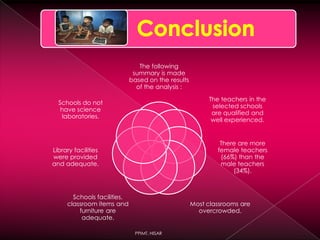
The following
summary is made
based on the results
of the analysis :
The teachers in the
selected schools
are qualified and
well experienced.
There are more
female teachers
(66%) than the
male teachers
(34%).
Most classrooms are
overcrowded.
Schools facilities,
classroom items and
furniture are
adequate.
Library facilities
were provided
and adequate.
Schools do not
have science
laboratories.
PPIMT, HISAR
 The present study has revealed that the current effort of the federal
and state government at revamping primary education has
objectively yielded good fruits.
 However much needs to be done in the area of provision of modern
Elementary Science laboratories and ICT facilities in the primary
schools across the country.
 Workshops and training should be provided to equip the teachers
on how to develop reliable and quality test items for teachers.
 Proper keeping of school Attendance Registers, Schools Diary and
other records are of paramount importance. Also schools inspection
should be more thorough.
 Decongest the overcrowded classrooms to a smaller class size.
 Construct modern classrooms equipped with basic amenities so that
there will be facilities for the new nine years in the primary schools (9-
3-5 system of education).
 There is also the need for the recruitment of more qualified teachers.
PPIMT, HISAR
Problems
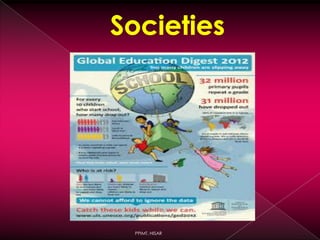
58% of Indian children do not complete primary education.
10 crore children in India are two or more years below their grade level.
The Annual Status of Education Report 2012 shows that among all rural children enrolled in standard five, only
50% can fluently read a standard two textbook and 40% cannot solve a simple two digit subtraction.
In 2000, the government launched the Sarva Shiksha Abhiyan with an aim to universalize elementary
education.
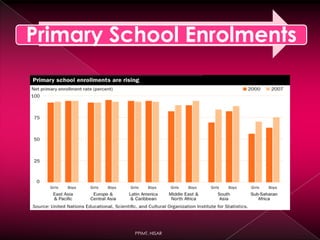
Since then, gross enrolment rates have risen dramatically.
In 2010, the government enacted the Right to Education Act which guarantees free and compulsory
education to every child between ages 6 to 14.
There is a need for innovative solutions to expand access to quality education so that every Indian child has
an equal start.
PPIMT, HISAR
PPIMT, HISAR
PPIMT, HISAR
Primary School Enrolments
PPIMT, HISAR
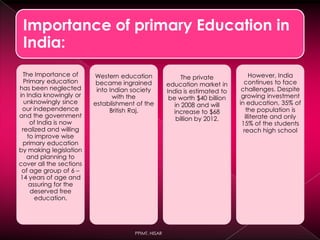
Importance of primary Education in
India:
The Importance of
Primary education
has been neglected
in India knowingly or
unknowingly since
our independence
and the government
of India is now
realized and willing
to improve wise
primary education
by making legislation
and planning to
cover all the sections
of age group of 6 –
14 years of age and
assuring for the
deserved free
education.
Western education
became ingrained
into Indian society
with the
establishment of the
British Raj.
The private
education market in
India is estimated to
be worth $40 billion
in 2008 and will
increase to $68
billion by 2012.
However, India
continues to face
challenges. Despite
growing investment
in education, 35% of
the population is
illiterate and only
15% of the students
reach high school
PPIMT, HISAR
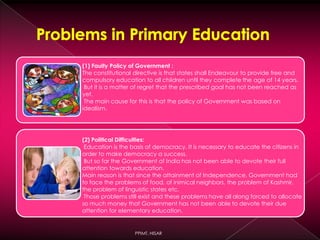
(1) Faulty Policy of Government :
The constitutional directive is that states shall Endeavour to provide free and
compulsory education to all children until they complete the age of 14 years.
But it is a matter of regret that the prescribed goal has not been reached as
yet.
The main cause for this is that the policy of Government was based on
idealism.
(2) Political Difficulties:
Education is the basis of democracy. It is necessary to educate the citizens in
order to make democracy a success.
But so far the Government of India has not been able to devote their full
attention towards education.
Main reason is that since the attainment of Independence, Government had
to face the problems of food, of inimical neighbors, the problem of Kashmir,
the problem of linguistic states etc.
Those problems still exist and these problems have all along forced to allocate
so much money that Government has not been able to devote their due
attention for elementary education.
PPIMT, HISAR
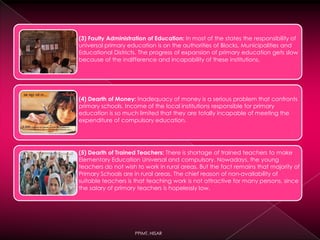
(3) Faulty Administration of Education: In most of the states the responsibility of
universal primary education is on the authorities of Blocks, Municipalities and
Educational Districts. The progress of expansion of primary education gets slow
because of the indifference and incapability of these institutions.
(4) Dearth of Money: Inadequacy of money is a serious problem that confronts
primary schools. Income of the local institutions responsible for primary
education is so much limited that they are totally incapable of meeting the
expenditure of compulsory education.
(5) Dearth of Trained Teachers: There is shortage of trained teachers to make
Elementary Education Universal and compulsory. Nowadays, the young
teachers do not wish to work in rural areas. But the fact remains that majority of
Primary Schools are in rural areas. The chief reason of non-availability of
suitable teachers is that teaching work is not attractive for many persons, since
the salary of primary teachers is hopelessly low.
PPIMT, HISAR
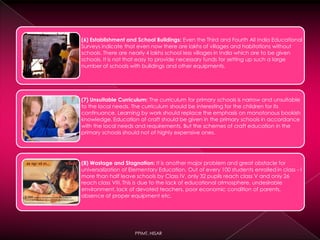
(6) Establishment and School Buildings: Even the Third and Fourth All India Educational
Surveys indicate that even now there are lakhs of villages and habitations without
schools. There are nearly 4 lakhs school less villages in India which are to be given
schools. It is not that easy to provide necessary funds for setting up such a large
number of schools with buildings and other equipments.
(7) Unsuitable Curriculum: The curriculum for primary schools is narrow and unsuitable
to the local needs. The curriculum should be interesting for the children for its
continuance. Learning by work should replace the emphasis on monotonous bookish
knowledge. Education of craft should be given in the primary schools in accordance
with the local needs and requirements. But the schemes of craft education in the
primary schools should not of highly expensive ones.
(8) Wastage and Stagnation: It is another major problem and great obstacle for
universalization of Elementary Education. Out of every 100 students enrolled in class - I
more than half leave schools by Class IV, only 32 pupils reach class V and only 26
reach class VIII. This is due to the lack of educational atmosphere, undesirable
environment, lack of devoted teachers, poor economic condition of parents,
absence of proper equipment etc.
PPIMT, HISAR
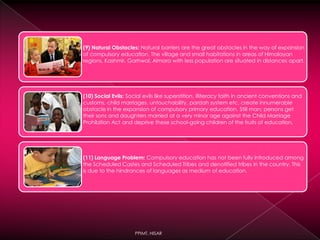
(9) Natural Obstacles: Natural barriers are the great obstacles in the way of expansion
of compulsory education. The village and small habitations in areas of Himalayan
regions, Kashmir, Garhwal, Almora with less population are situated in distances apart.
(10) Social Evils: Social evils like superstition, illiteracy faith in ancient conventions and
customs, child marriages, untouchability, pardah system etc. create innumerable
obstacle in the expansion of compulsory primary education. Still man; persons get
their sons and daughters married at a very minor age against the Child Marriage
Prohibition Act and deprive these school-going children of the fruits of education.
(11) Language Problem: Compulsory education has not been fully introduced among
the Scheduled Castes and Scheduled Tribes and denotified tribes in the country. This
is due to the hindrances of languages as medium of education.
PPIMT, HISAR
THANK YOU
PPIMT, HISAR

kapil07team

  • 1.
    Coordinator : KapilKumar(7404153427) Sub-cordinator : Priyanka Sharma(8683939864), Lalit Sharma(9802281061) Vishal Sardana(9802412371) Pooja Puniyani(8295144198) PPIMT, HISAR
  • 2.
    Quality assurance isa mechanism used to evaluate the efficiency and appropriateness of teaching and learning in primary schools so as to ensure the delivery of high quality education. It is also a holistic method of identifying and resolving problem within the educational system in order to ensure continuous quality improvement. It can also be described as means of disseminating information regarding the quality of primary education. PPIMT, HISAR
  • 3.
    The importance ofconsistence and continuous quality assurance in primary education are many. Some of these benefits associated with consistent quality assurance and continuous Quality improvement measure in education include: · the establishment of establish high standards academic excellence which will go long way to enhance the school's reputation and image, · improved communication across the school system, · Improvement of outcome so that the policies and procedures are constantly revisited through analysis and the delivery of teaching and learning, · identification of systems strengths and weaknesses PPIMT, HISAR
  • 4.
    The following summary ismade based on the results of the analysis : The teachers in the selected schools are qualified and well experienced. There are more female teachers (66%) than the male teachers (34%). Most classrooms are overcrowded. Schools facilities, classroom items and furniture are adequate. Library facilities were provided and adequate. Schools do not have science laboratories. PPIMT, HISAR
  • 5.
     The presentstudy has revealed that the current effort of the federal and state government at revamping primary education has objectively yielded good fruits.  However much needs to be done in the area of provision of modern Elementary Science laboratories and ICT facilities in the primary schools across the country.  Workshops and training should be provided to equip the teachers on how to develop reliable and quality test items for teachers.  Proper keeping of school Attendance Registers, Schools Diary and other records are of paramount importance. Also schools inspection should be more thorough.  Decongest the overcrowded classrooms to a smaller class size.  Construct modern classrooms equipped with basic amenities so that there will be facilities for the new nine years in the primary schools (9- 3-5 system of education).  There is also the need for the recruitment of more qualified teachers. PPIMT, HISAR
  • 6.
    Problems 58% of Indianchildren do not complete primary education. 10 crore children in India are two or more years below their grade level. The Annual Status of Education Report 2012 shows that among all rural children enrolled in standard five, only 50% can fluently read a standard two textbook and 40% cannot solve a simple two digit subtraction. In 2000, the government launched the Sarva Shiksha Abhiyan with an aim to universalize elementary education. Since then, gross enrolment rates have risen dramatically. In 2010, the government enacted the Right to Education Act which guarantees free and compulsory education to every child between ages 6 to 14. There is a need for innovative solutions to expand access to quality education so that every Indian child has an equal start. PPIMT, HISAR
  • 7.
  • 8.
  • 9.
  • 10.
    Importance of primaryEducation in India: The Importance of Primary education has been neglected in India knowingly or unknowingly since our independence and the government of India is now realized and willing to improve wise primary education by making legislation and planning to cover all the sections of age group of 6 – 14 years of age and assuring for the deserved free education. Western education became ingrained into Indian society with the establishment of the British Raj. The private education market in India is estimated to be worth $40 billion in 2008 and will increase to $68 billion by 2012. However, India continues to face challenges. Despite growing investment in education, 35% of the population is illiterate and only 15% of the students reach high school PPIMT, HISAR
  • 11.
    (1) Faulty Policyof Government : The constitutional directive is that states shall Endeavour to provide free and compulsory education to all children until they complete the age of 14 years. But it is a matter of regret that the prescribed goal has not been reached as yet. The main cause for this is that the policy of Government was based on idealism. (2) Political Difficulties: Education is the basis of democracy. It is necessary to educate the citizens in order to make democracy a success. But so far the Government of India has not been able to devote their full attention towards education. Main reason is that since the attainment of Independence, Government had to face the problems of food, of inimical neighbors, the problem of Kashmir, the problem of linguistic states etc. Those problems still exist and these problems have all along forced to allocate so much money that Government has not been able to devote their due attention for elementary education. PPIMT, HISAR
  • 12.
    (3) Faulty Administrationof Education: In most of the states the responsibility of universal primary education is on the authorities of Blocks, Municipalities and Educational Districts. The progress of expansion of primary education gets slow because of the indifference and incapability of these institutions. (4) Dearth of Money: Inadequacy of money is a serious problem that confronts primary schools. Income of the local institutions responsible for primary education is so much limited that they are totally incapable of meeting the expenditure of compulsory education. (5) Dearth of Trained Teachers: There is shortage of trained teachers to make Elementary Education Universal and compulsory. Nowadays, the young teachers do not wish to work in rural areas. But the fact remains that majority of Primary Schools are in rural areas. The chief reason of non-availability of suitable teachers is that teaching work is not attractive for many persons, since the salary of primary teachers is hopelessly low. PPIMT, HISAR
  • 13.
    (6) Establishment andSchool Buildings: Even the Third and Fourth All India Educational Surveys indicate that even now there are lakhs of villages and habitations without schools. There are nearly 4 lakhs school less villages in India which are to be given schools. It is not that easy to provide necessary funds for setting up such a large number of schools with buildings and other equipments. (7) Unsuitable Curriculum: The curriculum for primary schools is narrow and unsuitable to the local needs. The curriculum should be interesting for the children for its continuance. Learning by work should replace the emphasis on monotonous bookish knowledge. Education of craft should be given in the primary schools in accordance with the local needs and requirements. But the schemes of craft education in the primary schools should not of highly expensive ones. (8) Wastage and Stagnation: It is another major problem and great obstacle for universalization of Elementary Education. Out of every 100 students enrolled in class - I more than half leave schools by Class IV, only 32 pupils reach class V and only 26 reach class VIII. This is due to the lack of educational atmosphere, undesirable environment, lack of devoted teachers, poor economic condition of parents, absence of proper equipment etc. PPIMT, HISAR
  • 14.
    (9) Natural Obstacles:Natural barriers are the great obstacles in the way of expansion of compulsory education. The village and small habitations in areas of Himalayan regions, Kashmir, Garhwal, Almora with less population are situated in distances apart. (10) Social Evils: Social evils like superstition, illiteracy faith in ancient conventions and customs, child marriages, untouchability, pardah system etc. create innumerable obstacle in the expansion of compulsory primary education. Still man; persons get their sons and daughters married at a very minor age against the Child Marriage Prohibition Act and deprive these school-going children of the fruits of education. (11) Language Problem: Compulsory education has not been fully introduced among the Scheduled Castes and Scheduled Tribes and denotified tribes in the country. This is due to the hindrances of languages as medium of education. PPIMT, HISAR
  • 15.