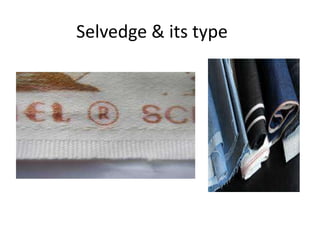
Selvedge & its type
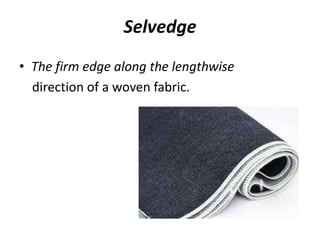
Selvedge
• The firm edge along the lengthwise
direction of a woven fabric.
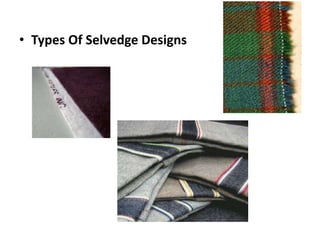
• Types Of Selvedge Designs
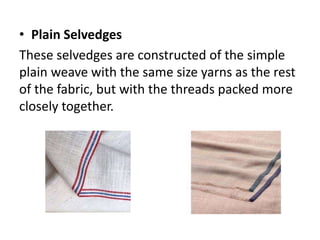
• Plain Selvedges
These selvedges are constructed of the simple
plain weave with the same size yarns as the rest
of the fabric, but with the threads packed more
closely together.
• Tape Selvedges
• The tape selvedges are sometimes
constructed with the plain weave but often
are made of the basket or twill weaves, which
makes a flatter edge.
• Tape selvedges are made of heavier yarns or
ply yarns, which provide greater strength.
• Split Selvedges
• These are made by weaving a narrow width
fabric twice its ordinary width with two
selvedges in the center.
• The fabric is then cut between the selvedges,
and the cut edges are finished with a chain
stitch or hemming.
• Split selvedges are used when items such as
towels are woven side by side and cut apart
after weaving
• Fused Selvedges
• These selvedges are made on fabrics of
thermoplastic fibers, such as
polypropylene, nylon, etc., by pressing a hot
mechanical element on the edges of the
fabric.
• The fibers melt and fuse together, sealing the
edges.
• Leno Selvedges
• The leno selvedges are obtained by binding
the wefts with strong additional threads
working in leno or gauze weave and by
eliminating through cutting the protruding
weft ends.
• Half cross leno weave fabrics have excellent
shear resistance. They are made with special
leno weaving harnesses. The leno selvedge is
used on some shuttle less looms.
Tucked-In Selvedges
The tucked selvedge is a technique used on some shuttle
less looms. A device is used to tuck and hold the cut ends
into the fabric edge.
In tucked-in selvedge, the fringed edges of the weft yarns
are woven back into the body of the fabric using a special
tuck-in mechanism. As a result, the weft density is doubled
in the selvedge area.
The tucked-in selvedge was being only used for projectile
weaving machines in the past; however, it is now also
applied to other shuttle less weaving machines.

Salvage & its type.pptx

  • 1.
  • 2.
    Selvedge • The firmedge along the lengthwise direction of a woven fabric.
  • 3.
    • Types OfSelvedge Designs
  • 4.
    • Plain Selvedges Theseselvedges are constructed of the simple plain weave with the same size yarns as the rest of the fabric, but with the threads packed more closely together.
  • 5.
    • Tape Selvedges •The tape selvedges are sometimes constructed with the plain weave but often are made of the basket or twill weaves, which makes a flatter edge. • Tape selvedges are made of heavier yarns or ply yarns, which provide greater strength.
  • 7.
    • Split Selvedges •These are made by weaving a narrow width fabric twice its ordinary width with two selvedges in the center. • The fabric is then cut between the selvedges, and the cut edges are finished with a chain stitch or hemming. • Split selvedges are used when items such as towels are woven side by side and cut apart after weaving
  • 9.
    • Fused Selvedges •These selvedges are made on fabrics of thermoplastic fibers, such as polypropylene, nylon, etc., by pressing a hot mechanical element on the edges of the fabric. • The fibers melt and fuse together, sealing the edges.
  • 10.
    • Leno Selvedges •The leno selvedges are obtained by binding the wefts with strong additional threads working in leno or gauze weave and by eliminating through cutting the protruding weft ends. • Half cross leno weave fabrics have excellent shear resistance. They are made with special leno weaving harnesses. The leno selvedge is used on some shuttle less looms.
  • 12.
    Tucked-In Selvedges The tuckedselvedge is a technique used on some shuttle less looms. A device is used to tuck and hold the cut ends into the fabric edge. In tucked-in selvedge, the fringed edges of the weft yarns are woven back into the body of the fabric using a special tuck-in mechanism. As a result, the weft density is doubled in the selvedge area. The tucked-in selvedge was being only used for projectile weaving machines in the past; however, it is now also applied to other shuttle less weaving machines.