Mark.H.V.Corps
IFI Angling Advisor

Marine & Countryside Guiding
       FETAC Level 6
Wild salmon management
        in Ireland
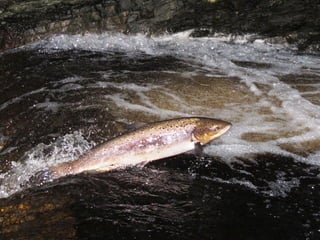
• Irish wild salmon are part of the national
  identity

• Traditionally Ireland has been one of the
  largest producers of salmon in the North
  Atlantic

• Ireland traditionally operated a commercial
  offshore fishery, estuarine draft net fishery &
  river angling
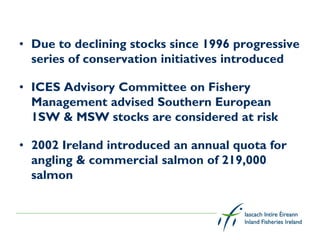
• Due to declining stocks since 1996 progressive
  series of conservation initiatives introduced

• ICES Advisory Committee on Fishery
  Management advised Southern European
  1SW & MSW stocks are considered at risk

• 2002 Ireland introduced an annual quota for
  angling & commercial salmon of 219,000
  salmon
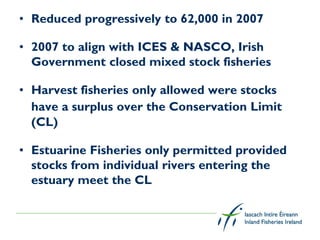
• Reduced progressively to 62,000 in 2007

• 2007 to align with ICES & NASCO, Irish
  Government closed mixed stock fisheries

• Harvest fisheries only allowed were stocks
  have a surplus over the Conservation Limit
  (CL)

• Estuarine Fisheries only permitted provided
  stocks from individual rivers entering the
  estuary meet the CL
Conservation Limit (CL)
•   For a river is the number of spawning
    salmon required to produce the next
    generation
•   Developed using a range of scientific indices
    including
1. analysis of salmon fry (juvenile abundance index)
   through catchment wide electro fishing undertaken
   on selected rivers
2. rod catch
3. smolt count
4. redd count index &
5. fish counter data
Example – R. Barrow juvenile salmon
  stock assessment
• A catchment wide electro fishing survey
  (CWEF) of juvenile salmon abundance was
  undertaken during 2011 (4th yr of the survey)

• 79 sites were included. In 2011the mean catch
  was 24.75 salmon fry (a high abundance level),
  an increase on previous years. Mean catch
  over the four yrs was 15.35 fry
• An average of 15.35 fry over 4 yrs is below the
  threshold level of 17 salmon fry. The Barrow
  remains closed for 2012 but the survey will
  again take place in 2012

• Catchments where the average threshold
  level of 17 fry is exceeded have been opened
  for C&R angling
• 2007 a hardship scheme for drift net
  fishermen was introduced providing a
  financial package for affected fishermen

• 2008 allowable harvest increased to 86,000
  salmon including both commercial & angling
  harvest - distributed on an individual river
  basis

• Salmon are now managed on an individual
  river basis
• Rivers with identifiable surplus above the CL
  are open for salmon / sea trout fishing

• Rivers meeting in excess of 65% of the CL are
  granted ‘C&R’ status

• Rivers with insufficient scientific information /
  rod catch of <10 salmon closed

• Goal to encourage recovery of stocks in rivers
  not meeting CL & manage rivers in
  compliance with the Habitats Directive
• With decreasing marine survival challenge is
  to improve stocks in rivers through habitat
  improvements & other initiatives
Wild Salmon & Sea Trout
  Tagging Scheme
• Aim to provide a means of collecting accurate
  catch statistics & estimates of salmon /sea
  trout stock exploitation

• Develop management strategies & ensure
  species are exploited in a manner consistent
  with long-term sustainability on a national,
  regional, fishery district & river basis
• Scheme commenced for both commercial &
  recreational salmon fishing licence holders 1st
  Jan ’01

• Followed by introduction of Total Allowable
  Catches (TAC) for the commercial salmon
  fishing sector & bag limits for recreational
  anglers in 2002

• Since 2007, following consultation with IFI &
  the Standing Scientific Committee, Minister
  sets the TAC on an annual basis for each river
  exceeding the CL
Management of the Wild Salmon
  Fishery in 2012
• Salmon Standing Scientific Committee of IFI
  assessed 141 rivers

• 43 rivers are open (surplus fish identified over
  & above the CL in these rivers) - 7 less than in
  2011

• 34 open rivers on a ‘C&R’ basis - 6 more than
  in 2011

• 64 closed rivers - 63 in 2011
Recreational Angling
• Annual bag limit of 10 fish per angler of
  salmon or sea trout (> 40cm)

• 1 salmon or sea trout (> 40cm) per day until
  May 11th with a max of 3 fish for this period

• 3 salmon or sea trout (> 40cm) per day from
  May 12th until end of August

• 1 salmon or sea trout (> 40cm) per day 1st
  September to the end of the season
• After the daily bag limit has been caught
  anglers are permitted to fish C&R, using
  single barbless hooks (no worms)
Questions?
Some questions from me!
1. What is a Conservation limit?
2. How is it drawn up?
3. What % of the CL does a river have to
   achieve to be C&R?
4. Annual bag limit for salmon is?
5. If you have caught your daily bag limit
   – how should you fish on?

Salmon stocks protection

  • 1.
    Mark.H.V.Corps IFI Angling Advisor Marine& Countryside Guiding FETAC Level 6
  • 2.
  • 4.
    • Irish wildsalmon are part of the national identity • Traditionally Ireland has been one of the largest producers of salmon in the North Atlantic • Ireland traditionally operated a commercial offshore fishery, estuarine draft net fishery & river angling
  • 7.
    • Due todeclining stocks since 1996 progressive series of conservation initiatives introduced • ICES Advisory Committee on Fishery Management advised Southern European 1SW & MSW stocks are considered at risk • 2002 Ireland introduced an annual quota for angling & commercial salmon of 219,000 salmon
  • 8.
    • Reduced progressivelyto 62,000 in 2007 • 2007 to align with ICES & NASCO, Irish Government closed mixed stock fisheries • Harvest fisheries only allowed were stocks have a surplus over the Conservation Limit (CL) • Estuarine Fisheries only permitted provided stocks from individual rivers entering the estuary meet the CL
  • 10.
    Conservation Limit (CL) • For a river is the number of spawning salmon required to produce the next generation • Developed using a range of scientific indices including 1. analysis of salmon fry (juvenile abundance index) through catchment wide electro fishing undertaken on selected rivers 2. rod catch 3. smolt count 4. redd count index & 5. fish counter data
  • 11.
    Example – R.Barrow juvenile salmon stock assessment • A catchment wide electro fishing survey (CWEF) of juvenile salmon abundance was undertaken during 2011 (4th yr of the survey) • 79 sites were included. In 2011the mean catch was 24.75 salmon fry (a high abundance level), an increase on previous years. Mean catch over the four yrs was 15.35 fry
  • 12.
    • An averageof 15.35 fry over 4 yrs is below the threshold level of 17 salmon fry. The Barrow remains closed for 2012 but the survey will again take place in 2012 • Catchments where the average threshold level of 17 fry is exceeded have been opened for C&R angling
  • 13.
    • 2007 ahardship scheme for drift net fishermen was introduced providing a financial package for affected fishermen • 2008 allowable harvest increased to 86,000 salmon including both commercial & angling harvest - distributed on an individual river basis • Salmon are now managed on an individual river basis
  • 14.
    • Rivers withidentifiable surplus above the CL are open for salmon / sea trout fishing • Rivers meeting in excess of 65% of the CL are granted ‘C&R’ status • Rivers with insufficient scientific information / rod catch of <10 salmon closed • Goal to encourage recovery of stocks in rivers not meeting CL & manage rivers in compliance with the Habitats Directive
  • 15.
    • With decreasingmarine survival challenge is to improve stocks in rivers through habitat improvements & other initiatives
  • 18.
    Wild Salmon &Sea Trout Tagging Scheme • Aim to provide a means of collecting accurate catch statistics & estimates of salmon /sea trout stock exploitation • Develop management strategies & ensure species are exploited in a manner consistent with long-term sustainability on a national, regional, fishery district & river basis
  • 19.
    • Scheme commencedfor both commercial & recreational salmon fishing licence holders 1st Jan ’01 • Followed by introduction of Total Allowable Catches (TAC) for the commercial salmon fishing sector & bag limits for recreational anglers in 2002 • Since 2007, following consultation with IFI & the Standing Scientific Committee, Minister sets the TAC on an annual basis for each river exceeding the CL
  • 20.
    Management of theWild Salmon Fishery in 2012 • Salmon Standing Scientific Committee of IFI assessed 141 rivers • 43 rivers are open (surplus fish identified over & above the CL in these rivers) - 7 less than in 2011 • 34 open rivers on a ‘C&R’ basis - 6 more than in 2011 • 64 closed rivers - 63 in 2011
  • 22.
    Recreational Angling • Annualbag limit of 10 fish per angler of salmon or sea trout (> 40cm) • 1 salmon or sea trout (> 40cm) per day until May 11th with a max of 3 fish for this period • 3 salmon or sea trout (> 40cm) per day from May 12th until end of August • 1 salmon or sea trout (> 40cm) per day 1st September to the end of the season
  • 23.
    • After thedaily bag limit has been caught anglers are permitted to fish C&R, using single barbless hooks (no worms)
  • 24.
  • 25.
    Some questions fromme! 1. What is a Conservation limit? 2. How is it drawn up? 3. What % of the CL does a river have to achieve to be C&R? 4. Annual bag limit for salmon is? 5. If you have caught your daily bag limit – how should you fish on?