Mark.H.V.Corps
 IFI Angling Advisor

Marine & Countryside Guiding
       FETAC Level 6
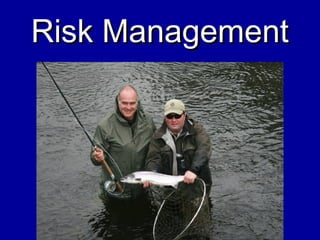
Risk Management
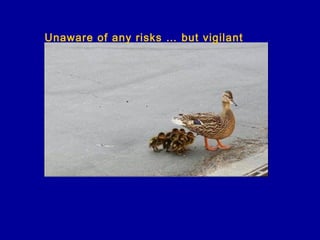
Unaware of any risks … but vigilant
This isn't dangerous I’ve crossed it many times…
What the duck!!


                  Bugger!
I can't take the risk!
• You can & do (every day), we all take risks,
  walking down stairs, crossing roads, driving,
  cooking

• We manage risks by using our judgment,
  experience & following guidance where
  necessary

• A risk assessment (RA) is simply a record that
  people have considered the risks & prepared for
  them
Keeping it in perspective
• Living is dangerous - there is risk even when
 asleep, but from the moment we wake the risk
 increases

• In Britain every year, 20 people are electrocuted
 by bedside lights /alarm clocks; 20 killed falling
 whilst getting out of bed; 30 drown in the bath;
 60 are seriously injured putting on socks; 600
 die from falling down stairs

• To make the world safe we have to remove
 baths, socks & stairs. Zero risk is not a
 meaningful option, because zero in this case
 can only be obtained by not doing anything at
 all.
Managing Risk
‘I’ve been doing this for        Sensibly             ‘It’s not worth the risk’
twenty years without a
hitch’                      Reasonably Practicable     ‘Where do you stop?’

‘Someone else should             Foreseeable                ‘You have to risk
do this’                                                  assess everything’
                            Suitable and Sufficient
                             Focus on Significant
                                  Hazards
                                 ‘Duty of Care’
Apathy                                                               Paranoia
                                Not ‘Life’ Risks
                                    Simple
                                   Efficient
                                Cost Effective
                                Good Practice
No consideration                                                      Overkill
                            ‘We’ve done the best we
                                Common Sense
                                     can’
                            ‘We can always review
                              and improve this’
Active risk management
• Involve clients & staff

• Managing rather than eliminating risks

• Guides / coaches with appropriate training &
  experience should feel confident in using their
  judgement

• Flexibility in format
Sensible risk management IS about
• Ensuring clients, workers & ‘others’ are
  properly protected

• Providing overall benefit by balancing benefits
  & risks, with a focus on controlling real risks -
  either those which arise most often or those
  with the most serious consequences

• Enabling innovation & learning not stifling them
• Ensuring that those who create risks manage
  them responsibly & understand that failure to
  manage serious risks responsibly is likely to
  lead to robust action

• Enabling individuals to understand that as well
  as the right to protection, they also have to
  exercise responsibility


                                    HSE June 2006
It IS NOT about

• Creating a totally risk free society

• Generating useless paperwork

• Scaring people by exaggerating / publicising
  trivial risks

• Stopping recreational or learning activities for
  individuals where the risks are managed


                                    HSE June 2006
What is Risk Assessment?
A RA should usually involve identifying the
hazards present in any undertaking (whether
arising from work activities or from other
factors, e.g. the layout of the premises) &
then evaluating the extent of the risks
involved, taking into account whatever
precautions are already been taken’
What is RA?
• A RA is nothing more than a careful
  examination of what in the workplace could
  cause harm

• It is a formal exercise required by law, where
  the employer has to identify the risks to
  employees & others associated with their
  business activities

• It is about identifying what might go wrong,
  prioritising the possibilities & implementing
  control measures to prevent them from
  occurring
Risk Assessment
• Suitable & sufficient

• Identify significant risks arising out of work
  activities

• Enable identification & prioritisation of the
  measures needed to comply with H & S
  legislation

• Be appropriate to the work activities

• Remain valid for a reasonable time period
Stages involved in RA

• Identification of hazards

• Identification of people at risk

• Evaluation of the risk

• Selection of additional control measures

• Information & training

• Record

• Monitoring & review
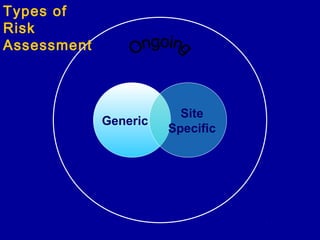
Types of
Risk
Assessment


                         Site
             Generic
                       Specific
Definition of an Accident (ROSPA)

‘ an unplanned & uncontrolled event, which has
led to, or could have caused injury to persons,
damage to plant or other loss’
Distinction between ‘accident’ &
‘injury’
A major difficulty in accident prevention is that
‘accident’ and ‘injury’ has come to mean one & the
same thing. It is important to distinguish the two –
an injury is the result of an accident

 Many accidents occur which have the potential to
cause injury but do not
Definition of Hazard
a hazard is something with an
inherent potential to cause harm
Please list 10 angling
       hazards
     (3 minutes)
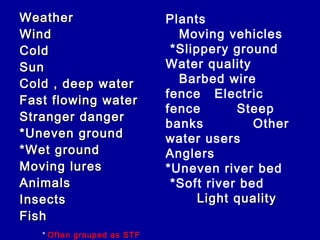
Weather                     Plants
Wind                          Moving vehicles
Cold                         *Slippery ground
Sun                         Water quality
Cold , deep water             Barbed wire
                            fence Electric
Fast flowing water
                            fence       Steep
Stranger danger
                            banks          Other
*Uneven ground              water users
*Wet ground                 Anglers
Moving lures                *Uneven river bed
Animals                      *Soft river bed
Insects                           Light quality
Fish
   * Often grouped as STF
Definition of Risk
is the likelihood or probability that
a hazard will cause actual harm
Control Measures
are the arrangements made or
precautions taken to reduce risk
Risk assessment must be
• Simple

• Manageable

• Proportional

• Suitable

• RA is a process, what you do is more important

You should have a clear system of support documents
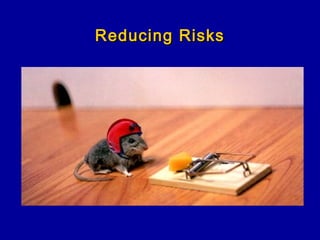
Reducing Risks
Reducing Risks
• Employ / use experienced & competent
  Guides


• Substitute actual high risk for perceived risk

• Use alternative method(s)

• Separate people from the risk

• Reduce the period of exposure to the risk
• Increase training & qualification of guides

• Apply stricter supervision ratios

• Improve your briefings

• Provide PPE

• Discontinue the activity
Top Tips
•   Think of RA’s as the minutes of a meeting
    where issues regarding safety were raised &
    discussed


•   It is the discussion & sharing of ideas,
    experience & knowledge which will enhance
    safety & reduce risk – not the piece of paper


•   Keep it proportional


•   Include yourself in ‘who might be harmed’
•   Use Generic RA’s carefully- it may be best
    to write your specific RA from scratch, then
    use the generic to check if you’ve left
    anything major out


•   Don’t let your RA’s become static – review
    them regularly or ‘as required’


•   Use other peoples’ accidents as a ‘near
    miss’ for your client / groups & revisit your
    RA’s – anything to change or add?
•   There is no ‘right way’ to do RA’s. A dozen
    different RA’s could be done for one activity &
    they could all be equally valid


•   Most accidents occur on activities considered
    to be the lowest risk


•   It’s not what you write which drives safety, it’s
    what you do. Merely writing a RA will not
    protect people from harm. It is the operating
    procedure that comes out of RA that is
    important.
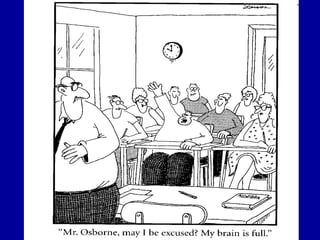
Make sure they understand you!
RA in practice
• Prior to commencing thorough preparation is
  necessary

• Brief all personnel involved

• Ensuring risk assessors are competent
Priorities in Prevention
• Avoid a risk altogether

• Combat risks at source

• Adapt work to the individual

• Give priority to those measures which protect
  the whole workplace

• Ensure everyone involved knows what they are
  expected to do

• An active Health & Safety culture
Record RA

• Practical

• Use own format

• Sub group exercise at suitable location

• Share results
Questions?
Risk Management

Risk Management

  • 1.
    Mark.H.V.Corps IFI AnglingAdvisor Marine & Countryside Guiding FETAC Level 6
  • 2.
  • 3.
    Unaware of anyrisks … but vigilant
  • 4.
    This isn't dangerousI’ve crossed it many times…
  • 5.
  • 7.
    I can't takethe risk! • You can & do (every day), we all take risks, walking down stairs, crossing roads, driving, cooking • We manage risks by using our judgment, experience & following guidance where necessary • A risk assessment (RA) is simply a record that people have considered the risks & prepared for them
  • 8.
    Keeping it inperspective • Living is dangerous - there is risk even when asleep, but from the moment we wake the risk increases • In Britain every year, 20 people are electrocuted by bedside lights /alarm clocks; 20 killed falling whilst getting out of bed; 30 drown in the bath; 60 are seriously injured putting on socks; 600 die from falling down stairs • To make the world safe we have to remove baths, socks & stairs. Zero risk is not a meaningful option, because zero in this case can only be obtained by not doing anything at all.
  • 10.
    Managing Risk ‘I’ve beendoing this for Sensibly ‘It’s not worth the risk’ twenty years without a hitch’ Reasonably Practicable ‘Where do you stop?’ ‘Someone else should Foreseeable ‘You have to risk do this’ assess everything’ Suitable and Sufficient Focus on Significant Hazards ‘Duty of Care’ Apathy Paranoia Not ‘Life’ Risks Simple Efficient Cost Effective Good Practice No consideration Overkill ‘We’ve done the best we Common Sense can’ ‘We can always review and improve this’
  • 11.
    Active risk management •Involve clients & staff • Managing rather than eliminating risks • Guides / coaches with appropriate training & experience should feel confident in using their judgement • Flexibility in format
  • 13.
    Sensible risk managementIS about • Ensuring clients, workers & ‘others’ are properly protected • Providing overall benefit by balancing benefits & risks, with a focus on controlling real risks - either those which arise most often or those with the most serious consequences • Enabling innovation & learning not stifling them
  • 14.
    • Ensuring thatthose who create risks manage them responsibly & understand that failure to manage serious risks responsibly is likely to lead to robust action • Enabling individuals to understand that as well as the right to protection, they also have to exercise responsibility HSE June 2006
  • 15.
    It IS NOTabout • Creating a totally risk free society • Generating useless paperwork • Scaring people by exaggerating / publicising trivial risks • Stopping recreational or learning activities for individuals where the risks are managed HSE June 2006
  • 16.
    What is RiskAssessment? A RA should usually involve identifying the hazards present in any undertaking (whether arising from work activities or from other factors, e.g. the layout of the premises) & then evaluating the extent of the risks involved, taking into account whatever precautions are already been taken’
  • 17.
    What is RA? •A RA is nothing more than a careful examination of what in the workplace could cause harm • It is a formal exercise required by law, where the employer has to identify the risks to employees & others associated with their business activities • It is about identifying what might go wrong, prioritising the possibilities & implementing control measures to prevent them from occurring
  • 18.
    Risk Assessment • Suitable& sufficient • Identify significant risks arising out of work activities • Enable identification & prioritisation of the measures needed to comply with H & S legislation • Be appropriate to the work activities • Remain valid for a reasonable time period
  • 19.
    Stages involved inRA • Identification of hazards • Identification of people at risk • Evaluation of the risk • Selection of additional control measures • Information & training • Record • Monitoring & review
  • 20.
    Types of Risk Assessment Site Generic Specific
  • 21.
    Definition of anAccident (ROSPA) ‘ an unplanned & uncontrolled event, which has led to, or could have caused injury to persons, damage to plant or other loss’
  • 22.
    Distinction between ‘accident’& ‘injury’ A major difficulty in accident prevention is that ‘accident’ and ‘injury’ has come to mean one & the same thing. It is important to distinguish the two – an injury is the result of an accident Many accidents occur which have the potential to cause injury but do not
  • 23.
    Definition of Hazard ahazard is something with an inherent potential to cause harm
  • 24.
    Please list 10angling hazards (3 minutes)
  • 25.
    Weather Plants Wind Moving vehicles Cold *Slippery ground Sun Water quality Cold , deep water Barbed wire fence Electric Fast flowing water fence Steep Stranger danger banks Other *Uneven ground water users *Wet ground Anglers Moving lures *Uneven river bed Animals *Soft river bed Insects Light quality Fish * Often grouped as STF
  • 26.
    Definition of Risk isthe likelihood or probability that a hazard will cause actual harm
  • 27.
    Control Measures are thearrangements made or precautions taken to reduce risk
  • 29.
    Risk assessment mustbe • Simple • Manageable • Proportional • Suitable • RA is a process, what you do is more important You should have a clear system of support documents
  • 30.
  • 31.
    Reducing Risks • Employ/ use experienced & competent Guides • Substitute actual high risk for perceived risk • Use alternative method(s) • Separate people from the risk • Reduce the period of exposure to the risk
  • 32.
    • Increase training& qualification of guides • Apply stricter supervision ratios • Improve your briefings • Provide PPE • Discontinue the activity
  • 34.
    Top Tips • Think of RA’s as the minutes of a meeting where issues regarding safety were raised & discussed • It is the discussion & sharing of ideas, experience & knowledge which will enhance safety & reduce risk – not the piece of paper • Keep it proportional • Include yourself in ‘who might be harmed’
  • 35.
    Use Generic RA’s carefully- it may be best to write your specific RA from scratch, then use the generic to check if you’ve left anything major out • Don’t let your RA’s become static – review them regularly or ‘as required’ • Use other peoples’ accidents as a ‘near miss’ for your client / groups & revisit your RA’s – anything to change or add?
  • 36.
    There is no ‘right way’ to do RA’s. A dozen different RA’s could be done for one activity & they could all be equally valid • Most accidents occur on activities considered to be the lowest risk • It’s not what you write which drives safety, it’s what you do. Merely writing a RA will not protect people from harm. It is the operating procedure that comes out of RA that is important.
  • 37.
    Make sure theyunderstand you!
  • 39.
    RA in practice •Prior to commencing thorough preparation is necessary • Brief all personnel involved • Ensuring risk assessors are competent
  • 40.
    Priorities in Prevention •Avoid a risk altogether • Combat risks at source • Adapt work to the individual • Give priority to those measures which protect the whole workplace • Ensure everyone involved knows what they are expected to do • An active Health & Safety culture
  • 41.
    Record RA • Practical •Use own format • Sub group exercise at suitable location • Share results
  • 42.

Editor's Notes

  • #2 Importance of water to humans.