The Sales Tax Act, 1990

                   (Sales Tax Act, 1990, as on Oct, 28, 2009)
(The amendments through the Finance Act, 2009, have been shown in Red)
                                     And
(The amendments through the Finance (Amendment) Ordinance, 2009, have
been shown in Green)


           The Sales Tax Act, 1990
      (Act No. III of 1951 as Amended by Act
                    VII of 1990)


   ............................................................................................................................................
 Updated vide Finance Act, 2009 and Finance (Amendment) Ordinance, 2009.
                                                                        By

                                                          Hamid Hussain,
                                                           Joint Director,
                                                     Sales Tax & Federal Wing,
                                                      Federal Board Revenue,
                                                             Islamabad.


                                                                                                                                           1
The Sales Tax Act, 1990

Contents
Chapter I ...................................................................................................... 6
PRELIMINARY ................................................................................................ 6
1. Short title, extent and commencement. ................................................................ 6
2. Definitions...............................................................................................………….6
Chapter-II .................................................................................................. 17
SCOPE AND PAYMENT OF TAX ................................................. 17
3. Scope of tax.— ........................................................................................................17
3A. Omitted..................................................................................................................18
3AA. Omitted ..............................................................................................................18
3AAA. Omitted ...........................................................................................................18
3B. Collection of excess sales tax etc.― ...................................................................18
4. Zero rating.— ..........................................................................................................18
5. Change in the rate of tax.— ..................................................................................19
6. Time and manner of payment.― ..........................................................................20
7. Determination of tax liability.― ............................................................................20
7A. Levy and collection of tax on specified goods on value addition......                                                     21
8. Tax credit not allowed.— ......................................................................................22
8A. Joint and several liability of registered persons in supply chain where tax unpaid.– .....22
8B. Adjustable input tax..............................................................................................23
9. Debit and credit note.— ........................................................................................23
(10). Refund of input tax. .............................................................................................24
11. Assessment of Tax.― ...........................................................................................24
11A. Short paid amounts recoverable without notice.– ........................................25
12. Omitted...................................................................................................................26
13. Exemption.― .........................................................................................................26
Chapter-III ................................................................................................ 27
REGISTRATION ..................................................................................... 27
14. Registration. –........................................................................................................27
15. Omitted...................................................................................................................27
16. Omitted...................................................................................................................27
17. Omitted...................................................................................................................27
18. Omitted...................................................................................................................27
19. Omitted...................................................................................................................27
20. Omitted...................................................................................................................27
21. De-registration, blacklisting and suspension of registration.—.....................27
Chapter-IV................................................................................................. 28
BOOK KEEPING AND INVOICING REQUIREMENTS ......... 28
22. Records.–................................................................................................................28
23. Tax Invoices.- ........................................................................................................29
24. Retention of record and documents for five years.-........................................29
25. Access to record, documents, etc.-.....................................................................30
25A. Drawing of samples.-.........................................................................................31

                                                                                                                              2
The Sales Tax Act, 1990

Chapter-V................................................................................................... 32
RETURNS ................................................................................................ 32
26. (****) Return.– ......................................................................................................32
26A. Omitted ...............................................................................................................33
27. Special Returns.-- ..................................................................................................33
28. Final Return.-.........................................................................................................33
29. Return deemed to have been made.- .................................................................33
Chapter-VI................................................................................................. 34
APPOINTMENT OF OFFICER OF SALES TAX & THEIR POWERS.............. 34
30. Appointment of officer.— ..................................................................................34
30A. Directorate General, (Intelligence and Investigation) FBR.........................34
30B. Directorate General Internal Audit. ................................................................34
30C. Directorate General of Training and Research. ............................................34
30D. Directorate General of Valuation. ..................................................................35
30DD. Directorate of Post Clearance Audit. ............................................................35
30E. Powers and Functions of Directorate etc. .....................................................35
31. Powers.--.................................................................................................................35
32. Delegation of powers.-- .......................................................................................35
32A. Special Audit by Chartered Accountants or Cost Accountants– ...............36
32AA. Omitted. ...........................................................................................................36
Chapter-VII ............................................................................................... 37
OFFENCES AND PENALTIES....................................................................... 37
33. Offences and penalties.—....................................................................................37
Offences........................................................................................................................37
Penalties ........................................................................................................................37
34. Default Surcharge.– ..............................................................................................44
34A. Exemption from penalty and default surcharge.-- ....................................44
35. Omitted...................................................................................................................45
35A. Omitted. ..............................................................................................................45
36. Recovery of tax not levied or short-levied or erroneously refunded............45
37. Power to summon persons to give evidence and produce documents in
    inquiries under the Act.--......................................................................................46
37A. Power to arrest and prosecute.--......................................................................46
37B. Procedure to be followed on arrest of a person.--........................................46
37C. Omitted................................................................................................................48
38. Authorised officers to have access to premises, stocks, accounts and
    records.-- .................................................................................................................48
38A. Power to call for information.—.....................................................................49
38B. Obligation to produce documents and provide information .....................49
39. Omitted...................................................................................................................50
40. Searches under warrant-.......................................................................................50
40A. Omitted. ..............................................................................................................50
40B. Posting of Sales Tax Officer.--.........................................................................50
41. Omitted...................................................................................................................51

                                                                                                                                  3
The Sales Tax Act, 1990

42. Omitted....................................................................................................................51
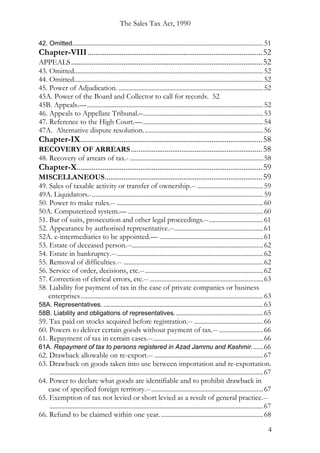
Chapter-VIII ............................................................................................. 52
APPEALS ...................................................................................................... 52
43. Omitted...................................................................................................................52
44. Omitted...................................................................................................................52
45. Power of Adjudication. ........................................................................................52
45A. Power of the Board and Collector to call for records. 52
45B. Appeals.—...........................................................................................................52
46. Appeals to Appellate Tribunal.–.........................................................................53
47. Reference to the High Court.— .........................................................................54
47A. Alternative dispute resolution.........................................................................56
Chapter-IX................................................................................................. 58
RECOVERY OF ARREARS ...................................................................... 58
48. Recovery of arrears of tax.- .................................................................................58
Chapter-X................................................................................................... 59
MISCELLANEOUS .................................................................................... 59
49. Sales of taxable activity or transfer of ownership.-- ........................................59
49A. Liquidators.-........................................................................................................59
50. Power to make rules.-- .........................................................................................60
50A. Computerized system.— ..................................................................................60
51. Bar of suits, prosecution and other legal proceedings.--.................................61
52. Appearance by authorised representative.--......................................................61
52A. e-intermediaries to be appointed.— ...............................................................61
53. Estate of deceased person.--................................................................................62
54. Estate in bankruptcy.-- .........................................................................................62
55. Removal of difficulties.-- .....................................................................................62
56. Service of order, decisions, etc.--........................................................................62
57. Correction of clerical errors, etc.-- .....................................................................63
58. Liability for payment of tax in the case of private companies or business
    enterprises...............................................................................................................63
58A. Representatives. .................................................................................................63
58B. Liability and obligations of representatives. .....................................................65
59. Tax paid on stocks acquired before registration.-- ..........................................66
60. Powers to deliver certain goods without payment of tax.-- ...........................66
61. Repayment of tax in certain cases.--...................................................................66
61A. Repayment of tax to persons registered in Azad Jammu and Kashmir. ......66
62. Drawback allowable on re-export.-- ..................................................................67
63. Drawback on goods taken into use between importation and re-exportation.
    ..................................................................................................................................67
64. Power to declare what goods are identifiable and to prohibit drawback in
    case of specified foreign territory.--....................................................................67
65. Exemption of tax not levied or short levied as a result of general practice.--
    ..................................................................................................................................67
66. Refund to be claimed within one year. ..............................................................68

                                                                                                                                      4
The Sales Tax Act, 1990

67. Delayed Refund.-- .................................................................................................68
68. Liability of the registered person for the acts of his agent.-...........................68
69. Issuance of duplicate of sales tax documents. ..................................................68
70. Computation of limitation period. .........................................................................69
71. Special procedure. .................................................................................................69
72. Officers of Inland Revenue to follow Board's orders, etc..............................69
73. Certain transactions not admissible....................................................................69
74. Condonation of time-limit...................................................................................70
75. Application of the provisions of Act IV of 1969 to Sales Tax. .....................70
SCHEDULES........................................................................................... 70
THE FIRST SCHEDULE ........................................................................................71
THE SECOND SCHEDULE..................................................................................71
THE THIRD SCHEDULE ......................................................................................71
THE FOURTH SCHEDULE..................................................................................72
THE FIFTH SCHEDULE .......................................................................................72
THE SIXTH SCHEDULE .......................................................................................74
THE SEVENTH SCHEDULE ...............................................................................84


                                                                                                                        5
The Sales Tax Act, 1990


                   The Sales Tax Act, 1990.
(Act No. III of 1951 as Amended by Act VII of 1990)


                                              Chapter I
                                           PRELIMINARY

1.Short title, extent and commencement.

(1) This Act may be called the Sales Tax Act, 1990.
(2) It extends to the whole of Pakistan.
(3) It shall come into force on such date as the Federal Government may, by
notification in the official Gazette, appoint.

2. Definitions.―

In this Act, unless there is anything repugnant in the subject or context,--
1
 (1) Appellate Tribunal” means the Appellate Tribunal Inland Revenue
established under section 130 of the Income Tax Ordinance 2001 (XLIX of
2001)’’
(2) ‘appropriate officer’ means an officer of Inland Revenue authorised by the
Board by notification in the official Gazette to perform certain functions under this
Act;


(2A) “arrears”, in relation to a person, means, on any day, the sales tax due and
payable by the person under this Act before that day but which has not yet been
paid,

(3) “associates (associated persons)” means, –

           (i)     subject to sub-clause (ii), where two persons associate and the
                   relationship between the two is such that one may reasonably be
                   expected to act in accordance with the intentions of the other, or
                   both persons may reasonably be expected to act in accordance
                   with the intentions of a third person;

           (ii)    two persons shall not be associates solely by reason of the fact that
                   one person is an employee of the other or both persons are
                   employees of a third person;
           (iii)   without limiting the generality of sub-clause (i) and subject to sub-
                   clause (iv), the following shall be treated as associates, namely: –

1
    Substituted vide Finance (Amended) Ordinance, 2009.
                                                                                      6
The Sales Tax Act, 1990


                   (a)     an individual and a relative of the individual;
                   (b)     members of an association of persons;
                   (c)     a member of an association of persons and the association,
                           where the member, either alone or together with an
                           associate or associates under another application of this
                           section, controls fifty per cent or more of the rights to income
                           or capital of the association;
                   (d)     a trust and any person who benefits or may benefit under the
                           trust;
                   (e)     a shareholder in a company and the company, where the
                           shareholder, either alone or together with an associate or
                           associates under another application of this section, controls
                           either directly or through one or more interposed persons–

                           (i)      fifty per cent or more of the voting power in the
                                    company;

                           (ii)     fifty per cent or more of the rights to dividends; or

                           (iii)    fifty per cent or more of the rights to capital; and

                   (f)     two companies, where a person, either alone or together with
                           an associate or associates under another application of this
                           section, controls either directly or through one or more
                           interposed persons –

                           (i)      fifty per cent or more of the voting power in both
                                    companies;

                           (ii)     fifty per cent or more of the rights to dividends in both
                                    companies; or

                           (iii)    fifty per cent or more of the rights to capital in both
                                    companies.

                           (iv)     two persons shall not be associates under sub-clause
                                    (a) or (b) of paragraph (iii) where the 1 Commissioner
                                    is satisfied that neither person may reasonably be
                                    expected to act in accordance with the intentions of
                                    the other.

                           (v)      In this clause, “relative” in relation to an individual,
                                    means–

                                   (a)      an ancestor, a descendant of any of the
                                            grandparents, or an adopted child, of the
                                            individual, or of a spouse of the individual; or


1
    Substituted vide Finance (Amended) Ordinance, 2009.
                                                                                              7
The Sales Tax Act, 1990

                                   (b)    a spouse of the individual or of any person
                                           specified in sub-clause (a).

(3A) “association of persons” includes a firm, a Hindu undivided family, any
artificial juridical person and body of persons formed under a foreign law, but
does not include a company;

(3AA) ‘banking company’ means a banking company as defined in the Banking
Companies Ordinance, 1962 (LVII of 1962) and includes any body corporate
which transacts the business of banking in Pakistan.

(4)     “Board” means the Federal Board of Revenue established under section 3
of the Federal Board of Revenue Act, 2007;
1
 (4A) “Chief Commissioner” means a person appointed as the chief
Commissioner Inland Revenue under section 30;”;
2
 “(5) ‘Commissioner’ means the Commissioner of Inland Revenue appointed
under section 30;”;
(5A) “common taxpayer identification number” means the registration number or
any other number allocated to a registered person;

(5AA) “company” means—

           (a)     a company as defined in the Companies Ordinance, 1984 (XL VII of
                   1984);

           (b)     a body corporate formed by or under any law in force in Pakistan;

           (c)     a modaraba;

           (d)     a body incorporated by or under the law of a country outside
                   Pakistan relating to incorporation of companies;

           (e)     a trust, a co-operative society or a finance society or any other
                   society established or constituted by or under any law for the time
                   being in force; or

           (f)     a foreign association, whether incorporated or not, which the Board
                   has, by general or special order, declared to be a company for the
                   purposes of the Income Tax Ordinance 2001 (XLIX of 2001);

(5AAA)    “computerized system” means any comprehensive information
technology system to be used by the Board or any other office as may be notified
by the Board, for carrying out the purposes of this Act;
(5AB) ”cottage industry” means a manufacturer whose annual turnover from
taxable supplies made in any tax period during the last twelve months ending any
tax period does not exceed five million rupees or whose annual utility (electricity,
gas and telephone) bills during the last twelve months ending any tax period do
not exceed seven hundred thousand rupees;

1
    Substituted vide Finance (Amended) Ordinance, 2009.
2
    Substituted vide Finance (Amended) Ordinance, 2009.
                                                                                       8
The Sales Tax Act, 1990

(6) ‘Customs Act’ means the Customs Act, 1969 (IV of 1969), and where
appropriate all rules and notifications made under that Act;
(6A) 'defaulter' means a person and, in the case of company or firm, every
director, or partner of the company, or as the case may be, of the firm, of which
he is a director or partner or a proprietor and includes guarantors or successors,
who fail to pay the arrears;

(6B) “default surcharge” means the default surcharge levied under section 34;

(7) ‘distributor’ means a person appointed by a manufacturer, importer or any
other person for a specified area to purchase goods from him for further supply
and includes a person who in addition to being a distributor is also engaged in
supply of goods as a wholesaler or a retailer;

(8) ‘document’ includes any electronic data, computer programmes, computer
tapes, computer disks, micro-films or any other medium for the storage of such
data;
(9) ‘due date’ in relation to the furnishing of a return under section 26 (***) and
section 26AA means the 15th day of the month following the end of the tax period,
or such other date as the Board may, by notification in the official Gazette,
specify;
(9a) (***)
(9A) “e-intermediary” means a person appointed as e-intermediary under section
52A for filing of electronic returns and such other documents as may be
prescribed by the Board from time to time, on behalf of a person registered under
section 14;
(9aa) (***)
(10) ‘establishment’ means an undertaking, firm or company,                 whether
incorporated or not, an association of persons or an individual;

(11) ‘exempt supply’ means a supply which is exempt from tax under section 13;

(11A) “firm” means the relation between persons who have agreed to share the
profits of a business carried on by all or any of them acting for all;

(12) ‘goods’ include every kind of movable property other than actionable claims,
money, stocks, shares and securities;

(13) ‘importer’ means any person who imports any goods into Pakistan;

(14) “input tax”, in relation to a registered person, means—

       (a)    tax levied under this Act on supply of goods to the person;

       (b)    tax levied under this Act on the import of goods by the person;

       (c)    in relation to goods or services acquired by the person, tax levied
              under the Federal Excise Act, 2005 in sales tax mode as a duty of
              excise on the manufacture or production of the goods, or the
              rendering or providing of the services;

                                                                                 9
The Sales Tax Act, 1990

            (d)        Provincial sales tax levied on services rendered or provided to the
                       person; and

            (e)        levied under the Sales Tax Act, 1990 as adapted in the State of
                       Azad Jammu and Kashmir, on the supply of goods received by the
                       person;
1
 (14A)     The expression “KIBOR” means Karachi Inter-Bank offered rate
prevalent on the first day of each quarter of the financial year;
2
 “(15)    ‘Local Sales Tax Office’ means the office of Superintendent of Inland
Revenue or such other office as the Board may, by notification in the official
Gazette, specify;”;

(16) ‘Manufacture’ or ‘produce’ includes -
          (a)     any process in which an article singly or in combination with other
                  articles, materials, components, is either converted into another
                  distinct article or product or is so changed, transformed or reshaped
                  that it becomes capable of being put to use differently or distinctly and
                  includes any process incidental or ancillary to the completion of a
                  manufactured product;
          (b)     process of printing, publishing, lithography and engraving; and
          (c)     process and operations of assembling, mixing, cutting, diluting,
                  bottling, packaging, repacking or preparation of goods in any other
                  manner;
(17) ‘manufacturer’ or ‘producer’ means a person who engages, whether
exclusively or not, in the production or manufacture of goods whether or not the
raw material of which the goods are produced or manufactured are owned by
him; and shall include–
          (a)     a person who by any process or operation assembles, mixes, cuts,
                  dilutes, bottles, packages, repackages or prepares goods by any other
                  manner;
          (b)     an assignee or trustee in bankruptcy, liquidator, executor, or curator or
                  any manufacturer or producer and any person who disposes of his
                  assets in any fiduciary capacity; and
          (c)     any person, firm or company which owns, holds, claims or uses any
                  patent, proprietary, or other right to goods being manufactured,
                  whether in his or its name, or on his or its behalf, as the case may be,
                  whether or not such person, firm or company sells, distributes,
                  consigns or otherwise disposes of the goods:
                                 Provided that for the purpose of refund under this Act,
                  only such person shall be treated as manufacturer-cum-exporter who
                  owns or has his own manufacturing facility to manufacture or produce
                  the goods exported or to be exported;


1
    Added vide Finance Act, 2009.
2
    Substituted vide Finance (Amended) Ordinance, 2009.
                                                                                         10
The Sales Tax Act, 1990

1
 “(18)           “Officer of Inland Revenue” means an officer appointed under section
30;”;
(19) ‘open market price’ means the consideration in money which that supply or
a similar supply would generally fetch in an open market;

(20) “output tax”, in relation to a registered person, means-

           (a)     tax levied under this Act on a supply of goods, made by the person;

           (b)     tax levied under the Federal Excise Act, 2005 in sales tax mode as
                   a duty of excise on the manufacture or production of the goods, or
                   the rendering or providing of the services, by the person;

           (c)     Provincial sales tax levied on services rendered or provided by the
                   person;


(21) “person” means,–

           (a)     an individual;

           (b)     a company or association of persons incorporated, formed,
                   organized or established in Pakistan or elsewhere;

           (c)     the Federal Government;

           (d)     a Provincial Government;

           (e)     a local authority in Pakistan; or

           (f)     a foreign government, a political subdivision of a foreign
                   government, or public international organization;”;

(22) ‘Prescribed’ means prescribed by rules made under this Act;

(22A) “Provincial sales tax” means tax levied under.–

           (a)     the Balochistan Sales Tax Ordinance, 2000 (I of 2000);

           (b)     Islamabad Capital Territory (Tax on Services) Ordinance, 2001
                   (XLII of 2001);

           (c)     the Punjab Sales Tax Ordinance , 2000 (Pb. Ord. II of 2000);

           (d)     the North West Frontier Province Sales Tax Ordinance, 2000 (III of
                   2000); and

           (e)     the Sindh Sales Tax Ordinance, 2000 (VIII of 2000);

(23) ‘registered office’ means the office or other place of business specified by
the registered person in the application made by him for registration under this
Act or through any subsequent application to the 1 Commissioner;

1
    Substituted vide Finance (Amended) Ordinance, 2009.
                                                                                    11
The Sales Tax Act, 1990

(24) ‘registration number’ means the number allocated to the registered person
for the purpose of this Act;

(25) ‘registered person’ means a person who is registered or is liable to be
registered under this Act:

      Provided that a person liable to be registered but not registered under this
Act shall not be entitled to any benefit available to a registered person under any
of the provisions of this Act or the rules made there under;

(26) * * *

(27) ‘retail price’, with reference to the Third Schedule, means the price fixed by
the manufacturer, inclusive of all duties, charges and taxes (other than sales tax)
at which any particular brand or variety of any article should be sold to the
general body of consumers or, if more than one such price is so fixed for the
same brand or variety, the highest of such price;

(28) ‘retailer’ means a person, supplying goods to general public for the purpose
of consumption:

      Provided that any person, who combines the business of import and retail
or manufacture or production with retail, shall notify and advertise wholesale
prices and retail prices separately, and declare the address of retail outlets, and
his total turnover per annum shall be taken into account for the purposes of
registration under section 14.


(28A) omitted

(29) ‘return’ means any return required to be furnished under Chapter-V of this
Act;

(29A) “sales tax” means—

           (a)     the tax, additional tax, or default surcharge levied under this Act;

           (b)     a fine, penalty or fee imposed or charged under this Act; and

           (c)     any other sum payable under the provisions of this Act or the rules
                   made there under;

(29AA) “sales tax account” means an account representing the double entry
recording of sales tax transactions in the books of account;


(30) ‘Schedule’ means a Schedule appended to this Act;


(31) ‘similar supply’, in relation to the open market price of goods, means any
other supply of goods which closely or substantially resembles the
characteristics, quantity, components and materials of the aforementioned goods;

1
    Substituted vide Finance (Amended) Ordinance, 2009.
                                                                                          12
The Sales Tax Act, 1990


(31A) ‘special audit’ means an audit conducted under section 32A;


(32) ‘Special Judge’ means the Special Judge appointed under Section 185 of
the Customs Act;

(33) “supply” means a sale or other transfer of the right to dispose of goods as
owner, including such sale or transfer under a hire purchase agreement, and also
includes—

      (a)    putting to private, business or non-business use of goods produced
             or manufactured in the course of taxable activity for purposes other
             than those of making a taxable supply;

      (b)    auction or disposal of goods to satisfy a debt owed by a person;
             and

      (c)    possession of taxable goods held immediately before a person
             ceases to be a registered person:

              Provided that the Federal Government, may by notification in the
      official Gazette, specify such other transactions which shall or shall not
      constitute supply;

(34) “tax”, unless the context requires otherwise, means sales tax;

(35) “taxable activity”, means any economic activity carried on by a person
whether or not for profit, and includes—

      (a)    an activity carried on in the form of a business, trade or
             manufacture;

      (b)    an activity that involves the supply of goods, the rendering or
             providing of services, or both to another person;

      (c)    a one-off adventure or concern in the nature of a trade; and

      (d)    anything done or undertaken during the commencement or
             termination of the economic activity,

but does not include—

      (a)    the activities of an employee providing services in that capacity to
             an employer;

      (b)    an activity carried on by an individual as a private recreational
             pursuit or hobby; and

      (c)    an activity carried on by a person other than an individual which, if
             carried on by an individual, would fall within sub-clause (b).


                                                                                13
The Sales Tax Act, 1990

(36) ‘tax fraction’ means the amount worked out in accordance with the following
formula:-
                                         a
                                      100 + a

     ('a' is the rate of tax specified in section 3);
(37) ‘tax fraud’ means knowingly, dishonestly or fraudulently and without any
lawful excuse (burden of proof of which excuse shall be upon the accused) –
     (i)     doing of any act or causing to do any act; or
     (ii)    omitting to take any action or causing the omission to take any action,
             including the making of taxable supplies without getting registration
             under this Act; or
     (iii)   falsifying or causing falsification the sales tax invoices,
     in contravention of duties or obligations imposed under this Act or rules or
     instructions issued there under with the intention of understating the tax
     liability or underpaying the tax liability for two consecutive tax periods or
     overstating the entitlement to tax credit or tax refund to cause loss of tax;
(38) (***)
(39) ‘taxable goods’ means all goods other than those which have been
exempted under section 13;
(40) ‘tax invoice’ means a document required to be issued under section 23;
(41) ‘taxable supply’ means a supply of taxable goods made by an importer,
manufacturer, wholesaler (including dealer), distributor or retailer other than a
supply of goods which is exempt under section 13 and includes a supply of goods
chargeable to tax at the rate of zero per cent under section 4;
     (42) (***)
(43) ‘tax period’ means a period of one month or such other period as the
Federal Government may, by notification in the official Gazette, specify;

(44) “time of supply,” in relation to,–

       (a)      a supply of goods, other than under hire purchase agreement,
                means the time at which the goods are delivered or made available
                to the recipient of the supply;

       (b)      a supply of goods under a hire purchase agreement, means the
                time at which the agreement is entered into; and

       (c)      services, means the time at which the services are rendered or
                provided;

(44A) “trust”, means an obligation annexed to the ownership of property and
arising out of the confidence reposed in and accepted by the owner, or declared
and accepted by the owner for the benefit of another, or of another and the
owner, and includes a unit trust;


                                                                                 14
The Sales Tax Act, 1990

(44AA) “unit trust”, means any trust under which beneficial interests are divided
into units such that the entitlements of the beneficiaries to income or capital are
determined by the number of units held;

(45) (***)
(46) ‘value of supply’ means:--
         (a)   in respect of a taxable supply, the consideration in money including all
               Federal and Provincial duties and taxes, if any, which the supplier
               receives from the recipient for that supply but excluding the amount of
               tax:
               Provided that–
               (i)     in case the consideration for a supply is in kind or is partly in kind
                       and partly in money, the value of the supply shall mean the open
                       market price of the supply excluding the amount of tax;
               (ii)    in case the supplier and recipient are associated persons and the
                       supply is made for no consideration or for a consideration which
                       is lower than the open market price, the value of supply shall
                       mean the open market price of the supply excluding the amount
                       of tax; and
               (iii)   in case a taxable supply is made to a consumer from general
                       public on installment basis on a price inclusive of mark up or
                       surcharge rendering it higher than open market price, the value of
                       supply shall mean the open market price of the supply excluding
                       the amount of tax.
         (b)   in case of trade discounts, the discounted price excluding the amount
               of tax; provided the tax invoice shows the discounted price and the
               related tax and the discount allowed is in conformity with the normal
               business practices;
         (c)   in case where for any special nature of transaction it is difficult to
               ascertain the value of a supply, the open market price;
         (d)   in case of imported goods, the value determined under section 25 of
               the Customs Act, including the amount of customs-duties and central
               excise duty levied thereon;
         (e)   in case where there is sufficient reason to believe that the value of a
               supply has not been correctly declared in the invoice, the value
               determined by the Valuation Committee comprising representatives of
               trade and the 1 Inland Revenue constituted by the 2 Commissioner; and
         (f)   in case the goods other than taxable goods are supplied to a
               registered person for processing, the value of supply of such
               processed goods shall mean the price excluding the amount of sales
               tax which such goods will fetch on sale in the market:
        (g)        in case of a taxable supply, with reference to retail tax, the price
        of taxable goods excluding the amount of retail tax, which a supplier will


1
    Substituted vide Finance (Amended) Ordinance, 2009.
2
    Substituted vide Finance (Amended) Ordinance, 2009.
                                                                                          15
The Sales Tax Act, 1990

    charge at the time of making taxable supply by him, or such other price as
    the Board may, by a notification in the official Gazette, specify:
     Provided that, where the Board deems it necessary it may, by notification in
     the official Gazette, fix the value of any imported goods or taxable supplies
     or class of supplies and for that purpose fix different values for different
     classes or description of same type of imported goods or supplies:
     Provided further that where the value at which import or supply is made is
     higher than the value fixed by the Board, the value of goods shall, unless
     otherwise directed by the Board, be the value at which the import or supply
     is made;
(47) ‘wholesaler’ includes a dealer and means any person who carries on,
     whether regularly or otherwise, the business of buying and selling goods by
     wholesale or of supplying or distributing goods, directly or indirectly, by
     wholesale for cash or deferred payment or for commission or other valuable
     consideration or stores such goods belonging to others as an agent for the
     purpose of sale; and includes a person supplying taxable goods to a person
     who deducts income tax at source under the Income Tax Ordinance, 2001
     (XLIX of 2001) [***]; and
(48) ‘zero-rated supply’ means a taxable supply which is charged to tax at the
     rate of zero per cent under section 4.


                                                                               16
The Sales Tax Act, 1990


                                                Chapter-II
                                 SCOPE AND PAYMENT OF TAX

3. Scope of tax.—

(1) Subject to the provisions of this Act, there shall be charged, levied and paid
a tax known as sales tax at the rate of 1 sixteen per cent of the value of--
         (a) taxable supplies made by a registered person in the course or
              furtherance of any taxable activity carried on by him; and
         (b) goods imported into Pakistan.
(1A) (***)
(2)      Notwithstanding the provisions of sub-section (1):--
         (a)    taxable supplies specified in the Third Schedule shall be charged to
                tax at the rate of sixteen per cent of the retail price which along with
                the amount of sales tax shall be legibly, prominently and indelibly
                printed or embossed by the manufacturer on each article, packet,
                container, package, cover or label, as the case may be:

                        Provided that the Federal Government, may, by notification in
                the official Gazette, exclude any taxable supply from the said Schedule
                or include any taxable supply therein; and

         (b)    the Federal Government may, subject to such conditions and
                restrictions as it may impose, by notification in the official Gazette,
                declare that in respect of any goods or class of goods imported into or
                produced or any taxable supplies made by a registered person or a
                class of registered persons, the tax shall be charged, collected and
                paid in such manner and at such higher or lower rate or rates as may
                be specified in the said notification.
(3)      The liability to pay the tax shall be,--
         (a)    in the case of supply of goods, of the person making the supply, and
         (b)    in the case of goods imported into Pakistan, of the person importing
                the goods.
(3A) Notwithstanding anything contained in clause (a) sub-section (3), the
Federal Government may, by a notification in the official Gazette, specify the


1
    Substituted vide Finance Act, 2008.
                                                                                       17
The Sales Tax Act, 1990

goods in respect of which the liability to pay tax shall be of the person receiving
the supply.
(4) Omitted
(5) The Federal Government may, in addition to the tax levied under sub-
section (1), sub-section (2) and sub-section (4), levy and collect such extra
amount of tax not exceeding 1 sixteen per cent of the value of such goods or class
of goods and on such persons or class of persons, in such mode, manner and at
time, and subject to such conditions and limitations as it may, by rules, prescribe.
(6) The Federal Government or the Board may, in lieu of the tax under sub-
section (1), by notification in the official Gazette, levy and collect such amount of
tax as it may deem fit on any supplies or class of supplies or on any goods or
class of goods and may also specify the mode, manner or time of payment of
such amount of tax.
(7) The Federal Government may, by notification in the official Gazette, specify
any person or class of persons as withholding agent for the purpose of deduction
and deposit of tax at the specified rate in such manner and subject to such
conditions or restrictions as the Federal Government may prescribe in this behalf.

3A. Omitted

3AA. Omitted

3AAA. Omitted

3B. Collection of excess sales tax etc.―

(1) Any person who has collected or collects any tax or charge, whether under
misapprehension of any provision of this Act or otherwise, which was not payable
as tax or charge or which is in excess of the tax or charge actually payable and
the incidence of which has been passed on to the consumer, shall pay the
amount of tax or charge so collected to the Federal Government.
(2) Any amount payable to the Federal Government under sub-section (1) shall
be deemed to be an arrear of tax or charge payable under this Act and shall be
recoverable accordingly and no claim for refund in respect of such amount shall
be admissible.
(3) The burden of proof that the incidence of tax or charge referred to in sub-
section (1) has been or has not been passed to the consumer shall be on the
person collecting the tax or charge.

4. Zero rating.—

Notwithstanding the provisions of section 3, the following goods shall be charged
to tax at the rate of zero per cent:--
         (a)    goods exported, or the goods specified in the Fifth Schedule;


1
    Substituted vide Finance Act, 2008.

                                                                                  18
The Sales Tax Act, 1990

     (b) supply of stores and provisions for consumption aboard a conveyance
          proceeding to a destination outside Pakistan as specified in section 24
          of the Customs Act, 1969 (IV of 1969);
     (c) such other goods as the Federal Government may, by notification in the
           official Gazette, specify:
     (d) such other goods as may be specified by the Federal Board of
     Revenue through a general order as are supplied to a registered person or
     class of registered persons engaged in the manufacture and supply of zero-
     rated goods.

    Provided that nothing in this section shall apply in respect of a supply of
goods which --

     (i)    are exported, but have been or are intended to be re-imported into
            Pakistan; or


     (ii)   have been entered for export under Section 131 of the Customs Act,
            1969 (IV of 1969), but are not exported; or
     (iii) have been exported to a country specified by the Federal Government,
            by Notification in the official Gazette:
       provided further that the Federal Government may, by a notification in the
official Gazette, restrict the amount of credit for input tax actually paid and
claimed by a person making a zero-rated supply of goods otherwise chargeable
to sales tax.

5. Change in the rate of tax.—

If there is a change in the rate of tax--
     (a)    a taxable supply made by a registered person shall be charged to tax
            at such rate as is in force at the time of supply;
     (b)    imported goods shall be charged to tax at such rate as is in force,--
            (i)    in case the goods are entered for home consumption, on the date
                   on which a goods declaration is presented under section 79 of
                   the Customs Act, 1969 (IV of 1969);
            (ii)   in case the goods are cleared from warehouse, on the date on
                   which a goods declaration for clearance of such goods is
                   presented under section 104 of the Customs Act, 1969 (IV of
                   1969):

                  Provided that where a goods declaration is presented in advance
            of the arrival of the conveyance by which the goods are imported, the
            tax shall be charged as is in force on the date on which the manifest of
            the conveyance is delivered:

                 Provided further that if the tax is not paid within seven days of the
            presenting of the goods declaration under section 104 of the Customs

                                                                                    19
The Sales Tax Act, 1990

            Act, the tax shall be charged at the rate as is in force on the date on
            which tax is actually paid.

6. Time and manner of payment.―

(1) The tax in respect of goods imported into Pakistan shall be charged and
paid in the same manner and at the same time as if it were a duty of customs
payable under the Customs Act, 1969 and the provisions of the said Act including
section 31A thereof, shall, so far as they relate to collection, payment and
enforcement of tax under this Act on such goods where no specific provision
exists in this Act, apply.
(1A) Notwithstanding anything contained in any other law for the time being in
force, including but not limited to the Protection of Economic Reforms Act, 1992
(XII of 1992), and notwithstanding any decision or judgment of any forum,
authority or court whether passed, before or after the promulgation of the Finance
Act, 1998 (III of 1998), the provisions of section 31-A of the Customs Act, 1969
(IV of 1969), referred to in sub-section (1) shall be incorporated in and shall be
deemed to have always been so incorporated in this Act and no person shall be
entitled to any exemption from or adjustment of or refund of tax on account of the
absence of such a provision in this Act, or in consequence of any decision or
judgment of any forum, authority or court passed on that ground or on the basis
of the doctrine of promissory estoppel or on account of any promise or
commitment made or understanding given whether in writing or otherwise, by any
government department or authority.
(2) The tax in respect of taxable supplies made during a tax period shall be paid
by the registered person at the time of filing the return in respect of that period
under Chapter-V:
       Provided that the Board may, by a notification in the Official Gazette, direct
that the tax in respect of all or such classes of supplies (other than zero-rated
supplies) of all or such taxable goods, as may be specified in the aforesaid
notification, shall be charged, collected and paid in any other way, mode, manner
or at time as may be specified therein.
(3) The tax due on taxable supplies shall be paid by any of the following modes,
namely:--
     (i)    through deposit in a bank designated by the Board; and
     (ii)   through such other mode and manner as may be specified by the
            Board.

7. Determination of tax liability.―

(1) Subject to the provisions of section 8B, for the purpose of determining his
tax liability in respect of taxable supplies made during a tax period, a registered
person shall, subject to the provisions of section 73, be entitled to deduct input
tax paid or payable during the tax period for the purpose of taxable supplies
made, or to be made, by him from the output tax that is due from him in respect
of that tax period and to make such other adjustments as are specified in Section
9:


                                                                                  20
The Sales Tax Act, 1990

       Provided that where a registered person did not deduct input tax within the
relevant period, he may claim such tax in the return for any of the six succeeding
tax periods.

(2) A registered person shall not be entitled to deduct input tax from output tax
unless,--
     (i)     in case of a claim for input tax in respect of a taxable supply made, he
             holds a tax invoice in his name and bearing his registration number in
             respect of such supply for which a return is furnished;
     (ii)    in case of goods imported into Pakistan, he holds bill of entry or goods
             declaration in his name and showing his sales tax registration number,
             duly cleared by the customs under section 79 or section 104 of the
             Customs Act, 1969 (IV of 1969);
     (iii)   in case of goods purchased in auction, he holds a treasury challan, in
             his name and bearing his registration number, showing payment of
             sales tax;
(3) Notwithstanding anything in sub-sections (1) and (2), the Federal
Government may, by a special order, subject to such conditions, limitations or
restrictions as may be specified therein allow a registered person to deduct input
tax paid by him from the output tax determined or to be determined as due from
him under this Act.

(4)    Notwithstanding anything contained in this Act or rules made there under,
the Federal Government may, by notification in the official Gazette, subject to
such conditions, limitations or restrictions as may be specified therein, allow a
registered person or class of persons to deduct such amount of input tax from the
output tax as may be specified in the said notification.


7A. Levy and collection of tax on specified goods on value addition.—

(1) Notwithstanding anything contained in this Act or the rules made there under,
the Federal Government may specify, by notification in the official Gazette, that
sales tax chargeable on the supply of goods of such description or class shall,
with such limitations or restrictions as may be prescribed, be levied and collected
on the difference between the value of supply for which the goods are acquired
and the value of supply for which the goods, either in the same state or on further
manufacture, are supplied.
(2) Notwithstanding anything contained in this Act or the rules made there under,
the Federal Government may, by notification in the official Gazette, and subject to
the conditions, limitations, restrictions and procedure mentioned therein, specify
the minimum value addition required to be declared by certain persons or
categories of persons, for supply of goods of such description, or class as may be
prescribed, and to waive the requirement of audit or scrutiny of records if such
minimum value addition is declared.


                                                                                  21
The Sales Tax Act, 1990

8. Tax credit not allowed.—

(1) Notwithstanding anything contained in this Act, a registered person shall not
be entitled to reclaim or deduct input tax paid on --
      (a)   the goods or services used or to be used for any purpose other than
            for taxable supplies made or to be made by him;
      (b)   any other goods or services which the Federal Government may, by a
            notification in the official Gazette, specify;
      (c)   the goods under sub-section (5) of section 3:
      (ca) the goods or services in respect of which sales tax has not been
           deposited in the Government treasury by the respective supplier;
      (d)   fake invoices; and
      (e)   purchases made by such registered person, in case he fails to furnish
            the information required by the Board through a notification issued
            under sub-section (5) of section 26.

(2) If a registered person deals in taxable and non-taxable supplies, he can
reclaim only such proportion of the input tax as is attributable to taxable supplies
in such manner as may be specified by the Board.
(3) No person other than a registered person shall make any deduction or reclaim
input tax in respect of taxable supplies made or to be made by him.
(4) (***)
(5) Notwithstanding anything contained in any other law for the time being in
force or any decision of any Court, for the purposes of this section, no input tax
credit shall be allowed to the persons who paid fixed tax under any provisions of
this Act as it existed at any time prior to the first day of December, 1998.
(6) Notwithstanding anything contained in any other law for the time being in
force or any provision of this Act, the Federal Government may, by notification in
the official Gazette, specify any goods or class of goods which a registered
person cannot supply to any person who is not registered under this Act.
(7) (***)

8A. Joint and several liability of registered persons in supply chain where
tax unpaid.–

Where a registered person receiving a taxable supply from another registered
person is in the knowledge or has reasonable grounds to suspect that some or all
of the tax payable in respect of that supply or any previous or subsequent supply
of the goods supplied would go unpaid, such person as well as the person
making the taxable supply shall be jointly and severally liable for payment of such
unpaid amount of tax:

       Provided that the Board may by notification in the official gazette, exempt
any transaction or transactions from the provisions of this section.


                                                                                 22
The Sales Tax Act, 1990

8B. Adjustable input tax.– (1) Notwithstanding anything contained in this Act,
in relation to a tax period, a registered person shall not be allowed to adjust input
tax in excess of ninety per cent of the output tax for that tax period:

       Provided that the tax charged on the acquisition of fixed assets shall be
adjustable against the output tax in twelve equal monthly installments [***]:

       provided further that the Board may, by notification in the official Gazette,
exclude any person or class of persons from the purview of sub-section (1).

(2)      A registered person, subject to section (1), may be allowed adjustment
1
  or refund of input tax not allowed under sub-section (1) subject to the following
conditions, namely:–


            (i)       in the case of registered persons, whose accounts are subject to
                      audit under the Companies Ordinance, 1984, upon furnishing a
                      statement along with annual audited accounts, duly certified by the
                      auditors, showing value additions less than the limit prescribed
                      under sub-section (1) above; or

            (ii)      in case of other registered persons, subject to the conditions and
                      restrictions as may be specified by the Board by notification in the
                      official Gazette.

(3)     The adjustment or refund of input tax mentioned in sub-section (2), if any,
shall be made on yearly basis in the second month following the end of the
financial year of the registered person.

(4)    Notwithstanding anything contained in sub-section (1) and (2), the Board
may, by notification in the official Gazette, prescribe any other limit of input tax
adjustment for any person or class of persons.

(5)     Any auditor found guilty of misconduct in furnishing the certificate
mentioned in sub-section (2) shall be referred to the Council for disciplinary
action under section 20D of Chartered Accountants, Ordinance, 1961 (X of
1961).


9. Debit and credit note.—

Where a registered person has issued a tax invoice in respect of a supply made
by him and as a result of cancellation of supply or return of goods or a change in
the nature of supply or change in the value of the supply or some such event the
amount shown in the tax invoice or the return needs to be modified, the
registered person may, subject to such conditions and limitations as the Board
may impose, issue a debit or credit note and make corresponding adjustment
against output tax in the return.


1
    Added vide Finance Act, 2009.
                                                                                       23
The Sales Tax Act, 1990

(10) Refund of input tax. — (1) If the input tax paid by a registered person on
taxable purchases made during a tax period exceeds the output tax on account of
zero rated local supplies or export made during that tax period, the excess
amount of input tax shall be refunded to the registered person not later than forty-
five days of filing of refund claim in such manner and subject to such conditions
as the Board may, by notification in the official Gazette specify:

         Provided that in case of excess input tax against supplies other than zero-
rated or exports, such excess input tax may be carried forward to the next tax
period, along with the input tax as is not adjustable in terms of sub-section (1) of
section 8B, and shall be treated as input tax for that period and the Board may,
subject to such conditions and restrictions as it may impose, by notification in the
official Gazette, prescribe the procedure for refund of such excess input tax;

       Provided further that the Board may, from such date and subject to such
conditions and restrictions as it may impose, by notification in the official Gazette,
direct that refund of input tax against exports shall be paid along with duty
drawback at the rates notified in the said notification.

(2)    If a registered person is liable to pay any tax, default surcharge or penalty
payable under any law administered by the Board, the refund of input tax shall be
made after adjustment of unpaid outstanding amount of tax or, as the case may,
default surcharge and penalty.

(3)    Where there is reason to believe that a person has claimed input tax credit
or refund which was not admissible to him, the proceedings against him shall be
completed within sixty days. For the purposes of enquiry or audit or investigation
regarding admissibility of the refund claim, the period of sixty days may be
extended up to one hundred and twenty days by an officer not below the rank of
an Additional 1 Commissioner Inland Revenue and the Board may, for reasons to
be recorded in written, extend the aforesaid period which shall in no case exceed
nine months.


11. Assessment of Tax.―

(1) Where a person who is required to file a tax return fails to file the return for a
tax period by the due date or pays an amount which, for some miscalculation is
less than the amount of tax actually payable, an officer of 2 Inland Revenue shall,
after a notice to show cause to such person, make an order for assessment of
tax, including imposition of penalty and default surcharge in accordance with
section 33 and 34:
      Provided that where a person required to file a tax return files the return
after the due date and pays the amount of tax payable in accordance with the tax
return along with default surcharge and penalty, the notice to show cause and the
order of assessment shall abate.
(2) Where a person has not paid the tax due on supplies made by him or has
made short payment or has claimed input tax credit or refund which is not


1
    Substituted vide Finance (Amended) Ordinance, 2009.
2
    Substituted vide Finance (Amended) Ordinance, 2009.
                                                                                   24
The Sales Tax Act, 1990

admissible under this Act for reasons other than those specified in sub-section
(1), an officer of 1 Inland Revenue shall make an assessment of sales tax actually
payable by that person or determine the amount of tax credit or tax refund which
he has unlawfully claimed and shall impose a penalty and charge default
surcharge in accordance with section 33 and 34.
(3)      (* * * )
(4) No order under this section shall be made by an officer of 2 Inland Revenue
unless a notice to show cause is given within five years to the person in default
specifying the grounds on which it is intended to proceed against him and the
officer of Sales Tax shall take into consideration the representation made by such
person and provide him with an opportunity of being heard:
      Provided that order under this section shall be made within one hundred
and twenty days of issuance of show cause notice or within such extended period
as the 3 Commissioner may, for reasons to be recorded in writing, fix provided
that such extended period shall in no case exceed 4 sixty days:

         5
       Provided further that any period during which the proceedings are
adjourned on account of a stay order or Alternative Dispute Resolution
proceedings or the time taken through adjournment by the petitioner not
exceeding thirty days shall be excluded from the computation of the period
specified in the first proviso.


(5) Notwithstanding anything in sub-section (1), where a registered person fails
to file a return, an officer of 6 Inland Revenue, not below the rank of Assistant
7
  Commissioner , shall subject to such conditions as specified by the Central
Board of Revenue, determine the minimum tax liability of the registered person.

11A.Short paid amounts recoverable without notice. –

      Notwithstanding any of the provisions of this Act, where a registered person
pays the amount of tax less than the tax due as indicated in his return, the short
paid amount of tax along with default surcharge shall be recovered from such
person by stopping removal of any goods from his business premises and
through attachment of his business bank accounts, without giving him a show
cause notice and without prejudice to any other action prescribed under section
48 of this Act or the rules made thereunder:
     Provided that no penalty under section 33 of this Act shall be imposed
unless a show cause notice is given to such person.


1
  Substituted vide Finance (Amended) Ordinance, 2009.
2
  Substituted vide Finance (Amended) Ordinance, 2009.
3
  Substituted vide Finance (Amended) Ordinance, 2009.
4
    Amended vide Finance Act, 2009.
5
    Added vide Finance Act, 2009.
6
    Substituted vide Finance (Amended) Ordinance, 2009.
7
    Substituted vide Finance (Amended) Ordinance, 2009.
                                                                               25
The Sales Tax Act, 1990

12. Omitted

13. Exemption.―

(1) Notwithstanding the provisions of section 3, supply of goods or import of
goods specified in the Sixth Schedule shall, subject to such conditions as may be
specified by the Federal Government, be exempt from tax under this Act.
(2) Notwithstanding the provisions of sub-section (1)–
     (a)   the Federal Government may, by notification in the official Gazette,
           exempt any taxable supplies made or import or supply of any goods or
           class of goods, from the whole or any part of the tax chargeable under
           this Act, subject to the conditions and limitations specified therein; and
     (b)   the Board may, by special order in each case stating the reasons,
           exempt any import or supply of goods of such description or class, as
           may be specified from the payment of the whole or any part of the tax
           chargeable under this Act.

(3) The exemption from tax chargeable under sub-section (2) may be allowed
from any previous date specified in the notification issued under clause (a) or, as
the case may be, order made under clause (b) of that sub-section.
(4) (*****) Omitted.


                                                                                  26
The Sales Tax Act, 1990


                                             Chapter-III
                                          REGISTRATION

14. Registration. –

Under this Act, registration will be required for such persons and be regulated in
such manner and subject to rules as the Board may, by notification in the official
Gazette, prescribe.

15. Omitted

16. Omitted

17. Omitted

18. Omitted

19. Omitted

20. Omitted

21. De-registration, blacklisting and suspension of registration.—

(1) The Board or any officer, authorized in this behalf, may subject to the rules,
de-register a registered person or such class of registered persons not required
to be registered under this Act.
(2) Notwithstanding anything contained in this Act, in cases where the
1
  Commissioner is satisfied that a registered person is found to have issued fake
invoices [***] or has otherwise committed tax fraud, he may blacklist such person
or suspend his registration in accordance with such procedure as the Board may,
by notification in the official Gazette, prescribe.


1
    Substituted vide Finance (Amended) Ordinance, 2009.
                                                                               27
The Sales Tax Act, 1990


                                    Chapter-IV
              BOOK KEEPING AND INVOICING REQUIREMENTS

22. Records.–

(1) A registered person making taxable supplies shall maintain and keep at his
business premises or registered office in English or Urdu language the following
records of goods purchased, imported and supplies (including zero-rated and
exempt supplies) made by him or by his agent acting on his behalf in such form
and manner as would permit ready ascertainment of his tax liability during a tax
period -
     (a)   records of supplies made shall indicate the description, quantity and
           value of goods, name and address of the person to whom supplies
           were made and the amount of the tax charged;
     (b)   records of goods purchased shall show the description, quantity and
           value of goods, name, address and registration number of the supplier
           and the amount of the tax on purchases;
     (c)   records of goods imported shall show the description, quantity and
           value of goods and the amount of tax paid on imports;
     (d)   records of zero-rated and exempt supplies;
     (da) double entry sales tax accounts;
     (e) invoices, credit notes, debit notes, bank statements, banking instruments
           in terms of section 73, inventory records, utility bills, salary and labour
           bills, rental agreements, sale purchase agreements and lease
           agreements; and
     (f)   such other records as may be specified by the Board:

     Provided that the persons paying retail tax shall keep such record as may
be specified by the Board.


       (1A) Notwithstanding anything in any other law for the time being in force,
the Board may require, by notification in the official Gazette, a registered person
or class of registered persons to declare and use only as many number of
business bank accounts as may be specified by the Board in such notification to
make or receive payments on account of purchase and sale transactions for the
purpose of this Act or rules made there under and to make payment of due tax
from such accounts only.

(2) The Board may, by notification in the official Gazette, specify for any class of
taxable persons or any other person registered under this Act to keep such other
records for the purposes of this Act.


                                                                                   28
The Sales Tax Act, 1990

(2A) The Board may, by notification in the Official Gazette, specify for any class
of taxable persons registered under this Act to use such electronic fiscal cash
registers as are approved by the Board in the manner as may be prescribed.
(3) The Board may, by notification in the official gazette, prescribe the procedure
or software for electronically maintenance of records, filing of sales tax returns or
refunds and for any other matter or approve any software for electronic
maintenance of records and filing of returns or refunds by a person or class of
such persons.
(4).   The registered persons, whose accounts are subject to audit under the
Companies Ordinance, 1984, shall be required to submit a copy of the annual
audited accounts, along with a certificate by the auditors certifying the payment of
due tax by the registered person.

23. Tax Invoices.-

(1) A registered person making a taxable supply shall issue a serially numbered
tax invoice at the time of supply of goods containing the following particulars,
namely:-
         (a) name, address and registration number of the supplier;
         (b) name, address and registration number of the recipient;
         (c) date of issue of invoice;
         (d) description and quantity of goods;
         (e) value exclusive of tax;
         (f) amount of sales tax; and
         (ff) (***)
         (g) value inclusive of tax:
     Provided that the Board may, by notification in the official Gazette, specify
such modified invoices for different persons or classes of persons:
     Provided further that not more than one tax invoice shall be issued for a
taxable supply.
(2) No person other than a registered person or a person paying (***) retail tax
shall issue an invoice under this section.
(3) A registered person making a taxable supply may, subject to such conditions,
restrictions and limitations as the Board may, by notification in the official
Gazette, specify, issue invoices to another registered person electronically and to
the Board as well as to the 1 Commissioner, as may be specified.

(4) The Board may, by notification in the Official Gazette, prescribe the manner
and procedure for regulating the issuance and authentication of tax invoices.

24. Retention of record and documents for five years.-
A person, who is required to maintain any record or documents under this Act,
shall retain the record and documents for a period of 2 Six years after the end of

1
    Substituted vide Finance (Amended) Ordinance, 2009.
2
    Substituted vide Finance (Amended) Ordinance, 2009.
                                                                                  29
The Sales Tax Act, 1990

the tax period to which such record or documents relate 1 or till the final decision
in any proceedings including proceedings for assessment, appeal, revision,
reference, petition and any proceedings before an alternative Dispute Resolution
Committee.

25. Access to record, documents, etc.-
(1) A person who is required to maintain any record or documents under this Act
or any other law shall, as and when required by an officer of 2 Inland Revenue,
produce record or documents which are in his possession or control or in the
possession or control of his agent; and where such record or documents have
been kept on electronic data, he shall allow access to such officer of 3 Inland
Revenue and use of any machine on which such data is kept.
(2) The officer of 4 Inland Revenue, on the basis of the record, obtained under
sub-section (1), may, once in a year, conduct audit:
      Provided that in case the 5 Commissioner has information or sufficient
evidence showing that such registered person is involved in tax fraud or evasion
of tax, he may authorize an officer of 6 Inland Revenue, not below the rank of
Assistant 7 Commissioner, to conduct an inquiry or investigation under section 38:
      Provided further that nothing in this sub-section shall bar the 8 Inland
Revenue officer from conducting audit of the records of the registered person if
the same were earlier audited by the office of the Auditor-General of Pakistan;

(3) The Assistant 9 Commissioner (Audit), shall issue audit observation pointing
out the contraventions of the Act or rules, as the case may be, and the amount of
tax evaded therein, on the basis of scrutiny of such records, as prescribed under
the Act or rules or in any other manner by the Board. The registered person may,
within a period of fifteen days of the receipt of audit observation, submit his point
of view in writing.
(4) If, within the period prescribed in sub-section (3), no reply is received or the
reply furnished by the registered person is found unsatisfactory, the Assistant
10
   Commissioner shall issue an audit report specifying the amount of tax or
charge that has not been levied or has been short levied or has been erroneously
refunded or any other violation of any provision of Act or rules made there under.
11
  (4A) After completion of the audit under this section or this any other provision
of law, the officer of Inland Revenue may, if considered necessary, after obtaining
the registered person’s explanation on all the issues raised in the audit shall pass
an order under section 11 or section 36, as the case may be, imposing the
correct amount of tax, charging default surcharge, imposing penalty and recovery
amount erroneously refunded”

1
  Substituted vide Finance (Amended) Ordinance, 2009.
2
  Substituted vide Finance (Amended) Ordinance, 2009.
3
  Substituted vide Finance (Amended) Ordinance, 2009
4
  Substituted vide Finance (Amended) Ordinance, 2009.
5
  Substituted vide Finance (Amended) Ordinance, 2009.
6
  Substituted vide Finance (Amended) Ordinance, 2009.
7
  Substituted vide Finance (Amended) Ordinance, 2009.
8
  Substituted vide Finance (Amended) Ordinance, 2009.
9
  Substituted vide Finance (Amended) Ordinance, 2009.
10
   Substituted vide Finance (Amended) Ordinance, 2009.
11
   Inserted vide Finance (Amended) Ordinance, 2009
                                                                                  30
The Sales Tax Act, 1990

(5) Notwithstanding the penalties prescribed in section 33, if a registered person
wishes to deposit the amount of tax short paid or amount of tax evaded along
with default surcharge voluntarily, whenever it comes to his notice, before receipt
of notice of audit, no penalty shall be recovered from him:
      Provided if a registered person wishes to deposit the amount of tax short
paid or amount of tax evaded along with default surcharge during the audit, or at
any time before issuance of show cause notice in lieu of the audit report, he may
deposit the evaded amount of tax, default surcharge under section 34, and
twenty five per cent of the penalty payable under section 33:
      Provided further that if a registered person wishes to deposit the amount of
tax short paid or amount of tax evaded along with default surcharge after
issuance of show cause notice, he shall deposit the evaded amount of tax,
default surcharge under section 34, and full amount of the penalty payable under
section 33 and thereafter, the show cause notice, shall stand abated.

25A. Drawing of samples.-

Where an authorized officer of 1 Inland Revenue considers it necessary to take a
sample of any goods or raw materials, for the purpose of determining their liability
to sales tax or for the purpose of establishing their value or for any other reason,
he may remove a minimum quantity of goods or raw materials sufficient to enable
a proper examination or analysis to be made. At the time of taking the sample the
person in possession of the goods shall be informed and given the opportunity to
sign the representative samples, so drawn, and take a corresponding sample for
his record. Any sample taken under this section shall be taken against a proper
receipt a copy each of which shall be kept in the record by the registered person
and the 2 Large Taxpayers Unit or Regional Tax Office, as the case may be:
3
 25 AA. Transactions between associates _____The 4 Commissioner or an
office of 5 Inland Revenue may, in respect of any transaction between parsons
who are associates, determine the transfer price of taxable supplies between the
persons as is necessary to reflect the fair market value of supplies in an arm’s
length transaction;


1
  Substituted vide Finance (Amended) Ordinance, 2009.
2
  Substituted vide Finance (Amended) Ordinance, 2009.
3
  Inserted vide Finance (Amended) Ordinance, 2009
4
  Substituted vide Finance (Amended) Ordinance, 2009.
5
  Substituted vide Finance (Amended) Ordinance, 2009.
                                                                                 31
The Sales Tax Act, 1990

                                              Chapter-V

                                              RETURNS

26. (****) Return.–

(1) Every registered person shall furnish not later than the due date a true and
correct return in the prescribed form to a designated bank or any other office
specified by the Board, indicating the purchases and the supplies made during a
tax period, the tax due and paid and such other information, as may be
prescribed:
     Provided that the Board may, by notification in the official Gazette, require
any person or class of persons to submit return on quarterly basis:
     Provided further that the Board may, by notification in the official Gazette,
require any person or class of persons to submit such return as may be
prescribed annually in addition to the monthly return or quarterly return:
      Provided also that the return filed electronically on the web or any magnetic
media or any other computer readable media as may be specified by the Board
shall also be deemed to be a return for the purpose of sub-section (1) and the
Board may, by notification in the official Gazette, make rules for determining
eligibility of the data of such returns and e-intermediaries who will digitize the
data of such returns and transmit the same electronically under their digital
signatures.
(2) If there is a change in the rate of tax during a tax period, a separate return in
respect of each portion of tax period showing the application of different rates of
tax shall be furnished.
(3) A registered person may, subject to approval of the 1 Commissioner Inland
Revenue having jurisdiction, file a revised return within one hundred and twenty
days of the filing of return under sub-section (1) or, as the case may be, sub-
section (2), to correct any omission or wrong declaration made therein.
(4) Notwithstanding the penalties prescribed in section 33, if a registered person
wishes to file revised return voluntarily along with deposit of the amount of tax
short paid or amount of tax evaded along with default surcharge, whenever it
comes to his notice, before receipt of notice of audit, no penalty shall be
recovered from him:
     Provided that in case the registered person wishes to deposit the amount of
tax as pointed out by the officer of sales tax during the audit, or at any time
before issuance of the show cause notice in lieu of the audit report, he may
deposit the evaded amount of tax, default surcharge under section 34, and
twenty-five per cent of the penalty payable under section 33 along with the
revised return:
     Provided further that in case the registered person wishes to deposit the
amount after issuance of show cause notice, he shall deposit the evaded amount
of sales tax, default surcharge under section 34, and full amount of the leviable
penalty under section 33 along with the revised return and thereafter, the show
cause notice, shall stand abated.

1
    Substituted vide Finance (Amended) Ordinance, 2009
                                                                                  32
The Sales Tax Act, 1990

(5) The Board may, by notification in the official Gazette, require any person or
class of persons, for any goods of such description or class, to furnish such
summary or details or particulars pertaining to the imports, purchases and
supplies during any tax period or periods, in such format as may be specified.

26A. Omitted

26AA. Omitted

27. Special Returns.--

In addition to the return specified under section 26--
         (a)   a person registered (***) under this Act shall furnish special return
               within such date and in such form indicating information such as
               quantity manufactured or produced, purchases made, goods supplied
               or payment of arrears made, etc, for such period as the Board may, by
               a notification in official gazette, specify; and
         (b)   the commissioner may require any person whether, registered or not,
               to furnish a return (whether on his own behalf or as an agent or
               trustee) in a prescribed form and such person shall furnish the return
               not later than the date specified in this regard.

28. Final Return.-

If a person applies for de-registration in terms of section 21, he shall before such
de-registration, furnish a final return to the 1 commissioner in the specified form in
such manner and at such time as directed by the 2 commissioner].

29. Return deemed to have been made.-

A return purporting to be made on behalf of a person by his duly appointed
representative shall, for all purposes, be deemed to have been made by such
person or under his authority unless proved to the contrary.


1
    Substituted vide Finance (Amended) Ordinance, 2009.
2
    Substituted vide Finance (Amended) Ordinance, 2009.
                                                                                   33
The Sales Tax Act, 1990

                                             Chapter-VI
                  APPOINTMENT OF AUTHORITIES & THEIR POWERS

1
 30. Appointment of Authorities.—(1)For the purposes of this Act, the board
may, by notification in the Authorities Gazette, appoint in relation to any
area, any case or class of cases specified in the notification, any person to
be-

         (a) a chief commissioner of Inland Revenue;
         (b) a commissioner of Inland Revenue ;
         (c) a commissioner of Inland Revenue (Appeals);
         (d) an Additional commissioner of Inland Revenue ;
         (e) a Deputy commissioner of Inland Revenue;
         (f) an Assistant commissioner of Inland Revenue;
         (g) a Superintendent of Inland Revenue;
         (h) a Senior Auditor of Inland Revenue;
         (i) an officer of Inland Revenue with any other designation.
(2)      The chief Commissioner Inland Revenue and Commissioner Inland
Revenue (Appeals) shall be sub--ordinate to the Board and Commissioner Inland
Revenue shall be sub---ordinate to the chief commissioner Inland Revenue.
(3)        Additional Commissioner Inland Revenue, Deputy Commissioners
Inland Revenue, Assistant Commissioner Inland Revenue, Superintendent Inland
Revenue, Senior Auditor Inland Revenue and Officer of Inland Revenue with any
other designation shall be sub---ordinate to the Commissioner Inland Revenue;

30A. Directorate General, (Intelligence and Investigation) FBR.

The Directorate General (Intelligence and Investigation) FBR shall consist of a
Director General and as many Directors, Additional Directors, Deputy Directors
and Assistant Directors and such other officers as the Board, may by notification
in the official Gazette, appoint.


30B. Directorate General Internal Audit.

The Directorate General Internal Audit shall consist of a Director General and as
many Directors, Additional Directors, Deputy Directors and Assistant Directors
and such other officers as the Board, may by notification in the official Gazette,
appoint.

30C. Directorate General of Training and Research.

The Directorate General of Training and Research shall consist of a Director
General and as many Directors, Additional Directors, Deputy Directors and

1
    Substituted vide Finance (Amended) Ordinance, 2009
                                                                               34
The Sales Tax Act, 1990

Assistant Directors and such other officers as the Board, may by notification in
the official Gazette, appoint.

30D. Directorate General of Valuation.

The Directorate General of Valuation shall consist of a Director General and as
many Directors, Additional Directors, Deputy Directors and Assistant Directors
and such other officers as the Board, may by notification in the official Gazette,
appoint.

30DD.          Directorate of Post Clearance Audit.– The Directorate of Post
clearance Audit shall consist of a Director and as many Additional Directors,
Deputy Directors, Assistant Directors and such other officers as the Board may,
by notification in the official Gazette, appoint.

30E. Powers and Functions of Directorate etc.

The Board may, by notification in the official Gazette, specify the functions,
jurisdiction and powers of the Directorates General as specified in the preceding
sections and their officers by notification in the official Gazette.


31. Powers.--

An officer of sales tax appointed under section 30 shall exercise such powers and
discharge such duties as are conferred or imposed upon him under this Act; and
he shall also be competent to exercise all powers and discharge all duties
conferred or imposed upon any officer subordinate to him:
Provided that, notwithstanding anything contained in this Act or the rules, the
Board may, by general or special order, impose such limitations or conditions on
the exercise of such powers and discharge of such duties as it deems fit.

32. Delegation of powers.--

(1) The Board may, by notification in the official Gazette and subject to such
limitations or conditions as may be specified therein, empower by name or
designation -
         (a)   any 1 Additional Commissioner Inland Revenue or Deputy
               Commissioner Inland Revenue to exercise any of the powers of a
               Commissioner Inland Revenue under this Act; and
         (b)   any 2 Deputy Commissioner Inland Revenue or Assistant
               Commissioner Inland Revenue to exercise any of the powers of an
               Additional Commissioner Inland Revenue under this Act; and


1
    Substituted vide Finance (Amended) Ordinance, 2009.
2
    Substituted vide Finance (Amended) Ordinance, 2009.
                                                                               35
The Sales Tax Act, 1990

      (c)    any 1 Assistant Commissioner Inland Revenue to exercise any of the
             powers of a 2 Deputy Commissioner Inland Revenue under this Act;
             and
      (d)    any other officer of 3 Inland Revenue to exercise any of the powers of
             an 4 Assistant Commissioner Inland Revenue under this Act.
(2) Unless the Board in any case otherwise directs, the 5 Commissioner Inland
Revenue may authorize an officer subordinate to him to exercise within any
specified area, any of the powers of the 6 Commissioner Inland Revenue or of any
other 7 officer of Inland Revenue under this Act.
(3) The officer to whom any powers are delegated under this section shall not
further delegate such powers.

32A. Special Audit by Chartered Accountants or Cost Accountants (1) The
Board may, by notification in the official Gazette, appoint a Chartered Accountant
as defined under Chartered Accountants Ordinance, 1961 (X of 1961) or a firm of
Chartered Accountants or a Cost and Management Accountant within the
meaning of the Cost and Management Accountants Act, 1966 (XIV of 1966) or a
firm of Cost and Management Accountants, for conducting special audit of
records of registered person:

Provided that the Board may, by notification in the official Gazette, appoint a firm
of Chartered Accountants as defined under the Chartered Accountants
Ordinance, 1961 (X of 1961), or a Cost and Management Accountant within the
meaning of the Cost and Management Accountants Act, 1966 (XIV of 1966), or a
firm of Cost and Management Accountants to conduct audit of refund claims.
(2) Notwithstanding that records of a registered person have been audited by an
officer appointed under section 30, the Board or a Commissioner may direct an
auditor appointed under sub-section (1) to audit the records of any registered
person.
(3) An auditor appointed under sub-section (1), shall have the powers of an
officer of sales tax under sections 25, 37 and 38.
32AA. Omitted.


1
  Substituted vide Finance (Amended) Ordinance, 2009.
2
  Substituted vide Finance (Amended) Ordinance, 2009.
3
  Substituted vide Finance (Amended) Ordinance, 2009.
4
  Substituted vide Finance (Amended) Ordinance, 2009.
5
  Substituted vide Finance (Amended) Ordinance, 2009.
6
  Substituted vide Finance (Amended) Ordinance, 2009.
7
  Substituted vide Finance (Amended) Ordinance, 2009.

                                                                                 36
The Sales Tax Act, 1990

                                       Chapter-VII
                           OFFENCES AND PENALTIES

33. Offences and penalties.—

[***] Whoever commits any offence described in column (1) of the Table below
shall, in addition to and not in derogation of any punishment to which he may be
liable under any other law, be liable to the penalty mentioned against that offence
in column (2) thereof:—

                                       TABLE

Offences                           Penalties             Section of the Act to
                                                         which offence has
                                                         reference
           (1)                          (2)                        (3)
1. Where any person         Such person shall pay a                26
      fails to furnish a    penalty of five thousand
      return within the     rupees:
      due date.
                            Provided that in case a
                            person files a return
                            within fifteen days of the
                            due date, he shall pay a
                            penalty of one hundred
                            rupees for each day of
                            default.
2. Any person who fails     Such person shall pay a                23
       to issue an          penalty of five thousand
       invoice when         rupees or three per cent
       required under       of the amount of the tax
       this Act.            involved, whichever is
                            higher.
3. Any person who un-       Such person shall pay a            3, 7 and 23
       authorizedly         penalty of ten thousand
       issues an invoice    rupees or five per cent
       in which an          of the amount of the tax
       amount of tax is     involved, whichever is
       specified.           higher.


                                                                                 37
The Sales Tax Act, 1990

4. Any person who fails            Such person shall pay a            14
   to notify the changes           penalty of five thousand
   of material nature in           rupees.
   the particulars of
   registration        of
   taxable activity.
5. Any person who fails            Such person shall pay a       3, 6, 7 and 48
   to     deposit     the          penalty of ten thousand
   amount of tax due or            rupees or five per cent
   any part thereof in             of the amount of the tax
   the time or manner              involved, whichever is
   laid down under this            higher:
   Act or rules or orders          Provided that, if the
   made there under.               amount of tax or any
                                   part thereof is paid
                                   within fifteen days from
                                   the due date, the
                                   defaulter shall pay a
                                   penalty of five hundred
                                   rupees for each day of
                                   default:
                                   Provided further that no
                                   penalty shall be
                                   imposed when any
                                   miscalculation is made
                                   for the first time during a
                                   year:
                                   Provided further that if
                                   the amount of tax due is
                                   not paid even after the
                                   expiry of a period of
                                   sixty days of issuance of
                                   the notice for such
                                   payments by an officer
                                   of 1 Inland Revenue, not
                                   below the rank of
                                   Assistant
                                   2
                                     Commissioner Inland
                                   Revenue, the defaulter
                                   shall, further be liable,
                                   upon conviction by a
                                   Special Judge, to
                                   imprisonment for a term
                                   which may extend to
                                   three years, or with fine
                                   which may extend to
                                   amount equal to the
                                   amount of tax involved,
                                   or with both.

1
    Substituted vide Finance (Amended) Ordinance, 2009.
2
    Substituted vide Finance (Amended) Ordinance, 2009.
                                                                                  38
The Sales Tax Act, 1990


6. Any person who           Such person shall pay a       7 and 26
       repeats              penalty of five thousand
       erroneous            rupees or three per cent
       calculation in the   of the amount of the tax
       return during a      involved, whichever is
       year whereby         higher.
       amount of tax
       less than the
       actual tax due is
       paid.
7. Any person who is        Such person shall pay a          14
       required to apply    penalty of ten thousand
       for registration     rupees or five per cent
       under this Act       of the amount of tax
       fails to make an     involved, whichever is
       application for      higher:
       registration         Provided that such
       before making        person who is required
       taxable supplies.    to get himself registered
                            under this Act, fails to
                            get registered within
                            sixty days of the
                            commencement of
                            taxable activity, he shall,
                            further be liable, upon
                            conviction by a Special
                            Judge, to imprisonment
                            for a term which may
                            extend to three years, or
                            with fine which may
                            extend to an amount
                            equal to the amount of
                            tax involved, or with
                            both.

8. Any person who fails     Such person shall pay a       22 and 24
       to maintain          penalty of ten thousand
       records required     rupees or five per cent
       under this Act or    of the amount of tax
       the rules made       involved, whichever is
       there under.         higher.


                                                                      39
The Sales Tax Act, 1990


9. Where a registered                                              25
  person who, without any
  reasonable cause, in
  non compliance with the
  provisions of section
                                such person shall pay a
  25,—
                                penalty of five thousand
(a) fails to produce the        rupees;
    record on receipt of
    first notice;               such person shall pay a
                                penalty of ten thousand
(b) fails to produce the        rupees; and
     record on receipt of
     second notice; and         such person shall pay a
(c) fails to produce the        penalty of fifty thousand
     record on receipt of       rupees.
     third notice.
10. Any person who fails        Such person shall pay a            26
     to       furnish     the   penalty of ten thousand
     information required by    rupees.
     the Board through a
     notification     issued
     under sub-section (5)
     of section 26.
11. Any person who,—            Such person shall pay a     2(37) and General
                                penalty of twenty five
(a) submits a false or          thousand rupees or one
    forged document to          hundred per cent of the
    any officer of sales tax;   amount of tax involved,
    or                          whichever is higher. He
                                shall, further be liable,
(b) destroys, alters,           upon conviction by a
    mutilates or falsifies      Special Judge, to
    the records including a     imprisonment for a term
    sales tax invoice; or       which may extend to five
                                years, or with fine which
(c) Knowingly or                may extend to an amount
    fraudulently makes          equal to the loss of tax
    false statement, false      involved, or with both.
    declaration, false
    representation, false
    personification, gives
    any false information
    or issues or uses a
    document which is
    forged or false.


                                                                                40
The Sales Tax Act, 1990

12. Any person who                    Such person shall pay a       25, 38 ,” 2 38A and 40B”
    denies or obstructs the              penalty of twenty five
    access of an                         thousand rupees or
    authorized officer to                one hundred per cent
    the business premises,               of the amount of tax
    registered office or to              involved, whichever is
    any other place where                higher. He shall,
    records are kept, or                 further be liable, upon
    otherwise refuses                    conviction by a
    access to the stocks,                Special Judge, to
    accounts or records or               imprisonment for a
    fails to present the                 term which may
    same when required                   extend to three years,
    under section 25, 38                 or with fine which may
    1
      38A or 40B.                        extend to an amount
                                         equal to the amount of
                                         tax involved, or with
                                         both.
13. Any person who                    Such person shall pay a                2(37)
    commits, causes to                   penalty of twenty five
    commit or attempts to                thousand rupees or
    commit the tax fraud,                one hundred per cent
    or abets or connives in              of the amount of tax
    commissioning of tax                 involved, whichever is
    fraud.                               higher. He shall,
                                         further be liable, upon
                                         conviction by a
                                         Special Judge, to
                                         imprisonment for a
                                         term which may
                                         extend to five years, or
                                         with fine which may
                                         extend to an amount
                                         equal to the loss of tax
                                         involved, or with both.
14. Where any person                  Such person shall pay a                 48
    violates any embargo                 penalty of twenty five
    placed on removal of                 thousand rupees or
    goods in connection                  ten per cent of the
    with recovery of tax.                amount of the tax
                                         involved, whichever is
                                         higher. He shall,
                                         further be liable, upon
                                         conviction by a
                                         Special Judge, to
                                         imprisonment for a
                                         term which may
                                         extend to one year, or
                                         with fine which may
                                         extend to amount
                                         equal to the amount of
                                         tax involved, or with
                                         both.

1
    Amended vide Finance Act, 2009.
2
    Amended vide Finance Act, 2009.
                                                                                               41
The Sales Tax Act, 1990


15. Any person who                 Such person shall pay a     31 and General
      obstructs the                penalty of twenty five
      authorized officer           thousand rupees or one
      in the                       hundred per cent of the
      performance of               amount of tax involved,
      his official duties.         whichever is higher.
16. Any person who fails           Such person shall pay a          73
      to make payment              penalty of five thousand
      in the manner                rupees or three per cent
      prescribed under             of the amount of tax
      section 73 of this           involved, whichever is
      Act.                         higher.
17. Any person who fails           Such person shall pay a     71 and General
      to fulfil any of the         penalty of five thousand
      conditions,                  rupees or three per cent
      limitations or               of the amount of tax
      restrictions                 involved, whichever is
      prescribed in a              higher.
      Notification
      issued under any
      of the provisions
      of this Act.
18. Where any officer of           Such officer of 1 Inland       General
      Sales Tax                    Revenue shall be liable,
      authorized to act            upon conviction by a
      under this Act,              Special Judge, to
      acts or omits or             imprisonment for a term
      attempts to act or           which may extend to
      omit in a manner             three years, or with fine
      causing loss to              which may extend to
      the sales tax                amount equal to the
      revenue or                   amount of tax involved,
      otherwise abets              or with both.
      or connives in
      any such act.
19. Any person who                 Such person shall pay a        General
      contravenes any              penalty of five thousand
      of the provision of          rupees or three per cent
      this Act for which           of the amount of tax
      no penalty has,              involved, whichever is
      specifically, been           higher.
      provided in this
      section.


1
    Substituted vide Finance (Amended) Ordinance, 2009.
                                                                                42
The Sales Tax Act, 1990


20. Omitted


21. Where any person repeats an              Such person shall pay       General.
    offence for which a penalty is           twice the amount of
    provided under this Act                  penalty provided under
                                             the Act for the said
                                             offence
22. Any person who,-                         Such person shall pay         50A
                                             a penalty of twenty-five
      (a) knowingly and without lawful       thousand rupees or
      authority gains access to or           one hundred per cent
      attempts to gain access to the         of the amount of tax
      computerized system; or                involved, whichever is
                                             higher. He shall,
      (b) unauthorizedly uses or             further be liable, upon
      discloses or publishes or              conviction by the
      otherwise disseminates                 Special Judge, to
      information obtained from the          imprisonment for a
      computerized system; or                term which may extend
                                             to one year, or with
      (c) falsifies any record or            fine which may extend
      information stored in the              to an amount equal to
      computerized system; or                the loss of tax
                                             involved, or with both.”;
      (d) knowingly or dishonestly
      damages or impairs the
      computerized system; or

      (e) knowingly or dishonestly
      damages or impairs any
      duplicate tape or disc or other
      medium on which any
      information obtained from the
      computerized system is kept or
      stored; or

     (f) unauthorizedly uses unique
     user identifier of any other
     registered user to authenticate a
     transmission of information to the
     computerized system; or


     (g) fails to comply with or
     contravenes any of the conditions
     prescribed for security of unique
     user identifier.


                                                                                    43
The Sales Tax Act, 1990

34. Default Surcharge.–

(1) Notwithstanding the provisions of section 11, if a registered person does not
pay the tax due or any part thereof, whether wilfully or otherwise, in time or in the
manner specified under this Act, rules or notifications issued thereunder or claims
a tax credit, refund or makes an adjustment which is not admissible to him, or
incorrectly applies the rate of zero per cent to supplies made by him, he shall, in
addition to the tax due, pay default surcharge at the rate mentioned below:—
          (a)     [***] the person liable to pay any amount of tax or charge or the
                  amount of refund erroneously made, shall pay default surcharge at the
                  rate of 1 KIBOR plus three per cent per annum of the amount of tax due
                  or the amount of refund erroneously made; and
          (b)     Omitted
          (c)     in case, the default is on account of tax fraud, the person who has
                  committed tax fraud shall pay default surcharge at the rate of two per
                  cent per month, of the amount of tax evaded or the amount of refund
                  fraudulently claimed, till such time the entire liability including the
                  amount of default surcharge is paid.
(2) For the purpose of calculation of default surcharge,—
          (a)     in the case of inadmissible input tax credit or refund, the period of
                  default shall be reckoned from the date of adjustment of such credit or,
                  as the case may be, refund is received; and
          (b)     in the case of non-payment of tax or part thereof, the period of default
                  shall be reckoned from the 16th day of a month (following the due date
                  of the tax period to which the default relates) to the day preceding the
                  date on which the tax due is actually paid.
Explanation.— For the purpose of this section tax due does not include the
amount of penalty.

34A.         Exemption from penalty and default surcharge.--

The Federal Government may, by a notification in the official Gazette, or the
Board by a special order published in Gazette for reasons to be recorded in
writing, exempt any person or class of persons from payment of the whole or part
of the penalty and default surcharge imposed under sections 33 and 34 subject to
such conditions and limitations as may be specified in such notification or, as the
case may be, special order.


1
    Amended vide Finance Act, 2009.


                                                                                       44
The Sales Tax Act, 1990

35. Omitted.

35A. Omitted.

36. Recovery of tax not levied or short-levied or erroneously refunded.--

(1) Where by reason of some collusion or a deliberate act any tax or charge has
not been levied or made or has been short-levied or has been erroneously
refunded, the person liable to pay any amount of tax or charge or the amount of
refund erroneously made shall be served with a notice, within five years of the
relevant date, requiring him to show cause for payment of the amount specified in
the notice.
(2) Where, by reason of any inadvertence, error or misconstruction, any tax or
charge has not been levied or made or has been short-levied or has been
erroneously refunded, the person liable to pay the amount of tax or charge or the
amount of refund erroneously made shall be served with a notice within three
years of the relevant date, requiring him to show cause for payment of the
amount specified in the notice:
      Provided that, where a tax or charge has not been levied under this sub-
section, the amount of tax shall be recovered as tax fraction of the value of
supply.
(3) The officer of 1 Inland Revenue empowered in this behalf shall, after
considering the objections of the person served with a notice to show cause
under sub-section (1) or sub-section (2), determine the amount of tax or charge
payable by him and such person shall pay the amount so determined.
     Provided that order under this section shall be made within one and twenty
hundred days of issuance of show cause notice or within such extended period
as the 2 Commissioner [***] may, for reasons to be recorded in writing, fix,
provided that such extended period shall in no case exceed 3 sixty days:
          4
       ”Provided further that any period during which the proceedings are
adjourned on account of a stay order or Alternative Dispute Resolution
proceedings or the time taken through adjournment by the petitioner not
exceeding thirty days shall be excluded from the computation of the periods
specified in the first proviso”. [***]
(4) For the purpose of this section, the expression "relevant date" means--
          (a)      the time of payment of tax or charge as provided under section 6; and
          (b)      in a case where tax or charge has been erroneously refunded, the
                   date of its refund.


1
    Substituted vide Finance (Amended) Ordinance, 2009.
2
    Substituted vide Finance (Amended) Ordinance, 2009.
3
    Amended vide Finance bill 2009.
4
    Inserted vide Finance bill 2009.
                                                                                      45
The Sales Tax Act, 1990

37. Power to summon persons to give evidence and produce documents in
inquiries under the Act.-(1) Any officer of 1 Inland Revenue shall have powers to
summon any person whose attendance he considers necessary either to tender
evidence or to produce documents or any other thing in any inquiry which such
officer is making for any of the purposes of this Act.

(2) Any person summoned under sub-section (1) shall be bound to attend either
in person or by an authorised agent, as the officer of sales tax may direct;
Provided that a person who is exempted from personal appearance in a court
under section 132 and 133 of the Code of Civil Procedure (V of 1908), shall not
be required to appear in person.
(3) Any inquiry before an officer of sales tax shall be deemed to be a judicial
proceeding within the meaning of section 193 and 228 of the Pakistan Penal
Code (Act XLV of 1860).
37A. Power to arrest and prosecute.--
(1) An officer of 2 Inland Revenue, not below the rank of an 3 Assistant
Commissioner of Inland Revenue or any other officer of equal rank authorised by
the Board in this behalf, who on the basis of material evidence has reason to
believe that any person has committed a tax fraud or any offence warranting
prosecution under this Act] [***], may cause arrest of such person.
(2) All arrests made under this Act shall be carried out in accordance with the
relevant provisions of the Code of Criminal Procedure, 1898 (Act V of 1898).
(3) [***]
(4) Notwithstanding anything contained in sub-section (1) to subsection (3) or any
other provision of this Act, where any person has committed a tax fraud or any
offence warranting prosecution under this Act, the 4 Commissioner may, either
before or after the institution of any proceedings for recovery of tax, compound
the offence if such person pays the amount of tax due along with such default
surcharge and penalty as is determined under the provisions of this Act.
(5) Where the person suspected of tax fraud or any offence warranting
prosecution under this Act is a company, every director or officer of that company
whom the authorised officer has reason to believe is personally responsible for
actions of the company contributing the tax fraud or any offence warranting
prosecution under this Act shall be liable to arrest; provided that any arrest under
this sub-section shall not absolve the company from the liabilities of payment of
tax, default surcharge and penalty imposed under this Act.

37B. Procedure to be followed on arrest of a person.--

(1) When a 5 Officer of Inland Revenue authorised in this behalf arrests a person
under Section 37A, he shall immediately intimate the fact of the arrest of that

1
  Substituted vide Finance (Amended) Ordinance, 2009.
2
  Substituted vide Finance (Amended) Ordinance, 2009.
3
  Substituted vide Finance (Amended) Ordinance, 2009.
4
  Substituted vide Finance (Amended) Ordinance, 2009.
5
  Substituted vide Finance (Amended) Ordinance, 2009.


                                                                                 46
The Sales Tax Act, 1990

person to the Special Judge who may direct such Officer to produce that person
at considers such time and place and on such date as the Special Judge
expedient and such Officer shall act accordingly.
(2) Notwithstanding anything contained in the sub-section (1), any person
arrested under this Act shall be produced before the Special Judge or, if there is
no Special Judge within a reasonable distance, to the nearest Judicial Magistrate
within twenty-four hours of such arrest, excluding the time necessary for the
journey from the place of arrest to the Court of the Special Judge or, as the case
may be, of such Magistrate.
(3) When any person is produced under sub-section (2) before the Special
Judge, he may, on the request of such person, after perusing the record, if any
and after giving the prosecution an opportunity of being heard, admit him to bail
on his executing a bond, with or without sureties, or refuse to admit him to bail
and direct his detention at such place as he deems fit:
         Provided that nothing herein contained shall preclude the Special Judge
from cancelling the bail of any such person at a subsequent stage if, for any
reason, he considers such cancellation necessary, but before passing such order
he shall afford such person an opportunity of being heard, unless for reasons to
be recorded he considered that the affording of such opportunity shall defeat the
purpose of this Act.
(4) When such person is produced under sub-section (2) before a Judicial
Magistrate, such Magistrate may, after authorising his detention in such custody
at such place and for such period as he considers necessary or proper for
facilitating his earliest production before the Special Judge, direct his production
before the Special Judge on a date and time to be fixed by him or direct such
person to be forthwith taken to, and produced before, the Special Judge and he
shall be so taken.
(5) Nothing in sub-section (3) or sub-section (4) shall preclude the Special Judge
or the Judicial Magistrate from remanding any such person to the custody of the
1
  officer of Inland Revenue holding inquiry against that person if such officer
makes a request in writing to that effect, and the Special Judge or the Judicial
Magistrate, after perusing the record, if any, and hearing such person, is of the
opinion that for the completion of inquiry or investigation it is necessary to make
such order:
     Provided that in no case the period of such custody shall exceed fourteen
days.
(6) When any person is arrested under this Act, the Sales Tax Officer shall record
the fact of arrest and other relevant particulars in the register specified in sub-
section (10) and shall immediately proceed to inquire into the charge against
such person and if he completes the inquiry within twenty-four hours of his arrest,
excluding the time necessary for journey as aforesaid, he may, after producing
such person before the Special Judge or the nearest Judicial Magistrate, make a
request for his further detention in his custody.
(7) While holding an inquiry under sub-section (6), the 2 officer of Inland Revenue
shall exercise the same powers as are exercisable by an officer in charge of a

1
    Substituted vide Finance (Amended) Ordinance, 2009.
2
    Substituted vide Finance (Amended) Ordinance, 2009.
                                                                                 47
The Sales Tax Act, 1990

police station under the Code of Criminal Procedure, 1898 (Act V of 1898), but
such officer shall exercise such powers subject to the foregoing provisions of this
section while holding an inquiry under this Act.
(8) If the 1 Officer of Inland Revenue, after holding an inquiry as aforesaid, is of
the opinion that there is no sufficient evidence or reasonable ground for suspicion
against such person, he shall release him on his executing a bond, with or
without sureties, and shall direct such person to appear, as and when required,
before the Special Judge, and make a report to the Special Judge for the
discharge of such person and shall make a full report of the case to his
immediate superior.
(9) The Special Judge to whom a report has been made under sub-section (8)
may, after the perusal of record of the inquiry, and hearing the prosecution, agree
with such report and discharge the accused or, if he is of the opinion that there is
sufficient ground for proceedings against such person, proceed with his trial and
direct the prosecution to produce evidence.
(10) The Sales Tax Officer empowered to hold inquiry under this section shall
maintain a register to be called "Register of Arrests and Detentions" in the
prescribed form in which he shall enter the name and other particulars of every
person arrested under this Act, together with the time and date of arrest, the
details of the information received, the details of things, goods or documents,
recovered from his custody, the name of the witnesses and the explanation, if
any, given by him and the manner in which the inquiry has been conducted from
day to day; and, such register or authenticated copies of its aforesaid entries
shall be produced before the Special Judge, whenever such Officer is so directed
by him.
(11) After completing the inquiry, the 2 Officer of Inland Revenue shall, as early as
possible, submit to Special Judge a complaint in the same form and manner in
which the officer in charge of a police station submits a report, before a court.
(12) Any Magistrate of the first class may record any statement or confession
during inquiry under this Act, in accordance with the provisions of Section 164 of
the Code of Criminal Procedure, 1898 (Act V of 1898).
(13) Without prejudice to the foregoing provisions to this section, the Federal
Government may, by notification in the official Gazette, authorise any other officer
working under the Board to exercise the powers and perform the functions of a
Sales Tax Officer under this section, subject to such conditions, if any, that it may
deem fit to impose.
37C. Omitted.

38. Authorised officers to have access to premises, stocks, accounts and
records.--

(1) Any officer authorised in this behalf by the Board 3 [***]shall have free access
to business or manufacturing premises, registered office or any other place
where any stocks, business records or documents required under this Act are
kept or maintained belonging to any registered person or a person liable for

1
  Substituted vide Finance (Amended) Ordinance, 2009.
2
  Substituted vide Finance (Amended) Ordinance, 2009.
3
  Omitted vide Finance Act, 2009.
                                                                                  48
The Sales Tax Act, 1990

registration or whose business activities are covered under this Act or who may
be required for any inquiry or investigation in any tax fraud committed by him or
his agent or any other person; and such officer may, at any time, inspect the
goods, stocks, records, data, documents, correspondence, accounts and
statements, utility bills, bank statements, information regarding nature and
sources of funds or assets with which his business is financed, and any other
records or documents, including those which are required under any of the
Federal, Provincial or local laws maintained in any form or mode and may take
into his custody such records, statements, diskettes, documents or any part
thereof, in original or copies thereof in such form as the authorised officer may
deem fit against a signed receipt.


(2) The registered person, his agent or any other person specified in sub-section
(1) shall be bound to answer any question or furnish such information or
explanation as may be asked by the authorised officer.


(3) The department of' direct and indirect taxes or any other Government
department, local bodies, autonomous bodies, corporations or such other
institutions shall supply requisite information and render necessary assistance to
the authorised officer in the course of inquiry or investigation under this section.

38A. Power to call for information.—

The 1 Commissioner may, by notice in writing, require any person, including a
banking company, to furnish such information or such statement in connection
with any investigation or inquiry in cases of tax fraud, as may be specified in such
notice:

      provided that the Collector may require any regulatory authority to provide
information concerning the licenses and authorizations issued by it.

38B. Obligation to produce documents and provide information.—

(1) Notwithstanding anything contained in this Act or any other law for the time
being in force, any person required to maintain the record under the Act, on
demand by an officer, not below the rank of a Deputy 2 Commissioner Inland
Revenue , by notice in writing, as and when specified in the notice, shall,–


      (a)    produce for examination, such documents or records which the officer
             of 3 Inland Revenue considers necessary or relevant to the audit,
             inquiry or investigation under the Act;
      (b)    allow the officer of 4 Inland Revenue to take extracts from or make
             copies of such documents or records; and


1
  Substituted vide Finance (Amended) Ordinance, 2009.
2
  Substituted vide Finance (Amended) Ordinance, 2009.
3
  Substituted vide Finance (Amended) Ordinance, 2009.
4
  Substituted vide Finance (Amended) Ordinance, 2009.
                                                                                 49
The Sales Tax Act, 1990


      (c)           appear before the officer of 1 Inland Revenue and answer any
            question put to him concerning the documents and records relating to the
            audit or inquiry or investigation referred to in clause (a) above.
(2) An officer of 2 Inland Revenue conducting an audit, inquiry or, as the case may
be, an investigation under the Act, may require in writing any person, department,
company or organization to furnish such information as is held by that person,
department, company or organization, which, in the opinion of the officer of
3
  Inland Revenue, is relevant to such audit, inquiry or investigation.
(3) The Board may require, in writing, any person, department, company or
organization, as the case may be, to provide any information or data held by that
person, department, company or organization, which, in the opinion of the Board,
is required for purposes of formulation of policy or administering the Customs,
Sales Tax, Federal Excise or Income Tax.
(4) Every person, department, company or organization shall furnish the
information requisitioned by the Board or the officer of Sales Tax under sub-
section (2) or (3), within the time specified in the notice issued by the Board or, as
the case may be, the officer of 4 Inland Revenue.

39. Omitted

40. Searches under warrant-

(1) Where any officer of 5 Inland Revenue has reason to believe that any
documents or things which in his opinion, may be useful for, or relevant to, any
proceedings under this Act are kept in any place, he may after obtaining a
warrant from the magistrate, enter that place and cause a search to be made at
any time.
(2) The search made under sub-section (1) shall be carried out in accordance
with the relevant provisions of the Code of Criminal Procedure, 1898 (V of 1898).

40A. Omitted.

40B. Posting of 6 Inland Revenue Officer. —

Subject to such conditions and restrictions, as deemed fit to impose, the Board,
may post Officer of 7 Inland Revenue to the premises of registered person or
class of such persons to monitor production, sale of taxable goods and the stock
position:
         Provided that if a 8 Commissioner, on the basis of material evidence,
has reason to believe that a registered person is involved in evasion of sales tax

1
  Substituted vide Finance (Amended) Ordinance, 2009.
2
  Substituted vide Finance (Amended) Ordinance, 2009.
3
  Substituted vide Finance (Amended) Ordinance, 2009.
4
  Substituted vide Finance (Amended) Ordinance, 2009.
5
  Substituted vide Finance (Amended) Ordinance, 2009.
6
  Substituted vide Finance (Amended) Ordinance, 2009.
7
  Substituted vide Finance (Amended) Ordinance, 2009.
8
  Substituted vide Finance (Amended) Ordinance, 2009.
                                                                                   50
The Sales Tax Act, 1990

or tax fraud, he may, by recording the reason in writing, post an 1 officer of Inland
Revenue to the premises of such registered person to monitor production or sale
of taxable goods and the stocks position.

41. Omitted.

42. Omitted.


11
     Substituted vide Finance (Amended) Ordinance, 2009.
                                                                                  51
The Sales Tax Act, 1990


                                          Chapter-VIII
                                            APPEALS

43. Omitted.

44. Omitted.
1
    45. Omitted.

45A. Power of the Board and 2 Commissioner to call for records.

(1) The Board may, of its own motion, call for and examine the record of any
departmental proceedings under this Act or the rules made there under for the
purpose of satisfying itself as to the legality or propriety of any decision or order
passed therein by an Officer of Inland Revenue, it may pass such order as it may
think fit:

     Provided that no order imposing or enhancing any penalty or fine requiring
payment of a greater amount of Inland Revenue than the originally levied shall be
passed unless the person affected by such order has been given an opportunity
of showing cause and of being heard.
(2) No proceeding under this section shall be initiated in a case where an appeal
under Section 45B or Section 46 is pending.
(3) No order shall be made under this Section after the expiry of five years from
the date of original decision or order of the sub-ordinate officer referred to in sub-
section (1).
(4) The 3 Commissioner may, suo moto, call for and examine the record of any
proceeding under this Act or the rules made thereunder for the purpose of
satisfying himself as to the legality or propriety of any decision or order passed by
an officer of 4 Inland Revenue subordinate to him, and pass such order as he may
deem fit.

45B. Appeals.—
5
 (1) Any person, other than the Sales Tax Department, aggrieved by any decision
or order passed under sections 10, 11, 25, 36, or 66, by an officer of Inland
Revenue may, within thirty days of the date of receipt of such decision or order,
prefer appeal to the Commissioner Inland Revenue (Appeals):


1
  Omitted vide Finance (Amended) Ordinance, 2009.
2
  Substituted vide Finance (Amended) Ordinance, 2009.
3
  Substituted vide Finance (Amended) Ordinance, 2009.
44
   Substituted vide Finance (Amended) Ordinance, 2009.
5
  Substituted vide Finance (Amended) Ordinance, 2009.
                                                                                   52
The Sales Tax Act, 1990

     Provided that an appeal preferred after the expiry of thirty days may be
admitted by the Commissioner Inland Revenue (Appeals) if he is satisfied that the
appellant has sufficient cause for not preferring the appeal within the specified
period:
     Provided further that the appeal shall be accompanied by a fee of one
thousand rupees to be paid in such manner as the Board may prescribe.


(2) The 1 Commissioner Inland Revenue (Appeals) may, after giving both parties
to the appeal an opportunity of being heard, pass such order as he thinks fit,
confirming, varying, altering, setting aside or annulling the decision or order
appealed against:


Provided that such order shall be passed not later than one hundred and twenty
days from the date of filing of appeal or within such extended period as the
2
  Commissioner Inland Revenue (Appeals) may, for reasons to be recorded in
writing fix:


     Provided further that such extended period shall, in no case, exceed 3 [Sixty]
days:
          4”
       Provided further that any period                  during which the proceedings are
adjourned on account of a stay order                      or Alternative Dispute Resolution
proceedings or the time taken through                    adjournment by the petitioner not
exceeding thirty days shall be excluded                  from the computation of aforesaid
periods”.
(3) In deciding an appeal, the 5 Commissioner of Inland Revenue (Appeals) may
make such further inquiry as may be necessary provided that he shall not remand
the case for denovo consideration.
6
    (4) (*****) omitted

46. Appeals to Appellate Tribunal.–

(1) Any person including an officer of 7 Inland Revenue (not below the rank of an
8
  Additional Commissioner, aggrieved by any order passed by–

            (a)        the 9 Commissioner Inland Revenue (Appeals) under section
                       45B,


1
    Substituted vide Finance (Amended) Ordinance, 2009
2
    Substituted vide Finance (Amended) Ordinance, 2009
3
    Amended vide Finance Act, 2009
4
    Inserted vide Finance Act, 2009
5
  Substituted vide Finance (Amended) Ordinance, 2009
6
  Omitted vide Finance Act,2006.
7
  Substituted vide Finance (Amended) Ordinance, 2009
8
  Substituted vide Finance (Amended) Ordinance, 2009
9
  Substituted vide Finance (Amended) Ordinance, 2009
                                                                                        53
The Sales Tax Act, 1990

              (b)       the 1 Commissioner Inland Revenue through adjudication or under
                        any of the provisions of this Act or rules made thereunder,

              (c)       the Board under section 45A, may, within sixty days of the receipt of
                        such decision or order, prefer appeal to the Appellate Tribunal.
2
  (2) The Appellate Tribunal may admit, hear and dispose of the appeal as per
procedure laid down in sections 3 131 and 132 of the Income tax
Ordinance,2001(XLIX of 2001, and rules made thereunder.


     4
         (3) [*************************]    omitted
     5
         (4) [*************************]    omitted
     6
         (5) [*************************]    omitted
     7
         (6) [*************************]    omitted
     8
         (7) [*************************]    omitted
     9
         (8) [*************************]    omitted
     10
          (9) [*************************]    omitted


11
  (2A) All appeals and proceedings under this Act pending before the customs,
Excise and Sales Tax Appellate Tribunal Constituted under section 194 of the
customs Act 1969(IV of 1969) shall stand transferred to the Appellate Tribunal
constituted under section 130 of the Income Tax Ordinance 2001 (XLIX of 2001)
with effect from the date promulgation of the Finance (Amendment) Ordinance,
2009

47. Reference to the High Court.—
(1) Within ninety days of the communication of the order of the Appellate Tribunal
under sub-section (5) of section 46, the aggrieved person or any officer of
12
   Inland Revenue not below the rank of an Additional 13 Commissioner,
authorized by the 14 Commissioner may prefer an application in the prescribed
form along with a statement of the case to the High Court, stating any question of
law arising out of such order.
1
    Substituted vide Finance (Amended) Ordinance, 2009
2
    Inserted vide Finance Act, 2009
3
    Substituted vide Finance (Amended) Ordinance, 2009
4
  Omitted vide Finance Act, 2009.
5
  Omitted vide Finance Act, 2009.
6
  Omitted vide Finance Act, 2009.
7
  Omitted vide Finance Act, 2009.
8
  Omitted vide Finance Act, 2009.
9
  Omitted vide Finance Act, 2009.
10
   Omitted vide Finance Act, 2009.
11
   Substituted vide Finance (Amended) Ordinance, 2009
12
   Substituted vide Finance (Amended) Ordinance, 2009
13
   Substituted vide Finance (Amended) Ordinance, 2009
14
   Substituted vide Finance (Amended) Ordinance, 2009
                                                                                          54
The Sales Tax Act, 1990


(2) The statement to the High Court referred to in sub-section (1), shall set out
the facts, the determination of the Appellate Tribunal and the question of law,
which arises out of its order.


(3 where, on an application made under sub-section (1), the High Court is
satisfied that a question of law arises out of the order referred to in sub-section
(1), may proceed to hear the case.


(4) A reference to the High Court under this section shall be heard by a bench of
not less than two judges of the High Court and, in respect of the reference, the
provisions of section 98 of the Code of Civil Procedure, 1908 (V of 1908) shall
apply, so far as may be, notwithstanding anything contained in any other law for
the time being in force.


(5) The High Court upon hearing a reference under this section shall pass the
question of law raised by the reference and deliver judgment thereon specifying
the grounds on which such judgment is based and the order of the Tribunal shall
stand modified accordingly. The Court shall send a copy of the judgment under
the seal of the Court to the Appellate Tribunal.


(6) The cost of any reference to the High Court shall be in the discretion of the
Court.


(7) Notwithstanding that a reference has been made to the High Court, the tax
shall be payable in accordance with the order of the Appellate Tribunal:
      Provided that, if the amount of tax is reduced as a result of the judgment in
the reference by the High Court, and amount of tax found refundable by the High
Court, the High Court may on application by an Additional 1 Commissioner
authorized by the 2 Commissioner within thirty days of the receipt of the judgment
of the High Court that he intends to seek leave to appeal to the Supreme Court,
make an order authorizing the Collector to postpone the refund until the disposal
of the appeal by the Supreme Court.


(8) Where recovery of tax has been stayed by the High Court by an order, such
order shall cease to have effect on the expiration of a period of six months
following the day on which it is made unless the reference is decided, or such
order is withdrawn, by the High Court earlier.


(9) Section 5 of the Limitation Act, 1908 (IX of 1908), shall apply to an application
made to the High Court under sub-section (I).


1
    Substituted vide Finance (Amended) Ordinance, 2009
2
    Substituted vide Finance (Amended) Ordinance, 2009
                                                                                  55
The Sales Tax Act, 1990


(10) An application under sub-section (1) by a person other than the Additional
1
  Commissioner authorized by the 2 Commissioner shall be accompanied by a fee
of one hundred rupees.
(11) Notwithstanding anything contained in any provision of this Act, where any
reference or appeal was filed with the approval of 3 Commissioner by the officer of
lower rank than the 4 Commissioner, and the reference or appeal is pending
before an appellate forum or the Court, such reference or appeal shall always be
deemed to have been so filed by the 5 Commissioner.

47A Alternative dispute resolution.—

(1) Notwithstanding any other provisions of this Act, or the rules made there
under, any registered person aggrieved in connection with any dispute pertaining
to:–

        (a)     The liability of tax against the registered person, or admissibility of
                refunds, as the case may be;

        (b)      The extent of waiver of default surcharge and penalty;

        (c)     The quantum of input tax admissible in terms of sub-section (3) of
                section 7;

        (d)      Relaxation of any procedural or technical irregularities and
                condonation of any prescribed time limitation; and

        (e)      any other specific relief required to resolve the dispute,

may apply to the Board for the appointment of a committee for the resolution of
any hardship or dispute mentioned in detail in the application, which is under
litigation in any Court of Law or an Appellate authority, except in the cases where
first information reports (FIRs) have been lodged under the Act or criminal
proceedings initiated or where interpretation of question of law having larger
revenue impact in the opinion of the Federal Board of Revenue is involved, may
apply to the Federal Board of Revenue for the appointment of a committee for the
resolution of dispute in appeal and only such application may be entertained for
dispute resolution under the provisions of this section.

       (2) The Board may, after examination of the application of a registered
person, appoint a committee within thirty days of receipt of such application in the
Board, consisting of an officer of 6 Inland Revenue not below the rank of an
Additional 7 Commissioner and two persons from the notified panel consisting of
retired Judges not below District and Sessions Judge, chartered or cost
1
  Substituted vide Finance (Amended) Ordinance, 2009
2
  Substituted vide Finance (Amended) Ordinance, 2009
3
  Substituted vide Finance (Amended) Ordinance, 2009
4
  Substituted vide Finance (Amended) Ordinance, 2009
5
  Substituted vide Finance (Amended) Ordinance, 2009
6
  Substituted vide Finance (Amended) Ordinance, 2009
7
  Substituted vide Finance (Amended) Ordinance, 2009
                                                                                    56
The Sales Tax Act, 1990

accountants, advocates, representatives of trade bodies or associations, or any
other reputable taxpayers, for the resolution of dispute.
           1
       (3) The committee constituted under sub-section (2) shall examine the
issue and may if it deems fit, conduct inquiry, seek expert opinion, direct any
officer of the 2 Inland Revenue or any other person to conduct an audit and shall
make recommendations within ninety days of its constitution in respect of the
dispute. If the committee fails to make recommendations with the said period the
Board shall dissolve the committee and constitute a new committee which shall
decide the matter within a further period of ninety days. If after the expiry of that
period the dispute is not resolved the matter shall be taken up by the appropriate
forum for decision.

       (4)    The Board may, on the recommendation of the committee, pass
such order, as it may deem appropriate 3 within forty-five days of the receipt of
the recommendations of the Committee.

 (4A) Notwithstanding anything contained in sub-section (4) 4or under sub-section
(4A) the Chairman may on the application of an aggrieved person, for reasons to
be recorded in writing, and on being satisfied that there is an error in order or
decision may pass such order may be deemed just and equitable.

(5)    The registered person may make payment of sales tax and other duty and
taxes as determined by the Board in its order under sub-section (4), and such
order of the Board shall be submitted before the forum, tribunal or the Court
where the matter is subjudice for consideration of orders as deemed appropriate.

(6)       The Board may, by notification in the official Gazette, make rules for
           carrying out the purposes of this section.


1
    Inserted vide Finance Act, 2009
2
    Substituted vide Finance (Amended) Ordinance, 2009
                                                                                   57
The Sales Tax Act, 1990


                                             Chapter-IX
                                   RECOVERY OF ARREARS

48. Recovery of arrears of tax.-

(1) Subject to sub-section (1A), where any amount of tax is due from any person,
the officer of 1 Inland Revenue may:-
        (a)    deduct the amount from any money owing to person from whom such
               amount is recoverable and which may be at the disposal or in the
               control of such officer or any officer of Income Tax, Customs or Federal
               Excise Department;
         (b)   require by a notice in writing any person who holds or may
               subsequently hold any money for or on account of the person from
               whom tax may be recoverable to pay to such officer the amount
               specified in the notice;
         (c)   stop removal of any goods from the business premises of such person
               till such time the amount of tax is paid or recovered in full;
        (ca) require by a notice in writing any person to stop clearance of imported
             goods or manufactured goods or attach bank accounts;
        (d)    seal the business premises till such time the amount of tax is paid or-
               recovered in full;
        (e)    attach and sell or sell without attachment any movable or immovable
               property of the registered person from whom tax is due; and
        (f)    recover such amount by attachment and sale of any moveable or-
               immovable property of the guarantor, person, company, bank or
               financial institution where a guarantor or any other person, company,
               bank or financial institution fails to make payment under such
               guarantee, bond or instrument.

(1A) If any arrears of tax, default surcharge, penalty or any other amount which
is adjudged or payable by any person and which cannot be recovered in the
manner prescribed above, the Board or any officer authorized by the Board, may,
write off the arrears in the manner as may be prescribed by the Board.

(2) For the purpose of recovery of tax, penalty or any other demand raised under
this Act, the officer of 2 Inland Revenue shall have the same powers which under
the Code of Civil Procedure 1908 (V of 1908), a Civil Court has for the purpose of
recovery of an amount due under a decree.

1
    Substituted vide Finance (Amended) Ordinance, 2009.
2
    Substituted vide Finance (Amended) Ordinance, 2009.

                                                                                    58
The Sales Tax Act, 1990

                                           Chapter-X
                                      MISCELLANEOUS

49. Sales of taxable activity or transfer of ownership.--

(1) In case of termination of taxable activity or part thereof or its sale or transfer of
ownership to a non-registered person, the possession of taxable goods or part
thereof by the registered person shall be deemed to be a taxable supply and the
registered person shall be required to account for and pay the tax on the taxable
goods held by him:
     Provided that if the tax payable by such registered person remains unpaid,
the amount of unpaid tax shall be the first charge on the assets of the business
and shall be payable by the transferee of business
(2) In the case of sale or transfer of ownership of a taxable activity or part thereof
to another registered person as an ongoing concern, sales tax chargeable on
taxable goods or part thereof shall be accounted for and paid by the registered
person to whom such sale is made or ownership is transferred.


49A. Liquidators.-

(1) Every person (hereinafter referred to as a “liquidator”) who is-
      (a) a liquidator of a company;
      (b) a receiver appointed by a Court or appointed out of Court;
      (c) a trustee for a bankrupt; or
      (d) a mortgagee in possession,
shall, within fourteen days of being appointed or taking possession of an asset in
Pakistan, whichever occurs first, give written notice thereof to the
1
  Commissioner.
(2) The C shall, within three months of being notified under sub-section (1), notify
the liquidator, 2 Commissioner. in writing, of the amount which appears to the
3
  Commissioner. to be sufficient to provide for any sales tax which is or will
become payable by the person whose assets are in the possession of the
liquidator.
(3) A liquidator shall not, without leave of the 4 Commissioner. Part with any asset
held as liquidator until the liquidator has been notified under sub-section (2).
(4) A liquidator-
      (a)    shall set aside, out of the proceeds of sale of any asset by the
             liquidator, the amount notified by the 5 Commissioner under sub-

1
  Substituted vide Finance (Amended) Ordinance, 2009
2
  Substituted vide Finance (Amended) Ordinance, 2009
3
  Substituted vide Finance (Amended) Ordinance, 2009
4
  Substituted vide Finance (Amended) Ordinance, 2009
5
  Substituted vide Finance (Amended) Ordinance, 2009

                                                                                      59
The Sales Tax Act, 1990

               section (2), or such amount as is subsequently agreed to by the
               Collector; and
         (b)   shall be liable to the extent of the amount set aside for the 1 Inland
               Revenue liability of the person who owned the asset.
(5) A liquidator shall be personally liable to the extent of any amount required to
be set-aside under sub-section (4) for the tax referred to in sub-section (2) if, and
to the extent that, the liquidator fails to comply with the requirements of this
section.
(6) Where the proceeds of sale of any asset are less than the amount notified by
the 2 Commissioner. under sub-section (2), the application of sub-section (4) and
(5) shall be limited to the proceeds of sale.
(7) This section shall have effect notwithstanding anything contained in any other
law for the time being in force.

50. Power to make rules.--

(1) The Board may, by notification in the official Gazette, make rules for carrying
out the purposes of this Act including rules for charging fee for processing return,
claims and other documents and for preparation of copies thereof.

(2) All rules made under sub-section (1) or any other provisions of this Act, shall
be collected, arranged and published along with general orders and departmental
instructions and rulings, if any, at appropriate intervals and sold to the public at
reasonable price

50A. Computerized system.—

(1) The Board may prescribe the use of computerized system for carrying out the
purposes of this Act, including the receipt of applications for registration, returns
and such other declarations or information required to be provided under this Act
and the rules made thereunder, from such date and for such registered persons
or class of persons as the Board may, by notification in the official Gazette,
specify.
(2) The Board may make rules for regulating the conduct and transaction of
business in relation to the submission of returns or other information to the Board
by the persons required to transmit or receive any information through the
computerized system, including matters such as grant of authorization,
suspension and cancellation of authorization and for security of the information
transmitted or received through the computerized system.

(3) Unless otherwise proved, the information received in the computerized
system from or on behalf of any registered person shall, for all official and legal
purposes, be deemed to have been furnished by and received from such
registered person.


1
    Substituted vide Finance (Amended) Ordinance, 2009
2
    Substituted vide Finance (Amended) Ordinance, 2009
                                                                                  60
The Sales Tax Act, 1990

(4) The business information gathered through computerized system shall be
confidential to be used only for official and legal purposes and no unauthorized
person shall claim for any access to such information.

51. Bar of suits, prosecution and other legal proceedings.--

(1) No suit shall be brought in any Civil Court to set aside or modify any order
passed, any assessment made, any tax levied, any penalty imposed or collection
of any tax made under this Act.
(2) No suit, prosecution or other legal proceeding shall lie against the Federal
Government or against any public servant in respect of any order passed in good
faith under this Act.
(3) Notwithstanding anything in any other law for the time being in force, no
investigation or inquiry shall be undertaken or initiated by any governmental
agency against any officer or official for anything done in his official capacity
under this Act, rules, instructions or direction made or issued thereunder without
the prior approval of the Board.

52. Appearance by authorised representative.--

A registered person required to appear before the Appellate Tribunal or an officer
of 1 Inland Revenue in connection with any proceedings under this Act may, in
writing, authorise any person1[having such qualification as may be prescribed] to
represent him or appear on his behalf.

52A. e-intermediaries to be appointed.—

(1) Subject to such conditions, limitations and restrictions, the Board may, by a
notification in the official Gazette, appoint a person to electronically file return
under Chapter V and such other documents electronically, as may be prescribed
from time to time, on behalf of a person registered under section 14.
(2) A person registered under section 14 may authorize an e-intermediary to
electronically file return or any other documents, as specified in sub-section (1).
(3) The return or such other documents filed by an e-intermediary on behalf of a
registered person shall be deemed to have been filed by that registered person.
(4) Where this Act requires anything to be done by the registered person and if
such thing is done by an e-intermediary authorized by the registered person
under sub-section (2), unless the contrary is proved, shall be deemed to have
been done with the knowledge and consent of such registered person so that in
any proceedings under this Act, the registered person shall be liable as if the
thing has been done by him.
(5) Where an e-intermediary, authorized by a registered person under sub-
section (2) to act on his behalf, knowingly or wilfully submits a false or incorrect
information or document or declaration with an intent to avoid payment of tax due
or any part thereof or claiming a tax credit or a refund that is not due to the
registered person, such e-intermediary shall be jointly and severally responsible

1
    Substituted vide Finance (Amended) Ordinance, 2009

                                                                                 61
The Sales Tax Act, 1990

for recovery of the amount of tax short paid or the amount refunded in excess as
a result of such incorrect or false information or document or declaration, without
prejudice to any other action that may be taken against him under the relevant
provisions of the law.
(6) The Board may, by notification in the official Gazette, prescribe rules for the
conduct and transaction of business of e- intermediaries, including their
appointment, suspension and cancellation of appointment, subject to such
conditions as specified therein.

53. Estate of deceased person.--

The tax liability of a deceased registered person under the Act shall be the first
charge on his estate in the hands of his successors.

54. Estate in bankruptcy.--

(1) If a registered person is declared bankrupt, the tax liability under this Act shall
pass on to the estate in bankruptcy if it continues to operate the business.
(2) If tax liability is incurred by an estate in bankruptcy, the tax is deemed to be a
current expenditure in the operations of the estate in bankruptcy and shall be
paid before the claims preferred by other creditors are settled.

55. Removal of difficulties.--

If any difficulty arises in giving effect to the provisions of this Act or the rules
made or notifications issued there under, the Board may through a general order
or otherwise, issue instructions or directions, not inconsistent with the provisions
of this Act, for such actions to be taken by an officer of 1 Inland Revenue or any
other person as it considers necessary or expedient for the purpose of removing
the difficulty.

2
    56. Service of orders; decisions etc___(1) subject to this Act , any notice, order
        or requisition required to be served on a resident individual, other than in a
        representative capacity for the purposes of this Act shall be treated as
        properly served on the individual if___
(a) personally served on the individual or, in the case of an individual under a
    legal disability or a non-residents individual” the representative of the
    individual;
(b) sent by register post or courier service specified in clause (b) of sub--section
     (2) or to the individual’s usual or last known address in Pakistan, or(c)
     Served on the individual in the manner prescribed for service of a summons
     under the code of civil procedure, 1908(v of 1908)
(2) subject to this Act, any notice order or requisition required to be served on any
  person, other than a resident individual to whom sub-section (1)applies, for the


1
    Substituted vide Finance (Amended) Ordinance, 2009
2
    Inserted vide Finance (Amended) Ordinance, 2009

                                                                                    62
The Sales Tax Act, 1990

       purposes of this Act, shall be treated as properly served on person if___(a)
       Personally served on the representative of the person;

 (b) sent by registered post or courier service to the person’s registered office or
 address for service of notices under this Act in Pakistan or where the person does
 not have such office or address, the notice is sent by registered to any office or
 place of business of the person in Pakistan; or

 (c) Served on the manner prescribed for service of a summons under the code of
 civil procedure, 1908(v of 1908)

 (3) Where an association of persons is dissolved, any notice, order or requisition
 required to be served under this Act, on the association or a member of the
 association may be served on any person’s who was the principal officer or a
 member of the association immediately before such dissolution,

 (4) Where, business stands discontinued any notice order or requisition required to
 be served under this Act, on the person discontinuing the business may be served
 on the person personally or on any individual who was the person’s representative
 at the time of discontinuance.

 (5) The validity of any notice issued under this Act or the validity any service of a
notice under this Act Shall not be called into question after the notice has been
complied with in any manner;

   57. Correction of clerical errors, etc.--

   Clerical or arithmetical errors in any assessment, adjudication, order or decision
   may, at any time, be corrected by the officer of 1 Inland Revenue who made the
   assessment or adjudication or passed such order or decision or by his successor
   in office :
         Provided that before such correction, a notice shall be given to the
   registered person or to a person affected by such correction.
   58. Liability for payment of tax in the case of private companies or business
   enterprises.--
   Notwithstanding anything contained in the Companies ordinance 1984 (XLVII of
   1984), where any private company or business enterprise is wound up and any
   tax chargeable on the company or business enterprise, whether before, or in the
   course, or after its liquidation, in respect of any tax period cannot be recovered
   from the company or business enterprise, every person who was a owner of, or
   partner in, or director of, the company or business enterprise during the relevant
   period shall, Jointly and severally with such persons be liable for the payment of
   such tax.

   58A. Representatives.—(1) For the purpose of this Act and subject to sub-
   sections (2) and (3), the expression “representative” in respect of a registered
   person, means—

   1
       Substituted vide Finance (Amended) Ordinance, 2009

                                                                                         63
The Sales Tax Act, 1990

      (a)    where the person is an individual under a legal disability, the
             guardian or manager who receives or is entitled to receive income
             on behalf, or for the benefit of the individual;

      (b)    where the person is a company (other than a trust, a Provincial
             Government, or local authority in Pakistan), a director or a manager
             or secretary or agent or accountant or any similar officer of the
             company;

      (c)    where the person is a trust declared by a duly executed instrument
             in writing whether testamentary or otherwise, any trustee of the
             trust;

      (d)    where the person is a Provincial Government, or local authority in
             Pakistan, any individual responsible for accounting for the receipt
             and payment of money or funds on behalf of the Provincial
             Government or local authority;

      (e)    where the person is an association of persons, a director or a
             manager or secretary or agent or accountant or any similar officer
             of the association or, in the case of a firm, any partner in the firm;

      (f)    where the person is the Federal Government, any individual
             responsible for accounting for the receipt and payment of moneys
             or funds on behalf of the Federal Government; or

      (g)    where the person is a public international organization, or a foreign
             government or political sub-division of a foreign government, any
             individual responsible for accounting for the receipt and payment of
             moneys or funds in Pakistan on behalf of the organization,
             government, or political subdivision of the government.

(2) Where the Court of Wards, the Administrator General, the Official Trustee, or
any receiver or manager appointed by, or under, any order of a Court receives or
is entitled to receive income on behalf, or for the benefit of any person, such
Court of Wards, Administrator General, Official Trustee, receiver, or manager
shall be the representative of the person for the purposes of this Act.

(3) Subject to sub-section (4), where a person is a non-resident person, the
representative of the persons for the purpose of this Act for a tax year shall be
any person in Pakistan—

      (a)    who is employed by, or on behalf of, the non-resident person;

      (b)    who has any business connection with the non-resident person;

      (c)    from or through whom the non-resident person is in receipt of any
             income, whether directly or indirectly;

      (d)    who holds, or controls the receipt or disposal of any money
             belonging to the non-resident person;

      (e)    who is the trustee of the non-resident person; or

                                                                                  64
The Sales Tax Act, 1990

           (f)     who is declared by the 1 Commissioner by an order in writing to be
                   the representative of the non-resident person.

(4) No person shall be declared as the representative of a non-resident person
unless the person has been given an opportunity by the 2 Commissioner of being
heard.

58B. Liability and obligations of representatives.—(1) Every representative of
a person shall be responsible for performing any duties or obligations imposed by
or under this Act on the person, including the payment of tax.

(2) Subject to section 58 and sub-section (5) of this section, any tax that, by virtue
of sub-section (1), is payable by a representative of a registered person shall be
recoverable from the representative only to the extent of any assets of the
registered person that are in the possession or under the control of the
representative.

(3) Every representative of a registered person who pays any tax owing by          the
registered person shall be entitled to recover the amount so paid from             the
registered person or to retain the amount so paid out of any moneys of             the
registered person that are in the representative’s possession or under             the
representative’s control.

(4) Any representative, or any person who apprehends that he may be assessed
as a representative, may retain out of any money payable by him to the person
on whose behalf he is liable to pay tax (hereinafter in this section referred to as
the “principal”), a sum equal to his estimated liability under this Act, and in the
event of disagreement between the principal and such a representative or a
person as to the amount to be so retained, such representative or person may
obtain from the Commissioner a certificate stating the amount to be so retained
pending final determination of the tax liability, and the certificate so obtained shall
be his authority for retaining that amount.

(5) Every representative shall be personally liable for the payment of any tax due
by the representative in a representative capacity if, while the amount remains
unpaid, the representative—

           (a)     alienates, charges or disposes of any moneys received or accrued
                   in respect of which the tax is payable; or

           (b)     disposes of or parts with any moneys or funds belonging to the
                   registered person that is in the possession of the representative or
                   which comes to the representative after the tax is payable, if such
                   tax could legally have been paid from or out of such moneys or
                   funds.

(6) Nothing in this section shall relieve any person from performing any duties
imposed by or under this Act on the person which the representative of the
person has failed to perform.


1
    Substituted vide Finance (Amended) Ordinance, 2009.
2
    Substituted vide Finance (Amended) Ordinance, 2009.
                                                                                    65
The Sales Tax Act, 1990

59. Tax paid on stocks acquired before registration.--

The tax paid on goods purchased by a person who is subsequently required to be
registered under section 14 due to new liabilities or levies or gets voluntary
registration under this Act or the rules made thereunder, shall be treated as input
tax, provided that such goods were purchased by him from a registered person
against an invoice issued under section 23 during a period of thirty days before
making an application for registration and constitute his verifiable unsold stock on
the date of compulsory registration or on the date of application for registration or
for voluntary registration:
      Provided that where a person imports goods, the tax paid by him thereon
during a period of ninety days before making an application for registration shall
be treated as an input tax subject to the condition that he holds the bill of entry
relating to such goods and also that these are verifiable unsold or un-consumed
stocks on the date of compulsory registration or on the date of application for
registration or for voluntary registration.

60. Powers to deliver certain goods without payment of tax.--

Subject to such conditions, limitations or restrictions as it thinks fit Federal
Government may authorise the import of goods or class of goods, without
payment of the whole or any part of the tax payable thereon to the following
persons, namely:-
         (i)      registered importers importing such goods temporarily with a view to
                  subsequent exportation;
         1
             (ii) registered manufacturer-cum-exporters who import raw materials and
                  intermediary products for further manufacture of goods meant for
                  export;
         2
             (iii) (* * *)

61. Repayment of tax in certain cases.--

Subject to such conditions, limitations or restrictions as it thinks fit to impose, the
Board may authorise the repayment in whole or in part of the tax paid on any
goods of such class or description as it may determine, which have been used in
the production, manufacture, processing, repair or refitting in Pakistan of goods of
such class or description as it may determine.

61A. Repayment of tax to persons registered in Azad Jammu and
Kashmir.—Subject to such conditions, limitations or restrictions as it may deem
fit to impose, the Board may authorize the repayment in whole or in part of the
input tax paid on any goods acquired in or imported into Pakistan by the persons
registered in Azad Jammu and Kashmir as are engaged in making of zero-rated
supplies.”;


1
    Substituted vide Finance Act, 1999.
2
    Omitted vide Finance Act, 1999.
                                                                                    66
The Sales Tax Act, 1990

62. Drawback allowable on re-export.--

When any goods which have been imported into Pakistan and on which tax has
been paid on importation are re-exported outside Pakistan and such goods are
capable of being identified, seven-eighth of such tax shall, except as otherwise
hereinafter provided, be repaid as drawback, and the provisions of Customs Act,
1969 (IV of 1969), relating to drawback of customs duties shall, so far as may
apply to such tax, as they apply for the purposes of that Act:
     Provided that no such drawback shall be repaid unless the re-export is
made within a period of two years from the date of importation as shown in the
records of the Custom House:
     Provided further that the Board may, on sufficient cause being shown, in
any case extend the said period by a further period of one year.

63. Drawback on goods taken into use between importation and re-
exportation.

Notwithstanding anything contained in section 62, the repayment of sales tax as
drawback in respect of goods which have been taken into use between
importation and re-exportation shall be subject to such orders, conditions or
limitations as may be passed or imposed by the Board in each case -
     (a)   modifying the amount of tax which shall be repaid as drawback on any
           such goods or class of goods; or
     (b)   prohibiting the repayment of tax as drawback on any such goods or
           class of goods; or
     (c)   varying the condition for the grant of drawback on any such goods or
           class of such goods by restricting the period after importation within
           which the goods must be re-exported.

64. Power to declare what goods are identifiable and to prohibit drawback
in case of specified foreign territory.--
The Federal Government may, from time to time, by notification in the official
Gazette, prohibit the payment of drawback upon the exportation of goods or any
specified goods or class of goods to any specified foreign port or territory.

65. Exemption of tax not levied or short levied as a result of general
practice.--
Notwithstanding anything contained in this Act, if in respect of any supply the
Federal Government is satisfied that inadvertently and as a general practice:-
     (a)   tax has not been charged in any area on any supply which was
           otherwise taxable, or according to the said practice the amount
           charged was less than the amount that should have actually been
           charged;
     (b)   the registered person did not recover any tax prior to the date it was
           discovered that the supply was liable to tax; and
     (c)   the registered person started paying the tax from the date when it was
           found that the supply was chargeable to tax;


                                                                              67
The Sales Tax Act, 1990

It may, by a notification in the official Gazette, direct that the tax not levied or
short levied as a result of that inadvertent practice, shall not be required to be
paid for the period prior to the discovery of such inadvertent practice.

66. Refund to be claimed within one year.--
No refund of tax claimed to have been paid or over paid through inadvertence,
error or misconstruction or refund on account of input adjustment not claimed
within the relevant tax period, shall be allowed, unless the claim is made within
one year of the date of payment:
      Provided that in a case where a registered person did not deduct input tax
within the relevant tax period, the 1 Commissioner may, after satisfying himself
that input tax adjustment is due and admissible, allow the registered person to
take such adjustment in the tax period as specified by the 2 Commissioner:
     Provided further that in a case where the refund has become due on
account of any decision or judgement of any officer of 3 Inland Revenue or court
or the Tribunal, the period of one year shall be reckoned from the date of
judgement or decision of such officer, court or Tribunal:
     Provided further that the application or claim filed under this section shall be
disposed of within a period not exceeding ninety days from the date of filing of
such application or claim.

67. Delayed Refund.--
Where a refund due under section 10 is not made within the time specified in this
behalf, there shall be paid to the claimant in addition to the amount of refund due
to him, a further sum equal to 4 KIBOR per annum of the amount of refund due,
from the date following the expiry of the time specified as aforesaid, to the day
preceding the day of payment of refund:
     Provided that where there is reason to believe that a person has claimed the
refund which is not admissible to him, the provision regarding the payment of
such additional amount shall not apply till the investigation of the claim is
completed and the claim is either accepted or rejected.


68. Liability of the registered person for the acts of his agent.--

     When any person is expressly or impliedly authorised by a registered
person to be his agent for all or any of the purposes of this Act, the registered
person shall be responsible for the act done by his agent.

69. Issuance of duplicate of sales tax documents.—An officer of 5 Inland
Revenue not below the rank of Assistant 6 Commissioner may, on payment of
one hundred rupees, issue an attested duplicate of any 7 Inland Revenue


1
  Substituted vide Finance (Amended) Ordinance, 2009.
2
  Substituted vide Finance (Amended) Ordinance, 2009.
3
  Substituted vide Finance (Amended) Ordinance, 2009.
4
    Amended vide Finance bill 2009
5
  Substituted vide Finance (Amended) Ordinance, 2009.
6
  Substituted vide Finance (Amended) Ordinance, 2009.
7
  Substituted vide Finance (Amended) Ordinance, 2009.
                                                                                  68
The Sales Tax Act, 1990

document as is available with the department or has been filed under this Act or
rules made thereunder to a relevant registered person applying for the same.

70. Computation of limitation period.--
In computing the period of limitation prescribed for any appeal or application
under this Act, the day on which the order complained of was served and, if the
concerned person was not furnished with a copy of the order, the time requisite
for obtaining a copy of such order shall be excluded.

71. Special procedure.—

(1) Notwithstanding anything contained in this Act, the Federal Government may,
by notification in the official Gazette, prescribe special procedure for scope and
payment of tax, registration, book keeping and invoicing requirements and
returns, etc. in respect of such supplies as may be specified therein.
(2) * * *
(3) Notwithstanding anything contained in this Act or any other law for the time
being in force or any decision of any court the trade enrolment Certificate
Schemes immediately in force before the commencement of the Finance Act,
1999, shall be deemed to be validly made under this Act.

72. Officers of sales tax to follow Board's orders, etc.--

All officers of 1 Inland Revenue and other persons employed in the execution of
this Act shall observe and follow the orders, instructions and directions of the
Board:

Provided that no such orders, instructions or directions shall be given so as to
interfere with the discretion of officers of 2 Inland Revenue in the exercise of their
quasi-judicial functions.
3
 “72A. Reference to the authorities. — Any reference to the Collector,
Additional Collector, Deputy Collector, Assistant Collector, Superintendent,
Senior Auditor and an officer of Sales Tax wherever occur in this Act and
rules, notifications, clarifications general orders or order made or issued
there under, shall be construed as reference to the Commissioner Inland
Revenue,       Additional     Commissioner     Inland   Revenue,”    Deputy
Commissioner Inland Revenue, Assistant Commissioner Inland Revenue,
Superintendent Inland Revenue, Senior Auditor Inland Revenue and an
officer of Inland Revenue, respectively.”;


73. Certain transactions not admissible.—

(1) Notwithstanding anything contained in this Act or any other law for the time
being in force, payment of the amount for a transaction exceeding value of fifty
thousand rupees, excluding payment against a utility bill, shall be made by a

1
  Substituted vide Finance (Amended) Ordinance, 2009.
2
  Substituted vide Finance (Amended) Ordinance, 2009.
3
  Inserted vide Finance (Amended) Ordinance, 2009.
                                                                                   69
The Sales Tax Act, 1990

crossed cheque drawn on a bank or by crossed bank draft or crossed pay order
or any other crossed banking instrument showing transfer of the amount of the
sales tax invoice in favour of the supplier from the business bank account of the
buyer:
Provided that online transfer of payment from the business account of buyer to
the business account of supplier as well as payments through credit card shall be
treated as transactions through the banking channel, subject to the condition that
such transactions are verifiable from the bank statements of the respective buyer
and the supplier.
(2) The buyer shall not be entitled to claim input tax credit, adjustment or
deduction, or refund, repayment or draw-back or zero-rating of tax under this Act
if payment for the amount is made otherwise than in the manner prescribed in
sub-section (1), provided that payment in case of a transaction on credit is so
transferred within one hundred and eighty days of issuance of the tax invoice.
(3) The amount transferred in terms of this section shall be deposited in the
business bank account of the supplier, otherwise the supplier shall not be entitled
to claim input tax credit, adjustment or deduction, or refund, repayment or draw-
back or zero-rating of tax under this Act.
Explanation— For the purpose of this section, the term “business bank account”
shall mean a bank account utilized by the registered person for business
transactions, declared to the 1 Commissioner in whose jurisdiction he is
registered.

74. Condonation of time-limit.—

Where any time or period has been specified under any of the provisions of the
Act or rules made thereunder within which any application is to be made or any
act or thing is to be done, the Board may, in any case or class of cases, permit
such application to be made or such act or thing to be done within such time or
period as it may consider appropriate:
Provided that the Board may, by notification in the official Gazette, and subject to
such limitations or conditions as may be specified therein, empower any
2
  Commissioner to exercise the powers under this section in any case or class of
cases.

75. Application of the provisions of Act IV of 1969 to Sales Tax.—

The Federal Government may, by notification in the official Gazette, declare that
any of the provision of the Customs Act, 1969 (IV of 1969), relating to the levy of,
and exemption from, customs duties, draw-back of duty, warehousing,
confiscation, and procedure relating to offences and appeals shall, with such
modifications and alterations as it may consider necessary or desirable to adapt
them to the circumstances, be applicable in regard to like matters in respect of
the tax imposed by section 3.
                                            SCHEDULES


1
    Substituted vide Finance (Amended) Ordinance, 2009.
2
    Substituted vide Finance (Amended) Ordinance, 2009.
                                                                                 70
The Sales Tax Act, 1990

                            THE FIRST SCHEDULE

The First Schedule omitted vide Finance Supplementary (Amendment) Act, 1997,
                        with effect from March 28, 1997.


                           THE SECOND SCHEDULE

The Second Schedule omitted vides Finance Supplementary (Amendment) Act,
                 1997, with effect from March 28, 1997.


                            THE THIRD SCHEDULE

                 See clause (a) of sub-section (2) of section 3

 Serial           Description             Heading Nos. of the First Schedule
  No.                                       to the Customs Act, 1969 (IV of
                                                        1969)
  (1)                    (2)                             (3)
   1      Fruit juices and vegetable      20.09
          juices
   2      Ice Cream.                      21.05
   3      Aerated waters or beverages.    22.01 and 20.02
   4      Syrups and squashes.            Respective headings
   5      Cigarettes.                     2402.2000
   6      Toilet soap                     3401.1100 and 3401.2000
   7      Detergents                      3402.2000
   8      Shampoo                         3305.1000
   9      Toothpaste                      3306.1010
  10      Shaving cream                   3307.1000
  11      Perfumery and cosmetics         Respective sub-headings of 33.03
                                          and 33.04.
  12      Omitted
  13      Omitted
  14      Tea                             Respective sub-headings of 09.02
  15      Powder drinks                   21.06
  16      Milky drinks                    2106.9090
  17      Toilet paper and tissue paper   4818.1000 and 4818.2000
  18.     Spices sold in retail packing   09.04, 09.06, 09.08 and 09.10
          bearing brand names and
          trade marks
  19.     Omitted
  20.     Omitted
  21.     Shoe polish and shoe cream      3405.1010


                                                                             71
The Sales Tax Act, 1990

                              THE FOURTH SCHEDULE

                                      (OMITTED)


                               THE FIFTH SCHEDULE

                                     See section 4

Serial
                                         Description
 No.
 (1)                                          (2)
  1.      (i) Supply, repair or maintenance of any ship which is neither;
                 (a) a ship of gross tonnage of less than 15 LDT; nor
                 (b) a ship designed or adapted for use for recreation or
                 pleasure.
          (ii) Supply, repair or maintenance of any aircraft which is neither;
                 (a) an aircraft of weight-less than 8000 kilograms; nor
                 (b) an aircraft designed or adapted for use for recreation or
                 pleasure.
          (iii) Supply of spare parts and equipment for ships and aircraft
                 falling under (i) and (ii) above.
          (iv) Supply of equipment and machinery for pilot age, salvage or
                 towage services.
          (v) Supply of equipment and machinery for air navigation services.
          (vi) Supply of equipment and machinery for other services provided
                 for the handling of ships or aircraft in a port or Customs
                 Airport.
  2.     Supply to diplomats, diplomatic missions, privileged persons and privileged
         organizations which are covered under various Acts, Orders, Rules,
         Regulations and Agreements passed by the Parliament or issued or
         agreed by the Government of Pakistan.
  3.     Supplies to duty free shops, provided that in case of clearance from duty
         free shops against various baggage rules issued under the Customs Act,
         1969, (IV of 1969), the supplies from duty free shops shall be treated as
         import for the purpose of levy of sales tax.
  4.     Supplies against international tenders.
         Supplies of raw materials, components and goods for further manufacture
  5.
         of goods in the Export Processing Zone.
         Supplies of such locally manufactured plant and machinery to the Export
         Processing Zones and to petroleum and gas sector Exploration and
  6.     Production companies, their contractors and sub-contractors as may be
         specified by the Federal Government, by notification in the official Gazette,
         subject to such conditions and restrictions as may be specified in such

                                                                                    72
The Sales Tax Act, 1990

     notification.

     Supplies made to exporters under the Duty and Tax Remission Rules,
7.   2001 subject to the observance of procedures, restrictions and conditions
     prescribed therein.
     Imports or supplies made to Gawadar Special Economic Zone, excluding
     vehicles falling under heading 87.02 of the Pakistan Customs Tariff,
8.
     subject to such conditions, limitations and restrictions as the Central Board
     of Revenue may impose.


                                                                                73
The Sales Tax Act, 1990


                            THE SIXTH SCHEDULE

                              [See section 13(1)]
                         Table-1 (Imports or Supplies)

Serial             Description                     Heading Nos. of the First
 No                                             Schedule to the Customs Act,
                                                      1969 (IV of 1969)
 (1)                     (2)                                 (3)
  1.     Live Animals and live poultry.      0101.1000, 0101.9000, 0102.1010,
                                             0102.1020, 0102.1030, 0102.1040,
                                             0102.1090, 0102.9010, 0102.9020,
                                             0102.9030, 0102.9040, 0102.9090,
                                             0104.1000, 0104.2000, 0105.1100,
                                             0105.1200, 0105.1900, 0105.9400,
                                             0105.9900, 0106.1100, 0106.1200,
                                             0106.1900, 0106.2000, 0106.3110,
                                             0106.3190, 0106.3200, 0106.3900
                                             and 0106.9000
2.       Meat of bovine animals, sheep 02.01, 02.02 and 02.04
         and goat, excluding poultry and
         offal, whether or not fresh, frozen
         or otherwise, preserved.
3.       Fish and crustaceans excluding 03.02, 03.03, 03.04, 03.05 and
         live fish whether or not fresh, 03.06
         frozen or otherwise preserved.
4.       (****)                              (****)


5.       (****)                               (****)
6.       (****)                               (****)

7.       (****)                               (****)
8.       (****)                               (****)
9.       (****)                               (****)
10.      (****)                               (****)
11.      Eggs including eggs for hatching     0407.0010 and 0407.0090
12.      Live plants including bulbs, roots    0601.1010, 0601.1090, 0601.2000,
         and the like.                        0602.1000, 0602.2000, 0602.3000,
                                              0602.4000,          0602.9010 and
                                              0602.9090
13.      Edible vegetables including roots    0701.1000, [***], 0702.0000, [***],
         and tubers, 1[except ware potato     0703.2000, 0703.9000, 0704.1000,
         and onions] whether fresh, frozen    0704.2000, 0704.9000, 0705.1100,
         or otherwise preserved (e.g. in      0705.1900, 0705.2100, 0705.2900,
         cold storage) but excluding those    0706.1000, 0706.9000, 0707.0000,
         bottled or canned [***].             0708.1000, 0708.2000, 0708.9000,
                                              0709.1000, 0709.2000, 0709.3000,

                                                                              74
The Sales Tax Act, 1990

                                                     0709.4000, 0709.5100, 0709.5910,
                                                     0709.5990, 0709.6000, 0709.7000,
                                                     0709.9000, 0710.1000, 0710.2100,
                                                     0710.2200, 0710.2900, 0710.3000,
                                                     0710.4000, 0710.8000, 0710.9000,
                                                     0712.2000, 0712.3100, 0712.3200,
                                                     0712.3300, 0712.3900
                                                     and 0712.9000.
14.          Pulses.                                 0713.1000, 1 [713.2010, 0713.2020,
                                                     0713.2090], 0713.3100, 0713.3200,
                                                     0713.3300, 0713.3910, 0713.3920,
                                                     0713.3990, 0713.4010, 0713.4020,
                                                     0713.5000, 0713.9010, 0713.9020
                                                     and 0713.9090.
15.          Edible fruits excluding imported        0803.0000, 0804.1010, 0804.1020,
             fruits (except fruits imported from     0804.2000, 0804.3000, 0804.4000,
             Afghanistan) whether fresh, frozen      0804.5010, 0804.5020, 0804.5030,
             or otherwise preserved but              0805.1000, 0805.2010, 0805.2090,
             excluding those bottled or canned       0805.4000, 0805.5000, 0805.9000,
             [***].                                  0806.1000, 0806.2000, 0807.1100,
                                                     0807.1900, 0807.2000, 0808.1000,
                                                     0808.2000, 0809.1000, 0809.2000,
                                                     0809.3000, 0809.4000, 0810.1000,
                                                     0810.2000,      [***],  0810.4000,
                                                     0810.5000, 0810.6000, 0810.9010,
                                                     0810.9090, 0811.1000, 0811.2000,
                                                     0811.9000, 0813.1000, 0813.2000,
                                                     0813.3000, 0813.4010, 0813.4020
                                                     and 0813.4090.
16.          Red chillies excluding those sold       0904.2010 and 0904.2020
             in retail packing bearing brand
             names and trademarks.
17.          Ginger excluding those sold in          0910.1000
             retail packing bearing brand
             names and trademarks.
18.          Turmeric excluding those sold in        0910.3000
             retail packing bearing brand
             names and trademarks.
19.          Cereals and products of milling         1001.1000, 1001.9000, 1002.0000,
             industry.                               1003.0000, 1004.0000, 1005.1000,
                                                                     2
                                                     1005.9000,            [1006.1010,
                                                     1006.1090], 1006.2000, 1006.3010,
                                                     1006.3090, 1006.4000, 1007.0000,
                                                     1008.1000, 1008.2000, 1008.3000,
                                                     1008.9000, 1101.0010, 1101.0020,
                                                     1102.1000, 1102.2000, 1102.3000,
                                                     1102.9000, 1103.1100, 1103.1300,
                                                     1103.1900, 1104.2200, 1104.2300,
                                                     1104.2900 and 1104.3000
1
    Amended vide Finance Act, 2009
2
    Amended vide finance Act, 2009.
                                                                                    75
The Sales Tax Act, 1990

20.         Seeds, fruit and spores of a kind 1209.1000, 1209.2100, 1209.2200,
            used for sowing.                     1209.2300, 1209.2400, 1209.2500,
                                                 [***],    1209.2900,    1209.3000,
                                                 1209.9110, 1209.9120, 1209. 9130,
                                                 1209.9190 and 1209.9900.
21.         Cinchona bark.                       1211.9000
22.         Sugar beet.                          1212.9100
3                                                 1
  23.       Sugar cane.                             [1212.9990]
24.         Edible oils and vegetable ghee, 1507.9000, 1508.9000, 1509.1000,
            including cooking oil, on which 1509.9000,           1510.0000,    [***],
            Federal Excise Duty is charged, 1511.9020, 1511.9030, 1512.1900,
            levied and collected by a 1513.1900, 1513.2900, 1514.1900,
            registered       manufacturer     or 1514.9900, 1515.2900, 1515.5000,
            importer as if it were a tax payable 1516.2010, 1516.2020, 1517.1000,
            under section 3 of the Act.          1517.9000 and 1518.0000.

                  Explanation.– Exemption of
            this entry shall not be available to
            distributors,    wholesalers      or
            retailers.
25.         Milk preparations obtained by           1901.1000,    1901.9020      and
            replacing one or more of the            1901.9090
            constituents of milk by another
            substance, whether or not packed
            for retail sale.
26.         Fruit juices, whether fresh, frozen2009.1100, 2009.1200,      2009.1900,
            or otherwise preserved but         2009.2100, 2009.2900,      2009.3100,
            excluding those bottled, canned or 2009.3900, 2009.4100,      2009.4900,
            packaged.                          2009.5000, 2009.6100,      2009.6900,
                                               2009.7100, 2009.7900,       2009.8000
                                               and 2009.9000.
27.         Ice and waters excluding those for 2201.1010
            sale under brand names or
            trademarks.

28.         Poultry feed and Cattle feed            2301.2090, 2305.0000, 2306.2000,
            including their all ingredients         2306.3000, 2306.4100, 2306.5000,
            except soyabean meal of PCT             2309.9010, 2309.9020, 2309.9090,
            heading 2304.0000 and oil-cake of       2936.2100, 2936.2200, 2936.2300,
            cottonseed falling under PCT            2936.2400, 2936.2500, 2936.2600,
            heading 2306.1000.                      2936.2700 and 2936.2800
29.         Table salt including iodized salt       2501.0010
            excluding salt sold in retail
            packing bearing brand names and
            trademarks.
29A.        Surgical tapes                          30.05
29B.        Ultrasound gel                          3006.7000
29C.        Glass bangles                           7020.0090
30.         Diapers for adults (patients)           4818.4010

1
    Amended vide finance Act, 2009
                                                                                  76
The Sales Tax Act, 1990

31.         Holy Quran, complete or in parts,      4901.9910, 8523.2100, 8523.2910,
            with or without translation; Quranic   8523.2990, 8523.4010, 8523.4030,
            Verses recorded on any analogue        8523.4090, 8523.5100, 8523.5200,
            or digital media; other Holy books.    8523.5910, 8523.5990, 8523.8010,
                                                   8523.8020 and 8523.8090
1
    [32.    Newsprint, newspapers, journals, 4801.0000,4901.9100, 4901.9990,
            periodicals,    books     [***]    but 4902.1000,     4902.9000,     and
            excluding directories.                 4903.0000 ]
33.         Currency notes, bank notes, 4907.0000
            shares, stocks and bonds.
34.         Bricks.                                6901.0000
35.         Building     blocks    of      cement 6810.1100
            including ready mix concrete
            blocks.
36.         Silver, in unworked condition.         7106.1000,      7106.9110     and
                                                   7106.9190
37.         Gold, in un-worked condition.          7108.1100,      7108.1210     and
                                                   7108.1290
38.         Monetary gold.                         7108.2000 and 7108.2090
39.         Incinerators of disposal of waste 8417.8000,           8430.2000     and
            management, motorized sweepers 8479.8990
            and snow ploughs.
40.         (****)                                 (****)
41.         Computer software.                     8523.2990, 8523.4010, 8523.4090,
                                                   8523.5990 and 8523.8090
42.         Ambulances, fire fighting vehicles, 87.02,         87.03,     8704.2200,
            waste disposal trucks, brake down 8704.2300,           8705.3000     and
            lorries, special purposes vehicles 8705.9000
            for the maintenance of streetlights
            and overhead cables.
43.         Aircrafts                              8802.2000,      8802.3000     and
                                                   8802.4000
44.         Ships of gross tonnage exceeding 8901.2000,            8901.3000     and
            15 LDTs, excluding those for 8901.9000
            recreational or pleasure purpose.
45.         Dextrose and saline infusion 9018.3910, 9018.3920, 9021.3100,
            giving sets [***] along with empty 9021.3900 and 9027.8000
            non-toxic     bags    for     infusion
            solution, Dextrose and saline
            infusion giving sets, Artificial parts
            of the body, Intra-Ocular lenses
            and Glucose testing equipment.
46.         Goods imported by various 99.01, 99.02, 99.03 and 99.06
            agencies of the United Nations,
            diplomats, diplomatic missions,
            privileged persons and privileged
            organizations which are covered
            under various Acts and, Orders,
            rules and regulations made

1
    Amended vide Finance Act, 2009.
                                                                                 77
The Sales Tax Act, 1990

      thereunder; and agreements by
      the Federal Government provided
      that such goods are charged to
      zero-rate of customs duty under
      Customs Act, 1969 (IV of 1969),
      and the conditions laid therein
47.   Import of articles of household and 99.05
      personal effects including vehicles
      and also the goods for donation to
      projects established in Pakistan
      imported by any of the rulers of
      Gulf Sheikhdoms who is in
      possession        of      residential
      accommodation in Pakistan and
      goods including vehicles by the
      United Arab Emirates dignitaries
      as are listed in column (2) against
      heading No. 99.05 in column (1) of
      the First Schedule to the Customs
      Act, 1969 (IV of 1969) for their
      personal use and for donation to
      welfare projects established in
      Pakistan subject to the similar
      conditions as are envisaged for
      the purposes of applying zero-rate
      of customs duty on such goods
      under the said Act.
48.   Goods imported or supplied under 99.03
      grants-in-aid for which a specific
      consent has been obtained from
      the Board; supplies and imports
      under agreements signed by the
      Government of Pakistan before
      the 30th June, 1996, provided the
      agreements        contained      the
      provision for exemption of tax at
      the time of signing of agreement.
49.   Import of all goods received, in the 99.07, 99.08 and 99.11
      event of a natural disaster or other
      catastrophe, as gifts and relief
      consignments, including goods
      imported for the President’s Fund
      for Afghan Refugees, relief goods
      donated for Afghan Refugees,
      gifts for President’s Fund for
      Assistance of Palestine and gifts
      received         by        Pakistani
      organizations from Church World
      Services or the Catholic Relief
      Services subject to the similar
      conditions as are envisaged for

                                                                    78
The Sales Tax Act, 1990

       the purposes of applying zero-rate
       of customs duty under the Custom
       Act.
50.    Articles imported through post as        99.09
       unsolicited gifts, subject to the
       same conditions as are envisaged
       for the purposes of applying zero-
       rate of customs duty under the
       Customs Act, 1969.
51.    Imported samples, subject to the         99.10
       same conditions as are envisaged
       for the purposes of applying zero-
       rate of customs duty under the
       Customs Act, 1969.
52.    Goods imported by or donated to          99.13, 99.14, 99.15 and 99.15
       hospitals run by the Federal
       Government or a Provincial
       Government;        and      non-profit
       making educational and research
       institutions subject to the similar
       restrictions, limitations, conditions
       and procedures as are envisaged
       for the purpose of applying zero-
       rate of customs duty on such
       goods under the Customs Act,
       1969 (IV of 1969).
52-A   Goods supplied to hospitals run by       Respective headings
       the      Federal      or   Provincial
       Governments         or     charitable
       operating hospitals of fifty beds or
       more or the teaching hospitals of
       statutory universities of two
       hundred or more beds.
53.    Import of all such gifts as are          99.12, 99.13 and 99.14
       received, and such equipment for
       fighting    tuberculosis,     leprosy,
       AIDS and cancer and such
       equipment and apparatus for the
       rehabilitation of the deaf, the blind,
       crippled or mentally retarded as
       are purchased or otherwise
       secured by a charitable non-profit
       making institution solely for the
       purpose of advancing declared
       objectives of such institution,
       subject to the similar conditions as
       are envisaged for the purposes of
       applying zero-rate of customs duty
       under the Customs Act, 1969 (IV
       of 1969).
54.    Educational, scientific and cultural     99.15

                                                                                79
The Sales Tax Act, 1990

      material imported from a country
      signatory to UNESCO Agreement
      or a country signatory to bilateral
      commodity exchange agreement
      with Pakistan, subject to the same
      conditions as are envisaged for
      the purposes of exemption under
      the Customs Act, 1969 (IV of
      1969).
55.   Import of replacement goods               99.16
      supplied free of cost in lieu of
      defective goods imported, subject
      to similar conditions as are
      envisaged for the purposes of
      applying zero-rate of customs duty
      under the Customs Act, 1969.
56.   Re-importation of foreign origin          99.18
      goods which were temporarily
      exported out of Pakistan subject to
      similar     conditions      as      are
      envisaged for the purposes of
      applying zero-rate of customs duty
      under the Customs Act, 1969.
57.   Goods      (including     dry    fruits   99.19, 99.20 and 99.21
      imported       from      Afghanistan)
      temporarily        imported        into
      Pakistan, meant for subsequent
      exportation charged to zero-rate of
      customs duty subject to the similar
      restrictions, limitations, conditions
      and procedures as are envisaged
      for the purpose of applying zero-
      rate of customs duty on such
      goods under the Customs Act,
      1969 (IV of 1969).
58.   Import of ship stores, subject to         99.22
      the procedures, conditions and
      restrictions as may be specified by
      the Collector of Customs in this
      behalf         including        those
      consignments of such stores that
      have been released without
      charging sales tax since the 1st
      July, 1998, but excluding such
      consignments of ship stores as
      have been cleared on payment of
      sales tax.
59.   Artificial kidneys, eye cornea,           99.24, 99.25 and 99.38
      hemodialysis                machines,
      hemodialyzers,         A.V.    fistula
      needles, hemodialysis fluids and

                                                                         80
The Sales Tax Act, 1990

      powder, blood tubing tines for
      dialysis and reverse osmosis
      plants for dialysis, double lumen
      catheter for dialysis, catheter for
      renal failure patient and peritoneal
      dialysis solution and angioplasty
      equipment (balloons, catheters,
      wires and stents), subject to the
      similar conditions and procedures
      as are envisaged for the purpose
      of applying zero-rate of customs
      duty on these goods under the
      Customs Act, 1969 (IV of 1969).
60.   Contraceptives and accessories          3926.9020 and 4014.1000
      thereof.
61.   Goods produced or manufactured          Respective headings
      in and exported from Pakistan
      which are subsequently imported
      in Pakistan within one year of their
      exportation, provided conditions of
      section 22 of the Customs Act,
      1969 (IV of 1969), are complied
      with.
62.   Defence         stores,     whether     Respective headings
      manufactured locally or imported
      by the Federal Government
      against       foreign     exchange
      allocation for defence, including
      trucks, trailers and vehicles falling
      under PCT heading 87.04 of the
      First Schedule to the Customs
      Act, 1969 (IV of 1969), specially
      modified for mounting defence
      equipments, their parts and
      accessories for supply to Armed
      Forces.
63.   Personal wearing apparel and            Respective headings
      bonafide baggage imported by
      overseas Pakistanis and tourists,
      if imported under various baggage
      rules and is exempt from Customs
      duties.
64.   Spare parts and equipment for           Respective headings
      aircraft and ships covered by
      serial number 43 and 44 above.
65.   Equipment and Machinery for             Respective headings
      pilotage, salvage or towage for
      use in ports or airports.
66.   Equipment and Machinery for air         Respective headings
      navigation.
67.   Equipment and machinery used            Respective headings

                                                                        81
The Sales Tax Act, 1990

            for services provided for handling
            of ships or aircrafts in a customs
            port or Customs airport.
68.         Such plant and machinery as is           Respective headings
            notified     by      the    Federal
            Government in the official Gazette
            but if imported, these shall be
            entitled to exemption from sales
            tax on importation if these are not
            manufactured in Pakistan.
1           1
    69.       [Tractors,     bulldozers     and      Respective headings
            combined        harvesters;     and
            components (which include sub-
            components, components, sub-
            assemblies an assemblies but
            exclude consumables) imported in
            any kit form and direct materials or
            assembly or manufacture thereof,
            subject to the same conditions as
            are envisaged for the purposes of
            exemption under the Customs Act,
            1969 (IV of 1969).]
70.         Import and supply of fully               8702.9010 and 8702.9090
            dedicated CNG Euro-2 buses
            whether in CBU or CKD condition.
71.         Goods and services purchased by          Respective headings
            non-resident entrepreneurs and in
            trade fairs and exhibitions subject
            to reciprocity and such conditions
            and restrictions as may be
            specified by the Board.


1
    Amended vide Finance Act, 2009.
                                                                               82
The Sales Tax Act, 1990

                                   Table 2
                            (Local Supplies only)

Serial Description                            Heading Nos. of the First
No                                            Schedule to the Customs Act,
                                              1969 (IV of 1969)
(1)       (2)                                 (3)
1.        Supply of cottonseed exclusively 1207.2000.
          meant for sowing purposes,
          subject to such conditions as the
          Board may specify.
2.        Supply of locally produced crude Respective headings.
          vegetable oil obtained from the
          locally produced seeds [***],
          except cooking oil, without having
          undergone any process except the
          process of washing.
3.        Supplies made by (a) cottage Respective headings.
          industry; and (b) retailers whose
          annual turnover from supplies,
          whether taxable or otherwise,
          made in any tax period during the
          last twelve months ending any tax
          period does not exceed rupees
          five million.
4.        Raw material and intermediary Respective headings.
          goods manufactured or produced,
          and      services    provided    or
          rendered, by a registered person,
          consumed in-house for the
          manufacture of goods subject to
          sales tax.
5.        Supply of other such agricultural Respective headings.
          implements as may be specified in
          a notification to be issued by the
          Federal Government in the official
          Gazette.
6.        Supply of fixed assets against Respective headings.
          which input tax adjustment is not
          available under a notification
          issued in terms of clause (b) of
          sub-section (1) of section 8 of the
          Sales Tax Act, 1990.
7.        Breads prepared in tandoors and Respective headings.
          bakeries,      vermicillies,  nans,
          chapattis, sheer mal, bun, rusk.
8.        Foodstuff cooked or prepared in- Respective headings.
          house and served in messes run
          on the basis of mutuality and
          industrial canteens for workers.
     9.   Foodstuff and other eatables        Respective headings.

                                                                       83
The Sales Tax Act, 1990

              prepared in the flight kitchens and
              supplied for consumption on-
              board in local flights.
    10.       Agricultural produce of Pakistan,                Respective headings.
              not subjected to any further
              process of manufacture.
    1
        11.   [Supply of ware potato and onions                0701.9000 and 0703.1000]


NOTES:

1. For the purpose of this Schedule, for entries against which classification of
headings or sub-headings has been specified, exemption shall be admissible on
the basis of description of goods as mentioned in column 2 of the Schedule
Pakistan Customs Tariff classification of headings is provided for ease of
reference and commodity classification purposes only.

2. For the purposes of determining classification of any goods, the general rules
for interpretation of the First Schedule to the Customs Act, 1969 (IV of 1969) and
Explanatory Notes to the Harmonized Commodity Description and Coding
System (relevant version) as amended from time to time shall be considered
authentic source of interpretation.

3. For the purposes of exemption of sales tax under serial numbers 46, 47, 49,
50, 51, 52, 53, 56, 57, 59, 60 and 62 of this Schedule, the definitions, restrictions,
limitations, conditions and procedures and all the provisions of Chapter 99 of the
First Schedule to the Customs Act, 1969 (IV of 1969), for the purposes of
applying zero-rate of customs duty shall, mutatis mutandis, apply and shall be
deemed and construed to be part of this Schedule


                                      THE SEVENTH SCHEDULE

                     The Seventh Schedule omitted vides Finance Act, 1997.


         -----------------------------------------------------------------------------------------------------


1
    Added vide Finance Act, 2009.
                                                                                                             84

Sales tax act1990

  • 1.
    The Sales TaxAct, 1990 (Sales Tax Act, 1990, as on Oct, 28, 2009) (The amendments through the Finance Act, 2009, have been shown in Red) And (The amendments through the Finance (Amendment) Ordinance, 2009, have been shown in Green) The Sales Tax Act, 1990 (Act No. III of 1951 as Amended by Act VII of 1990) ............................................................................................................................................ Updated vide Finance Act, 2009 and Finance (Amendment) Ordinance, 2009. By Hamid Hussain, Joint Director, Sales Tax & Federal Wing, Federal Board Revenue, Islamabad. 1
  • 2.
    The Sales TaxAct, 1990 Contents Chapter I ...................................................................................................... 6 PRELIMINARY ................................................................................................ 6 1. Short title, extent and commencement. ................................................................ 6 2. Definitions...............................................................................................………….6 Chapter-II .................................................................................................. 17 SCOPE AND PAYMENT OF TAX ................................................. 17 3. Scope of tax.— ........................................................................................................17 3A. Omitted..................................................................................................................18 3AA. Omitted ..............................................................................................................18 3AAA. Omitted ...........................................................................................................18 3B. Collection of excess sales tax etc.― ...................................................................18 4. Zero rating.— ..........................................................................................................18 5. Change in the rate of tax.— ..................................................................................19 6. Time and manner of payment.― ..........................................................................20 7. Determination of tax liability.― ............................................................................20 7A. Levy and collection of tax on specified goods on value addition...... 21 8. Tax credit not allowed.— ......................................................................................22 8A. Joint and several liability of registered persons in supply chain where tax unpaid.– .....22 8B. Adjustable input tax..............................................................................................23 9. Debit and credit note.— ........................................................................................23 (10). Refund of input tax. .............................................................................................24 11. Assessment of Tax.― ...........................................................................................24 11A. Short paid amounts recoverable without notice.– ........................................25 12. Omitted...................................................................................................................26 13. Exemption.― .........................................................................................................26 Chapter-III ................................................................................................ 27 REGISTRATION ..................................................................................... 27 14. Registration. –........................................................................................................27 15. Omitted...................................................................................................................27 16. Omitted...................................................................................................................27 17. Omitted...................................................................................................................27 18. Omitted...................................................................................................................27 19. Omitted...................................................................................................................27 20. Omitted...................................................................................................................27 21. De-registration, blacklisting and suspension of registration.—.....................27 Chapter-IV................................................................................................. 28 BOOK KEEPING AND INVOICING REQUIREMENTS ......... 28 22. Records.–................................................................................................................28 23. Tax Invoices.- ........................................................................................................29 24. Retention of record and documents for five years.-........................................29 25. Access to record, documents, etc.-.....................................................................30 25A. Drawing of samples.-.........................................................................................31 2
  • 3.
    The Sales TaxAct, 1990 Chapter-V................................................................................................... 32 RETURNS ................................................................................................ 32 26. (****) Return.– ......................................................................................................32 26A. Omitted ...............................................................................................................33 27. Special Returns.-- ..................................................................................................33 28. Final Return.-.........................................................................................................33 29. Return deemed to have been made.- .................................................................33 Chapter-VI................................................................................................. 34 APPOINTMENT OF OFFICER OF SALES TAX & THEIR POWERS.............. 34 30. Appointment of officer.— ..................................................................................34 30A. Directorate General, (Intelligence and Investigation) FBR.........................34 30B. Directorate General Internal Audit. ................................................................34 30C. Directorate General of Training and Research. ............................................34 30D. Directorate General of Valuation. ..................................................................35 30DD. Directorate of Post Clearance Audit. ............................................................35 30E. Powers and Functions of Directorate etc. .....................................................35 31. Powers.--.................................................................................................................35 32. Delegation of powers.-- .......................................................................................35 32A. Special Audit by Chartered Accountants or Cost Accountants– ...............36 32AA. Omitted. ...........................................................................................................36 Chapter-VII ............................................................................................... 37 OFFENCES AND PENALTIES....................................................................... 37 33. Offences and penalties.—....................................................................................37 Offences........................................................................................................................37 Penalties ........................................................................................................................37 34. Default Surcharge.– ..............................................................................................44 34A. Exemption from penalty and default surcharge.-- ....................................44 35. Omitted...................................................................................................................45 35A. Omitted. ..............................................................................................................45 36. Recovery of tax not levied or short-levied or erroneously refunded............45 37. Power to summon persons to give evidence and produce documents in inquiries under the Act.--......................................................................................46 37A. Power to arrest and prosecute.--......................................................................46 37B. Procedure to be followed on arrest of a person.--........................................46 37C. Omitted................................................................................................................48 38. Authorised officers to have access to premises, stocks, accounts and records.-- .................................................................................................................48 38A. Power to call for information.—.....................................................................49 38B. Obligation to produce documents and provide information .....................49 39. Omitted...................................................................................................................50 40. Searches under warrant-.......................................................................................50 40A. Omitted. ..............................................................................................................50 40B. Posting of Sales Tax Officer.--.........................................................................50 41. Omitted...................................................................................................................51 3
  • 4.
    The Sales TaxAct, 1990 42. Omitted....................................................................................................................51 Chapter-VIII ............................................................................................. 52 APPEALS ...................................................................................................... 52 43. Omitted...................................................................................................................52 44. Omitted...................................................................................................................52 45. Power of Adjudication. ........................................................................................52 45A. Power of the Board and Collector to call for records. 52 45B. Appeals.—...........................................................................................................52 46. Appeals to Appellate Tribunal.–.........................................................................53 47. Reference to the High Court.— .........................................................................54 47A. Alternative dispute resolution.........................................................................56 Chapter-IX................................................................................................. 58 RECOVERY OF ARREARS ...................................................................... 58 48. Recovery of arrears of tax.- .................................................................................58 Chapter-X................................................................................................... 59 MISCELLANEOUS .................................................................................... 59 49. Sales of taxable activity or transfer of ownership.-- ........................................59 49A. Liquidators.-........................................................................................................59 50. Power to make rules.-- .........................................................................................60 50A. Computerized system.— ..................................................................................60 51. Bar of suits, prosecution and other legal proceedings.--.................................61 52. Appearance by authorised representative.--......................................................61 52A. e-intermediaries to be appointed.— ...............................................................61 53. Estate of deceased person.--................................................................................62 54. Estate in bankruptcy.-- .........................................................................................62 55. Removal of difficulties.-- .....................................................................................62 56. Service of order, decisions, etc.--........................................................................62 57. Correction of clerical errors, etc.-- .....................................................................63 58. Liability for payment of tax in the case of private companies or business enterprises...............................................................................................................63 58A. Representatives. .................................................................................................63 58B. Liability and obligations of representatives. .....................................................65 59. Tax paid on stocks acquired before registration.-- ..........................................66 60. Powers to deliver certain goods without payment of tax.-- ...........................66 61. Repayment of tax in certain cases.--...................................................................66 61A. Repayment of tax to persons registered in Azad Jammu and Kashmir. ......66 62. Drawback allowable on re-export.-- ..................................................................67 63. Drawback on goods taken into use between importation and re-exportation. ..................................................................................................................................67 64. Power to declare what goods are identifiable and to prohibit drawback in case of specified foreign territory.--....................................................................67 65. Exemption of tax not levied or short levied as a result of general practice.-- ..................................................................................................................................67 66. Refund to be claimed within one year. ..............................................................68 4
  • 5.
    The Sales TaxAct, 1990 67. Delayed Refund.-- .................................................................................................68 68. Liability of the registered person for the acts of his agent.-...........................68 69. Issuance of duplicate of sales tax documents. ..................................................68 70. Computation of limitation period. .........................................................................69 71. Special procedure. .................................................................................................69 72. Officers of Inland Revenue to follow Board's orders, etc..............................69 73. Certain transactions not admissible....................................................................69 74. Condonation of time-limit...................................................................................70 75. Application of the provisions of Act IV of 1969 to Sales Tax. .....................70 SCHEDULES........................................................................................... 70 THE FIRST SCHEDULE ........................................................................................71 THE SECOND SCHEDULE..................................................................................71 THE THIRD SCHEDULE ......................................................................................71 THE FOURTH SCHEDULE..................................................................................72 THE FIFTH SCHEDULE .......................................................................................72 THE SIXTH SCHEDULE .......................................................................................74 THE SEVENTH SCHEDULE ...............................................................................84 5
  • 6.
    The Sales TaxAct, 1990 The Sales Tax Act, 1990. (Act No. III of 1951 as Amended by Act VII of 1990) Chapter I PRELIMINARY 1.Short title, extent and commencement. (1) This Act may be called the Sales Tax Act, 1990. (2) It extends to the whole of Pakistan. (3) It shall come into force on such date as the Federal Government may, by notification in the official Gazette, appoint. 2. Definitions.― In this Act, unless there is anything repugnant in the subject or context,-- 1 (1) Appellate Tribunal” means the Appellate Tribunal Inland Revenue established under section 130 of the Income Tax Ordinance 2001 (XLIX of 2001)’’ (2) ‘appropriate officer’ means an officer of Inland Revenue authorised by the Board by notification in the official Gazette to perform certain functions under this Act; (2A) “arrears”, in relation to a person, means, on any day, the sales tax due and payable by the person under this Act before that day but which has not yet been paid, (3) “associates (associated persons)” means, – (i) subject to sub-clause (ii), where two persons associate and the relationship between the two is such that one may reasonably be expected to act in accordance with the intentions of the other, or both persons may reasonably be expected to act in accordance with the intentions of a third person; (ii) two persons shall not be associates solely by reason of the fact that one person is an employee of the other or both persons are employees of a third person; (iii) without limiting the generality of sub-clause (i) and subject to sub- clause (iv), the following shall be treated as associates, namely: – 1 Substituted vide Finance (Amended) Ordinance, 2009. 6
  • 7.
    The Sales TaxAct, 1990 (a) an individual and a relative of the individual; (b) members of an association of persons; (c) a member of an association of persons and the association, where the member, either alone or together with an associate or associates under another application of this section, controls fifty per cent or more of the rights to income or capital of the association; (d) a trust and any person who benefits or may benefit under the trust; (e) a shareholder in a company and the company, where the shareholder, either alone or together with an associate or associates under another application of this section, controls either directly or through one or more interposed persons– (i) fifty per cent or more of the voting power in the company; (ii) fifty per cent or more of the rights to dividends; or (iii) fifty per cent or more of the rights to capital; and (f) two companies, where a person, either alone or together with an associate or associates under another application of this section, controls either directly or through one or more interposed persons – (i) fifty per cent or more of the voting power in both companies; (ii) fifty per cent or more of the rights to dividends in both companies; or (iii) fifty per cent or more of the rights to capital in both companies. (iv) two persons shall not be associates under sub-clause (a) or (b) of paragraph (iii) where the 1 Commissioner is satisfied that neither person may reasonably be expected to act in accordance with the intentions of the other. (v) In this clause, “relative” in relation to an individual, means– (a) an ancestor, a descendant of any of the grandparents, or an adopted child, of the individual, or of a spouse of the individual; or 1 Substituted vide Finance (Amended) Ordinance, 2009. 7
  • 8.
    The Sales TaxAct, 1990 (b) a spouse of the individual or of any person specified in sub-clause (a). (3A) “association of persons” includes a firm, a Hindu undivided family, any artificial juridical person and body of persons formed under a foreign law, but does not include a company; (3AA) ‘banking company’ means a banking company as defined in the Banking Companies Ordinance, 1962 (LVII of 1962) and includes any body corporate which transacts the business of banking in Pakistan. (4) “Board” means the Federal Board of Revenue established under section 3 of the Federal Board of Revenue Act, 2007; 1 (4A) “Chief Commissioner” means a person appointed as the chief Commissioner Inland Revenue under section 30;”; 2 “(5) ‘Commissioner’ means the Commissioner of Inland Revenue appointed under section 30;”; (5A) “common taxpayer identification number” means the registration number or any other number allocated to a registered person; (5AA) “company” means— (a) a company as defined in the Companies Ordinance, 1984 (XL VII of 1984); (b) a body corporate formed by or under any law in force in Pakistan; (c) a modaraba; (d) a body incorporated by or under the law of a country outside Pakistan relating to incorporation of companies; (e) a trust, a co-operative society or a finance society or any other society established or constituted by or under any law for the time being in force; or (f) a foreign association, whether incorporated or not, which the Board has, by general or special order, declared to be a company for the purposes of the Income Tax Ordinance 2001 (XLIX of 2001); (5AAA) “computerized system” means any comprehensive information technology system to be used by the Board or any other office as may be notified by the Board, for carrying out the purposes of this Act; (5AB) ”cottage industry” means a manufacturer whose annual turnover from taxable supplies made in any tax period during the last twelve months ending any tax period does not exceed five million rupees or whose annual utility (electricity, gas and telephone) bills during the last twelve months ending any tax period do not exceed seven hundred thousand rupees; 1 Substituted vide Finance (Amended) Ordinance, 2009. 2 Substituted vide Finance (Amended) Ordinance, 2009. 8
  • 9.
    The Sales TaxAct, 1990 (6) ‘Customs Act’ means the Customs Act, 1969 (IV of 1969), and where appropriate all rules and notifications made under that Act; (6A) 'defaulter' means a person and, in the case of company or firm, every director, or partner of the company, or as the case may be, of the firm, of which he is a director or partner or a proprietor and includes guarantors or successors, who fail to pay the arrears; (6B) “default surcharge” means the default surcharge levied under section 34; (7) ‘distributor’ means a person appointed by a manufacturer, importer or any other person for a specified area to purchase goods from him for further supply and includes a person who in addition to being a distributor is also engaged in supply of goods as a wholesaler or a retailer; (8) ‘document’ includes any electronic data, computer programmes, computer tapes, computer disks, micro-films or any other medium for the storage of such data; (9) ‘due date’ in relation to the furnishing of a return under section 26 (***) and section 26AA means the 15th day of the month following the end of the tax period, or such other date as the Board may, by notification in the official Gazette, specify; (9a) (***) (9A) “e-intermediary” means a person appointed as e-intermediary under section 52A for filing of electronic returns and such other documents as may be prescribed by the Board from time to time, on behalf of a person registered under section 14; (9aa) (***) (10) ‘establishment’ means an undertaking, firm or company, whether incorporated or not, an association of persons or an individual; (11) ‘exempt supply’ means a supply which is exempt from tax under section 13; (11A) “firm” means the relation between persons who have agreed to share the profits of a business carried on by all or any of them acting for all; (12) ‘goods’ include every kind of movable property other than actionable claims, money, stocks, shares and securities; (13) ‘importer’ means any person who imports any goods into Pakistan; (14) “input tax”, in relation to a registered person, means— (a) tax levied under this Act on supply of goods to the person; (b) tax levied under this Act on the import of goods by the person; (c) in relation to goods or services acquired by the person, tax levied under the Federal Excise Act, 2005 in sales tax mode as a duty of excise on the manufacture or production of the goods, or the rendering or providing of the services; 9
  • 10.
    The Sales TaxAct, 1990 (d) Provincial sales tax levied on services rendered or provided to the person; and (e) levied under the Sales Tax Act, 1990 as adapted in the State of Azad Jammu and Kashmir, on the supply of goods received by the person; 1 (14A) The expression “KIBOR” means Karachi Inter-Bank offered rate prevalent on the first day of each quarter of the financial year; 2 “(15) ‘Local Sales Tax Office’ means the office of Superintendent of Inland Revenue or such other office as the Board may, by notification in the official Gazette, specify;”; (16) ‘Manufacture’ or ‘produce’ includes - (a) any process in which an article singly or in combination with other articles, materials, components, is either converted into another distinct article or product or is so changed, transformed or reshaped that it becomes capable of being put to use differently or distinctly and includes any process incidental or ancillary to the completion of a manufactured product; (b) process of printing, publishing, lithography and engraving; and (c) process and operations of assembling, mixing, cutting, diluting, bottling, packaging, repacking or preparation of goods in any other manner; (17) ‘manufacturer’ or ‘producer’ means a person who engages, whether exclusively or not, in the production or manufacture of goods whether or not the raw material of which the goods are produced or manufactured are owned by him; and shall include– (a) a person who by any process or operation assembles, mixes, cuts, dilutes, bottles, packages, repackages or prepares goods by any other manner; (b) an assignee or trustee in bankruptcy, liquidator, executor, or curator or any manufacturer or producer and any person who disposes of his assets in any fiduciary capacity; and (c) any person, firm or company which owns, holds, claims or uses any patent, proprietary, or other right to goods being manufactured, whether in his or its name, or on his or its behalf, as the case may be, whether or not such person, firm or company sells, distributes, consigns or otherwise disposes of the goods: Provided that for the purpose of refund under this Act, only such person shall be treated as manufacturer-cum-exporter who owns or has his own manufacturing facility to manufacture or produce the goods exported or to be exported; 1 Added vide Finance Act, 2009. 2 Substituted vide Finance (Amended) Ordinance, 2009. 10
  • 11.
    The Sales TaxAct, 1990 1 “(18) “Officer of Inland Revenue” means an officer appointed under section 30;”; (19) ‘open market price’ means the consideration in money which that supply or a similar supply would generally fetch in an open market; (20) “output tax”, in relation to a registered person, means- (a) tax levied under this Act on a supply of goods, made by the person; (b) tax levied under the Federal Excise Act, 2005 in sales tax mode as a duty of excise on the manufacture or production of the goods, or the rendering or providing of the services, by the person; (c) Provincial sales tax levied on services rendered or provided by the person; (21) “person” means,– (a) an individual; (b) a company or association of persons incorporated, formed, organized or established in Pakistan or elsewhere; (c) the Federal Government; (d) a Provincial Government; (e) a local authority in Pakistan; or (f) a foreign government, a political subdivision of a foreign government, or public international organization;”; (22) ‘Prescribed’ means prescribed by rules made under this Act; (22A) “Provincial sales tax” means tax levied under.– (a) the Balochistan Sales Tax Ordinance, 2000 (I of 2000); (b) Islamabad Capital Territory (Tax on Services) Ordinance, 2001 (XLII of 2001); (c) the Punjab Sales Tax Ordinance , 2000 (Pb. Ord. II of 2000); (d) the North West Frontier Province Sales Tax Ordinance, 2000 (III of 2000); and (e) the Sindh Sales Tax Ordinance, 2000 (VIII of 2000); (23) ‘registered office’ means the office or other place of business specified by the registered person in the application made by him for registration under this Act or through any subsequent application to the 1 Commissioner; 1 Substituted vide Finance (Amended) Ordinance, 2009. 11
  • 12.
    The Sales TaxAct, 1990 (24) ‘registration number’ means the number allocated to the registered person for the purpose of this Act; (25) ‘registered person’ means a person who is registered or is liable to be registered under this Act: Provided that a person liable to be registered but not registered under this Act shall not be entitled to any benefit available to a registered person under any of the provisions of this Act or the rules made there under; (26) * * * (27) ‘retail price’, with reference to the Third Schedule, means the price fixed by the manufacturer, inclusive of all duties, charges and taxes (other than sales tax) at which any particular brand or variety of any article should be sold to the general body of consumers or, if more than one such price is so fixed for the same brand or variety, the highest of such price; (28) ‘retailer’ means a person, supplying goods to general public for the purpose of consumption: Provided that any person, who combines the business of import and retail or manufacture or production with retail, shall notify and advertise wholesale prices and retail prices separately, and declare the address of retail outlets, and his total turnover per annum shall be taken into account for the purposes of registration under section 14. (28A) omitted (29) ‘return’ means any return required to be furnished under Chapter-V of this Act; (29A) “sales tax” means— (a) the tax, additional tax, or default surcharge levied under this Act; (b) a fine, penalty or fee imposed or charged under this Act; and (c) any other sum payable under the provisions of this Act or the rules made there under; (29AA) “sales tax account” means an account representing the double entry recording of sales tax transactions in the books of account; (30) ‘Schedule’ means a Schedule appended to this Act; (31) ‘similar supply’, in relation to the open market price of goods, means any other supply of goods which closely or substantially resembles the characteristics, quantity, components and materials of the aforementioned goods; 1 Substituted vide Finance (Amended) Ordinance, 2009. 12
  • 13.
    The Sales TaxAct, 1990 (31A) ‘special audit’ means an audit conducted under section 32A; (32) ‘Special Judge’ means the Special Judge appointed under Section 185 of the Customs Act; (33) “supply” means a sale or other transfer of the right to dispose of goods as owner, including such sale or transfer under a hire purchase agreement, and also includes— (a) putting to private, business or non-business use of goods produced or manufactured in the course of taxable activity for purposes other than those of making a taxable supply; (b) auction or disposal of goods to satisfy a debt owed by a person; and (c) possession of taxable goods held immediately before a person ceases to be a registered person: Provided that the Federal Government, may by notification in the official Gazette, specify such other transactions which shall or shall not constitute supply; (34) “tax”, unless the context requires otherwise, means sales tax; (35) “taxable activity”, means any economic activity carried on by a person whether or not for profit, and includes— (a) an activity carried on in the form of a business, trade or manufacture; (b) an activity that involves the supply of goods, the rendering or providing of services, or both to another person; (c) a one-off adventure or concern in the nature of a trade; and (d) anything done or undertaken during the commencement or termination of the economic activity, but does not include— (a) the activities of an employee providing services in that capacity to an employer; (b) an activity carried on by an individual as a private recreational pursuit or hobby; and (c) an activity carried on by a person other than an individual which, if carried on by an individual, would fall within sub-clause (b). 13
  • 14.
    The Sales TaxAct, 1990 (36) ‘tax fraction’ means the amount worked out in accordance with the following formula:- a 100 + a ('a' is the rate of tax specified in section 3); (37) ‘tax fraud’ means knowingly, dishonestly or fraudulently and without any lawful excuse (burden of proof of which excuse shall be upon the accused) – (i) doing of any act or causing to do any act; or (ii) omitting to take any action or causing the omission to take any action, including the making of taxable supplies without getting registration under this Act; or (iii) falsifying or causing falsification the sales tax invoices, in contravention of duties or obligations imposed under this Act or rules or instructions issued there under with the intention of understating the tax liability or underpaying the tax liability for two consecutive tax periods or overstating the entitlement to tax credit or tax refund to cause loss of tax; (38) (***) (39) ‘taxable goods’ means all goods other than those which have been exempted under section 13; (40) ‘tax invoice’ means a document required to be issued under section 23; (41) ‘taxable supply’ means a supply of taxable goods made by an importer, manufacturer, wholesaler (including dealer), distributor or retailer other than a supply of goods which is exempt under section 13 and includes a supply of goods chargeable to tax at the rate of zero per cent under section 4; (42) (***) (43) ‘tax period’ means a period of one month or such other period as the Federal Government may, by notification in the official Gazette, specify; (44) “time of supply,” in relation to,– (a) a supply of goods, other than under hire purchase agreement, means the time at which the goods are delivered or made available to the recipient of the supply; (b) a supply of goods under a hire purchase agreement, means the time at which the agreement is entered into; and (c) services, means the time at which the services are rendered or provided; (44A) “trust”, means an obligation annexed to the ownership of property and arising out of the confidence reposed in and accepted by the owner, or declared and accepted by the owner for the benefit of another, or of another and the owner, and includes a unit trust; 14
  • 15.
    The Sales TaxAct, 1990 (44AA) “unit trust”, means any trust under which beneficial interests are divided into units such that the entitlements of the beneficiaries to income or capital are determined by the number of units held; (45) (***) (46) ‘value of supply’ means:-- (a) in respect of a taxable supply, the consideration in money including all Federal and Provincial duties and taxes, if any, which the supplier receives from the recipient for that supply but excluding the amount of tax: Provided that– (i) in case the consideration for a supply is in kind or is partly in kind and partly in money, the value of the supply shall mean the open market price of the supply excluding the amount of tax; (ii) in case the supplier and recipient are associated persons and the supply is made for no consideration or for a consideration which is lower than the open market price, the value of supply shall mean the open market price of the supply excluding the amount of tax; and (iii) in case a taxable supply is made to a consumer from general public on installment basis on a price inclusive of mark up or surcharge rendering it higher than open market price, the value of supply shall mean the open market price of the supply excluding the amount of tax. (b) in case of trade discounts, the discounted price excluding the amount of tax; provided the tax invoice shows the discounted price and the related tax and the discount allowed is in conformity with the normal business practices; (c) in case where for any special nature of transaction it is difficult to ascertain the value of a supply, the open market price; (d) in case of imported goods, the value determined under section 25 of the Customs Act, including the amount of customs-duties and central excise duty levied thereon; (e) in case where there is sufficient reason to believe that the value of a supply has not been correctly declared in the invoice, the value determined by the Valuation Committee comprising representatives of trade and the 1 Inland Revenue constituted by the 2 Commissioner; and (f) in case the goods other than taxable goods are supplied to a registered person for processing, the value of supply of such processed goods shall mean the price excluding the amount of sales tax which such goods will fetch on sale in the market: (g) in case of a taxable supply, with reference to retail tax, the price of taxable goods excluding the amount of retail tax, which a supplier will 1 Substituted vide Finance (Amended) Ordinance, 2009. 2 Substituted vide Finance (Amended) Ordinance, 2009. 15
  • 16.
    The Sales TaxAct, 1990 charge at the time of making taxable supply by him, or such other price as the Board may, by a notification in the official Gazette, specify: Provided that, where the Board deems it necessary it may, by notification in the official Gazette, fix the value of any imported goods or taxable supplies or class of supplies and for that purpose fix different values for different classes or description of same type of imported goods or supplies: Provided further that where the value at which import or supply is made is higher than the value fixed by the Board, the value of goods shall, unless otherwise directed by the Board, be the value at which the import or supply is made; (47) ‘wholesaler’ includes a dealer and means any person who carries on, whether regularly or otherwise, the business of buying and selling goods by wholesale or of supplying or distributing goods, directly or indirectly, by wholesale for cash or deferred payment or for commission or other valuable consideration or stores such goods belonging to others as an agent for the purpose of sale; and includes a person supplying taxable goods to a person who deducts income tax at source under the Income Tax Ordinance, 2001 (XLIX of 2001) [***]; and (48) ‘zero-rated supply’ means a taxable supply which is charged to tax at the rate of zero per cent under section 4. 16
  • 17.
    The Sales TaxAct, 1990 Chapter-II SCOPE AND PAYMENT OF TAX 3. Scope of tax.— (1) Subject to the provisions of this Act, there shall be charged, levied and paid a tax known as sales tax at the rate of 1 sixteen per cent of the value of-- (a) taxable supplies made by a registered person in the course or furtherance of any taxable activity carried on by him; and (b) goods imported into Pakistan. (1A) (***) (2) Notwithstanding the provisions of sub-section (1):-- (a) taxable supplies specified in the Third Schedule shall be charged to tax at the rate of sixteen per cent of the retail price which along with the amount of sales tax shall be legibly, prominently and indelibly printed or embossed by the manufacturer on each article, packet, container, package, cover or label, as the case may be: Provided that the Federal Government, may, by notification in the official Gazette, exclude any taxable supply from the said Schedule or include any taxable supply therein; and (b) the Federal Government may, subject to such conditions and restrictions as it may impose, by notification in the official Gazette, declare that in respect of any goods or class of goods imported into or produced or any taxable supplies made by a registered person or a class of registered persons, the tax shall be charged, collected and paid in such manner and at such higher or lower rate or rates as may be specified in the said notification. (3) The liability to pay the tax shall be,-- (a) in the case of supply of goods, of the person making the supply, and (b) in the case of goods imported into Pakistan, of the person importing the goods. (3A) Notwithstanding anything contained in clause (a) sub-section (3), the Federal Government may, by a notification in the official Gazette, specify the 1 Substituted vide Finance Act, 2008. 17
  • 18.
    The Sales TaxAct, 1990 goods in respect of which the liability to pay tax shall be of the person receiving the supply. (4) Omitted (5) The Federal Government may, in addition to the tax levied under sub- section (1), sub-section (2) and sub-section (4), levy and collect such extra amount of tax not exceeding 1 sixteen per cent of the value of such goods or class of goods and on such persons or class of persons, in such mode, manner and at time, and subject to such conditions and limitations as it may, by rules, prescribe. (6) The Federal Government or the Board may, in lieu of the tax under sub- section (1), by notification in the official Gazette, levy and collect such amount of tax as it may deem fit on any supplies or class of supplies or on any goods or class of goods and may also specify the mode, manner or time of payment of such amount of tax. (7) The Federal Government may, by notification in the official Gazette, specify any person or class of persons as withholding agent for the purpose of deduction and deposit of tax at the specified rate in such manner and subject to such conditions or restrictions as the Federal Government may prescribe in this behalf. 3A. Omitted 3AA. Omitted 3AAA. Omitted 3B. Collection of excess sales tax etc.― (1) Any person who has collected or collects any tax or charge, whether under misapprehension of any provision of this Act or otherwise, which was not payable as tax or charge or which is in excess of the tax or charge actually payable and the incidence of which has been passed on to the consumer, shall pay the amount of tax or charge so collected to the Federal Government. (2) Any amount payable to the Federal Government under sub-section (1) shall be deemed to be an arrear of tax or charge payable under this Act and shall be recoverable accordingly and no claim for refund in respect of such amount shall be admissible. (3) The burden of proof that the incidence of tax or charge referred to in sub- section (1) has been or has not been passed to the consumer shall be on the person collecting the tax or charge. 4. Zero rating.— Notwithstanding the provisions of section 3, the following goods shall be charged to tax at the rate of zero per cent:-- (a) goods exported, or the goods specified in the Fifth Schedule; 1 Substituted vide Finance Act, 2008. 18
  • 19.
    The Sales TaxAct, 1990 (b) supply of stores and provisions for consumption aboard a conveyance proceeding to a destination outside Pakistan as specified in section 24 of the Customs Act, 1969 (IV of 1969); (c) such other goods as the Federal Government may, by notification in the official Gazette, specify: (d) such other goods as may be specified by the Federal Board of Revenue through a general order as are supplied to a registered person or class of registered persons engaged in the manufacture and supply of zero- rated goods. Provided that nothing in this section shall apply in respect of a supply of goods which -- (i) are exported, but have been or are intended to be re-imported into Pakistan; or (ii) have been entered for export under Section 131 of the Customs Act, 1969 (IV of 1969), but are not exported; or (iii) have been exported to a country specified by the Federal Government, by Notification in the official Gazette: provided further that the Federal Government may, by a notification in the official Gazette, restrict the amount of credit for input tax actually paid and claimed by a person making a zero-rated supply of goods otherwise chargeable to sales tax. 5. Change in the rate of tax.— If there is a change in the rate of tax-- (a) a taxable supply made by a registered person shall be charged to tax at such rate as is in force at the time of supply; (b) imported goods shall be charged to tax at such rate as is in force,-- (i) in case the goods are entered for home consumption, on the date on which a goods declaration is presented under section 79 of the Customs Act, 1969 (IV of 1969); (ii) in case the goods are cleared from warehouse, on the date on which a goods declaration for clearance of such goods is presented under section 104 of the Customs Act, 1969 (IV of 1969): Provided that where a goods declaration is presented in advance of the arrival of the conveyance by which the goods are imported, the tax shall be charged as is in force on the date on which the manifest of the conveyance is delivered: Provided further that if the tax is not paid within seven days of the presenting of the goods declaration under section 104 of the Customs 19
  • 20.
    The Sales TaxAct, 1990 Act, the tax shall be charged at the rate as is in force on the date on which tax is actually paid. 6. Time and manner of payment.― (1) The tax in respect of goods imported into Pakistan shall be charged and paid in the same manner and at the same time as if it were a duty of customs payable under the Customs Act, 1969 and the provisions of the said Act including section 31A thereof, shall, so far as they relate to collection, payment and enforcement of tax under this Act on such goods where no specific provision exists in this Act, apply. (1A) Notwithstanding anything contained in any other law for the time being in force, including but not limited to the Protection of Economic Reforms Act, 1992 (XII of 1992), and notwithstanding any decision or judgment of any forum, authority or court whether passed, before or after the promulgation of the Finance Act, 1998 (III of 1998), the provisions of section 31-A of the Customs Act, 1969 (IV of 1969), referred to in sub-section (1) shall be incorporated in and shall be deemed to have always been so incorporated in this Act and no person shall be entitled to any exemption from or adjustment of or refund of tax on account of the absence of such a provision in this Act, or in consequence of any decision or judgment of any forum, authority or court passed on that ground or on the basis of the doctrine of promissory estoppel or on account of any promise or commitment made or understanding given whether in writing or otherwise, by any government department or authority. (2) The tax in respect of taxable supplies made during a tax period shall be paid by the registered person at the time of filing the return in respect of that period under Chapter-V: Provided that the Board may, by a notification in the Official Gazette, direct that the tax in respect of all or such classes of supplies (other than zero-rated supplies) of all or such taxable goods, as may be specified in the aforesaid notification, shall be charged, collected and paid in any other way, mode, manner or at time as may be specified therein. (3) The tax due on taxable supplies shall be paid by any of the following modes, namely:-- (i) through deposit in a bank designated by the Board; and (ii) through such other mode and manner as may be specified by the Board. 7. Determination of tax liability.― (1) Subject to the provisions of section 8B, for the purpose of determining his tax liability in respect of taxable supplies made during a tax period, a registered person shall, subject to the provisions of section 73, be entitled to deduct input tax paid or payable during the tax period for the purpose of taxable supplies made, or to be made, by him from the output tax that is due from him in respect of that tax period and to make such other adjustments as are specified in Section 9: 20
  • 21.
    The Sales TaxAct, 1990 Provided that where a registered person did not deduct input tax within the relevant period, he may claim such tax in the return for any of the six succeeding tax periods. (2) A registered person shall not be entitled to deduct input tax from output tax unless,-- (i) in case of a claim for input tax in respect of a taxable supply made, he holds a tax invoice in his name and bearing his registration number in respect of such supply for which a return is furnished; (ii) in case of goods imported into Pakistan, he holds bill of entry or goods declaration in his name and showing his sales tax registration number, duly cleared by the customs under section 79 or section 104 of the Customs Act, 1969 (IV of 1969); (iii) in case of goods purchased in auction, he holds a treasury challan, in his name and bearing his registration number, showing payment of sales tax; (3) Notwithstanding anything in sub-sections (1) and (2), the Federal Government may, by a special order, subject to such conditions, limitations or restrictions as may be specified therein allow a registered person to deduct input tax paid by him from the output tax determined or to be determined as due from him under this Act. (4) Notwithstanding anything contained in this Act or rules made there under, the Federal Government may, by notification in the official Gazette, subject to such conditions, limitations or restrictions as may be specified therein, allow a registered person or class of persons to deduct such amount of input tax from the output tax as may be specified in the said notification. 7A. Levy and collection of tax on specified goods on value addition.— (1) Notwithstanding anything contained in this Act or the rules made there under, the Federal Government may specify, by notification in the official Gazette, that sales tax chargeable on the supply of goods of such description or class shall, with such limitations or restrictions as may be prescribed, be levied and collected on the difference between the value of supply for which the goods are acquired and the value of supply for which the goods, either in the same state or on further manufacture, are supplied. (2) Notwithstanding anything contained in this Act or the rules made there under, the Federal Government may, by notification in the official Gazette, and subject to the conditions, limitations, restrictions and procedure mentioned therein, specify the minimum value addition required to be declared by certain persons or categories of persons, for supply of goods of such description, or class as may be prescribed, and to waive the requirement of audit or scrutiny of records if such minimum value addition is declared. 21
  • 22.
    The Sales TaxAct, 1990 8. Tax credit not allowed.— (1) Notwithstanding anything contained in this Act, a registered person shall not be entitled to reclaim or deduct input tax paid on -- (a) the goods or services used or to be used for any purpose other than for taxable supplies made or to be made by him; (b) any other goods or services which the Federal Government may, by a notification in the official Gazette, specify; (c) the goods under sub-section (5) of section 3: (ca) the goods or services in respect of which sales tax has not been deposited in the Government treasury by the respective supplier; (d) fake invoices; and (e) purchases made by such registered person, in case he fails to furnish the information required by the Board through a notification issued under sub-section (5) of section 26. (2) If a registered person deals in taxable and non-taxable supplies, he can reclaim only such proportion of the input tax as is attributable to taxable supplies in such manner as may be specified by the Board. (3) No person other than a registered person shall make any deduction or reclaim input tax in respect of taxable supplies made or to be made by him. (4) (***) (5) Notwithstanding anything contained in any other law for the time being in force or any decision of any Court, for the purposes of this section, no input tax credit shall be allowed to the persons who paid fixed tax under any provisions of this Act as it existed at any time prior to the first day of December, 1998. (6) Notwithstanding anything contained in any other law for the time being in force or any provision of this Act, the Federal Government may, by notification in the official Gazette, specify any goods or class of goods which a registered person cannot supply to any person who is not registered under this Act. (7) (***) 8A. Joint and several liability of registered persons in supply chain where tax unpaid.– Where a registered person receiving a taxable supply from another registered person is in the knowledge or has reasonable grounds to suspect that some or all of the tax payable in respect of that supply or any previous or subsequent supply of the goods supplied would go unpaid, such person as well as the person making the taxable supply shall be jointly and severally liable for payment of such unpaid amount of tax: Provided that the Board may by notification in the official gazette, exempt any transaction or transactions from the provisions of this section. 22
  • 23.
    The Sales TaxAct, 1990 8B. Adjustable input tax.– (1) Notwithstanding anything contained in this Act, in relation to a tax period, a registered person shall not be allowed to adjust input tax in excess of ninety per cent of the output tax for that tax period: Provided that the tax charged on the acquisition of fixed assets shall be adjustable against the output tax in twelve equal monthly installments [***]: provided further that the Board may, by notification in the official Gazette, exclude any person or class of persons from the purview of sub-section (1). (2) A registered person, subject to section (1), may be allowed adjustment 1 or refund of input tax not allowed under sub-section (1) subject to the following conditions, namely:– (i) in the case of registered persons, whose accounts are subject to audit under the Companies Ordinance, 1984, upon furnishing a statement along with annual audited accounts, duly certified by the auditors, showing value additions less than the limit prescribed under sub-section (1) above; or (ii) in case of other registered persons, subject to the conditions and restrictions as may be specified by the Board by notification in the official Gazette. (3) The adjustment or refund of input tax mentioned in sub-section (2), if any, shall be made on yearly basis in the second month following the end of the financial year of the registered person. (4) Notwithstanding anything contained in sub-section (1) and (2), the Board may, by notification in the official Gazette, prescribe any other limit of input tax adjustment for any person or class of persons. (5) Any auditor found guilty of misconduct in furnishing the certificate mentioned in sub-section (2) shall be referred to the Council for disciplinary action under section 20D of Chartered Accountants, Ordinance, 1961 (X of 1961). 9. Debit and credit note.— Where a registered person has issued a tax invoice in respect of a supply made by him and as a result of cancellation of supply or return of goods or a change in the nature of supply or change in the value of the supply or some such event the amount shown in the tax invoice or the return needs to be modified, the registered person may, subject to such conditions and limitations as the Board may impose, issue a debit or credit note and make corresponding adjustment against output tax in the return. 1 Added vide Finance Act, 2009. 23
  • 24.
    The Sales TaxAct, 1990 (10) Refund of input tax. — (1) If the input tax paid by a registered person on taxable purchases made during a tax period exceeds the output tax on account of zero rated local supplies or export made during that tax period, the excess amount of input tax shall be refunded to the registered person not later than forty- five days of filing of refund claim in such manner and subject to such conditions as the Board may, by notification in the official Gazette specify: Provided that in case of excess input tax against supplies other than zero- rated or exports, such excess input tax may be carried forward to the next tax period, along with the input tax as is not adjustable in terms of sub-section (1) of section 8B, and shall be treated as input tax for that period and the Board may, subject to such conditions and restrictions as it may impose, by notification in the official Gazette, prescribe the procedure for refund of such excess input tax; Provided further that the Board may, from such date and subject to such conditions and restrictions as it may impose, by notification in the official Gazette, direct that refund of input tax against exports shall be paid along with duty drawback at the rates notified in the said notification. (2) If a registered person is liable to pay any tax, default surcharge or penalty payable under any law administered by the Board, the refund of input tax shall be made after adjustment of unpaid outstanding amount of tax or, as the case may, default surcharge and penalty. (3) Where there is reason to believe that a person has claimed input tax credit or refund which was not admissible to him, the proceedings against him shall be completed within sixty days. For the purposes of enquiry or audit or investigation regarding admissibility of the refund claim, the period of sixty days may be extended up to one hundred and twenty days by an officer not below the rank of an Additional 1 Commissioner Inland Revenue and the Board may, for reasons to be recorded in written, extend the aforesaid period which shall in no case exceed nine months. 11. Assessment of Tax.― (1) Where a person who is required to file a tax return fails to file the return for a tax period by the due date or pays an amount which, for some miscalculation is less than the amount of tax actually payable, an officer of 2 Inland Revenue shall, after a notice to show cause to such person, make an order for assessment of tax, including imposition of penalty and default surcharge in accordance with section 33 and 34: Provided that where a person required to file a tax return files the return after the due date and pays the amount of tax payable in accordance with the tax return along with default surcharge and penalty, the notice to show cause and the order of assessment shall abate. (2) Where a person has not paid the tax due on supplies made by him or has made short payment or has claimed input tax credit or refund which is not 1 Substituted vide Finance (Amended) Ordinance, 2009. 2 Substituted vide Finance (Amended) Ordinance, 2009. 24
  • 25.
    The Sales TaxAct, 1990 admissible under this Act for reasons other than those specified in sub-section (1), an officer of 1 Inland Revenue shall make an assessment of sales tax actually payable by that person or determine the amount of tax credit or tax refund which he has unlawfully claimed and shall impose a penalty and charge default surcharge in accordance with section 33 and 34. (3) (* * * ) (4) No order under this section shall be made by an officer of 2 Inland Revenue unless a notice to show cause is given within five years to the person in default specifying the grounds on which it is intended to proceed against him and the officer of Sales Tax shall take into consideration the representation made by such person and provide him with an opportunity of being heard: Provided that order under this section shall be made within one hundred and twenty days of issuance of show cause notice or within such extended period as the 3 Commissioner may, for reasons to be recorded in writing, fix provided that such extended period shall in no case exceed 4 sixty days: 5 Provided further that any period during which the proceedings are adjourned on account of a stay order or Alternative Dispute Resolution proceedings or the time taken through adjournment by the petitioner not exceeding thirty days shall be excluded from the computation of the period specified in the first proviso. (5) Notwithstanding anything in sub-section (1), where a registered person fails to file a return, an officer of 6 Inland Revenue, not below the rank of Assistant 7 Commissioner , shall subject to such conditions as specified by the Central Board of Revenue, determine the minimum tax liability of the registered person. 11A.Short paid amounts recoverable without notice. – Notwithstanding any of the provisions of this Act, where a registered person pays the amount of tax less than the tax due as indicated in his return, the short paid amount of tax along with default surcharge shall be recovered from such person by stopping removal of any goods from his business premises and through attachment of his business bank accounts, without giving him a show cause notice and without prejudice to any other action prescribed under section 48 of this Act or the rules made thereunder: Provided that no penalty under section 33 of this Act shall be imposed unless a show cause notice is given to such person. 1 Substituted vide Finance (Amended) Ordinance, 2009. 2 Substituted vide Finance (Amended) Ordinance, 2009. 3 Substituted vide Finance (Amended) Ordinance, 2009. 4 Amended vide Finance Act, 2009. 5 Added vide Finance Act, 2009. 6 Substituted vide Finance (Amended) Ordinance, 2009. 7 Substituted vide Finance (Amended) Ordinance, 2009. 25
  • 26.
    The Sales TaxAct, 1990 12. Omitted 13. Exemption.― (1) Notwithstanding the provisions of section 3, supply of goods or import of goods specified in the Sixth Schedule shall, subject to such conditions as may be specified by the Federal Government, be exempt from tax under this Act. (2) Notwithstanding the provisions of sub-section (1)– (a) the Federal Government may, by notification in the official Gazette, exempt any taxable supplies made or import or supply of any goods or class of goods, from the whole or any part of the tax chargeable under this Act, subject to the conditions and limitations specified therein; and (b) the Board may, by special order in each case stating the reasons, exempt any import or supply of goods of such description or class, as may be specified from the payment of the whole or any part of the tax chargeable under this Act. (3) The exemption from tax chargeable under sub-section (2) may be allowed from any previous date specified in the notification issued under clause (a) or, as the case may be, order made under clause (b) of that sub-section. (4) (*****) Omitted. 26
  • 27.
    The Sales TaxAct, 1990 Chapter-III REGISTRATION 14. Registration. – Under this Act, registration will be required for such persons and be regulated in such manner and subject to rules as the Board may, by notification in the official Gazette, prescribe. 15. Omitted 16. Omitted 17. Omitted 18. Omitted 19. Omitted 20. Omitted 21. De-registration, blacklisting and suspension of registration.— (1) The Board or any officer, authorized in this behalf, may subject to the rules, de-register a registered person or such class of registered persons not required to be registered under this Act. (2) Notwithstanding anything contained in this Act, in cases where the 1 Commissioner is satisfied that a registered person is found to have issued fake invoices [***] or has otherwise committed tax fraud, he may blacklist such person or suspend his registration in accordance with such procedure as the Board may, by notification in the official Gazette, prescribe. 1 Substituted vide Finance (Amended) Ordinance, 2009. 27
  • 28.
    The Sales TaxAct, 1990 Chapter-IV BOOK KEEPING AND INVOICING REQUIREMENTS 22. Records.– (1) A registered person making taxable supplies shall maintain and keep at his business premises or registered office in English or Urdu language the following records of goods purchased, imported and supplies (including zero-rated and exempt supplies) made by him or by his agent acting on his behalf in such form and manner as would permit ready ascertainment of his tax liability during a tax period - (a) records of supplies made shall indicate the description, quantity and value of goods, name and address of the person to whom supplies were made and the amount of the tax charged; (b) records of goods purchased shall show the description, quantity and value of goods, name, address and registration number of the supplier and the amount of the tax on purchases; (c) records of goods imported shall show the description, quantity and value of goods and the amount of tax paid on imports; (d) records of zero-rated and exempt supplies; (da) double entry sales tax accounts; (e) invoices, credit notes, debit notes, bank statements, banking instruments in terms of section 73, inventory records, utility bills, salary and labour bills, rental agreements, sale purchase agreements and lease agreements; and (f) such other records as may be specified by the Board: Provided that the persons paying retail tax shall keep such record as may be specified by the Board. (1A) Notwithstanding anything in any other law for the time being in force, the Board may require, by notification in the official Gazette, a registered person or class of registered persons to declare and use only as many number of business bank accounts as may be specified by the Board in such notification to make or receive payments on account of purchase and sale transactions for the purpose of this Act or rules made there under and to make payment of due tax from such accounts only. (2) The Board may, by notification in the official Gazette, specify for any class of taxable persons or any other person registered under this Act to keep such other records for the purposes of this Act. 28
  • 29.
    The Sales TaxAct, 1990 (2A) The Board may, by notification in the Official Gazette, specify for any class of taxable persons registered under this Act to use such electronic fiscal cash registers as are approved by the Board in the manner as may be prescribed. (3) The Board may, by notification in the official gazette, prescribe the procedure or software for electronically maintenance of records, filing of sales tax returns or refunds and for any other matter or approve any software for electronic maintenance of records and filing of returns or refunds by a person or class of such persons. (4). The registered persons, whose accounts are subject to audit under the Companies Ordinance, 1984, shall be required to submit a copy of the annual audited accounts, along with a certificate by the auditors certifying the payment of due tax by the registered person. 23. Tax Invoices.- (1) A registered person making a taxable supply shall issue a serially numbered tax invoice at the time of supply of goods containing the following particulars, namely:- (a) name, address and registration number of the supplier; (b) name, address and registration number of the recipient; (c) date of issue of invoice; (d) description and quantity of goods; (e) value exclusive of tax; (f) amount of sales tax; and (ff) (***) (g) value inclusive of tax: Provided that the Board may, by notification in the official Gazette, specify such modified invoices for different persons or classes of persons: Provided further that not more than one tax invoice shall be issued for a taxable supply. (2) No person other than a registered person or a person paying (***) retail tax shall issue an invoice under this section. (3) A registered person making a taxable supply may, subject to such conditions, restrictions and limitations as the Board may, by notification in the official Gazette, specify, issue invoices to another registered person electronically and to the Board as well as to the 1 Commissioner, as may be specified. (4) The Board may, by notification in the Official Gazette, prescribe the manner and procedure for regulating the issuance and authentication of tax invoices. 24. Retention of record and documents for five years.- A person, who is required to maintain any record or documents under this Act, shall retain the record and documents for a period of 2 Six years after the end of 1 Substituted vide Finance (Amended) Ordinance, 2009. 2 Substituted vide Finance (Amended) Ordinance, 2009. 29
  • 30.
    The Sales TaxAct, 1990 the tax period to which such record or documents relate 1 or till the final decision in any proceedings including proceedings for assessment, appeal, revision, reference, petition and any proceedings before an alternative Dispute Resolution Committee. 25. Access to record, documents, etc.- (1) A person who is required to maintain any record or documents under this Act or any other law shall, as and when required by an officer of 2 Inland Revenue, produce record or documents which are in his possession or control or in the possession or control of his agent; and where such record or documents have been kept on electronic data, he shall allow access to such officer of 3 Inland Revenue and use of any machine on which such data is kept. (2) The officer of 4 Inland Revenue, on the basis of the record, obtained under sub-section (1), may, once in a year, conduct audit: Provided that in case the 5 Commissioner has information or sufficient evidence showing that such registered person is involved in tax fraud or evasion of tax, he may authorize an officer of 6 Inland Revenue, not below the rank of Assistant 7 Commissioner, to conduct an inquiry or investigation under section 38: Provided further that nothing in this sub-section shall bar the 8 Inland Revenue officer from conducting audit of the records of the registered person if the same were earlier audited by the office of the Auditor-General of Pakistan; (3) The Assistant 9 Commissioner (Audit), shall issue audit observation pointing out the contraventions of the Act or rules, as the case may be, and the amount of tax evaded therein, on the basis of scrutiny of such records, as prescribed under the Act or rules or in any other manner by the Board. The registered person may, within a period of fifteen days of the receipt of audit observation, submit his point of view in writing. (4) If, within the period prescribed in sub-section (3), no reply is received or the reply furnished by the registered person is found unsatisfactory, the Assistant 10 Commissioner shall issue an audit report specifying the amount of tax or charge that has not been levied or has been short levied or has been erroneously refunded or any other violation of any provision of Act or rules made there under. 11 (4A) After completion of the audit under this section or this any other provision of law, the officer of Inland Revenue may, if considered necessary, after obtaining the registered person’s explanation on all the issues raised in the audit shall pass an order under section 11 or section 36, as the case may be, imposing the correct amount of tax, charging default surcharge, imposing penalty and recovery amount erroneously refunded” 1 Substituted vide Finance (Amended) Ordinance, 2009. 2 Substituted vide Finance (Amended) Ordinance, 2009. 3 Substituted vide Finance (Amended) Ordinance, 2009 4 Substituted vide Finance (Amended) Ordinance, 2009. 5 Substituted vide Finance (Amended) Ordinance, 2009. 6 Substituted vide Finance (Amended) Ordinance, 2009. 7 Substituted vide Finance (Amended) Ordinance, 2009. 8 Substituted vide Finance (Amended) Ordinance, 2009. 9 Substituted vide Finance (Amended) Ordinance, 2009. 10 Substituted vide Finance (Amended) Ordinance, 2009. 11 Inserted vide Finance (Amended) Ordinance, 2009 30
  • 31.
    The Sales TaxAct, 1990 (5) Notwithstanding the penalties prescribed in section 33, if a registered person wishes to deposit the amount of tax short paid or amount of tax evaded along with default surcharge voluntarily, whenever it comes to his notice, before receipt of notice of audit, no penalty shall be recovered from him: Provided if a registered person wishes to deposit the amount of tax short paid or amount of tax evaded along with default surcharge during the audit, or at any time before issuance of show cause notice in lieu of the audit report, he may deposit the evaded amount of tax, default surcharge under section 34, and twenty five per cent of the penalty payable under section 33: Provided further that if a registered person wishes to deposit the amount of tax short paid or amount of tax evaded along with default surcharge after issuance of show cause notice, he shall deposit the evaded amount of tax, default surcharge under section 34, and full amount of the penalty payable under section 33 and thereafter, the show cause notice, shall stand abated. 25A. Drawing of samples.- Where an authorized officer of 1 Inland Revenue considers it necessary to take a sample of any goods or raw materials, for the purpose of determining their liability to sales tax or for the purpose of establishing their value or for any other reason, he may remove a minimum quantity of goods or raw materials sufficient to enable a proper examination or analysis to be made. At the time of taking the sample the person in possession of the goods shall be informed and given the opportunity to sign the representative samples, so drawn, and take a corresponding sample for his record. Any sample taken under this section shall be taken against a proper receipt a copy each of which shall be kept in the record by the registered person and the 2 Large Taxpayers Unit or Regional Tax Office, as the case may be: 3 25 AA. Transactions between associates _____The 4 Commissioner or an office of 5 Inland Revenue may, in respect of any transaction between parsons who are associates, determine the transfer price of taxable supplies between the persons as is necessary to reflect the fair market value of supplies in an arm’s length transaction; 1 Substituted vide Finance (Amended) Ordinance, 2009. 2 Substituted vide Finance (Amended) Ordinance, 2009. 3 Inserted vide Finance (Amended) Ordinance, 2009 4 Substituted vide Finance (Amended) Ordinance, 2009. 5 Substituted vide Finance (Amended) Ordinance, 2009. 31
  • 32.
    The Sales TaxAct, 1990 Chapter-V RETURNS 26. (****) Return.– (1) Every registered person shall furnish not later than the due date a true and correct return in the prescribed form to a designated bank or any other office specified by the Board, indicating the purchases and the supplies made during a tax period, the tax due and paid and such other information, as may be prescribed: Provided that the Board may, by notification in the official Gazette, require any person or class of persons to submit return on quarterly basis: Provided further that the Board may, by notification in the official Gazette, require any person or class of persons to submit such return as may be prescribed annually in addition to the monthly return or quarterly return: Provided also that the return filed electronically on the web or any magnetic media or any other computer readable media as may be specified by the Board shall also be deemed to be a return for the purpose of sub-section (1) and the Board may, by notification in the official Gazette, make rules for determining eligibility of the data of such returns and e-intermediaries who will digitize the data of such returns and transmit the same electronically under their digital signatures. (2) If there is a change in the rate of tax during a tax period, a separate return in respect of each portion of tax period showing the application of different rates of tax shall be furnished. (3) A registered person may, subject to approval of the 1 Commissioner Inland Revenue having jurisdiction, file a revised return within one hundred and twenty days of the filing of return under sub-section (1) or, as the case may be, sub- section (2), to correct any omission or wrong declaration made therein. (4) Notwithstanding the penalties prescribed in section 33, if a registered person wishes to file revised return voluntarily along with deposit of the amount of tax short paid or amount of tax evaded along with default surcharge, whenever it comes to his notice, before receipt of notice of audit, no penalty shall be recovered from him: Provided that in case the registered person wishes to deposit the amount of tax as pointed out by the officer of sales tax during the audit, or at any time before issuance of the show cause notice in lieu of the audit report, he may deposit the evaded amount of tax, default surcharge under section 34, and twenty-five per cent of the penalty payable under section 33 along with the revised return: Provided further that in case the registered person wishes to deposit the amount after issuance of show cause notice, he shall deposit the evaded amount of sales tax, default surcharge under section 34, and full amount of the leviable penalty under section 33 along with the revised return and thereafter, the show cause notice, shall stand abated. 1 Substituted vide Finance (Amended) Ordinance, 2009 32
  • 33.
    The Sales TaxAct, 1990 (5) The Board may, by notification in the official Gazette, require any person or class of persons, for any goods of such description or class, to furnish such summary or details or particulars pertaining to the imports, purchases and supplies during any tax period or periods, in such format as may be specified. 26A. Omitted 26AA. Omitted 27. Special Returns.-- In addition to the return specified under section 26-- (a) a person registered (***) under this Act shall furnish special return within such date and in such form indicating information such as quantity manufactured or produced, purchases made, goods supplied or payment of arrears made, etc, for such period as the Board may, by a notification in official gazette, specify; and (b) the commissioner may require any person whether, registered or not, to furnish a return (whether on his own behalf or as an agent or trustee) in a prescribed form and such person shall furnish the return not later than the date specified in this regard. 28. Final Return.- If a person applies for de-registration in terms of section 21, he shall before such de-registration, furnish a final return to the 1 commissioner in the specified form in such manner and at such time as directed by the 2 commissioner]. 29. Return deemed to have been made.- A return purporting to be made on behalf of a person by his duly appointed representative shall, for all purposes, be deemed to have been made by such person or under his authority unless proved to the contrary. 1 Substituted vide Finance (Amended) Ordinance, 2009. 2 Substituted vide Finance (Amended) Ordinance, 2009. 33
  • 34.
    The Sales TaxAct, 1990 Chapter-VI APPOINTMENT OF AUTHORITIES & THEIR POWERS 1 30. Appointment of Authorities.—(1)For the purposes of this Act, the board may, by notification in the Authorities Gazette, appoint in relation to any area, any case or class of cases specified in the notification, any person to be- (a) a chief commissioner of Inland Revenue; (b) a commissioner of Inland Revenue ; (c) a commissioner of Inland Revenue (Appeals); (d) an Additional commissioner of Inland Revenue ; (e) a Deputy commissioner of Inland Revenue; (f) an Assistant commissioner of Inland Revenue; (g) a Superintendent of Inland Revenue; (h) a Senior Auditor of Inland Revenue; (i) an officer of Inland Revenue with any other designation. (2) The chief Commissioner Inland Revenue and Commissioner Inland Revenue (Appeals) shall be sub--ordinate to the Board and Commissioner Inland Revenue shall be sub---ordinate to the chief commissioner Inland Revenue. (3) Additional Commissioner Inland Revenue, Deputy Commissioners Inland Revenue, Assistant Commissioner Inland Revenue, Superintendent Inland Revenue, Senior Auditor Inland Revenue and Officer of Inland Revenue with any other designation shall be sub---ordinate to the Commissioner Inland Revenue; 30A. Directorate General, (Intelligence and Investigation) FBR. The Directorate General (Intelligence and Investigation) FBR shall consist of a Director General and as many Directors, Additional Directors, Deputy Directors and Assistant Directors and such other officers as the Board, may by notification in the official Gazette, appoint. 30B. Directorate General Internal Audit. The Directorate General Internal Audit shall consist of a Director General and as many Directors, Additional Directors, Deputy Directors and Assistant Directors and such other officers as the Board, may by notification in the official Gazette, appoint. 30C. Directorate General of Training and Research. The Directorate General of Training and Research shall consist of a Director General and as many Directors, Additional Directors, Deputy Directors and 1 Substituted vide Finance (Amended) Ordinance, 2009 34
  • 35.
    The Sales TaxAct, 1990 Assistant Directors and such other officers as the Board, may by notification in the official Gazette, appoint. 30D. Directorate General of Valuation. The Directorate General of Valuation shall consist of a Director General and as many Directors, Additional Directors, Deputy Directors and Assistant Directors and such other officers as the Board, may by notification in the official Gazette, appoint. 30DD. Directorate of Post Clearance Audit.– The Directorate of Post clearance Audit shall consist of a Director and as many Additional Directors, Deputy Directors, Assistant Directors and such other officers as the Board may, by notification in the official Gazette, appoint. 30E. Powers and Functions of Directorate etc. The Board may, by notification in the official Gazette, specify the functions, jurisdiction and powers of the Directorates General as specified in the preceding sections and their officers by notification in the official Gazette. 31. Powers.-- An officer of sales tax appointed under section 30 shall exercise such powers and discharge such duties as are conferred or imposed upon him under this Act; and he shall also be competent to exercise all powers and discharge all duties conferred or imposed upon any officer subordinate to him: Provided that, notwithstanding anything contained in this Act or the rules, the Board may, by general or special order, impose such limitations or conditions on the exercise of such powers and discharge of such duties as it deems fit. 32. Delegation of powers.-- (1) The Board may, by notification in the official Gazette and subject to such limitations or conditions as may be specified therein, empower by name or designation - (a) any 1 Additional Commissioner Inland Revenue or Deputy Commissioner Inland Revenue to exercise any of the powers of a Commissioner Inland Revenue under this Act; and (b) any 2 Deputy Commissioner Inland Revenue or Assistant Commissioner Inland Revenue to exercise any of the powers of an Additional Commissioner Inland Revenue under this Act; and 1 Substituted vide Finance (Amended) Ordinance, 2009. 2 Substituted vide Finance (Amended) Ordinance, 2009. 35
  • 36.
    The Sales TaxAct, 1990 (c) any 1 Assistant Commissioner Inland Revenue to exercise any of the powers of a 2 Deputy Commissioner Inland Revenue under this Act; and (d) any other officer of 3 Inland Revenue to exercise any of the powers of an 4 Assistant Commissioner Inland Revenue under this Act. (2) Unless the Board in any case otherwise directs, the 5 Commissioner Inland Revenue may authorize an officer subordinate to him to exercise within any specified area, any of the powers of the 6 Commissioner Inland Revenue or of any other 7 officer of Inland Revenue under this Act. (3) The officer to whom any powers are delegated under this section shall not further delegate such powers. 32A. Special Audit by Chartered Accountants or Cost Accountants (1) The Board may, by notification in the official Gazette, appoint a Chartered Accountant as defined under Chartered Accountants Ordinance, 1961 (X of 1961) or a firm of Chartered Accountants or a Cost and Management Accountant within the meaning of the Cost and Management Accountants Act, 1966 (XIV of 1966) or a firm of Cost and Management Accountants, for conducting special audit of records of registered person: Provided that the Board may, by notification in the official Gazette, appoint a firm of Chartered Accountants as defined under the Chartered Accountants Ordinance, 1961 (X of 1961), or a Cost and Management Accountant within the meaning of the Cost and Management Accountants Act, 1966 (XIV of 1966), or a firm of Cost and Management Accountants to conduct audit of refund claims. (2) Notwithstanding that records of a registered person have been audited by an officer appointed under section 30, the Board or a Commissioner may direct an auditor appointed under sub-section (1) to audit the records of any registered person. (3) An auditor appointed under sub-section (1), shall have the powers of an officer of sales tax under sections 25, 37 and 38. 32AA. Omitted. 1 Substituted vide Finance (Amended) Ordinance, 2009. 2 Substituted vide Finance (Amended) Ordinance, 2009. 3 Substituted vide Finance (Amended) Ordinance, 2009. 4 Substituted vide Finance (Amended) Ordinance, 2009. 5 Substituted vide Finance (Amended) Ordinance, 2009. 6 Substituted vide Finance (Amended) Ordinance, 2009. 7 Substituted vide Finance (Amended) Ordinance, 2009. 36
  • 37.
    The Sales TaxAct, 1990 Chapter-VII OFFENCES AND PENALTIES 33. Offences and penalties.— [***] Whoever commits any offence described in column (1) of the Table below shall, in addition to and not in derogation of any punishment to which he may be liable under any other law, be liable to the penalty mentioned against that offence in column (2) thereof:— TABLE Offences Penalties Section of the Act to which offence has reference (1) (2) (3) 1. Where any person Such person shall pay a 26 fails to furnish a penalty of five thousand return within the rupees: due date. Provided that in case a person files a return within fifteen days of the due date, he shall pay a penalty of one hundred rupees for each day of default. 2. Any person who fails Such person shall pay a 23 to issue an penalty of five thousand invoice when rupees or three per cent required under of the amount of the tax this Act. involved, whichever is higher. 3. Any person who un- Such person shall pay a 3, 7 and 23 authorizedly penalty of ten thousand issues an invoice rupees or five per cent in which an of the amount of the tax amount of tax is involved, whichever is specified. higher. 37
  • 38.
    The Sales TaxAct, 1990 4. Any person who fails Such person shall pay a 14 to notify the changes penalty of five thousand of material nature in rupees. the particulars of registration of taxable activity. 5. Any person who fails Such person shall pay a 3, 6, 7 and 48 to deposit the penalty of ten thousand amount of tax due or rupees or five per cent any part thereof in of the amount of the tax the time or manner involved, whichever is laid down under this higher: Act or rules or orders Provided that, if the made there under. amount of tax or any part thereof is paid within fifteen days from the due date, the defaulter shall pay a penalty of five hundred rupees for each day of default: Provided further that no penalty shall be imposed when any miscalculation is made for the first time during a year: Provided further that if the amount of tax due is not paid even after the expiry of a period of sixty days of issuance of the notice for such payments by an officer of 1 Inland Revenue, not below the rank of Assistant 2 Commissioner Inland Revenue, the defaulter shall, further be liable, upon conviction by a Special Judge, to imprisonment for a term which may extend to three years, or with fine which may extend to amount equal to the amount of tax involved, or with both. 1 Substituted vide Finance (Amended) Ordinance, 2009. 2 Substituted vide Finance (Amended) Ordinance, 2009. 38
  • 39.
    The Sales TaxAct, 1990 6. Any person who Such person shall pay a 7 and 26 repeats penalty of five thousand erroneous rupees or three per cent calculation in the of the amount of the tax return during a involved, whichever is year whereby higher. amount of tax less than the actual tax due is paid. 7. Any person who is Such person shall pay a 14 required to apply penalty of ten thousand for registration rupees or five per cent under this Act of the amount of tax fails to make an involved, whichever is application for higher: registration Provided that such before making person who is required taxable supplies. to get himself registered under this Act, fails to get registered within sixty days of the commencement of taxable activity, he shall, further be liable, upon conviction by a Special Judge, to imprisonment for a term which may extend to three years, or with fine which may extend to an amount equal to the amount of tax involved, or with both. 8. Any person who fails Such person shall pay a 22 and 24 to maintain penalty of ten thousand records required rupees or five per cent under this Act or of the amount of tax the rules made involved, whichever is there under. higher. 39
  • 40.
    The Sales TaxAct, 1990 9. Where a registered 25 person who, without any reasonable cause, in non compliance with the provisions of section such person shall pay a 25,— penalty of five thousand (a) fails to produce the rupees; record on receipt of first notice; such person shall pay a penalty of ten thousand (b) fails to produce the rupees; and record on receipt of second notice; and such person shall pay a (c) fails to produce the penalty of fifty thousand record on receipt of rupees. third notice. 10. Any person who fails Such person shall pay a 26 to furnish the penalty of ten thousand information required by rupees. the Board through a notification issued under sub-section (5) of section 26. 11. Any person who,— Such person shall pay a 2(37) and General penalty of twenty five (a) submits a false or thousand rupees or one forged document to hundred per cent of the any officer of sales tax; amount of tax involved, or whichever is higher. He shall, further be liable, (b) destroys, alters, upon conviction by a mutilates or falsifies Special Judge, to the records including a imprisonment for a term sales tax invoice; or which may extend to five years, or with fine which (c) Knowingly or may extend to an amount fraudulently makes equal to the loss of tax false statement, false involved, or with both. declaration, false representation, false personification, gives any false information or issues or uses a document which is forged or false. 40
  • 41.
    The Sales TaxAct, 1990 12. Any person who Such person shall pay a 25, 38 ,” 2 38A and 40B” denies or obstructs the penalty of twenty five access of an thousand rupees or authorized officer to one hundred per cent the business premises, of the amount of tax registered office or to involved, whichever is any other place where higher. He shall, records are kept, or further be liable, upon otherwise refuses conviction by a access to the stocks, Special Judge, to accounts or records or imprisonment for a fails to present the term which may same when required extend to three years, under section 25, 38 or with fine which may 1 38A or 40B. extend to an amount equal to the amount of tax involved, or with both. 13. Any person who Such person shall pay a 2(37) commits, causes to penalty of twenty five commit or attempts to thousand rupees or commit the tax fraud, one hundred per cent or abets or connives in of the amount of tax commissioning of tax involved, whichever is fraud. higher. He shall, further be liable, upon conviction by a Special Judge, to imprisonment for a term which may extend to five years, or with fine which may extend to an amount equal to the loss of tax involved, or with both. 14. Where any person Such person shall pay a 48 violates any embargo penalty of twenty five placed on removal of thousand rupees or goods in connection ten per cent of the with recovery of tax. amount of the tax involved, whichever is higher. He shall, further be liable, upon conviction by a Special Judge, to imprisonment for a term which may extend to one year, or with fine which may extend to amount equal to the amount of tax involved, or with both. 1 Amended vide Finance Act, 2009. 2 Amended vide Finance Act, 2009. 41
  • 42.
    The Sales TaxAct, 1990 15. Any person who Such person shall pay a 31 and General obstructs the penalty of twenty five authorized officer thousand rupees or one in the hundred per cent of the performance of amount of tax involved, his official duties. whichever is higher. 16. Any person who fails Such person shall pay a 73 to make payment penalty of five thousand in the manner rupees or three per cent prescribed under of the amount of tax section 73 of this involved, whichever is Act. higher. 17. Any person who fails Such person shall pay a 71 and General to fulfil any of the penalty of five thousand conditions, rupees or three per cent limitations or of the amount of tax restrictions involved, whichever is prescribed in a higher. Notification issued under any of the provisions of this Act. 18. Where any officer of Such officer of 1 Inland General Sales Tax Revenue shall be liable, authorized to act upon conviction by a under this Act, Special Judge, to acts or omits or imprisonment for a term attempts to act or which may extend to omit in a manner three years, or with fine causing loss to which may extend to the sales tax amount equal to the revenue or amount of tax involved, otherwise abets or with both. or connives in any such act. 19. Any person who Such person shall pay a General contravenes any penalty of five thousand of the provision of rupees or three per cent this Act for which of the amount of tax no penalty has, involved, whichever is specifically, been higher. provided in this section. 1 Substituted vide Finance (Amended) Ordinance, 2009. 42
  • 43.
    The Sales TaxAct, 1990 20. Omitted 21. Where any person repeats an Such person shall pay General. offence for which a penalty is twice the amount of provided under this Act penalty provided under the Act for the said offence 22. Any person who,- Such person shall pay 50A a penalty of twenty-five (a) knowingly and without lawful thousand rupees or authority gains access to or one hundred per cent attempts to gain access to the of the amount of tax computerized system; or involved, whichever is higher. He shall, (b) unauthorizedly uses or further be liable, upon discloses or publishes or conviction by the otherwise disseminates Special Judge, to information obtained from the imprisonment for a computerized system; or term which may extend to one year, or with (c) falsifies any record or fine which may extend information stored in the to an amount equal to computerized system; or the loss of tax involved, or with both.”; (d) knowingly or dishonestly damages or impairs the computerized system; or (e) knowingly or dishonestly damages or impairs any duplicate tape or disc or other medium on which any information obtained from the computerized system is kept or stored; or (f) unauthorizedly uses unique user identifier of any other registered user to authenticate a transmission of information to the computerized system; or (g) fails to comply with or contravenes any of the conditions prescribed for security of unique user identifier. 43
  • 44.
    The Sales TaxAct, 1990 34. Default Surcharge.– (1) Notwithstanding the provisions of section 11, if a registered person does not pay the tax due or any part thereof, whether wilfully or otherwise, in time or in the manner specified under this Act, rules or notifications issued thereunder or claims a tax credit, refund or makes an adjustment which is not admissible to him, or incorrectly applies the rate of zero per cent to supplies made by him, he shall, in addition to the tax due, pay default surcharge at the rate mentioned below:— (a) [***] the person liable to pay any amount of tax or charge or the amount of refund erroneously made, shall pay default surcharge at the rate of 1 KIBOR plus three per cent per annum of the amount of tax due or the amount of refund erroneously made; and (b) Omitted (c) in case, the default is on account of tax fraud, the person who has committed tax fraud shall pay default surcharge at the rate of two per cent per month, of the amount of tax evaded or the amount of refund fraudulently claimed, till such time the entire liability including the amount of default surcharge is paid. (2) For the purpose of calculation of default surcharge,— (a) in the case of inadmissible input tax credit or refund, the period of default shall be reckoned from the date of adjustment of such credit or, as the case may be, refund is received; and (b) in the case of non-payment of tax or part thereof, the period of default shall be reckoned from the 16th day of a month (following the due date of the tax period to which the default relates) to the day preceding the date on which the tax due is actually paid. Explanation.— For the purpose of this section tax due does not include the amount of penalty. 34A. Exemption from penalty and default surcharge.-- The Federal Government may, by a notification in the official Gazette, or the Board by a special order published in Gazette for reasons to be recorded in writing, exempt any person or class of persons from payment of the whole or part of the penalty and default surcharge imposed under sections 33 and 34 subject to such conditions and limitations as may be specified in such notification or, as the case may be, special order. 1 Amended vide Finance Act, 2009. 44
  • 45.
    The Sales TaxAct, 1990 35. Omitted. 35A. Omitted. 36. Recovery of tax not levied or short-levied or erroneously refunded.-- (1) Where by reason of some collusion or a deliberate act any tax or charge has not been levied or made or has been short-levied or has been erroneously refunded, the person liable to pay any amount of tax or charge or the amount of refund erroneously made shall be served with a notice, within five years of the relevant date, requiring him to show cause for payment of the amount specified in the notice. (2) Where, by reason of any inadvertence, error or misconstruction, any tax or charge has not been levied or made or has been short-levied or has been erroneously refunded, the person liable to pay the amount of tax or charge or the amount of refund erroneously made shall be served with a notice within three years of the relevant date, requiring him to show cause for payment of the amount specified in the notice: Provided that, where a tax or charge has not been levied under this sub- section, the amount of tax shall be recovered as tax fraction of the value of supply. (3) The officer of 1 Inland Revenue empowered in this behalf shall, after considering the objections of the person served with a notice to show cause under sub-section (1) or sub-section (2), determine the amount of tax or charge payable by him and such person shall pay the amount so determined. Provided that order under this section shall be made within one and twenty hundred days of issuance of show cause notice or within such extended period as the 2 Commissioner [***] may, for reasons to be recorded in writing, fix, provided that such extended period shall in no case exceed 3 sixty days: 4 ”Provided further that any period during which the proceedings are adjourned on account of a stay order or Alternative Dispute Resolution proceedings or the time taken through adjournment by the petitioner not exceeding thirty days shall be excluded from the computation of the periods specified in the first proviso”. [***] (4) For the purpose of this section, the expression "relevant date" means-- (a) the time of payment of tax or charge as provided under section 6; and (b) in a case where tax or charge has been erroneously refunded, the date of its refund. 1 Substituted vide Finance (Amended) Ordinance, 2009. 2 Substituted vide Finance (Amended) Ordinance, 2009. 3 Amended vide Finance bill 2009. 4 Inserted vide Finance bill 2009. 45
  • 46.
    The Sales TaxAct, 1990 37. Power to summon persons to give evidence and produce documents in inquiries under the Act.-(1) Any officer of 1 Inland Revenue shall have powers to summon any person whose attendance he considers necessary either to tender evidence or to produce documents or any other thing in any inquiry which such officer is making for any of the purposes of this Act. (2) Any person summoned under sub-section (1) shall be bound to attend either in person or by an authorised agent, as the officer of sales tax may direct; Provided that a person who is exempted from personal appearance in a court under section 132 and 133 of the Code of Civil Procedure (V of 1908), shall not be required to appear in person. (3) Any inquiry before an officer of sales tax shall be deemed to be a judicial proceeding within the meaning of section 193 and 228 of the Pakistan Penal Code (Act XLV of 1860). 37A. Power to arrest and prosecute.-- (1) An officer of 2 Inland Revenue, not below the rank of an 3 Assistant Commissioner of Inland Revenue or any other officer of equal rank authorised by the Board in this behalf, who on the basis of material evidence has reason to believe that any person has committed a tax fraud or any offence warranting prosecution under this Act] [***], may cause arrest of such person. (2) All arrests made under this Act shall be carried out in accordance with the relevant provisions of the Code of Criminal Procedure, 1898 (Act V of 1898). (3) [***] (4) Notwithstanding anything contained in sub-section (1) to subsection (3) or any other provision of this Act, where any person has committed a tax fraud or any offence warranting prosecution under this Act, the 4 Commissioner may, either before or after the institution of any proceedings for recovery of tax, compound the offence if such person pays the amount of tax due along with such default surcharge and penalty as is determined under the provisions of this Act. (5) Where the person suspected of tax fraud or any offence warranting prosecution under this Act is a company, every director or officer of that company whom the authorised officer has reason to believe is personally responsible for actions of the company contributing the tax fraud or any offence warranting prosecution under this Act shall be liable to arrest; provided that any arrest under this sub-section shall not absolve the company from the liabilities of payment of tax, default surcharge and penalty imposed under this Act. 37B. Procedure to be followed on arrest of a person.-- (1) When a 5 Officer of Inland Revenue authorised in this behalf arrests a person under Section 37A, he shall immediately intimate the fact of the arrest of that 1 Substituted vide Finance (Amended) Ordinance, 2009. 2 Substituted vide Finance (Amended) Ordinance, 2009. 3 Substituted vide Finance (Amended) Ordinance, 2009. 4 Substituted vide Finance (Amended) Ordinance, 2009. 5 Substituted vide Finance (Amended) Ordinance, 2009. 46
  • 47.
    The Sales TaxAct, 1990 person to the Special Judge who may direct such Officer to produce that person at considers such time and place and on such date as the Special Judge expedient and such Officer shall act accordingly. (2) Notwithstanding anything contained in the sub-section (1), any person arrested under this Act shall be produced before the Special Judge or, if there is no Special Judge within a reasonable distance, to the nearest Judicial Magistrate within twenty-four hours of such arrest, excluding the time necessary for the journey from the place of arrest to the Court of the Special Judge or, as the case may be, of such Magistrate. (3) When any person is produced under sub-section (2) before the Special Judge, he may, on the request of such person, after perusing the record, if any and after giving the prosecution an opportunity of being heard, admit him to bail on his executing a bond, with or without sureties, or refuse to admit him to bail and direct his detention at such place as he deems fit: Provided that nothing herein contained shall preclude the Special Judge from cancelling the bail of any such person at a subsequent stage if, for any reason, he considers such cancellation necessary, but before passing such order he shall afford such person an opportunity of being heard, unless for reasons to be recorded he considered that the affording of such opportunity shall defeat the purpose of this Act. (4) When such person is produced under sub-section (2) before a Judicial Magistrate, such Magistrate may, after authorising his detention in such custody at such place and for such period as he considers necessary or proper for facilitating his earliest production before the Special Judge, direct his production before the Special Judge on a date and time to be fixed by him or direct such person to be forthwith taken to, and produced before, the Special Judge and he shall be so taken. (5) Nothing in sub-section (3) or sub-section (4) shall preclude the Special Judge or the Judicial Magistrate from remanding any such person to the custody of the 1 officer of Inland Revenue holding inquiry against that person if such officer makes a request in writing to that effect, and the Special Judge or the Judicial Magistrate, after perusing the record, if any, and hearing such person, is of the opinion that for the completion of inquiry or investigation it is necessary to make such order: Provided that in no case the period of such custody shall exceed fourteen days. (6) When any person is arrested under this Act, the Sales Tax Officer shall record the fact of arrest and other relevant particulars in the register specified in sub- section (10) and shall immediately proceed to inquire into the charge against such person and if he completes the inquiry within twenty-four hours of his arrest, excluding the time necessary for journey as aforesaid, he may, after producing such person before the Special Judge or the nearest Judicial Magistrate, make a request for his further detention in his custody. (7) While holding an inquiry under sub-section (6), the 2 officer of Inland Revenue shall exercise the same powers as are exercisable by an officer in charge of a 1 Substituted vide Finance (Amended) Ordinance, 2009. 2 Substituted vide Finance (Amended) Ordinance, 2009. 47
  • 48.
    The Sales TaxAct, 1990 police station under the Code of Criminal Procedure, 1898 (Act V of 1898), but such officer shall exercise such powers subject to the foregoing provisions of this section while holding an inquiry under this Act. (8) If the 1 Officer of Inland Revenue, after holding an inquiry as aforesaid, is of the opinion that there is no sufficient evidence or reasonable ground for suspicion against such person, he shall release him on his executing a bond, with or without sureties, and shall direct such person to appear, as and when required, before the Special Judge, and make a report to the Special Judge for the discharge of such person and shall make a full report of the case to his immediate superior. (9) The Special Judge to whom a report has been made under sub-section (8) may, after the perusal of record of the inquiry, and hearing the prosecution, agree with such report and discharge the accused or, if he is of the opinion that there is sufficient ground for proceedings against such person, proceed with his trial and direct the prosecution to produce evidence. (10) The Sales Tax Officer empowered to hold inquiry under this section shall maintain a register to be called "Register of Arrests and Detentions" in the prescribed form in which he shall enter the name and other particulars of every person arrested under this Act, together with the time and date of arrest, the details of the information received, the details of things, goods or documents, recovered from his custody, the name of the witnesses and the explanation, if any, given by him and the manner in which the inquiry has been conducted from day to day; and, such register or authenticated copies of its aforesaid entries shall be produced before the Special Judge, whenever such Officer is so directed by him. (11) After completing the inquiry, the 2 Officer of Inland Revenue shall, as early as possible, submit to Special Judge a complaint in the same form and manner in which the officer in charge of a police station submits a report, before a court. (12) Any Magistrate of the first class may record any statement or confession during inquiry under this Act, in accordance with the provisions of Section 164 of the Code of Criminal Procedure, 1898 (Act V of 1898). (13) Without prejudice to the foregoing provisions to this section, the Federal Government may, by notification in the official Gazette, authorise any other officer working under the Board to exercise the powers and perform the functions of a Sales Tax Officer under this section, subject to such conditions, if any, that it may deem fit to impose. 37C. Omitted. 38. Authorised officers to have access to premises, stocks, accounts and records.-- (1) Any officer authorised in this behalf by the Board 3 [***]shall have free access to business or manufacturing premises, registered office or any other place where any stocks, business records or documents required under this Act are kept or maintained belonging to any registered person or a person liable for 1 Substituted vide Finance (Amended) Ordinance, 2009. 2 Substituted vide Finance (Amended) Ordinance, 2009. 3 Omitted vide Finance Act, 2009. 48
  • 49.
    The Sales TaxAct, 1990 registration or whose business activities are covered under this Act or who may be required for any inquiry or investigation in any tax fraud committed by him or his agent or any other person; and such officer may, at any time, inspect the goods, stocks, records, data, documents, correspondence, accounts and statements, utility bills, bank statements, information regarding nature and sources of funds or assets with which his business is financed, and any other records or documents, including those which are required under any of the Federal, Provincial or local laws maintained in any form or mode and may take into his custody such records, statements, diskettes, documents or any part thereof, in original or copies thereof in such form as the authorised officer may deem fit against a signed receipt. (2) The registered person, his agent or any other person specified in sub-section (1) shall be bound to answer any question or furnish such information or explanation as may be asked by the authorised officer. (3) The department of' direct and indirect taxes or any other Government department, local bodies, autonomous bodies, corporations or such other institutions shall supply requisite information and render necessary assistance to the authorised officer in the course of inquiry or investigation under this section. 38A. Power to call for information.— The 1 Commissioner may, by notice in writing, require any person, including a banking company, to furnish such information or such statement in connection with any investigation or inquiry in cases of tax fraud, as may be specified in such notice: provided that the Collector may require any regulatory authority to provide information concerning the licenses and authorizations issued by it. 38B. Obligation to produce documents and provide information.— (1) Notwithstanding anything contained in this Act or any other law for the time being in force, any person required to maintain the record under the Act, on demand by an officer, not below the rank of a Deputy 2 Commissioner Inland Revenue , by notice in writing, as and when specified in the notice, shall,– (a) produce for examination, such documents or records which the officer of 3 Inland Revenue considers necessary or relevant to the audit, inquiry or investigation under the Act; (b) allow the officer of 4 Inland Revenue to take extracts from or make copies of such documents or records; and 1 Substituted vide Finance (Amended) Ordinance, 2009. 2 Substituted vide Finance (Amended) Ordinance, 2009. 3 Substituted vide Finance (Amended) Ordinance, 2009. 4 Substituted vide Finance (Amended) Ordinance, 2009. 49
  • 50.
    The Sales TaxAct, 1990 (c) appear before the officer of 1 Inland Revenue and answer any question put to him concerning the documents and records relating to the audit or inquiry or investigation referred to in clause (a) above. (2) An officer of 2 Inland Revenue conducting an audit, inquiry or, as the case may be, an investigation under the Act, may require in writing any person, department, company or organization to furnish such information as is held by that person, department, company or organization, which, in the opinion of the officer of 3 Inland Revenue, is relevant to such audit, inquiry or investigation. (3) The Board may require, in writing, any person, department, company or organization, as the case may be, to provide any information or data held by that person, department, company or organization, which, in the opinion of the Board, is required for purposes of formulation of policy or administering the Customs, Sales Tax, Federal Excise or Income Tax. (4) Every person, department, company or organization shall furnish the information requisitioned by the Board or the officer of Sales Tax under sub- section (2) or (3), within the time specified in the notice issued by the Board or, as the case may be, the officer of 4 Inland Revenue. 39. Omitted 40. Searches under warrant- (1) Where any officer of 5 Inland Revenue has reason to believe that any documents or things which in his opinion, may be useful for, or relevant to, any proceedings under this Act are kept in any place, he may after obtaining a warrant from the magistrate, enter that place and cause a search to be made at any time. (2) The search made under sub-section (1) shall be carried out in accordance with the relevant provisions of the Code of Criminal Procedure, 1898 (V of 1898). 40A. Omitted. 40B. Posting of 6 Inland Revenue Officer. — Subject to such conditions and restrictions, as deemed fit to impose, the Board, may post Officer of 7 Inland Revenue to the premises of registered person or class of such persons to monitor production, sale of taxable goods and the stock position: Provided that if a 8 Commissioner, on the basis of material evidence, has reason to believe that a registered person is involved in evasion of sales tax 1 Substituted vide Finance (Amended) Ordinance, 2009. 2 Substituted vide Finance (Amended) Ordinance, 2009. 3 Substituted vide Finance (Amended) Ordinance, 2009. 4 Substituted vide Finance (Amended) Ordinance, 2009. 5 Substituted vide Finance (Amended) Ordinance, 2009. 6 Substituted vide Finance (Amended) Ordinance, 2009. 7 Substituted vide Finance (Amended) Ordinance, 2009. 8 Substituted vide Finance (Amended) Ordinance, 2009. 50
  • 51.
    The Sales TaxAct, 1990 or tax fraud, he may, by recording the reason in writing, post an 1 officer of Inland Revenue to the premises of such registered person to monitor production or sale of taxable goods and the stocks position. 41. Omitted. 42. Omitted. 11 Substituted vide Finance (Amended) Ordinance, 2009. 51
  • 52.
    The Sales TaxAct, 1990 Chapter-VIII APPEALS 43. Omitted. 44. Omitted. 1 45. Omitted. 45A. Power of the Board and 2 Commissioner to call for records. (1) The Board may, of its own motion, call for and examine the record of any departmental proceedings under this Act or the rules made there under for the purpose of satisfying itself as to the legality or propriety of any decision or order passed therein by an Officer of Inland Revenue, it may pass such order as it may think fit: Provided that no order imposing or enhancing any penalty or fine requiring payment of a greater amount of Inland Revenue than the originally levied shall be passed unless the person affected by such order has been given an opportunity of showing cause and of being heard. (2) No proceeding under this section shall be initiated in a case where an appeal under Section 45B or Section 46 is pending. (3) No order shall be made under this Section after the expiry of five years from the date of original decision or order of the sub-ordinate officer referred to in sub- section (1). (4) The 3 Commissioner may, suo moto, call for and examine the record of any proceeding under this Act or the rules made thereunder for the purpose of satisfying himself as to the legality or propriety of any decision or order passed by an officer of 4 Inland Revenue subordinate to him, and pass such order as he may deem fit. 45B. Appeals.— 5 (1) Any person, other than the Sales Tax Department, aggrieved by any decision or order passed under sections 10, 11, 25, 36, or 66, by an officer of Inland Revenue may, within thirty days of the date of receipt of such decision or order, prefer appeal to the Commissioner Inland Revenue (Appeals): 1 Omitted vide Finance (Amended) Ordinance, 2009. 2 Substituted vide Finance (Amended) Ordinance, 2009. 3 Substituted vide Finance (Amended) Ordinance, 2009. 44 Substituted vide Finance (Amended) Ordinance, 2009. 5 Substituted vide Finance (Amended) Ordinance, 2009. 52
  • 53.
    The Sales TaxAct, 1990 Provided that an appeal preferred after the expiry of thirty days may be admitted by the Commissioner Inland Revenue (Appeals) if he is satisfied that the appellant has sufficient cause for not preferring the appeal within the specified period: Provided further that the appeal shall be accompanied by a fee of one thousand rupees to be paid in such manner as the Board may prescribe. (2) The 1 Commissioner Inland Revenue (Appeals) may, after giving both parties to the appeal an opportunity of being heard, pass such order as he thinks fit, confirming, varying, altering, setting aside or annulling the decision or order appealed against: Provided that such order shall be passed not later than one hundred and twenty days from the date of filing of appeal or within such extended period as the 2 Commissioner Inland Revenue (Appeals) may, for reasons to be recorded in writing fix: Provided further that such extended period shall, in no case, exceed 3 [Sixty] days: 4” Provided further that any period during which the proceedings are adjourned on account of a stay order or Alternative Dispute Resolution proceedings or the time taken through adjournment by the petitioner not exceeding thirty days shall be excluded from the computation of aforesaid periods”. (3) In deciding an appeal, the 5 Commissioner of Inland Revenue (Appeals) may make such further inquiry as may be necessary provided that he shall not remand the case for denovo consideration. 6 (4) (*****) omitted 46. Appeals to Appellate Tribunal.– (1) Any person including an officer of 7 Inland Revenue (not below the rank of an 8 Additional Commissioner, aggrieved by any order passed by– (a) the 9 Commissioner Inland Revenue (Appeals) under section 45B, 1 Substituted vide Finance (Amended) Ordinance, 2009 2 Substituted vide Finance (Amended) Ordinance, 2009 3 Amended vide Finance Act, 2009 4 Inserted vide Finance Act, 2009 5 Substituted vide Finance (Amended) Ordinance, 2009 6 Omitted vide Finance Act,2006. 7 Substituted vide Finance (Amended) Ordinance, 2009 8 Substituted vide Finance (Amended) Ordinance, 2009 9 Substituted vide Finance (Amended) Ordinance, 2009 53
  • 54.
    The Sales TaxAct, 1990 (b) the 1 Commissioner Inland Revenue through adjudication or under any of the provisions of this Act or rules made thereunder, (c) the Board under section 45A, may, within sixty days of the receipt of such decision or order, prefer appeal to the Appellate Tribunal. 2 (2) The Appellate Tribunal may admit, hear and dispose of the appeal as per procedure laid down in sections 3 131 and 132 of the Income tax Ordinance,2001(XLIX of 2001, and rules made thereunder. 4 (3) [*************************] omitted 5 (4) [*************************] omitted 6 (5) [*************************] omitted 7 (6) [*************************] omitted 8 (7) [*************************] omitted 9 (8) [*************************] omitted 10 (9) [*************************] omitted 11 (2A) All appeals and proceedings under this Act pending before the customs, Excise and Sales Tax Appellate Tribunal Constituted under section 194 of the customs Act 1969(IV of 1969) shall stand transferred to the Appellate Tribunal constituted under section 130 of the Income Tax Ordinance 2001 (XLIX of 2001) with effect from the date promulgation of the Finance (Amendment) Ordinance, 2009 47. Reference to the High Court.— (1) Within ninety days of the communication of the order of the Appellate Tribunal under sub-section (5) of section 46, the aggrieved person or any officer of 12 Inland Revenue not below the rank of an Additional 13 Commissioner, authorized by the 14 Commissioner may prefer an application in the prescribed form along with a statement of the case to the High Court, stating any question of law arising out of such order. 1 Substituted vide Finance (Amended) Ordinance, 2009 2 Inserted vide Finance Act, 2009 3 Substituted vide Finance (Amended) Ordinance, 2009 4 Omitted vide Finance Act, 2009. 5 Omitted vide Finance Act, 2009. 6 Omitted vide Finance Act, 2009. 7 Omitted vide Finance Act, 2009. 8 Omitted vide Finance Act, 2009. 9 Omitted vide Finance Act, 2009. 10 Omitted vide Finance Act, 2009. 11 Substituted vide Finance (Amended) Ordinance, 2009 12 Substituted vide Finance (Amended) Ordinance, 2009 13 Substituted vide Finance (Amended) Ordinance, 2009 14 Substituted vide Finance (Amended) Ordinance, 2009 54
  • 55.
    The Sales TaxAct, 1990 (2) The statement to the High Court referred to in sub-section (1), shall set out the facts, the determination of the Appellate Tribunal and the question of law, which arises out of its order. (3 where, on an application made under sub-section (1), the High Court is satisfied that a question of law arises out of the order referred to in sub-section (1), may proceed to hear the case. (4) A reference to the High Court under this section shall be heard by a bench of not less than two judges of the High Court and, in respect of the reference, the provisions of section 98 of the Code of Civil Procedure, 1908 (V of 1908) shall apply, so far as may be, notwithstanding anything contained in any other law for the time being in force. (5) The High Court upon hearing a reference under this section shall pass the question of law raised by the reference and deliver judgment thereon specifying the grounds on which such judgment is based and the order of the Tribunal shall stand modified accordingly. The Court shall send a copy of the judgment under the seal of the Court to the Appellate Tribunal. (6) The cost of any reference to the High Court shall be in the discretion of the Court. (7) Notwithstanding that a reference has been made to the High Court, the tax shall be payable in accordance with the order of the Appellate Tribunal: Provided that, if the amount of tax is reduced as a result of the judgment in the reference by the High Court, and amount of tax found refundable by the High Court, the High Court may on application by an Additional 1 Commissioner authorized by the 2 Commissioner within thirty days of the receipt of the judgment of the High Court that he intends to seek leave to appeal to the Supreme Court, make an order authorizing the Collector to postpone the refund until the disposal of the appeal by the Supreme Court. (8) Where recovery of tax has been stayed by the High Court by an order, such order shall cease to have effect on the expiration of a period of six months following the day on which it is made unless the reference is decided, or such order is withdrawn, by the High Court earlier. (9) Section 5 of the Limitation Act, 1908 (IX of 1908), shall apply to an application made to the High Court under sub-section (I). 1 Substituted vide Finance (Amended) Ordinance, 2009 2 Substituted vide Finance (Amended) Ordinance, 2009 55
  • 56.
    The Sales TaxAct, 1990 (10) An application under sub-section (1) by a person other than the Additional 1 Commissioner authorized by the 2 Commissioner shall be accompanied by a fee of one hundred rupees. (11) Notwithstanding anything contained in any provision of this Act, where any reference or appeal was filed with the approval of 3 Commissioner by the officer of lower rank than the 4 Commissioner, and the reference or appeal is pending before an appellate forum or the Court, such reference or appeal shall always be deemed to have been so filed by the 5 Commissioner. 47A Alternative dispute resolution.— (1) Notwithstanding any other provisions of this Act, or the rules made there under, any registered person aggrieved in connection with any dispute pertaining to:– (a) The liability of tax against the registered person, or admissibility of refunds, as the case may be; (b) The extent of waiver of default surcharge and penalty; (c) The quantum of input tax admissible in terms of sub-section (3) of section 7; (d) Relaxation of any procedural or technical irregularities and condonation of any prescribed time limitation; and (e) any other specific relief required to resolve the dispute, may apply to the Board for the appointment of a committee for the resolution of any hardship or dispute mentioned in detail in the application, which is under litigation in any Court of Law or an Appellate authority, except in the cases where first information reports (FIRs) have been lodged under the Act or criminal proceedings initiated or where interpretation of question of law having larger revenue impact in the opinion of the Federal Board of Revenue is involved, may apply to the Federal Board of Revenue for the appointment of a committee for the resolution of dispute in appeal and only such application may be entertained for dispute resolution under the provisions of this section. (2) The Board may, after examination of the application of a registered person, appoint a committee within thirty days of receipt of such application in the Board, consisting of an officer of 6 Inland Revenue not below the rank of an Additional 7 Commissioner and two persons from the notified panel consisting of retired Judges not below District and Sessions Judge, chartered or cost 1 Substituted vide Finance (Amended) Ordinance, 2009 2 Substituted vide Finance (Amended) Ordinance, 2009 3 Substituted vide Finance (Amended) Ordinance, 2009 4 Substituted vide Finance (Amended) Ordinance, 2009 5 Substituted vide Finance (Amended) Ordinance, 2009 6 Substituted vide Finance (Amended) Ordinance, 2009 7 Substituted vide Finance (Amended) Ordinance, 2009 56
  • 57.
    The Sales TaxAct, 1990 accountants, advocates, representatives of trade bodies or associations, or any other reputable taxpayers, for the resolution of dispute. 1 (3) The committee constituted under sub-section (2) shall examine the issue and may if it deems fit, conduct inquiry, seek expert opinion, direct any officer of the 2 Inland Revenue or any other person to conduct an audit and shall make recommendations within ninety days of its constitution in respect of the dispute. If the committee fails to make recommendations with the said period the Board shall dissolve the committee and constitute a new committee which shall decide the matter within a further period of ninety days. If after the expiry of that period the dispute is not resolved the matter shall be taken up by the appropriate forum for decision. (4) The Board may, on the recommendation of the committee, pass such order, as it may deem appropriate 3 within forty-five days of the receipt of the recommendations of the Committee. (4A) Notwithstanding anything contained in sub-section (4) 4or under sub-section (4A) the Chairman may on the application of an aggrieved person, for reasons to be recorded in writing, and on being satisfied that there is an error in order or decision may pass such order may be deemed just and equitable. (5) The registered person may make payment of sales tax and other duty and taxes as determined by the Board in its order under sub-section (4), and such order of the Board shall be submitted before the forum, tribunal or the Court where the matter is subjudice for consideration of orders as deemed appropriate. (6) The Board may, by notification in the official Gazette, make rules for carrying out the purposes of this section. 1 Inserted vide Finance Act, 2009 2 Substituted vide Finance (Amended) Ordinance, 2009 57
  • 58.
    The Sales TaxAct, 1990 Chapter-IX RECOVERY OF ARREARS 48. Recovery of arrears of tax.- (1) Subject to sub-section (1A), where any amount of tax is due from any person, the officer of 1 Inland Revenue may:- (a) deduct the amount from any money owing to person from whom such amount is recoverable and which may be at the disposal or in the control of such officer or any officer of Income Tax, Customs or Federal Excise Department; (b) require by a notice in writing any person who holds or may subsequently hold any money for or on account of the person from whom tax may be recoverable to pay to such officer the amount specified in the notice; (c) stop removal of any goods from the business premises of such person till such time the amount of tax is paid or recovered in full; (ca) require by a notice in writing any person to stop clearance of imported goods or manufactured goods or attach bank accounts; (d) seal the business premises till such time the amount of tax is paid or- recovered in full; (e) attach and sell or sell without attachment any movable or immovable property of the registered person from whom tax is due; and (f) recover such amount by attachment and sale of any moveable or- immovable property of the guarantor, person, company, bank or financial institution where a guarantor or any other person, company, bank or financial institution fails to make payment under such guarantee, bond or instrument. (1A) If any arrears of tax, default surcharge, penalty or any other amount which is adjudged or payable by any person and which cannot be recovered in the manner prescribed above, the Board or any officer authorized by the Board, may, write off the arrears in the manner as may be prescribed by the Board. (2) For the purpose of recovery of tax, penalty or any other demand raised under this Act, the officer of 2 Inland Revenue shall have the same powers which under the Code of Civil Procedure 1908 (V of 1908), a Civil Court has for the purpose of recovery of an amount due under a decree. 1 Substituted vide Finance (Amended) Ordinance, 2009. 2 Substituted vide Finance (Amended) Ordinance, 2009. 58
  • 59.
    The Sales TaxAct, 1990 Chapter-X MISCELLANEOUS 49. Sales of taxable activity or transfer of ownership.-- (1) In case of termination of taxable activity or part thereof or its sale or transfer of ownership to a non-registered person, the possession of taxable goods or part thereof by the registered person shall be deemed to be a taxable supply and the registered person shall be required to account for and pay the tax on the taxable goods held by him: Provided that if the tax payable by such registered person remains unpaid, the amount of unpaid tax shall be the first charge on the assets of the business and shall be payable by the transferee of business (2) In the case of sale or transfer of ownership of a taxable activity or part thereof to another registered person as an ongoing concern, sales tax chargeable on taxable goods or part thereof shall be accounted for and paid by the registered person to whom such sale is made or ownership is transferred. 49A. Liquidators.- (1) Every person (hereinafter referred to as a “liquidator”) who is- (a) a liquidator of a company; (b) a receiver appointed by a Court or appointed out of Court; (c) a trustee for a bankrupt; or (d) a mortgagee in possession, shall, within fourteen days of being appointed or taking possession of an asset in Pakistan, whichever occurs first, give written notice thereof to the 1 Commissioner. (2) The C shall, within three months of being notified under sub-section (1), notify the liquidator, 2 Commissioner. in writing, of the amount which appears to the 3 Commissioner. to be sufficient to provide for any sales tax which is or will become payable by the person whose assets are in the possession of the liquidator. (3) A liquidator shall not, without leave of the 4 Commissioner. Part with any asset held as liquidator until the liquidator has been notified under sub-section (2). (4) A liquidator- (a) shall set aside, out of the proceeds of sale of any asset by the liquidator, the amount notified by the 5 Commissioner under sub- 1 Substituted vide Finance (Amended) Ordinance, 2009 2 Substituted vide Finance (Amended) Ordinance, 2009 3 Substituted vide Finance (Amended) Ordinance, 2009 4 Substituted vide Finance (Amended) Ordinance, 2009 5 Substituted vide Finance (Amended) Ordinance, 2009 59
  • 60.
    The Sales TaxAct, 1990 section (2), or such amount as is subsequently agreed to by the Collector; and (b) shall be liable to the extent of the amount set aside for the 1 Inland Revenue liability of the person who owned the asset. (5) A liquidator shall be personally liable to the extent of any amount required to be set-aside under sub-section (4) for the tax referred to in sub-section (2) if, and to the extent that, the liquidator fails to comply with the requirements of this section. (6) Where the proceeds of sale of any asset are less than the amount notified by the 2 Commissioner. under sub-section (2), the application of sub-section (4) and (5) shall be limited to the proceeds of sale. (7) This section shall have effect notwithstanding anything contained in any other law for the time being in force. 50. Power to make rules.-- (1) The Board may, by notification in the official Gazette, make rules for carrying out the purposes of this Act including rules for charging fee for processing return, claims and other documents and for preparation of copies thereof. (2) All rules made under sub-section (1) or any other provisions of this Act, shall be collected, arranged and published along with general orders and departmental instructions and rulings, if any, at appropriate intervals and sold to the public at reasonable price 50A. Computerized system.— (1) The Board may prescribe the use of computerized system for carrying out the purposes of this Act, including the receipt of applications for registration, returns and such other declarations or information required to be provided under this Act and the rules made thereunder, from such date and for such registered persons or class of persons as the Board may, by notification in the official Gazette, specify. (2) The Board may make rules for regulating the conduct and transaction of business in relation to the submission of returns or other information to the Board by the persons required to transmit or receive any information through the computerized system, including matters such as grant of authorization, suspension and cancellation of authorization and for security of the information transmitted or received through the computerized system. (3) Unless otherwise proved, the information received in the computerized system from or on behalf of any registered person shall, for all official and legal purposes, be deemed to have been furnished by and received from such registered person. 1 Substituted vide Finance (Amended) Ordinance, 2009 2 Substituted vide Finance (Amended) Ordinance, 2009 60
  • 61.
    The Sales TaxAct, 1990 (4) The business information gathered through computerized system shall be confidential to be used only for official and legal purposes and no unauthorized person shall claim for any access to such information. 51. Bar of suits, prosecution and other legal proceedings.-- (1) No suit shall be brought in any Civil Court to set aside or modify any order passed, any assessment made, any tax levied, any penalty imposed or collection of any tax made under this Act. (2) No suit, prosecution or other legal proceeding shall lie against the Federal Government or against any public servant in respect of any order passed in good faith under this Act. (3) Notwithstanding anything in any other law for the time being in force, no investigation or inquiry shall be undertaken or initiated by any governmental agency against any officer or official for anything done in his official capacity under this Act, rules, instructions or direction made or issued thereunder without the prior approval of the Board. 52. Appearance by authorised representative.-- A registered person required to appear before the Appellate Tribunal or an officer of 1 Inland Revenue in connection with any proceedings under this Act may, in writing, authorise any person1[having such qualification as may be prescribed] to represent him or appear on his behalf. 52A. e-intermediaries to be appointed.— (1) Subject to such conditions, limitations and restrictions, the Board may, by a notification in the official Gazette, appoint a person to electronically file return under Chapter V and such other documents electronically, as may be prescribed from time to time, on behalf of a person registered under section 14. (2) A person registered under section 14 may authorize an e-intermediary to electronically file return or any other documents, as specified in sub-section (1). (3) The return or such other documents filed by an e-intermediary on behalf of a registered person shall be deemed to have been filed by that registered person. (4) Where this Act requires anything to be done by the registered person and if such thing is done by an e-intermediary authorized by the registered person under sub-section (2), unless the contrary is proved, shall be deemed to have been done with the knowledge and consent of such registered person so that in any proceedings under this Act, the registered person shall be liable as if the thing has been done by him. (5) Where an e-intermediary, authorized by a registered person under sub- section (2) to act on his behalf, knowingly or wilfully submits a false or incorrect information or document or declaration with an intent to avoid payment of tax due or any part thereof or claiming a tax credit or a refund that is not due to the registered person, such e-intermediary shall be jointly and severally responsible 1 Substituted vide Finance (Amended) Ordinance, 2009 61
  • 62.
    The Sales TaxAct, 1990 for recovery of the amount of tax short paid or the amount refunded in excess as a result of such incorrect or false information or document or declaration, without prejudice to any other action that may be taken against him under the relevant provisions of the law. (6) The Board may, by notification in the official Gazette, prescribe rules for the conduct and transaction of business of e- intermediaries, including their appointment, suspension and cancellation of appointment, subject to such conditions as specified therein. 53. Estate of deceased person.-- The tax liability of a deceased registered person under the Act shall be the first charge on his estate in the hands of his successors. 54. Estate in bankruptcy.-- (1) If a registered person is declared bankrupt, the tax liability under this Act shall pass on to the estate in bankruptcy if it continues to operate the business. (2) If tax liability is incurred by an estate in bankruptcy, the tax is deemed to be a current expenditure in the operations of the estate in bankruptcy and shall be paid before the claims preferred by other creditors are settled. 55. Removal of difficulties.-- If any difficulty arises in giving effect to the provisions of this Act or the rules made or notifications issued there under, the Board may through a general order or otherwise, issue instructions or directions, not inconsistent with the provisions of this Act, for such actions to be taken by an officer of 1 Inland Revenue or any other person as it considers necessary or expedient for the purpose of removing the difficulty. 2 56. Service of orders; decisions etc___(1) subject to this Act , any notice, order or requisition required to be served on a resident individual, other than in a representative capacity for the purposes of this Act shall be treated as properly served on the individual if___ (a) personally served on the individual or, in the case of an individual under a legal disability or a non-residents individual” the representative of the individual; (b) sent by register post or courier service specified in clause (b) of sub--section (2) or to the individual’s usual or last known address in Pakistan, or(c) Served on the individual in the manner prescribed for service of a summons under the code of civil procedure, 1908(v of 1908) (2) subject to this Act, any notice order or requisition required to be served on any person, other than a resident individual to whom sub-section (1)applies, for the 1 Substituted vide Finance (Amended) Ordinance, 2009 2 Inserted vide Finance (Amended) Ordinance, 2009 62
  • 63.
    The Sales TaxAct, 1990 purposes of this Act, shall be treated as properly served on person if___(a) Personally served on the representative of the person; (b) sent by registered post or courier service to the person’s registered office or address for service of notices under this Act in Pakistan or where the person does not have such office or address, the notice is sent by registered to any office or place of business of the person in Pakistan; or (c) Served on the manner prescribed for service of a summons under the code of civil procedure, 1908(v of 1908) (3) Where an association of persons is dissolved, any notice, order or requisition required to be served under this Act, on the association or a member of the association may be served on any person’s who was the principal officer or a member of the association immediately before such dissolution, (4) Where, business stands discontinued any notice order or requisition required to be served under this Act, on the person discontinuing the business may be served on the person personally or on any individual who was the person’s representative at the time of discontinuance. (5) The validity of any notice issued under this Act or the validity any service of a notice under this Act Shall not be called into question after the notice has been complied with in any manner; 57. Correction of clerical errors, etc.-- Clerical or arithmetical errors in any assessment, adjudication, order or decision may, at any time, be corrected by the officer of 1 Inland Revenue who made the assessment or adjudication or passed such order or decision or by his successor in office : Provided that before such correction, a notice shall be given to the registered person or to a person affected by such correction. 58. Liability for payment of tax in the case of private companies or business enterprises.-- Notwithstanding anything contained in the Companies ordinance 1984 (XLVII of 1984), where any private company or business enterprise is wound up and any tax chargeable on the company or business enterprise, whether before, or in the course, or after its liquidation, in respect of any tax period cannot be recovered from the company or business enterprise, every person who was a owner of, or partner in, or director of, the company or business enterprise during the relevant period shall, Jointly and severally with such persons be liable for the payment of such tax. 58A. Representatives.—(1) For the purpose of this Act and subject to sub- sections (2) and (3), the expression “representative” in respect of a registered person, means— 1 Substituted vide Finance (Amended) Ordinance, 2009 63
  • 64.
    The Sales TaxAct, 1990 (a) where the person is an individual under a legal disability, the guardian or manager who receives or is entitled to receive income on behalf, or for the benefit of the individual; (b) where the person is a company (other than a trust, a Provincial Government, or local authority in Pakistan), a director or a manager or secretary or agent or accountant or any similar officer of the company; (c) where the person is a trust declared by a duly executed instrument in writing whether testamentary or otherwise, any trustee of the trust; (d) where the person is a Provincial Government, or local authority in Pakistan, any individual responsible for accounting for the receipt and payment of money or funds on behalf of the Provincial Government or local authority; (e) where the person is an association of persons, a director or a manager or secretary or agent or accountant or any similar officer of the association or, in the case of a firm, any partner in the firm; (f) where the person is the Federal Government, any individual responsible for accounting for the receipt and payment of moneys or funds on behalf of the Federal Government; or (g) where the person is a public international organization, or a foreign government or political sub-division of a foreign government, any individual responsible for accounting for the receipt and payment of moneys or funds in Pakistan on behalf of the organization, government, or political subdivision of the government. (2) Where the Court of Wards, the Administrator General, the Official Trustee, or any receiver or manager appointed by, or under, any order of a Court receives or is entitled to receive income on behalf, or for the benefit of any person, such Court of Wards, Administrator General, Official Trustee, receiver, or manager shall be the representative of the person for the purposes of this Act. (3) Subject to sub-section (4), where a person is a non-resident person, the representative of the persons for the purpose of this Act for a tax year shall be any person in Pakistan— (a) who is employed by, or on behalf of, the non-resident person; (b) who has any business connection with the non-resident person; (c) from or through whom the non-resident person is in receipt of any income, whether directly or indirectly; (d) who holds, or controls the receipt or disposal of any money belonging to the non-resident person; (e) who is the trustee of the non-resident person; or 64
  • 65.
    The Sales TaxAct, 1990 (f) who is declared by the 1 Commissioner by an order in writing to be the representative of the non-resident person. (4) No person shall be declared as the representative of a non-resident person unless the person has been given an opportunity by the 2 Commissioner of being heard. 58B. Liability and obligations of representatives.—(1) Every representative of a person shall be responsible for performing any duties or obligations imposed by or under this Act on the person, including the payment of tax. (2) Subject to section 58 and sub-section (5) of this section, any tax that, by virtue of sub-section (1), is payable by a representative of a registered person shall be recoverable from the representative only to the extent of any assets of the registered person that are in the possession or under the control of the representative. (3) Every representative of a registered person who pays any tax owing by the registered person shall be entitled to recover the amount so paid from the registered person or to retain the amount so paid out of any moneys of the registered person that are in the representative’s possession or under the representative’s control. (4) Any representative, or any person who apprehends that he may be assessed as a representative, may retain out of any money payable by him to the person on whose behalf he is liable to pay tax (hereinafter in this section referred to as the “principal”), a sum equal to his estimated liability under this Act, and in the event of disagreement between the principal and such a representative or a person as to the amount to be so retained, such representative or person may obtain from the Commissioner a certificate stating the amount to be so retained pending final determination of the tax liability, and the certificate so obtained shall be his authority for retaining that amount. (5) Every representative shall be personally liable for the payment of any tax due by the representative in a representative capacity if, while the amount remains unpaid, the representative— (a) alienates, charges or disposes of any moneys received or accrued in respect of which the tax is payable; or (b) disposes of or parts with any moneys or funds belonging to the registered person that is in the possession of the representative or which comes to the representative after the tax is payable, if such tax could legally have been paid from or out of such moneys or funds. (6) Nothing in this section shall relieve any person from performing any duties imposed by or under this Act on the person which the representative of the person has failed to perform. 1 Substituted vide Finance (Amended) Ordinance, 2009. 2 Substituted vide Finance (Amended) Ordinance, 2009. 65
  • 66.
    The Sales TaxAct, 1990 59. Tax paid on stocks acquired before registration.-- The tax paid on goods purchased by a person who is subsequently required to be registered under section 14 due to new liabilities or levies or gets voluntary registration under this Act or the rules made thereunder, shall be treated as input tax, provided that such goods were purchased by him from a registered person against an invoice issued under section 23 during a period of thirty days before making an application for registration and constitute his verifiable unsold stock on the date of compulsory registration or on the date of application for registration or for voluntary registration: Provided that where a person imports goods, the tax paid by him thereon during a period of ninety days before making an application for registration shall be treated as an input tax subject to the condition that he holds the bill of entry relating to such goods and also that these are verifiable unsold or un-consumed stocks on the date of compulsory registration or on the date of application for registration or for voluntary registration. 60. Powers to deliver certain goods without payment of tax.-- Subject to such conditions, limitations or restrictions as it thinks fit Federal Government may authorise the import of goods or class of goods, without payment of the whole or any part of the tax payable thereon to the following persons, namely:- (i) registered importers importing such goods temporarily with a view to subsequent exportation; 1 (ii) registered manufacturer-cum-exporters who import raw materials and intermediary products for further manufacture of goods meant for export; 2 (iii) (* * *) 61. Repayment of tax in certain cases.-- Subject to such conditions, limitations or restrictions as it thinks fit to impose, the Board may authorise the repayment in whole or in part of the tax paid on any goods of such class or description as it may determine, which have been used in the production, manufacture, processing, repair or refitting in Pakistan of goods of such class or description as it may determine. 61A. Repayment of tax to persons registered in Azad Jammu and Kashmir.—Subject to such conditions, limitations or restrictions as it may deem fit to impose, the Board may authorize the repayment in whole or in part of the input tax paid on any goods acquired in or imported into Pakistan by the persons registered in Azad Jammu and Kashmir as are engaged in making of zero-rated supplies.”; 1 Substituted vide Finance Act, 1999. 2 Omitted vide Finance Act, 1999. 66
  • 67.
    The Sales TaxAct, 1990 62. Drawback allowable on re-export.-- When any goods which have been imported into Pakistan and on which tax has been paid on importation are re-exported outside Pakistan and such goods are capable of being identified, seven-eighth of such tax shall, except as otherwise hereinafter provided, be repaid as drawback, and the provisions of Customs Act, 1969 (IV of 1969), relating to drawback of customs duties shall, so far as may apply to such tax, as they apply for the purposes of that Act: Provided that no such drawback shall be repaid unless the re-export is made within a period of two years from the date of importation as shown in the records of the Custom House: Provided further that the Board may, on sufficient cause being shown, in any case extend the said period by a further period of one year. 63. Drawback on goods taken into use between importation and re- exportation. Notwithstanding anything contained in section 62, the repayment of sales tax as drawback in respect of goods which have been taken into use between importation and re-exportation shall be subject to such orders, conditions or limitations as may be passed or imposed by the Board in each case - (a) modifying the amount of tax which shall be repaid as drawback on any such goods or class of goods; or (b) prohibiting the repayment of tax as drawback on any such goods or class of goods; or (c) varying the condition for the grant of drawback on any such goods or class of such goods by restricting the period after importation within which the goods must be re-exported. 64. Power to declare what goods are identifiable and to prohibit drawback in case of specified foreign territory.-- The Federal Government may, from time to time, by notification in the official Gazette, prohibit the payment of drawback upon the exportation of goods or any specified goods or class of goods to any specified foreign port or territory. 65. Exemption of tax not levied or short levied as a result of general practice.-- Notwithstanding anything contained in this Act, if in respect of any supply the Federal Government is satisfied that inadvertently and as a general practice:- (a) tax has not been charged in any area on any supply which was otherwise taxable, or according to the said practice the amount charged was less than the amount that should have actually been charged; (b) the registered person did not recover any tax prior to the date it was discovered that the supply was liable to tax; and (c) the registered person started paying the tax from the date when it was found that the supply was chargeable to tax; 67
  • 68.
    The Sales TaxAct, 1990 It may, by a notification in the official Gazette, direct that the tax not levied or short levied as a result of that inadvertent practice, shall not be required to be paid for the period prior to the discovery of such inadvertent practice. 66. Refund to be claimed within one year.-- No refund of tax claimed to have been paid or over paid through inadvertence, error or misconstruction or refund on account of input adjustment not claimed within the relevant tax period, shall be allowed, unless the claim is made within one year of the date of payment: Provided that in a case where a registered person did not deduct input tax within the relevant tax period, the 1 Commissioner may, after satisfying himself that input tax adjustment is due and admissible, allow the registered person to take such adjustment in the tax period as specified by the 2 Commissioner: Provided further that in a case where the refund has become due on account of any decision or judgement of any officer of 3 Inland Revenue or court or the Tribunal, the period of one year shall be reckoned from the date of judgement or decision of such officer, court or Tribunal: Provided further that the application or claim filed under this section shall be disposed of within a period not exceeding ninety days from the date of filing of such application or claim. 67. Delayed Refund.-- Where a refund due under section 10 is not made within the time specified in this behalf, there shall be paid to the claimant in addition to the amount of refund due to him, a further sum equal to 4 KIBOR per annum of the amount of refund due, from the date following the expiry of the time specified as aforesaid, to the day preceding the day of payment of refund: Provided that where there is reason to believe that a person has claimed the refund which is not admissible to him, the provision regarding the payment of such additional amount shall not apply till the investigation of the claim is completed and the claim is either accepted or rejected. 68. Liability of the registered person for the acts of his agent.-- When any person is expressly or impliedly authorised by a registered person to be his agent for all or any of the purposes of this Act, the registered person shall be responsible for the act done by his agent. 69. Issuance of duplicate of sales tax documents.—An officer of 5 Inland Revenue not below the rank of Assistant 6 Commissioner may, on payment of one hundred rupees, issue an attested duplicate of any 7 Inland Revenue 1 Substituted vide Finance (Amended) Ordinance, 2009. 2 Substituted vide Finance (Amended) Ordinance, 2009. 3 Substituted vide Finance (Amended) Ordinance, 2009. 4 Amended vide Finance bill 2009 5 Substituted vide Finance (Amended) Ordinance, 2009. 6 Substituted vide Finance (Amended) Ordinance, 2009. 7 Substituted vide Finance (Amended) Ordinance, 2009. 68
  • 69.
    The Sales TaxAct, 1990 document as is available with the department or has been filed under this Act or rules made thereunder to a relevant registered person applying for the same. 70. Computation of limitation period.-- In computing the period of limitation prescribed for any appeal or application under this Act, the day on which the order complained of was served and, if the concerned person was not furnished with a copy of the order, the time requisite for obtaining a copy of such order shall be excluded. 71. Special procedure.— (1) Notwithstanding anything contained in this Act, the Federal Government may, by notification in the official Gazette, prescribe special procedure for scope and payment of tax, registration, book keeping and invoicing requirements and returns, etc. in respect of such supplies as may be specified therein. (2) * * * (3) Notwithstanding anything contained in this Act or any other law for the time being in force or any decision of any court the trade enrolment Certificate Schemes immediately in force before the commencement of the Finance Act, 1999, shall be deemed to be validly made under this Act. 72. Officers of sales tax to follow Board's orders, etc.-- All officers of 1 Inland Revenue and other persons employed in the execution of this Act shall observe and follow the orders, instructions and directions of the Board: Provided that no such orders, instructions or directions shall be given so as to interfere with the discretion of officers of 2 Inland Revenue in the exercise of their quasi-judicial functions. 3 “72A. Reference to the authorities. — Any reference to the Collector, Additional Collector, Deputy Collector, Assistant Collector, Superintendent, Senior Auditor and an officer of Sales Tax wherever occur in this Act and rules, notifications, clarifications general orders or order made or issued there under, shall be construed as reference to the Commissioner Inland Revenue, Additional Commissioner Inland Revenue,” Deputy Commissioner Inland Revenue, Assistant Commissioner Inland Revenue, Superintendent Inland Revenue, Senior Auditor Inland Revenue and an officer of Inland Revenue, respectively.”; 73. Certain transactions not admissible.— (1) Notwithstanding anything contained in this Act or any other law for the time being in force, payment of the amount for a transaction exceeding value of fifty thousand rupees, excluding payment against a utility bill, shall be made by a 1 Substituted vide Finance (Amended) Ordinance, 2009. 2 Substituted vide Finance (Amended) Ordinance, 2009. 3 Inserted vide Finance (Amended) Ordinance, 2009. 69
  • 70.
    The Sales TaxAct, 1990 crossed cheque drawn on a bank or by crossed bank draft or crossed pay order or any other crossed banking instrument showing transfer of the amount of the sales tax invoice in favour of the supplier from the business bank account of the buyer: Provided that online transfer of payment from the business account of buyer to the business account of supplier as well as payments through credit card shall be treated as transactions through the banking channel, subject to the condition that such transactions are verifiable from the bank statements of the respective buyer and the supplier. (2) The buyer shall not be entitled to claim input tax credit, adjustment or deduction, or refund, repayment or draw-back or zero-rating of tax under this Act if payment for the amount is made otherwise than in the manner prescribed in sub-section (1), provided that payment in case of a transaction on credit is so transferred within one hundred and eighty days of issuance of the tax invoice. (3) The amount transferred in terms of this section shall be deposited in the business bank account of the supplier, otherwise the supplier shall not be entitled to claim input tax credit, adjustment or deduction, or refund, repayment or draw- back or zero-rating of tax under this Act. Explanation— For the purpose of this section, the term “business bank account” shall mean a bank account utilized by the registered person for business transactions, declared to the 1 Commissioner in whose jurisdiction he is registered. 74. Condonation of time-limit.— Where any time or period has been specified under any of the provisions of the Act or rules made thereunder within which any application is to be made or any act or thing is to be done, the Board may, in any case or class of cases, permit such application to be made or such act or thing to be done within such time or period as it may consider appropriate: Provided that the Board may, by notification in the official Gazette, and subject to such limitations or conditions as may be specified therein, empower any 2 Commissioner to exercise the powers under this section in any case or class of cases. 75. Application of the provisions of Act IV of 1969 to Sales Tax.— The Federal Government may, by notification in the official Gazette, declare that any of the provision of the Customs Act, 1969 (IV of 1969), relating to the levy of, and exemption from, customs duties, draw-back of duty, warehousing, confiscation, and procedure relating to offences and appeals shall, with such modifications and alterations as it may consider necessary or desirable to adapt them to the circumstances, be applicable in regard to like matters in respect of the tax imposed by section 3. SCHEDULES 1 Substituted vide Finance (Amended) Ordinance, 2009. 2 Substituted vide Finance (Amended) Ordinance, 2009. 70
  • 71.
    The Sales TaxAct, 1990 THE FIRST SCHEDULE The First Schedule omitted vide Finance Supplementary (Amendment) Act, 1997, with effect from March 28, 1997. THE SECOND SCHEDULE The Second Schedule omitted vides Finance Supplementary (Amendment) Act, 1997, with effect from March 28, 1997. THE THIRD SCHEDULE See clause (a) of sub-section (2) of section 3 Serial Description Heading Nos. of the First Schedule No. to the Customs Act, 1969 (IV of 1969) (1) (2) (3) 1 Fruit juices and vegetable 20.09 juices 2 Ice Cream. 21.05 3 Aerated waters or beverages. 22.01 and 20.02 4 Syrups and squashes. Respective headings 5 Cigarettes. 2402.2000 6 Toilet soap 3401.1100 and 3401.2000 7 Detergents 3402.2000 8 Shampoo 3305.1000 9 Toothpaste 3306.1010 10 Shaving cream 3307.1000 11 Perfumery and cosmetics Respective sub-headings of 33.03 and 33.04. 12 Omitted 13 Omitted 14 Tea Respective sub-headings of 09.02 15 Powder drinks 21.06 16 Milky drinks 2106.9090 17 Toilet paper and tissue paper 4818.1000 and 4818.2000 18. Spices sold in retail packing 09.04, 09.06, 09.08 and 09.10 bearing brand names and trade marks 19. Omitted 20. Omitted 21. Shoe polish and shoe cream 3405.1010 71
  • 72.
    The Sales TaxAct, 1990 THE FOURTH SCHEDULE (OMITTED) THE FIFTH SCHEDULE See section 4 Serial Description No. (1) (2) 1. (i) Supply, repair or maintenance of any ship which is neither; (a) a ship of gross tonnage of less than 15 LDT; nor (b) a ship designed or adapted for use for recreation or pleasure. (ii) Supply, repair or maintenance of any aircraft which is neither; (a) an aircraft of weight-less than 8000 kilograms; nor (b) an aircraft designed or adapted for use for recreation or pleasure. (iii) Supply of spare parts and equipment for ships and aircraft falling under (i) and (ii) above. (iv) Supply of equipment and machinery for pilot age, salvage or towage services. (v) Supply of equipment and machinery for air navigation services. (vi) Supply of equipment and machinery for other services provided for the handling of ships or aircraft in a port or Customs Airport. 2. Supply to diplomats, diplomatic missions, privileged persons and privileged organizations which are covered under various Acts, Orders, Rules, Regulations and Agreements passed by the Parliament or issued or agreed by the Government of Pakistan. 3. Supplies to duty free shops, provided that in case of clearance from duty free shops against various baggage rules issued under the Customs Act, 1969, (IV of 1969), the supplies from duty free shops shall be treated as import for the purpose of levy of sales tax. 4. Supplies against international tenders. Supplies of raw materials, components and goods for further manufacture 5. of goods in the Export Processing Zone. Supplies of such locally manufactured plant and machinery to the Export Processing Zones and to petroleum and gas sector Exploration and 6. Production companies, their contractors and sub-contractors as may be specified by the Federal Government, by notification in the official Gazette, subject to such conditions and restrictions as may be specified in such 72
  • 73.
    The Sales TaxAct, 1990 notification. Supplies made to exporters under the Duty and Tax Remission Rules, 7. 2001 subject to the observance of procedures, restrictions and conditions prescribed therein. Imports or supplies made to Gawadar Special Economic Zone, excluding vehicles falling under heading 87.02 of the Pakistan Customs Tariff, 8. subject to such conditions, limitations and restrictions as the Central Board of Revenue may impose. 73
  • 74.
    The Sales TaxAct, 1990 THE SIXTH SCHEDULE [See section 13(1)] Table-1 (Imports or Supplies) Serial Description Heading Nos. of the First No Schedule to the Customs Act, 1969 (IV of 1969) (1) (2) (3) 1. Live Animals and live poultry. 0101.1000, 0101.9000, 0102.1010, 0102.1020, 0102.1030, 0102.1040, 0102.1090, 0102.9010, 0102.9020, 0102.9030, 0102.9040, 0102.9090, 0104.1000, 0104.2000, 0105.1100, 0105.1200, 0105.1900, 0105.9400, 0105.9900, 0106.1100, 0106.1200, 0106.1900, 0106.2000, 0106.3110, 0106.3190, 0106.3200, 0106.3900 and 0106.9000 2. Meat of bovine animals, sheep 02.01, 02.02 and 02.04 and goat, excluding poultry and offal, whether or not fresh, frozen or otherwise, preserved. 3. Fish and crustaceans excluding 03.02, 03.03, 03.04, 03.05 and live fish whether or not fresh, 03.06 frozen or otherwise preserved. 4. (****) (****) 5. (****) (****) 6. (****) (****) 7. (****) (****) 8. (****) (****) 9. (****) (****) 10. (****) (****) 11. Eggs including eggs for hatching 0407.0010 and 0407.0090 12. Live plants including bulbs, roots 0601.1010, 0601.1090, 0601.2000, and the like. 0602.1000, 0602.2000, 0602.3000, 0602.4000, 0602.9010 and 0602.9090 13. Edible vegetables including roots 0701.1000, [***], 0702.0000, [***], and tubers, 1[except ware potato 0703.2000, 0703.9000, 0704.1000, and onions] whether fresh, frozen 0704.2000, 0704.9000, 0705.1100, or otherwise preserved (e.g. in 0705.1900, 0705.2100, 0705.2900, cold storage) but excluding those 0706.1000, 0706.9000, 0707.0000, bottled or canned [***]. 0708.1000, 0708.2000, 0708.9000, 0709.1000, 0709.2000, 0709.3000, 74
  • 75.
    The Sales TaxAct, 1990 0709.4000, 0709.5100, 0709.5910, 0709.5990, 0709.6000, 0709.7000, 0709.9000, 0710.1000, 0710.2100, 0710.2200, 0710.2900, 0710.3000, 0710.4000, 0710.8000, 0710.9000, 0712.2000, 0712.3100, 0712.3200, 0712.3300, 0712.3900 and 0712.9000. 14. Pulses. 0713.1000, 1 [713.2010, 0713.2020, 0713.2090], 0713.3100, 0713.3200, 0713.3300, 0713.3910, 0713.3920, 0713.3990, 0713.4010, 0713.4020, 0713.5000, 0713.9010, 0713.9020 and 0713.9090. 15. Edible fruits excluding imported 0803.0000, 0804.1010, 0804.1020, fruits (except fruits imported from 0804.2000, 0804.3000, 0804.4000, Afghanistan) whether fresh, frozen 0804.5010, 0804.5020, 0804.5030, or otherwise preserved but 0805.1000, 0805.2010, 0805.2090, excluding those bottled or canned 0805.4000, 0805.5000, 0805.9000, [***]. 0806.1000, 0806.2000, 0807.1100, 0807.1900, 0807.2000, 0808.1000, 0808.2000, 0809.1000, 0809.2000, 0809.3000, 0809.4000, 0810.1000, 0810.2000, [***], 0810.4000, 0810.5000, 0810.6000, 0810.9010, 0810.9090, 0811.1000, 0811.2000, 0811.9000, 0813.1000, 0813.2000, 0813.3000, 0813.4010, 0813.4020 and 0813.4090. 16. Red chillies excluding those sold 0904.2010 and 0904.2020 in retail packing bearing brand names and trademarks. 17. Ginger excluding those sold in 0910.1000 retail packing bearing brand names and trademarks. 18. Turmeric excluding those sold in 0910.3000 retail packing bearing brand names and trademarks. 19. Cereals and products of milling 1001.1000, 1001.9000, 1002.0000, industry. 1003.0000, 1004.0000, 1005.1000, 2 1005.9000, [1006.1010, 1006.1090], 1006.2000, 1006.3010, 1006.3090, 1006.4000, 1007.0000, 1008.1000, 1008.2000, 1008.3000, 1008.9000, 1101.0010, 1101.0020, 1102.1000, 1102.2000, 1102.3000, 1102.9000, 1103.1100, 1103.1300, 1103.1900, 1104.2200, 1104.2300, 1104.2900 and 1104.3000 1 Amended vide Finance Act, 2009 2 Amended vide finance Act, 2009. 75
  • 76.
    The Sales TaxAct, 1990 20. Seeds, fruit and spores of a kind 1209.1000, 1209.2100, 1209.2200, used for sowing. 1209.2300, 1209.2400, 1209.2500, [***], 1209.2900, 1209.3000, 1209.9110, 1209.9120, 1209. 9130, 1209.9190 and 1209.9900. 21. Cinchona bark. 1211.9000 22. Sugar beet. 1212.9100 3 1 23. Sugar cane. [1212.9990] 24. Edible oils and vegetable ghee, 1507.9000, 1508.9000, 1509.1000, including cooking oil, on which 1509.9000, 1510.0000, [***], Federal Excise Duty is charged, 1511.9020, 1511.9030, 1512.1900, levied and collected by a 1513.1900, 1513.2900, 1514.1900, registered manufacturer or 1514.9900, 1515.2900, 1515.5000, importer as if it were a tax payable 1516.2010, 1516.2020, 1517.1000, under section 3 of the Act. 1517.9000 and 1518.0000. Explanation.– Exemption of this entry shall not be available to distributors, wholesalers or retailers. 25. Milk preparations obtained by 1901.1000, 1901.9020 and replacing one or more of the 1901.9090 constituents of milk by another substance, whether or not packed for retail sale. 26. Fruit juices, whether fresh, frozen2009.1100, 2009.1200, 2009.1900, or otherwise preserved but 2009.2100, 2009.2900, 2009.3100, excluding those bottled, canned or 2009.3900, 2009.4100, 2009.4900, packaged. 2009.5000, 2009.6100, 2009.6900, 2009.7100, 2009.7900, 2009.8000 and 2009.9000. 27. Ice and waters excluding those for 2201.1010 sale under brand names or trademarks. 28. Poultry feed and Cattle feed 2301.2090, 2305.0000, 2306.2000, including their all ingredients 2306.3000, 2306.4100, 2306.5000, except soyabean meal of PCT 2309.9010, 2309.9020, 2309.9090, heading 2304.0000 and oil-cake of 2936.2100, 2936.2200, 2936.2300, cottonseed falling under PCT 2936.2400, 2936.2500, 2936.2600, heading 2306.1000. 2936.2700 and 2936.2800 29. Table salt including iodized salt 2501.0010 excluding salt sold in retail packing bearing brand names and trademarks. 29A. Surgical tapes 30.05 29B. Ultrasound gel 3006.7000 29C. Glass bangles 7020.0090 30. Diapers for adults (patients) 4818.4010 1 Amended vide finance Act, 2009 76
  • 77.
    The Sales TaxAct, 1990 31. Holy Quran, complete or in parts, 4901.9910, 8523.2100, 8523.2910, with or without translation; Quranic 8523.2990, 8523.4010, 8523.4030, Verses recorded on any analogue 8523.4090, 8523.5100, 8523.5200, or digital media; other Holy books. 8523.5910, 8523.5990, 8523.8010, 8523.8020 and 8523.8090 1 [32. Newsprint, newspapers, journals, 4801.0000,4901.9100, 4901.9990, periodicals, books [***] but 4902.1000, 4902.9000, and excluding directories. 4903.0000 ] 33. Currency notes, bank notes, 4907.0000 shares, stocks and bonds. 34. Bricks. 6901.0000 35. Building blocks of cement 6810.1100 including ready mix concrete blocks. 36. Silver, in unworked condition. 7106.1000, 7106.9110 and 7106.9190 37. Gold, in un-worked condition. 7108.1100, 7108.1210 and 7108.1290 38. Monetary gold. 7108.2000 and 7108.2090 39. Incinerators of disposal of waste 8417.8000, 8430.2000 and management, motorized sweepers 8479.8990 and snow ploughs. 40. (****) (****) 41. Computer software. 8523.2990, 8523.4010, 8523.4090, 8523.5990 and 8523.8090 42. Ambulances, fire fighting vehicles, 87.02, 87.03, 8704.2200, waste disposal trucks, brake down 8704.2300, 8705.3000 and lorries, special purposes vehicles 8705.9000 for the maintenance of streetlights and overhead cables. 43. Aircrafts 8802.2000, 8802.3000 and 8802.4000 44. Ships of gross tonnage exceeding 8901.2000, 8901.3000 and 15 LDTs, excluding those for 8901.9000 recreational or pleasure purpose. 45. Dextrose and saline infusion 9018.3910, 9018.3920, 9021.3100, giving sets [***] along with empty 9021.3900 and 9027.8000 non-toxic bags for infusion solution, Dextrose and saline infusion giving sets, Artificial parts of the body, Intra-Ocular lenses and Glucose testing equipment. 46. Goods imported by various 99.01, 99.02, 99.03 and 99.06 agencies of the United Nations, diplomats, diplomatic missions, privileged persons and privileged organizations which are covered under various Acts and, Orders, rules and regulations made 1 Amended vide Finance Act, 2009. 77
  • 78.
    The Sales TaxAct, 1990 thereunder; and agreements by the Federal Government provided that such goods are charged to zero-rate of customs duty under Customs Act, 1969 (IV of 1969), and the conditions laid therein 47. Import of articles of household and 99.05 personal effects including vehicles and also the goods for donation to projects established in Pakistan imported by any of the rulers of Gulf Sheikhdoms who is in possession of residential accommodation in Pakistan and goods including vehicles by the United Arab Emirates dignitaries as are listed in column (2) against heading No. 99.05 in column (1) of the First Schedule to the Customs Act, 1969 (IV of 1969) for their personal use and for donation to welfare projects established in Pakistan subject to the similar conditions as are envisaged for the purposes of applying zero-rate of customs duty on such goods under the said Act. 48. Goods imported or supplied under 99.03 grants-in-aid for which a specific consent has been obtained from the Board; supplies and imports under agreements signed by the Government of Pakistan before the 30th June, 1996, provided the agreements contained the provision for exemption of tax at the time of signing of agreement. 49. Import of all goods received, in the 99.07, 99.08 and 99.11 event of a natural disaster or other catastrophe, as gifts and relief consignments, including goods imported for the President’s Fund for Afghan Refugees, relief goods donated for Afghan Refugees, gifts for President’s Fund for Assistance of Palestine and gifts received by Pakistani organizations from Church World Services or the Catholic Relief Services subject to the similar conditions as are envisaged for 78
  • 79.
    The Sales TaxAct, 1990 the purposes of applying zero-rate of customs duty under the Custom Act. 50. Articles imported through post as 99.09 unsolicited gifts, subject to the same conditions as are envisaged for the purposes of applying zero- rate of customs duty under the Customs Act, 1969. 51. Imported samples, subject to the 99.10 same conditions as are envisaged for the purposes of applying zero- rate of customs duty under the Customs Act, 1969. 52. Goods imported by or donated to 99.13, 99.14, 99.15 and 99.15 hospitals run by the Federal Government or a Provincial Government; and non-profit making educational and research institutions subject to the similar restrictions, limitations, conditions and procedures as are envisaged for the purpose of applying zero- rate of customs duty on such goods under the Customs Act, 1969 (IV of 1969). 52-A Goods supplied to hospitals run by Respective headings the Federal or Provincial Governments or charitable operating hospitals of fifty beds or more or the teaching hospitals of statutory universities of two hundred or more beds. 53. Import of all such gifts as are 99.12, 99.13 and 99.14 received, and such equipment for fighting tuberculosis, leprosy, AIDS and cancer and such equipment and apparatus for the rehabilitation of the deaf, the blind, crippled or mentally retarded as are purchased or otherwise secured by a charitable non-profit making institution solely for the purpose of advancing declared objectives of such institution, subject to the similar conditions as are envisaged for the purposes of applying zero-rate of customs duty under the Customs Act, 1969 (IV of 1969). 54. Educational, scientific and cultural 99.15 79
  • 80.
    The Sales TaxAct, 1990 material imported from a country signatory to UNESCO Agreement or a country signatory to bilateral commodity exchange agreement with Pakistan, subject to the same conditions as are envisaged for the purposes of exemption under the Customs Act, 1969 (IV of 1969). 55. Import of replacement goods 99.16 supplied free of cost in lieu of defective goods imported, subject to similar conditions as are envisaged for the purposes of applying zero-rate of customs duty under the Customs Act, 1969. 56. Re-importation of foreign origin 99.18 goods which were temporarily exported out of Pakistan subject to similar conditions as are envisaged for the purposes of applying zero-rate of customs duty under the Customs Act, 1969. 57. Goods (including dry fruits 99.19, 99.20 and 99.21 imported from Afghanistan) temporarily imported into Pakistan, meant for subsequent exportation charged to zero-rate of customs duty subject to the similar restrictions, limitations, conditions and procedures as are envisaged for the purpose of applying zero- rate of customs duty on such goods under the Customs Act, 1969 (IV of 1969). 58. Import of ship stores, subject to 99.22 the procedures, conditions and restrictions as may be specified by the Collector of Customs in this behalf including those consignments of such stores that have been released without charging sales tax since the 1st July, 1998, but excluding such consignments of ship stores as have been cleared on payment of sales tax. 59. Artificial kidneys, eye cornea, 99.24, 99.25 and 99.38 hemodialysis machines, hemodialyzers, A.V. fistula needles, hemodialysis fluids and 80
  • 81.
    The Sales TaxAct, 1990 powder, blood tubing tines for dialysis and reverse osmosis plants for dialysis, double lumen catheter for dialysis, catheter for renal failure patient and peritoneal dialysis solution and angioplasty equipment (balloons, catheters, wires and stents), subject to the similar conditions and procedures as are envisaged for the purpose of applying zero-rate of customs duty on these goods under the Customs Act, 1969 (IV of 1969). 60. Contraceptives and accessories 3926.9020 and 4014.1000 thereof. 61. Goods produced or manufactured Respective headings in and exported from Pakistan which are subsequently imported in Pakistan within one year of their exportation, provided conditions of section 22 of the Customs Act, 1969 (IV of 1969), are complied with. 62. Defence stores, whether Respective headings manufactured locally or imported by the Federal Government against foreign exchange allocation for defence, including trucks, trailers and vehicles falling under PCT heading 87.04 of the First Schedule to the Customs Act, 1969 (IV of 1969), specially modified for mounting defence equipments, their parts and accessories for supply to Armed Forces. 63. Personal wearing apparel and Respective headings bonafide baggage imported by overseas Pakistanis and tourists, if imported under various baggage rules and is exempt from Customs duties. 64. Spare parts and equipment for Respective headings aircraft and ships covered by serial number 43 and 44 above. 65. Equipment and Machinery for Respective headings pilotage, salvage or towage for use in ports or airports. 66. Equipment and Machinery for air Respective headings navigation. 67. Equipment and machinery used Respective headings 81
  • 82.
    The Sales TaxAct, 1990 for services provided for handling of ships or aircrafts in a customs port or Customs airport. 68. Such plant and machinery as is Respective headings notified by the Federal Government in the official Gazette but if imported, these shall be entitled to exemption from sales tax on importation if these are not manufactured in Pakistan. 1 1 69. [Tractors, bulldozers and Respective headings combined harvesters; and components (which include sub- components, components, sub- assemblies an assemblies but exclude consumables) imported in any kit form and direct materials or assembly or manufacture thereof, subject to the same conditions as are envisaged for the purposes of exemption under the Customs Act, 1969 (IV of 1969).] 70. Import and supply of fully 8702.9010 and 8702.9090 dedicated CNG Euro-2 buses whether in CBU or CKD condition. 71. Goods and services purchased by Respective headings non-resident entrepreneurs and in trade fairs and exhibitions subject to reciprocity and such conditions and restrictions as may be specified by the Board. 1 Amended vide Finance Act, 2009. 82
  • 83.
    The Sales TaxAct, 1990 Table 2 (Local Supplies only) Serial Description Heading Nos. of the First No Schedule to the Customs Act, 1969 (IV of 1969) (1) (2) (3) 1. Supply of cottonseed exclusively 1207.2000. meant for sowing purposes, subject to such conditions as the Board may specify. 2. Supply of locally produced crude Respective headings. vegetable oil obtained from the locally produced seeds [***], except cooking oil, without having undergone any process except the process of washing. 3. Supplies made by (a) cottage Respective headings. industry; and (b) retailers whose annual turnover from supplies, whether taxable or otherwise, made in any tax period during the last twelve months ending any tax period does not exceed rupees five million. 4. Raw material and intermediary Respective headings. goods manufactured or produced, and services provided or rendered, by a registered person, consumed in-house for the manufacture of goods subject to sales tax. 5. Supply of other such agricultural Respective headings. implements as may be specified in a notification to be issued by the Federal Government in the official Gazette. 6. Supply of fixed assets against Respective headings. which input tax adjustment is not available under a notification issued in terms of clause (b) of sub-section (1) of section 8 of the Sales Tax Act, 1990. 7. Breads prepared in tandoors and Respective headings. bakeries, vermicillies, nans, chapattis, sheer mal, bun, rusk. 8. Foodstuff cooked or prepared in- Respective headings. house and served in messes run on the basis of mutuality and industrial canteens for workers. 9. Foodstuff and other eatables Respective headings. 83
  • 84.
    The Sales TaxAct, 1990 prepared in the flight kitchens and supplied for consumption on- board in local flights. 10. Agricultural produce of Pakistan, Respective headings. not subjected to any further process of manufacture. 1 11. [Supply of ware potato and onions 0701.9000 and 0703.1000] NOTES: 1. For the purpose of this Schedule, for entries against which classification of headings or sub-headings has been specified, exemption shall be admissible on the basis of description of goods as mentioned in column 2 of the Schedule Pakistan Customs Tariff classification of headings is provided for ease of reference and commodity classification purposes only. 2. For the purposes of determining classification of any goods, the general rules for interpretation of the First Schedule to the Customs Act, 1969 (IV of 1969) and Explanatory Notes to the Harmonized Commodity Description and Coding System (relevant version) as amended from time to time shall be considered authentic source of interpretation. 3. For the purposes of exemption of sales tax under serial numbers 46, 47, 49, 50, 51, 52, 53, 56, 57, 59, 60 and 62 of this Schedule, the definitions, restrictions, limitations, conditions and procedures and all the provisions of Chapter 99 of the First Schedule to the Customs Act, 1969 (IV of 1969), for the purposes of applying zero-rate of customs duty shall, mutatis mutandis, apply and shall be deemed and construed to be part of this Schedule THE SEVENTH SCHEDULE The Seventh Schedule omitted vides Finance Act, 1997. ----------------------------------------------------------------------------------------------------- 1 Added vide Finance Act, 2009. 84