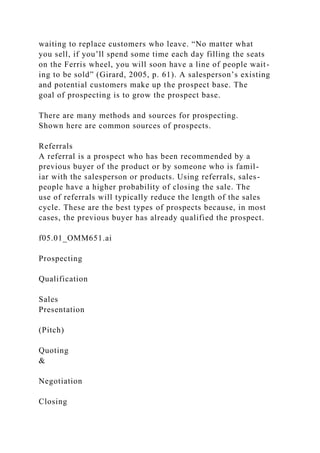
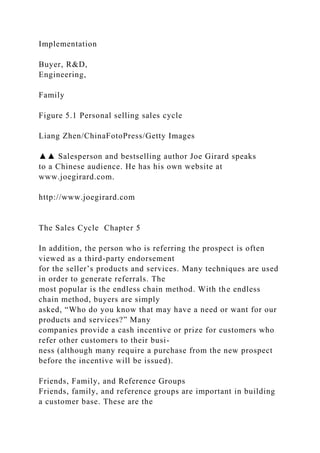
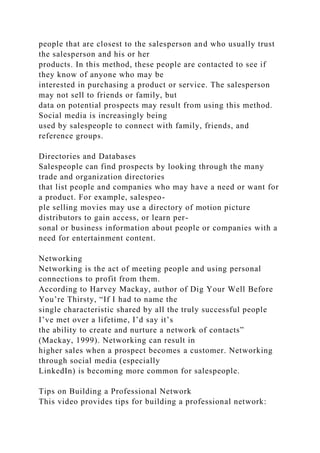
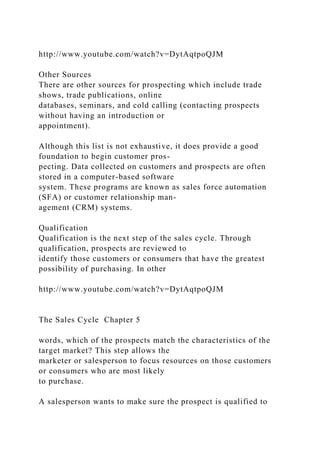
Sales Promotion
Learning Objectives
Upon completing this chapter the student will be able to:
• Define sales promotion and list advantages and disadvantages
of using this IMC tactic.
• Distinguish between consumer and trade promotions and
explain the types of tactics used in
each category.
• Describe the process of planning for sales promotions.
6
AP Photo/Franklin Reyes
Introduction Chapter 6
Pre-Test
1. Which of the following is NOT an advantage of sales
promotions?
a) It is easy to measure the success of most sales promotions.
b) Sales promotions coordinate well with other IMC tactics,
including online marketing
and advertising.
c) Frequent sales promotions are always good for a company’s
image.
d) Sales can be kept more level throughout the year when sales
promotion incentives are
offered.
2. In which type of trade promotion does a retailer receive a
discount or incentive from a manu-
facturer in exchange for performing a specific function?
a) Trade incentive
b) Trade contest
c) Trade allowance
d) Trade show
3. A toothpaste promotion manager would like to see 5,000 new
customers try the toothpaste
brand in March. This is an example of which type of sales
promotion objective?
a) Defending current customer base
b) Obtaining product trial or repurchase
c) Targeting a specified targeted market segment
d) Increasing consumption of an established brand
Answers
1. c) Frequent sales promotions are always good for a
company’s image. The correct answer
can be found in Section 6.1
2. a) Trade incentive. The correct answer can be found in
Section 6.2
3. b) Obtaining product trial or repurchase. The correct answer
can be found in Section 6.3
Introduction
The authors wish to thank Dr. Therese Maskulka for being a
contributing co-author on this chapter.
Sales promotions can greatly increase sales, especially when
they complement other IMC tactics.
For example, Creative Display Now (creativedisplaysnow.com)
developed an in-store floor display
to hold Gatorade’s G Series® (sports drinks) in 2011. The
structure was a one-piece column with
images of Usain Bolt, the Olympic gold medalist. The brand
message had high visibility and com-
municated product benefits. As a result of the point-of-purchase
display, products on the display
sold at four times the rate of those on the shelf (Ruggle, 2011).
In earlier chapters we discussed the development of the
marketing and integrated marketing com-
munications plans. In Chapter 4 we looked at advertising and in
Chapter 5 the concept of per-
sonal selling was covered. Those areas make up the framework
for the development of integrated
marketing communication; however, there are other tactical
areas that work in conjunction with
advertising and selling. This chapter focuses on the
development of a sales promotional plan that
creativedisplaysnow.com
Sales Promotion and IMC Chapter 6
must be integrated with the sales and advertising functions.
Working with the
other elements of the IMC mix, sales promotion can generate a
synergistic effect
for the IMC plan. The use of sales promotions has seen a
significant increase in
overall spending in the past decade for both consumer and trade
promotions.
6.1 Sales Promotion and IMC
In an earlier chapter we defined sales promotion as incentive
and interest-
creating activities that are designed to get customers to buy
immediately instead
of waiting. Let’s look at a more formal definition. Sales
promotions (also called
promotions) are “. . . all promotional activities (excluding
advertising, public
relations, personal selling, direct marketing, and online
marketing/social media)
that stimulate short-term behavioral responses from (1)
consumers, (2) the trade
(e.g., distributors, wholesalers, or retailers), and/or (3) the
company’s sales force”
(Shimp and Andrews, 2013, p. 512). Promotion includes all
types of communica-
tion, but sales promotions are limited to executions that
stimulate short-term
responses. For example, a coupon for a department store
typically expires so
a person has a small window in which to use the coupon. The
coupon is a sales
promotion piece. The act of communicating about the coupon
via a website or a
magazine is promotion. The goal of sales promotions, in
conjunction with other
elements of the IMC mix, is to create immediate short-term
sales, customer traf-
fic, or exposure for products and services.
Historically, many marketing experts believed sales promotions
would erode
brand equity. They believed any kind of incentive encouraged
channel members,
including consumers, to focus too much on price. However, the
view changed as
marketers realized that sales promotions can complement other
IMC efforts and
can help differentiate a brand from the competition. The use of
sales promotions can strengthen
sales and help to engage consumers and shoppers, with an
additional benefit of creating even more
sales, store traffic, or behavioral changes.
Sales promotions can take many different shapes, and there are
numerous executions that can be
generated using sales promotions. In recent years, promotional
professionals have developed met-
rics for measuring the effectiveness of sales promotions,
particularly at the point-of-sale for prod-
ucts and services. Because many consumer purchases are
impulse buys, point-of-sale promotions
will drive additional sales for both retailers and suppliers.
Advantages and Disadvantages of Sales Promotions
As is true of all IMC tactics, there are advantages and
disadvantages to the use of sales promotions.
We will take a look at the positive aspects of sales promotions
followed by a look at the negative
aspects.
Advantages of Sales Promotions
There are several advantages to using sales promotions as part
of a company’s IMC mix. One
advantage is that they result in immediate sales, as when a
person takes advantage of a buy one get
one (BOGO) promotion. BOGO is a type of consumer
promotion. Another advantage is increased
sales for a retailer when new products are introduced or a
product is featured in a sale. When a sales
promotion is not immediate, there is usually a deadline
associated with the sales promotion. For
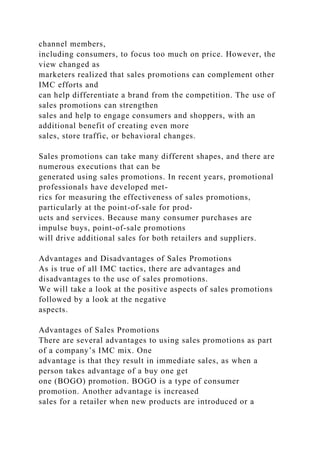
PRNewsFoto/CarMD.com Corporation
▲▲ Point-of-purchase dis-
plays, such as this one, are
sales promotion items that
can greatly increase sales.
Sales Promotion and IMC Chapter 6
example, a person may be entitled to a free product if he or she
attends a grand opening of a store,
but after the grand opening the offer is no longer available.
Manufacturers also impose deadlines
for other companies to launch sales promotions. In addition,
sales promotions are easy to track.
Coupons, for example, have a code associated with them so that
a manufacturer and retail manag-
ers know how successful the promotion was.
Another advantage is that sales promotions help to complement
other IMC tactics. Often a sales
promotion is used with advertising or with online
communication methods. Sales promotions can
easily be incorporated into an IMC plan. For example, a
salesperson can offer “free shipping” to
catch a prospect’s attention and increase sales volume. Sales
promotions can also complement B2B
efforts. For example, salespeople via personal selling may give
items such as calendars and desk
accessories to existing or potential customers to build goodwill
and strengthen relationships. Sales
promotions can also be used to differentiate a company from a
competitor.
Sales promotions can help keep sales con-
sistent throughout the year. A company
that experiences lower sales in February, for
example, may implement sales promotions
to help level out sales. Sales promotions can
also encourage trial of a product. When a
new product comes out, the company may
use coupons to encourage people to try the
product with the hope that the customer will
like the product and purchase it in the future
without the use of a coupon. Similarly, a
customer may try a product with the use
of a sales promotion and like the product
so much that he or she switches brands as
a result. From the trade perspective, a com-
pany can use sales promotions, such as dis-
counts to a retailer, to encourage sales.
Disadvantages of Sales Promotions
Sales promotions are short-term. This is a disadvantage because
their use often does not build
brand loyalty. With a new product introduction for example, if
the product quality is poor, sales
promotions may increase short-term sales, but the product will
not last if customers do not buy it
again. The same is true for B2B promotions. Poor quality
products will weaken relationships in the
supply chain. Or customers, accustomed to sales promotions,
may choose to wait for sales promo-
tions before they buy, which can erode long-term profits.
Another disadvantage is that the overuse of sales promotions
may damage the company image. A
customer may wonder what is wrong with a product if the
company uses too many sales promo-
tions to sell it. Often brand managers find it easy to continually
offer trade deals, which do not
help the company image. These actions may also increase price
sensitivity among customers. For
example, a manufacturing company offering trade discounts to a
retailer may find that the retailer
grows to expect significant discounts when purchasing.
Likewise, a retail customer may not shop
at a retailer unless he or she has a coupon or there is a sale.
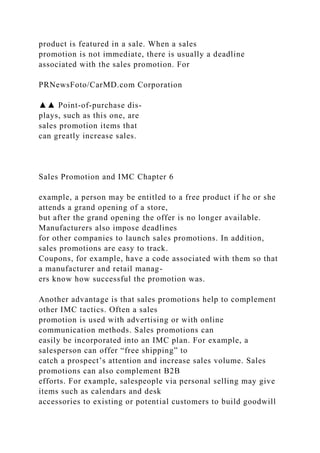
Roberto Herrett/age fotostock/SuperStock
▲▲ BOGO offers are used by retailers to move products and
increase
traffic.
Types of Sales Promotions Chapter 6
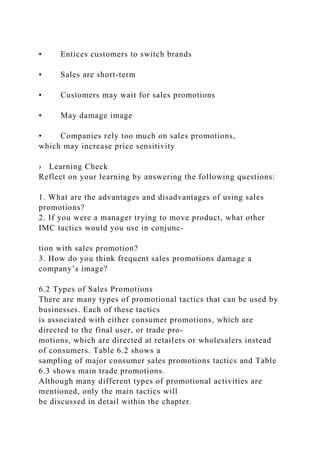
Table 6.1 Advantages and disadvantages of sales promotions
Advantages Disadvantages
• Immediate sales
• Easy to measure
• Helps other IMC areas
• Helps keep sales consistent
• Encourages trial of a product
• Entices customers to switch brands
• Sales are short-term
• Customers may wait for sales promotions
• May damage image
• Companies rely too much on sales promotions,
which may increase price sensitivity
› Learning Check
Reflect on your learning by answering the following questions:
1. What are the advantages and disadvantages of using sales
promotions?
2. If you were a manager trying to move product, what other
IMC tactics would you use in conjunc-
tion with sales promotion?
3. How do you think frequent sales promotions damage a
company’s image?
6.2 Types of Sales Promotions
There are many types of promotional tactics that can be used by
businesses. Each of these tactics
is associated with either consumer promotions, which are
directed to the final user, or trade pro-
motions, which are directed at retailers or wholesalers instead
of consumers. Table 6.2 shows a
sampling of major consumer sales promotions tactics and Table
6.3 shows main trade promotions.
Although many different types of promotional activities are
mentioned, only the main tactics will
be discussed in detail within the chapter.
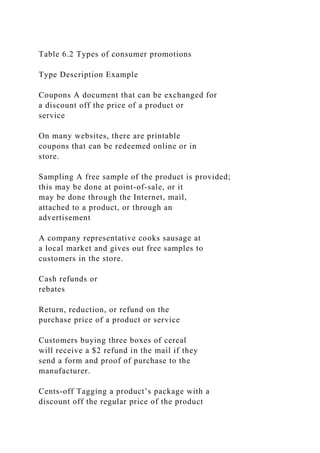
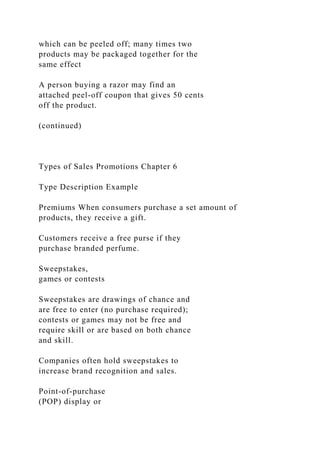
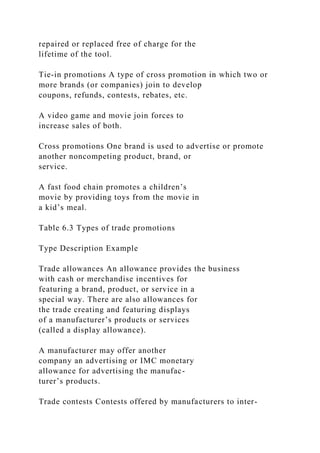
Table 6.2 Types of consumer promotions
Type Description Example
Coupons A document that can be exchanged for
a discount off the price of a product or
service
On many websites, there are printable
coupons that can be redeemed online or in
store.
Sampling A free sample of the product is provided;
this may be done at point-of-sale, or it
may be done through the Internet, mail,
attached to a product, or through an
advertisement
A company representative cooks sausage at
a local market and gives out free samples to
customers in the store.
Cash refunds or
rebates
Return, reduction, or refund on the
purchase price of a product or service
Customers buying three boxes of cereal
will receive a $2 refund in the mail if they
send a form and proof of purchase to the
manufacturer.
Cents-off Tagging a product’s package with a
discount off the regular price of the product
which can be peeled off; many times two
products may be packaged together for the
same effect
A person buying a razor may find an
attached peel-off coupon that gives 50 cents
off the product.
(continued)
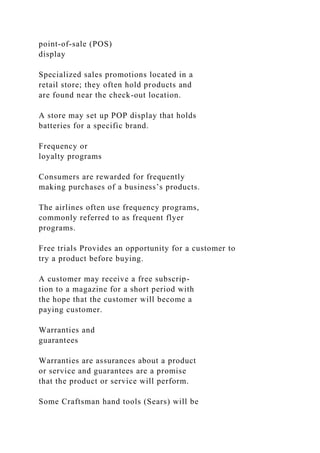
Types of Sales Promotions Chapter 6
Type Description Example
Premiums When consumers purchase a set amount of
products, they receive a gift.
Customers receive a free purse if they
purchase branded perfume.
Sweepstakes,
games or contests
Sweepstakes are drawings of chance and
are free to enter (no purchase required);
contests or games may not be free and
require skill or are based on both chance
and skill.
Companies often hold sweepstakes to
increase brand recognition and sales.
Point-of-purchase
(POP) display or
point-of-sale (POS)
display
Specialized sales promotions located in a
retail store; they often hold products and
are found near the check-out location.
A store may set up POP display that holds
batteries for a specific brand.
Frequency or
loyalty programs
Consumers are rewarded for frequently
making purchases of a business’s products.
The airlines often use frequency programs,
commonly referred to as frequent flyer
programs.
Free trials Provides an opportunity for a customer to
try a product before buying.
A customer may receive a free subscrip-
tion to a magazine for a short period with
the hope that the customer will become a
paying customer.
Warranties and
guarantees
Warranties are assurances about a product
or service and guarantees are a promise
that the product or service will perform.
Some Craftsman hand tools (Sears) will be
repaired or replaced free of charge for the
lifetime of the tool.
Tie-in promotions A type of cross promotion in which two or
more brands (or companies) join to develop
coupons, refunds, contests, rebates, etc.
A video game and movie join forces to
increase sales of both.
Cross promotions One brand is used to advertise or promote
another noncompeting product, brand, or
service.
A fast food chain promotes a children’s
movie by providing toys from the movie in
a kid’s meal.
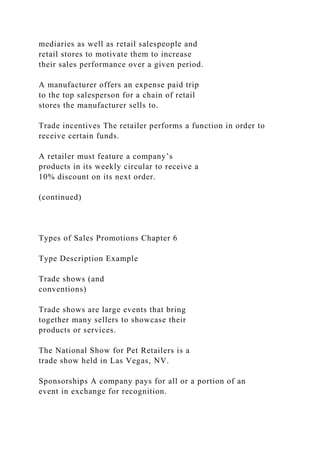
Table 6.3 Types of trade promotions
Type Description Example
Trade allowances An allowance provides the business
with cash or merchandise incentives for
featuring a brand, product, or service in a
special way. There are also allowances for
the trade creating and featuring displays
of a manufacturer’s products or services
(called a display allowance).
A manufacturer may offer another
company an advertising or IMC monetary
allowance for advertising the manufac-
turer’s products.
Trade contests Contests offered by manufacturers to inter-
mediaries as well as retail salespeople and
retail stores to motivate them to increase
their sales performance over a given period.
A manufacturer offers an expense paid trip
to the top salesperson for a chain of retail
stores the manufacturer sells to.
Trade incentives The retailer performs a function in order to
receive certain funds.
A retailer must feature a company’s
products in its weekly circular to receive a
10% discount on its next order.
(continued)
Types of Sales Promotions Chapter 6
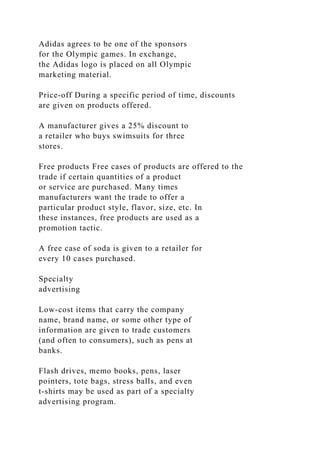
Type Description Example
Trade shows (and
conventions)
Trade shows are large events that bring
together many sellers to showcase their
products or services.
The National Show for Pet Retailers is a
trade show held in Las Vegas, NV.
Sponsorships A company pays for all or a portion of an
event in exchange for recognition.
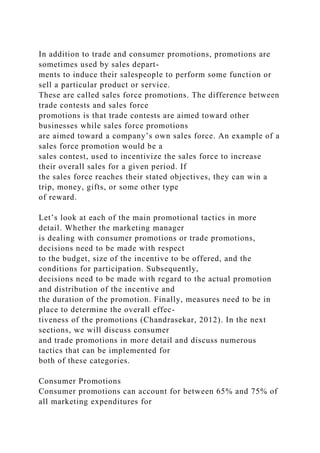
Adidas agrees to be one of the sponsors
for the Olympic games. In exchange,
the Adidas logo is placed on all Olympic
marketing material.
Price-off During a specific period of time, discounts
are given on products offered.
A manufacturer gives a 25% discount to
a retailer who buys swimsuits for three
stores.
Free products Free cases of products are offered to the
trade if certain quantities of a product
or service are purchased. Many times
manufacturers want the trade to offer a
particular product style, flavor, size, etc. In
these instances, free products are used as a
promotion tactic.
A free case of soda is given to a retailer for
every 10 cases purchased.
Specialty
advertising
Low-cost items that carry the company
name, brand name, or some other type of
information are given to trade customers
(and often to consumers), such as pens at
banks.
Flash drives, memo books, pens, laser
pointers, tote bags, stress balls, and even
t-shirts may be used as part of a specialty
advertising program.
In addition to trade and consumer promotions, promotions are
sometimes used by sales depart-
ments to induce their salespeople to perform some function or
sell a particular product or service.
These are called sales force promotions. The difference between
trade contests and sales force
promotions is that trade contests are aimed toward other
businesses while sales force promotions
are aimed toward a company’s own sales force. An example of a
sales force promotion would be a
sales contest, used to incentivize the sales force to increase
their overall sales for a given period. If
the sales force reaches their stated objectives, they can win a
trip, money, gifts, or some other type
of reward.
Let’s look at each of the main promotional tactics in more
detail. Whether the marketing manager
is dealing with consumer promotions or trade promotions,
decisions need to be made with respect
to the budget, size of the incentive to be offered, and the
conditions for participation. Subsequently,
decisions need to be made with regard to the actual promotion
and distribution of the incentive and
the duration of the promotion. Finally, measures need to be in
place to determine the overall effec-
tiveness of the promotions (Chandrasekar, 2012). In the next
sections, we will discuss consumer
and trade promotions in more detail and discuss numerous
tactics that can be implemented for
both of these categories.
Consumer Promotions
Consumer promotions can account for between 65% and 75% of
all marketing expenditures for
many of the consumer packaged-goods companies (Kotler,
2003). There are numerous reasons why
a large percentage of the marketing budget goes to sales
promotions. Today’s product managers
are under tremendous pressure to increase sales, consumers
expect deals, and the effectiveness
of a firm’s advertising efforts may be decreasing. In addition,
the increased competition makes it
Types of Sales Promotions Chapter 6
difficult for consumers to differentiate among competing
brands. Sales promotions may help gain
the competitive advantage needed to stay relevant.
While advertising makes a consumer aware of the product, sales
promotions serve as the incentive
for the consumer to purchase the product or service. Marcom
planners will often generate promo-
tions in order to promote increased sales. For branding
campaigns, sales promotions are used to
achieve various sales-influencing objectives for the brand.
Remember sales promotions = promot-
ing sales (Shimp and Andrews, 2013). It is important for IMC
planners to understand the market
and customers prior to initiating the sales promotions plan.
Additionally, it is important to take
into account all areas of the IMC mix prior to the launch of any
sales promotion.
SALES PROMOTIONS = PROMOTING SALES!
Tactics
Consumer sales promotions consist of short-term incentives to
encourage the purchase or sale of a
product or service. The product life cycle (PLC) is often a
consideration when making sales promo-
tion decisions. For example, a new product may require a bigger
portion of the budget going to sales
promotions to achieve a successful launch. Let’s take a look at
common sales promotion tactics.
Coupons
One of the most popular consumer sales promotion tactics is the
use of coupons, which offer cus-
tomers a savings when they purchase the specified product. A
coupon can be expressed as a per-
centage off (e.g., 20%) or an actual amount, for example, 35
cents. According to a report on coupons
(CPG Coupons, 2013), 80% of consumers redeem coupons
regularly. In 2012, people in the United
States redeemed 2.9 billion coupons, a 17% drop from 3.5
billion coupons redeemed in 2011. The
drop was attributed to a shift in the types of coupons available
to consumers. There were fewer food
coupons, which are redeemed more frequently, and more
product coupons, which are redeemed
less frequently. The top cities for coupon redemption were
Atlanta, Tampa, St. Louis, and Cincinnati
(Smith, 2012). As can be seen, coupons are an important tool
and tactic for IMC planners.
Coupons have many advantages, but also have many
disadvantages (Berman and Evans, 2013).
Both are summarized in Table 6.4.
Table 6.4 Advantages and disadvantages of coupons
Advantages Disadvantages
• With manufacturers’ coupons, the manufacturer
pays a retailer to advertise, and also pays for the
redemption of manufacturers’ coupons; this is a key
advantage for retailers.
• 80% of consumers regularly shop using coupons
• Consumers perceive they are getting a good value
• Promotional and advertising effectiveness can be
measured based upon coupon redemption rates
• Coupons often create a negative consumer percep-
tion of the brand or retailer’s image
• Many consumers will only shop if coupons are
available
• There is a lot of coupon clutter
• There is a cost associated with issuing coupons, espe-
cially for the manufacturer
• There is coupon fraud at both the manufacturer and
retail levels
An increasingly popular source for securing coupons can be
found on Internet sites. Table 6.5
shows the most popular Internet sites to obtain coupons.
Types of Sales Promotions Chapter 6
Table 6.5 Top coupon Internet sites
• www.coolsavings.com
• www.couponmountain.com
• www.couponcabin.com
• www.couponheaven.com
• www.coupons.com
• www.coupons2Redeem.com
• www.dealfind.com
• www.ebates.com
• www.fatwallet.com
• www.greatcoupons-online.com
• www.groupon.com
• www.livingsocial.com
• www.retailmenot.com
• www.slickdeals.net
• www.smartsource.com
Free-Standing Inserts
Coupons may be delivered through direct mail and print media.
They can also be found on a pack-
age (called peelies), in a package (called bounce back coupons),
or distributed in the store (scanner
delivered upon printing of receipt). Most of all print media
coupons are found in free-standing
inserts (FSIs), which are coupons and other promotions
distributed in separate publications such
as newspapers and magazines. For newspapers, Sundays and
Thursdays are days with high FSIs.
Consumers have grown to expect these FSIs in their
newspapers. Large consumer goods producers
such as Proctor & Gamble often have their own FSI at least
once a month. The objective of FSIs is to
encourage the consumers to use the coupons on their next trip to
the store. Retailers support FSIs
because they can increase store traffic and increase store sales.
According to Kantar Media, FSI coupon distribution has
increased by 18% over the last 10 years.
The greatest activity for FSIs in 2012 was the pre-Super Bowl
promotion week. Coming in sec-
ond was the pre-Thanksgiving promotion week. The largest
category using FSIs was the consumer
packaged-goods industry. Of retailers, Walmart, Walgreens,
Target, and Family Dollar Stores®
were the top users of FSIs (Kantar Media, 2013).
Coupon Fraud
Coupon fraud exists despite the many places
available on the Internet and elsewhere to
get coupons. Coupon fraud occurs when
someone tries to use coupons illegally. It is
estimated that companies lose about $500
million a year due to counterfeit coupons
alone (Chan, 2013). Coupon fraud may lead
to an increase in the consumer price of goods.
Internet coupons downloaded at home come
under the greatest scrutiny from retailers.
Some retailers have even refused to accept
Internet coupons because of the potential for
fraud. Consumers as well as manufacturers
have become more proactive in their effort
to detect coupon fraud. In order for a con-
sumer, manufacturer, or retailer to ensure a
coupon obtained from the Internet is legiti-
mate they can go to the Coupon Information
Corporation (http://www.couponinformationcenter.com/), an
organization that is leading reform
to improve security in the coupon industry. Consumers can find
tips for spotting counterfeits at
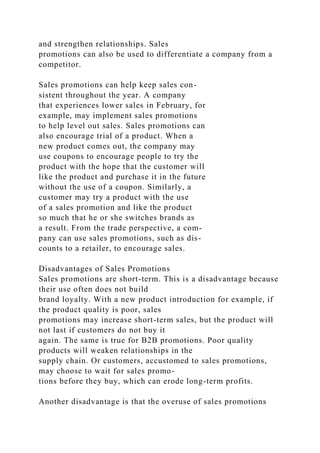
Tim Boyle/Getty Images
▲▲ Subway discontinued its customer appreciation program
because
counterfeiters were using high-tech printers to make Sub Club
stamps to
earn free meals.
http://www.coolsavings.com
http://www.couponmountain.com
http://www.couponcabin.com
http://www.couponheaven.com
http://www.coupons.com
http://www.coupons2Redeem.com
http://www.dealfind.com
http://www.ebates.com
http://www.fatwallet.com
http://www.greatcoupons-online.com
http://www.groupon.com
http://www.livingsocial.com
http://www.retailmenot.com
http://www.slickdeals.net
http://www.smartsource.com
http://www.couponinformationcenter.com/
Types of Sales Promotions Chapter 6
http://couponing.about.com/od/groceryzone/a/webprintcoups.ht
m. Some suggestions include check-
ing for barcodes on the coupon, not redeeming too many
Internet coupons at one time, and never
paying for coupons. Selling coupons is a crime.
Cost of Coupons to Company
It’s great to use coupons as a sales promotion tool, but what’s
the cost to the company? When assess-
ing costs associated with the use of coupons, many variables
need to be considered to calculate the
cost per coupon. Sales promotion professionals must be
cognizant that there may be some hidden
costs associated with this practice, not just the redemption cost.
First, sales promotion profession-
als need to calculate the distribution cost of the coupon. What
will it take to have the coupons
distributed to the target market? How will they be delivered?
Many times, coupon distribution
costs can be mitigated by piggybacking on other IMC tactics.
For example, coupons may be deliv-
ered along with print advertising and the cost may be shared
with media and advertising. Second,
what is the redemption rate? Even at 1%, redemption costs will
be the highest cost associated with
the use of coupons. What is the cost of redemption based upon
the redemption rates? Third, there
will be costs associated with the handling of coupons,
especially at the retail level. What are the
handling and processing fees that will be associated with the
coupon redemption? Fourth, what are
the creative expenses? The coupon must be designed, and there
will be a cost associated with that
function. By looking at these key points, sales promotion
personnel will be able to calculate a cost
per coupon. To illustrate this point see the example below.
Example: Cost per coupon redeemed
Case in Point: Counterfeit Coupon Creator Finally Caught
In 2012 Robin Ramirez, a 40-year-old woman from Phoenix,
AZ, was arrested for running the larg-
est counterfeit-coupon enterprise in U.S. history. Robin owned
26 vehicles, a boat, and three condo-
miniums that she paid for with coupon fraud money. Ramirez
sold fake coupons online. The fake
coupons were from over 240 brands and totaled $40 million. In
2013, she was sentenced to two years
in state prison and may have to pay up to $5 million in
restitution. She convinced her husband she
was running a legitimate business (Chan, 2013).
How did she pull off such a sophisticated scam? She started out
selling fake coupons on eBay. In
2007, she launched a website called savvyshoppersite.com.
Companies that were targeted in the
scam wanted to find out who was committing fraud. These
companies partnered with the Coupon
Information Corporation to hire private investigators who
tracked the coupons to Phoenix, AZ.
Despite the use of fake identities and addresses, search warrants
for the website eventually proved
that Ramirez was behind the scam.
To pull off the fraud, Ramirez collected product coupons and
arranged with a foreign printing
company to produce the coupons in mass quantities. She often
added a counterfeit hologram that
signaled the coupons were real. She then sold these coupons
online for half the face value. Coupons
ranged from $2 to $70. The coupons were of such high quality
that retailers accepted them and it was
not until the coupon reached the manufacturers that the fakes
were detected (Gunter, 2013).
Reflection Questions
1. Why do people attempt these scams?
2. Do you think the sentence was too harsh? Not harsh enough?
3. How can manufacturers prevent coupon fraud?
http://couponing.about.com/od/groceryzone/a/webprintcoups.ht
m
Types of Sales Promotions Chapter 6
This example is for illustrative purposes and the numbers are
fabricated.
Distribution costs: 50,000 circulation × $5.00 CPM $250
Redemption rate of 3% $1,500
Cost of redemption: 1,500 × $2.00 (coupon face value) $3,000
Handling costs and fees: 1,500 redemptions × $ 0.15 $225
Creative costs associated with coupon $2,000
Total cost: $250 + $3,000 + $225 + $2,000 $5,475
Cost per coupon redeemed: $5,475 ÷ 1,500 $3.65
As can be seen from the example, sometimes the cost of a
coupon is high from the company’s per-
spective. The return on investment is important to consider
when using coupons.
Sampling
Sampling is an effective sales promotion tactic in which a
company offers the consumer a free
sample of a product. Often viewed as the best way to introduce
a new product to the market and
generate excitement, it is also the most expensive consumer
promotion. Sampling can occur in the
store, through the mail, or by selecting a subset of people to
receive a sample.
Samples can be useful in breaking down resistance to new and
different products. A company
representative may provide samples to those who pass by a table
in a retail store, for example. A
coupon that provides an incentive to buy the product is usually
handed out along with the sample.
Case in Point: Pepsi Uses Samples to Drive Facebook Likes
In an attempt to drive customers to Facebook, Pepsi is creating
a new twist on the tactic of sampling.
Pepsi has created vending machines that provide free samples of
Pepsi products—with a catch. In
order to get the free sample, consumers have to go to Facebook
and give Pepsi a Like on Pepsi’s
Facebook site. Pepsi also tied in the use of m-commerce by
allowing smartphone users the ability
to simply stand by the screen and Like the Facebook page. They
then choose their favorite flavor
(or one they want to try) and the can comes immediately. Those
without a smartphone can log into
the Pepsi Facebook page via a large touchscreen on the
machine. As soon as they Like the Facebook
page, they too get their selected product. The objective of the
promotion is to collect customer data.
Users of Pepsi (and potential users) provide Pepsi with
individual data via social media sites, in this
instance, Facebook. Pepsi will look at the data generated and
use it to develop a more effective inte-
grated marketing communication plan. The concept was first
tested at a Beyoncé concert in Belgium
where a significant percentage of the fans opted for the free
beverage and Liked the Pepsi Facebook
page. Based upon its success, Pepsi began to offer the vending
machines in the United States
(Kooser, 2013).
Take a look at Pepsi’s promotion video about the Like machine:
http://www.youtube.com/
watch?feature=player_embedded&v=O4YrQpupEO8
Reflection Questions
1. Do customers think about sharing their personal data with a
company before getting a free
product?
2. Would you Like a product on Facebook in exchange for a free
sample?
3. What will Pepsi do with the information they collected?
http://www.youtube.com/watch?feature=player_embedded&v=O
4YrQpupEO8
http://www.youtube.com/watch?feature=player_embedded&v=O
4YrQpupEO8
Types of Sales Promotions Chapter 6
Cash Refunds and Rebates
Cash refunds and rebates represent a return, reduction, or refund
on what has been paid for a
product or service. They are similar to coupons except that the
price reduction occurs after the
purchase rather than at the retail outlet. While the cash refund
or rebate is enticing and can often
be the reason for the purchase, the National Consumers League,
a consumer advocacy group, esti-
mates that only 2% to 3% of rebate forms are successfully
submitted. This figure differs widely from
figures provided by rebate centers such as Parago
(www.parago.com), who report that as many as
47% of consumers file rebates on a yearly basis (Heller, 2011).
The trend toward paperless rebates
may make rebates more popular. The challenge for the
manufacturer is to differentiate its rebate
from others on the market, making it a unique opportunity for
the consumer.
Cents-Off Deals
Cents-off deals (also called price-packs) offer consumers a
temporary price reduction off the regu-
lar price of a product. This may take the form of a coupon
affixed directly on the product that can
be peeled off (called a peelie). Cents-off deals can also be tied
to special promotions. This can be a
way to stimulate sales of an existing product, or perhaps a
product that is declining in sales.
One interesting take on the use of price-packs is a campaign run
by Pizza Hut. In the sum-
mer of 2013, Pizza Hut developed a promotion that offered a
large one-topping pizza for only
$5.55. The move was undertaken to drive summer sales of Pizza
Hut pizzas. Pizza Hut used the
$5.55 promotion as a tie-in to its 55th anniversary promotional
hook. The promotion ran for 10
days (June 5–15) and was only good on take-out pizzas. The
take-out angle helped reduce costs
associated with pizza delivery. Because pizza sales are slow in
the summer months, many pizza
companies rely on heavy promotions during this period in order
to drive immediate business
into their retail outlets. The promotions look like they cost the
companies money; however, when
consumers buy pizza, they also purchase side items such as soft
drinks to supplement their meal
(Horowitz, 2013).
Premiums
Premiums are goods offered either free or at low cost as an
incentive to buy a product. Premiums
can enhance a product’s image. One option available to the
consumer is the free in the mail pre-
mium, which requires a mail-in proof-of-purchase to receive
some type of merchandise. Another
option is the self-liquidating premium, which requires the
consumer to mail in a specified dollar
amount to cover the handling and shipping and perhaps cost of
the premium. The last option is
the in or near pack premiums (merchandise is available in or is
attached to the product’s package).
Consumer goods manufacturers need to exercise caution when
selecting the premium to ensure
that it fits with their IMC plan. Fads should be avoided.
Premiums need to match the target market
for the product and the firm should not expect the premium to
increase short-term profits.
Sweepstakes, Games, and Contests
Sweepstakes are drawings of chance and are free to enter (no
purchase required). Contests and
games may not be free and require skill, or are based on both
chance and skill. The chance of
winning a sweepstake is based on a probability factor. The
probability of winning must be clearly
stated on all advertising materials. The primary goal of contests
and sweepstakes is to create
awareness and encourage customer traffic. While contests and
sweepstakes may not boost sales
in the short run, they can increase brand awareness and possibly
affect brand image over a longer
period of time.
Contests and games provide the consumers with an opportunity
to win something by taking some
kind of action. A contest may require consumers to submit an
essay, which will be evaluated by
http://www.parago.com
Types of Sales Promotions Chapter 6
judges selected by the sponsoring firm.
Other contests may require contestants to
answer questions on a game show such as
Jeopardy. Another type of contest requires
the consumer to make a purchase in order
to enter the contest. It is important that the
prize offered is enticing and exciting enough
for the consumer to want to take advan-
tage of the opportunity. Scratch-off games
are popular because they provide instant
results. Sometimes offering several levels of
prizes is enough to entice the consumer.
McDonald’s® Sponsors Dunk Contest
This video features highlights of McDonald’s All American
dunk contest:
http://www.youtube.com/watch?v=nYESAzucqR0
Heineken® has taken a unique approach in the development of a
contest to engage its male consum-
ers. Heineken launched a promotion called “Dropped” which
asks its male consumers (ages 21 and
over) to submit an entry to Heineken that will allow them to be
removed from the grind of daily
life and dropped into the “great unknown.” Men who wished to
participate submitted a video with
their thoughts on an everyday journey. They uploaded it to an
online site and tweeted the link using
#dropped. The winners are dropped into a remote site where
they are followed on their “legendary
travel experience.” Heineken developed a promotional campaign
called “Legends,” and has several
executions of the campaign, rewarding thrill seekers with
adventures out of the seekers’ comfort
zones. Heineken developed a YouTube channel where viewers
watch the winners’ travels. Viewers
of the videos on YouTube have to confirm their age prior to
watching the videos to prevent under-
age viewers. Viewers may add their own comments and share
their own travel experiences. Fans
also follow the adventures on Heineken’s Facebook page (Irwin,
2013).
Point-of-Purchase and Point-of-Sale
Point-of-Purchase (POP) or Point-of-Sale (POS) promotions are
popular with retailers and
packaged-goods manufacturers. These promotions occur in the
store or close to the time of receiv-
ing payment. The impact of point-of-sale advertising and
promotion has grown over the past 20
years, and the point-of-purchase industry has developed a
metric that can be used to assess the
effectiveness of point-of-sale promotions. One of the largest
trade associations focusing on point-
of-sale promotions and other activities is the Point-of-Purchase
Advertising International (POPAI)
at www.popai.com. POPAI is the only not-for-profit trade
association for the marketing-at-retail
industry. They offer many services to POPAI members
including research studies, education, and
certification programs. The association examines ways that
marketers can leverage consumer deci-
sion making at the point of purchase (Liljenwall, 2004).
Frequency or Loyalty Programs
With frequency or loyalty programs, consumers are rewarded
for frequently making purchases
of a business’s products or services. This could take the form of
a formalized program (most
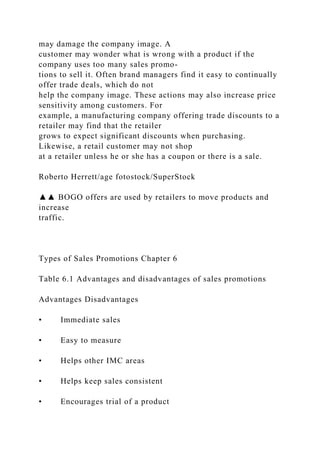
PRNewsFoto/The Hershey Company
▲▲ Contests and sweepstakes seek to promote product
awareness
and encourage customer traffic.
http://www.youtube.com/watch?v=nYESAzucqR0
http://popai.com
Types of Sales Promotions Chapter 6
expensive) with rules and regulations, or
the simple punch card given to record visits
or purchases. It is important to ensure the
program is user-friendly and easy to under-
stand. If loyalty programs are too difficult
to use or understand, the program could
backfire and alienate customers. The Small
Business Administration (www.sba.gov)
offers seven tips for starting a small business
loyalty program (Beesley, 2013).
1. Start with a loyalty punch card. This is a
low-tech option that is useful for busi-
nesses new to loyalty programs. With
a punch card, a free gift is offered after
a certain number of purchases have
been made.
2. Start an opt-in program. With this method, customers are
asked to share their email addresses
and are added to an opt-in email list. Customers can receive
special offers only available
via email.
4. Consider a premium loyalty program. Customer-relationship
management software is required
for this method and is used to track high value purchases.
Customers who meet thresholds are
invited to join.
5. Offer branded loyalty membership cards. Use a commercially
available loyalty card service and
develop a store card. These cards allow a business to track
customer spending.
6. Add a digital component. A business could use a company
that provides apps to develop a
mobile payment platform and deliver coupons or other sales
promotions.
7. Choose your incentives carefully. A company should be
selective with what is offered to cus-
tomers as rewards. Too many free items can erode brand image.
8. Communicate regularly with your members. Businesses need
to treat the customer with
respect. Make sure all communications are relevant to the target
market.
Cross Promotions and Tie-ins
Cross promotions are when one brand is used to advertise or
promote another noncompeting
product, brand, or service. These types of promotions are
growing in popularity. A tie-in is a type
of cross promotion in which two or more brands (or companies)
join to develop coupons, refunds,
contests, rebates, etc. Cross ruffing is a type of cross promotion
that occurs when two promotional
materials are packaged together. An example of this is when a
coupon is placed on one product for
another product. The products chosen need to fit together
logically. For example, placing a Cheese
Whiz (bottled cheese spread) coupon on a package of frozen
broccoli creates a synergistic effect for
both of the company’s products while driving sales for both.
Consumer Behavior at the Point of Purchase
Examining consumer behavior at the point of purchase helps to
explain how consumers make a
decision to buy, and how the marketer can impact that decision
(Liljenwall, 2004). As discussed in
Chapter 2, the consumer decision process involves five steps
that consumers follow when making
a buying decision. These steps include problem awareness,
search for information, evaluation of
Emile Wamsteker/Bloomberg via Getty Images
▲▲ A loyalty program is a sales promotion that rewards
frequent
customers.
www.sba.gov
Types of Sales Promotions Chapter 6
alternatives, purchase, and post-purchase evaluation. In the first
step, the consumer knows little
or nothing about a product or service. In order to get the
consumer’s attention, it is necessary to
expose the shopper to the products and services offered. The
customer may then become aware
of an unsatisfied need. In-store displays (among other
promotional methods) for various product
categories may be used to create that exposure. Once exposed to
a product category, the search for
information step is shortened because the product is available
for immediate purchase. The evalua-
tion of alternatives step also occurs in the store. Shoppers must
be offered some type of motivation
in order to process the in-store stimuli, such as point-of-
purchase displays. Once the exposure and
motivation have been created, the shopper will experience a
need recognition for the product. The
need recognition comes from an IMC synergy and the fact that
promotional activities are taking
place at the point-of-sale. The IMC synergy may have been
created by exposure, motivation, and
previous shopping experiences combined with advertising,
personal selling, branding, and other
areas of the IMC tactical executions. Once the recognition
occurs, the shopper will make a decision
either to buy the product or to continue shopping.
A model developed by researchers J. Inman and R. Winer
(1998) depicts the in-store consumer
decision-making process and is helpful to retailers to
understand where sales promotions can be
used (Figure 6.1). The researchers suggest that why consumers
take a trip to the store has an impact
Case in Point: Hoover’s Sales Promotion Fiasco
When planning a sales promotion, a company has to provide a
big enough incentive to catch atten-
tion, but not so big that the company doesn’t get a return on the
investment. Hoover Company
learned this lesson the hard way when a sales promotion
received so much attention that the com-
pany had to halt the promotion. The resulting publicity hurt the
brand.
In 1992, the UK arm of Hoover planned a sales promotion to
reduce overstock of vacuum cleaners.
The sales promotion gave consumers two free return airplane
tickets to England from one of six
European cities if they spent at least 119 pounds ($236 at the
time) on a Hoover vacuum cleaner or
Maytag product. The exchange rate at the time was U.S. $1.98
for every British pound. The com-
pany estimated that 50,000 people would partake in the
promotion. Executives made the paperwork
difficult for redemption, thinking that people would buy a
product but never follow through with the
application. Instead of 50,000 applicants, there were 200,000
applicants. Company executives were
so happy with initial results that they expanded the promotion
to include return tickets from the
United States.
The tickets were worth more than a customer spent on a Hoover
or Maytag product (Rivkin, 2011).
Stores ran out of Hoover products and could not meet demand.
The company stepped up produc-
tion and had to get more company people involved in handling
all the applicants. Because Hoover
did not purchase tickets up front, the company had to scramble
to find airline tickets, which cost the
company millions more pounds than anticipated. Customer
complaints increased as people did not
receive their tickets (Blackhurst and Hotten, 1993). The
marketing executives responsible for the pro-
motion were eventually fired.
The Hoover Holiday Pressure Group formed and sued the
company. The group spent six years fight-
ing the company to make sure everyone received their tickets.
In the end about 220,000 people did
get to fly, but it cost the company over 50 million pounds
(Chan, 2004).
Reflection Questions
1. What could the executives have done differently to ensure the
success of the sales promotion?
2. How can a company recover from such a mistake?
Types of Sales Promotions Chapter 6
on their behavior. Is the trip for a convenience product or a
major purchase? By understanding the
type of trip the shopper is making, retailers can react by
executing sales promotion tactics that
please or excite the shopper. In addition to understanding the
type of trip, retailers should try to
understand which aisles in the store are being shopped and the
types of displays needed to interest
the consumer in purchasing.
Inman and Winer’s model shows that a consumer’s deal
proneness will also have an impact on his
or her shopping behavior. Deal proneness is a shopper’s
propensity to purchase products that are
on sale or when the shopper is offered some type of deal.
Closely related to deal proneness is fea-
ture proneness. Consumers are feature prone when they use
coupons, FSIs, or some other type of
circular, e-coupon, or other feature to encourage them to make a
purchase. Understanding which
consumers are feature prone and which are not will help the
retailer create more effective sales
promotion tactics, creating more success for the retailer. As
stressed in search and post-purchase
f06.01_OMM651.ai
Stage 3
Need recognition is in�uenced
by a shopper’s gender,
compulsiveness, household
size, and income.
Were shoppers already planning
to purchase an item? This is
in�uenced by the number of
trips shoppers make to the store
and feature proneness.
Stage 1
Exposure to categories and displays
in the store. In�uenced by the
type of trip, aisles that are
shopped, display types and
purchase involvement.
Stage 2
Motivation to process the stimuli in
the store. In�uenced by deals
available, age of the shopper, time
constraints, and the need to think.
Stage 4
Type of category purchase
After a shopper recognizes his or her needs
If the answer is No
If the answer is Yes
Processing of the stimuli inside the store.
Figure 6.1 A model of in-store consumer decision making
Source: Adapted from Inman & Winer. (1998).
Types of Sales Promotions Chapter 6
evaluation steps of the five-step decision-making process, the
Inman and Winer model stresses
that retailers need to be aware of the consumer’s purchase
involvement toward a particular product
or service. Finally, retailers need to understand that a
consumer’s compulsiveness will also influ-
ence the buyer’s behavior. Compulsiveness is the degree of
openness shoppers have to impulse
purchases. The more a consumer feels that impulse purchases
are acceptable, the more compulsive
he or she is toward purchasing. For example, when you go
grocery shopping, do you come home
with many unplanned items such as cookies, chips, soda, or
granola bars? If so, you are high in
compulsiveness.
Trade Promotions
Trade promotions are sales promotions aimed at the
intermediaries in the marketing channel. The
strategy behind trade promotions is to persuade resellers to
carry new items and more inventory,
buy ahead, promote the company’s products, give products more
shelf space, and push products to
consumers. Manufacturers direct more sales promotion dollars
toward retailers and wholesalers
than to final consumers. In this section, we discuss the major
types of trade promotions.
Trade Allowances
Manufacturers can offer a straight discount (also called price-
off, off-invoice, or off-list) which
is a dollar or percentage amount off the bill. The discount
encourages intermediaries to carry the
manufacturer’s goods or to order a larger quantity of the goods.
Manufacturers may offer a trade
allowance, which is some type of monetary or other
compensation in return for the retailer’s agree-
ment to feature the manufacturer’s products in some way.
Manufacturers may offer free goods like
extra cases of merchandise, to resellers who buy a certain
quantity or who feature a certain flavor or
size of a product. They may offer push money which is cash or
gifts to dealers or their sales forces
to “push” the manufacturer’s goods down the channel of
distribution. Table 6.6 summarizes the
main types of allowances.
Table 6.6 Types of trade allowances
Type Description
advertising allowance A manufacturer compensates retailers for
advertising
its products.
display allowance A manufacturer compensates retailers for
using special
displays in their stores.
bill back allowance Allowances are given to retailers for
featuring a
particular brand in their ads or for using special
displays in the store. After receiving a bill from the
retailer for services rendered, the manufacturer grants
an allowance toward the retailer’s next purchase.
slotting allowance Allowance in which manufacturers pay
retailers to
carry the product or service.
Slotting allowances are controversial because these fees often
prohibit small businesses from get-
ting products onto shelves due to the bigger companies using
their leverage to keep shelf space.
The word “slotting,” refers to gaining shelf space on the food
retailer’s shelf. For every new product
that a food retailer wants to place on shelves, either another
product will be removed, or the space
allocated to that other product will be minimized. This is a risk
to the food retailer since the retailer
Types of Sales Promotions Chapter 6
does not know if the new product will be well received by the
consumer. The retailer could poten-
tially lose money from lost sales of the product removed from
the shelf.
Exit fees are fees retailers charge to remove a product from the
shelf. The vendor, wholesaler, or
manufacturer signs a contract with the retailer stipulating an
average volume of weekly traffic dur-
ing a specified period. If this volume is not achieved, the
retailer charges the vendor for the removal
of the product (also called a handling charge). Only 4% of
retailers use exit fees, compared to 82%
who use slotting allowance fees. (Heller, 2002)
In order to increase their profit margins retailers often engage
in forward buying and diverting.
Forward buying induces retailers to purchase large quantities of
products and then stockpile them
in order to take advantage of a temporary price reduction. When
a manufacturer restricts a deal
to a limited geographical area, the wholesalers and retailers buy
abnormally large quantities of the
goods at the reduced price and often resell the goods to
wholesalers and retailers at a higher price in
other geographical areas. Diverting occurs when a retailer
purchases a product at a reduced price
in one geographical area and ships it to another geographical
area where it is sold at a higher price.
When considering diverting, the firm must consider the
additional transportation costs, and what
profit level will be realized. Often it is determined that it is not
profitable to divert the product. As
a result, forward buying is more often used than diverting.
Trade Contests
Trade contests are offered to intermediaries as well as retail
salespeople and retail stores to motivate
them to increase their sales performance over a given period.
Often these are referred to as spiff
money and may include vacations, big-screen televisions, or
computers. A contest can be between
a broker and agent who handles the manufacturer’s goods or
could simply be a sales volume contest
among retail stores or retail salespeople. The ideal retail contest
could be a contest among retail
operations in a certain region for the highest level of sales
volume within a certain amount of time.
Trade Incentives
Trade incentives are similar to trade allowances except trade
incentives involve the retailer per-
forming actions in order to receive certain funds. The goal is
still the same as trade allowances,
which is to encourage retailers to push the manufacturer’s
product or increase the purchase of the
manufacturer’s products. The three most popular trade
incentives are:
1. Cooperative merchandising agreements (CMAs) are formal
agreements between the
manufacturer and retailer committing the retailer to a specific
marketing effort. A typical
CMA might require the retailer to feature the manufacturer’s
brand in an advertisement.
Manufacturers like this type of agreement because the retailer
has to perform a function in
order to receive the allowance or incentive. The promotion is
welcomed by retailers because it
allows the retailer to rely on and develop calendar promotions.
2. Cooperative advertising occurs when the manufacturer agrees
to reimburse the retailer a
certain percentage of the advertising costs associated with
promoting the manufacturer’s prod-
ucts. Manufacturers generally have specific guidelines
concerning the placement and content
of the ad. Usually no competing products may be advertised.
Co-op advertising programs
allow retailers to use the manufacturer’s dollars to expand their
advertising programs.
3. Premiums and bonus packs are another trade incentive where
retailers receive free merchan-
dise instead of discounting the price of the product. For
example, a retailer may receive a pre-
mium such as a free carton for every twelve cartons they order.
A bonus pack may be offered if
the order is placed within a certain period of time.
Types of Sales Promotions Chapter 6
Trade Shows
Trade shows are used throughout the B2B markets as vehi-
cles for firms to sell to the industry and have become quite
sophisticated with recent technological advances. This forum
allows firms to introduce new products, find new leads, meet
new customers, educate the customers, and reach customers
unavailable to them. At the trade shows, the manufacturers use
reminder advertising by providing free specialty advertising
items that carry the company’s name such as jump drives, pens,
pencils, calendars, paperweights, matchbooks, memo pads, and
yardsticks.
Sponsorships are gaining in popularity. When an organization
pays part or all of a program’s cost in exchange for recogni-
tion it is called a sponsorship. Sponsorship is an effective way
to generate communication and awareness for a company’s
brands, products, and services.
Since 2010, sponsorships have accounted for around $17 billion
in expenditures for North America alone. Of those sponsor-
ships, approximately 68% are aimed toward sports; approxi-
mately 10% for entertainment, tours and attractions; 5% on the
arts; 3% on association memberships and 9% on cause-related
marketing efforts (Promo, 2009). The concept of sponsorship is
to create a positive association between a company’s brand and
the target market. It’s great to have customers say positive
things about a brand as it strengthens the
brand’s value. Companies like State Farm® and MillerCoors
have achieved success in sponsoring
sports events.
There are numerous reasons for the development of events
promotions, and in particular sponsor-
ships for those events. Some of the reasons businesses
undertake sponsorships are shown below
(Kotler and Keller, 2012).
1. enhance the corporate or organizational image
2. create experiences that will evoke positive feelings from
consumers and link those experiences
to a company or organizational brand
3. allow for merchandising or other promotional reasons
4. entertainment
5. identify with customers
6. create awareness
7. reinforce brand perceptions
8. show commitment to the community
When a company chooses an event to sponsor that aligns with
the values of its customers there
is a higher likelihood of customers connecting with the brand.
This can also reinforce consumer
perceptions about the brand, product, or service. This is
particularly important for sports spon-
sorships. In order to reach a male-dominated target market or
audience, sports and video games
provide some of the best avenues to communicate with the
market. A sports marketer will have the
ability to directly relate products and brands to a particular
event, such as the World Series, which
George Doyle/Stockbyte/Thinkstock
▲▲ Trade shows allow companies to introduce new
product and increase the customer base. Have
you ever attended a trade show? Did you purchase
anything?
Types of Sales Promotions Chapter 6
builds additional credibility for the brand.
By sponsoring sporting events, IMC profes-
sionals can reinforce the consumer percep-
tion that these products are effective and are
used by the top performers in each of the
sporting categories (like Michael Jordan’s
Nike shoes). Sponsorships also allow a com-
pany to show an interest and a commitment
to the communities in which businesses
are involved. For example, AT&T provided
seed money to start a nonprofit organization
called “Curing Kids Cancer” (www.curingkidscancer.org). This
demonstrates to consumers that
AT&T cares about children. The use of sponsorships and events
is an effective way to show the tar-
get market that a company embraces corporate social
responsibility (CSR). This reason is extremely
important if a company has made cause-marketing a cornerstone
of its overall strategy (Kotler and
Keller, 2012).
Although sponsorships offer a great marketing opportunity, they
must be measured. Many times
sponsorships will not help the IMC professional reach his or her
objectives, but can be used to cre-
ate goodwill. The overriding goal of business is to sell and
drive profits. Because of that, promotion
planners need to measure the effectiveness of their sponsorship
and event marketing programs and
tactics. Are the events providing assistance in reaching the IMC
objectives? Are they driving busi-
ness? What is their overall impact on the IMC program? To
answer these questions, there must be
accurate measurement of the entire sponsorship program. Some
guidelines for measuring a high
performance sponsorship program are shown below (Measuring
High Performance Sponsorship
Programs, 2009):
1. Measure outcomes, not outputs. In other words, focus on
what the sponsorship actually pro-
duced for the business, not on what the sponsor received.
2. Define and benchmark objectives on the front end. Don’t wait
until after the sponsorship to
determine what should be achieved. Make sure to develop
objectives that are measureable.
3. Measure return for each objective against prorated share of
rights and activation fees. In
other words, make sure that all costs and benefits are measured
to determine if objectives have
been achieved.
4. Measure behavior. Are there changes in the behavior of the
target audience or target mar-
ket as a result of the sponsorship?
5. Apply the assumptions and ratios used by other departments
within the company. This
is particularly important for the overall IMC plan. Quantify the
objectives and use statistical
analysis to show that the events or sponsorships are effective
when compared across the IMC
plan and across the business plan.
6. Research the emotional identities of customers and measure
the results of emotional
connections.
7. Slice the data. Each individual sponsorship will have a
different impact upon the targeted
market groups. Create market segments germane to the
sponsorship objectives for each of the
segments. This should provide the event or sponsorship planner
specific effects on the custom-
ers from all targeted segments.
8. Capture normative data. Utilize a core set of criteria and
rationale that will be applied
across all the various sponsorship and event activities.
PRNewsFoto/Major League Baseball
▲▲ Budweiser is designated the Official Beer Sponsor of
Major League
Baseball. Who is this sponsor’s primary target audience?
file:///C:UserscbrandtAppDataLocalTempwww.curingkidsca
ncer.org
Sales Promotion Planning Chapter 6
While sponsorships are an effective sales promotion tactic, it is
imperative that the sponsorship
and event activity outcomes are measured.
› Learning Check
Reflect on your learning by answering the following questions:
1. What are the main consumer sales promotions used?
2. What are some of the benefits and drawbacks of using
coupons?
3. What type of consumer promotions do you think are most
successful?
4. What do you think makes a good point-of-purchase display?
6.3 Sales Promotion Planning
Promotional plans and campaigns should be devel-
oped for the entire IMC campaign period, typically a
year. They should also be refined or changed during
the campaign if they are ineffective, or if a specific pro-
motional execution is more effective than the others.
The responsibility of making sure the executions are
up and running and that they’re effective falls on the
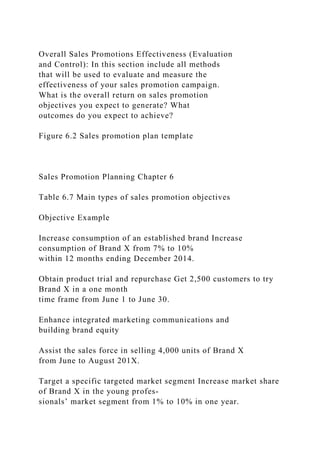
promotion manager in conjunction with the account
executive. Figure 6.2 shows a template for a sales
promotion plan.
Developing Sales Promotion Objectives
The first step in the development of sales promotion
recommendations is for the IMC planner to state the
objective for the sales promotion. As in all the other
IMC areas, the objective should be SMART (specific,
measurable, attainable, relevant, and time-bound).
Examples of potential promotion objectives available
to the IMC planner are to introduce new products,
stimulate sales, or encourage multiple purchases. Keep
in mind that the trade and consumer promotion objec-
tives should be closely linked. Both of these types of
sales promotion objectives share similar end goals, the
difference is toward whom the promotions are aimed
and in the incentives provided to each group. Typically,
point-of-purchase promotions serve as a bridge between
both the trade and final consumer promotions. For
promotional executions aimed toward the end user or
consumer, five basic objectives are listed below (Belch
and Belch, 2012).
f06.03_OMM651.ai
Trade
Objectives:
Strategies (or Strategy):
Tactics:
Rationale:
Evaluation Methods:
Consumer
Objectives:
Strategies (or Strategy):
Tactics:
Rationale:
Evaluation Methods:
Consumer:
Sales Promotion Schedule/Budget. Insert the
specific, overall sales promotions executions to
be used for both trade and consumer promo-
tions. Remember, it is necessary to include
timelines and costs associated with each of the
promotional executions. There needs to be
rationale included for the timing of the sales
promotion activities.
Overall Sales Promotions Effectiveness (Evaluation
and Control): In this section include all methods
that will be used to evaluate and measure the
effectiveness of your sales promotion campaign.
What is the overall return on sales promotion
objectives you expect to generate? What
outcomes do you expect to achieve?
Figure 6.2 Sales promotion plan template
Sales Promotion Planning Chapter 6
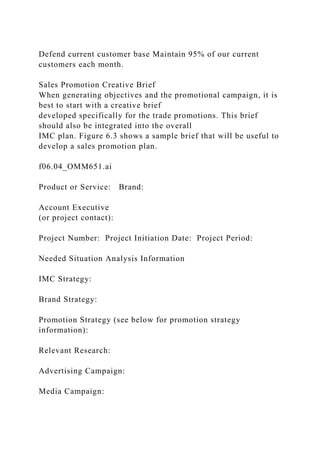
Table 6.7 Main types of sales promotion objectives
Objective Example
Increase consumption of an established brand Increase
consumption of Brand X from 7% to 10%
within 12 months ending December 2014.
Obtain product trial and repurchase Get 2,500 customers to try
Brand X in a one month
time frame from June 1 to June 30.
Enhance integrated marketing communications and
building brand equity
Assist the sales force in selling 4,000 units of Brand X
from June to August 201X.
Target a specific targeted market segment Increase market share
of Brand X in the young profes-
sionals’ market segment from 1% to 10% in one year.
Defend current customer base Maintain 95% of our current
customers each month.
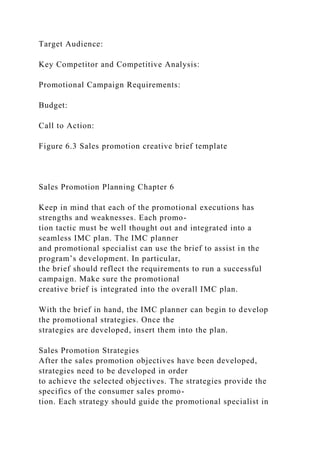
Sales Promotion Creative Brief
When generating objectives and the promotional campaign, it is
best to start with a creative brief
developed specifically for the trade promotions. This brief
should also be integrated into the overall
IMC plan. Figure 6.3 shows a sample brief that will be useful to
develop a sales promotion plan.
f06.04_OMM651.ai
Product or Service: Brand:
Account Executive
(or project contact):
Project Number: Project Initiation Date: Project Period:
Needed Situation Analysis Information
IMC Strategy:
Brand Strategy:
Promotion Strategy (see below for promotion strategy
information):
Relevant Research:
Advertising Campaign:
Media Campaign:
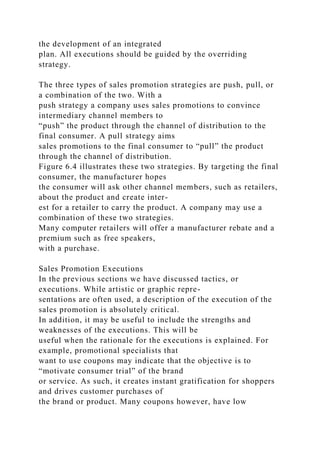
Target Audience:
Key Competitor and Competitive Analysis:
Promotional Campaign Requirements:
Budget:
Call to Action:
Figure 6.3 Sales promotion creative brief template
Sales Promotion Planning Chapter 6
Keep in mind that each of the promotional executions has
strengths and weaknesses. Each promo-
tion tactic must be well thought out and integrated into a
seamless IMC plan. The IMC planner
and promotional specialist can use the brief to assist in the
program’s development. In particular,
the brief should reflect the requirements to run a successful
campaign. Make sure the promotional
creative brief is integrated into the overall IMC plan.
With the brief in hand, the IMC planner can begin to develop
the promotional strategies. Once the
strategies are developed, insert them into the plan.
Sales Promotion Strategies
After the sales promotion objectives have been developed,
strategies need to be developed in order
to achieve the selected objectives. The strategies provide the
specifics of the consumer sales promo-
tion. Each strategy should guide the promotional specialist in
the development of an integrated
plan. All executions should be guided by the overriding
strategy.
The three types of sales promotion strategies are push, pull, or
a combination of the two. With a
push strategy a company uses sales promotions to convince
intermediary channel members to
“push” the product through the channel of distribution to the
final consumer. A pull strategy aims
sales promotions to the final consumer to “pull” the product
through the channel of distribution.
Figure 6.4 illustrates these two strategies. By targeting the final
consumer, the manufacturer hopes
the consumer will ask other channel members, such as retailers,
about the product and create inter-
est for a retailer to carry the product. A company may use a
combination of these two strategies.
Many computer retailers will offer a manufacturer rebate and a
premium such as free speakers,
with a purchase.
Sales Promotion Executions
In the previous sections we have discussed tactics, or
executions. While artistic or graphic repre-
sentations are often used, a description of the execution of the
sales promotion is absolutely critical.
In addition, it may be useful to include the strengths and
weaknesses of the executions. This will be
useful when the rationale for the executions is explained. For
example, promotional specialists that
want to use coupons may indicate that the objective is to
“motivate consumer trial” of the brand
or service. As such, it creates instant gratification for shoppers
and drives customer purchases of
the brand or product. Many coupons however, have low
redemption rates and are inconvenient
to retailers. All executions should have examples. Examples
show what is to be used and how the
promotions fit with the other IMC mix variables.
f06.05_OMM651.ai
Pull Strategy Push Strategy
Promotion PromotionCustomer CustomerRetailer
RetailerManufacturer
or Service Provider
BUY
BU
Y
BU
Y BUY
BUY
BUY
BU
Y
BU
Y BUY
BUY
Figure 6.4 Pull and push strategies
Post-Test Chapter 6
It is important to provide a rationale for every specified
consumer sales promotion activity. Each
activity needs to be justified and the associated costs need to be
explicit. Normally, a cost benefit
analysis will suffice.
Evaluation of Sales Promotions
After developing and executing consumer sales promotion
activities, an evaluation plan is needed
to determine their overall effectiveness. If the goal is not
achieved, the IMC planner needs to iden-
tify the specific reasons why. Perhaps the objective was
unrealistic. The IMC planner needs to use
this information for restating the objective in the future.
However, the reason may have been due
to an uncontrollable variable (the economy, competition,
technology) and beyond the control of
the IMC planner.
› Learning Check
Reflect on your learning by answering the following questions:
1. What are the types of objectives most used with sales
promotions?
2. What is the difference between pull and push strategies?
3. Which sales promotion strategy do you think is more
effective when targeting other businesses?
Summary and Resources
This chapter focused on the tactic of sales promotions. Sales
promotions are used to promote sales,
typically short-term. A distinction was made between sales
promotions aimed toward the trade,
and promotions aimed toward the end user of the product or
service. Sales promotions are ancil-
lary tactics that help the major categories of advertising and
personal selling. Any promotion aimed
at the trade is used to increase sales in a B2B setting. Consumer
promotions are used to stimulate
the final consumer to act by making purchases. Often the
promotions are used to increase the fre-
quency or quantity of product purchased. Promotions such as
event marketing may also be used to
generate brand or company awareness.
Information was provided as to where the sales promotion tactic
fits into the overall integrated
marketing communication plan. Additionally, templates were
provided that help make sure the
sales promotions are seamless and integrated with the other
IMC activities and tactics.
Post-Test
1. Which of the following is NOT an advantage of sales
promotions?
a) It is easy to measure the success of most sales promotions.
b) Sales promotions coordinate well with other IMC tactics,
including online marketing
and advertising.
c) Frequent sales promotions are always good for a company’s
image.
d) Sales can be kept more level throughout the year when sales
promotion incentives
are offered.
Post-Test Chapter 6
2. In which type of trade promotion does a retailer receive a
discount or incentive from a manu-
facturer in exchange for performing a specific function?
a) Trade incentive
b) Trade contest
c) Trade allowance
d) Trade show
3. A toothpaste promotion manager would like to see 5,000 new
customers try the toothpaste
brand in March. This is an example of which type of sales
promotion objective?
a) Defending current customer base
b) Obtaining product trial or repurchase
c) Targeting a specified targeted market segment
d) Increasing consumption of an established brand
4. Why is the short-term nature of sales promotions sometimes a
disadvantage?
a) Because though they encourage short-term sales, they often
do not build brand loyalty.
b) Because customers prefer the more long-term discounts that
come with other types of
IMC elements.
c) Because the deadlines associated with sales promotions keep
many customers from being
able to use them.
d) Because they do not have a chance to improve sales as much
as long-term marketing
efforts can.
5. Which type of consumer promotion is the most expensive for
the company?
a) Sampling
b) Cash refunds and rebates
c) Coupons
d) Premiums
6. When creating sales promotion objectives and campaigns, it
is suggested to begin with a(n)
a) sponsorship idea in mind.
b) push strategy.
c) sales promotion creative brief.
d) analysis of the competition.
Answers
1. c) Frequent sales promotions are always good for a
company’s image. The correct answer
can be found in Section 6.1.
2. a) Trade incentive. The correct answer can be found in
Section 6.2.
3. b) Obtaining product trial or repurchase. The correct answer
can be found in Section 6.3.
4. a) Because though they encourage short-term sales, they
often do not build brand loyalty.
The correct answer can be found in Section 6.1.
5. a) Sampling. The correct answer can be found in Section 6.2.
6. c) sales promotion creative brief. The correct answer can be
found in Section 6.3.
Key Terms Chapter 6
Key Ideas
• While promotion includes all types of communication,
sales promotions are limited to
executions that stimulate short-term responses.
• Sales promotions can complement other IMC efforts and
can help differentiate a brand from
the competition.
• The use of sales promotions can strengthen sales and help
to engage consumers and shoppers
with an additional benefit of creating even more sales, store
traffic, or behavioral changes.
• When a sales promotion is not immediate, there is usually
a deadline associated with the
sales promotion.
• Sales promotions are easy to track with the use of codes,
website addresses, redemption rate
information, or determining the increase in sales as a result of
the promotion.
• Sales promotions can be associated with consumer
promotions, directed to the final user;
trade promotions, directed at retailers or wholesalers instead of
consumers; or sales force
promotions, directed at the company’s own sales force.
• Decisions regarding sales promotions include the budget;
size of the incentive to be offered;
conditions for participation, promotion, and distribution of the
incentive; duration of the
promotion; and how the sales promotion will be measured.
• The strategy behind trade promotions is to persuade
resellers to carry new items and more
inventory, buy ahead, promote the company’s products and give
them more shelf space, and
push products to consumers.
• Examining consumer behavior at the point of purchase
helps explain how consumers make a
decision to buy, and how the marketer can impact that decision.
• Promotional plans and campaigns should be developed for
the entire IMC campaign period,
typically a year. They should also be refined or changed during
the campaign if they are
ineffective, or if it is discovered that a specific promotional
execution is more effective than
others.
• Sales promotion strategy should guide the promotional
specialist in the development of an
integrated plan. All executions should be guided by the
overriding strategy.
Key Terms
advertising allowance A manufacturer compensates retailers for
advertising its products.
bill back allowance Allowances are given to retailers for
featuring a particular brand in their ads
or for using special displays in the store; after receiving a bill
from the retailer for services ren-
dered, the manufacturer grants an allowance toward the
retailer’s next purchase.
BOGO A sales promotion; stands for buy one (product) get one
(product).
cash refunds/rebates Money returned to someone (usually the
trade or end user) for making a
purchase.
cents-off deals (also called price-packs) Offer consumers a
temporary price reduction off the
regular price of a product.
compulsiveness The degree of openness shoppers have to
impulse purchases.
Key Terms Chapter 6
consumer promotions Sales promotions that are aimed to the
final user of a product or service.
contest A sales promotion that may not be free and requires
skill to win or is based on both
chance and skill.
cooperative advertising Two or more companies or divisions
share the costs associated with
some type of advertising or promotion.
cooperative merchandising agreement (CMA) Formal agreement
between the manufacturer
and retailer committing the party to a specific marketing effort.
coupon A piece of paper used in place of money (usually by the
end user).
cross promotions When one brand is used to advertise or
promote another noncompeting prod-
uct, brand, or service.
cross ruffing A type of cross promotion that occurs when two
promotional materials are pack-
aged together.
deal proneness A shopper’s propensity to purchase products that
are on sale or when the shop-
per is offered some type of deal.
display allowance A manufacturer compensates retailers for
using special displays in
their stores.
diverting Occurs when a retailer purchases a product at a
reduced price in one geographical area
and ships it to another geographical area where it is sold for a
higher price.
exit fees Fees retailers charge to remove a product from the
shelf.
feature proneness A consumer who likes to use coupons, FSIs,
or some type of circular,
e-coupon, or other feature to encourage the consumer to make a
purchase.
forward buying Buying products or services at today’s price to
sell or deliver at a later date.
free-standing inserts (FSIs) Coupons and other promotions
distributed in a separate publica-
tion such as newspapers and magazines.
frequency or loyalty programs A sales promotion in which
consumers are rewarded for fre-
quently making purchases of a business’s products or services.
guarantees A promise that the product or service will perform as
stated.
point-of-purchase (POP) display or point-of-sale (POS) display
Specialized sales promotions
found in a retail store; they often hold products and are found
near the check-out location.
premiums A free item given to a buyer, typically for the buyer’s
patronage.
premiums and bonus packs Trade incentives by which retailers
receive free merchandise instead
of discounting the price of the product.
price-off Discounts are given on products offered during a
specific period of time.
pull strategy A company aims sales promotions to the final
consumer to “pull” the product
through the channel of distribution.
Key Terms Chapter 6
push money Cash or gifts given to resellers for their attempts at
“pushing” a manufacturer’s
product to end users at point of sale.
push strategy When a company uses sales promotions to
convince intermediary channel mem-
bers to “push” the product through the channel of distribution to
the final consumer.
sales force promotions Promotional activities aimed toward a
company’s sales staff
sampling Products given free to consumers in order to create
future sales of the product
or service.
slotting allowance Fees paid by product manufacturers, to
retailers, in order to have the retailers
carry their products.
specialty advertising A type of sales promotion that provides
free, typically low-cost items to the
trade or consumers in order to create a reminder of the company
or product.
spiff money Money or other incentives that are used to motivate
retailers or salespeople to
increase their sales performance over a given period.
sponsorship A type of sales promotion in which an organization
pays part or all of a program’s
cost in exchange for recognition.
straight discount (price-off, off-invoice, or off-list) A monetary
deduction given to intermediar-
ies to carry a product (or product line; straight discounts are
often given to retailers who order
large quantities of products.
sweepstakes Drawings of chance that are free to enter (no
purchase required).
tie-in A type of cross promotion in which two or more brands
(or companies) join to develop
coupons, refunds, contests, rebates, etc.
trade allowance Some type of monetary or other compensation
given by an intermediary to a
retailer in return for the retailer’s agreement to feature the
manufacturer’s products in some way.
trade contests Types of promotional activity aimed toward the
trade, where the trade may
answer questions or engage in an activity that results in a prize
being awarded.
trade incentive A promotional activity where the trade
undertakes a function on behalf of the
manufacturer or service provider; trade incentives are similar to
allowances.
trade premiums An incentive where retailers receive
merchandise free of charge instead of
receiving a discount on merchandise.
trade promotions Any promotional activity aimed toward the
trade.
trade shows Large events that brings together many sellers to
showcase their products
or services.
warranties Assurances about a product or service.
Critical Thinking Exercises Chapter 6
Discussion Questions
1. What are sales promotions? Why do companies rely on sales
promotions? Where do they fit in
the overall IMC plan?
2. What is the difference between a consumer promotion and a
trade promotion? Why do you
think these promotions differ?
3. What impact do coupons have on the consumer?
4. Why do most retailers pay close attention to their promotions
at point-of-sale? What is the
benefit compared to the cost of developing these types of
promotions?
5. Defend the statement “Trade promotions are important to
having a synergistic IMC plan.”
Critical Thinking Exercises
1. Go online to one of the coupon sites shown in Table 6.5 and
select three coupons that
interest you.
a) Why do you think the company placed the coupons on this
site?
b) What effect do you think the coupons will have on the
purchase of products and
services?
c) Do you think the coupons will increase the likelihood you
will buy this product?
2. Use the Internet to find an event with multiple sponsors. List
four of the sponsors and state
why each would sponsor the event. Include concepts from the
chapter in your analysis.
3. Go to a retail store and write down three sales promotions
that the store is having. What is the
purpose behind each promotion? Explain what makes them
effective or ineffective.
4. Evaluate the Inman and Winer model of in-store decision
making (Figure 6.1). Is there any-
thing the model does not consider? Apply the model by
providing an example of a person
going to a store.
Additional Resources Chapter 6
Continuing Project
As with the other tactical executions, it is necessary to create a
plan for sales promotions. Presented
below is a template that you can use to insert your sales
promotion plan. Keep in mind that this
plan will need to be integrated into the overall IMC plan.
Additional Resources
Institute of Promotional Marketing (UK)—Trade association:
http://www.theipm.org.uk/
Sales Promotion Careers—Explains what is involved in sales
promotion positions: http://www.
aroj.com/careers/marketing-sales-and-advertising/sales-
promotion-executive.html
List of sales promotion agencies—
http://www.dmnews.com/sales-promotion-agencies/
directory/4661/1/#
Trade
Objective:
Strategies (or Strategy):
Tactics:
Rationale:
Evaluation Methods:
Consumer
Objectives:
Strategies (or Strategy):
Tactics:
Rationale:
Evaluation Methods:
Consumer:
Sales Promotion Schedule/Budget. Insert the specific, overall
sales
promotions executions to be used for both trade and consumer
promo-
tions. Remember, it is necessary to include timelines and costs
asso-
ciated with each of the promotional executions. There needs to
be
rationale included for the timing of the sales promotion
activities.
Overall Sales Promotions Effectiveness (Evaluation and
Control). In this
section include all methods that will be used to evaluate and
measure
the effectiveness of your sales promotion campaign. What is the
overall
return on sales promotion objectives you expect to generate?
What
outcomes do you expect to achieve?
http://www.theipm.org.uk/
http://www.aroj.com/careers/marketing-sales-and-
advertising/sales-promotion-executive.html
http://www.aroj.com/careers/marketing-sales-and-
advertising/sales-promotion-executive.html
http://www.dmnews.com/sales-promotion-
agencies/directory/4661/1/#
http://www.dmnews.com/sales-promotion-
agencies/directory/4661/1/#
Case Study Chapter 6
Case Study: J. C. Penney and the
Failed Sales Promotion Strategy
In October 2011, J. C. Penney hired Ron Johnson as chief
executive officer. Johnson is a veteran of
Target Corporation and Apple®. He is credited for Apple’s
genius bar concept. Johnson’s first move
was to change J. C. Penney’s sales promotion strategy from a
promotion focus based on sales and
coupons to a simpler format called Everyday Low Pricing
(EDLP) strategy, with occasional promo-
tions (Misonzhnik, 2012). The campaign about the changes
launched in February 2012. J. C. Penney
spent $80 million a month on marketing to promote the IMC
campaign, which included television
commercials with comedian Ellen DeGeneres. The new pricing
was called “Fair and Square.” The
three-tiered strategy included
1. everyday prices,
2. month-long values,
3. and best prices.
For the best prices, J. C. Penney marked down merchandise
every first and third Fridays of the
month. This was unlike the sales promotional pricing strategy of
other department stores in which
sales promote percentage-off merchandise and the store offers
coupons or special promotions.
Company management believed these changes would make
pricing less confusing for customers. In
a launch event held in New York City in January 2012, Johnson
said
“The department store is the number one opportunity in retail
today. We are going to
rethink every aspect of our business, boldly pursue change, and
create long-term share-
holder value, as we become America’s favorite store. Every
initiative we pursue will be
guided by our core value to treat customers as we would like to
be treated—fair and square.
Beginning February 1, we will have Fair and Square Pricing,
making every day a great day
to shop” (J. C. Penney’s Transformation . . ., 2012).
The move was meant to revitalize the struggling retailer. This
transformation also involved rear-
ranging the selling space and opening “stores within a store” to
better place consumer attention on
the merchandise. The transformation included other changes to
the IMC, including a new logo and
creating a new brand identity.
In April 2013, Ron Johnson was fired. The new strategy did not
work as indicated by losses of more
than $1.1 billion in the year ending February 1, 2013. The stock
dropped 60% in one year (Hall,
2013). The company plans to move back to using frequent sales
promotions.
Critical Thinking Questions:
1. What are the advantages and disadvantages of Johnson’s sales
promotion strategy?
2. What factors cause a consumer to choose one department
store over another?
3. Why do you think the change in strategy did not work?
Point of Purchase Advertising International—Largest trade
group of professionals interested in
marketing at retail: http://www.popai.com/
Coupon Information Corporation—An organization that
attempts to improve security in the
coupon industry: http://www.couponinformationcenter.com/
Promotional Marketing (UK)—A source of news on the
industry: http://www.promomarketing.
info/
http://www.popai.com/
http://www.couponinformationcenter.com/
http://www.promomarketing.info/
Finance Project
50 points
Buying a car is not easy. Decisions go far beyond the color and
how many doors it has. Prices can change
drastically by the number of features added to the vehicle or by
whether it is new or used.
Research a new automobile of your choice and write a report
that includes:
a) A descriptions of the auto and why you chose it. Cite where
obtained information. (5 pts)
b) A table listing all the specifications about the auto as well as
the price. (4 pts)
c) Two options for financing detailing terms and conditions. (8
pts)
d) Formatted amortization schedules for each financing option
using Excel (16 pts).
e) Two comparable vehicles (new or used) listing where sold
and price (8 pts).
d) A summary of the “Best Choice” for you and why (4 pts).
e) A financial plan with supporting mathematical calculations
for saving the money instead of
borrowing it (5 pts).
Personal Selling
Learning Objectives
Upon completion of this chapter the student will be able to:
• Define personal selling and explain where it fits into the
overall integrated marketing
communication plan.
• Understand and explain the advantages and disadvantages of
personal selling.
• Describe the steps in the sales cycle.
• Describe the different selling strategies.
• State the main types of selling.
• Outline the areas in a department and individual sales plan.
5
© Iakov Filimonov/iStock/Thinkstock
Pre-Test Chapter 5
Pre-Test
1. Which of the following is NOT true about personal selling?
a) It is an expensive tactic.
b) It involves building individual relationships with customers.
c) It is no longer conducted completely face-to-face.
d) It involves less intimacy than other IMC variables.
2. Which of the following accurately describes an advantage of
personal selling?
a) Personal selling saves companies a lot of money, because it
is less expensive to contact
customers directly than to take out pricey advertising spots.
b) Because it relies on relationship building, personal selling
works well even if an individ-
ual salesperson is untrained or ineffective.
c) In personal selling, the customer provides instant feedback to
the salesperson, who can
help resolve any problems, building a positive image for the
company.
d) Personal selling has a better reach than advertising, allowing
salespeople to reach many
more consumers than any other medium would.
3. The term “sales cycle” refers to
a) the amount of sales generated by integrated marketing
activities during a set period,
usually a year.
b) the variation in sales at different times during the calendar
year.
c) all of the activities that take place over the course of the
sales process.
d) the fluctuation in sales generated by a new product during its
lifetime.
4. A salesperson used a script to deliver a sales presentation.
When the potential customer did not
buy after the trial close, the salesperson moved on to a different
script. This salesperson was
using a
a) selling formula approach.
b) canned sales presentation.
c) consultative sales approach.
d) sales approach continuum.
5. Which type of selling has a longer sales cycle?
a) Trade selling
b) Retail selling
c) Telemarketing
d) E-marketing
6. What is one reason it is especially important that sales
objectives be created with the outcome
in mind?
a) Without this kind of objective, salespeople will have
difficulty with the closing step of
the sales cycle.
Introduction Chapter 5
b) Sales managers generally have little experience with creating
goals or objectives, so it is
important that they learn to write very clear objectives.
c) Salespeople are often paid based on whether sales goals and
objectives have been
reached.
d) Providing these objectives to potential customers helps
salespeople build relationships.
Answers
1. d) It involves less intimacy than other IMC variables. The
correct answer can be found in
Section 5.1
2. c) In personal selling the customer provides instant feedback
to the salesperson, who can
help resolve any problems, building a positive image for the
company. The correct answer
can be found in Section 5.2
3. c) all of the activities that take place over the course of the
sales process. The correct answer
can be found in Section 5.3
4. b) canned sales presentation. The correct answer can be
found in Section 5.4
5. a) Trade selling. The correct answer can be found in Section
5.5
6. c) Salespeople are often paid based on whether sales goals
and objectives have been
reached. The correct answer can be found in Section 5.6
Introduction
The authors wish to thank Ms. Courtney Kingery for co-
authoring the chapter.
Many people make money by selling cosmetics. Avon and Mary
Kay Cosmetics are two companies
that rely primarily on independent sale consultants to reach
their customers. The personal selling
may take place at a party designed to gather interested
consumers and showcase products. Or, it
may take place when a family member or friend gives out a
catalog of the products the consultants
sell. Regardless of the method, much of the selling from these
beauty consultants involves build-
ing relationships. The company representatives share
information, educate potential and existing
customers about products, and listen to their needs to find the
best products that will fit their
client base.
In the last chapter we took a look at the first tactical execution
for IMC planners, advertising.
For business-to-consumer (B2C) marketing communicators,
advertising is one of the most impor-
tant tactics. When developing an IMC plan, another important
tactical execution is personal sell-
ing. While many companies use personal selling as an
execution, the organizations involved in
business-to-business (B2B) marketing rely heavily on this
tactic. Because of the nature of personal
selling, it typically requires large investments in the sales
department (money and personnel). In
practice, many companies divide their marketing and sales
functions into separate units. It is rec-
ommended that personal selling be integrated into the overall
IMC plan to create synergy and
consistency when communicating with the target market. It is
important to make sure the sales
message is the same as the message sent to consumers via other
tactical executions such as advertis-
ing and promotion. Additionally, by keeping personal selling as
part of the IMC mix, companies
and organizations will realize additional savings from
administrative costs.
Overview of Personal Selling Chapter 5
5.1 Overview of Personal Selling
If you ask a child what they want to be when they grown up,
you might get a response like “astro-
naut,” “professional basketball player,” “model,” or “actor.”
Most children don’t aspire to be regional
sales managers or directors of sales, but every industry, service,
or not-for-profit needs sales to
drive revenue and continue operations. Sales are the backbone
of any revenue driven organiza-
tion. Conduct a search on “sales” on any job-posting website
and see how many results you get.
Nearly every company needs sales; most of them are done
through personal selling. We defined
personal selling in an earlier chapter as face-to-face
communications with a prospect or customer
(Manning, Ahearne, and Reece, 2012). As the definition states,
personal selling involves person-
to-person communication and interaction where the seller
attempts to persuade an individual to
purchase products from his or her organization. While this is the
most intimate form of marketing
communication, personal selling is also one of the most
expensive tactics in the IMC mix.
In the past, personal selling relied on face-
to-face communication. But with advances
in technology, personal selling has evolved
to include contact via telephone, email,
interactions on social media, and virtual
meetings held via the Internet. Personal sell-
ing is different from other IMC variables
because of the intimacy involved in commu-
nication and contact between the seller and
buyer. Instead of having contact with many
different consumers at once, personal selling
involves relationship building with one, or a
few customers at a time.
The location of the sales functions within
an organization depends largely on the type
of organization itself. If the organization is
primarily a manufacturing organization,
sales responsibility may fall within the com-
mercial and operational units. For a service or consumer-
focused organization, the sales respon-
sibilities may fall under an integrated sales and marketing
department. No matter where sales
responsibilities are located, coordination and communication
between the sales, marketing, and
public relations departments are critical for a successfully
implemented IMC plan.
A wide variety of companies ranging from hotels to financial
services hire salespeople. A career
in sales can be very rewarding. Benefits include recognition,
rewards (financial and personal), and
opportunities for advancement. A successful salesperson
typically has the following traits:
• Strong ethics and values
• A desire to achieve
• Confidence (believes in self and can handle rejection)
• Likes people and social interactions
• Assertive (expresses opinions in a self-assured manner)
• Cares about building relationships and not only making a
sale
• Has a win-win attitude (desire for both buyer and seller to
benefit from a sale)
Ingram Publishing/Thinkstock
▲▲ Instead of meeting in person, technology has enabled
salespeople to
use the Internet to meet with customers.
Overview of Personal Selling Chapter 5
Meet Courtney Kingery
Courtney Kingery has worked in sales and marketing in the
agriculture processing and food space
for over 17 years. Courtney is currently a lead strategic product
manager of Tate & Lyle’s health and
wellness portfolio for North America, Latin America, and Asia.
We asked
Courtney where she thought personal selling was headed in the
future.
Here is her response.
Q: How do you see IMC, marketing, and personal selling con-
verging during the next 10 years?
I foresee both a convergence and divergence of integrated mar-
keting communications, marketing, and personal selling over
the next 10 years rooted in impatience. Let’s first look at the
convergence. Marketing and sales are so intertwined that it is
like trying to separate the chocolate chips from the cookie. Yes,
you can eat them separately, but they are so much more satisfy-
ing when they are together. Sales can exist without marketing,
but as management and investors become more impatient for
top-
line sustainable growth, marketing’s preselling of the brand,
product,
or need development dramatically shortens the sales cycle, thus
generat-
ing faster revenue. Let me give you an example. When food
manufacturers
look to bring a new snack, drink, or food to our grocery store
shelves, the product development, and
therefore the sales cycle, is typically 18–24 months. My
organization was developing a new ingredi-
ent for food and beverage companies that was unlike anything
currently on the market. Six months
after the plant was open, we had our first commercial sale. How
did we shave 12 months off the sales
cycle? By using advertising and public relations to develop a
need and build interest in the ingredient
before it was even commercially available. Sales and marketing
converged to shorten the sales cycle
and give our impatient investors revenue.
Now, let’s look at the divergence. The divergence between IMC,
marketing, and personal selling is
taking place on two fronts: managerial impatience and
organization of duties.
First, management in many organizations is impatient and
information is imperfect. A thorough
thought-out and researched IMC plan can take months to
develop. Management does not have that
much patience or time to read a 100+ page document in detail.
Also, in dynamic business environ-
ments, decisions and strategies can’t wait for perfect
information. The result is that IMCs are get-
ting dissected and completed à la carte. In the previous example
of the new food ingredient, the
brand was developed first and launched with a PR campaign at
an industry trade event before any
advertising strategy or budget was developed or the ingredient
was even available for a personal
selling campaign. Each piece of IMC was treated as a smaller,
more manageable piece of the whole
because management wanted to move the project forward and
not wait for the perfect strategy to be
developed.
Second, we are seeing a divergence due to organizational
structuring and separation of duties. In
many organizations, sales and marketing professionals are being
asked to do more with less. As sales
territories are growing and marketing projects become more
sophisticated, sales and marketing
professionals are so focused on their responsibilities, they have
less time to lift their heads up and
look strategically across the entire landscape. There is less time
to observe the subtle interplay and
interaction between sales and marketing, when one’s attention is
focused on the contract negation
or the email blast right before one’s eyes. Recently, I oversaw
the development and production of a
webinar hosted by an industry trade publication. I was so
focused on aligning the webinar content
with our messaging and promoting the webinar to meet our
target of 200 leads that I completely
(continued)
Advantages and Disadvantages of Personal Selling Chapter 5
› Learning Check
Reflect on your learning by answering the following questions:
1. What is the definition of personal selling?
2. How has technology changed the field of personal selling?
3. In your opinion, what are the downsides of using technology
in personal selling?
5.2 Advantages and Disadvantages of Personal Selling
Let’s take a look at some of the issues involved in personal
selling. We will start by looking at
numerous advantages of using this tactic and follow up with an
assessment of the disadvantages
associated with personal selling.
Advantages of Personal Selling
There are several advantages to using personal selling as part of
a company’s IMC mix. One advan-
tage of personal selling includes the ability to customize the
message to the buyer’s needs. Instant
feedback from the buyer is conveyed to the salesperson
allowing the salesperson to immediately
adapt the sales pitch to any concerns from the buyer.
Another advantage is that personal selling allows for product
demonstrations. A consumer can
try on the shoes or compare the picture clarity on big-screen
televisions before the product is pur-
chased. Because of the instant feedback, the salesperson can
immediately modify the information
and use open-ended questions to uncover the buyer’s needs and
understanding of the sales message.
Based on the salesperson’s understanding of a buyer’s needs
and wants, and his or her ability
to be flexible with the sales message, personal selling also
allows an organization to effectively
build long-term buyer-seller relationships. When a buyer
understands a seller’s needs and a seller
understands a buyer’s needs an integrated sales system can be
developed that serves both the
buyer’s and seller’s interests. Because of this, personal selling
allows for the development of effec-
tive relationships and continuity. If the customer feels special
and feels that the salesperson is
forgot to let the sales team know when the event was taking
place! Needless to say, the sales team was
a bit annoyed with me when they saw the promotion of the
webinar from the trade publication and
not from their own marketing manager (me). Forgetting to loop
our sales team in on a campaign is a
mistake that I won’t likely repeat.
So, where does this leave marketing managers? The manager
must align the right size of an IMC plan
for each of our organizations and projects. As we build our IMC
and develop our marketing and
sales strategies, we must understand the temperament of our
organization’s management, the abil-
ity of our sales teams, and the goals of our investors or owners.
In other words, we have to be skilled
politicians, mind readers, magicians, and a bit creative, too.
This is all in a day’s work for a marketing
professional.
Reflection Questions
1. How does Ms. Kingery’s company adapt to impatient
investors?
2. What part of Ms. Kingery’s answer do you agree with? Which
part do you disagree with? Why?
Advantages and Disadvantages of Personal Selling Chapter 5
interested, a happy customer is developed. Happy customers are
the key to sales, repeat business,
and increased profits.
Salespeople are in a position to collect information that helps an
organization to better meet the
demands of the changing market. This is another advantage of
personal selling. When a customer
provides information to a salesperson about new trends, the
information can be used to develop
new products to better meet customer needs.
Finally, salespeople help build a positive image for the
organization that they represent. When a
customer is unhappy and can address his or her concerns with a
knowledgeable, empathetic sales-
person who can resolve the problem, the customer is more likely
to have a favorable opinion of the
company.
Disadvantages of Personal Selling
The primary disadvantage of personal selling is the
cost. While technological advances in communication
have decreased the overall cost of communications,
the cost per contact between a buyer and a seller is still
very high.
Another disadvantage is limited reach. With adver-
tising, millions of consumers may be reached via one
medium. The cost to reach millions of consumers utiliz-
ing personal selling would be prohibitive. Accordingly,
“More money is spent on personal selling than on any
other form of marketing communications, whether it
be advertising, sales promotion, publicity or public
relations” (Ingram, T. N., LaForge, R. W., Avila, R. A.,
Schwepker, C. H., and Williams, M. R., 2004, p. 4).
Personal selling relies on salespeople. This is an advan-
tage as well as a disadvantage. Because selling relies on
the skills and abilities of the salesperson, untrained or
ineffective salespeople can lose sales. One poor sales-
person can instantly damage a company’s reputation.
Another disadvantage is the time involved in develop-
ing and executing a sales plan. Many sales managers
report that time constraints and the additional respon-
sibilities of professional or B2B buyers makes it increas-
ingly difficult to find the required time to convey all the
benefits and values of the products. Because planning
helps with time management, assessment, and opera-
tions, it is essential to make the time up-front to develop an
effective sales plan and to integrate
it into the overall IMC plan. Many business people say they
don’t have time to plan: We say you
don’t have time not to plan! Time constraints force sellers to
continually fine-tune and improve
their sales techniques. An efficient and productive salesperson
must be well prepared, have a deep
understanding of the product and brands, and have a deep
understanding of the customer’s needs
or wants in order to make the most of the time spent with the
buyer. Preparation will result in more
efficient sales contacts, which will minimize the overall cost of
personal selling.
© monkeybusinessimages/iStock/Thinkstock
▲▲ An advantage of personal selling is building a positive
image for the company; a disadvantage is the limited reach.
Often salespeople meet with one person or a few people at
a time.
The Sales Cycle Chapter 5
Table 5.1 summarizes the advantages and disadvantages of
personal selling.
Table 5.1 Advantages and disadvantages of personal selling
Advantages Disadvantages
• Ability to customize message
• Instant feedback from customer
• Ability to conduct product demonstrations
• Can build long-term relationships with customers
• Salespeople are in a position to collect market
information
• Salespeople can help build a positive company image
• High cost per contact
• Limited reach
• Time involved in developing plan
• Time involved in selling
• Poor salesperson can damage company image
› Learning Check
Reflect on your learning by answering the following questions:
1. What are three advantages to personal selling?
2. What are three disadvantages to personal selling?
3. In your opinion would you excel in a sales career? Why or
why not?
5.3 The Sales Cycle
The sales cycle consists of the activities that occur during the
course of the sales process. For exam-
ple, the duration of the sales cycle could be very short if selling
a new pair of shoes, or quite long if
selling a new generator for a manufacturing facility. The
marketing manager’s role in the sales cycle
will vary depending on the type of organization or industry. A
retail or consumer packaged-goods
company, for example, is often directed by marketing which
drives sales. Alternatively, with many
manufacturers or B2B sales companies, marketing plays a more
supportive role. No matter the type
of organization, salespeople should know the sales cycle and be
able to answer a few basic questions
about it. A complete outline of a sales cycle is illustrated in
Figure 5.1.
As with all steps of the IMC, the sales cycle is only a guide, and
while all of the activities in the sales
cycle will be touched on, the extent to which one engages in the
activity varies by industry, brands,
and product. When including personal selling in the IMC, the
marketer must have an understand-
ing of the duration of the sales cycle and account for that in the
plan.
Let’s take a closer look at the parts of the sales cycle, beginning
with prospecting.
Prospecting
Sometimes referred to as a new business development or new
business selling, prospecting is the
act of identifying potential customers. A prospect is someone
who is qualified to purchase a good
or service. Prospects can come from lists that are purchased,
industry contacts, trade shows, or
consumers who walk in the front door of a shopping center. Due
to the low number of actual
prospects that turn into purchasing customers, it is important to
always have a pool of prospects.
Another reason for prospecting is attrition in the existing
customer base due to factors such as a
The Sales Cycle Chapter 5
company going out of business, the customer moving or
retiring, the customer’s needs change, or
a deteriorating relationship between the customer and
salesperson.
Joe Girard is listed in the Guinness Book of Records as the
world’s greatest salesperson. He compared the process
of prospecting to filling up the seats on a carnival Ferris
wheel. When the ride starts, a person gets on and the wheel
rotates so the next person or couple can get on. Once the
ride ends, people get off and the process starts over again.
Prospecting involves making sure there are customers
waiting to replace customers who leave. “No matter what
you sell, if you’ll spend some time each day filling the seats
on the Ferris wheel, you will soon have a line of people wait-
ing to be sold” (Girard, 2005, p. 61). A salesperson’s existing
and potential customers make up the prospect base. The
goal of prospecting is to grow the prospect base.
There are many methods and sources for prospecting.
Shown here are common sources of prospects.
Referrals
A referral is a prospect who has been recommended by a
previous buyer of the product or by someone who is famil-
iar with the salesperson or products. Using referrals, sales-
people have a higher probability of closing the sale. The
use of referrals will typically reduce the length of the sales
cycle. These are the best types of prospects because, in most
cases, the previous buyer has already qualified the prospect.
f05.01_OMM651.ai
Prospecting
Qualification
Sales
Presentation
(Pitch)
Quoting
&
Negotiation
Closing
Implementation
Buyer, R&D,
Engineering,
Family
Figure 5.1 Personal selling sales cycle
Liang Zhen/ChinaFotoPress/Getty Images
▲▲ Salesperson and bestselling author Joe Girard speaks
to a Chinese audience. He has his own website at
www.joegirard.com.
http://www.joegirard.com
The Sales Cycle Chapter 5
In addition, the person who is referring the prospect is often
viewed as a third-party endorsement
for the seller’s products and services. Many techniques are used
in order to generate referrals. The
most popular is the endless chain method. With the endless
chain method, buyers are simply
asked, “Who do you know that may have a need or want for our
products and services?” Many
companies provide a cash incentive or prize for customers who
refer other customers to their busi-
ness (although many require a purchase from the new prospect
before the incentive will be issued).
Friends, Family, and Reference Groups
Friends, family, and reference groups are important in building
a customer base. These are the
people that are closest to the salesperson and who usually trust
the salesperson and his or her
products. In this method, these people are contacted to see if
they know of anyone who may be
interested in purchasing a product or service. The salesperson
may not sell to friends or family, but
data on potential prospects may result from using this method.
Social media is increasingly being
used by salespeople to connect with family, friends, and
reference groups.
Directories and Databases
Salespeople can find prospects by looking through the many
trade and organization directories
that list people and companies who may have a need or want for
a product. For example, salespeo-
ple selling movies may use a directory of motion picture
distributors to gain access, or learn per-
sonal or business information about people or companies with a
need for entertainment content.
Networking
Networking is the act of meeting people and using personal
connections to profit from them.
According to Harvey Mackay, author of Dig Your Well Before
You’re Thirsty, “If I had to name the
single characteristic shared by all the truly successful people
I’ve met over a lifetime, I’d say it’s
the ability to create and nurture a network of contacts”
(Mackay, 1999). Networking can result in
higher sales when a prospect becomes a customer. Networking
through social media (especially
LinkedIn) is becoming more common for salespeople.
Tips on Building a Professional Network
This video provides tips for building a professional network:
http://www.youtube.com/watch?v=DytAqtpoQJM
Other Sources
There are other sources for prospecting which include trade
shows, trade publications, online
databases, seminars, and cold calling (contacting prospects
without having an introduction or
appointment).
Although this list is not exhaustive, it does provide a good
foundation to begin customer pros-
pecting. Data collected on customers and prospects are often
stored in a computer-based software
system. These programs are known as sales force automation
(SFA) or customer relationship man-
agement (CRM) systems.
Qualification
Qualification is the next step of the sales cycle. Through
qualification, prospects are reviewed to
identify those customers or consumers that have the greatest
possibility of purchasing. In other
http://www.youtube.com/watch?v=DytAqtpoQJM
The Sales Cycle Chapter 5
words, which of the prospects match the characteristics of the
target market? This step allows the
marketer or salesperson to focus resources on those customers
or consumers who are most likely
to purchase.
A salesperson wants to make sure the prospect is qualified to
purchase. In order to gain this infor-
mation, data on the potential customer (prospect) must be
obtained. The following are key ques-
tions to ask when trying to qualify individuals.
a) Want and need: Does the prospect have an actual or
perceived need or want for the prod-
ucts and services? Has there been enough information provided
to the prospect to make
him or her want the product?
b) Willingness to buy: Is the prospect willing to buy the
products and services? Is there an
urgency to buy? Is the prospect willing to buy from a particular
company or salesperson?
c) Ability: Is the prospect able to buy? In other words, do they
have the money required for
purchase? If not, is there a way to help finance the purchase for
the buyer (especially in a
retail setting, like selling automobiles)?
d) Authority: Does the prospect have the authority to make the
purchase? Often salespeople
waste time making presentations to corporate individuals who
don’t make the buying
decisions.
If this sounds a lot like the characteristics of a useful target
market, covered in an earlier chapter,
it’s because a prospect should mirror a company’s target
market. The characteristics of a prospect
and useful target market are similar.
Sales Presentation
In the sales presentation step, the salesperson meets with a
prospect or customer to present product
information and determine whether the product meets the
person’s needs. The sales presentation
is also known as the sales pitch. The sales pitch needs to be
pertinent to the buyer and convey how
the product or service will satisfy the buyer’s need. This is
when the advantages of personal selling
are realized and hopefully when the sale is made. The seller can
personalize the message for the
buyer and demonstrate the product being sold. Since several
individuals may be involved in the
decision-making process, the sales presentation may need to be
repeated several times and tailored
to several different audiences. For example, if you are selling a
generator to a manufacturing facil-
ity, you will need to present cost savings benefits to the
purchasing department and present the
ease of maintenance to the engineering department. The
repetition of this stage drives up the cost
of personal selling.
In developing a sales presentation, salespeople concentrate on
creating a sales plan, and make sure
the plan includes the following:
a) Well-defined (SMART) objectives
b) The executions (pamphlets, products, etc.) needed to fulfill
or reach the objectives
c) A plan or method of providing outstanding customer service
Quoting and Negotiation
Since the primary purpose of selling is for the seller to realize a
profit, at some point, the topic
of money and terms must come up. At this stage of the process,
price, terms, and conditions are
The Sales Cycle Chapter 5
presented to the buyer in a formal document. This is a sales
quote. A sales quote allows the poten-
tial buyer to see all the costs involved in a deal. Often buyers,
especially professional buyers, will not
make an immediate purchase. They will have objections to
making the purchase such as the price
is too high, the color is wrong, the product doesn’t solve their
problem, etc. The buyer may counter
with a lower offer and negotiations can go back and forth
several times. Most sellers either love or
hate negotiations. Strong negotiation skills are an art and talent
and the topic of several profes-
sional development programs.
Negotiation is “a process by which two or more parties attempt
to resolve their opposing interests”
(Lewicki, R. J., Barry, B., and Saunders, D. M., 2010, p. 6).
There are three characteristics of a nego-
tiation (Lewicki, R. J., Saunders, D. M., Barry, B., 2011, pp. 6–
7):
1. There are two or more parties involved.
2. There is a conflict of needs and wants between the parties.
3. The parties negotiate by choice.
According to Nierenberg (1995, p. 3), an expert in negotiation,
the success of a negotiation depends
on the following:
1. having an issue that is negotiable
2. the negotiators are interested not only in taking, but also in
giving, are able to exchange value
for value, and must be willing to compromise
3. the negotiating parties trust each other to some extent
The goal of the negotiation is to create a situation in which both
the salesperson and customer or
prospect reach an agreement that is mutually satisfying. This is
known as a win-win negotiation.
While this sounds reasonable, it is difficult because negotiation
involves fully understanding a
customer’s concerns and overcoming objections. If the
salesperson is focused more on relationship
building and less on trying to get a sale, the process is more
likely to end in a win-win negotiation.
According to Ron Willingham (2003), noted author on selling,
“When trust and rapport are strong,
negotiation becomes a partnership to work through customer
concerns. But when trust and rap-
port are weak, almost any negotiation becomes too combative”
(p. 154).
The Three Ts of Sales Negotiation
Sales negotiation requires time, trust, and tactics. In this video,
Mark Hunter, speaker and sales con-
sultant, explains how to use each “T” effectively and the risk of
not using them properly:
http://www.youtube.com/watch?v=9knCV-Lj9kM
Closing
The close is when the buyer says “yes” to the terms and
conditions of the sale. When closing the
sale, the terms of the agreement are finalized and the seller has
a firm commitment from the buyer
to move forward with the implementation of the agreement.
There are many methods to close a sale
and it’s important for a salesperson to know these methods and
plan which methods will be used
in the sales presentation. In addition, it’s important for the
salesperson to recognize closing clues
(those things the buyer says or does that indicate readiness to
make a purchase). For example, a
http://www.youtube.com/watch?v=9knCV-Lj9kM
The Sales Cycle Chapter 5
customer who says, “This software would be ideal for our
department,” is sending a clue to the
salesperson that he or she is ready to buy. Closing clues can
also be nonverbal such as when a cus-
tomer carefully studies the product and product literature.
One of the ways to help close a sale is to focus on the dominant
buying motive (DBM) of the buyer.
This is the one area that has the greatest influence on the buying
decision. For example, if a cus-
tomer keeps asking questions and has concerns about the ease of
using a piece of equipment, this is
a dominant buying motive. The salesperson should answer these
concerns and use the DBM to help
close the sale. One way to identify the DBM is to look for that
one important product benefit that
excites the prospect and keep focusing on that benefit. Table 5.2
summarizes some basic methods
used by salespeople in order to make sure the sale gets closed.
Table 5.2 Main methods to close a sale
Type Description Example
The assumptive close In an assumptive close the salesperson
simply assumes the sale has been
made.
The retail salesclerk may say, “I’ll go
ahead and wrap this present while you
continue to look.”
The direct appeal close The salesperson asks for the sale in an
up-front manner.
“Would you like to buy the car today?”
Summarize the benefits
close
The salesperson summarizes the
benefits the buyer receives by making
the purchase.
“The time frame more than meets
your needs, you indicated the color
fits well with the décor, and the
designer understands your style.”
The multiple-choice close With this type of close, the sales-
person gives the prospective buyer a
number of choices in order to facili-
tate closing the sale.
“Would you rather pay all up front,
pay half now and half on comple-
tion, or would you prefer a monthly
payment plan?”
Combination close This close combines two or more
methods.
“The time frame more than meets
your needs, you indicated the color fits
well with the décor, and the designer
understands your style. Are you ready
to sign the contract?” (summarize the
benefits and direct close)
Implementation
Implementation is the execution of the agreement. Often at this
point, the customer is handed over
to customer service or a support team. Implementation might
include determining delivery and
installation of the product purchased, scheduling the service
provided, or bagging the shoes pur-
chased and thanking the customer for the business.
Implementation is often where long-term cus-
tomers are created. The quality of the service after the sale is
what customers often value the most.
Continuation of the Sales Cycle
The sales cycle does not stop with the implementation. To
continue to grow and develop additional
sales with the buyer, the seller must start to prospect again for
new opportunities. Simply asking,
“What else can I help you with?” will open the door to
additional opportunities.
The Sales Cycle Chapter 5
With an understanding of the sales cycle, salespeople must also
understand the particular sales
cycle that is germane to their organization. In addition, they
must understand how the sales cycle
will impact other areas of the IMC plan. The following
questions will help sales representatives
gain a better picture of their sales cycle. Salespeople should ask
themselves the following questions:
• What is the duration of the sales cycle; 1 to 2 hours, or 18
months?
• What steps in the sales cycle are most important to the
organization in order to close the
sale? Which steps take the most time?
• How many people from the buying side are involved in the
decision and what are their roles?
In other words, who is the audience?
• What does the bidding and negotiation process look like?
Do bids have to be in writing to a
purchasing department or are the prices posted as final?
• What is the conversion rate from prospects to qualified
customer to buyer? Marketers need
to keep that funnel filled with prospects. How many are needed?
• What motivation does the sales force have for closing a
sale? The motivation of the sales force
is a big factor in how successful the personal selling campaign
is.
When developing a sales plan, one pitfall to avoid is the
assumption that the seller is speaking
to the primary decision maker. Rarely is the purchasing decision
in the hands of a single indi-
vidual. While the husband may be admiring big-screen
televisions or the wife trying on shoes,
the opinion and the approval of family members or friends is
often required. In trade sales,
engineering or research and development departments are often
involved in the final approval
Case in Point: Social Media Helps Salespeople Sell More
According to Jim Keenan, social sales specialist, salespeople
are abandoning some selling methods
and migrating toward social media to connect with customers.
Keenan believes that when sales-
people use social media it helps improve sales and profits
(Fidelman, 2013). According to Keenan,
“A lead today can be someone complaining on Twitter that their
current vendor is driving them
crazy. It can be a question in a LinkedIn group. It can be an
unassuming comment on a Facebook
page. Today, leads are far more than a call from a friend, a
business card from an event or a chance
encounter on a flight” (Fidelman and Keenan, 2012).
Keenan’s consulting firm, A Sales Guy Consulting, conducted a
study on the impact of social media
on a salesperson’s quota attainment. The survey found that in
2012, 78.6% of salespeople using social
media to sell performed better than those not using social
media. Over 50% of the respondents
stated that social media helped close at least one deal and over
40% said they closed between two
and five deals by using social media. In terms of time spent,
about 50% of salespeople who took the
survey said they spent less than 10% of their selling time using
social media (Social Media and Sales
Quota, 2013). Top social media sites used to sell were LinkedIn,
Twitter, Facebook, Google,
and blogs.
Keenan believes the old sales model of cold calling is being
replaced by the new sales model in which
salespeople use social networks to educate and engage
customers.
Reflection Questions
1. Do you agree with Keenan that social media sales are
replacing traditional selling methods? Why
or why not?
2. How many salespeople are using social media to sell? Why
isn’t the percentage higher?
Selling Approaches Chapter 5
of the vendor or product. These additional approvals and
reviews must be planned for in the
sales process.
› Learning Check
Reflect on your learning by answering the following questions:
1. Does the sales cycle always follow the same steps? Why or
why not?
2. What are some methods for prospecting? In your opinion,
which are most effective?
3. Describe the main closing methods. In your opinion, why is it
difficult for salespeople to ask for
the sale?
5.4 Selling Approaches
There are several different styles or approaches to selling. The
approach implemented depends on
many variables including manager’s preferences, the industry,
type of organization involved in the
sales execution, the product or brand, along with the objectives
and goals of the sales organization.
The approach is determined when planning and is decided prior
to the sales presentation. Jolson
(1973) sees the approaches as a continuum. On one end is the
fully automated approach (such as a
video) and on the other end is the unstructured approach where
the salesperson adapts what is said
to the customer and situation. The approaches in between
include a memorized presentation; semi-
automated, which may include video and a presentation; and an
organized approach, which may
include an agenda with room to answer questions that are
presented. This continuum is depicted
in Figure 5.2.
The next section discusses the three main approaches: canned,
consultative, and the selling for-
mula approach. The selling formula approach is a hybrid of the
other two approaches.
Canned Sales Presentations
In a canned sales presentation, salespeople use a script as they
deliver their sales presentation.
During each presentation, the salesperson is looking to close the
sale. For each prepared script,
there is a trial close (an attempt at closing). If the customer
doesn’t buy after the attempt, the sales-
person goes to another script and another trial close until the
sale is made (or the customer doesn’t
buy). This is a typical approach when the sales staff isn’t
trained in the selling area or where a short
presentation is required. The problem with a canned approach is
that it doesn’t focus on individual
customers, but rather, treats all customers the same (it assumes
the customers have the same needs
Figure 5.2 Sales approach continuum
f05.03_OMM651.ai
Fully-automated Memorized
Semi-automated Organized
Unstructured
Source: Adapted from Jolson, M.A. (1973).
Types of Selling Chapter 5
and wants). Many have experienced the canned sales call. When
a salesperson doesn’t have experi-
ence using this approach he or she sound like they are reading
off of the script.
According to Jolson (1973, 1975), the canned sales
presentation, when done correctly, can be very
effective and can be well received by the customer.
Selling Formula Approach
When using a selling formula approach, basic customer needs
and wants that are similar for each
buyer are identified through research and past experience.
Based upon those general needs and
wants a script is developed for the salesperson. The script walks
the prospect through a series of
logical steps to a preplanned close. Unlike the canned approach,
the salesperson using a selling
formula approach has some flexibility to bring the prospect into
the conversation or presentation
in order to clarify needs. If there are new needs, the salesperson
incorporates those into the presen-
tation, then goes back to the script to lead the prospect to the
close. This would be in line with the
organized approach in the continuum depicted in Figure 5.2.
Consultative Sales Approach
The consultative sales approach embodies the marketing
concept by placing the customer at the
center of all decisions. The goal of this approach is to identify
needs, build relationships, and ensure
that customers are satisfied. Utilizing a consultative sales
approach, prior to a sale the sales staff
is required to research the customer, industry, and products in
order to identify specific customer
wants and needs. The consultative sales approach follows a plan
or process, but has flexibility built
in for the sales staff so that they can alter their style or
approach any time during the presentation.
When using a consultative approach, listening skills are very
important. The salesperson begins
the presentation by outlining many benefits of the products or
services in order to connect with
the customer. After the opening, the salesperson should spend
the majority of time listening to the
customer and learning about the customer’s needs and wants in
order to create a sales presentation
specially tailored to that potential buyer. In consultative selling,
the sales representative (sales rep)
uses the information the prospect provides and then presents the
vast assortment of products and
services offered by the sales rep’s company as a potential
solution to the buyer’s problems or needs.
› Learning Check
Reflect on your learning by answering the following questions:
1. In what instances is a canned sales approach useful?
2. What are the benefits of the consultative selling approach?
3. Which selling approach would be best suited for a realtor
selling a home? Why?
5.5 Types of Selling
It is important for the IMC planner to understand and implement
the appropriate type of selling
to meet the stated objectives. What are the choices in regard to
types of selling? The following sec-
tions describe the most popular types, but are not inclusive of
all types of selling. Within each of
these types, decisions will have to be made regarding the
classification of sales preferred by the sales
manager(s).
Types of Selling Chapter 5
Trade Selling
Trade selling is also known as B2B selling (business-to-
business selling). The product being sold is
not a consumer good, instead the product is part of material that
goes into making another com-
pany’s product(s). The sale is typically to members of a supply
chain. In other words, the trade will
purchase products to be used in the development of other
products that will be sold to the final
consumer, or they will purchase products that help their
business operations. Those involved in
trade selling may sell finished goods and services to retailers
who sell to the final consumers. They
may also sell their goods and services to wholesalers who in
turn store, or warehouse the products
and services to retailers. This occurs when manufacturers don’t
want to service retail accounts.
This type of selling generally has a longer sales cycle and more
buyers involved in the purchasing
decision. The typical approach for trade selling is to use
consultative selling.
Retail Selling
In retail selling a canned or selling formula
approach is often used. Here the consumer
comes in direct contact with a salesperson
in a retail environment or online. The con-
sumer comes in with a specific need or want
that he or she wants to satisfy (sometimes
that need is unstated, like the “I’m just brows-
ing” customer). This type of selling often has
a shorter sales cycle and is often focused on a
few buyers in the purchasing decision. A key
to retail selling is to make sure the consumer
comes into contact with the sales person-
nel, rather than wandering the store without
assistance. It is easier to up-sell or close a sale
when there is personal contact between the
salesclerks and buyers. For larger sales such
as automobile sales, a selling formula or con-
sultative approach is used.
Telemarketing
In telemarketing the telephone is used to perform many of the
sales functions. In telephone sales
(telesales), a canned or selling formula approach is almost
always used. Sales managers make a
guess (based upon past experience or research) as to the needs
and wants of the potential cus-
tomers. After the needs and wants are identified, the sales
manager will also forecast the types of
objections the salesperson will face. Based upon the most
common objections, sales managers will
prepare responses for their telesales personnel.
Compared to retail selling, when the buyer comes to the seller
with a defined need, the seller may
be cold calling a prequalified buyer. The IMC planner must be
aware of and consider “do not call
lists” and local privacy regulations before implementing a
telemarketing technique.
E-Marketing
In e-marketing, the sales functions are conducted online rather
than in person. Similar to telemar-
keting, e-marketing sales presentations or information are sent
from a salesperson to a prequalified
Jack Hollingsworth/Photodisc/ Thinkstock
▲▲ Retail selling occurs on a daily basis. How does the sales
process differ
depending on the merchandise being sold?
Developing Sales Plans Chapter 5
buyer’s email account or delivered via website or web-based
meetings. This greatly reduces the cost
of personal selling. While e-marketing information may include
unsolicited and unwanted “spam”
messages, it can be used as a complementary method to trade,
retail, or telemarketing. It is becom-
ing common practice to place a “chat line” online to accompany
the e-marketing efforts. The chat
line allows customers to phone the salesperson with questions
about online products prior to mak-
ing a purchase. This added feature aids the salespeople in
closing a sale or upselling the customer
in real time, even though it’s online sales. As with
telemarketing, the IMC planner must be aware
of privacy regulations before implementing e-marketing
techniques.
› Learning Check
Reflect on your learning by answering the following questions:
1. What is the difference between trade and retail selling?
2. What type of approach is most often used in telemarketing?
3. In your opinion, is personal selling over the Internet
effective? Why or why not?
5.6 Developing Sales Plans
As with other IMC variables, a plan must be developed for the
personal selling function. A sales
plan is developed at two levels: the department sales plan and
the individual sales plan.
The Department Sales Plan
The department sales plan should include discussion and
information on just how the sales func-
tion fits in with other variables. There must be coordination
between departments, especially if
sales teams are a separate function from the rest of the
integrated marketing areas.
Prior to the setting of sales objectives, sales management will
revisit the IMC mission, vision, and
objectives to understand the role personal selling is going to
play within the marketing commu-
nication plan. Based upon the focus of personal selling (Is it
going to be the main communication
method? Will it supplement advertising? Is it going to be used
at all? Is it needed to communicate
sales promotions?), a sales plan is developed. As with any
business plan, the sales plan has the com-
ponents of objectives, strategy, and tactics. Let’s take a look at
each of those areas.
Objectives
As with all other variables in the IMC plan, the first step in the
development of a good sales plan is
to develop a list of objectives. Often the objectives can be
secured from the director or vice presi-
dent of sales. These objectives must flow from the overall
company strategy and objectives, and
complement the objectives of the other IMC variables. If
objectives are not available from manage-
ment, the IMC planner must decide what the function of
personal selling will be during the cam-
paign. Sales objectives must be clear, measurable, and
controllable to ensure that the sales team is
productive. The objectives must be communicated to everyone
involved in the IMC process. Sales
compensation is typically tied to the achievement of the sales
objectives.
Because it’s common practice to use the attainment of sales
objectives and sales goals as a tool to
pay salespeople, the objectives must be created with the end in
mind. What is it that the company
wants to accomplish in terms of sales, and at what level should
the sales staff be working? Keep in
Developing Sales Plans Chapter 5
mind that some of these objectives overlap with other areas of
the IMC mix because they are inter-
related. Table 5.3 shows some of the objectives that may be
used when developing a sales plan.
Table 5.3 Types of sales objectives
Type of Objective Description
Conversion Typically expressed as a ratio, this objective states
the number of sales that should be
closed based upon the total sales calls made.
New account These types of objectives state the number of new
accounts needed to bring in the
desired cash flow and profits.
Financial Financial objectives are the main form of objectives
for most sales plans. The objec-
tives may depict sales, profits, or return on investment.
Sales volume Sales volume objectives are most often expressed
as dollar sales and unit sales. The
number of orders generated by the sales staff may also be used.
Market share These objectives state the total market share a
company is looking to achieve for a
particular market. Often the market share that each individual
salesperson needs to
generate to achieve the overall goal is stated.
Customer retention These objectives pertain to the service
provided by the sales staff to clients or buyers
that keep a customer from defecting. These types of objectives
may be expressed as a
goal to reduce the number of buyer complaints since this is an
indication of whether or
not a customer will stay or leave.
Specific salesperson
activity
Although these objectives are developed for the sales function
as a whole, each indi-
vidual salesperson can also be held accountable by taking these
objectives into account.
Items measured may include the number of sales reports needed,
training, number of
sales calls to make, and the number of times required to service
an account.
Objectives are very important in sales planning, just as in the
other functional areas of integrated
marketing communication planning. Once the objectives are set,
sales managers can look to the
objectives to help develop the overall sales strategy or
strategies to be used in reaching the market.
Selling Strategies
Developing a sales strategy is the next step in producing an
effective, integrated sales plan. The
strategy is how the salesperson will achieve the objectives. The
strategy will flow from the sales
practices, industry of the firm, and the duration of the sales
cycle. The strategy must also be con-
sistent with other areas of the IMC plan. The three most
common strategies are feature-benefit,
product positioning, and price.
Feature-Benefit Strategy
A person will not buy a product unless it helps him or her. The
successful salesperson is able to con-
vert product features into benefits that are relevant to the
prospect or customer, called a feature-
benefit strategy. A feature is a word, words, or a sentence used
to describe a product. Color, size,
shape, and price are all features of a product. A benefit is an
advantage that the product provides
a customer. While the color white is a feature of a blouse, a
benefit would be that the blouse keeps
a person cooler in hot weather because the white color reflects
the sun. If a salesperson tells a cus-
tomer that the camera comes with a 4 GB memory card, the
customer may not know what this
means. To convert the feature into a benefit the salesperson will
determine what this feature means
for the customer. The salesperson may say, “This camera comes
with a 4 GB memory card which
means you can take and store about 1,000 pictures.” The ability
to store a large number of pictures
Developing Sales Plans Chapter 5
is an advantage for the customer if he or she buys the camera.
To remember to convert features to
benefits it helps to use phrases that connect a feature to a
benefit. Terms like “this means,” “which
means,” and “because” connect a feature with a benefit. Table
5.4 provides examples of converting
a feature to a benefit:
Table 5.4 Feature-benefit conversion
Product: Apple® Ipad with Retina display
(http://www.apple.com/ipad/features/)
Feature Benefit
Retina display This means you can see pictures and websites in
the clearest resolution possible.
A6X chip Which means you won’t be waiting for websites or
apps to load and you will be able
to watch videos without interruptions.
10 hours of battery power This means that you can accomplish
many tasks and don’t have to keep recharging
the battery every few hours.
FaceTime HD Camera Which means you can see high quality
video of your family and friends when you
call them.
Remember that the benefit has to be relevant to the customer so
it’s important to ask questions
upfront about what the customer is looking for when buying a
product.
Converting Features into Benefits
In this video, Bob Phibbs, sales trainer, explains how to convert
features into benefits:
http://www.youtube.com/watch?v=L2TUi4kNW0I
Product Positioning Strategy
Recall from Chapter 1 that positioning is how customers think
about products, brands, or com-
panies in a market in relation to the competition. The concept of
value proposition was covered
in Chapter 2 but is worth repeating here. The value proposition
is the set of value and benefits the
product or company provides. With a product positioning
strategy the salesperson attempts to
differentiate the products and services offered by the company
by creating a strong value proposi-
tion. Differentiation involves determining the competitive
advantage of a company or products
(unique selling proposition) as well as separating the product or
company from other competitors.
What is the value proposition of Starbucks’ coffee? How is
Starbucks different from its competitors?
The reason people are willing to pay $2–$5 for a cup of coffee
is that Starbucks provides a great
atmosphere where people can enjoy a quality cup of coffee
(value proposition). Starbucks differ-
entiates itself from the competition through the excellent
customer service and apps that make it
convenient to do business with the company.
Price Strategy
Some companies use a price strategy to sell. Although a high or
low price can be emphasized with
this strategy, it is more often a low price that is presented.
Often salespeople can lower price with
quantity or seasonal discounts. The salesperson can also remove
or “unbundle” some of the prod-
ucts or services provided to lower the cost. Often pricing
strategies are used in conjunction with
a product’s position in the product life cycle. When a product is
in the maturity or decline state of
the product life cycle, low-price strategies are often used. A
price strategy is often used with caution
because too many discounts cut into profits and sales
commission.
http://www.apple.com/ipad/features/
http://www.youtube.com/watch?v=L2TUi4kNW0I
Developing Sales Plans Chapter 5
The Customer Who Only Cares About Price
This is a humorous video about a person who is only concerned
about price
and negotiates the price of a service from $1,600 to $200.
Salespeople do not want
a customer who only cares about price because there is very
little room to add value.
Low prices also cut into the company profits and salaries of
salespeople.
http://www.youtube.com/watch?v=7_qwjcxwUqw&feature=yout
ube_gdata_player
Tactics
Sales tactics are the specific actions taken to implement the
strategy. Tactics involve how the mes-
sage will be delivered to the customer or prospect. Will the
salesperson use a PowerPoint presenta-
tion? A product demonstration? What questions will the
customer be asked? Where will a meeting
take place? Who will follow up with the customer? The
successful salesperson understands the
value of preparation. The salesperson who prepares in advance
is much more successful than the
one who does not. Experienced salespeople should avoid the
“I’ve been in sales for many years; I
don’t need to prepare” mentality.
In order for salespeople to be effective, they need effective
sales management. Although it is not the
function of this book to provide an in-depth look at sales
management, it is important to note to
the IMC planner the important responsibilities of sales
management in supporting the IMC sales
plan. These include: (1) organization of resources, (2) recruiting
top talent, (3) leading, (4) motivat-
ing, (5) training, (6) managing communications and
information, and (7) supervising sales staff.
Without these functions properly executed by sales
management, the sales variable of the IMC will
not be successful.
Rationale
Once the sales functions have been planned, a rationale must be
provided for each activity. How
does the use of consultative selling or hard selling fit the
objective and strategy? Why is a tactic such
as telemarketing or e-marketing being used over other methods?
The rationale should extend to all
areas of the sales function, including the sales techniques and
demonstration materials. A ratio-
nale should be provided for the timetables, budgets, personnel,
and prospect qualification criteria.
Finally, the rationale should explain how these functions create
synergy and fit the other aspects
of the IMC plan.
Evaluation
Just as the individual sales call should be evaluated, the overall
sales strategy must also include
methods for evaluation. The methods of evaluation should flow
directly from the objectives. The
effectiveness of the selling will be measured and noted against
the objectives. Evaluating sales staff
is often more difficult than it seems. While one basic evaluation
tool considers how much each
salesperson is bringing in, environmental or market conditions
may affect the bottom-line figure.
There may also be production or commercial delays that slow
delivery of products to customers and
delay sales. When evaluating sales outcomes, it is necessary to
understand all factors in the market
and the sales cycle before making many changes in the overall
plan.
A template for a sample personal selling plan is shown in Table
5.5. The sales plan helps manag-
ers see the big picture of what occurs within a sales department.
A sales manager would fill in the
blanks with the needed information. It is also a good idea to
generate a separate individual sales
plan. Often a budget is also included in the plan.
http://www.youtube.com/watch?v=7_qwjcxwUqw&feature=yout
ube_gdata_player
Developing Sales Plans Chapter 5
Table 5.5 Template: The departmental personal sales plan
Sales cycle summary
Objectives
Strategy
Tactics
Rationale
Evaluation
Case in Point: Motorola Plans a Price Strategy to Gain a
Foothold in the Smartphone Market
According to CNN, in 2012 Android had 68.8% of the
smartphone market. Coming in second place
was Apple’s iOS operating system with 18.8% of the market.
Together, the two operating systems
accounted for 87.6% of all new smartphones in 2012
(Kelly, 2013). Motorola Mobility is trying to gain
market share by introducing the Moto X smartphone.
Although Google owns Motorola Mobility, the com-
pany has not been impressed with the Motorola prod-
uct line. The Moto X may change that.
To differentiate the Moto X smartphone, it will be the
first to be assembled in the United States, which com-
pany management believes will allow the company to
respond more quickly to demand. Motorola Mobility
CEO, Dennis Woodside, wants to lower the price of
the Moto X when compared to the major players to grow
market share. Woodside also wants to use a low-price strategy
to win over customers. He said that
because the company is not one of the top companies in the
industry, the company will offer “high-
quality, low-cost” devices. “We can attack, and we can do
things and challenge the business model
that exists now in ways that our competitors can’t,” he said
(Newman, 2013).
Reflection Questions
1. How might a salesperson position Moto X against the
competition?
2. Who do you think the target market might be for the Moto X?
3. A feature of the product is that it will be assembled in the
United States. Convert this feature into
a benefit for retailers who are considering carrying the
smartphone.
AP Photo/LM Otero
Developing Sales Plans Chapter 5
Individual Sales Plan Outline
The second level of sales planning is planning at the individual
level. Because of the process involved
and the time commitment required to generate sales, especially
in trade sales, it is important for
salespeople to develop their own plans. In this section we
present an outline that salespeople can
use as a guide in generating and preparing the necessary
information for successful completion of
the sales cycle. Remember, it must be integrated with all other
aspects of the organization’s sales
and marketing plan to be successful. Often companies develop
guides to help a salesperson with
the selling process. The guides should be easy to read.
The importance of planning before making a call cannot be
stressed enough. With planning, cus-
tomer contacts become more efficient and the sales cycle is
more likely to be shortened, reducing
the cost of personal selling to an organization. The basic steps
for a sales plan include prepare,
plan, present, and evaluate. Because the marketing concept
deals with meeting customer needs
at a profit, so should the sales plan. Remember, happy
customers are repeat customers and repeat
customers are the lifeblood of any organization. It is easier and
less expensive to retain an existing
customer than prospect and qualify a new customer. Let’s take a
look at the outline.
Prepare
Prepare and gather general supporting information that can be
applied across all customers.
1. Describe the company and the competition. List the
competitors and the competitive advan-
tage of the product or service in one clear and concise sentence.
2. Complete the feature-benefit analysis for the products and
services. Turn the features into ben-
efits to add value for the customers. This can be completed in a
table. Use phrases that connect
features and benefits. It helps salespeople to remember the
sentence “my product will be able
to help you accomplish (X) by bringing you (Z) value.”
Salespeople don’t just state what the
product or service does, but also state the value it brings to the
customer. Thinking about how
the customer would benefit from the product is an important
part of the process.
3. List product details and secure all product information
documentation. The details vary by
product or services provided, but generally include price,
packaging details, product specifica-
tions, delivery or service hours, lead time, or material safety
data sheets. Compile comparable
information on competitive products. While this information
may not be necessary in the
presentation, it helps to be prepared when asked a question
about the competition.
4. A detailed explanation of the description of a qualified
customer is included. This will be used
to filter prospects to qualified customers. This should follow
closely the identified target market
from the marketing communication plan.
5. Any type of integrated marketing communication that may be
used to assist in the sales
of the product or service should be secured. For example, if
advertising is going to be used
obtain copies of the ads. Are there any sales promotional
materials available? Business cards?
Brochures? All elements of the integrated marketing plan must
support each other.
Plan
This is a specific sales plan to present for a specific customer or
customer encounter. Often a sales-
person will give a formal presentation; other times it is less
formal and very short in duration. In
retail settings, it may not be possible to have a specific plan for
each customer and many of the steps
may not apply or are skipped due to the short time available.
Often retail associates are helping
customers complete the sale and may not be involved in
consultative selling.
Developing Sales Plans Chapter 5
1. Review the sales cycle and sales duration. Evaluate where
this customer is in the sales cycle. For
retail sales, the sales cycle may be collapsed into a single
encounter; for trade sales, the sales
cycle may be several months or years.
2. Think about what is already known about this customer.
Research information that is not
known such as the customer’s business segment, products sold,
company history, and growth
strategy. Much of this information can be found on customer
websites or in annual reports to
shareholders. This may have greater application for trade sales.
3. Determine the objective(s) and strategy for the sales call.
Start with the end goal in mind and
think about what will be presented to reach the goal. One of the
goals should always be to
move the customer through the sales cycle towards a purchase.
Think about the best strat-
egy that will achieve the objectives. Will a consultative selling
approach be used or is a price
strategy more applicable? Not all meetings will end with a sale.
An objective of a call may be to
qualify a prospect or to present a price quote.
4. Preplan the opening. A salesperson has only about seven
seconds to make a strong first impres-
sion. Salespeople need to smile, have a strong handshake,
maintain eye contact, and speak
clearly throughout the introduction (Pitts, 2013). It also is
recommended that the salesperson
thank the buyer for his or her time, propose an agenda for the
discussion, check if the cus-
tomer has anything to add to the agenda, and state the value of
the call to the customer. In
retail sales, a smile and greeting are typical.
How to Deliver a Strong Opening Message
In this video, Keith Rosen, sales advisor, explains how to
develop a compelling opening message:
http://www.youtube.com/watch?v=RwqisNG6LJ4
5. Prepare probing questions. Before one can present the value
of a product to the customer, one
must understand what the customer values. High-caliber
salespeople know that probing is one
of the most important parts of the sales call. Probing involves
using open-ended questions to
explore the needs and wants of the customer. These questions
support the overall objective of
the call and move the customer through the sales cycle. Such
questions include, “What compa-
nies do you currently buy from?” and “What are you looking for
in a product?” Salespeople also
use follow-up questions like, “Why is that product feature
important to you?”
6. Plan the demonstration or presentation. Will the
demonstration occur onsite or elsewhere?
What features and benefits will be presented to the customer?
What sales aids are required to
complete the demonstration?
7. Prepare a list of closing clues to look for.
8. Salespeople need to go over various closing techniques and
choose the one that will work best.
They list the closing technique that supports their objectives.
For example, if the salesperson
does not get agreement from the buyer on the price quote to
close the sale, then the salesperson
should consider how he or she can seek agreement to present the
information to the buyer’s
supervisor.
9. Develop a plan to sell additional items to the customer. What
additional items are available to
complement the product? For example, could an extended
warranty for the big-screen TV be
sold or a complimentary necklace for the new dress?
http://www.youtube.com/watch?v=RwqisNG6LJ4
Developing Sales Plans Chapter 5
10. Plan for delivery or installation if needed.
Determine how delivery or installation
will be completed and when. Determine
if there will be additional charges for
these services, or if they were included
in the price quote.
11. Rehearse. Salespeople should practice
their presentations before delivering
them, and develop a method to critique
presentations. An effective strategy is
to have the sales staff do a practice run
before giving the presentation to cus-
tomers. Another effective strategy is to
have sales managers join salespeople on
calls and provide constructive criticism.
Present
For most sales methods (other than the
canned presentation), there should be more
listening than presenting. By listening, the salesperson can pick
up on key problems and needs.
This allows the salesperson to tailor the presentation to satisfy
those needs rather than present a
canned presentation that may have no relevance to the buyer. In
the beginning of a presentation,
the customer does most of the talking and the salesperson
listens. This is due to the probing ques-
tions the salesperson is asking. Toward the end the opposite
occurs, the salesperson does most of
the talking and the customer listens. At this time the
salesperson is presenting information to meet
needs uncovered earlier in the presentation. Here are the
suggested steps for the presentation:
1. Execute the sales plan including the opening, probing
questions to uncover needs, product
demonstration, and overcoming objections.
2. Ask for the close. A salesperson should not be afraid to trial
close and close the sale. Customers
know a salesperson is trying to sell something.
3. Ask about additional opportunities to sell complementary
products.
4. Determine if there are any follow-up items that either the
salesperson or the customer is
responsible for. These items should be noted so that both parties
understand what will happen
going forward.
Evaluate
Once the presentation is complete, the effectiveness of the
presentation needs to be evaluated.
Below are questions that should be answered to assist in the
evaluation process.
1. Determine how the sales call will be documented.
2. Note whether the objectives were achieved. If the objectives
were not achieved, what was
learned? Did the customer move further down the sales cycle?
3. If the sale was made, what post sale activities are required?
This is an opportunity to tie in sales
promotion aspects of the IMC plan. For example, one might
mail literature to the customer on
new product launches or discount coupons for additional
business.
© Jacob Wackerhausen/iStock/Thinkstock
▲▲It’s important for salespeople to recognize closing clues,
such as the
customer who expresses happiness when presented with the
product. In
this case, a couple likes the ring a jeweler is showing them.
Post-Test Chapter 5
4. Evaluate the overall effectiveness of the sales call. What
could have been done more effectively?
What went well? What are those elements that worked and could
be used by other salespeople
or other divisions?
5. Generate a total cost for the sales call. This should include
the salesperson’s time, any travel
expenses, cost of the demonstration or samples. This will be
combined with other salespeople’s
costs and go against the overall sales budget in the department
or company sales plan.
As can be seen, a great deal of thought and preparation goes
into selling prior to meeting with a cus-
tomer. The prepared salesperson is in a better position to meet
and exceed customer expectations.
› Learning Check
Reflect on your learning by answering the following questions:
1. Why is sales planning important?
2. How does selling work with other areas of the marketing
plan?
3. Explain each of the areas involved in an individual selling
plan (prepare, plan, present, evaluate).
Summary and Resources
In-depth coverage of the development of a sales plan was
discussed. The profession of personal
selling was explored and advantages and disadvantages
associated with personal selling were
explained. Pointed coverage of the sales cycle was provided,
and the steps involved in the sales
cycle, prospecting, qualification, the sales presentation, quoting
and negotiation, closing, and
implementation were explored. Additionally, the chapter
provided information on types of sell-
ing. The chapter ended with information on the development of
the sales plan. In particular, sales
objectives, strategies, and tactics were explained. A sample
sales plan outline was included in the
chapter to help facilitate the development of a well-thought-out
and comprehensive sales plan.
Post-Test
1. Which of the following is NOT true about personal selling?
a) It is an expensive tactic.
b) It involves building individual relationships with customers.
c) It is no longer conducted completely face-to-face.
d) It involves less intimacy than other IMC variables.
2. Which of the following accurately describes an advantage of
personal selling?
a) Personal selling saves companies a lot of money, because it
is less expensive to contact
customers directly than to take out pricey advertising spots.
b) Because it relies on relationship building, personal selling
works well even if an individ-
ual salesperson is untrained or ineffective.
Post-Test Chapter 5
c) In personal selling, the customer provides instant feedback to
the salesperson, who can
help resolve any problems, building a positive image for the
company.
d) Personal selling has a better reach than advertising, allowing
salespeople to reach many
more consumers than any other medium would.
3. The term “sales cycle” refers to
a) the amount of sales generated by integrated marketing
activities during a set period,
usually a year.
b) the variation in sales at different times during the calendar
year.
c) all of the activities that take place over the course of the
sales process.
d) the fluctuation in sales generated by a new product during its
lifetime.
4. A salesperson used a script to deliver a sales presentation.
When the potential customer did not
buy after the trial close, the salesperson moved on to a different
script. This salesperson was
using a
a) selling formula approach.
b) canned sales presentation.
c) consultative sales approach.
d) sales approach continuum.
5. Which type of selling has a longer sales cycle?
a) Trade selling
b) Retail selling
c) Telemarketing
d) E-marketing
6. What is one reason it is especially important that sales
objectives be created with the outcome
in mind?
a) Without this kind of objective, salespeople will have
difficulty with the closing step of
the sales cycle.
b) Sales managers generally have little experience with creating
goals or objectives, so it is
important that they learn to write very clear objectives.
c) Salespeople are often paid based on whether sales goals and
objectives have been
reached.
d) Providing these objectives to potential customers helps
salespeople build relationships.
7. Today, personal selling can be defined to include
a) face-to-face contact, phone calls, email and social media
contacts, and Internet
meetings.
b) in-person meetings and face-to-face online meetings only.
c) anything that involves voice contact, including phone calls or
in-person meetings, but
not written contacts like email or social media.
d) emails, advertisements, direct marketing, face-to-face and
online meetings, and
phone calls.
Post-Test Chapter 5
8. What is one reason that sales plans are essential?
a) Planning makes sales contacts more efficient, minimizing the
costs of using personal
selling.
b) Salespeople by nature are bad at time management, because
they would rather be inter-
acting with people than following time constraints.
c) Most companies require sales departments to submit formal
sales plans.
d) Most salespeople have too much free time, so plans are
necessary to make sure they stay
busy and serve the company’s best interests.
9. A salesperson making a sales pitch about office photocopiers
notices that her potential cus-
tomer keeps asking about paper jams and is excited to hear
about the copier’s unique technol-
ogy for avoiding jams. The salesperson has identified the
customer’s
a) dominant buying motive.
b) closing cues.
c) qualification.
d) authority.
10. What kind of sales approach might fall closest to the center
of the sales approach continuum?
a) A fully automated approach
b) A canned sales presentation
c) A consultative approach
d) A selling formula approach
11. Which of the following is NOT true about the common types
of selling?
a) In retail selling, a canned approach may be used except when
it comes to larger pur-
chases, in which a selling formula or consultative approach may
be more appropriate.
b) In telemarketing and in e-marketing, the integrated media
communication planner
needs to be very careful about privacy regulations designed to
protect consumers.
c) A consultative approach is most often used in telemarketing,
because it allows sales-
people to respond to the most common objections they face.
d) E-marketing works well in combination with retail, trade, or
telemarketing sales.
12. An office furniture company has an objective stating that
25% of sales calls should result in
sales being closed. This can best be described as a
a) conversion objective.
b) sales volume objective.
c) customer retention objective.
d) market share objective.
Answers
1. d) It involves less intimacy than other IMC variables. The
correct answer can be found in
Section 5.1.
2. c) In personal selling the customer provides instant feedback
to the salesperson, who
can help resolve any problems, building a positive image for the
company. The correct
answer can be found in Section 5.2.
Key Ideas Chapter 5
3. c) all of the activities that take place over the course of the
sales process. The correct
answer can be found in Section 5.3.
4. b) canned sales presentation. The correct answer can be
found in Section 5.4.
5. a) Trade selling. The correct answer can be found in Section
5.5.
6. c) Salespeople are often paid based on whether sales goals
and objectives have been
reached. The correct answer can be found in Section 5.6.
7. a) face-to-face contact, phone calls, email and social media
contacts, and Internet meet-
ings. The correct answer can be found in Section 5.1.
8. a) Planning makes sales contacts more efficient, minimizing
the costs of using personal
selling. The correct answer can be found in Section 5.2.
9. a) dominant buying motive. The correct answer can be found
in Section 5.3.
10. d) A selling formula approach. The correct answer can be
found in Section 5.4.
11. c) A consultative approach is most often used in
telemarketing, because it allows sales-
people to respond to the most common objections they face. The
correct answer can be
found in Section 5.5.
12. a) conversion objective. The correct answer can be found in
Section 5.6.
Key Ideas
• Personal selling is one of the variables in the IMC mix
and requires person-to-person com-
munication. It is used extensively as an IMC variable when a
firm is engaged in business-to-
business marketing and IMC.
• Personal selling allows IMC planners the ability to
customize their communications around
a client or buyer.
• Personal selling provides instant feedback when executed
properly. This feedback can
be used to hone the sales presentation, giving continuous
improvement to the personal
selling area.
• Personal selling, per contact, is very expensive.
Additionally, personal selling has a limited
reach when compared to the other IMC variables.
• In selling, sales go through stages or steps called the sales
cycle. An understanding of the
sales cycle helps IMC planners prepare better presentations and
allows them to concen-
trate on closing sales or floating trial closes during stages where
buyers are ready to make a
purchase.
• All salespeople prospect. Prospecting is the process of
identifying consumers who may have
a want or need for a product and who have the ability to make a
decision to buy. The pros-
pects must also have the resources (i.e., money) to make the
purchase.
• Networking is a key to success in personal selling.
Salespeople should develop networks
of friends, family, and associates that have a need or want for
the products the salesperson
represents.
• In almost all cases, sales professionals must make
presentations or pitches to communicate
with their potential customers exactly why the customer should
buy from them. Benefits
are provided during a sales presentation. Salespeople should
always be prepared to make a
presentation.
Key Terms Chapter 5
• The goal of a sales presentation is to close the sale. Once
the customer has said “yes” to the
sales presentation and proposal, the sale is closed.
• Although there are many different types of sales
approaches and presentations, the consulta-
tive sales presentation and approach is the most widely used
method. In consultative selling,
the salesperson acts like a consultant and attempts to determine
the buyer’s motives, needs,
and wants and then finds products and services that meet or
exceed those needs.
• Product features are words, sentences, pictures, or some
other means used to convey what
the product or service looks like. Color and style are examples
of product features. It is help-
ful to benefit the product for the customer. A product benefit
simply tells the customer what
advantages are gained if he or she purchases the product.
Key Terms
benefit An advantage that the product provides a customer.
canned sales presentation A sales presentation that uses a
scripted message to sell.
close When the buyer says “yes” to the terms and conditions of
the sale.
closing clues Things the buyer says or does that indicate
readiness to make a purchase.
closing the sale The time in the sales process when the customer
makes a decision to buy the
product.
cold calling Contacting prospects without having an
introduction or appointment.
consultative sales approach This approach embodies the
marketing concept by placing the cus-
tomer at the center of all decisions; the goal of this approach is
to identify needs, build relation-
ships, and ensure that customers are satisfied.
consultative selling In consultative selling, the salesperson acts
as a consultant to the buyer,
attempting to solve the buyers’ problems by offering different
products and services.
differentiation Involves determining the competitive advantage
of a company or products as
well as separating the product/company from other competitors.
dominant buying motive (DBM) An area that has the greatest
influence on the buying decision.
endless chain method A method of obtaining customers by
asking current customers if they
know of anyone who can use the products or services.
feature A word, words, or a sentence used to describe a product.
feature-benefit strategy A sales strategy in which product
features are converted into benefits
that are relevant to the prospect or customer.
negotiation A process by which two or more parties attempt to
resolve their opposing interests.
product positioning strategy A sales strategy in which the
salesperson attempts to differentiate
the products and services offered by the company by creating a
strong value proposition.
prospect A potential customer who is qualified to purchase a
product or service.
prospect base The combination of a salesperson’s existing and
potential customers.
Critical Thinking Exercises Chapter 5
prospecting The act of identifying potential customers.
qualification Prospects are reviewed to identify those customers
or consumers that have the
greatest possibility of purchasing.
referral A prospect that has been recommended by a previous
buyer of the product or by some-
one who is familiar with the salesperson or products.
retail selling Sales made between a retailer and a buyer.
sales cycle Sales cycles are the steps or activities that occur in
the process of a sale.
sales quote A formal document that shows the price, terms, and
conditions.
selling formula approach A method of selling that is a cross
between a prepared sales presen-
tation and consultative selling; the sales formula uses prepared
questions to lead the prospect
through a series of steps to a logical conclusion (or close).
telemarketing Marketing a product or service using the
telephone; in regard to personal selling,
the salesperson contacts the customers via the telephone and
employs sales techniques to attempt
to close a sale.
trade selling The act of selling products and services to the
trade or industry as opposed to the
end or final consumer.
trial close An attempt at closing the sale.
win-win negotiation A negotiation in which both the salesperson
and customer or prospect
reach an agreement that is mutually satisfying.
Discussion Questions
1. What are some reasons that a company would not use
personal selling as part of the IMC mix?
2. Which areas or steps do you think are the most difficult to
accomplish in the sales cycle? Why?
3. What would you say to a friend or family member in order to
get prospects?
4. Write a few lines of what a salesperson might say if he or she
was using a consultative selling
approach. How would this differ from a canned approach?
5. Which technological advances do you feel have impacted
selling the most? Why?
Critical Thinking Exercises
1. Write about an experience where you were disappointed with
a salesperson and an experience
in which your expectations were surpassed. What attributes did
each salesperson possess that
formed your impressions about the experience?
2. Find two examples of a company that may embrace
consultative selling and write a summary
of the indicators.
3. Look up the elements of a strong business card and design
one for yourself as a sales represen-
tative for a firm of your choosing.
4. Navigate through the following website and find a sales job
that might interest you:
http://www.top10bestjobsites.com/jobsearchresults?qv=Sales.
http://www.top10bestjobsites.com/jobsearchresults?qv=Sales
Continuing Project Chapter 5
• What are the responsibilities of the position?
• Why does the position interest you? What might you not
like about the position?
• Look up the position (or closest to it) in the occupational
outlook handbook. What
did you find out? The census publication (occupational outlook
handbook) website:
http://www.bls.gov/oco/
Continuing Project
Below is a template for a sales plan. Use the product chosen
from the last chapter’s continuing
exercise and develop a sales plan. Remember that the sales plan
will become part of the overall
IMC plan.
The Perso
nal Sales
Plan Outli
ne
Sales cycl
e summar
y
Objective
s
Strategy
Tactics
Rationale
Evaluation
http://www.bls.gov/oco/
Case Study Chapter 5
Additional Resources
Directory.ac—An online, searchable business directory:
http://directory.ac/
Free Management Library—A free library that contains many
topics pertaining to selling:
http://managementhelp.org/sales/sales.htm
LinkedIn—A networking site for business professionals:
http://www.linkedin.com/
Zoominfo—A company that sells software that helps with
prospecting:
http://www.zoominfo.com/
National Association of Sales Professionals:
http://www.nasp.com/
Sales and Marketing Professionals Association:
http://www.smei.org/
The Sales Association: http://www.salesassociation.org/
Case Study: Eli Lilly and Company
Eli Lilly, founded in 1976, is the 10th largest pharmaceutical
company in the world. The company
employs over 38,000 people worldwide, with about 18,000
employees in the United States (www.lilly.
com). The company is consistently ranked as one of the best
companies in the world to work for. The
company also has one of the largest sales teams in the country.
Salespeople sell health care solutions
to hospitals and health care professionals around the world.
Business Week has recognized the company as one of the “Top
50 Places to Launch your Career.”
According to Eli Lilly’s website,
“Lilly sales offers a path to tremendous growth and personal
success. We offer traditional
roles as a sales representative, or opportunities as a fixed-
duration employee. Each of these
opportunities allow you to have a positive impact on people’s
lives, while enhancing your
future with solid training and professional experience”
(Lilly Careers. (n.d.). Retrieved from www.lilly.com/careers ©
Copyright Eli Lilly and Company. All Rights Reserved. Used
with Permission).
Watch the video below to hear the consultative sales philosophy
from one of Eli Lilly’s sales repre-
sentatives: http://youtu.be/j4y80r4Ywcs
In April 2013, the company announced they will cut 1,000 sales
jobs in the United States, which is
30% of the U.S. sales force. Changes in the environment
prompted the cuts. The changes include
greater competition from generic drugs and the expiration of
two patents. When a drug company’s
patent expires, other companies can make generic versions of
the drug. In addition, the company
forecasts flat sales for 2013 (Drugmaker Eli Lilly to cut 1,000
U.S. sales jobs, 2013).
Critical Thinking Questions:
1. What did the sales representative say that indicates a
consultative approach to selling?
2. How is Eli Lilly adapting to changes in the environment?
Would you do the same if you were a
manager?
3. What will be the impact of cutting the sales force?
4. Go to the Eli Lilly website (www.lilly.com). What
indications are there that the company inte-
grated its IMC tactics?
http://directory.ac/
http://managementhelp.org/sales/sales.htm
http://www.linkedin.com/
http://www.zoominfo.com/
http://www.nasp.com/
http://www.smei.org/
http://www.salesassociation.org/
www.lilly.com/careers
http://youtu.be/j4y80r4Ywcs
http://www.lilly.com

Sales PromotionLearning ObjectivesUpon completing this c.docx

  • 1.
    Sales Promotion Learning Objectives Uponcompleting this chapter the student will be able to: • Define sales promotion and list advantages and disadvantages of using this IMC tactic. • Distinguish between consumer and trade promotions and explain the types of tactics used in each category. • Describe the process of planning for sales promotions. 6 AP Photo/Franklin Reyes Introduction Chapter 6 Pre-Test 1. Which of the following is NOT an advantage of sales promotions? a) It is easy to measure the success of most sales promotions. b) Sales promotions coordinate well with other IMC tactics, including online marketing and advertising. c) Frequent sales promotions are always good for a company’s
  • 2.
    image. d) Sales canbe kept more level throughout the year when sales promotion incentives are offered. 2. In which type of trade promotion does a retailer receive a discount or incentive from a manu- facturer in exchange for performing a specific function? a) Trade incentive b) Trade contest c) Trade allowance d) Trade show 3. A toothpaste promotion manager would like to see 5,000 new customers try the toothpaste brand in March. This is an example of which type of sales promotion objective? a) Defending current customer base b) Obtaining product trial or repurchase c) Targeting a specified targeted market segment d) Increasing consumption of an established brand Answers 1. c) Frequent sales promotions are always good for a company’s image. The correct answer can be found in Section 6.1 2. a) Trade incentive. The correct answer can be found in Section 6.2 3. b) Obtaining product trial or repurchase. The correct answer can be found in Section 6.3 Introduction The authors wish to thank Dr. Therese Maskulka for being a contributing co-author on this chapter.
  • 3.
    Sales promotions cangreatly increase sales, especially when they complement other IMC tactics. For example, Creative Display Now (creativedisplaysnow.com) developed an in-store floor display to hold Gatorade’s G Series® (sports drinks) in 2011. The structure was a one-piece column with images of Usain Bolt, the Olympic gold medalist. The brand message had high visibility and com- municated product benefits. As a result of the point-of-purchase display, products on the display sold at four times the rate of those on the shelf (Ruggle, 2011). In earlier chapters we discussed the development of the marketing and integrated marketing com- munications plans. In Chapter 4 we looked at advertising and in Chapter 5 the concept of per- sonal selling was covered. Those areas make up the framework for the development of integrated marketing communication; however, there are other tactical areas that work in conjunction with advertising and selling. This chapter focuses on the development of a sales promotional plan that creativedisplaysnow.com Sales Promotion and IMC Chapter 6 must be integrated with the sales and advertising functions. Working with the other elements of the IMC mix, sales promotion can generate a synergistic effect for the IMC plan. The use of sales promotions has seen a significant increase in overall spending in the past decade for both consumer and trade
  • 4.
    promotions. 6.1 Sales Promotionand IMC In an earlier chapter we defined sales promotion as incentive and interest- creating activities that are designed to get customers to buy immediately instead of waiting. Let’s look at a more formal definition. Sales promotions (also called promotions) are “. . . all promotional activities (excluding advertising, public relations, personal selling, direct marketing, and online marketing/social media) that stimulate short-term behavioral responses from (1) consumers, (2) the trade (e.g., distributors, wholesalers, or retailers), and/or (3) the company’s sales force” (Shimp and Andrews, 2013, p. 512). Promotion includes all types of communica- tion, but sales promotions are limited to executions that stimulate short-term responses. For example, a coupon for a department store typically expires so a person has a small window in which to use the coupon. The coupon is a sales promotion piece. The act of communicating about the coupon via a website or a magazine is promotion. The goal of sales promotions, in conjunction with other elements of the IMC mix, is to create immediate short-term sales, customer traf- fic, or exposure for products and services. Historically, many marketing experts believed sales promotions would erode brand equity. They believed any kind of incentive encouraged
  • 5.
    channel members, including consumers,to focus too much on price. However, the view changed as marketers realized that sales promotions can complement other IMC efforts and can help differentiate a brand from the competition. The use of sales promotions can strengthen sales and help to engage consumers and shoppers, with an additional benefit of creating even more sales, store traffic, or behavioral changes. Sales promotions can take many different shapes, and there are numerous executions that can be generated using sales promotions. In recent years, promotional professionals have developed met- rics for measuring the effectiveness of sales promotions, particularly at the point-of-sale for prod- ucts and services. Because many consumer purchases are impulse buys, point-of-sale promotions will drive additional sales for both retailers and suppliers. Advantages and Disadvantages of Sales Promotions As is true of all IMC tactics, there are advantages and disadvantages to the use of sales promotions. We will take a look at the positive aspects of sales promotions followed by a look at the negative aspects. Advantages of Sales Promotions There are several advantages to using sales promotions as part of a company’s IMC mix. One advantage is that they result in immediate sales, as when a person takes advantage of a buy one get one (BOGO) promotion. BOGO is a type of consumer promotion. Another advantage is increased sales for a retailer when new products are introduced or a
  • 6.
    product is featuredin a sale. When a sales promotion is not immediate, there is usually a deadline associated with the sales promotion. For PRNewsFoto/CarMD.com Corporation ▲▲ Point-of-purchase dis- plays, such as this one, are sales promotion items that can greatly increase sales. Sales Promotion and IMC Chapter 6 example, a person may be entitled to a free product if he or she attends a grand opening of a store, but after the grand opening the offer is no longer available. Manufacturers also impose deadlines for other companies to launch sales promotions. In addition, sales promotions are easy to track. Coupons, for example, have a code associated with them so that a manufacturer and retail manag- ers know how successful the promotion was. Another advantage is that sales promotions help to complement other IMC tactics. Often a sales promotion is used with advertising or with online communication methods. Sales promotions can easily be incorporated into an IMC plan. For example, a salesperson can offer “free shipping” to catch a prospect’s attention and increase sales volume. Sales promotions can also complement B2B efforts. For example, salespeople via personal selling may give items such as calendars and desk accessories to existing or potential customers to build goodwill
  • 7.
    and strengthen relationships.Sales promotions can also be used to differentiate a company from a competitor. Sales promotions can help keep sales con- sistent throughout the year. A company that experiences lower sales in February, for example, may implement sales promotions to help level out sales. Sales promotions can also encourage trial of a product. When a new product comes out, the company may use coupons to encourage people to try the product with the hope that the customer will like the product and purchase it in the future without the use of a coupon. Similarly, a customer may try a product with the use of a sales promotion and like the product so much that he or she switches brands as a result. From the trade perspective, a com- pany can use sales promotions, such as dis- counts to a retailer, to encourage sales. Disadvantages of Sales Promotions Sales promotions are short-term. This is a disadvantage because their use often does not build brand loyalty. With a new product introduction for example, if the product quality is poor, sales promotions may increase short-term sales, but the product will not last if customers do not buy it again. The same is true for B2B promotions. Poor quality products will weaken relationships in the supply chain. Or customers, accustomed to sales promotions, may choose to wait for sales promo- tions before they buy, which can erode long-term profits. Another disadvantage is that the overuse of sales promotions
  • 8.
    may damage thecompany image. A customer may wonder what is wrong with a product if the company uses too many sales promo- tions to sell it. Often brand managers find it easy to continually offer trade deals, which do not help the company image. These actions may also increase price sensitivity among customers. For example, a manufacturing company offering trade discounts to a retailer may find that the retailer grows to expect significant discounts when purchasing. Likewise, a retail customer may not shop at a retailer unless he or she has a coupon or there is a sale. Roberto Herrett/age fotostock/SuperStock ▲▲ BOGO offers are used by retailers to move products and increase traffic. Types of Sales Promotions Chapter 6 Table 6.1 Advantages and disadvantages of sales promotions Advantages Disadvantages • Immediate sales • Easy to measure • Helps other IMC areas • Helps keep sales consistent • Encourages trial of a product
  • 9.
    • Entices customersto switch brands • Sales are short-term • Customers may wait for sales promotions • May damage image • Companies rely too much on sales promotions, which may increase price sensitivity › Learning Check Reflect on your learning by answering the following questions: 1. What are the advantages and disadvantages of using sales promotions? 2. If you were a manager trying to move product, what other IMC tactics would you use in conjunc- tion with sales promotion? 3. How do you think frequent sales promotions damage a company’s image? 6.2 Types of Sales Promotions There are many types of promotional tactics that can be used by businesses. Each of these tactics is associated with either consumer promotions, which are directed to the final user, or trade pro- motions, which are directed at retailers or wholesalers instead of consumers. Table 6.2 shows a sampling of major consumer sales promotions tactics and Table 6.3 shows main trade promotions. Although many different types of promotional activities are mentioned, only the main tactics will be discussed in detail within the chapter.
  • 10.
    Table 6.2 Typesof consumer promotions Type Description Example Coupons A document that can be exchanged for a discount off the price of a product or service On many websites, there are printable coupons that can be redeemed online or in store. Sampling A free sample of the product is provided; this may be done at point-of-sale, or it may be done through the Internet, mail, attached to a product, or through an advertisement A company representative cooks sausage at a local market and gives out free samples to customers in the store. Cash refunds or rebates Return, reduction, or refund on the purchase price of a product or service Customers buying three boxes of cereal will receive a $2 refund in the mail if they send a form and proof of purchase to the manufacturer. Cents-off Tagging a product’s package with a discount off the regular price of the product
  • 11.
    which can bepeeled off; many times two products may be packaged together for the same effect A person buying a razor may find an attached peel-off coupon that gives 50 cents off the product. (continued) Types of Sales Promotions Chapter 6 Type Description Example Premiums When consumers purchase a set amount of products, they receive a gift. Customers receive a free purse if they purchase branded perfume. Sweepstakes, games or contests Sweepstakes are drawings of chance and are free to enter (no purchase required); contests or games may not be free and require skill or are based on both chance and skill. Companies often hold sweepstakes to increase brand recognition and sales. Point-of-purchase (POP) display or
  • 12.
    point-of-sale (POS) display Specialized salespromotions located in a retail store; they often hold products and are found near the check-out location. A store may set up POP display that holds batteries for a specific brand. Frequency or loyalty programs Consumers are rewarded for frequently making purchases of a business’s products. The airlines often use frequency programs, commonly referred to as frequent flyer programs. Free trials Provides an opportunity for a customer to try a product before buying. A customer may receive a free subscrip- tion to a magazine for a short period with the hope that the customer will become a paying customer. Warranties and guarantees Warranties are assurances about a product or service and guarantees are a promise that the product or service will perform. Some Craftsman hand tools (Sears) will be
  • 13.
    repaired or replacedfree of charge for the lifetime of the tool. Tie-in promotions A type of cross promotion in which two or more brands (or companies) join to develop coupons, refunds, contests, rebates, etc. A video game and movie join forces to increase sales of both. Cross promotions One brand is used to advertise or promote another noncompeting product, brand, or service. A fast food chain promotes a children’s movie by providing toys from the movie in a kid’s meal. Table 6.3 Types of trade promotions Type Description Example Trade allowances An allowance provides the business with cash or merchandise incentives for featuring a brand, product, or service in a special way. There are also allowances for the trade creating and featuring displays of a manufacturer’s products or services (called a display allowance). A manufacturer may offer another company an advertising or IMC monetary allowance for advertising the manufac- turer’s products. Trade contests Contests offered by manufacturers to inter-
  • 14.
    mediaries as wellas retail salespeople and retail stores to motivate them to increase their sales performance over a given period. A manufacturer offers an expense paid trip to the top salesperson for a chain of retail stores the manufacturer sells to. Trade incentives The retailer performs a function in order to receive certain funds. A retailer must feature a company’s products in its weekly circular to receive a 10% discount on its next order. (continued) Types of Sales Promotions Chapter 6 Type Description Example Trade shows (and conventions) Trade shows are large events that bring together many sellers to showcase their products or services. The National Show for Pet Retailers is a trade show held in Las Vegas, NV. Sponsorships A company pays for all or a portion of an event in exchange for recognition.
  • 15.
    Adidas agrees tobe one of the sponsors for the Olympic games. In exchange, the Adidas logo is placed on all Olympic marketing material. Price-off During a specific period of time, discounts are given on products offered. A manufacturer gives a 25% discount to a retailer who buys swimsuits for three stores. Free products Free cases of products are offered to the trade if certain quantities of a product or service are purchased. Many times manufacturers want the trade to offer a particular product style, flavor, size, etc. In these instances, free products are used as a promotion tactic. A free case of soda is given to a retailer for every 10 cases purchased. Specialty advertising Low-cost items that carry the company name, brand name, or some other type of information are given to trade customers (and often to consumers), such as pens at banks. Flash drives, memo books, pens, laser pointers, tote bags, stress balls, and even t-shirts may be used as part of a specialty advertising program.
  • 16.
    In addition totrade and consumer promotions, promotions are sometimes used by sales depart- ments to induce their salespeople to perform some function or sell a particular product or service. These are called sales force promotions. The difference between trade contests and sales force promotions is that trade contests are aimed toward other businesses while sales force promotions are aimed toward a company’s own sales force. An example of a sales force promotion would be a sales contest, used to incentivize the sales force to increase their overall sales for a given period. If the sales force reaches their stated objectives, they can win a trip, money, gifts, or some other type of reward. Let’s look at each of the main promotional tactics in more detail. Whether the marketing manager is dealing with consumer promotions or trade promotions, decisions need to be made with respect to the budget, size of the incentive to be offered, and the conditions for participation. Subsequently, decisions need to be made with regard to the actual promotion and distribution of the incentive and the duration of the promotion. Finally, measures need to be in place to determine the overall effec- tiveness of the promotions (Chandrasekar, 2012). In the next sections, we will discuss consumer and trade promotions in more detail and discuss numerous tactics that can be implemented for both of these categories. Consumer Promotions Consumer promotions can account for between 65% and 75% of all marketing expenditures for
  • 17.
    many of theconsumer packaged-goods companies (Kotler, 2003). There are numerous reasons why a large percentage of the marketing budget goes to sales promotions. Today’s product managers are under tremendous pressure to increase sales, consumers expect deals, and the effectiveness of a firm’s advertising efforts may be decreasing. In addition, the increased competition makes it Types of Sales Promotions Chapter 6 difficult for consumers to differentiate among competing brands. Sales promotions may help gain the competitive advantage needed to stay relevant. While advertising makes a consumer aware of the product, sales promotions serve as the incentive for the consumer to purchase the product or service. Marcom planners will often generate promo- tions in order to promote increased sales. For branding campaigns, sales promotions are used to achieve various sales-influencing objectives for the brand. Remember sales promotions = promot- ing sales (Shimp and Andrews, 2013). It is important for IMC planners to understand the market and customers prior to initiating the sales promotions plan. Additionally, it is important to take into account all areas of the IMC mix prior to the launch of any sales promotion. SALES PROMOTIONS = PROMOTING SALES! Tactics Consumer sales promotions consist of short-term incentives to
  • 18.
    encourage the purchaseor sale of a product or service. The product life cycle (PLC) is often a consideration when making sales promo- tion decisions. For example, a new product may require a bigger portion of the budget going to sales promotions to achieve a successful launch. Let’s take a look at common sales promotion tactics. Coupons One of the most popular consumer sales promotion tactics is the use of coupons, which offer cus- tomers a savings when they purchase the specified product. A coupon can be expressed as a per- centage off (e.g., 20%) or an actual amount, for example, 35 cents. According to a report on coupons (CPG Coupons, 2013), 80% of consumers redeem coupons regularly. In 2012, people in the United States redeemed 2.9 billion coupons, a 17% drop from 3.5 billion coupons redeemed in 2011. The drop was attributed to a shift in the types of coupons available to consumers. There were fewer food coupons, which are redeemed more frequently, and more product coupons, which are redeemed less frequently. The top cities for coupon redemption were Atlanta, Tampa, St. Louis, and Cincinnati (Smith, 2012). As can be seen, coupons are an important tool and tactic for IMC planners. Coupons have many advantages, but also have many disadvantages (Berman and Evans, 2013). Both are summarized in Table 6.4. Table 6.4 Advantages and disadvantages of coupons Advantages Disadvantages
  • 19.
    • With manufacturers’coupons, the manufacturer pays a retailer to advertise, and also pays for the redemption of manufacturers’ coupons; this is a key advantage for retailers. • 80% of consumers regularly shop using coupons • Consumers perceive they are getting a good value • Promotional and advertising effectiveness can be measured based upon coupon redemption rates • Coupons often create a negative consumer percep- tion of the brand or retailer’s image • Many consumers will only shop if coupons are available • There is a lot of coupon clutter • There is a cost associated with issuing coupons, espe- cially for the manufacturer • There is coupon fraud at both the manufacturer and retail levels An increasingly popular source for securing coupons can be found on Internet sites. Table 6.5 shows the most popular Internet sites to obtain coupons. Types of Sales Promotions Chapter 6 Table 6.5 Top coupon Internet sites
  • 20.
    • www.coolsavings.com • www.couponmountain.com •www.couponcabin.com • www.couponheaven.com • www.coupons.com • www.coupons2Redeem.com • www.dealfind.com • www.ebates.com • www.fatwallet.com • www.greatcoupons-online.com • www.groupon.com • www.livingsocial.com • www.retailmenot.com • www.slickdeals.net • www.smartsource.com Free-Standing Inserts Coupons may be delivered through direct mail and print media. They can also be found on a pack- age (called peelies), in a package (called bounce back coupons), or distributed in the store (scanner delivered upon printing of receipt). Most of all print media
  • 21.
    coupons are foundin free-standing inserts (FSIs), which are coupons and other promotions distributed in separate publications such as newspapers and magazines. For newspapers, Sundays and Thursdays are days with high FSIs. Consumers have grown to expect these FSIs in their newspapers. Large consumer goods producers such as Proctor & Gamble often have their own FSI at least once a month. The objective of FSIs is to encourage the consumers to use the coupons on their next trip to the store. Retailers support FSIs because they can increase store traffic and increase store sales. According to Kantar Media, FSI coupon distribution has increased by 18% over the last 10 years. The greatest activity for FSIs in 2012 was the pre-Super Bowl promotion week. Coming in sec- ond was the pre-Thanksgiving promotion week. The largest category using FSIs was the consumer packaged-goods industry. Of retailers, Walmart, Walgreens, Target, and Family Dollar Stores® were the top users of FSIs (Kantar Media, 2013). Coupon Fraud Coupon fraud exists despite the many places available on the Internet and elsewhere to get coupons. Coupon fraud occurs when someone tries to use coupons illegally. It is estimated that companies lose about $500 million a year due to counterfeit coupons alone (Chan, 2013). Coupon fraud may lead to an increase in the consumer price of goods. Internet coupons downloaded at home come under the greatest scrutiny from retailers. Some retailers have even refused to accept Internet coupons because of the potential for
  • 22.
    fraud. Consumers aswell as manufacturers have become more proactive in their effort to detect coupon fraud. In order for a con- sumer, manufacturer, or retailer to ensure a coupon obtained from the Internet is legiti- mate they can go to the Coupon Information Corporation (http://www.couponinformationcenter.com/), an organization that is leading reform to improve security in the coupon industry. Consumers can find tips for spotting counterfeits at Tim Boyle/Getty Images ▲▲ Subway discontinued its customer appreciation program because counterfeiters were using high-tech printers to make Sub Club stamps to earn free meals. http://www.coolsavings.com http://www.couponmountain.com http://www.couponcabin.com http://www.couponheaven.com http://www.coupons.com http://www.coupons2Redeem.com http://www.dealfind.com http://www.ebates.com http://www.fatwallet.com http://www.greatcoupons-online.com http://www.groupon.com http://www.livingsocial.com http://www.retailmenot.com http://www.slickdeals.net http://www.smartsource.com http://www.couponinformationcenter.com/
  • 23.
    Types of SalesPromotions Chapter 6 http://couponing.about.com/od/groceryzone/a/webprintcoups.ht m. Some suggestions include check- ing for barcodes on the coupon, not redeeming too many Internet coupons at one time, and never paying for coupons. Selling coupons is a crime. Cost of Coupons to Company It’s great to use coupons as a sales promotion tool, but what’s the cost to the company? When assess- ing costs associated with the use of coupons, many variables need to be considered to calculate the cost per coupon. Sales promotion professionals must be cognizant that there may be some hidden costs associated with this practice, not just the redemption cost. First, sales promotion profession- als need to calculate the distribution cost of the coupon. What will it take to have the coupons distributed to the target market? How will they be delivered? Many times, coupon distribution costs can be mitigated by piggybacking on other IMC tactics. For example, coupons may be deliv- ered along with print advertising and the cost may be shared with media and advertising. Second, what is the redemption rate? Even at 1%, redemption costs will be the highest cost associated with the use of coupons. What is the cost of redemption based upon the redemption rates? Third, there will be costs associated with the handling of coupons, especially at the retail level. What are the handling and processing fees that will be associated with the coupon redemption? Fourth, what are the creative expenses? The coupon must be designed, and there will be a cost associated with that
  • 24.
    function. By lookingat these key points, sales promotion personnel will be able to calculate a cost per coupon. To illustrate this point see the example below. Example: Cost per coupon redeemed Case in Point: Counterfeit Coupon Creator Finally Caught In 2012 Robin Ramirez, a 40-year-old woman from Phoenix, AZ, was arrested for running the larg- est counterfeit-coupon enterprise in U.S. history. Robin owned 26 vehicles, a boat, and three condo- miniums that she paid for with coupon fraud money. Ramirez sold fake coupons online. The fake coupons were from over 240 brands and totaled $40 million. In 2013, she was sentenced to two years in state prison and may have to pay up to $5 million in restitution. She convinced her husband she was running a legitimate business (Chan, 2013). How did she pull off such a sophisticated scam? She started out selling fake coupons on eBay. In 2007, she launched a website called savvyshoppersite.com. Companies that were targeted in the scam wanted to find out who was committing fraud. These companies partnered with the Coupon Information Corporation to hire private investigators who tracked the coupons to Phoenix, AZ. Despite the use of fake identities and addresses, search warrants for the website eventually proved that Ramirez was behind the scam. To pull off the fraud, Ramirez collected product coupons and arranged with a foreign printing company to produce the coupons in mass quantities. She often added a counterfeit hologram that signaled the coupons were real. She then sold these coupons
  • 25.
    online for halfthe face value. Coupons ranged from $2 to $70. The coupons were of such high quality that retailers accepted them and it was not until the coupon reached the manufacturers that the fakes were detected (Gunter, 2013). Reflection Questions 1. Why do people attempt these scams? 2. Do you think the sentence was too harsh? Not harsh enough? 3. How can manufacturers prevent coupon fraud? http://couponing.about.com/od/groceryzone/a/webprintcoups.ht m Types of Sales Promotions Chapter 6 This example is for illustrative purposes and the numbers are fabricated. Distribution costs: 50,000 circulation × $5.00 CPM $250 Redemption rate of 3% $1,500 Cost of redemption: 1,500 × $2.00 (coupon face value) $3,000 Handling costs and fees: 1,500 redemptions × $ 0.15 $225 Creative costs associated with coupon $2,000 Total cost: $250 + $3,000 + $225 + $2,000 $5,475 Cost per coupon redeemed: $5,475 ÷ 1,500 $3.65 As can be seen from the example, sometimes the cost of a coupon is high from the company’s per-
  • 26.
    spective. The returnon investment is important to consider when using coupons. Sampling Sampling is an effective sales promotion tactic in which a company offers the consumer a free sample of a product. Often viewed as the best way to introduce a new product to the market and generate excitement, it is also the most expensive consumer promotion. Sampling can occur in the store, through the mail, or by selecting a subset of people to receive a sample. Samples can be useful in breaking down resistance to new and different products. A company representative may provide samples to those who pass by a table in a retail store, for example. A coupon that provides an incentive to buy the product is usually handed out along with the sample. Case in Point: Pepsi Uses Samples to Drive Facebook Likes In an attempt to drive customers to Facebook, Pepsi is creating a new twist on the tactic of sampling. Pepsi has created vending machines that provide free samples of Pepsi products—with a catch. In order to get the free sample, consumers have to go to Facebook and give Pepsi a Like on Pepsi’s Facebook site. Pepsi also tied in the use of m-commerce by allowing smartphone users the ability to simply stand by the screen and Like the Facebook page. They then choose their favorite flavor (or one they want to try) and the can comes immediately. Those without a smartphone can log into the Pepsi Facebook page via a large touchscreen on the machine. As soon as they Like the Facebook page, they too get their selected product. The objective of the
  • 27.
    promotion is tocollect customer data. Users of Pepsi (and potential users) provide Pepsi with individual data via social media sites, in this instance, Facebook. Pepsi will look at the data generated and use it to develop a more effective inte- grated marketing communication plan. The concept was first tested at a Beyoncé concert in Belgium where a significant percentage of the fans opted for the free beverage and Liked the Pepsi Facebook page. Based upon its success, Pepsi began to offer the vending machines in the United States (Kooser, 2013). Take a look at Pepsi’s promotion video about the Like machine: http://www.youtube.com/ watch?feature=player_embedded&v=O4YrQpupEO8 Reflection Questions 1. Do customers think about sharing their personal data with a company before getting a free product? 2. Would you Like a product on Facebook in exchange for a free sample? 3. What will Pepsi do with the information they collected? http://www.youtube.com/watch?feature=player_embedded&v=O 4YrQpupEO8 http://www.youtube.com/watch?feature=player_embedded&v=O 4YrQpupEO8 Types of Sales Promotions Chapter 6 Cash Refunds and Rebates Cash refunds and rebates represent a return, reduction, or refund
  • 28.
    on what hasbeen paid for a product or service. They are similar to coupons except that the price reduction occurs after the purchase rather than at the retail outlet. While the cash refund or rebate is enticing and can often be the reason for the purchase, the National Consumers League, a consumer advocacy group, esti- mates that only 2% to 3% of rebate forms are successfully submitted. This figure differs widely from figures provided by rebate centers such as Parago (www.parago.com), who report that as many as 47% of consumers file rebates on a yearly basis (Heller, 2011). The trend toward paperless rebates may make rebates more popular. The challenge for the manufacturer is to differentiate its rebate from others on the market, making it a unique opportunity for the consumer. Cents-Off Deals Cents-off deals (also called price-packs) offer consumers a temporary price reduction off the regu- lar price of a product. This may take the form of a coupon affixed directly on the product that can be peeled off (called a peelie). Cents-off deals can also be tied to special promotions. This can be a way to stimulate sales of an existing product, or perhaps a product that is declining in sales. One interesting take on the use of price-packs is a campaign run by Pizza Hut. In the sum- mer of 2013, Pizza Hut developed a promotion that offered a large one-topping pizza for only $5.55. The move was undertaken to drive summer sales of Pizza Hut pizzas. Pizza Hut used the $5.55 promotion as a tie-in to its 55th anniversary promotional hook. The promotion ran for 10
  • 29.
    days (June 5–15)and was only good on take-out pizzas. The take-out angle helped reduce costs associated with pizza delivery. Because pizza sales are slow in the summer months, many pizza companies rely on heavy promotions during this period in order to drive immediate business into their retail outlets. The promotions look like they cost the companies money; however, when consumers buy pizza, they also purchase side items such as soft drinks to supplement their meal (Horowitz, 2013). Premiums Premiums are goods offered either free or at low cost as an incentive to buy a product. Premiums can enhance a product’s image. One option available to the consumer is the free in the mail pre- mium, which requires a mail-in proof-of-purchase to receive some type of merchandise. Another option is the self-liquidating premium, which requires the consumer to mail in a specified dollar amount to cover the handling and shipping and perhaps cost of the premium. The last option is the in or near pack premiums (merchandise is available in or is attached to the product’s package). Consumer goods manufacturers need to exercise caution when selecting the premium to ensure that it fits with their IMC plan. Fads should be avoided. Premiums need to match the target market for the product and the firm should not expect the premium to increase short-term profits. Sweepstakes, Games, and Contests Sweepstakes are drawings of chance and are free to enter (no purchase required). Contests and games may not be free and require skill, or are based on both
  • 30.
    chance and skill.The chance of winning a sweepstake is based on a probability factor. The probability of winning must be clearly stated on all advertising materials. The primary goal of contests and sweepstakes is to create awareness and encourage customer traffic. While contests and sweepstakes may not boost sales in the short run, they can increase brand awareness and possibly affect brand image over a longer period of time. Contests and games provide the consumers with an opportunity to win something by taking some kind of action. A contest may require consumers to submit an essay, which will be evaluated by http://www.parago.com Types of Sales Promotions Chapter 6 judges selected by the sponsoring firm. Other contests may require contestants to answer questions on a game show such as Jeopardy. Another type of contest requires the consumer to make a purchase in order to enter the contest. It is important that the prize offered is enticing and exciting enough for the consumer to want to take advan- tage of the opportunity. Scratch-off games are popular because they provide instant results. Sometimes offering several levels of prizes is enough to entice the consumer. McDonald’s® Sponsors Dunk Contest This video features highlights of McDonald’s All American
  • 31.
    dunk contest: http://www.youtube.com/watch?v=nYESAzucqR0 Heineken® hastaken a unique approach in the development of a contest to engage its male consum- ers. Heineken launched a promotion called “Dropped” which asks its male consumers (ages 21 and over) to submit an entry to Heineken that will allow them to be removed from the grind of daily life and dropped into the “great unknown.” Men who wished to participate submitted a video with their thoughts on an everyday journey. They uploaded it to an online site and tweeted the link using #dropped. The winners are dropped into a remote site where they are followed on their “legendary travel experience.” Heineken developed a promotional campaign called “Legends,” and has several executions of the campaign, rewarding thrill seekers with adventures out of the seekers’ comfort zones. Heineken developed a YouTube channel where viewers watch the winners’ travels. Viewers of the videos on YouTube have to confirm their age prior to watching the videos to prevent under- age viewers. Viewers may add their own comments and share their own travel experiences. Fans also follow the adventures on Heineken’s Facebook page (Irwin, 2013). Point-of-Purchase and Point-of-Sale Point-of-Purchase (POP) or Point-of-Sale (POS) promotions are popular with retailers and packaged-goods manufacturers. These promotions occur in the store or close to the time of receiv- ing payment. The impact of point-of-sale advertising and promotion has grown over the past 20
  • 32.
    years, and thepoint-of-purchase industry has developed a metric that can be used to assess the effectiveness of point-of-sale promotions. One of the largest trade associations focusing on point- of-sale promotions and other activities is the Point-of-Purchase Advertising International (POPAI) at www.popai.com. POPAI is the only not-for-profit trade association for the marketing-at-retail industry. They offer many services to POPAI members including research studies, education, and certification programs. The association examines ways that marketers can leverage consumer deci- sion making at the point of purchase (Liljenwall, 2004). Frequency or Loyalty Programs With frequency or loyalty programs, consumers are rewarded for frequently making purchases of a business’s products or services. This could take the form of a formalized program (most PRNewsFoto/The Hershey Company ▲▲ Contests and sweepstakes seek to promote product awareness and encourage customer traffic. http://www.youtube.com/watch?v=nYESAzucqR0 http://popai.com Types of Sales Promotions Chapter 6 expensive) with rules and regulations, or the simple punch card given to record visits or purchases. It is important to ensure the program is user-friendly and easy to under-
  • 33.
    stand. If loyaltyprograms are too difficult to use or understand, the program could backfire and alienate customers. The Small Business Administration (www.sba.gov) offers seven tips for starting a small business loyalty program (Beesley, 2013). 1. Start with a loyalty punch card. This is a low-tech option that is useful for busi- nesses new to loyalty programs. With a punch card, a free gift is offered after a certain number of purchases have been made. 2. Start an opt-in program. With this method, customers are asked to share their email addresses and are added to an opt-in email list. Customers can receive special offers only available via email. 4. Consider a premium loyalty program. Customer-relationship management software is required for this method and is used to track high value purchases. Customers who meet thresholds are invited to join. 5. Offer branded loyalty membership cards. Use a commercially available loyalty card service and develop a store card. These cards allow a business to track customer spending. 6. Add a digital component. A business could use a company that provides apps to develop a mobile payment platform and deliver coupons or other sales promotions.
  • 34.
    7. Choose yourincentives carefully. A company should be selective with what is offered to cus- tomers as rewards. Too many free items can erode brand image. 8. Communicate regularly with your members. Businesses need to treat the customer with respect. Make sure all communications are relevant to the target market. Cross Promotions and Tie-ins Cross promotions are when one brand is used to advertise or promote another noncompeting product, brand, or service. These types of promotions are growing in popularity. A tie-in is a type of cross promotion in which two or more brands (or companies) join to develop coupons, refunds, contests, rebates, etc. Cross ruffing is a type of cross promotion that occurs when two promotional materials are packaged together. An example of this is when a coupon is placed on one product for another product. The products chosen need to fit together logically. For example, placing a Cheese Whiz (bottled cheese spread) coupon on a package of frozen broccoli creates a synergistic effect for both of the company’s products while driving sales for both. Consumer Behavior at the Point of Purchase Examining consumer behavior at the point of purchase helps to explain how consumers make a decision to buy, and how the marketer can impact that decision (Liljenwall, 2004). As discussed in Chapter 2, the consumer decision process involves five steps that consumers follow when making a buying decision. These steps include problem awareness, search for information, evaluation of
  • 35.
    Emile Wamsteker/Bloomberg viaGetty Images ▲▲ A loyalty program is a sales promotion that rewards frequent customers. www.sba.gov Types of Sales Promotions Chapter 6 alternatives, purchase, and post-purchase evaluation. In the first step, the consumer knows little or nothing about a product or service. In order to get the consumer’s attention, it is necessary to expose the shopper to the products and services offered. The customer may then become aware of an unsatisfied need. In-store displays (among other promotional methods) for various product categories may be used to create that exposure. Once exposed to a product category, the search for information step is shortened because the product is available for immediate purchase. The evalua- tion of alternatives step also occurs in the store. Shoppers must be offered some type of motivation in order to process the in-store stimuli, such as point-of- purchase displays. Once the exposure and motivation have been created, the shopper will experience a need recognition for the product. The need recognition comes from an IMC synergy and the fact that promotional activities are taking place at the point-of-sale. The IMC synergy may have been created by exposure, motivation, and previous shopping experiences combined with advertising, personal selling, branding, and other areas of the IMC tactical executions. Once the recognition
  • 36.
    occurs, the shopperwill make a decision either to buy the product or to continue shopping. A model developed by researchers J. Inman and R. Winer (1998) depicts the in-store consumer decision-making process and is helpful to retailers to understand where sales promotions can be used (Figure 6.1). The researchers suggest that why consumers take a trip to the store has an impact Case in Point: Hoover’s Sales Promotion Fiasco When planning a sales promotion, a company has to provide a big enough incentive to catch atten- tion, but not so big that the company doesn’t get a return on the investment. Hoover Company learned this lesson the hard way when a sales promotion received so much attention that the com- pany had to halt the promotion. The resulting publicity hurt the brand. In 1992, the UK arm of Hoover planned a sales promotion to reduce overstock of vacuum cleaners. The sales promotion gave consumers two free return airplane tickets to England from one of six European cities if they spent at least 119 pounds ($236 at the time) on a Hoover vacuum cleaner or Maytag product. The exchange rate at the time was U.S. $1.98 for every British pound. The com- pany estimated that 50,000 people would partake in the promotion. Executives made the paperwork difficult for redemption, thinking that people would buy a product but never follow through with the application. Instead of 50,000 applicants, there were 200,000 applicants. Company executives were so happy with initial results that they expanded the promotion to include return tickets from the
  • 37.
    United States. The ticketswere worth more than a customer spent on a Hoover or Maytag product (Rivkin, 2011). Stores ran out of Hoover products and could not meet demand. The company stepped up produc- tion and had to get more company people involved in handling all the applicants. Because Hoover did not purchase tickets up front, the company had to scramble to find airline tickets, which cost the company millions more pounds than anticipated. Customer complaints increased as people did not receive their tickets (Blackhurst and Hotten, 1993). The marketing executives responsible for the pro- motion were eventually fired. The Hoover Holiday Pressure Group formed and sued the company. The group spent six years fight- ing the company to make sure everyone received their tickets. In the end about 220,000 people did get to fly, but it cost the company over 50 million pounds (Chan, 2004). Reflection Questions 1. What could the executives have done differently to ensure the success of the sales promotion? 2. How can a company recover from such a mistake? Types of Sales Promotions Chapter 6 on their behavior. Is the trip for a convenience product or a major purchase? By understanding the type of trip the shopper is making, retailers can react by executing sales promotion tactics that
  • 38.
    please or excitethe shopper. In addition to understanding the type of trip, retailers should try to understand which aisles in the store are being shopped and the types of displays needed to interest the consumer in purchasing. Inman and Winer’s model shows that a consumer’s deal proneness will also have an impact on his or her shopping behavior. Deal proneness is a shopper’s propensity to purchase products that are on sale or when the shopper is offered some type of deal. Closely related to deal proneness is fea- ture proneness. Consumers are feature prone when they use coupons, FSIs, or some other type of circular, e-coupon, or other feature to encourage them to make a purchase. Understanding which consumers are feature prone and which are not will help the retailer create more effective sales promotion tactics, creating more success for the retailer. As stressed in search and post-purchase f06.01_OMM651.ai Stage 3 Need recognition is in�uenced by a shopper’s gender, compulsiveness, household size, and income. Were shoppers already planning to purchase an item? This is in�uenced by the number of trips shoppers make to the store
  • 39.
    and feature proneness. Stage1 Exposure to categories and displays in the store. In�uenced by the type of trip, aisles that are shopped, display types and purchase involvement. Stage 2 Motivation to process the stimuli in the store. In�uenced by deals available, age of the shopper, time constraints, and the need to think. Stage 4 Type of category purchase After a shopper recognizes his or her needs If the answer is No If the answer is Yes Processing of the stimuli inside the store. Figure 6.1 A model of in-store consumer decision making Source: Adapted from Inman & Winer. (1998).
  • 40.
    Types of SalesPromotions Chapter 6 evaluation steps of the five-step decision-making process, the Inman and Winer model stresses that retailers need to be aware of the consumer’s purchase involvement toward a particular product or service. Finally, retailers need to understand that a consumer’s compulsiveness will also influ- ence the buyer’s behavior. Compulsiveness is the degree of openness shoppers have to impulse purchases. The more a consumer feels that impulse purchases are acceptable, the more compulsive he or she is toward purchasing. For example, when you go grocery shopping, do you come home with many unplanned items such as cookies, chips, soda, or granola bars? If so, you are high in compulsiveness. Trade Promotions Trade promotions are sales promotions aimed at the intermediaries in the marketing channel. The strategy behind trade promotions is to persuade resellers to carry new items and more inventory, buy ahead, promote the company’s products, give products more shelf space, and push products to consumers. Manufacturers direct more sales promotion dollars toward retailers and wholesalers than to final consumers. In this section, we discuss the major types of trade promotions. Trade Allowances Manufacturers can offer a straight discount (also called price- off, off-invoice, or off-list) which
  • 41.
    is a dollaror percentage amount off the bill. The discount encourages intermediaries to carry the manufacturer’s goods or to order a larger quantity of the goods. Manufacturers may offer a trade allowance, which is some type of monetary or other compensation in return for the retailer’s agree- ment to feature the manufacturer’s products in some way. Manufacturers may offer free goods like extra cases of merchandise, to resellers who buy a certain quantity or who feature a certain flavor or size of a product. They may offer push money which is cash or gifts to dealers or their sales forces to “push” the manufacturer’s goods down the channel of distribution. Table 6.6 summarizes the main types of allowances. Table 6.6 Types of trade allowances Type Description advertising allowance A manufacturer compensates retailers for advertising its products. display allowance A manufacturer compensates retailers for using special displays in their stores. bill back allowance Allowances are given to retailers for featuring a particular brand in their ads or for using special displays in the store. After receiving a bill from the retailer for services rendered, the manufacturer grants an allowance toward the retailer’s next purchase. slotting allowance Allowance in which manufacturers pay
  • 42.
    retailers to carry theproduct or service. Slotting allowances are controversial because these fees often prohibit small businesses from get- ting products onto shelves due to the bigger companies using their leverage to keep shelf space. The word “slotting,” refers to gaining shelf space on the food retailer’s shelf. For every new product that a food retailer wants to place on shelves, either another product will be removed, or the space allocated to that other product will be minimized. This is a risk to the food retailer since the retailer Types of Sales Promotions Chapter 6 does not know if the new product will be well received by the consumer. The retailer could poten- tially lose money from lost sales of the product removed from the shelf. Exit fees are fees retailers charge to remove a product from the shelf. The vendor, wholesaler, or manufacturer signs a contract with the retailer stipulating an average volume of weekly traffic dur- ing a specified period. If this volume is not achieved, the retailer charges the vendor for the removal of the product (also called a handling charge). Only 4% of retailers use exit fees, compared to 82% who use slotting allowance fees. (Heller, 2002) In order to increase their profit margins retailers often engage in forward buying and diverting. Forward buying induces retailers to purchase large quantities of
  • 43.
    products and thenstockpile them in order to take advantage of a temporary price reduction. When a manufacturer restricts a deal to a limited geographical area, the wholesalers and retailers buy abnormally large quantities of the goods at the reduced price and often resell the goods to wholesalers and retailers at a higher price in other geographical areas. Diverting occurs when a retailer purchases a product at a reduced price in one geographical area and ships it to another geographical area where it is sold at a higher price. When considering diverting, the firm must consider the additional transportation costs, and what profit level will be realized. Often it is determined that it is not profitable to divert the product. As a result, forward buying is more often used than diverting. Trade Contests Trade contests are offered to intermediaries as well as retail salespeople and retail stores to motivate them to increase their sales performance over a given period. Often these are referred to as spiff money and may include vacations, big-screen televisions, or computers. A contest can be between a broker and agent who handles the manufacturer’s goods or could simply be a sales volume contest among retail stores or retail salespeople. The ideal retail contest could be a contest among retail operations in a certain region for the highest level of sales volume within a certain amount of time. Trade Incentives Trade incentives are similar to trade allowances except trade incentives involve the retailer per- forming actions in order to receive certain funds. The goal is still the same as trade allowances,
  • 44.
    which is toencourage retailers to push the manufacturer’s product or increase the purchase of the manufacturer’s products. The three most popular trade incentives are: 1. Cooperative merchandising agreements (CMAs) are formal agreements between the manufacturer and retailer committing the retailer to a specific marketing effort. A typical CMA might require the retailer to feature the manufacturer’s brand in an advertisement. Manufacturers like this type of agreement because the retailer has to perform a function in order to receive the allowance or incentive. The promotion is welcomed by retailers because it allows the retailer to rely on and develop calendar promotions. 2. Cooperative advertising occurs when the manufacturer agrees to reimburse the retailer a certain percentage of the advertising costs associated with promoting the manufacturer’s prod- ucts. Manufacturers generally have specific guidelines concerning the placement and content of the ad. Usually no competing products may be advertised. Co-op advertising programs allow retailers to use the manufacturer’s dollars to expand their advertising programs. 3. Premiums and bonus packs are another trade incentive where retailers receive free merchan- dise instead of discounting the price of the product. For example, a retailer may receive a pre- mium such as a free carton for every twelve cartons they order. A bonus pack may be offered if the order is placed within a certain period of time.
  • 45.
    Types of SalesPromotions Chapter 6 Trade Shows Trade shows are used throughout the B2B markets as vehi- cles for firms to sell to the industry and have become quite sophisticated with recent technological advances. This forum allows firms to introduce new products, find new leads, meet new customers, educate the customers, and reach customers unavailable to them. At the trade shows, the manufacturers use reminder advertising by providing free specialty advertising items that carry the company’s name such as jump drives, pens, pencils, calendars, paperweights, matchbooks, memo pads, and yardsticks. Sponsorships are gaining in popularity. When an organization pays part or all of a program’s cost in exchange for recogni- tion it is called a sponsorship. Sponsorship is an effective way to generate communication and awareness for a company’s brands, products, and services. Since 2010, sponsorships have accounted for around $17 billion in expenditures for North America alone. Of those sponsor- ships, approximately 68% are aimed toward sports; approxi- mately 10% for entertainment, tours and attractions; 5% on the arts; 3% on association memberships and 9% on cause-related marketing efforts (Promo, 2009). The concept of sponsorship is to create a positive association between a company’s brand and the target market. It’s great to have customers say positive things about a brand as it strengthens the brand’s value. Companies like State Farm® and MillerCoors have achieved success in sponsoring sports events. There are numerous reasons for the development of events
  • 46.
    promotions, and inparticular sponsor- ships for those events. Some of the reasons businesses undertake sponsorships are shown below (Kotler and Keller, 2012). 1. enhance the corporate or organizational image 2. create experiences that will evoke positive feelings from consumers and link those experiences to a company or organizational brand 3. allow for merchandising or other promotional reasons 4. entertainment 5. identify with customers 6. create awareness 7. reinforce brand perceptions 8. show commitment to the community When a company chooses an event to sponsor that aligns with the values of its customers there is a higher likelihood of customers connecting with the brand. This can also reinforce consumer perceptions about the brand, product, or service. This is particularly important for sports spon- sorships. In order to reach a male-dominated target market or audience, sports and video games provide some of the best avenues to communicate with the market. A sports marketer will have the ability to directly relate products and brands to a particular event, such as the World Series, which George Doyle/Stockbyte/Thinkstock ▲▲ Trade shows allow companies to introduce new product and increase the customer base. Have you ever attended a trade show? Did you purchase anything?
  • 47.
    Types of SalesPromotions Chapter 6 builds additional credibility for the brand. By sponsoring sporting events, IMC profes- sionals can reinforce the consumer percep- tion that these products are effective and are used by the top performers in each of the sporting categories (like Michael Jordan’s Nike shoes). Sponsorships also allow a com- pany to show an interest and a commitment to the communities in which businesses are involved. For example, AT&T provided seed money to start a nonprofit organization called “Curing Kids Cancer” (www.curingkidscancer.org). This demonstrates to consumers that AT&T cares about children. The use of sponsorships and events is an effective way to show the tar- get market that a company embraces corporate social responsibility (CSR). This reason is extremely important if a company has made cause-marketing a cornerstone of its overall strategy (Kotler and Keller, 2012). Although sponsorships offer a great marketing opportunity, they must be measured. Many times sponsorships will not help the IMC professional reach his or her objectives, but can be used to cre- ate goodwill. The overriding goal of business is to sell and drive profits. Because of that, promotion planners need to measure the effectiveness of their sponsorship and event marketing programs and tactics. Are the events providing assistance in reaching the IMC
  • 48.
    objectives? Are theydriving busi- ness? What is their overall impact on the IMC program? To answer these questions, there must be accurate measurement of the entire sponsorship program. Some guidelines for measuring a high performance sponsorship program are shown below (Measuring High Performance Sponsorship Programs, 2009): 1. Measure outcomes, not outputs. In other words, focus on what the sponsorship actually pro- duced for the business, not on what the sponsor received. 2. Define and benchmark objectives on the front end. Don’t wait until after the sponsorship to determine what should be achieved. Make sure to develop objectives that are measureable. 3. Measure return for each objective against prorated share of rights and activation fees. In other words, make sure that all costs and benefits are measured to determine if objectives have been achieved. 4. Measure behavior. Are there changes in the behavior of the target audience or target mar- ket as a result of the sponsorship? 5. Apply the assumptions and ratios used by other departments within the company. This is particularly important for the overall IMC plan. Quantify the objectives and use statistical analysis to show that the events or sponsorships are effective when compared across the IMC plan and across the business plan.
  • 49.
    6. Research theemotional identities of customers and measure the results of emotional connections. 7. Slice the data. Each individual sponsorship will have a different impact upon the targeted market groups. Create market segments germane to the sponsorship objectives for each of the segments. This should provide the event or sponsorship planner specific effects on the custom- ers from all targeted segments. 8. Capture normative data. Utilize a core set of criteria and rationale that will be applied across all the various sponsorship and event activities. PRNewsFoto/Major League Baseball ▲▲ Budweiser is designated the Official Beer Sponsor of Major League Baseball. Who is this sponsor’s primary target audience? file:///C:UserscbrandtAppDataLocalTempwww.curingkidsca ncer.org Sales Promotion Planning Chapter 6 While sponsorships are an effective sales promotion tactic, it is imperative that the sponsorship and event activity outcomes are measured. › Learning Check Reflect on your learning by answering the following questions: 1. What are the main consumer sales promotions used?
  • 50.
    2. What aresome of the benefits and drawbacks of using coupons? 3. What type of consumer promotions do you think are most successful? 4. What do you think makes a good point-of-purchase display? 6.3 Sales Promotion Planning Promotional plans and campaigns should be devel- oped for the entire IMC campaign period, typically a year. They should also be refined or changed during the campaign if they are ineffective, or if a specific pro- motional execution is more effective than the others. The responsibility of making sure the executions are up and running and that they’re effective falls on the promotion manager in conjunction with the account executive. Figure 6.2 shows a template for a sales promotion plan. Developing Sales Promotion Objectives The first step in the development of sales promotion recommendations is for the IMC planner to state the objective for the sales promotion. As in all the other IMC areas, the objective should be SMART (specific, measurable, attainable, relevant, and time-bound). Examples of potential promotion objectives available to the IMC planner are to introduce new products, stimulate sales, or encourage multiple purchases. Keep in mind that the trade and consumer promotion objec- tives should be closely linked. Both of these types of sales promotion objectives share similar end goals, the difference is toward whom the promotions are aimed and in the incentives provided to each group. Typically, point-of-purchase promotions serve as a bridge between both the trade and final consumer promotions. For promotional executions aimed toward the end user or consumer, five basic objectives are listed below (Belch
  • 51.
    and Belch, 2012). f06.03_OMM651.ai Trade Objectives: Strategies(or Strategy): Tactics: Rationale: Evaluation Methods: Consumer Objectives: Strategies (or Strategy): Tactics: Rationale: Evaluation Methods: Consumer: Sales Promotion Schedule/Budget. Insert the specific, overall sales promotions executions to be used for both trade and consumer promo- tions. Remember, it is necessary to include timelines and costs associated with each of the promotional executions. There needs to be rationale included for the timing of the sales promotion activities.
  • 52.
    Overall Sales PromotionsEffectiveness (Evaluation and Control): In this section include all methods that will be used to evaluate and measure the effectiveness of your sales promotion campaign. What is the overall return on sales promotion objectives you expect to generate? What outcomes do you expect to achieve? Figure 6.2 Sales promotion plan template Sales Promotion Planning Chapter 6 Table 6.7 Main types of sales promotion objectives Objective Example Increase consumption of an established brand Increase consumption of Brand X from 7% to 10% within 12 months ending December 2014. Obtain product trial and repurchase Get 2,500 customers to try Brand X in a one month time frame from June 1 to June 30. Enhance integrated marketing communications and building brand equity Assist the sales force in selling 4,000 units of Brand X from June to August 201X. Target a specific targeted market segment Increase market share of Brand X in the young profes- sionals’ market segment from 1% to 10% in one year.
  • 53.
    Defend current customerbase Maintain 95% of our current customers each month. Sales Promotion Creative Brief When generating objectives and the promotional campaign, it is best to start with a creative brief developed specifically for the trade promotions. This brief should also be integrated into the overall IMC plan. Figure 6.3 shows a sample brief that will be useful to develop a sales promotion plan. f06.04_OMM651.ai Product or Service: Brand: Account Executive (or project contact): Project Number: Project Initiation Date: Project Period: Needed Situation Analysis Information IMC Strategy: Brand Strategy: Promotion Strategy (see below for promotion strategy information): Relevant Research: Advertising Campaign: Media Campaign:
  • 54.
    Target Audience: Key Competitorand Competitive Analysis: Promotional Campaign Requirements: Budget: Call to Action: Figure 6.3 Sales promotion creative brief template Sales Promotion Planning Chapter 6 Keep in mind that each of the promotional executions has strengths and weaknesses. Each promo- tion tactic must be well thought out and integrated into a seamless IMC plan. The IMC planner and promotional specialist can use the brief to assist in the program’s development. In particular, the brief should reflect the requirements to run a successful campaign. Make sure the promotional creative brief is integrated into the overall IMC plan. With the brief in hand, the IMC planner can begin to develop the promotional strategies. Once the strategies are developed, insert them into the plan. Sales Promotion Strategies After the sales promotion objectives have been developed, strategies need to be developed in order to achieve the selected objectives. The strategies provide the specifics of the consumer sales promo- tion. Each strategy should guide the promotional specialist in
  • 55.
    the development ofan integrated plan. All executions should be guided by the overriding strategy. The three types of sales promotion strategies are push, pull, or a combination of the two. With a push strategy a company uses sales promotions to convince intermediary channel members to “push” the product through the channel of distribution to the final consumer. A pull strategy aims sales promotions to the final consumer to “pull” the product through the channel of distribution. Figure 6.4 illustrates these two strategies. By targeting the final consumer, the manufacturer hopes the consumer will ask other channel members, such as retailers, about the product and create inter- est for a retailer to carry the product. A company may use a combination of these two strategies. Many computer retailers will offer a manufacturer rebate and a premium such as free speakers, with a purchase. Sales Promotion Executions In the previous sections we have discussed tactics, or executions. While artistic or graphic repre- sentations are often used, a description of the execution of the sales promotion is absolutely critical. In addition, it may be useful to include the strengths and weaknesses of the executions. This will be useful when the rationale for the executions is explained. For example, promotional specialists that want to use coupons may indicate that the objective is to “motivate consumer trial” of the brand or service. As such, it creates instant gratification for shoppers and drives customer purchases of the brand or product. Many coupons however, have low
  • 56.
    redemption rates andare inconvenient to retailers. All executions should have examples. Examples show what is to be used and how the promotions fit with the other IMC mix variables. f06.05_OMM651.ai Pull Strategy Push Strategy Promotion PromotionCustomer CustomerRetailer RetailerManufacturer or Service Provider BUY BU Y BU Y BUY BUY BUY BU Y BU Y BUY BUY
  • 57.
    Figure 6.4 Pulland push strategies Post-Test Chapter 6 It is important to provide a rationale for every specified consumer sales promotion activity. Each activity needs to be justified and the associated costs need to be explicit. Normally, a cost benefit analysis will suffice. Evaluation of Sales Promotions After developing and executing consumer sales promotion activities, an evaluation plan is needed to determine their overall effectiveness. If the goal is not achieved, the IMC planner needs to iden- tify the specific reasons why. Perhaps the objective was unrealistic. The IMC planner needs to use this information for restating the objective in the future. However, the reason may have been due to an uncontrollable variable (the economy, competition, technology) and beyond the control of the IMC planner. › Learning Check Reflect on your learning by answering the following questions: 1. What are the types of objectives most used with sales promotions? 2. What is the difference between pull and push strategies? 3. Which sales promotion strategy do you think is more effective when targeting other businesses? Summary and Resources
  • 58.
    This chapter focusedon the tactic of sales promotions. Sales promotions are used to promote sales, typically short-term. A distinction was made between sales promotions aimed toward the trade, and promotions aimed toward the end user of the product or service. Sales promotions are ancil- lary tactics that help the major categories of advertising and personal selling. Any promotion aimed at the trade is used to increase sales in a B2B setting. Consumer promotions are used to stimulate the final consumer to act by making purchases. Often the promotions are used to increase the fre- quency or quantity of product purchased. Promotions such as event marketing may also be used to generate brand or company awareness. Information was provided as to where the sales promotion tactic fits into the overall integrated marketing communication plan. Additionally, templates were provided that help make sure the sales promotions are seamless and integrated with the other IMC activities and tactics. Post-Test 1. Which of the following is NOT an advantage of sales promotions? a) It is easy to measure the success of most sales promotions. b) Sales promotions coordinate well with other IMC tactics, including online marketing and advertising. c) Frequent sales promotions are always good for a company’s image. d) Sales can be kept more level throughout the year when sales promotion incentives
  • 59.
    are offered. Post-Test Chapter6 2. In which type of trade promotion does a retailer receive a discount or incentive from a manu- facturer in exchange for performing a specific function? a) Trade incentive b) Trade contest c) Trade allowance d) Trade show 3. A toothpaste promotion manager would like to see 5,000 new customers try the toothpaste brand in March. This is an example of which type of sales promotion objective? a) Defending current customer base b) Obtaining product trial or repurchase c) Targeting a specified targeted market segment d) Increasing consumption of an established brand 4. Why is the short-term nature of sales promotions sometimes a disadvantage? a) Because though they encourage short-term sales, they often do not build brand loyalty. b) Because customers prefer the more long-term discounts that come with other types of IMC elements. c) Because the deadlines associated with sales promotions keep many customers from being able to use them.
  • 60.
    d) Because theydo not have a chance to improve sales as much as long-term marketing efforts can. 5. Which type of consumer promotion is the most expensive for the company? a) Sampling b) Cash refunds and rebates c) Coupons d) Premiums 6. When creating sales promotion objectives and campaigns, it is suggested to begin with a(n) a) sponsorship idea in mind. b) push strategy. c) sales promotion creative brief. d) analysis of the competition. Answers 1. c) Frequent sales promotions are always good for a company’s image. The correct answer can be found in Section 6.1. 2. a) Trade incentive. The correct answer can be found in Section 6.2. 3. b) Obtaining product trial or repurchase. The correct answer can be found in Section 6.3. 4. a) Because though they encourage short-term sales, they often do not build brand loyalty. The correct answer can be found in Section 6.1. 5. a) Sampling. The correct answer can be found in Section 6.2. 6. c) sales promotion creative brief. The correct answer can be found in Section 6.3.
  • 61.
    Key Terms Chapter6 Key Ideas • While promotion includes all types of communication, sales promotions are limited to executions that stimulate short-term responses. • Sales promotions can complement other IMC efforts and can help differentiate a brand from the competition. • The use of sales promotions can strengthen sales and help to engage consumers and shoppers with an additional benefit of creating even more sales, store traffic, or behavioral changes. • When a sales promotion is not immediate, there is usually a deadline associated with the sales promotion. • Sales promotions are easy to track with the use of codes, website addresses, redemption rate information, or determining the increase in sales as a result of the promotion. • Sales promotions can be associated with consumer promotions, directed to the final user; trade promotions, directed at retailers or wholesalers instead of consumers; or sales force promotions, directed at the company’s own sales force. • Decisions regarding sales promotions include the budget; size of the incentive to be offered;
  • 62.
    conditions for participation,promotion, and distribution of the incentive; duration of the promotion; and how the sales promotion will be measured. • The strategy behind trade promotions is to persuade resellers to carry new items and more inventory, buy ahead, promote the company’s products and give them more shelf space, and push products to consumers. • Examining consumer behavior at the point of purchase helps explain how consumers make a decision to buy, and how the marketer can impact that decision. • Promotional plans and campaigns should be developed for the entire IMC campaign period, typically a year. They should also be refined or changed during the campaign if they are ineffective, or if it is discovered that a specific promotional execution is more effective than others. • Sales promotion strategy should guide the promotional specialist in the development of an integrated plan. All executions should be guided by the overriding strategy. Key Terms advertising allowance A manufacturer compensates retailers for advertising its products. bill back allowance Allowances are given to retailers for featuring a particular brand in their ads or for using special displays in the store; after receiving a bill from the retailer for services ren- dered, the manufacturer grants an allowance toward the
  • 63.
    retailer’s next purchase. BOGOA sales promotion; stands for buy one (product) get one (product). cash refunds/rebates Money returned to someone (usually the trade or end user) for making a purchase. cents-off deals (also called price-packs) Offer consumers a temporary price reduction off the regular price of a product. compulsiveness The degree of openness shoppers have to impulse purchases. Key Terms Chapter 6 consumer promotions Sales promotions that are aimed to the final user of a product or service. contest A sales promotion that may not be free and requires skill to win or is based on both chance and skill. cooperative advertising Two or more companies or divisions share the costs associated with some type of advertising or promotion. cooperative merchandising agreement (CMA) Formal agreement between the manufacturer and retailer committing the party to a specific marketing effort. coupon A piece of paper used in place of money (usually by the
  • 64.
    end user). cross promotionsWhen one brand is used to advertise or promote another noncompeting prod- uct, brand, or service. cross ruffing A type of cross promotion that occurs when two promotional materials are pack- aged together. deal proneness A shopper’s propensity to purchase products that are on sale or when the shop- per is offered some type of deal. display allowance A manufacturer compensates retailers for using special displays in their stores. diverting Occurs when a retailer purchases a product at a reduced price in one geographical area and ships it to another geographical area where it is sold for a higher price. exit fees Fees retailers charge to remove a product from the shelf. feature proneness A consumer who likes to use coupons, FSIs, or some type of circular, e-coupon, or other feature to encourage the consumer to make a purchase. forward buying Buying products or services at today’s price to sell or deliver at a later date. free-standing inserts (FSIs) Coupons and other promotions distributed in a separate publica-
  • 65.
    tion such asnewspapers and magazines. frequency or loyalty programs A sales promotion in which consumers are rewarded for fre- quently making purchases of a business’s products or services. guarantees A promise that the product or service will perform as stated. point-of-purchase (POP) display or point-of-sale (POS) display Specialized sales promotions found in a retail store; they often hold products and are found near the check-out location. premiums A free item given to a buyer, typically for the buyer’s patronage. premiums and bonus packs Trade incentives by which retailers receive free merchandise instead of discounting the price of the product. price-off Discounts are given on products offered during a specific period of time. pull strategy A company aims sales promotions to the final consumer to “pull” the product through the channel of distribution. Key Terms Chapter 6 push money Cash or gifts given to resellers for their attempts at “pushing” a manufacturer’s product to end users at point of sale.
  • 66.
    push strategy Whena company uses sales promotions to convince intermediary channel mem- bers to “push” the product through the channel of distribution to the final consumer. sales force promotions Promotional activities aimed toward a company’s sales staff sampling Products given free to consumers in order to create future sales of the product or service. slotting allowance Fees paid by product manufacturers, to retailers, in order to have the retailers carry their products. specialty advertising A type of sales promotion that provides free, typically low-cost items to the trade or consumers in order to create a reminder of the company or product. spiff money Money or other incentives that are used to motivate retailers or salespeople to increase their sales performance over a given period. sponsorship A type of sales promotion in which an organization pays part or all of a program’s cost in exchange for recognition. straight discount (price-off, off-invoice, or off-list) A monetary deduction given to intermediar- ies to carry a product (or product line; straight discounts are often given to retailers who order large quantities of products. sweepstakes Drawings of chance that are free to enter (no
  • 67.
    purchase required). tie-in Atype of cross promotion in which two or more brands (or companies) join to develop coupons, refunds, contests, rebates, etc. trade allowance Some type of monetary or other compensation given by an intermediary to a retailer in return for the retailer’s agreement to feature the manufacturer’s products in some way. trade contests Types of promotional activity aimed toward the trade, where the trade may answer questions or engage in an activity that results in a prize being awarded. trade incentive A promotional activity where the trade undertakes a function on behalf of the manufacturer or service provider; trade incentives are similar to allowances. trade premiums An incentive where retailers receive merchandise free of charge instead of receiving a discount on merchandise. trade promotions Any promotional activity aimed toward the trade. trade shows Large events that brings together many sellers to showcase their products or services. warranties Assurances about a product or service.
  • 68.
    Critical Thinking ExercisesChapter 6 Discussion Questions 1. What are sales promotions? Why do companies rely on sales promotions? Where do they fit in the overall IMC plan? 2. What is the difference between a consumer promotion and a trade promotion? Why do you think these promotions differ? 3. What impact do coupons have on the consumer? 4. Why do most retailers pay close attention to their promotions at point-of-sale? What is the benefit compared to the cost of developing these types of promotions? 5. Defend the statement “Trade promotions are important to having a synergistic IMC plan.” Critical Thinking Exercises 1. Go online to one of the coupon sites shown in Table 6.5 and select three coupons that interest you. a) Why do you think the company placed the coupons on this site? b) What effect do you think the coupons will have on the purchase of products and services? c) Do you think the coupons will increase the likelihood you will buy this product? 2. Use the Internet to find an event with multiple sponsors. List four of the sponsors and state
  • 69.
    why each wouldsponsor the event. Include concepts from the chapter in your analysis. 3. Go to a retail store and write down three sales promotions that the store is having. What is the purpose behind each promotion? Explain what makes them effective or ineffective. 4. Evaluate the Inman and Winer model of in-store decision making (Figure 6.1). Is there any- thing the model does not consider? Apply the model by providing an example of a person going to a store. Additional Resources Chapter 6 Continuing Project As with the other tactical executions, it is necessary to create a plan for sales promotions. Presented below is a template that you can use to insert your sales promotion plan. Keep in mind that this plan will need to be integrated into the overall IMC plan. Additional Resources Institute of Promotional Marketing (UK)—Trade association: http://www.theipm.org.uk/ Sales Promotion Careers—Explains what is involved in sales promotion positions: http://www. aroj.com/careers/marketing-sales-and-advertising/sales- promotion-executive.html List of sales promotion agencies— http://www.dmnews.com/sales-promotion-agencies/
  • 70.
    directory/4661/1/# Trade Objective: Strategies (or Strategy): Tactics: Rationale: EvaluationMethods: Consumer Objectives: Strategies (or Strategy): Tactics: Rationale: Evaluation Methods: Consumer: Sales Promotion Schedule/Budget. Insert the specific, overall sales promotions executions to be used for both trade and consumer promo- tions. Remember, it is necessary to include timelines and costs asso- ciated with each of the promotional executions. There needs to be rationale included for the timing of the sales promotion activities.
  • 71.
    Overall Sales PromotionsEffectiveness (Evaluation and Control). In this section include all methods that will be used to evaluate and measure the effectiveness of your sales promotion campaign. What is the overall return on sales promotion objectives you expect to generate? What outcomes do you expect to achieve? http://www.theipm.org.uk/ http://www.aroj.com/careers/marketing-sales-and- advertising/sales-promotion-executive.html http://www.aroj.com/careers/marketing-sales-and- advertising/sales-promotion-executive.html http://www.dmnews.com/sales-promotion- agencies/directory/4661/1/# http://www.dmnews.com/sales-promotion- agencies/directory/4661/1/# Case Study Chapter 6 Case Study: J. C. Penney and the Failed Sales Promotion Strategy In October 2011, J. C. Penney hired Ron Johnson as chief executive officer. Johnson is a veteran of Target Corporation and Apple®. He is credited for Apple’s genius bar concept. Johnson’s first move was to change J. C. Penney’s sales promotion strategy from a promotion focus based on sales and coupons to a simpler format called Everyday Low Pricing (EDLP) strategy, with occasional promo- tions (Misonzhnik, 2012). The campaign about the changes
  • 72.
    launched in February2012. J. C. Penney spent $80 million a month on marketing to promote the IMC campaign, which included television commercials with comedian Ellen DeGeneres. The new pricing was called “Fair and Square.” The three-tiered strategy included 1. everyday prices, 2. month-long values, 3. and best prices. For the best prices, J. C. Penney marked down merchandise every first and third Fridays of the month. This was unlike the sales promotional pricing strategy of other department stores in which sales promote percentage-off merchandise and the store offers coupons or special promotions. Company management believed these changes would make pricing less confusing for customers. In a launch event held in New York City in January 2012, Johnson said “The department store is the number one opportunity in retail today. We are going to rethink every aspect of our business, boldly pursue change, and create long-term share- holder value, as we become America’s favorite store. Every initiative we pursue will be guided by our core value to treat customers as we would like to be treated—fair and square. Beginning February 1, we will have Fair and Square Pricing, making every day a great day to shop” (J. C. Penney’s Transformation . . ., 2012). The move was meant to revitalize the struggling retailer. This
  • 73.
    transformation also involvedrear- ranging the selling space and opening “stores within a store” to better place consumer attention on the merchandise. The transformation included other changes to the IMC, including a new logo and creating a new brand identity. In April 2013, Ron Johnson was fired. The new strategy did not work as indicated by losses of more than $1.1 billion in the year ending February 1, 2013. The stock dropped 60% in one year (Hall, 2013). The company plans to move back to using frequent sales promotions. Critical Thinking Questions: 1. What are the advantages and disadvantages of Johnson’s sales promotion strategy? 2. What factors cause a consumer to choose one department store over another? 3. Why do you think the change in strategy did not work? Point of Purchase Advertising International—Largest trade group of professionals interested in marketing at retail: http://www.popai.com/ Coupon Information Corporation—An organization that attempts to improve security in the coupon industry: http://www.couponinformationcenter.com/ Promotional Marketing (UK)—A source of news on the industry: http://www.promomarketing. info/ http://www.popai.com/ http://www.couponinformationcenter.com/ http://www.promomarketing.info/
  • 74.
    http://www.promomarketing.info/ Finance Project 50 points Buyinga car is not easy. Decisions go far beyond the color and how many doors it has. Prices can change drastically by the number of features added to the vehicle or by whether it is new or used. Research a new automobile of your choice and write a report that includes: a) A descriptions of the auto and why you chose it. Cite where obtained information. (5 pts) b) A table listing all the specifications about the auto as well as the price. (4 pts) c) Two options for financing detailing terms and conditions. (8 pts) d) Formatted amortization schedules for each financing option using Excel (16 pts). e) Two comparable vehicles (new or used) listing where sold and price (8 pts). d) A summary of the “Best Choice” for you and why (4 pts).
  • 75.
    e) A financialplan with supporting mathematical calculations for saving the money instead of borrowing it (5 pts). Personal Selling Learning Objectives Upon completion of this chapter the student will be able to: • Define personal selling and explain where it fits into the overall integrated marketing communication plan. • Understand and explain the advantages and disadvantages of personal selling. • Describe the steps in the sales cycle. • Describe the different selling strategies. • State the main types of selling. • Outline the areas in a department and individual sales plan. 5 © Iakov Filimonov/iStock/Thinkstock Pre-Test Chapter 5
  • 76.
    Pre-Test 1. Which ofthe following is NOT true about personal selling? a) It is an expensive tactic. b) It involves building individual relationships with customers. c) It is no longer conducted completely face-to-face. d) It involves less intimacy than other IMC variables. 2. Which of the following accurately describes an advantage of personal selling? a) Personal selling saves companies a lot of money, because it is less expensive to contact customers directly than to take out pricey advertising spots. b) Because it relies on relationship building, personal selling works well even if an individ- ual salesperson is untrained or ineffective. c) In personal selling, the customer provides instant feedback to the salesperson, who can help resolve any problems, building a positive image for the company. d) Personal selling has a better reach than advertising, allowing salespeople to reach many more consumers than any other medium would. 3. The term “sales cycle” refers to a) the amount of sales generated by integrated marketing activities during a set period, usually a year. b) the variation in sales at different times during the calendar year. c) all of the activities that take place over the course of the
  • 77.
    sales process. d) thefluctuation in sales generated by a new product during its lifetime. 4. A salesperson used a script to deliver a sales presentation. When the potential customer did not buy after the trial close, the salesperson moved on to a different script. This salesperson was using a a) selling formula approach. b) canned sales presentation. c) consultative sales approach. d) sales approach continuum. 5. Which type of selling has a longer sales cycle? a) Trade selling b) Retail selling c) Telemarketing d) E-marketing 6. What is one reason it is especially important that sales objectives be created with the outcome in mind? a) Without this kind of objective, salespeople will have difficulty with the closing step of the sales cycle. Introduction Chapter 5 b) Sales managers generally have little experience with creating goals or objectives, so it is important that they learn to write very clear objectives.
  • 78.
    c) Salespeople areoften paid based on whether sales goals and objectives have been reached. d) Providing these objectives to potential customers helps salespeople build relationships. Answers 1. d) It involves less intimacy than other IMC variables. The correct answer can be found in Section 5.1 2. c) In personal selling the customer provides instant feedback to the salesperson, who can help resolve any problems, building a positive image for the company. The correct answer can be found in Section 5.2 3. c) all of the activities that take place over the course of the sales process. The correct answer can be found in Section 5.3 4. b) canned sales presentation. The correct answer can be found in Section 5.4 5. a) Trade selling. The correct answer can be found in Section 5.5 6. c) Salespeople are often paid based on whether sales goals and objectives have been reached. The correct answer can be found in Section 5.6 Introduction The authors wish to thank Ms. Courtney Kingery for co- authoring the chapter.
  • 79.
    Many people makemoney by selling cosmetics. Avon and Mary Kay Cosmetics are two companies that rely primarily on independent sale consultants to reach their customers. The personal selling may take place at a party designed to gather interested consumers and showcase products. Or, it may take place when a family member or friend gives out a catalog of the products the consultants sell. Regardless of the method, much of the selling from these beauty consultants involves build- ing relationships. The company representatives share information, educate potential and existing customers about products, and listen to their needs to find the best products that will fit their client base. In the last chapter we took a look at the first tactical execution for IMC planners, advertising. For business-to-consumer (B2C) marketing communicators, advertising is one of the most impor- tant tactics. When developing an IMC plan, another important tactical execution is personal sell- ing. While many companies use personal selling as an execution, the organizations involved in business-to-business (B2B) marketing rely heavily on this tactic. Because of the nature of personal selling, it typically requires large investments in the sales department (money and personnel). In practice, many companies divide their marketing and sales functions into separate units. It is rec- ommended that personal selling be integrated into the overall IMC plan to create synergy and consistency when communicating with the target market. It is important to make sure the sales message is the same as the message sent to consumers via other tactical executions such as advertis-
  • 80.
    ing and promotion.Additionally, by keeping personal selling as part of the IMC mix, companies and organizations will realize additional savings from administrative costs. Overview of Personal Selling Chapter 5 5.1 Overview of Personal Selling If you ask a child what they want to be when they grown up, you might get a response like “astro- naut,” “professional basketball player,” “model,” or “actor.” Most children don’t aspire to be regional sales managers or directors of sales, but every industry, service, or not-for-profit needs sales to drive revenue and continue operations. Sales are the backbone of any revenue driven organiza- tion. Conduct a search on “sales” on any job-posting website and see how many results you get. Nearly every company needs sales; most of them are done through personal selling. We defined personal selling in an earlier chapter as face-to-face communications with a prospect or customer (Manning, Ahearne, and Reece, 2012). As the definition states, personal selling involves person- to-person communication and interaction where the seller attempts to persuade an individual to purchase products from his or her organization. While this is the most intimate form of marketing communication, personal selling is also one of the most expensive tactics in the IMC mix. In the past, personal selling relied on face- to-face communication. But with advances in technology, personal selling has evolved
  • 81.
    to include contactvia telephone, email, interactions on social media, and virtual meetings held via the Internet. Personal sell- ing is different from other IMC variables because of the intimacy involved in commu- nication and contact between the seller and buyer. Instead of having contact with many different consumers at once, personal selling involves relationship building with one, or a few customers at a time. The location of the sales functions within an organization depends largely on the type of organization itself. If the organization is primarily a manufacturing organization, sales responsibility may fall within the com- mercial and operational units. For a service or consumer- focused organization, the sales respon- sibilities may fall under an integrated sales and marketing department. No matter where sales responsibilities are located, coordination and communication between the sales, marketing, and public relations departments are critical for a successfully implemented IMC plan. A wide variety of companies ranging from hotels to financial services hire salespeople. A career in sales can be very rewarding. Benefits include recognition, rewards (financial and personal), and opportunities for advancement. A successful salesperson typically has the following traits: • Strong ethics and values • A desire to achieve • Confidence (believes in self and can handle rejection)
  • 82.
    • Likes peopleand social interactions • Assertive (expresses opinions in a self-assured manner) • Cares about building relationships and not only making a sale • Has a win-win attitude (desire for both buyer and seller to benefit from a sale) Ingram Publishing/Thinkstock ▲▲ Instead of meeting in person, technology has enabled salespeople to use the Internet to meet with customers. Overview of Personal Selling Chapter 5 Meet Courtney Kingery Courtney Kingery has worked in sales and marketing in the agriculture processing and food space for over 17 years. Courtney is currently a lead strategic product manager of Tate & Lyle’s health and wellness portfolio for North America, Latin America, and Asia. We asked Courtney where she thought personal selling was headed in the future. Here is her response. Q: How do you see IMC, marketing, and personal selling con- verging during the next 10 years? I foresee both a convergence and divergence of integrated mar- keting communications, marketing, and personal selling over the next 10 years rooted in impatience. Let’s first look at the convergence. Marketing and sales are so intertwined that it is like trying to separate the chocolate chips from the cookie. Yes,
  • 83.
    you can eatthem separately, but they are so much more satisfy- ing when they are together. Sales can exist without marketing, but as management and investors become more impatient for top- line sustainable growth, marketing’s preselling of the brand, product, or need development dramatically shortens the sales cycle, thus generat- ing faster revenue. Let me give you an example. When food manufacturers look to bring a new snack, drink, or food to our grocery store shelves, the product development, and therefore the sales cycle, is typically 18–24 months. My organization was developing a new ingredi- ent for food and beverage companies that was unlike anything currently on the market. Six months after the plant was open, we had our first commercial sale. How did we shave 12 months off the sales cycle? By using advertising and public relations to develop a need and build interest in the ingredient before it was even commercially available. Sales and marketing converged to shorten the sales cycle and give our impatient investors revenue. Now, let’s look at the divergence. The divergence between IMC, marketing, and personal selling is taking place on two fronts: managerial impatience and organization of duties. First, management in many organizations is impatient and information is imperfect. A thorough thought-out and researched IMC plan can take months to develop. Management does not have that much patience or time to read a 100+ page document in detail. Also, in dynamic business environ- ments, decisions and strategies can’t wait for perfect
  • 84.
    information. The resultis that IMCs are get- ting dissected and completed à la carte. In the previous example of the new food ingredient, the brand was developed first and launched with a PR campaign at an industry trade event before any advertising strategy or budget was developed or the ingredient was even available for a personal selling campaign. Each piece of IMC was treated as a smaller, more manageable piece of the whole because management wanted to move the project forward and not wait for the perfect strategy to be developed. Second, we are seeing a divergence due to organizational structuring and separation of duties. In many organizations, sales and marketing professionals are being asked to do more with less. As sales territories are growing and marketing projects become more sophisticated, sales and marketing professionals are so focused on their responsibilities, they have less time to lift their heads up and look strategically across the entire landscape. There is less time to observe the subtle interplay and interaction between sales and marketing, when one’s attention is focused on the contract negation or the email blast right before one’s eyes. Recently, I oversaw the development and production of a webinar hosted by an industry trade publication. I was so focused on aligning the webinar content with our messaging and promoting the webinar to meet our target of 200 leads that I completely (continued)
  • 85.
    Advantages and Disadvantagesof Personal Selling Chapter 5 › Learning Check Reflect on your learning by answering the following questions: 1. What is the definition of personal selling? 2. How has technology changed the field of personal selling? 3. In your opinion, what are the downsides of using technology in personal selling? 5.2 Advantages and Disadvantages of Personal Selling Let’s take a look at some of the issues involved in personal selling. We will start by looking at numerous advantages of using this tactic and follow up with an assessment of the disadvantages associated with personal selling. Advantages of Personal Selling There are several advantages to using personal selling as part of a company’s IMC mix. One advan- tage of personal selling includes the ability to customize the message to the buyer’s needs. Instant feedback from the buyer is conveyed to the salesperson allowing the salesperson to immediately adapt the sales pitch to any concerns from the buyer. Another advantage is that personal selling allows for product demonstrations. A consumer can try on the shoes or compare the picture clarity on big-screen televisions before the product is pur- chased. Because of the instant feedback, the salesperson can immediately modify the information and use open-ended questions to uncover the buyer’s needs and understanding of the sales message. Based on the salesperson’s understanding of a buyer’s needs
  • 86.
    and wants, andhis or her ability to be flexible with the sales message, personal selling also allows an organization to effectively build long-term buyer-seller relationships. When a buyer understands a seller’s needs and a seller understands a buyer’s needs an integrated sales system can be developed that serves both the buyer’s and seller’s interests. Because of this, personal selling allows for the development of effec- tive relationships and continuity. If the customer feels special and feels that the salesperson is forgot to let the sales team know when the event was taking place! Needless to say, the sales team was a bit annoyed with me when they saw the promotion of the webinar from the trade publication and not from their own marketing manager (me). Forgetting to loop our sales team in on a campaign is a mistake that I won’t likely repeat. So, where does this leave marketing managers? The manager must align the right size of an IMC plan for each of our organizations and projects. As we build our IMC and develop our marketing and sales strategies, we must understand the temperament of our organization’s management, the abil- ity of our sales teams, and the goals of our investors or owners. In other words, we have to be skilled politicians, mind readers, magicians, and a bit creative, too. This is all in a day’s work for a marketing professional. Reflection Questions 1. How does Ms. Kingery’s company adapt to impatient investors? 2. What part of Ms. Kingery’s answer do you agree with? Which
  • 87.
    part do youdisagree with? Why? Advantages and Disadvantages of Personal Selling Chapter 5 interested, a happy customer is developed. Happy customers are the key to sales, repeat business, and increased profits. Salespeople are in a position to collect information that helps an organization to better meet the demands of the changing market. This is another advantage of personal selling. When a customer provides information to a salesperson about new trends, the information can be used to develop new products to better meet customer needs. Finally, salespeople help build a positive image for the organization that they represent. When a customer is unhappy and can address his or her concerns with a knowledgeable, empathetic sales- person who can resolve the problem, the customer is more likely to have a favorable opinion of the company. Disadvantages of Personal Selling The primary disadvantage of personal selling is the cost. While technological advances in communication have decreased the overall cost of communications, the cost per contact between a buyer and a seller is still very high. Another disadvantage is limited reach. With adver- tising, millions of consumers may be reached via one medium. The cost to reach millions of consumers utiliz-
  • 88.
    ing personal sellingwould be prohibitive. Accordingly, “More money is spent on personal selling than on any other form of marketing communications, whether it be advertising, sales promotion, publicity or public relations” (Ingram, T. N., LaForge, R. W., Avila, R. A., Schwepker, C. H., and Williams, M. R., 2004, p. 4). Personal selling relies on salespeople. This is an advan- tage as well as a disadvantage. Because selling relies on the skills and abilities of the salesperson, untrained or ineffective salespeople can lose sales. One poor sales- person can instantly damage a company’s reputation. Another disadvantage is the time involved in develop- ing and executing a sales plan. Many sales managers report that time constraints and the additional respon- sibilities of professional or B2B buyers makes it increas- ingly difficult to find the required time to convey all the benefits and values of the products. Because planning helps with time management, assessment, and opera- tions, it is essential to make the time up-front to develop an effective sales plan and to integrate it into the overall IMC plan. Many business people say they don’t have time to plan: We say you don’t have time not to plan! Time constraints force sellers to continually fine-tune and improve their sales techniques. An efficient and productive salesperson must be well prepared, have a deep understanding of the product and brands, and have a deep understanding of the customer’s needs or wants in order to make the most of the time spent with the buyer. Preparation will result in more efficient sales contacts, which will minimize the overall cost of personal selling. © monkeybusinessimages/iStock/Thinkstock
  • 89.
    ▲▲ An advantageof personal selling is building a positive image for the company; a disadvantage is the limited reach. Often salespeople meet with one person or a few people at a time. The Sales Cycle Chapter 5 Table 5.1 summarizes the advantages and disadvantages of personal selling. Table 5.1 Advantages and disadvantages of personal selling Advantages Disadvantages • Ability to customize message • Instant feedback from customer • Ability to conduct product demonstrations • Can build long-term relationships with customers • Salespeople are in a position to collect market information • Salespeople can help build a positive company image • High cost per contact • Limited reach • Time involved in developing plan
  • 90.
    • Time involvedin selling • Poor salesperson can damage company image › Learning Check Reflect on your learning by answering the following questions: 1. What are three advantages to personal selling? 2. What are three disadvantages to personal selling? 3. In your opinion would you excel in a sales career? Why or why not? 5.3 The Sales Cycle The sales cycle consists of the activities that occur during the course of the sales process. For exam- ple, the duration of the sales cycle could be very short if selling a new pair of shoes, or quite long if selling a new generator for a manufacturing facility. The marketing manager’s role in the sales cycle will vary depending on the type of organization or industry. A retail or consumer packaged-goods company, for example, is often directed by marketing which drives sales. Alternatively, with many manufacturers or B2B sales companies, marketing plays a more supportive role. No matter the type of organization, salespeople should know the sales cycle and be able to answer a few basic questions about it. A complete outline of a sales cycle is illustrated in Figure 5.1. As with all steps of the IMC, the sales cycle is only a guide, and while all of the activities in the sales cycle will be touched on, the extent to which one engages in the activity varies by industry, brands, and product. When including personal selling in the IMC, the marketer must have an understand-
  • 91.
    ing of theduration of the sales cycle and account for that in the plan. Let’s take a closer look at the parts of the sales cycle, beginning with prospecting. Prospecting Sometimes referred to as a new business development or new business selling, prospecting is the act of identifying potential customers. A prospect is someone who is qualified to purchase a good or service. Prospects can come from lists that are purchased, industry contacts, trade shows, or consumers who walk in the front door of a shopping center. Due to the low number of actual prospects that turn into purchasing customers, it is important to always have a pool of prospects. Another reason for prospecting is attrition in the existing customer base due to factors such as a The Sales Cycle Chapter 5 company going out of business, the customer moving or retiring, the customer’s needs change, or a deteriorating relationship between the customer and salesperson. Joe Girard is listed in the Guinness Book of Records as the world’s greatest salesperson. He compared the process of prospecting to filling up the seats on a carnival Ferris wheel. When the ride starts, a person gets on and the wheel rotates so the next person or couple can get on. Once the ride ends, people get off and the process starts over again. Prospecting involves making sure there are customers
  • 92.
    waiting to replacecustomers who leave. “No matter what you sell, if you’ll spend some time each day filling the seats on the Ferris wheel, you will soon have a line of people wait- ing to be sold” (Girard, 2005, p. 61). A salesperson’s existing and potential customers make up the prospect base. The goal of prospecting is to grow the prospect base. There are many methods and sources for prospecting. Shown here are common sources of prospects. Referrals A referral is a prospect who has been recommended by a previous buyer of the product or by someone who is famil- iar with the salesperson or products. Using referrals, sales- people have a higher probability of closing the sale. The use of referrals will typically reduce the length of the sales cycle. These are the best types of prospects because, in most cases, the previous buyer has already qualified the prospect. f05.01_OMM651.ai Prospecting Qualification Sales Presentation (Pitch) Quoting & Negotiation Closing
  • 93.
    Implementation Buyer, R&D, Engineering, Family Figure 5.1Personal selling sales cycle Liang Zhen/ChinaFotoPress/Getty Images ▲▲ Salesperson and bestselling author Joe Girard speaks to a Chinese audience. He has his own website at www.joegirard.com. http://www.joegirard.com The Sales Cycle Chapter 5 In addition, the person who is referring the prospect is often viewed as a third-party endorsement for the seller’s products and services. Many techniques are used in order to generate referrals. The most popular is the endless chain method. With the endless chain method, buyers are simply asked, “Who do you know that may have a need or want for our products and services?” Many companies provide a cash incentive or prize for customers who refer other customers to their busi- ness (although many require a purchase from the new prospect before the incentive will be issued). Friends, Family, and Reference Groups Friends, family, and reference groups are important in building a customer base. These are the
  • 94.
    people that areclosest to the salesperson and who usually trust the salesperson and his or her products. In this method, these people are contacted to see if they know of anyone who may be interested in purchasing a product or service. The salesperson may not sell to friends or family, but data on potential prospects may result from using this method. Social media is increasingly being used by salespeople to connect with family, friends, and reference groups. Directories and Databases Salespeople can find prospects by looking through the many trade and organization directories that list people and companies who may have a need or want for a product. For example, salespeo- ple selling movies may use a directory of motion picture distributors to gain access, or learn per- sonal or business information about people or companies with a need for entertainment content. Networking Networking is the act of meeting people and using personal connections to profit from them. According to Harvey Mackay, author of Dig Your Well Before You’re Thirsty, “If I had to name the single characteristic shared by all the truly successful people I’ve met over a lifetime, I’d say it’s the ability to create and nurture a network of contacts” (Mackay, 1999). Networking can result in higher sales when a prospect becomes a customer. Networking through social media (especially LinkedIn) is becoming more common for salespeople. Tips on Building a Professional Network This video provides tips for building a professional network:
  • 95.
    http://www.youtube.com/watch?v=DytAqtpoQJM Other Sources There areother sources for prospecting which include trade shows, trade publications, online databases, seminars, and cold calling (contacting prospects without having an introduction or appointment). Although this list is not exhaustive, it does provide a good foundation to begin customer pros- pecting. Data collected on customers and prospects are often stored in a computer-based software system. These programs are known as sales force automation (SFA) or customer relationship man- agement (CRM) systems. Qualification Qualification is the next step of the sales cycle. Through qualification, prospects are reviewed to identify those customers or consumers that have the greatest possibility of purchasing. In other http://www.youtube.com/watch?v=DytAqtpoQJM The Sales Cycle Chapter 5 words, which of the prospects match the characteristics of the target market? This step allows the marketer or salesperson to focus resources on those customers or consumers who are most likely to purchase. A salesperson wants to make sure the prospect is qualified to
  • 96.
    purchase. In orderto gain this infor- mation, data on the potential customer (prospect) must be obtained. The following are key ques- tions to ask when trying to qualify individuals. a) Want and need: Does the prospect have an actual or perceived need or want for the prod- ucts and services? Has there been enough information provided to the prospect to make him or her want the product? b) Willingness to buy: Is the prospect willing to buy the products and services? Is there an urgency to buy? Is the prospect willing to buy from a particular company or salesperson? c) Ability: Is the prospect able to buy? In other words, do they have the money required for purchase? If not, is there a way to help finance the purchase for the buyer (especially in a retail setting, like selling automobiles)? d) Authority: Does the prospect have the authority to make the purchase? Often salespeople waste time making presentations to corporate individuals who don’t make the buying decisions. If this sounds a lot like the characteristics of a useful target market, covered in an earlier chapter, it’s because a prospect should mirror a company’s target market. The characteristics of a prospect and useful target market are similar. Sales Presentation In the sales presentation step, the salesperson meets with a
  • 97.
    prospect or customerto present product information and determine whether the product meets the person’s needs. The sales presentation is also known as the sales pitch. The sales pitch needs to be pertinent to the buyer and convey how the product or service will satisfy the buyer’s need. This is when the advantages of personal selling are realized and hopefully when the sale is made. The seller can personalize the message for the buyer and demonstrate the product being sold. Since several individuals may be involved in the decision-making process, the sales presentation may need to be repeated several times and tailored to several different audiences. For example, if you are selling a generator to a manufacturing facil- ity, you will need to present cost savings benefits to the purchasing department and present the ease of maintenance to the engineering department. The repetition of this stage drives up the cost of personal selling. In developing a sales presentation, salespeople concentrate on creating a sales plan, and make sure the plan includes the following: a) Well-defined (SMART) objectives b) The executions (pamphlets, products, etc.) needed to fulfill or reach the objectives c) A plan or method of providing outstanding customer service Quoting and Negotiation Since the primary purpose of selling is for the seller to realize a profit, at some point, the topic of money and terms must come up. At this stage of the process, price, terms, and conditions are
  • 98.
    The Sales CycleChapter 5 presented to the buyer in a formal document. This is a sales quote. A sales quote allows the poten- tial buyer to see all the costs involved in a deal. Often buyers, especially professional buyers, will not make an immediate purchase. They will have objections to making the purchase such as the price is too high, the color is wrong, the product doesn’t solve their problem, etc. The buyer may counter with a lower offer and negotiations can go back and forth several times. Most sellers either love or hate negotiations. Strong negotiation skills are an art and talent and the topic of several profes- sional development programs. Negotiation is “a process by which two or more parties attempt to resolve their opposing interests” (Lewicki, R. J., Barry, B., and Saunders, D. M., 2010, p. 6). There are three characteristics of a nego- tiation (Lewicki, R. J., Saunders, D. M., Barry, B., 2011, pp. 6– 7): 1. There are two or more parties involved. 2. There is a conflict of needs and wants between the parties. 3. The parties negotiate by choice. According to Nierenberg (1995, p. 3), an expert in negotiation, the success of a negotiation depends on the following: 1. having an issue that is negotiable 2. the negotiators are interested not only in taking, but also in giving, are able to exchange value
  • 99.
    for value, andmust be willing to compromise 3. the negotiating parties trust each other to some extent The goal of the negotiation is to create a situation in which both the salesperson and customer or prospect reach an agreement that is mutually satisfying. This is known as a win-win negotiation. While this sounds reasonable, it is difficult because negotiation involves fully understanding a customer’s concerns and overcoming objections. If the salesperson is focused more on relationship building and less on trying to get a sale, the process is more likely to end in a win-win negotiation. According to Ron Willingham (2003), noted author on selling, “When trust and rapport are strong, negotiation becomes a partnership to work through customer concerns. But when trust and rap- port are weak, almost any negotiation becomes too combative” (p. 154). The Three Ts of Sales Negotiation Sales negotiation requires time, trust, and tactics. In this video, Mark Hunter, speaker and sales con- sultant, explains how to use each “T” effectively and the risk of not using them properly: http://www.youtube.com/watch?v=9knCV-Lj9kM Closing The close is when the buyer says “yes” to the terms and conditions of the sale. When closing the sale, the terms of the agreement are finalized and the seller has a firm commitment from the buyer to move forward with the implementation of the agreement.
  • 100.
    There are manymethods to close a sale and it’s important for a salesperson to know these methods and plan which methods will be used in the sales presentation. In addition, it’s important for the salesperson to recognize closing clues (those things the buyer says or does that indicate readiness to make a purchase). For example, a http://www.youtube.com/watch?v=9knCV-Lj9kM The Sales Cycle Chapter 5 customer who says, “This software would be ideal for our department,” is sending a clue to the salesperson that he or she is ready to buy. Closing clues can also be nonverbal such as when a cus- tomer carefully studies the product and product literature. One of the ways to help close a sale is to focus on the dominant buying motive (DBM) of the buyer. This is the one area that has the greatest influence on the buying decision. For example, if a cus- tomer keeps asking questions and has concerns about the ease of using a piece of equipment, this is a dominant buying motive. The salesperson should answer these concerns and use the DBM to help close the sale. One way to identify the DBM is to look for that one important product benefit that excites the prospect and keep focusing on that benefit. Table 5.2 summarizes some basic methods used by salespeople in order to make sure the sale gets closed. Table 5.2 Main methods to close a sale Type Description Example
  • 101.
    The assumptive closeIn an assumptive close the salesperson simply assumes the sale has been made. The retail salesclerk may say, “I’ll go ahead and wrap this present while you continue to look.” The direct appeal close The salesperson asks for the sale in an up-front manner. “Would you like to buy the car today?” Summarize the benefits close The salesperson summarizes the benefits the buyer receives by making the purchase. “The time frame more than meets your needs, you indicated the color fits well with the décor, and the designer understands your style.” The multiple-choice close With this type of close, the sales- person gives the prospective buyer a number of choices in order to facili- tate closing the sale. “Would you rather pay all up front, pay half now and half on comple- tion, or would you prefer a monthly payment plan?”
  • 102.
    Combination close Thisclose combines two or more methods. “The time frame more than meets your needs, you indicated the color fits well with the décor, and the designer understands your style. Are you ready to sign the contract?” (summarize the benefits and direct close) Implementation Implementation is the execution of the agreement. Often at this point, the customer is handed over to customer service or a support team. Implementation might include determining delivery and installation of the product purchased, scheduling the service provided, or bagging the shoes pur- chased and thanking the customer for the business. Implementation is often where long-term cus- tomers are created. The quality of the service after the sale is what customers often value the most. Continuation of the Sales Cycle The sales cycle does not stop with the implementation. To continue to grow and develop additional sales with the buyer, the seller must start to prospect again for new opportunities. Simply asking, “What else can I help you with?” will open the door to additional opportunities. The Sales Cycle Chapter 5 With an understanding of the sales cycle, salespeople must also understand the particular sales
  • 103.
    cycle that isgermane to their organization. In addition, they must understand how the sales cycle will impact other areas of the IMC plan. The following questions will help sales representatives gain a better picture of their sales cycle. Salespeople should ask themselves the following questions: • What is the duration of the sales cycle; 1 to 2 hours, or 18 months? • What steps in the sales cycle are most important to the organization in order to close the sale? Which steps take the most time? • How many people from the buying side are involved in the decision and what are their roles? In other words, who is the audience? • What does the bidding and negotiation process look like? Do bids have to be in writing to a purchasing department or are the prices posted as final? • What is the conversion rate from prospects to qualified customer to buyer? Marketers need to keep that funnel filled with prospects. How many are needed? • What motivation does the sales force have for closing a sale? The motivation of the sales force is a big factor in how successful the personal selling campaign is. When developing a sales plan, one pitfall to avoid is the assumption that the seller is speaking to the primary decision maker. Rarely is the purchasing decision in the hands of a single indi- vidual. While the husband may be admiring big-screen
  • 104.
    televisions or thewife trying on shoes, the opinion and the approval of family members or friends is often required. In trade sales, engineering or research and development departments are often involved in the final approval Case in Point: Social Media Helps Salespeople Sell More According to Jim Keenan, social sales specialist, salespeople are abandoning some selling methods and migrating toward social media to connect with customers. Keenan believes that when sales- people use social media it helps improve sales and profits (Fidelman, 2013). According to Keenan, “A lead today can be someone complaining on Twitter that their current vendor is driving them crazy. It can be a question in a LinkedIn group. It can be an unassuming comment on a Facebook page. Today, leads are far more than a call from a friend, a business card from an event or a chance encounter on a flight” (Fidelman and Keenan, 2012). Keenan’s consulting firm, A Sales Guy Consulting, conducted a study on the impact of social media on a salesperson’s quota attainment. The survey found that in 2012, 78.6% of salespeople using social media to sell performed better than those not using social media. Over 50% of the respondents stated that social media helped close at least one deal and over 40% said they closed between two and five deals by using social media. In terms of time spent, about 50% of salespeople who took the survey said they spent less than 10% of their selling time using social media (Social Media and Sales Quota, 2013). Top social media sites used to sell were LinkedIn, Twitter, Facebook, Google, and blogs.
  • 105.
    Keenan believes theold sales model of cold calling is being replaced by the new sales model in which salespeople use social networks to educate and engage customers. Reflection Questions 1. Do you agree with Keenan that social media sales are replacing traditional selling methods? Why or why not? 2. How many salespeople are using social media to sell? Why isn’t the percentage higher? Selling Approaches Chapter 5 of the vendor or product. These additional approvals and reviews must be planned for in the sales process. › Learning Check Reflect on your learning by answering the following questions: 1. Does the sales cycle always follow the same steps? Why or why not? 2. What are some methods for prospecting? In your opinion, which are most effective? 3. Describe the main closing methods. In your opinion, why is it difficult for salespeople to ask for the sale? 5.4 Selling Approaches There are several different styles or approaches to selling. The
  • 106.
    approach implemented dependson many variables including manager’s preferences, the industry, type of organization involved in the sales execution, the product or brand, along with the objectives and goals of the sales organization. The approach is determined when planning and is decided prior to the sales presentation. Jolson (1973) sees the approaches as a continuum. On one end is the fully automated approach (such as a video) and on the other end is the unstructured approach where the salesperson adapts what is said to the customer and situation. The approaches in between include a memorized presentation; semi- automated, which may include video and a presentation; and an organized approach, which may include an agenda with room to answer questions that are presented. This continuum is depicted in Figure 5.2. The next section discusses the three main approaches: canned, consultative, and the selling for- mula approach. The selling formula approach is a hybrid of the other two approaches. Canned Sales Presentations In a canned sales presentation, salespeople use a script as they deliver their sales presentation. During each presentation, the salesperson is looking to close the sale. For each prepared script, there is a trial close (an attempt at closing). If the customer doesn’t buy after the attempt, the sales- person goes to another script and another trial close until the sale is made (or the customer doesn’t buy). This is a typical approach when the sales staff isn’t trained in the selling area or where a short
  • 107.
    presentation is required.The problem with a canned approach is that it doesn’t focus on individual customers, but rather, treats all customers the same (it assumes the customers have the same needs Figure 5.2 Sales approach continuum f05.03_OMM651.ai Fully-automated Memorized Semi-automated Organized Unstructured Source: Adapted from Jolson, M.A. (1973). Types of Selling Chapter 5 and wants). Many have experienced the canned sales call. When a salesperson doesn’t have experi- ence using this approach he or she sound like they are reading off of the script. According to Jolson (1973, 1975), the canned sales presentation, when done correctly, can be very effective and can be well received by the customer. Selling Formula Approach When using a selling formula approach, basic customer needs and wants that are similar for each buyer are identified through research and past experience. Based upon those general needs and wants a script is developed for the salesperson. The script walks
  • 108.
    the prospect througha series of logical steps to a preplanned close. Unlike the canned approach, the salesperson using a selling formula approach has some flexibility to bring the prospect into the conversation or presentation in order to clarify needs. If there are new needs, the salesperson incorporates those into the presen- tation, then goes back to the script to lead the prospect to the close. This would be in line with the organized approach in the continuum depicted in Figure 5.2. Consultative Sales Approach The consultative sales approach embodies the marketing concept by placing the customer at the center of all decisions. The goal of this approach is to identify needs, build relationships, and ensure that customers are satisfied. Utilizing a consultative sales approach, prior to a sale the sales staff is required to research the customer, industry, and products in order to identify specific customer wants and needs. The consultative sales approach follows a plan or process, but has flexibility built in for the sales staff so that they can alter their style or approach any time during the presentation. When using a consultative approach, listening skills are very important. The salesperson begins the presentation by outlining many benefits of the products or services in order to connect with the customer. After the opening, the salesperson should spend the majority of time listening to the customer and learning about the customer’s needs and wants in order to create a sales presentation specially tailored to that potential buyer. In consultative selling, the sales representative (sales rep) uses the information the prospect provides and then presents the vast assortment of products and
  • 109.
    services offered bythe sales rep’s company as a potential solution to the buyer’s problems or needs. › Learning Check Reflect on your learning by answering the following questions: 1. In what instances is a canned sales approach useful? 2. What are the benefits of the consultative selling approach? 3. Which selling approach would be best suited for a realtor selling a home? Why? 5.5 Types of Selling It is important for the IMC planner to understand and implement the appropriate type of selling to meet the stated objectives. What are the choices in regard to types of selling? The following sec- tions describe the most popular types, but are not inclusive of all types of selling. Within each of these types, decisions will have to be made regarding the classification of sales preferred by the sales manager(s). Types of Selling Chapter 5 Trade Selling Trade selling is also known as B2B selling (business-to- business selling). The product being sold is not a consumer good, instead the product is part of material that goes into making another com- pany’s product(s). The sale is typically to members of a supply chain. In other words, the trade will purchase products to be used in the development of other products that will be sold to the final consumer, or they will purchase products that help their
  • 110.
    business operations. Thoseinvolved in trade selling may sell finished goods and services to retailers who sell to the final consumers. They may also sell their goods and services to wholesalers who in turn store, or warehouse the products and services to retailers. This occurs when manufacturers don’t want to service retail accounts. This type of selling generally has a longer sales cycle and more buyers involved in the purchasing decision. The typical approach for trade selling is to use consultative selling. Retail Selling In retail selling a canned or selling formula approach is often used. Here the consumer comes in direct contact with a salesperson in a retail environment or online. The con- sumer comes in with a specific need or want that he or she wants to satisfy (sometimes that need is unstated, like the “I’m just brows- ing” customer). This type of selling often has a shorter sales cycle and is often focused on a few buyers in the purchasing decision. A key to retail selling is to make sure the consumer comes into contact with the sales person- nel, rather than wandering the store without assistance. It is easier to up-sell or close a sale when there is personal contact between the salesclerks and buyers. For larger sales such as automobile sales, a selling formula or con- sultative approach is used. Telemarketing In telemarketing the telephone is used to perform many of the sales functions. In telephone sales (telesales), a canned or selling formula approach is almost
  • 111.
    always used. Salesmanagers make a guess (based upon past experience or research) as to the needs and wants of the potential cus- tomers. After the needs and wants are identified, the sales manager will also forecast the types of objections the salesperson will face. Based upon the most common objections, sales managers will prepare responses for their telesales personnel. Compared to retail selling, when the buyer comes to the seller with a defined need, the seller may be cold calling a prequalified buyer. The IMC planner must be aware of and consider “do not call lists” and local privacy regulations before implementing a telemarketing technique. E-Marketing In e-marketing, the sales functions are conducted online rather than in person. Similar to telemar- keting, e-marketing sales presentations or information are sent from a salesperson to a prequalified Jack Hollingsworth/Photodisc/ Thinkstock ▲▲ Retail selling occurs on a daily basis. How does the sales process differ depending on the merchandise being sold? Developing Sales Plans Chapter 5 buyer’s email account or delivered via website or web-based meetings. This greatly reduces the cost of personal selling. While e-marketing information may include unsolicited and unwanted “spam”
  • 112.
    messages, it canbe used as a complementary method to trade, retail, or telemarketing. It is becom- ing common practice to place a “chat line” online to accompany the e-marketing efforts. The chat line allows customers to phone the salesperson with questions about online products prior to mak- ing a purchase. This added feature aids the salespeople in closing a sale or upselling the customer in real time, even though it’s online sales. As with telemarketing, the IMC planner must be aware of privacy regulations before implementing e-marketing techniques. › Learning Check Reflect on your learning by answering the following questions: 1. What is the difference between trade and retail selling? 2. What type of approach is most often used in telemarketing? 3. In your opinion, is personal selling over the Internet effective? Why or why not? 5.6 Developing Sales Plans As with other IMC variables, a plan must be developed for the personal selling function. A sales plan is developed at two levels: the department sales plan and the individual sales plan. The Department Sales Plan The department sales plan should include discussion and information on just how the sales func- tion fits in with other variables. There must be coordination between departments, especially if sales teams are a separate function from the rest of the integrated marketing areas. Prior to the setting of sales objectives, sales management will
  • 113.
    revisit the IMCmission, vision, and objectives to understand the role personal selling is going to play within the marketing commu- nication plan. Based upon the focus of personal selling (Is it going to be the main communication method? Will it supplement advertising? Is it going to be used at all? Is it needed to communicate sales promotions?), a sales plan is developed. As with any business plan, the sales plan has the com- ponents of objectives, strategy, and tactics. Let’s take a look at each of those areas. Objectives As with all other variables in the IMC plan, the first step in the development of a good sales plan is to develop a list of objectives. Often the objectives can be secured from the director or vice presi- dent of sales. These objectives must flow from the overall company strategy and objectives, and complement the objectives of the other IMC variables. If objectives are not available from manage- ment, the IMC planner must decide what the function of personal selling will be during the cam- paign. Sales objectives must be clear, measurable, and controllable to ensure that the sales team is productive. The objectives must be communicated to everyone involved in the IMC process. Sales compensation is typically tied to the achievement of the sales objectives. Because it’s common practice to use the attainment of sales objectives and sales goals as a tool to pay salespeople, the objectives must be created with the end in mind. What is it that the company wants to accomplish in terms of sales, and at what level should the sales staff be working? Keep in
  • 114.
    Developing Sales PlansChapter 5 mind that some of these objectives overlap with other areas of the IMC mix because they are inter- related. Table 5.3 shows some of the objectives that may be used when developing a sales plan. Table 5.3 Types of sales objectives Type of Objective Description Conversion Typically expressed as a ratio, this objective states the number of sales that should be closed based upon the total sales calls made. New account These types of objectives state the number of new accounts needed to bring in the desired cash flow and profits. Financial Financial objectives are the main form of objectives for most sales plans. The objec- tives may depict sales, profits, or return on investment. Sales volume Sales volume objectives are most often expressed as dollar sales and unit sales. The number of orders generated by the sales staff may also be used. Market share These objectives state the total market share a company is looking to achieve for a particular market. Often the market share that each individual salesperson needs to generate to achieve the overall goal is stated.
  • 115.
    Customer retention Theseobjectives pertain to the service provided by the sales staff to clients or buyers that keep a customer from defecting. These types of objectives may be expressed as a goal to reduce the number of buyer complaints since this is an indication of whether or not a customer will stay or leave. Specific salesperson activity Although these objectives are developed for the sales function as a whole, each indi- vidual salesperson can also be held accountable by taking these objectives into account. Items measured may include the number of sales reports needed, training, number of sales calls to make, and the number of times required to service an account. Objectives are very important in sales planning, just as in the other functional areas of integrated marketing communication planning. Once the objectives are set, sales managers can look to the objectives to help develop the overall sales strategy or strategies to be used in reaching the market. Selling Strategies Developing a sales strategy is the next step in producing an effective, integrated sales plan. The strategy is how the salesperson will achieve the objectives. The strategy will flow from the sales practices, industry of the firm, and the duration of the sales cycle. The strategy must also be con- sistent with other areas of the IMC plan. The three most common strategies are feature-benefit,
  • 116.
    product positioning, andprice. Feature-Benefit Strategy A person will not buy a product unless it helps him or her. The successful salesperson is able to con- vert product features into benefits that are relevant to the prospect or customer, called a feature- benefit strategy. A feature is a word, words, or a sentence used to describe a product. Color, size, shape, and price are all features of a product. A benefit is an advantage that the product provides a customer. While the color white is a feature of a blouse, a benefit would be that the blouse keeps a person cooler in hot weather because the white color reflects the sun. If a salesperson tells a cus- tomer that the camera comes with a 4 GB memory card, the customer may not know what this means. To convert the feature into a benefit the salesperson will determine what this feature means for the customer. The salesperson may say, “This camera comes with a 4 GB memory card which means you can take and store about 1,000 pictures.” The ability to store a large number of pictures Developing Sales Plans Chapter 5 is an advantage for the customer if he or she buys the camera. To remember to convert features to benefits it helps to use phrases that connect a feature to a benefit. Terms like “this means,” “which means,” and “because” connect a feature with a benefit. Table 5.4 provides examples of converting a feature to a benefit:
  • 117.
    Table 5.4 Feature-benefitconversion Product: Apple® Ipad with Retina display (http://www.apple.com/ipad/features/) Feature Benefit Retina display This means you can see pictures and websites in the clearest resolution possible. A6X chip Which means you won’t be waiting for websites or apps to load and you will be able to watch videos without interruptions. 10 hours of battery power This means that you can accomplish many tasks and don’t have to keep recharging the battery every few hours. FaceTime HD Camera Which means you can see high quality video of your family and friends when you call them. Remember that the benefit has to be relevant to the customer so it’s important to ask questions upfront about what the customer is looking for when buying a product. Converting Features into Benefits In this video, Bob Phibbs, sales trainer, explains how to convert features into benefits: http://www.youtube.com/watch?v=L2TUi4kNW0I Product Positioning Strategy Recall from Chapter 1 that positioning is how customers think about products, brands, or com-
  • 118.
    panies in amarket in relation to the competition. The concept of value proposition was covered in Chapter 2 but is worth repeating here. The value proposition is the set of value and benefits the product or company provides. With a product positioning strategy the salesperson attempts to differentiate the products and services offered by the company by creating a strong value proposi- tion. Differentiation involves determining the competitive advantage of a company or products (unique selling proposition) as well as separating the product or company from other competitors. What is the value proposition of Starbucks’ coffee? How is Starbucks different from its competitors? The reason people are willing to pay $2–$5 for a cup of coffee is that Starbucks provides a great atmosphere where people can enjoy a quality cup of coffee (value proposition). Starbucks differ- entiates itself from the competition through the excellent customer service and apps that make it convenient to do business with the company. Price Strategy Some companies use a price strategy to sell. Although a high or low price can be emphasized with this strategy, it is more often a low price that is presented. Often salespeople can lower price with quantity or seasonal discounts. The salesperson can also remove or “unbundle” some of the prod- ucts or services provided to lower the cost. Often pricing strategies are used in conjunction with a product’s position in the product life cycle. When a product is in the maturity or decline state of the product life cycle, low-price strategies are often used. A price strategy is often used with caution because too many discounts cut into profits and sales
  • 119.
    commission. http://www.apple.com/ipad/features/ http://www.youtube.com/watch?v=L2TUi4kNW0I Developing Sales PlansChapter 5 The Customer Who Only Cares About Price This is a humorous video about a person who is only concerned about price and negotiates the price of a service from $1,600 to $200. Salespeople do not want a customer who only cares about price because there is very little room to add value. Low prices also cut into the company profits and salaries of salespeople. http://www.youtube.com/watch?v=7_qwjcxwUqw&feature=yout ube_gdata_player Tactics Sales tactics are the specific actions taken to implement the strategy. Tactics involve how the mes- sage will be delivered to the customer or prospect. Will the salesperson use a PowerPoint presenta- tion? A product demonstration? What questions will the customer be asked? Where will a meeting take place? Who will follow up with the customer? The successful salesperson understands the value of preparation. The salesperson who prepares in advance is much more successful than the one who does not. Experienced salespeople should avoid the “I’ve been in sales for many years; I
  • 120.
    don’t need toprepare” mentality. In order for salespeople to be effective, they need effective sales management. Although it is not the function of this book to provide an in-depth look at sales management, it is important to note to the IMC planner the important responsibilities of sales management in supporting the IMC sales plan. These include: (1) organization of resources, (2) recruiting top talent, (3) leading, (4) motivat- ing, (5) training, (6) managing communications and information, and (7) supervising sales staff. Without these functions properly executed by sales management, the sales variable of the IMC will not be successful. Rationale Once the sales functions have been planned, a rationale must be provided for each activity. How does the use of consultative selling or hard selling fit the objective and strategy? Why is a tactic such as telemarketing or e-marketing being used over other methods? The rationale should extend to all areas of the sales function, including the sales techniques and demonstration materials. A ratio- nale should be provided for the timetables, budgets, personnel, and prospect qualification criteria. Finally, the rationale should explain how these functions create synergy and fit the other aspects of the IMC plan. Evaluation Just as the individual sales call should be evaluated, the overall sales strategy must also include methods for evaluation. The methods of evaluation should flow directly from the objectives. The
  • 121.
    effectiveness of theselling will be measured and noted against the objectives. Evaluating sales staff is often more difficult than it seems. While one basic evaluation tool considers how much each salesperson is bringing in, environmental or market conditions may affect the bottom-line figure. There may also be production or commercial delays that slow delivery of products to customers and delay sales. When evaluating sales outcomes, it is necessary to understand all factors in the market and the sales cycle before making many changes in the overall plan. A template for a sample personal selling plan is shown in Table 5.5. The sales plan helps manag- ers see the big picture of what occurs within a sales department. A sales manager would fill in the blanks with the needed information. It is also a good idea to generate a separate individual sales plan. Often a budget is also included in the plan. http://www.youtube.com/watch?v=7_qwjcxwUqw&feature=yout ube_gdata_player Developing Sales Plans Chapter 5 Table 5.5 Template: The departmental personal sales plan Sales cycle summary Objectives Strategy Tactics
  • 122.
    Rationale Evaluation Case in Point:Motorola Plans a Price Strategy to Gain a Foothold in the Smartphone Market According to CNN, in 2012 Android had 68.8% of the smartphone market. Coming in second place was Apple’s iOS operating system with 18.8% of the market. Together, the two operating systems accounted for 87.6% of all new smartphones in 2012 (Kelly, 2013). Motorola Mobility is trying to gain market share by introducing the Moto X smartphone. Although Google owns Motorola Mobility, the com- pany has not been impressed with the Motorola prod- uct line. The Moto X may change that. To differentiate the Moto X smartphone, it will be the first to be assembled in the United States, which com- pany management believes will allow the company to respond more quickly to demand. Motorola Mobility CEO, Dennis Woodside, wants to lower the price of the Moto X when compared to the major players to grow market share. Woodside also wants to use a low-price strategy to win over customers. He said that because the company is not one of the top companies in the industry, the company will offer “high- quality, low-cost” devices. “We can attack, and we can do things and challenge the business model that exists now in ways that our competitors can’t,” he said (Newman, 2013). Reflection Questions 1. How might a salesperson position Moto X against the
  • 123.
    competition? 2. Who doyou think the target market might be for the Moto X? 3. A feature of the product is that it will be assembled in the United States. Convert this feature into a benefit for retailers who are considering carrying the smartphone. AP Photo/LM Otero Developing Sales Plans Chapter 5 Individual Sales Plan Outline The second level of sales planning is planning at the individual level. Because of the process involved and the time commitment required to generate sales, especially in trade sales, it is important for salespeople to develop their own plans. In this section we present an outline that salespeople can use as a guide in generating and preparing the necessary information for successful completion of the sales cycle. Remember, it must be integrated with all other aspects of the organization’s sales and marketing plan to be successful. Often companies develop guides to help a salesperson with the selling process. The guides should be easy to read. The importance of planning before making a call cannot be stressed enough. With planning, cus- tomer contacts become more efficient and the sales cycle is more likely to be shortened, reducing the cost of personal selling to an organization. The basic steps for a sales plan include prepare, plan, present, and evaluate. Because the marketing concept
  • 124.
    deals with meetingcustomer needs at a profit, so should the sales plan. Remember, happy customers are repeat customers and repeat customers are the lifeblood of any organization. It is easier and less expensive to retain an existing customer than prospect and qualify a new customer. Let’s take a look at the outline. Prepare Prepare and gather general supporting information that can be applied across all customers. 1. Describe the company and the competition. List the competitors and the competitive advan- tage of the product or service in one clear and concise sentence. 2. Complete the feature-benefit analysis for the products and services. Turn the features into ben- efits to add value for the customers. This can be completed in a table. Use phrases that connect features and benefits. It helps salespeople to remember the sentence “my product will be able to help you accomplish (X) by bringing you (Z) value.” Salespeople don’t just state what the product or service does, but also state the value it brings to the customer. Thinking about how the customer would benefit from the product is an important part of the process. 3. List product details and secure all product information documentation. The details vary by product or services provided, but generally include price, packaging details, product specifica- tions, delivery or service hours, lead time, or material safety data sheets. Compile comparable information on competitive products. While this information
  • 125.
    may not benecessary in the presentation, it helps to be prepared when asked a question about the competition. 4. A detailed explanation of the description of a qualified customer is included. This will be used to filter prospects to qualified customers. This should follow closely the identified target market from the marketing communication plan. 5. Any type of integrated marketing communication that may be used to assist in the sales of the product or service should be secured. For example, if advertising is going to be used obtain copies of the ads. Are there any sales promotional materials available? Business cards? Brochures? All elements of the integrated marketing plan must support each other. Plan This is a specific sales plan to present for a specific customer or customer encounter. Often a sales- person will give a formal presentation; other times it is less formal and very short in duration. In retail settings, it may not be possible to have a specific plan for each customer and many of the steps may not apply or are skipped due to the short time available. Often retail associates are helping customers complete the sale and may not be involved in consultative selling. Developing Sales Plans Chapter 5 1. Review the sales cycle and sales duration. Evaluate where
  • 126.
    this customer isin the sales cycle. For retail sales, the sales cycle may be collapsed into a single encounter; for trade sales, the sales cycle may be several months or years. 2. Think about what is already known about this customer. Research information that is not known such as the customer’s business segment, products sold, company history, and growth strategy. Much of this information can be found on customer websites or in annual reports to shareholders. This may have greater application for trade sales. 3. Determine the objective(s) and strategy for the sales call. Start with the end goal in mind and think about what will be presented to reach the goal. One of the goals should always be to move the customer through the sales cycle towards a purchase. Think about the best strat- egy that will achieve the objectives. Will a consultative selling approach be used or is a price strategy more applicable? Not all meetings will end with a sale. An objective of a call may be to qualify a prospect or to present a price quote. 4. Preplan the opening. A salesperson has only about seven seconds to make a strong first impres- sion. Salespeople need to smile, have a strong handshake, maintain eye contact, and speak clearly throughout the introduction (Pitts, 2013). It also is recommended that the salesperson thank the buyer for his or her time, propose an agenda for the discussion, check if the cus- tomer has anything to add to the agenda, and state the value of the call to the customer. In retail sales, a smile and greeting are typical.
  • 127.
    How to Delivera Strong Opening Message In this video, Keith Rosen, sales advisor, explains how to develop a compelling opening message: http://www.youtube.com/watch?v=RwqisNG6LJ4 5. Prepare probing questions. Before one can present the value of a product to the customer, one must understand what the customer values. High-caliber salespeople know that probing is one of the most important parts of the sales call. Probing involves using open-ended questions to explore the needs and wants of the customer. These questions support the overall objective of the call and move the customer through the sales cycle. Such questions include, “What compa- nies do you currently buy from?” and “What are you looking for in a product?” Salespeople also use follow-up questions like, “Why is that product feature important to you?” 6. Plan the demonstration or presentation. Will the demonstration occur onsite or elsewhere? What features and benefits will be presented to the customer? What sales aids are required to complete the demonstration? 7. Prepare a list of closing clues to look for. 8. Salespeople need to go over various closing techniques and choose the one that will work best. They list the closing technique that supports their objectives. For example, if the salesperson does not get agreement from the buyer on the price quote to close the sale, then the salesperson
  • 128.
    should consider howhe or she can seek agreement to present the information to the buyer’s supervisor. 9. Develop a plan to sell additional items to the customer. What additional items are available to complement the product? For example, could an extended warranty for the big-screen TV be sold or a complimentary necklace for the new dress? http://www.youtube.com/watch?v=RwqisNG6LJ4 Developing Sales Plans Chapter 5 10. Plan for delivery or installation if needed. Determine how delivery or installation will be completed and when. Determine if there will be additional charges for these services, or if they were included in the price quote. 11. Rehearse. Salespeople should practice their presentations before delivering them, and develop a method to critique presentations. An effective strategy is to have the sales staff do a practice run before giving the presentation to cus- tomers. Another effective strategy is to have sales managers join salespeople on calls and provide constructive criticism. Present For most sales methods (other than the canned presentation), there should be more listening than presenting. By listening, the salesperson can pick
  • 129.
    up on keyproblems and needs. This allows the salesperson to tailor the presentation to satisfy those needs rather than present a canned presentation that may have no relevance to the buyer. In the beginning of a presentation, the customer does most of the talking and the salesperson listens. This is due to the probing ques- tions the salesperson is asking. Toward the end the opposite occurs, the salesperson does most of the talking and the customer listens. At this time the salesperson is presenting information to meet needs uncovered earlier in the presentation. Here are the suggested steps for the presentation: 1. Execute the sales plan including the opening, probing questions to uncover needs, product demonstration, and overcoming objections. 2. Ask for the close. A salesperson should not be afraid to trial close and close the sale. Customers know a salesperson is trying to sell something. 3. Ask about additional opportunities to sell complementary products. 4. Determine if there are any follow-up items that either the salesperson or the customer is responsible for. These items should be noted so that both parties understand what will happen going forward. Evaluate Once the presentation is complete, the effectiveness of the presentation needs to be evaluated. Below are questions that should be answered to assist in the evaluation process.
  • 130.
    1. Determine howthe sales call will be documented. 2. Note whether the objectives were achieved. If the objectives were not achieved, what was learned? Did the customer move further down the sales cycle? 3. If the sale was made, what post sale activities are required? This is an opportunity to tie in sales promotion aspects of the IMC plan. For example, one might mail literature to the customer on new product launches or discount coupons for additional business. © Jacob Wackerhausen/iStock/Thinkstock ▲▲It’s important for salespeople to recognize closing clues, such as the customer who expresses happiness when presented with the product. In this case, a couple likes the ring a jeweler is showing them. Post-Test Chapter 5 4. Evaluate the overall effectiveness of the sales call. What could have been done more effectively? What went well? What are those elements that worked and could be used by other salespeople or other divisions? 5. Generate a total cost for the sales call. This should include the salesperson’s time, any travel expenses, cost of the demonstration or samples. This will be combined with other salespeople’s
  • 131.
    costs and goagainst the overall sales budget in the department or company sales plan. As can be seen, a great deal of thought and preparation goes into selling prior to meeting with a cus- tomer. The prepared salesperson is in a better position to meet and exceed customer expectations. › Learning Check Reflect on your learning by answering the following questions: 1. Why is sales planning important? 2. How does selling work with other areas of the marketing plan? 3. Explain each of the areas involved in an individual selling plan (prepare, plan, present, evaluate). Summary and Resources In-depth coverage of the development of a sales plan was discussed. The profession of personal selling was explored and advantages and disadvantages associated with personal selling were explained. Pointed coverage of the sales cycle was provided, and the steps involved in the sales cycle, prospecting, qualification, the sales presentation, quoting and negotiation, closing, and implementation were explored. Additionally, the chapter provided information on types of sell- ing. The chapter ended with information on the development of the sales plan. In particular, sales objectives, strategies, and tactics were explained. A sample sales plan outline was included in the chapter to help facilitate the development of a well-thought-out and comprehensive sales plan. Post-Test
  • 132.
    1. Which ofthe following is NOT true about personal selling? a) It is an expensive tactic. b) It involves building individual relationships with customers. c) It is no longer conducted completely face-to-face. d) It involves less intimacy than other IMC variables. 2. Which of the following accurately describes an advantage of personal selling? a) Personal selling saves companies a lot of money, because it is less expensive to contact customers directly than to take out pricey advertising spots. b) Because it relies on relationship building, personal selling works well even if an individ- ual salesperson is untrained or ineffective. Post-Test Chapter 5 c) In personal selling, the customer provides instant feedback to the salesperson, who can help resolve any problems, building a positive image for the company. d) Personal selling has a better reach than advertising, allowing salespeople to reach many more consumers than any other medium would. 3. The term “sales cycle” refers to a) the amount of sales generated by integrated marketing activities during a set period, usually a year.
  • 133.
    b) the variationin sales at different times during the calendar year. c) all of the activities that take place over the course of the sales process. d) the fluctuation in sales generated by a new product during its lifetime. 4. A salesperson used a script to deliver a sales presentation. When the potential customer did not buy after the trial close, the salesperson moved on to a different script. This salesperson was using a a) selling formula approach. b) canned sales presentation. c) consultative sales approach. d) sales approach continuum. 5. Which type of selling has a longer sales cycle? a) Trade selling b) Retail selling c) Telemarketing d) E-marketing 6. What is one reason it is especially important that sales objectives be created with the outcome in mind? a) Without this kind of objective, salespeople will have difficulty with the closing step of the sales cycle. b) Sales managers generally have little experience with creating goals or objectives, so it is important that they learn to write very clear objectives. c) Salespeople are often paid based on whether sales goals and objectives have been
  • 134.
    reached. d) Providing theseobjectives to potential customers helps salespeople build relationships. 7. Today, personal selling can be defined to include a) face-to-face contact, phone calls, email and social media contacts, and Internet meetings. b) in-person meetings and face-to-face online meetings only. c) anything that involves voice contact, including phone calls or in-person meetings, but not written contacts like email or social media. d) emails, advertisements, direct marketing, face-to-face and online meetings, and phone calls. Post-Test Chapter 5 8. What is one reason that sales plans are essential? a) Planning makes sales contacts more efficient, minimizing the costs of using personal selling. b) Salespeople by nature are bad at time management, because they would rather be inter- acting with people than following time constraints. c) Most companies require sales departments to submit formal sales plans. d) Most salespeople have too much free time, so plans are
  • 135.
    necessary to makesure they stay busy and serve the company’s best interests. 9. A salesperson making a sales pitch about office photocopiers notices that her potential cus- tomer keeps asking about paper jams and is excited to hear about the copier’s unique technol- ogy for avoiding jams. The salesperson has identified the customer’s a) dominant buying motive. b) closing cues. c) qualification. d) authority. 10. What kind of sales approach might fall closest to the center of the sales approach continuum? a) A fully automated approach b) A canned sales presentation c) A consultative approach d) A selling formula approach 11. Which of the following is NOT true about the common types of selling? a) In retail selling, a canned approach may be used except when it comes to larger pur- chases, in which a selling formula or consultative approach may be more appropriate. b) In telemarketing and in e-marketing, the integrated media communication planner needs to be very careful about privacy regulations designed to protect consumers. c) A consultative approach is most often used in telemarketing, because it allows sales-
  • 136.
    people to respondto the most common objections they face. d) E-marketing works well in combination with retail, trade, or telemarketing sales. 12. An office furniture company has an objective stating that 25% of sales calls should result in sales being closed. This can best be described as a a) conversion objective. b) sales volume objective. c) customer retention objective. d) market share objective. Answers 1. d) It involves less intimacy than other IMC variables. The correct answer can be found in Section 5.1. 2. c) In personal selling the customer provides instant feedback to the salesperson, who can help resolve any problems, building a positive image for the company. The correct answer can be found in Section 5.2. Key Ideas Chapter 5 3. c) all of the activities that take place over the course of the sales process. The correct answer can be found in Section 5.3. 4. b) canned sales presentation. The correct answer can be found in Section 5.4. 5. a) Trade selling. The correct answer can be found in Section
  • 137.
    5.5. 6. c) Salespeopleare often paid based on whether sales goals and objectives have been reached. The correct answer can be found in Section 5.6. 7. a) face-to-face contact, phone calls, email and social media contacts, and Internet meet- ings. The correct answer can be found in Section 5.1. 8. a) Planning makes sales contacts more efficient, minimizing the costs of using personal selling. The correct answer can be found in Section 5.2. 9. a) dominant buying motive. The correct answer can be found in Section 5.3. 10. d) A selling formula approach. The correct answer can be found in Section 5.4. 11. c) A consultative approach is most often used in telemarketing, because it allows sales- people to respond to the most common objections they face. The correct answer can be found in Section 5.5. 12. a) conversion objective. The correct answer can be found in Section 5.6. Key Ideas • Personal selling is one of the variables in the IMC mix and requires person-to-person com- munication. It is used extensively as an IMC variable when a firm is engaged in business-to- business marketing and IMC.
  • 138.
    • Personal sellingallows IMC planners the ability to customize their communications around a client or buyer. • Personal selling provides instant feedback when executed properly. This feedback can be used to hone the sales presentation, giving continuous improvement to the personal selling area. • Personal selling, per contact, is very expensive. Additionally, personal selling has a limited reach when compared to the other IMC variables. • In selling, sales go through stages or steps called the sales cycle. An understanding of the sales cycle helps IMC planners prepare better presentations and allows them to concen- trate on closing sales or floating trial closes during stages where buyers are ready to make a purchase. • All salespeople prospect. Prospecting is the process of identifying consumers who may have a want or need for a product and who have the ability to make a decision to buy. The pros- pects must also have the resources (i.e., money) to make the purchase. • Networking is a key to success in personal selling. Salespeople should develop networks of friends, family, and associates that have a need or want for the products the salesperson represents. • In almost all cases, sales professionals must make
  • 139.
    presentations or pitchesto communicate with their potential customers exactly why the customer should buy from them. Benefits are provided during a sales presentation. Salespeople should always be prepared to make a presentation. Key Terms Chapter 5 • The goal of a sales presentation is to close the sale. Once the customer has said “yes” to the sales presentation and proposal, the sale is closed. • Although there are many different types of sales approaches and presentations, the consulta- tive sales presentation and approach is the most widely used method. In consultative selling, the salesperson acts like a consultant and attempts to determine the buyer’s motives, needs, and wants and then finds products and services that meet or exceed those needs. • Product features are words, sentences, pictures, or some other means used to convey what the product or service looks like. Color and style are examples of product features. It is help- ful to benefit the product for the customer. A product benefit simply tells the customer what advantages are gained if he or she purchases the product. Key Terms benefit An advantage that the product provides a customer. canned sales presentation A sales presentation that uses a
  • 140.
    scripted message tosell. close When the buyer says “yes” to the terms and conditions of the sale. closing clues Things the buyer says or does that indicate readiness to make a purchase. closing the sale The time in the sales process when the customer makes a decision to buy the product. cold calling Contacting prospects without having an introduction or appointment. consultative sales approach This approach embodies the marketing concept by placing the cus- tomer at the center of all decisions; the goal of this approach is to identify needs, build relation- ships, and ensure that customers are satisfied. consultative selling In consultative selling, the salesperson acts as a consultant to the buyer, attempting to solve the buyers’ problems by offering different products and services. differentiation Involves determining the competitive advantage of a company or products as well as separating the product/company from other competitors. dominant buying motive (DBM) An area that has the greatest influence on the buying decision. endless chain method A method of obtaining customers by asking current customers if they know of anyone who can use the products or services.
  • 141.
    feature A word,words, or a sentence used to describe a product. feature-benefit strategy A sales strategy in which product features are converted into benefits that are relevant to the prospect or customer. negotiation A process by which two or more parties attempt to resolve their opposing interests. product positioning strategy A sales strategy in which the salesperson attempts to differentiate the products and services offered by the company by creating a strong value proposition. prospect A potential customer who is qualified to purchase a product or service. prospect base The combination of a salesperson’s existing and potential customers. Critical Thinking Exercises Chapter 5 prospecting The act of identifying potential customers. qualification Prospects are reviewed to identify those customers or consumers that have the greatest possibility of purchasing. referral A prospect that has been recommended by a previous buyer of the product or by some- one who is familiar with the salesperson or products. retail selling Sales made between a retailer and a buyer.
  • 142.
    sales cycle Salescycles are the steps or activities that occur in the process of a sale. sales quote A formal document that shows the price, terms, and conditions. selling formula approach A method of selling that is a cross between a prepared sales presen- tation and consultative selling; the sales formula uses prepared questions to lead the prospect through a series of steps to a logical conclusion (or close). telemarketing Marketing a product or service using the telephone; in regard to personal selling, the salesperson contacts the customers via the telephone and employs sales techniques to attempt to close a sale. trade selling The act of selling products and services to the trade or industry as opposed to the end or final consumer. trial close An attempt at closing the sale. win-win negotiation A negotiation in which both the salesperson and customer or prospect reach an agreement that is mutually satisfying. Discussion Questions 1. What are some reasons that a company would not use personal selling as part of the IMC mix? 2. Which areas or steps do you think are the most difficult to accomplish in the sales cycle? Why? 3. What would you say to a friend or family member in order to get prospects?
  • 143.
    4. Write afew lines of what a salesperson might say if he or she was using a consultative selling approach. How would this differ from a canned approach? 5. Which technological advances do you feel have impacted selling the most? Why? Critical Thinking Exercises 1. Write about an experience where you were disappointed with a salesperson and an experience in which your expectations were surpassed. What attributes did each salesperson possess that formed your impressions about the experience? 2. Find two examples of a company that may embrace consultative selling and write a summary of the indicators. 3. Look up the elements of a strong business card and design one for yourself as a sales represen- tative for a firm of your choosing. 4. Navigate through the following website and find a sales job that might interest you: http://www.top10bestjobsites.com/jobsearchresults?qv=Sales. http://www.top10bestjobsites.com/jobsearchresults?qv=Sales Continuing Project Chapter 5 • What are the responsibilities of the position? • Why does the position interest you? What might you not like about the position? • Look up the position (or closest to it) in the occupational
  • 144.
    outlook handbook. What didyou find out? The census publication (occupational outlook handbook) website: http://www.bls.gov/oco/ Continuing Project Below is a template for a sales plan. Use the product chosen from the last chapter’s continuing exercise and develop a sales plan. Remember that the sales plan will become part of the overall IMC plan. The Perso nal Sales Plan Outli ne Sales cycl e summar y Objective s Strategy Tactics Rationale Evaluation http://www.bls.gov/oco/
  • 145.
    Case Study Chapter5 Additional Resources Directory.ac—An online, searchable business directory: http://directory.ac/ Free Management Library—A free library that contains many topics pertaining to selling: http://managementhelp.org/sales/sales.htm LinkedIn—A networking site for business professionals: http://www.linkedin.com/ Zoominfo—A company that sells software that helps with prospecting: http://www.zoominfo.com/ National Association of Sales Professionals: http://www.nasp.com/ Sales and Marketing Professionals Association: http://www.smei.org/ The Sales Association: http://www.salesassociation.org/ Case Study: Eli Lilly and Company Eli Lilly, founded in 1976, is the 10th largest pharmaceutical company in the world. The company employs over 38,000 people worldwide, with about 18,000 employees in the United States (www.lilly. com). The company is consistently ranked as one of the best companies in the world to work for. The company also has one of the largest sales teams in the country. Salespeople sell health care solutions
  • 146.
    to hospitals andhealth care professionals around the world. Business Week has recognized the company as one of the “Top 50 Places to Launch your Career.” According to Eli Lilly’s website, “Lilly sales offers a path to tremendous growth and personal success. We offer traditional roles as a sales representative, or opportunities as a fixed- duration employee. Each of these opportunities allow you to have a positive impact on people’s lives, while enhancing your future with solid training and professional experience” (Lilly Careers. (n.d.). Retrieved from www.lilly.com/careers © Copyright Eli Lilly and Company. All Rights Reserved. Used with Permission). Watch the video below to hear the consultative sales philosophy from one of Eli Lilly’s sales repre- sentatives: http://youtu.be/j4y80r4Ywcs In April 2013, the company announced they will cut 1,000 sales jobs in the United States, which is 30% of the U.S. sales force. Changes in the environment prompted the cuts. The changes include greater competition from generic drugs and the expiration of two patents. When a drug company’s patent expires, other companies can make generic versions of the drug. In addition, the company forecasts flat sales for 2013 (Drugmaker Eli Lilly to cut 1,000 U.S. sales jobs, 2013). Critical Thinking Questions: 1. What did the sales representative say that indicates a consultative approach to selling?
  • 147.
    2. How isEli Lilly adapting to changes in the environment? Would you do the same if you were a manager? 3. What will be the impact of cutting the sales force? 4. Go to the Eli Lilly website (www.lilly.com). What indications are there that the company inte- grated its IMC tactics? http://directory.ac/ http://managementhelp.org/sales/sales.htm http://www.linkedin.com/ http://www.zoominfo.com/ http://www.nasp.com/ http://www.smei.org/ http://www.salesassociation.org/ www.lilly.com/careers http://youtu.be/j4y80r4Ywcs http://www.lilly.com