SALES MANAGEMENT
PRESENTATION
ON
SALES FORCE AUTOMATION
Presented by:
Nisha Gupta – 24/020
Prateek Chhabra – 24/022
Rahul Tanwar – 24/025
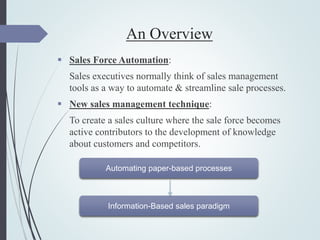
An Overview
 Sales Force Automation:
Sales executives normally think of sales management
tools as a way to automate & streamline sale processes.
 New sales management technique:
To create a sales culture where the sale force becomes
active contributors to the development of knowledge
about customers and competitors.
Automating paper-based processes
Information-Based sales paradigm
Information Based Sales Paradigm
 Customer profitability – to target & segment
customers.
 Customer purchasing patterns – to identify
opportunities to grow customer relationships.
 Best practice sales tactics & competitor’s product
offering – to improve product positioning.
Some Facts
 By spending average $10,000 - $13,000 and up to
$38,000 per Sales Representative(SR), leads to increase
in
 Operational cost saving – up to 25% reduction in cost
of selling.
 Sales force productivity – up to 30% increase in
productivity per SR.
 Sales cost + Marketing Cost = 15% to 35% of total
corporate cost.
First Generation Sales Tools
 It improves productivity of costly resource by
automating information management
 to help the sales force to manage their sales territory
 to help Sales managers to manage SRs
 Building blocks of 1st Gen:
1) Sale productivity system (SPS)
2) Service Quality System (SQS)
3) Marketing Encyclopaedias.
1st Gen Outcomes
Increase Time on Selling
Efficient Sales Management
Continuity in Customer Relationships
Strategic Sales Management
 It involves drawing on data on customer purchasing &
customer contact to begin
 to segment customers according to their profitability
 To identifying & act on promising new growth
opportunities.
 Managing Customer Profitability (MCP):
 Rule of thumb: 30% of customers account = 70-80% of
profits
 Data Mining / Data Filtration
Second Generation Sales Tools
1) Relationship Management Software Systems
2) Sales Productivity System (SPS)
3) Sales Quality System (SQS)
 Some Facts:
 Customers contributing more than $3000 in net interest
margin are given to the Dedicated Sales Representative
(DSR)
 Remaining customers are assigned to branches without
DSR
Third Generation Sales Tools
 Managing Growth Opportunities:
 Objective - to look for opportunities to deepen
customer relationships - (Product Positioning)
 It helps SRs identify and act on the most promising
new sales opportunities.
 It focus on deepening existing customer
relationship’s rather than acquiring new customers
or expanding new product lines.
Some Facts
 40% of growth come through existing customer
relationship.
 All other growth categories:
 New customer in existing market
 New Products
 Mergers
 New customers in new market,
 Expected to account only 20% or less of growth.
Building Block of 3rd Gen
 Purchasing Profiles:
 It helps SR to develop a mental model or pattern of
customer purchasing behaviour
 Technologies used for PP:
1) Scripting tools or expert systems
2) Comparing customer’s current purchasing level to the
actual average purchasing level of similar customers
Building Block of 3rd Gen
 Using Competitor's Information:
 It helps with positioning products to convert a growth
opportunities into a sale
 Can be done by two ways:
 By developing Marketing Encyclopaedia
 By developing a Sales Solution Database (SSD) –
“Early Warning System”
Creating an Info Based Sales Culture
 Wining Sales Force Acceptance:
 Organize sales training around sales tool
 Change job expectations to reward tool use
 Ensure consistency in leadership support
 Create a user-friendly technical design
 Managing Sales Force Knowledge:
 Standardizing content and vocabulary
 Rewarding contributions to knowledge development
 Creating a knowledge manager role
Conclusion
 Sales Management Tools have the potential to
significantly improve sales force performance.
 Sales Force Automation is just the first step in a
broader transition to an information-based sales
paradigm.
 Sales Tools are creating a platform to manage
information about customers & competitors.
 Realizing both the operational or strategic benefits of
sales tools requires significant changes to the culture
of the sales organization.

THANK YOU..!!!

Sales Force Automation - Sales Management Approach

  • 1.
    SALES MANAGEMENT PRESENTATION ON SALES FORCEAUTOMATION Presented by: Nisha Gupta – 24/020 Prateek Chhabra – 24/022 Rahul Tanwar – 24/025
  • 2.
    An Overview  SalesForce Automation: Sales executives normally think of sales management tools as a way to automate & streamline sale processes.  New sales management technique: To create a sales culture where the sale force becomes active contributors to the development of knowledge about customers and competitors. Automating paper-based processes Information-Based sales paradigm
  • 3.
    Information Based SalesParadigm  Customer profitability – to target & segment customers.  Customer purchasing patterns – to identify opportunities to grow customer relationships.  Best practice sales tactics & competitor’s product offering – to improve product positioning.
  • 4.
    Some Facts  Byspending average $10,000 - $13,000 and up to $38,000 per Sales Representative(SR), leads to increase in  Operational cost saving – up to 25% reduction in cost of selling.  Sales force productivity – up to 30% increase in productivity per SR.  Sales cost + Marketing Cost = 15% to 35% of total corporate cost.
  • 5.
    First Generation SalesTools  It improves productivity of costly resource by automating information management  to help the sales force to manage their sales territory  to help Sales managers to manage SRs  Building blocks of 1st Gen: 1) Sale productivity system (SPS) 2) Service Quality System (SQS) 3) Marketing Encyclopaedias.
  • 6.
    1st Gen Outcomes IncreaseTime on Selling Efficient Sales Management Continuity in Customer Relationships
  • 7.
    Strategic Sales Management It involves drawing on data on customer purchasing & customer contact to begin  to segment customers according to their profitability  To identifying & act on promising new growth opportunities.  Managing Customer Profitability (MCP):  Rule of thumb: 30% of customers account = 70-80% of profits  Data Mining / Data Filtration
  • 8.
    Second Generation SalesTools 1) Relationship Management Software Systems 2) Sales Productivity System (SPS) 3) Sales Quality System (SQS)  Some Facts:  Customers contributing more than $3000 in net interest margin are given to the Dedicated Sales Representative (DSR)  Remaining customers are assigned to branches without DSR
  • 9.
    Third Generation SalesTools  Managing Growth Opportunities:  Objective - to look for opportunities to deepen customer relationships - (Product Positioning)  It helps SRs identify and act on the most promising new sales opportunities.  It focus on deepening existing customer relationship’s rather than acquiring new customers or expanding new product lines.
  • 10.
    Some Facts  40%of growth come through existing customer relationship.  All other growth categories:  New customer in existing market  New Products  Mergers  New customers in new market,  Expected to account only 20% or less of growth.
  • 11.
    Building Block of3rd Gen  Purchasing Profiles:  It helps SR to develop a mental model or pattern of customer purchasing behaviour  Technologies used for PP: 1) Scripting tools or expert systems 2) Comparing customer’s current purchasing level to the actual average purchasing level of similar customers
  • 12.
    Building Block of3rd Gen  Using Competitor's Information:  It helps with positioning products to convert a growth opportunities into a sale  Can be done by two ways:  By developing Marketing Encyclopaedia  By developing a Sales Solution Database (SSD) – “Early Warning System”
  • 13.
    Creating an InfoBased Sales Culture  Wining Sales Force Acceptance:  Organize sales training around sales tool  Change job expectations to reward tool use  Ensure consistency in leadership support  Create a user-friendly technical design  Managing Sales Force Knowledge:  Standardizing content and vocabulary  Rewarding contributions to knowledge development  Creating a knowledge manager role
  • 14.
    Conclusion  Sales ManagementTools have the potential to significantly improve sales force performance.  Sales Force Automation is just the first step in a broader transition to an information-based sales paradigm.  Sales Tools are creating a platform to manage information about customers & competitors.  Realizing both the operational or strategic benefits of sales tools requires significant changes to the culture of the sales organization.
  • 15.