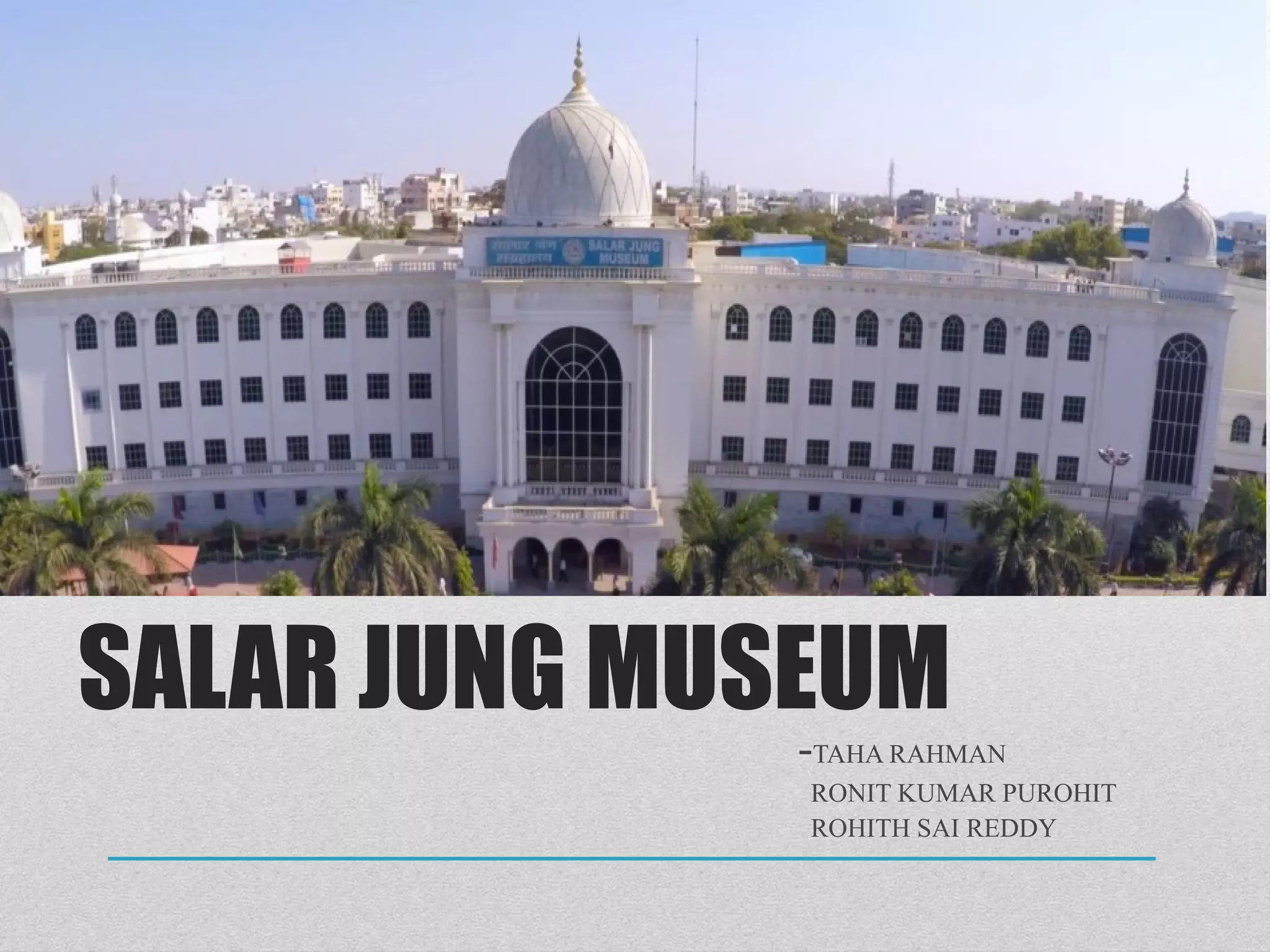
SALAR JUNG MUSEUM
-TAHA RAHMAN
RONIT KUMAR PUROHIT
ROHITH SAI REDDY
INTRODUCTION
• The Salar Jung museum is the largest one man collection
museum in the world
• It houses a staggering 1.1 million artefacts including
books and manuscripts
• The museum has 38 galleries which are spread in 2
floors. The ground floor of the museum consists of 20
galleries while the first floor has 18 galleries
LOCATION
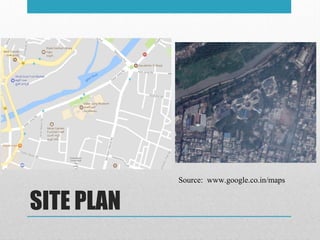
• The Salar Jung Museum is an art museum located at
Darushifa, on the southern bank of the Musi River in the
city of Hyderabad, Telangana
SITE SURROUNDINGS
• NORTH - SALAR JUNG ROAD AND MUSI RIVER
• EAST - FOCUS HIGH SCHOOL
• SOUTH - DARUSHIFA DEGREE COLLEGE
• WEST - MINAR GARDEN FUNCTION HALL
SITE PLAN
Source: www.google.co.in/maps
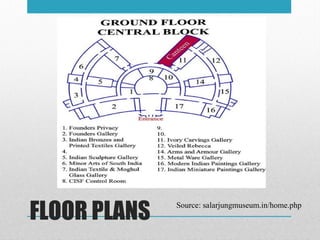
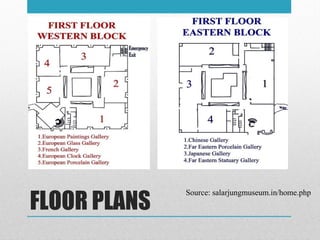
FLOOR PLANS Source: salarjungmuseum.in/home.php
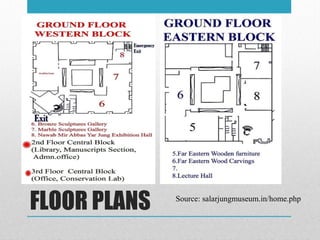
FLOOR PLANS
Source: salarjungmuseum.in/home.php
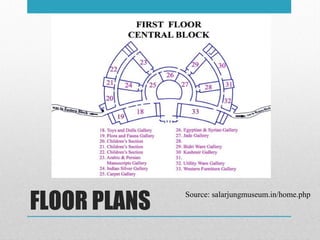
FLOOR PLANS
Source: salarjungmuseum.in/home.php
FLOOR PLANS
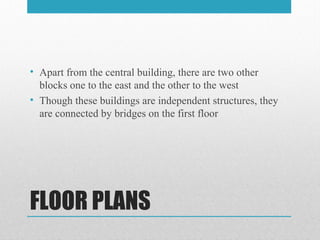
• Apart from the central building, there are two other
blocks one to the east and the other to the west
• Though these buildings are independent structures, they
are connected by bridges on the first floor
LIGHTING
• More than half of the artefacts are manuscripts and books
are preserved in the libraries under controlled lighting
conditions
• The rest of the exhibits like statues, weapons, paintings
are also under artificial lighting and are not exposed to
daylight
LIGHTING SOLUTIONS
• Fluorescent light fixtures are the most used lights for
general lighting and diffused indirect lighting
• UV filters are avidly used to prevent any damage to
organic materials
LIGHTING SOLUTIONS
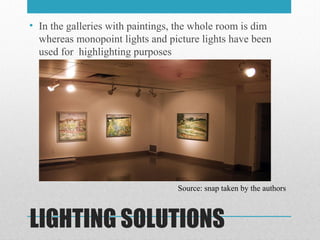
• In the galleries with paintings, the whole room is dim
whereas monopoint lights and picture lights have been
used for highlighting purposes
Source: snap taken by the authors
LIGHTING SOLUTIONS
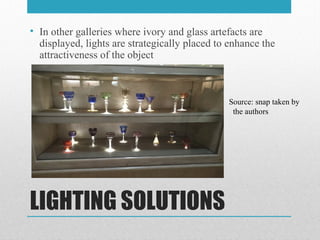
• In other galleries where ivory and glass artefacts are
displayed, lights are strategically placed to enhance the
attractiveness of the object
Source: snap taken by
the authors
LIGHTING SOLUTIONS
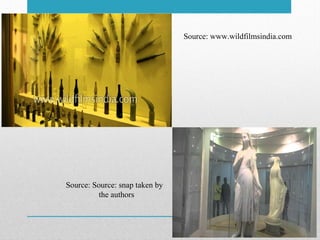
• The rest of the galleries have general recessed lights
throughout and each of the display box has its own light
• These lights inside the boxes are decided according to the
artefact they hold
Source: www.wildfilmsindia.com
Source: Source: snap taken by
the authors
NATURAL LIGHTING
• Natural lighting is only used in central circulation court
• The whole structure is based around the central rotunda
which lights up the entire corridor
ADMINISTRATION AND
CONSERVATION
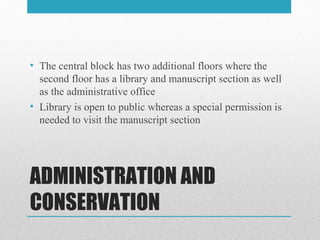
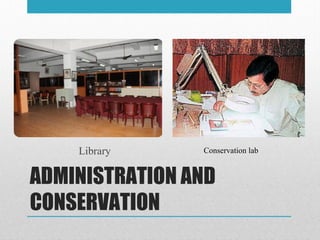
• The central block has two additional floors where the
second floor has a library and manuscript section as well
as the administrative office
• Library is open to public whereas a special permission is
needed to visit the manuscript section
ADMINISTRATION AND
CONSERVATION
Library Conservation lab
CONSERVATION LAB
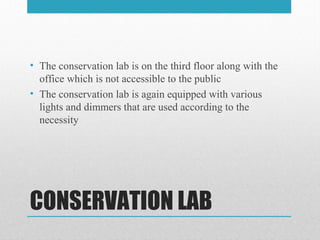
• The conservation lab is on the third floor along with the
office which is not accessible to the public
• The conservation lab is again equipped with various
lights and dimmers that are used according to the
necessity
TREATMENT OF SPECIAL
ATTRACTIONS
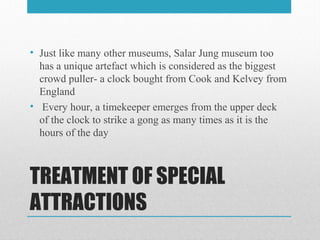
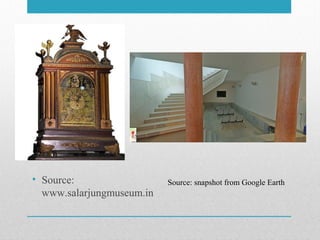
• Just like many other museums, Salar Jung museum too
has a unique artefact which is considered as the biggest
crowd puller- a clock bought from Cook and Kelvey from
England
• Every hour, a timekeeper emerges from the upper deck
of the clock to strike a gong as many times as it is the
hours of the day
TREATMENT OF SPECIAL
ATTRACTIONS
• Since it is so important and it goes into action every hour,
there will be visitors thronging around the clock
• To avoid the discomfort, there are large screens
displaying the clock live at all times throughout the
museum
• Source:
www.salarjungmuseum.in
Source: snapshot from Google Earth
ACOUSTIC TREATMENT
• No special acoustic treatment is done throughout the
museum except for the library and the conservation lab
SERVICES
• There are ducts and fire safety water pipes running
throughout the museum
• All the safety and order is maintained from the control
room on the ground floor
FACILITIES
• Facilities such as cloak rooms, restrooms at all cardinal
points and a cafeteria run by Telangana Tourism are
present
• There is also an official museum shop for people to
purchase souvenirs
PARKING
• Though there is no official parking inside the premises,
tour buses are allowed to be parked below the bridges on
both sides
• There is a staff parking on the far side of the western
block with a capacity of seven four-wheelers and a
number of two-wheelers
ARCHITECTURAL DETAILS
• The site is situated in a 10 acre land
• The area of all the galleries together is approximately 1.4
lakh square feet
• The main building has a floor to floor height of 4 metres
while the two other blocks have 3.5 metres ( the height
varies according to the lighting necessities of the
galleries
DRAWBACKS
• Even though the museum attracts more than 500 visitors
a day, there are no proper parking facilities
• A large open to sky courtyard is being under utilised
BIBLIOGRAPHY
www.google.com/images
www.salarjungmuseum.in
www.wildfilmsindia.com
www.wikipedia.com
Personal site visit
THANKYOU

Salar jung museum

  • 1.
    SALAR JUNG MUSEUM -TAHARAHMAN RONIT KUMAR PUROHIT ROHITH SAI REDDY
  • 2.
    INTRODUCTION • The SalarJung museum is the largest one man collection museum in the world • It houses a staggering 1.1 million artefacts including books and manuscripts • The museum has 38 galleries which are spread in 2 floors. The ground floor of the museum consists of 20 galleries while the first floor has 18 galleries
  • 3.
    LOCATION • The SalarJung Museum is an art museum located at Darushifa, on the southern bank of the Musi River in the city of Hyderabad, Telangana
  • 4.
    SITE SURROUNDINGS • NORTH- SALAR JUNG ROAD AND MUSI RIVER • EAST - FOCUS HIGH SCHOOL • SOUTH - DARUSHIFA DEGREE COLLEGE • WEST - MINAR GARDEN FUNCTION HALL
  • 5.
  • 6.
    FLOOR PLANS Source:salarjungmuseum.in/home.php
  • 7.
    FLOOR PLANS Source:salarjungmuseum.in/home.php
  • 8.
  • 9.
  • 10.
    FLOOR PLANS • Apartfrom the central building, there are two other blocks one to the east and the other to the west • Though these buildings are independent structures, they are connected by bridges on the first floor
  • 11.
    LIGHTING • More thanhalf of the artefacts are manuscripts and books are preserved in the libraries under controlled lighting conditions • The rest of the exhibits like statues, weapons, paintings are also under artificial lighting and are not exposed to daylight
  • 12.
    LIGHTING SOLUTIONS • Fluorescentlight fixtures are the most used lights for general lighting and diffused indirect lighting • UV filters are avidly used to prevent any damage to organic materials
  • 13.
    LIGHTING SOLUTIONS • Inthe galleries with paintings, the whole room is dim whereas monopoint lights and picture lights have been used for highlighting purposes Source: snap taken by the authors
  • 14.
    LIGHTING SOLUTIONS • Inother galleries where ivory and glass artefacts are displayed, lights are strategically placed to enhance the attractiveness of the object Source: snap taken by the authors
  • 15.
    LIGHTING SOLUTIONS • Therest of the galleries have general recessed lights throughout and each of the display box has its own light • These lights inside the boxes are decided according to the artefact they hold
  • 16.
  • 17.
    NATURAL LIGHTING • Naturallighting is only used in central circulation court • The whole structure is based around the central rotunda which lights up the entire corridor
  • 18.
    ADMINISTRATION AND CONSERVATION • Thecentral block has two additional floors where the second floor has a library and manuscript section as well as the administrative office • Library is open to public whereas a special permission is needed to visit the manuscript section
  • 19.
  • 20.
    CONSERVATION LAB • Theconservation lab is on the third floor along with the office which is not accessible to the public • The conservation lab is again equipped with various lights and dimmers that are used according to the necessity
  • 21.
    TREATMENT OF SPECIAL ATTRACTIONS •Just like many other museums, Salar Jung museum too has a unique artefact which is considered as the biggest crowd puller- a clock bought from Cook and Kelvey from England • Every hour, a timekeeper emerges from the upper deck of the clock to strike a gong as many times as it is the hours of the day
  • 22.
    TREATMENT OF SPECIAL ATTRACTIONS •Since it is so important and it goes into action every hour, there will be visitors thronging around the clock • To avoid the discomfort, there are large screens displaying the clock live at all times throughout the museum
  • 23.
  • 24.
    ACOUSTIC TREATMENT • Nospecial acoustic treatment is done throughout the museum except for the library and the conservation lab
  • 25.
    SERVICES • There areducts and fire safety water pipes running throughout the museum • All the safety and order is maintained from the control room on the ground floor
  • 26.
    FACILITIES • Facilities suchas cloak rooms, restrooms at all cardinal points and a cafeteria run by Telangana Tourism are present • There is also an official museum shop for people to purchase souvenirs
  • 27.
    PARKING • Though thereis no official parking inside the premises, tour buses are allowed to be parked below the bridges on both sides • There is a staff parking on the far side of the western block with a capacity of seven four-wheelers and a number of two-wheelers
  • 28.
    ARCHITECTURAL DETAILS • Thesite is situated in a 10 acre land • The area of all the galleries together is approximately 1.4 lakh square feet • The main building has a floor to floor height of 4 metres while the two other blocks have 3.5 metres ( the height varies according to the lighting necessities of the galleries
  • 29.
    DRAWBACKS • Even thoughthe museum attracts more than 500 visitors a day, there are no proper parking facilities • A large open to sky courtyard is being under utilised
  • 30.
  • 31.