PRESENTING BY :SUNILRAJ N MASKI
BTA VI SEMESTER
12T1OOO8
INTRUDUCTION
 Meaning : A building or place where works of art,
scientific specimens, or other objects of permanent
value are kept and displayed is known as means of
museum.
 Museums definition:
'A museum is an institution which collects,
documents, preserves, exhibits and interprets
material evidence and associated information for
the public benefit'
 Starter : The Indian museum founder was
“Dr Nathaniel Wallich a, Danish botanist”.
 First time Started Museum In India:
For the year 1814 ,was founded by the Asiatic
Society of Bengal in Kolkata (Calcutta), in India.
The largest and oldest Museum in India and has
rare collections of antiques, armour and
ornaments, skeletons, and Mughal paintings.
Brief history of Indian Museum
 The museums of any country represent their past history.
The Indian Museums too present a part of India on their
own. See the Indian History unfold itself in the unspoken
walls of these museums which have the past closed in
them. Here are the some of the most famous ones..
 India is famous for its museum that proves the rich culture
of the country. Museums of India are best to explore the
people, culture, beliefs, and history of ancient India. Indian
tour can’t be completed without its museums, museums of
India are an archive of India’s history and government and
archaeology. Museums are the treasure house of ancient
documents, there are so many unique museums in India.
Brief history of Indian Museum
 The museums of any country represent their past history.
The Indian Museums too present a part of India on their
own. See the Indian History unfold itself in the unspoken
walls of these museums which have the past closed in
them. Here are the some of the most famous ones..
 India is famous for its museum that proves the rich culture
of the country. Museums of India are best to explore the
people, culture, beliefs, and history of ancient India. Indian
tour can’t be completed without its museums, museums of
India are an archive of India’s history and government and
archaeology. Museums are the treasure house of ancient
documents, there are so many unique museums in India.
 For Example :-Rail museum that will starts for the
year 1855 in India. This unique museum has a
fascinating and exotic collection of over 100 real
size exhibits of Indian Railways.
Top Museums in India
National Museum of India in Delhi .
The prince of Wales Museum in Mumbai .
Indian Museum in Calcutta,(Kolkata).
Hawa Mahal Museum in Jaipur .
Karnataka Government Museums in Bangalore
Salar Jung Museum in Hyderabad.
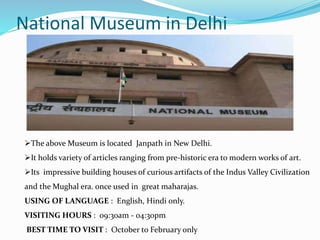
National Museum in Delhi
The above Museum is located Janpath in New Delhi.
It holds variety of articles ranging from pre-historic era to modern works of art.
Its impressive building houses of curious artifacts of the Indus Valley Civilization
and the Mughal era. once used in great maharajas.
USING OF LANGUAGE : English, Hindi only.
VISITING HOURS : 09:30am - 04:30pm
BEST TIME TO VISIT : October to February only
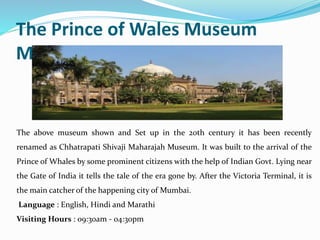
The Prince of Wales Museum
Mumbai
The above museum shown and Set up in the 20th century it has been recently
renamed as Chhatrapati Shivaji Maharajah Museum. It was built to the arrival of the
Prince of Whales by some prominent citizens with the help of Indian Govt. Lying near
the Gate of India it tells the tale of the era gone by. After the Victoria Terminal, it is
the main catcher of the happening city of Mumbai.
Language : English, Hindi and Marathi
Visiting Hours : 09:30am - 04:30pm
ENTRY FEES: Rs.20 per Mobile
Rs.200 per Still Camera
Rs.1,000 per Camcorder
Rs.100 - 300 per Audio Guide
(different cost for different languages)
BEST TIME TO VISIT : October to
February
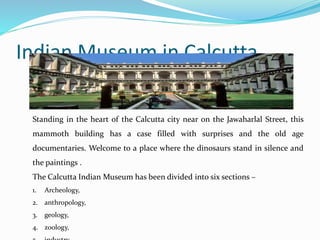
Indian Museum in Calcutta
Standing in the heart of the Calcutta city near on the Jawaharlal Street, this
mammoth building has a case filled with surprises and the old age
documentaries. Welcome to a place where the dinosaurs stand in silence and
the paintings .
The Calcutta Indian Museum has been divided into six sections –
1. Archeology,
2. anthropology,
3. geology,
4. zoology,
All of them have a special place, as they have the uniqueness of being there. It
takes at least 3 DAYS to see the entire Museum.
 LANGUAGE : Bengali, Hindi, English
 VISITING HOURS : 10 am - 05 pm
 ENTRY FEES:
Rs.10 per person for Indians
Rs.150 per person for Foreigners
 BEST TIME TO VISIT : December to February
Hawa Mahal in Jaipur
.
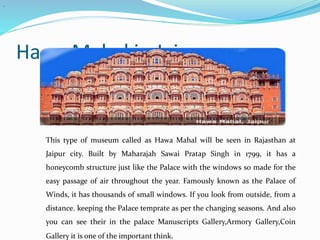
This type of museum called as Hawa Mahal will be seen in Rajasthan at
Jaipur city. Built by Maharajah Sawai Pratap Singh in 1799, it has a
honeycomb structure just like the Palace with the windows so made for the
easy passage of air throughout the year. Famously known as the Palace of
Winds, it has thousands of small windows. If you look from outside, from a
distance. keeping the Palace temprate as per the changing seasons. And also
you can see their in the palace Manuscripts Gallery,Armory Gallery,Coin
Gallery it is one of the important think.
Karnataka Government
Museum
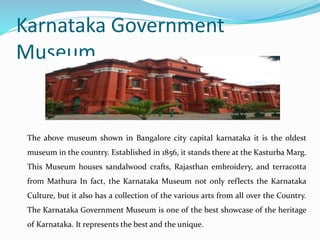
The above museum shown in Bangalore city capital karnataka it is the oldest
museum in the country. Established in 1856, it stands there at the Kasturba Marg.
This Museum houses sandalwood crafts, Rajasthan embroidery, and terracotta
from Mathura In fact, the Karnataka Museum not only reflects the Karnataka
Culture, but it also has a collection of the various arts from all over the Country.
The Karnataka Government Museum is one of the best showcase of the heritage
of Karnataka. It represents the best and the unique.
 LANGUAGE : Tamil, English, Hindi, kannada
 VISITING HOURS : 9:30am - 4:30pm
 ENTRY FEES:
Rs.4 - 10 per person for adults
Rs.2 - 5 per person for children
 BEST TIME TO VISIT : October to February
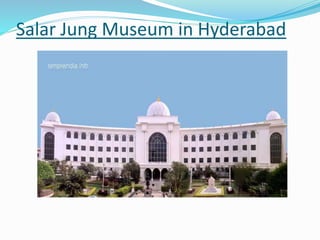
Salar Jung Museum in Hyderabad
The Salar Jung museum is art museum in the town of Hyderabad,
Andhra Pradesh, In India. it’s one of the 3 National Museums of
India.locateded on the southern bank of River Musi, which is in close
proximity to the important monuments of old city of Hyderabad near
by the historic Charminar, Mecca Masjid
History of Salar Jung museum
 The Salar Jung Museum was established in 1951. The major portion of
collection museum was acquired by Mir Yousuf Ali Khan.
 The Government of India appointed a Committee to administer the Salar Jung
Estate. Later on with the idea of his name, the Salar Jung Museum was brought
into existence on 16th December, 1951 in Diwan Deodi, the residential palace of
Salar Jung III and opened to the public by Pandit Jawarharlal Nehru, the Prime
Minister of India.
 In 1958, the Government of India took over the museum through a
compromise deed. Till 1958 this museum was administered by the Salar Jung
Estate Committee
 Thereafter the Museum continued to be administered by the Ministry of
Scientific Research and Cultural Affairs, Government of India till 1961. In 1961,
through an Act of Parliament, the Salar Jung Museum along with its library was
declared as an “Institution of National Importance
 The administration of the museum was transferred to an Autonomous Board,
having the Governor of A.P. and its Chairman. The museum was transferred to
its present building in the year 1968.
 The family of Salar Jungs had assumed such great importance that five of its
family members served as Prime Ministers to the Nizam of Hyderabad
Contd…..
 Mir Turab Ali Khan - Salar Jung I, was awarded the title of Salar Jung Bahadur
at the age of 13 years. At the age of 24 years he was appointed as Prime Minister
by the then Nizam, Nasir-ud- Daulah. He was a great administrator, known for
his reforms of art. He died in the year 1882.
 His eldest son, Mir Iaiq Ali Khan was appointed as first Secretary to the
Council. And later than member of the Council of the State. He was appointed
as Prime Minister in 1884 A.D.
 He spent most of his time in continuing the social reforms which were
discontinued by his father Mir Turab Ali Khan, Salar Jung I. When he was only
26 years old he died at Poona, leaving behind an infant of 24 days, Abul Qasim
Mir Yousuf Ali Khan
Contd…..
 Mir Osman Ali Khan, Nizam VII, selected Mir Yousuf Ali Khan, Salar Jung
III as his Prime Minister. Due to some difference of opinion, Salar Jung III
relinquished the post of Prime Minister in November 1914. Thereafter his
entire life he devoted in enriching his treasures of art.
 Mir Yousuf Ali Khan was not only a collector of antiques but he also
patronized poets, writers and artists, encouraging literary and cultural
activities. He continued with his zeal as an art. Till the very end of his life
enriching his art collections and died as a bachelor on 2nd March,1949 at
the age of 60
COLLECTION
As on date, there are 38 galleries in the Museum in three blocks.
(1) Indian Block (27 galleries),
(2)Western Block (7 galleries) and
(3) Eastern Block (4 galleries)
in which nearly 13,654 objects are on display.
The Indian collections are from the States of Andhra Pradesh, Tamilnadu, Karnataka, Kerala,
Orissa, West Bengal, Uttar Pradesh, Madhya Pradesh, Maharashtra, Punjab, Rajasthan,
Himachal Pradesh, Gujarat, Jammu & Kashmir, and places like Kangra, Basholi, Jaipur,
Udaipur, Mewar, Hyderabad, Golconda, Bijapur, Kurnool and Nirmal.
The Western collections are from England, Ireland, France, Belgium, Italy, Germany,
Czechoslovakia, Venice and Austria.
The Eastern collections are from countries like China, Japan, Burma, Korea, Nepal, Thailand,
Indonesia and from Middle East countries like Egypt, Syria, Persia and Arabia. The Indian art
objects comprise of stone sculptures, bronzes, wood carvings, miniature paintings, modern
Name of galleries
 Founders Gallery
 South Indian Bronzes
 Minor Arts of South India
 Indian Sculptures
 Indian Textiles
 Ivory objects
 Arms and Armour
 Jade Gallery
 Indian Miniature Paintings
 Modern Paintings
 Bidri Gallery
 Middle Eastern Carpets
Contd………..
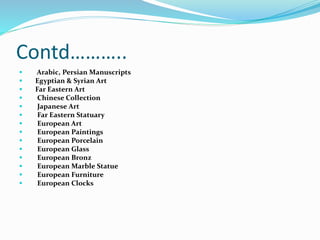
 Arabic, Persian Manuscripts
 Egyptian & Syrian Art
 Far Eastern Art
 Chinese Collection
 Japanese Art
 Far Eastern Statuary
 European Art
 European Paintings
 European Porcelain
 European Glass
 European Bronz
 European Marble Statue
 European Furniture
 European Clocks
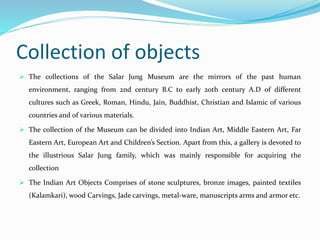
Collection of objects
 The collections of the Salar Jung Museum are the mirrors of the past human
environment, ranging from 2nd century B.C to early 20th century A.D of different
cultures such as Greek, Roman, Hindu, Jain, Buddhist, Christian and Islamic of various
countries and of various materials.
 The collection of the Museum can be divided into Indian Art, Middle Eastern Art, Far
Eastern Art, European Art and Children’s Section. Apart from this, a gallery is devoted to
the illustrious Salar Jung family, which was mainly responsible for acquiring the
collection
 The Indian Art Objects Comprises of stone sculptures, bronze images, painted textiles
(Kalamkari), wood Carvings, Jade carvings, metal-ware, manuscripts arms and armor etc.
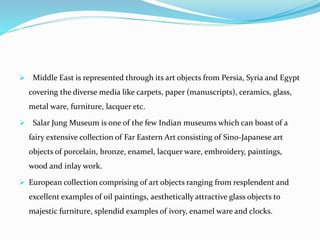
 Middle East is represented through its art objects from Persia, Syria and Egypt
covering the diverse media like carpets, paper (manuscripts), ceramics, glass,
metal ware, furniture, lacquer etc.
 Salar Jung Museum is one of the few Indian museums which can boast of a
fairy extensive collection of Far Eastern Art consisting of Sino-Japanese art
objects of porcelain, bronze, enamel, lacquer ware, embroidery, paintings,
wood and inlay work.
 European collection comprising of art objects ranging from resplendent and
excellent examples of oil paintings, aesthetically attractive glass objects to
majestic furniture, splendid examples of ivory, enamel ware and clocks.
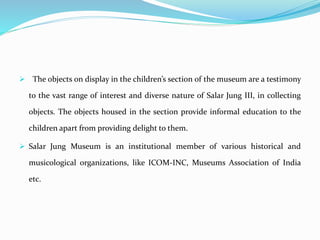
 The objects on display in the children’s section of the museum are a testimony
to the vast range of interest and diverse nature of Salar Jung III, in collecting
objects. The objects housed in the section provide informal education to the
children apart from providing delight to them.
 Salar Jung Museum is an institutional member of various historical and
musicological organizations, like ICOM-INC, Museums Association of India
etc.
Activities of the Museum
 The Museum is regularly organizing special exhibitions and workshops in
collaboration with International Museums and organizations. The museum
publishes guide-Books, brochures, research Journals, and books on selected
subjects in English, Hindi and Urdu languages. Seminars and workshops are
being organized on special occasions such as – Birthday celebrations of Salar
Jung III, Museum Week, Children’s Week etc., as part of its educational
activities. As one of the museums of “National importance” in India, the Salar
Jung Museum is meant to function as a cultural centre through its exhibits,
research projects and planned activities as a cultural centre
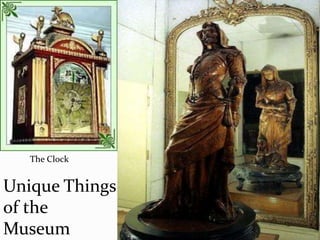
Unique Things
of the
Museum
The Clock

TOP MUSEUMS IN INDIA

  • 1.
    PRESENTING BY :SUNILRAJN MASKI BTA VI SEMESTER 12T1OOO8
  • 2.
    INTRUDUCTION  Meaning :A building or place where works of art, scientific specimens, or other objects of permanent value are kept and displayed is known as means of museum.  Museums definition: 'A museum is an institution which collects, documents, preserves, exhibits and interprets material evidence and associated information for the public benefit'
  • 3.
     Starter :The Indian museum founder was “Dr Nathaniel Wallich a, Danish botanist”.  First time Started Museum In India: For the year 1814 ,was founded by the Asiatic Society of Bengal in Kolkata (Calcutta), in India. The largest and oldest Museum in India and has rare collections of antiques, armour and ornaments, skeletons, and Mughal paintings.
  • 4.
    Brief history ofIndian Museum  The museums of any country represent their past history. The Indian Museums too present a part of India on their own. See the Indian History unfold itself in the unspoken walls of these museums which have the past closed in them. Here are the some of the most famous ones..  India is famous for its museum that proves the rich culture of the country. Museums of India are best to explore the people, culture, beliefs, and history of ancient India. Indian tour can’t be completed without its museums, museums of India are an archive of India’s history and government and archaeology. Museums are the treasure house of ancient documents, there are so many unique museums in India.
  • 5.
    Brief history ofIndian Museum  The museums of any country represent their past history. The Indian Museums too present a part of India on their own. See the Indian History unfold itself in the unspoken walls of these museums which have the past closed in them. Here are the some of the most famous ones..  India is famous for its museum that proves the rich culture of the country. Museums of India are best to explore the people, culture, beliefs, and history of ancient India. Indian tour can’t be completed without its museums, museums of India are an archive of India’s history and government and archaeology. Museums are the treasure house of ancient documents, there are so many unique museums in India.
  • 6.
     For Example:-Rail museum that will starts for the year 1855 in India. This unique museum has a fascinating and exotic collection of over 100 real size exhibits of Indian Railways.
  • 7.
    Top Museums inIndia National Museum of India in Delhi . The prince of Wales Museum in Mumbai . Indian Museum in Calcutta,(Kolkata). Hawa Mahal Museum in Jaipur . Karnataka Government Museums in Bangalore Salar Jung Museum in Hyderabad.
  • 8.
    National Museum inDelhi The above Museum is located Janpath in New Delhi. It holds variety of articles ranging from pre-historic era to modern works of art. Its impressive building houses of curious artifacts of the Indus Valley Civilization and the Mughal era. once used in great maharajas. USING OF LANGUAGE : English, Hindi only. VISITING HOURS : 09:30am - 04:30pm BEST TIME TO VISIT : October to February only
  • 9.
    The Prince ofWales Museum Mumbai The above museum shown and Set up in the 20th century it has been recently renamed as Chhatrapati Shivaji Maharajah Museum. It was built to the arrival of the Prince of Whales by some prominent citizens with the help of Indian Govt. Lying near the Gate of India it tells the tale of the era gone by. After the Victoria Terminal, it is the main catcher of the happening city of Mumbai. Language : English, Hindi and Marathi Visiting Hours : 09:30am - 04:30pm
  • 10.
    ENTRY FEES: Rs.20per Mobile Rs.200 per Still Camera Rs.1,000 per Camcorder Rs.100 - 300 per Audio Guide (different cost for different languages) BEST TIME TO VISIT : October to February
  • 11.
    Indian Museum inCalcutta Standing in the heart of the Calcutta city near on the Jawaharlal Street, this mammoth building has a case filled with surprises and the old age documentaries. Welcome to a place where the dinosaurs stand in silence and the paintings . The Calcutta Indian Museum has been divided into six sections – 1. Archeology, 2. anthropology, 3. geology, 4. zoology,
  • 12.
    All of themhave a special place, as they have the uniqueness of being there. It takes at least 3 DAYS to see the entire Museum.  LANGUAGE : Bengali, Hindi, English  VISITING HOURS : 10 am - 05 pm  ENTRY FEES: Rs.10 per person for Indians Rs.150 per person for Foreigners  BEST TIME TO VISIT : December to February
  • 13.
    Hawa Mahal inJaipur . This type of museum called as Hawa Mahal will be seen in Rajasthan at Jaipur city. Built by Maharajah Sawai Pratap Singh in 1799, it has a honeycomb structure just like the Palace with the windows so made for the easy passage of air throughout the year. Famously known as the Palace of Winds, it has thousands of small windows. If you look from outside, from a distance. keeping the Palace temprate as per the changing seasons. And also you can see their in the palace Manuscripts Gallery,Armory Gallery,Coin Gallery it is one of the important think.
  • 14.
    Karnataka Government Museum The abovemuseum shown in Bangalore city capital karnataka it is the oldest museum in the country. Established in 1856, it stands there at the Kasturba Marg. This Museum houses sandalwood crafts, Rajasthan embroidery, and terracotta from Mathura In fact, the Karnataka Museum not only reflects the Karnataka Culture, but it also has a collection of the various arts from all over the Country. The Karnataka Government Museum is one of the best showcase of the heritage of Karnataka. It represents the best and the unique.
  • 15.
     LANGUAGE :Tamil, English, Hindi, kannada  VISITING HOURS : 9:30am - 4:30pm  ENTRY FEES: Rs.4 - 10 per person for adults Rs.2 - 5 per person for children  BEST TIME TO VISIT : October to February
  • 16.
    Salar Jung Museumin Hyderabad
  • 17.
    The Salar Jungmuseum is art museum in the town of Hyderabad, Andhra Pradesh, In India. it’s one of the 3 National Museums of India.locateded on the southern bank of River Musi, which is in close proximity to the important monuments of old city of Hyderabad near by the historic Charminar, Mecca Masjid
  • 18.
    History of SalarJung museum  The Salar Jung Museum was established in 1951. The major portion of collection museum was acquired by Mir Yousuf Ali Khan.  The Government of India appointed a Committee to administer the Salar Jung Estate. Later on with the idea of his name, the Salar Jung Museum was brought into existence on 16th December, 1951 in Diwan Deodi, the residential palace of Salar Jung III and opened to the public by Pandit Jawarharlal Nehru, the Prime Minister of India.  In 1958, the Government of India took over the museum through a compromise deed. Till 1958 this museum was administered by the Salar Jung Estate Committee
  • 19.
     Thereafter theMuseum continued to be administered by the Ministry of Scientific Research and Cultural Affairs, Government of India till 1961. In 1961, through an Act of Parliament, the Salar Jung Museum along with its library was declared as an “Institution of National Importance  The administration of the museum was transferred to an Autonomous Board, having the Governor of A.P. and its Chairman. The museum was transferred to its present building in the year 1968.  The family of Salar Jungs had assumed such great importance that five of its family members served as Prime Ministers to the Nizam of Hyderabad
  • 20.
    Contd…..  Mir TurabAli Khan - Salar Jung I, was awarded the title of Salar Jung Bahadur at the age of 13 years. At the age of 24 years he was appointed as Prime Minister by the then Nizam, Nasir-ud- Daulah. He was a great administrator, known for his reforms of art. He died in the year 1882.  His eldest son, Mir Iaiq Ali Khan was appointed as first Secretary to the Council. And later than member of the Council of the State. He was appointed as Prime Minister in 1884 A.D.  He spent most of his time in continuing the social reforms which were discontinued by his father Mir Turab Ali Khan, Salar Jung I. When he was only 26 years old he died at Poona, leaving behind an infant of 24 days, Abul Qasim Mir Yousuf Ali Khan
  • 21.
    Contd…..  Mir OsmanAli Khan, Nizam VII, selected Mir Yousuf Ali Khan, Salar Jung III as his Prime Minister. Due to some difference of opinion, Salar Jung III relinquished the post of Prime Minister in November 1914. Thereafter his entire life he devoted in enriching his treasures of art.  Mir Yousuf Ali Khan was not only a collector of antiques but he also patronized poets, writers and artists, encouraging literary and cultural activities. He continued with his zeal as an art. Till the very end of his life enriching his art collections and died as a bachelor on 2nd March,1949 at the age of 60
  • 22.
    COLLECTION As on date,there are 38 galleries in the Museum in three blocks. (1) Indian Block (27 galleries), (2)Western Block (7 galleries) and (3) Eastern Block (4 galleries) in which nearly 13,654 objects are on display. The Indian collections are from the States of Andhra Pradesh, Tamilnadu, Karnataka, Kerala, Orissa, West Bengal, Uttar Pradesh, Madhya Pradesh, Maharashtra, Punjab, Rajasthan, Himachal Pradesh, Gujarat, Jammu & Kashmir, and places like Kangra, Basholi, Jaipur, Udaipur, Mewar, Hyderabad, Golconda, Bijapur, Kurnool and Nirmal. The Western collections are from England, Ireland, France, Belgium, Italy, Germany, Czechoslovakia, Venice and Austria. The Eastern collections are from countries like China, Japan, Burma, Korea, Nepal, Thailand, Indonesia and from Middle East countries like Egypt, Syria, Persia and Arabia. The Indian art objects comprise of stone sculptures, bronzes, wood carvings, miniature paintings, modern
  • 23.
    Name of galleries Founders Gallery  South Indian Bronzes  Minor Arts of South India  Indian Sculptures  Indian Textiles  Ivory objects  Arms and Armour  Jade Gallery  Indian Miniature Paintings  Modern Paintings  Bidri Gallery  Middle Eastern Carpets
  • 24.
    Contd………..  Arabic, PersianManuscripts  Egyptian & Syrian Art  Far Eastern Art  Chinese Collection  Japanese Art  Far Eastern Statuary  European Art  European Paintings  European Porcelain  European Glass  European Bronz  European Marble Statue  European Furniture  European Clocks
  • 25.
    Collection of objects The collections of the Salar Jung Museum are the mirrors of the past human environment, ranging from 2nd century B.C to early 20th century A.D of different cultures such as Greek, Roman, Hindu, Jain, Buddhist, Christian and Islamic of various countries and of various materials.  The collection of the Museum can be divided into Indian Art, Middle Eastern Art, Far Eastern Art, European Art and Children’s Section. Apart from this, a gallery is devoted to the illustrious Salar Jung family, which was mainly responsible for acquiring the collection  The Indian Art Objects Comprises of stone sculptures, bronze images, painted textiles (Kalamkari), wood Carvings, Jade carvings, metal-ware, manuscripts arms and armor etc.
  • 26.
     Middle Eastis represented through its art objects from Persia, Syria and Egypt covering the diverse media like carpets, paper (manuscripts), ceramics, glass, metal ware, furniture, lacquer etc.  Salar Jung Museum is one of the few Indian museums which can boast of a fairy extensive collection of Far Eastern Art consisting of Sino-Japanese art objects of porcelain, bronze, enamel, lacquer ware, embroidery, paintings, wood and inlay work.  European collection comprising of art objects ranging from resplendent and excellent examples of oil paintings, aesthetically attractive glass objects to majestic furniture, splendid examples of ivory, enamel ware and clocks.
  • 27.
     The objectson display in the children’s section of the museum are a testimony to the vast range of interest and diverse nature of Salar Jung III, in collecting objects. The objects housed in the section provide informal education to the children apart from providing delight to them.  Salar Jung Museum is an institutional member of various historical and musicological organizations, like ICOM-INC, Museums Association of India etc.
  • 28.
    Activities of theMuseum  The Museum is regularly organizing special exhibitions and workshops in collaboration with International Museums and organizations. The museum publishes guide-Books, brochures, research Journals, and books on selected subjects in English, Hindi and Urdu languages. Seminars and workshops are being organized on special occasions such as – Birthday celebrations of Salar Jung III, Museum Week, Children’s Week etc., as part of its educational activities. As one of the museums of “National importance” in India, the Salar Jung Museum is meant to function as a cultural centre through its exhibits, research projects and planned activities as a cultural centre
  • 29.