1. Prepare all ingredients by washing, cutting, and chilling them.
2. Arrange the base and body of the salad on plates lined up on trays for easy transfer to refrigeration.
3. Garnish all salads before refrigerating until serving time.
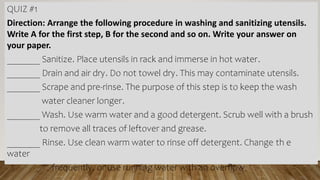
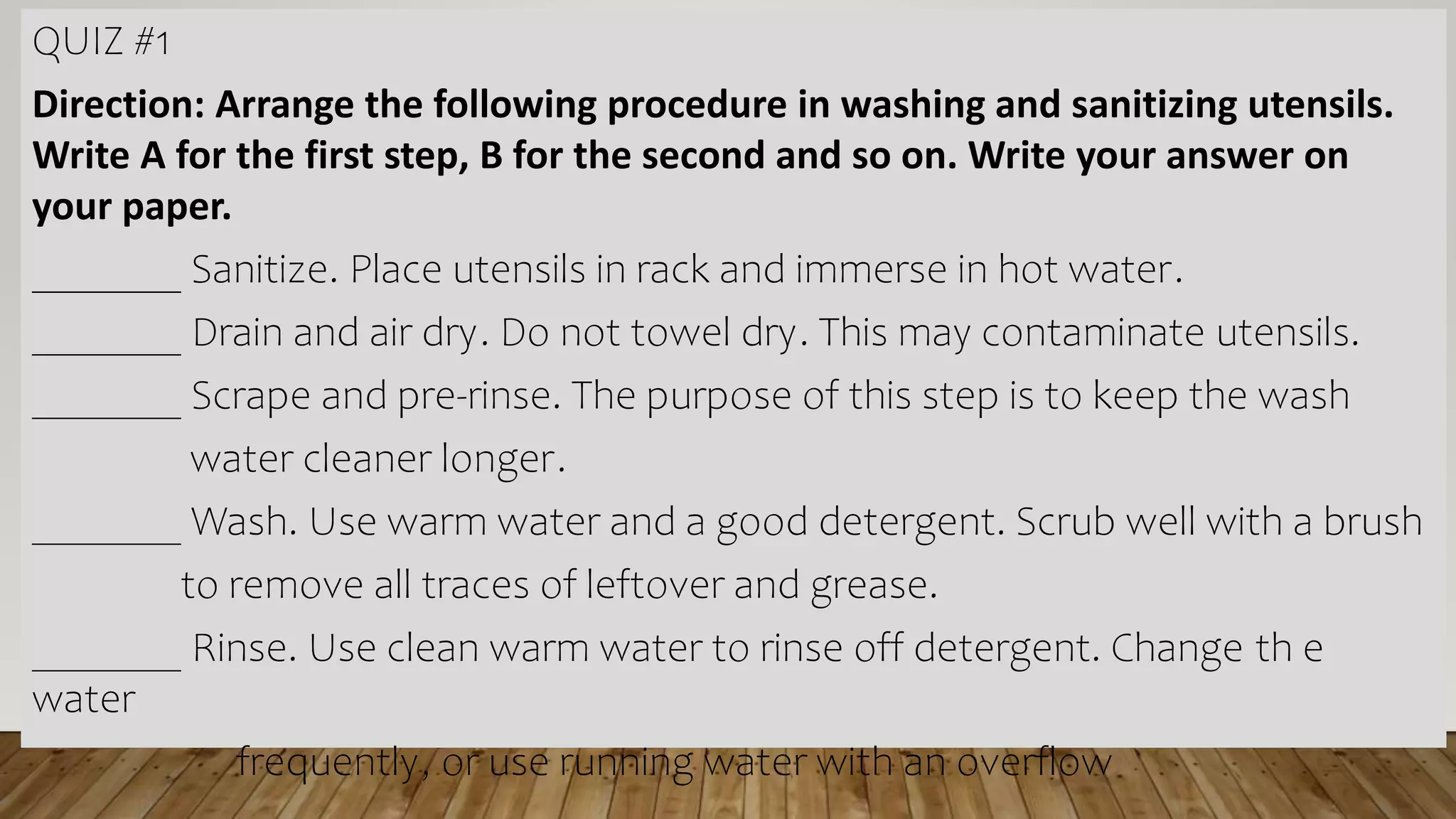
QUIZ #1
Direction: Arrangethe following procedure in washing and sanitizing utensils.
Write A for the first step, B for the second and so on. Write your answer on
your paper.
_______ Sanitize. Place utensils in rack and immerse in hot water.
_______ Drain and air dry. Do not towel dry. This may contaminate utensils.
_______ Scrape and pre-rinse. The purpose of this step is to keep the wash
water cleaner longer.
_______ Wash. Use warm water and a good detergent. Scrub well with a brush
to remove all traces of leftover and grease.
_______ Rinse. Use clean warm water to rinse off detergent. Change th e
water
frequently, or use running water with an overflow
2.
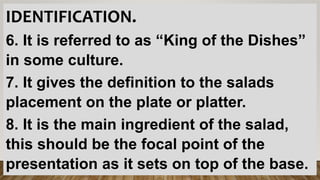
IDENTIFICATION.
6. It isreferred to as “King of the Dishes”
in some culture.
7. It gives the definition to the salads
placement on the plate or platter.
8. It is the main ingredient of the salad,
this should be the focal point of the
presentation as it sets on top of the base.
3.
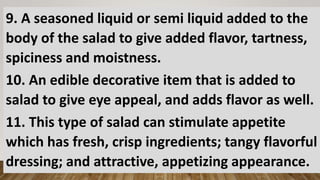
9. A seasonedliquid or semi liquid added to the
body of the salad to give added flavor, tartness,
spiciness and moistness.
10. An edible decorative item that is added to
salad to give eye appeal, and adds flavor as well.
11. This type of salad can stimulate appetite
which has fresh, crisp ingredients; tangy flavorful
dressing; and attractive, appetizing appearance.
4.
12. This saladmust balance and harmonize
with the rest of the meal, like any other side
dish. 13. It is usually sweet and may
contain item such as fruits, sweetened gelatin,
nuts and cream
14. This type of salad is bound to stay together
15. These are made by arranging two or more
elements attractively on a plate.
5.
CHECKLIST FOR SALADMAKING
•Apron
•Hairnet
•Gloves
•Hand towel
•Tissue
•Dishwashing liquid
•Hand soap
•Tray
•Plate for
presentation
•Spoon and Fork for
tasting and mixing
•Salad bowl
6.
IDENTIFICATION.
Salad 6. Itis referred to as “King of the Dishes” in some culture.
Base 7. It gives the definition to the salads placement on the plate or platter.
Body 8. It is the main ingredient of the salad, this should be the focal point of the presentation as it sets on top of the base.
Dressing 9. A seasoned liquid or semi liquid added to the body of the salad to give added flavor, tartness, spiciness and
moistness.
Garnish 10. An edible decorative item that is added to salad to give eye appeal, and adds flavor as well.
Appetizer Salad 11. This type of salad can stimulate appetite which has fresh, crisp ingredients; tangy flavorful dressing; and
attractive, appetizing appearance.
Accompaniment Salad 12. This salad must balance and harmonize with the rest of the meal, like any other side dish.
Dessert Salad 13. It is usually sweet and may contain item such as fruits, sweetened gelatin, nuts and cream
Bound Salad 14. This type of salad is bound to stay together
Composed Salad 15. These are made by arranging two or more elements attractively on a plate.
INGREDIENTS OF SALADDRESSING
•Salad dressings are liquid or semi liquids used
to flavor salads. The flavors of most salad
dressings are not modified by cooking. The
quality depends directly on the quality of the
ingredients used. Most salad dressings are
made primarily of oil and acid with other
ingredients added to modify the flavor or
9.
•Oils – shouldhave mild, sweet flavor. Strongly
flavored oil can make excellent salad dressing
but not appropriate with every food.
Examples: corn oil, soybean oil, canola oil,
peanut oil, olive oil, walnut oil.
•Vinegar – should have a good, clean sharp
flavor. Most salad vinegar are about 5%
acidity, but some range from 7-8%.
10.
•Lemon Juice –fresh lemon juice maybe
used in place of or in addition to
vinegar in some preparation.
•Egg yolk – as essential ingredient in
mayonnaise and other emulsifier
dressings. For safety, pasteurized eggs
should be used.
11.
•Seasoning and flavorings– fresh
herbs are preferable to dried
herbs. Other flavorings include
mustard, ketchup, Worcestershire
sauce and various kinds of
cheeses.
12.
TYPES OF SALADDRESSINGS
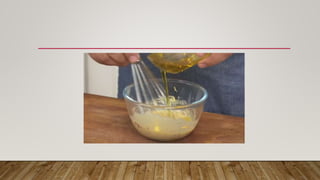
•Oil and Vinegar dressings – Basic vinaigrette is
a simple mixture of oil, vinegar and
seasonings which is an example of temporary
emulsions. The ratio of oil to vinegar is 3 parts
oil to 1 part vinegar. However, it can be
changed depending upon the taste. Less oil
makes the dressing tarter, while more oil
13.
•Emulsified Dressings –Mayonnaise is an emulsified
dressing. It is more often serves as the base for
wide variety of other dressings. Mayonnaise based
dressings are generally thick and creamy.
•Other Dressings – cooked salad dressing is similar
with appearance to mayonnaise, but it has a tarter
flavor, while mayonnaise is richer and milder.
Cooked dressing is made with little or no oil and
with a starch thickener
14.
PROCEDURE FOR QUANTITY
SALADPRODUCTION
1.Prepare all ingredients. Wash and cut greens,
fruits, vegetables, and garnishes. Prepare
cooked vegetables and mix bound and
marinated salads. Have all ingredients chilled.
2.Arrange salad plates on worktables. Line them
up on trays for easy transfer to refrigerator.
3.Place bases on all plates.
15.
PROCEDURE FOR QUANTITY
SALADPRODUCTION
4. Arrange body of salad on all
plates.
5. Garnish all salads.
6. Refrigerate until serving.
7. Do not add dressing to green
16.
IMPORTANT FACTORS TO
CONSIDERIN SALAD PREPARATION
1.Quality of ingredients.
2.Eye Appeal.
3.Simplicity.
4.Neatness.
5.Contrast and Harmony of colors.
17.
IMPORTANT FACTORS TO
CONSIDERIN SALAD PREPARATION
6. Proper Food combinations.
7. Foods should be recognizable.
8. Keep foods properly chilled
but not ice-cold.
9. Serve hot foods while hot and
cold foods cold.
18.
IMPORTANT FACTORS TO
CONSIDERIN SALAD PREPARATION
10. Keep it clean and crispy.
11. Flavorful.
12. Drain all the ingredients
well.
Editor's Notes
#17 Quality of ingredients. Salad is as good as the quality of its ingredients, so you have to use ingredients that are fresh, ripe and in season.
Eye Appeal. It should be attractive, appetizing, creatively presented.
Simplicity. Make it simple not overcrowded.
Neatness. Keep salad neatly placed in a plate.
Contrast and Harmony of colors. Contrast in color for your garnishing can accentuate the appearance of the salad.
#18 6. Proper Food combinations. Choose combination of ingredients carefully. Pineapples and coconut go well with chicken but not compatible with tuna.
7. Foods should be recognizable. Taste of the food that you are using as a base should be identifiable when you taste the salad.
The dressing should dominate the taste. The size of cut should be bid enough (usually bite size) to be recognized.
8. Keep foods properly chilled but not ice-cold.
9. Serve hot foods while hot and cold foods cold.
#19 10. Keep it clean and crispy. This is done by washing greens in large quantity of water and drain well and removing the green from the water to allow the dirt to settle to the bottom of the container.
11. Flavorful. Tempting and stimulating if prepared and presented properly.
12. Drain all the ingredients well. Water or excess juices will weaken dressings and will make your salad look messy.
13. Do not overcook food. Food and ingredients when overcooked eliminates the color and its vitamins and minerals as well.