Salads and dressing
MARY ROSE T. BASCO
Pre service Teacher
Objectives:
At the end of the lesson, students will be
able to:
• Prepare mise ‘en place
• Prepare variety of salads and dressings
• Present a variety of salads and dressings
• Store salads and dressings
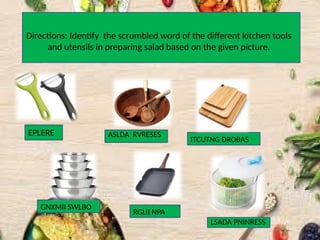
Directions: Identify the scrumbled word of the different kitchen tools
and utensils in preparing salad based on the given picture.
EPLERE ASLDA RVRESES
ITCUTNG DROBAS
GNXMII SWLBO
RGLII NPA
LSADA PNINRESS
What is salad and dressings?
SALAD
A usually cold dish consisting of
vegetables, as lettuce, tomatoes, and
cucumbers, covered with a dressing
and sometimes containing seafood,
meat or eggs.
DRESSINGS
A sauce for salads, typically one
consisting of oil and vinegar mixed
together with herbs or other
flavorings
Tools, Equipment, Utensils needed in
preparing salads and dressings
KNIVES
A cutting tool used in food
preparation
CUTTING BOARDS
Is a durable board on which to place a
material for cutting. The kitchen cutting board
is commonly used in preparing food; other
types exist for cutting raw materials such as
leather or plastic.
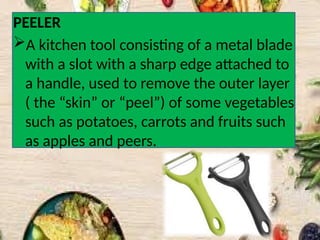
PEELER
A kitchen tool consisting of a metal blade
with a slot with a sharp edge attached to
a handle, used to remove the outer layer
( the “skin” or “peel”) of some vegetables
such as potatoes, carrots and fruits such
as apples and peers.
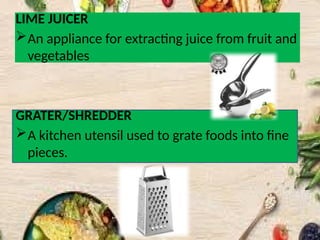
LIME JUICER
An appliance for extracting juice from fruit and
vegetables
GRATER/SHREDDER
A kitchen utensil used to grate foods into fine
pieces.
GRILL PAN
Used for salad toppings to be broiled or grilled
SALAD SPINNER
Also known as a salad
tosser, is a kitchen tool
used to wash and remove
excess water from salad
greens.
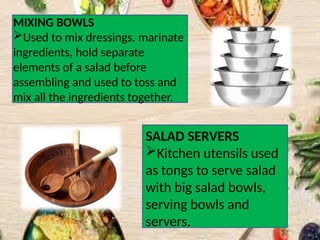
MIXING BOWLS
Used to mix dressings, marinate
ingredients, hold separate
elements of a salad before
assembling and used to toss and
mix all the ingredients together.
SALAD SERVERS
Kitchen utensils used
as tongs to serve salad
with big salad bowls,
serving bowls and
servers.
Preparation Of Ingredients
In Making Salads and
Dressings Including Washing
and Thawing of Frozen Food
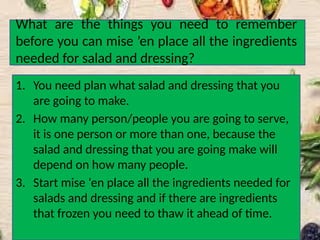
What are the things you need to remember
before you can mise ’en place all the ingredients
needed for salad and dressing?
1. You need plan what salad and dressing that you
are going to make.
2. How many person/people you are going to serve,
it is one person or more than one, because the
salad and dressing that you are going make will
depend on how many people.
3. Start mise ‘en place all the ingredients needed for
salads and dressing and if there are ingredients
that frozen you need to thaw it ahead of time.
COMMON INGREDIENTS IN MAKING
SALADS
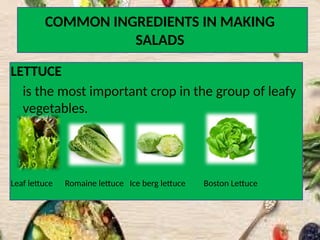
LETTUCE
is the most important crop in the group of leafy
vegetables.
Leaf lettuce Romaine lettuce Ice berg lettuce Boston Lettuce
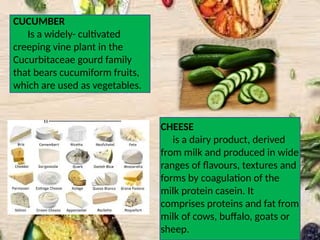
CUCUMBER
Is a widely- cultivated
creeping vine plant in the
Cucurbitaceae gourd family
that bears cucumiform fruits,
which are used as vegetables.
CHEESE
is a dairy product, derived
from milk and produced in wide
ranges of flavours, textures and
forms by coagulation of the
milk protein casein. It
comprises proteins and fat from
milk of cows, buffalo, goats or
sheep.
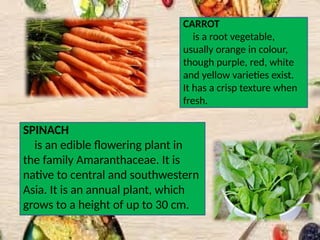
CARROT
is a root vegetable,
usually orange in colour,
though purple, red, white
and yellow varieties exist.
It has a crisp texture when
fresh.
SPINACH
is an edible flowering plant in
the family Amaranthaceae. It is
native to central and southwestern
Asia. It is an annual plant, which
grows to a height of up to 30 cm.
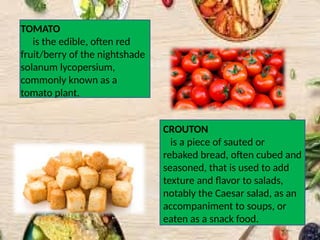
TOMATO
is the edible, often red
fruit/berry of the nightshade
solanum lycopersium,
commonly known as a
tomato plant.
CROUTON
is a piece of sauted or
rebaked bread, often cubed and
seasoned, that is used to add
texture and flavor to salads,
notably the Caesar salad, as an
accompaniment to soups, or
eaten as a snack food.
PREPARE VARIETY OF SALADS
What is Salad?
 Is a dish, usually cold, of raw or
sometimes cooked vegetables or fruit in
various combination, served with a
dressing, or molded in gelatin, and
sometimes with a seafood, poultry,
meat and eggs.
Types of Salads
1. Green salads
 Must be fresh, clean, crisp and cold and well drained.
Moisture and air are necessary to keep greens crisp.
a) Leaves wilt because they lose moisture. Crispness can be
restored by washing and refrigerating. The moisture that
clings to the leaves after thorough draining is usually enough.
b) Air circulation is essential so do not washed greens too tightly
or pack too firmly. Refrigerate in colanders covered with clean
damp towels, or in specially designed perforated plastic bins.
These protect from drying while allowing air circulation.
2. Vegetable, Grain legumes and Pasta
Salads
Vegetable salads are salads whose main ingredients
are vegetables other than lettuce or other leafy
greens. Starchy items such as grains, pastas and
dried legumes can also form the body of a salad.
Raw or cooked vegetables are usually added to the
starch items to enhance the color, flavor and
nutritional balance of the salad. Protein items such
as poultry, meat, seafood and cheese maybe added
to vegetables and starch salads.
3. Bound salads
Are mixture of foods that are held together or
bound with a dressing usually a thick dressing
like mayonnaise.
The term bound is most often used for
tradition mixtures of cooked protein, starch
and vegetables items with mayonnaise like
chicken salad, tuna salad, egg salad and
potato salad.
4. Fruit salads
Are very sweet in taste and can be made
from fresh or canned fruit. The fruit
contained in fruit salads is in larger
pieces than in fruit cocktails. Sometimes
fruit salads are dressed with ice creams
or syrups.
5. Composed salads
Made by arranging two or more elements
attractively on a plate. They are called
composed because the components are
arranged on the plate rather than being mixed
together.
They are elaborate and can be substantial in
size, usually served as main courses or fruit
courses rather than accompaniments or side
dishes.
6. Gelatin Salads
Most gelatin products are made with
sweetened prepared mixes with artificial
color and flavor. But some professional
cook used to prepare salads using
unflavored gelatin relying on fruit juices
and other ingredients for flavor.
Classification Of Salads According To Their
Functions In The Meal
APPETIZER SALADS
Stimulate appetite which has fresh, crisp
ingredients, tangy flavorful dressing; and
attractive, appetizing appearance.
It looks appealing because of flavorful foods
like cheese, ham, salami shrimp.
Crisp raw or lightly cooked vegetables can also
be added.
ACCOMPANIMENT SALAD
Must balance and harmonize with the rest of
the meal, like any other side dish.
Don’t serve potato salad at the same meal at
which you are serving French fries or another
starch.
Sweet fruit salads are rarely appropriate as
accompaniment except with such items as
ham or pork.
SIDE DISH SALAD
It should be light and flavorful, not too much
vegetable salads are often good choices.
Heavier salads such as macaroni or high
protein salads containing seafood, cheese are
less appropriate, unless the main course is
light.
MAIN COURSE SALADS
It should be large enough to serve as a full
meal and should contain a substantial portion
of protein.
Meat, poultry and seafood salads as well as
egg salad and cheese are popular choices.
Main course salads should offer enough
variety of flavors and textures in addition to
the protein and salad platter or fruits.
SEPARATE COURSE SALAD
These salads must be very light without
filling.
Rich, heavy dressings such as sour cream
and mayonnaise should be avoided.
Light salad are serve after the main
course to cleanse the palate, refresh the
appetite and provide a break before
dessert.
DESSERT SALAD
Dessert salad are usually
sweet and may contain items
such as fruits, sweetened
gelatin, nuts and cream.
GUIDELINES FOR MAKING SALADS
Vegetables, legumes grains and pasta salads
 Neat, accurate cutting of ingredients is important because the
shapes of the vegetables add to eye appeal.
 Cut vegetables as close as possible to serving time or they
may dry or shrivel at the edges.
 Cooked vegetables to a firm, crisp texture and good color.
 After cooking, vegetables must be thoroughly drained and
chilled before using.
 Starches, pastas and legumes should be cooked until
completely tender but not overcooked.
• Vegetables are sometimes marinated or soaked in
a seasoned liquid before being made into salad.
The marinade is usually some form of oil and
vinegar dressing that also serves as the dressing
for the salad. Do not plate marinated salads too far
ahead of time because the lettuce base will wilt.
• Grains and pastas may also be marinated for a
short time. If marinated too long, pasta absorb too
much liquid and become very soft. Legumes
should not be allowed to stand longer in a
marinade because the acid toughen the proteins in
the beans.
BOUND SALADS
• Cooked ingredients must be thoroughly cooled before
being mixed with mayonnaise and the completed salad
mixture must be kept chilled at all times.
• Leftover such as chicken meat or fish which have been
handled according to the rules of good sanitation and
food management can be used for making bound salads.
• Potatoes for salads should be cooked whole before
peeling and cut in order to preserve nutrients.
• Crisp vegetables like celery, green peppers, carrots,
chopped pickles, onions and water chestnuts are used.
• Bland ingredients like potatoes and some foods
maybe marinated in seasoned liquid such as
vinaigrette before being mixed with mayonnaise
and other ingredients.
• Fold in thick dressings gently to avoid crushing or
breaking the main ingredients.
• Bound salads are portioned using scoop to give
height and shape to the salad.
• For plated salads, serve on a base with greens
and choose attractive, colorful garnishes when
appropriate
FRUIT SALADS
• Fruit salads are often arranged, mixed or tossed of
most fruits that are delicate and easily broken. An
exception is the Waldorf salad, made of firm apples
mixed with nuts, celery and mayonnaise based
dressing.
• Broken or less attractive pieces of fruit should be
placed on the bottom of the salad while more
attractive pieces arranged on top.
• Some fruit discolor when cut and should be dipped
into an acid such as tart or fruit juice.
SALAD COMPONENTS
• Foundation
• Body
• Garnish
• Dressing

powerpoint presentation grade 12 cookery.pptx

  • 1.
    Salads and dressing MARYROSE T. BASCO Pre service Teacher
  • 2.
    Objectives: At the endof the lesson, students will be able to: • Prepare mise ‘en place • Prepare variety of salads and dressings • Present a variety of salads and dressings • Store salads and dressings
  • 3.
    Directions: Identify thescrumbled word of the different kitchen tools and utensils in preparing salad based on the given picture. EPLERE ASLDA RVRESES ITCUTNG DROBAS GNXMII SWLBO RGLII NPA LSADA PNINRESS
  • 4.
    What is saladand dressings? SALAD A usually cold dish consisting of vegetables, as lettuce, tomatoes, and cucumbers, covered with a dressing and sometimes containing seafood, meat or eggs.
  • 5.
    DRESSINGS A sauce forsalads, typically one consisting of oil and vinegar mixed together with herbs or other flavorings
  • 6.
    Tools, Equipment, Utensilsneeded in preparing salads and dressings KNIVES A cutting tool used in food preparation
  • 7.
    CUTTING BOARDS Is adurable board on which to place a material for cutting. The kitchen cutting board is commonly used in preparing food; other types exist for cutting raw materials such as leather or plastic.
  • 8.
    PEELER A kitchen toolconsisting of a metal blade with a slot with a sharp edge attached to a handle, used to remove the outer layer ( the “skin” or “peel”) of some vegetables such as potatoes, carrots and fruits such as apples and peers.
  • 9.
    LIME JUICER An appliancefor extracting juice from fruit and vegetables GRATER/SHREDDER A kitchen utensil used to grate foods into fine pieces.
  • 10.
    GRILL PAN Used forsalad toppings to be broiled or grilled SALAD SPINNER Also known as a salad tosser, is a kitchen tool used to wash and remove excess water from salad greens.
  • 11.
    MIXING BOWLS Used tomix dressings, marinate ingredients, hold separate elements of a salad before assembling and used to toss and mix all the ingredients together. SALAD SERVERS Kitchen utensils used as tongs to serve salad with big salad bowls, serving bowls and servers.
  • 12.
    Preparation Of Ingredients InMaking Salads and Dressings Including Washing and Thawing of Frozen Food
  • 13.
    What are thethings you need to remember before you can mise ’en place all the ingredients needed for salad and dressing? 1. You need plan what salad and dressing that you are going to make. 2. How many person/people you are going to serve, it is one person or more than one, because the salad and dressing that you are going make will depend on how many people. 3. Start mise ‘en place all the ingredients needed for salads and dressing and if there are ingredients that frozen you need to thaw it ahead of time.
  • 14.
    COMMON INGREDIENTS INMAKING SALADS LETTUCE is the most important crop in the group of leafy vegetables. Leaf lettuce Romaine lettuce Ice berg lettuce Boston Lettuce
  • 15.
    CUCUMBER Is a widely-cultivated creeping vine plant in the Cucurbitaceae gourd family that bears cucumiform fruits, which are used as vegetables. CHEESE is a dairy product, derived from milk and produced in wide ranges of flavours, textures and forms by coagulation of the milk protein casein. It comprises proteins and fat from milk of cows, buffalo, goats or sheep.
  • 16.
    CARROT is a rootvegetable, usually orange in colour, though purple, red, white and yellow varieties exist. It has a crisp texture when fresh. SPINACH is an edible flowering plant in the family Amaranthaceae. It is native to central and southwestern Asia. It is an annual plant, which grows to a height of up to 30 cm.
  • 17.
    TOMATO is the edible,often red fruit/berry of the nightshade solanum lycopersium, commonly known as a tomato plant. CROUTON is a piece of sauted or rebaked bread, often cubed and seasoned, that is used to add texture and flavor to salads, notably the Caesar salad, as an accompaniment to soups, or eaten as a snack food.
  • 18.
    PREPARE VARIETY OFSALADS What is Salad?  Is a dish, usually cold, of raw or sometimes cooked vegetables or fruit in various combination, served with a dressing, or molded in gelatin, and sometimes with a seafood, poultry, meat and eggs.
  • 19.
    Types of Salads 1.Green salads  Must be fresh, clean, crisp and cold and well drained. Moisture and air are necessary to keep greens crisp. a) Leaves wilt because they lose moisture. Crispness can be restored by washing and refrigerating. The moisture that clings to the leaves after thorough draining is usually enough. b) Air circulation is essential so do not washed greens too tightly or pack too firmly. Refrigerate in colanders covered with clean damp towels, or in specially designed perforated plastic bins. These protect from drying while allowing air circulation.
  • 20.
    2. Vegetable, Grainlegumes and Pasta Salads Vegetable salads are salads whose main ingredients are vegetables other than lettuce or other leafy greens. Starchy items such as grains, pastas and dried legumes can also form the body of a salad. Raw or cooked vegetables are usually added to the starch items to enhance the color, flavor and nutritional balance of the salad. Protein items such as poultry, meat, seafood and cheese maybe added to vegetables and starch salads.
  • 21.
    3. Bound salads Aremixture of foods that are held together or bound with a dressing usually a thick dressing like mayonnaise. The term bound is most often used for tradition mixtures of cooked protein, starch and vegetables items with mayonnaise like chicken salad, tuna salad, egg salad and potato salad.
  • 22.
    4. Fruit salads Arevery sweet in taste and can be made from fresh or canned fruit. The fruit contained in fruit salads is in larger pieces than in fruit cocktails. Sometimes fruit salads are dressed with ice creams or syrups.
  • 23.
    5. Composed salads Madeby arranging two or more elements attractively on a plate. They are called composed because the components are arranged on the plate rather than being mixed together. They are elaborate and can be substantial in size, usually served as main courses or fruit courses rather than accompaniments or side dishes.
  • 24.
    6. Gelatin Salads Mostgelatin products are made with sweetened prepared mixes with artificial color and flavor. But some professional cook used to prepare salads using unflavored gelatin relying on fruit juices and other ingredients for flavor.
  • 25.
    Classification Of SaladsAccording To Their Functions In The Meal APPETIZER SALADS Stimulate appetite which has fresh, crisp ingredients, tangy flavorful dressing; and attractive, appetizing appearance. It looks appealing because of flavorful foods like cheese, ham, salami shrimp. Crisp raw or lightly cooked vegetables can also be added.
  • 26.
    ACCOMPANIMENT SALAD Must balanceand harmonize with the rest of the meal, like any other side dish. Don’t serve potato salad at the same meal at which you are serving French fries or another starch. Sweet fruit salads are rarely appropriate as accompaniment except with such items as ham or pork.
  • 27.
    SIDE DISH SALAD Itshould be light and flavorful, not too much vegetable salads are often good choices. Heavier salads such as macaroni or high protein salads containing seafood, cheese are less appropriate, unless the main course is light.
  • 28.
    MAIN COURSE SALADS Itshould be large enough to serve as a full meal and should contain a substantial portion of protein. Meat, poultry and seafood salads as well as egg salad and cheese are popular choices. Main course salads should offer enough variety of flavors and textures in addition to the protein and salad platter or fruits.
  • 29.
    SEPARATE COURSE SALAD Thesesalads must be very light without filling. Rich, heavy dressings such as sour cream and mayonnaise should be avoided. Light salad are serve after the main course to cleanse the palate, refresh the appetite and provide a break before dessert.
  • 30.
    DESSERT SALAD Dessert saladare usually sweet and may contain items such as fruits, sweetened gelatin, nuts and cream.
  • 31.
    GUIDELINES FOR MAKINGSALADS Vegetables, legumes grains and pasta salads  Neat, accurate cutting of ingredients is important because the shapes of the vegetables add to eye appeal.  Cut vegetables as close as possible to serving time or they may dry or shrivel at the edges.  Cooked vegetables to a firm, crisp texture and good color.  After cooking, vegetables must be thoroughly drained and chilled before using.  Starches, pastas and legumes should be cooked until completely tender but not overcooked.
  • 32.
    • Vegetables aresometimes marinated or soaked in a seasoned liquid before being made into salad. The marinade is usually some form of oil and vinegar dressing that also serves as the dressing for the salad. Do not plate marinated salads too far ahead of time because the lettuce base will wilt. • Grains and pastas may also be marinated for a short time. If marinated too long, pasta absorb too much liquid and become very soft. Legumes should not be allowed to stand longer in a marinade because the acid toughen the proteins in the beans.
  • 33.
    BOUND SALADS • Cookedingredients must be thoroughly cooled before being mixed with mayonnaise and the completed salad mixture must be kept chilled at all times. • Leftover such as chicken meat or fish which have been handled according to the rules of good sanitation and food management can be used for making bound salads. • Potatoes for salads should be cooked whole before peeling and cut in order to preserve nutrients. • Crisp vegetables like celery, green peppers, carrots, chopped pickles, onions and water chestnuts are used.
  • 34.
    • Bland ingredientslike potatoes and some foods maybe marinated in seasoned liquid such as vinaigrette before being mixed with mayonnaise and other ingredients. • Fold in thick dressings gently to avoid crushing or breaking the main ingredients. • Bound salads are portioned using scoop to give height and shape to the salad. • For plated salads, serve on a base with greens and choose attractive, colorful garnishes when appropriate
  • 35.
    FRUIT SALADS • Fruitsalads are often arranged, mixed or tossed of most fruits that are delicate and easily broken. An exception is the Waldorf salad, made of firm apples mixed with nuts, celery and mayonnaise based dressing. • Broken or less attractive pieces of fruit should be placed on the bottom of the salad while more attractive pieces arranged on top. • Some fruit discolor when cut and should be dipped into an acid such as tart or fruit juice.
  • 36.
    SALAD COMPONENTS • Foundation •Body • Garnish • Dressing