Salads and Garnishes
1. Appetizer salad = stimulate the appetite and have
fresh, crisp ingredients, lightly coated with a tangy,
flavorful dressing ex. Shrimp cocktail, needs to be
light enough for a first course
2. Accompaniment salad= light and flavorful, but not too
rich, complement the meal ex potato salad, just be
careful not to serve a starchy salad if the main entrée
also contains a starch Also a heavy accompaniment
salad goes best with a light entree
3. Main Course Salad = needs to be large enough to
serve as a full meal and also contain a protein
ingredient. Ex. Chef Salad
4. Separate Course Salads = cleanse the palate after a
rich dinner and before a dessert Ex. Bibb lettuce
5. Dessert Salad = usually sweet and often contain
fruits, sweetened gelatin, nuts, cream, and whipped
cream. Ex. Gelatin MUST BE HEARTIE
 Vegetable Salad = contains vegetables as the main
ingredients, resting on greens
 Cooked Salad = contain cooked foods as their
main ingredients – meat, poultry, fish, eggs,
starches, and vegetables (can be marinated,
all ingredients must be cut neatly)
 Fruit Salad = very popular desserts or as part
of combination lunch plates
 Most fruit salads are arrange on plate
 Some fruit discolor after they are peeled – use
lemon juice to help with discoloration
 Fruits do not hold well if they have been cut and
peeled
 Dressings for fruit and usually sweet
 Combination = combinations of different kinds of
ingredients or even two different kinds of salads ex
chef salad
 Gelatin = extracting it from boiled bones (pg 356)
 Acid weakens the properties of gelatin
 Dissolves at about 100°F
 Make gelatin set up faster use half cold water
 Raw pineapple and papaya should never be added to
gelatin, it contains enzymes that dissolve the gelatin
 Add solid ingredients when the gelatin is partially set
 Always drain canned fruits well
 Too much gelatin can make the salad rubbery
1. Base or underline = usually a layer of salad greens
that line the plate (iceberg for a bowl)
2. Body = the main ingredient (mixed veggies or
protein based)
3. Garnish = adds color and appeal to the salad and
sometimes flavor
4. Dressing = are liquids or semi-liquids used to
flavor salads, sometimes called cold sauces
because their purpose is to flavor, moisten and
enrich foods Bound Salads = because the mayo
holds, or binds the ingredients together
Description – Crabmeat-Mayo Salad on a bed of Mixed Greens served with
Garlic Croutons and Herbed Vinaigrette
 Arugula = Pungent, distinctive flavor; tender,
perishable; dark green
 Belgian endive = Narrow, pointed heads, 4-6
inches long; pale yellow to green to white – good
for appetizers or base of a salad
 Bibb = Smaller and more delicate, dark green
outside and creamy yellow inside, sm.
 Boston = Small round heads, with soft, fragile
leaves; deep green outside, white inside, buttery
texture, does not keep well excellent for a salad
base
 Chicory = Narrow, curly leaves; firm texture; bitter
flavor; outside dark green, inside yellow or white – do
not serve alone use as a base
 Chinese cabbage = Long, light green heads with
broad, white center ribs; tender and crisp, mild
cabbage
 Dandelion greens = Young, tender leavers; rich green
color; best in spring
 Escarole = Broad, thick leaves, also in bunches;
coarse texture, slightly bitter flavor, needs to be mixed,
can be braised
 Iceberg = Most popular in America, firm, compact
head with crisp, mild tasting pale green leaves –
good underliner
 Loose-leaf = Grows in bunches; soft, delicate
leaves with curly edges; green or shades of red,
wilts easily, adds color
 Radicchio = Attractive red-leafed Italian variety of
chicory; white ribs and small, round heads,
crunchy texture, slightly bitter
 Romaine = Elongated head with dark green,
coarse leaves, crisp texture and full sweet, mild
flavor; keeps well, easy to handle, main ing. In a
Caesar Salad
 Sorrel = Small to medium-sized, semi-curly, spade-
shaped leaves; white to green stems, can be toxic in
large amounts
 Spinach = Dark, leafy green leaves
 Sprouts = Small, round leaves on tender stalks;
delicate texture; peppery, pungent flavor
 Watercress = Small, dark green, oval leaves; pungent,
peppery flavor
 Keep greens refrigerated
 Clean greens thoroughly (repeat washing)
 DIP THEM IN AND OUT OF WATER – DON’T SOAK
 Carefully remove the core (Iceberg) –TWIST OUT
 Chill all ingredients
 Dry the greens
 Wash your hands thoroughly
 Remove any tough stems or wilted spots
 Tear or cut greens
 Toss the greens (dressing)
 Place the salad on chilled plates
 Garnish
 Clean and sanitize your knives, cutting board and other
utensils – including your sink
 Keep the salad chilled once it’s prepared and the plate too
1. The four basic parts of any salad are the
_____,_____,______&______.
2. Always__________canned fruits.
3. To make sure the salad greens will be
crisp,_____them and store them in a
______wrapped loosely in____ _____ and
______ ______.
Match the salad with it’s description
4. Dessert e) Waldorf Salad
5. Appetizer f) Chef Salad
6. Accompaniment g) Classic Coleslaw
7. Main-Course h) Light salad w/bibb
lettuce lightly dressed with vinaigrette
8. Separate-Course i) Hawaiian salad w/pineapple,
marshmallows w/whip cream and almond cookie
9. Combination j) Petite shrimp cocktail
10. Fruit k) Fresh crabmeat salad with tomato
and lemon wedges and avocados
Dressings, Dips, and Condiments
 Basic dressing are vinaigrette, which is made of
oil and vinegar; emulsified vinaigrette, and
mayonnaise
 Basic vinaigrette includes approximately three
parts oil to one part vinegar, combined slowly until
a homogeneous mixture is formed, serve
immediately
 Salad dressings should e prepared in quantities
that will last no more than three days
 Emulsified Vinaigrette dressing = thick and coat
the ingredients more heavily
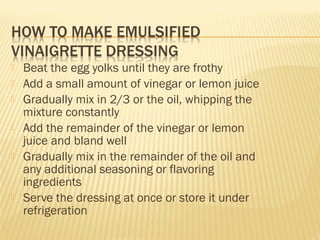
 Beat the egg yolks until they are frothy
 Add a small amount of vinegar or lemon juice
 Gradually mix in 2/3 or the oil, whipping the
mixture constantly
 Add the remainder of the vinegar or lemon
juice and bland well
 Gradually mix in the remainder of the oil and
any additional seasoning or flavoring
ingredients
 Serve the dressing at once or store it under
refrigeration
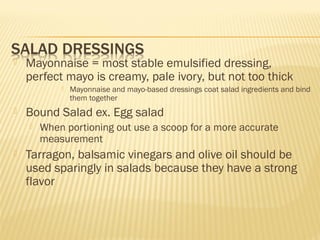
 Mayonnaise = most stable emulsified dressing,
perfect mayo is creamy, pale ivory, but not too thick
 Mayonnaise and mayo-based dressings coat salad ingredients and bind
them together
 Bound Salad ex. Egg salad
 When portioning out use a scoop for a more accurate
measurement
 Tarragon, balsamic vinegars and olive oil should be
used sparingly in salads because they have a strong
flavor
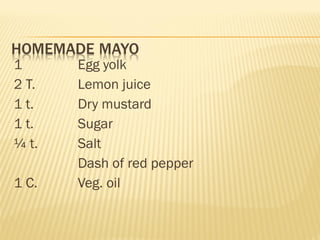
1 Egg yolk
2 T. Lemon juice
1 t. Dry mustard
1 t. Sugar
¼ t. Salt
Dash of red pepper
1 C. Veg. oil
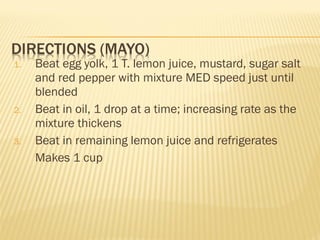
1. Beat egg yolk, 1 T. lemon juice, mustard, sugar salt
and red pepper with mixture MED speed just until
blended
2. Beat in oil, 1 drop at a time; increasing rate as the
mixture thickens
3. Beat in remaining lemon juice and refrigerates
Makes 1 cup
 Corn Oil – light golden color, nearly tasteless
 Cottonseed oil, Soybean Oil, Canola Oil, Safflower Oil –
bland, nearly tasteless
 Walnut oil – Distinctive flavor, expensive; used mostly
in elegant restaurants with specialty salads
 Olive Oil – distinctive, fruity flavor; greenish color
(different pressings)
 Winterized oil = been treated so it will remain a clear
liquid when chilled
 Cider Vinegar = made from apples, brown
color, slightly sweet taste
 White/Distilled = Neutral flavor
 Wine Vinegar = red or white, wine flavor
 Flavored Vinegar = flavor of other products
added to it
 Sherry Vinegar = Made from sherry wine
 Balsamic Vinegar = Special wine vinegar aged
in wooden barrels, dark brown color, sweet
taste
 Specialty Vinegar = Malt vinegar, rice vinegar
and vinegars flavored with fruits
 Condiments = cooked or prepared
flavorings, such as horseradish, ketchup,
relishes, prepared sauces and dips.
 Dips = can be served hot or cold and as
an accompaniment to other foods
 Guacamole – avocado dip
 Salsa – peppers, onions and tomatoes
 Hummus – chick peas with garlic and tahini
1. Emulsified vinaigrette contains_____, but
regular vinaigrette does not.
2. The normal ratio of dressing to greens in a
salad is three parts______ to one part_____.
3. Freshly-made salad dressings should be
stored for only________.
4. The most stable emulsified dressing
is_______.
5. _________ dressings are thick and coat
salad ingredients more heavily.
 Indicate whether each dressing below is an oil and
vinegar dressing or a mayonnaise-based dressing.
6. Louis dressing
7. Basic French dressing
8. Thousand island dressing
9. Dijon vinaigrette
10. Russian dressing
11. Oriental vinaigrette
12. Roquefort dressing
13. Blue cheese dressing
14. Italian dressing
The Art of Garnishing
 Plating = means arranging the presentation of
food items on the serving plate or dish.
 Classical French Garnishing = what many
modern chefs call accompaniments = to a
main entrée (pg. 366 – you need to know
them)
Parsley
Cucumbers
Mushroom Caps – to keep them white simmer them is salted
water with butter and lemon juice
Radishes
Scallion Brushes
Pickles
Frosted Grapes
Lemons – dip edges in paprika for color
Toast Points
Edible Flowers = pansy, primrose, rose petals,
violets – washed thoroughly
 Consommés = rich, clarified stocks or broths,
are named after their garnishes ex consommé
julienne
 Toppings for soup:
 Chopped parsley of chives
 Toasted, sliced almonds
 Grated cheese
 Sieved egg yolks
 Chopped hard-cooked eggs
 Croutons
 Crumble bacon
 Paprika
 Dollop= small scoop or spoonful or sour cream or
whipped cream
 Profiterole = tiny, unsweetened cream puff
shells
 Lets think about what each group is
going to be making on Thursday for their
salads
 Crab
 Chick
 Tuna
 Fruit
 Pasta
 Gelatin
 Veggies
 Each group must pick one main
ingredient
If you went with several friends to a formal French
restaurant and your friends asked you to describe
the following items
 Beef Filet Crecy
 Eggs Florentine
 Filet of Sole Provencal
 Chicken Vichy
 Beef Tips Lyonnais
For each garnish listed below, list one word
that describes its color
6. Tomato wedges
7. Parsley
8. Fluted lemon slices
9. Radish roses
10. Pickle fans
For each of the following entrees, choose an
appropriate garnish based on color and
EXPLAIN YOUR ANSWER
11. Veal with marinara sauce
12. Scrambled eggs
13. Green bean casserole
14. Black bean soup
15. Broiled catfish

Pr classical salads 3

  • 1.
  • 2.
    1. Appetizer salad= stimulate the appetite and have fresh, crisp ingredients, lightly coated with a tangy, flavorful dressing ex. Shrimp cocktail, needs to be light enough for a first course 2. Accompaniment salad= light and flavorful, but not too rich, complement the meal ex potato salad, just be careful not to serve a starchy salad if the main entrée also contains a starch Also a heavy accompaniment salad goes best with a light entree
  • 3.
    3. Main CourseSalad = needs to be large enough to serve as a full meal and also contain a protein ingredient. Ex. Chef Salad 4. Separate Course Salads = cleanse the palate after a rich dinner and before a dessert Ex. Bibb lettuce 5. Dessert Salad = usually sweet and often contain fruits, sweetened gelatin, nuts, cream, and whipped cream. Ex. Gelatin MUST BE HEARTIE  Vegetable Salad = contains vegetables as the main ingredients, resting on greens
  • 4.
     Cooked Salad= contain cooked foods as their main ingredients – meat, poultry, fish, eggs, starches, and vegetables (can be marinated, all ingredients must be cut neatly)  Fruit Salad = very popular desserts or as part of combination lunch plates  Most fruit salads are arrange on plate  Some fruit discolor after they are peeled – use lemon juice to help with discoloration  Fruits do not hold well if they have been cut and peeled  Dressings for fruit and usually sweet
  • 5.
     Combination =combinations of different kinds of ingredients or even two different kinds of salads ex chef salad  Gelatin = extracting it from boiled bones (pg 356)  Acid weakens the properties of gelatin  Dissolves at about 100°F  Make gelatin set up faster use half cold water  Raw pineapple and papaya should never be added to gelatin, it contains enzymes that dissolve the gelatin  Add solid ingredients when the gelatin is partially set  Always drain canned fruits well  Too much gelatin can make the salad rubbery
  • 6.
    1. Base orunderline = usually a layer of salad greens that line the plate (iceberg for a bowl) 2. Body = the main ingredient (mixed veggies or protein based) 3. Garnish = adds color and appeal to the salad and sometimes flavor 4. Dressing = are liquids or semi-liquids used to flavor salads, sometimes called cold sauces because their purpose is to flavor, moisten and enrich foods Bound Salads = because the mayo holds, or binds the ingredients together Description – Crabmeat-Mayo Salad on a bed of Mixed Greens served with Garlic Croutons and Herbed Vinaigrette
  • 7.
     Arugula =Pungent, distinctive flavor; tender, perishable; dark green  Belgian endive = Narrow, pointed heads, 4-6 inches long; pale yellow to green to white – good for appetizers or base of a salad  Bibb = Smaller and more delicate, dark green outside and creamy yellow inside, sm.  Boston = Small round heads, with soft, fragile leaves; deep green outside, white inside, buttery texture, does not keep well excellent for a salad base
  • 8.
     Chicory =Narrow, curly leaves; firm texture; bitter flavor; outside dark green, inside yellow or white – do not serve alone use as a base  Chinese cabbage = Long, light green heads with broad, white center ribs; tender and crisp, mild cabbage  Dandelion greens = Young, tender leavers; rich green color; best in spring  Escarole = Broad, thick leaves, also in bunches; coarse texture, slightly bitter flavor, needs to be mixed, can be braised
  • 9.
     Iceberg =Most popular in America, firm, compact head with crisp, mild tasting pale green leaves – good underliner  Loose-leaf = Grows in bunches; soft, delicate leaves with curly edges; green or shades of red, wilts easily, adds color  Radicchio = Attractive red-leafed Italian variety of chicory; white ribs and small, round heads, crunchy texture, slightly bitter  Romaine = Elongated head with dark green, coarse leaves, crisp texture and full sweet, mild flavor; keeps well, easy to handle, main ing. In a Caesar Salad
  • 10.
     Sorrel =Small to medium-sized, semi-curly, spade- shaped leaves; white to green stems, can be toxic in large amounts  Spinach = Dark, leafy green leaves  Sprouts = Small, round leaves on tender stalks; delicate texture; peppery, pungent flavor  Watercress = Small, dark green, oval leaves; pungent, peppery flavor
  • 11.
     Keep greensrefrigerated  Clean greens thoroughly (repeat washing)  DIP THEM IN AND OUT OF WATER – DON’T SOAK  Carefully remove the core (Iceberg) –TWIST OUT  Chill all ingredients  Dry the greens  Wash your hands thoroughly  Remove any tough stems or wilted spots  Tear or cut greens  Toss the greens (dressing)  Place the salad on chilled plates  Garnish  Clean and sanitize your knives, cutting board and other utensils – including your sink  Keep the salad chilled once it’s prepared and the plate too
  • 12.
    1. The fourbasic parts of any salad are the _____,_____,______&______. 2. Always__________canned fruits. 3. To make sure the salad greens will be crisp,_____them and store them in a ______wrapped loosely in____ _____ and ______ ______.
  • 13.
    Match the saladwith it’s description 4. Dessert e) Waldorf Salad 5. Appetizer f) Chef Salad 6. Accompaniment g) Classic Coleslaw 7. Main-Course h) Light salad w/bibb lettuce lightly dressed with vinaigrette 8. Separate-Course i) Hawaiian salad w/pineapple, marshmallows w/whip cream and almond cookie 9. Combination j) Petite shrimp cocktail 10. Fruit k) Fresh crabmeat salad with tomato and lemon wedges and avocados
  • 14.
  • 15.
     Basic dressingare vinaigrette, which is made of oil and vinegar; emulsified vinaigrette, and mayonnaise  Basic vinaigrette includes approximately three parts oil to one part vinegar, combined slowly until a homogeneous mixture is formed, serve immediately  Salad dressings should e prepared in quantities that will last no more than three days  Emulsified Vinaigrette dressing = thick and coat the ingredients more heavily
  • 16.
     Beat theegg yolks until they are frothy  Add a small amount of vinegar or lemon juice  Gradually mix in 2/3 or the oil, whipping the mixture constantly  Add the remainder of the vinegar or lemon juice and bland well  Gradually mix in the remainder of the oil and any additional seasoning or flavoring ingredients  Serve the dressing at once or store it under refrigeration
  • 17.
     Mayonnaise =most stable emulsified dressing, perfect mayo is creamy, pale ivory, but not too thick  Mayonnaise and mayo-based dressings coat salad ingredients and bind them together  Bound Salad ex. Egg salad  When portioning out use a scoop for a more accurate measurement  Tarragon, balsamic vinegars and olive oil should be used sparingly in salads because they have a strong flavor
  • 18.
    1 Egg yolk 2T. Lemon juice 1 t. Dry mustard 1 t. Sugar ¼ t. Salt Dash of red pepper 1 C. Veg. oil
  • 19.
    1. Beat eggyolk, 1 T. lemon juice, mustard, sugar salt and red pepper with mixture MED speed just until blended 2. Beat in oil, 1 drop at a time; increasing rate as the mixture thickens 3. Beat in remaining lemon juice and refrigerates Makes 1 cup
  • 20.
     Corn Oil– light golden color, nearly tasteless  Cottonseed oil, Soybean Oil, Canola Oil, Safflower Oil – bland, nearly tasteless  Walnut oil – Distinctive flavor, expensive; used mostly in elegant restaurants with specialty salads  Olive Oil – distinctive, fruity flavor; greenish color (different pressings)  Winterized oil = been treated so it will remain a clear liquid when chilled
  • 21.
     Cider Vinegar= made from apples, brown color, slightly sweet taste  White/Distilled = Neutral flavor  Wine Vinegar = red or white, wine flavor  Flavored Vinegar = flavor of other products added to it  Sherry Vinegar = Made from sherry wine  Balsamic Vinegar = Special wine vinegar aged in wooden barrels, dark brown color, sweet taste  Specialty Vinegar = Malt vinegar, rice vinegar and vinegars flavored with fruits
  • 22.
     Condiments =cooked or prepared flavorings, such as horseradish, ketchup, relishes, prepared sauces and dips.  Dips = can be served hot or cold and as an accompaniment to other foods  Guacamole – avocado dip  Salsa – peppers, onions and tomatoes  Hummus – chick peas with garlic and tahini
  • 23.
    1. Emulsified vinaigrettecontains_____, but regular vinaigrette does not. 2. The normal ratio of dressing to greens in a salad is three parts______ to one part_____. 3. Freshly-made salad dressings should be stored for only________. 4. The most stable emulsified dressing is_______. 5. _________ dressings are thick and coat salad ingredients more heavily.
  • 24.
     Indicate whethereach dressing below is an oil and vinegar dressing or a mayonnaise-based dressing. 6. Louis dressing 7. Basic French dressing 8. Thousand island dressing 9. Dijon vinaigrette 10. Russian dressing 11. Oriental vinaigrette 12. Roquefort dressing 13. Blue cheese dressing 14. Italian dressing
  • 25.
    The Art ofGarnishing
  • 26.
     Plating =means arranging the presentation of food items on the serving plate or dish.  Classical French Garnishing = what many modern chefs call accompaniments = to a main entrée (pg. 366 – you need to know them)
  • 27.
    Parsley Cucumbers Mushroom Caps –to keep them white simmer them is salted water with butter and lemon juice Radishes Scallion Brushes Pickles Frosted Grapes Lemons – dip edges in paprika for color Toast Points Edible Flowers = pansy, primrose, rose petals, violets – washed thoroughly
  • 28.
     Consommés =rich, clarified stocks or broths, are named after their garnishes ex consommé julienne  Toppings for soup:  Chopped parsley of chives  Toasted, sliced almonds  Grated cheese  Sieved egg yolks  Chopped hard-cooked eggs  Croutons  Crumble bacon  Paprika  Dollop= small scoop or spoonful or sour cream or whipped cream  Profiterole = tiny, unsweetened cream puff shells
  • 29.
     Lets thinkabout what each group is going to be making on Thursday for their salads  Crab  Chick  Tuna  Fruit  Pasta  Gelatin  Veggies  Each group must pick one main ingredient
  • 30.
    If you wentwith several friends to a formal French restaurant and your friends asked you to describe the following items  Beef Filet Crecy  Eggs Florentine  Filet of Sole Provencal  Chicken Vichy  Beef Tips Lyonnais
  • 31.
    For each garnishlisted below, list one word that describes its color 6. Tomato wedges 7. Parsley 8. Fluted lemon slices 9. Radish roses 10. Pickle fans For each of the following entrees, choose an appropriate garnish based on color and EXPLAIN YOUR ANSWER 11. Veal with marinara sauce 12. Scrambled eggs 13. Green bean casserole 14. Black bean soup 15. Broiled catfish