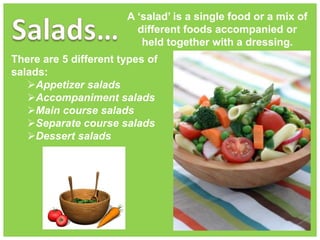
A ‘salad’ is a single food or a mix of
different foods accompanied or
held together with a dressing.
There are 5 different types of
salads:
Appetizer salads
Accompaniment salads
Main course salads
Separate course salads
Dessert salads
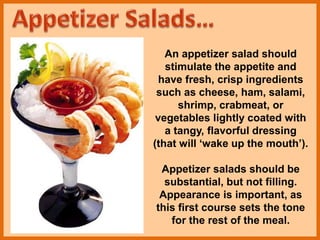
An appetizer salad should
stimulate the appetite and
have fresh, crisp ingredients
such as cheese, ham, salami,
shrimp, crabmeat, or
vegetables lightly coated with
a tangy, flavorful dressing
(that will ‘wake up the mouth’).
Appetizer salads should be
substantial, but not filling.
Appearance is important, as
this first course sets the tone
for the rest of the meal.
Accompaniment salads should
be flavorful, and should
balance and complement the
rest of the meal.
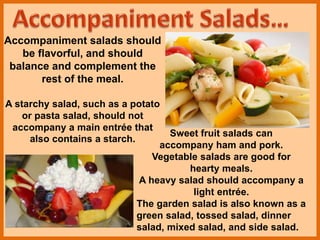
A starchy salad, such as a potato
or pasta salad, should not
accompany a main entrée that
also contains a starch.
Sweet fruit salads can
accompany ham and pork.
Vegetable salads are good for
hearty meals.
A heavy salad should accompany a
light entrée.
The garden salad is also known as a
green salad, tossed salad, dinner
salad, mixed salad, and side salad.
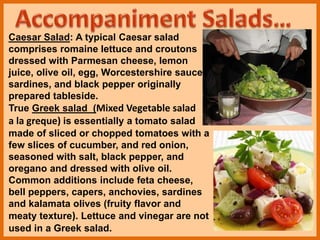
Caesar Salad: A typical Caesar salad
comprises romaine lettuce and croutons
dressed with Parmesan cheese, lemon
juice, olive oil, egg, Worcestershire sauce,
sardines, and black pepper originally
prepared tableside.
True Greek salad (Mixed Vegetable salad
a la greque) is essentially a tomato salad
made of sliced or chopped tomatoes with a
few slices of cucumber, and red onion,
seasoned with salt, black pepper, and
oregano and dressed with olive oil.
Common additions include feta cheese,
bell peppers, capers, anchovies, sardines
and kalamata olives (fruity flavor and
meaty texture). Lettuce and vinegar are not
used in a Greek salad.
A main course salad should be large enough to serve as a
whole meal. It should contain protein ingredients, such as
meat, poultry, seafood, eggs, legumes, or cheese. It should
also contain a variety of vegetables, greens, and/or fruits.
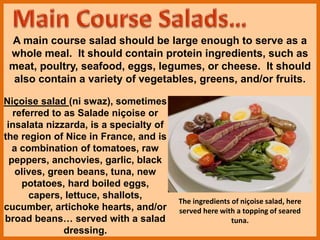
Niçoise salad (ni swaz), sometimes
referred to as Salade niçoise or
insalata nizzarda, is a specialty of
the region of Nice in France, and is
a combination of tomatoes, raw
peppers, anchovies, garlic, black
olives, green beans, tuna, new
potatoes, hard boiled eggs,
capers, lettuce, shallots,
cucumber, artichoke hearts, and/or
broad beans… served with a salad
dressing.
The ingredients of niçoise salad, here
served here with a topping of seared
tuna.
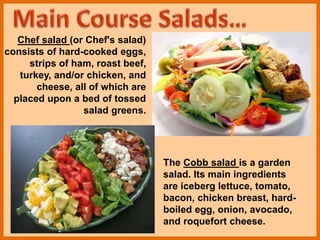
Chef salad (or Chef's salad)
consists of hard-cooked eggs,
strips of ham, roast beef,
turkey, and/or chicken, and
cheese, all of which are
placed upon a bed of tossed
salad greens.
The Cobb salad is a garden
salad. Its main ingredients
are iceberg lettuce, tomato,
bacon, chicken breast, hard-
boiled egg, onion, avocado,
and roquefort cheese.
Separate course salads
cleanse the palate after a
rich dinner and before
dessert. This means they
refresh or stimulate a
person’s appetite for the
dessert or next course. They
are often served in classic
French meals.
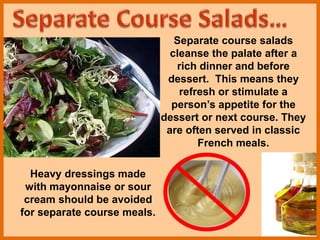
Heavy dressings made
with mayonnaise or sour
cream should be avoided
for separate course meals.
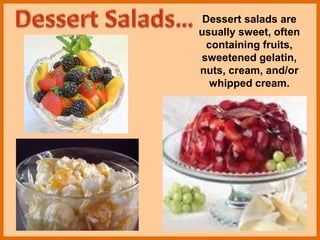
Dessert salads are
usually sweet, often
containing fruits,
sweetened gelatin,
nuts, cream, and/or
whipped cream.
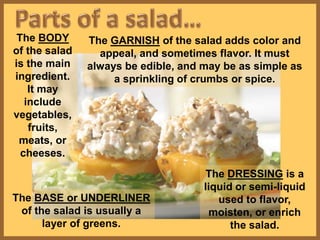
The BASE or UNDERLINER
of the salad is usually a
layer of greens.
The BODY
of the salad
is the main
ingredient.
It may
include
vegetables,
fruits,
meats, or
cheeses.
The GARNISH of the salad adds color and
appeal, and sometimes flavor. It must
always be edible, and may be as simple as
a sprinkling of crumbs or spice.
The DRESSING is a
liquid or semi-liquid
used to flavor,
moisten, or enrich
the salad.
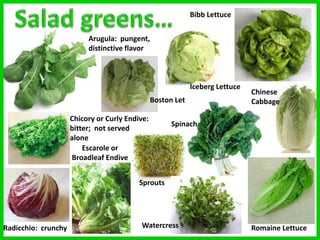
Arugula: pungent,
distinctive flavor
Bibb Lettuce
Boston Lettuce
Chicory or Curly Endive:
bitter; not served
alone
Escarole or
Broadleaf Endive
Iceberg Lettuce
Radicchio: crunchy Romaine Lettuce
Spinach
Sprouts
Chinese
Cabbage
Watercress
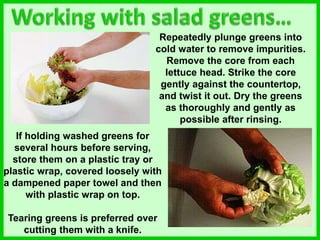
Repeatedly plunge greens into
cold water to remove impurities.
Remove the core from each
lettuce head. Strike the core
gently against the countertop,
and twist it out. Dry the greens
as thoroughly and gently as
possible after rinsing.
If holding washed greens for
several hours before serving,
store them on a plastic tray or
plastic wrap, covered loosely with
a dampened paper towel and then
with plastic wrap on top.
Tearing greens is preferred over
cutting them with a knife.
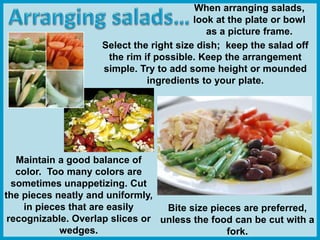
When arranging salads,
look at the plate or bowl
as a picture frame.
Maintain a good balance of
color. Too many colors are
sometimes unappetizing. Cut
the pieces neatly and uniformly,
in pieces that are easily
recognizable. Overlap slices or
wedges.
Bite size pieces are preferred,
unless the food can be cut with a
fork.
Select the right size dish; keep the salad off
the rim if possible. Keep the arrangement
simple. Try to add some height or mounded
ingredients to your plate.
When using cooked
vegetables or meats,
chill them thoroughly
before adding to the salad.
Chill all cooked foods before adding
mayonnaise or mayonnaise-based
dressings.
When using fruits that discolor from
enzymatic browning, sprinkle them
with acid such as lemon juice to
preserve color.
Crisp foods add flavor and texture.
Make sure all flavors complement
each other.
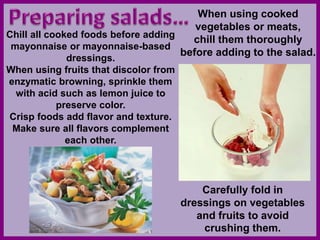
Carefully fold in
dressings on vegetables
and fruits to avoid
crushing them.
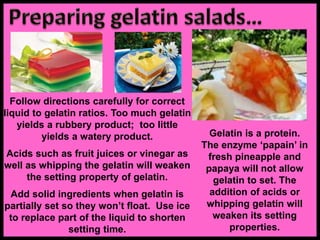
Follow directions carefully for correct
liquid to gelatin ratios. Too much gelatin
yields a rubbery product; too little
yields a watery product.
Acids such as fruit juices or vinegar as
well as whipping the gelatin will weaken
the setting property of gelatin.
Add solid ingredients when gelatin is
partially set so they won’t float. Use ice
to replace part of the liquid to shorten
setting time.
Gelatin is a protein.
The enzyme ‘papain’ in
fresh pineapple and
papaya will not allow
gelatin to set. The
addition of acids or
whipping gelatin will
weaken its setting
properties.
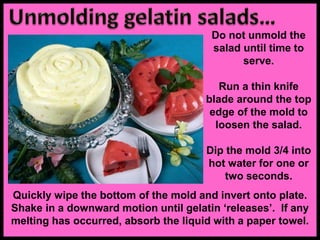
Do not unmold the
salad until time to
serve.
Run a thin knife
blade around the top
edge of the mold to
loosen the salad.
Dip the mold 3/4 into
hot water for one or
two seconds.
Quickly wipe the bottom of the mold and invert onto plate.
Shake in a downward motion until gelatin ‘releases’. If any
melting has occurred, absorb the liquid with a paper towel.
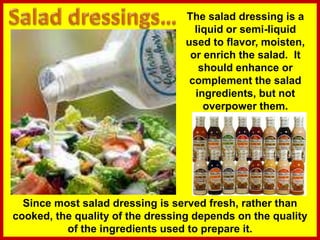
The salad dressing is a
liquid or semi-liquid
used to flavor, moisten,
or enrich the salad. It
should enhance or
complement the salad
ingredients, but not
overpower them.
Since most salad dressing is served fresh, rather than
cooked, the quality of the dressing depends on the quality
of the ingredients used to prepare it.
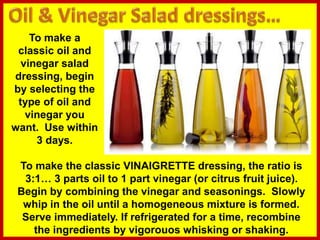
To make a
classic oil and
vinegar salad
dressing, begin
by selecting the
type of oil and
vinegar you
want. Use within
3 days.
To make the classic VINAIGRETTE dressing, the ratio is
3:1… 3 parts oil to 1 part vinegar (or citrus fruit juice).
Begin by combining the vinegar and seasonings. Slowly
whip in the oil until a homogeneous mixture is formed.
Serve immediately. If refrigerated for a time, recombine
the ingredients by vigorouos whisking or shaking.
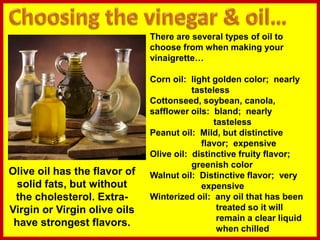
There are several types of oil to
choose from when making your
vinaigrette…
Corn oil: light golden color; nearly
tasteless
Cottonseed, soybean, canola,
safflower oils: bland; nearly
tasteless
Peanut oil: Mild, but distinctive
flavor; expensive
Olive oil: distinctive fruity flavor;
greenish color
Walnut oil: Distinctive flavor; very
expensive
Winterized oil: any oil that has been
treated so it will
remain a clear liquid
when chilled
Olive oil has the flavor of
solid fats, but without
the cholesterol. Extra-
Virgin or Virgin olive oils
have strongest flavors.
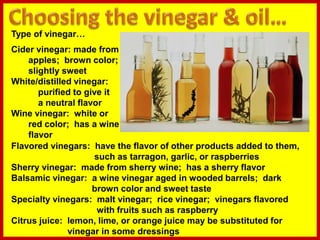
Type of vinegar…
Cider vinegar: made from
apples; brown color;
slightly sweet
White/distilled vinegar:
purified to give it
a neutral flavor
Wine vinegar: white or
red color; has a wine
flavor
Flavored vinegars: have the flavor of other products added to them,
such as tarragon, garlic, or raspberries
Sherry vinegar: made from sherry wine; has a sherry flavor
Balsamic vinegar: a wine vinegar aged in wooded barrels; dark
brown color and sweet taste
Specialty vinegars: malt vinegar; rice vinegar; vinegars flavored
with fruits such as raspberry
Citrus juice: lemon, lime, or orange juice may be substituted for
vinegar in some dressings
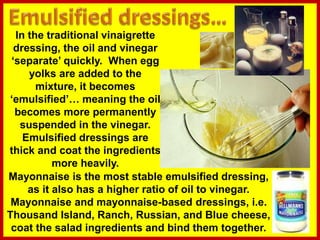
In the traditional vinaigrette
dressing, the oil and vinegar
‘separate’ quickly. When egg
yolks are added to the
mixture, it becomes
‘emulsified’… meaning the oil
becomes more permanently
suspended in the vinegar.
Emulsified dressings are
thick and coat the ingredients
more heavily.
Mayonnaise is the most stable emulsified dressing,
as it also has a higher ratio of oil to vinegar.
Mayonnaise and mayonnaise-based dressings, i.e.
Thousand Island, Ranch, Russian, and Blue cheese,
coat the salad ingredients and bind them together.
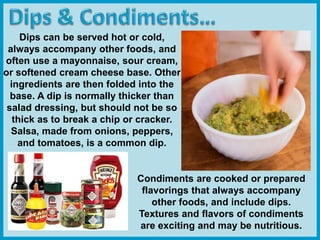
Dips can be served hot or cold,
always accompany other foods, and
often use a mayonnaise, sour cream,
or softened cream cheese base. Other
ingredients are then folded into the
base. A dip is normally thicker than
salad dressing, but should not be so
thick as to break a chip or cracker.
Salsa, made from onions, peppers,
and tomatoes, is a common dip.
Condiments are cooked or prepared
flavorings that always accompany
other foods, and include dips.
Textures and flavors of condiments
are exciting and may be nutritious.
84-Salads-Dressings-Dips-Condiments.ppt

84-Salads-Dressings-Dips-Condiments.ppt

  • 2.
    A ‘salad’ isa single food or a mix of different foods accompanied or held together with a dressing. There are 5 different types of salads: Appetizer salads Accompaniment salads Main course salads Separate course salads Dessert salads
  • 3.
    An appetizer saladshould stimulate the appetite and have fresh, crisp ingredients such as cheese, ham, salami, shrimp, crabmeat, or vegetables lightly coated with a tangy, flavorful dressing (that will ‘wake up the mouth’). Appetizer salads should be substantial, but not filling. Appearance is important, as this first course sets the tone for the rest of the meal.
  • 4.
    Accompaniment salads should beflavorful, and should balance and complement the rest of the meal. A starchy salad, such as a potato or pasta salad, should not accompany a main entrée that also contains a starch. Sweet fruit salads can accompany ham and pork. Vegetable salads are good for hearty meals. A heavy salad should accompany a light entrée. The garden salad is also known as a green salad, tossed salad, dinner salad, mixed salad, and side salad.
  • 5.
    Caesar Salad: Atypical Caesar salad comprises romaine lettuce and croutons dressed with Parmesan cheese, lemon juice, olive oil, egg, Worcestershire sauce, sardines, and black pepper originally prepared tableside. True Greek salad (Mixed Vegetable salad a la greque) is essentially a tomato salad made of sliced or chopped tomatoes with a few slices of cucumber, and red onion, seasoned with salt, black pepper, and oregano and dressed with olive oil. Common additions include feta cheese, bell peppers, capers, anchovies, sardines and kalamata olives (fruity flavor and meaty texture). Lettuce and vinegar are not used in a Greek salad.
  • 6.
    A main coursesalad should be large enough to serve as a whole meal. It should contain protein ingredients, such as meat, poultry, seafood, eggs, legumes, or cheese. It should also contain a variety of vegetables, greens, and/or fruits. Niçoise salad (ni swaz), sometimes referred to as Salade niçoise or insalata nizzarda, is a specialty of the region of Nice in France, and is a combination of tomatoes, raw peppers, anchovies, garlic, black olives, green beans, tuna, new potatoes, hard boiled eggs, capers, lettuce, shallots, cucumber, artichoke hearts, and/or broad beans… served with a salad dressing. The ingredients of niçoise salad, here served here with a topping of seared tuna.
  • 7.
    Chef salad (orChef's salad) consists of hard-cooked eggs, strips of ham, roast beef, turkey, and/or chicken, and cheese, all of which are placed upon a bed of tossed salad greens. The Cobb salad is a garden salad. Its main ingredients are iceberg lettuce, tomato, bacon, chicken breast, hard- boiled egg, onion, avocado, and roquefort cheese.
  • 8.
    Separate course salads cleansethe palate after a rich dinner and before dessert. This means they refresh or stimulate a person’s appetite for the dessert or next course. They are often served in classic French meals. Heavy dressings made with mayonnaise or sour cream should be avoided for separate course meals.
  • 9.
    Dessert salads are usuallysweet, often containing fruits, sweetened gelatin, nuts, cream, and/or whipped cream.
  • 10.
    The BASE orUNDERLINER of the salad is usually a layer of greens. The BODY of the salad is the main ingredient. It may include vegetables, fruits, meats, or cheeses. The GARNISH of the salad adds color and appeal, and sometimes flavor. It must always be edible, and may be as simple as a sprinkling of crumbs or spice. The DRESSING is a liquid or semi-liquid used to flavor, moisten, or enrich the salad.
  • 11.
    Arugula: pungent, distinctive flavor BibbLettuce Boston Lettuce Chicory or Curly Endive: bitter; not served alone Escarole or Broadleaf Endive Iceberg Lettuce Radicchio: crunchy Romaine Lettuce Spinach Sprouts Chinese Cabbage Watercress
  • 12.
    Repeatedly plunge greensinto cold water to remove impurities. Remove the core from each lettuce head. Strike the core gently against the countertop, and twist it out. Dry the greens as thoroughly and gently as possible after rinsing. If holding washed greens for several hours before serving, store them on a plastic tray or plastic wrap, covered loosely with a dampened paper towel and then with plastic wrap on top. Tearing greens is preferred over cutting them with a knife.
  • 13.
    When arranging salads, lookat the plate or bowl as a picture frame. Maintain a good balance of color. Too many colors are sometimes unappetizing. Cut the pieces neatly and uniformly, in pieces that are easily recognizable. Overlap slices or wedges. Bite size pieces are preferred, unless the food can be cut with a fork. Select the right size dish; keep the salad off the rim if possible. Keep the arrangement simple. Try to add some height or mounded ingredients to your plate.
  • 14.
    When using cooked vegetablesor meats, chill them thoroughly before adding to the salad. Chill all cooked foods before adding mayonnaise or mayonnaise-based dressings. When using fruits that discolor from enzymatic browning, sprinkle them with acid such as lemon juice to preserve color. Crisp foods add flavor and texture. Make sure all flavors complement each other. Carefully fold in dressings on vegetables and fruits to avoid crushing them.
  • 15.
    Follow directions carefullyfor correct liquid to gelatin ratios. Too much gelatin yields a rubbery product; too little yields a watery product. Acids such as fruit juices or vinegar as well as whipping the gelatin will weaken the setting property of gelatin. Add solid ingredients when gelatin is partially set so they won’t float. Use ice to replace part of the liquid to shorten setting time. Gelatin is a protein. The enzyme ‘papain’ in fresh pineapple and papaya will not allow gelatin to set. The addition of acids or whipping gelatin will weaken its setting properties.
  • 16.
    Do not unmoldthe salad until time to serve. Run a thin knife blade around the top edge of the mold to loosen the salad. Dip the mold 3/4 into hot water for one or two seconds. Quickly wipe the bottom of the mold and invert onto plate. Shake in a downward motion until gelatin ‘releases’. If any melting has occurred, absorb the liquid with a paper towel.
  • 17.
    The salad dressingis a liquid or semi-liquid used to flavor, moisten, or enrich the salad. It should enhance or complement the salad ingredients, but not overpower them. Since most salad dressing is served fresh, rather than cooked, the quality of the dressing depends on the quality of the ingredients used to prepare it.
  • 18.
    To make a classicoil and vinegar salad dressing, begin by selecting the type of oil and vinegar you want. Use within 3 days. To make the classic VINAIGRETTE dressing, the ratio is 3:1… 3 parts oil to 1 part vinegar (or citrus fruit juice). Begin by combining the vinegar and seasonings. Slowly whip in the oil until a homogeneous mixture is formed. Serve immediately. If refrigerated for a time, recombine the ingredients by vigorouos whisking or shaking.
  • 19.
    There are severaltypes of oil to choose from when making your vinaigrette… Corn oil: light golden color; nearly tasteless Cottonseed, soybean, canola, safflower oils: bland; nearly tasteless Peanut oil: Mild, but distinctive flavor; expensive Olive oil: distinctive fruity flavor; greenish color Walnut oil: Distinctive flavor; very expensive Winterized oil: any oil that has been treated so it will remain a clear liquid when chilled Olive oil has the flavor of solid fats, but without the cholesterol. Extra- Virgin or Virgin olive oils have strongest flavors.
  • 20.
    Type of vinegar… Cidervinegar: made from apples; brown color; slightly sweet White/distilled vinegar: purified to give it a neutral flavor Wine vinegar: white or red color; has a wine flavor Flavored vinegars: have the flavor of other products added to them, such as tarragon, garlic, or raspberries Sherry vinegar: made from sherry wine; has a sherry flavor Balsamic vinegar: a wine vinegar aged in wooded barrels; dark brown color and sweet taste Specialty vinegars: malt vinegar; rice vinegar; vinegars flavored with fruits such as raspberry Citrus juice: lemon, lime, or orange juice may be substituted for vinegar in some dressings
  • 21.
    In the traditionalvinaigrette dressing, the oil and vinegar ‘separate’ quickly. When egg yolks are added to the mixture, it becomes ‘emulsified’… meaning the oil becomes more permanently suspended in the vinegar. Emulsified dressings are thick and coat the ingredients more heavily. Mayonnaise is the most stable emulsified dressing, as it also has a higher ratio of oil to vinegar. Mayonnaise and mayonnaise-based dressings, i.e. Thousand Island, Ranch, Russian, and Blue cheese, coat the salad ingredients and bind them together.
  • 22.
    Dips can beserved hot or cold, always accompany other foods, and often use a mayonnaise, sour cream, or softened cream cheese base. Other ingredients are then folded into the base. A dip is normally thicker than salad dressing, but should not be so thick as to break a chip or cracker. Salsa, made from onions, peppers, and tomatoes, is a common dip. Condiments are cooked or prepared flavorings that always accompany other foods, and include dips. Textures and flavors of condiments are exciting and may be nutritious.