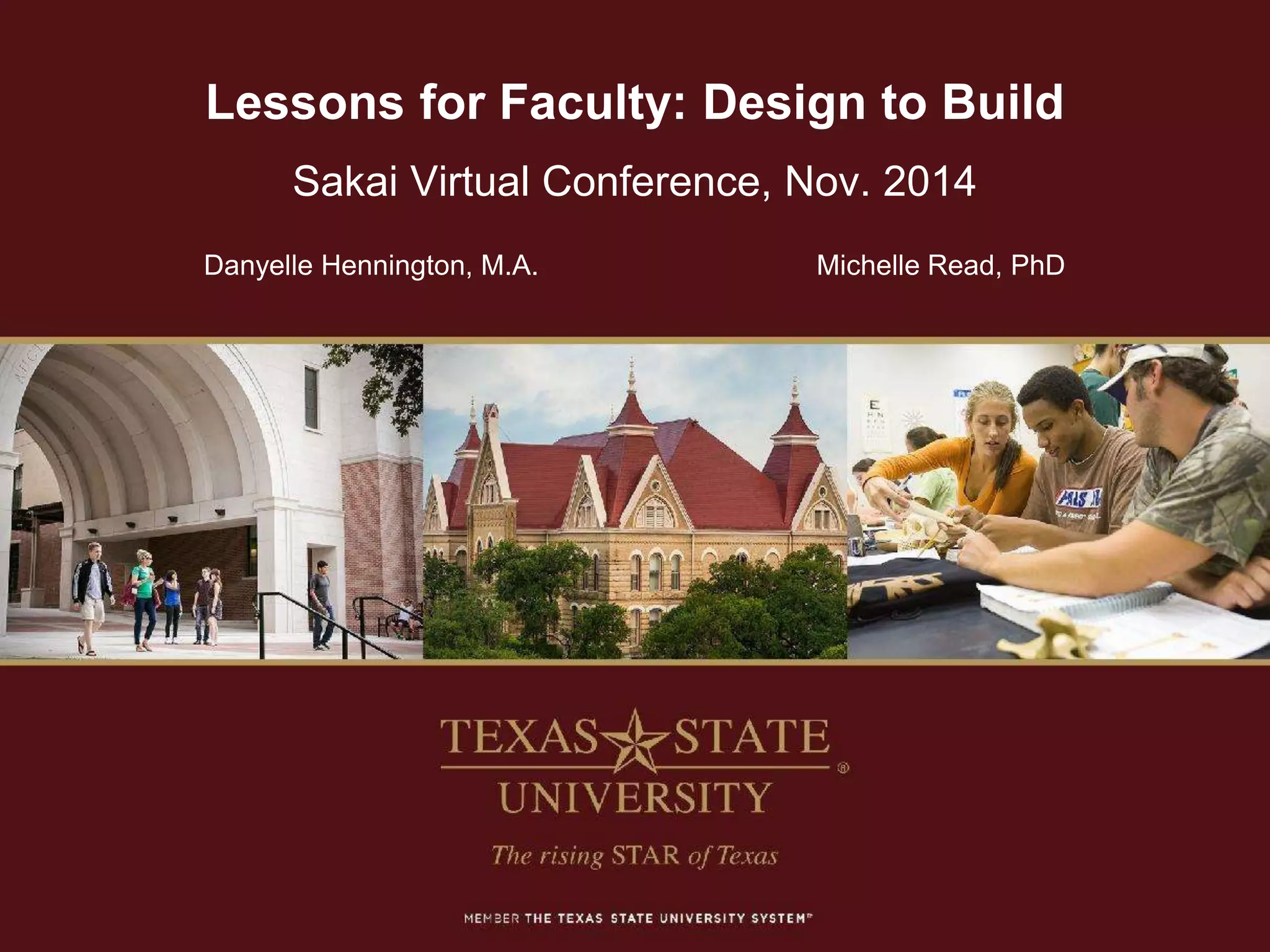
Lessons for Faculty: Design to Build
Danyelle Hennington, M.A. Michelle Read, PhD
Sakai Virtual Conference, Nov. 2014
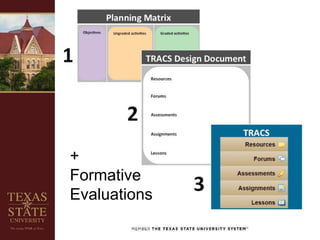
+
Formative
Evaluations
ByDaveBraunschweig(Ownwork)[CC-BY-SA-3.0(http://creativecommons.org/licenses/by-sa/3.0)],viaWikimediaCommons
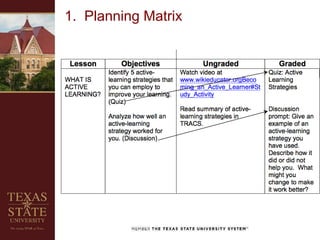
1. Planning Matrix
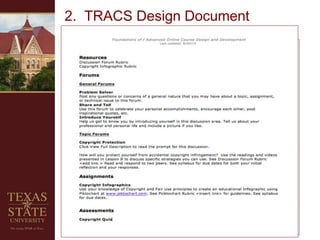
2. TRACS Design Document
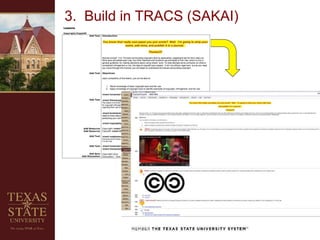
3. Build in TRACS (SAKAI)
Foundations/Advanced Online Course
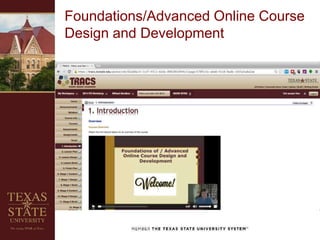
Design and Development
• Complete online course development tasks
following best practices as described in the
Texas State Best Practices Checklist.
• Learn about issues related to teaching online.
• Collaborate with peers and exchange ideas and
feedback on online course design, development,
and implementation.
• Evaluate the quality of his/her course using the
Texas State Best Practices Checklist.
• Successfully use TRACS tools such as Lessons,
Forums, Assessments, and Assignments to
develop a course site.
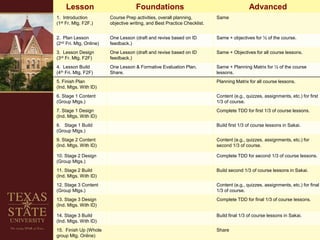
Lesson Foundations Advanced
1. Introduction
(1st Fr. Mtg. F2F.)
Course Prep activities, overall planning,
objective writing, and Best Practice Checklist.
Same
2. Plan Lesson
(2nd Fri. Mtg. Online)
One Lesson (draft and revise based on ID
feedback.)
Same + objectives for ½ of the course.
3. Lesson Design
(3rd Fr. Mtg. F2F)
One Lesson (draft and revise based on ID
feedback.)
Same + Objectives for all course lessons.
4. Lesson Build
(4th Fri. Mtg. F2F)
One Lesson & Formative Evaluation Plan.
Share.
Same + Planning Matrix for ½ of the course
lessons.
5. Finish Plan
(Ind. Mtgs. With ID)
Planning Matrix for all course lessons.
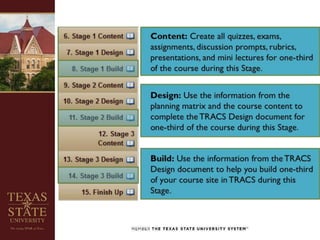
6. Stage 1 Content
(Group Mtgs.)
Content (e.g., quizzes, assignments, etc.) for first
1/3 of course.
7. Stage 1 Design
(Ind. Mtgs. With ID)
Complete TDD for first 1/3 of course lessons.
8. Stage 1 Build
(Group Mtgs.)
Build first 1/3 of course lessons in Sakai.
9. Stage 2 Content
(Ind. Mtgs. With ID)
Content (e.g., quizzes, assignments, etc.) for
second 1/3 of course.
10. Stage 2 Design
(Group Mtgs.)
Complete TDD for second 1/3 of course lessons.
11. Stage 2 Build
(Ind. Mtgs. With ID)
Build second 1/3 of course lessons in Sakai.
12. Stage 3 Content
(Group Mtgs.)
Content (e.g., quizzes, assignments, etc.) for final
1/3 of course.
13. Stage 3 Design
(Ind. Mtgs. With ID)
Complete TDD for final 1/3 of course lessons.
14. Stage 3 Build
(Ind. Mtgs. With ID)
Build final 1/3 of course lessons in Sakai.
15. Finish Up (Whole
group Mtg. Online)
Share
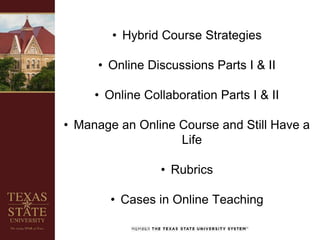
• Hybrid Course Strategies
• Online Discussions Parts I & II
• Online Collaboration Parts I & II
• Manage an Online Course and Still Have a
Life
• Rubrics
• Cases in Online Teaching
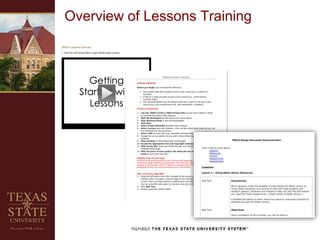
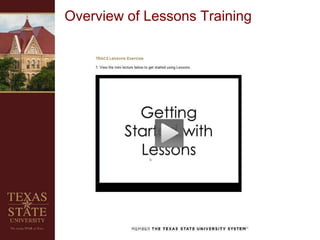
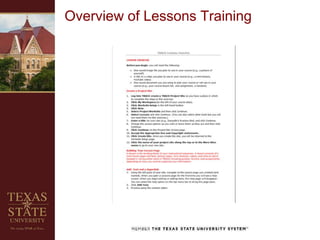
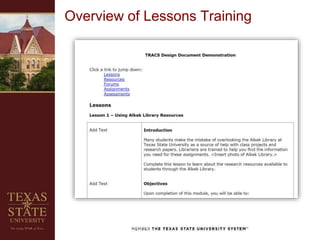
Overview of Lessons Training
 Broad ranged technical abilities among participants.
 Lessons easier to learn/use than Learning Modules.
 Self-paced exercises had mixed success.
 After completion of training materials, many participants still had key misconceptions.
 The TRACS Design Document was a useful tool for both participant designing and ID
feedback.
 Most faculty believed the TRACS Design Document that while time consuming,
made the build process easier. It helped faculty organize their ideas.
 Faculty liked the look and feel of Lessons.
 Faculty felt that they were now prepared to design/build online course materials.
Key Findings
Implications
 Need to add accountability for self-paced exercises just as you would in any flipped
model course.
 Additionally, more guidance may be needed when explaining how to fill in the Lesson
tools column of the TDD.
 Adjust the calendar for working on the TRACS DD AND building. This would allow for
more time to take advantage of the 1:1 sessions offered by our course developers to
assist with building.
 We trust the UI improvements planned will address issues that confounded the
learning process.
Questions

Sakai pres2014 10_24

  • 1.
    Lessons for Faculty:Design to Build Danyelle Hennington, M.A. Michelle Read, PhD Sakai Virtual Conference, Nov. 2014
  • 3.
  • 4.
  • 5.
  • 6.
  • 7.
    3. Build inTRACS (SAKAI)
  • 8.
  • 9.
    • Complete onlinecourse development tasks following best practices as described in the Texas State Best Practices Checklist. • Learn about issues related to teaching online. • Collaborate with peers and exchange ideas and feedback on online course design, development, and implementation. • Evaluate the quality of his/her course using the Texas State Best Practices Checklist. • Successfully use TRACS tools such as Lessons, Forums, Assessments, and Assignments to develop a course site.
  • 10.
    Lesson Foundations Advanced 1.Introduction (1st Fr. Mtg. F2F.) Course Prep activities, overall planning, objective writing, and Best Practice Checklist. Same 2. Plan Lesson (2nd Fri. Mtg. Online) One Lesson (draft and revise based on ID feedback.) Same + objectives for ½ of the course. 3. Lesson Design (3rd Fr. Mtg. F2F) One Lesson (draft and revise based on ID feedback.) Same + Objectives for all course lessons. 4. Lesson Build (4th Fri. Mtg. F2F) One Lesson & Formative Evaluation Plan. Share. Same + Planning Matrix for ½ of the course lessons. 5. Finish Plan (Ind. Mtgs. With ID) Planning Matrix for all course lessons. 6. Stage 1 Content (Group Mtgs.) Content (e.g., quizzes, assignments, etc.) for first 1/3 of course. 7. Stage 1 Design (Ind. Mtgs. With ID) Complete TDD for first 1/3 of course lessons. 8. Stage 1 Build (Group Mtgs.) Build first 1/3 of course lessons in Sakai. 9. Stage 2 Content (Ind. Mtgs. With ID) Content (e.g., quizzes, assignments, etc.) for second 1/3 of course. 10. Stage 2 Design (Group Mtgs.) Complete TDD for second 1/3 of course lessons. 11. Stage 2 Build (Ind. Mtgs. With ID) Build second 1/3 of course lessons in Sakai. 12. Stage 3 Content (Group Mtgs.) Content (e.g., quizzes, assignments, etc.) for final 1/3 of course. 13. Stage 3 Design (Ind. Mtgs. With ID) Complete TDD for final 1/3 of course lessons. 14. Stage 3 Build (Ind. Mtgs. With ID) Build final 1/3 of course lessons in Sakai. 15. Finish Up (Whole group Mtg. Online) Share
  • 12.
    • Hybrid CourseStrategies • Online Discussions Parts I & II • Online Collaboration Parts I & II • Manage an Online Course and Still Have a Life • Rubrics • Cases in Online Teaching
  • 13.
  • 14.
  • 15.
  • 16.
  • 17.
     Broad rangedtechnical abilities among participants.  Lessons easier to learn/use than Learning Modules.  Self-paced exercises had mixed success.  After completion of training materials, many participants still had key misconceptions.  The TRACS Design Document was a useful tool for both participant designing and ID feedback.  Most faculty believed the TRACS Design Document that while time consuming, made the build process easier. It helped faculty organize their ideas.  Faculty liked the look and feel of Lessons.  Faculty felt that they were now prepared to design/build online course materials. Key Findings
  • 18.
    Implications  Need toadd accountability for self-paced exercises just as you would in any flipped model course.  Additionally, more guidance may be needed when explaining how to fill in the Lesson tools column of the TDD.  Adjust the calendar for working on the TRACS DD AND building. This would allow for more time to take advantage of the 1:1 sessions offered by our course developers to assist with building.  We trust the UI improvements planned will address issues that confounded the learning process.
  • 19.