Stark Parks’ mission is to preserve, manage, and connect natural areas to serve
the community through recreation, conservation, and education.
Training and
Documentation
• Three components – online training, review of each equipment manual
and in field, hands on practical evaluation
• All employees will complete outlined trainings before operating any
Stark Parks equipment
• Supervisor will hold records of each component for each employee
operating equipment
• Refresher training is to be taken annually for all employees operating
equipment
Learning Objectives
• Purpose of a skid loader
• Characteristics & potential hazards
• Controls and instrumentation of a skid loader
• Attachments
• Preventative maintenance and pre-operation checks
• Demonstrating use of the unit
• General Safety
Purpose
• Compact, powerful, and versatile machines with a small turn
radius
• Can be 4-wheel or track driven
• Turns by skidding, or dragging its fixed-orientation wheels /
tracks across the ground
• Skid loaders function to push, scrape, scoop, lift, and dump
materials.
Characteristics & Hazards
• A skid loader is a very powerful hydraulic machine
• A hydrostatic transmission controls forward and reverse
direction
• Hydrostatic valves control the flow of hydraulic oil to steer the
machine by “skidding” it sharply around corners
• The machine moves (forward, reverse or sideways) the instant
you move the hydraulic control levers or pedals
• The load bucket will lift, roll or tilt
• HAZARD POTENTIAL: Bumping the control levers can cause the
machine to move unintentionally.
Characteristics & Hazards
• The skid loader’s center of gravity is low and between the wheels
• The center of gravity is always shifting during operation
• Typically 2/3 of the skid loader’s weight is towards the rear axle of
the machine and lifting a load transfers weight to the front axle.
• The higher the load, increases height of the center of gravity, and
increases risk of tip over in any direction
HAZARD POTENTIAL: Know the manufactures load weight limit and
DO NOT exceed this limit.
Characteristics & Hazards
ADDITIONAL HAZARDS:
• Pinch points, cut points, and crush points exist within close reach
of the operator’s space
• Lift arms raise and lower the loader bucket near the operator’s cab
• The loader bucket is mounted in front of the operator and can be
rolled forward or tilted back within inches of the operator
• Control levers, pedals, and a parking brake are arranged compactly
within the operator’s space (It is easy to bump these controls)
Operators must be aware of job site hazards outside of the
machine as well (slope of site, etc.).
Characteristics & Hazards
The most commonly reported causes of serious injury and death
using skid steer loaders are:
1. Crushed by moving parts
2. Rollover accidents
Characteristics & Hazards
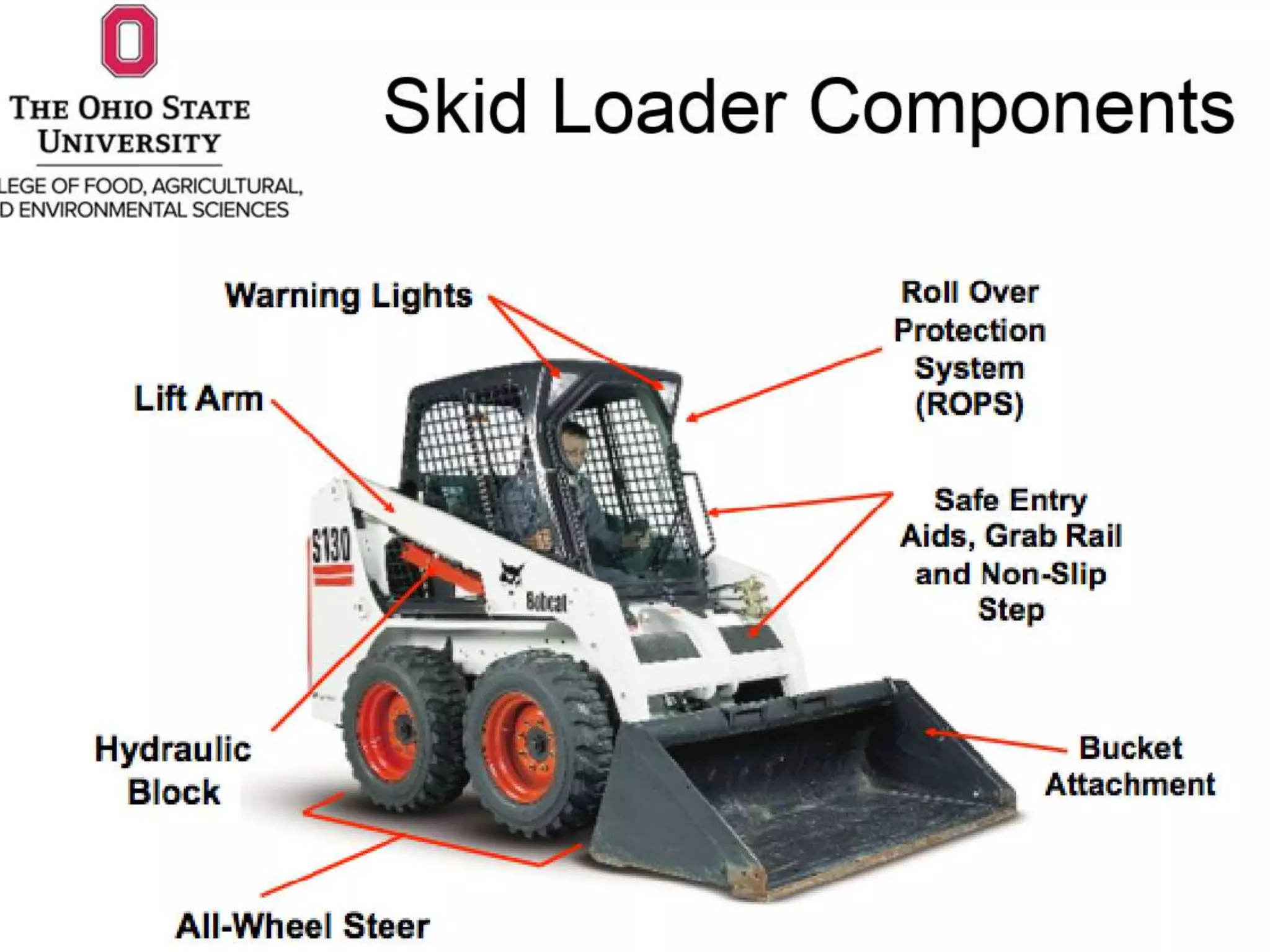
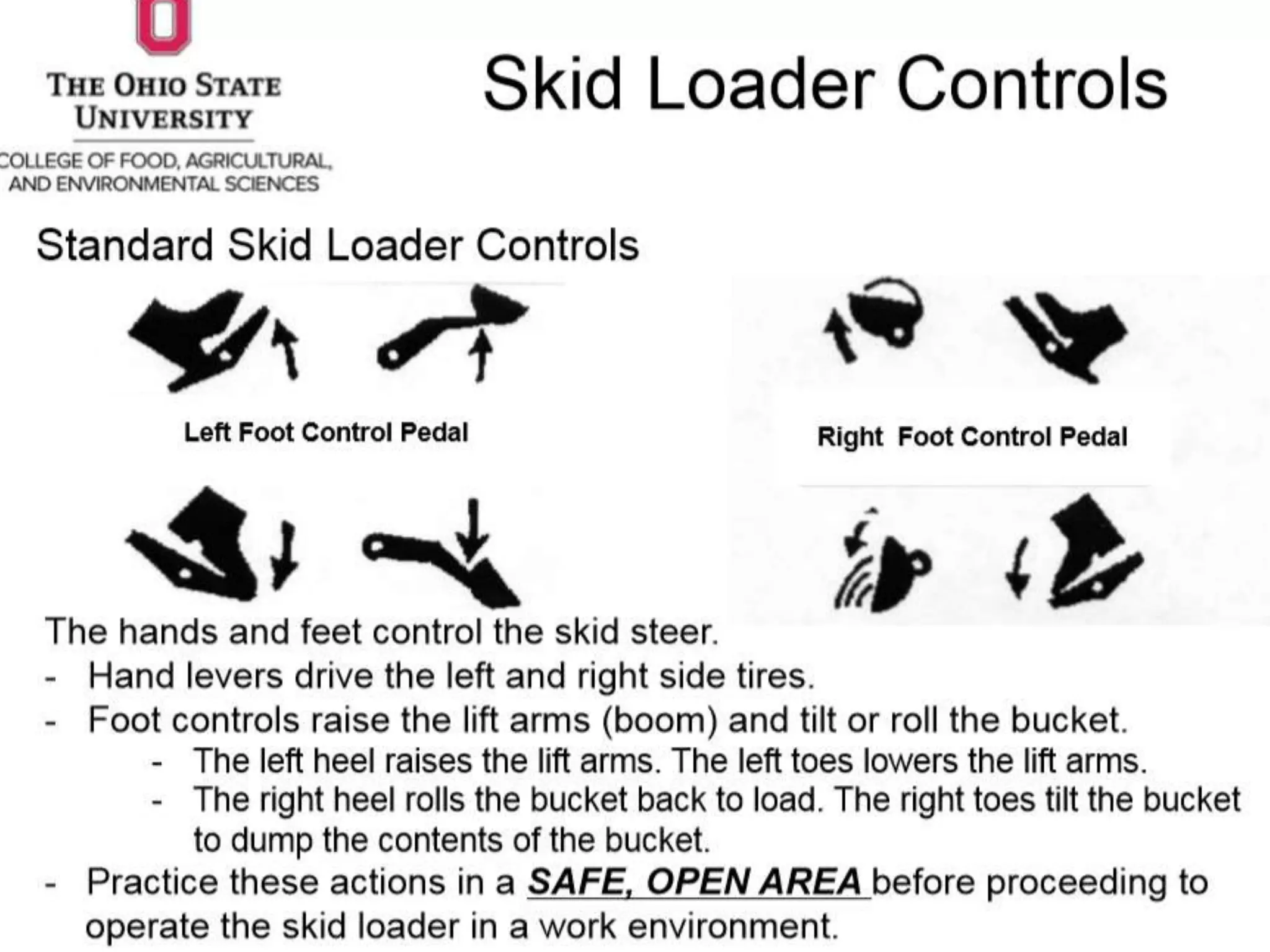
Controls & Instrumentation
Controls and Attachments
• Before using the skid loader, review the operator’s manual for the
specific unit you will be expected to operate and become familiar with
the controls
• A competent operator should demonstrate how to start and stop the
engine, how to move the machine forward and reverse, how to steer
the skid loader, and how to raise, lower, and tilt the bucket
attachment.
• An operator should also understand how to safely change
attachments and how the controls are used to operate the
attachment.
Attachment Use
• Attachments must be compatible with the machine
• Installation must be handled by a competent person
• Carefully read attachment manual and follow all instructions and
warnings
• Verify that all connections are secure and attachment responds
properly to controls
• Test attachment in an open area to insure proper operation
• Attachment changes can effect:
o Intended use of the skid loader
o Weight or balance of the machine
o Can alter machine controls, performance, or reliability
Pre-Start Checklist
(Use the Stark Parks Provided Checklist)
General Safety
Entering and Exiting
• Lift arms and bucket should be completely lowered
• Face the machine and maintain 3-points of contact when getting on
and off.
• To enter the skid loader, use the grab bars (hand holds) and the tread
plates mounted on the loader bucket. Never use machine controls as
handholds.
• When seated, lower the restraint bar and/or fasten the seat belt. Exit
the machine in the same manner.
• Do not reach into the cab from the ground level to move hydraulic
levers or pedals to position the lift arms and bucket.
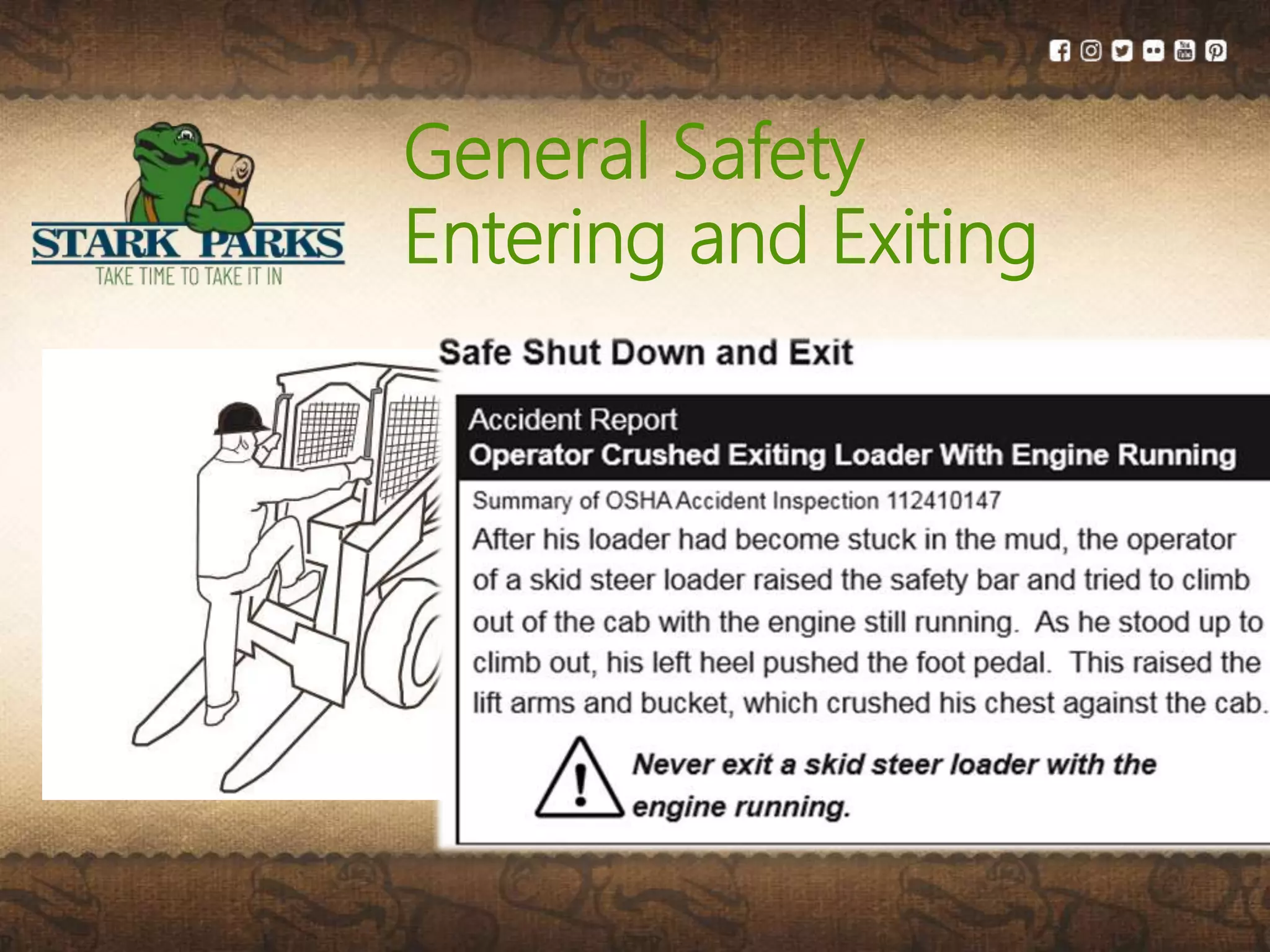
General Safety
Entering and Exiting
General Safety
• Lower the safety restraint bar and/or fasten the seat belt every time
you enter the machine
• Be sure area around skid loader is clear of others, bystanders, farm
animals or other equipment
• Lower all equipment to the ground, engage park brake and shut off
machine, before allowing anyone to approach.
• Never stand or lean where lift arms or load bucket movements could
crush you.
• Use the lift arm locks (boom locks) to prevent lift arms from dropping
downward if repairs must be made to the machine.
General Safety
Potential Site Hazards
• Buried utilities – water, electrical, natural gas
• Overhead power lines
• Adjacent structures, equipment, or traffic
• Excessive debris, mud, or snow
• Consider travel path conditions – steep terrain, soft soil, loose gravel,
rutting and uneven ground transitions
• Limited vision / blind corners
• Excessive noise for long periods of time (please wear the proper PPE)
General Safety
Preventing Tip Over
• Avoid crossing steep slopes such as ditches or stream banks
• Avoid sharp turns and reduce speeds when turning
• Use slower speeds over rough ground
• Balance loads so weight is evenly distributed and load is stable
• Lower the load bucket for travel to aid in visibility and to lower the
machine’s center of gravity and DO NOT overload the bucket
• Exceeding that capacity with a lifted load can result in forward or
sideways tipping of the machine
• When moving up a slope keep the heaviest weight up the hill
o With an empty bucket, back up the hill/slope
o With a full bucket, drive forward up the hill/slope
General Safety
Always Remember
• Before moving the machine, be sure all persons or vehicles are
clear of the machine path & use a signal person if view is
obstructed
• Never swing, lift or move a load overtop of anyone
• Lower the boom and bucket, stop the engine, and set the park
brake before dismounting the machine. Do this every time.
• Prevent material rollback by securing loads in the bucket and
filling the bucket only to rated levels.
General Safety
Always Remember
• Avoid working with an embankment or pile that is taller than the
machine. A collapse could cause the operator station to become
buried.
• Do not reach outside of the cab while the skid loader is running.
All adjustments and connections of attachments should be made
with the engine stopped.
References
• For Questions and Additional Information Regarding Skid Steer
Safety Contact Rob Hoover at rhoover@starkparks.com
• References:
o National Safe Tractor and Machinery Operation Program,
Hazardous Occupations Safety Training in Agriculture. Penn Sate
University, Ohio State University, and National Safety Council
o OSHA 29CFR1910 and 29CFR1928
o Skid Steer Loader Safety For the Landscaping and Horticultural
Services Industry K-State Research and Extension, Kansas State
University, Manhattan, Kansas.
References
• For Questions and Additional Information Regarding Skid Steer
Safety Contact Rob Hoover at rhoover@starkparks.com
• References:
o National Safe Tractor and Machinery Operation Program,
Hazardous Occupations Safety Training in Agriculture. Penn Sate
University, Ohio State University, and National Safety Council
o OSHA 29CFR1910 and 29CFR1928
o Skid Steer Loader Safety For the Landscaping and Horticultural
Services Industry K-State Research and Extension, Kansas State
University, Manhattan, Kansas.

Equipment Operation, Skid Loader

  • 1.
    Stark Parks’ missionis to preserve, manage, and connect natural areas to serve the community through recreation, conservation, and education.
  • 2.
    Training and Documentation • Threecomponents – online training, review of each equipment manual and in field, hands on practical evaluation • All employees will complete outlined trainings before operating any Stark Parks equipment • Supervisor will hold records of each component for each employee operating equipment • Refresher training is to be taken annually for all employees operating equipment
  • 3.
    Learning Objectives • Purposeof a skid loader • Characteristics & potential hazards • Controls and instrumentation of a skid loader • Attachments • Preventative maintenance and pre-operation checks • Demonstrating use of the unit • General Safety
  • 4.
    Purpose • Compact, powerful,and versatile machines with a small turn radius • Can be 4-wheel or track driven • Turns by skidding, or dragging its fixed-orientation wheels / tracks across the ground • Skid loaders function to push, scrape, scoop, lift, and dump materials.
  • 5.
    Characteristics & Hazards •A skid loader is a very powerful hydraulic machine • A hydrostatic transmission controls forward and reverse direction • Hydrostatic valves control the flow of hydraulic oil to steer the machine by “skidding” it sharply around corners • The machine moves (forward, reverse or sideways) the instant you move the hydraulic control levers or pedals • The load bucket will lift, roll or tilt • HAZARD POTENTIAL: Bumping the control levers can cause the machine to move unintentionally.
  • 6.
    Characteristics & Hazards •The skid loader’s center of gravity is low and between the wheels • The center of gravity is always shifting during operation • Typically 2/3 of the skid loader’s weight is towards the rear axle of the machine and lifting a load transfers weight to the front axle. • The higher the load, increases height of the center of gravity, and increases risk of tip over in any direction HAZARD POTENTIAL: Know the manufactures load weight limit and DO NOT exceed this limit.
  • 7.
    Characteristics & Hazards ADDITIONALHAZARDS: • Pinch points, cut points, and crush points exist within close reach of the operator’s space • Lift arms raise and lower the loader bucket near the operator’s cab • The loader bucket is mounted in front of the operator and can be rolled forward or tilted back within inches of the operator • Control levers, pedals, and a parking brake are arranged compactly within the operator’s space (It is easy to bump these controls) Operators must be aware of job site hazards outside of the machine as well (slope of site, etc.).
  • 8.
    Characteristics & Hazards Themost commonly reported causes of serious injury and death using skid steer loaders are: 1. Crushed by moving parts 2. Rollover accidents
  • 9.
  • 10.
  • 11.
  • 15.
    Controls and Attachments •Before using the skid loader, review the operator’s manual for the specific unit you will be expected to operate and become familiar with the controls • A competent operator should demonstrate how to start and stop the engine, how to move the machine forward and reverse, how to steer the skid loader, and how to raise, lower, and tilt the bucket attachment. • An operator should also understand how to safely change attachments and how the controls are used to operate the attachment.
  • 16.
    Attachment Use • Attachmentsmust be compatible with the machine • Installation must be handled by a competent person • Carefully read attachment manual and follow all instructions and warnings • Verify that all connections are secure and attachment responds properly to controls • Test attachment in an open area to insure proper operation • Attachment changes can effect: o Intended use of the skid loader o Weight or balance of the machine o Can alter machine controls, performance, or reliability
  • 17.
    Pre-Start Checklist (Use theStark Parks Provided Checklist)
  • 18.
    General Safety Entering andExiting • Lift arms and bucket should be completely lowered • Face the machine and maintain 3-points of contact when getting on and off. • To enter the skid loader, use the grab bars (hand holds) and the tread plates mounted on the loader bucket. Never use machine controls as handholds. • When seated, lower the restraint bar and/or fasten the seat belt. Exit the machine in the same manner. • Do not reach into the cab from the ground level to move hydraulic levers or pedals to position the lift arms and bucket.
  • 19.
  • 20.
    General Safety • Lowerthe safety restraint bar and/or fasten the seat belt every time you enter the machine • Be sure area around skid loader is clear of others, bystanders, farm animals or other equipment • Lower all equipment to the ground, engage park brake and shut off machine, before allowing anyone to approach. • Never stand or lean where lift arms or load bucket movements could crush you. • Use the lift arm locks (boom locks) to prevent lift arms from dropping downward if repairs must be made to the machine.
  • 21.
    General Safety Potential SiteHazards • Buried utilities – water, electrical, natural gas • Overhead power lines • Adjacent structures, equipment, or traffic • Excessive debris, mud, or snow • Consider travel path conditions – steep terrain, soft soil, loose gravel, rutting and uneven ground transitions • Limited vision / blind corners • Excessive noise for long periods of time (please wear the proper PPE)
  • 22.
    General Safety Preventing TipOver • Avoid crossing steep slopes such as ditches or stream banks • Avoid sharp turns and reduce speeds when turning • Use slower speeds over rough ground • Balance loads so weight is evenly distributed and load is stable • Lower the load bucket for travel to aid in visibility and to lower the machine’s center of gravity and DO NOT overload the bucket • Exceeding that capacity with a lifted load can result in forward or sideways tipping of the machine • When moving up a slope keep the heaviest weight up the hill o With an empty bucket, back up the hill/slope o With a full bucket, drive forward up the hill/slope
  • 23.
    General Safety Always Remember •Before moving the machine, be sure all persons or vehicles are clear of the machine path & use a signal person if view is obstructed • Never swing, lift or move a load overtop of anyone • Lower the boom and bucket, stop the engine, and set the park brake before dismounting the machine. Do this every time. • Prevent material rollback by securing loads in the bucket and filling the bucket only to rated levels.
  • 24.
    General Safety Always Remember •Avoid working with an embankment or pile that is taller than the machine. A collapse could cause the operator station to become buried. • Do not reach outside of the cab while the skid loader is running. All adjustments and connections of attachments should be made with the engine stopped.
  • 25.
    References • For Questionsand Additional Information Regarding Skid Steer Safety Contact Rob Hoover at rhoover@starkparks.com • References: o National Safe Tractor and Machinery Operation Program, Hazardous Occupations Safety Training in Agriculture. Penn Sate University, Ohio State University, and National Safety Council o OSHA 29CFR1910 and 29CFR1928 o Skid Steer Loader Safety For the Landscaping and Horticultural Services Industry K-State Research and Extension, Kansas State University, Manhattan, Kansas.
  • 26.
    References • For Questionsand Additional Information Regarding Skid Steer Safety Contact Rob Hoover at rhoover@starkparks.com • References: o National Safe Tractor and Machinery Operation Program, Hazardous Occupations Safety Training in Agriculture. Penn Sate University, Ohio State University, and National Safety Council o OSHA 29CFR1910 and 29CFR1928 o Skid Steer Loader Safety For the Landscaping and Horticultural Services Industry K-State Research and Extension, Kansas State University, Manhattan, Kansas.