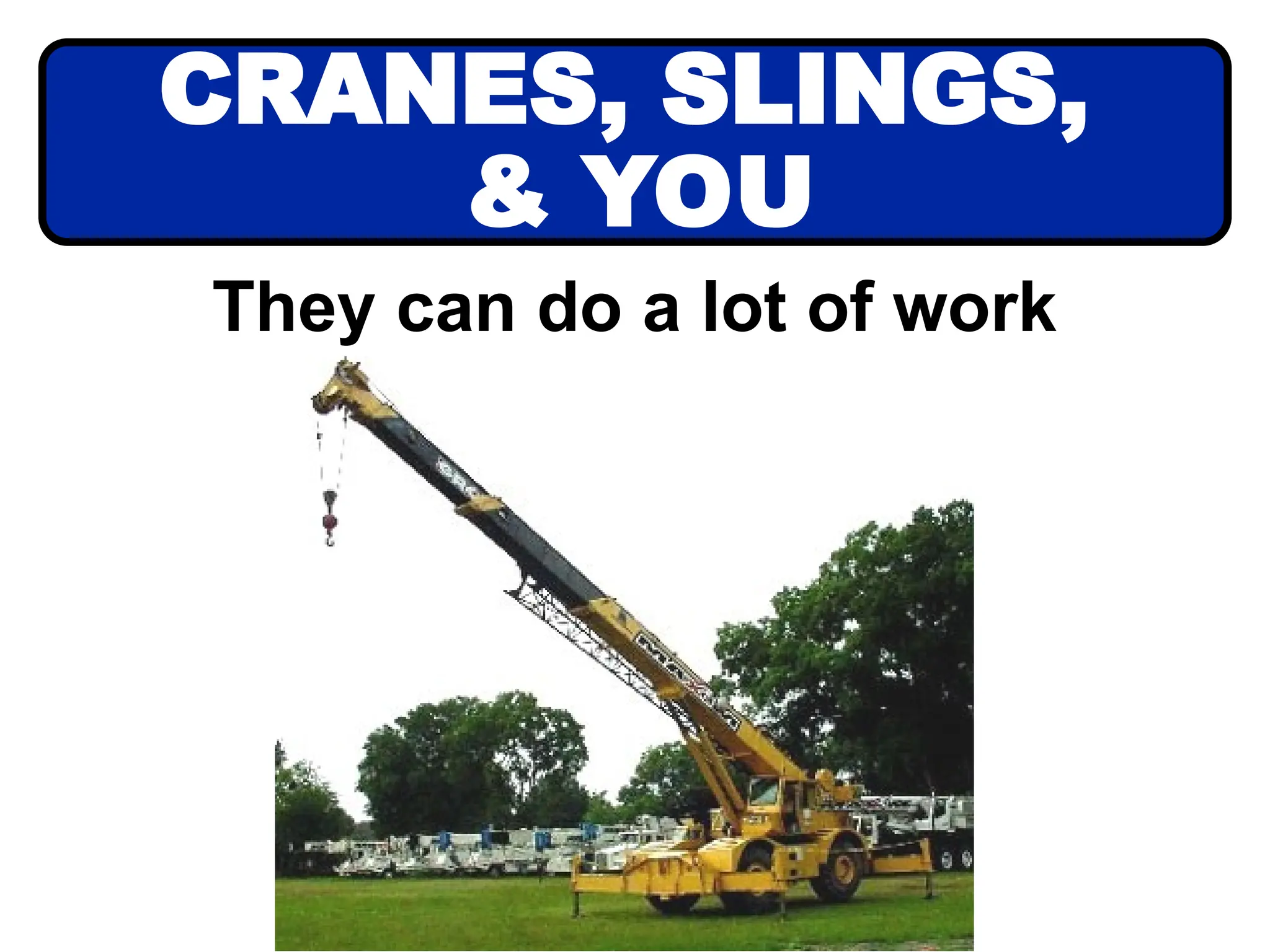
CRANES, SLINGS,
& YOU
They can do a lot of work
They can do a lot of damage
CRANES, SLINGS,
& YOU
Idle Cranes
Cranes that have been idle, must be
inspected and tested before being
placed back in service using the criteria
that applies to periodic inspection.
Special attention should be given to the
hook, lifting chain and wire rope.
Review the manufacturers specific inspection requirements!
Altered Cranes
Cranes that have been altered or repaired
must be inspected and tested. If load
sustaining parts are altered or repaired, a
load test should be conducted to verify the
rated load capacity of the crane. Report
issued by a qualified person and kept on
file.
Load Testing
When load testing, the test load cannot
exceed 125 percent of the rated load.
Hoists & cranes should be operated a
number of times at various positions.
Report issued by testing organization
giving the conditions under which system
was load tested.
Preventive
Maintenance
1. Clean & lube wire rope & chain
2. Adjusting brakes
3. Checking & filling gear cases levels
4. Replacing any contaminated oils
5. Lube bearings, gears, pinions, linkages, & shafts
6. Adjusting operation of limit switches
7. Clean & replace pitted/burned electrical contacts
8. Cleaning or replacing air & fluid filters
9. Inspecting all controls & warning systems
General Pre-Op Test
1. Disconnects are known before any test
2. Get help if you’re not familiar with the cranes
3. Follow manufacturers recommendations
4. Follow Checklist
5. Inspect electrical controls
6. Check for obstructions in crane’s travel path
7. Test proper operation of controls
8. Observe for smooth operation of components
9. Never unwind spool completely
10.Check upper & lower limit switches
Hook Pre-op Test
1. Replace if deformed or cracked
2. Check for proper function of safety latch
3. Inspect for twists from plane of unbent hook
4. Check for proper swivel
5. Hook repair is not recommended
6. Emergency hook repair must be performed
only under competent supervision
7. After any hook repairs, hook must be load
tested before being returned to normal
service
Rope Pre-op Test
1. Reduction in rope diameter
2. Broken or worn outside wires
3. Corroded or broken wires at end of
connections
4. Severe kinking, crushing, cutting or
unstranding
5. Corroded, cracked, bent, worn, or
improperly applied end connections
Lockout-Tagout
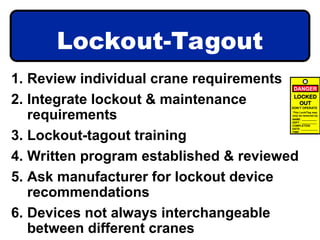
1. Review individual crane requirements
2. Integrate lockout & maintenance
requirements
3. Lockout-tagout training
4. Written program established & reviewed
5. Ask manufacturer for lockout device
recommendations
6. Devices not always interchangeable
between different cranes
LOCKED
OUT
This Lock/Tag may
only be removed by
NAME: __________
DEPT : __________
COMPLETION
DATE: ___________
TIME: ____________
DON’T OPERATE
DANGER
Crane Safety Basics
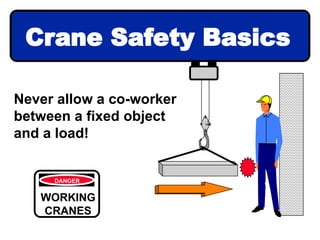
Never allow a co-worker
between a fixed object
and a load!
2
TON
DANGER
WORKING
CRANES
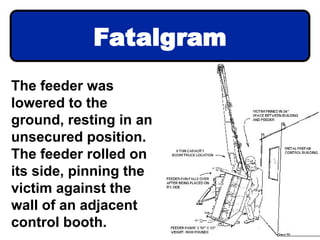
The feeder was
lowered to the
ground, resting in an
unsecured position.
The feeder rolled on
its side, pinning the
victim against the
wall of an adjacent
control booth.
Fatalgram
The employee was in the process of
loading a conveyor onto the trailer of his
truck using the truck's crane. The cable
attached to the conveyor slipped off the
hook of the crane causing the conveyor to
bounce off the trailer and crush the victim
who was standing between the crane and
the trailer. He died from crushing injuries.
Fatalgram
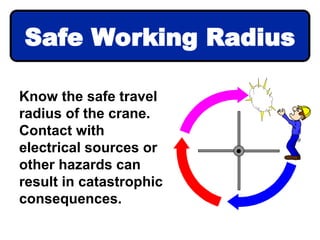
Know the safe travel
radius of the crane.
Contact with
electrical sources or
other hazards can
result in catastrophic
consequences.
Safe Working Radius
Load Chart
Even when properly trained, equipment
properly maintained, & employees work in a
safe manner, accidents can still occur
because crane operations are dependant on
mechanical devices that can fail. The results
can be catastrophic. You are the only
controlling influence that can minimize the
hazard. Your life literally is in your own
hands!
Crane Safety Basics
1. No history of unsafe acts in workplace
2. Mature & safe attitude
3. Ability to react quickly in an emergency
4. Drug & alcohol free
5. Good depth perception
6. Good hearing and vision
7. Thoroughly trained
8. Understand lift requirements
9. No medication that will interfere with operation
Operator
Requirements
Safe Practices
1. Test controls & brakes at start of shift
2. Don’t operate unsafe cranes or hoists
3. Test brakes by a short lift to ensure
control
4. Move loads only after being signaled by
designated, qualified signaler
1. Never carry loads over anyone
2. Never carry loads past anyone
3. Signalers in line-of-sight of operator
4. No riders on loads or hooks
5. No unauthorized person operating crane
6. Lockout before maintenance or repairs
7. Frequently inspect cranes
Safe Practices
1. Hook directly over load before lifting
2. Document & maintain inspection records
3. Check warning devices & signals
4. Signalers must watch load
5. Operators must watch signalers
6. Know travel path in advance of lift
7. Know where to set down load
8. Will new location support weight
Safe Practices
Fatalgram
The employee was using a truck
equipped with a hydraulic boom to
position a tire on the hub of a
caterpillar loader. The tire fell off the
hook and struck the employee on his
head and neck.
Fatalgram
Three steel plates weighing nearly 6,000
pounds were tied together by one nylon
strap. They were lifted about 5 feet by a
crane in order to slide a second strap
around them. The truck driver walked
under the suspended load, and at that
moment, the strap around the steel plates
broke. The plates fell striking the victim.
He died from head injuries.
Fatalgram
A cement take-up pulley weight for a
conveyer was being lifted into position by a
crane. To lift the weight, straps were
attached to four pins that had been set into
the cement weight. The employee was riding
on the 3,000 pound weight as it was being
lifted. One of the pins pulled out of the
weight causing the employee to lose his
balance and fall 35 feet to the ground. He
died from sustained injuries.
1. Only one person is designated signaler
2. Maintain line-of-sight with operator
3. Operator acknowledges every signal
4. Stop operation if comprehension is lost
5. Operators must watch signalers
6. Plan in advance where load is going
7. Will new location will support the weight
Signaler Safe
Practices
1. Raise hooks to limit switches
2. Place controls in “off” position
3. Place main power switch in “off” position
4. Visual check for dangerous conditions
5. Report defects immediately
6. Tagout defective equipment immediately
7. Report cranes not in operation
8. Follow manufacturer’s recommendations.
Leaving or Parking
1. Size, weight, & center of gravity of load
2. Number of sling legs
3. Angle sling makes with horizontal line
4. Rated capacity of sling
5. History of care & usage of sling
Lifting Factors
1. Crane hook must be directly above
center of gravity
2. If crane hook is too far to one side of
center of gravity, dangerous tilting and
unequal stress to sling leg will result
Size, Weight, &
Center of Gravity
1. Rated capacity varies depending upon
type of sling, size of sling, & type of hitch
2. Consult with manufacturer
3. Older slings must be used with additional
caution
4. Sling charts based on new sling usage.
Capacity of Sling
1. Mishandling & misuse of slings are
leading cause of sling-related accidents
2. Proper care essential for maximum
service & safety
3. Always protect slings with cover saddles,
burlap padding or wood blocking to
prevent sharp bends & cutting edges.
Care & Usage
1. Use a Dynamometer
2. Check shipping papers
3. Check nomenclature plates
4. Use industry standard tables or charts
5. Consult equipment manufacturer
6. Estimate using weights of similar loads
7. Never lift based on a guess
8. Stay within 50% of cranes rated capacity
when estimating loads
Estimating Load
Weight
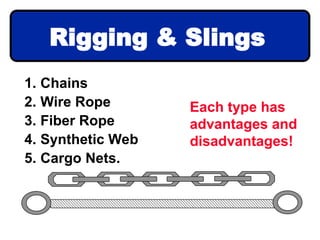
1. Chains
2. Wire Rope
3. Fiber Rope
4. Synthetic Web
5. Cargo Nets.
Rigging & Slings
Each type has
advantages and
disadvantages!
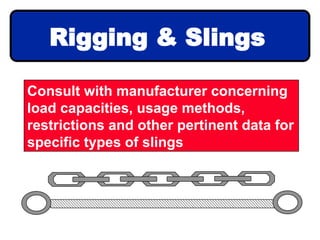
Consult with manufacturer concerning
load capacities, usage methods,
restrictions and other pertinent data for
specific types of slings
Rigging & Slings
1. Never load in excess of rated capacity
2. Never use a damaged sling
3. Never pull sling from a suspended load
4. Never shorten with knots
5. Suspended loads clear of everyone
6. Suspended loads clear of obstructions
7. Hands & fingers clear of loads
8. Protect slings from sharp edges of load
9. Think before you affect a load.
Rules for Slings
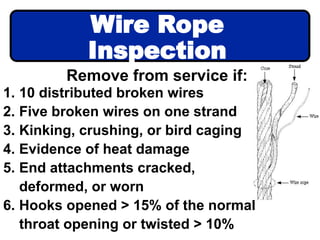
Remove from service if:
Wire Rope
Inspection
1. 10 distributed broken wires
2. Five broken wires on one strand
3. Kinking, crushing, or bird caging
4. Evidence of heat damage
5. End attachments cracked,
deformed, or worn
6. Hooks opened > 15% of the normal
throat opening or twisted > 10%
Remove from service if:
1. Defective or questionable welds
2. Bending or elongation of chain links
3. Cracked or deformed links
4. Missing or removed identification tags
5. End attachments cracked, deformed, worn
6. Other suspected unsafe conditions
Chain Inspection
Remove from service if:
1. Acid or caustic burns
2. Age deterioration (drying/cracking)
3. Melting or charring of sling surface
4. Snags, tears or cuts exposure of colored
thread
5. Missing or removed identification tags
6. Other suspected unsafe conditions
Web Sling
Inspection
1. Clean sling
2. Check for damage
3. Follow proper storage rules
4. Leave in good condition for next lift
5. Report damaged or defective slings
6. Follow proper disposal or replacement
procedures
After The Lift
1. Dry environment, out of sunlight
2. Off floor or ground
3. Hung from hooks to prevent tangling
and easy access
4. Away from electrical sources
5. By type - don’t mix steel chain slings
with synthetics
6. In a controlled area
Slings Storage
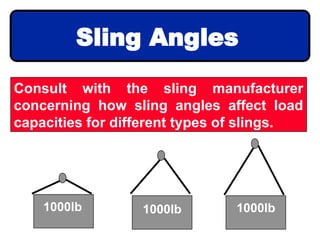
Consult with the sling manufacturer
concerning how sling angles affect load
capacities for different types of slings.
Sling Angles
1000lb 1000lb 1000lb
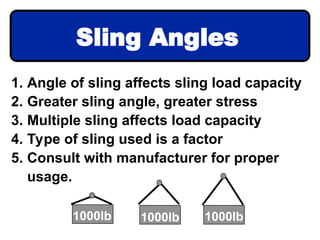
1. Angle of sling affects sling load capacity
2. Greater sling angle, greater stress
3. Multiple sling affects load capacity
4. Type of sling used is a factor
5. Consult with manufacturer for proper
usage.
1000lb 1000lb 1000lb
Sling Angles
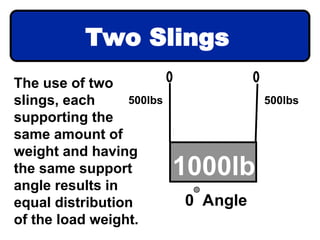
Two Slings
The use of two
slings, each
supporting the
same amount of
weight and having
the same support
angle results in
equal distribution
of the load weight.
500lbs 500lbs
1000lb
0 Angle
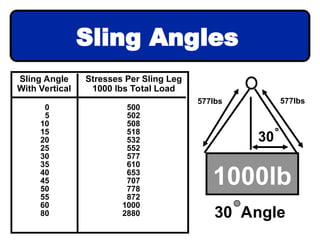
Sling Angle
With Vertical
Stresses Per Sling Leg
1000 lbs Total Load
0 500
5 502
10 508
15 518
20 532
25 552
30 577
35 610
40 653
45 707
50 778
55 872
60 1000
80 2880
1000lb
30
577lbs 577lbs
30 Angle
Sling Angles
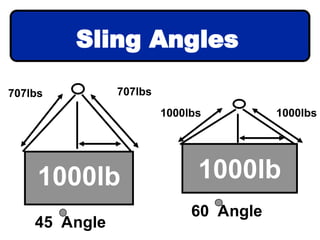
1000lb
707lbs 707lbs
45 Angle
1000lbs 1000lbs
1000lb
60 Angle
Sling Angles
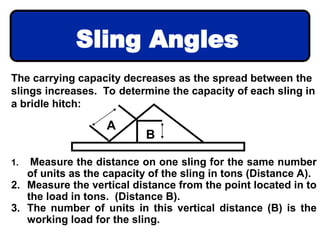
B
A
1. Measure the distance on one sling for the same number
of units as the capacity of the sling in tons (Distance A).
2. Measure the vertical distance from the point located in to
the load in tons. (Distance B).
3. The number of units in this vertical distance (B) is the
working load for the sling.
Sling Angles
The carrying capacity decreases as the spread between the
slings increases. To determine the capacity of each sling in
a bridle hitch:
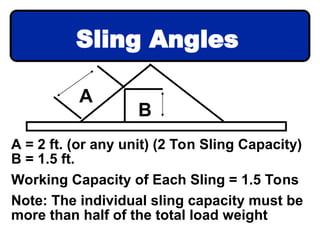
B
A
A = 2 ft. (or any unit) (2 Ton Sling Capacity)
B = 1.5 ft.
Working Capacity of Each Sling = 1.5 Tons
Note: The individual sling capacity must be
more than half of the total load weight
Sling Angles
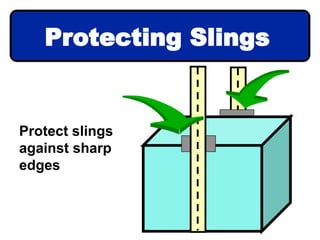
Protecting Slings
Protect slings
against sharp
edges
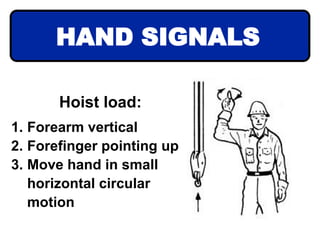
HAND SIGNALS
Hoist load:
1. Forearm vertical
2. Forefinger pointing up
3. Move hand in small
horizontal circular
motion
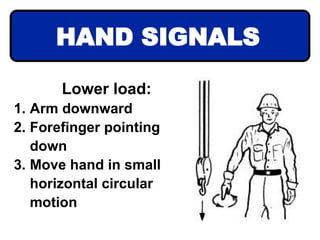
Lower load:
1. Arm downward
2. Forefinger pointing
down
3. Move hand in small
horizontal circular
motion
HAND SIGNALS
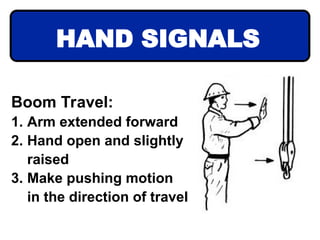
Boom Travel:
1. Arm extended forward
2. Hand open and slightly
raised
3. Make pushing motion
in the direction of travel
HAND SIGNALS
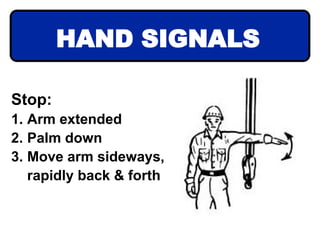
Stop:
1. Arm extended
2. Palm down
3. Move arm sideways,
rapidly back & forth
HAND SIGNALS
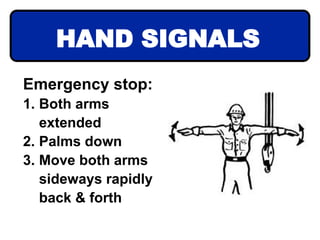
Emergency stop:
1. Both arms
extended
2. Palms down
3. Move both arms
sideways rapidly
back & forth
HAND SIGNALS
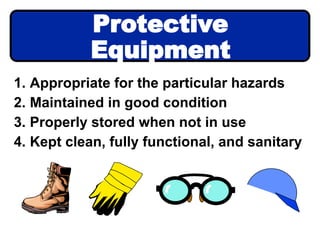
Protective
Equipment
1. Appropriate for the particular hazards
2. Maintained in good condition
3. Properly stored when not in use
4. Kept clean, fully functional, and sanitary

Crane and Slinging Safety Training Presentation

  • 1.
    CRANES, SLINGS, & YOU Theycan do a lot of work
  • 2.
    They can doa lot of damage CRANES, SLINGS, & YOU
  • 3.
    Idle Cranes Cranes thathave been idle, must be inspected and tested before being placed back in service using the criteria that applies to periodic inspection. Special attention should be given to the hook, lifting chain and wire rope. Review the manufacturers specific inspection requirements!
  • 4.
    Altered Cranes Cranes thathave been altered or repaired must be inspected and tested. If load sustaining parts are altered or repaired, a load test should be conducted to verify the rated load capacity of the crane. Report issued by a qualified person and kept on file.
  • 5.
    Load Testing When loadtesting, the test load cannot exceed 125 percent of the rated load. Hoists & cranes should be operated a number of times at various positions. Report issued by testing organization giving the conditions under which system was load tested.
  • 6.
    Preventive Maintenance 1. Clean &lube wire rope & chain 2. Adjusting brakes 3. Checking & filling gear cases levels 4. Replacing any contaminated oils 5. Lube bearings, gears, pinions, linkages, & shafts 6. Adjusting operation of limit switches 7. Clean & replace pitted/burned electrical contacts 8. Cleaning or replacing air & fluid filters 9. Inspecting all controls & warning systems
  • 7.
    General Pre-Op Test 1.Disconnects are known before any test 2. Get help if you’re not familiar with the cranes 3. Follow manufacturers recommendations 4. Follow Checklist 5. Inspect electrical controls 6. Check for obstructions in crane’s travel path 7. Test proper operation of controls 8. Observe for smooth operation of components 9. Never unwind spool completely 10.Check upper & lower limit switches
  • 8.
    Hook Pre-op Test 1.Replace if deformed or cracked 2. Check for proper function of safety latch 3. Inspect for twists from plane of unbent hook 4. Check for proper swivel 5. Hook repair is not recommended 6. Emergency hook repair must be performed only under competent supervision 7. After any hook repairs, hook must be load tested before being returned to normal service
  • 9.
    Rope Pre-op Test 1.Reduction in rope diameter 2. Broken or worn outside wires 3. Corroded or broken wires at end of connections 4. Severe kinking, crushing, cutting or unstranding 5. Corroded, cracked, bent, worn, or improperly applied end connections
  • 10.
    Lockout-Tagout 1. Review individualcrane requirements 2. Integrate lockout & maintenance requirements 3. Lockout-tagout training 4. Written program established & reviewed 5. Ask manufacturer for lockout device recommendations 6. Devices not always interchangeable between different cranes LOCKED OUT This Lock/Tag may only be removed by NAME: __________ DEPT : __________ COMPLETION DATE: ___________ TIME: ____________ DON’T OPERATE DANGER
  • 11.
    Crane Safety Basics Neverallow a co-worker between a fixed object and a load! 2 TON DANGER WORKING CRANES
  • 12.
    The feeder was loweredto the ground, resting in an unsecured position. The feeder rolled on its side, pinning the victim against the wall of an adjacent control booth. Fatalgram
  • 13.
    The employee wasin the process of loading a conveyor onto the trailer of his truck using the truck's crane. The cable attached to the conveyor slipped off the hook of the crane causing the conveyor to bounce off the trailer and crush the victim who was standing between the crane and the trailer. He died from crushing injuries. Fatalgram
  • 14.
    Know the safetravel radius of the crane. Contact with electrical sources or other hazards can result in catastrophic consequences. Safe Working Radius
  • 15.
  • 16.
    Even when properlytrained, equipment properly maintained, & employees work in a safe manner, accidents can still occur because crane operations are dependant on mechanical devices that can fail. The results can be catastrophic. You are the only controlling influence that can minimize the hazard. Your life literally is in your own hands! Crane Safety Basics
  • 17.
    1. No historyof unsafe acts in workplace 2. Mature & safe attitude 3. Ability to react quickly in an emergency 4. Drug & alcohol free 5. Good depth perception 6. Good hearing and vision 7. Thoroughly trained 8. Understand lift requirements 9. No medication that will interfere with operation Operator Requirements
  • 18.
    Safe Practices 1. Testcontrols & brakes at start of shift 2. Don’t operate unsafe cranes or hoists 3. Test brakes by a short lift to ensure control 4. Move loads only after being signaled by designated, qualified signaler
  • 19.
    1. Never carryloads over anyone 2. Never carry loads past anyone 3. Signalers in line-of-sight of operator 4. No riders on loads or hooks 5. No unauthorized person operating crane 6. Lockout before maintenance or repairs 7. Frequently inspect cranes Safe Practices
  • 20.
    1. Hook directlyover load before lifting 2. Document & maintain inspection records 3. Check warning devices & signals 4. Signalers must watch load 5. Operators must watch signalers 6. Know travel path in advance of lift 7. Know where to set down load 8. Will new location support weight Safe Practices
  • 21.
    Fatalgram The employee wasusing a truck equipped with a hydraulic boom to position a tire on the hub of a caterpillar loader. The tire fell off the hook and struck the employee on his head and neck.
  • 22.
    Fatalgram Three steel platesweighing nearly 6,000 pounds were tied together by one nylon strap. They were lifted about 5 feet by a crane in order to slide a second strap around them. The truck driver walked under the suspended load, and at that moment, the strap around the steel plates broke. The plates fell striking the victim. He died from head injuries.
  • 23.
    Fatalgram A cement take-uppulley weight for a conveyer was being lifted into position by a crane. To lift the weight, straps were attached to four pins that had been set into the cement weight. The employee was riding on the 3,000 pound weight as it was being lifted. One of the pins pulled out of the weight causing the employee to lose his balance and fall 35 feet to the ground. He died from sustained injuries.
  • 24.
    1. Only oneperson is designated signaler 2. Maintain line-of-sight with operator 3. Operator acknowledges every signal 4. Stop operation if comprehension is lost 5. Operators must watch signalers 6. Plan in advance where load is going 7. Will new location will support the weight Signaler Safe Practices
  • 25.
    1. Raise hooksto limit switches 2. Place controls in “off” position 3. Place main power switch in “off” position 4. Visual check for dangerous conditions 5. Report defects immediately 6. Tagout defective equipment immediately 7. Report cranes not in operation 8. Follow manufacturer’s recommendations. Leaving or Parking
  • 26.
    1. Size, weight,& center of gravity of load 2. Number of sling legs 3. Angle sling makes with horizontal line 4. Rated capacity of sling 5. History of care & usage of sling Lifting Factors
  • 27.
    1. Crane hookmust be directly above center of gravity 2. If crane hook is too far to one side of center of gravity, dangerous tilting and unequal stress to sling leg will result Size, Weight, & Center of Gravity
  • 28.
    1. Rated capacityvaries depending upon type of sling, size of sling, & type of hitch 2. Consult with manufacturer 3. Older slings must be used with additional caution 4. Sling charts based on new sling usage. Capacity of Sling
  • 29.
    1. Mishandling &misuse of slings are leading cause of sling-related accidents 2. Proper care essential for maximum service & safety 3. Always protect slings with cover saddles, burlap padding or wood blocking to prevent sharp bends & cutting edges. Care & Usage
  • 30.
    1. Use aDynamometer 2. Check shipping papers 3. Check nomenclature plates 4. Use industry standard tables or charts 5. Consult equipment manufacturer 6. Estimate using weights of similar loads 7. Never lift based on a guess 8. Stay within 50% of cranes rated capacity when estimating loads Estimating Load Weight
  • 31.
    1. Chains 2. WireRope 3. Fiber Rope 4. Synthetic Web 5. Cargo Nets. Rigging & Slings Each type has advantages and disadvantages!
  • 32.
    Consult with manufacturerconcerning load capacities, usage methods, restrictions and other pertinent data for specific types of slings Rigging & Slings
  • 33.
    1. Never loadin excess of rated capacity 2. Never use a damaged sling 3. Never pull sling from a suspended load 4. Never shorten with knots 5. Suspended loads clear of everyone 6. Suspended loads clear of obstructions 7. Hands & fingers clear of loads 8. Protect slings from sharp edges of load 9. Think before you affect a load. Rules for Slings
  • 34.
    Remove from serviceif: Wire Rope Inspection 1. 10 distributed broken wires 2. Five broken wires on one strand 3. Kinking, crushing, or bird caging 4. Evidence of heat damage 5. End attachments cracked, deformed, or worn 6. Hooks opened > 15% of the normal throat opening or twisted > 10%
  • 35.
    Remove from serviceif: 1. Defective or questionable welds 2. Bending or elongation of chain links 3. Cracked or deformed links 4. Missing or removed identification tags 5. End attachments cracked, deformed, worn 6. Other suspected unsafe conditions Chain Inspection
  • 36.
    Remove from serviceif: 1. Acid or caustic burns 2. Age deterioration (drying/cracking) 3. Melting or charring of sling surface 4. Snags, tears or cuts exposure of colored thread 5. Missing or removed identification tags 6. Other suspected unsafe conditions Web Sling Inspection
  • 37.
    1. Clean sling 2.Check for damage 3. Follow proper storage rules 4. Leave in good condition for next lift 5. Report damaged or defective slings 6. Follow proper disposal or replacement procedures After The Lift
  • 38.
    1. Dry environment,out of sunlight 2. Off floor or ground 3. Hung from hooks to prevent tangling and easy access 4. Away from electrical sources 5. By type - don’t mix steel chain slings with synthetics 6. In a controlled area Slings Storage
  • 39.
    Consult with thesling manufacturer concerning how sling angles affect load capacities for different types of slings. Sling Angles 1000lb 1000lb 1000lb
  • 40.
    1. Angle ofsling affects sling load capacity 2. Greater sling angle, greater stress 3. Multiple sling affects load capacity 4. Type of sling used is a factor 5. Consult with manufacturer for proper usage. 1000lb 1000lb 1000lb Sling Angles
  • 41.
    Two Slings The useof two slings, each supporting the same amount of weight and having the same support angle results in equal distribution of the load weight. 500lbs 500lbs 1000lb 0 Angle
  • 42.
    Sling Angle With Vertical StressesPer Sling Leg 1000 lbs Total Load 0 500 5 502 10 508 15 518 20 532 25 552 30 577 35 610 40 653 45 707 50 778 55 872 60 1000 80 2880 1000lb 30 577lbs 577lbs 30 Angle Sling Angles
  • 43.
    1000lb 707lbs 707lbs 45 Angle 1000lbs1000lbs 1000lb 60 Angle Sling Angles
  • 44.
    B A 1. Measure thedistance on one sling for the same number of units as the capacity of the sling in tons (Distance A). 2. Measure the vertical distance from the point located in to the load in tons. (Distance B). 3. The number of units in this vertical distance (B) is the working load for the sling. Sling Angles The carrying capacity decreases as the spread between the slings increases. To determine the capacity of each sling in a bridle hitch:
  • 45.
    B A A = 2ft. (or any unit) (2 Ton Sling Capacity) B = 1.5 ft. Working Capacity of Each Sling = 1.5 Tons Note: The individual sling capacity must be more than half of the total load weight Sling Angles
  • 46.
  • 47.
    HAND SIGNALS Hoist load: 1.Forearm vertical 2. Forefinger pointing up 3. Move hand in small horizontal circular motion
  • 48.
    Lower load: 1. Armdownward 2. Forefinger pointing down 3. Move hand in small horizontal circular motion HAND SIGNALS
  • 49.
    Boom Travel: 1. Armextended forward 2. Hand open and slightly raised 3. Make pushing motion in the direction of travel HAND SIGNALS
  • 50.
    Stop: 1. Arm extended 2.Palm down 3. Move arm sideways, rapidly back & forth HAND SIGNALS
  • 51.
    Emergency stop: 1. Botharms extended 2. Palms down 3. Move both arms sideways rapidly back & forth HAND SIGNALS
  • 52.
    Protective Equipment 1. Appropriate forthe particular hazards 2. Maintained in good condition 3. Properly stored when not in use 4. Kept clean, fully functional, and sanitary