System Analysis and Design
Lecture 2
Spring 2024
2nd Stage
Computer Science Department
Faculty of Science
Soran University
Topics covered
▪ Introduction
▪ Systems development life cycle
▪ Identify the four phases
▪ Classes of Methodologies
▪ Team roles & skill sets
2
Introduction
• Why do we need a formal process?
– Failures occur (too) often
– Projects are late, over budget or delivered with
fewer features than planned
• The System Analyst is the key person
– Designs a system to add value
– Must understand the business processes
– Job is rewarding, yet challenging
– Requires specific skill sets
3
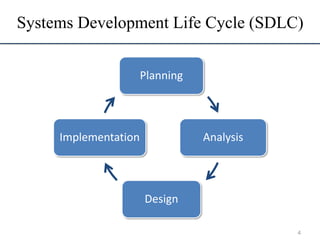
Systems Development Life Cycle (SDLC)
Planning
Analysis
Design
Implementation
4
The SDLC Process
• The process consists of four phases
• Each phase consists of a series of steps
• Each phase is documented (deliverables)
• Phases are executed sequentially,
incrementally, iteratively or in some other
pattern
5
Questions to be Answered
• Planning phase
– Why should we build this system?
– What value does it provide?
– How long will it take to build?
• Analysis phase
– Who will use it?
– What should the system do for us?
– Where & when will it be used?
• Design phase
– How should we build it?
6
SDLC: The Planning Phase
1. Project Initiation
– Develop/receive a system request
– Conduct a feasibility analysis
• Technical feasibility
• Economic feasibility
• Organizational feasibility
2. Project Management
– Develop the work plan
– Staff the project
– Monitor & control the project
7
SDLC: The Analysis Phase
1. Develop an analysis strategy
– Model the current system
– Formulate the new system
2. Gather the requirements
– Develop a system concept
– Create a business model to represent:
• Business data
• Business processes
3. Develop a system proposal
8
SDLC: The Design Phase
1. Develop a design strategy
2. Design architecture and interfaces
3. Develop databases and file specifications
4. Develop the program design to specify:
– What programs to write
– What each program will do
9
SDLC: The Implementation Phase
1. Construct the system
– Build it (write the programming code)
– Test it
2. Install system
– Train the users
3. Support the system (maintenance)
10
SDLC: Methodologies
• Methodology: a formalized approach to
implementing the SDLC
• Categories
– Process oriented
– Data centered
– Object-oriented
– Structured
– Rapid action development
– Agile development
11
Classes of Methodologies
• Structured Development
– Waterfall Development
– Parallel Development
• Rapid Application Development
– Phased
– Prototyping
• Agile Development
– eXtreme Programming
– SCRUM
12
The Systems Analyst: Skills
• Agents of change
– Identify ways to improve the organization
– Motivate & train others
• Skills needed:
– Technical: must understand the technology
– Business: must know the business processes
– Analytical: must be able to solve problems
– Communications: technical & non-technical audiences
– Interpersonal: leadership & management
– Ethics: deal fairly and protect confidential information
13

SAD - Lecturcghtfggjytdddcffge 2 (1).pdf

  • 1.
    System Analysis andDesign Lecture 2 Spring 2024 2nd Stage Computer Science Department Faculty of Science Soran University
  • 2.
    Topics covered ▪ Introduction ▪Systems development life cycle ▪ Identify the four phases ▪ Classes of Methodologies ▪ Team roles & skill sets 2
  • 3.
    Introduction • Why dowe need a formal process? – Failures occur (too) often – Projects are late, over budget or delivered with fewer features than planned • The System Analyst is the key person – Designs a system to add value – Must understand the business processes – Job is rewarding, yet challenging – Requires specific skill sets 3
  • 4.
    Systems Development LifeCycle (SDLC) Planning Analysis Design Implementation 4
  • 5.
    The SDLC Process •The process consists of four phases • Each phase consists of a series of steps • Each phase is documented (deliverables) • Phases are executed sequentially, incrementally, iteratively or in some other pattern 5
  • 6.
    Questions to beAnswered • Planning phase – Why should we build this system? – What value does it provide? – How long will it take to build? • Analysis phase – Who will use it? – What should the system do for us? – Where & when will it be used? • Design phase – How should we build it? 6
  • 7.
    SDLC: The PlanningPhase 1. Project Initiation – Develop/receive a system request – Conduct a feasibility analysis • Technical feasibility • Economic feasibility • Organizational feasibility 2. Project Management – Develop the work plan – Staff the project – Monitor & control the project 7
  • 8.
    SDLC: The AnalysisPhase 1. Develop an analysis strategy – Model the current system – Formulate the new system 2. Gather the requirements – Develop a system concept – Create a business model to represent: • Business data • Business processes 3. Develop a system proposal 8
  • 9.
    SDLC: The DesignPhase 1. Develop a design strategy 2. Design architecture and interfaces 3. Develop databases and file specifications 4. Develop the program design to specify: – What programs to write – What each program will do 9
  • 10.
    SDLC: The ImplementationPhase 1. Construct the system – Build it (write the programming code) – Test it 2. Install system – Train the users 3. Support the system (maintenance) 10
  • 11.
    SDLC: Methodologies • Methodology:a formalized approach to implementing the SDLC • Categories – Process oriented – Data centered – Object-oriented – Structured – Rapid action development – Agile development 11
  • 12.
    Classes of Methodologies •Structured Development – Waterfall Development – Parallel Development • Rapid Application Development – Phased – Prototyping • Agile Development – eXtreme Programming – SCRUM 12
  • 13.
    The Systems Analyst:Skills • Agents of change – Identify ways to improve the organization – Motivate & train others • Skills needed: – Technical: must understand the technology – Business: must know the business processes – Analytical: must be able to solve problems – Communications: technical & non-technical audiences – Interpersonal: leadership & management – Ethics: deal fairly and protect confidential information 13