1
7.2 System Development Life Cycle (SDLC)
At the end of this topic, students should be able to:
1. Identify the steps of system development life
cycle
2. Describe each step of system development life
cycle
INFORMATION SYSTEM
Learning Outcome
2
7.2 System Development Life Cycle (SDLC)
Collection of phases that contain set a group
of activities in the information system
development.
3
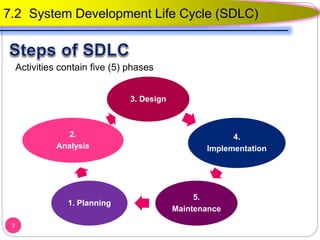
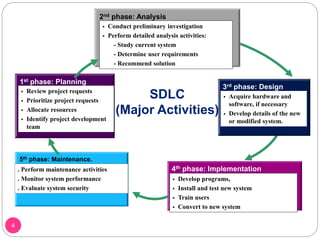
Activities contain five (5) phases
3. Design
4.
Implementation
5.
Maintenance
1. Planning
2.
Analysis
7.2 System Development Life Cycle (SDLC)
4
4th phase: Implementation
1st phase: Planning
5th phase: Maintenance.
 Review project requests
 Prioritize project requests
 Allocate resources
 Identify project development
team
2nd phase: Analysis
 Conduct preliminary investigation
 Perform detailed analysis activities:
- Study current system
- Determine user requirements
- Recommend solution
3rd phase: Design
 Acquire hardware and
software, if necessary
 Develop details of the new
or modified system.
 Develop programs,
 Install and test new system
 Train users
 Convert to new system
. Perform maintenance activities
. Monitor system performance
. Evaluate system security
SDLC
(Major Activities)
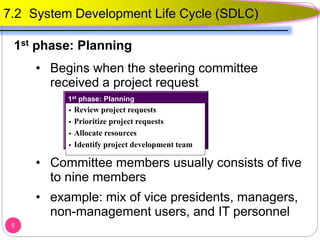
1st phase: Planning
• Begins when the steering committee
received a project request
• Committee members usually consists of five
to nine members
• example: mix of vice presidents, managers,
non-management users, and IT personnel
5
7.2 System Development Life Cycle (SDLC)
1st phase: Planning
 Review project requests
 Prioritize project requests
 Allocate resources
 Identify project development team
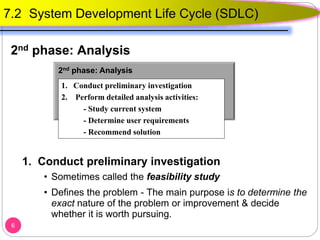
1. Conduct preliminary investigation
• Sometimes called the feasibility study
• Defines the problem - The main purpose is to determine the
exact nature of the problem or improvement & decide
whether it is worth pursuing.
6
7.2 System Development Life Cycle (SDLC)
2nd phase: Analysis
2nd phase: Analysis
1. Conduct preliminary investigation
2. Perform detailed analysis activities:
- Study current system
- Determine user requirements
- Recommend solution
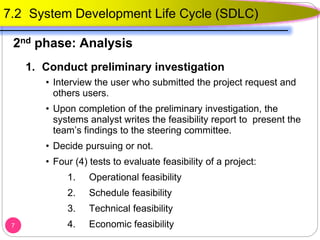
1. Conduct preliminary investigation
• Interview the user who submitted the project request and
others users.
• Upon completion of the preliminary investigation, the
systems analyst writes the feasibility report to present the
team’s findings to the steering committee.
• Decide pursuing or not.
• Four (4) tests to evaluate feasibility of a project:
1. Operational feasibility
2. Schedule feasibility
3. Technical feasibility
4. Economic feasibility7
7.2 System Development Life Cycle (SDLC)
2nd phase: Analysis
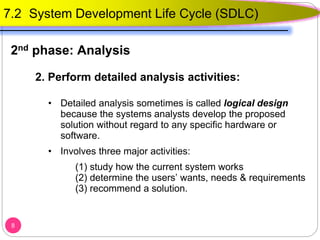
2. Perform detailed analysis activities:
• Detailed analysis sometimes is called logical design
because the systems analysts develop the proposed
solution without regard to any specific hardware or
software.
• Involves three major activities:
(1) study how the current system works
(2) determine the users’ wants, needs & requirements
(3) recommend a solution.
8
7.2 System Development Life Cycle (SDLC)
2nd phase: Analysis
1. Acquire hardware and software
• The activity consists of four major tasks:
(1) identify technical specifications
(2) request vendor proposals
(3) test and evaluate vendor proposals
(4) make a decision
9
7.2 System Development Life Cycle (SDLC)
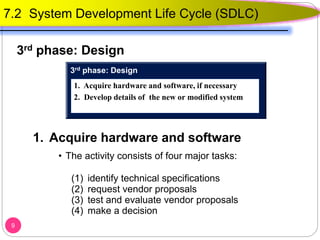
3rd phase: Design
3rd phase: Design
1. Acquire hardware and software, if necessary
2. Develop details of the new or modified system
• After the systems analyst identifies the data and
process requirements, the next step is to develop
detailed design specifications for the components in
the proposed solution.
• A detailed design sometimes is called a physical
design because it specifies hardware & software —
the physical components required — for automated
procedures.
• The activities include developing designs for the
databases, inputs, outputs & programs.
10
7.2 System Development Life Cycle (SDLC)
3rd phase: Design
4th phase: Implementation
• The purpose of this phase is to Construct or
build the new or modified system and then
deliver it to the user
• Four (4) major activities
11
7.2 System Development Life Cycle (SDLC)
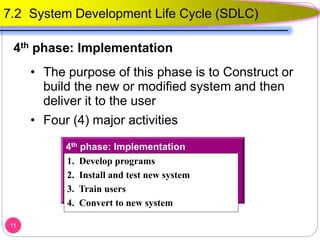
4th phase: Implementation
1. Develop programs
2. Install and test new system
3. Train users
4. Convert to new system
1. Develop programs
• If the organization purchases packaged software (no
modifications required) the development team may skip this
activity.
• For custom software or packaged software, however,
programs are developed or modified either by an outside
firm or in-house.
• Programmers write or modify programs from the program
specification package created during the analysis phase.
• These program development follow an organized set of
activities known as the program development life cycle.
12
7.2 System Development Life Cycle (SDLC)
4th phase: Implementation
2. Install and test new system
• If the organization acquires new hardware or software,
someone must install and test it
• Tests performed during this step include:
1. unit tests - verifies that each individual program or object
works by itself.
2. systems tests - verifies that all programs in an application
work together properly
3. integration tests - verifies that an application works with
other applications.
4. acceptance tests - performed by end- users & checks the
new system to ensure that it works with actual data.
13
7.2 System Development Life Cycle (SDLC)
4th phase: Implementation
3. Train user
• Training involves showing users exactly how
they will use the new hardware and software in
the system.
• Some training takes place as one-on-one
sessions or classroom style lectures
• Other organizations use Web-based training,
which is a self-directed, self-paced online
instruction technique.
14
7.2 System Development Life Cycle (SDLC)
4th phase: Implementation
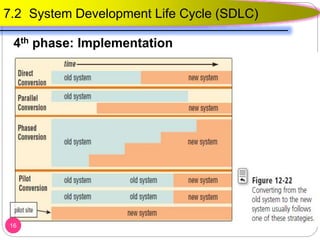
4. Convert to new system
• The final implementation activity is to change
from the old system to the new system.
• This change can take place using one or more
of the following conversion strategies:
1. direct
2. parallel
3. phased
4. pilot
15
4th phase: Implementation
7.2 System Development Life Cycle (SDLC)
16
7.2 System Development Life Cycle (SDLC)
4th phase: Implementation
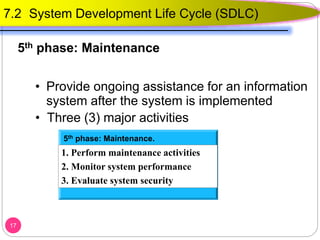
5th phase: Maintenance
• Provide ongoing assistance for an information
system after the system is implemented
• Three (3) major activities
17
7.2 System Development Life Cycle (SDLC)
5th phase: Maintenance.
1. Perform maintenance activities
2. Monitor system performance
3. Evaluate system security
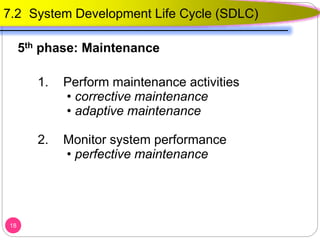
1. Perform maintenance activities
• corrective maintenance
• adaptive maintenance
2. Monitor system performance
• perfective maintenance
18
7.2 System Development Life Cycle (SDLC)
5th phase: Maintenance
3. Evaluate system security
• All elements of an information system must be secure
from threats both inside and outside.
• Users should be allowed access only to the data and
information for which they are authorized (Maintain
confidentiality)
• Data should be secure so that intruders cannot alter,
damage, or steal data. (Ensure integrity and reliability)
• Networks need safeguards to prevent them from being
compromised. (Limited access to information)
19
7.2 System Development Life Cycle (SDLC)
5th phase: Maintenance
Shelly, G.B., & Vermaat, M. (2012). Discovering computers:
Your interactive guide to the digital world. Boston, MA:
Course Technology/ Cengage Learning.
20
REFERENCES
7.2 System Development Life Cycle (SDLC)

Information System Part 2

  • 1.
    1 7.2 System DevelopmentLife Cycle (SDLC) At the end of this topic, students should be able to: 1. Identify the steps of system development life cycle 2. Describe each step of system development life cycle INFORMATION SYSTEM Learning Outcome
  • 2.
    2 7.2 System DevelopmentLife Cycle (SDLC) Collection of phases that contain set a group of activities in the information system development.
  • 3.
    3 Activities contain five(5) phases 3. Design 4. Implementation 5. Maintenance 1. Planning 2. Analysis 7.2 System Development Life Cycle (SDLC)
  • 4.
    4 4th phase: Implementation 1stphase: Planning 5th phase: Maintenance.  Review project requests  Prioritize project requests  Allocate resources  Identify project development team 2nd phase: Analysis  Conduct preliminary investigation  Perform detailed analysis activities: - Study current system - Determine user requirements - Recommend solution 3rd phase: Design  Acquire hardware and software, if necessary  Develop details of the new or modified system.  Develop programs,  Install and test new system  Train users  Convert to new system . Perform maintenance activities . Monitor system performance . Evaluate system security SDLC (Major Activities)
  • 5.
    1st phase: Planning •Begins when the steering committee received a project request • Committee members usually consists of five to nine members • example: mix of vice presidents, managers, non-management users, and IT personnel 5 7.2 System Development Life Cycle (SDLC) 1st phase: Planning  Review project requests  Prioritize project requests  Allocate resources  Identify project development team
  • 6.
    1. Conduct preliminaryinvestigation • Sometimes called the feasibility study • Defines the problem - The main purpose is to determine the exact nature of the problem or improvement & decide whether it is worth pursuing. 6 7.2 System Development Life Cycle (SDLC) 2nd phase: Analysis 2nd phase: Analysis 1. Conduct preliminary investigation 2. Perform detailed analysis activities: - Study current system - Determine user requirements - Recommend solution
  • 7.
    1. Conduct preliminaryinvestigation • Interview the user who submitted the project request and others users. • Upon completion of the preliminary investigation, the systems analyst writes the feasibility report to present the team’s findings to the steering committee. • Decide pursuing or not. • Four (4) tests to evaluate feasibility of a project: 1. Operational feasibility 2. Schedule feasibility 3. Technical feasibility 4. Economic feasibility7 7.2 System Development Life Cycle (SDLC) 2nd phase: Analysis
  • 8.
    2. Perform detailedanalysis activities: • Detailed analysis sometimes is called logical design because the systems analysts develop the proposed solution without regard to any specific hardware or software. • Involves three major activities: (1) study how the current system works (2) determine the users’ wants, needs & requirements (3) recommend a solution. 8 7.2 System Development Life Cycle (SDLC) 2nd phase: Analysis
  • 9.
    1. Acquire hardwareand software • The activity consists of four major tasks: (1) identify technical specifications (2) request vendor proposals (3) test and evaluate vendor proposals (4) make a decision 9 7.2 System Development Life Cycle (SDLC) 3rd phase: Design 3rd phase: Design 1. Acquire hardware and software, if necessary 2. Develop details of the new or modified system
  • 10.
    2. Develop detailsof the new or modified system • After the systems analyst identifies the data and process requirements, the next step is to develop detailed design specifications for the components in the proposed solution. • A detailed design sometimes is called a physical design because it specifies hardware & software — the physical components required — for automated procedures. • The activities include developing designs for the databases, inputs, outputs & programs. 10 7.2 System Development Life Cycle (SDLC) 3rd phase: Design
  • 11.
    4th phase: Implementation •The purpose of this phase is to Construct or build the new or modified system and then deliver it to the user • Four (4) major activities 11 7.2 System Development Life Cycle (SDLC) 4th phase: Implementation 1. Develop programs 2. Install and test new system 3. Train users 4. Convert to new system
  • 12.
    1. Develop programs •If the organization purchases packaged software (no modifications required) the development team may skip this activity. • For custom software or packaged software, however, programs are developed or modified either by an outside firm or in-house. • Programmers write or modify programs from the program specification package created during the analysis phase. • These program development follow an organized set of activities known as the program development life cycle. 12 7.2 System Development Life Cycle (SDLC) 4th phase: Implementation
  • 13.
    2. Install andtest new system • If the organization acquires new hardware or software, someone must install and test it • Tests performed during this step include: 1. unit tests - verifies that each individual program or object works by itself. 2. systems tests - verifies that all programs in an application work together properly 3. integration tests - verifies that an application works with other applications. 4. acceptance tests - performed by end- users & checks the new system to ensure that it works with actual data. 13 7.2 System Development Life Cycle (SDLC) 4th phase: Implementation
  • 14.
    3. Train user •Training involves showing users exactly how they will use the new hardware and software in the system. • Some training takes place as one-on-one sessions or classroom style lectures • Other organizations use Web-based training, which is a self-directed, self-paced online instruction technique. 14 7.2 System Development Life Cycle (SDLC) 4th phase: Implementation
  • 15.
    4. Convert tonew system • The final implementation activity is to change from the old system to the new system. • This change can take place using one or more of the following conversion strategies: 1. direct 2. parallel 3. phased 4. pilot 15 4th phase: Implementation 7.2 System Development Life Cycle (SDLC)
  • 16.
    16 7.2 System DevelopmentLife Cycle (SDLC) 4th phase: Implementation
  • 17.
    5th phase: Maintenance •Provide ongoing assistance for an information system after the system is implemented • Three (3) major activities 17 7.2 System Development Life Cycle (SDLC) 5th phase: Maintenance. 1. Perform maintenance activities 2. Monitor system performance 3. Evaluate system security
  • 18.
    1. Perform maintenanceactivities • corrective maintenance • adaptive maintenance 2. Monitor system performance • perfective maintenance 18 7.2 System Development Life Cycle (SDLC) 5th phase: Maintenance
  • 19.
    3. Evaluate systemsecurity • All elements of an information system must be secure from threats both inside and outside. • Users should be allowed access only to the data and information for which they are authorized (Maintain confidentiality) • Data should be secure so that intruders cannot alter, damage, or steal data. (Ensure integrity and reliability) • Networks need safeguards to prevent them from being compromised. (Limited access to information) 19 7.2 System Development Life Cycle (SDLC) 5th phase: Maintenance
  • 20.
    Shelly, G.B., &Vermaat, M. (2012). Discovering computers: Your interactive guide to the digital world. Boston, MA: Course Technology/ Cengage Learning. 20 REFERENCES 7.2 System Development Life Cycle (SDLC)