THE SACRED BY EMILE
DURKHEIM
By
Monojit Gope
Research Scholar
INTRODUCTION
Emile Durkheim was a French sociologist who lived from
1858 to 1917.
He is considered one of the founders of sociology.
His work focused on the relationship between the individual
and society.
WHAT IS SACRED?
In sociology, the sacred is a concept that refers to things that are set apart from the
ordinary and mundane. They are often associated with religious beliefs and
practices, but they can also be secular. Sacred objects, rituals, and people are
regarded as having special significance and will be treated with awe and respect.
The concept of the sacred was first introduced by the French sociologist Émile
Durkheim. He argued that the sacred is a social construct that is created by people to
represent their shared values and beliefs. The sacred helps to create a sense of
community and solidarity, and it can also be used to legitimize power and authority.
DEFINITION
• The term "sacred" can be defined in a variety of ways. In general, it refers to something that
is set apart from the ordinary and profane world. It is often associated with awe, mystery,
and power. It can be represented by objects, places, or rituals. Here are some definitions of
the sacred from different sources:
Émile Durkheim: "The sacred is that which is set apart from the profane."
Mircea Eliade: "The sacred is the transcendent reality that manifests itself in the world of
the profane."
Rudolf Otto: "The sacred is the mysterium tremendum et fascinans, the awe-inspiring and
fascinating mystery."
ORIGIN
In his book, The Elementary Forms of Religious Life, Durkheim argues
that religion is a social phenomenon.
He defines religion as a "unified system of beliefs and practices relative
to sacred things, that is to say, things set apart and forbidden—beliefs
and practices which unite into one single moral community called a
Church all those who adhere to them."
MEANING
Sacred, according to Durkheim, was something that was beyond the reach of
mortals. Sacred was supernatural, extraordinary, and in possession of dangerous
powers that could only be approached through prayers, rituals, rites, etc.
Anything and everything can be sacred until a community or society specifies it. It
can be an inanimate object, like a tree or a bare rock, or a living, breathing
organisms, like a person or an animal.
Once identified as sacred, they become symbols of religious ideas, beliefs,
sentiments, and practices.
CONCEPTS
Durkheim argues that the sacred is a social construct.
He argues that the sacred is not a supernatural entity, but
rather a representation of society.
The sacred is set apart from the profane, which is everything
that is ordinary and everyday.
FUNCTIONS
Durkheim argues that religion serves two important functions in
society.
First, it helps to create social solidarity.
Second, it helps to maintain social order.
Religion does this by providing a set of shared beliefs and values that
bind people together.
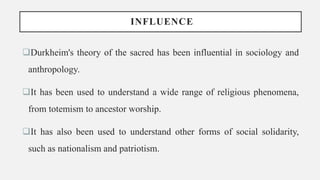
INFLUENCE
Durkheim's theory of the sacred has been influential in sociology and
anthropology.
It has been used to understand a wide range of religious phenomena,
from totemism to ancestor worship.
It has also been used to understand other forms of social solidarity,
such as nationalism and patriotism.
FORM OF SACRED
• The sacred can be found in many different forms, including:
Religious objects, such as statues, idols, and holy books
Religious rituals, such as prayer, sacrifice, and pilgrimage
Sacred places, such as temples, mosques, and churches
Sacred people, such as priests, monks, and nuns
Sacred texts, such as the Bible, the Quran, and the Torah
CRITICISMS
Durkheim's definition of religion is very broad, and it includes many things that are not typically
considered to be religious, such as nationalism and patriotism. This has led some critics to argue that
Durkheim's theory is not very useful for understanding religion.
Durkheim's theory of the sacred is based on his study of Australian Aboriginal religion. However, critics
argue that this theory does not account for the diversity of religious experience found in other cultures. For
example, some religions focus on personal salvation, while others focus on social solidarity.
Durkheim's theory of the sacred is functionalist, which means that it sees religion as serving a positive
function in society. However, critics argue that this theory does not take into account the conflict that
exists in society. For example, some religions have been used to justify violence and oppression.
SACRED AND PROFANE
In his book The Elementary Forms of Religious Life, Émile Durkheim defined
the sacred as "that which is set apart and forbidden" and the profane as "that
which is ordinary and commonplace." He argued that all societies divide the
world into these two realms, and that religion is the way in which societies
maintain this division.
The sacred is associated with things that are considered to be holy, powerful, or
dangerous. It can include objects, places, people, or ideas. The profane, on the
other hand, is associated with things that are considered to be ordinary,
everyday, or mundane.
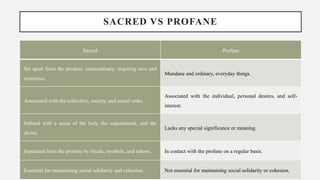
SACRED VS PROFANE
Sacred Profane
Set apart from the profane, extraordinary, inspiring awe and
reverence.
Mundane and ordinary, everyday things.
Associated with the collective, society, and social order.
Associated with the individual, personal desires, and self-
interest.
Imbued with a sense of the holy, the supernatural, and the
divine.
Lacks any special significance or meaning.
Separated from the profane by rituals, symbols, and taboos. In contact with the profane on a regular basis.
Essential for maintaining social solidarity and cohesion. Not essential for maintaining social solidarity or cohesion.
CONCLUSION
In conclusion, Emile Durkheim's theory of the sacred is a sociological perspective
that argues that religion is a social phenomenon.
The sacred is a representation of society that serves to create social solidarity and
maintain social order.
Durkheim's theory of the sacred has been influential in sociology and anthropology,
and it continues to be debated and discussed today.
THANK YOU

Sacred.pptx

  • 1.
    THE SACRED BYEMILE DURKHEIM By Monojit Gope Research Scholar
  • 2.
    INTRODUCTION Emile Durkheim wasa French sociologist who lived from 1858 to 1917. He is considered one of the founders of sociology. His work focused on the relationship between the individual and society.
  • 3.
    WHAT IS SACRED? Insociology, the sacred is a concept that refers to things that are set apart from the ordinary and mundane. They are often associated with religious beliefs and practices, but they can also be secular. Sacred objects, rituals, and people are regarded as having special significance and will be treated with awe and respect. The concept of the sacred was first introduced by the French sociologist Émile Durkheim. He argued that the sacred is a social construct that is created by people to represent their shared values and beliefs. The sacred helps to create a sense of community and solidarity, and it can also be used to legitimize power and authority.
  • 4.
    DEFINITION • The term"sacred" can be defined in a variety of ways. In general, it refers to something that is set apart from the ordinary and profane world. It is often associated with awe, mystery, and power. It can be represented by objects, places, or rituals. Here are some definitions of the sacred from different sources: Émile Durkheim: "The sacred is that which is set apart from the profane." Mircea Eliade: "The sacred is the transcendent reality that manifests itself in the world of the profane." Rudolf Otto: "The sacred is the mysterium tremendum et fascinans, the awe-inspiring and fascinating mystery."
  • 5.
    ORIGIN In his book,The Elementary Forms of Religious Life, Durkheim argues that religion is a social phenomenon. He defines religion as a "unified system of beliefs and practices relative to sacred things, that is to say, things set apart and forbidden—beliefs and practices which unite into one single moral community called a Church all those who adhere to them."
  • 6.
    MEANING Sacred, according toDurkheim, was something that was beyond the reach of mortals. Sacred was supernatural, extraordinary, and in possession of dangerous powers that could only be approached through prayers, rituals, rites, etc. Anything and everything can be sacred until a community or society specifies it. It can be an inanimate object, like a tree or a bare rock, or a living, breathing organisms, like a person or an animal. Once identified as sacred, they become symbols of religious ideas, beliefs, sentiments, and practices.
  • 7.
    CONCEPTS Durkheim argues thatthe sacred is a social construct. He argues that the sacred is not a supernatural entity, but rather a representation of society. The sacred is set apart from the profane, which is everything that is ordinary and everyday.
  • 8.
    FUNCTIONS Durkheim argues thatreligion serves two important functions in society. First, it helps to create social solidarity. Second, it helps to maintain social order. Religion does this by providing a set of shared beliefs and values that bind people together.
  • 9.
    INFLUENCE Durkheim's theory ofthe sacred has been influential in sociology and anthropology. It has been used to understand a wide range of religious phenomena, from totemism to ancestor worship. It has also been used to understand other forms of social solidarity, such as nationalism and patriotism.
  • 10.
    FORM OF SACRED •The sacred can be found in many different forms, including: Religious objects, such as statues, idols, and holy books Religious rituals, such as prayer, sacrifice, and pilgrimage Sacred places, such as temples, mosques, and churches Sacred people, such as priests, monks, and nuns Sacred texts, such as the Bible, the Quran, and the Torah
  • 11.
    CRITICISMS Durkheim's definition ofreligion is very broad, and it includes many things that are not typically considered to be religious, such as nationalism and patriotism. This has led some critics to argue that Durkheim's theory is not very useful for understanding religion. Durkheim's theory of the sacred is based on his study of Australian Aboriginal religion. However, critics argue that this theory does not account for the diversity of religious experience found in other cultures. For example, some religions focus on personal salvation, while others focus on social solidarity. Durkheim's theory of the sacred is functionalist, which means that it sees religion as serving a positive function in society. However, critics argue that this theory does not take into account the conflict that exists in society. For example, some religions have been used to justify violence and oppression.
  • 12.
    SACRED AND PROFANE Inhis book The Elementary Forms of Religious Life, Émile Durkheim defined the sacred as "that which is set apart and forbidden" and the profane as "that which is ordinary and commonplace." He argued that all societies divide the world into these two realms, and that religion is the way in which societies maintain this division. The sacred is associated with things that are considered to be holy, powerful, or dangerous. It can include objects, places, people, or ideas. The profane, on the other hand, is associated with things that are considered to be ordinary, everyday, or mundane.
  • 13.
    SACRED VS PROFANE SacredProfane Set apart from the profane, extraordinary, inspiring awe and reverence. Mundane and ordinary, everyday things. Associated with the collective, society, and social order. Associated with the individual, personal desires, and self- interest. Imbued with a sense of the holy, the supernatural, and the divine. Lacks any special significance or meaning. Separated from the profane by rituals, symbols, and taboos. In contact with the profane on a regular basis. Essential for maintaining social solidarity and cohesion. Not essential for maintaining social solidarity or cohesion.
  • 14.
    CONCLUSION In conclusion, EmileDurkheim's theory of the sacred is a sociological perspective that argues that religion is a social phenomenon. The sacred is a representation of society that serves to create social solidarity and maintain social order. Durkheim's theory of the sacred has been influential in sociology and anthropology, and it continues to be debated and discussed today.
  • 15.