
GROSS DOMESTIC
PRODUCT (GDP)
By
Monojit Gope
Research Scholar
WHAT IS GDP?
GDP is the market value of all final goods and services produced within a
country in a given time period.
It is a measure of the size of an economy and its rate of growth.
GDP is calculated using three methods: the expenditure approach, the
income approach, and the value-added approach.
THE EXPENDITURE APPROACH
• The expenditure approach adds up the spending of four different groups:
Consumers.
Businesses.
Governments.
Foreigners.
• The spending of these four groups is equal to the value of all final goods and services
produced in the economy.
THE INCOME APPROACH
• The income approach adds up the income earned by all factors of production:
Labor.
Land.
Capital.
• The income earned by these factors of production is equal to the value of all
final goods and services produced in the economy.
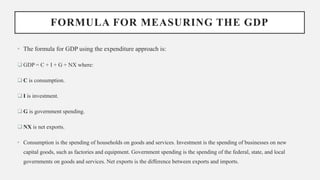
FORMULA FOR MEASURING THE GDP
• The formula for GDP using the expenditure approach is:
 GDP = C + I + G + NX where:
 C is consumption.
 I is investment.
 G is government spending.
 NX is net exports.
• Consumption is the spending of households on goods and services. Investment is the spending of businesses on new
capital goods, such as factories and equipment. Government spending is the spending of the federal, state, and local
governments on goods and services. Net exports is the difference between exports and imports.
WHY IS GDP IMPORTANT?
GDP is an important measure of the size and health of an economy.
A growing GDP indicates a growing economy, while a shrinking
GDP indicates a shrinking economy.
GDP can be used to track economic growth over time, compare the
size of different economies, and measure the impact of economic
policies.
LIMITATIONS OF GDP
GDP is not a perfect measure of economic well-being.
It does not account for the distribution of income, the quality of
goods and services, or the value of leisure time.
Despite its limitations, GDP is a widely used measure of
economic activity.
FINAL GOODS AND SERVICES
Final goods and services are those that are purchased by the
final user.
Intermediate goods and services are those that are used to
produce other goods and services.
GDP only includes final goods and services.
MARKET VALUE
Market value is the price at which a good or service is bought
and sold.
GDP is calculated using the market value of all final goods and
services produced in the economy.
CONSUMPTION
Consumption is the spending of households on goods and
services.
Consumption is the largest component of GDP.
INVESTMENT
Investment is the spending of businesses on new capital goods,
such as factories and equipment.
Investment is also the spending of households on new housing.
GOVERNMENT SPENDING
Government spending is the spending of the federal, state, and
local governments on goods and services.
Government spending is a major component of GDP in most
countries.
NET EXPORTS
Net exports is the difference between exports and imports.
Exports are the goods and services that a country sells to other
countries.
Imports are the goods and services that a country buys from
other countries.
GDP PER CAPITA
GDP per capita is GDP divided by the population.
GDP per capita is a measure of the average standard of
living in a country.
NOMINAL GDP
Nominal GDP is the total value of all final goods and services produced
in an economy in a given year, measured at current market prices. It is the
most commonly used measure of economic activity.
Nominal GDP is GDP measured in current prices.
Nominal GDP can be used to track the growth of the economy over time.
FORMULA FOR NOMINAL GDP
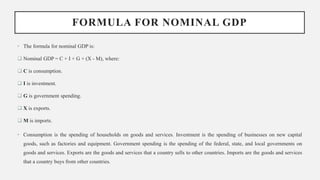
• The formula for nominal GDP is:
 Nominal GDP = C + I + G + (X - M), where:
 C is consumption.
 I is investment.
 G is government spending.
 X is exports.
 M is imports.
• Consumption is the spending of households on goods and services. Investment is the spending of businesses on new capital
goods, such as factories and equipment. Government spending is the spending of the federal, state, and local governments on
goods and services. Exports are the goods and services that a country sells to other countries. Imports are the goods and services
that a country buys from other countries.
ADVANTAGES OF NOMINAL GDP
Nominal GDP is a simple and straightforward measure of economic
output.
It is easy to calculate and understand.
It can be used to track economic growth over time.
It can be used to compare the economic output of different countries.
LIMITATIONS OF NOMINAL GDP
Nominal GDP does not account for inflation or deflation.
This means that a rise in nominal GDP could be due to either an increase in output or an increase in
prices.
Nominal GDP does not account for the quality of goods and services produced.
This means that a rise in nominal GDP could be due to the production of more low-quality goods and
services.
Nominal GDP does not account for the distribution of income.
This means that a rise in nominal GDP could be due to the rich getting richer while the poor get poorer.
REAL GDP
Real GDP is GDP adjusted for inflation.
Real GDP is a better measure of the actual output of the
economy.
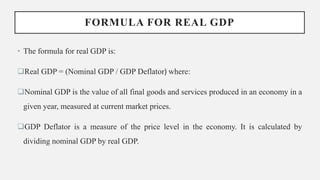
FORMULA FOR REAL GDP
• The formula for real GDP is:
Real GDP = (Nominal GDP / GDP Deflator) where:
Nominal GDP is the value of all final goods and services produced in an economy in a
given year, measured at current market prices.
GDP Deflator is a measure of the price level in the economy. It is calculated by
dividing nominal GDP by real GDP.
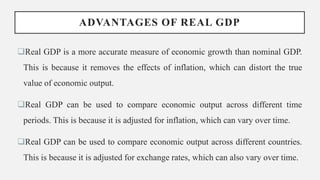
ADVANTAGES OF REAL GDP
Real GDP is a more accurate measure of economic growth than nominal GDP.
This is because it removes the effects of inflation, which can distort the true
value of economic output.
Real GDP can be used to compare economic output across different time
periods. This is because it is adjusted for inflation, which can vary over time.
Real GDP can be used to compare economic output across different countries.
This is because it is adjusted for exchange rates, which can also vary over time.
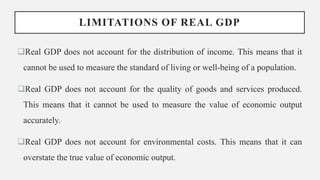
LIMITATIONS OF REAL GDP
Real GDP does not account for the distribution of income. This means that it
cannot be used to measure the standard of living or well-being of a population.
Real GDP does not account for the quality of goods and services produced.
This means that it cannot be used to measure the value of economic output
accurately.
Real GDP does not account for environmental costs. This means that it can
overstate the true value of economic output.
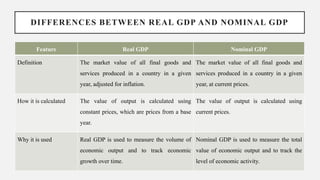
DIFFERENCES BETWEEN REAL GDP AND NOMINAL GDP
Feature Real GDP Nominal GDP
Definition The market value of all final goods and
services produced in a country in a given
year, adjusted for inflation.
The market value of all final goods and
services produced in a country in a given
year, at current prices.
How it is calculated The value of output is calculated using
constant prices, which are prices from a base
year.
The value of output is calculated using
current prices.
Why it is used Real GDP is used to measure the volume of
economic output and to track economic
growth over time.
Nominal GDP is used to measure the total
value of economic output and to track the
level of economic activity.
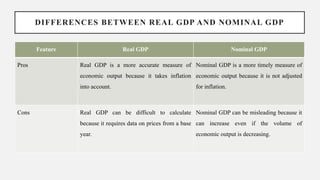
DIFFERENCES BETWEEN REAL GDP AND NOMINAL GDP
Feature Real GDP Nominal GDP
Pros Real GDP is a more accurate measure of
economic output because it takes inflation
into account.
Nominal GDP is a more timely measure of
economic output because it is not adjusted
for inflation.
Cons Real GDP can be difficult to calculate
because it requires data on prices from a base
year.
Nominal GDP can be misleading because it
can increase even if the volume of
economic output is decreasing.
CONCLUSION
GDP is a complex measure of the size and health of an economy.
It is important to understand the limitations of GDP in order to use it
effectively.
Despite its limitations, GDP is a valuable tool for policymakers and
economists.
THANK YOU

GDP.pptx

  • 1.
  • 2.
    WHAT IS GDP? GDPis the market value of all final goods and services produced within a country in a given time period. It is a measure of the size of an economy and its rate of growth. GDP is calculated using three methods: the expenditure approach, the income approach, and the value-added approach.
  • 3.
    THE EXPENDITURE APPROACH •The expenditure approach adds up the spending of four different groups: Consumers. Businesses. Governments. Foreigners. • The spending of these four groups is equal to the value of all final goods and services produced in the economy.
  • 4.
    THE INCOME APPROACH •The income approach adds up the income earned by all factors of production: Labor. Land. Capital. • The income earned by these factors of production is equal to the value of all final goods and services produced in the economy.
  • 5.
    FORMULA FOR MEASURINGTHE GDP • The formula for GDP using the expenditure approach is:  GDP = C + I + G + NX where:  C is consumption.  I is investment.  G is government spending.  NX is net exports. • Consumption is the spending of households on goods and services. Investment is the spending of businesses on new capital goods, such as factories and equipment. Government spending is the spending of the federal, state, and local governments on goods and services. Net exports is the difference between exports and imports.
  • 6.
    WHY IS GDPIMPORTANT? GDP is an important measure of the size and health of an economy. A growing GDP indicates a growing economy, while a shrinking GDP indicates a shrinking economy. GDP can be used to track economic growth over time, compare the size of different economies, and measure the impact of economic policies.
  • 7.
    LIMITATIONS OF GDP GDPis not a perfect measure of economic well-being. It does not account for the distribution of income, the quality of goods and services, or the value of leisure time. Despite its limitations, GDP is a widely used measure of economic activity.
  • 8.
    FINAL GOODS ANDSERVICES Final goods and services are those that are purchased by the final user. Intermediate goods and services are those that are used to produce other goods and services. GDP only includes final goods and services.
  • 9.
    MARKET VALUE Market valueis the price at which a good or service is bought and sold. GDP is calculated using the market value of all final goods and services produced in the economy.
  • 10.
    CONSUMPTION Consumption is thespending of households on goods and services. Consumption is the largest component of GDP.
  • 11.
    INVESTMENT Investment is thespending of businesses on new capital goods, such as factories and equipment. Investment is also the spending of households on new housing.
  • 12.
    GOVERNMENT SPENDING Government spendingis the spending of the federal, state, and local governments on goods and services. Government spending is a major component of GDP in most countries.
  • 13.
    NET EXPORTS Net exportsis the difference between exports and imports. Exports are the goods and services that a country sells to other countries. Imports are the goods and services that a country buys from other countries.
  • 14.
    GDP PER CAPITA GDPper capita is GDP divided by the population. GDP per capita is a measure of the average standard of living in a country.
  • 15.
    NOMINAL GDP Nominal GDPis the total value of all final goods and services produced in an economy in a given year, measured at current market prices. It is the most commonly used measure of economic activity. Nominal GDP is GDP measured in current prices. Nominal GDP can be used to track the growth of the economy over time.
  • 16.
    FORMULA FOR NOMINALGDP • The formula for nominal GDP is:  Nominal GDP = C + I + G + (X - M), where:  C is consumption.  I is investment.  G is government spending.  X is exports.  M is imports. • Consumption is the spending of households on goods and services. Investment is the spending of businesses on new capital goods, such as factories and equipment. Government spending is the spending of the federal, state, and local governments on goods and services. Exports are the goods and services that a country sells to other countries. Imports are the goods and services that a country buys from other countries.
  • 17.
    ADVANTAGES OF NOMINALGDP Nominal GDP is a simple and straightforward measure of economic output. It is easy to calculate and understand. It can be used to track economic growth over time. It can be used to compare the economic output of different countries.
  • 18.
    LIMITATIONS OF NOMINALGDP Nominal GDP does not account for inflation or deflation. This means that a rise in nominal GDP could be due to either an increase in output or an increase in prices. Nominal GDP does not account for the quality of goods and services produced. This means that a rise in nominal GDP could be due to the production of more low-quality goods and services. Nominal GDP does not account for the distribution of income. This means that a rise in nominal GDP could be due to the rich getting richer while the poor get poorer.
  • 19.
    REAL GDP Real GDPis GDP adjusted for inflation. Real GDP is a better measure of the actual output of the economy.
  • 20.
    FORMULA FOR REALGDP • The formula for real GDP is: Real GDP = (Nominal GDP / GDP Deflator) where: Nominal GDP is the value of all final goods and services produced in an economy in a given year, measured at current market prices. GDP Deflator is a measure of the price level in the economy. It is calculated by dividing nominal GDP by real GDP.
  • 21.
    ADVANTAGES OF REALGDP Real GDP is a more accurate measure of economic growth than nominal GDP. This is because it removes the effects of inflation, which can distort the true value of economic output. Real GDP can be used to compare economic output across different time periods. This is because it is adjusted for inflation, which can vary over time. Real GDP can be used to compare economic output across different countries. This is because it is adjusted for exchange rates, which can also vary over time.
  • 22.
    LIMITATIONS OF REALGDP Real GDP does not account for the distribution of income. This means that it cannot be used to measure the standard of living or well-being of a population. Real GDP does not account for the quality of goods and services produced. This means that it cannot be used to measure the value of economic output accurately. Real GDP does not account for environmental costs. This means that it can overstate the true value of economic output.
  • 23.
    DIFFERENCES BETWEEN REALGDP AND NOMINAL GDP Feature Real GDP Nominal GDP Definition The market value of all final goods and services produced in a country in a given year, adjusted for inflation. The market value of all final goods and services produced in a country in a given year, at current prices. How it is calculated The value of output is calculated using constant prices, which are prices from a base year. The value of output is calculated using current prices. Why it is used Real GDP is used to measure the volume of economic output and to track economic growth over time. Nominal GDP is used to measure the total value of economic output and to track the level of economic activity.
  • 24.
    DIFFERENCES BETWEEN REALGDP AND NOMINAL GDP Feature Real GDP Nominal GDP Pros Real GDP is a more accurate measure of economic output because it takes inflation into account. Nominal GDP is a more timely measure of economic output because it is not adjusted for inflation. Cons Real GDP can be difficult to calculate because it requires data on prices from a base year. Nominal GDP can be misleading because it can increase even if the volume of economic output is decreasing.
  • 25.
    CONCLUSION GDP is acomplex measure of the size and health of an economy. It is important to understand the limitations of GDP in order to use it effectively. Despite its limitations, GDP is a valuable tool for policymakers and economists.
  • 26.