2 4 6 
Wojciech S. Maliszewski 
Monetary Policy in Transition: Structural 
Econometric Modelling and Policy 
Simulations 
W a r s a w , 2 0 0 2
Materials published here have a working paper character. They can be subject to further 
publication. The views and opinions expressed here reflect Author point of view and not 
necessarily those of CASE. 
This research was supported by a grant from the CERGE-EI Foundation under a program of 
the Global Development Network. Additional funds for grantees in the Balkan countries 
have been provided by the Austrian Government through WIIW, Vienna. All opinions 
expressed are those of the autor and have not been endorsed by CERGE-EI Foundation, 
WIIW, or the GDN. 
Key words: transition, monetary policy, inflation, structural vector autoregression, 
policy simulations. 
© CASE – Center for Social and Economic Research, Warsaw 2002 
Graphic Design: Agnieszka Natalia Bury 
DTP: CeDeWu Sp. z o.o. 
ISSN 1506-1701, ISBN 83-7178-297-7 
Publisher: 
CASE – Center for Social and Economic Research 
ul. Sienkiewicza 12, 00-944 Warsaw, Poland 
tel.: (48 22) 622 66 27, 828 61 33, fax: (48 22) 828 60 69 
e-mail: case@case.com.pl 
http://www.case.com.pl
Contents 
Abstract 5 
1. Introduction 6 
2. Specification and Identification of the Model 7 
3. Monetary and Exchange Rate Policy in Poland 10 
4. Monetary and Exchange Rate Policy in the Czech Republic 13 
5. Estimation and Results 15 
5.1. Coefficients of the A0 Matrix 16 
5.2. Dynamic Responses to Policy Shocks in Two Regimes 17 
6. Counterfactual Simulation of the 1998 Policy Change 19 
7. Conclusions 20 
Appendix A 25 
Appendix B 25 
Appendix C 29
Wojciech S. Maliszewski 
Wojciech S. Maliszewski holds Master degrees from the University of Sussex (1996), Warsaw 
University's Department of Economics (1997) and the London School of Economics (1999). 
He is presently studying for his doctorate at the London School of Economics. In 1997-98 and 
in 1999, he worked in Romania as a CASE representative in the ProDemocratia advisory 
mission. In 2001 he was an intern at the World Bank, Washington, DC. His main areas of 
interest include monetary and fiscal policy, and political economy of transition. He has 
published widely on central bank independence, exchange rate behavour, monetary policy 
transmission mechanism, and fiscal sustainability in transition countries. 
He has worked for the CASE Foundation as an economist since 1996. 
4 
Studies & Analyses CASE No. 246 – Wojciech S. Maliszewski
Abstract 
In this paper I estimate a Bayesian structural VAR models for the Czech Republic and 
Poland, allowing for changes in parameters between the two monetary policy 
arrangements. The four-variables structural VAR methodology adopted in the study is 
successful in identifying monetary policy shocks and their effects for the Czech and Polish 
economies. The time-varying model is capable of detecting a change in the policy reaction 
function consistent with introduction of the floating exchange rate system and switching 
to short-term interest rate as the main policy instrument. The results indicate the 
dominant role of exchange rate in the monetary transmission mechanism. 
5 
Studies & Analyses CASE No. 246 – Monetary Policy in Transition ...
1. Introduction 
Conducting monetary policy in the transition environment is a difficult task. Available time 
series are short and often unreliable, there is an ongoing adjustment processes in the real sector 
of the economy, and even more dramatic developments in the financial sector. It is therefore not 
surprising that even the advanced transition economies opted for exchange rate anchors at the 
beginning of reforms. Fixing the exchange rate was relatively easy to implement and effective in 
taming inflationary expectations, but became difficult to sustain when inflation reached a 
moderate-level plateau. Exit from the fixed peg was either volatile as in the Czech Republic or 
carried on in an orderly manner as in case of Poland, where the crawling peg system evolved 
into a gradually widening target zone with a decreasing rate of crawl of the central parity. At the 
end of the decade Poland and the Czech Republic conducted their monetary policies using direct 
inflation targeting and floating exchange rates. Although inflation targeting requires a thorough 
knowledge about the monetary transmission mechanism, precise understanding of this 
mechanism in transition countries remained a challenge, not only because of ongoing structural 
changes, but also because the history of monetary policy under floating exchange in these 
countries rate is so short. Researchers quickly documented that a highly uncertain relationship 
between monetary policy instruments and inflation may hamper implementation of the 
framework (Christoffersen et al., 2001 and Gottschalk and Moore, 2001). 
In this paper I present several structural VAR models for Poland and the Czech Republic. 
The identifying restriction are supplemented with Bayesian priors, which turned out to be 
useful for estimation of the models with short available time series. To account for policy 
changes in the period under investigation I apply a methodology recently proposed by Sims 
and Zha (2002) and allow for changes in some parameters of the model. The changes are 
restricted to parameters of policy reaction functions and equations describing the behavior 
of financial variables, leaving coefficients of equations describing the behavior of 
macroeconomic variables constant across regimes. Although this specification seems to be 
restrictive, it is supported by the data. It is also parsimonious enough to produce reasonable 
results in small samples under investigation, where the most recent policy regimes last for no 
longer than four years. 
The remainder of the paper is constructed as follows: the first part discusses estimation 
strategy. The next part discusses monetary and exchange rate policies in Poland, the Czech 
Republic. Next two sections present results from the VAR estimates and some policy 
simulations for the Czech Republic and Poland. The last section concludes. Data sources and 
details about exchange rate policy in the two countries and technical details behind the 
estimation strategy are relegated to appendices. 
6 
Studies & Analyses CASE No. 246 – Wojciech S. Maliszewski
2. Specification and Identification of the Model 
The empirical model adopted in this study is a version of a "small open-economy" 
structural vector autoregression (SVAR). A similar model was successfully estimated for 
Canada by Cushman and Zha (1997). Due to obvious data limitations (short time series), 
the size of the model is kept at the minimum and consequently the adopted identification 
scheme is simpler than in other studies. However, there were only limited attempts of 
estimating structural VAR for transition economies going beyond a simple recursive 
identification scheme (with a notable exception of Dibogloo and Kutan, 2000) and one of 
the goals of our paper is to fill this gap. As will become apparent, interactions between 
exchange rate and monetary policies makes the use of recursive identification unjustified. 
Moreover, an evident change in the monetary policy strategy reflected in the switch to 
inflation targeting makes the fixed-coefficients VAR model potentially unsuitable for 
analysis of the whole period. I approach this problem by allowing for a limited time 
variation in the coefficients of the model, following the methodology laid down by Sims 
and Zha (2002) and Del Negro and Obiols-Homs (2001). The estimated model is 
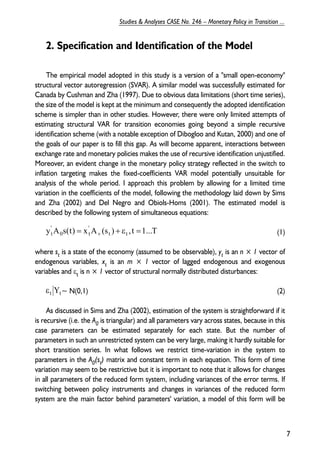
described by the following system of simultaneous equations: 
(1) 
’ 
= ’ 
t + + ε = 
where st is a state of the economy (assumed to be observable), yt is an n × 1 vector of 
endogenous variables, xt is an m × 1 vector of lagged endogenous and exogenous 
variables and εt is n × 1 vector of structural normally distributed disturbances: 
~ N(0,1) (2) 
As discussed in Sims and Zha (2002), estimation of the system is straightforward if it 
is recursive (i.e. the A0 is triangular) and all parameters vary across states, because in this 
case parameters can be estimated separately for each state. But the number of 
parameters in such an unrestricted system can be very large, making it hardly suitable for 
short transition series. In what follows we restrict time-variation in the system to 
parameters in the A0(st) matrix and constant term in each equation. This form of time 
variation may seem to be restrictive but it is important to note that it allows for changes 
in all parameters of the reduced form system, including variances of the error terms. If 
switching between policy instruments and changes in variances of the reduced form 
system are the main factor behind parameters' variation, a model of this form will be 
7 
Studies & Analyses CASE No. 246 – Monetary Policy in Transition ... 
y A 0 s(t) x t 
A (st ) t , t 1...T 
εt Yt
correctly specified. Although I do not test the model against a more flexible alternative, 
this specification seems to reflect the major policy change in the three transition 
economies: adopting short-term interest rate as the main policy instrument and 
abandoning interventions on the foreign exchange market. I set the number of states to 
two and the date of policy change to January 1998 for the Czech Republic (corresponding 
to introduction of inflation targeting framework) and January 1998 for Poland 
(corresponding to a switch to inflation targeting). Short available time series preclude 
estimation of a model allowing for more regimes. 
The aim of the SVAR methodology is to identify monetary shocks, and their effect on 
the economy, by imposing some minimal identifying assumptions on the unrestricted VAR 
system. Changes in potential policy instruments are potentially influenced not only by 
policy actions, but also by disturbances beyond policy-makers' control. Thus, in order to 
identify the monetary policy shock, it is necessary to differentiate between various 
disturbances. The yt vector in our model consists four variables grouped into two blocks: 
consumer prices and industrial production form a "production sector" block and short-term 
interest rate and the exchange rate form a "financial sector" block. In the structural 
VAR methodology the identification of shocks is frequently achieved by allowing for only 
a delayed response of variables in the production sector to shocks in the financial sector 
and I follow this approach in our study. Identification of separate shocks in the financial 
sector requires some further restrictions and they are usually derived from central bank 
operating procedures. Since monetary authorities can react only to information available 
in real time, the time-lag in data collection and dissemination provides a natural identifying 
restriction, and I adopt it in this paper. I do not attempt to identify economically 
interpretable shocks in the production sector and therefore I normalize the production 
block to be upper triangular. The imposed restrictions do not depend on any particular 
policy regime and can be used in both the target zone and the floating exchange rate 
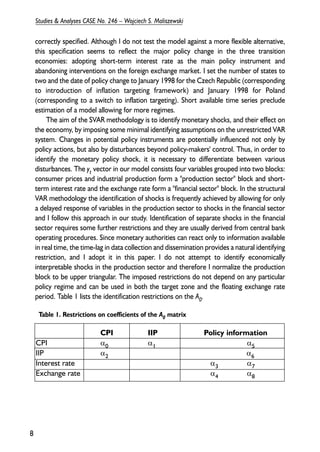
period. Table 1 lists the identification restrictions on the A0. 
8 
Studies & Analyses CASE No. 246 – Wojciech S. Maliszewski 
Table 1. Restrictions on coefficients of the A0 matrix 
CPI IIP Policy information 
CPI α0 α1 α5 
IIP α2 α6 
Interest rate α3 α7 
Exchange rate α4 α8
The first column of table lists endogenous variables and the top raw policy shocks 
entering behavioral equations as defined by cells with α's. Empty cells in the first two 
columns reflect our assumption of a lagged response of variables in the production block 
to financial variables. Empty cells in the third column reflect the assumption that 
monetary authorities cannot react to shocks in the production sector instantaneously. 
The policy reaction equation may be interpreted as a function describing the behavior 
of an implicit monetary condition index, i.e. a linear combination of short term interest 
rate and exchange rate, by lagged endogenous and exogenous variables. This 
interpretation is identical to Smets (2001), who estimates the weights in the monetary 
condition index under the assumption of orthogonality between the index and shocks 
originating from the foreign financial sector (derived from theoretical models in Gerlach 
and Smets, 1996 and Smets, 1996). In our case the weights are identified only by 
assumption of a lagged response of monetary authorities to production sector variables. 
Successful identification should give a higher weight to the exchange rate in the target 
zone regime and a higher weight to interest rate in the floating regime. Below I report 
the estimates of the A0 matrix supporting our identification scheme. 
The "information" equation reflects the fact that in efficient markets financial variables 
quickly respond to shocks in other sectors. Again, this specification is not regime 
dependent as long as the parameters in A0 are allowed to vary between regimes 
(depending on the regime, either exchange rate or interest rate is free to adjust). 
9 
Studies & Analyses CASE No. 246 – Monetary Policy in Transition ...
3. Monetary and Exchange Rate Policy in Poland 
Fixing the zloty against the dollar was one of the main elements of the 1990 Polish 
stabilization program. The peg, however, was announced to be temporary at the outset 
of the program, potentially limiting its effect on expectations. Moreover, the starting 
offcial rate was grossly undervalued, giving a boost to Polish competitiveness but failing to 
provide an anchor for price level. The initial undervaluation allowed the peg to last longer 
than expected but after a year and a half the exchange rate was devalued, the dollar was 
replaced by a basket of five currencies and, within few month, a crawling peg system 
replaced the peg. Although the rate of crawl was set below the targeted inflation rate, 
securing a competitive level of the real exchange rate seemed to be the principal goal of 
exchange rate policy in the following years. 
At the initial stage of a macroeconomic stabilization program, the National Bank of 
Poland faced severe difficulties in conducting monetary policy. The monetary system was 
in the process of transformation from a monobank to a modern, two-tier banking system 
and the money market was non-existing. There was an excess liquidity in the system, 
excess reserves were subject to large fluctuations due to inefficient payment system, and 
real interest rates were negative (Ugolini, 1996 and Balino, Dhawan and Sundararajan, 
1994). In response to these unfavorable circumstances monetary authorities relied on 
credit ceilings as the main policy instrument. In addition, refinancing policy was tightened, 
interest rates were increased to positive real levels and reserve requirements were 
increased to the maximum legal limit. The money market started operating in 1992 and 
the credit ceilings were abolished at the end of this year. Since 1993, open market 
operations – repo, reverse repo and outright sales – became the main monetary policy 
instruments and the money market rate (T/N reverse repo rate) became an operational 
central bank target. 
Intermediate monetary targets were defined in terms of broad money growth, 
although the NBP usually reacted in a flexible manner to developments in money 
demand. Moreover, between 1992 and 1994, substantial fiscal deficits, financed mostly by 
the NBP and the banking system, fueled monetary expansion (NBP 1998). As a result, M2 
growth deviated from the targets by wide margins both in 1992 and 1994 (Polañski, 
1998). While the National Bank of Poland enjoyed relatively high degree of statutory 
independence (see Maliszewski, 2000) and the government borrowings from the NBP 
were formally restricted, the budgetary law regularly suspended the provisions of the 
central bank law, raising the borrowing limits. Fiscal deficit in 1992 amounted to 6 per 
cent of GDP and was financed in over 40 per cent by the central bank. After significant 
10 
Studies & Analyses CASE No. 246 – Wojciech S. Maliszewski
fiscal adjustments in 1993, the deficit was reduced to 3 per cent of GDP, but almost 40 
percent of it was still financed by the NBP. In 1994 this proportion remained at above 30 
percent level (IMF, 1997). Although fiscal deficit financing made monetary policy lax in this 
period, central bank interest rates remain at positive real levels. 
In 1995, increases in net foreign assets of the NBP became the major source of 
monetary expansion and large-scale sterilization operations did not prevent overshooting 
of the annual money growth target by almost 60 per cent. In order to increase the risk 
faced by portfolio investors and tame capital inflows, the crawling peg system was 
replaced by a 14 percent band in May 1995. As anticipated, zloty appreciated after 
introduction of the new system1, but the new regime did not bring any significant increase 
in volatility since exchange rate was persistently close to the strong bound of the zone. 
The capital inflow slowed down only after interest rate cuts and revaluation of the central 
parity by 6 per cent at the end of 1995. The revaluation took the pressure off the lower 
bound of the target zone, but still did not increase exchange rate volatility because the 
NBP frequently intervened on the forex market. The intra-marginal interventions aimed 
at preventing excessive appreciation of the zloty and for most of the period average 
deviations of the USD and DM from the parity were kept above the -2.5 per cent2. 
Capital inflows exerted lower pressure on monetary policy in 1996, but fast 
expansion of credit to non-financial institutions became the new source of money 
creation. The expansion was fueled by a buoyant economy and by improvement in 
financial situation of the banking system after solving problems with bad debts from the 
1992-1994 period. Monetary policy reacted sluggishly to this rapid credit growth and 
significant interest rate increases came only at the end of 1996 and in 1997, when the 
GDP growth rate accelerated to a record 6.9 per cent of GDP and a large current 
account deficit emerged. Policy tightening was facilitated by an increased risk on 
international financial markets after the Czech devaluation in June and the Asian crisis in 
October 1997, allowing for more independent monetary policy actions. Although in 1996 
and 1997 the NBP offcially adopted base money growth as its operating target, interest 
rate continued to play a major role in conducting monetary policy (Opiela, 1998). 
The new law on the National Bank of Poland, adopted in January 1998, granted the 
NBP a high degree of independence guaranteed in the Constitutional Law, and 
11 
Studies & Analyses CASE No. 246 – Monetary Policy in Transition ... 
1 It has been claimed that the appreciation caused an increase in money demand and the inflation target 
was overshot by only 5 per cent despite the very high money growth (Durjasz and Kokoszczyñski, 1998). 
2 The NBP intervened very frequently in the first four months after revaluation of the central parity in 
December 1995. As a result, the average deviation of the USD and DM from the central parity (widely believed 
to be targeted by the NBP) remained continueously above the -2.5 per cent. Interventions became less frequent 
afterwards, but zloty remained in the desired region for several months in anticipation of the NBP interventions. 
For an econometric analysis of this implicit target zone arrangement see Maliszewski (1999).
established Monetary Policy Council (MPC), a body responsible for conducting the NBP 
monetary policy. The newly formed MPC offcially adopted inflation targeting as a 
monetary policy strategy and published the Medium Term Financial Strategy, where the 
medium-term inflation target was set below the 4 percent level at the end of 2003. The 
minimum interest rate on 28-days NBP Bills became a principal policy rate and the MPC 
considered a break from the previous exchange rate policy as a necessary step in 
implementation of the inflation targeting framework (NBP, 1998). In February 1998 the 
exchange rate band was widened to ±10 per cent and the exchange rate was allowed to 
move more freely within the zone. Since July 1998, the NBP abstained from interventions 
at the forex market. In October 1998 the target zone was widened again to ±12.5 per 
cent and in December 1998 transactions between the NBP and commercial banks at the 
fixing session3 were restricted to reduce the central bank influence on the market rate 
(NBP, 1998). In April 2000 zloty started floating. 
In 1998 the reference rate was reduced from 24 per cent in February to 15.5 per cent 
in December. The sharp reduction was a response to economic slowdown, declining 
inflation, and a large portfolio capital inflows at the beginning of the year. One of the 
interest rate cuts was decided immediately after the Russian crisis, to signal immunity of 
Polish financial markets to a potential contagion. Central bank interest rates remained at 
the stable level for the first half of 1999 but a higher inflation – overshoting the target in 
1999 – prompted monetary authorities to reverse the cuts starting from the second half 
of 1999. In 2000 interest rates were further increased and the cautious period of cuts 
started only from the beginning of 2001, when inflation started declining and economic 
activity experienced a recession. Despite the policy relaxation, inflation remained below 
the target in 2001 and 2002. 
12 
Studies & Analyses CASE No. 246 – Wojciech S. Maliszewski 
3 The official daily exchange rates were set in transactions between the NBP and commercial banks, in 
which the central bank was buying or selling currency at the current market rate. The restrictions increased the 
spread between the NBP buying and selling rate above the market spread and limited time allowed for 
transactions with the central bank.
4. Monetary and Exchange Rate Policy in the Czech 
Republic 
Czechoslovakia did not start economic reforms before 1990, but macroeconomic 
disequilibrium inherited from the Soviet-style system was less severe than in other 
transition countries. Consequently, the price and foreign exchange liberalization produced 
relatively smaller effect on inflation. Monetary tightening in 1990 and 1991 succeeded in 
curbing inflation after the initial price hike and monetary policy took a neutral stance from 
1992 onwards, with a temporary tightening in the period before dissolution of the 
Czechoslovak state and splitting the joint currency (Tosovsky, 1995). The Czech National 
Bank (CNB) targeted monetary aggregates, with a particular emphasis on M2. The overall 
trend in monetary aggregates was close to the path targeted by the Czech National Bank, 
although the bank did not strictly adher to its targets, facing significant uncertainties about 
the behavior of money demand at the initial stage of transition process (Horvath and Jonas, 
1998). Initially (from 1990 to the second half of 1992), the CNB controlled money supply 
through direct credit and interest rate ceilings. In 1992, the money market became mature 
enough to allow the CNB for replacing direct restrictions with indirect monetary policy 
instruments (discount rate, lombard rate, minimum reserve requirements, refinancing 
credits, open market operations and open foreign exchange positions). 
A second, and the most visible anti-inflationary anchor, considered to be a 
complement to monetary targets, was the exchange rate peg. The koruna was initially 
pegged to a basket of five currencies, with weights based on their share in the 
Czechoslovak foreign trade. Since 1993 the basket included only DM and USD, with a 65 
percent weight given to the DM. The exchange rate was kept in a narrow, 0.5 percent-wide, 
corridor. Fixing the exchange rate was combined with exchange rate convertibility 
for most of the current account purposes, extended in 1995 to meet requirements of the 
article VIII of the IMF Agreement. 
The exchange rate parity against the basket was set at an undervalued level, providing 
a room for real exchange appreciation in the presence of large differences between 
inflation rates at home and in the main trading partners. The initial real appreciation of 
koruna was mainly the effect of price adjustments to the undervalued exchange rate. 
From 1994, the fixed exchange rate regime combined with liberalization of the foreign 
exchange market, improved rating of the Czech Republic and ongoing privatization 
process led to a massive capital inflow, a pressure on further real appreciation and a 
growing current account deficit. In 1997, the external disequilibrium changed market 
sentiments towards koruna. A speculative attack, triggered by the Asian crises, led to 
13 
Studies & Analyses CASE No. 246 – Monetary Policy in Transition ...
abandoning the peg in May 1997. The CNB adopted measures to avoid a sharp drop in 
the domestic currency value. The koruna was well inside the band when exit from the 
previous exchange rate regime was announced, leaving some scope for depreciation even 
within the previous, narrow band. The CNB maintained a tight liquidity control after the 
regime change, driving up money market rates and preventing excessive depreciation. 
Pressure on koruna eased after June 1997 and the central bank was gradually reducing 
interest rates, closely monitoring developments on the foreign exchange market. Real 
interest rates converged to the pre-crises level in August 1997, completing the process 
of interest landing after the hike triggered by the crises (Smidkova et al., 1999). 
Inflation targeting, the new regime in the Czech monetary policy, was introduced in 
the Czech Republic at the beginning of 1998. The CNB initially targeted net inflation rate 
(excluding changes in administrative prices and changes in direct taxes) and announced 
end-year target ranges approximately 20 months in advance. Economic slowdown, 
brought about by the currency crises and the tight monetary policy in its aftermath, 
excerted downward pressure on inflation. The 1998 target was missed by a large margin: 
the net inflation was 1.7 percent against the 6 ± 2 percent target range. In mid-1998 the 
CNB started reducing interest rates and, in a series of cuts, the repo rate was lowered 
from 15 percent in July 1998 to 5.6 percent in December 1999. Policy relaxation did not 
prevent the 1999 net inflation rate to drop below the 4.5 ± 0.5 percent target. Interest 
rates continued to fall at a slower rate in 2000 and 2001, reaching 5 percent in May 2001. 
Low interest rates induced net portfolio outflows, but capital inflows related to foreign 
direct investments put a pressure on koruna appreciation and in 2000 the currency 
appreciated in nominal terms. The net inflation in 2000 was again below the target 
(4.5±1 percent). In 2001, the CNB announced the target band for a headline inflation, 
declining from 3-5 percent in January 2002 to 2-4 percent in December 2005. Further 
appreciation on koruna, despite record-low interest rates and sporadic interventions in 
the forex market, kept monetary conditions tight and hampered implementation of the 
inflation targeting framework. 
14 
Studies & Analyses CASE No. 246 – Wojciech S. Maliszewski
5. Estimation and Results 
The policy variables in the estimated VAR system are short term interest rate (1 
month WIBOR for Poland and 1 month PRIBOR for the Czech Republic) and exchange 
rate index defined as an average of USD/PLN and DM/PLN rates (with weight of the 
dollar 35 percent and 50 percent for the Czech Republic and Poland respectively). Non-policy 
variables are consumer price index and industrial production index. Industrial 
production index and consumer price index are seasonally adjusted and in logs, exchange 
rate index is in log and money market rate is not transformed. A description of variables 
is given in appendix A. The effective estimation period starts only in 1993 for Poland, 
when the modern payment system and the central bank open market operations became 
fully operational (see discussion above). For the Czech Republic, I start the estimation 
sample after a breakup of Czechoslovakia. Following Sims and Zha (2002) I estimate the 
model using a Bayesian estimation method described in appendix B. 
I skip a cointegration analysis in the study. I believe that the very limited sample does 
not allow for drawing precise conclusions about the long-run properties of the series and 
consequently I do not impose cointegration/nocointegration restrictions. 
As discussed in Sims (2000), estimation of the system like the one analyzed here by OLS 
(or similarly with flat priors in the Bayesian methodology adopted in this paper) attributes a 
high share of variation to a deterministic component of the model. This phenomenon is similar 
to the well documented bias towards stationarity in univariate models. Sims (2000) and Sims 
and Zha's (2002) Bayesian solution to the problem is based on the use of priors pushing the 
system into the non-stationarity region. Although my base priors for the coefficients of the A+ 
matrix are unit root priors (Minnesota priors), I heavily discount other priors advocated by 
Sims (2000) and Sims and Zha (2002) to force the non-stationarity of the system. According 
to Sims (2000), the use of these priors should not be automatic but should rather depend on 
investigator's prior knowledge about the behavior of the system. For example, the powerful 
price liberalization shock experienced by Poland in 1990 makes the initial conditions for the 
system different from its subsequent behavior. Attributing a significant share of variation to the 
deterministic component seems to be a reasonable strategy in this case4. 
The lag length in the VAR is set to six, which is a balance between limiting degrees of 
freedom and allowing for a reach dynamics in the system. I do not attempt to reduce the 
number of lags since the use of Minnesota priors in our short sample effectively shrinks 
parameters of higher-order lags towards zero. 
15 
Studies & Analyses CASE No. 246 – Monetary Policy in Transition ... 
4 In other words, the estimated model leans toward a hypothesis that the gradual disinflation path 
experienced by Poland between 1990 and 2002 could had been expected at the start of the process.
The choice of the dates of regime changes is based on policy decision in countriesunder 
investigation, but is also consistent with stability tests conducted on the reduced system with 
fixed coefficients, usually indicating problems with stability of the exchange rate equation in 
the period of regime change. 
All calculations were conducted in OX and programs replicating the results are 
available at request from authors. 
5.1. Coefficients of the A0 Matrix 
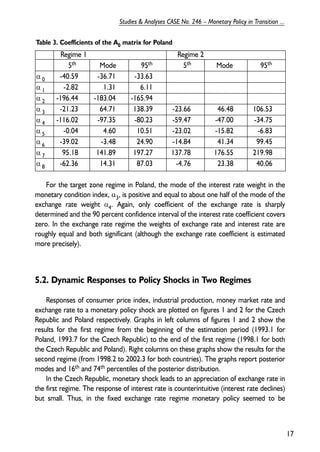
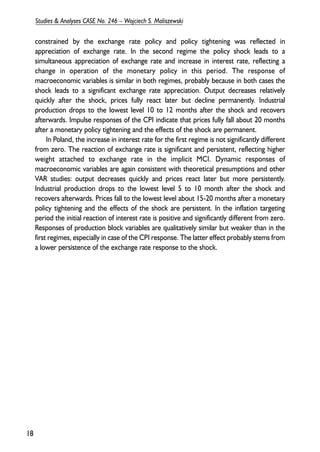
Tables 2 and 3 lists modes, 5th and 95th percentiles of the posterior distribution of the 
coefficients in A0 matrix for two regimes for the Czech Republic and Poland. 
Coefficients of the policy reaction function α3 and α4 validate our identification 
restrictions. For the fixed exchange rate regime in the Czech Republic the mode of the 
weight attached to exchange rate in the monetary condition index is sharply determined 
and much higher than the weight attached to the interest rate (which has the wrong sign, 
but is very imprecisely estimated). For the floating exchange rate regime, both weights 
are precisely determined (although estimate of the weight attached to the exchange rate 
is again estimated more sharply). 
16 
Studies & Analyses CASE No. 246 – Wojciech S. Maliszewski 
Table 2. Coefficients of the A0 matrix for the Czech Republic 
Regime 1 Regime 2 
5th Mode 95th 5th Mode 95th 
α 0 -34.81 -30.99 -26.93 -48.17 -42.42 -36.83 
α 1 -2.87 54.63 108.57 42.31 86.48 132.72 
α 2 278.29 319.21 359.56 238.25 275.24 312.23 
α 3 -10.07 -1.35 26.01 6.43 174.98 342.46 
α 4 -150.45 -126.07 -104.23 -81.13 -51.92 -23.43 
α 5 -0.93 5.31 11.87 -12.65 -5.64 .60 
α 6 84.73 156.98 223.49 16.46 70.82 124.59 
α 7 40.45 47.55 55.26 130.38 257.31 374.93 
α 8 -104.01 -44.75 6.02 6.21 41.61 76.87
For the target zone regime in Poland, the mode of the interest rate weight in the 
monetary condition index, α3, is positive and equal to about one half of the mode of the 
exchange rate weight α4. Again, only coefficient of the exchange rate is sharply 
determined and the 90 percent confidence interval of the interest rate coefficient covers 
zero. In the exchange rate regime the weights of exchange rate and interest rate are 
roughly equal and both significant (although the exchange rate coefficient is estimated 
more precisely). 
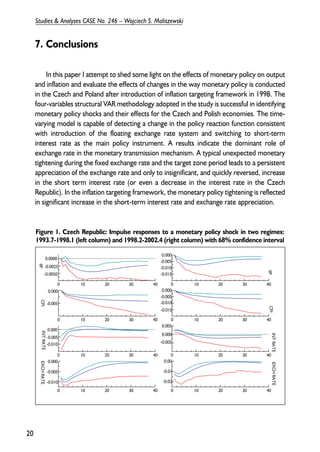
5.2. Dynamic Responses to Policy Shocks in Two Regimes 
Responses of consumer price index, industrial production, money market rate and 
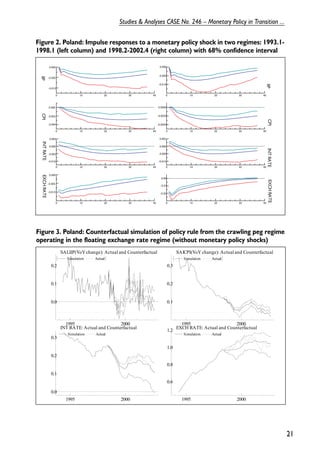
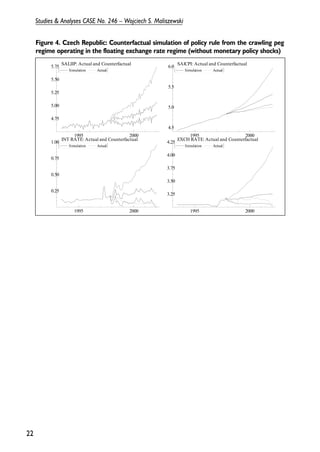
exchange rate to a monetary policy shock are plotted on figures 1 and 2 for the Czech 
Republic and Poland respectively. Graphs in left columns of figures 1 and 2 show the 
results for the first regime from the beginning of the estimation period (1993.1 for 
Poland, 1993.7 for the Czech Republic) to the end of the first regime (1998.1 for both 
the Czech Republic and Poland). Right columns on these graphs show the results for the 
second regime (from 1998.2 to 2002.3 for both countries). The graphs report posterior 
modes and 16th and 74th percentiles of the posterior distribution. 
In the Czech Republic, monetary shock leads to an appreciation of exchange rate in 
the first regime. The response of interest rate is counterintuitive (interest rate declines) 
but small. Thus, in the fixed exchange rate regime monetary policy seemed to be 
17 
Studies & Analyses CASE No. 246 – Monetary Policy in Transition ... 
Table 3. Coefficients of the A0 matrix for Poland 
Regime 1 Regime 2 
5th Mode 95th 5th Mode 95th 
α 0 -40.59 -36.71 -33.63 
α 1 -2.82 1.31 6.11 
α 2 -196.44 -183.04 -165.94 
α 3 -21.23 64.71 138.39 -23.66 46.48 106.53 
α 4 -116.02 -97.35 -80.23 -59.47 -47.00 -34.75 
α 5 -0.04 4.60 10.51 -23.02 -15.82 -6.83 
α 6 -39.02 -3.48 24.90 -14.84 41.34 99.45 
α 7 95.18 141.89 197.27 137.78 176.55 219.98 
α 8 -62.36 14.31 87.03 -4.76 23.38 40.06
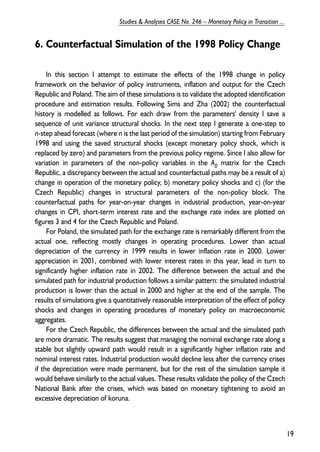
constrained by the exchange rate policy and policy tightening was reflected in 
appreciation of exchange rate. In the second regime the policy shock leads to a 
simultaneous appreciation of exchange rate and increase in interest rate, reflecting a 
change in operation of the monetary policy in this period. The response of 
macroeconomic variables is similar in both regimes, probably because in both cases the 
shock leads to a significant exchange rate appreciation. Output decreases relatively 
quickly after the shock, prices fully react later but decline permanently. Industrial 
production drops to the lowest level 10 to 12 months after the shock and recovers 
afterwards. Impulse responses of the CPI indicate that prices fully fall about 20 months 
after a monetary policy tightening and the effects of the shock are permanent. 
In Poland, the increase in interest rate for the first regime is not significantly different 
from zero. The reaction of exchange rate is significant and persistent, reflecting higher 
weight attached to exchange rate in the implicit MCI. Dynamic responses of 
macroeconomic variables are again consistent with theoretical presumptions and other 
VAR studies: output decreases quickly and prices react later but more persistently. 
Industrial production drops to the lowest level 5 to 10 month after the shock and 
recovers afterwards. Prices fall to the lowest level about 15-20 months after a monetary 
policy tightening and the effects of the shock are persistent. In the inflation targeting 
period the initial reaction of interest rate is positive and significantly different from zero. 
Responses of production block variables are qualitatively similar but weaker than in the 
first regimes, especially in case of the CPI response. The latter effect probably stems from 
a lower persistence of the exchange rate response to the shock. 
18 
Studies & Analyses CASE No. 246 – Wojciech S. Maliszewski
6. Counterfactual Simulation of the 1998 Policy Change 
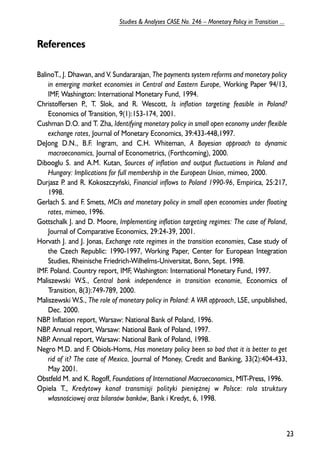
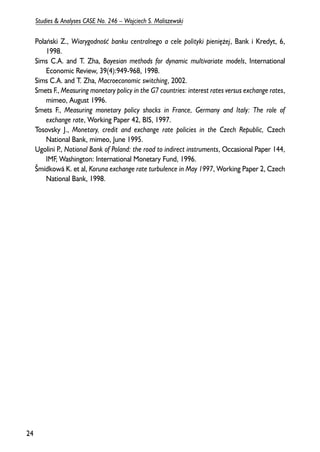
In this section I attempt to estimate the effects of the 1998 change in policy 
framework on the behavior of policy instruments, inflation and output for the Czech 
Republic and Poland. The aim of these simulations is to validate the adopted identification 
procedure and estimation results. Following Sims and Zha (2002) the counterfactual 
history is modelled as follows. For each draw from the parameters' density I save a 
sequence of unit variance structural shocks. In the next step I generate a one-step to 
n-step ahead forecast (where n is the last period of the simulation) starting from February 
1998 and using the saved structural shocks (except monetary policy shock, which is 
replaced by zero) and parameters from the previous policy regime. Since I also allow for 
variation in parameters of the non-policy variables in the A0 matrix for the Czech 
Republic, a discrepancy between the actual and counterfactual paths may be a result of a) 
change in operation of the monetary policy, b) monetary policy shocks and c) (for the 
Czech Republic) changes in structural parameters of the non-policy block. The 
counterfactual paths for year-on-year changes in industrial production, year-on-year 
changes in CPI, short-term interest rate and the exchange rate index are plotted on 
figures 3 and 4 for the Czech Republic and Poland. 
For Poland, the simulated path for the exchange rate is remarkably different from the 
actual one, reflecting mostly changes in operating procedures. Lower than actual 
depreciation of the currency in 1999 results in lower inflation rate in 2000. Lower 
appreciation in 2001, combined with lower interest rates in this year, lead in turn to 
significantly higher inflation rate in 2002. The difference between the actual and the 
simulated path for industrial production follows a similar pattern: the simulated industrial 
production is lower than the actual in 2000 and higher at the end of the sample. The 
results of simulations give a quantitatively reasonable interpretation of the effect of policy 
shocks and changes in operating procedures of monetary policy on macroeconomic 
aggregates. 
For the Czech Republic, the differences between the actual and the simulated path 
are more dramatic. The results suggest that managing the nominal exchange rate along a 
stable but slightly upward path would result in a significantly higher inflation rate and 
nominal interest rates. Industrial production would decline less after the currency crises 
if the depreciation were made permanent, but for the rest of the simulation sample it 
would behave similarly to the actual values. These results validate the policy of the Czech 
National Bank after the crises, which was based on monetary tightening to avoid an 
excessive depreciation of koruna. 
19 
Studies & Analyses CASE No. 246 – Monetary Policy in Transition ...
7. Conclusions 
In this paper I attempt to shed some light on the effects of monetary policy on output 
and inflation and evaluate the effects of changes in the way monetary policy is conducted 
in the Czech and Poland after introduction of inflation targeting framework in 1998. The 
four-variables structural VAR methodology adopted in the study is successful in identifying 
monetary policy shocks and their effects for the Czech and Polish economies. The time-varying 
model is capable of detecting a change in the policy reaction function consistent 
with introduction of the floating exchange rate system and switching to short-term 
interest rate as the main policy instrument. A results indicate the dominant role of 
exchange rate in the monetary transmission mechanism. A typical unexpected monetary 
tightening during the fixed exchange rate and the target zone period leads to a persistent 
appreciation of the exchange rate and only to insignificant, and quickly reversed, increase 
in the short term interest rate (or even a decrease in the interest rate in the Czech 
Republic). In the inflation targeting framework, the monetary policy tightening is reflected 
in significant increase in the short-term interest rate and exchange rate appreciation. 
20 
Studies & Analyses CASE No. 246 – Wojciech S. Maliszewski 
Figure 1. Czech Republic: Impulse responses to a monetary policy shock in two regimes: 
1993.7-1998.1 (left column) and 1998.2-2002.4 (right column) with 68% confidence interval 
-0.0025 
-0.0050 
0 10 20 30 40 
0.0000 
IIP 
0.000 
-0.005 
-0.010 
-0.015 
IIP 
0 10 20 30 40 
0.000 
-0.005 
0 10 20 30 40 
CPI 
0.000 
-0.005 
-0.010 
-0.015 
CPI 
0 10 20 30 40 
-0.005 
-0.010 
0 10 20 30 40 
0.000 
INT RATE 
0.005 
0.000 
-0.005 
INT RATE 
0 10 20 30 40 
0.000 
-0.005 
-0.010 
0 10 20 30 40 
EXCH RATE 
0.00 
-0.01 
-0.02 
0 10 20 30 40 
EXCH RATE
21 
Studies & Analyses CASE No. 246 – Monetary Policy in Transition ... 
Figure 2. Poland: Impulse responses to a monetary policy shock in two regimes: 1993.1- 
1998.1 (left column) and 1998.2-2002.4 (right column) with 68% confidence interval 
0.000 
-0.010 
0 10 20 30 40 
-0.005 
IIP 
0.000 
-0.005 
-0.010 
IIP 
0 10 20 30 40 
0 10 20 30 40 
0.000 
-0.002 
-0.004 
CPI 
0.0000 
-0.0025 
-0.0050 
0 10 20 30 40 
CPI 
0.005 
0.000 
-0.005 
0 10 20 30 40 
-0.010 
INT RATE 
0.005 
0.000 
-0.005 
0 10 20 30 40 
-0.010 
INT RATE 
0 10 20 30 40 
0.000 
-0.005 
-0.010 
EXCH RATE 
0.00 
-0.01 
-0.02 
0 10 20 30 40 
EXCH RATE 
Figure 3. Poland: Counterfactual simulation of policy rule from the crawling peg regime 
operating in the floating exchange rate regime (without monetary policy shocks) 
1995 2000 
0.2 
0.1 
0.0 
SALIIP(YoY change): Actual and Counterfactual 
Simulation Actual 
1995 2000 
0.3 
0.2 
0.1 
SAlCPI(YoY change): Actual and Counterfactual 
Simulation Actual 
1995 2000 
0.3 
0.2 
0.1 
0.0 
INT RATE: Actual and Counterfactual 
Simulation Actual 
1.2 EXCH RATE: Actual and Counterfactual 
1995 2000 
1.0 
0.8 
0.6 
Simulation Actual
22 
Studies & Analyses CASE No. 246 – Wojciech S. Maliszewski 
Figure 4. Czech Republic: Counterfactual simulation of policy rule from the crawling peg 
regime operating in the floating exchange rate regime (without monetary policy shocks) 
5.75 SALIIP: Actual and Counterfactual 
1995 2000 
5.50 
5.25 
5.00 
4.75 
Simulation Actual 
6.0 SAlCPI: Actual and Counterfactual 
1995 2000 
5.5 
5.0 
4.5 
Simulation Actual 
1.00 INT RATE: Actual and Counterfactual 
1995 2000 
0.75 
0.50 
0.25 
Simulation Actual 
4.25 EXCH RATE: Actual and Counterfactual 
1995 2000 
4.00 
3.75 
3.50 
3.25 
Simulation Actual
References 
BalinoT., J. Dhawan, and V. Sundararajan, The payments system reforms and monetary policy 
in emerging market economies in Central and Eastern Europe, Working Paper 94/13, 
IMF, Washington: International Monetary Fund, 1994. 
Christoffersen P., T. Slok, and R. Wescott, Is inflation targeting feasible in Poland? 
Economics of Transition, 9(1):153-174, 2001. 
Cushman D.O. and T. Zha, Identifying monetary policy in small open economy under flexible 
exchange rates, Journal of Monetary Economics, 39:433-448,1997. 
DeJong D.N., B.F. Ingram, and C.H. Whiteman, A Bayesian approach to dynamic 
macroeconomics, Journal of Econometrics, (Forthcoming), 2000. 
Dibooglu S. and A.M. Kutan, Sources of inflation and output fluctuations in Poland and 
Hungary: Implications for full membership in the European Union, mimeo, 2000. 
Durjasz P. and R. Kokoszczyñski, Financial inflows to Poland 1990-96, Empirica, 25:217, 
1998. 
Gerlach S. and F. Smets, MCIs and monetary policy in small open economies under floating 
rates, mimeo, 1996. 
Gottschalk J. and D. Moore, Implementing inflation targeting regimes: The case of Poland, 
Journal of Comparative Economics, 29:24-39, 2001. 
Horvath J. and J. Jonas, Exchange rate regimes in the transition economies, Case study of 
the Czech Republic: 1990-1997, Working Paper, Center for European Integration 
Studies, Rheinische Friedrich-Wilhelms-Universitat, Bonn, Sept. 1998. 
IMF. Poland. Country report, IMF, Washington: International Monetary Fund, 1997. 
Maliszewski W.S., Central bank independence in transition economie, Economics of 
Transition, 8(3):749-789, 2000. 
Maliszewski W.S., The role of monetary policy in Poland: A VAR approach, LSE, unpublished, 
Dec. 2000. 
NBP. Inflation report, Warsaw: National Bank of Poland, 1996. 
NBP. Annual report, Warsaw: National Bank of Poland, 1997. 
NBP. Annual report, Warsaw: National Bank of Poland, 1998. 
Negro M.D. and F. Obiols-Homs, Has monetary policy been so bad that it is better to get 
rid of it? The case of Mexico, Journal of Money, Credit and Banking, 33(2):404-433, 
May 2001. 
Obstfeld M. and K. Rogoff, Foundations of International Macroeconomics, MIT-Press, 1996. 
Opiela T., Kredytowy kana³ transmisji polityki pieniê¿nej w Polsce: rola struktury 
w³asnooeciowej oraz bilansów banków, Bank i Kredyt, 6, 1998. 
23 
Studies & Analyses CASE No. 246 – Monetary Policy in Transition ...
Polañski Z., Wiarygodnooeæ banku centralnego a cele polityki pieniê¿ej, Bank i Kredyt, 6, 
1998. 
Sims C.A. and T. Zha, Bayesian methods for dynamic multivariate models, International 
Economic Review, 39(4):949-968, 1998. 
Sims C.A. and T. Zha, Macroeconomic switching, 2002. 
Smets F., Measuring monetary policy in the G7 countries: interest rates versus exchange rates, 
mimeo, August 1996. 
Smets F., Measuring monetary policy shocks in France, Germany and Italy: The role of 
exchange rate, Working Paper 42, BIS, 1997. 
Tosovsky J., Monetary, credit and exchange rate policies in the Czech Republic, Czech 
National Bank, mimeo, June 1995. 
Ugolini P., National Bank of Poland: the road to indirect instruments, Occasional Paper 144, 
IMF, Washington: International Monetary Fund, 1996. 
Šmídkowá K. et al, Koruna exchange rate turbulence in May 1997, Working Paper 2, Czech 
National Bank, 1998. 
24 
Studies & Analyses CASE No. 246 – Wojciech S. Maliszewski
Appendix A. Data sources and transformations 
Money market rates: 
Czech Republic: 1 month PRIBOR – Czech National Bank 
Poland: 1 month WIBOR – Datastream 
Exchange rate indices: 
Czech Republic: (0.35 log(CZK/USD) + 0.65 log(CZK/DM)) – Czech National 
Bank 
Poland: (0.5 log(PLN/USD) + 0.5 log(PLN/DM)) – National Bank of Poland 
Consumer Price Indices CPI (log of X11 seasonally adjusted series) 
Czech Republic: Czech National Bank 
Poland – Central Statistical Office 
Index of Industrial Production IIP (log of X11 seasonally adjusted series) 
Czech Republic: Czech National Bank 
Poland: Central Statistical Office 
Appendix B. Bayesian estimation 
The estimation method for the multi-regime model in this paper is adapted from Del 
Negro and Obiols-Homs (2001) (who estimate a similar model for Mexico) and Sims and 
Zha (2002). The following description follows closely Sims and Zha but is simplified due 
to my assumption that dates of regime changes are known. 
Following Sims and Zha, I begin by rewriting the model 1 in the following way 
(1) 
’ 
ytA = x [D + SA ]+ ε 
where 
(2) 
 
 
= 
nxn 
0 
I specify priors for non-zero coefficients in A0 (for regimes k=1,2) in the same way as 
in Sims and Zha (2002), assuming a joint Gaussian prior distribution with independent 
individual elements with mean zero and standard deviation set to λ0/δi for the i'th raw of 
25 
Studies & Analyses CASE No. 246 – Monetary Policy in Transition ... 
’ 
t 
(k) 
0 
’ (k) 
t 
(k) 
0 
 
 
(m−n)xn 
I 
S 
⌃
A0 
(k), where λ0 is a hyperparameter and δi is a standard deviation from an estimated 
autoregressive process for the i'th variable. For D(k), I specify a joint Gaussian prior 
distribution with independent individual elements with mean zero and standard deviation 
of the coefficient on lag l of variable j in each equation given by , where λ1, λ3 
are hyperparameters and δj is a standard deviation from an estimated autoregressive 
process for the j'th variable. This formulation of the prior is equivalent to specifying a 
random walk prior for reduced form VAR coefficients. 
(K) by a0,j 
Denoting the j'th column of A0 
λ λ 
0 1 
δ λ 
(K) and the j'th column of D(k) by dj 
(k) for j = 1 
(k) in 
,…, n and k = 1, 2, I write the proposed prior distributions for elements of A0 
equation j as: 
(3) 
(4) 
a ~ N(0,H ),k = 1,2, j = 
1,...,n 
I also follow Sims and Zha incorporating the two sets of "dummy observations" 
pushing the model towards the non-stationarity region but not excluding cointegration 
among the series. Given very short sample under investigation, the effect of these 
dummies on dynamic properties of the model is very strong and the model generates 
reasonable impulse responses only when variance of these priors is made substantially 
greater than in the Sims and Zha's application. In the final specification I scale the Sims and 
Zha's dummy observations by a factor of 0.01. As discussed in the main text, this also 
reflects our beliefs that a large part of variation in the series can be explained by 
deterministic part of the model due to a slowly decaying effect of initial conditions. 
(k) and dj 
I further rewrite the model by stacking a0,j 
(k) for k = 1; 2 into: 
 
 
= 
 
 
= 
(1) 
j 
(1) 
0, j 
d 
,d 
a 
In order to avoid overparametrization of the model, the coefficients in aj and dj must 
(k) are the same for all k's and a0,j 
be restricted. In the model I impose restrictions that dj 
(k) 
are the same for k = 1 and 2 in the non-policy block of the model. I then follow 
Waggoner and Zha by expressing coefficients in a0,j and d0,j in terms of "free" coefficients 
by writing these restrictions as: 
(5) 
26 
Studies & Analyses CASE No. 246 – Wojciech S. Maliszewski 
ˆ l 3 j 
d ~ N(0,H ),k 1,2, j 1,...,n 
j 
(k) 
0, j 
0 j 
(k) 
0, j 
= = 
+ 
  
 
  
 
  
 
  
 
(2) 
j 
(2) j 
0, j 
0, j a 
d 
a 
Qja0, j = 0,R jd j = 0, j =1,...,n 
⌃ 
⌃
where Qj is a nk x nk matrix with rank qj and Rj is a mk x mk matrix with rank rj. 
Denoting by Uj a nk x qj matrix such that the columns of Uj form an orthonormal basis for 
the null space of Qj and denoting by Vj a mk x rj matrix such that the columns of Vj form 
an orthonormal space for the null space of Rj, I can express aj and dj in terms of a qj x nk 
vector bj and a rj x mk vector gj satisfying the following relationships: 
(6) 
Vectors bj and gj contain "free" parameters of the model and the original parameters 
in aj and dj can be recovered by linear transformations Uj and Vj. 
The prior for coefficients in bj and gj are obtained by combining equations 3, 4 and 6: 
(7) 
(8) 
b ~ N(0,H ), j 1,...,n 
j 0 j 
where 
= 
H = (U (I ⊗ H )U ) , j = 
1,...,n 
Introducing notation: 
1 
 
 
’ 
t 
) k (1 
x 
. 
, , k=1,2 
(k) and tTk 
 
 
’ 
t 
) k (1 
y 
. 
. 
. 
where Tk is the total number of observations in regime k; and t1 
(k) are 
respectively the first and the last observation from regime k, the likelihood function 
expressed in terms of original parameters is proportional to: 
27 
Studies & Analyses CASE No. 246 – Monetary Policy in Transition ... 
a0, j = Ujb j ,d j = Vjg j , j =1,...,n 
g ~ N(0,H ), j 1,...,n 
j j 
= 
+ 
H (V (I H )V ) , j 1,...,n 
j 
1j 
0 
’j 
j 
1 
j 
1j 
0 
’ 
0 j j 
− − 
+ 
= ⊗ = 
− − 
     
 
     
 
= 
’ 
t 
(k) 
(k ) 
Tk 
y 
Y 
     
 
     
 
= 
’ 
t 
(k) 
(k ) 
Tk 
x 
X 
det( exp 1 
k T k k k k k k k k k k 
Π Π 
L A trace Y A X D SA Y A X D SA 
k k 
= = 
det( exp 1 
Π Π 
A k 
Y a X d Sa Y a X d Sa 
k k 
= = 
[ ( )] [ ( )] 
2 
[ ( )] [ ( )] 
2 
det( exp 1 
Π Π 
= = 
= 
   
   
= 
− − + + + + 
   
   
− − + − + 
= 
   
   
∝ − − + − + 
2 
1 
2 
1 
( ) 
0, 
( ) ( )’ ( ) ( ) 
0, 
( ) ( ) 
0, 
( ) ’ ( )’ ( ) 
0, 
( ) ( ) 
0, 
’( ) ( )’ ( ) 
0, 
) (0 
2 
1 
2 
1 
( ) 
0, 
( ) ( ) ( ) 
0, 
( ) ’ ( ) 
0, 
( ) ( ) ( ) 
0, 
) ( ) (0 
2 
1 
2 
1 
) (0 
) ( ) ( ) (0 
) ( ’ ) (0 
) ( ) ( ) (0 
) ( ) (0 
[ 2( ) ( )’ ( )] 
2 
k k 
k 
j 
k 
j 
k k k 
j 
k 
j 
k 
j 
k k k 
j 
k 
j 
k 
j 
k k k 
j 
k T 
k 
j 
k 
j 
k k 
j 
k k 
j 
k 
j 
k k 
j 
k T k 
A k 
a Y Y a d Sa X Y a d Sa X X d Sa 
k
The above expression can be simplified by introducing the following notation: 
~ diag [Y Y 2S’X Y S’X X S] 
diag [X(k)’X(k) ] = 
where is a matrix X(1)'X(1) and X(2)'X(2) on the diagonal. 
Using the newly introduced symbols, the likelihood function is proportional 
to: 
(9) 
2 
L det(A k 
exp 1 (k) T 
0 d ] [a ~ a 2d’ ~ a d ~ 
Equation 9 can be re-written in terms of free parameters bj and gj implicitly defined 
in equation 6: 
(10) 
2 
L det(A k 
exp 1 (k) T 
0 V g ] [b U’ ~ U b 2g’ V ~ U b g V ~ 
Combining equation 10 with priors from equation 8 and 7, and completing the 
squares in gj gives the following conditional posterior distribution for gj and the marginal 
density kernel for b: 
(11) 
where 
(12) 
2 
det(A exp 1 
where 
1 ’jj U )]b ~ V ( ) H V ~ V ( g ~ 
Alternatively, combining equation 10 with priors from equation 7 gives the following 
π 
conditional density kernel for b: 
28 
Studies & Analyses CASE No. 246 – Wojciech S. Maliszewski 
{ } 
{ 2 } 
k 1 
(k)’ (k) (k)’ (k) 
0 
2 
k 1 
1 (k)’ (k) (k)’ (k) (k)’ (k) 
0 
~ diag [X Y X X S] 
+ = 
= 
− 
Δ = − 
Δ = − + 
{ 2 } 
k 1 
~ 1 diag [X(k)’X(k) ] 
= 
− 
Δ+ = 
{ 2 } 
k 1 
Π Π 
= = 
− 
+ + 
− 
   
   
∝ − Δ − Δ + Δ 
k 1 
2 
k 1 
j 
’ 1 
0,j j 0 0, j j 
1 
0 
’ 
0,j 
2 
Π Π 
= = 
− 
+ + 
− 
   
   
∝ − Δ − Δ + Δ 
k 1 
2 
k 1 
j j 
1 ’j 
’ 
0 j j j 
’j 
j j j 
1 
j 0 
’ 
j 
2 
) ) H V ~ zV ( , g ~ 
( ) b , Y g ( 1 1j 
j 
1 ’j 
j T j 
− −+ 
− 
π = Ν Δ+ + 
Π Π 
= = 
+ 
− −+ 
− 
+ + 
− − 
   
   
∝ − Δ + − Δ Δ + Δ 
k 1 
2 
k 1 
0 j j 
’j 
1 1j 
j 
1 ’j 
0 j 
’j 
j 
1j 
j 0 
1 
j 0 
’ 
j 
(k) T 
0 
t j 
[b (U’ ~ U H )b (V ~ U )’(V ~ V H ) (V ~ U )]b 
2 
(bY ,g ) 
k 
0 j j 
’j 
1 1j 
j 
+ 
− −+ 
− 
= Δ+ + Δ
(13) 
π 
2 
det(A exp 1 
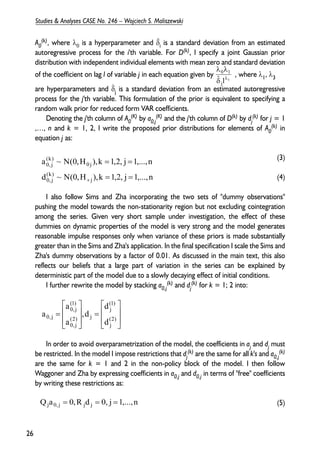
The posterior density of parameters of the model can be estimated by Gibbs sampling, 
combining direct draws from distribution in equation 11 with Metropolis-Hastings step for 
drawing from distribution in equation 13. Alternatively, modal estimates of b coefficients 
can be obtained by maximizing the expression in equation 12 with respect to b and modal 
estimates of g's can be obtained by substituting estimated b's in the expression for the 
mean of normal distribution in equation 11. Posterior density of b can then be 
approximated by a multivariate normal density with variance-covariance matrix equal to 
the inverse of the Hessian of equation 12 (as a function of b) evaluated at the maximum. 
This second approach, used in Negro and Obiols-Homs (2001), is adopted here. 
Appendix C. Exchange Rate Policy in the Czech Republic 
and Poland 
29 
Studies & Analyses CASE No. 246 – Monetary Policy in Transition ... 
Π Π 
= = 
+ 
− − 
   
   
∝ − Δ + − Δ 
k 1 
2 
k 1 
0 j j 
’j 
j j 
1j 
j 0 
1 
j 0 
’ 
j 
(k) T 
0 
t j 
[b (U’ ~ U H )b 2g’ V ~ U b ) 
2 
(bY ,g ) 
k 
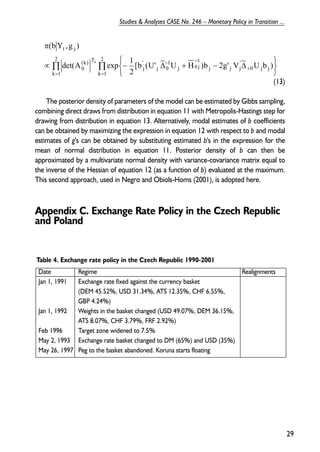
Table 4. Exchange rate policy in the Czech Republic 1990-2001 
Date Regime Realignments 
Jan 1, 1991 Exchange rate fixed against the currency basket 
(DEM 45.52%, USD 31.34%, ATS 12.35%, CHF 6.55%, 
GBP 4.24%) 
Jan 1, 1992 Weights in the basket changed (USD 49.07%, DEM 36.15%, 
ATS 8.07%, CHF 3.79%, FRF 2.92%) 
Feb 1996 Target zone widened to 7.5% 
May 2, 1993 Exchange rate basket changed to DM (65%) and USD (35%) 
May 26, 1997 Peg to the basket abandoned. Koruna starts floating
30 
Studies & Analyses CASE No. 246 – Wojciech S. Maliszewski 
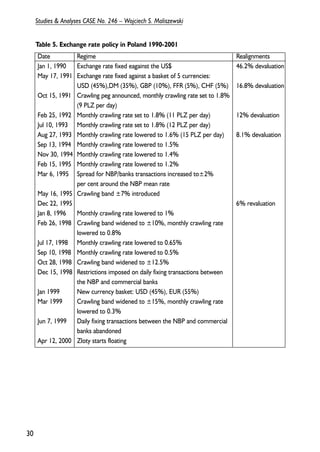
Table 5. Exchange rate policy in Poland 1990-2001 
Date Regime Realignments 
Jan 1, 1990 Exchange rate fixed eagainst the US$ 46.2% devaluation 
May 17, 1991 Exchange rate fixed against a basket of 5 currencies: 
USD (45%),DM (35%), GBP (10%), FFR (5%), CHF (5%) 16.8% devaluation 
Oct 15, 1991 Crawling peg announced, monthly crawling rate set to 1.8% 
(9 PLZ per day) 
Feb 25, 1992 Monthly crawling rate set to 1.8% (11 PLZ per day) 12% devaluation 
Jul 10, 1993 Monthly crawling rate set to 1.8% (12 PLZ per day) 
Aug 27, 1993 Monthly crawling rate lowered to 1.6% (15 PLZ per day) 8.1% devaluation 
Sep 13, 1994 Monthly crawling rate lowered to 1.5% 
Nov 30, 1994 Monthly crawling rate lowered to 1.4% 
Feb 15, 1995 Monthly crawling rate lowered to 1.2% 
Mar 6, 1995 Spread for NBP/banks transactions increased to±2% 
per cent around the NBP mean rate 
May 16, 1995 Crawling band ±7% introduced 
Dec 22, 1995 6% revaluation 
Jan 8, 1996 Monthly crawling rate lowered to 1% 
Feb 26, 1998 Crawling band widened to ±10%, monthly crawling rate 
lowered to 0.8% 
Jul 17, 1998 Monthly crawling rate lowered to 0.65% 
Sep 10, 1998 Monthly crawling rate lowered to 0.5% 
Oct 28, 1998 Crawling band widened to ±12.5% 
Dec 15, 1998 Restrictions imposed on daily fixing transactions between 
the NBP and commercial banks 
Jan 1999 New currency basket: USD (45%), EUR (55%) 
Mar 1999 Crawling band widened to ±15%, monthly crawling rate 
lowered to 0.3% 
Jun 7, 1999 Daily fixing transactions between the NBP and commercial 
banks abandoned 
Apr 12, 2000 Zloty starts floating
215 Cukrowski J., Financing the Defict of the State Budget by National Bank of 
Georgia (1996–1999) 
216
, 
 ,

CASE Network Studies and Analyses 246 - Monetary Policy in Transition: Structural Econometric Modelling and Policy Simulations

  • 1.
    2 4 6 Wojciech S. Maliszewski Monetary Policy in Transition: Structural Econometric Modelling and Policy Simulations W a r s a w , 2 0 0 2
  • 2.
    Materials published herehave a working paper character. They can be subject to further publication. The views and opinions expressed here reflect Author point of view and not necessarily those of CASE. This research was supported by a grant from the CERGE-EI Foundation under a program of the Global Development Network. Additional funds for grantees in the Balkan countries have been provided by the Austrian Government through WIIW, Vienna. All opinions expressed are those of the autor and have not been endorsed by CERGE-EI Foundation, WIIW, or the GDN. Key words: transition, monetary policy, inflation, structural vector autoregression, policy simulations. © CASE – Center for Social and Economic Research, Warsaw 2002 Graphic Design: Agnieszka Natalia Bury DTP: CeDeWu Sp. z o.o. ISSN 1506-1701, ISBN 83-7178-297-7 Publisher: CASE – Center for Social and Economic Research ul. Sienkiewicza 12, 00-944 Warsaw, Poland tel.: (48 22) 622 66 27, 828 61 33, fax: (48 22) 828 60 69 e-mail: case@case.com.pl http://www.case.com.pl
  • 3.
    Contents Abstract 5 1. Introduction 6 2. Specification and Identification of the Model 7 3. Monetary and Exchange Rate Policy in Poland 10 4. Monetary and Exchange Rate Policy in the Czech Republic 13 5. Estimation and Results 15 5.1. Coefficients of the A0 Matrix 16 5.2. Dynamic Responses to Policy Shocks in Two Regimes 17 6. Counterfactual Simulation of the 1998 Policy Change 19 7. Conclusions 20 Appendix A 25 Appendix B 25 Appendix C 29
  • 4.
    Wojciech S. Maliszewski Wojciech S. Maliszewski holds Master degrees from the University of Sussex (1996), Warsaw University's Department of Economics (1997) and the London School of Economics (1999). He is presently studying for his doctorate at the London School of Economics. In 1997-98 and in 1999, he worked in Romania as a CASE representative in the ProDemocratia advisory mission. In 2001 he was an intern at the World Bank, Washington, DC. His main areas of interest include monetary and fiscal policy, and political economy of transition. He has published widely on central bank independence, exchange rate behavour, monetary policy transmission mechanism, and fiscal sustainability in transition countries. He has worked for the CASE Foundation as an economist since 1996. 4 Studies & Analyses CASE No. 246 – Wojciech S. Maliszewski
  • 5.
    Abstract In thispaper I estimate a Bayesian structural VAR models for the Czech Republic and Poland, allowing for changes in parameters between the two monetary policy arrangements. The four-variables structural VAR methodology adopted in the study is successful in identifying monetary policy shocks and their effects for the Czech and Polish economies. The time-varying model is capable of detecting a change in the policy reaction function consistent with introduction of the floating exchange rate system and switching to short-term interest rate as the main policy instrument. The results indicate the dominant role of exchange rate in the monetary transmission mechanism. 5 Studies & Analyses CASE No. 246 – Monetary Policy in Transition ...
  • 6.
    1. Introduction Conductingmonetary policy in the transition environment is a difficult task. Available time series are short and often unreliable, there is an ongoing adjustment processes in the real sector of the economy, and even more dramatic developments in the financial sector. It is therefore not surprising that even the advanced transition economies opted for exchange rate anchors at the beginning of reforms. Fixing the exchange rate was relatively easy to implement and effective in taming inflationary expectations, but became difficult to sustain when inflation reached a moderate-level plateau. Exit from the fixed peg was either volatile as in the Czech Republic or carried on in an orderly manner as in case of Poland, where the crawling peg system evolved into a gradually widening target zone with a decreasing rate of crawl of the central parity. At the end of the decade Poland and the Czech Republic conducted their monetary policies using direct inflation targeting and floating exchange rates. Although inflation targeting requires a thorough knowledge about the monetary transmission mechanism, precise understanding of this mechanism in transition countries remained a challenge, not only because of ongoing structural changes, but also because the history of monetary policy under floating exchange in these countries rate is so short. Researchers quickly documented that a highly uncertain relationship between monetary policy instruments and inflation may hamper implementation of the framework (Christoffersen et al., 2001 and Gottschalk and Moore, 2001). In this paper I present several structural VAR models for Poland and the Czech Republic. The identifying restriction are supplemented with Bayesian priors, which turned out to be useful for estimation of the models with short available time series. To account for policy changes in the period under investigation I apply a methodology recently proposed by Sims and Zha (2002) and allow for changes in some parameters of the model. The changes are restricted to parameters of policy reaction functions and equations describing the behavior of financial variables, leaving coefficients of equations describing the behavior of macroeconomic variables constant across regimes. Although this specification seems to be restrictive, it is supported by the data. It is also parsimonious enough to produce reasonable results in small samples under investigation, where the most recent policy regimes last for no longer than four years. The remainder of the paper is constructed as follows: the first part discusses estimation strategy. The next part discusses monetary and exchange rate policies in Poland, the Czech Republic. Next two sections present results from the VAR estimates and some policy simulations for the Czech Republic and Poland. The last section concludes. Data sources and details about exchange rate policy in the two countries and technical details behind the estimation strategy are relegated to appendices. 6 Studies & Analyses CASE No. 246 – Wojciech S. Maliszewski
  • 7.
    2. Specification andIdentification of the Model The empirical model adopted in this study is a version of a "small open-economy" structural vector autoregression (SVAR). A similar model was successfully estimated for Canada by Cushman and Zha (1997). Due to obvious data limitations (short time series), the size of the model is kept at the minimum and consequently the adopted identification scheme is simpler than in other studies. However, there were only limited attempts of estimating structural VAR for transition economies going beyond a simple recursive identification scheme (with a notable exception of Dibogloo and Kutan, 2000) and one of the goals of our paper is to fill this gap. As will become apparent, interactions between exchange rate and monetary policies makes the use of recursive identification unjustified. Moreover, an evident change in the monetary policy strategy reflected in the switch to inflation targeting makes the fixed-coefficients VAR model potentially unsuitable for analysis of the whole period. I approach this problem by allowing for a limited time variation in the coefficients of the model, following the methodology laid down by Sims and Zha (2002) and Del Negro and Obiols-Homs (2001). The estimated model is described by the following system of simultaneous equations: (1) ’ = ’ t + + ε = where st is a state of the economy (assumed to be observable), yt is an n × 1 vector of endogenous variables, xt is an m × 1 vector of lagged endogenous and exogenous variables and εt is n × 1 vector of structural normally distributed disturbances: ~ N(0,1) (2) As discussed in Sims and Zha (2002), estimation of the system is straightforward if it is recursive (i.e. the A0 is triangular) and all parameters vary across states, because in this case parameters can be estimated separately for each state. But the number of parameters in such an unrestricted system can be very large, making it hardly suitable for short transition series. In what follows we restrict time-variation in the system to parameters in the A0(st) matrix and constant term in each equation. This form of time variation may seem to be restrictive but it is important to note that it allows for changes in all parameters of the reduced form system, including variances of the error terms. If switching between policy instruments and changes in variances of the reduced form system are the main factor behind parameters' variation, a model of this form will be 7 Studies & Analyses CASE No. 246 – Monetary Policy in Transition ... y A 0 s(t) x t A (st ) t , t 1...T εt Yt
  • 8.
    correctly specified. AlthoughI do not test the model against a more flexible alternative, this specification seems to reflect the major policy change in the three transition economies: adopting short-term interest rate as the main policy instrument and abandoning interventions on the foreign exchange market. I set the number of states to two and the date of policy change to January 1998 for the Czech Republic (corresponding to introduction of inflation targeting framework) and January 1998 for Poland (corresponding to a switch to inflation targeting). Short available time series preclude estimation of a model allowing for more regimes. The aim of the SVAR methodology is to identify monetary shocks, and their effect on the economy, by imposing some minimal identifying assumptions on the unrestricted VAR system. Changes in potential policy instruments are potentially influenced not only by policy actions, but also by disturbances beyond policy-makers' control. Thus, in order to identify the monetary policy shock, it is necessary to differentiate between various disturbances. The yt vector in our model consists four variables grouped into two blocks: consumer prices and industrial production form a "production sector" block and short-term interest rate and the exchange rate form a "financial sector" block. In the structural VAR methodology the identification of shocks is frequently achieved by allowing for only a delayed response of variables in the production sector to shocks in the financial sector and I follow this approach in our study. Identification of separate shocks in the financial sector requires some further restrictions and they are usually derived from central bank operating procedures. Since monetary authorities can react only to information available in real time, the time-lag in data collection and dissemination provides a natural identifying restriction, and I adopt it in this paper. I do not attempt to identify economically interpretable shocks in the production sector and therefore I normalize the production block to be upper triangular. The imposed restrictions do not depend on any particular policy regime and can be used in both the target zone and the floating exchange rate period. Table 1 lists the identification restrictions on the A0. 8 Studies & Analyses CASE No. 246 – Wojciech S. Maliszewski Table 1. Restrictions on coefficients of the A0 matrix CPI IIP Policy information CPI α0 α1 α5 IIP α2 α6 Interest rate α3 α7 Exchange rate α4 α8
  • 9.
    The first columnof table lists endogenous variables and the top raw policy shocks entering behavioral equations as defined by cells with α's. Empty cells in the first two columns reflect our assumption of a lagged response of variables in the production block to financial variables. Empty cells in the third column reflect the assumption that monetary authorities cannot react to shocks in the production sector instantaneously. The policy reaction equation may be interpreted as a function describing the behavior of an implicit monetary condition index, i.e. a linear combination of short term interest rate and exchange rate, by lagged endogenous and exogenous variables. This interpretation is identical to Smets (2001), who estimates the weights in the monetary condition index under the assumption of orthogonality between the index and shocks originating from the foreign financial sector (derived from theoretical models in Gerlach and Smets, 1996 and Smets, 1996). In our case the weights are identified only by assumption of a lagged response of monetary authorities to production sector variables. Successful identification should give a higher weight to the exchange rate in the target zone regime and a higher weight to interest rate in the floating regime. Below I report the estimates of the A0 matrix supporting our identification scheme. The "information" equation reflects the fact that in efficient markets financial variables quickly respond to shocks in other sectors. Again, this specification is not regime dependent as long as the parameters in A0 are allowed to vary between regimes (depending on the regime, either exchange rate or interest rate is free to adjust). 9 Studies & Analyses CASE No. 246 – Monetary Policy in Transition ...
  • 10.
    3. Monetary andExchange Rate Policy in Poland Fixing the zloty against the dollar was one of the main elements of the 1990 Polish stabilization program. The peg, however, was announced to be temporary at the outset of the program, potentially limiting its effect on expectations. Moreover, the starting offcial rate was grossly undervalued, giving a boost to Polish competitiveness but failing to provide an anchor for price level. The initial undervaluation allowed the peg to last longer than expected but after a year and a half the exchange rate was devalued, the dollar was replaced by a basket of five currencies and, within few month, a crawling peg system replaced the peg. Although the rate of crawl was set below the targeted inflation rate, securing a competitive level of the real exchange rate seemed to be the principal goal of exchange rate policy in the following years. At the initial stage of a macroeconomic stabilization program, the National Bank of Poland faced severe difficulties in conducting monetary policy. The monetary system was in the process of transformation from a monobank to a modern, two-tier banking system and the money market was non-existing. There was an excess liquidity in the system, excess reserves were subject to large fluctuations due to inefficient payment system, and real interest rates were negative (Ugolini, 1996 and Balino, Dhawan and Sundararajan, 1994). In response to these unfavorable circumstances monetary authorities relied on credit ceilings as the main policy instrument. In addition, refinancing policy was tightened, interest rates were increased to positive real levels and reserve requirements were increased to the maximum legal limit. The money market started operating in 1992 and the credit ceilings were abolished at the end of this year. Since 1993, open market operations – repo, reverse repo and outright sales – became the main monetary policy instruments and the money market rate (T/N reverse repo rate) became an operational central bank target. Intermediate monetary targets were defined in terms of broad money growth, although the NBP usually reacted in a flexible manner to developments in money demand. Moreover, between 1992 and 1994, substantial fiscal deficits, financed mostly by the NBP and the banking system, fueled monetary expansion (NBP 1998). As a result, M2 growth deviated from the targets by wide margins both in 1992 and 1994 (Polañski, 1998). While the National Bank of Poland enjoyed relatively high degree of statutory independence (see Maliszewski, 2000) and the government borrowings from the NBP were formally restricted, the budgetary law regularly suspended the provisions of the central bank law, raising the borrowing limits. Fiscal deficit in 1992 amounted to 6 per cent of GDP and was financed in over 40 per cent by the central bank. After significant 10 Studies & Analyses CASE No. 246 – Wojciech S. Maliszewski
  • 11.
    fiscal adjustments in1993, the deficit was reduced to 3 per cent of GDP, but almost 40 percent of it was still financed by the NBP. In 1994 this proportion remained at above 30 percent level (IMF, 1997). Although fiscal deficit financing made monetary policy lax in this period, central bank interest rates remain at positive real levels. In 1995, increases in net foreign assets of the NBP became the major source of monetary expansion and large-scale sterilization operations did not prevent overshooting of the annual money growth target by almost 60 per cent. In order to increase the risk faced by portfolio investors and tame capital inflows, the crawling peg system was replaced by a 14 percent band in May 1995. As anticipated, zloty appreciated after introduction of the new system1, but the new regime did not bring any significant increase in volatility since exchange rate was persistently close to the strong bound of the zone. The capital inflow slowed down only after interest rate cuts and revaluation of the central parity by 6 per cent at the end of 1995. The revaluation took the pressure off the lower bound of the target zone, but still did not increase exchange rate volatility because the NBP frequently intervened on the forex market. The intra-marginal interventions aimed at preventing excessive appreciation of the zloty and for most of the period average deviations of the USD and DM from the parity were kept above the -2.5 per cent2. Capital inflows exerted lower pressure on monetary policy in 1996, but fast expansion of credit to non-financial institutions became the new source of money creation. The expansion was fueled by a buoyant economy and by improvement in financial situation of the banking system after solving problems with bad debts from the 1992-1994 period. Monetary policy reacted sluggishly to this rapid credit growth and significant interest rate increases came only at the end of 1996 and in 1997, when the GDP growth rate accelerated to a record 6.9 per cent of GDP and a large current account deficit emerged. Policy tightening was facilitated by an increased risk on international financial markets after the Czech devaluation in June and the Asian crisis in October 1997, allowing for more independent monetary policy actions. Although in 1996 and 1997 the NBP offcially adopted base money growth as its operating target, interest rate continued to play a major role in conducting monetary policy (Opiela, 1998). The new law on the National Bank of Poland, adopted in January 1998, granted the NBP a high degree of independence guaranteed in the Constitutional Law, and 11 Studies & Analyses CASE No. 246 – Monetary Policy in Transition ... 1 It has been claimed that the appreciation caused an increase in money demand and the inflation target was overshot by only 5 per cent despite the very high money growth (Durjasz and Kokoszczyñski, 1998). 2 The NBP intervened very frequently in the first four months after revaluation of the central parity in December 1995. As a result, the average deviation of the USD and DM from the central parity (widely believed to be targeted by the NBP) remained continueously above the -2.5 per cent. Interventions became less frequent afterwards, but zloty remained in the desired region for several months in anticipation of the NBP interventions. For an econometric analysis of this implicit target zone arrangement see Maliszewski (1999).
  • 12.
    established Monetary PolicyCouncil (MPC), a body responsible for conducting the NBP monetary policy. The newly formed MPC offcially adopted inflation targeting as a monetary policy strategy and published the Medium Term Financial Strategy, where the medium-term inflation target was set below the 4 percent level at the end of 2003. The minimum interest rate on 28-days NBP Bills became a principal policy rate and the MPC considered a break from the previous exchange rate policy as a necessary step in implementation of the inflation targeting framework (NBP, 1998). In February 1998 the exchange rate band was widened to ±10 per cent and the exchange rate was allowed to move more freely within the zone. Since July 1998, the NBP abstained from interventions at the forex market. In October 1998 the target zone was widened again to ±12.5 per cent and in December 1998 transactions between the NBP and commercial banks at the fixing session3 were restricted to reduce the central bank influence on the market rate (NBP, 1998). In April 2000 zloty started floating. In 1998 the reference rate was reduced from 24 per cent in February to 15.5 per cent in December. The sharp reduction was a response to economic slowdown, declining inflation, and a large portfolio capital inflows at the beginning of the year. One of the interest rate cuts was decided immediately after the Russian crisis, to signal immunity of Polish financial markets to a potential contagion. Central bank interest rates remained at the stable level for the first half of 1999 but a higher inflation – overshoting the target in 1999 – prompted monetary authorities to reverse the cuts starting from the second half of 1999. In 2000 interest rates were further increased and the cautious period of cuts started only from the beginning of 2001, when inflation started declining and economic activity experienced a recession. Despite the policy relaxation, inflation remained below the target in 2001 and 2002. 12 Studies & Analyses CASE No. 246 – Wojciech S. Maliszewski 3 The official daily exchange rates were set in transactions between the NBP and commercial banks, in which the central bank was buying or selling currency at the current market rate. The restrictions increased the spread between the NBP buying and selling rate above the market spread and limited time allowed for transactions with the central bank.
  • 13.
    4. Monetary andExchange Rate Policy in the Czech Republic Czechoslovakia did not start economic reforms before 1990, but macroeconomic disequilibrium inherited from the Soviet-style system was less severe than in other transition countries. Consequently, the price and foreign exchange liberalization produced relatively smaller effect on inflation. Monetary tightening in 1990 and 1991 succeeded in curbing inflation after the initial price hike and monetary policy took a neutral stance from 1992 onwards, with a temporary tightening in the period before dissolution of the Czechoslovak state and splitting the joint currency (Tosovsky, 1995). The Czech National Bank (CNB) targeted monetary aggregates, with a particular emphasis on M2. The overall trend in monetary aggregates was close to the path targeted by the Czech National Bank, although the bank did not strictly adher to its targets, facing significant uncertainties about the behavior of money demand at the initial stage of transition process (Horvath and Jonas, 1998). Initially (from 1990 to the second half of 1992), the CNB controlled money supply through direct credit and interest rate ceilings. In 1992, the money market became mature enough to allow the CNB for replacing direct restrictions with indirect monetary policy instruments (discount rate, lombard rate, minimum reserve requirements, refinancing credits, open market operations and open foreign exchange positions). A second, and the most visible anti-inflationary anchor, considered to be a complement to monetary targets, was the exchange rate peg. The koruna was initially pegged to a basket of five currencies, with weights based on their share in the Czechoslovak foreign trade. Since 1993 the basket included only DM and USD, with a 65 percent weight given to the DM. The exchange rate was kept in a narrow, 0.5 percent-wide, corridor. Fixing the exchange rate was combined with exchange rate convertibility for most of the current account purposes, extended in 1995 to meet requirements of the article VIII of the IMF Agreement. The exchange rate parity against the basket was set at an undervalued level, providing a room for real exchange appreciation in the presence of large differences between inflation rates at home and in the main trading partners. The initial real appreciation of koruna was mainly the effect of price adjustments to the undervalued exchange rate. From 1994, the fixed exchange rate regime combined with liberalization of the foreign exchange market, improved rating of the Czech Republic and ongoing privatization process led to a massive capital inflow, a pressure on further real appreciation and a growing current account deficit. In 1997, the external disequilibrium changed market sentiments towards koruna. A speculative attack, triggered by the Asian crises, led to 13 Studies & Analyses CASE No. 246 – Monetary Policy in Transition ...
  • 14.
    abandoning the pegin May 1997. The CNB adopted measures to avoid a sharp drop in the domestic currency value. The koruna was well inside the band when exit from the previous exchange rate regime was announced, leaving some scope for depreciation even within the previous, narrow band. The CNB maintained a tight liquidity control after the regime change, driving up money market rates and preventing excessive depreciation. Pressure on koruna eased after June 1997 and the central bank was gradually reducing interest rates, closely monitoring developments on the foreign exchange market. Real interest rates converged to the pre-crises level in August 1997, completing the process of interest landing after the hike triggered by the crises (Smidkova et al., 1999). Inflation targeting, the new regime in the Czech monetary policy, was introduced in the Czech Republic at the beginning of 1998. The CNB initially targeted net inflation rate (excluding changes in administrative prices and changes in direct taxes) and announced end-year target ranges approximately 20 months in advance. Economic slowdown, brought about by the currency crises and the tight monetary policy in its aftermath, excerted downward pressure on inflation. The 1998 target was missed by a large margin: the net inflation was 1.7 percent against the 6 ± 2 percent target range. In mid-1998 the CNB started reducing interest rates and, in a series of cuts, the repo rate was lowered from 15 percent in July 1998 to 5.6 percent in December 1999. Policy relaxation did not prevent the 1999 net inflation rate to drop below the 4.5 ± 0.5 percent target. Interest rates continued to fall at a slower rate in 2000 and 2001, reaching 5 percent in May 2001. Low interest rates induced net portfolio outflows, but capital inflows related to foreign direct investments put a pressure on koruna appreciation and in 2000 the currency appreciated in nominal terms. The net inflation in 2000 was again below the target (4.5±1 percent). In 2001, the CNB announced the target band for a headline inflation, declining from 3-5 percent in January 2002 to 2-4 percent in December 2005. Further appreciation on koruna, despite record-low interest rates and sporadic interventions in the forex market, kept monetary conditions tight and hampered implementation of the inflation targeting framework. 14 Studies & Analyses CASE No. 246 – Wojciech S. Maliszewski
  • 15.
    5. Estimation andResults The policy variables in the estimated VAR system are short term interest rate (1 month WIBOR for Poland and 1 month PRIBOR for the Czech Republic) and exchange rate index defined as an average of USD/PLN and DM/PLN rates (with weight of the dollar 35 percent and 50 percent for the Czech Republic and Poland respectively). Non-policy variables are consumer price index and industrial production index. Industrial production index and consumer price index are seasonally adjusted and in logs, exchange rate index is in log and money market rate is not transformed. A description of variables is given in appendix A. The effective estimation period starts only in 1993 for Poland, when the modern payment system and the central bank open market operations became fully operational (see discussion above). For the Czech Republic, I start the estimation sample after a breakup of Czechoslovakia. Following Sims and Zha (2002) I estimate the model using a Bayesian estimation method described in appendix B. I skip a cointegration analysis in the study. I believe that the very limited sample does not allow for drawing precise conclusions about the long-run properties of the series and consequently I do not impose cointegration/nocointegration restrictions. As discussed in Sims (2000), estimation of the system like the one analyzed here by OLS (or similarly with flat priors in the Bayesian methodology adopted in this paper) attributes a high share of variation to a deterministic component of the model. This phenomenon is similar to the well documented bias towards stationarity in univariate models. Sims (2000) and Sims and Zha's (2002) Bayesian solution to the problem is based on the use of priors pushing the system into the non-stationarity region. Although my base priors for the coefficients of the A+ matrix are unit root priors (Minnesota priors), I heavily discount other priors advocated by Sims (2000) and Sims and Zha (2002) to force the non-stationarity of the system. According to Sims (2000), the use of these priors should not be automatic but should rather depend on investigator's prior knowledge about the behavior of the system. For example, the powerful price liberalization shock experienced by Poland in 1990 makes the initial conditions for the system different from its subsequent behavior. Attributing a significant share of variation to the deterministic component seems to be a reasonable strategy in this case4. The lag length in the VAR is set to six, which is a balance between limiting degrees of freedom and allowing for a reach dynamics in the system. I do not attempt to reduce the number of lags since the use of Minnesota priors in our short sample effectively shrinks parameters of higher-order lags towards zero. 15 Studies & Analyses CASE No. 246 – Monetary Policy in Transition ... 4 In other words, the estimated model leans toward a hypothesis that the gradual disinflation path experienced by Poland between 1990 and 2002 could had been expected at the start of the process.
  • 16.
    The choice ofthe dates of regime changes is based on policy decision in countriesunder investigation, but is also consistent with stability tests conducted on the reduced system with fixed coefficients, usually indicating problems with stability of the exchange rate equation in the period of regime change. All calculations were conducted in OX and programs replicating the results are available at request from authors. 5.1. Coefficients of the A0 Matrix Tables 2 and 3 lists modes, 5th and 95th percentiles of the posterior distribution of the coefficients in A0 matrix for two regimes for the Czech Republic and Poland. Coefficients of the policy reaction function α3 and α4 validate our identification restrictions. For the fixed exchange rate regime in the Czech Republic the mode of the weight attached to exchange rate in the monetary condition index is sharply determined and much higher than the weight attached to the interest rate (which has the wrong sign, but is very imprecisely estimated). For the floating exchange rate regime, both weights are precisely determined (although estimate of the weight attached to the exchange rate is again estimated more sharply). 16 Studies & Analyses CASE No. 246 – Wojciech S. Maliszewski Table 2. Coefficients of the A0 matrix for the Czech Republic Regime 1 Regime 2 5th Mode 95th 5th Mode 95th α 0 -34.81 -30.99 -26.93 -48.17 -42.42 -36.83 α 1 -2.87 54.63 108.57 42.31 86.48 132.72 α 2 278.29 319.21 359.56 238.25 275.24 312.23 α 3 -10.07 -1.35 26.01 6.43 174.98 342.46 α 4 -150.45 -126.07 -104.23 -81.13 -51.92 -23.43 α 5 -0.93 5.31 11.87 -12.65 -5.64 .60 α 6 84.73 156.98 223.49 16.46 70.82 124.59 α 7 40.45 47.55 55.26 130.38 257.31 374.93 α 8 -104.01 -44.75 6.02 6.21 41.61 76.87
  • 17.
    For the targetzone regime in Poland, the mode of the interest rate weight in the monetary condition index, α3, is positive and equal to about one half of the mode of the exchange rate weight α4. Again, only coefficient of the exchange rate is sharply determined and the 90 percent confidence interval of the interest rate coefficient covers zero. In the exchange rate regime the weights of exchange rate and interest rate are roughly equal and both significant (although the exchange rate coefficient is estimated more precisely). 5.2. Dynamic Responses to Policy Shocks in Two Regimes Responses of consumer price index, industrial production, money market rate and exchange rate to a monetary policy shock are plotted on figures 1 and 2 for the Czech Republic and Poland respectively. Graphs in left columns of figures 1 and 2 show the results for the first regime from the beginning of the estimation period (1993.1 for Poland, 1993.7 for the Czech Republic) to the end of the first regime (1998.1 for both the Czech Republic and Poland). Right columns on these graphs show the results for the second regime (from 1998.2 to 2002.3 for both countries). The graphs report posterior modes and 16th and 74th percentiles of the posterior distribution. In the Czech Republic, monetary shock leads to an appreciation of exchange rate in the first regime. The response of interest rate is counterintuitive (interest rate declines) but small. Thus, in the fixed exchange rate regime monetary policy seemed to be 17 Studies & Analyses CASE No. 246 – Monetary Policy in Transition ... Table 3. Coefficients of the A0 matrix for Poland Regime 1 Regime 2 5th Mode 95th 5th Mode 95th α 0 -40.59 -36.71 -33.63 α 1 -2.82 1.31 6.11 α 2 -196.44 -183.04 -165.94 α 3 -21.23 64.71 138.39 -23.66 46.48 106.53 α 4 -116.02 -97.35 -80.23 -59.47 -47.00 -34.75 α 5 -0.04 4.60 10.51 -23.02 -15.82 -6.83 α 6 -39.02 -3.48 24.90 -14.84 41.34 99.45 α 7 95.18 141.89 197.27 137.78 176.55 219.98 α 8 -62.36 14.31 87.03 -4.76 23.38 40.06
  • 18.
    constrained by theexchange rate policy and policy tightening was reflected in appreciation of exchange rate. In the second regime the policy shock leads to a simultaneous appreciation of exchange rate and increase in interest rate, reflecting a change in operation of the monetary policy in this period. The response of macroeconomic variables is similar in both regimes, probably because in both cases the shock leads to a significant exchange rate appreciation. Output decreases relatively quickly after the shock, prices fully react later but decline permanently. Industrial production drops to the lowest level 10 to 12 months after the shock and recovers afterwards. Impulse responses of the CPI indicate that prices fully fall about 20 months after a monetary policy tightening and the effects of the shock are permanent. In Poland, the increase in interest rate for the first regime is not significantly different from zero. The reaction of exchange rate is significant and persistent, reflecting higher weight attached to exchange rate in the implicit MCI. Dynamic responses of macroeconomic variables are again consistent with theoretical presumptions and other VAR studies: output decreases quickly and prices react later but more persistently. Industrial production drops to the lowest level 5 to 10 month after the shock and recovers afterwards. Prices fall to the lowest level about 15-20 months after a monetary policy tightening and the effects of the shock are persistent. In the inflation targeting period the initial reaction of interest rate is positive and significantly different from zero. Responses of production block variables are qualitatively similar but weaker than in the first regimes, especially in case of the CPI response. The latter effect probably stems from a lower persistence of the exchange rate response to the shock. 18 Studies & Analyses CASE No. 246 – Wojciech S. Maliszewski
  • 19.
    6. Counterfactual Simulationof the 1998 Policy Change In this section I attempt to estimate the effects of the 1998 change in policy framework on the behavior of policy instruments, inflation and output for the Czech Republic and Poland. The aim of these simulations is to validate the adopted identification procedure and estimation results. Following Sims and Zha (2002) the counterfactual history is modelled as follows. For each draw from the parameters' density I save a sequence of unit variance structural shocks. In the next step I generate a one-step to n-step ahead forecast (where n is the last period of the simulation) starting from February 1998 and using the saved structural shocks (except monetary policy shock, which is replaced by zero) and parameters from the previous policy regime. Since I also allow for variation in parameters of the non-policy variables in the A0 matrix for the Czech Republic, a discrepancy between the actual and counterfactual paths may be a result of a) change in operation of the monetary policy, b) monetary policy shocks and c) (for the Czech Republic) changes in structural parameters of the non-policy block. The counterfactual paths for year-on-year changes in industrial production, year-on-year changes in CPI, short-term interest rate and the exchange rate index are plotted on figures 3 and 4 for the Czech Republic and Poland. For Poland, the simulated path for the exchange rate is remarkably different from the actual one, reflecting mostly changes in operating procedures. Lower than actual depreciation of the currency in 1999 results in lower inflation rate in 2000. Lower appreciation in 2001, combined with lower interest rates in this year, lead in turn to significantly higher inflation rate in 2002. The difference between the actual and the simulated path for industrial production follows a similar pattern: the simulated industrial production is lower than the actual in 2000 and higher at the end of the sample. The results of simulations give a quantitatively reasonable interpretation of the effect of policy shocks and changes in operating procedures of monetary policy on macroeconomic aggregates. For the Czech Republic, the differences between the actual and the simulated path are more dramatic. The results suggest that managing the nominal exchange rate along a stable but slightly upward path would result in a significantly higher inflation rate and nominal interest rates. Industrial production would decline less after the currency crises if the depreciation were made permanent, but for the rest of the simulation sample it would behave similarly to the actual values. These results validate the policy of the Czech National Bank after the crises, which was based on monetary tightening to avoid an excessive depreciation of koruna. 19 Studies & Analyses CASE No. 246 – Monetary Policy in Transition ...
  • 20.
    7. Conclusions Inthis paper I attempt to shed some light on the effects of monetary policy on output and inflation and evaluate the effects of changes in the way monetary policy is conducted in the Czech and Poland after introduction of inflation targeting framework in 1998. The four-variables structural VAR methodology adopted in the study is successful in identifying monetary policy shocks and their effects for the Czech and Polish economies. The time-varying model is capable of detecting a change in the policy reaction function consistent with introduction of the floating exchange rate system and switching to short-term interest rate as the main policy instrument. A results indicate the dominant role of exchange rate in the monetary transmission mechanism. A typical unexpected monetary tightening during the fixed exchange rate and the target zone period leads to a persistent appreciation of the exchange rate and only to insignificant, and quickly reversed, increase in the short term interest rate (or even a decrease in the interest rate in the Czech Republic). In the inflation targeting framework, the monetary policy tightening is reflected in significant increase in the short-term interest rate and exchange rate appreciation. 20 Studies & Analyses CASE No. 246 – Wojciech S. Maliszewski Figure 1. Czech Republic: Impulse responses to a monetary policy shock in two regimes: 1993.7-1998.1 (left column) and 1998.2-2002.4 (right column) with 68% confidence interval -0.0025 -0.0050 0 10 20 30 40 0.0000 IIP 0.000 -0.005 -0.010 -0.015 IIP 0 10 20 30 40 0.000 -0.005 0 10 20 30 40 CPI 0.000 -0.005 -0.010 -0.015 CPI 0 10 20 30 40 -0.005 -0.010 0 10 20 30 40 0.000 INT RATE 0.005 0.000 -0.005 INT RATE 0 10 20 30 40 0.000 -0.005 -0.010 0 10 20 30 40 EXCH RATE 0.00 -0.01 -0.02 0 10 20 30 40 EXCH RATE
  • 21.
    21 Studies &Analyses CASE No. 246 – Monetary Policy in Transition ... Figure 2. Poland: Impulse responses to a monetary policy shock in two regimes: 1993.1- 1998.1 (left column) and 1998.2-2002.4 (right column) with 68% confidence interval 0.000 -0.010 0 10 20 30 40 -0.005 IIP 0.000 -0.005 -0.010 IIP 0 10 20 30 40 0 10 20 30 40 0.000 -0.002 -0.004 CPI 0.0000 -0.0025 -0.0050 0 10 20 30 40 CPI 0.005 0.000 -0.005 0 10 20 30 40 -0.010 INT RATE 0.005 0.000 -0.005 0 10 20 30 40 -0.010 INT RATE 0 10 20 30 40 0.000 -0.005 -0.010 EXCH RATE 0.00 -0.01 -0.02 0 10 20 30 40 EXCH RATE Figure 3. Poland: Counterfactual simulation of policy rule from the crawling peg regime operating in the floating exchange rate regime (without monetary policy shocks) 1995 2000 0.2 0.1 0.0 SALIIP(YoY change): Actual and Counterfactual Simulation Actual 1995 2000 0.3 0.2 0.1 SAlCPI(YoY change): Actual and Counterfactual Simulation Actual 1995 2000 0.3 0.2 0.1 0.0 INT RATE: Actual and Counterfactual Simulation Actual 1.2 EXCH RATE: Actual and Counterfactual 1995 2000 1.0 0.8 0.6 Simulation Actual
  • 22.
    22 Studies &Analyses CASE No. 246 – Wojciech S. Maliszewski Figure 4. Czech Republic: Counterfactual simulation of policy rule from the crawling peg regime operating in the floating exchange rate regime (without monetary policy shocks) 5.75 SALIIP: Actual and Counterfactual 1995 2000 5.50 5.25 5.00 4.75 Simulation Actual 6.0 SAlCPI: Actual and Counterfactual 1995 2000 5.5 5.0 4.5 Simulation Actual 1.00 INT RATE: Actual and Counterfactual 1995 2000 0.75 0.50 0.25 Simulation Actual 4.25 EXCH RATE: Actual and Counterfactual 1995 2000 4.00 3.75 3.50 3.25 Simulation Actual
  • 23.
    References BalinoT., J.Dhawan, and V. Sundararajan, The payments system reforms and monetary policy in emerging market economies in Central and Eastern Europe, Working Paper 94/13, IMF, Washington: International Monetary Fund, 1994. Christoffersen P., T. Slok, and R. Wescott, Is inflation targeting feasible in Poland? Economics of Transition, 9(1):153-174, 2001. Cushman D.O. and T. Zha, Identifying monetary policy in small open economy under flexible exchange rates, Journal of Monetary Economics, 39:433-448,1997. DeJong D.N., B.F. Ingram, and C.H. Whiteman, A Bayesian approach to dynamic macroeconomics, Journal of Econometrics, (Forthcoming), 2000. Dibooglu S. and A.M. Kutan, Sources of inflation and output fluctuations in Poland and Hungary: Implications for full membership in the European Union, mimeo, 2000. Durjasz P. and R. Kokoszczyñski, Financial inflows to Poland 1990-96, Empirica, 25:217, 1998. Gerlach S. and F. Smets, MCIs and monetary policy in small open economies under floating rates, mimeo, 1996. Gottschalk J. and D. Moore, Implementing inflation targeting regimes: The case of Poland, Journal of Comparative Economics, 29:24-39, 2001. Horvath J. and J. Jonas, Exchange rate regimes in the transition economies, Case study of the Czech Republic: 1990-1997, Working Paper, Center for European Integration Studies, Rheinische Friedrich-Wilhelms-Universitat, Bonn, Sept. 1998. IMF. Poland. Country report, IMF, Washington: International Monetary Fund, 1997. Maliszewski W.S., Central bank independence in transition economie, Economics of Transition, 8(3):749-789, 2000. Maliszewski W.S., The role of monetary policy in Poland: A VAR approach, LSE, unpublished, Dec. 2000. NBP. Inflation report, Warsaw: National Bank of Poland, 1996. NBP. Annual report, Warsaw: National Bank of Poland, 1997. NBP. Annual report, Warsaw: National Bank of Poland, 1998. Negro M.D. and F. Obiols-Homs, Has monetary policy been so bad that it is better to get rid of it? The case of Mexico, Journal of Money, Credit and Banking, 33(2):404-433, May 2001. Obstfeld M. and K. Rogoff, Foundations of International Macroeconomics, MIT-Press, 1996. Opiela T., Kredytowy kana³ transmisji polityki pieniê¿nej w Polsce: rola struktury w³asnooeciowej oraz bilansów banków, Bank i Kredyt, 6, 1998. 23 Studies & Analyses CASE No. 246 – Monetary Policy in Transition ...
  • 24.
    Polañski Z., Wiarygodnooeæbanku centralnego a cele polityki pieniê¿ej, Bank i Kredyt, 6, 1998. Sims C.A. and T. Zha, Bayesian methods for dynamic multivariate models, International Economic Review, 39(4):949-968, 1998. Sims C.A. and T. Zha, Macroeconomic switching, 2002. Smets F., Measuring monetary policy in the G7 countries: interest rates versus exchange rates, mimeo, August 1996. Smets F., Measuring monetary policy shocks in France, Germany and Italy: The role of exchange rate, Working Paper 42, BIS, 1997. Tosovsky J., Monetary, credit and exchange rate policies in the Czech Republic, Czech National Bank, mimeo, June 1995. Ugolini P., National Bank of Poland: the road to indirect instruments, Occasional Paper 144, IMF, Washington: International Monetary Fund, 1996. Šmídkowá K. et al, Koruna exchange rate turbulence in May 1997, Working Paper 2, Czech National Bank, 1998. 24 Studies & Analyses CASE No. 246 – Wojciech S. Maliszewski
  • 25.
    Appendix A. Datasources and transformations Money market rates: Czech Republic: 1 month PRIBOR – Czech National Bank Poland: 1 month WIBOR – Datastream Exchange rate indices: Czech Republic: (0.35 log(CZK/USD) + 0.65 log(CZK/DM)) – Czech National Bank Poland: (0.5 log(PLN/USD) + 0.5 log(PLN/DM)) – National Bank of Poland Consumer Price Indices CPI (log of X11 seasonally adjusted series) Czech Republic: Czech National Bank Poland – Central Statistical Office Index of Industrial Production IIP (log of X11 seasonally adjusted series) Czech Republic: Czech National Bank Poland: Central Statistical Office Appendix B. Bayesian estimation The estimation method for the multi-regime model in this paper is adapted from Del Negro and Obiols-Homs (2001) (who estimate a similar model for Mexico) and Sims and Zha (2002). The following description follows closely Sims and Zha but is simplified due to my assumption that dates of regime changes are known. Following Sims and Zha, I begin by rewriting the model 1 in the following way (1) ’ ytA = x [D + SA ]+ ε where (2)   = nxn 0 I specify priors for non-zero coefficients in A0 (for regimes k=1,2) in the same way as in Sims and Zha (2002), assuming a joint Gaussian prior distribution with independent individual elements with mean zero and standard deviation set to λ0/δi for the i'th raw of 25 Studies & Analyses CASE No. 246 – Monetary Policy in Transition ... ’ t (k) 0 ’ (k) t (k) 0   (m−n)xn I S ⌃
  • 26.
    A0 (k), whereλ0 is a hyperparameter and δi is a standard deviation from an estimated autoregressive process for the i'th variable. For D(k), I specify a joint Gaussian prior distribution with independent individual elements with mean zero and standard deviation of the coefficient on lag l of variable j in each equation given by , where λ1, λ3 are hyperparameters and δj is a standard deviation from an estimated autoregressive process for the j'th variable. This formulation of the prior is equivalent to specifying a random walk prior for reduced form VAR coefficients. (K) by a0,j Denoting the j'th column of A0 λ λ 0 1 δ λ (K) and the j'th column of D(k) by dj (k) for j = 1 (k) in ,…, n and k = 1, 2, I write the proposed prior distributions for elements of A0 equation j as: (3) (4) a ~ N(0,H ),k = 1,2, j = 1,...,n I also follow Sims and Zha incorporating the two sets of "dummy observations" pushing the model towards the non-stationarity region but not excluding cointegration among the series. Given very short sample under investigation, the effect of these dummies on dynamic properties of the model is very strong and the model generates reasonable impulse responses only when variance of these priors is made substantially greater than in the Sims and Zha's application. In the final specification I scale the Sims and Zha's dummy observations by a factor of 0.01. As discussed in the main text, this also reflects our beliefs that a large part of variation in the series can be explained by deterministic part of the model due to a slowly decaying effect of initial conditions. (k) and dj I further rewrite the model by stacking a0,j (k) for k = 1; 2 into:   =   = (1) j (1) 0, j d ,d a In order to avoid overparametrization of the model, the coefficients in aj and dj must (k) are the same for all k's and a0,j be restricted. In the model I impose restrictions that dj (k) are the same for k = 1 and 2 in the non-policy block of the model. I then follow Waggoner and Zha by expressing coefficients in a0,j and d0,j in terms of "free" coefficients by writing these restrictions as: (5) 26 Studies & Analyses CASE No. 246 – Wojciech S. Maliszewski ˆ l 3 j d ~ N(0,H ),k 1,2, j 1,...,n j (k) 0, j 0 j (k) 0, j = = +             (2) j (2) j 0, j 0, j a d a Qja0, j = 0,R jd j = 0, j =1,...,n ⌃ ⌃
  • 27.
    where Qj isa nk x nk matrix with rank qj and Rj is a mk x mk matrix with rank rj. Denoting by Uj a nk x qj matrix such that the columns of Uj form an orthonormal basis for the null space of Qj and denoting by Vj a mk x rj matrix such that the columns of Vj form an orthonormal space for the null space of Rj, I can express aj and dj in terms of a qj x nk vector bj and a rj x mk vector gj satisfying the following relationships: (6) Vectors bj and gj contain "free" parameters of the model and the original parameters in aj and dj can be recovered by linear transformations Uj and Vj. The prior for coefficients in bj and gj are obtained by combining equations 3, 4 and 6: (7) (8) b ~ N(0,H ), j 1,...,n j 0 j where = H = (U (I ⊗ H )U ) , j = 1,...,n Introducing notation: 1   ’ t ) k (1 x . , , k=1,2 (k) and tTk   ’ t ) k (1 y . . . where Tk is the total number of observations in regime k; and t1 (k) are respectively the first and the last observation from regime k, the likelihood function expressed in terms of original parameters is proportional to: 27 Studies & Analyses CASE No. 246 – Monetary Policy in Transition ... a0, j = Ujb j ,d j = Vjg j , j =1,...,n g ~ N(0,H ), j 1,...,n j j = + H (V (I H )V ) , j 1,...,n j 1j 0 ’j j 1 j 1j 0 ’ 0 j j − − + = ⊗ = − −             = ’ t (k) (k ) Tk y Y             = ’ t (k) (k ) Tk x X det( exp 1 k T k k k k k k k k k k Π Π L A trace Y A X D SA Y A X D SA k k = = det( exp 1 Π Π A k Y a X d Sa Y a X d Sa k k = = [ ( )] [ ( )] 2 [ ( )] [ ( )] 2 det( exp 1 Π Π = = =       = − − + + + +       − − + − + =       ∝ − − + − + 2 1 2 1 ( ) 0, ( ) ( )’ ( ) ( ) 0, ( ) ( ) 0, ( ) ’ ( )’ ( ) 0, ( ) ( ) 0, ’( ) ( )’ ( ) 0, ) (0 2 1 2 1 ( ) 0, ( ) ( ) ( ) 0, ( ) ’ ( ) 0, ( ) ( ) ( ) 0, ) ( ) (0 2 1 2 1 ) (0 ) ( ) ( ) (0 ) ( ’ ) (0 ) ( ) ( ) (0 ) ( ) (0 [ 2( ) ( )’ ( )] 2 k k k j k j k k k j k j k j k k k j k j k j k k k j k T k j k j k k j k k j k j k k j k T k A k a Y Y a d Sa X Y a d Sa X X d Sa k
  • 28.
    The above expressioncan be simplified by introducing the following notation: ~ diag [Y Y 2S’X Y S’X X S] diag [X(k)’X(k) ] = where is a matrix X(1)'X(1) and X(2)'X(2) on the diagonal. Using the newly introduced symbols, the likelihood function is proportional to: (9) 2 L det(A k exp 1 (k) T 0 d ] [a ~ a 2d’ ~ a d ~ Equation 9 can be re-written in terms of free parameters bj and gj implicitly defined in equation 6: (10) 2 L det(A k exp 1 (k) T 0 V g ] [b U’ ~ U b 2g’ V ~ U b g V ~ Combining equation 10 with priors from equation 8 and 7, and completing the squares in gj gives the following conditional posterior distribution for gj and the marginal density kernel for b: (11) where (12) 2 det(A exp 1 where 1 ’jj U )]b ~ V ( ) H V ~ V ( g ~ Alternatively, combining equation 10 with priors from equation 7 gives the following π conditional density kernel for b: 28 Studies & Analyses CASE No. 246 – Wojciech S. Maliszewski { } { 2 } k 1 (k)’ (k) (k)’ (k) 0 2 k 1 1 (k)’ (k) (k)’ (k) (k)’ (k) 0 ~ diag [X Y X X S] + = = − Δ = − Δ = − + { 2 } k 1 ~ 1 diag [X(k)’X(k) ] = − Δ+ = { 2 } k 1 Π Π = = − + + −       ∝ − Δ − Δ + Δ k 1 2 k 1 j ’ 1 0,j j 0 0, j j 1 0 ’ 0,j 2 Π Π = = − + + −       ∝ − Δ − Δ + Δ k 1 2 k 1 j j 1 ’j ’ 0 j j j ’j j j j 1 j 0 ’ j 2 ) ) H V ~ zV ( , g ~ ( ) b , Y g ( 1 1j j 1 ’j j T j − −+ − π = Ν Δ+ + Π Π = = + − −+ − + + − −       ∝ − Δ + − Δ Δ + Δ k 1 2 k 1 0 j j ’j 1 1j j 1 ’j 0 j ’j j 1j j 0 1 j 0 ’ j (k) T 0 t j [b (U’ ~ U H )b (V ~ U )’(V ~ V H ) (V ~ U )]b 2 (bY ,g ) k 0 j j ’j 1 1j j + − −+ − = Δ+ + Δ
  • 29.
    (13) π 2 det(A exp 1 The posterior density of parameters of the model can be estimated by Gibbs sampling, combining direct draws from distribution in equation 11 with Metropolis-Hastings step for drawing from distribution in equation 13. Alternatively, modal estimates of b coefficients can be obtained by maximizing the expression in equation 12 with respect to b and modal estimates of g's can be obtained by substituting estimated b's in the expression for the mean of normal distribution in equation 11. Posterior density of b can then be approximated by a multivariate normal density with variance-covariance matrix equal to the inverse of the Hessian of equation 12 (as a function of b) evaluated at the maximum. This second approach, used in Negro and Obiols-Homs (2001), is adopted here. Appendix C. Exchange Rate Policy in the Czech Republic and Poland 29 Studies & Analyses CASE No. 246 – Monetary Policy in Transition ... Π Π = = + − −       ∝ − Δ + − Δ k 1 2 k 1 0 j j ’j j j 1j j 0 1 j 0 ’ j (k) T 0 t j [b (U’ ~ U H )b 2g’ V ~ U b ) 2 (bY ,g ) k Table 4. Exchange rate policy in the Czech Republic 1990-2001 Date Regime Realignments Jan 1, 1991 Exchange rate fixed against the currency basket (DEM 45.52%, USD 31.34%, ATS 12.35%, CHF 6.55%, GBP 4.24%) Jan 1, 1992 Weights in the basket changed (USD 49.07%, DEM 36.15%, ATS 8.07%, CHF 3.79%, FRF 2.92%) Feb 1996 Target zone widened to 7.5% May 2, 1993 Exchange rate basket changed to DM (65%) and USD (35%) May 26, 1997 Peg to the basket abandoned. Koruna starts floating
  • 30.
    30 Studies &Analyses CASE No. 246 – Wojciech S. Maliszewski Table 5. Exchange rate policy in Poland 1990-2001 Date Regime Realignments Jan 1, 1990 Exchange rate fixed eagainst the US$ 46.2% devaluation May 17, 1991 Exchange rate fixed against a basket of 5 currencies: USD (45%),DM (35%), GBP (10%), FFR (5%), CHF (5%) 16.8% devaluation Oct 15, 1991 Crawling peg announced, monthly crawling rate set to 1.8% (9 PLZ per day) Feb 25, 1992 Monthly crawling rate set to 1.8% (11 PLZ per day) 12% devaluation Jul 10, 1993 Monthly crawling rate set to 1.8% (12 PLZ per day) Aug 27, 1993 Monthly crawling rate lowered to 1.6% (15 PLZ per day) 8.1% devaluation Sep 13, 1994 Monthly crawling rate lowered to 1.5% Nov 30, 1994 Monthly crawling rate lowered to 1.4% Feb 15, 1995 Monthly crawling rate lowered to 1.2% Mar 6, 1995 Spread for NBP/banks transactions increased to±2% per cent around the NBP mean rate May 16, 1995 Crawling band ±7% introduced Dec 22, 1995 6% revaluation Jan 8, 1996 Monthly crawling rate lowered to 1% Feb 26, 1998 Crawling band widened to ±10%, monthly crawling rate lowered to 0.8% Jul 17, 1998 Monthly crawling rate lowered to 0.65% Sep 10, 1998 Monthly crawling rate lowered to 0.5% Oct 28, 1998 Crawling band widened to ±12.5% Dec 15, 1998 Restrictions imposed on daily fixing transactions between the NBP and commercial banks Jan 1999 New currency basket: USD (45%), EUR (55%) Mar 1999 Crawling band widened to ±15%, monthly crawling rate lowered to 0.3% Jun 7, 1999 Daily fixing transactions between the NBP and commercial banks abandoned Apr 12, 2000 Zloty starts floating
  • 31.
    215 Cukrowski J.,Financing the Defict of the State Budget by National Bank of Georgia (1996–1999) 216
  • 32.