BEHAVIOR
INTERVENTION PLANS
SED433A
COLORADO CHRISTIAN UNIVERSITY
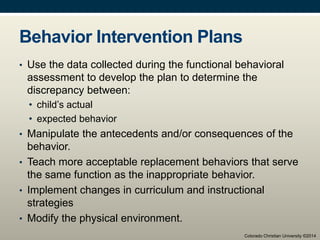
Behavior Intervention Plans
• Use the data collected during the functional behavioral
assessment to develop the plan to determine the
discrepancy between:
• child’s actual
• expected behavior
• Manipulate the antecedents and/or consequences of the
behavior.
• Teach more acceptable replacement behaviors that serve
the same function as the inappropriate behavior.
• Implement changes in curriculum and instructional
strategies
• Modify the physical environment.
Colorado Christian University ©2014
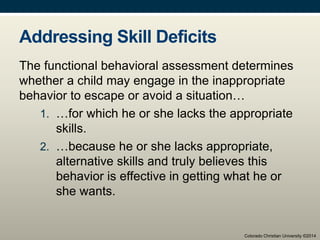
Addressing Skill Deficits
The functional behavioral assessment determines
whether a child may engage in the inappropriate
behavior to escape or avoid a situation…
1. …for which he or she lacks the appropriate
skills.
2. …because he or she lacks appropriate,
alternative skills and truly believes this
behavior is effective in getting what he or
she wants.
Colorado Christian University ©2014
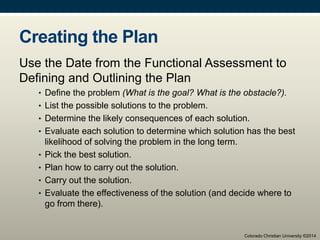
Creating the Plan
Use the Date from the Functional Assessment to
Defining and Outlining the Plan
• Define the problem (What is the goal? What is the obstacle?).
• List the possible solutions to the problem.
• Determine the likely consequences of each solution.
• Evaluate each solution to determine which solution has the best
likelihood of solving the problem in the long term.
• Pick the best solution.
• Plan how to carry out the solution.
• Carry out the solution.
• Evaluate the effectiveness of the solution (and decide where to
go from there).
Colorado Christian University ©2014
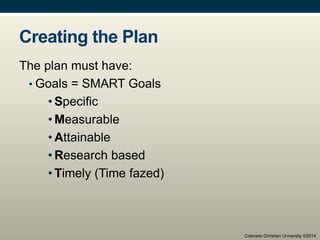
Creating the Plan
The plan must have:
• Goals = SMART Goals
• Specific
• Measurable
• Attainable
• Research based
• Timely (Time fazed)
Colorado Christian University ©2014
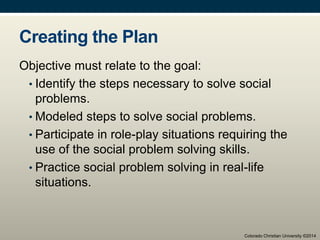
Creating the Plan
Objective must relate to the goal:
• Identify the steps necessary to solve social
problems.
• Modeled steps to solve social problems.
• Participate in role-play situations requiring the
use of the social problem solving skills.
• Practice social problem solving in real-life
situations.
Colorado Christian University ©2014
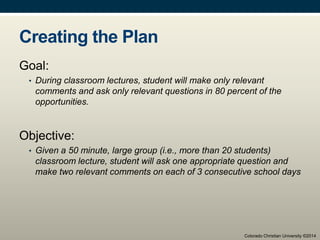
Creating the Plan
Goal:
• During classroom lectures, student will make only relevant
comments and ask only relevant questions in 80 percent of the
opportunities.
Objective:
• Given a 50 minute, large group (i.e., more than 20 students)
classroom lecture, student will ask one appropriate question and
make two relevant comments on each of 3 consecutive school days
Colorado Christian University ©2014
Creating the Plan
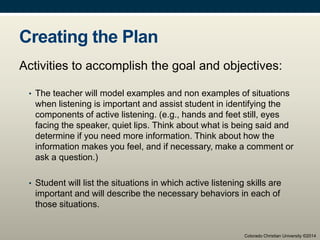
Activities to accomplish the goal and objectives:
• The teacher will model examples and non examples of situations
when listening is important and assist student in identifying the
components of active listening. (e.g., hands and feet still, eyes
facing the speaker, quiet lips. Think about what is being said and
determine if you need more information. Think about how the
information makes you feel, and if necessary, make a comment or
ask a question.)
• Student will list the situations in which active listening skills are
important and will describe the necessary behaviors in each of
those situations.
Colorado Christian University ©2014
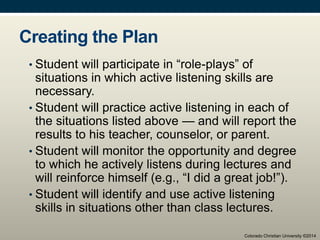
Creating the Plan
• Student will participate in “role-plays” of
situations in which active listening skills are
necessary.
• Student will practice active listening in each of
the situations listed above — and will report the
results to his teacher, counselor, or parent.
• Student will monitor the opportunity and degree
to which he actively listens during lectures and
will reinforce himself (e.g., “I did a great job!”).
• Student will identify and use active listening
skills in situations other than class lectures.
Colorado Christian University ©2014

S3.behavior interventionplans.2014

  • 1.
  • 2.
    Behavior Intervention Plans •Use the data collected during the functional behavioral assessment to develop the plan to determine the discrepancy between: • child’s actual • expected behavior • Manipulate the antecedents and/or consequences of the behavior. • Teach more acceptable replacement behaviors that serve the same function as the inappropriate behavior. • Implement changes in curriculum and instructional strategies • Modify the physical environment. Colorado Christian University ©2014
  • 3.
    Addressing Skill Deficits Thefunctional behavioral assessment determines whether a child may engage in the inappropriate behavior to escape or avoid a situation… 1. …for which he or she lacks the appropriate skills. 2. …because he or she lacks appropriate, alternative skills and truly believes this behavior is effective in getting what he or she wants. Colorado Christian University ©2014
  • 4.
    Creating the Plan Usethe Date from the Functional Assessment to Defining and Outlining the Plan • Define the problem (What is the goal? What is the obstacle?). • List the possible solutions to the problem. • Determine the likely consequences of each solution. • Evaluate each solution to determine which solution has the best likelihood of solving the problem in the long term. • Pick the best solution. • Plan how to carry out the solution. • Carry out the solution. • Evaluate the effectiveness of the solution (and decide where to go from there). Colorado Christian University ©2014
  • 5.
    Creating the Plan Theplan must have: • Goals = SMART Goals • Specific • Measurable • Attainable • Research based • Timely (Time fazed) Colorado Christian University ©2014
  • 6.
    Creating the Plan Objectivemust relate to the goal: • Identify the steps necessary to solve social problems. • Modeled steps to solve social problems. • Participate in role-play situations requiring the use of the social problem solving skills. • Practice social problem solving in real-life situations. Colorado Christian University ©2014
  • 7.
    Creating the Plan Goal: •During classroom lectures, student will make only relevant comments and ask only relevant questions in 80 percent of the opportunities. Objective: • Given a 50 minute, large group (i.e., more than 20 students) classroom lecture, student will ask one appropriate question and make two relevant comments on each of 3 consecutive school days Colorado Christian University ©2014
  • 8.
    Creating the Plan Activitiesto accomplish the goal and objectives: • The teacher will model examples and non examples of situations when listening is important and assist student in identifying the components of active listening. (e.g., hands and feet still, eyes facing the speaker, quiet lips. Think about what is being said and determine if you need more information. Think about how the information makes you feel, and if necessary, make a comment or ask a question.) • Student will list the situations in which active listening skills are important and will describe the necessary behaviors in each of those situations. Colorado Christian University ©2014
  • 9.
    Creating the Plan •Student will participate in “role-plays” of situations in which active listening skills are necessary. • Student will practice active listening in each of the situations listed above — and will report the results to his teacher, counselor, or parent. • Student will monitor the opportunity and degree to which he actively listens during lectures and will reinforce himself (e.g., “I did a great job!”). • Student will identify and use active listening skills in situations other than class lectures. Colorado Christian University ©2014