Dana Corriveau
Director of Student Services
North Haven Public Schools
It’s that time of year
To set some goals
And you’ve forgotten
how
Or don’t know where
to start
Let’s go
through
some
reminders
CSDE. A guidebook for student and educator support specialists. (2015)
SLO with 2 IAGDs (45%)
Observation Performance & Practice (40%)
CSDE. A guidebook for student and educator support specialists. (2015)
Parent or peer feedback
10%
Whole school indicator
5%
CSDE. A guidebook for student and educator support specialists. (2015)
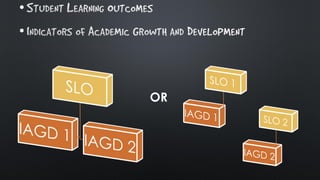
•
•
OR
SLO
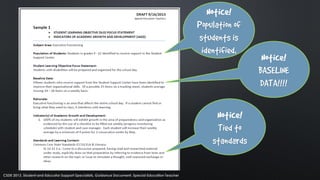
Students with disabilities will be
prepared and organized for
the school day.
IAGD 1
100% of my students will exhibit growth in the
area of preparedness and organization as
evidenced by the use of a checklist to be
filled out weekly (progress monitoring
schedule) with student and case manager.
Each student will increase their weekly
average by a minimum of 4 points for 3
consecutive weeks by May.
IAGD 2
100% of identified students will increase their
work completion as evidenced by a weekly
review of PowerSchool grades and student
filling out their tracking log. Identified students
will increase by 20% each marking period.
CSDE 2013. Student and Educator Support Specialists, Guidance Document. Special Education Teacher
SLO
Improve Social Competency of ASD
students through initiating peer
interaction(s).
IAGD 1
Three out of five students will successfully
initiate 3 peer interactions with 3 different
peers in 3 different situations/environments
on a daily basis as measured by frequency
data on daily point sheets and
documented in observations by school
psychologist by January 2017.
IAGD 2
Two out of five students will successfully initiate
2 peer interactions in two different
situations/environments on a daily basis as
measured by frequency data on daily point
sheets and documented in observations by
school psychologist by May 2017.
CSDE 2013. Student and Educator Support Specialists, Guidance Document. School Psychologist
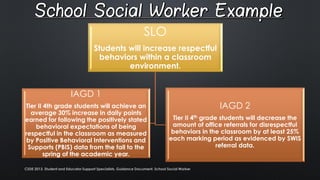
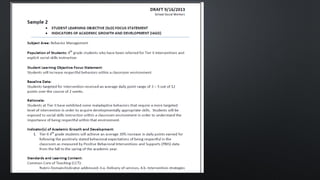
SLO
Students will increase respectful
behaviors within a classroom
environment.
IAGD 1
Tier II 4th grade students will achieve an
average 30% increase in daily points
earned for following the positively stated
behavioral expectations of being
respectful in the classroom as measured
by Positive Behavioral Interventions and
Supports (PBIS) data from the fall to the
spring of the academic year.
IAGD 2
Tier II 4th grade students will decrease the
amount of office referrals for disrespectful
behaviors in the classroom by at least 25%
each marking period as evidenced by SWIS
referral data.
CSDE 2013. Student and Educator Support Specialists, Guidance Document. School Social Worker
Goal setting October 31.
Baseline October 15.
No reason to delay. Six weeks into the school year.
Get moving!
Assess as you go – progress monitor!!
Do not wait until January midyears to check the
data…..
… And then decide you want to change your
IAGDs…
Without
a few
data
points
to
support
it
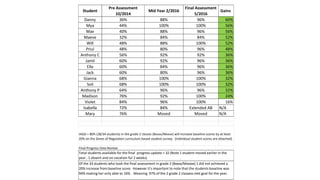
Student
Pre Assessment
10/2014
Mid Year 2/2016
Final Assessment
5/2016
Gains
Danny 36% 88% 96% 60%
Mya 44% 100% 100% 56%
Max 40% 88% 96% 56%
Maeve 32% 84% 84% 52%
Will 48% 88% 100% 52%
Priul 48% 80% 96% 48%
Anthony C 56% 92% 92% 36%
Jamil 60% 92% 96% 36%
Ella 60% 84% 96% 36%
Jack 60% 80% 96% 36%
Gianna 68% 100% 100% 32%
Soli 68% 100% 100% 32%
Anthony P 64% 96% 96% 32%
Madison 76% 92% 100% 24%
Violet 84% 96% 100% 16%
Isabella 72% 84% Extended AB N/A
Mary 76% Moved Moved N/A
IAGD = 80% (28/34 students) in the grade 2 classes (Bxxxx/Mxxxx) will increase baseline scores by at least
20% on the Zones of Regulation curriculum based student survey. (Individual student scores are attached)
Total students available for the final progress update = 32 (Note 1 student moved earlier in the
year , 1 absent and on vacation for 2 weeks)
Of the 33 students who took the final assessment in grade 2 (Bxxxx/Mxxxxx) 1 did not achieved a
20% increase from baseline score. However it's important to note that the students baseline was
94% making her only able to 16%. Meaning 97% of the 2 grade 2 classess met goal for the year.
Final Progress Data Review:
Student Grade Primary
Disability
Target Social Skill Current Data - Midyear
H 2 AUT Given a list of questions, H will independently approach a peer, ask a
question, and then share the same information about himself,
followed by independently completing a checklist in 80% of
measured opportunities.
Task completed nine days since the beginning of December;
asked relevant questions to peers 15 times and answered
his own question 12 times (80%).
A 3 ID Given a small group of peers, A will ask a peer a question that is
relevant to the conversation with no more than one prompt in three
out of five sessions.
Improved from 2/5 to 3/4 measured conversations.
N 3 ID N will maintain a given topic for three minutes given one prompt
when an off topic comment is made
Achieved with therapist for last 3/3 measured
conversations.
S 5 ID S will keep her “brain and body in the group” during semi-structured
social situations, such as CoF and lunch groups.
Achieved in CoF last 3/4 groups.
C 5 ID C will name 3 questions she could ask and 3 comments she could
make related to a given topic for 4 out of 5 conversation topics
presented.
Completed with minimal assistance last 2/2 topics
presented.
Goal: As a result of participating in weekly targeted intervention using an evidence-based social skills curriculum, identified students will
improve their ability to understand the rules for interacting with peers and improve their ability to build and sustain meaningful
relationships with their peers.
AIGD #1: Students will show a 20% improvement in their overall score on the Test of Adolescent Social Skills Knowledge (TASSK) from
baseline. The TASSK is a multiple choice test from the PEERS curriculum the students completed at the beginning of the year.
AIGD #2: Students will increase their standard score by at least one point on the CELF-5 Pragmatics Profile from baseline. The
Pragmatics Profile is a standardized behavior rating scale which will be completed by the students' parents.
Student Fall Close Rdg Dec Close Rdg RW – Oct RW – Nov RW - Jan
PB Below Basic Basic 40 60 20
LB Basic Proficient 50 50 40
CB Basic Basic 50 80 50
AC Basic Basic 40 50 70
VG Basic Proficient 60 70 70
SL Basic Goal 80 100 --
KL Basic Proficient 90 70 70
SM Basic Below Basic 40 50 40
MS Basic Proficient 60 80 70
IE Proficient Basic 60 80 60
EG Proficient Proficient 100 70 80
SR Proficient Basic 60 80 70
Beginning Results: Below Basic: 1, Basic: 8, Proficient: 3, Goal: 0
Midyear Results: Below Basic: 0, Basic: 5, Proficient: 5, Goal: 1
SLO: Identified students will demonstrate progress on close reading skills.
IAGD 1: Of the eight students who scored at basic, at least six of them will score at Proficient. Of the three
students who scored at Proficient, at least two of them will score at Goal.
IAGD 2: On the Read Works assessment, student will achieve at least a 20% improvement over the course of the
year.
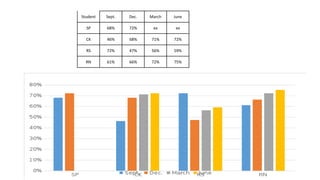
Work Behaviors Rating Form Data
Student Sept. Dec. March June
SP 68% 72% ex ex
CK 46% 68% 71% 72%
RS 72% 47% 56% 59%
RN 61% 66% 72% 75%
BTW:
You have to
collect data
frequently
enough to be
able to say
something
about it with
confidence.
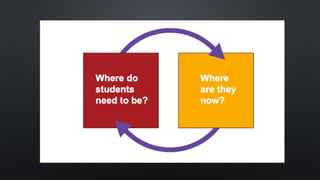
Where
Do
I
Start?
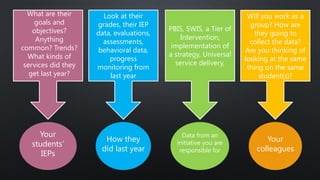
Your
students’
IEPs
How they
did last year
Data from an
initiative you are
responsible for
Your
colleagues
What are their
goals and
objectives?
Anything
common? Trends?
What kinds of
services did they
get last year?
Look at their
grades, their IEP
data, evaluations,
assessments,
behavioral data,
progress
monitoring from
last year
PBIS, SWIS, a Tier of
Intervention,
implementation of
a strategy, Universal
service delivery,
Will you work as a
group? How are
they going to
collect the data?
Are you thinking of
looking at the same
thing on the same
student(s)?
A focus on your
performance &
practice
TENURED TEACHERS
These indicators will be determined at
the beginning of the year.
proficient or better at the end of last
year
observers will focus on 3 indicators
when conducting formal and informal
observations.
You select an indicator from that domain.
This becomes your practice and
performance focus area.
You then select an
indicator from that
domain as a second
practice and
performance focus area.
SUPERINTENDENT’S DOMAIN
2: PLANNING FOR ACTIVE LEARNING
Teachers plan instruction in order to engage students in rigorous and
relevant learning and promote their curiosity about the world at large
by:
2a. Planning instructional content that is aligned with standards, builds
on students’ prior knowledge and provides for appropriate level of
challenge for all students;
2b. Planning instruction to cognitively engage students in the content;
2c. Selecting appropriate assessment strategies to monitor student
progress
DIRECTOR’S DOMAIN
2: PLANNING FOR ACTIVE LEARNING
Teachers plan instruction in order to engage students in rigorous and
relevant learning and promote their curiosity about the world at large
by:
2a. Planning instructional content that is aligned with standards, builds
on students’ prior knowledge and provides for appropriate level of
challenge for all students;
2b. Planning instruction to cognitively engage students in the content;
2c. Selecting appropriate assessment strategies to monitor student
progress
Is there an area that
you want to grow?
Is there an area that
you and your
evaluator discussed
at the end of last
year?
Is there an
something you feel
you’re weak at and
want to improve?
• September 6, 2016
– Goal Setting Conference on BloomBoard. 45 minutes.
• October 7, 2016
- last day to input SLO/IAGDs Parent/Peer Feedback
Goal, Performance and Practice Focus Area.
- By this date, all teachers must submit and share this
information via BloomBoard with their evaluator.
• October 11- 28, 2016 – Goals Setting Conferences
• October 31, 2016 – Everything approved and closed out
Resources
colleagues–knockonthedoor,maketime
administrator
coordinator
director
internet–youcanfindanythingoutthere!
• CSDESEEDWebsite:http://www.connecticutseed.org/

SLO & IAGDs

  • 1.
    Dana Corriveau Director ofStudent Services North Haven Public Schools
  • 2.
    It’s that timeof year To set some goals And you’ve forgotten how Or don’t know where to start
  • 5.
  • 7.
    CSDE. A guidebookfor student and educator support specialists. (2015)
  • 8.
    SLO with 2IAGDs (45%) Observation Performance & Practice (40%) CSDE. A guidebook for student and educator support specialists. (2015)
  • 9.
    Parent or peerfeedback 10% Whole school indicator 5% CSDE. A guidebook for student and educator support specialists. (2015)
  • 10.
  • 11.
    SLO Students with disabilitieswill be prepared and organized for the school day. IAGD 1 100% of my students will exhibit growth in the area of preparedness and organization as evidenced by the use of a checklist to be filled out weekly (progress monitoring schedule) with student and case manager. Each student will increase their weekly average by a minimum of 4 points for 3 consecutive weeks by May. IAGD 2 100% of identified students will increase their work completion as evidenced by a weekly review of PowerSchool grades and student filling out their tracking log. Identified students will increase by 20% each marking period. CSDE 2013. Student and Educator Support Specialists, Guidance Document. Special Education Teacher
  • 12.
    CSDE 2013. Studentand Educator Support Specialists, Guidance Document. Special Education Teacher
  • 13.
    SLO Improve Social Competencyof ASD students through initiating peer interaction(s). IAGD 1 Three out of five students will successfully initiate 3 peer interactions with 3 different peers in 3 different situations/environments on a daily basis as measured by frequency data on daily point sheets and documented in observations by school psychologist by January 2017. IAGD 2 Two out of five students will successfully initiate 2 peer interactions in two different situations/environments on a daily basis as measured by frequency data on daily point sheets and documented in observations by school psychologist by May 2017. CSDE 2013. Student and Educator Support Specialists, Guidance Document. School Psychologist
  • 15.
    SLO Students will increaserespectful behaviors within a classroom environment. IAGD 1 Tier II 4th grade students will achieve an average 30% increase in daily points earned for following the positively stated behavioral expectations of being respectful in the classroom as measured by Positive Behavioral Interventions and Supports (PBIS) data from the fall to the spring of the academic year. IAGD 2 Tier II 4th grade students will decrease the amount of office referrals for disrespectful behaviors in the classroom by at least 25% each marking period as evidenced by SWIS referral data. CSDE 2013. Student and Educator Support Specialists, Guidance Document. School Social Worker
  • 17.
    Goal setting October31. Baseline October 15. No reason to delay. Six weeks into the school year. Get moving!
  • 18.
    Assess as yougo – progress monitor!! Do not wait until January midyears to check the data….. … And then decide you want to change your IAGDs…
  • 19.
  • 22.
    Student Pre Assessment 10/2014 Mid Year2/2016 Final Assessment 5/2016 Gains Danny 36% 88% 96% 60% Mya 44% 100% 100% 56% Max 40% 88% 96% 56% Maeve 32% 84% 84% 52% Will 48% 88% 100% 52% Priul 48% 80% 96% 48% Anthony C 56% 92% 92% 36% Jamil 60% 92% 96% 36% Ella 60% 84% 96% 36% Jack 60% 80% 96% 36% Gianna 68% 100% 100% 32% Soli 68% 100% 100% 32% Anthony P 64% 96% 96% 32% Madison 76% 92% 100% 24% Violet 84% 96% 100% 16% Isabella 72% 84% Extended AB N/A Mary 76% Moved Moved N/A IAGD = 80% (28/34 students) in the grade 2 classes (Bxxxx/Mxxxx) will increase baseline scores by at least 20% on the Zones of Regulation curriculum based student survey. (Individual student scores are attached) Total students available for the final progress update = 32 (Note 1 student moved earlier in the year , 1 absent and on vacation for 2 weeks) Of the 33 students who took the final assessment in grade 2 (Bxxxx/Mxxxxx) 1 did not achieved a 20% increase from baseline score. However it's important to note that the students baseline was 94% making her only able to 16%. Meaning 97% of the 2 grade 2 classess met goal for the year. Final Progress Data Review:
  • 24.
    Student Grade Primary Disability TargetSocial Skill Current Data - Midyear H 2 AUT Given a list of questions, H will independently approach a peer, ask a question, and then share the same information about himself, followed by independently completing a checklist in 80% of measured opportunities. Task completed nine days since the beginning of December; asked relevant questions to peers 15 times and answered his own question 12 times (80%). A 3 ID Given a small group of peers, A will ask a peer a question that is relevant to the conversation with no more than one prompt in three out of five sessions. Improved from 2/5 to 3/4 measured conversations. N 3 ID N will maintain a given topic for three minutes given one prompt when an off topic comment is made Achieved with therapist for last 3/3 measured conversations. S 5 ID S will keep her “brain and body in the group” during semi-structured social situations, such as CoF and lunch groups. Achieved in CoF last 3/4 groups. C 5 ID C will name 3 questions she could ask and 3 comments she could make related to a given topic for 4 out of 5 conversation topics presented. Completed with minimal assistance last 2/2 topics presented. Goal: As a result of participating in weekly targeted intervention using an evidence-based social skills curriculum, identified students will improve their ability to understand the rules for interacting with peers and improve their ability to build and sustain meaningful relationships with their peers. AIGD #1: Students will show a 20% improvement in their overall score on the Test of Adolescent Social Skills Knowledge (TASSK) from baseline. The TASSK is a multiple choice test from the PEERS curriculum the students completed at the beginning of the year. AIGD #2: Students will increase their standard score by at least one point on the CELF-5 Pragmatics Profile from baseline. The Pragmatics Profile is a standardized behavior rating scale which will be completed by the students' parents.
  • 25.
    Student Fall CloseRdg Dec Close Rdg RW – Oct RW – Nov RW - Jan PB Below Basic Basic 40 60 20 LB Basic Proficient 50 50 40 CB Basic Basic 50 80 50 AC Basic Basic 40 50 70 VG Basic Proficient 60 70 70 SL Basic Goal 80 100 -- KL Basic Proficient 90 70 70 SM Basic Below Basic 40 50 40 MS Basic Proficient 60 80 70 IE Proficient Basic 60 80 60 EG Proficient Proficient 100 70 80 SR Proficient Basic 60 80 70 Beginning Results: Below Basic: 1, Basic: 8, Proficient: 3, Goal: 0 Midyear Results: Below Basic: 0, Basic: 5, Proficient: 5, Goal: 1 SLO: Identified students will demonstrate progress on close reading skills. IAGD 1: Of the eight students who scored at basic, at least six of them will score at Proficient. Of the three students who scored at Proficient, at least two of them will score at Goal. IAGD 2: On the Read Works assessment, student will achieve at least a 20% improvement over the course of the year.
  • 26.
    Work Behaviors RatingForm Data Student Sept. Dec. March June SP 68% 72% ex ex CK 46% 68% 71% 72% RS 72% 47% 56% 59% RN 61% 66% 72% 75%
  • 27.
    BTW: You have to collectdata frequently enough to be able to say something about it with confidence.
  • 28.
  • 29.
    Your students’ IEPs How they did lastyear Data from an initiative you are responsible for Your colleagues What are their goals and objectives? Anything common? Trends? What kinds of services did they get last year? Look at their grades, their IEP data, evaluations, assessments, behavioral data, progress monitoring from last year PBIS, SWIS, a Tier of Intervention, implementation of a strategy, Universal service delivery, Will you work as a group? How are they going to collect the data? Are you thinking of looking at the same thing on the same student(s)?
  • 32.
    A focus onyour performance & practice
  • 33.
    TENURED TEACHERS These indicatorswill be determined at the beginning of the year. proficient or better at the end of last year observers will focus on 3 indicators when conducting formal and informal observations.
  • 34.
    You select anindicator from that domain. This becomes your practice and performance focus area.
  • 35.
    You then selectan indicator from that domain as a second practice and performance focus area.
  • 37.
    SUPERINTENDENT’S DOMAIN 2: PLANNINGFOR ACTIVE LEARNING Teachers plan instruction in order to engage students in rigorous and relevant learning and promote their curiosity about the world at large by: 2a. Planning instructional content that is aligned with standards, builds on students’ prior knowledge and provides for appropriate level of challenge for all students; 2b. Planning instruction to cognitively engage students in the content; 2c. Selecting appropriate assessment strategies to monitor student progress
  • 38.
    DIRECTOR’S DOMAIN 2: PLANNINGFOR ACTIVE LEARNING Teachers plan instruction in order to engage students in rigorous and relevant learning and promote their curiosity about the world at large by: 2a. Planning instructional content that is aligned with standards, builds on students’ prior knowledge and provides for appropriate level of challenge for all students; 2b. Planning instruction to cognitively engage students in the content; 2c. Selecting appropriate assessment strategies to monitor student progress
  • 39.
    Is there anarea that you want to grow? Is there an area that you and your evaluator discussed at the end of last year? Is there an something you feel you’re weak at and want to improve?
  • 40.
    • September 6,2016 – Goal Setting Conference on BloomBoard. 45 minutes. • October 7, 2016 - last day to input SLO/IAGDs Parent/Peer Feedback Goal, Performance and Practice Focus Area. - By this date, all teachers must submit and share this information via BloomBoard with their evaluator. • October 11- 28, 2016 – Goals Setting Conferences • October 31, 2016 – Everything approved and closed out
  • 41.