Reflections from the Field I: Perspectives on Policy
PhD Eva Alfredsson
Growth Analysis, KTH (Royal Technology of Science), Global
challenge, Expert in Miljömålsberedningen
SWEDISH ENVIRONMENTAL POLICY
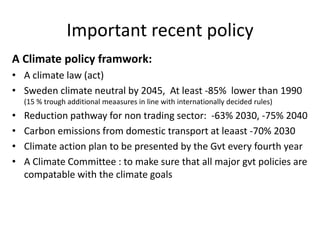
Important recent policy
A Climate policy framwork:
• A climate law (act)
• Sweden climate neutral by 2045, At least -85% lower than 1990
(15 % trough additional meaasures in line with internationally decided rules)
• Reduction pathway for non trading sector: -63% 2030, -75% 2040
• Carbon emissions from domestic transport at leaast -70% 2030
• Climate action plan to be presented by the Gvt every fourth year
• A Climate Committee : to make sure that all major gvt policies are
compatable with the climate goals
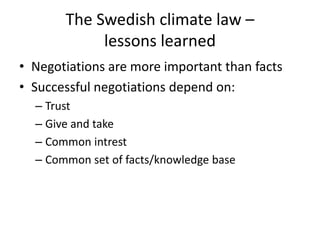
The Swedish climate law –
lessons learned
• Negotiations are more important than facts
• Successful negotiations depend on:
– Trust
– Give and take
– Common intrest
– Common set of facts/knowledge base
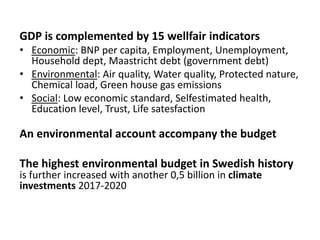
GDP is complemented by 15 wellfair indicators
• Economic: BNP per capita, Employment, Unemployment,
Household dept, Maastricht debt (government debt)
• Environmental: Air quality, Water quality, Protected nature,
Chemical load, Green house gas emissions
• Social: Low economic standard, Selfestimated health,
Education level, Trust, Life satesfaction
An environmental account accompany the budget
The highest environmental budget in Swedish history
is further increased with another 0,5 billion in climate
investments 2017-2020
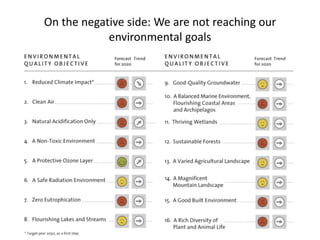
On the negative side: We are not reaching our
environmental goals
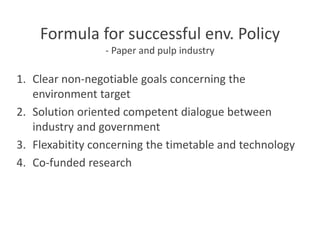
Formula for successful env. Policy
- Paper and pulp industry
1. Clear non-negotiable goals concerning the
environment target
2. Solution oriented competent dialogue between
industry and government
3. Flexabitity concerning the timetable and technology
4. Co-funded research
Reflections & Perspectives on
Policy
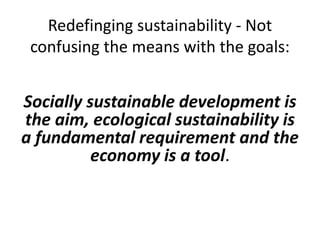
Redefinging sustainability - Not
confusing the means with the goals:
Socially sustainable development is
the aim, ecological sustainability is
a fundamental requirement and the
economy is a tool.
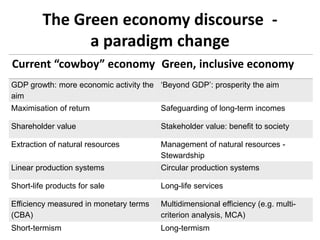
The Green economy discourse -
a paradigm change
Current “cowboy” economy Green, inclusive economy
GDP growth: more economic activity the
aim
‘Beyond GDP’: prosperity the aim
Maximisation of return Safeguarding of long-term incomes
Shareholder value Stakeholder value: benefit to society
Extraction of natural resources Management of natural resources -
Stewardship
Linear production systems Circular production systems
Short-life products for sale Long-life services
Efficiency measured in monetary terms
(CBA)
Multidimensional efficiency (e.g. multi-
criterion analysis, MCA)
Short-termism Long-termism
” Yesterdays successfactors are todays
challenges
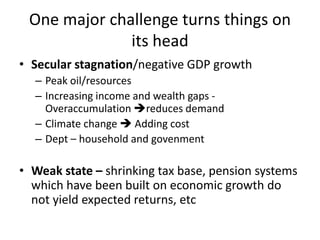
One major challenge turns things on
its head
• Secular stagnation/negative GDP growth
– Peak oil/resources
– Increasing income and wealth gaps -
Overaccumulation reduces demand
– Climate change  Adding cost
– Dept – household and govenment
• Weak state – shrinking tax base, pension systems
which have been built on economic growth do
not yield expected returns, etc
One major opportunity:
• Negative external effects no longer exist - the
economy has grown to fill the world which
means that there is no external – only internal
- effects
• Macro and micro rationality is thus to an
increasing extent overlapping
 Markets and cooperations need
environmental policy
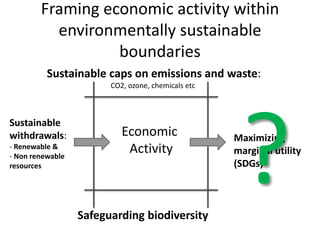
Framing economic activity within
environmentally sustainable
boundaries
Sustainable
withdrawals:
- Renewable &
- Non renewable
resources
Maximizing
marginal utility
(SDGs)
Economic
Activity
Sustainable caps on emissions and waste:
CO2, ozone, chemicals etc
Safeguarding biodiversity
Dr Eva Alfredsson
Growth Analysis
KTH
Global Challenge
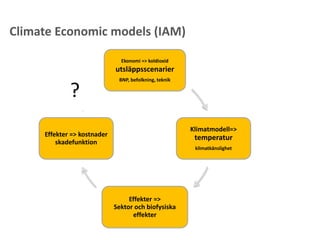
Ekonomi => koldioxid
utsläppsscenarier
BNP, befolkning, teknik
Klimatmodell=>
temperatur
klimatkänslighet
Effekter =>
Sektor och biofysiska
effekter
Effekter => kostnader
skadefunktion
Climate Economic models (IAM)
?
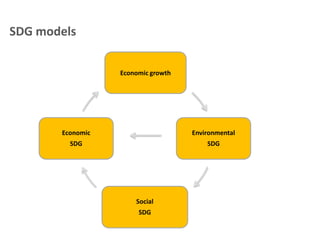
Economic growth
Environmental
SDG
Social
SDG
Economic
SDG
SDG models
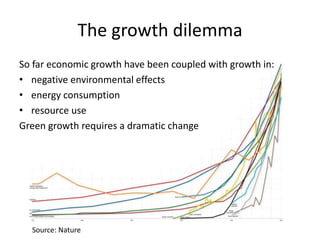
The growth dilemma
So far economic growth have been coupled with growth in:
• negative environmental effects
• energy consumption
• resource use
Green growth requires a dramatic change
Source: Nature
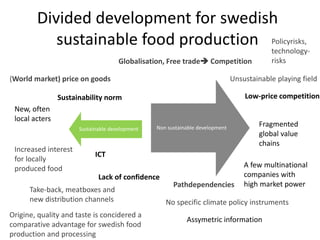
Divided development for swedish
sustainable food production
Sustainable development Non sustainable development
Low-price competition
Fragmented
global value
chains
A few multinational
companies with
high market power
Sustainability norm
New, often
local acters
ICT
Increased interest
for locally
produced food
Take-back, meatboxes and
new distribution channels
Origine, quality and taste is concidered a
comparative advantage for swedish food
production and processing
Globalisation, Free trade Competition
No specific climate policy instruments
(World market) price on goods Unsustainable playing field
Assymetric information
Policyrisks,
technology-
risks
Pathdependencies
Lack of confidence
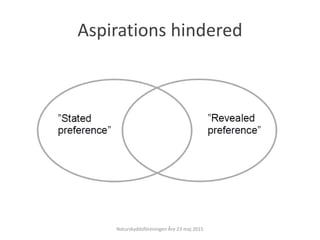
Aspirations hindered
Naturskyddsföreningen Åre 23 maj 2015
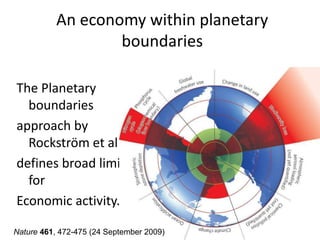
An economy within planetary
boundaries
The Planetary
boundaries
approach by
Rockström et al
defines broad limits
for
Economic activity.
Nature 461, 472-475 (24 September 2009)
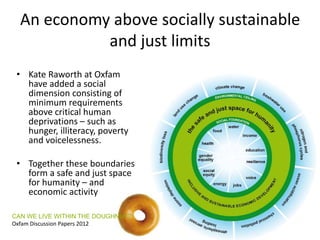
An economy above socially sustainable
and just limits
• Kate Raworth at Oxfam
have added a social
dimension consisting of
minimum requirements
above critical human
deprivations – such as
hunger, illiteracy, poverty
and voicelessness.
• Together these boundaries
form a safe and just space
for humanity – and
economic activity
CAN WE LIVE WITHIN THE DOUGHNUT?
Oxfam Discussion Papers 2012
How do we win the war - achieving a
green, inclusive economy in support of
sustainable development - and not just
the individual battles?

S3 eva alfredsson

  • 1.
    Reflections from theField I: Perspectives on Policy PhD Eva Alfredsson Growth Analysis, KTH (Royal Technology of Science), Global challenge, Expert in Miljömålsberedningen
  • 2.
  • 3.
    Important recent policy AClimate policy framwork: • A climate law (act) • Sweden climate neutral by 2045, At least -85% lower than 1990 (15 % trough additional meaasures in line with internationally decided rules) • Reduction pathway for non trading sector: -63% 2030, -75% 2040 • Carbon emissions from domestic transport at leaast -70% 2030 • Climate action plan to be presented by the Gvt every fourth year • A Climate Committee : to make sure that all major gvt policies are compatable with the climate goals
  • 4.
    The Swedish climatelaw – lessons learned • Negotiations are more important than facts • Successful negotiations depend on: – Trust – Give and take – Common intrest – Common set of facts/knowledge base
  • 5.
    GDP is complementedby 15 wellfair indicators • Economic: BNP per capita, Employment, Unemployment, Household dept, Maastricht debt (government debt) • Environmental: Air quality, Water quality, Protected nature, Chemical load, Green house gas emissions • Social: Low economic standard, Selfestimated health, Education level, Trust, Life satesfaction An environmental account accompany the budget The highest environmental budget in Swedish history is further increased with another 0,5 billion in climate investments 2017-2020
  • 6.
    On the negativeside: We are not reaching our environmental goals
  • 7.
    Formula for successfulenv. Policy - Paper and pulp industry 1. Clear non-negotiable goals concerning the environment target 2. Solution oriented competent dialogue between industry and government 3. Flexabitity concerning the timetable and technology 4. Co-funded research
  • 8.
  • 9.
    Redefinging sustainability -Not confusing the means with the goals: Socially sustainable development is the aim, ecological sustainability is a fundamental requirement and the economy is a tool.
  • 10.
    The Green economydiscourse - a paradigm change Current “cowboy” economy Green, inclusive economy GDP growth: more economic activity the aim ‘Beyond GDP’: prosperity the aim Maximisation of return Safeguarding of long-term incomes Shareholder value Stakeholder value: benefit to society Extraction of natural resources Management of natural resources - Stewardship Linear production systems Circular production systems Short-life products for sale Long-life services Efficiency measured in monetary terms (CBA) Multidimensional efficiency (e.g. multi- criterion analysis, MCA) Short-termism Long-termism
  • 11.
    ” Yesterdays successfactorsare todays challenges
  • 12.
    One major challengeturns things on its head • Secular stagnation/negative GDP growth – Peak oil/resources – Increasing income and wealth gaps - Overaccumulation reduces demand – Climate change  Adding cost – Dept – household and govenment • Weak state – shrinking tax base, pension systems which have been built on economic growth do not yield expected returns, etc
  • 13.
    One major opportunity: •Negative external effects no longer exist - the economy has grown to fill the world which means that there is no external – only internal - effects • Macro and micro rationality is thus to an increasing extent overlapping  Markets and cooperations need environmental policy
  • 14.
    Framing economic activitywithin environmentally sustainable boundaries Sustainable withdrawals: - Renewable & - Non renewable resources Maximizing marginal utility (SDGs) Economic Activity Sustainable caps on emissions and waste: CO2, ozone, chemicals etc Safeguarding biodiversity
  • 15.
    Dr Eva Alfredsson GrowthAnalysis KTH Global Challenge
  • 16.
    Ekonomi => koldioxid utsläppsscenarier BNP,befolkning, teknik Klimatmodell=> temperatur klimatkänslighet Effekter => Sektor och biofysiska effekter Effekter => kostnader skadefunktion Climate Economic models (IAM) ?
  • 17.
  • 18.
    The growth dilemma Sofar economic growth have been coupled with growth in: • negative environmental effects • energy consumption • resource use Green growth requires a dramatic change Source: Nature
  • 19.
    Divided development forswedish sustainable food production Sustainable development Non sustainable development Low-price competition Fragmented global value chains A few multinational companies with high market power Sustainability norm New, often local acters ICT Increased interest for locally produced food Take-back, meatboxes and new distribution channels Origine, quality and taste is concidered a comparative advantage for swedish food production and processing Globalisation, Free trade Competition No specific climate policy instruments (World market) price on goods Unsustainable playing field Assymetric information Policyrisks, technology- risks Pathdependencies Lack of confidence
  • 20.
  • 21.
    An economy withinplanetary boundaries The Planetary boundaries approach by Rockström et al defines broad limits for Economic activity. Nature 461, 472-475 (24 September 2009)
  • 22.
    An economy abovesocially sustainable and just limits • Kate Raworth at Oxfam have added a social dimension consisting of minimum requirements above critical human deprivations – such as hunger, illiteracy, poverty and voicelessness. • Together these boundaries form a safe and just space for humanity – and economic activity CAN WE LIVE WITHIN THE DOUGHNUT? Oxfam Discussion Papers 2012
  • 23.
    How do wewin the war - achieving a green, inclusive economy in support of sustainable development - and not just the individual battles?

Editor's Notes

  • #2 BUDSKAP Innovate, re-think, re-learn old stylized facts Reseach: test the hypothesis of macro/micro Testa the big picture hypothesis Which conditions are neeeded in order for Macro Some basic facts on Swedish environmental policy: Lessons learned – in Sweden Environmental policy central position in government Env success stories – Paper and pulp industry, district heating , green certificates - not primarely the CO2-tax. Policy lesson: Clear non negotiable environmental goals, competent dialog between state and companies, joint research projects, flexible implementation. Equality as a political goal Reflections/my thesis/my posits: Rethink! Re-learn! Re-visit stylized facts! => At this point in time ”everything” changes!
  • #4 Historically Early awakening Early initiatives - Stockholm conference on sustainable development 1972 Environmental minister – central role in government All political parties have historically stood up behind the Swedish environmental policy The goal have been to be a pioneer in environmental regulations and policy – to provide a role model One of the first countries to implement a carbon tax Successful policy in the 70s turned paper and pulp industry green ”The nordic way” - Equality as a political goal - Individuality and strong state – trust in institutions, high level of general trust
  • #7 Black liquor
  • #8 Black liquor
  • #10 The nordic way, the nordic take on capitalism has to some extent been successfull but it is far from enough. (The Green Economy) One central conclusion is that adopting the aims of the green economy would entail a shift of perspective in political discourse, from seeing sustainable development as an endeavour to achieve a harmonious balance between economic, social and ecological development — as expressed by the Brundtland Report — to a perspective in which socially sustainable development is the aim, ecological sustainability is a fundamental requirement and the economy a tool.   The social dimension is critical. Development that is socially sustainable is not just an overarching aim. It also appears essential for success in implementing the major changes in economic frameworks and society at large that are needed to attain sustainable development in all its dimensions.
  • #11 What characterises a green, inclusive economy and how does it differ from the prevailing one? In this table we have summarised, in heading form, some differences between our current economy and a green economy as described by UNEP and the OECD, in particular. The green economy characteristic is a wish-list and it is obvious how much it differs from the current economy. The Green economy is truly a change in political discourse. A paradigm change Achieving the goals of the green economy require that the economic frameworks and incentive structure must be radically reformed
  • #13 In order for us to be successful in introducing sustainable policy we need to take into account what most people and politicians will be faciong – One of the main challenges her are secular stagnation – long term, global low economic growth and its consequences.
  • #15 To achieve a sustainable green economy I think we simply must enforce sustainability criteria's - Framing economic activity within sustainable boundaries WE need policy to enforce strict budget rules – making sure the withdrawals are sustainable WE need policy to cap waste WE need policy to ensure safe margins – safeguarding biodiversity And within those boundaries we need to figure out how to maximize output in terms of marginal utility (Renewables resources: forest, agriculture, water, etc Non renewables resources: Globally managed withdrawal taking future generations into account)
  • #17 Modellresultaten är helt beroende av de antaganden som görs: BAU – pop, CO2-intensitet/teknik, BNP Klimatkänslighet - Marknadens flexibilitet Energisektorn Diskonteringsräntan
  • #18 Modellresultaten är helt beroende av de antaganden som görs: BAU – pop, CO2-intensitet/teknik, BNP Klimatkänslighet - Marknadens flexibilitet Energisektorn Diskonteringsräntan
  • #22 We urgently need to position the economy within planetary boundaries The work by Rockström et al, published in Nature 2009 defined some boundaries of crucial importance for humanity. I realize you can not read this picture very well but each section identifies an important criteria for human life/welfare The Nine boundaries identified were: - climate change - stratospheric ozone - land use change - freshwater use - biological diversity - ocean acidification - nitrogen and phosphorus inputs to the biosphere and oceans - aerosol loading - chemical pollution. Three have already been overstepped Climate change Rate of biodiversity loss Nitrogen cycle
  • #23 WE also have to position the economy within socially just limits. Kate Raworth at Oxfam have added a social dimension to the planetary boundaries consisting of minimum requirements above critical human deprivations – such as hunger, illiteracy, poverty and voicelessness Kate asks us if we can live within the doughnut?  In order to do that we need to translate the planetary boundary and social boundary perspectives into policy
  • #24 James Gustav Speth