The OECD Green Growth Strategy
and its measurement framework
Workshop on green growth measurement in Armenia
11 May 2016, Yerevan
Krzysztof Michalak and Mikaela Rambali
Green Growth and Global Relations Division
OECD Environment Directorate
The green growth strategy
2
Green Growth indicators
• Risks to development are rising as growth continues to erode
natural capital.
– If left unchecked, this would mean increased water scarcity, resource
bottlenecks, greater pollution, climate change, and unrecoverable
biodiversity loss.
• It is becoming increasingly costly to substitute natural capital by
physical capital.
• Change does not necessarily follow a smooth, foreseeable
trajectory.
New ways of producing and consuming things, and even
redefine what we mean by progress and how we measure it
Need for Green Growth
Green Growth indicators
What do we mean by “green growth”?
Fostering economic growth and development
while ensuring that the natural assets continue to provide
the resources and environmental services
on which our well-being relies.
• Securing future wellbeing
• Delivering growth that is within environmental limits
• Implementing smart policies to stimulate innovation and avoid
lock-in to costly systems
• Getting the prices and governance frameworks right
Green Growth indicators
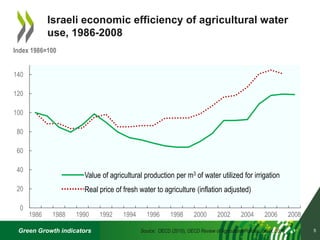
Israeli economic efficiency of agricultural water
use, 1986-2008
Source: OECD (2010), OECD Review of Agricultural Policies: Israel, 2010 . 5
0
20
40
60
80
100
120
140
1986 1988 1990 1992 1994 1996 1998 2000 2002 2004 2006 2008
Index 1986=100
Value of agricultural production per m3 of water utilized for irrigation
Real price of fresh water to agriculture (inflation adjusted)
Green Growth indicators
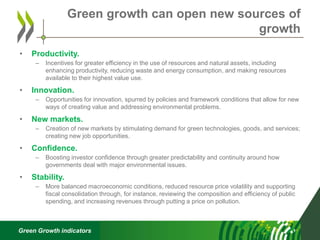
• Productivity.
– Incentives for greater efficiency in the use of resources and natural assets, including
enhancing productivity, reducing waste and energy consumption, and making resources
available to their highest value use.
• Innovation.
– Opportunities for innovation, spurred by policies and framework conditions that allow for new
ways of creating value and addressing environmental problems.
• New markets.
– Creation of new markets by stimulating demand for green technologies, goods, and services;
creating new job opportunities.
• Confidence.
– Boosting investor confidence through greater predictability and continuity around how
governments deal with major environmental issues.
• Stability.
– More balanced macroeconomic conditions, reduced resource price volatility and supporting
fiscal consolidation through, for instance, reviewing the composition and efficiency of public
spending, and increasing revenues through putting a price on pollution.
Green growth can open new sources of
growth
Green Growth indicators
• From bottlenecks that arise when resource scarcity or reduced
quality makes investment more costly, such as the need for capital
intensive infrastructure when water supplies become scarce or
water quality decreases
– the loss of natural capital can exceed the gains generated by economic activity,
undermining the ability to sustain future growth.
• From imbalances in natural systems that raise the risk of abrupt,
highly damaging – and potentially irreversible – effects
– attempts to identify potential thresholds suggest that some – climate change,
global nitrogen cycles and biodiversity loss – have already been exceeded.
Green growth can also reduce the risk to
growth
Green Growth indicators
• Reframing growth and analytical frameworks
– Account for the contribution that natural assets and ecosystem services
make to growth: in measurement, in analysis, in decision making.
• An operational and coherent policy framework to help achieve
concrete results, esp.:
– Remove environmentally harmful subsidies
– Make pollution more costly
– Value and price the natural assets and ecosystem services: stimulate
innovation
– Sound financial and governance framework
• Reliable measurement tools and indicators
– Inform policy development and
– Measure progress and policy outcomes
What is required to move towards “green
growth”?
Green Growth indicators
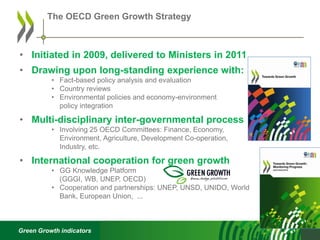
• Initiated in 2009, delivered to Ministers in 2011
• Drawing upon long-standing experience with:
• Fact-based policy analysis and evaluation
• Country reviews
• Environmental policies and economy-environment
policy integration
• Multi-disciplinary inter-governmental process
• Involving 25 OECD Committees: Finance, Economy,
Environment, Agriculture, Development Co-operation,
Industry, etc.
• International cooperation for green growth
• GG Knowledge Platform
(GGGI, WB, UNEP, OECD)
• Cooperation and partnerships: UNEP, UNSD, UNIDO, World
Bank, European Union, ...
The OECD Green Growth Strategy
Green Growth indicators
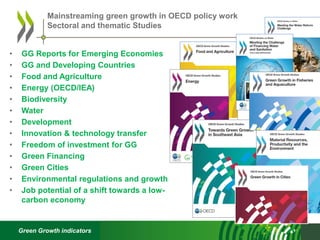
• GG Reports for Emerging Economies
• GG and Developing Countries
• Food and Agriculture
• Energy (OECD/IEA)
• Biodiversity
• Water
• Development
• Innovation & technology transfer
• Freedom of investment for GG
• Green Financing
• Green Cities
• Environmental regulations and growth
• Job potential of a shift towards a low-
carbon economy
Mainstreaming green growth in OECD policy work
Sectoral and thematic Studies
Green Growth indicators
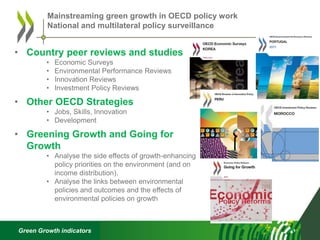
• Country peer reviews and studies
• Economic Surveys
• Environmental Performance Reviews
• Innovation Reviews
• Investment Policy Reviews
• Other OECD Strategies
• Jobs, Skills, Innovation
• Development
• Greening Growth and Going for
Growth
• Analyse the side effects of growth-enhancing
policy priorities on the environment (and on
income distribution).
• Analyse the links between environmental
policies and outcomes and the effects of
environmental policies on growth
Mainstreaming green growth in OECD policy work
National and multilateral policy surveillance
Monitoring progress:
Measurement framework
and indicators
12
Green Growth indicators
• At the core of the OECD GG Strategy
• Drawing upon experience with indicators, statistics,
accounts
• Concrete outputs
– Conceptual measurement framework
– Set of indicators
– Database
• Used in OECD work: policy analysis
and country reviews
• Applications in countries
Monitoring progress towards Green Growth
Green Growth indicators
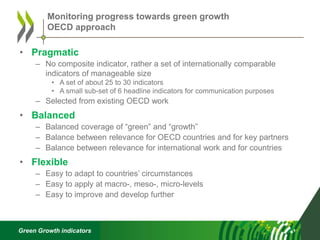
• Pragmatic
– No composite indicator, rather a set of internationally comparable
indicators of manageable size
• A set of about 25 to 30 indicators
• A small sub-set of 6 headline indicators for communication purposes
– Selected from existing OECD work
• Balanced
– Balanced coverage of “green” and “growth”
– Balance between relevance for OECD countries and for key partners
– Balance between relevance for international work and for countries
• Flexible
– Easy to adapt to countries’ circumstances
– Easy to apply at macro-, meso-, micro-levels
– Easy to improve and develop further
Monitoring progress towards green growth
OECD approach
Green Growth indicators
Monitoring progress towards green growth
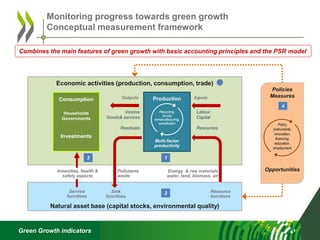
Conceptual measurement framework
Economic activities (production, consumption, trade)
Consumption
Households
Governments
Investments
Outputs Inputs
Energy & raw materials
water, land, biomass, air
Pollutants
waste
Income
Goods& services
Residuals
Labour
Capital
Resources
13
Production
Multi-factor
productivity
Recycling,
re-use
remanufacturing,
substitution
Natural asset base (capital stocks, environmental quality)
2 Resource
functions
Sink
functions
Service
functions
Policies
Measures
Opportunities
4
Policy
instruments,
innovation,
financing,
education,
employment
Amenities, health &
safety aspects
Combines the main features of green growth with basic accounting principles and the PSR model
Green Growth indicators
Monitoring progress towards green growth
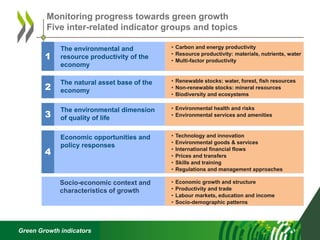
Five inter-related indicator groups and topics
• What are the growth characteristics of the
economy? its social context?
• Is the natural asset base preserved?
• Are there risks of future shocks to growth?
• Is the economy becoming greener? More
resource efficient?
• How does this contribute to growth and to
the productivity of the economy?
• Do people benefit from greener growth?
• Are we taking the right measures to
catalyse investments and innovation for
greening the economy?
• Is greening the economy opening up new
sources of growth?
The environmental and
resource productivity of the
economy
1
• Carbon and energy productivity
• Resource productivity: materials, nutrients, water
• Multi-factor productivity
The natural asset base of the
economy2
• Renewable stocks: water, forest, fish resources
• Non-renewable stocks: mineral resources
• Biodiversity and ecosystems
The environmental dimension
of quality of life3
• Environmental health and risks
• Environmental services and amenities
Economic opportunities and
policy responses
4
• Technology and innovation
• Environmental goods & services
• International financial flows
• Prices and transfers
• Skills and training
• Regulations and management approaches
Socio-economic context and
characteristics of growth
• Economic growth and structure
• Productivity and trade
• Labour markets, education and income
• Socio-demographic patterns
Green Growth indicators
Monitoring progress towards green growth
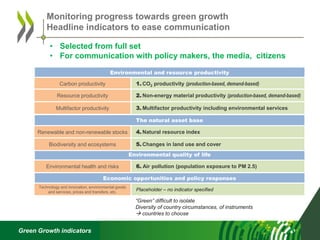
Headline indicators to ease communication
Environmental and resource productivity
1. CO2 productivity (production-based, demand-based)
3. Multifactor productivity including environmental services
2. Non-energy material productivity (production-based, demand-based)
Carbon productivity
Resource productivity
Multifactor productivity
6. Air pollution (population exposure to PM 2.5)
Environmental quality of life
Environmental health and risks
Economic opportunities and policy responses
Placeholder – no indicator specified
Technology and innovation, environmental goods
and services, prices and transfers, etc.
The natural asset base
4. Natural resource index
5. Changes in land use and cover
Renewable and non-renewable stocks
Biodiversity and ecosystems
“Green” difficult to isolate
Diversity of country circumstances, of instruments
 countries to choose
• Selected from full set
• For communication with policy makers, the media, citizens
Green Growth indicators 18
Monitoring progress towards green growth
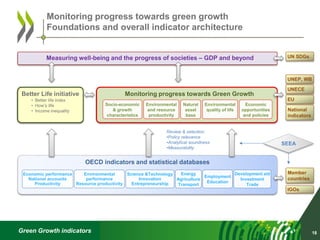
Foundations and overall indicator architecture
Monitoring progress towards Green Growth
Socio-economic
& growth
characteristics
Environmental
and resource
productivity
Natural
asset
base
Environmental
quality of life
Economic
opportunities
and policies
OECD indicators and statistical databases
Economic performance
National accounts
Productivity
Environmental
performance
Resource productivity
Science &Technology
Innovation
Entrepreneurship
Development aid
Investment
Trade
Employment
Education
Energy
Agriculture
Transport
UNEP, WB
SEEA
Review & selection:
•Policy relevance
•Analytical soundness
•Measurability
EU
Measuring well-being and the progress of societies – GDP and beyond
Member
countries
IGOs
National
indicators
UN SDGs
Better Life initiative
• Better life index
• How’s life
• Income inequality
UNECE
Green Growth indicators 19
Monitoring progress towards green growth
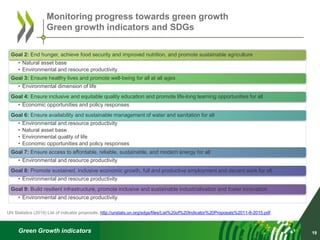
Green growth indicators and SDGs
UN Statistics (2015) List of indicator proposals, http://unstats.un.org/sdgs/files/List%20of%20Indicator%20Proposals%2011-8-2015.pdf;
Goal 2: End hunger, achieve food security and improved nutrition, and promote sustainable agriculture
• Natural asset base
• Environmental and resource productivity
Goal 3: Ensure healthy lives and promote well-being for all at all ages
• Environmental dimension of life
Goal 4: Ensure inclusive and equitable quality education and promote life-long learning opportunities for all
• Economic opportunities and policy responses
Goal 6: Ensure availability and sustainable management of water and sanitation for all
• Environmental and resource productivity
• Natural asset base
• Environmental quality of life
• Economic opportunities and policy responses
Goal 7: Ensure access to affordable, reliable, sustainable, and modern energy for all
• Environmental and resource productivity
Goal 8: Promote sustained, inclusive economic growth, full and productive employment and decent work for all
• Environmental and resource productivity
Goal 9: Build resilient infrastructure, promote inclusive and sustainable industrialisation and foster innovation
• Environmental and resource productivity
Green Growth indicators 20
Monitoring progress towards green growth
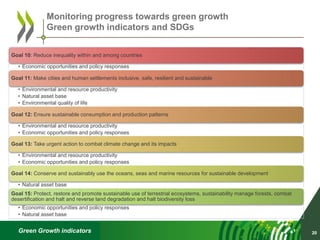
Green growth indicators and SDGs
Goal 10: Reduce inequality within and among countries
• Economic opportunities and policy responses
Goal 11: Make cities and human settlements inclusive, safe, resilient and sustainable
• Environmental and resource productivity
• Natural asset base
• Environmental quality of life
Goal 12: Ensure sustainable consumption and production patterns
• Environmental and resource productivity
• Economic opportunities and policy responses
Goal 13: Take urgent action to combat climate change and its impacts
• Environmental and resource productivity
• Economic opportunities and policy responses
Goal 14: Conserve and sustainably use the oceans, seas and marine resources for sustainable development
• Natural asset base
Goal 15: Protect, restore and promote sustainable use of terrestrial ecosystems, sustainability manage forests, combat
desertification and halt and reverse land degradation and halt biodiversity loss
• Economic opportunities and policy responses
• Natural asset base
Green growth in practice
21
Green Growth indicators
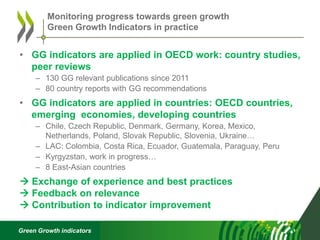
• GG indicators are applied in OECD work: country studies,
peer reviews
– 130 GG relevant publications since 2011
– 80 country reports with GG recommendations
• GG indicators are applied in countries: OECD countries,
emerging economies, developing countries
– Chile, Czech Republic, Denmark, Germany, Korea, Mexico,
Netherlands, Poland, Slovak Republic, Slovenia, Ukraine…
– LAC: Colombia, Costa Rica, Ecuador, Guatemala, Paraguay, Peru
– Kyrgyzstan, work in progress…
– 8 East-Asian countries
 Exchange of experience and best practices
 Feedback on relevance
 Contribution to indicator improvement
Monitoring progress towards green growth
Green Growth Indicators in practice
Green Growth indicators
Green Growth Indicators in practice
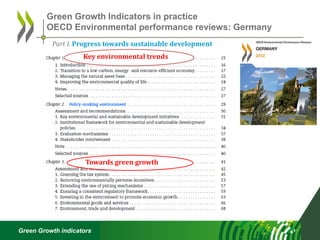
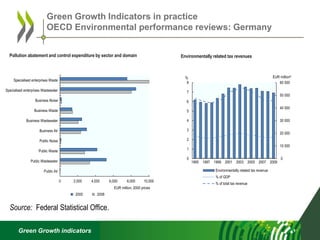
OECD Environmental performance reviews: Germany
Part I. Progress towards sustainable development
Towards green growth
Key environmental trends
Green Growth indicators
Green Growth Indicators in practice
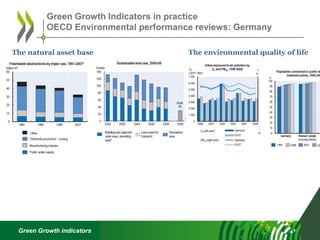
OECD Environmental performance reviews: Germany
The natural asset base The environmental quality of life
Green Growth indicators
Green Growth Indicators in practice
OECD Environmental performance reviews: Germany
0
10 000
20 000
30 000
40 000
50 000
60 000
0
1
2
3
4
5
6
7
8
1995 1997 1999 2001 2003 2005 2007 2009
%
Environmentally related tax revenue
% of GDP
% of total tax revenue
EUR millionb
0 2,000 4,000 6,000 8,000 10,000
Public Air
Public Wastewater
Public Waste
Public Noise
Business Air
Business Wastewater
Business Waste
Business Noise
Specialised enterprises Wastewater
Specialised enterprises Waste
EUR million, 2000 prices
2000 2008
Pollution abatement and control expenditure by sector and domain
Source: Federal Statistical Office.
Environmentally related tax revenues
Green Growth indicators 26
Green Growth Indicators in practice
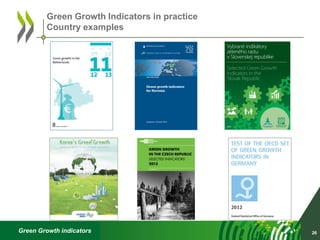
Country examples
Green Growth indicators
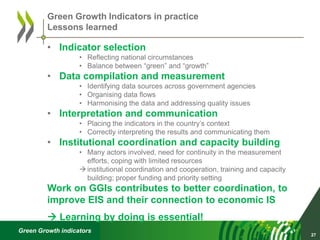
• Indicator selection
• Reflecting national circumstances
• Balance between “green” and “growth”
• Data compilation and measurement
• Identifying data sources across government agencies
• Organising data flows
• Harmonising the data and addressing quality issues
• Interpretation and communication
• Placing the indicators in the country’s context
• Correctly interpreting the results and communicating them
• Institutional coordination and capacity building
• Many actors involved, need for continuity in the measurement
efforts, coping with limited resources
 institutional coordination and cooperation, training and capacity
building; proper funding and priority setting
Work on GGIs contributes to better coordination, to
improve EIS and their connection to economic IS
 Learning by doing is essential!
27
Green Growth Indicators in practice
Lessons learned
Measurement agenda
28
Green Growth indicators
 Fill data gaps
• Consistent environmental-economic data at industry level
 structural changes; industry profiles
• Natural assets and material flows
• Biodiversity and ecosystem services
• Quality of life dimensions [“well-being”]
 Capture better
• The growth contribution of natural assets
• The “greening” of economic sectors beyond “eco-industries”
• Economic opportunities and the effectiveness of policies
 Role of System of Environmental-Economic Accounts (SEEA)
• Key for consistent information on environment-economy interface
• Key for enabling a breakdown by industry
• Key for better capturing the growth contribution of natural assets
29
Monitoring progress towards green growth
Advancing the measurement agenda
Green Growth indicators
• The list of indicators in the OECD set is not final
– About 20 indicators are measurable at varying degrees of quality and regularly published
(2011, 2014, 2017)
– Some indicators are not yet fully measurable, but kept to drive measurement agenda
– List of indicators will need to evolve accordingly if better data is available.
• Further develop the indicators (methodologies, underlying
data, interpretation)
GG headline indicators
• Raw material productivity (demand-based; footprint approach)
• Environmentally adjusted multi-factor productivity growth
• Natural resource index (current focus on sub-soil assets)
• Land cover and land use (building on geospatial data)
• Population exposure to air pollution (building on geospatial data)
Other indicators
• Nitrogen flows (nutrient balances),
• Policy response indicators: Innovation (patents); Tax systems (taxes, subsidies, …);
Environmental policy stringency
Monitoring progress towards green growth
Ongoing work (1)
Green Growth indicators
• Increase the availability of environmental data by industry
– Air and GHG emissions
– Waste generation, waste water generation, water use
– Expenditure, taxes
• Expand country coverage in database
• OECD, BRIICS, G20
• Strengthen the use of indicators in OECD work
– Country environmental performance reviews
– Economic surveys
– Gain additional feedback on relevance and interpretation (particularly for
new indicators)
• Work with countries to apply GGIs
– Joint OECD-DRC project “Green growth in the context of industrial
upgrading in China”
– EECCA countries
Monitoring progress towards green growth
Ongoing work (3)
Green Growth indicators
Green growth indicators
For more information, see
www.oecd.org/greengrowth and
www.oecd.org/greengrowth/indicators
Thank you!
Work in progress
33
Green Growth indicators
• Traditional measure of productivity growth
• A measure of economic performance that accounts for multiple factor inputs
• Links with material living standards
• Provides insights about long term growth prospects
– BUT:
• can be overestimated in countries where output growth relies on depletion of
natural capital, and on heavily polluting technologies
• can be underestimated in countries that invest in more efficient use of (domestic)
natural resources and invest in pollution abatement and control
• Adjusted measure of productivity growth
• Provides a more accurate measure of economic performance for multiple factor
inputs including the consumption of natural resources and the generation of
undesirable outputs (pollution, waste, …)
• Links “green” and “growth”:
• Provides insights about ways to achieve more sustainable long-term growth
• Fosters the integration of environmental concerns in economic policies
• Starting point for analysing drivers of green growth
34
Monitoring progress towards green growth
Environmentally adjusted multifactor productivity growth
Green Growth indicators
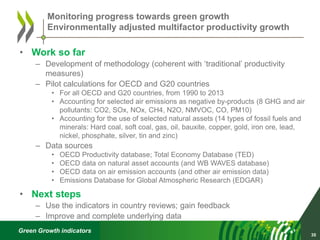
• Work so far
– Development of methodology (coherent with ‘traditional’ productivity
measures)
– Pilot calculations for OECD and G20 countries
• For all OECD and G20 countries, from 1990 to 2013
• Accounting for selected air emissions as negative by-products (8 GHG and air
pollutants: CO2, SOx, NOx, CH4, N2O, NMVOC, CO, PM10)
• Accounting for the use of selected natural assets (14 types of fossil fuels and
minerals: Hard coal, soft coal, gas, oil, bauxite, copper, gold, iron ore, lead,
nickel, phosphate, silver, tin and zinc)
– Data sources
• OECD Productivity database; Total Economy Database (TED)
• OECD data on natural asset accounts (and WB WAVES database)
• OECD data on air emission accounts (and other air emission data)
• Emissions Database for Global Atmospheric Research (EDGAR)
• Next steps
– Use the indicators in country reviews; gain feedback
– Improve and complete underlying data
35
Monitoring progress towards green growth
Environmentally adjusted multifactor productivity growth
Green Growth indicators
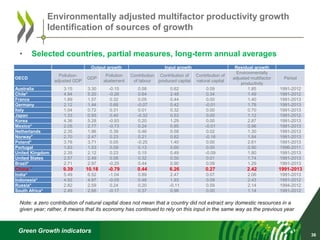
• Selected countries, partial measures, long-term annual averages
Note: a zero contribution of natural capital does not mean that a country did not extract any domestic resources in a
given year; rather, it means that its economy has continued to rely on this input in the same way as the previous year
36
Environmentally adjusted multifactor productivity growth
Identification of sources of growth
Output growth Input growth Residual growth
OECD
Pollution-
adjusted GDP
GDP
Pollution
abatement
Contribution
of labour
Contribution of
produced capital
Contribution of
natural capital
Environmentally
adjusted multifactor
productivity
Period
Australia 3.15 3.30 -0.15 0.58 0.62 0.09 1.85 1991-2012
Chile* 4.94 5.20 -0.26 0.64 2.48 0.34 1.49 1991-2012
France 1.89 1.57 0.32 0.05 0.44 0.00 1.40 1991-2013
Germany 2.12 1.44 0.68 -0.07 0.42 -0.01 1.78 1991-2013
Italy 1.04 0.72 0.31 0.01 0.32 0.00 0.70 1991-2013
Japan 1.33 0.93 0.40 -0.32 0.53 0.00 1.12 1991-2012
Korea 4.36 5.28 -0.93 0.20 1.29 0.00 2.87 1991-2013
Mexico* 2.05 2.77 -0.73 0.24 0.85 -0.01 0.96 1991-2013
Netherlands 2.35 1.96 0.39 0.46 0.58 0.02 1.30 1991-2013
Norway* 2.70 2.47 0.23 0.21 0.82 -0.16 1.84 1991-2013
Poland* 3.76 3.71 0.05 -0.25 1.40 0.00 2.61 1991-2013
Portugal 1.63 1.53 0.09 0.13 0.60 0.00 0.90 1996-2011
United Kingdom 2.35 2.12 0.23 0.15 0.49 -0.09 1.80 1991-2013
United States 2.57 2.49 0.08 0.32 0.50 0.01 1.74 1991-2013
Brazil* 2.71 2.97 -0.25 0.44 0.90 0.09 1.29 1991-2013
China * 9.39 10.18 -0.79 0.44 6.26 0.27 2.42 1991-2013
India* 5.49 6.52 -1.04 0.89 2.47 0.07 2.06 1991-2013
Indonesia* 4.92 4.97 -0.05 0.48 1.93 0.09 2.43 1991-2012
Russia* 2.82 2.59 0.24 0.20 -0.11 0.59 2.14 1994-2012
South Africa* 2.49 2.66 -0.17 0.37 0.98 0.00 1.14 1991-2012
Green Growth indicators
-1.5
-1
-0.5
0
0.5
1
CZE
DEU
HUN
BEL
JPN
NLD
FRA
ITA
LUX
AUT
SWE
SVK
CHE
RUS
GBR
FIN
NOR
LTU
LVA
DNK
SVN
IRL
PRT
EST
USA
GRC
ISL
POL
CAN
IDN
NZL
ESP
ARG
AUS
ZAF
ISR
BRA
CHL
COL
CRI
MEX
CHN
SAU
KOR
IND
TUR
%pointsofPA-GDP
growth
Adjustment for pollution abatement
-0.4
-0.2
0
0.2
0.4
0.6
0.8
RUS
SAU
CHL
ISR
CHN
COL
AUS
IDN
BRA
IND
CAN
FIN
ARG
NLD
EST
NZL
USA
LTU
GRC
TUR
ZAF
PRT
ESP
POL
CRI
SWE
LUX
BEL
CHE
JPN
KOR
LVA
ISL
DNK
SVN
AUT
FRA
SVK
CZE
ITA
DEU
IRL
MEX
HUN
GBR
NOR
%pointsofPA-GDP
growth
Contribution of natural capital
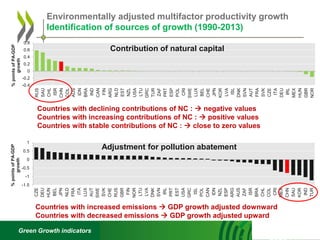
37
Environmentally adjusted multifactor productivity growth
Identification of sources of growth (1990-2013)
Countries with increased emissions  GDP growth adjusted downward
Countries with decreased emissions  GDP growth adjusted upward
Countries with declining contributions of NC :  negative values
Countries with increasing contributions of NC :  positive values
Countries with stable contributions of NC :  close to zero values
Green Growth indicators 38
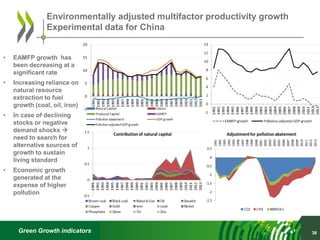
Environmentally adjusted multifactor productivity growth
Experimental data for China
• EAMFP growth has
been decreasing at a
significant rate
• Increasing reliance on
natural resource
extraction to fuel
growth (coal, oil, iron)
• In case of declining
stocks or negative
demand shocks 
need to search for
alternative sources of
growth to sustain
living standard
• Economic growth
generated at the
expense of higher
pollution

Presentation by the OECD

  • 1.
    The OECD GreenGrowth Strategy and its measurement framework Workshop on green growth measurement in Armenia 11 May 2016, Yerevan Krzysztof Michalak and Mikaela Rambali Green Growth and Global Relations Division OECD Environment Directorate
  • 2.
    The green growthstrategy 2
  • 3.
    Green Growth indicators •Risks to development are rising as growth continues to erode natural capital. – If left unchecked, this would mean increased water scarcity, resource bottlenecks, greater pollution, climate change, and unrecoverable biodiversity loss. • It is becoming increasingly costly to substitute natural capital by physical capital. • Change does not necessarily follow a smooth, foreseeable trajectory. New ways of producing and consuming things, and even redefine what we mean by progress and how we measure it Need for Green Growth
  • 4.
    Green Growth indicators Whatdo we mean by “green growth”? Fostering economic growth and development while ensuring that the natural assets continue to provide the resources and environmental services on which our well-being relies. • Securing future wellbeing • Delivering growth that is within environmental limits • Implementing smart policies to stimulate innovation and avoid lock-in to costly systems • Getting the prices and governance frameworks right
  • 5.
    Green Growth indicators Israelieconomic efficiency of agricultural water use, 1986-2008 Source: OECD (2010), OECD Review of Agricultural Policies: Israel, 2010 . 5 0 20 40 60 80 100 120 140 1986 1988 1990 1992 1994 1996 1998 2000 2002 2004 2006 2008 Index 1986=100 Value of agricultural production per m3 of water utilized for irrigation Real price of fresh water to agriculture (inflation adjusted)
  • 6.
    Green Growth indicators •Productivity. – Incentives for greater efficiency in the use of resources and natural assets, including enhancing productivity, reducing waste and energy consumption, and making resources available to their highest value use. • Innovation. – Opportunities for innovation, spurred by policies and framework conditions that allow for new ways of creating value and addressing environmental problems. • New markets. – Creation of new markets by stimulating demand for green technologies, goods, and services; creating new job opportunities. • Confidence. – Boosting investor confidence through greater predictability and continuity around how governments deal with major environmental issues. • Stability. – More balanced macroeconomic conditions, reduced resource price volatility and supporting fiscal consolidation through, for instance, reviewing the composition and efficiency of public spending, and increasing revenues through putting a price on pollution. Green growth can open new sources of growth
  • 7.
    Green Growth indicators •From bottlenecks that arise when resource scarcity or reduced quality makes investment more costly, such as the need for capital intensive infrastructure when water supplies become scarce or water quality decreases – the loss of natural capital can exceed the gains generated by economic activity, undermining the ability to sustain future growth. • From imbalances in natural systems that raise the risk of abrupt, highly damaging – and potentially irreversible – effects – attempts to identify potential thresholds suggest that some – climate change, global nitrogen cycles and biodiversity loss – have already been exceeded. Green growth can also reduce the risk to growth
  • 8.
    Green Growth indicators •Reframing growth and analytical frameworks – Account for the contribution that natural assets and ecosystem services make to growth: in measurement, in analysis, in decision making. • An operational and coherent policy framework to help achieve concrete results, esp.: – Remove environmentally harmful subsidies – Make pollution more costly – Value and price the natural assets and ecosystem services: stimulate innovation – Sound financial and governance framework • Reliable measurement tools and indicators – Inform policy development and – Measure progress and policy outcomes What is required to move towards “green growth”?
  • 9.
    Green Growth indicators •Initiated in 2009, delivered to Ministers in 2011 • Drawing upon long-standing experience with: • Fact-based policy analysis and evaluation • Country reviews • Environmental policies and economy-environment policy integration • Multi-disciplinary inter-governmental process • Involving 25 OECD Committees: Finance, Economy, Environment, Agriculture, Development Co-operation, Industry, etc. • International cooperation for green growth • GG Knowledge Platform (GGGI, WB, UNEP, OECD) • Cooperation and partnerships: UNEP, UNSD, UNIDO, World Bank, European Union, ... The OECD Green Growth Strategy
  • 10.
    Green Growth indicators •GG Reports for Emerging Economies • GG and Developing Countries • Food and Agriculture • Energy (OECD/IEA) • Biodiversity • Water • Development • Innovation & technology transfer • Freedom of investment for GG • Green Financing • Green Cities • Environmental regulations and growth • Job potential of a shift towards a low- carbon economy Mainstreaming green growth in OECD policy work Sectoral and thematic Studies
  • 11.
    Green Growth indicators •Country peer reviews and studies • Economic Surveys • Environmental Performance Reviews • Innovation Reviews • Investment Policy Reviews • Other OECD Strategies • Jobs, Skills, Innovation • Development • Greening Growth and Going for Growth • Analyse the side effects of growth-enhancing policy priorities on the environment (and on income distribution). • Analyse the links between environmental policies and outcomes and the effects of environmental policies on growth Mainstreaming green growth in OECD policy work National and multilateral policy surveillance
  • 12.
  • 13.
    Green Growth indicators •At the core of the OECD GG Strategy • Drawing upon experience with indicators, statistics, accounts • Concrete outputs – Conceptual measurement framework – Set of indicators – Database • Used in OECD work: policy analysis and country reviews • Applications in countries Monitoring progress towards Green Growth
  • 14.
    Green Growth indicators •Pragmatic – No composite indicator, rather a set of internationally comparable indicators of manageable size • A set of about 25 to 30 indicators • A small sub-set of 6 headline indicators for communication purposes – Selected from existing OECD work • Balanced – Balanced coverage of “green” and “growth” – Balance between relevance for OECD countries and for key partners – Balance between relevance for international work and for countries • Flexible – Easy to adapt to countries’ circumstances – Easy to apply at macro-, meso-, micro-levels – Easy to improve and develop further Monitoring progress towards green growth OECD approach
  • 15.
    Green Growth indicators Monitoringprogress towards green growth Conceptual measurement framework Economic activities (production, consumption, trade) Consumption Households Governments Investments Outputs Inputs Energy & raw materials water, land, biomass, air Pollutants waste Income Goods& services Residuals Labour Capital Resources 13 Production Multi-factor productivity Recycling, re-use remanufacturing, substitution Natural asset base (capital stocks, environmental quality) 2 Resource functions Sink functions Service functions Policies Measures Opportunities 4 Policy instruments, innovation, financing, education, employment Amenities, health & safety aspects Combines the main features of green growth with basic accounting principles and the PSR model
  • 16.
    Green Growth indicators Monitoringprogress towards green growth Five inter-related indicator groups and topics • What are the growth characteristics of the economy? its social context? • Is the natural asset base preserved? • Are there risks of future shocks to growth? • Is the economy becoming greener? More resource efficient? • How does this contribute to growth and to the productivity of the economy? • Do people benefit from greener growth? • Are we taking the right measures to catalyse investments and innovation for greening the economy? • Is greening the economy opening up new sources of growth? The environmental and resource productivity of the economy 1 • Carbon and energy productivity • Resource productivity: materials, nutrients, water • Multi-factor productivity The natural asset base of the economy2 • Renewable stocks: water, forest, fish resources • Non-renewable stocks: mineral resources • Biodiversity and ecosystems The environmental dimension of quality of life3 • Environmental health and risks • Environmental services and amenities Economic opportunities and policy responses 4 • Technology and innovation • Environmental goods & services • International financial flows • Prices and transfers • Skills and training • Regulations and management approaches Socio-economic context and characteristics of growth • Economic growth and structure • Productivity and trade • Labour markets, education and income • Socio-demographic patterns
  • 17.
    Green Growth indicators Monitoringprogress towards green growth Headline indicators to ease communication Environmental and resource productivity 1. CO2 productivity (production-based, demand-based) 3. Multifactor productivity including environmental services 2. Non-energy material productivity (production-based, demand-based) Carbon productivity Resource productivity Multifactor productivity 6. Air pollution (population exposure to PM 2.5) Environmental quality of life Environmental health and risks Economic opportunities and policy responses Placeholder – no indicator specified Technology and innovation, environmental goods and services, prices and transfers, etc. The natural asset base 4. Natural resource index 5. Changes in land use and cover Renewable and non-renewable stocks Biodiversity and ecosystems “Green” difficult to isolate Diversity of country circumstances, of instruments  countries to choose • Selected from full set • For communication with policy makers, the media, citizens
  • 18.
    Green Growth indicators18 Monitoring progress towards green growth Foundations and overall indicator architecture Monitoring progress towards Green Growth Socio-economic & growth characteristics Environmental and resource productivity Natural asset base Environmental quality of life Economic opportunities and policies OECD indicators and statistical databases Economic performance National accounts Productivity Environmental performance Resource productivity Science &Technology Innovation Entrepreneurship Development aid Investment Trade Employment Education Energy Agriculture Transport UNEP, WB SEEA Review & selection: •Policy relevance •Analytical soundness •Measurability EU Measuring well-being and the progress of societies – GDP and beyond Member countries IGOs National indicators UN SDGs Better Life initiative • Better life index • How’s life • Income inequality UNECE
  • 19.
    Green Growth indicators19 Monitoring progress towards green growth Green growth indicators and SDGs UN Statistics (2015) List of indicator proposals, http://unstats.un.org/sdgs/files/List%20of%20Indicator%20Proposals%2011-8-2015.pdf; Goal 2: End hunger, achieve food security and improved nutrition, and promote sustainable agriculture • Natural asset base • Environmental and resource productivity Goal 3: Ensure healthy lives and promote well-being for all at all ages • Environmental dimension of life Goal 4: Ensure inclusive and equitable quality education and promote life-long learning opportunities for all • Economic opportunities and policy responses Goal 6: Ensure availability and sustainable management of water and sanitation for all • Environmental and resource productivity • Natural asset base • Environmental quality of life • Economic opportunities and policy responses Goal 7: Ensure access to affordable, reliable, sustainable, and modern energy for all • Environmental and resource productivity Goal 8: Promote sustained, inclusive economic growth, full and productive employment and decent work for all • Environmental and resource productivity Goal 9: Build resilient infrastructure, promote inclusive and sustainable industrialisation and foster innovation • Environmental and resource productivity
  • 20.
    Green Growth indicators20 Monitoring progress towards green growth Green growth indicators and SDGs Goal 10: Reduce inequality within and among countries • Economic opportunities and policy responses Goal 11: Make cities and human settlements inclusive, safe, resilient and sustainable • Environmental and resource productivity • Natural asset base • Environmental quality of life Goal 12: Ensure sustainable consumption and production patterns • Environmental and resource productivity • Economic opportunities and policy responses Goal 13: Take urgent action to combat climate change and its impacts • Environmental and resource productivity • Economic opportunities and policy responses Goal 14: Conserve and sustainably use the oceans, seas and marine resources for sustainable development • Natural asset base Goal 15: Protect, restore and promote sustainable use of terrestrial ecosystems, sustainability manage forests, combat desertification and halt and reverse land degradation and halt biodiversity loss • Economic opportunities and policy responses • Natural asset base
  • 21.
    Green growth inpractice 21
  • 22.
    Green Growth indicators •GG indicators are applied in OECD work: country studies, peer reviews – 130 GG relevant publications since 2011 – 80 country reports with GG recommendations • GG indicators are applied in countries: OECD countries, emerging economies, developing countries – Chile, Czech Republic, Denmark, Germany, Korea, Mexico, Netherlands, Poland, Slovak Republic, Slovenia, Ukraine… – LAC: Colombia, Costa Rica, Ecuador, Guatemala, Paraguay, Peru – Kyrgyzstan, work in progress… – 8 East-Asian countries  Exchange of experience and best practices  Feedback on relevance  Contribution to indicator improvement Monitoring progress towards green growth Green Growth Indicators in practice
  • 23.
    Green Growth indicators GreenGrowth Indicators in practice OECD Environmental performance reviews: Germany Part I. Progress towards sustainable development Towards green growth Key environmental trends
  • 24.
    Green Growth indicators GreenGrowth Indicators in practice OECD Environmental performance reviews: Germany The natural asset base The environmental quality of life
  • 25.
    Green Growth indicators GreenGrowth Indicators in practice OECD Environmental performance reviews: Germany 0 10 000 20 000 30 000 40 000 50 000 60 000 0 1 2 3 4 5 6 7 8 1995 1997 1999 2001 2003 2005 2007 2009 % Environmentally related tax revenue % of GDP % of total tax revenue EUR millionb 0 2,000 4,000 6,000 8,000 10,000 Public Air Public Wastewater Public Waste Public Noise Business Air Business Wastewater Business Waste Business Noise Specialised enterprises Wastewater Specialised enterprises Waste EUR million, 2000 prices 2000 2008 Pollution abatement and control expenditure by sector and domain Source: Federal Statistical Office. Environmentally related tax revenues
  • 26.
    Green Growth indicators26 Green Growth Indicators in practice Country examples
  • 27.
    Green Growth indicators •Indicator selection • Reflecting national circumstances • Balance between “green” and “growth” • Data compilation and measurement • Identifying data sources across government agencies • Organising data flows • Harmonising the data and addressing quality issues • Interpretation and communication • Placing the indicators in the country’s context • Correctly interpreting the results and communicating them • Institutional coordination and capacity building • Many actors involved, need for continuity in the measurement efforts, coping with limited resources  institutional coordination and cooperation, training and capacity building; proper funding and priority setting Work on GGIs contributes to better coordination, to improve EIS and their connection to economic IS  Learning by doing is essential! 27 Green Growth Indicators in practice Lessons learned
  • 28.
  • 29.
    Green Growth indicators Fill data gaps • Consistent environmental-economic data at industry level  structural changes; industry profiles • Natural assets and material flows • Biodiversity and ecosystem services • Quality of life dimensions [“well-being”]  Capture better • The growth contribution of natural assets • The “greening” of economic sectors beyond “eco-industries” • Economic opportunities and the effectiveness of policies  Role of System of Environmental-Economic Accounts (SEEA) • Key for consistent information on environment-economy interface • Key for enabling a breakdown by industry • Key for better capturing the growth contribution of natural assets 29 Monitoring progress towards green growth Advancing the measurement agenda
  • 30.
    Green Growth indicators •The list of indicators in the OECD set is not final – About 20 indicators are measurable at varying degrees of quality and regularly published (2011, 2014, 2017) – Some indicators are not yet fully measurable, but kept to drive measurement agenda – List of indicators will need to evolve accordingly if better data is available. • Further develop the indicators (methodologies, underlying data, interpretation) GG headline indicators • Raw material productivity (demand-based; footprint approach) • Environmentally adjusted multi-factor productivity growth • Natural resource index (current focus on sub-soil assets) • Land cover and land use (building on geospatial data) • Population exposure to air pollution (building on geospatial data) Other indicators • Nitrogen flows (nutrient balances), • Policy response indicators: Innovation (patents); Tax systems (taxes, subsidies, …); Environmental policy stringency Monitoring progress towards green growth Ongoing work (1)
  • 31.
    Green Growth indicators •Increase the availability of environmental data by industry – Air and GHG emissions – Waste generation, waste water generation, water use – Expenditure, taxes • Expand country coverage in database • OECD, BRIICS, G20 • Strengthen the use of indicators in OECD work – Country environmental performance reviews – Economic surveys – Gain additional feedback on relevance and interpretation (particularly for new indicators) • Work with countries to apply GGIs – Joint OECD-DRC project “Green growth in the context of industrial upgrading in China” – EECCA countries Monitoring progress towards green growth Ongoing work (3)
  • 32.
    Green Growth indicators Greengrowth indicators For more information, see www.oecd.org/greengrowth and www.oecd.org/greengrowth/indicators Thank you!
  • 33.
  • 34.
    Green Growth indicators •Traditional measure of productivity growth • A measure of economic performance that accounts for multiple factor inputs • Links with material living standards • Provides insights about long term growth prospects – BUT: • can be overestimated in countries where output growth relies on depletion of natural capital, and on heavily polluting technologies • can be underestimated in countries that invest in more efficient use of (domestic) natural resources and invest in pollution abatement and control • Adjusted measure of productivity growth • Provides a more accurate measure of economic performance for multiple factor inputs including the consumption of natural resources and the generation of undesirable outputs (pollution, waste, …) • Links “green” and “growth”: • Provides insights about ways to achieve more sustainable long-term growth • Fosters the integration of environmental concerns in economic policies • Starting point for analysing drivers of green growth 34 Monitoring progress towards green growth Environmentally adjusted multifactor productivity growth
  • 35.
    Green Growth indicators •Work so far – Development of methodology (coherent with ‘traditional’ productivity measures) – Pilot calculations for OECD and G20 countries • For all OECD and G20 countries, from 1990 to 2013 • Accounting for selected air emissions as negative by-products (8 GHG and air pollutants: CO2, SOx, NOx, CH4, N2O, NMVOC, CO, PM10) • Accounting for the use of selected natural assets (14 types of fossil fuels and minerals: Hard coal, soft coal, gas, oil, bauxite, copper, gold, iron ore, lead, nickel, phosphate, silver, tin and zinc) – Data sources • OECD Productivity database; Total Economy Database (TED) • OECD data on natural asset accounts (and WB WAVES database) • OECD data on air emission accounts (and other air emission data) • Emissions Database for Global Atmospheric Research (EDGAR) • Next steps – Use the indicators in country reviews; gain feedback – Improve and complete underlying data 35 Monitoring progress towards green growth Environmentally adjusted multifactor productivity growth
  • 36.
    Green Growth indicators •Selected countries, partial measures, long-term annual averages Note: a zero contribution of natural capital does not mean that a country did not extract any domestic resources in a given year; rather, it means that its economy has continued to rely on this input in the same way as the previous year 36 Environmentally adjusted multifactor productivity growth Identification of sources of growth Output growth Input growth Residual growth OECD Pollution- adjusted GDP GDP Pollution abatement Contribution of labour Contribution of produced capital Contribution of natural capital Environmentally adjusted multifactor productivity Period Australia 3.15 3.30 -0.15 0.58 0.62 0.09 1.85 1991-2012 Chile* 4.94 5.20 -0.26 0.64 2.48 0.34 1.49 1991-2012 France 1.89 1.57 0.32 0.05 0.44 0.00 1.40 1991-2013 Germany 2.12 1.44 0.68 -0.07 0.42 -0.01 1.78 1991-2013 Italy 1.04 0.72 0.31 0.01 0.32 0.00 0.70 1991-2013 Japan 1.33 0.93 0.40 -0.32 0.53 0.00 1.12 1991-2012 Korea 4.36 5.28 -0.93 0.20 1.29 0.00 2.87 1991-2013 Mexico* 2.05 2.77 -0.73 0.24 0.85 -0.01 0.96 1991-2013 Netherlands 2.35 1.96 0.39 0.46 0.58 0.02 1.30 1991-2013 Norway* 2.70 2.47 0.23 0.21 0.82 -0.16 1.84 1991-2013 Poland* 3.76 3.71 0.05 -0.25 1.40 0.00 2.61 1991-2013 Portugal 1.63 1.53 0.09 0.13 0.60 0.00 0.90 1996-2011 United Kingdom 2.35 2.12 0.23 0.15 0.49 -0.09 1.80 1991-2013 United States 2.57 2.49 0.08 0.32 0.50 0.01 1.74 1991-2013 Brazil* 2.71 2.97 -0.25 0.44 0.90 0.09 1.29 1991-2013 China * 9.39 10.18 -0.79 0.44 6.26 0.27 2.42 1991-2013 India* 5.49 6.52 -1.04 0.89 2.47 0.07 2.06 1991-2013 Indonesia* 4.92 4.97 -0.05 0.48 1.93 0.09 2.43 1991-2012 Russia* 2.82 2.59 0.24 0.20 -0.11 0.59 2.14 1994-2012 South Africa* 2.49 2.66 -0.17 0.37 0.98 0.00 1.14 1991-2012
  • 37.
    Green Growth indicators -1.5 -1 -0.5 0 0.5 1 CZE DEU HUN BEL JPN NLD FRA ITA LUX AUT SWE SVK CHE RUS GBR FIN NOR LTU LVA DNK SVN IRL PRT EST USA GRC ISL POL CAN IDN NZL ESP ARG AUS ZAF ISR BRA CHL COL CRI MEX CHN SAU KOR IND TUR %pointsofPA-GDP growth Adjustmentfor pollution abatement -0.4 -0.2 0 0.2 0.4 0.6 0.8 RUS SAU CHL ISR CHN COL AUS IDN BRA IND CAN FIN ARG NLD EST NZL USA LTU GRC TUR ZAF PRT ESP POL CRI SWE LUX BEL CHE JPN KOR LVA ISL DNK SVN AUT FRA SVK CZE ITA DEU IRL MEX HUN GBR NOR %pointsofPA-GDP growth Contribution of natural capital 37 Environmentally adjusted multifactor productivity growth Identification of sources of growth (1990-2013) Countries with increased emissions  GDP growth adjusted downward Countries with decreased emissions  GDP growth adjusted upward Countries with declining contributions of NC :  negative values Countries with increasing contributions of NC :  positive values Countries with stable contributions of NC :  close to zero values
  • 38.
    Green Growth indicators38 Environmentally adjusted multifactor productivity growth Experimental data for China • EAMFP growth has been decreasing at a significant rate • Increasing reliance on natural resource extraction to fuel growth (coal, oil, iron) • In case of declining stocks or negative demand shocks  need to search for alternative sources of growth to sustain living standard • Economic growth generated at the expense of higher pollution