S-215

Unit 7
Tactics in the Interface
Unit 7 - Tactics in the Interface

Slide 7-1
S-215

• List items to consider when evaluating the
structure’s exterior.
• Identify items to address when performing
exterior structure preparation.
• List tasks to perform when preparing the
structure’s interior.
• Identify the importance and required tasks
to perform after the fire front passes.

Unit 7 - Tactics in the Interface

Slide 7-2
S-215

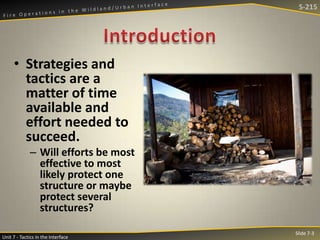
• Strategies and
tactics are a
matter of time
available and
effort needed to
succeed.
– Will efforts be most
effective to most
likely protect one
structure or maybe
protect several
structures?
Unit 7 - Tactics in the Interface

Slide 7-3
S-215

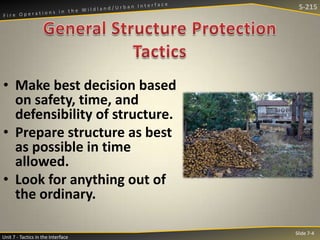
• Make best decision based
on safety, time, and
defensibility of structure.
• Prepare structure as best
as possible in time
allowed.
• Look for anything out of
the ordinary.
Unit 7 - Tactics in the Interface

Slide 7-4
S-215

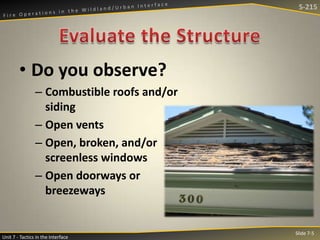
• Do you observe?
– Combustible roofs and/or
siding
– Open vents
– Open, broken, and/or
screenless windows
– Open doorways or
breezeways

Unit 7 - Tactics in the Interface

Slide 7-5
S-215

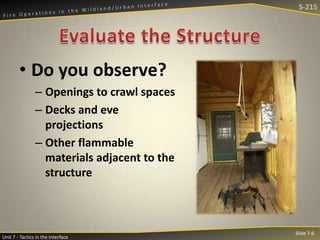
• Do you observe?
– Openings to crawl spaces
– Decks and eve
projections
– Other flammable
materials adjacent to the
structure

Unit 7 - Tactics in the Interface

Slide 7-6
S-215

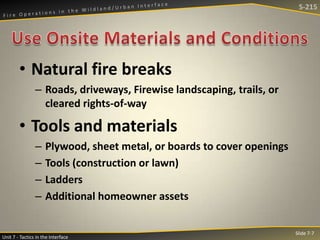
• Natural fire breaks
– Roads, driveways, Firewise landscaping, trails, or
cleared rights-of-way

• Tools and materials
–
–
–
–

Plywood, sheet metal, or boards to cover openings
Tools (construction or lawn)
Ladders
Additional homeowner assets

Unit 7 - Tactics in the Interface

Slide 7-7
S-215

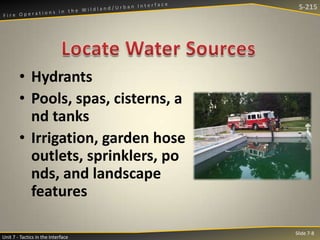
• Hydrants
• Pools, spas, cisterns, a
nd tanks
• Irrigation, garden hose
outlets, sprinklers, po
nds, and landscape
features
Unit 7 - Tactics in the Interface

Slide 7-8
S-215

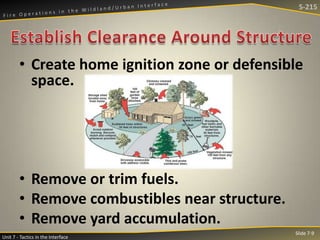
• Create home ignition zone or defensible
space.

• Remove or trim fuels.
• Remove combustibles near structure.
• Remove yard accumulation.
Unit 7 - Tactics in the Interface

Slide 7-9
S-215

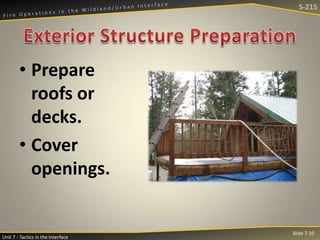
• Prepare
roofs or
decks.
• Cover
openings.

Unit 7 - Tactics in the Interface

Slide 7-10
S-215

• Sprinkler Systems
– Landscaping or fire suppression

• Class A Foam
– Wet, fluid, or dry

• Fire Gel
• Structure Wrap
Unit 7 - Tactics in the Interface

Slide 7-11
S-215

Unit 7 - Tactics in the Interface

Slide 7-12
S-215

• Close windows and any non-flammable
window coverings.
• Close interior doors.
• Turn off fans.
• Turn off any liquid petroleum gas sources.
• Leave porch lights and electricity on.
• Close, but don’t lock, doors.
• Leave a note for the homeowner regarding
your presence.
Unit 7 - Tactics in the Interface

Slide 7-13
S-215

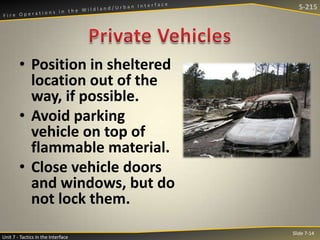
• Position in sheltered
location out of the
way, if possible.
• Avoid parking
vehicle on top of
flammable material.
• Close vehicle doors
and windows, but do
not lock them.
Unit 7 - Tactics in the Interface

Slide 7-14
S-215

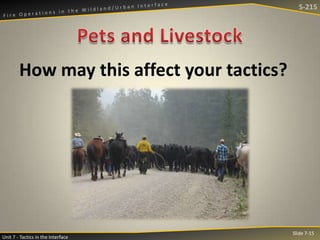
How may this affect your tactics?

Unit 7 - Tactics in the Interface

Slide 7-15
S-215

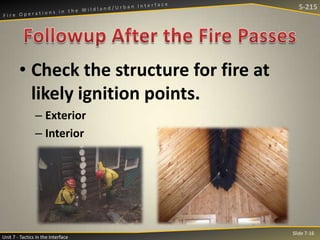
• Check the structure for fire at
likely ignition points.
– Exterior
– Interior

Unit 7 - Tactics in the Interface

Slide 7-16
S-215

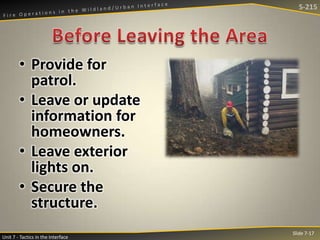
• Provide for
patrol.
• Leave or update
information for
homeowners.
• Leave exterior
lights on.
• Secure the
structure.
Unit 7 - Tactics in the Interface

Slide 7-17
S-215

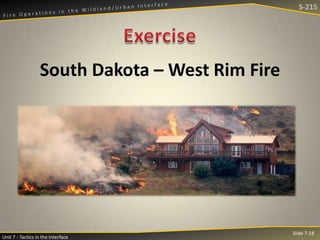
South Dakota – West Rim Fire

Unit 7 - Tactics in the Interface

Slide 7-18
S-215

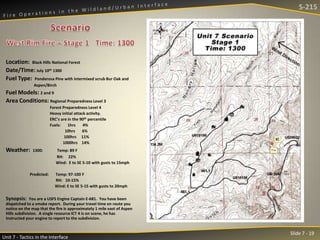
Location: Black Hills National Forest
Date/Time: July 10th 1300
Fuel Type: Ponderosa Pine with intermixed scrub Bur Oak and
Aspen/Birch

Fuel Models: 2 and 9
Area Conditions: Regional Preparedness Level 3
Forest Preparedness Level 4
Heavy initial attack activity.
ERC’s are in the 90th percentile
Fuels:
1hrs
4%
10hrs
6%
100hrs 11%
1000hrs 14%

Weather:

1300:

Predicted:

Temp: 89 F
RH: 22%
Wind: E to SE 5-10 with gusts to 15mph
Temp: 97-100 F
RH: 10-15%
Wind: E to SE 5-15 with gusts to 20mph

Synopsis: You are a USFS Engine Captain E-681. You have been
dispatched to a smoke report. During your travel time en route you
notice on the map that the fire is approximately 1 mile east of Aspen
Hills subdivision. A single resource ICT 4 is on scene, he has
instructed your engine to report to the subdivision.

Unit 7 - Tactics in the Interface

Slide 7 - 19
S-215

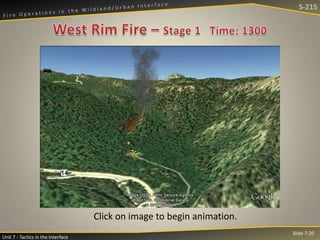
Click on image to begin animation.
Unit 7 - Tactics in the Interface

Slide 7-20
S-215

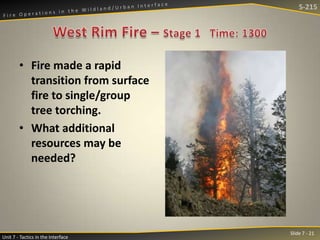
• Fire made a rapid
transition from surface
fire to single/group
tree torching.
• What additional
resources may be
needed?

Unit 7 - Tactics in the Interface

Slide 7 - 21
S-215

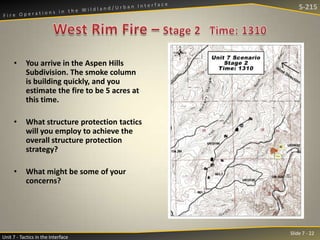
•

You arrive in the Aspen Hills
Subdivision. The smoke column
is building quickly, and you
estimate the fire to be 5 acres at
this time.

•

What structure protection tactics
will you employ to achieve the
overall structure protection
strategy?

•

What might be some of your
concerns?

Unit 7 - Tactics in the Interface

Slide 7 - 22
S-215

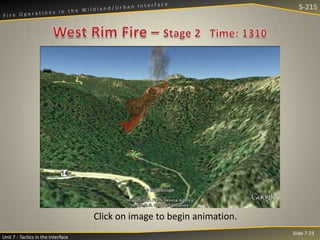
Click on image to begin animation.
Unit 7 - Tactics in the Interface

Slide 7-23
S-215

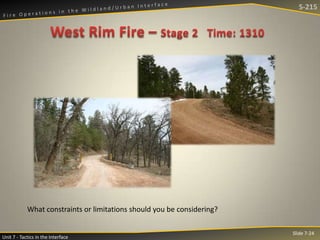
What constraints or limitations should you be considering?

Unit 7 - Tactics in the Interface

Slide 7-24
S-215

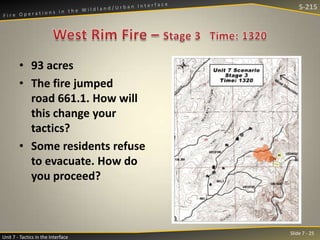
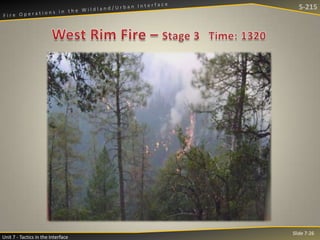
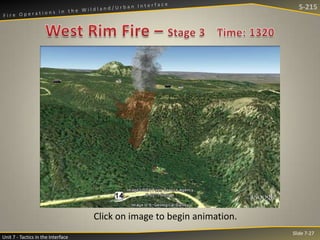
• 93 acres
• The fire jumped
road 661.1. How will
this change your
tactics?
• Some residents refuse
to evacuate. How do
you proceed?

Unit 7 - Tactics in the Interface

Slide 7 - 25
S-215

Unit 7 - Tactics in the Interface

Slide 7-26
S-215

Click on image to begin animation.
Unit 7 - Tactics in the Interface

Slide 7-27
S-215

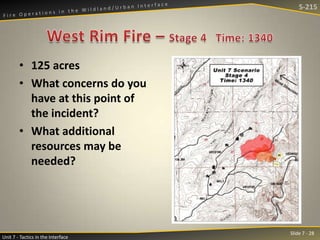
• 125 acres
• What concerns do you
have at this point of
the incident?
• What additional
resources may be
needed?

Unit 7 - Tactics in the Interface

Slide 7 - 28
S-215

Unit 7 - Tactics in the Interface

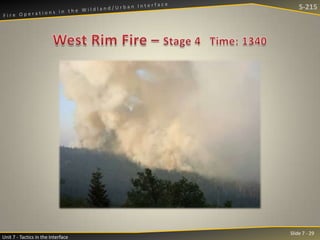
Slide 7 - 29
S-215

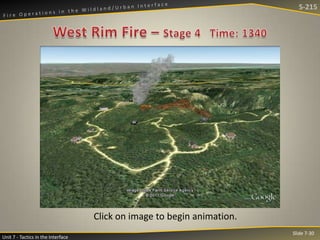
Click on image to begin animation.
Unit 7 - Tactics in the Interface

Slide 7-30
S-215

• Interface fires vary in complexity from
a single, uninhabited structure to
thousands of occupied primary
dwellings.
• The strategies and tactics contained in
this unit will apply to any interface
incident.
• Firefighters must maintain vigilance as
incidents wind down.
Unit 7 - Tactics in the Interface

Slide 7-31
S-215

• List items to consider when evaluating the
structure’s exterior.
• Identify items to address when performing
exterior structure preparation.
• List tasks to perform when preparing the
structure’s interior.
• Identify the importance and required tasks
to perform after the fire front passes.

Unit 7 - Tactics in the Interface

Slide 7-32

S215 unit 7

  • 1.
    S-215 Unit 7 Tactics inthe Interface Unit 7 - Tactics in the Interface Slide 7-1
  • 2.
    S-215 • List itemsto consider when evaluating the structure’s exterior. • Identify items to address when performing exterior structure preparation. • List tasks to perform when preparing the structure’s interior. • Identify the importance and required tasks to perform after the fire front passes. Unit 7 - Tactics in the Interface Slide 7-2
  • 3.
    S-215 • Strategies and tacticsare a matter of time available and effort needed to succeed. – Will efforts be most effective to most likely protect one structure or maybe protect several structures? Unit 7 - Tactics in the Interface Slide 7-3
  • 4.
    S-215 • Make bestdecision based on safety, time, and defensibility of structure. • Prepare structure as best as possible in time allowed. • Look for anything out of the ordinary. Unit 7 - Tactics in the Interface Slide 7-4
  • 5.
    S-215 • Do youobserve? – Combustible roofs and/or siding – Open vents – Open, broken, and/or screenless windows – Open doorways or breezeways Unit 7 - Tactics in the Interface Slide 7-5
  • 6.
    S-215 • Do youobserve? – Openings to crawl spaces – Decks and eve projections – Other flammable materials adjacent to the structure Unit 7 - Tactics in the Interface Slide 7-6
  • 7.
    S-215 • Natural firebreaks – Roads, driveways, Firewise landscaping, trails, or cleared rights-of-way • Tools and materials – – – – Plywood, sheet metal, or boards to cover openings Tools (construction or lawn) Ladders Additional homeowner assets Unit 7 - Tactics in the Interface Slide 7-7
  • 8.
    S-215 • Hydrants • Pools,spas, cisterns, a nd tanks • Irrigation, garden hose outlets, sprinklers, po nds, and landscape features Unit 7 - Tactics in the Interface Slide 7-8
  • 9.
    S-215 • Create homeignition zone or defensible space. • Remove or trim fuels. • Remove combustibles near structure. • Remove yard accumulation. Unit 7 - Tactics in the Interface Slide 7-9
  • 10.
    S-215 • Prepare roofs or decks. •Cover openings. Unit 7 - Tactics in the Interface Slide 7-10
  • 11.
    S-215 • Sprinkler Systems –Landscaping or fire suppression • Class A Foam – Wet, fluid, or dry • Fire Gel • Structure Wrap Unit 7 - Tactics in the Interface Slide 7-11
  • 12.
    S-215 Unit 7 -Tactics in the Interface Slide 7-12
  • 13.
    S-215 • Close windowsand any non-flammable window coverings. • Close interior doors. • Turn off fans. • Turn off any liquid petroleum gas sources. • Leave porch lights and electricity on. • Close, but don’t lock, doors. • Leave a note for the homeowner regarding your presence. Unit 7 - Tactics in the Interface Slide 7-13
  • 14.
    S-215 • Position insheltered location out of the way, if possible. • Avoid parking vehicle on top of flammable material. • Close vehicle doors and windows, but do not lock them. Unit 7 - Tactics in the Interface Slide 7-14
  • 15.
    S-215 How may thisaffect your tactics? Unit 7 - Tactics in the Interface Slide 7-15
  • 16.
    S-215 • Check thestructure for fire at likely ignition points. – Exterior – Interior Unit 7 - Tactics in the Interface Slide 7-16
  • 17.
    S-215 • Provide for patrol. •Leave or update information for homeowners. • Leave exterior lights on. • Secure the structure. Unit 7 - Tactics in the Interface Slide 7-17
  • 18.
    S-215 South Dakota –West Rim Fire Unit 7 - Tactics in the Interface Slide 7-18
  • 19.
    S-215 Location: Black HillsNational Forest Date/Time: July 10th 1300 Fuel Type: Ponderosa Pine with intermixed scrub Bur Oak and Aspen/Birch Fuel Models: 2 and 9 Area Conditions: Regional Preparedness Level 3 Forest Preparedness Level 4 Heavy initial attack activity. ERC’s are in the 90th percentile Fuels: 1hrs 4% 10hrs 6% 100hrs 11% 1000hrs 14% Weather: 1300: Predicted: Temp: 89 F RH: 22% Wind: E to SE 5-10 with gusts to 15mph Temp: 97-100 F RH: 10-15% Wind: E to SE 5-15 with gusts to 20mph Synopsis: You are a USFS Engine Captain E-681. You have been dispatched to a smoke report. During your travel time en route you notice on the map that the fire is approximately 1 mile east of Aspen Hills subdivision. A single resource ICT 4 is on scene, he has instructed your engine to report to the subdivision. Unit 7 - Tactics in the Interface Slide 7 - 19
  • 20.
    S-215 Click on imageto begin animation. Unit 7 - Tactics in the Interface Slide 7-20
  • 21.
    S-215 • Fire madea rapid transition from surface fire to single/group tree torching. • What additional resources may be needed? Unit 7 - Tactics in the Interface Slide 7 - 21
  • 22.
    S-215 • You arrive inthe Aspen Hills Subdivision. The smoke column is building quickly, and you estimate the fire to be 5 acres at this time. • What structure protection tactics will you employ to achieve the overall structure protection strategy? • What might be some of your concerns? Unit 7 - Tactics in the Interface Slide 7 - 22
  • 23.
    S-215 Click on imageto begin animation. Unit 7 - Tactics in the Interface Slide 7-23
  • 24.
    S-215 What constraints orlimitations should you be considering? Unit 7 - Tactics in the Interface Slide 7-24
  • 25.
    S-215 • 93 acres •The fire jumped road 661.1. How will this change your tactics? • Some residents refuse to evacuate. How do you proceed? Unit 7 - Tactics in the Interface Slide 7 - 25
  • 26.
    S-215 Unit 7 -Tactics in the Interface Slide 7-26
  • 27.
    S-215 Click on imageto begin animation. Unit 7 - Tactics in the Interface Slide 7-27
  • 28.
    S-215 • 125 acres •What concerns do you have at this point of the incident? • What additional resources may be needed? Unit 7 - Tactics in the Interface Slide 7 - 28
  • 29.
    S-215 Unit 7 -Tactics in the Interface Slide 7 - 29
  • 30.
    S-215 Click on imageto begin animation. Unit 7 - Tactics in the Interface Slide 7-30
  • 31.
    S-215 • Interface firesvary in complexity from a single, uninhabited structure to thousands of occupied primary dwellings. • The strategies and tactics contained in this unit will apply to any interface incident. • Firefighters must maintain vigilance as incidents wind down. Unit 7 - Tactics in the Interface Slide 7-31
  • 32.
    S-215 • List itemsto consider when evaluating the structure’s exterior. • Identify items to address when performing exterior structure preparation. • List tasks to perform when preparing the structure’s interior. • Identify the importance and required tasks to perform after the fire front passes. Unit 7 - Tactics in the Interface Slide 7-32