JNN INSTITUTE OF
ENGINEERING
MT8591– SENSORS AND INSTRUMENTATION
MALATHY N, ASSISTANT PROFESSOR
Department of ROBOTICS & AUTOMATION
 To understand the concepts of measurement technology
 To learn the various sensors used to measure various
physical parameters.
 To learn the fundamentals of signal conditioning, data
acquisition and communication systems used in
mechatronics system development.
OBJECTIVES
TEXT BOOKS:
1. Ernest O Doebelin, “Measurement Systems – Applications
and Design”, Tata McGraw-Hill, 2009
2. Sawney A K and Puneet Sawney, “A Course in Mechanical
Measurements and Instrumentation and Control”, 12th
edition, Dhanpat Rai & Co, New Delhi, 2013.
REFERENCES
1. C. Sujatha ... Dyer, S.A., Survey of Instrumentation and
Measurement, John Wiley & Sons, Canada, 2001
2. Hans Kurt Tönshoff (Editor), Ichiro , “Sensors in
Manufacturing” Volume 1, WileyVCH April 2001.
3. John Turner and Martyn Hill, “Instrumentation for Engineers
and Scientists”, Oxford Science Publications, 1999.
4. Patranabis D, “Sensors and Transducers”, 2nd Edition, PHI,
New Delhi, 2011.
5. Richard Zurawski, “Industrial Communication Technology
Handbook” 2nd edition, CRC Press, 2015
 Basics of Measurement – Classification of errors – Error
analysis – Static and dynamic characteristics of transducers
– Performance measures of sensors – Classification of
sensors – Sensor calibration techniques – Sensor Output
Signal Types.
UNIT I INTRODUCTION
 Motion Sensors – Potentiometers, Resolver, Encoders –
Optical, Magnetic, Inductive, Capacitive, LVDT – RVDT –
Synchro – Microsyn, Accelerometer – GPS, Bluetooth,
Range Sensors – RF beacons, Ultrasonic Ranging,
Reflective beacons, Laser Range Sensor (LIDAR)
UNIT II MOTION, PROXIMITY AND RANGING
SENSORS
 Strain Gage, Load Cell, Magnetic Sensors –types, principle,
requirement and advantages: Magneto resistive – Hall
Effect – Current sensor Heading Sensors – Compass,
Gyroscope, Inclinometers.
UNIT III FORCE, MAGNETIC AND HEADING
SENSORS
 Photo conductive cell, photo voltaic, Photo resistive, LDR –
Fiber optic sensors – Pressure – Diaphragm, Bellows,
Piezoelectric – Tactile sensors, Temperature – IC,
Thermistor, RTD, Thermocouple. Acoustic Sensors – flow
and level measurement, Radiation Sensors – Smart
Sensors - Film sensor, MEMS & Nano Sensors, LASER
sensors.
UNIT IV OPTICAL, PRESSURE AND
TEMPERATURE SENSORS
 Amplification – Filtering – Sample and Hold circuits – Data
Acquisition: Single channel and multi channel data
acquisition – Data logging - applications - Automobile,
Aerospace, Home appliances, Manufacturing,
Environmental monitoring.
UNIT V SIGNAL CONDITIONING AND DAQ
SYSTEMS
BASICS OF MEASUREMENT
The measurement of a given parameter or quantity is the act or result of a quantitative comparison
between a predefined standard and an unknown quantity to be measured.
For the result to be meaningful, there are two basic requirements:
• The comparison standard is accurately defined and commonly accepted and
• The procedure and the instrument used for obtaining the comparison must be provable.
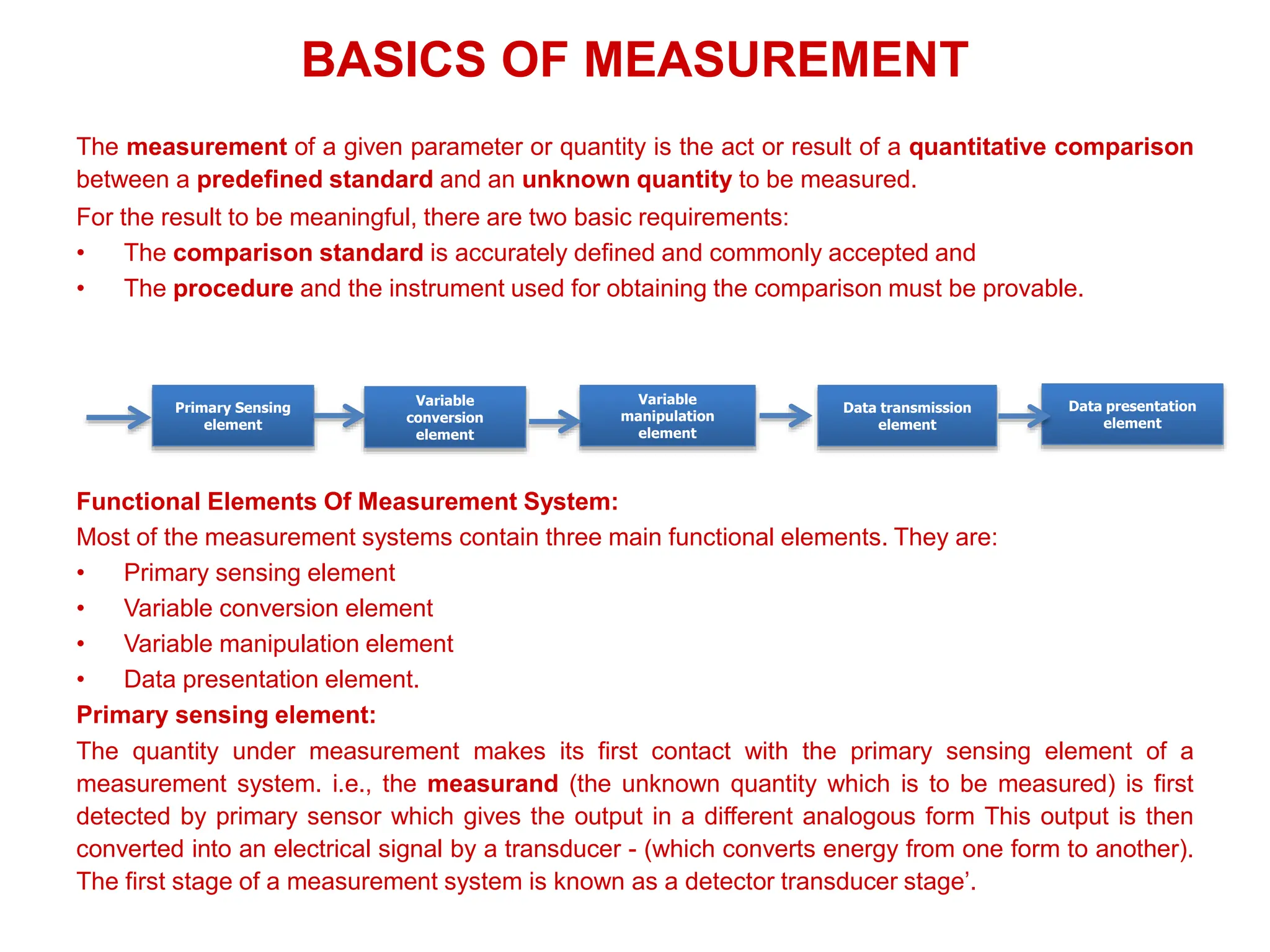
Functional Elements Of Measurement System:
Most of the measurement systems contain three main functional elements. They are:
• Primary sensing element
• Variable conversion element
• Variable manipulation element
• Data presentation element.
Primary sensing element:
The quantity under measurement makes its first contact with the primary sensing element of a
measurement system. i.e., the measurand (the unknown quantity which is to be measured) is first
detected by primary sensor which gives the output in a different analogous form This output is then
converted into an electrical signal by a transducer - (which converts energy from one form to another).
The first stage of a measurement system is known as a detector transducer stage’.
Primary Sensing
element
Variable
conversion
element
Variable
manipulation
element
Data transmission
element
Data presentation
element
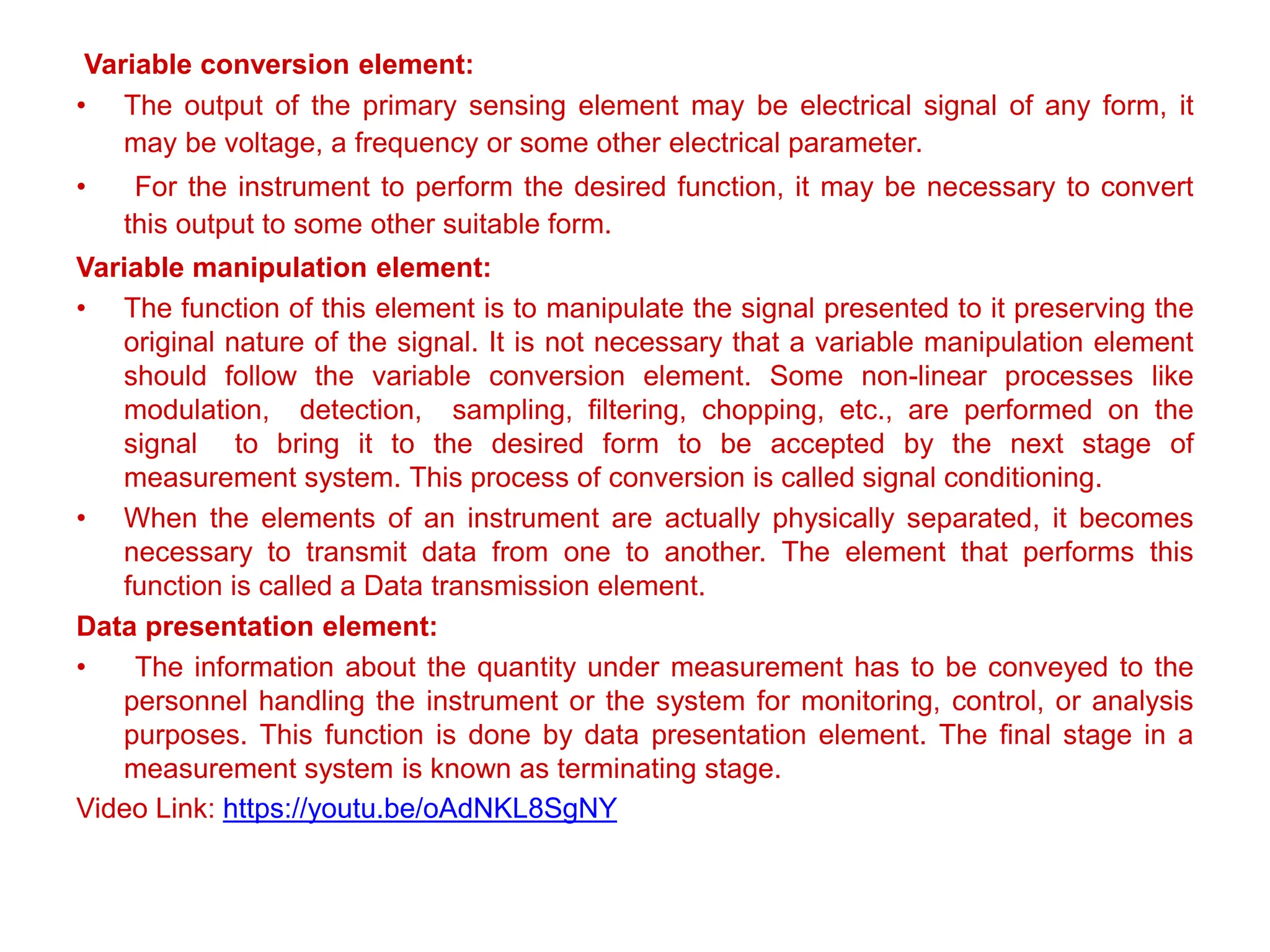
Variable conversion element:
• The output of the primary sensing element may be electrical signal of any form, it
may be voltage, a frequency or some other electrical parameter.
• For the instrument to perform the desired function, it may be necessary to convert
this output to some other suitable form.
Variable manipulation element:
• The function of this element is to manipulate the signal presented to it preserving the
original nature of the signal. It is not necessary that a variable manipulation element
should follow the variable conversion element. Some non-linear processes like
modulation, detection, sampling, filtering, chopping, etc., are performed on the
signal to bring it to the desired form to be accepted by the next stage of
measurement system. This process of conversion is called signal conditioning.
• When the elements of an instrument are actually physically separated, it becomes
necessary to transmit data from one to another. The element that performs this
function is called a Data transmission element.
Data presentation element:
• The information about the quantity under measurement has to be conveyed to the
personnel handling the instrument or the system for monitoring, control, or analysis
purposes. This function is done by data presentation element. The final stage in a
measurement system is known as terminating stage.
Video Link: https://youtu.be/oAdNKL8SgNY
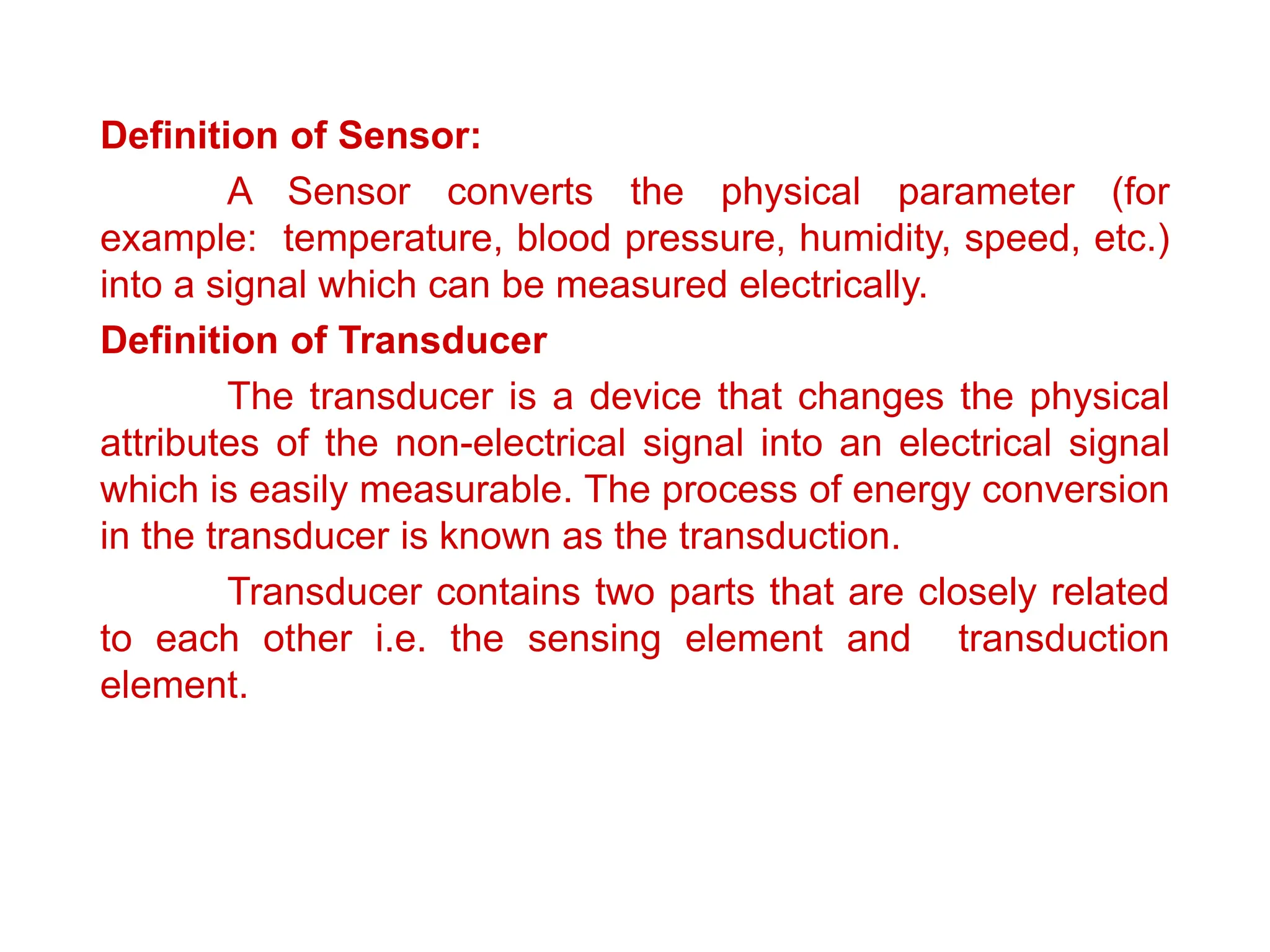
Definition of Sensor:
A Sensor converts the physical parameter (for
example: temperature, blood pressure, humidity, speed, etc.)
into a signal which can be measured electrically.
Definition of Transducer
The transducer is a device that changes the physical
attributes of the non-electrical signal into an electrical signal
which is easily measurable. The process of energy conversion
in the transducer is known as the transduction.
Transducer contains two parts that are closely related
to each other i.e. the sensing element and transduction
element.
• The sensing element is called as the sensor. It is device
producing measurable response to change in physical
conditions.
• The signal conditioning element convert the sensor output to
suitable electrical form.
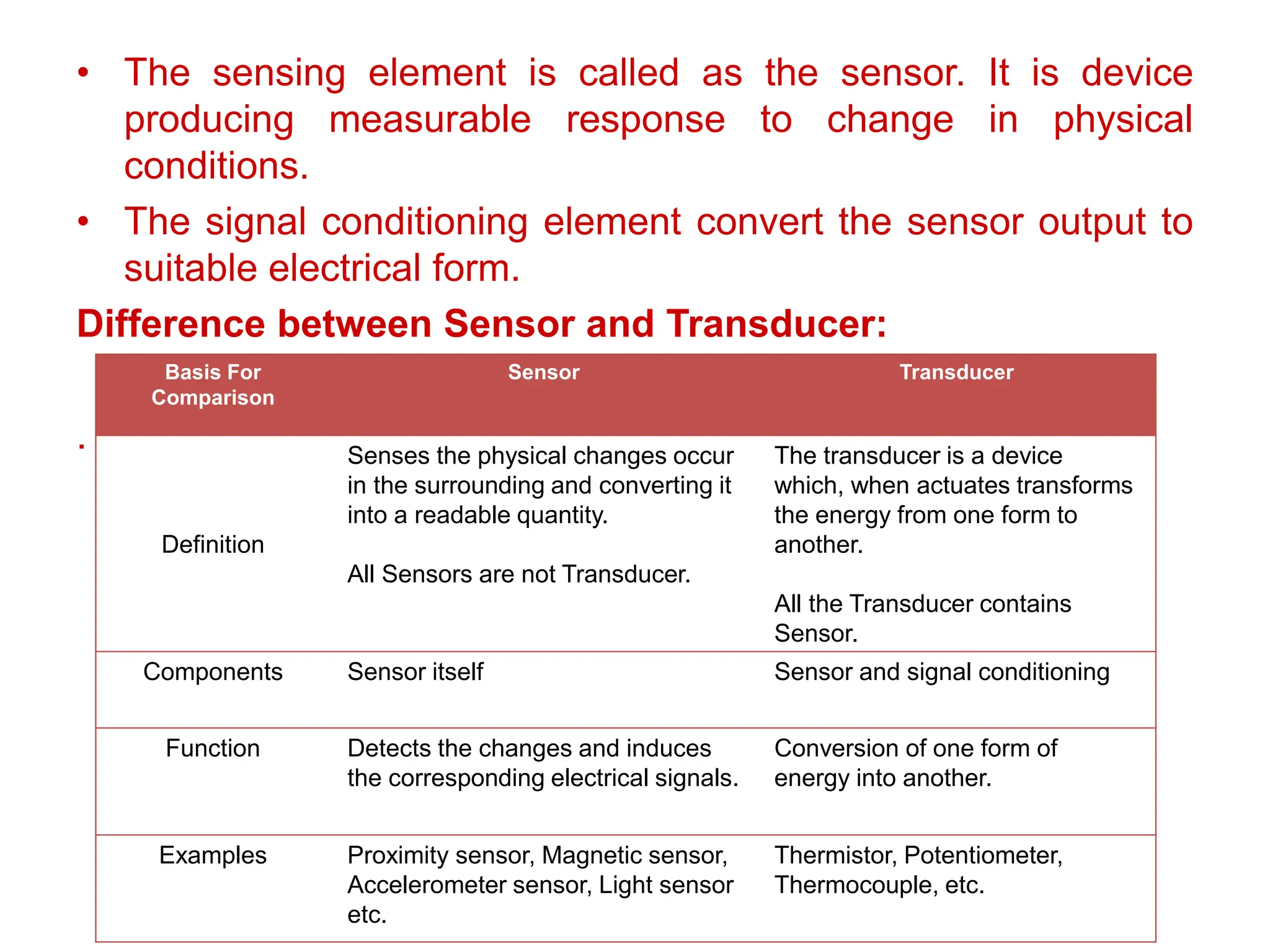
Difference between Sensor and Transducer:
.
Basis For
Comparison
Sensor Transducer
Definition
Senses the physical changes occur
in the surrounding and converting it
into a readable quantity.
All Sensors are not Transducer.
The transducer is a device
which, when actuates transforms
the energy from one form to
another.
All the Transducer contains
Sensor.
Components Sensor itself Sensor and signal conditioning
Function Detects the changes and induces
the corresponding electrical signals.
Conversion of one form of
energy into another.
Examples Proximity sensor, Magnetic sensor,
Accelerometer sensor, Light sensor
etc.
Thermistor, Potentiometer,
Thermocouple, etc.
CLASSIFICATION OF ERRORS:
Definition: The measurement error is defined as the difference
between the true or actual value and the measured value. The
true value is the average of the infinite number of
measurements, and the measured value is the precise value
Types of Errors in Measurement
The error may arise from the different source and are usually
classified into the following types. These types are
• Gross Errors
• Systematic Errors
• Random Errors
Systematic Errors
These types of systematic errors are generally categorized into three types which
are explained below in detail.
• Observational Errors
• Environmental Errors
• Instrumental Errors
Types of errors in
measurement
Random error
Systematic error
Gross error
Observational error
Environmental error
Instrumental error Abuse of apparatus
Inherent limitation of
device
Effect of loading
Observational Errors
The observational errors may occur due to the fault study of the instrument reading, and the
sources of these errors are many. For instance, the indicator of a voltmeter retunes a little over the
surface of the scale. As a result, a fault happens except the line of the image of the witness is
accurately above the indicator. To reduce the parallax error extremely precise meters are offered with
reflected scales.
Environmental Errors
Environmental errors will happen due to the outside situation of the measuring instruments. These
types of errors mostly happen due to the temperature result, force, moisture, dirt, vibration otherwise
because of the electrostatic field or magnetic. The remedial measures used to remove these unwanted
effects include the following.
• The preparation should be finished to remain the situations as stable as achievable.
• By the instrument which is at no cost from these results.
• With these methods which remove the result of these troubles.
• By applying the computed modifications.
Instrumental Errors:
Instrumental errors will happen due to some of the following reasons
• Inherent Limitation of devices
• Abuse of apparatus
• Effect of loading
An inherent limitation of Devices
These errors are integral in devices due to their features namely mechanical arrangement. These may
happen due to the instrument operation as well as the operation or computation of the instrument.
These types of errors will make the mistake to study very low otherwise very high.
Abuse of Apparatus
The error in the instrument happens due to the machinist’s fault. A superior device used in an
unintelligent method may provide a vast result. For instance the abuse of the apparatus may cause the
breakdown to change the zero of tools, poor early modification, with lead to very high resistance.
Improper observes of these may not reason for lasting harm to the device, except all the similar, they
cause faults.
Effect of Loading
The most frequent type of this error will occur due to the measurement work in the device. For
instance, as the voltmeter is associated to the high-resistance circuit which will give a false reading, as
well as after it is allied to the low-resistance circuit, this circuit will give the reliable reading, and then
the voltmeter will have the effect of loading on the circuit.
Gross Errors
Gross errors can be defined as physical errors in analysis apparatus or calculating and recording
measurement outcomes. In general, these types of errors will happen throughout the experiments,
wherever the researcher might study or record a worth different from the real one, possibly due to a
reduced view. With human concern, types of errors will predictable, although they can be estimated
and corrected.
These types of errors can be prohibited by the following couple of actions:
• Careful reading as well as a recording of information.
• Taking numerous readings of the instrument by different operators.
• Secure contracts between different understandings guarantee the elimination of every gross error.
Random Errors
This type of error is constantly there in a measurement, which is occurred by essentially random
oscillations in the apparatus measurement analysis or in the experimenter’s understanding of the
apparatus reading. These types of errors show up as dissimilar outcomes for apparently the similar
frequent measurement, which can be expected by contrasting numerous measurements, with
condensed by averaging numerous measurements.
ERROR ANALYSIS
• Statistical Analysis
• Average or Arithmetic mean value
• Deviation from average value
• Average Deviation
• Gaussian distribution of error
• Standard Deviation
• Variance
Statistical Analysis
Statistical methods are frequently used to find the most probable value from a group of readings taken
from a given experiment. It is also possible to determine the probable error in one reading and the
degree of uncertainty in the most probable value.
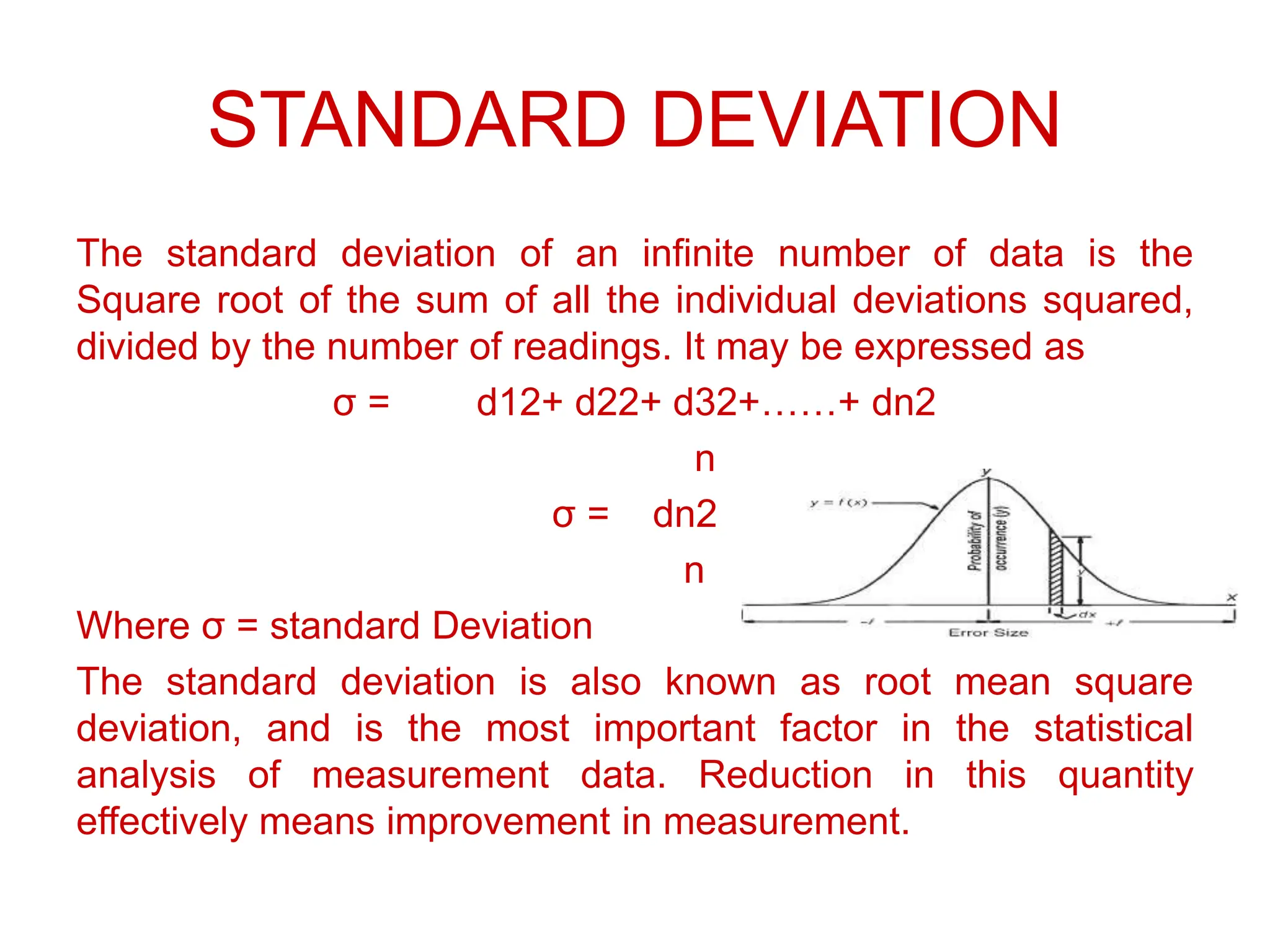
STANDARD DEVIATION
The standard deviation of an infinite number of data is the
Square root of the sum of all the individual deviations squared,
divided by the number of readings. It may be expressed as
σ = d12+ d22+ d32+……+ dn2
n
σ = dn2
n
Where σ = standard Deviation
The standard deviation is also known as root mean square
deviation, and is the most important factor in the statistical
analysis of measurement data. Reduction in this quantity
effectively means improvement in measurement.
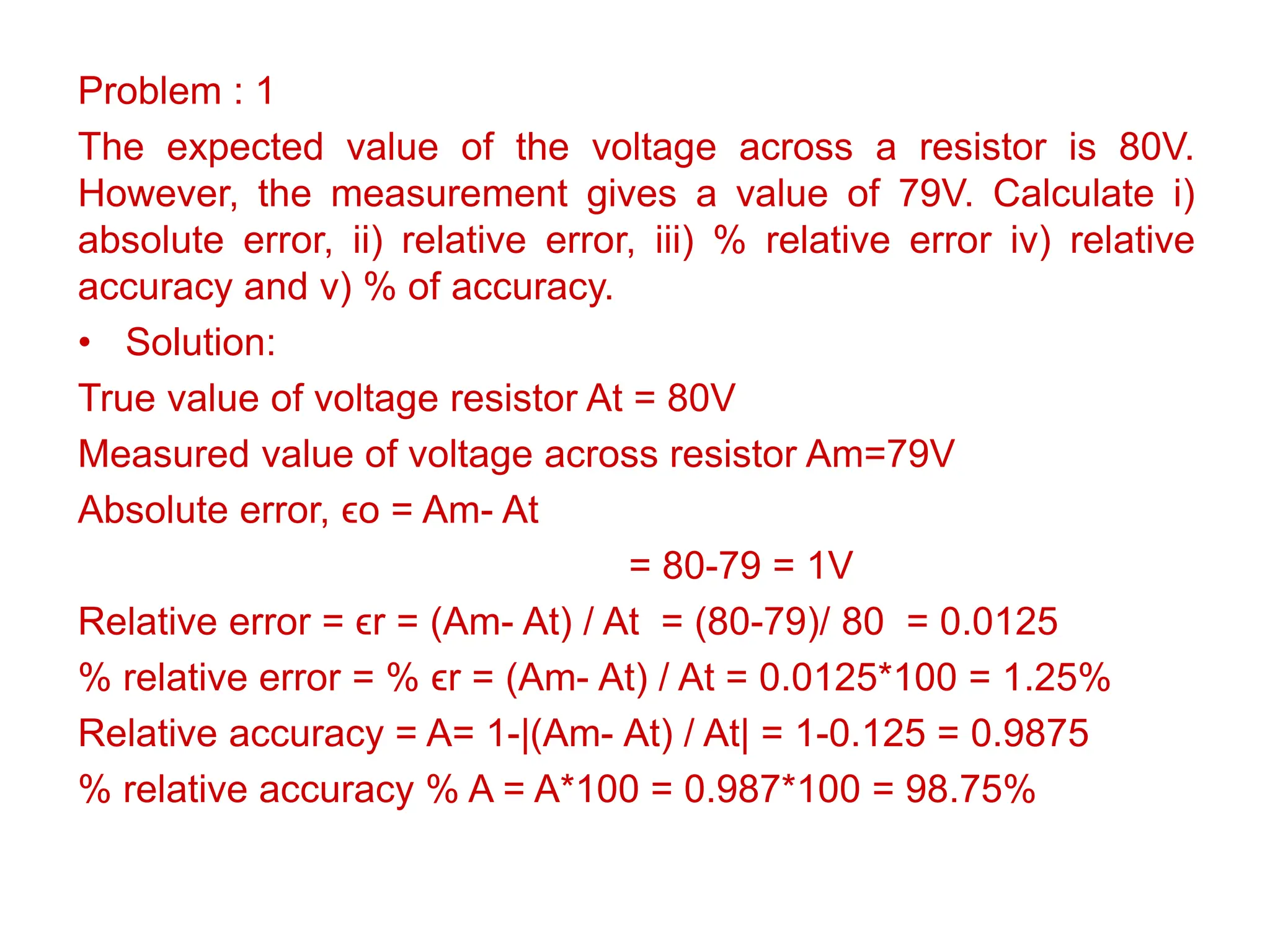
Problem : 1
The expected value of the voltage across a resistor is 80V.
However, the measurement gives a value of 79V. Calculate i)
absolute error, ii) relative error, iii) % relative error iv) relative
accuracy and v) % of accuracy.
• Solution:
True value of voltage resistor At = 80V
Measured value of voltage across resistor Am=79V
Absolute error, ϵo = Am- At
= 80-79 = 1V
Relative error = ϵr = (Am- At) / At = (80-79)/ 80 = 0.0125
% relative error = % ϵr = (Am- At) / At = 0.0125*100 = 1.25%
Relative accuracy = A= 1-|(Am- At) / At| = 1-0.125 = 0.9875
% relative accuracy % A = A*100 = 0.987*100 = 98.75%
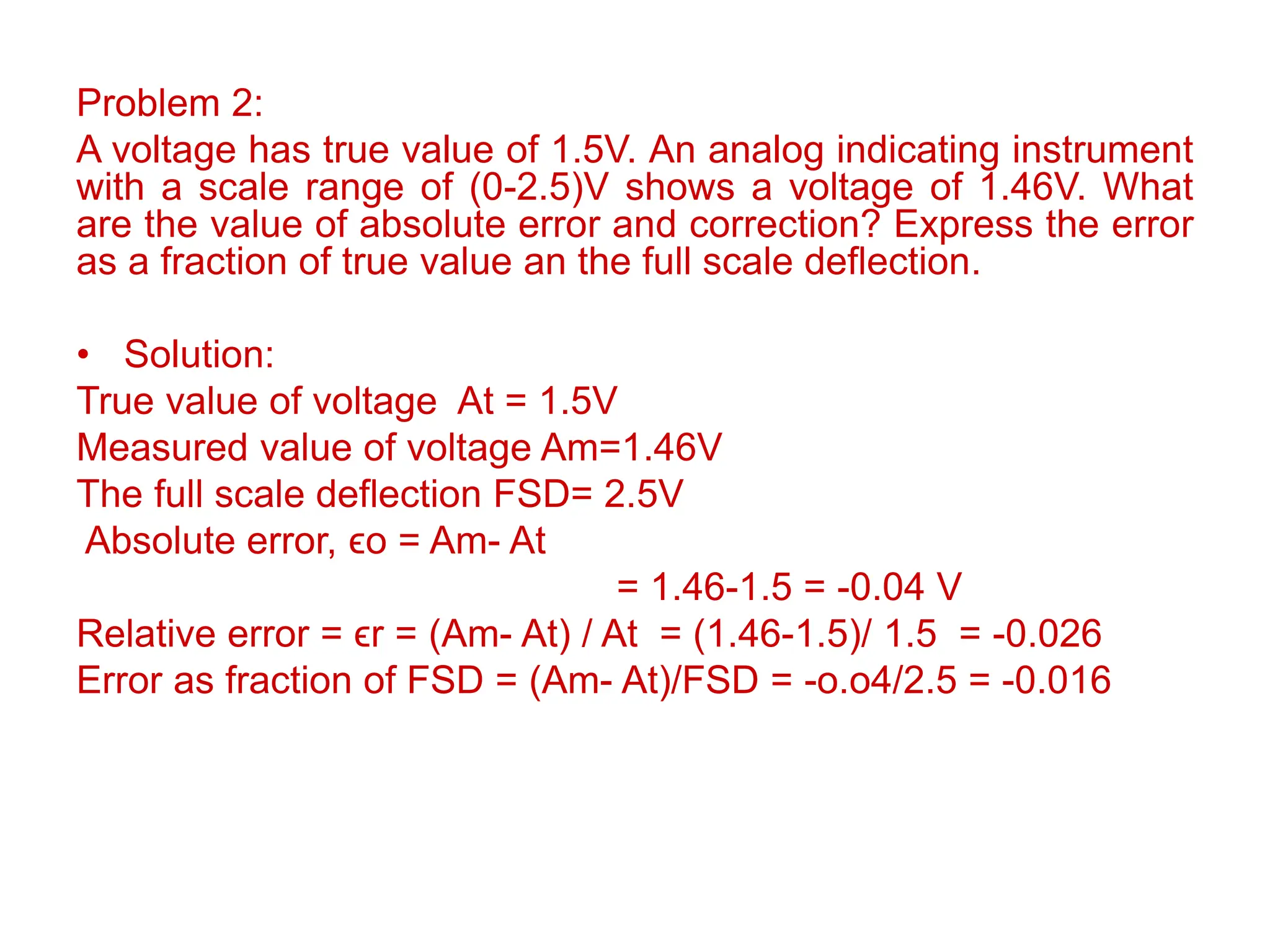
Problem 2:
A voltage has true value of 1.5V. An analog indicating instrument
with a scale range of (0-2.5)V shows a voltage of 1.46V. What
are the value of absolute error and correction? Express the error
as a fraction of true value an the full scale deflection.
• Solution:
True value of voltage At = 1.5V
Measured value of voltage Am=1.46V
The full scale deflection FSD= 2.5V
Absolute error, ϵo = Am- At
= 1.46-1.5 = -0.04 V
Relative error = ϵr = (Am- At) / At = (1.46-1.5)/ 1.5 = -0.026
Error as fraction of FSD = (Am- At)/FSD = -o.o4/2.5 = -0.016
STATIC AND DYNAMIC CHARACTERISTICS OF
TRANSDUCERS:
• The set of criteria defined for the instruments, which are used to measure the
quantities which are slowly varying with time or mostly constant, i.e., do not vary
with time, is called ‘static characteristics’.
• The various static characteristics are:
• Accuracy
• Precision
• Sensitivity
• Linearity
• Reproducibility
• Repeatability
• Resolution
• Threshold
• Drift
• Stability
• Tolerance
• Range or span
Accuracy:
Accuracy is the closeness with which the instrument reading approaches the true
value of the variable under measurement. Accuracy is determined as the maximum
amount by which the result differs from the true value. It is almost impossible to
determine experimentally the true value. The true value is not indicated by any
measurement system due to the loading effect, lags and mechanical problems (e.g.,
wear, hysteresis, noise, etc.).
Accuracy of the measured signal depends upon the following factors:
• Intrinsic accuracy of the instrument itself;
• Accuracy of the observer;
• Variation of the signal to be measured; and
• Whether or not the quantity is being truly impressed upon the instrument.
Unit of accuracy:
1. Percentage of true value = (Measured value – True value) * 100
True Value
2.Percentage of full scale deflection = (Measured value – True value) * 100
Maximum Scale value
Precision:
It is the measure of reproducibility i.e., given a fixed value of a quantity, precision is
a measure of the degree of agreement within a group of measurements. The
precision is composed of two characteristics:
Reproducibility:
It is the degree of closeness with which a given value may be repeatedly measured.
It is specified in terms of scale readings over a given period of time.
Resolution:
If the input is slowly increased from some arbitrary input value, it will again be found
that output does not change at all until a certain increment is exceeded. This
increment is called resolution.
Threshold:
If the instrument input is increased very gradually from zero there will be some
minimum value below which no output change can be detected. This minimum
value defines the threshold of the instrument.
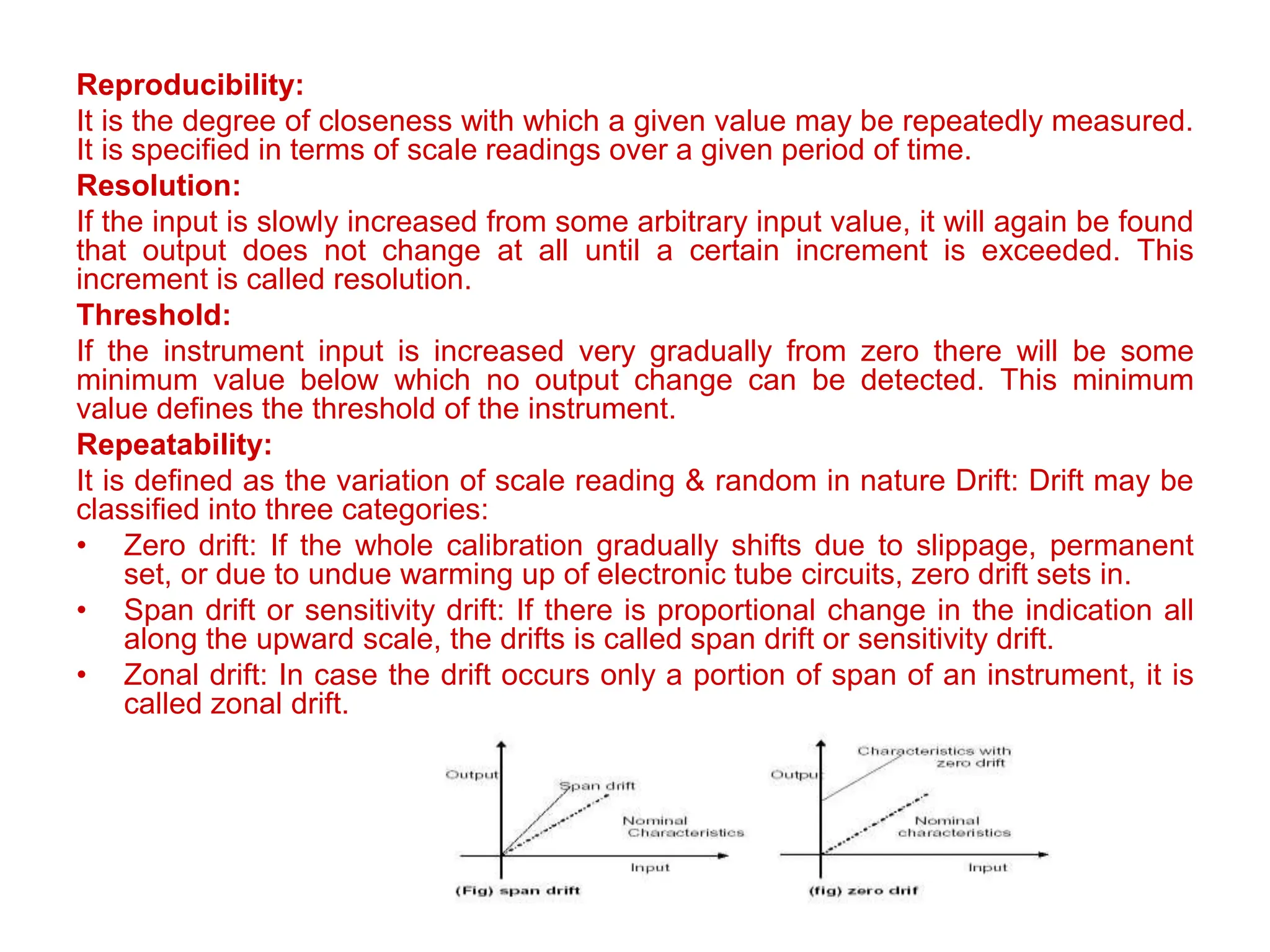
Repeatability:
It is defined as the variation of scale reading & random in nature Drift: Drift may be
classified into three categories:
• Zero drift: If the whole calibration gradually shifts due to slippage, permanent
set, or due to undue warming up of electronic tube circuits, zero drift sets in.
• Span drift or sensitivity drift: If there is proportional change in the indication all
along the upward scale, the drifts is called span drift or sensitivity drift.
• Zonal drift: In case the drift occurs only a portion of span of an instrument, it is
called zonal drift.
Stability:
It is the ability of an instrument to retain its performance throughout is
specified operating life.
Tolerance:
The maximum allowable error in the measurement is specified in terms
of some value which is called tolerance.
Range or span:
The minimum & maximum values of a quantity for which an instrument
is designed to measure is called its range or span.
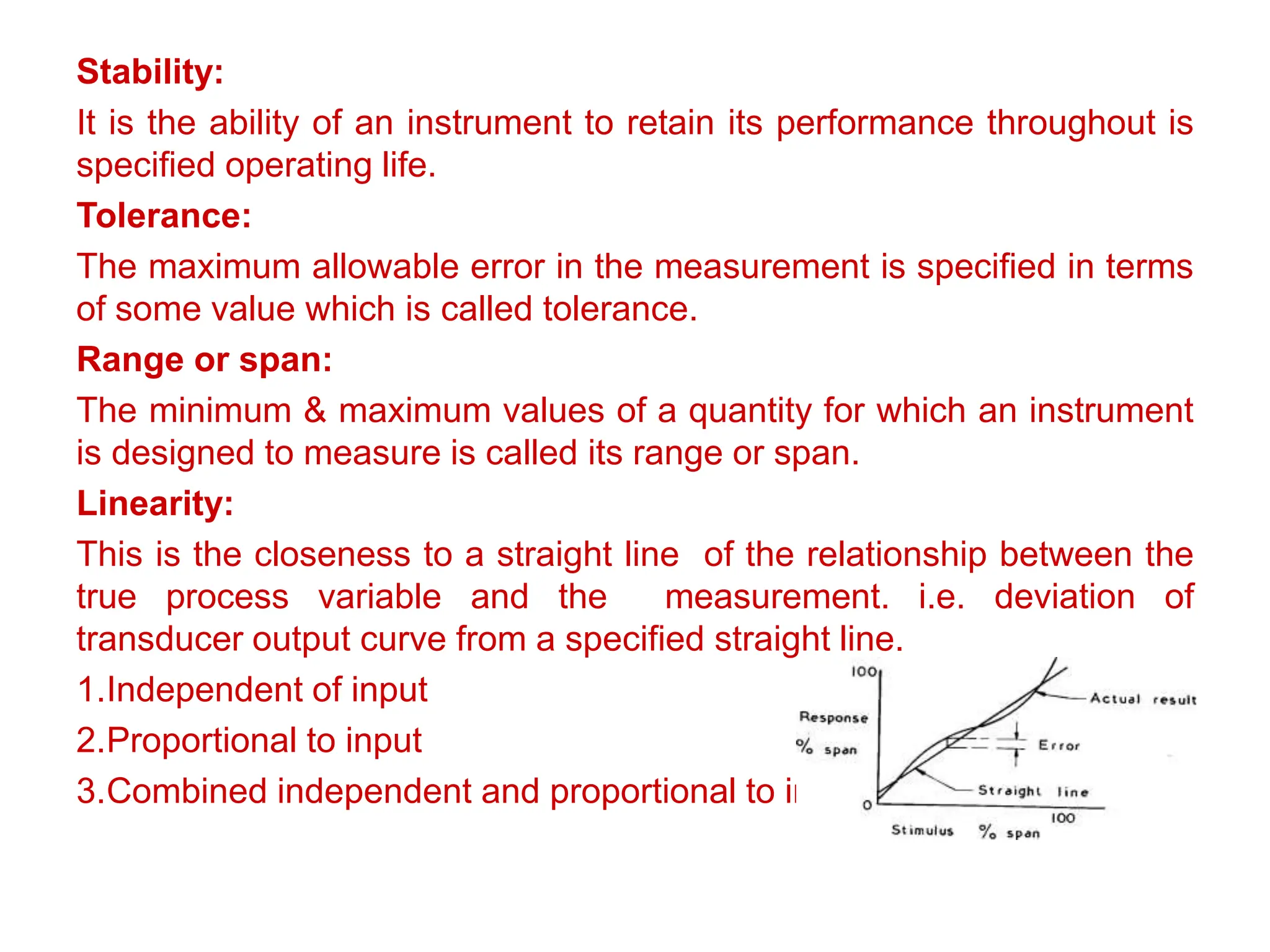
Linearity:
This is the closeness to a straight line of the relationship between the
true process variable and the measurement. i.e. deviation of
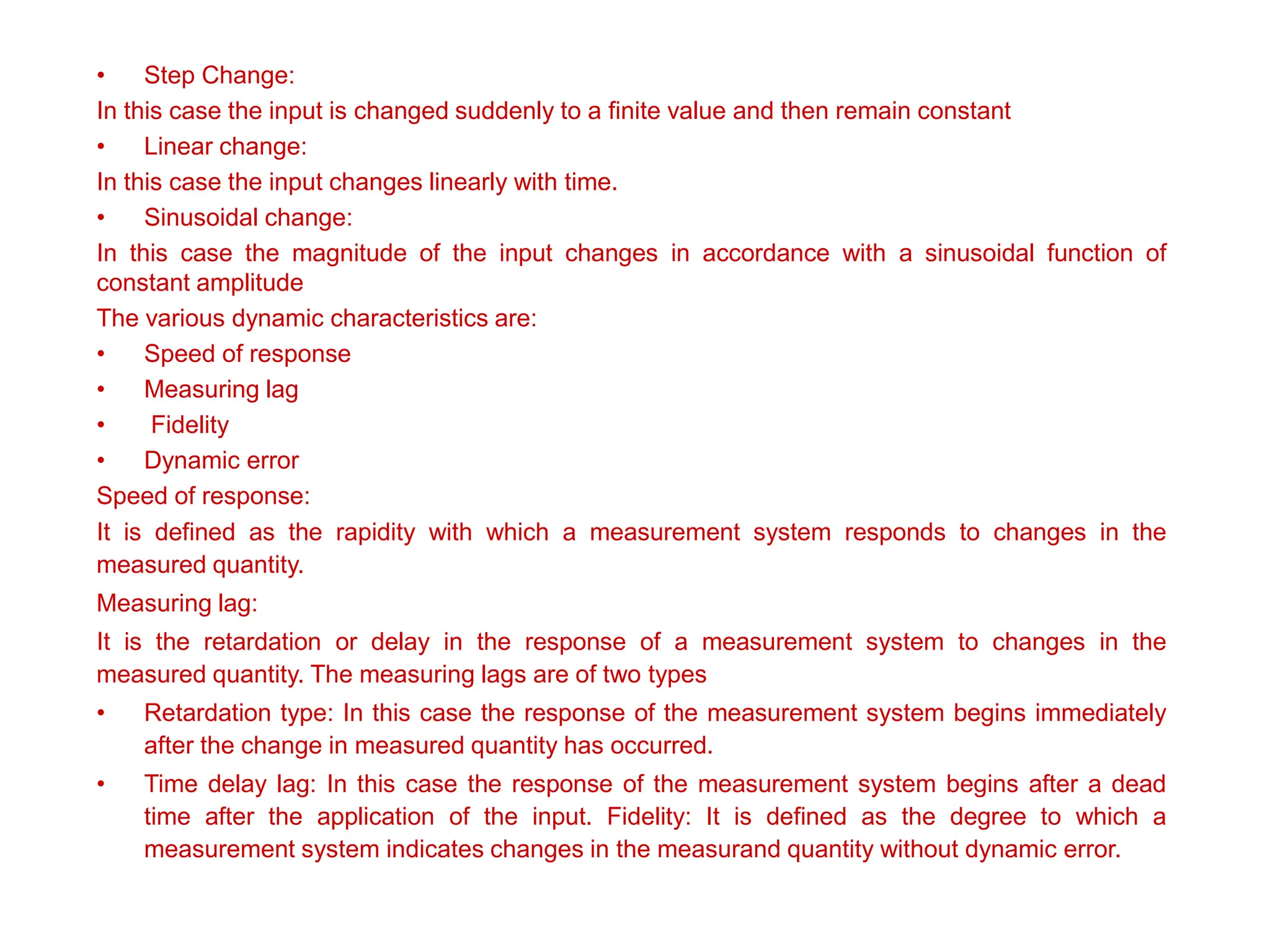
transducer output curve from a specified straight line.
1.Independent of input
2.Proportional to input
3.Combined independent and proportional to input
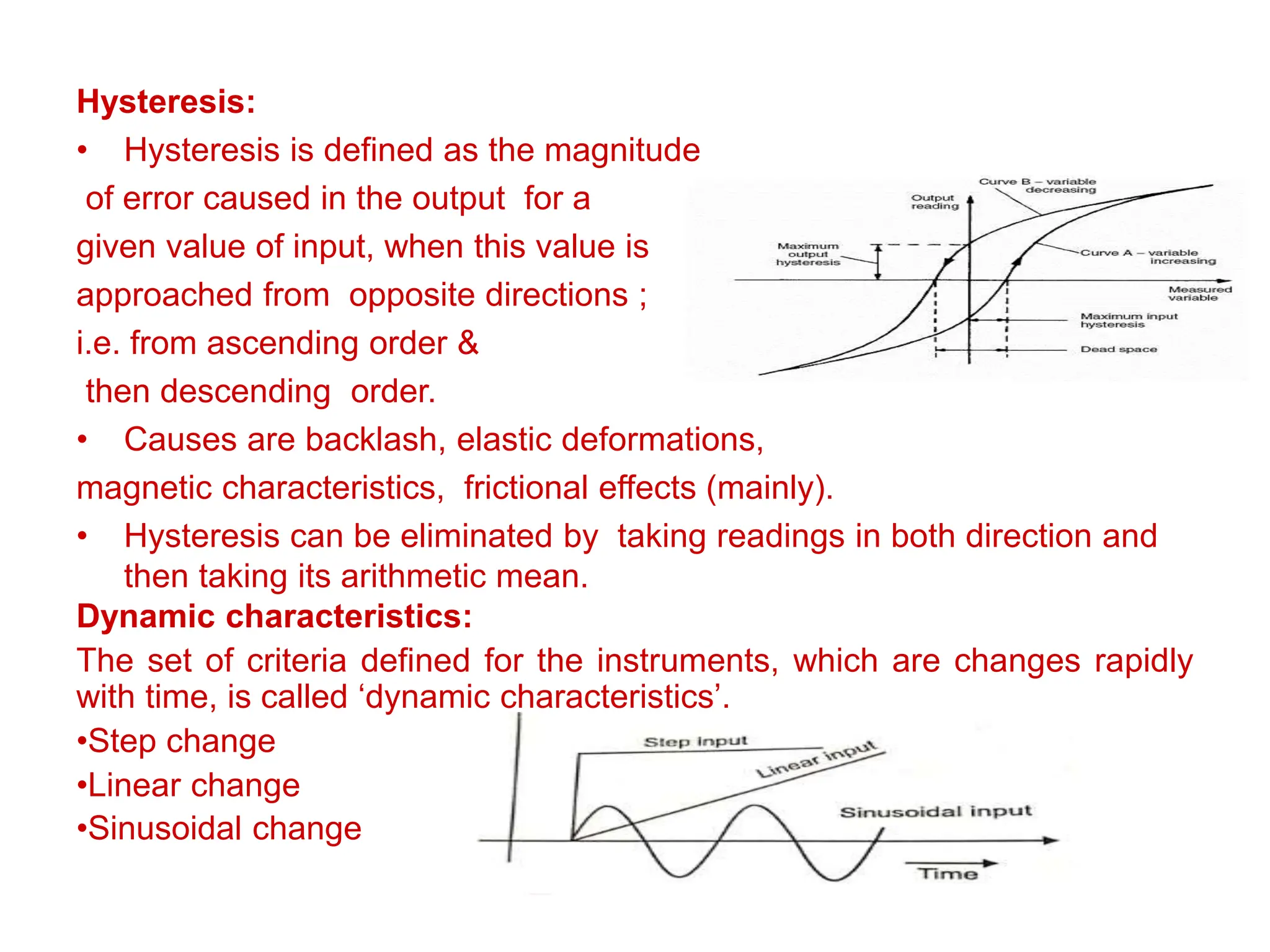
Hysteresis:
• Hysteresis is defined as the magnitude
of error caused in the output for a
given value of input, when this value is
approached from opposite directions ;
i.e. from ascending order &
then descending order.
• Causes are backlash, elastic deformations,
magnetic characteristics, frictional effects (mainly).
• Hysteresis can be eliminated by taking readings in both direction and
then taking its arithmetic mean.
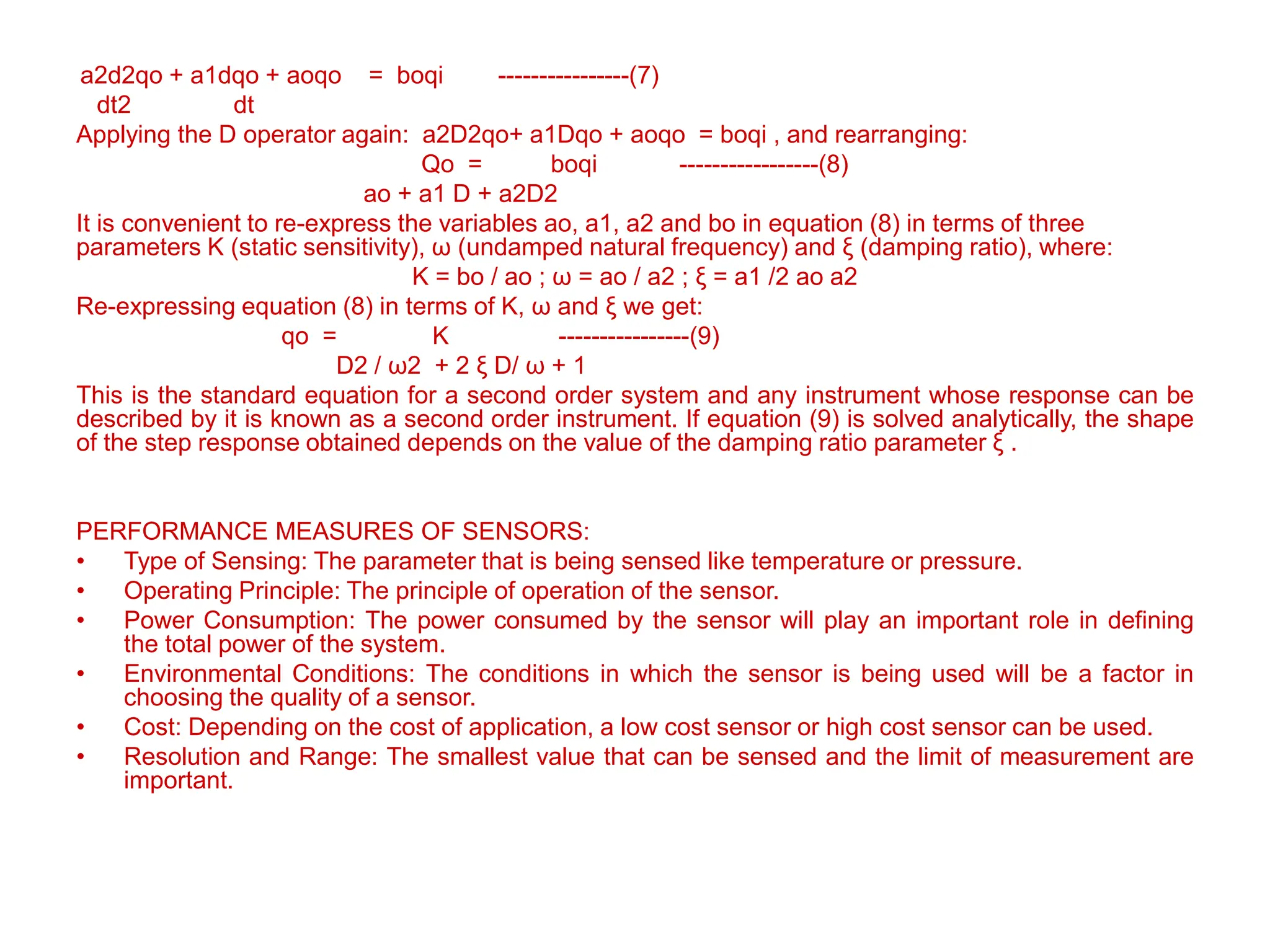
Dynamic characteristics:
The set of criteria defined for the instruments, which are changes rapidly
with time, is called ‘dynamic characteristics’.
•Step change
•Linear change
•Sinusoidal change
• Step Change:
In this case the input is changed suddenly to a finite value and then remain constant
• Linear change:
In this case the input changes linearly with time.
• Sinusoidal change:
In this case the magnitude of the input changes in accordance with a sinusoidal function of
constant amplitude
The various dynamic characteristics are:
• Speed of response
• Measuring lag
• Fidelity
• Dynamic error
Speed of response:
It is defined as the rapidity with which a measurement system responds to changes in the
measured quantity.
Measuring lag:
It is the retardation or delay in the response of a measurement system to changes in the
measured quantity. The measuring lags are of two types
• Retardation type: In this case the response of the measurement system begins immediately
after the change in measured quantity has occurred.
• Time delay lag: In this case the response of the measurement system begins after a dead
time after the application of the input. Fidelity: It is defined as the degree to which a
measurement system indicates changes in the measurand quantity without dynamic error.
Fidelity:
It is defined as the degree to which a measurement system indicates changes in the measurand quantity
without dynamic error.
Dynamic error:
It is the difference between the true value of the quantity changing with time & the value indicated by the
measurement system if no static error is assumed. It is also called measurement error.
Dynamic Characteristics of Transducers
The dynamic characteristic of transducer refers to the performance of the transducer when it is subjected to
time varying input
The number of parameters required to define the dynamic behavior of a transducer is decided by the group to
which the transducer belongs
The transducers can be categorized into
1. Zero-order transducers
2. First-order transducers
3. Second-order transducers
The dynamic characteristics of a measuring instrument describe its behaviour between the time a measured
quantity changes value and the time when the instrument output attains a steady value in response. As with
static characteristics, any values for dynamic characteristics quoted in instrument data sheets only apply
when the instrument is used under specified environmental conditions. Outside these calibration conditions,
some variation in the dynamic parameters can be expected. In any linear, time-invariant measuring system,
the following general relation can be written between input and output for time
(t) > 0:
an dnqo +an-1dn-1qo+…….+a1dqo + aoqo = bm dmqi + am-1dm-1qi +…….+ b1dqi + boqi
dtn dtn-1 dt dtm dtm-1 dt
---------------------(1)
where qi is the measured quantity, qo is the output reading and ao ... an, bo ... bm are constants.
If we limit consideration to that of step changes in the measured quantity only, then equation (1) reduces to:
an dnqo +an-1dn-1qo+…….+a1dqo + aoqo = boqi ----------------(2)
dtn dtn-1 dt
Dynamic Response of Zero-order Instruments
If all the coefficients a1 ... an other than ao in equation (2) are assumed zero, then:
aoqo = boqi or qo = boqi / ao = Kqi -------------(3)
K = bo / ao
where K is a constant known as the instrument sensitivity as defined earlier. Any instrument
that behaves according to equation (3) is said to be of zero order type. Following a step change
in the measured quantity at time t, the instrument output moves immediately to a new value at
the same time instant t.
Dynamic Response of a First Order Instrument:
If all the coefficients a2 ...an except for ao and a1 are assumed zero in equation (2) then:
a1dqo + aoqo = boqi ----------------(4)
dt
Any instrument that behaves according to equation (4) is known as a first order instrument. If
d/dt is replaced by the D operator in equation (4), we get:
a1Dqo+aoqo = boqi
and rearranging this then gives qo = (bo / ao ) qi ------------(5)
[1+(a1/ao)D]
Defining K = bo/ao as the static sensitivity and ԏ = a1/ao as the time constant of the system,
equation (5) becomes:
qo = K qi -----------------(6)
1+ԏD
If equation (6) is solved analytically, the output quantity qo in response to a step change in qi at
time t varies with time in the manner
Dynamic Response of Second Order Instrument :
A second order instrument is defined as one that follows the equation
a2d2qo + a1dqo + aoqo = boqi ----------------(7)
dt2 dt
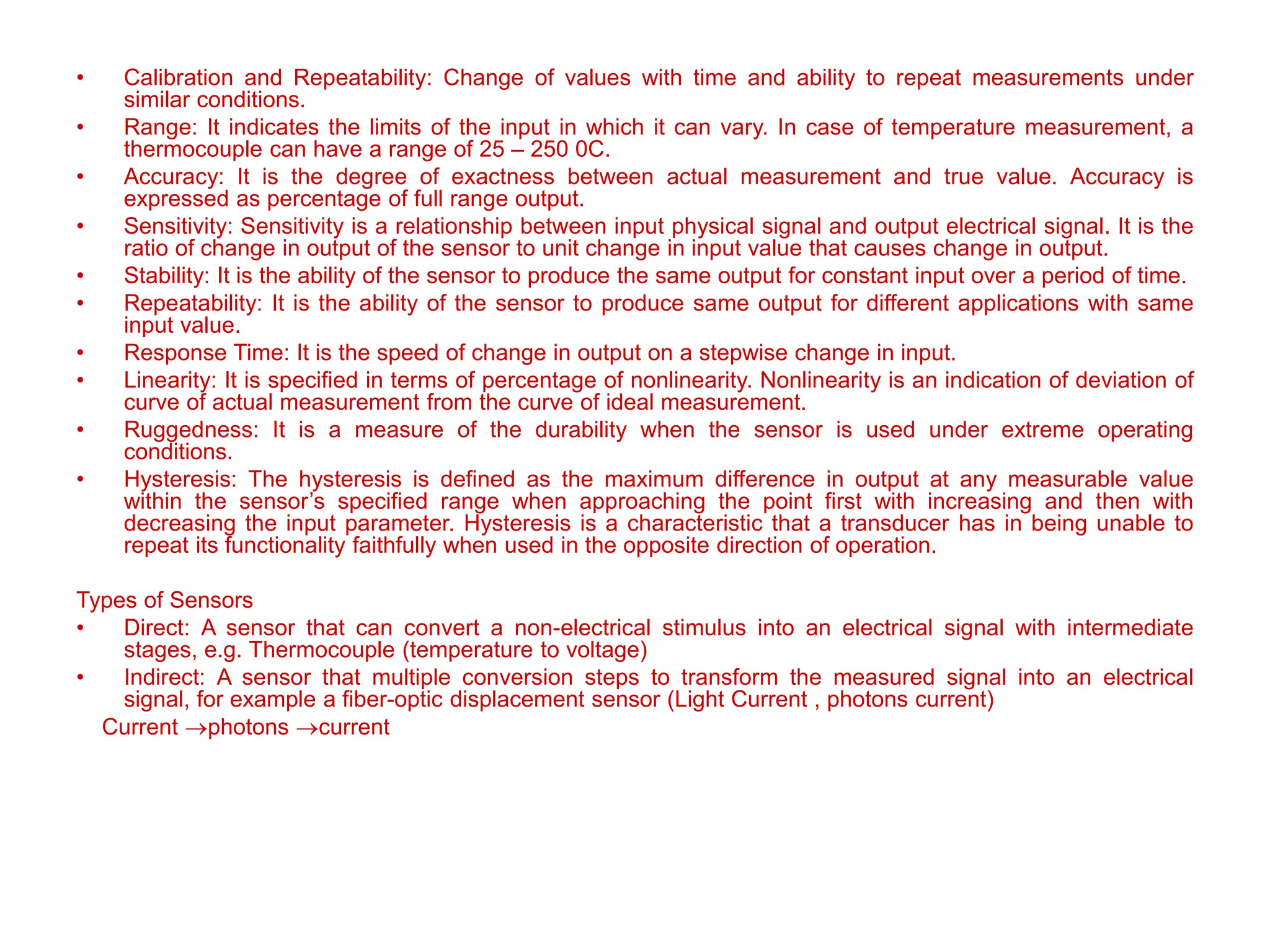
Applying the D operator again: a2D2qo+ a1Dqo + aoqo = boqi , and rearranging:
Qo = boqi -----------------(8)
ao + a1 D + a2D2
It is convenient to re-express the variables ao, a1, a2 and bo in equation (8) in terms of three
parameters K (static sensitivity), ω (undamped natural frequency) and ξ (damping ratio), where:
K = bo / ao ; ω = ao / a2 ; ξ = a1 /2 ao a2
Re-expressing equation (8) in terms of K, ω and ξ we get:
qo = K ----------------(9)
D2 / ω2 + 2 ξ D/ ω + 1
This is the standard equation for a second order system and any instrument whose response can be
described by it is known as a second order instrument. If equation (9) is solved analytically, the shape
of the step response obtained depends on the value of the damping ratio parameter ξ .
PERFORMANCE MEASURES OF SENSORS:
• Type of Sensing: The parameter that is being sensed like temperature or pressure.
• Operating Principle: The principle of operation of the sensor.
• Power Consumption: The power consumed by the sensor will play an important role in defining
the total power of the system.
• Environmental Conditions: The conditions in which the sensor is being used will be a factor in
choosing the quality of a sensor.
• Cost: Depending on the cost of application, a low cost sensor or high cost sensor can be used.
• Resolution and Range: The smallest value that can be sensed and the limit of measurement are
important.
• Calibration and Repeatability: Change of values with time and ability to repeat measurements under
similar conditions.
• Range: It indicates the limits of the input in which it can vary. In case of temperature measurement, a
thermocouple can have a range of 25 – 250 0C.
• Accuracy: It is the degree of exactness between actual measurement and true value. Accuracy is
expressed as percentage of full range output.
• Sensitivity: Sensitivity is a relationship between input physical signal and output electrical signal. It is the
ratio of change in output of the sensor to unit change in input value that causes change in output.
• Stability: It is the ability of the sensor to produce the same output for constant input over a period of time.
• Repeatability: It is the ability of the sensor to produce same output for different applications with same
input value.
• Response Time: It is the speed of change in output on a stepwise change in input.
• Linearity: It is specified in terms of percentage of nonlinearity. Nonlinearity is an indication of deviation of
curve of actual measurement from the curve of ideal measurement.
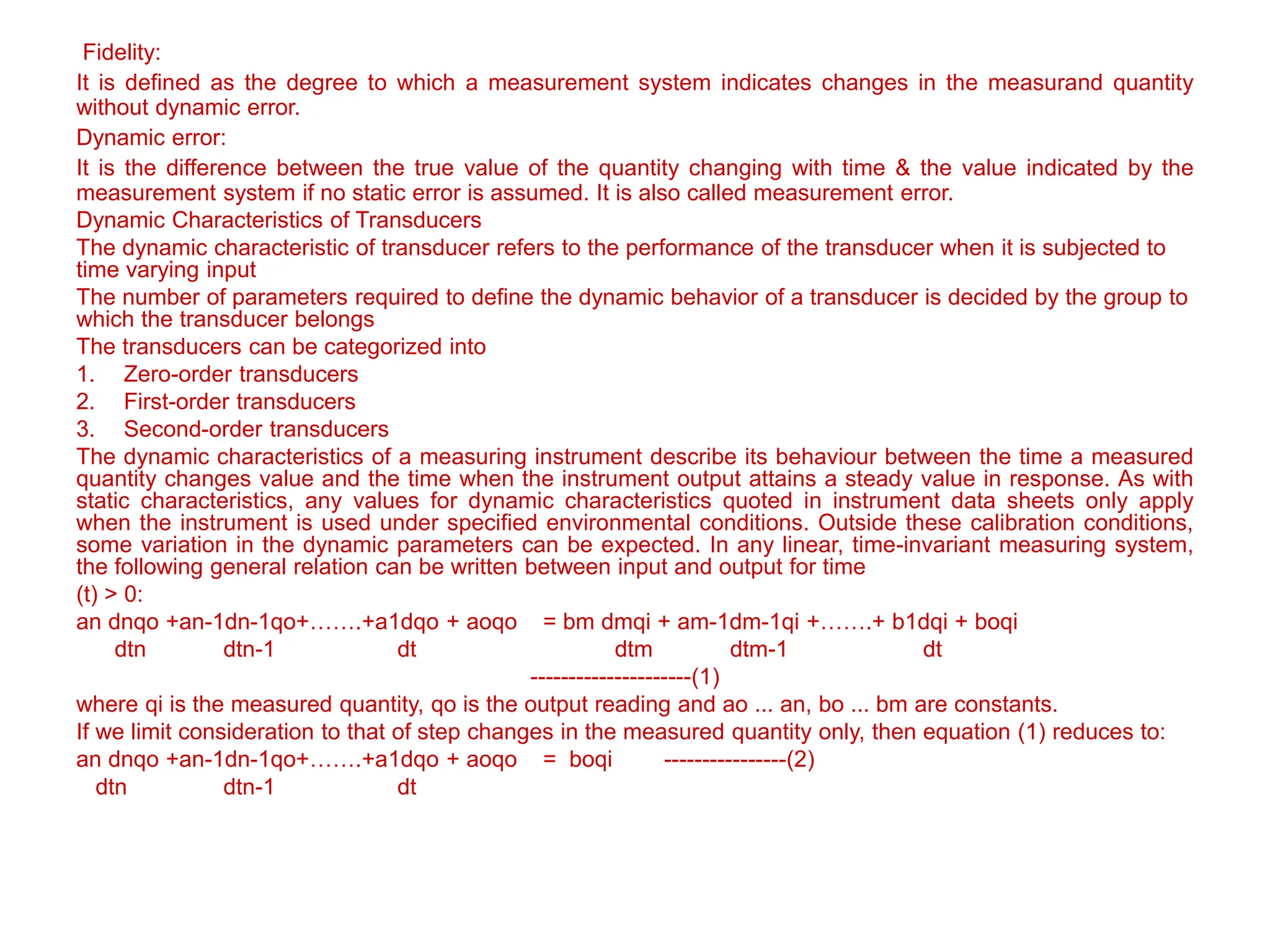
• Ruggedness: It is a measure of the durability when the sensor is used under extreme operating
conditions.
• Hysteresis: The hysteresis is defined as the maximum difference in output at any measurable value
within the sensor’s specified range when approaching the point first with increasing and then with
decreasing the input parameter. Hysteresis is a characteristic that a transducer has in being unable to
repeat its functionality faithfully when used in the opposite direction of operation.
Types of Sensors
• Direct: A sensor that can convert a non-electrical stimulus into an electrical signal with intermediate
stages, e.g. Thermocouple (temperature to voltage)
• Indirect: A sensor that multiple conversion steps to transform the measured signal into an electrical
signal, for example a fiber-optic displacement sensor (Light Current , photons current)
Current photons current
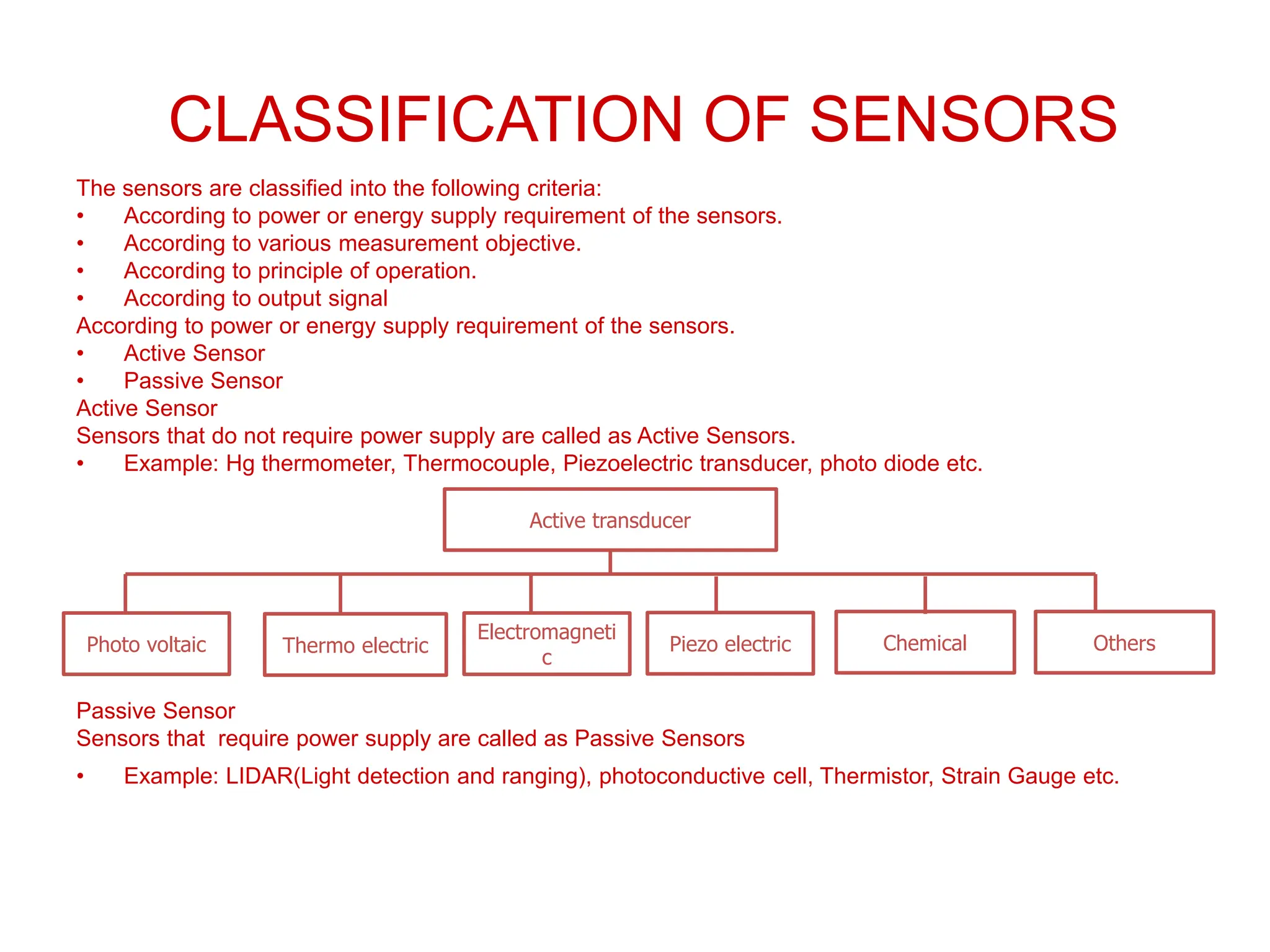
CLASSIFICATION OF SENSORS
The sensors are classified into the following criteria:
• According to power or energy supply requirement of the sensors.
• According to various measurement objective.
• According to principle of operation.
• According to output signal
According to power or energy supply requirement of the sensors.
• Active Sensor
• Passive Sensor
Active Sensor
Sensors that do not require power supply are called as Active Sensors.
• Example: Hg thermometer, Thermocouple, Piezoelectric transducer, photo diode etc.
Passive Sensor
Sensors that require power supply are called as Passive Sensors
• Example: LIDAR(Light detection and ranging), photoconductive cell, Thermistor, Strain Gauge etc.
Active transducer
Others
Chemical
Piezo electric
Electromagneti
c
Thermo electric
Photo voltaic
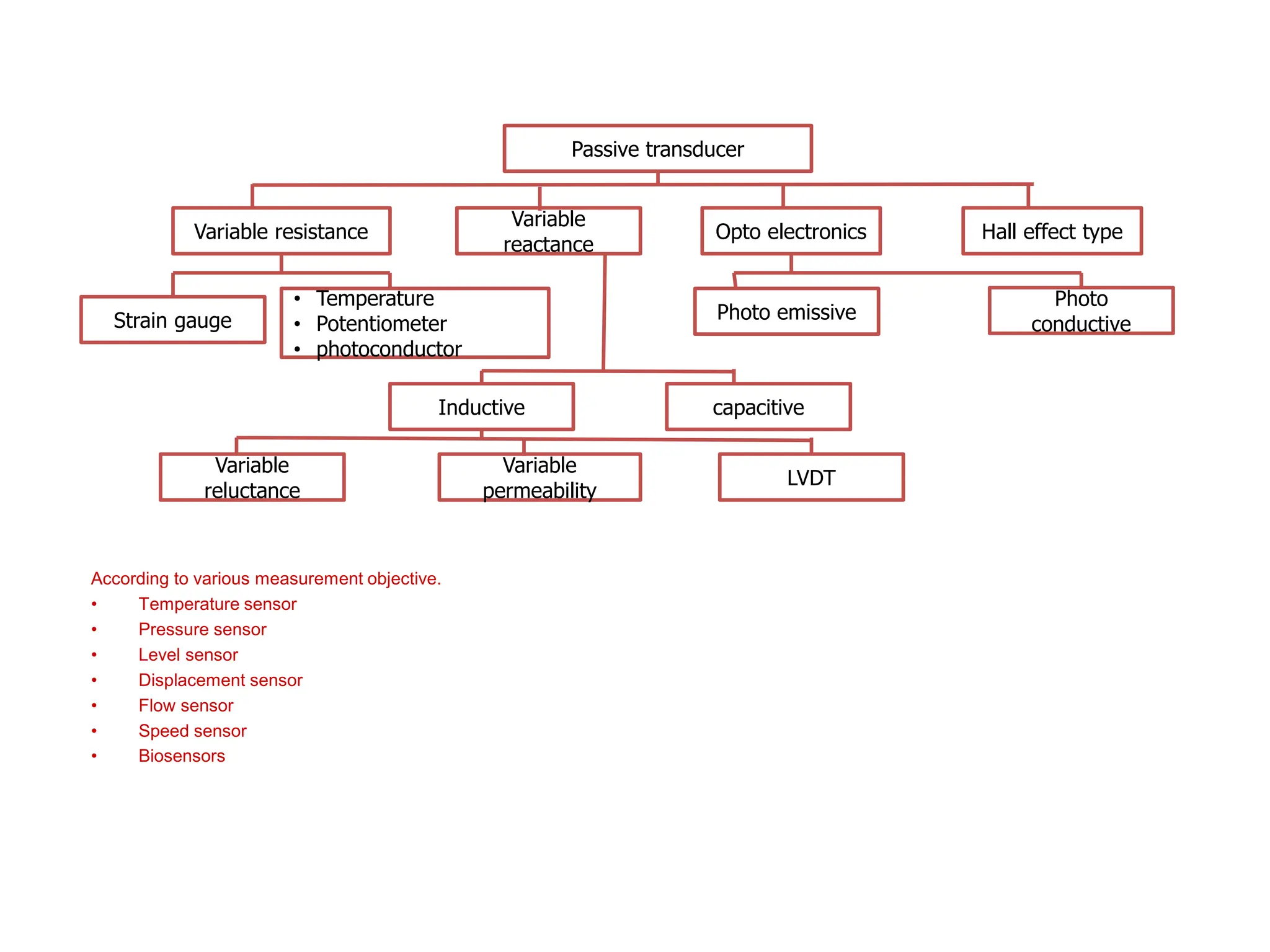
According to various measurement objective.
• Temperature sensor
• Pressure sensor
• Level sensor
• Displacement sensor
• Flow sensor
• Speed sensor
• Biosensors
Passive transducer
Variable resistance Opto electronics
Variable
reactance
Hall effect type
• Temperature
• Potentiometer
• photoconductor
Strain gauge
Photo
conductive
Photo emissive
capacitive
Inductive
LVDT
Variable
permeability
Variable
reluctance
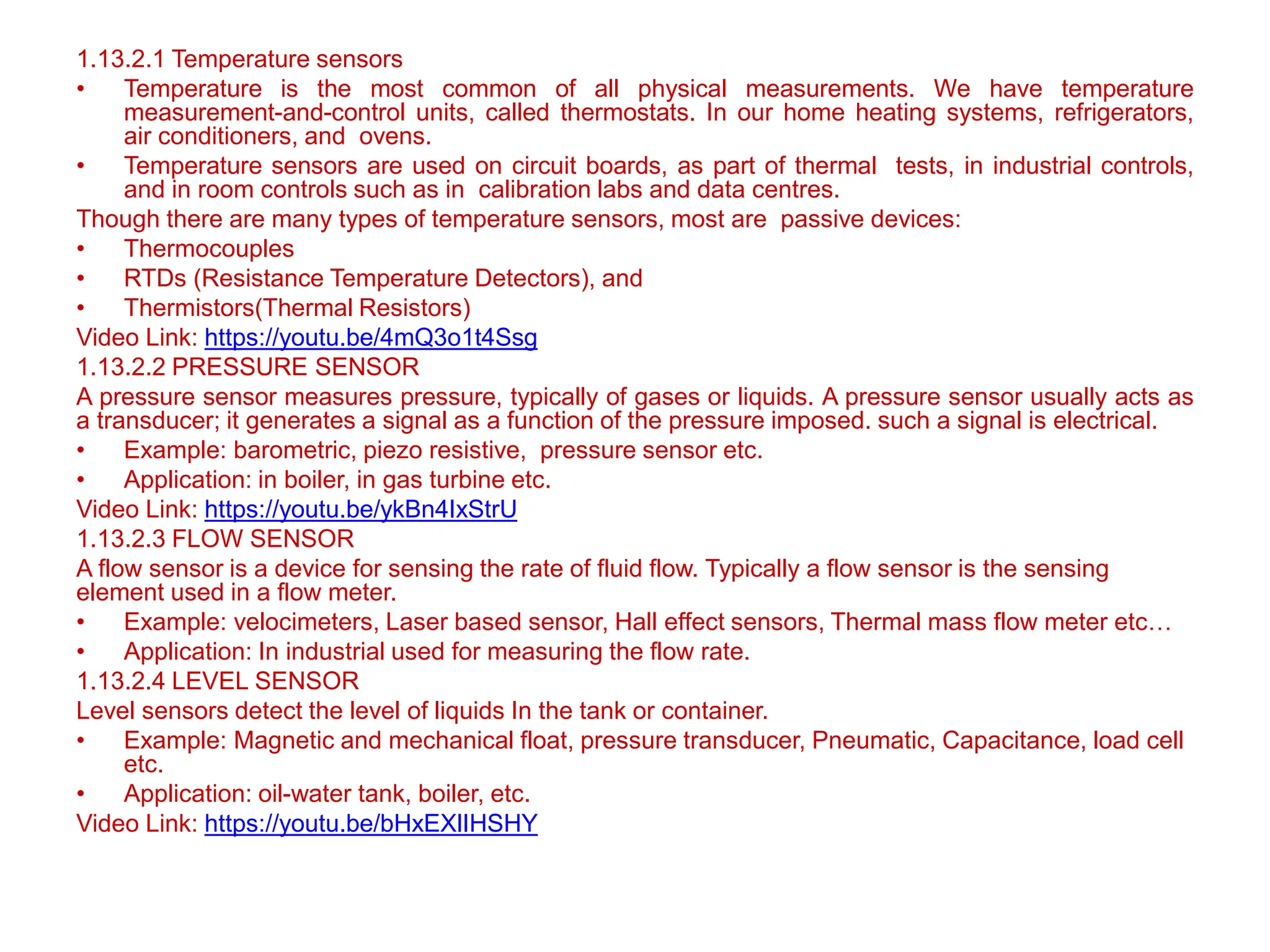
1.13.2.1 Temperature sensors
• Temperature is the most common of all physical measurements. We have temperature
measurement-and-control units, called thermostats. In our home heating systems, refrigerators,
air conditioners, and ovens.
• Temperature sensors are used on circuit boards, as part of thermal tests, in industrial controls,
and in room controls such as in calibration labs and data centres.
Though there are many types of temperature sensors, most are passive devices:
• Thermocouples
• RTDs (Resistance Temperature Detectors), and
• Thermistors(Thermal Resistors)
Video Link: https://youtu.be/4mQ3o1t4Ssg
1.13.2.2 PRESSURE SENSOR
A pressure sensor measures pressure, typically of gases or liquids. A pressure sensor usually acts as
a transducer; it generates a signal as a function of the pressure imposed. such a signal is electrical.
• Example: barometric, piezo resistive, pressure sensor etc.
• Application: in boiler, in gas turbine etc.
Video Link: https://youtu.be/ykBn4IxStrU
1.13.2.3 FLOW SENSOR
A flow sensor is a device for sensing the rate of fluid flow. Typically a flow sensor is the sensing
element used in a flow meter.
• Example: velocimeters, Laser based sensor, Hall effect sensors, Thermal mass flow meter etc…
• Application: In industrial used for measuring the flow rate.
1.13.2.4 LEVEL SENSOR
Level sensors detect the level of liquids In the tank or container.
• Example: Magnetic and mechanical float, pressure transducer, Pneumatic, Capacitance, load cell
etc.
• Application: oil-water tank, boiler, etc.
Video Link: https://youtu.be/bHxEXlIHSHY
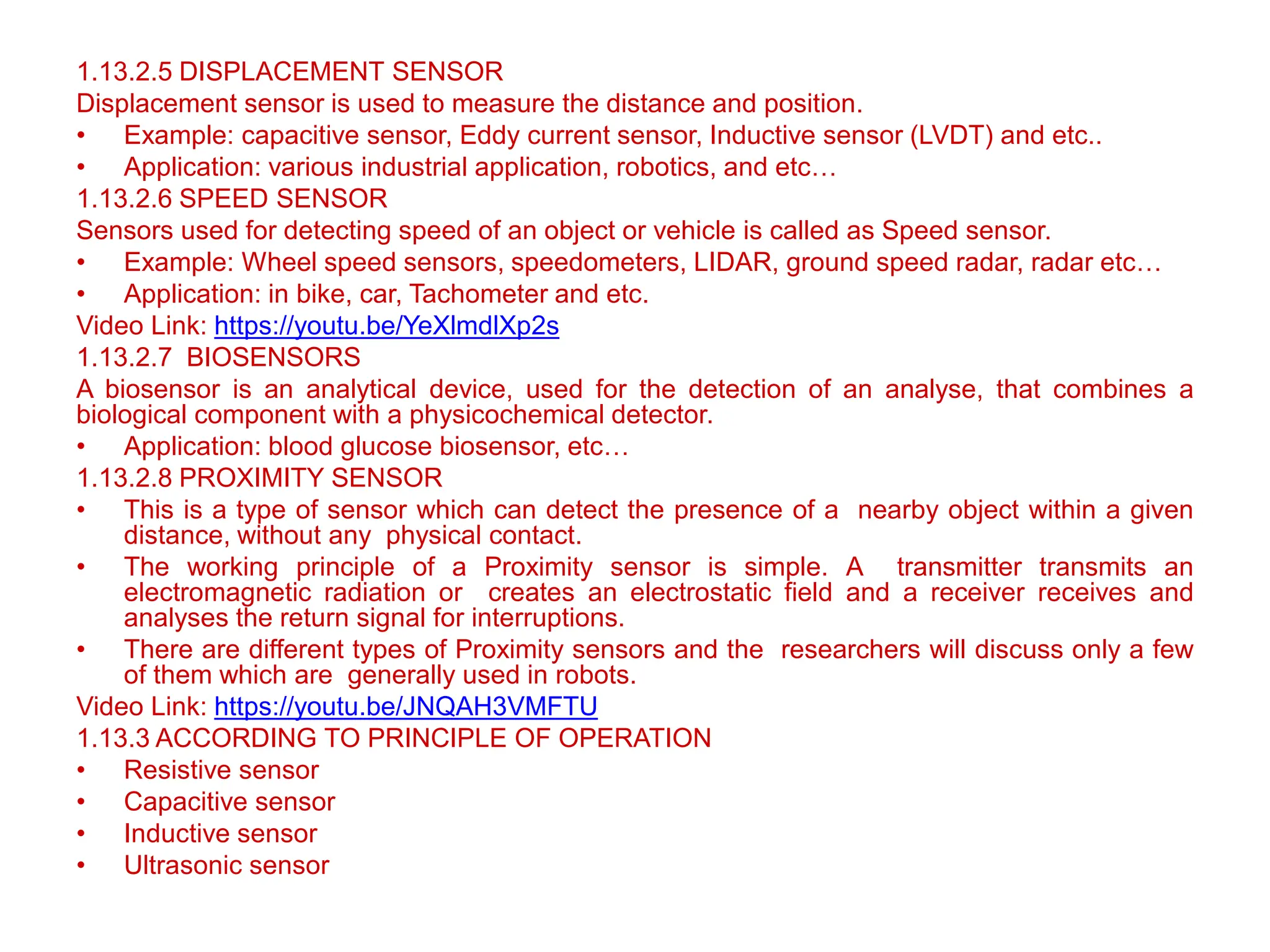
1.13.2.5 DISPLACEMENT SENSOR
Displacement sensor is used to measure the distance and position.
• Example: capacitive sensor, Eddy current sensor, Inductive sensor (LVDT) and etc..
• Application: various industrial application, robotics, and etc…
1.13.2.6 SPEED SENSOR
Sensors used for detecting speed of an object or vehicle is called as Speed sensor.
• Example: Wheel speed sensors, speedometers, LIDAR, ground speed radar, radar etc…
• Application: in bike, car, Tachometer and etc.
Video Link: https://youtu.be/YeXlmdlXp2s
1.13.2.7 BIOSENSORS
A biosensor is an analytical device, used for the detection of an analyse, that combines a
biological component with a physicochemical detector.
• Application: blood glucose biosensor, etc…
1.13.2.8 PROXIMITY SENSOR
• This is a type of sensor which can detect the presence of a nearby object within a given
distance, without any physical contact.
• The working principle of a Proximity sensor is simple. A transmitter transmits an
electromagnetic radiation or creates an electrostatic field and a receiver receives and
analyses the return signal for interruptions.
• There are different types of Proximity sensors and the researchers will discuss only a few
of them which are generally used in robots.
Video Link: https://youtu.be/JNQAH3VMFTU
1.13.3 ACCORDING TO PRINCIPLE OF OPERATION
• Resistive sensor
• Capacitive sensor
• Inductive sensor
• Ultrasonic sensor
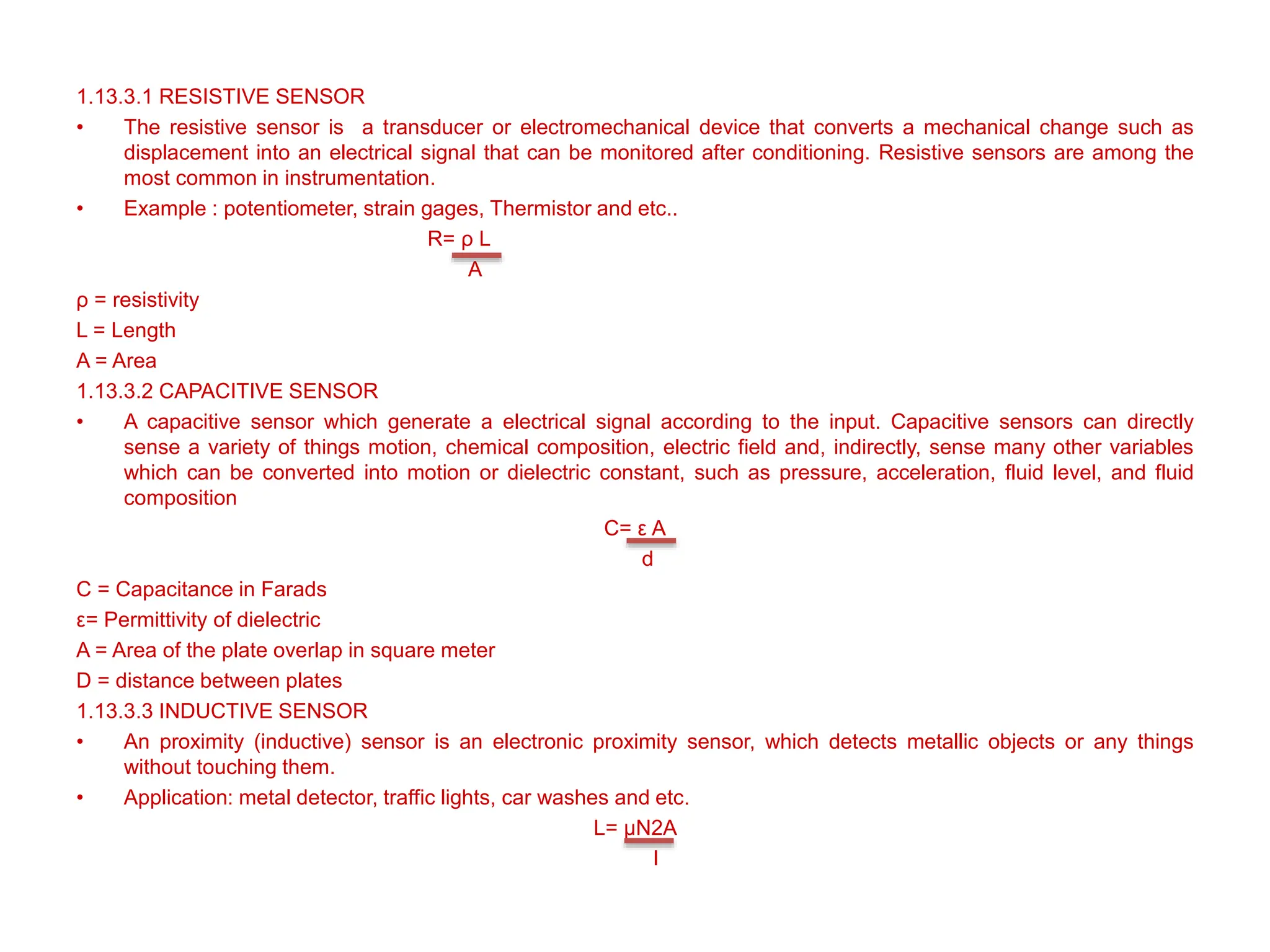
1.13.3.1 RESISTIVE SENSOR
• The resistive sensor is a transducer or electromechanical device that converts a mechanical change such as
displacement into an electrical signal that can be monitored after conditioning. Resistive sensors are among the
most common in instrumentation.
• Example : potentiometer, strain gages, Thermistor and etc..
R= ρ L
A
ρ = resistivity
L = Length
A = Area
1.13.3.2 CAPACITIVE SENSOR
• A capacitive sensor which generate a electrical signal according to the input. Capacitive sensors can directly
sense a variety of things motion, chemical composition, electric field and, indirectly, sense many other variables
which can be converted into motion or dielectric constant, such as pressure, acceleration, fluid level, and fluid
composition
C= ε A
d
C = Capacitance in Farads
ε= Permittivity of dielectric
A = Area of the plate overlap in square meter
D = distance between plates
1.13.3.3 INDUCTIVE SENSOR
• An proximity (inductive) sensor is an electronic proximity sensor, which detects metallic objects or any things
without touching them.
• Application: metal detector, traffic lights, car washes and etc.
L= μN2A
l
SENSOR CALIBRATION TECHNIQUES
• Sensor calibration helps in improving the performance and accuracy of the
sensors. There are two well-known processes in which sensor calibration is
done by industries.
Standard Reference Method
• Here the sensor output is compared with a standard physical reference to
know the error in some sensors. Examples of sensor calibration are rulers
and meter sticks, For temperature sensors- Boiling water at 100C, Triple
point of water, For Accelerometers- ”gravity is constant 1G on the surface of
the earth”.
There are three standard calibration methods used for sensors. They are-
• Primary calibration
• Secondary calibration
1.14.1 Primary Calibration:
• If the instrument is calibrated against primary standards, then the calibration
is called primary calibration. After the primary calibration, the instrument can
be used as a secondary calibration instrument
1.14.2 Secondary Calibration:
The secondary calibration instrument is used as secondary for further
calibration of other devices of lesser accuracy. This type of instruments
are used in general laboratory practice as well as in the industry
because they are practical calibration sources.
Two secondary calibration techniques:
• Direct calibration
• Indirect calibration
Direct Calibration:
• Direct Calibration with a known input source is in general of the
same order of accuracy as primary calibration. So, the instruments
which are calibrated directly are also used as secondary calibration
instruments.
Indirect Calibration:
This procedure is based on the equivalence of two different devices
adopting same similarity concept.
Video Link: https://youtu.be/TxweisA4oNI

S&I Introduction to sensor and transducer.pptx

  • 1.
    JNN INSTITUTE OF ENGINEERING MT8591–SENSORS AND INSTRUMENTATION MALATHY N, ASSISTANT PROFESSOR Department of ROBOTICS & AUTOMATION
  • 2.
     To understandthe concepts of measurement technology  To learn the various sensors used to measure various physical parameters.  To learn the fundamentals of signal conditioning, data acquisition and communication systems used in mechatronics system development. OBJECTIVES
  • 3.
    TEXT BOOKS: 1. ErnestO Doebelin, “Measurement Systems – Applications and Design”, Tata McGraw-Hill, 2009 2. Sawney A K and Puneet Sawney, “A Course in Mechanical Measurements and Instrumentation and Control”, 12th edition, Dhanpat Rai & Co, New Delhi, 2013. REFERENCES 1. C. Sujatha ... Dyer, S.A., Survey of Instrumentation and Measurement, John Wiley & Sons, Canada, 2001 2. Hans Kurt Tönshoff (Editor), Ichiro , “Sensors in Manufacturing” Volume 1, WileyVCH April 2001. 3. John Turner and Martyn Hill, “Instrumentation for Engineers and Scientists”, Oxford Science Publications, 1999. 4. Patranabis D, “Sensors and Transducers”, 2nd Edition, PHI, New Delhi, 2011. 5. Richard Zurawski, “Industrial Communication Technology Handbook” 2nd edition, CRC Press, 2015
  • 4.
     Basics ofMeasurement – Classification of errors – Error analysis – Static and dynamic characteristics of transducers – Performance measures of sensors – Classification of sensors – Sensor calibration techniques – Sensor Output Signal Types. UNIT I INTRODUCTION
  • 5.
     Motion Sensors– Potentiometers, Resolver, Encoders – Optical, Magnetic, Inductive, Capacitive, LVDT – RVDT – Synchro – Microsyn, Accelerometer – GPS, Bluetooth, Range Sensors – RF beacons, Ultrasonic Ranging, Reflective beacons, Laser Range Sensor (LIDAR) UNIT II MOTION, PROXIMITY AND RANGING SENSORS
  • 6.
     Strain Gage,Load Cell, Magnetic Sensors –types, principle, requirement and advantages: Magneto resistive – Hall Effect – Current sensor Heading Sensors – Compass, Gyroscope, Inclinometers. UNIT III FORCE, MAGNETIC AND HEADING SENSORS
  • 7.
     Photo conductivecell, photo voltaic, Photo resistive, LDR – Fiber optic sensors – Pressure – Diaphragm, Bellows, Piezoelectric – Tactile sensors, Temperature – IC, Thermistor, RTD, Thermocouple. Acoustic Sensors – flow and level measurement, Radiation Sensors – Smart Sensors - Film sensor, MEMS & Nano Sensors, LASER sensors. UNIT IV OPTICAL, PRESSURE AND TEMPERATURE SENSORS
  • 8.
     Amplification –Filtering – Sample and Hold circuits – Data Acquisition: Single channel and multi channel data acquisition – Data logging - applications - Automobile, Aerospace, Home appliances, Manufacturing, Environmental monitoring. UNIT V SIGNAL CONDITIONING AND DAQ SYSTEMS
  • 9.
    BASICS OF MEASUREMENT Themeasurement of a given parameter or quantity is the act or result of a quantitative comparison between a predefined standard and an unknown quantity to be measured. For the result to be meaningful, there are two basic requirements: • The comparison standard is accurately defined and commonly accepted and • The procedure and the instrument used for obtaining the comparison must be provable. Functional Elements Of Measurement System: Most of the measurement systems contain three main functional elements. They are: • Primary sensing element • Variable conversion element • Variable manipulation element • Data presentation element. Primary sensing element: The quantity under measurement makes its first contact with the primary sensing element of a measurement system. i.e., the measurand (the unknown quantity which is to be measured) is first detected by primary sensor which gives the output in a different analogous form This output is then converted into an electrical signal by a transducer - (which converts energy from one form to another). The first stage of a measurement system is known as a detector transducer stage’. Primary Sensing element Variable conversion element Variable manipulation element Data transmission element Data presentation element
  • 10.
    Variable conversion element: •The output of the primary sensing element may be electrical signal of any form, it may be voltage, a frequency or some other electrical parameter. • For the instrument to perform the desired function, it may be necessary to convert this output to some other suitable form. Variable manipulation element: • The function of this element is to manipulate the signal presented to it preserving the original nature of the signal. It is not necessary that a variable manipulation element should follow the variable conversion element. Some non-linear processes like modulation, detection, sampling, filtering, chopping, etc., are performed on the signal to bring it to the desired form to be accepted by the next stage of measurement system. This process of conversion is called signal conditioning. • When the elements of an instrument are actually physically separated, it becomes necessary to transmit data from one to another. The element that performs this function is called a Data transmission element. Data presentation element: • The information about the quantity under measurement has to be conveyed to the personnel handling the instrument or the system for monitoring, control, or analysis purposes. This function is done by data presentation element. The final stage in a measurement system is known as terminating stage. Video Link: https://youtu.be/oAdNKL8SgNY
  • 11.
    Definition of Sensor: ASensor converts the physical parameter (for example: temperature, blood pressure, humidity, speed, etc.) into a signal which can be measured electrically. Definition of Transducer The transducer is a device that changes the physical attributes of the non-electrical signal into an electrical signal which is easily measurable. The process of energy conversion in the transducer is known as the transduction. Transducer contains two parts that are closely related to each other i.e. the sensing element and transduction element.
  • 12.
    • The sensingelement is called as the sensor. It is device producing measurable response to change in physical conditions. • The signal conditioning element convert the sensor output to suitable electrical form. Difference between Sensor and Transducer: . Basis For Comparison Sensor Transducer Definition Senses the physical changes occur in the surrounding and converting it into a readable quantity. All Sensors are not Transducer. The transducer is a device which, when actuates transforms the energy from one form to another. All the Transducer contains Sensor. Components Sensor itself Sensor and signal conditioning Function Detects the changes and induces the corresponding electrical signals. Conversion of one form of energy into another. Examples Proximity sensor, Magnetic sensor, Accelerometer sensor, Light sensor etc. Thermistor, Potentiometer, Thermocouple, etc.
  • 13.
    CLASSIFICATION OF ERRORS: Definition:The measurement error is defined as the difference between the true or actual value and the measured value. The true value is the average of the infinite number of measurements, and the measured value is the precise value Types of Errors in Measurement The error may arise from the different source and are usually classified into the following types. These types are • Gross Errors • Systematic Errors • Random Errors
  • 14.
    Systematic Errors These typesof systematic errors are generally categorized into three types which are explained below in detail. • Observational Errors • Environmental Errors • Instrumental Errors Types of errors in measurement Random error Systematic error Gross error Observational error Environmental error Instrumental error Abuse of apparatus Inherent limitation of device Effect of loading
  • 15.
    Observational Errors The observationalerrors may occur due to the fault study of the instrument reading, and the sources of these errors are many. For instance, the indicator of a voltmeter retunes a little over the surface of the scale. As a result, a fault happens except the line of the image of the witness is accurately above the indicator. To reduce the parallax error extremely precise meters are offered with reflected scales. Environmental Errors Environmental errors will happen due to the outside situation of the measuring instruments. These types of errors mostly happen due to the temperature result, force, moisture, dirt, vibration otherwise because of the electrostatic field or magnetic. The remedial measures used to remove these unwanted effects include the following. • The preparation should be finished to remain the situations as stable as achievable. • By the instrument which is at no cost from these results. • With these methods which remove the result of these troubles. • By applying the computed modifications. Instrumental Errors: Instrumental errors will happen due to some of the following reasons • Inherent Limitation of devices • Abuse of apparatus • Effect of loading
  • 16.
    An inherent limitationof Devices These errors are integral in devices due to their features namely mechanical arrangement. These may happen due to the instrument operation as well as the operation or computation of the instrument. These types of errors will make the mistake to study very low otherwise very high. Abuse of Apparatus The error in the instrument happens due to the machinist’s fault. A superior device used in an unintelligent method may provide a vast result. For instance the abuse of the apparatus may cause the breakdown to change the zero of tools, poor early modification, with lead to very high resistance. Improper observes of these may not reason for lasting harm to the device, except all the similar, they cause faults. Effect of Loading The most frequent type of this error will occur due to the measurement work in the device. For instance, as the voltmeter is associated to the high-resistance circuit which will give a false reading, as well as after it is allied to the low-resistance circuit, this circuit will give the reliable reading, and then the voltmeter will have the effect of loading on the circuit. Gross Errors Gross errors can be defined as physical errors in analysis apparatus or calculating and recording measurement outcomes. In general, these types of errors will happen throughout the experiments, wherever the researcher might study or record a worth different from the real one, possibly due to a reduced view. With human concern, types of errors will predictable, although they can be estimated and corrected.
  • 17.
    These types oferrors can be prohibited by the following couple of actions: • Careful reading as well as a recording of information. • Taking numerous readings of the instrument by different operators. • Secure contracts between different understandings guarantee the elimination of every gross error. Random Errors This type of error is constantly there in a measurement, which is occurred by essentially random oscillations in the apparatus measurement analysis or in the experimenter’s understanding of the apparatus reading. These types of errors show up as dissimilar outcomes for apparently the similar frequent measurement, which can be expected by contrasting numerous measurements, with condensed by averaging numerous measurements. ERROR ANALYSIS • Statistical Analysis • Average or Arithmetic mean value • Deviation from average value • Average Deviation • Gaussian distribution of error • Standard Deviation • Variance Statistical Analysis Statistical methods are frequently used to find the most probable value from a group of readings taken from a given experiment. It is also possible to determine the probable error in one reading and the degree of uncertainty in the most probable value.
  • 18.
    STANDARD DEVIATION The standarddeviation of an infinite number of data is the Square root of the sum of all the individual deviations squared, divided by the number of readings. It may be expressed as σ = d12+ d22+ d32+……+ dn2 n σ = dn2 n Where σ = standard Deviation The standard deviation is also known as root mean square deviation, and is the most important factor in the statistical analysis of measurement data. Reduction in this quantity effectively means improvement in measurement.
  • 19.
    Problem : 1 Theexpected value of the voltage across a resistor is 80V. However, the measurement gives a value of 79V. Calculate i) absolute error, ii) relative error, iii) % relative error iv) relative accuracy and v) % of accuracy. • Solution: True value of voltage resistor At = 80V Measured value of voltage across resistor Am=79V Absolute error, ϵo = Am- At = 80-79 = 1V Relative error = ϵr = (Am- At) / At = (80-79)/ 80 = 0.0125 % relative error = % ϵr = (Am- At) / At = 0.0125*100 = 1.25% Relative accuracy = A= 1-|(Am- At) / At| = 1-0.125 = 0.9875 % relative accuracy % A = A*100 = 0.987*100 = 98.75%
  • 20.
    Problem 2: A voltagehas true value of 1.5V. An analog indicating instrument with a scale range of (0-2.5)V shows a voltage of 1.46V. What are the value of absolute error and correction? Express the error as a fraction of true value an the full scale deflection. • Solution: True value of voltage At = 1.5V Measured value of voltage Am=1.46V The full scale deflection FSD= 2.5V Absolute error, ϵo = Am- At = 1.46-1.5 = -0.04 V Relative error = ϵr = (Am- At) / At = (1.46-1.5)/ 1.5 = -0.026 Error as fraction of FSD = (Am- At)/FSD = -o.o4/2.5 = -0.016
  • 21.
    STATIC AND DYNAMICCHARACTERISTICS OF TRANSDUCERS: • The set of criteria defined for the instruments, which are used to measure the quantities which are slowly varying with time or mostly constant, i.e., do not vary with time, is called ‘static characteristics’. • The various static characteristics are: • Accuracy • Precision • Sensitivity • Linearity • Reproducibility • Repeatability • Resolution • Threshold • Drift • Stability • Tolerance • Range or span
  • 22.
    Accuracy: Accuracy is thecloseness with which the instrument reading approaches the true value of the variable under measurement. Accuracy is determined as the maximum amount by which the result differs from the true value. It is almost impossible to determine experimentally the true value. The true value is not indicated by any measurement system due to the loading effect, lags and mechanical problems (e.g., wear, hysteresis, noise, etc.). Accuracy of the measured signal depends upon the following factors: • Intrinsic accuracy of the instrument itself; • Accuracy of the observer; • Variation of the signal to be measured; and • Whether or not the quantity is being truly impressed upon the instrument. Unit of accuracy: 1. Percentage of true value = (Measured value – True value) * 100 True Value 2.Percentage of full scale deflection = (Measured value – True value) * 100 Maximum Scale value Precision: It is the measure of reproducibility i.e., given a fixed value of a quantity, precision is a measure of the degree of agreement within a group of measurements. The precision is composed of two characteristics:
  • 23.
    Reproducibility: It is thedegree of closeness with which a given value may be repeatedly measured. It is specified in terms of scale readings over a given period of time. Resolution: If the input is slowly increased from some arbitrary input value, it will again be found that output does not change at all until a certain increment is exceeded. This increment is called resolution. Threshold: If the instrument input is increased very gradually from zero there will be some minimum value below which no output change can be detected. This minimum value defines the threshold of the instrument. Repeatability: It is defined as the variation of scale reading & random in nature Drift: Drift may be classified into three categories: • Zero drift: If the whole calibration gradually shifts due to slippage, permanent set, or due to undue warming up of electronic tube circuits, zero drift sets in. • Span drift or sensitivity drift: If there is proportional change in the indication all along the upward scale, the drifts is called span drift or sensitivity drift. • Zonal drift: In case the drift occurs only a portion of span of an instrument, it is called zonal drift.
  • 24.
    Stability: It is theability of an instrument to retain its performance throughout is specified operating life. Tolerance: The maximum allowable error in the measurement is specified in terms of some value which is called tolerance. Range or span: The minimum & maximum values of a quantity for which an instrument is designed to measure is called its range or span. Linearity: This is the closeness to a straight line of the relationship between the true process variable and the measurement. i.e. deviation of transducer output curve from a specified straight line. 1.Independent of input 2.Proportional to input 3.Combined independent and proportional to input
  • 25.
    Hysteresis: • Hysteresis isdefined as the magnitude of error caused in the output for a given value of input, when this value is approached from opposite directions ; i.e. from ascending order & then descending order. • Causes are backlash, elastic deformations, magnetic characteristics, frictional effects (mainly). • Hysteresis can be eliminated by taking readings in both direction and then taking its arithmetic mean. Dynamic characteristics: The set of criteria defined for the instruments, which are changes rapidly with time, is called ‘dynamic characteristics’. •Step change •Linear change •Sinusoidal change
  • 26.
    • Step Change: Inthis case the input is changed suddenly to a finite value and then remain constant • Linear change: In this case the input changes linearly with time. • Sinusoidal change: In this case the magnitude of the input changes in accordance with a sinusoidal function of constant amplitude The various dynamic characteristics are: • Speed of response • Measuring lag • Fidelity • Dynamic error Speed of response: It is defined as the rapidity with which a measurement system responds to changes in the measured quantity. Measuring lag: It is the retardation or delay in the response of a measurement system to changes in the measured quantity. The measuring lags are of two types • Retardation type: In this case the response of the measurement system begins immediately after the change in measured quantity has occurred. • Time delay lag: In this case the response of the measurement system begins after a dead time after the application of the input. Fidelity: It is defined as the degree to which a measurement system indicates changes in the measurand quantity without dynamic error.
  • 27.
    Fidelity: It is definedas the degree to which a measurement system indicates changes in the measurand quantity without dynamic error. Dynamic error: It is the difference between the true value of the quantity changing with time & the value indicated by the measurement system if no static error is assumed. It is also called measurement error. Dynamic Characteristics of Transducers The dynamic characteristic of transducer refers to the performance of the transducer when it is subjected to time varying input The number of parameters required to define the dynamic behavior of a transducer is decided by the group to which the transducer belongs The transducers can be categorized into 1. Zero-order transducers 2. First-order transducers 3. Second-order transducers The dynamic characteristics of a measuring instrument describe its behaviour between the time a measured quantity changes value and the time when the instrument output attains a steady value in response. As with static characteristics, any values for dynamic characteristics quoted in instrument data sheets only apply when the instrument is used under specified environmental conditions. Outside these calibration conditions, some variation in the dynamic parameters can be expected. In any linear, time-invariant measuring system, the following general relation can be written between input and output for time (t) > 0: an dnqo +an-1dn-1qo+…….+a1dqo + aoqo = bm dmqi + am-1dm-1qi +…….+ b1dqi + boqi dtn dtn-1 dt dtm dtm-1 dt ---------------------(1) where qi is the measured quantity, qo is the output reading and ao ... an, bo ... bm are constants. If we limit consideration to that of step changes in the measured quantity only, then equation (1) reduces to: an dnqo +an-1dn-1qo+…….+a1dqo + aoqo = boqi ----------------(2) dtn dtn-1 dt
  • 28.
    Dynamic Response ofZero-order Instruments If all the coefficients a1 ... an other than ao in equation (2) are assumed zero, then: aoqo = boqi or qo = boqi / ao = Kqi -------------(3) K = bo / ao where K is a constant known as the instrument sensitivity as defined earlier. Any instrument that behaves according to equation (3) is said to be of zero order type. Following a step change in the measured quantity at time t, the instrument output moves immediately to a new value at the same time instant t. Dynamic Response of a First Order Instrument: If all the coefficients a2 ...an except for ao and a1 are assumed zero in equation (2) then: a1dqo + aoqo = boqi ----------------(4) dt Any instrument that behaves according to equation (4) is known as a first order instrument. If d/dt is replaced by the D operator in equation (4), we get: a1Dqo+aoqo = boqi and rearranging this then gives qo = (bo / ao ) qi ------------(5) [1+(a1/ao)D] Defining K = bo/ao as the static sensitivity and ԏ = a1/ao as the time constant of the system, equation (5) becomes: qo = K qi -----------------(6) 1+ԏD If equation (6) is solved analytically, the output quantity qo in response to a step change in qi at time t varies with time in the manner Dynamic Response of Second Order Instrument : A second order instrument is defined as one that follows the equation
  • 29.
    a2d2qo + a1dqo+ aoqo = boqi ----------------(7) dt2 dt Applying the D operator again: a2D2qo+ a1Dqo + aoqo = boqi , and rearranging: Qo = boqi -----------------(8) ao + a1 D + a2D2 It is convenient to re-express the variables ao, a1, a2 and bo in equation (8) in terms of three parameters K (static sensitivity), ω (undamped natural frequency) and ξ (damping ratio), where: K = bo / ao ; ω = ao / a2 ; ξ = a1 /2 ao a2 Re-expressing equation (8) in terms of K, ω and ξ we get: qo = K ----------------(9) D2 / ω2 + 2 ξ D/ ω + 1 This is the standard equation for a second order system and any instrument whose response can be described by it is known as a second order instrument. If equation (9) is solved analytically, the shape of the step response obtained depends on the value of the damping ratio parameter ξ . PERFORMANCE MEASURES OF SENSORS: • Type of Sensing: The parameter that is being sensed like temperature or pressure. • Operating Principle: The principle of operation of the sensor. • Power Consumption: The power consumed by the sensor will play an important role in defining the total power of the system. • Environmental Conditions: The conditions in which the sensor is being used will be a factor in choosing the quality of a sensor. • Cost: Depending on the cost of application, a low cost sensor or high cost sensor can be used. • Resolution and Range: The smallest value that can be sensed and the limit of measurement are important.
  • 30.
    • Calibration andRepeatability: Change of values with time and ability to repeat measurements under similar conditions. • Range: It indicates the limits of the input in which it can vary. In case of temperature measurement, a thermocouple can have a range of 25 – 250 0C. • Accuracy: It is the degree of exactness between actual measurement and true value. Accuracy is expressed as percentage of full range output. • Sensitivity: Sensitivity is a relationship between input physical signal and output electrical signal. It is the ratio of change in output of the sensor to unit change in input value that causes change in output. • Stability: It is the ability of the sensor to produce the same output for constant input over a period of time. • Repeatability: It is the ability of the sensor to produce same output for different applications with same input value. • Response Time: It is the speed of change in output on a stepwise change in input. • Linearity: It is specified in terms of percentage of nonlinearity. Nonlinearity is an indication of deviation of curve of actual measurement from the curve of ideal measurement. • Ruggedness: It is a measure of the durability when the sensor is used under extreme operating conditions. • Hysteresis: The hysteresis is defined as the maximum difference in output at any measurable value within the sensor’s specified range when approaching the point first with increasing and then with decreasing the input parameter. Hysteresis is a characteristic that a transducer has in being unable to repeat its functionality faithfully when used in the opposite direction of operation. Types of Sensors • Direct: A sensor that can convert a non-electrical stimulus into an electrical signal with intermediate stages, e.g. Thermocouple (temperature to voltage) • Indirect: A sensor that multiple conversion steps to transform the measured signal into an electrical signal, for example a fiber-optic displacement sensor (Light Current , photons current) Current photons current
  • 31.
    CLASSIFICATION OF SENSORS Thesensors are classified into the following criteria: • According to power or energy supply requirement of the sensors. • According to various measurement objective. • According to principle of operation. • According to output signal According to power or energy supply requirement of the sensors. • Active Sensor • Passive Sensor Active Sensor Sensors that do not require power supply are called as Active Sensors. • Example: Hg thermometer, Thermocouple, Piezoelectric transducer, photo diode etc. Passive Sensor Sensors that require power supply are called as Passive Sensors • Example: LIDAR(Light detection and ranging), photoconductive cell, Thermistor, Strain Gauge etc. Active transducer Others Chemical Piezo electric Electromagneti c Thermo electric Photo voltaic
  • 32.
    According to variousmeasurement objective. • Temperature sensor • Pressure sensor • Level sensor • Displacement sensor • Flow sensor • Speed sensor • Biosensors Passive transducer Variable resistance Opto electronics Variable reactance Hall effect type • Temperature • Potentiometer • photoconductor Strain gauge Photo conductive Photo emissive capacitive Inductive LVDT Variable permeability Variable reluctance
  • 33.
    1.13.2.1 Temperature sensors •Temperature is the most common of all physical measurements. We have temperature measurement-and-control units, called thermostats. In our home heating systems, refrigerators, air conditioners, and ovens. • Temperature sensors are used on circuit boards, as part of thermal tests, in industrial controls, and in room controls such as in calibration labs and data centres. Though there are many types of temperature sensors, most are passive devices: • Thermocouples • RTDs (Resistance Temperature Detectors), and • Thermistors(Thermal Resistors) Video Link: https://youtu.be/4mQ3o1t4Ssg 1.13.2.2 PRESSURE SENSOR A pressure sensor measures pressure, typically of gases or liquids. A pressure sensor usually acts as a transducer; it generates a signal as a function of the pressure imposed. such a signal is electrical. • Example: barometric, piezo resistive, pressure sensor etc. • Application: in boiler, in gas turbine etc. Video Link: https://youtu.be/ykBn4IxStrU 1.13.2.3 FLOW SENSOR A flow sensor is a device for sensing the rate of fluid flow. Typically a flow sensor is the sensing element used in a flow meter. • Example: velocimeters, Laser based sensor, Hall effect sensors, Thermal mass flow meter etc… • Application: In industrial used for measuring the flow rate. 1.13.2.4 LEVEL SENSOR Level sensors detect the level of liquids In the tank or container. • Example: Magnetic and mechanical float, pressure transducer, Pneumatic, Capacitance, load cell etc. • Application: oil-water tank, boiler, etc. Video Link: https://youtu.be/bHxEXlIHSHY
  • 34.
    1.13.2.5 DISPLACEMENT SENSOR Displacementsensor is used to measure the distance and position. • Example: capacitive sensor, Eddy current sensor, Inductive sensor (LVDT) and etc.. • Application: various industrial application, robotics, and etc… 1.13.2.6 SPEED SENSOR Sensors used for detecting speed of an object or vehicle is called as Speed sensor. • Example: Wheel speed sensors, speedometers, LIDAR, ground speed radar, radar etc… • Application: in bike, car, Tachometer and etc. Video Link: https://youtu.be/YeXlmdlXp2s 1.13.2.7 BIOSENSORS A biosensor is an analytical device, used for the detection of an analyse, that combines a biological component with a physicochemical detector. • Application: blood glucose biosensor, etc… 1.13.2.8 PROXIMITY SENSOR • This is a type of sensor which can detect the presence of a nearby object within a given distance, without any physical contact. • The working principle of a Proximity sensor is simple. A transmitter transmits an electromagnetic radiation or creates an electrostatic field and a receiver receives and analyses the return signal for interruptions. • There are different types of Proximity sensors and the researchers will discuss only a few of them which are generally used in robots. Video Link: https://youtu.be/JNQAH3VMFTU 1.13.3 ACCORDING TO PRINCIPLE OF OPERATION • Resistive sensor • Capacitive sensor • Inductive sensor • Ultrasonic sensor
  • 35.
    1.13.3.1 RESISTIVE SENSOR •The resistive sensor is a transducer or electromechanical device that converts a mechanical change such as displacement into an electrical signal that can be monitored after conditioning. Resistive sensors are among the most common in instrumentation. • Example : potentiometer, strain gages, Thermistor and etc.. R= ρ L A ρ = resistivity L = Length A = Area 1.13.3.2 CAPACITIVE SENSOR • A capacitive sensor which generate a electrical signal according to the input. Capacitive sensors can directly sense a variety of things motion, chemical composition, electric field and, indirectly, sense many other variables which can be converted into motion or dielectric constant, such as pressure, acceleration, fluid level, and fluid composition C= ε A d C = Capacitance in Farads ε= Permittivity of dielectric A = Area of the plate overlap in square meter D = distance between plates 1.13.3.3 INDUCTIVE SENSOR • An proximity (inductive) sensor is an electronic proximity sensor, which detects metallic objects or any things without touching them. • Application: metal detector, traffic lights, car washes and etc. L= μN2A l
  • 36.
    SENSOR CALIBRATION TECHNIQUES •Sensor calibration helps in improving the performance and accuracy of the sensors. There are two well-known processes in which sensor calibration is done by industries. Standard Reference Method • Here the sensor output is compared with a standard physical reference to know the error in some sensors. Examples of sensor calibration are rulers and meter sticks, For temperature sensors- Boiling water at 100C, Triple point of water, For Accelerometers- ”gravity is constant 1G on the surface of the earth”. There are three standard calibration methods used for sensors. They are- • Primary calibration • Secondary calibration 1.14.1 Primary Calibration: • If the instrument is calibrated against primary standards, then the calibration is called primary calibration. After the primary calibration, the instrument can be used as a secondary calibration instrument
  • 37.
    1.14.2 Secondary Calibration: Thesecondary calibration instrument is used as secondary for further calibration of other devices of lesser accuracy. This type of instruments are used in general laboratory practice as well as in the industry because they are practical calibration sources. Two secondary calibration techniques: • Direct calibration • Indirect calibration Direct Calibration: • Direct Calibration with a known input source is in general of the same order of accuracy as primary calibration. So, the instruments which are calibrated directly are also used as secondary calibration instruments. Indirect Calibration: This procedure is based on the equivalence of two different devices adopting same similarity concept. Video Link: https://youtu.be/TxweisA4oNI