Rwanda’s Experience
A bit of history
• Between 1987 and 2000: the Rwandan Government
set up the National Program to Fight against AIDS
(PNLS), based within the Ministry of Health.
• From 2000: the government divided the PNLS into two
organizations,
– a National AIDS Control Commission (CNLS – with
responsibility to coordinate the multi-sectoral response,
focusing on policy development, partnerships and M&E)
and
– TRAC Plus (an MOH department focused on HIV biomedical research and response initiatives).

• 2006: Decentralisation led to set up of District AIDS
Commitees in 106 districts.
And then. . . .
• 2011: President of Rwanda called on Ministers to reduce
the number of project management units across
government to improve aid effectiveness
– Vertical programmes were putting a strain on limited
management capacity across country, especially at
decentralised levels
– Similar issues with clinical capacity, having clinicians
dedicated to just one disease instead of the suite of health
problems facing Rwandans

• Ministry of Health was the first Ministry
– Had the most PMUs compared to other Ministries, 14
autonomous departments or institutions.
– Minister of Health had been the NAC Director previously,
with strong working relationship with her successor, who
agreed with government analysis
Solution
• National review and consultation led to absorption of NAC
into a newly formed Rwanda Bio-Medical Centre (RBC),
with.
– Absorbed all 14 institutions and programmes including AIDS,
with corresponding legislation passed by the Assembly in 2011
– AIDS coordination put into the Institute of HIV/AIDS, Disease
Prevention and Control (IHDPC), whose director is the former
NAC Director.

• The RBC has the statutory status as the CNLS before it, as
an autonomous public sector organization that reports to a
Board of Directors. However, the RBC does sit within the
Ministry of Health and the Minister is a member of the
Board
MINISTRY OF HEALTH

Overall Structure of the
Rwanda Biomedical Centre

BOARD OF
DIRECTORS

1

DG (1)
Medical
Research
Center

DG (1)
Medical
Maintenan
ce Center

Deputy
DMD(1)
King Faisal
Hospital

RWANDA
BIOMEDICAL
CENTER MD (1)

Deputy
MD(1)
Institute of
HIV/AIDS,
Disease
Prevention
and
Control
(IHDPC)

Deputy
MD (1)
Medical
Production
and
Procureme
nt

Rector
[DMD] (1)
Rwanda
University
of
Medicine
and Health
Sciences
(RUHMS)

DG (1)
Rwanda
Health
Communic
ation
Center

DG (1)
Corporate
Services

5
1

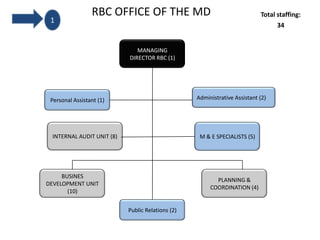
RBC OFFICE OF THE MD

Total staffing:
34

MANAGING
DIRECTOR RBC (1)

Administrative Assistant (2)

Personal Assistant (1)

INTERNAL AUDIT UNIT (8)

M & E SPECIALISTS (5)

BUSINES
DEVELOPMENT UNIT
(10)

PLANNING &
COORDINATION (4)

Public Relations (2)

Rwanda experience

  • 1.
  • 2.
    A bit ofhistory • Between 1987 and 2000: the Rwandan Government set up the National Program to Fight against AIDS (PNLS), based within the Ministry of Health. • From 2000: the government divided the PNLS into two organizations, – a National AIDS Control Commission (CNLS – with responsibility to coordinate the multi-sectoral response, focusing on policy development, partnerships and M&E) and – TRAC Plus (an MOH department focused on HIV biomedical research and response initiatives). • 2006: Decentralisation led to set up of District AIDS Commitees in 106 districts.
  • 3.
    And then. .. . • 2011: President of Rwanda called on Ministers to reduce the number of project management units across government to improve aid effectiveness – Vertical programmes were putting a strain on limited management capacity across country, especially at decentralised levels – Similar issues with clinical capacity, having clinicians dedicated to just one disease instead of the suite of health problems facing Rwandans • Ministry of Health was the first Ministry – Had the most PMUs compared to other Ministries, 14 autonomous departments or institutions. – Minister of Health had been the NAC Director previously, with strong working relationship with her successor, who agreed with government analysis
  • 4.
    Solution • National reviewand consultation led to absorption of NAC into a newly formed Rwanda Bio-Medical Centre (RBC), with. – Absorbed all 14 institutions and programmes including AIDS, with corresponding legislation passed by the Assembly in 2011 – AIDS coordination put into the Institute of HIV/AIDS, Disease Prevention and Control (IHDPC), whose director is the former NAC Director. • The RBC has the statutory status as the CNLS before it, as an autonomous public sector organization that reports to a Board of Directors. However, the RBC does sit within the Ministry of Health and the Minister is a member of the Board
  • 5.
    MINISTRY OF HEALTH OverallStructure of the Rwanda Biomedical Centre BOARD OF DIRECTORS 1 DG (1) Medical Research Center DG (1) Medical Maintenan ce Center Deputy DMD(1) King Faisal Hospital RWANDA BIOMEDICAL CENTER MD (1) Deputy MD(1) Institute of HIV/AIDS, Disease Prevention and Control (IHDPC) Deputy MD (1) Medical Production and Procureme nt Rector [DMD] (1) Rwanda University of Medicine and Health Sciences (RUHMS) DG (1) Rwanda Health Communic ation Center DG (1) Corporate Services 5
  • 6.
    1 RBC OFFICE OFTHE MD Total staffing: 34 MANAGING DIRECTOR RBC (1) Administrative Assistant (2) Personal Assistant (1) INTERNAL AUDIT UNIT (8) M & E SPECIALISTS (5) BUSINES DEVELOPMENT UNIT (10) PLANNING & COORDINATION (4) Public Relations (2)