Chapter Sections:
10.1, 10.5, 10.6,
4.3, 4.5
and
a little extra
History and
Models of the Atom
Click on me: http://hi.fi.tripod.com/timeline
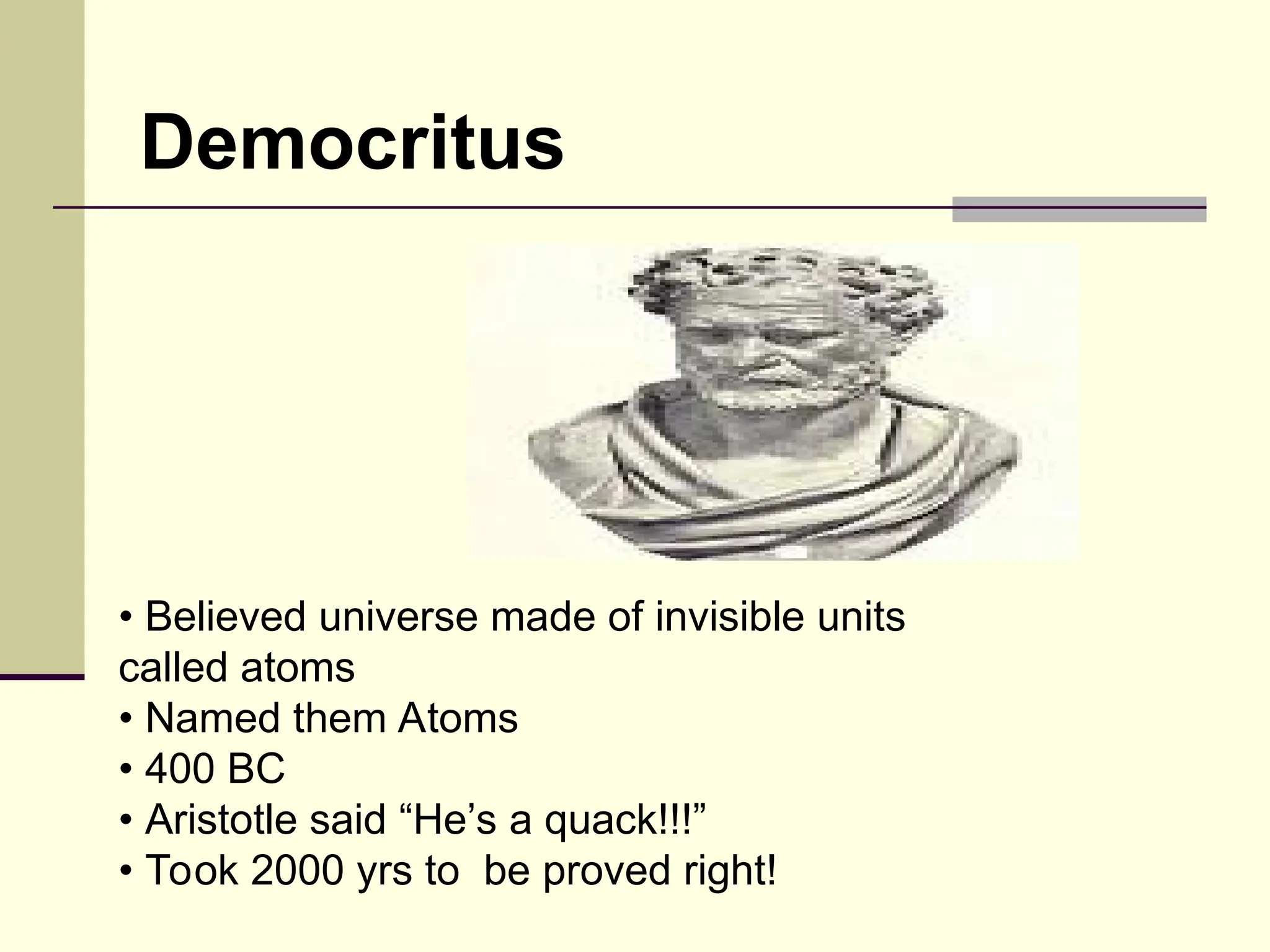
• Believed universe made of invisible units
called atoms
• Named them Atoms
• 400 BC
• Aristotle said “He’s a quack!!!”
• Took 2000 yrs to be proved right!
Democritus
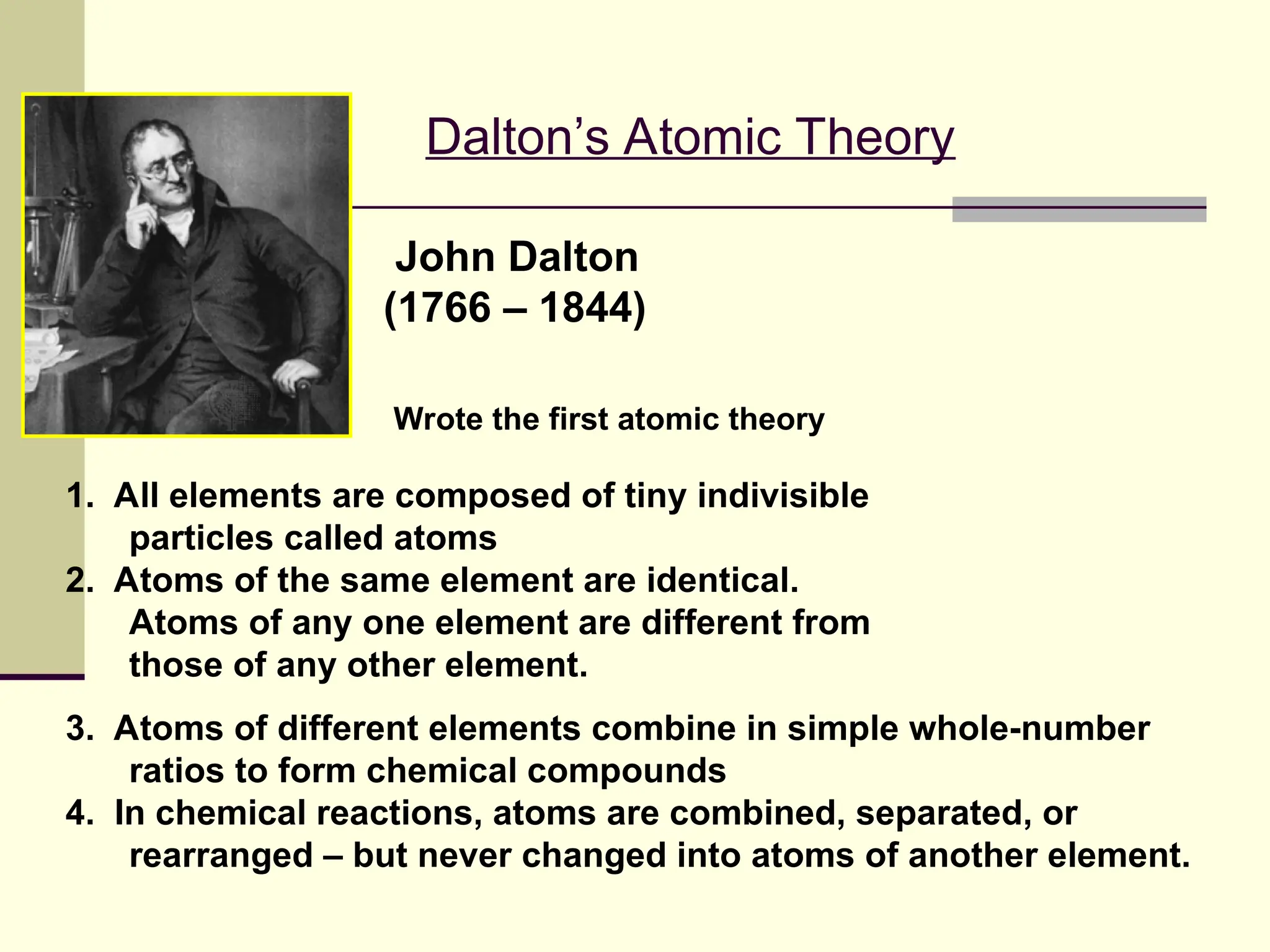
Dalton’s Atomic Theory
3. Atoms of different elements combine in simple whole-number
ratios to form chemical compounds
4. In chemical reactions, atoms are combined, separated, or
rearranged – but never changed into atoms of another element.
1. All elements are composed of tiny indivisible
particles called atoms
2. Atoms of the same element are identical.
Atoms of any one element are different from
those of any other element.
John Dalton
(1766 – 1844)
Wrote the first atomic theory
FYI……….Isotopes
Dalton was wrong about all
elements of the same type being
identical
Atoms of the same element can
have different numbers of neutrons.
Thus, different mass numbers.
These are called isotopes.
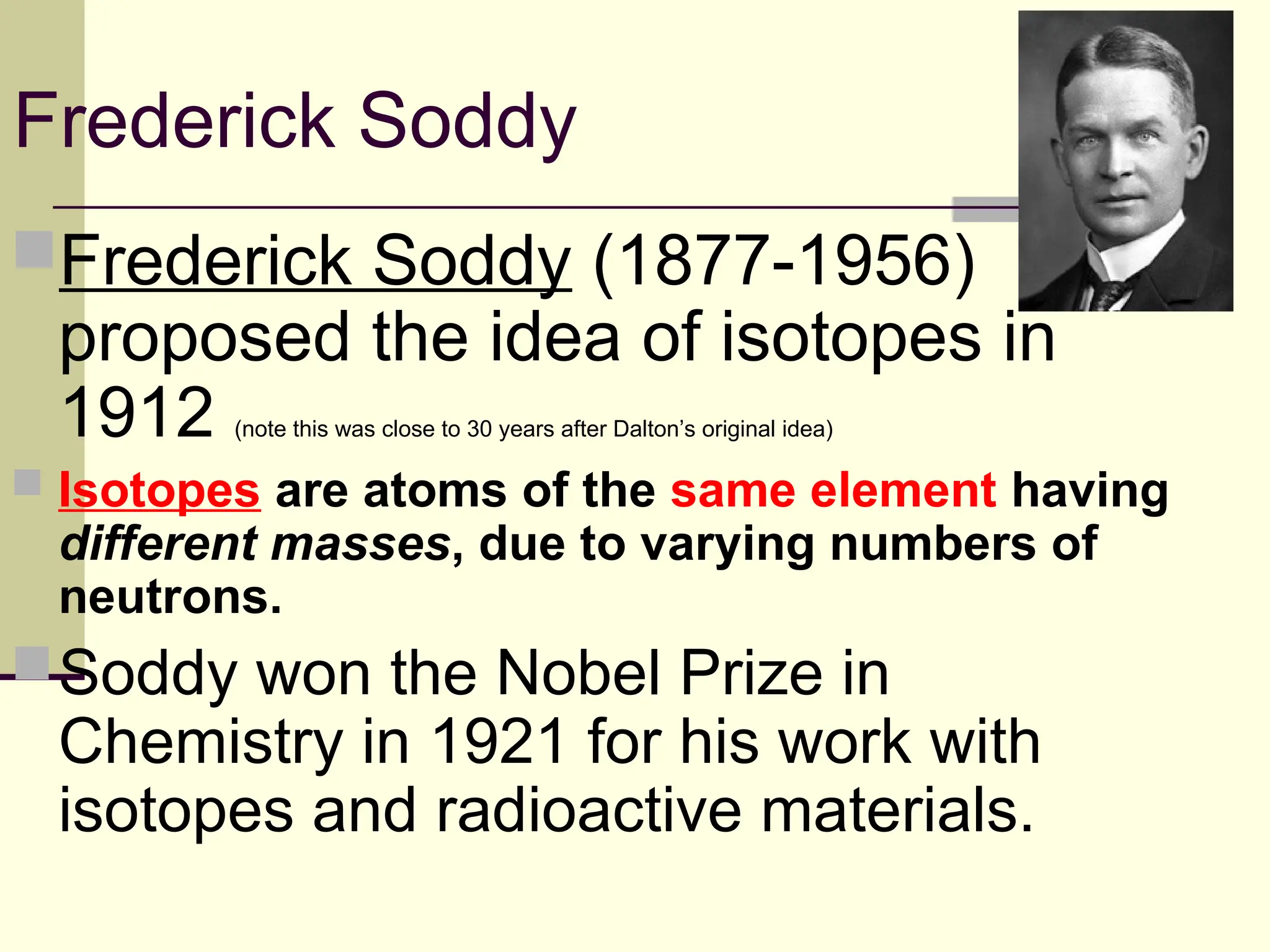
Frederick Soddy
Frederick Soddy (1877-1956)
proposed the idea of isotopes in
1912 (note this was close to 30 years after Dalton’s original idea)
 Isotopes are atoms of the same element having
different masses, due to varying numbers of
neutrons.
Soddy won the Nobel Prize in
Chemistry in 1921 for his work with
isotopes and radioactive materials.
The “Billiard Ball” Model
 proposed by John Dalton in 1804
 this theory proposed that matter was
composed of small, spherical particles
 but evidence was later gathered that matter
was composed of even smaller bits
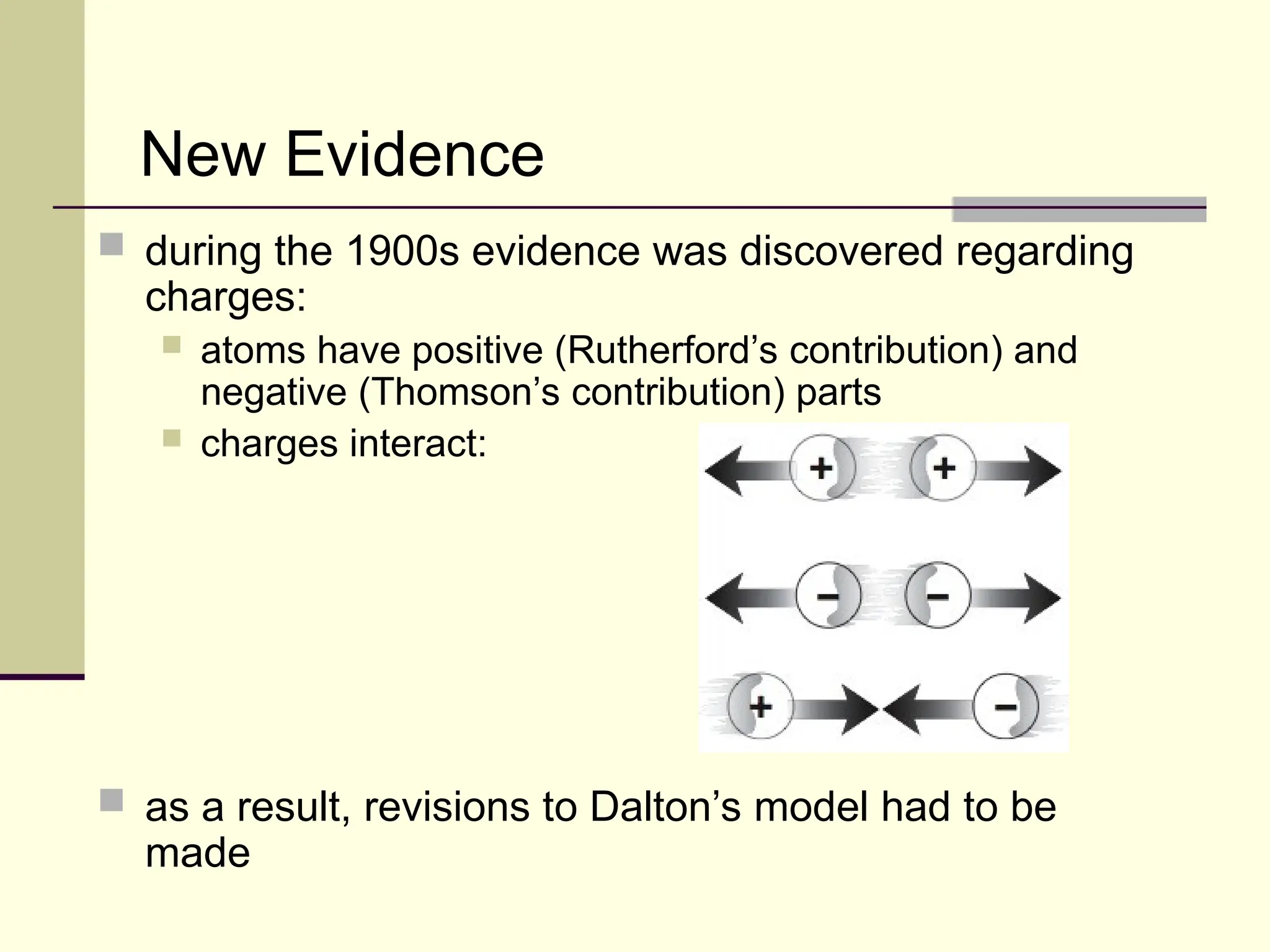
 during the 1900s evidence was discovered regarding
charges:
 atoms have positive (Rutherford’s contribution) and
negative (Thomson’s contribution) parts
 charges interact:
 as a result, revisions to Dalton’s model had to be
made
New Evidence
Thomson: “Plum Pudding” or
“Chocolate Chip Cookie” Model
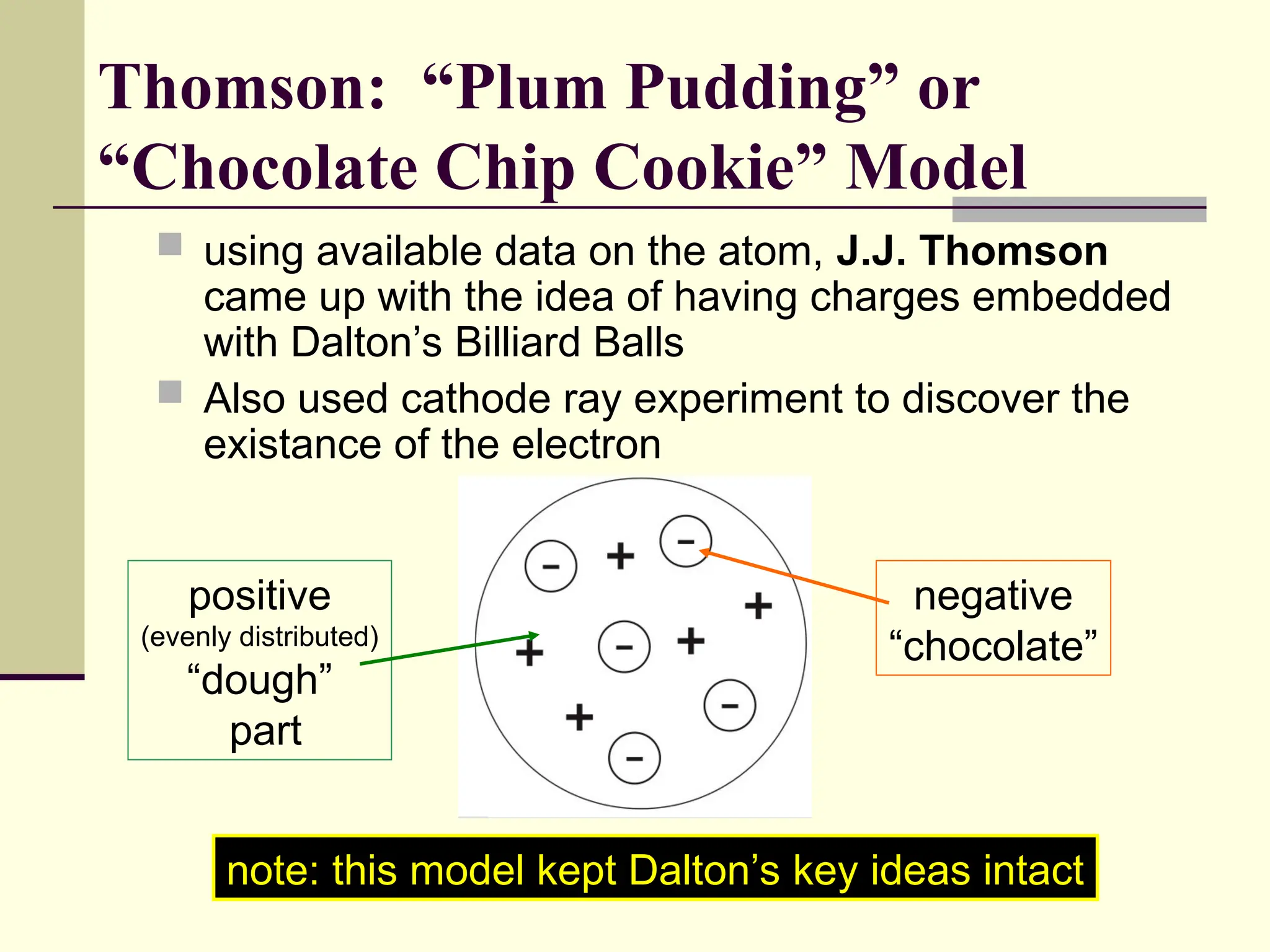
 using available data on the atom, J.J. Thomson
came up with the idea of having charges embedded
with Dalton’s Billiard Balls
 Also used cathode ray experiment to discover the
existance of the electron
positive
(evenly distributed)
“dough”
part
negative
“chocolate”
note: this model kept Dalton’s key ideas intact
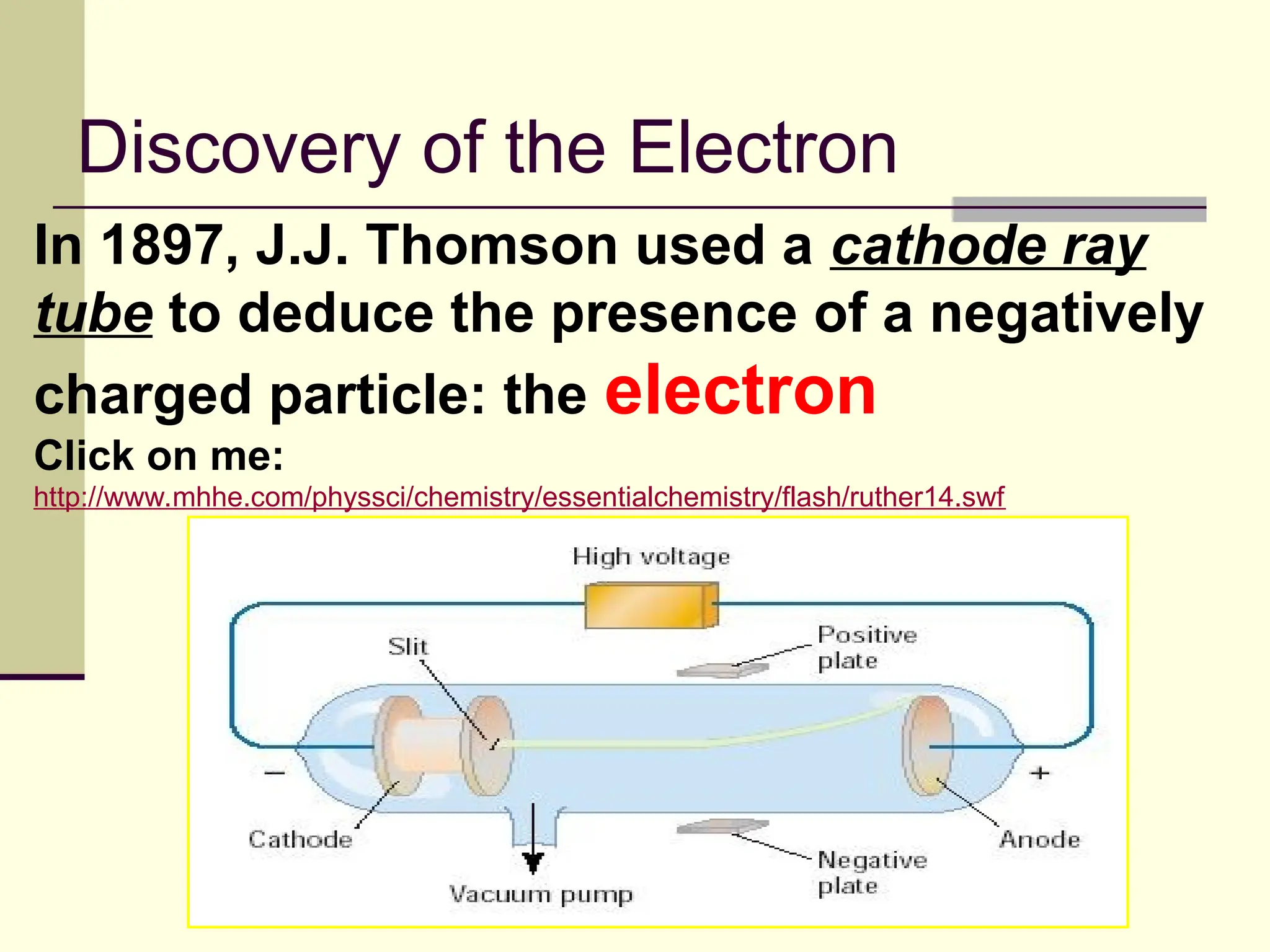
Discovery of the Electron
In 1897, J.J. Thomson used a cathode ray
tube to deduce the presence of a negatively
charged particle: the electron
Click on me:
http://www.mhhe.com/physsci/chemistry/essentialchemistry/flash/ruther14.swf
Conclusions from the Study of the
Electron:
A. Cathode rays have identical properties
regardless of the element used to produce
them. All elements must contain identically
charged electrons.
B. Atoms are neutral, so there must be
positive particles in the atom to balance the
negative charge of the electrons
C. Electrons have so little mass that atoms
must contain other particles that account
for most of the mass
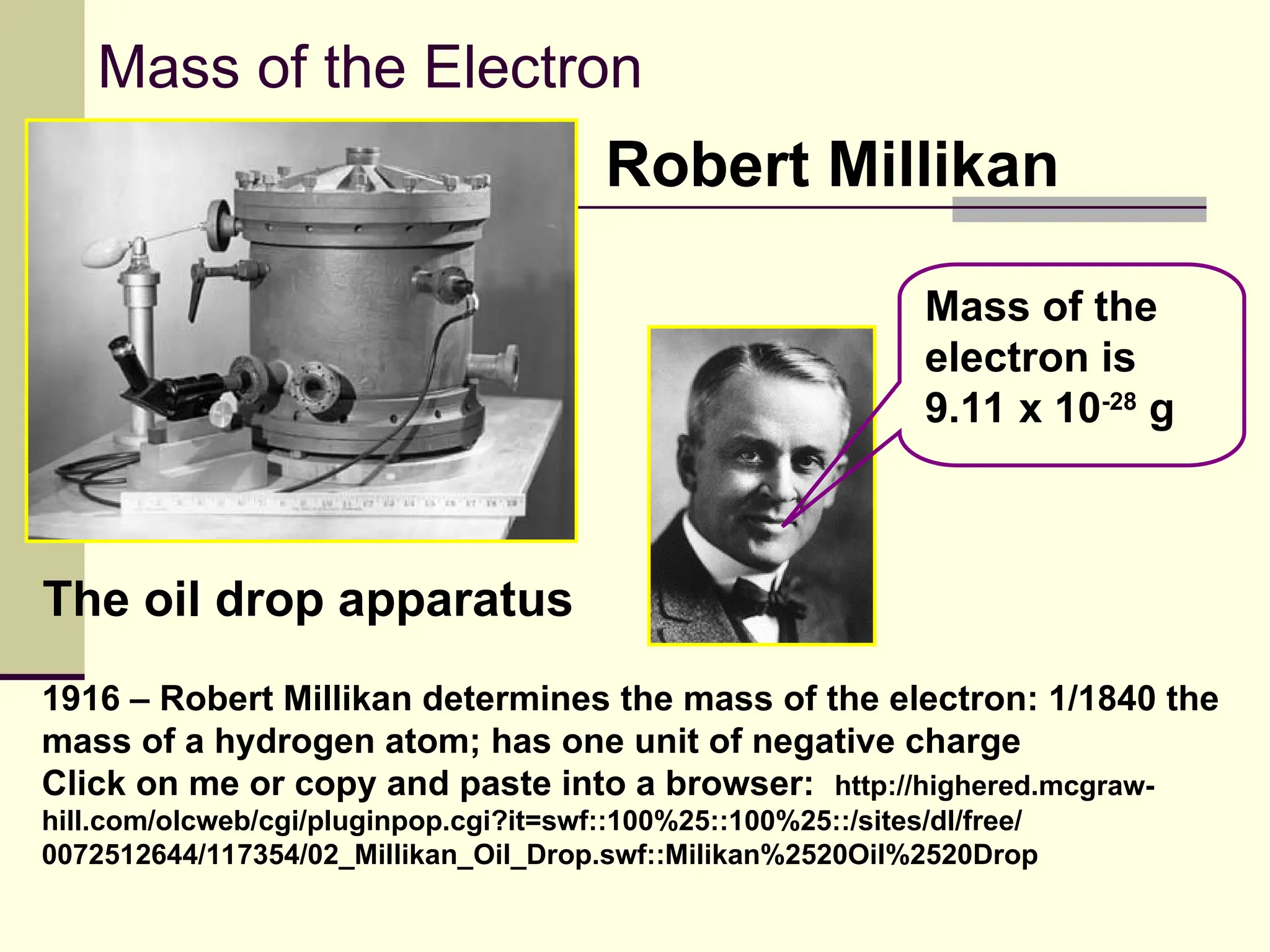
Mass of the Electron
1916 – Robert Millikan determines the mass of the electron: 1/1840 the
mass of a hydrogen atom; has one unit of negative charge
Click on me or copy and paste into a browser: http://highered.mcgraw-
hill.com/olcweb/cgi/pluginpop.cgi?it=swf::100%25::100%25::/sites/dl/free/
0072512644/117354/02_Millikan_Oil_Drop.swf::Milikan%2520Oil%2520Drop
The oil drop apparatus
Mass of the
electron is
9.11 x 10⁻²⁸
g
Robert Millikan
Nuclear Model
 Ernest Rutherford discovered a huge flaw in
the previous concept of the atom during his
now famous gold foil experiment
Rutherford
 Discovered the Nucleus
and the Positive Protons
 Surmised atoms are
made of mostly empty
space
 Didn’t know about the
Neutrons
 Famous Gold Foil
Experiment
 Click on me:
http://www.mhhe.com/physsci/chemist
ry/essentialchemistry/flash/ruther14.s
wf
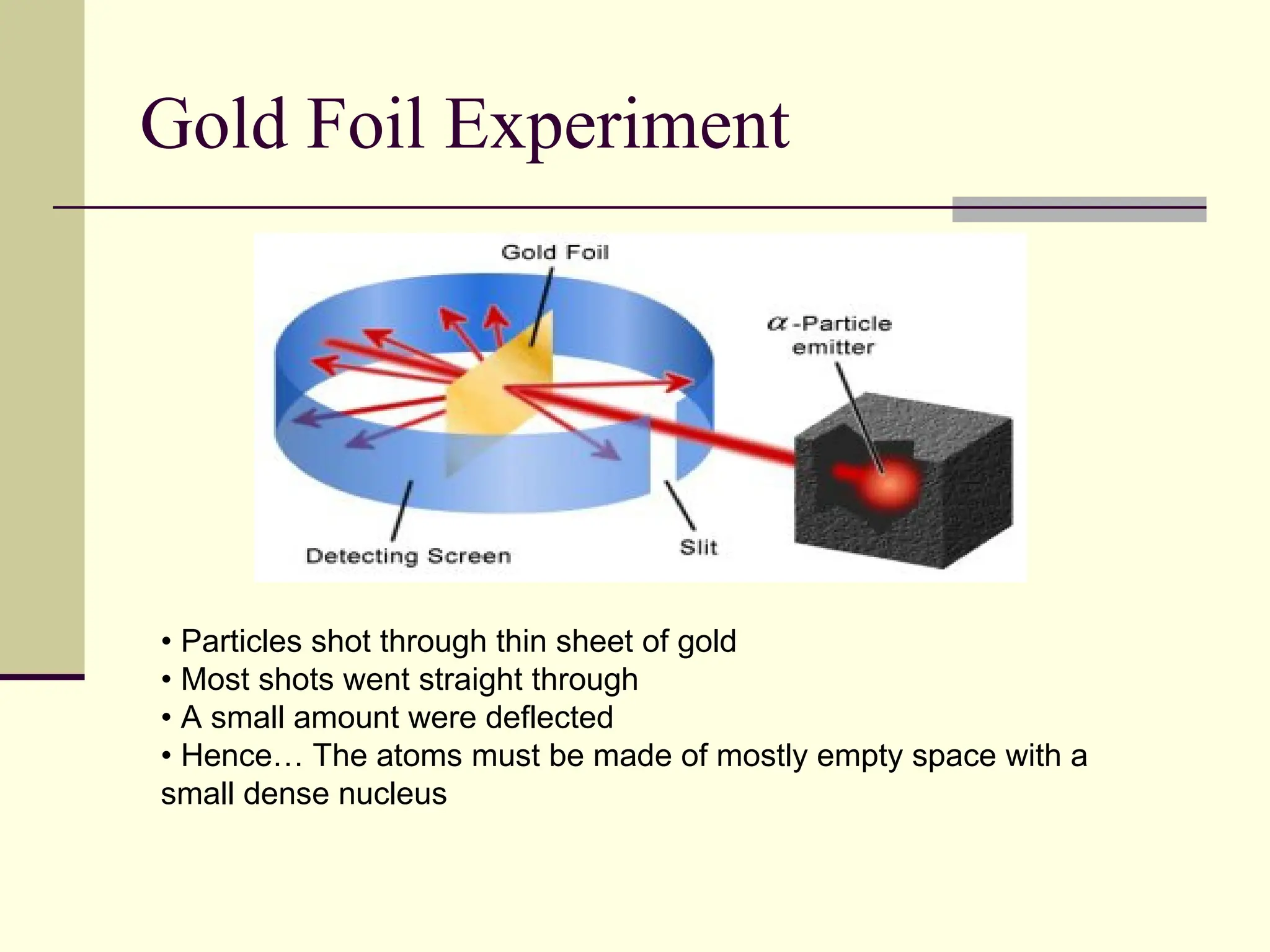
Gold Foil Experiment
• Particles shot through thin sheet of gold
• Most shots went straight through
• A small amount were deflected
• Hence… The atoms must be made of mostly empty space with a
small dense nucleus
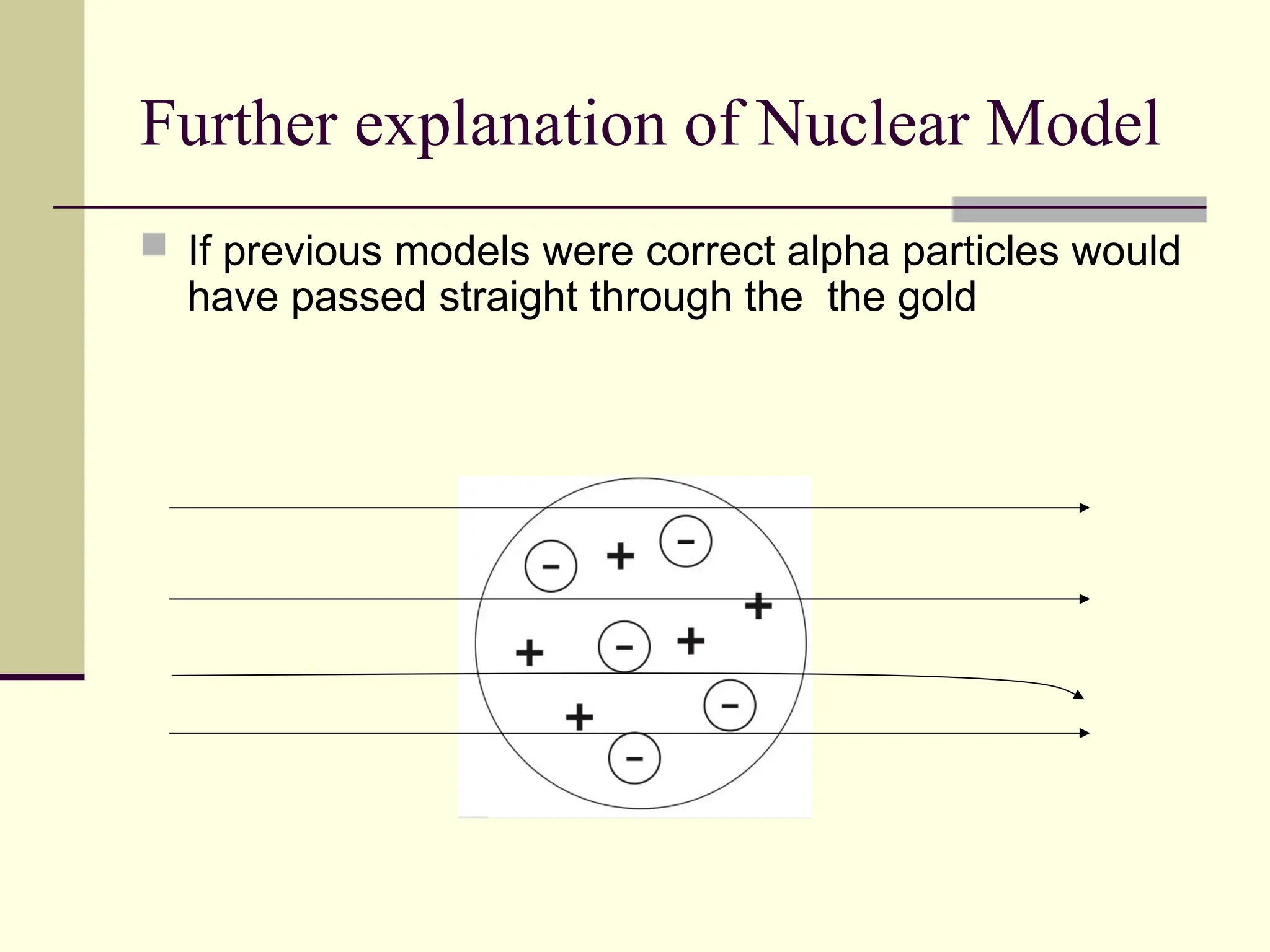
 If previous models were correct alpha particles would
have passed straight through the the gold
Further explanation of Nuclear Model
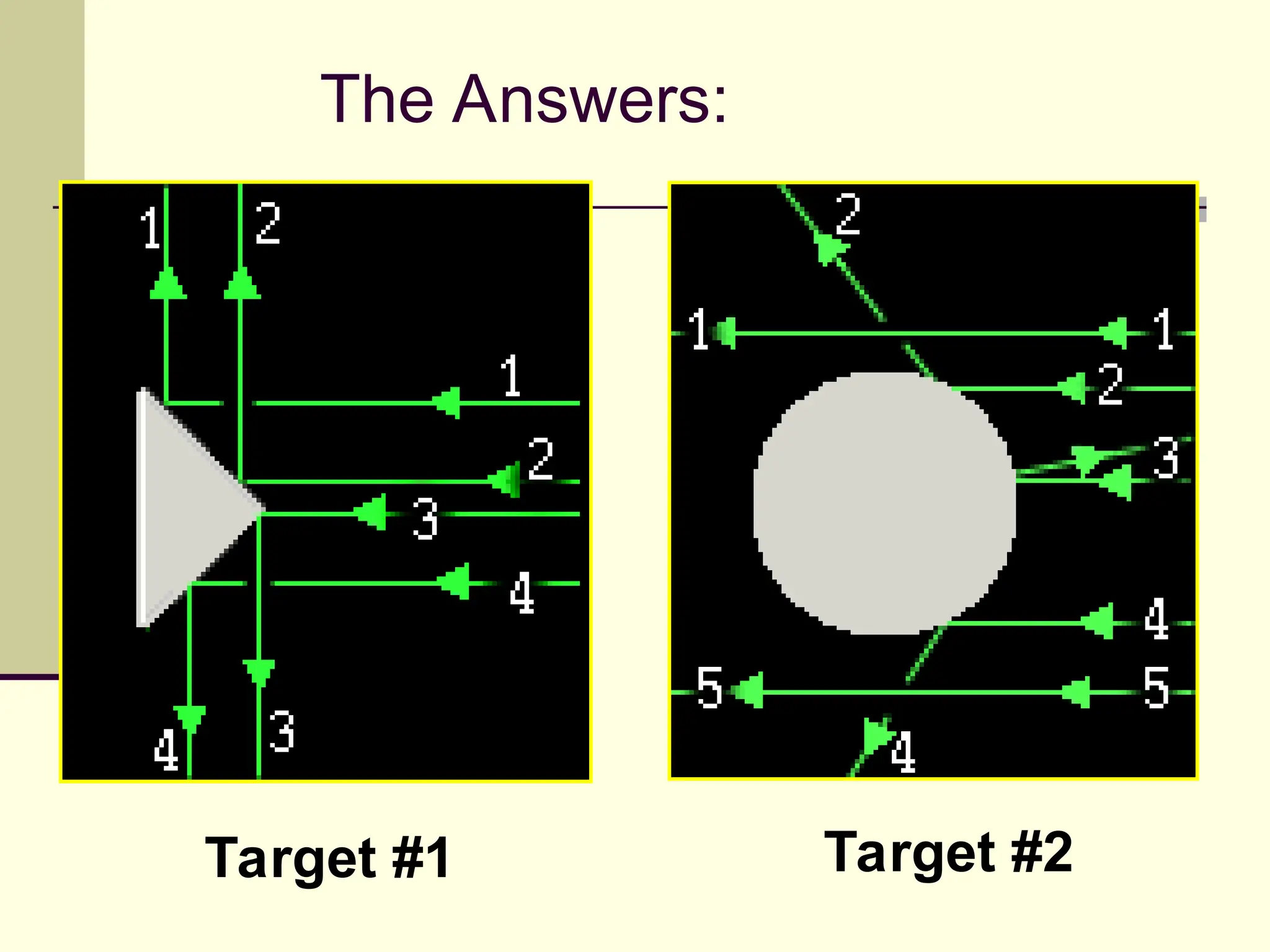
Rutherford’s problem:
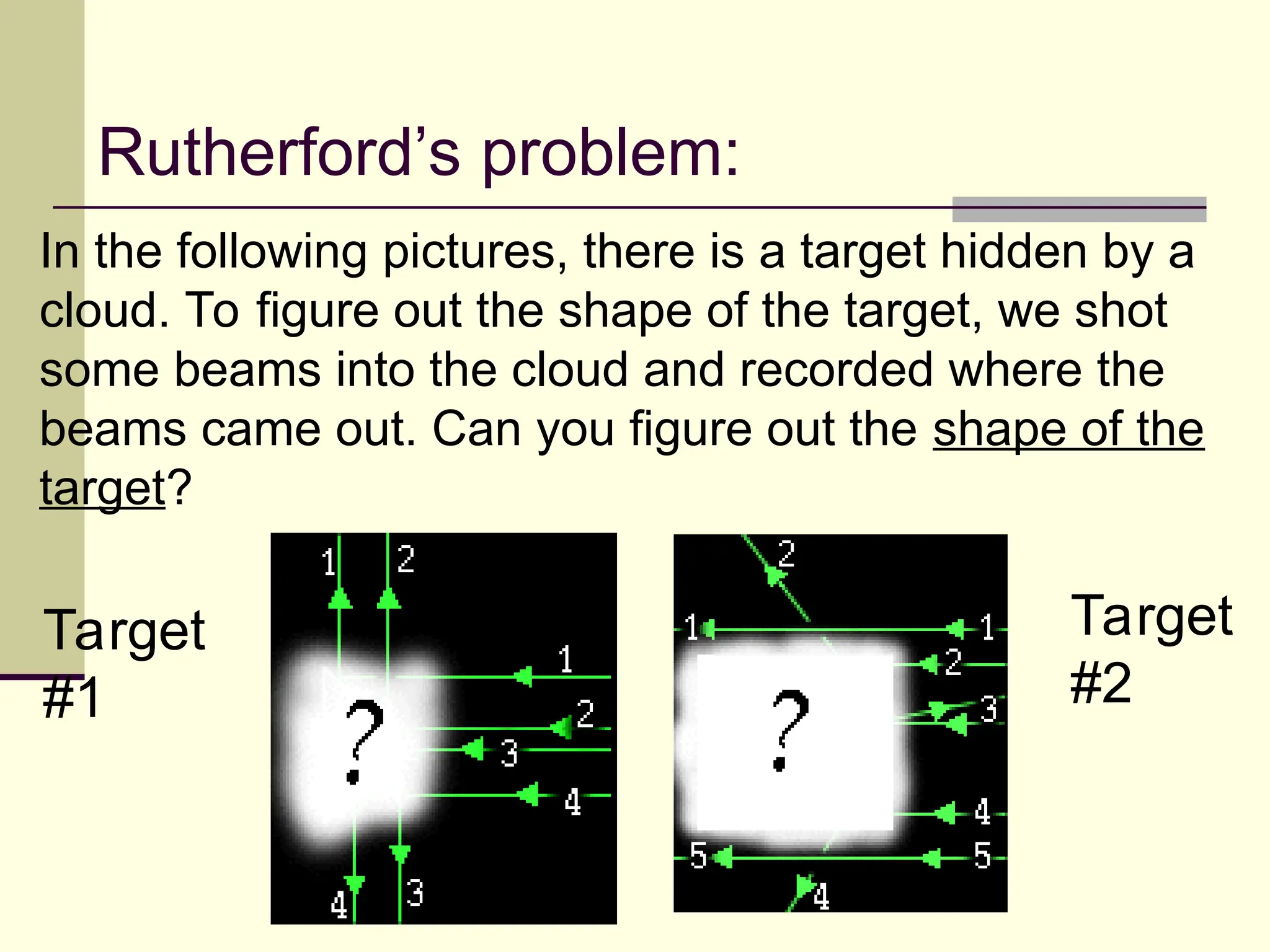
In the following pictures, there is a target hidden by a
cloud. To figure out the shape of the target, we shot
some beams into the cloud and recorded where the
beams came out. Can you figure out the shape of the
target?
Target
#1
Target
#2
The Answers:
Target #1 Target #2
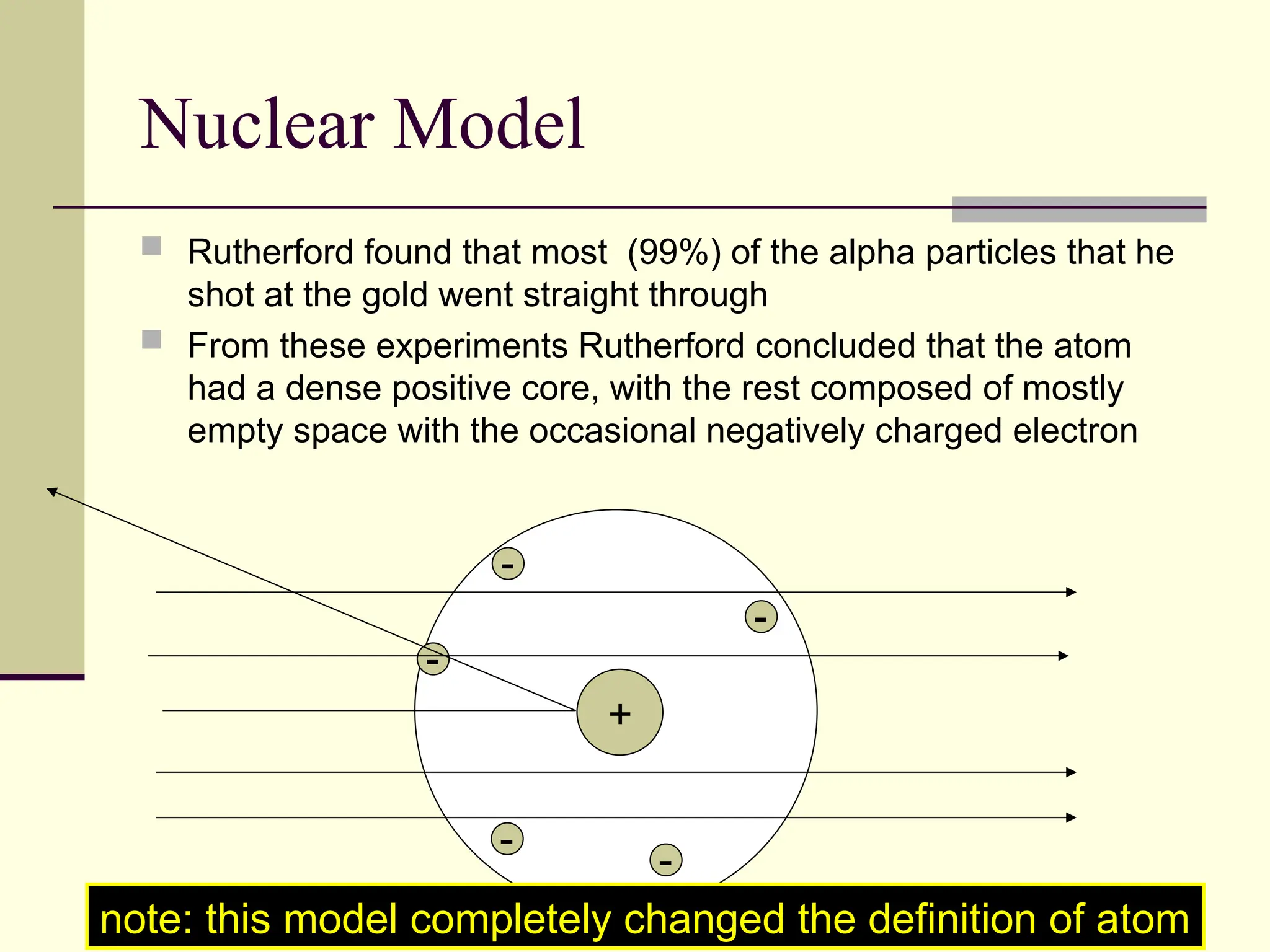
 Rutherford found that most (99%) of the alpha particles that he
shot at the gold went straight through
 From these experiments Rutherford concluded that the atom
had a dense positive core, with the rest composed of mostly
empty space with the occasional negatively charged electron
Nuclear Model
+
-
-
-
-
-
note: this model completely changed the definition of atom
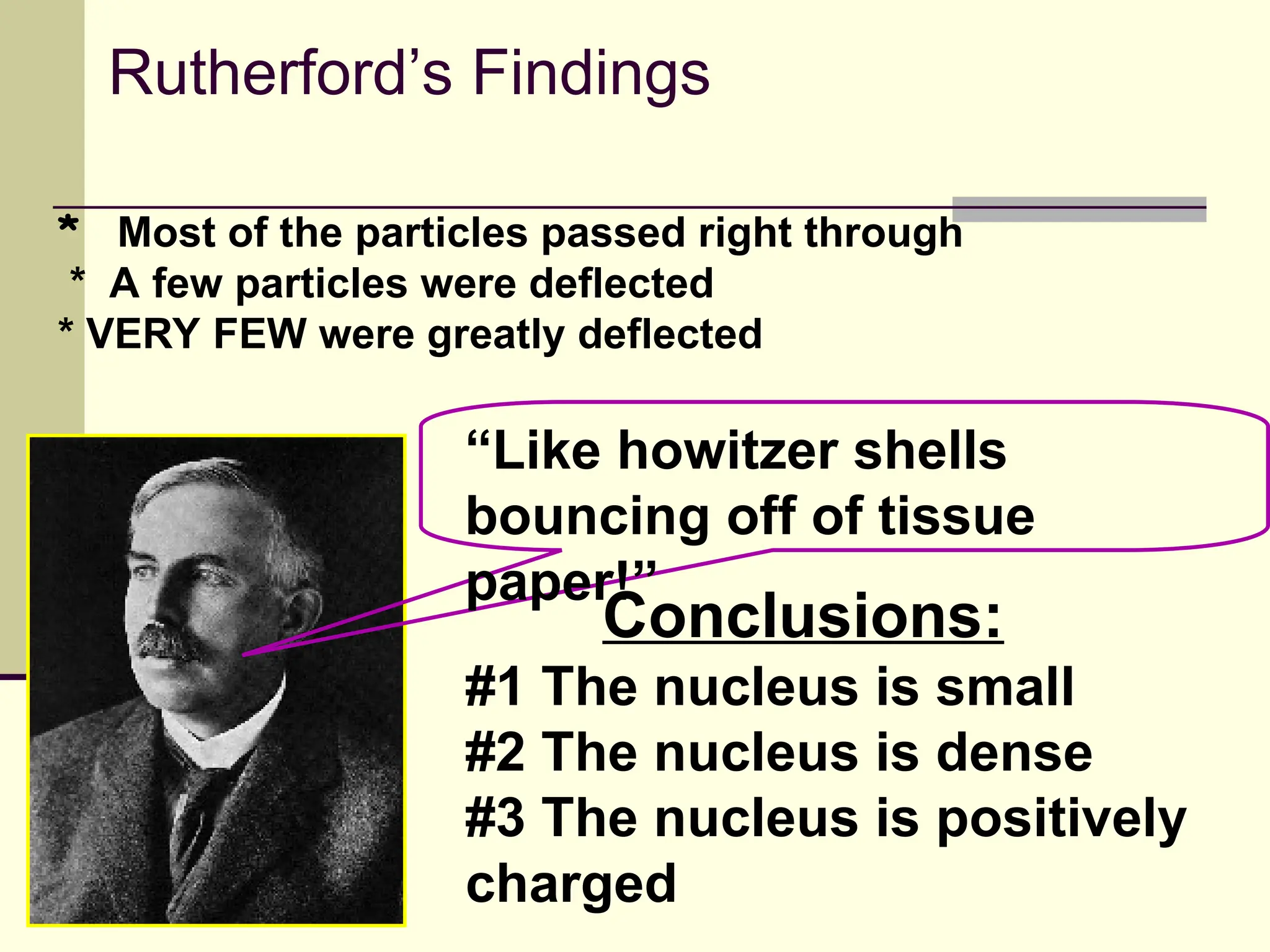
Rutherford’s Findings
#1 The nucleus is small
#2 The nucleus is dense
#3 The nucleus is positively
charged
* Most of the particles passed right through
* A few particles were deflected
* VERY FEW were greatly deflected
“Like howitzer shells
bouncing off of tissue
paper!”
Conclusions:
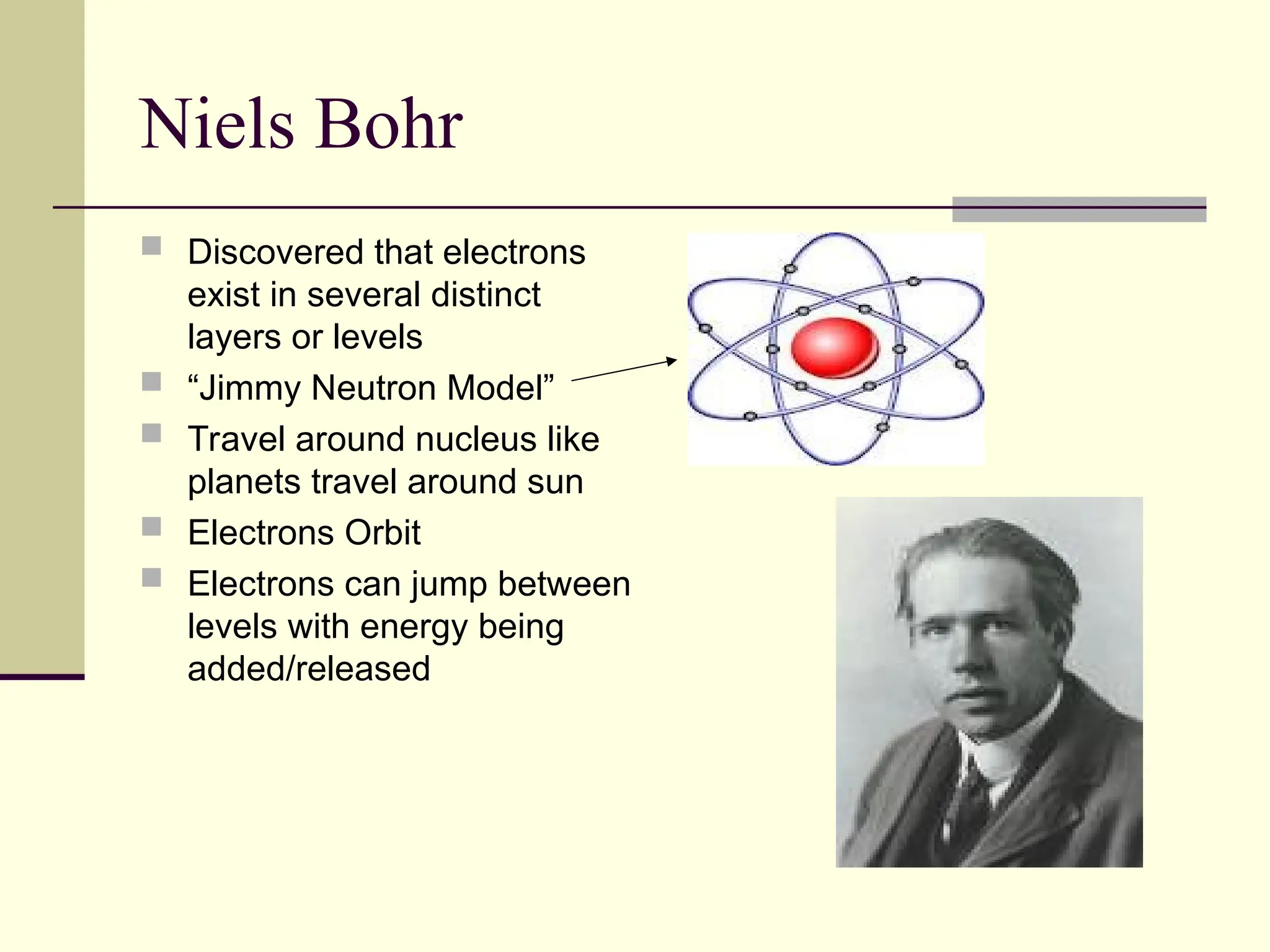
Niels Bohr
 Discovered that electrons
exist in several distinct
layers or levels
 “Jimmy Neutron Model”
 Travel around nucleus like
planets travel around sun
 Electrons Orbit
 Electrons can jump between
levels with energy being
added/released
Bohr Model
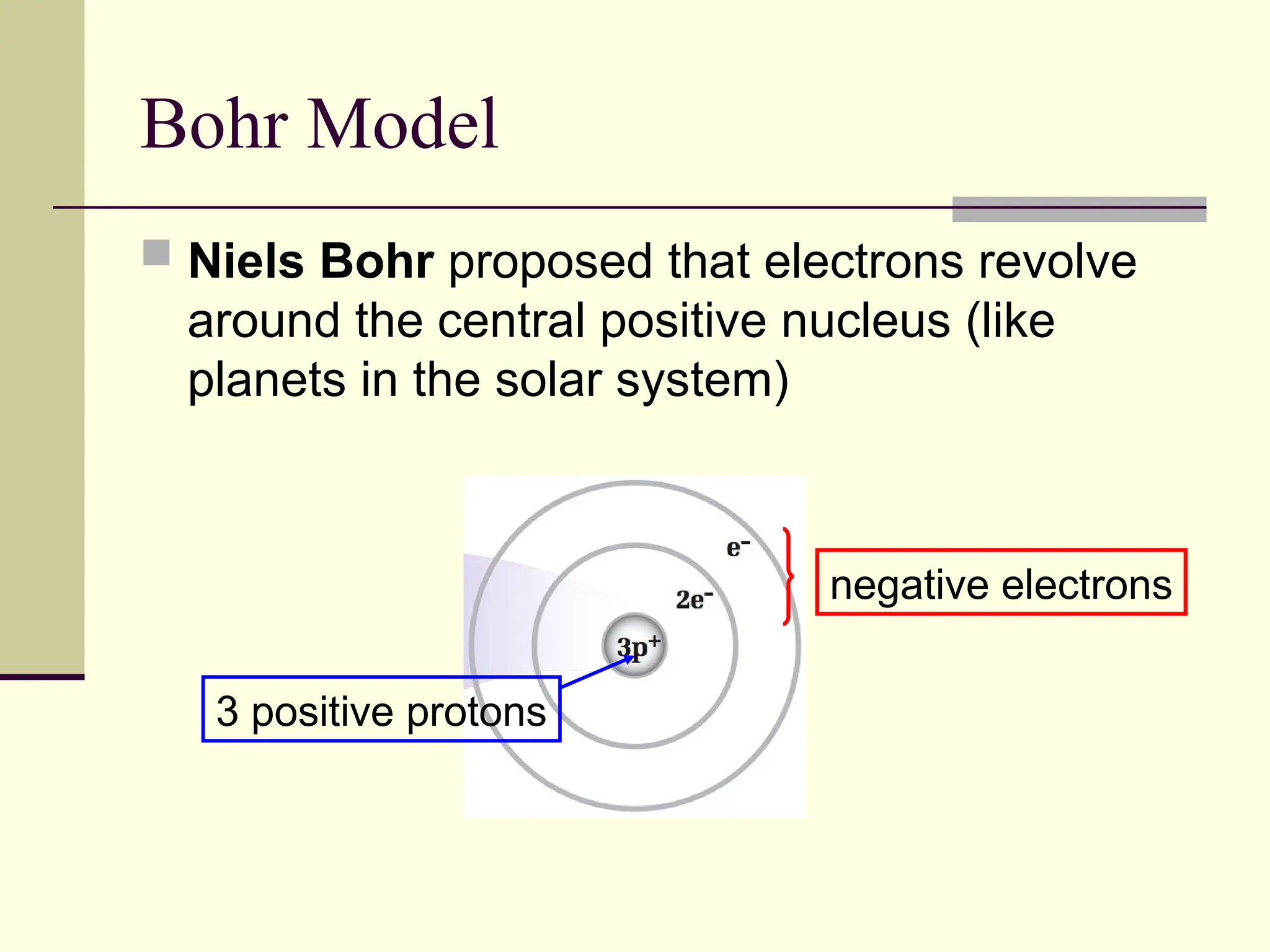
 Niels Bohr proposed that electrons revolve
around the central positive nucleus (like
planets in the solar system)
negative electrons
3 positive protons
Bohr Model
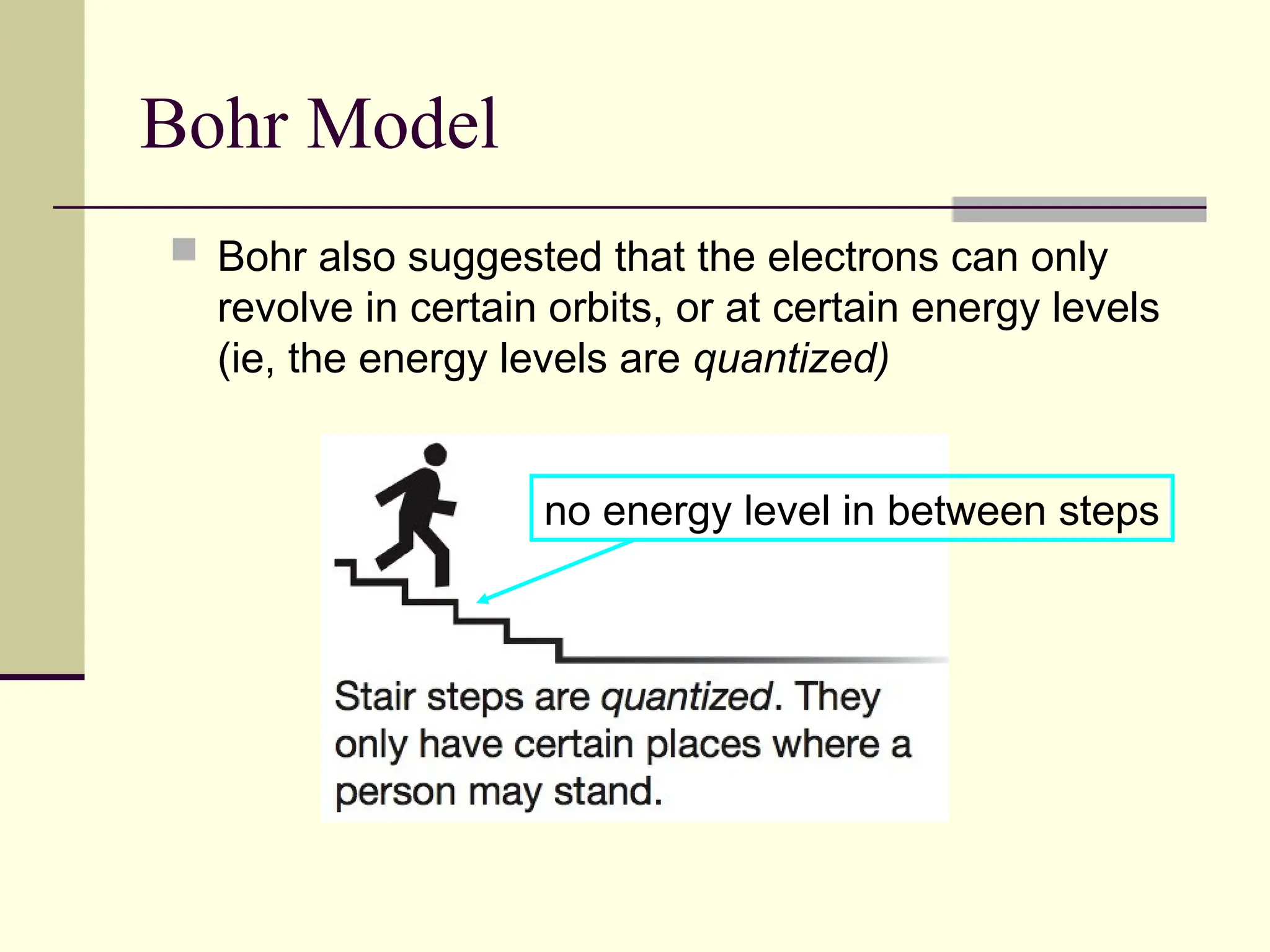
 Bohr also suggested that the electrons can only
revolve in certain orbits, or at certain energy levels
(ie, the energy levels are quantized)
no energy level in between steps
Heisenberg and Schrodinger
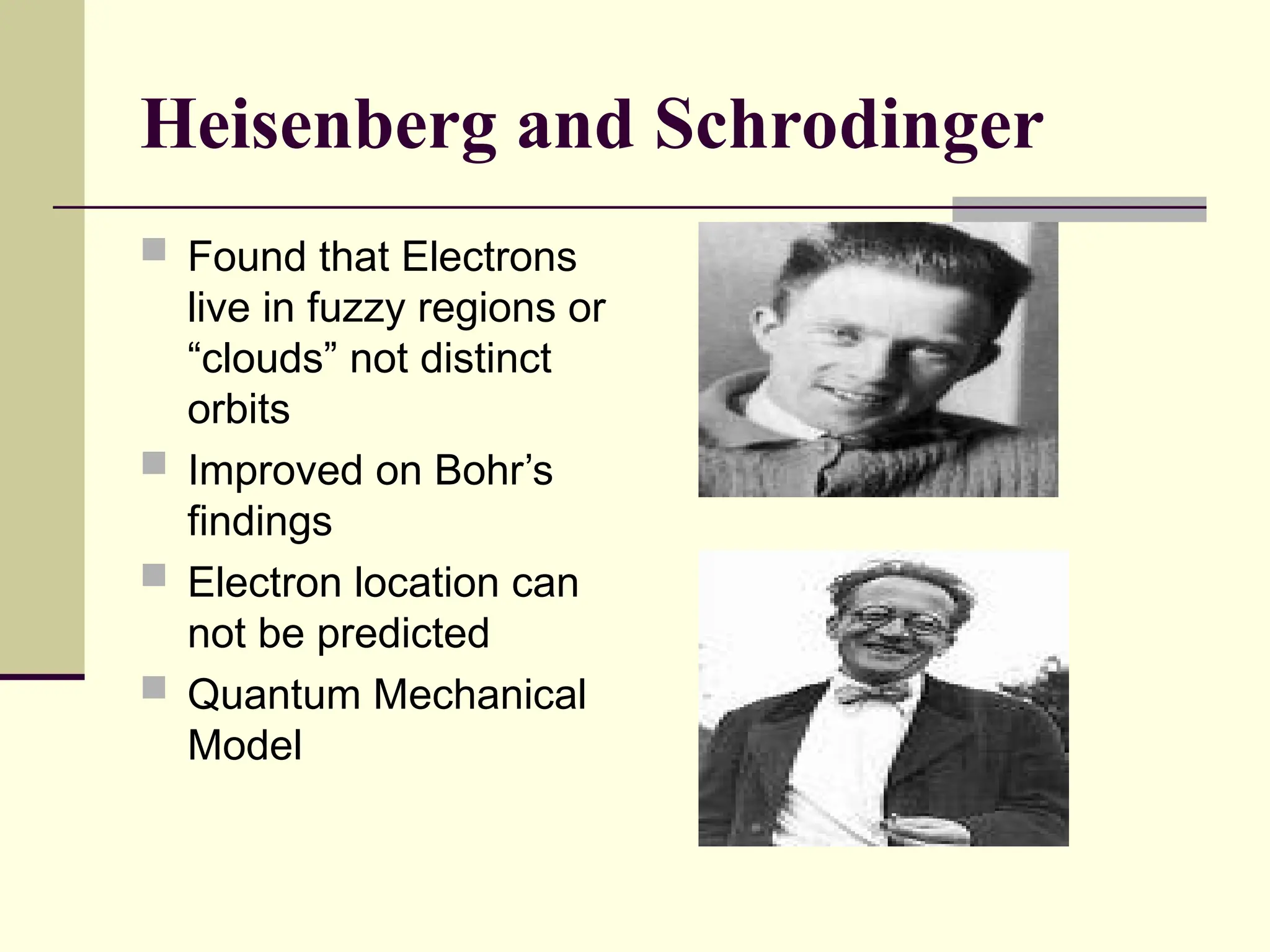
 Found that Electrons
live in fuzzy regions or
“clouds” not distinct
orbits
 Improved on Bohr’s
findings
 Electron location can
not be predicted
 Quantum Mechanical
Model
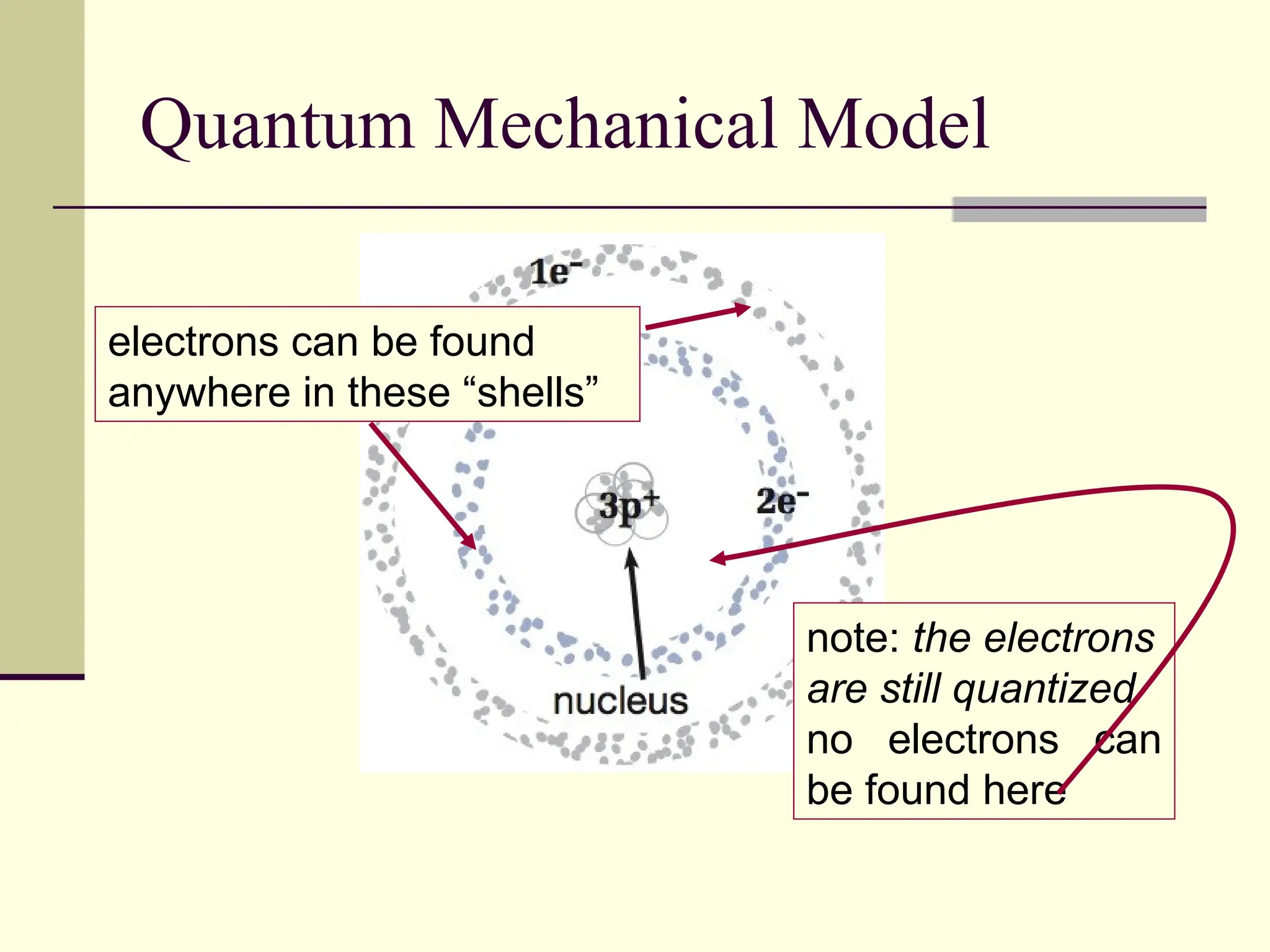
Quantum Mechanical Model
 the current understanding of the atom is based on
Quantum Mechanics
 this model sees the electrons not as individual
particles, but as behaving like a cloud - the electron
can be “anywhere” in a certain energy level
 Remember back to CPE with electrons behaving
like bees in a beehive
Quantum Mechanical Model
electrons can be found
anywhere in these “shells”
note: the electrons
are still quantized
no electrons can
be found here
FYI: Chemistry
 most things we do can be explained using
Dalton’s and/or Bohr’s model
 the Quantum Mechanical model, although
most accurate, is complex even at a
university level (conceptually and
mathematically)
 Click on me or copy and paste into browser:
http://www.hyperhistory.com/online_n2/people_n2/science_n2/atomic_theory.html
 to learn more about quarks & hadrons (its
located near the bottom of the page)

Atom History PP.pptttttttttttttttttttttttttttttttt

  • 1.
    Chapter Sections: 10.1, 10.5,10.6, 4.3, 4.5 and a little extra History and Models of the Atom Click on me: http://hi.fi.tripod.com/timeline
  • 2.
    • Believed universemade of invisible units called atoms • Named them Atoms • 400 BC • Aristotle said “He’s a quack!!!” • Took 2000 yrs to be proved right! Democritus
  • 3.
    Dalton’s Atomic Theory 3.Atoms of different elements combine in simple whole-number ratios to form chemical compounds 4. In chemical reactions, atoms are combined, separated, or rearranged – but never changed into atoms of another element. 1. All elements are composed of tiny indivisible particles called atoms 2. Atoms of the same element are identical. Atoms of any one element are different from those of any other element. John Dalton (1766 – 1844) Wrote the first atomic theory
  • 4.
    FYI……….Isotopes Dalton was wrongabout all elements of the same type being identical Atoms of the same element can have different numbers of neutrons. Thus, different mass numbers. These are called isotopes.
  • 5.
    Frederick Soddy Frederick Soddy(1877-1956) proposed the idea of isotopes in 1912 (note this was close to 30 years after Dalton’s original idea)  Isotopes are atoms of the same element having different masses, due to varying numbers of neutrons. Soddy won the Nobel Prize in Chemistry in 1921 for his work with isotopes and radioactive materials.
  • 6.
    The “Billiard Ball”Model  proposed by John Dalton in 1804  this theory proposed that matter was composed of small, spherical particles  but evidence was later gathered that matter was composed of even smaller bits
  • 7.
     during the1900s evidence was discovered regarding charges:  atoms have positive (Rutherford’s contribution) and negative (Thomson’s contribution) parts  charges interact:  as a result, revisions to Dalton’s model had to be made New Evidence
  • 8.
    Thomson: “Plum Pudding”or “Chocolate Chip Cookie” Model  using available data on the atom, J.J. Thomson came up with the idea of having charges embedded with Dalton’s Billiard Balls  Also used cathode ray experiment to discover the existance of the electron positive (evenly distributed) “dough” part negative “chocolate” note: this model kept Dalton’s key ideas intact
  • 9.
    Discovery of theElectron In 1897, J.J. Thomson used a cathode ray tube to deduce the presence of a negatively charged particle: the electron Click on me: http://www.mhhe.com/physsci/chemistry/essentialchemistry/flash/ruther14.swf
  • 10.
    Conclusions from theStudy of the Electron: A. Cathode rays have identical properties regardless of the element used to produce them. All elements must contain identically charged electrons. B. Atoms are neutral, so there must be positive particles in the atom to balance the negative charge of the electrons C. Electrons have so little mass that atoms must contain other particles that account for most of the mass
  • 11.
    Mass of theElectron 1916 – Robert Millikan determines the mass of the electron: 1/1840 the mass of a hydrogen atom; has one unit of negative charge Click on me or copy and paste into a browser: http://highered.mcgraw- hill.com/olcweb/cgi/pluginpop.cgi?it=swf::100%25::100%25::/sites/dl/free/ 0072512644/117354/02_Millikan_Oil_Drop.swf::Milikan%2520Oil%2520Drop The oil drop apparatus Mass of the electron is 9.11 x 10⁻²⁸ g Robert Millikan
  • 12.
    Nuclear Model  ErnestRutherford discovered a huge flaw in the previous concept of the atom during his now famous gold foil experiment
  • 13.
    Rutherford  Discovered theNucleus and the Positive Protons  Surmised atoms are made of mostly empty space  Didn’t know about the Neutrons  Famous Gold Foil Experiment  Click on me: http://www.mhhe.com/physsci/chemist ry/essentialchemistry/flash/ruther14.s wf
  • 14.
    Gold Foil Experiment •Particles shot through thin sheet of gold • Most shots went straight through • A small amount were deflected • Hence… The atoms must be made of mostly empty space with a small dense nucleus
  • 15.
     If previousmodels were correct alpha particles would have passed straight through the the gold Further explanation of Nuclear Model
  • 16.
    Rutherford’s problem: In thefollowing pictures, there is a target hidden by a cloud. To figure out the shape of the target, we shot some beams into the cloud and recorded where the beams came out. Can you figure out the shape of the target? Target #1 Target #2
  • 17.
  • 18.
     Rutherford foundthat most (99%) of the alpha particles that he shot at the gold went straight through  From these experiments Rutherford concluded that the atom had a dense positive core, with the rest composed of mostly empty space with the occasional negatively charged electron Nuclear Model + - - - - - note: this model completely changed the definition of atom
  • 19.
    Rutherford’s Findings #1 Thenucleus is small #2 The nucleus is dense #3 The nucleus is positively charged * Most of the particles passed right through * A few particles were deflected * VERY FEW were greatly deflected “Like howitzer shells bouncing off of tissue paper!” Conclusions:
  • 20.
    Niels Bohr  Discoveredthat electrons exist in several distinct layers or levels  “Jimmy Neutron Model”  Travel around nucleus like planets travel around sun  Electrons Orbit  Electrons can jump between levels with energy being added/released
  • 21.
    Bohr Model  NielsBohr proposed that electrons revolve around the central positive nucleus (like planets in the solar system) negative electrons 3 positive protons
  • 22.
    Bohr Model  Bohralso suggested that the electrons can only revolve in certain orbits, or at certain energy levels (ie, the energy levels are quantized) no energy level in between steps
  • 23.
    Heisenberg and Schrodinger Found that Electrons live in fuzzy regions or “clouds” not distinct orbits  Improved on Bohr’s findings  Electron location can not be predicted  Quantum Mechanical Model
  • 24.
    Quantum Mechanical Model the current understanding of the atom is based on Quantum Mechanics  this model sees the electrons not as individual particles, but as behaving like a cloud - the electron can be “anywhere” in a certain energy level  Remember back to CPE with electrons behaving like bees in a beehive
  • 25.
    Quantum Mechanical Model electronscan be found anywhere in these “shells” note: the electrons are still quantized no electrons can be found here
  • 26.
    FYI: Chemistry  mostthings we do can be explained using Dalton’s and/or Bohr’s model  the Quantum Mechanical model, although most accurate, is complex even at a university level (conceptually and mathematically)  Click on me or copy and paste into browser: http://www.hyperhistory.com/online_n2/people_n2/science_n2/atomic_theory.html  to learn more about quarks & hadrons (its located near the bottom of the page)

Editor's Notes

  • #18 but some bounced off at oblique angles