RURAL DEVELOPMENT
•Introduction
•Importance of Rural development
•Rural credit
•Importance of Rural Credit
•Sources of Rural credit
•Formal Sources
•Commercial Banks
•Co-operative societies
•Regional Rural Banks
RURAL DEVELOPMENT
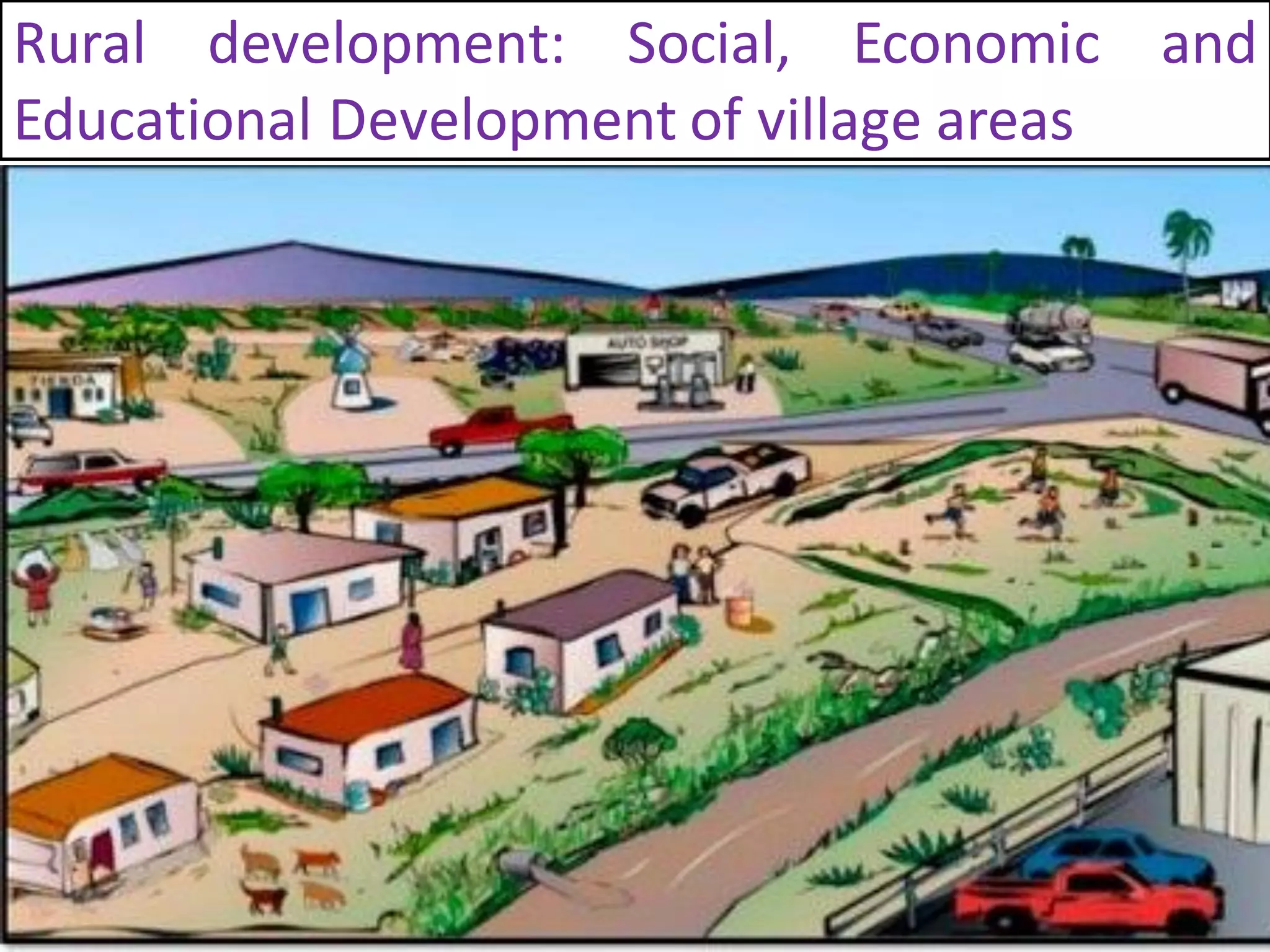
Rural development: Social, Economic and
Educational Development of village areas
Rural Development includes the following:
HUMAN RESOURCE DEVELOPMENT:
Literacy, Education, Skill Development and Health Facilities
LAND REFORMS TO MAKE REAL TILLER OWNER OF LAND
DEVELOPMENT OF LOCAL RESOURCES
DEVELOPMENT OF INFRASTRUCTURAL FACILITIES
POVERTY ALLEVIATION AND EMPLOYMENT
GENERATION PROGRAMMES
IMPORTANCE OF RURAL DEVELOPMENT
• More than two – third of the populationdepend on
agriculture. They live in villages.
• Most of the poor people live in villages.
• Agricultural growth rate has decreased to 3% per
annum.
• Cottage and village industries have declined.
• So, to improve the welfare of people steps should
be taken for the development of villages.
RURAL CREDIT
RURAL CREDIT
• The word credit literally means faith.
• Credit is an arrangement by which the lender gives
money or goods to a borrower in return for a
promise of repayment in future.
IMPORTANCE OF RURAL CREDIT
• Credit is needed to buy seeds, fertilisers,
implements etc. It is also needed to meet other
expenditure till the crops are ready.
• Credit is needed to buy additional land and to make
wells and tube wells.
• Credit helps to start small scale industrial units in
village areas.
IMPORTANCE OF RURAL CREDIT
• During crop failure, credit will help farmers to
survive and to continue cultivation.
• Credit helps a farmer to adopt new technology.
• Credit is needed to meet family expenditure during
marriage, death or religious functions.
INFORMAL SOURCES (NON INSTITUTIONAL
SOURCES) OF CREDIT
• Money Lenders, friends, relatives, traders and land
lords are the informal sources of credit.
• They are not controlled or supervised by any
government agency.
• They charge very high rate of interest.
• They exploit the borrower.
• Some of them cheat the borrowers.
• The borrower will fall in to debt trap.
• It is easy to get loans from them.
FORMAL SOURCES
(INSTITUTIONAL SOURCES) OF CREDIT
Banks, Co-operative Societies, Regional
Rural Banks and NABARD are formal sources.
.
COMMERCIAL BANKS
• The RBI has instructed Banks to make short term,
medium term and long term loans available to farmers
• Kissan Credit Cards are given to farmers. They can get
short term loans using these cards.
• It is difficult for poor farmers to get loans from Banks.
COMMERCIAL BANKS
• Branches of Banks are not there in many
villages.
• The Banks demand collateral security. The
poor farmers do not have anything to offer as
collateral security.
• The Banks do not consider poor farmers credit
worthy.
Co-operative Societies
• Co-operative societies give loans to the farmers at
reasonable rate of interest.
• They do not demand any collateral security.
• They supply HYV seeds and fertilisers to farmers.
• The educate farmers about new methods of
farming.
Regional Rural Banks
• They are set up jointly by the Central and the State
Governments to meet the credit needs of rural
people.
• They provide short term, medium term and long
term loans to farmers at very low interest rates.
• They are set up in village areas.
•Introduction
•Importance of Rural development
•Rural credit
•Importance of Rural Credit
•Sources of Rural credit
•Formal Sources
•Commercial Banks
•Co-operative societies
•Regional Rural Banks
Recap…..
RURAL DEVELOPMENT PART1.pdf

RURAL DEVELOPMENT PART1.pdf

  • 1.
  • 3.
    •Introduction •Importance of Ruraldevelopment •Rural credit •Importance of Rural Credit •Sources of Rural credit •Formal Sources •Commercial Banks •Co-operative societies •Regional Rural Banks RURAL DEVELOPMENT
  • 4.
    Rural development: Social,Economic and Educational Development of village areas
  • 5.
    Rural Development includesthe following: HUMAN RESOURCE DEVELOPMENT: Literacy, Education, Skill Development and Health Facilities LAND REFORMS TO MAKE REAL TILLER OWNER OF LAND DEVELOPMENT OF LOCAL RESOURCES DEVELOPMENT OF INFRASTRUCTURAL FACILITIES POVERTY ALLEVIATION AND EMPLOYMENT GENERATION PROGRAMMES
  • 6.
    IMPORTANCE OF RURALDEVELOPMENT • More than two – third of the populationdepend on agriculture. They live in villages. • Most of the poor people live in villages. • Agricultural growth rate has decreased to 3% per annum. • Cottage and village industries have declined. • So, to improve the welfare of people steps should be taken for the development of villages.
  • 7.
  • 8.
    RURAL CREDIT • Theword credit literally means faith. • Credit is an arrangement by which the lender gives money or goods to a borrower in return for a promise of repayment in future.
  • 9.
    IMPORTANCE OF RURALCREDIT • Credit is needed to buy seeds, fertilisers, implements etc. It is also needed to meet other expenditure till the crops are ready. • Credit is needed to buy additional land and to make wells and tube wells. • Credit helps to start small scale industrial units in village areas.
  • 10.
    IMPORTANCE OF RURALCREDIT • During crop failure, credit will help farmers to survive and to continue cultivation. • Credit helps a farmer to adopt new technology. • Credit is needed to meet family expenditure during marriage, death or religious functions.
  • 12.
    INFORMAL SOURCES (NONINSTITUTIONAL SOURCES) OF CREDIT
  • 13.
    • Money Lenders,friends, relatives, traders and land lords are the informal sources of credit. • They are not controlled or supervised by any government agency. • They charge very high rate of interest. • They exploit the borrower. • Some of them cheat the borrowers. • The borrower will fall in to debt trap. • It is easy to get loans from them.
  • 15.
    FORMAL SOURCES (INSTITUTIONAL SOURCES)OF CREDIT Banks, Co-operative Societies, Regional Rural Banks and NABARD are formal sources. .
  • 16.
    COMMERCIAL BANKS • TheRBI has instructed Banks to make short term, medium term and long term loans available to farmers • Kissan Credit Cards are given to farmers. They can get short term loans using these cards. • It is difficult for poor farmers to get loans from Banks.
  • 17.
    COMMERCIAL BANKS • Branchesof Banks are not there in many villages. • The Banks demand collateral security. The poor farmers do not have anything to offer as collateral security. • The Banks do not consider poor farmers credit worthy.
  • 18.
    Co-operative Societies • Co-operativesocieties give loans to the farmers at reasonable rate of interest. • They do not demand any collateral security. • They supply HYV seeds and fertilisers to farmers. • The educate farmers about new methods of farming.
  • 19.
    Regional Rural Banks •They are set up jointly by the Central and the State Governments to meet the credit needs of rural people. • They provide short term, medium term and long term loans to farmers at very low interest rates. • They are set up in village areas.
  • 20.
    •Introduction •Importance of Ruraldevelopment •Rural credit •Importance of Rural Credit •Sources of Rural credit •Formal Sources •Commercial Banks •Co-operative societies •Regional Rural Banks Recap…..