RUNNING HEADER: TERRORISM
1
Terrorism in America
Position Paper 1
CJUS 380
Kenton Shatzer
Liberty University
Introduction
“Have you forgotten how it felt that day? To see your
homeland under fire and her people blown away. Have you
forgotten when those towers fell? We had neighbors still inside
going thru a living hell and you say we shouldn’t worry ‘bout
bin Laden. Have you forgotten?” (Worley. 2003). Have
forgotten what happened on 9/11 and do you ever wonder what
the United States could have done to ensure that the terrorist
attack did not happen on that faithful day? 9/11 was not the first
terrorist attack on the United States and it was not the last. On
April 14, 1972, in New York City, “ten members of a local
mosque phoned in a false alarm and then ambushed responding
officer, killing one” (TheReligionofPeace.com. 2015). In
Moore, OK on September 25, 2014, “A Sharia advocate
beheaded a woman after calling for Islamic terror and posting
an Islamist beheading photo” (TheReligionofPeace.com. 2015.).
So what is terrorism? “There are more than 100 definitions
of terrorism in the literature. The United Nations defines
terrorism as “an anxiety-inspiring method of repeated violent
action, employed by clandestine individual, group or state
actors, for idiosyncratic, criminal or political reason, whereby-
in contrast to assassinations- the direct targets of violence are
not the man targets”” (Bullock, Haddow, & Coppola. 2013. Pg.
490). The problem with terrorism is that terrorists want to
attack when their target is not ready, but also when there is a
large crowd that will be watching and knowing that the attack
will kill and injury many innocent people. So how can terrorist
attacks be stopped or be limited? Can countries stop terrorist
from attacking their countries? The learner of this paper firmly
believes that countries can limit and stop terrorist attacks.
Literature Review
Like stated above, terrorism has been around since the first
attack in 1972 and has continued to present day when the last
terrorist attack was in September 2014. “The largest act of
international terrorism occurred on September 11, 2001 in a set
of co-ordinated attacks on the United States of America, where
Islamic terrorists hijacked civilian airliners and used them to
attack the World Trade Center towers in New York City and the
Pentagon in Washington, DC” (Terrorism Research). Since 9/11,
the United States has cracked down and created new laws to
help protect the American citizens. The learner firmly believes
that the laws have enhanced the security and protection of the
United States and the citizens.
The United States government created a new policy after
9/11 known as the “Homeland Security,” and in this new policy
is an act called the USA PARTRIOT Act. The Bush
Administration passed this acted and also updated electronic
surveillance rules which allowed “warrants to intercept
individuals even they frequently changed phones, and to grant
access to internet communications on the same basic terms as
applicable to traditional telephone communications” (Chertoff.
2011). “The Department of Homeland Security (DHS) and its
many partners across the federal government, public and private
sectors, and communities across the country and around the
world have worked since 9/11 to build a new homeland security
enterprise to better mitigate and defend against dynamic threats,
minimize risks, and maximize the ability to respond and recover
from attacks and disaster of all kinds” (Department of
Homeland Security. 2011).
Since 9/11, the Department of Homeland Security has changed
and updated air travel in order to prevent terrorist attacks, and
they have also improved passenger screening. DHS has created
a data base where passenger information and name record data
to help keep out terrorists and this program has “denied entry to
the United States for having ties to terrorism” (Department of
Homeland Security. 2011.). Before 9/11, there were limited
requirements for explosives screening, but that has changed.
Today, 100 percent of all passengers’ baggage and carry-ons are
checked before any bag or person can enter the main part of the
airports. “Through the Recovery Act and annual appropriations,
TSA has accelerated the deployment of new technologies to
detect the next generation of threats, including Advanced
Imaging Technology units, Explosive Detection Systems,
Explosives Trace Detection units, Advanced Technology X-Ray
systems and Bottled Liquid Scanners” (Department of Homeland
Security. 2011).
The new policies, acts, and laws do not stop at the federal
level of government, but they extend to the state and local
governments. All levels of governments agencies have been
trained in case of attack would happen and have been trained to
prevent attacks. The learner believes that will all levels
government being ready to prevent terrorist attacks, then attacks
on America will decrease which means that the protection as
increased. The learner also believes that everyone should stand
together to prevent attacks against the U.S. and should follow
all laws and guidelines that the government has set forth.
Conclusion
On Tuesday morning at 8:45 a.m. on September 11, 2001, a
20,000 gallons jet fuel, Airline Boeing 767 loaded crashed in
the north tower of the World Trade Center in New York City.
Eighteen minutes later, another airplane crashed into the south
near at the 60th floor. Both of these planes instantly killed
hundreds of people while injuring thousands and trapping
hundreds of people. Once the towers hit the World Trade
Centers, Americans knew that United States of America was
under an attack, but this was not the end of this attack as two
more planes crashed. This terrorist attack has forever changed
the lives of everyone in the United States and has changed the
United States’ government. Laws, policies, and upgrades have
been since 9/11 in order to prevent any more terrorist attacks.
The learner believes that the United States has set forth strong
laws and policies that will enhance the protection of the citizen
of the American people.
Reference
Bullock, J., Haddow, G., & Coppola, D. (2013). Introduction to
homeland security (4th ed.). New York, NY: Elsevier.
Chertoff, Michael., 2011. 9/11 Before and After.
http://www.hsaj.org/?fullarticle=7.2.13
Homeland Security. 2011. Preventing Terrorism and Enhancing
Security. https://www.dhs.gov/preventing-terrorism-and-
enhancing-security
Terrorism Research: International terrorism and security
research. http://www.terrorism-research.com/
TheReligionofPeace.com. (2002-2015). Islamic terror attacks on
American soil.
http://www.thereligionofpeace.com/pages/americanattacks.htm
Worley, D. (2003). Have you forgotten?
Name: _______________________
The following take home test may be used to replace your
lowest test score. You MUST work on this individually. You
may use your notes, book, and homework to answer the
following questions.
Chapter 1
1. Perform the given operations.
)
2
(
3
12
18
5
2
-
¸
-
+
-
2. Translate the following statement into symbols.
Five subtracted from the quotient of a number and five is twice
the sum of four and the number.
Chapter 2
3. Solve the following equation and check your solution.
y
y
y
6
)
3
(
2
)
3
(
5
11
+
+
-
=
-
-
Check:
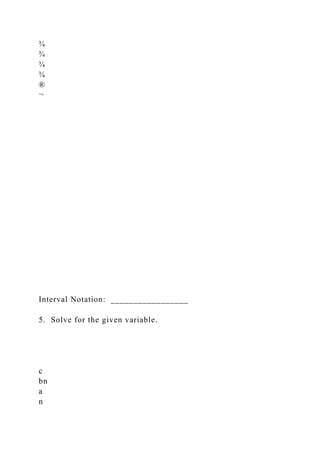
4. Solve the following inequality. Graph your solution on the
number line. Give answers in interval notation.
)
1
4
(
2
)
2
(
3
-
<
-
+
x
x
x
¾
¾
¾
¾
¾
¾
¾
¾
¾
¾
¾
¾
¾
¾
®
¬
Interval Notation: _________________
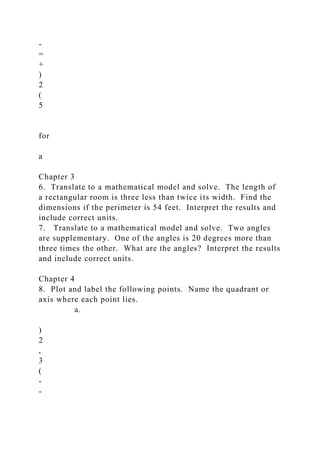
5. Solve for the given variable.
c
bn
a
n
-
=
+
)
2
(
5
for
a
Chapter 3
6. Translate to a mathematical model and solve. The length of
a rectangular room is three less than twice its width. Find the
dimensions if the perimeter is 54 feet. Interpret the results and
include correct units.
7. Translate to a mathematical model and solve. Two angles
are supplementary. One of the angles is 20 degrees more than
three times the other. What are the angles? Interpret the results
and include correct units.
Chapter 4
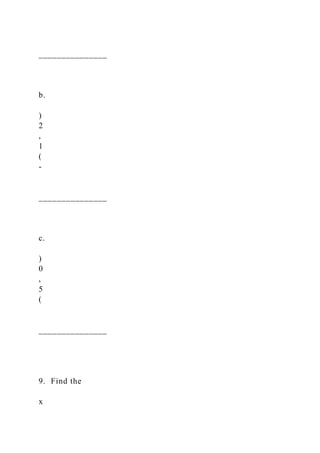
8. Plot and label the following points. Name the quadrant or
axis where each point lies.
a.
)
2
,
3
(
-
-
_______________
b.
)
2
,
1
(
-
_______________
c.
)
0
,
5
(
_______________
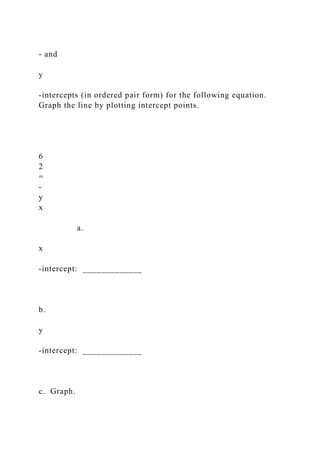
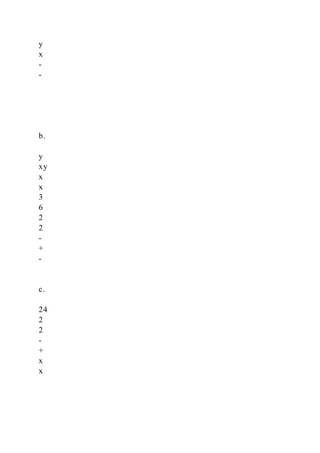
9. Find the
x
- and
y
-intercepts (in ordered pair form) for the following equation.
Graph the line by plotting intercept points.
6
2
=
-
y
x
a.
x
-intercept: _____________
b.
y
-intercept: _____________
c. Graph.
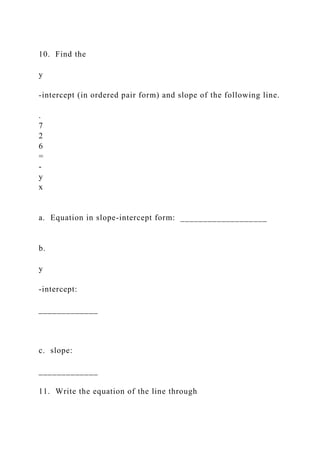
10. Find the
y
-intercept (in ordered pair form) and slope of the following line.
.
7
2
6
=
-
y
x
a. Equation in slope-intercept form: ___________________
b.
y
-intercept:
_____________
c. slope:
_____________
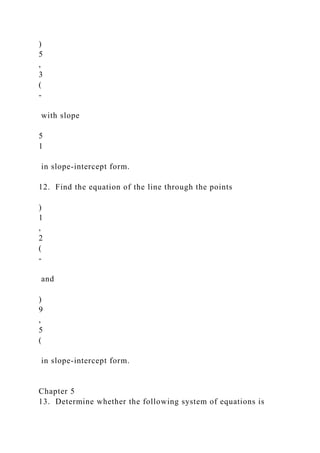
11. Write the equation of the line through
)
5
,
3
(
-
with slope
5
1
in slope-intercept form.
12. Find the equation of the line through the points
)
1
,
2
(
-
and
)
9
,
5
(
in slope-intercept form.
Chapter 5
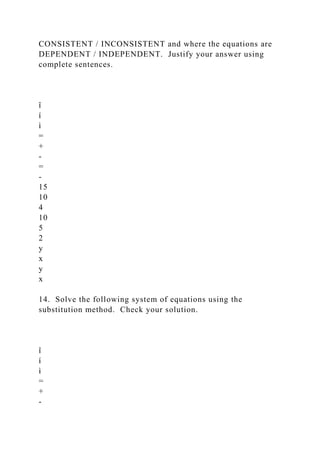
13. Determine whether the following system of equations is
CONSISTENT / INCONSISTENT and where the equations are
DEPENDENT / INDEPENDENT. Justify your answer using
complete sentences.
î
í
ì
=
+
-
=
-
15
10
4
10
5
2
y
x
y
x
14. Solve the following system of equations using the
substitution method. Check your solution.
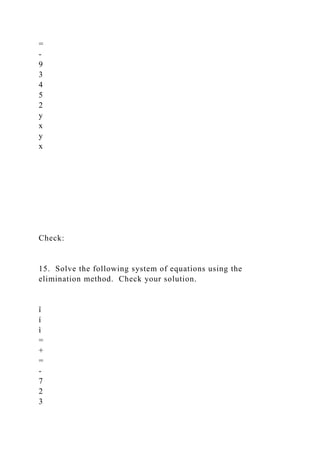
î
í
ì
=
+
-
=
-
9
3
4
5
2
y
x
y
x
Check:
15. Solve the following system of equations using the
elimination method. Check your solution.
î
í
ì
=
+
=
-
7
2
3
17
5
4
y
x
y
x
Check:
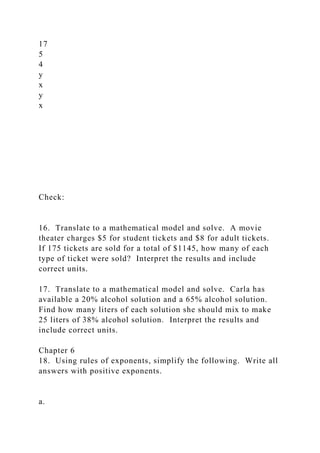
16. Translate to a mathematical model and solve. A movie
theater charges $5 for student tickets and $8 for adult tickets.
If 175 tickets are sold for a total of $1145, how many of each
type of ticket were sold? Interpret the results and include
correct units.
17. Translate to a mathematical model and solve. Carla has
available a 20% alcohol solution and a 65% alcohol solution.
Find how many liters of each solution she should mix to make
25 liters of 38% alcohol solution. Interpret the results and
include correct units.
Chapter 6
18. Using rules of exponents, simplify the following. Write all
answers with positive exponents.
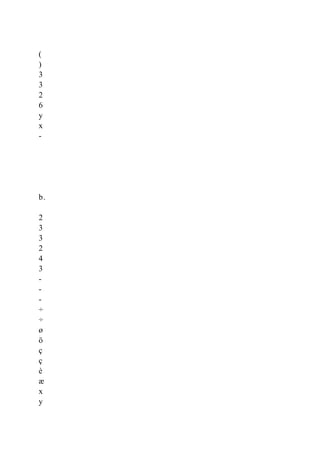
a.
(
)
3
3
2
6
y
x
-
b.
2
3
3
2
4
3
-
-
-
÷
÷
ø
ö
ç
ç
è
æ
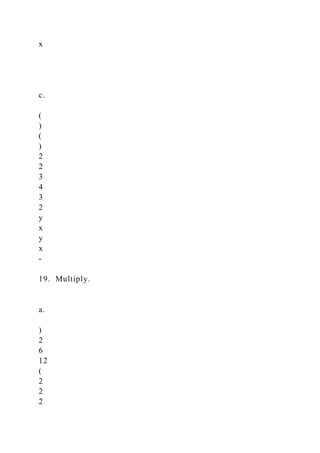
x
y
x
c.
(
)
(
)
2
2
3
4
3
2
y
x
y
x
-
19. Multiply.
a.
)
2
6
12
(
2
2
2
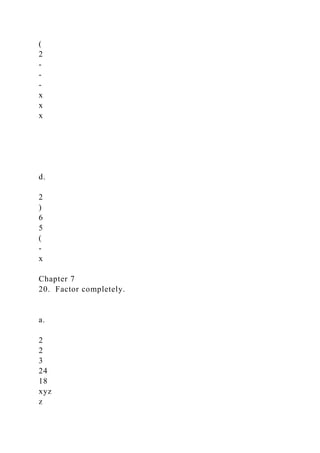
+
-
-
xy
x
xy
b.
)
2
3
)(
9
2
(
b
a
b
a
+
-
c.
)
3
2
)(
1
3
(
2
-
-
-
x
x
x
d.
2
)
6
5
(
-
x
Chapter 7
20. Factor completely.
a.
2
2
3
24
18
xyz
z
y
x
-
-
b.
y
xy
x
x
3
6
2
2
-
+
-
c.
24
2
2
-
+
x
x
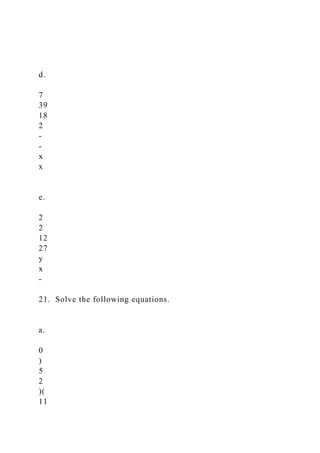
d.
7
39
18
2
-
-
x
x
e.
2
2
12
27
y
x
-
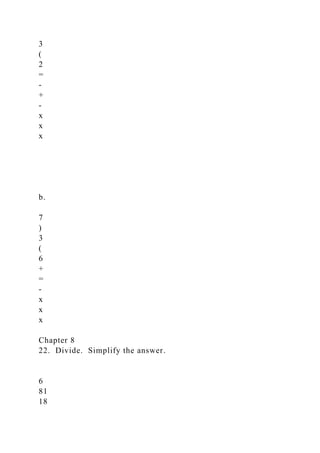
21. Solve the following equations.
a.
0
)
5
2
)(
11
3
(
2
=
-
+
-
x
x
x
b.
7
)
3
(
6
+
=
-
x
x
x
Chapter 8
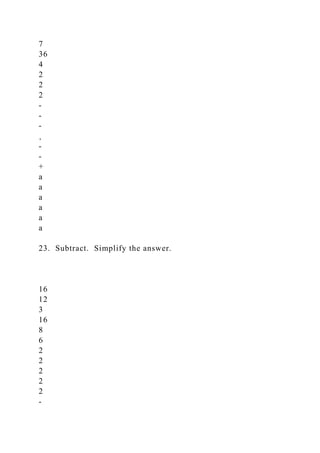
22. Divide. Simplify the answer.
6
81
18
7
36
4
2
2
2
-
-
-
¸
-
-
+
a
a
a
a
a
a
23. Subtract. Simplify the answer.
16
12
3
16
8
6
2
2
2
2
2
-
-
-
-
-
+
+
y
y
y
y
y
y
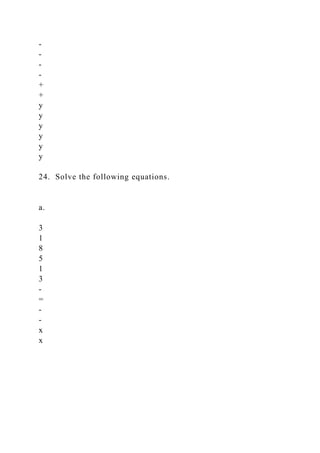
24. Solve the following equations.
a.
3
1
8
5
1
3
-
=
-
-
x
x
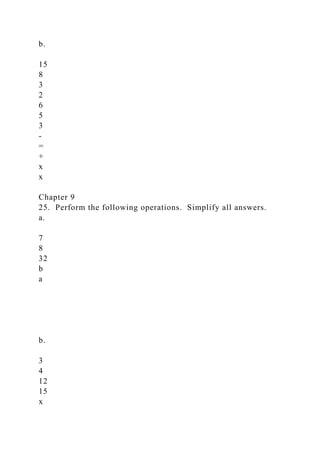
b.
15
8
3
2
6
5
3
-
=
+
x
x
Chapter 9
25. Perform the following operations. Simplify all answers.
a.
7
8
32
b
a
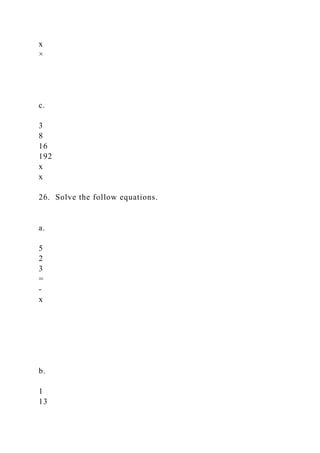
b.
3
4
12
15
x
x
×
c.
3
8
16
192
x
x
26. Solve the follow equations.
a.
5
2
3
=
-
x
b.
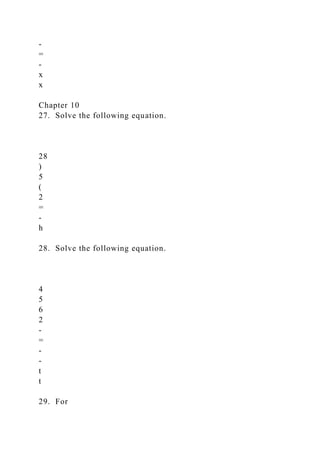
1
13
-
=
-
x
x
Chapter 10
27. Solve the following equation.
28
)
5
(
2
=
-
h
28. Solve the following equation.
4
5
6
2
-
=
-
-
t
t
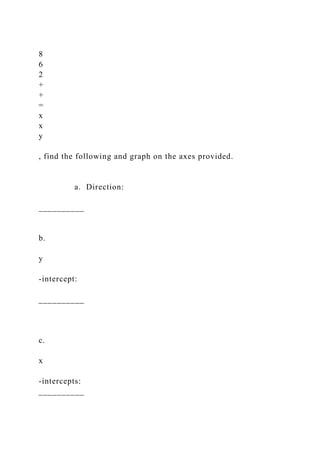
29. For
8
6
2
+
+
=
x
x
y
, find the following and graph on the axes provided.
a. Direction:
__________
b.
y
-intercept:
__________
c.
x
-intercepts:
__________
d. vertex:
__________
_1436286165.unknown
_1436286185.unknown
_1436286193.unknown
_1436286201.unknown
_1436286205.unknown
_1478968230.unknown
_1478968320.unknown
_1478968197.unknown
_1436286206.unknown
_1436286203.unknown
_1436286204.unknown
_1436286202.unknown
_1436286196.unknown
_1436286200.unknown
_1436286194.unknown
_1436286189.unknown
_1436286191.unknown
_1436286192.unknown
_1436286190.unknown
_1436286187.unknown
_1436286188.unknown
_1436286186.unknown
_1436286174.unknown
_1436286180.unknown
_1436286182.unknown
_1436286184.unknown
_1436286181.unknown
_1436286176.unknown
_1436286177.unknown
_1436286175.unknown
_1436286170.unknown
_1436286172.unknown
_1436286173.unknown
_1436286171.unknown
_1436286167.unknown
_1436286168.unknown
_1436286166.unknown
_1436286157.unknown
_1436286161.unknown
_1436286163.unknown
_1436286164.unknown
_1436286162.unknown
_1436286159.unknown
_1436286160.unknown
_1436286158.unknown
_1436286152.unknown
_1436286155.unknown
_1436286156.unknown
_1436286153.unknown
_1436286150.unknown
_1436286151.unknown
_1436286149.unknown

RUNNING HEADER TERRORISM .docx

  • 1.
    RUNNING HEADER: TERRORISM 1 Terrorismin America Position Paper 1 CJUS 380 Kenton Shatzer Liberty University Introduction “Have you forgotten how it felt that day? To see your homeland under fire and her people blown away. Have you forgotten when those towers fell? We had neighbors still inside going thru a living hell and you say we shouldn’t worry ‘bout bin Laden. Have you forgotten?” (Worley. 2003). Have forgotten what happened on 9/11 and do you ever wonder what the United States could have done to ensure that the terrorist attack did not happen on that faithful day? 9/11 was not the first terrorist attack on the United States and it was not the last. On April 14, 1972, in New York City, “ten members of a local mosque phoned in a false alarm and then ambushed responding officer, killing one” (TheReligionofPeace.com. 2015). In Moore, OK on September 25, 2014, “A Sharia advocate
  • 2.
    beheaded a womanafter calling for Islamic terror and posting an Islamist beheading photo” (TheReligionofPeace.com. 2015.). So what is terrorism? “There are more than 100 definitions of terrorism in the literature. The United Nations defines terrorism as “an anxiety-inspiring method of repeated violent action, employed by clandestine individual, group or state actors, for idiosyncratic, criminal or political reason, whereby- in contrast to assassinations- the direct targets of violence are not the man targets”” (Bullock, Haddow, & Coppola. 2013. Pg. 490). The problem with terrorism is that terrorists want to attack when their target is not ready, but also when there is a large crowd that will be watching and knowing that the attack will kill and injury many innocent people. So how can terrorist attacks be stopped or be limited? Can countries stop terrorist from attacking their countries? The learner of this paper firmly believes that countries can limit and stop terrorist attacks. Literature Review Like stated above, terrorism has been around since the first attack in 1972 and has continued to present day when the last terrorist attack was in September 2014. “The largest act of international terrorism occurred on September 11, 2001 in a set of co-ordinated attacks on the United States of America, where Islamic terrorists hijacked civilian airliners and used them to attack the World Trade Center towers in New York City and the Pentagon in Washington, DC” (Terrorism Research). Since 9/11, the United States has cracked down and created new laws to help protect the American citizens. The learner firmly believes that the laws have enhanced the security and protection of the United States and the citizens. The United States government created a new policy after 9/11 known as the “Homeland Security,” and in this new policy is an act called the USA PARTRIOT Act. The Bush Administration passed this acted and also updated electronic surveillance rules which allowed “warrants to intercept individuals even they frequently changed phones, and to grant
  • 3.
    access to internetcommunications on the same basic terms as applicable to traditional telephone communications” (Chertoff. 2011). “The Department of Homeland Security (DHS) and its many partners across the federal government, public and private sectors, and communities across the country and around the world have worked since 9/11 to build a new homeland security enterprise to better mitigate and defend against dynamic threats, minimize risks, and maximize the ability to respond and recover from attacks and disaster of all kinds” (Department of Homeland Security. 2011). Since 9/11, the Department of Homeland Security has changed and updated air travel in order to prevent terrorist attacks, and they have also improved passenger screening. DHS has created a data base where passenger information and name record data to help keep out terrorists and this program has “denied entry to the United States for having ties to terrorism” (Department of Homeland Security. 2011.). Before 9/11, there were limited requirements for explosives screening, but that has changed. Today, 100 percent of all passengers’ baggage and carry-ons are checked before any bag or person can enter the main part of the airports. “Through the Recovery Act and annual appropriations, TSA has accelerated the deployment of new technologies to detect the next generation of threats, including Advanced Imaging Technology units, Explosive Detection Systems, Explosives Trace Detection units, Advanced Technology X-Ray systems and Bottled Liquid Scanners” (Department of Homeland Security. 2011). The new policies, acts, and laws do not stop at the federal level of government, but they extend to the state and local governments. All levels of governments agencies have been trained in case of attack would happen and have been trained to prevent attacks. The learner believes that will all levels government being ready to prevent terrorist attacks, then attacks on America will decrease which means that the protection as increased. The learner also believes that everyone should stand together to prevent attacks against the U.S. and should follow
  • 4.
    all laws andguidelines that the government has set forth. Conclusion On Tuesday morning at 8:45 a.m. on September 11, 2001, a 20,000 gallons jet fuel, Airline Boeing 767 loaded crashed in the north tower of the World Trade Center in New York City. Eighteen minutes later, another airplane crashed into the south near at the 60th floor. Both of these planes instantly killed hundreds of people while injuring thousands and trapping hundreds of people. Once the towers hit the World Trade Centers, Americans knew that United States of America was under an attack, but this was not the end of this attack as two more planes crashed. This terrorist attack has forever changed the lives of everyone in the United States and has changed the United States’ government. Laws, policies, and upgrades have been since 9/11 in order to prevent any more terrorist attacks. The learner believes that the United States has set forth strong laws and policies that will enhance the protection of the citizen of the American people. Reference Bullock, J., Haddow, G., & Coppola, D. (2013). Introduction to homeland security (4th ed.). New York, NY: Elsevier. Chertoff, Michael., 2011. 9/11 Before and After. http://www.hsaj.org/?fullarticle=7.2.13
  • 5.
    Homeland Security. 2011.Preventing Terrorism and Enhancing Security. https://www.dhs.gov/preventing-terrorism-and- enhancing-security Terrorism Research: International terrorism and security research. http://www.terrorism-research.com/ TheReligionofPeace.com. (2002-2015). Islamic terror attacks on American soil. http://www.thereligionofpeace.com/pages/americanattacks.htm Worley, D. (2003). Have you forgotten? Name: _______________________ The following take home test may be used to replace your lowest test score. You MUST work on this individually. You may use your notes, book, and homework to answer the following questions. Chapter 1 1. Perform the given operations. ) 2 ( 3 12 18 5 2 - ¸ -
  • 6.
    + - 2. Translate thefollowing statement into symbols. Five subtracted from the quotient of a number and five is twice the sum of four and the number. Chapter 2 3. Solve the following equation and check your solution. y y y 6 ) 3 ( 2 ) 3 ( 5 11 + + - = - -
  • 7.
    Check: 4. Solve thefollowing inequality. Graph your solution on the number line. Give answers in interval notation. ) 1 4 ( 2 ) 2 ( 3 - < - + x x x ¾ ¾ ¾ ¾ ¾ ¾ ¾ ¾ ¾ ¾
  • 8.
    ¾ ¾ ¾ ¾ ® ¬ Interval Notation: _________________ 5.Solve for the given variable. c bn a n
  • 9.
    - = + ) 2 ( 5 for a Chapter 3 6. Translateto a mathematical model and solve. The length of a rectangular room is three less than twice its width. Find the dimensions if the perimeter is 54 feet. Interpret the results and include correct units. 7. Translate to a mathematical model and solve. Two angles are supplementary. One of the angles is 20 degrees more than three times the other. What are the angles? Interpret the results and include correct units. Chapter 4 8. Plot and label the following points. Name the quadrant or axis where each point lies. a. ) 2 , 3 ( - -
  • 10.
  • 11.
    - and y -intercepts (inordered pair form) for the following equation. Graph the line by plotting intercept points. 6 2 = - y x a. x -intercept: _____________ b. y -intercept: _____________ c. Graph.
  • 12.
    10. Find the y -intercept(in ordered pair form) and slope of the following line. . 7 2 6 = - y x a. Equation in slope-intercept form: ___________________ b. y -intercept: _____________ c. slope: _____________ 11. Write the equation of the line through
  • 13.
    ) 5 , 3 ( - with slope 5 1 in slope-interceptform. 12. Find the equation of the line through the points ) 1 , 2 ( - and ) 9 , 5 ( in slope-intercept form. Chapter 5 13. Determine whether the following system of equations is
  • 14.
    CONSISTENT / INCONSISTENTand where the equations are DEPENDENT / INDEPENDENT. Justify your answer using complete sentences. î í ì = + - = - 15 10 4 10 5 2 y x y x 14. Solve the following system of equations using the substitution method. Check your solution. î í ì = + -
  • 15.
    = - 9 3 4 5 2 y x y x Check: 15. Solve thefollowing system of equations using the elimination method. Check your solution. î í ì = + = - 7 2 3
  • 16.
    17 5 4 y x y x Check: 16. Translate toa mathematical model and solve. A movie theater charges $5 for student tickets and $8 for adult tickets. If 175 tickets are sold for a total of $1145, how many of each type of ticket were sold? Interpret the results and include correct units. 17. Translate to a mathematical model and solve. Carla has available a 20% alcohol solution and a 65% alcohol solution. Find how many liters of each solution she should mix to make 25 liters of 38% alcohol solution. Interpret the results and include correct units. Chapter 6 18. Using rules of exponents, simplify the following. Write all answers with positive exponents. a.
  • 17.
  • 18.
  • 19.
  • 20.
  • 21.
  • 22.
    d. 7 39 18 2 - - x x e. 2 2 12 27 y x - 21. Solve thefollowing equations. a. 0 ) 5 2 )( 11
  • 23.
  • 24.
  • 25.
    - - - - + + y y y y y y 24. Solve thefollowing equations. a. 3 1 8 5 1 3 - = - - x x
  • 26.
    b. 15 8 3 2 6 5 3 - = + x x Chapter 9 25. Performthe following operations. Simplify all answers. a. 7 8 32 b a b. 3 4 12 15 x
  • 27.
    x × c. 3 8 16 192 x x 26. Solve thefollow equations. a. 5 2 3 = - x b. 1 13
  • 28.
    - = - x x Chapter 10 27. Solvethe following equation. 28 ) 5 ( 2 = - h 28. Solve the following equation. 4 5 6 2 - = - - t t 29. For
  • 29.
    8 6 2 + + = x x y , find thefollowing and graph on the axes provided. a. Direction: __________ b. y -intercept: __________ c. x -intercepts: __________
  • 30.
  • 31.