How did the attacks on Sept. 11th create not only 
a domestic economic crisis but more importantly 
impacted a greater need for political, economic 
and security collaboration?
Introduction 
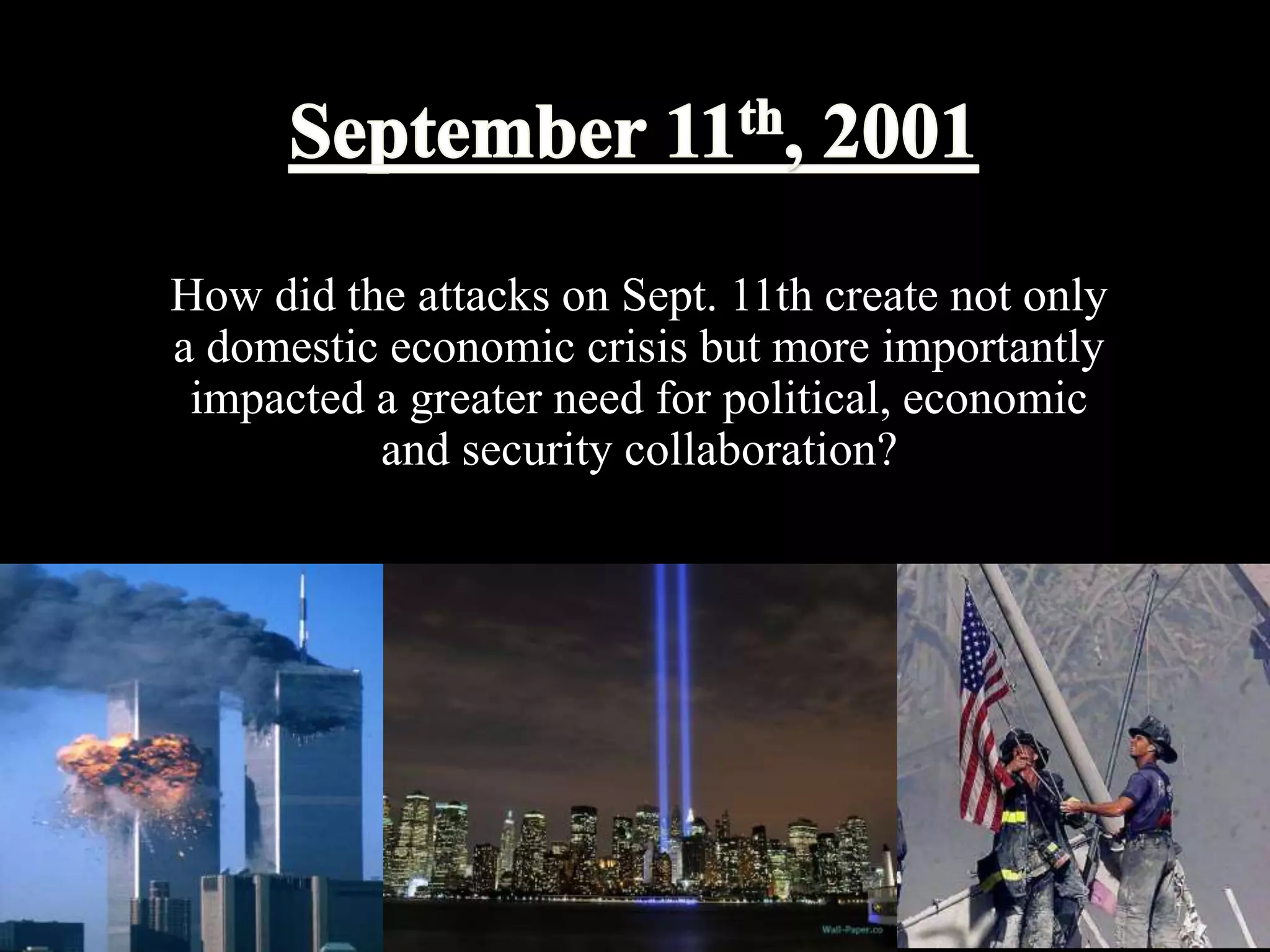
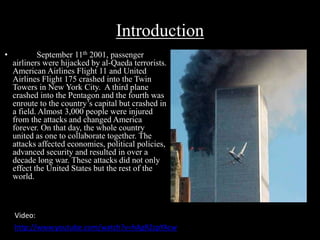
• September 11th 2001, passenger 
airliners were hijacked by al-Qaeda terrorists. 
American Airlines Flight 11 and United 
Airlines Flight 175 crashed into the Twin 
Towers in New York City. A third plane 
crashed into the Pentagon and the fourth was 
enroute to the country’s capital but crashed in 
a field. Almost 3,000 people were injured 
from the attacks and changed America 
forever. On that day, the whole country 
united as one to collaborate together. The 
attacks affected economies, political policies, 
advanced security and resulted in over a 
decade long war. These attacks did not only 
effect the United States but the rest of the 
world. 
Video: 
http://www.youtube.com/watch?v=hAgRZzpYAcw
Articulation: Economic/Business 
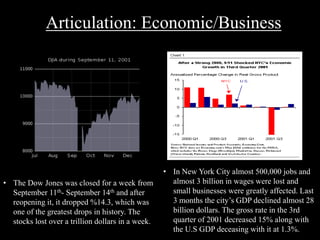
• The Dow Jones was closed for a week from 
September 11th- September 14th and after 
reopening it, it dropped %14.3, which was 
one of the greatest drops in history. The 
stocks lost over a trillion dollars in a week. 
• In New York City almost 500,000 jobs and 
almost 3 billion in wages were lost and 
small businesses were greatly affected. Last 
3 months the city’s GDP declined almost 28 
billion dollars. The gross rate in the 3rd 
quarter of 2001 decreased 15% along with 
the U.S GDP deceasing with it at 1.3%.
Articulation: Social 
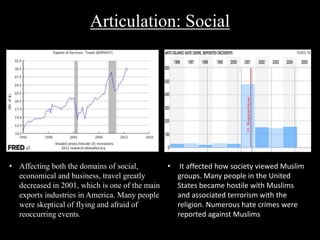
• Affecting both the domains of social, 
economical and business, travel greatly 
decreased in 2001, which is one of the main 
exports industries in America. Many people 
were skeptical of flying and afraid of 
reoccurring events. 
• It affected how society viewed Muslim 
groups. Many people in the United 
States became hostile with Muslims 
and associated terrorism with the 
religion. Numerous hate crimes were 
reported against Muslims
Articulation: Political 
• One of the greatest impacts politically was 
the importance of homeland security. The 
government created the Department of 
Homeland Security. Soon after the attacks, 
the USA Patriot Act was passed shortly 
after the attacks, which allowed law 
enforcement agencies to search U.S 
citizens without warrants. It affected many 
other countries, putting them in high alert 
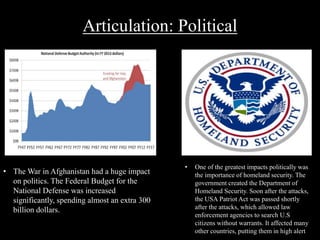
• The War in Afghanistan had a huge impact 
on politics. The Federal Budget for the 
National Defense was increased 
significantly, spending almost an extra 300 
billion dollars.
Cogitation: Domain Interactions 
• Political: 
– Homeland Security Department and the National 
Counterterrorism Center were created in response to the attacks. 
– Largest policy affected by 9/11 was the U.S Foreign policy. 
– USA Patriot Act- policy reduced restrictions that were on law 
enforcement agencies allowing the ability to search telephones, 
emails, medical, financial and other records. 
– War on Terror 
– U.S. relations grew 
• China immediately announced its cooperation with the U.S. 
to fight terrorism 
– Foreign countries also had to implement improved policies and 
methods to keep their country safe. 
• European Union reformed some anti-terrorist policies and 
programs as well.
Cogitation: Domain Interactions 
• Economic: 
– Increased defense spending also led to a debt crisis 
which led to rarely downgrade to United States 
debt by the Standard and Poor's. This also 
contributed to increased oil prices which shown 
gradual increase several years after the 9/11 
events. The 9/11 events also contributed to 
weakening the dollar against the euro and dollar 
declined about 33% against the euro in five years 
after the attacks. 
– All major economies witnessed slower economic 
growth, extended losses on stock markets, higher 
insurance costs and increased shipping costs. 
– Many countries increased their defense spending 
which contributing to slowing their growth. 
– Additional security measures resulted in increased 
cost of doing business and delayed shipments 
which effected the business among different 
countries
Cogitation: Domain Interactions 
Cultural: 
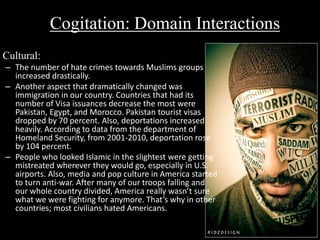
– The number of hate crimes towards Muslims groups 
increased drastically. 
– Another aspect that dramatically changed was 
immigration in our country. Countries that had its 
number of Visa issuances decrease the most were 
Pakistan, Egypt, and Morocco. Pakistan tourist visas 
dropped by 70 percent. Also, deportations increased 
heavily. According to data from the department of 
Homeland Security, from 2001-2010, deportation rose 
by 104 percent. 
– People who looked Islamic in the slightest were getting 
mistreated wherever they would go, especially in U.S. 
airports. Also, media and pop culture in America started 
to turn anti-war. After many of our troops falling and 
our whole country divided, America really wasn’t sure 
what we were fighting for anymore. That’s why in other 
countries; most civilians hated Americans.
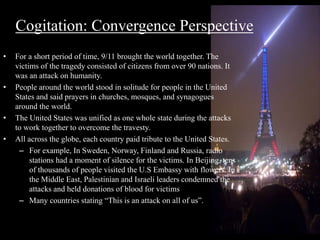
Cogitation: Convergence Perspective 
• For a short period of time, 9/11 brought the world together. The 
victims of the tragedy consisted of citizens from over 90 nations. It 
was an attack on humanity. 
• People around the world stood in solitude for people in the United 
States and said prayers in churches, mosques, and synagogues 
around the world. 
• The United States was unified as one whole state during the attacks 
to work together to overcome the travesty. 
• All across the globe, each country paid tribute to the United States. 
– For example, In Sweden, Norway, Finland and Russia, radio 
stations had a moment of silence for the victims. In Beijing, tens 
of thousands of people visited the U.S Embassy with flowers. In 
the Middle East, Palestinian and Israeli leaders condemned the 
attacks and held donations of blood for victims 
– Many countries stating “This is an attack on all of us”.
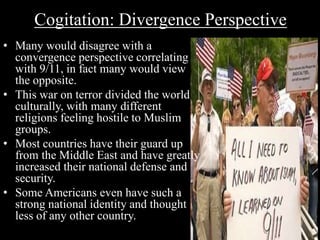
Cogitation: Divergence Perspective 
• Many would disagree with a 
convergence perspective correlating 
with 9/11, in fact many would view 
the opposite. 
• This war on terror divided the world 
culturally, with many different 
religions feeling hostile to Muslim 
groups. 
• Most countries have their guard up 
from the Middle East and have greatly 
increased their national defense and 
security. 
• Some Americans even have such a 
strong national identity and thought 
less of any other country.
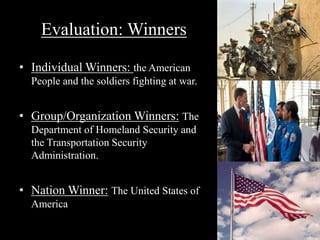
Evaluation: Winners 
• Individual Winners: the American 
People and the soldiers fighting at war. 
• Group/Organization Winners: The 
Department of Homeland Security and 
the Transportation Security 
Administration. 
• Nation Winner: The United States of 
America
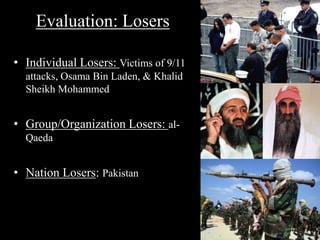
Evaluation: Losers 
• Individual Losers: Victims of 9/11 
attacks, Osama Bin Laden, & Khalid 
Sheikh Mohammed 
• Group/Organization Losers: al- 
Qaeda 
• Nation Losers: Pakistan
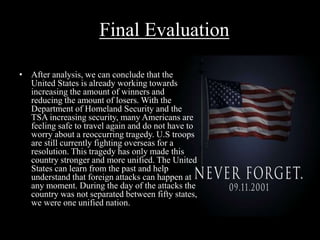
Final Evaluation 
• After analysis, we can conclude that the 
United States is already working towards 
increasing the amount of winners and 
reducing the amount of losers. With the 
Department of Homeland Security and the 
TSA increasing security, many Americans are 
feeling safe to travel again and do not have to 
worry about a reoccurring tragedy. U.S troops 
are still currently fighting overseas for a 
resolution. This tragedy has only made this 
country stronger and more unified. The United 
States can learn from the past and help 
understand that foreign attacks can happen at 
any moment. During the day of the attacks the 
country was not separated between fifty states, 
we were one unified nation.

Globlization

  • 1.
    How did theattacks on Sept. 11th create not only a domestic economic crisis but more importantly impacted a greater need for political, economic and security collaboration?
  • 2.
    Introduction • September11th 2001, passenger airliners were hijacked by al-Qaeda terrorists. American Airlines Flight 11 and United Airlines Flight 175 crashed into the Twin Towers in New York City. A third plane crashed into the Pentagon and the fourth was enroute to the country’s capital but crashed in a field. Almost 3,000 people were injured from the attacks and changed America forever. On that day, the whole country united as one to collaborate together. The attacks affected economies, political policies, advanced security and resulted in over a decade long war. These attacks did not only effect the United States but the rest of the world. Video: http://www.youtube.com/watch?v=hAgRZzpYAcw
  • 3.
    Articulation: Economic/Business •The Dow Jones was closed for a week from September 11th- September 14th and after reopening it, it dropped %14.3, which was one of the greatest drops in history. The stocks lost over a trillion dollars in a week. • In New York City almost 500,000 jobs and almost 3 billion in wages were lost and small businesses were greatly affected. Last 3 months the city’s GDP declined almost 28 billion dollars. The gross rate in the 3rd quarter of 2001 decreased 15% along with the U.S GDP deceasing with it at 1.3%.
  • 4.
    Articulation: Social •Affecting both the domains of social, economical and business, travel greatly decreased in 2001, which is one of the main exports industries in America. Many people were skeptical of flying and afraid of reoccurring events. • It affected how society viewed Muslim groups. Many people in the United States became hostile with Muslims and associated terrorism with the religion. Numerous hate crimes were reported against Muslims
  • 5.
    Articulation: Political •One of the greatest impacts politically was the importance of homeland security. The government created the Department of Homeland Security. Soon after the attacks, the USA Patriot Act was passed shortly after the attacks, which allowed law enforcement agencies to search U.S citizens without warrants. It affected many other countries, putting them in high alert • The War in Afghanistan had a huge impact on politics. The Federal Budget for the National Defense was increased significantly, spending almost an extra 300 billion dollars.
  • 6.
    Cogitation: Domain Interactions • Political: – Homeland Security Department and the National Counterterrorism Center were created in response to the attacks. – Largest policy affected by 9/11 was the U.S Foreign policy. – USA Patriot Act- policy reduced restrictions that were on law enforcement agencies allowing the ability to search telephones, emails, medical, financial and other records. – War on Terror – U.S. relations grew • China immediately announced its cooperation with the U.S. to fight terrorism – Foreign countries also had to implement improved policies and methods to keep their country safe. • European Union reformed some anti-terrorist policies and programs as well.
  • 7.
    Cogitation: Domain Interactions • Economic: – Increased defense spending also led to a debt crisis which led to rarely downgrade to United States debt by the Standard and Poor's. This also contributed to increased oil prices which shown gradual increase several years after the 9/11 events. The 9/11 events also contributed to weakening the dollar against the euro and dollar declined about 33% against the euro in five years after the attacks. – All major economies witnessed slower economic growth, extended losses on stock markets, higher insurance costs and increased shipping costs. – Many countries increased their defense spending which contributing to slowing their growth. – Additional security measures resulted in increased cost of doing business and delayed shipments which effected the business among different countries
  • 8.
    Cogitation: Domain Interactions Cultural: – The number of hate crimes towards Muslims groups increased drastically. – Another aspect that dramatically changed was immigration in our country. Countries that had its number of Visa issuances decrease the most were Pakistan, Egypt, and Morocco. Pakistan tourist visas dropped by 70 percent. Also, deportations increased heavily. According to data from the department of Homeland Security, from 2001-2010, deportation rose by 104 percent. – People who looked Islamic in the slightest were getting mistreated wherever they would go, especially in U.S. airports. Also, media and pop culture in America started to turn anti-war. After many of our troops falling and our whole country divided, America really wasn’t sure what we were fighting for anymore. That’s why in other countries; most civilians hated Americans.
  • 9.
    Cogitation: Convergence Perspective • For a short period of time, 9/11 brought the world together. The victims of the tragedy consisted of citizens from over 90 nations. It was an attack on humanity. • People around the world stood in solitude for people in the United States and said prayers in churches, mosques, and synagogues around the world. • The United States was unified as one whole state during the attacks to work together to overcome the travesty. • All across the globe, each country paid tribute to the United States. – For example, In Sweden, Norway, Finland and Russia, radio stations had a moment of silence for the victims. In Beijing, tens of thousands of people visited the U.S Embassy with flowers. In the Middle East, Palestinian and Israeli leaders condemned the attacks and held donations of blood for victims – Many countries stating “This is an attack on all of us”.
  • 10.
    Cogitation: Divergence Perspective • Many would disagree with a convergence perspective correlating with 9/11, in fact many would view the opposite. • This war on terror divided the world culturally, with many different religions feeling hostile to Muslim groups. • Most countries have their guard up from the Middle East and have greatly increased their national defense and security. • Some Americans even have such a strong national identity and thought less of any other country.
  • 11.
    Evaluation: Winners •Individual Winners: the American People and the soldiers fighting at war. • Group/Organization Winners: The Department of Homeland Security and the Transportation Security Administration. • Nation Winner: The United States of America
  • 12.
    Evaluation: Losers •Individual Losers: Victims of 9/11 attacks, Osama Bin Laden, & Khalid Sheikh Mohammed • Group/Organization Losers: al- Qaeda • Nation Losers: Pakistan
  • 13.
    Final Evaluation •After analysis, we can conclude that the United States is already working towards increasing the amount of winners and reducing the amount of losers. With the Department of Homeland Security and the TSA increasing security, many Americans are feeling safe to travel again and do not have to worry about a reoccurring tragedy. U.S troops are still currently fighting overseas for a resolution. This tragedy has only made this country stronger and more unified. The United States can learn from the past and help understand that foreign attacks can happen at any moment. During the day of the attacks the country was not separated between fifty states, we were one unified nation.