Bernard Aschwanden
www.publishingsmarter.com
bernard@publishingsmarter.com
Running a Business
17:53
1
@aschwanden4stc
Thank you
17:53@aschwanden4stc
2
 Alberta STC and its volunteers
 Cohort Technical Communications
Outline
17:53@aschwanden4stc
3
 Want to run a business? Make the right decisions, as incorrect ones impact
the bottom line.
 Where do you turn for advice? When do you NOT follow the expert
opinions?
 Explore ideas about business models, staffing, client development, and
administration.
 Ask questions and get input on real issues you face when starting and
running a business.
 We discuss starting or managing a business and explores the real issues
that are faced every day by business owners.
 Develop your (very) small business (one person shop?) into something
bigger.
 ID what to think about when going into business or growing a business.
 Dive deeper with a discussion around the entrepreneurial spirit and how it
can help you build and grow a business into a steady source of revenue
doing things you love to do (and handing off the "other" stuff to people
more qualified).
Housekeeping and note taking
17:53@aschwanden4stc
4
 Not all slides or topics
are equally weighted
 Use some, discard
others
 Slides speed varies
(reference)
 Questions? Ask any
time!
 I’d love to claim
errors/typos is on
purpose… they isn’t,
weren’t never, and ain’t;
I’ll fix ‘em as I can…
Disclaimer
17:53
5
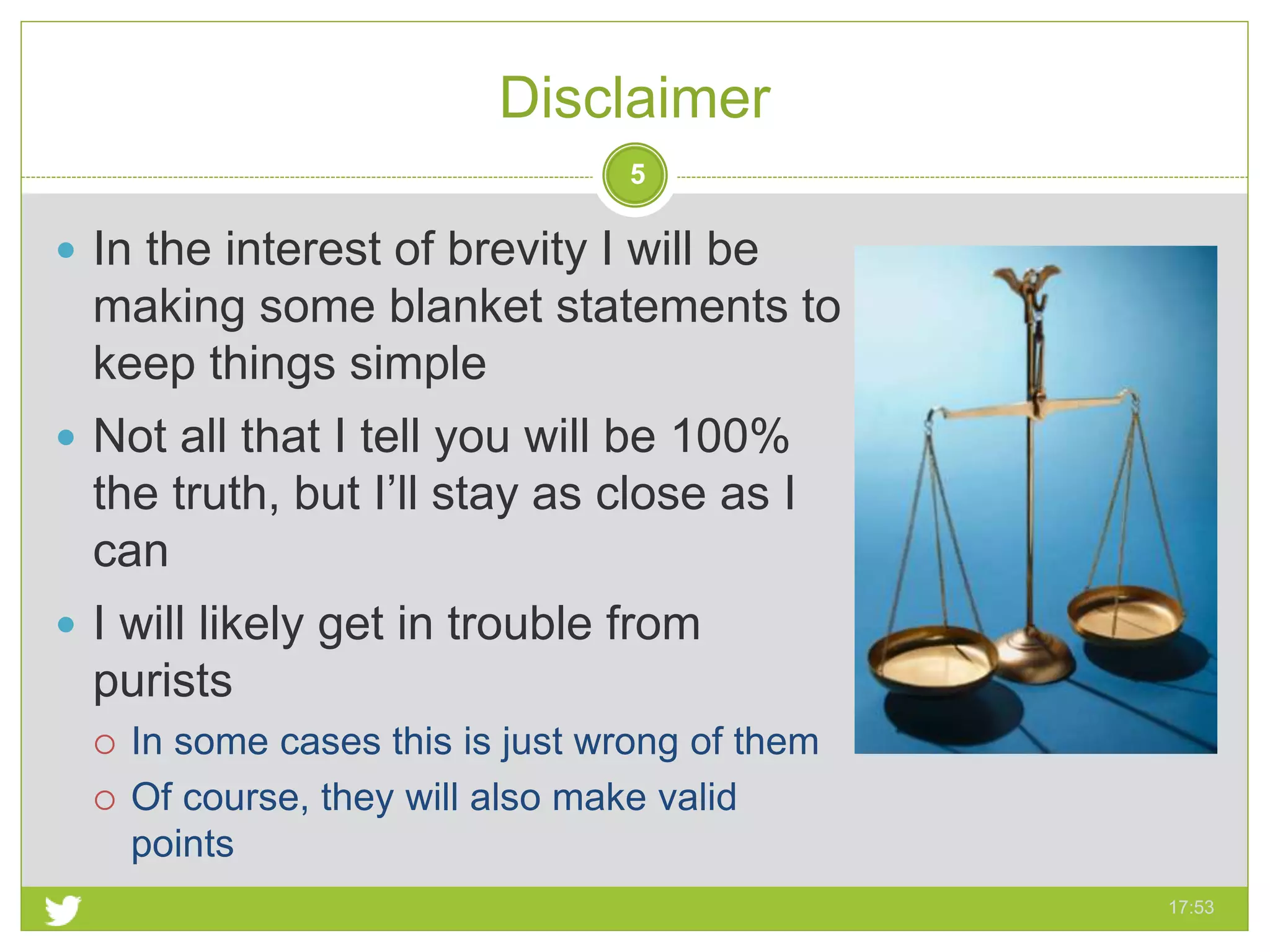
 In the interest of brevity I will be
making some blanket statements to
keep things simple
 Not all that I tell you will be 100%
the truth, but I’ll stay as close as I
can
 I will likely get in trouble from
purists
 In some cases this is just wrong of them
 Of course, they will also make valid
points
About your speaker
17:53@aschwanden4stc
 Publishing Smarter:
President
 Content strategist,
publishing technologies
expert, author, and geek-
enough
 Solves communications
problems to help
businesses be efficient
and profitable
 Society for Technical
Communication
 Past President
6
Business Models
Not here to tell you which to pick
Just want to have a brief discussion
17:53@aschwanden4stc
8
 Things to think about at a very high level
 Reasons that some business models are better or
worse
 Sole proprietorship
 Partnership
 Incorporation
 Co-operative
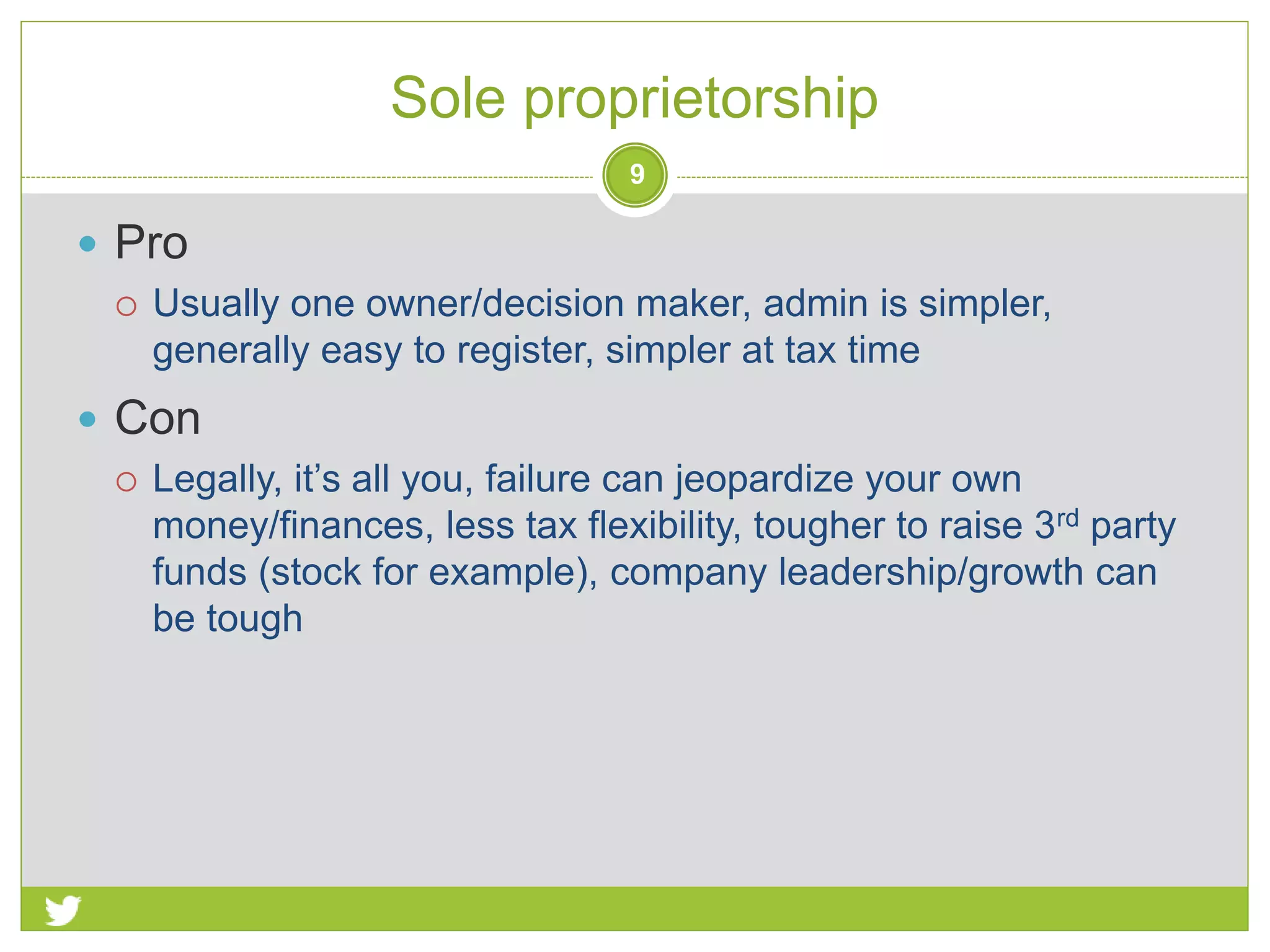
 Pro
 Usually one owner/decision maker, admin is simpler,
generally easy to register, simpler at tax time
 Con
 Legally, it’s all you, failure can jeopardize your own
money/finances, less tax flexibility, tougher to raise 3rd party
funds (stock for example), company leadership/growth can
be tough
Sole proprietorship
9
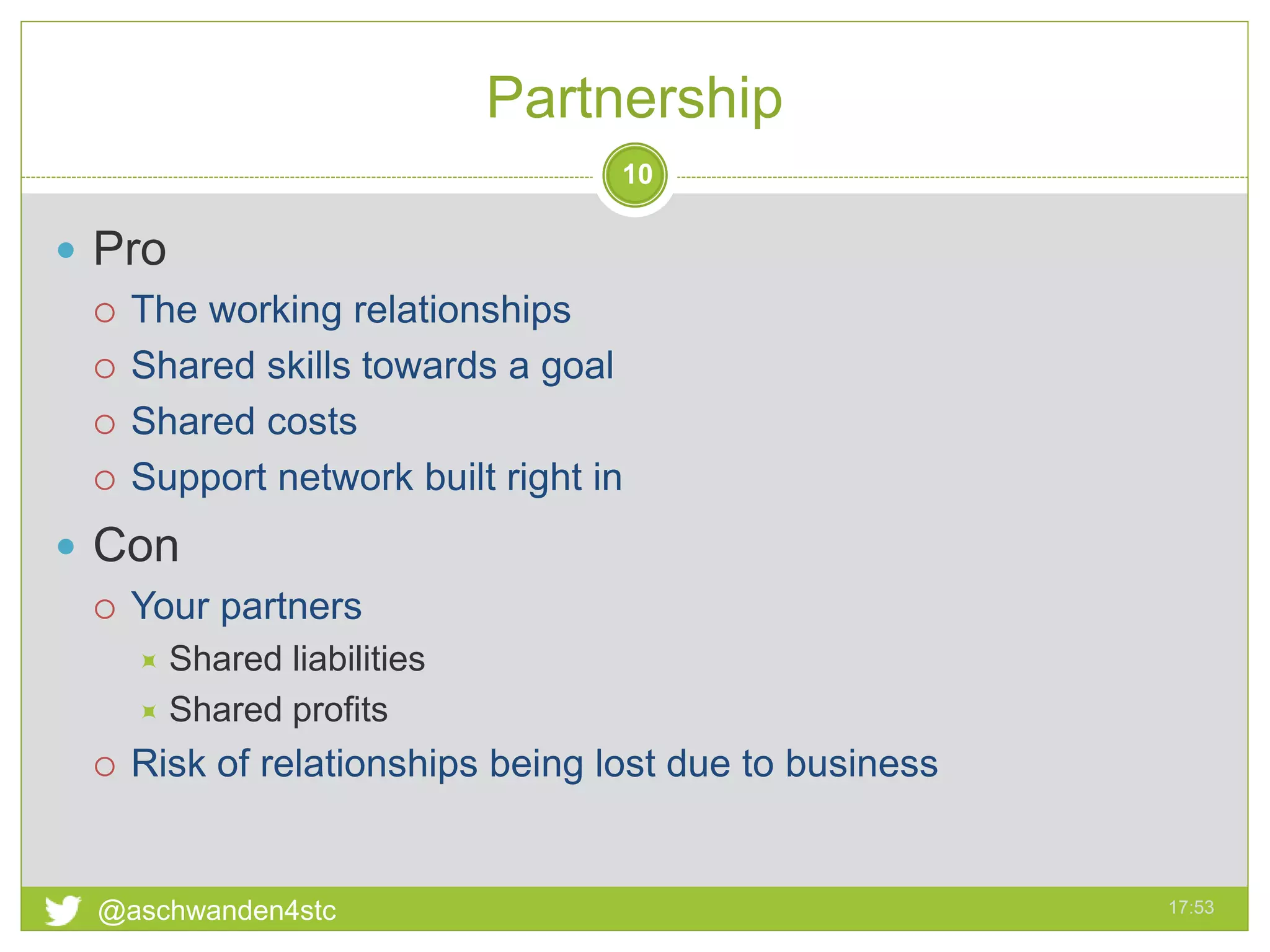
Partnership
17:53@aschwanden4stc
10
 Pro
 The working relationships
 Shared skills towards a goal
 Shared costs
 Support network built right in
 Con
 Your partners
 Shared liabilities
 Shared profits
 Risk of relationships being lost due to business
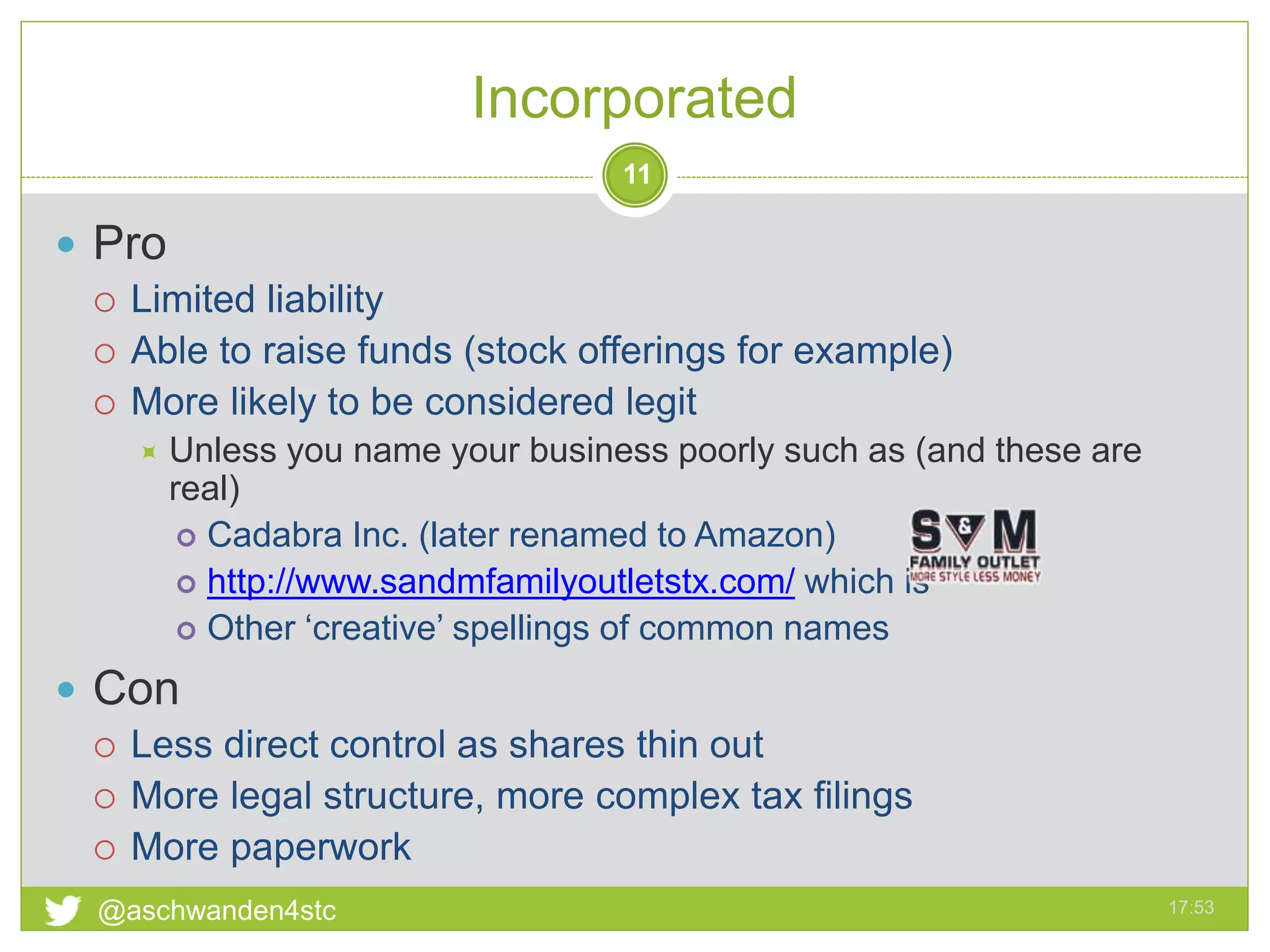
Incorporated
17:53@aschwanden4stc
11
 Pro
 Limited liability
 Able to raise funds (stock offerings for example)
 More likely to be considered legit
 Unless you name your business poorly such as (and these are
real)
 Cadabra Inc. (later renamed to Amazon)
 http://www.sandmfamilyoutletstx.com/ which is
 Other ‘creative’ spellings of common names
 Con
 Less direct control as shares thin out
 More legal structure, more complex tax filings
 More paperwork
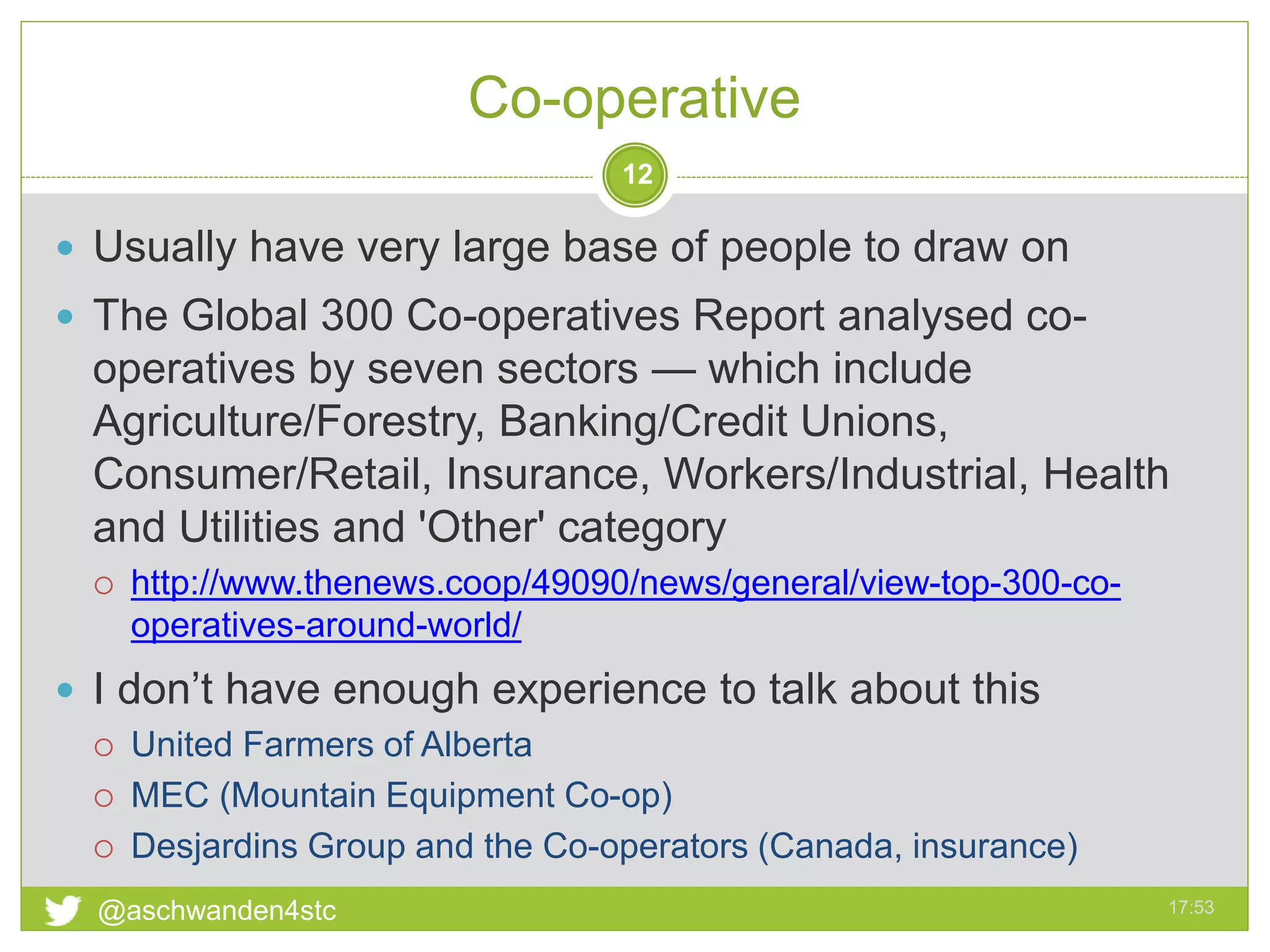
Co-operative
17:53@aschwanden4stc
12
 Usually have very large base of people to draw on
 The Global 300 Co-operatives Report analysed co-
operatives by seven sectors — which include
Agriculture/Forestry, Banking/Credit Unions,
Consumer/Retail, Insurance, Workers/Industrial, Health
and Utilities and 'Other' category
 http://www.thenews.coop/49090/news/general/view-top-300-co-
operatives-around-world/
 I don’t have enough experience to talk about this
 United Farmers of Alberta
 MEC (Mountain Equipment Co-op)
 Desjardins Group and the Co-operators (Canada, insurance)
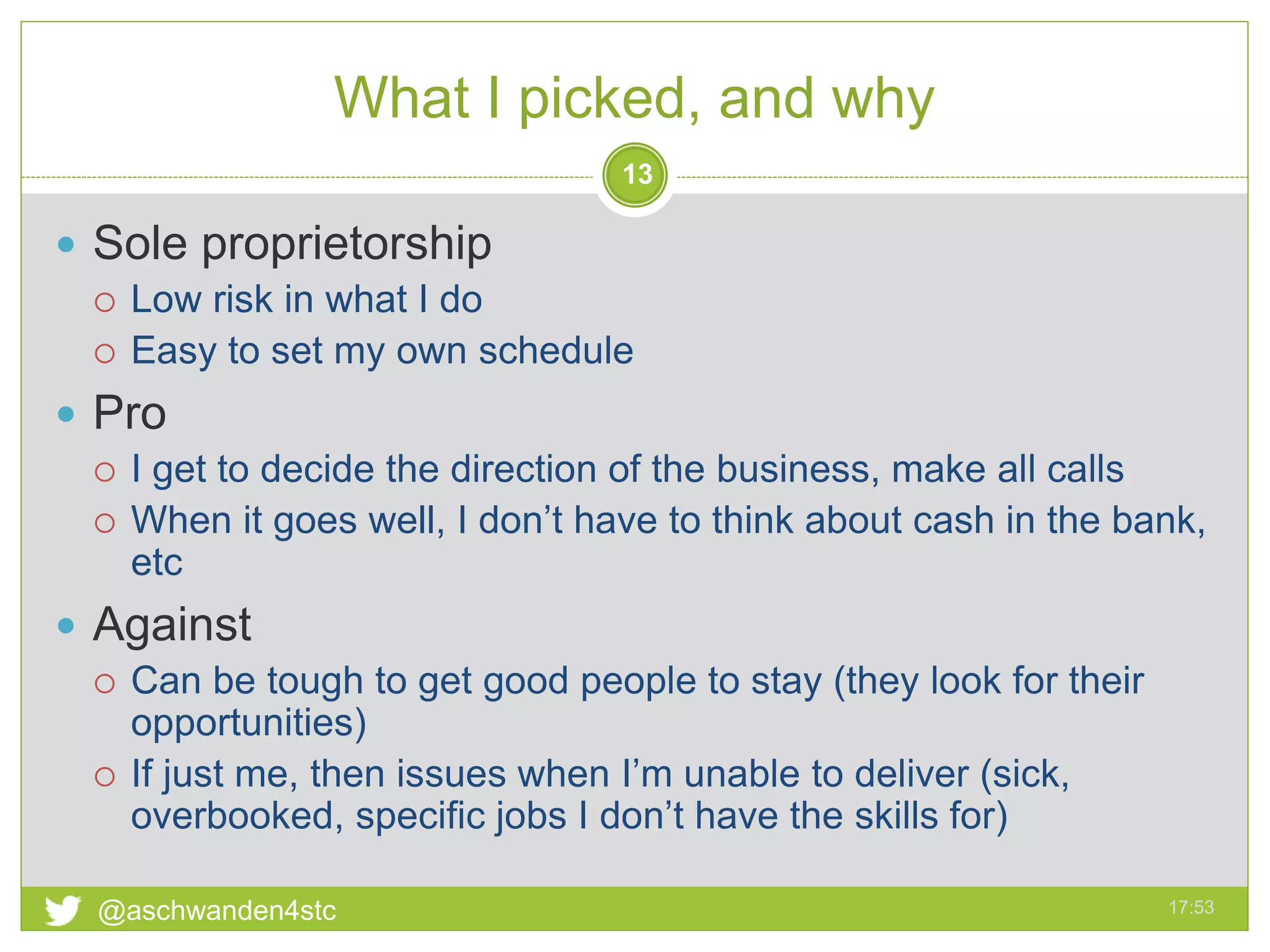
What I picked, and why
17:53@aschwanden4stc
13
 Sole proprietorship
 Low risk in what I do
 Easy to set my own schedule
 Pro
 I get to decide the direction of the business, make all calls
 When it goes well, I don’t have to think about cash in the bank,
etc
 Against
 Can be tough to get good people to stay (they look for their
opportunities)
 If just me, then issues when I’m unable to deliver (sick,
overbooked, specific jobs I don’t have the skills for)
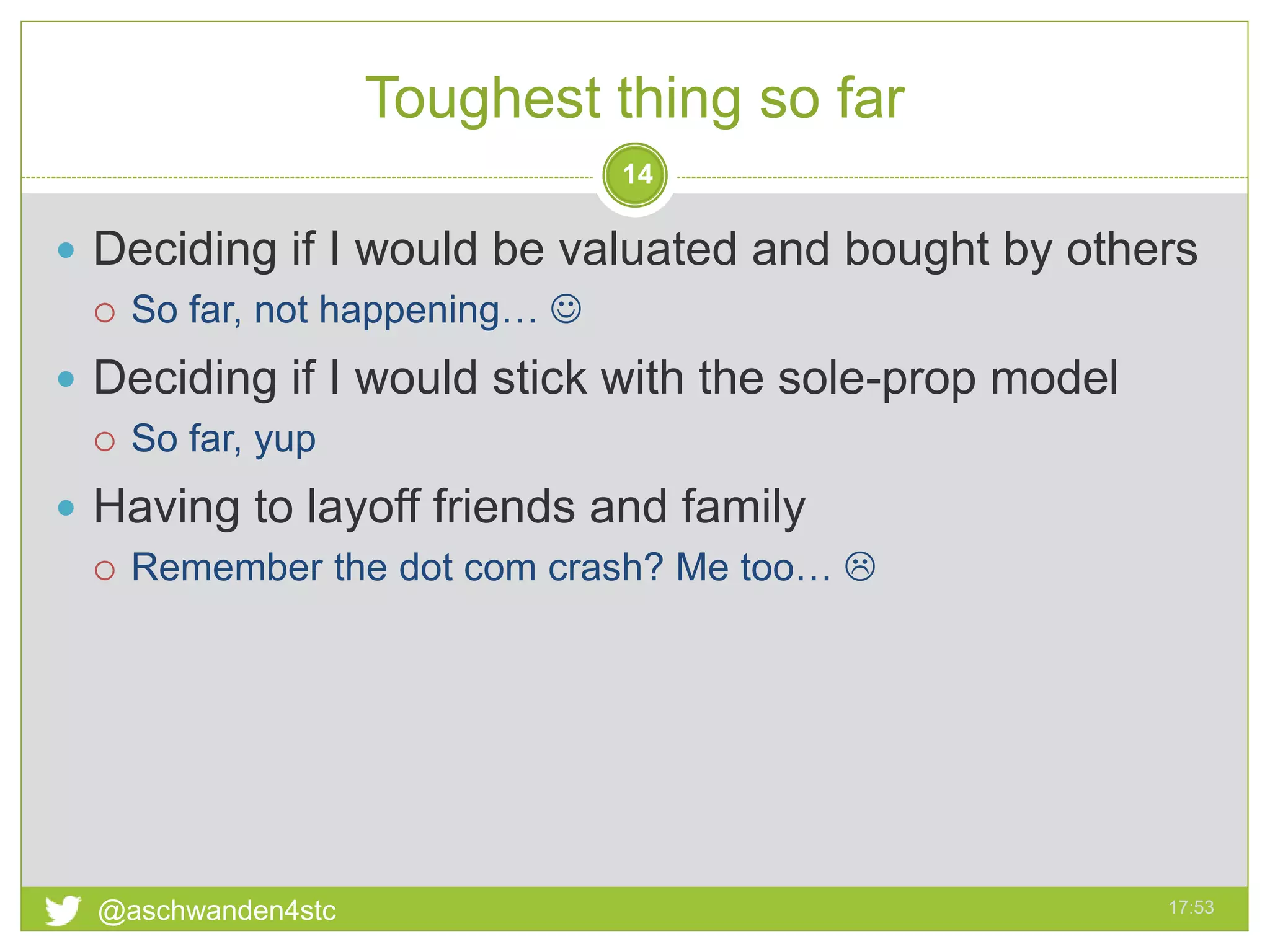
Toughest thing so far
17:53@aschwanden4stc
14
 Deciding if I would be valuated and bought by others
 So far, not happening… 
 Deciding if I would stick with the sole-prop model
 So far, yup
 Having to layoff friends and family
 Remember the dot com crash? Me too… 
Best things so far
17:53@aschwanden4stc
15
 Travel when and where I want
 Hawaii
 India
 Germany
 Denmark
 Hawaii
 Most of the USA
 Most of Canada
 Calgary
 Hawaii
Working with others
@aschwanden4stc 17:53
16
Staff
Common concerns
17:53@aschwanden4stc
17
 Hire/fire
 Insurance
 Pay
 Risk
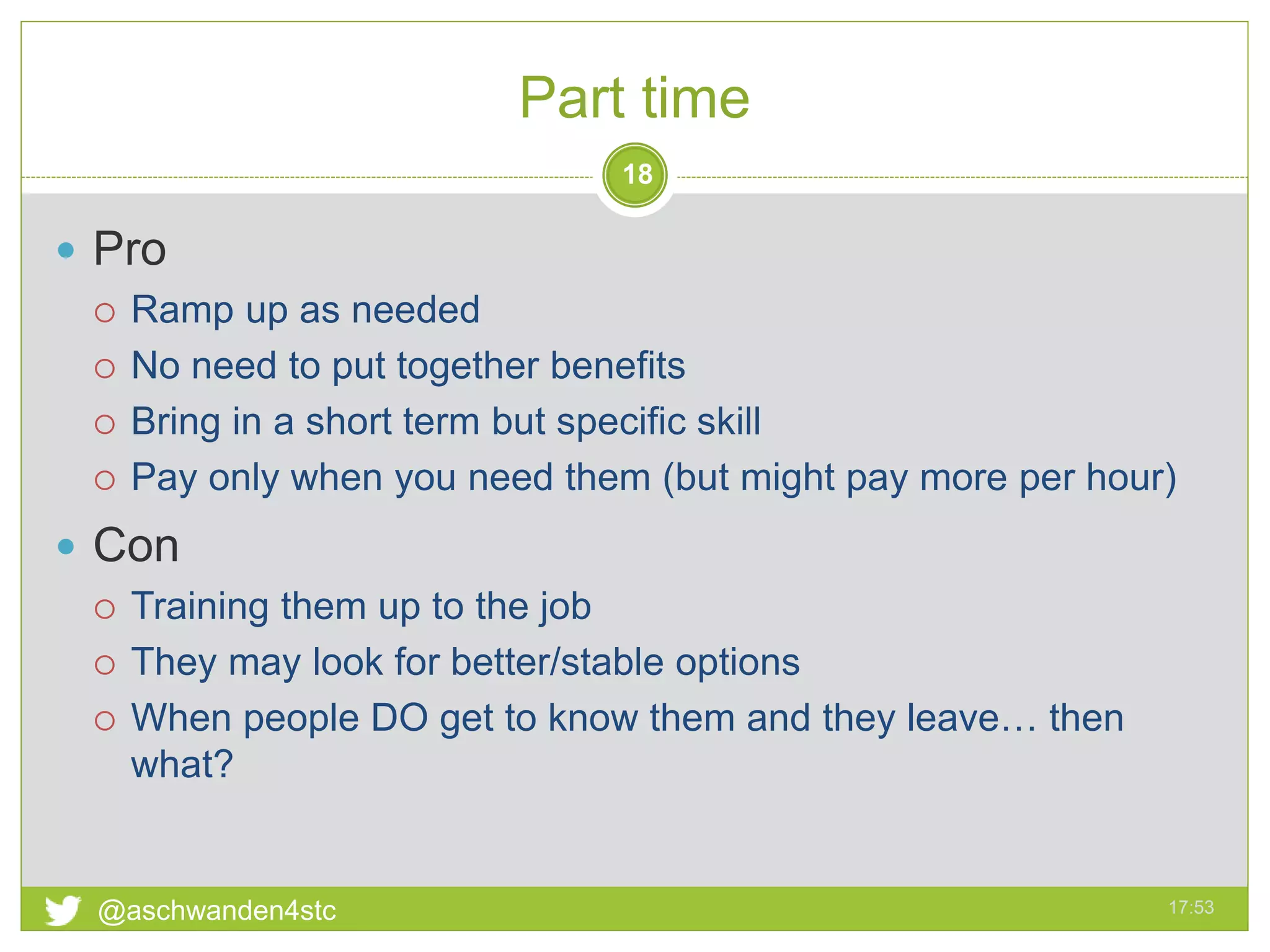
Part time
17:53@aschwanden4stc
18
 Pro
 Ramp up as needed
 No need to put together benefits
 Bring in a short term but specific skill
 Pay only when you need them (but might pay more per hour)
 Con
 Training them up to the job
 They may look for better/stable options
 When people DO get to know them and they leave… then
what?
Full time
17:53@aschwanden4stc
19
 Pro
 You know your payroll
 People have specific functions
 Easier to schedule and plan
 Con
 Meeting payroll
 Eventually adding HR or other roles to the team
 Costs go up across the board (phones, internet access, etc)
Contractors
17:53@aschwanden4stc
20
 Pro
 Very similar to the part time and full time
 Less of a legal issue (paperwork goes away)
 Con
 Similar to part time and full time
 Legal issues (if you contract them for TOO many hours, they
might actually be employees)
 Less of a connection to full time/part time staff
What I picked, and why
17:53@aschwanden4stc
21
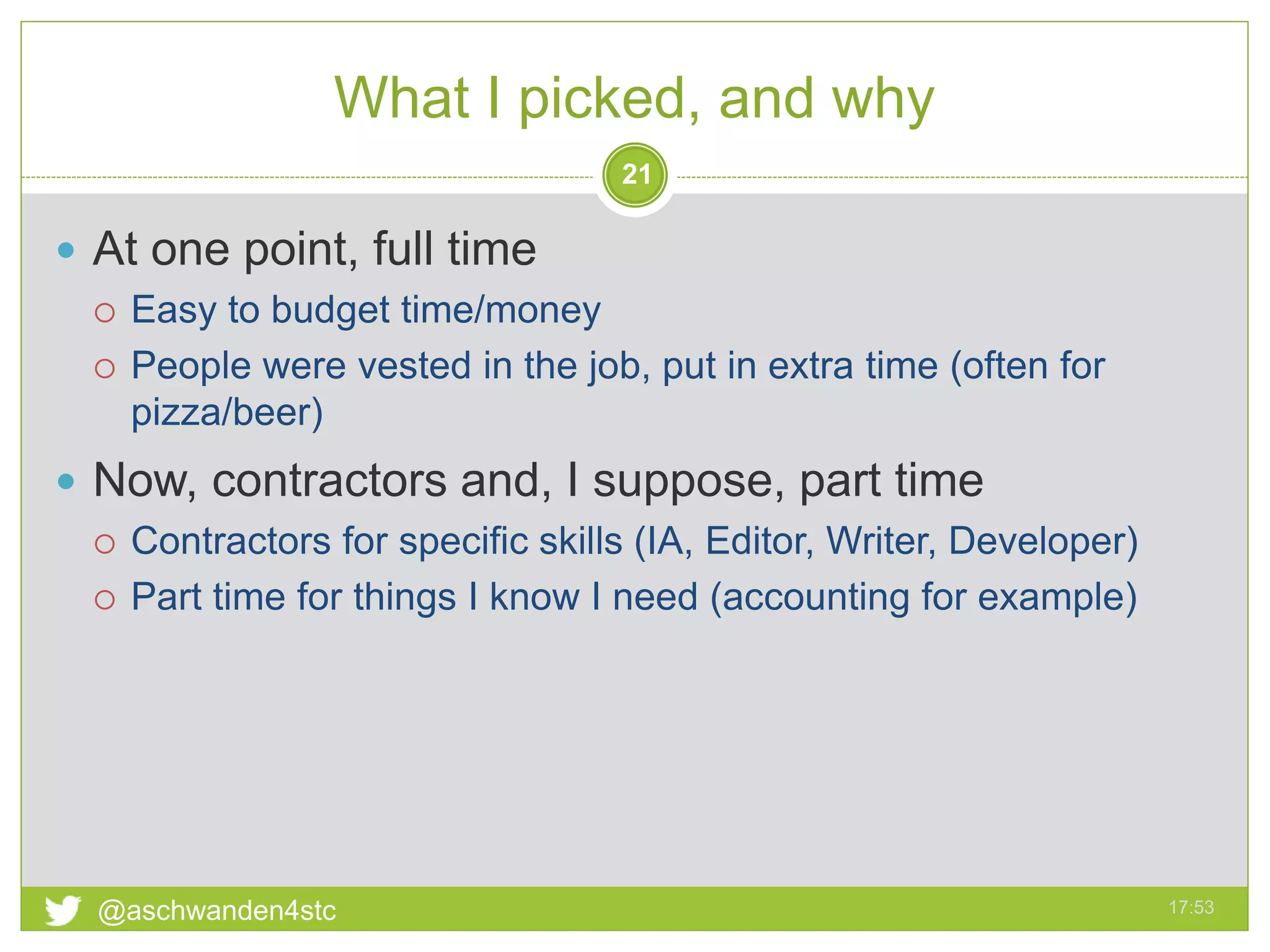
 At one point, full time
 Easy to budget time/money
 People were vested in the job, put in extra time (often for
pizza/beer)
 Now, contractors and, I suppose, part time
 Contractors for specific skills (IA, Editor, Writer, Developer)
 Part time for things I know I need (accounting for example)
Toughest thing so far
17:53@aschwanden4stc
22
 Again, having to lay off the family and friends
 Seeing people I contract with move to other jobs
 No longer available to work with me
 Sometimes even competing for the same business!
Best thing so far
17:53@aschwanden4stc
23
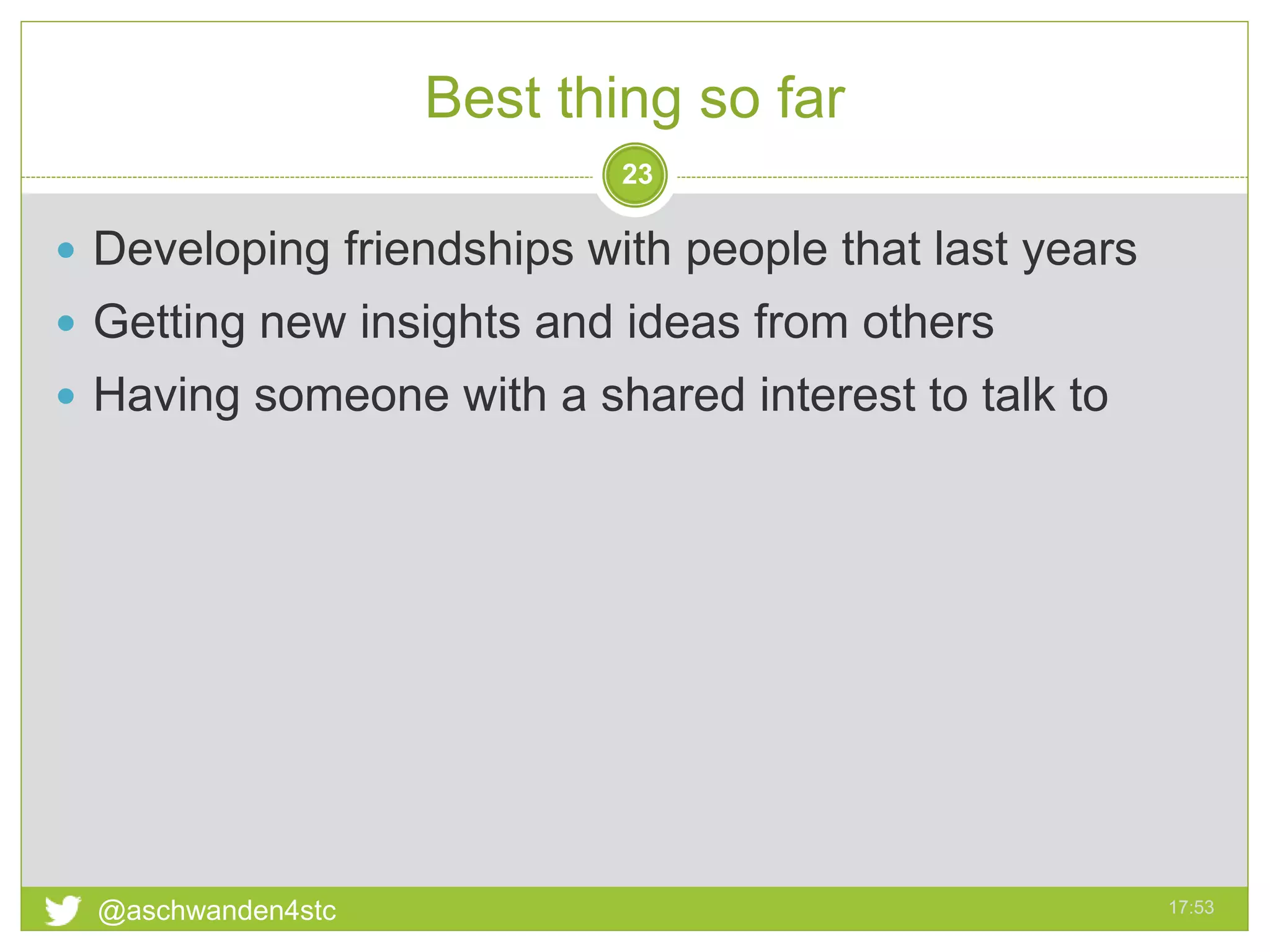
 Developing friendships with people that last years
 Getting new insights and ideas from others
 Having someone with a shared interest to talk to
Who you need to work with
@aschwanden4stc 17:53
24
Administration
Legal
17:53@aschwanden4stc
25
 They help with stuff that sucks
 Contracts to ID issues before they become problems
 Business organization (helping to incorporate, sole prop,
partnership)
 Real estate (review all the documents before you sign)
 Taxes and licenses (yes, an accountant is needed too)
 Intellectual property (media/design/creative, help with
protection)
 Finding a lawyer
 Start with finances, what can you afford?
 Should be well connected (ideally recommended)
 Lots of experience
 Similar clients
Bankers
17:53@aschwanden4stc
26
 Get to know the banker NOW, not when you start a
biz
 Build credit NOW, not when you start a biz
 Show collateral and a solid grasp of finance basics
 They can review a business plan and provide
guidance
 Often do this for “free” as you are a bank client
 At some point you likely want to borrow money
Accountants
17:53@aschwanden4stc
27
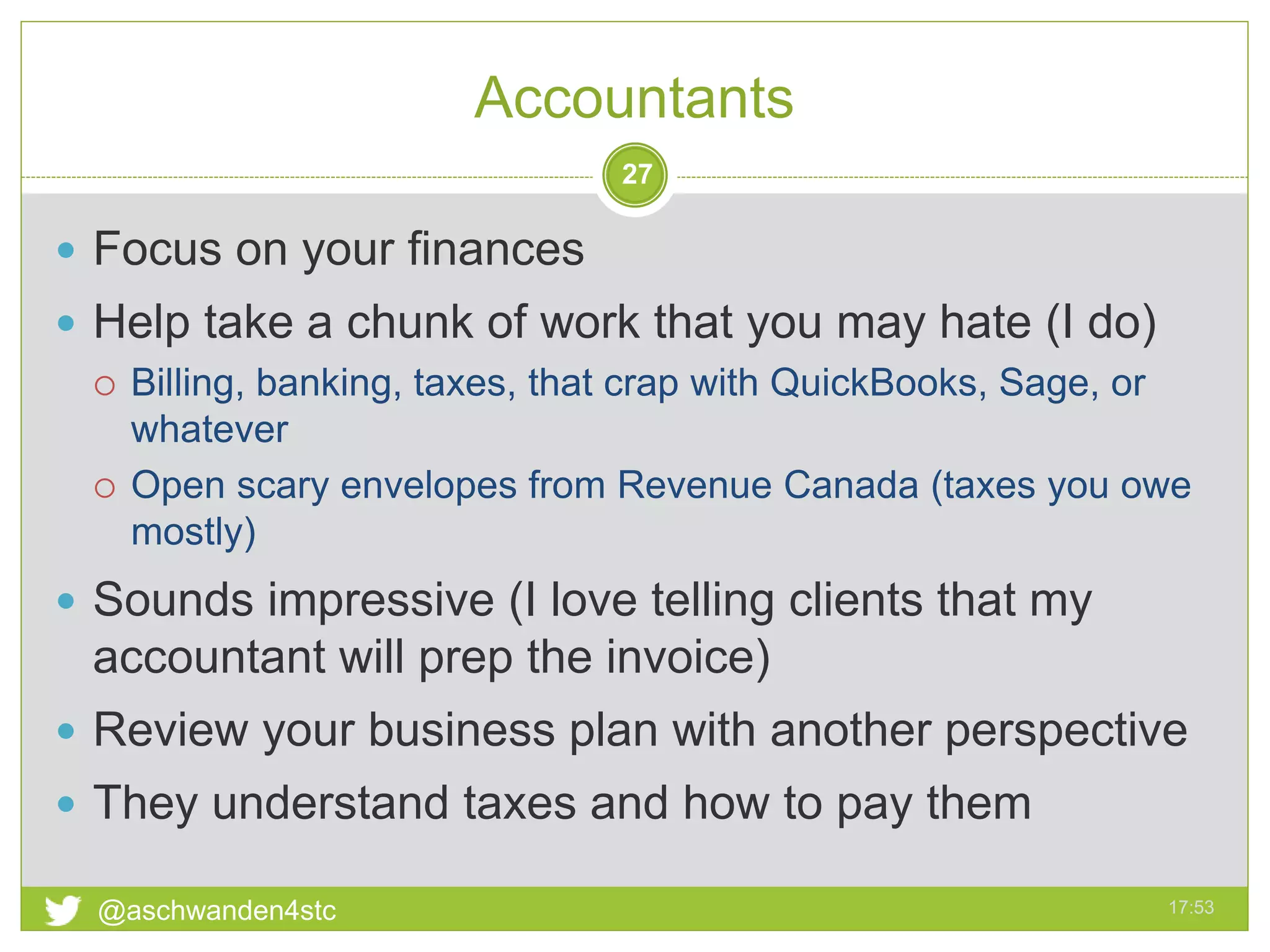
 Focus on your finances
 Help take a chunk of work that you may hate (I do)
 Billing, banking, taxes, that crap with QuickBooks, Sage, or
whatever
 Open scary envelopes from Revenue Canada (taxes you owe
mostly)
 Sounds impressive (I love telling clients that my
accountant will prep the invoice)
 Review your business plan with another perspective
 They understand taxes and how to pay them
What I picked, and why
17:53@aschwanden4stc
28
 Legal
 Few and far between
 Most contracts are *mostly* easy to read
 My standard agreements include:
 Non-compete
 Non-disclosure
 Contract terms
 Banking
 I’m with RBC, easy, local, ALL my accounts, they listen (or I
walk)
 Accounting
 Found an accountant recommended by a friend
Ideas that may be helpful (or not)
@aschwanden4stc 17:53
29
Developing relationships,
clients
Ongoing clients
17:53@aschwanden4stc
30
 Pro
 Steady income
 Reliable work
 Good relationships to keep
 Con
 If you have fewer, and one or two leave, it impacts your bottom
line
 You may get “out of practice” of building new client
leads/relations
 Things could become routine, and that can be boring
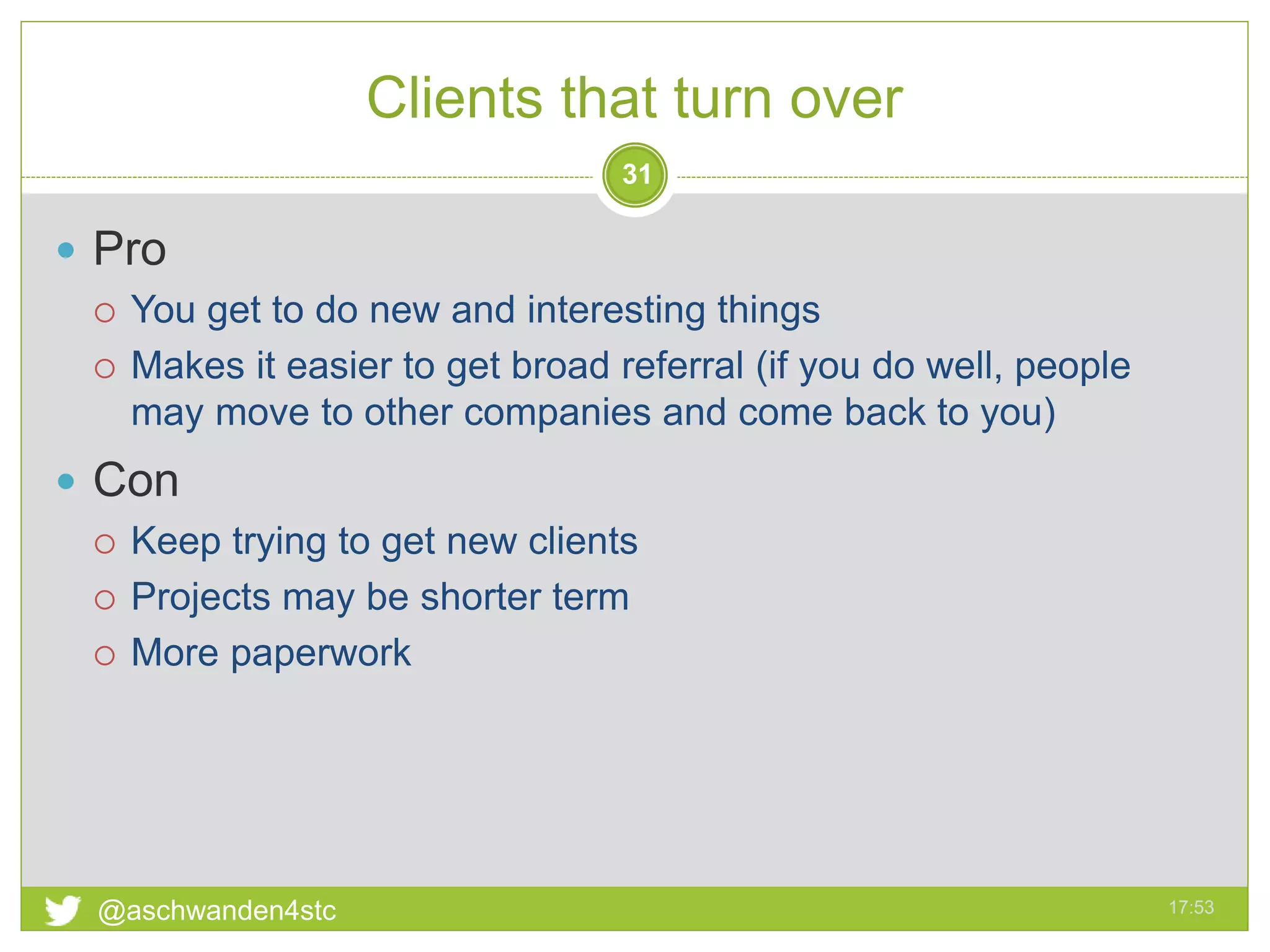
Clients that turn over
17:53@aschwanden4stc
31
 Pro
 You get to do new and interesting things
 Makes it easier to get broad referral (if you do well, people
may move to other companies and come back to you)
 Con
 Keep trying to get new clients
 Projects may be shorter term
 More paperwork
Sell a product
17:53@aschwanden4stc
32
 Pro
 Many products have return customers
 Good products can ‘sell themselves’
 Easy to develop customer loyalty
 Repeatable products are easy to make in bulk
 Think Coke, Netflix, Ford
 Con
 You need to make it (so you need people, or machines)
 You need to ship it (costs, pass them to the consumer?)
 You need to keep protecting it (legal)
 You need to manage costs (competition)
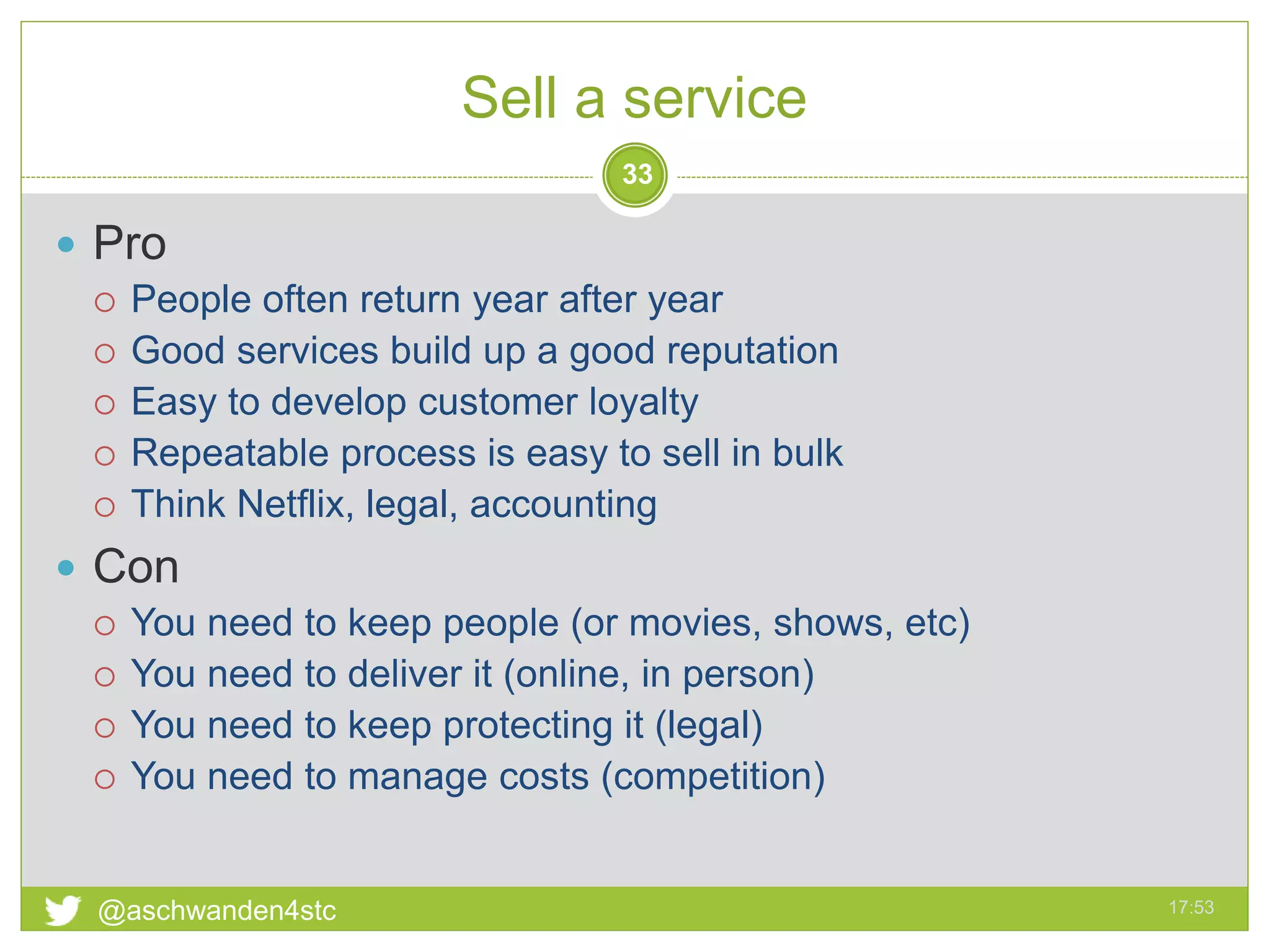
Sell a service
17:53@aschwanden4stc
33
 Pro
 People often return year after year
 Good services build up a good reputation
 Easy to develop customer loyalty
 Repeatable process is easy to sell in bulk
 Think Netflix, legal, accounting
 Con
 You need to keep people (or movies, shows, etc)
 You need to deliver it (online, in person)
 You need to keep protecting it (legal)
 You need to manage costs (competition)
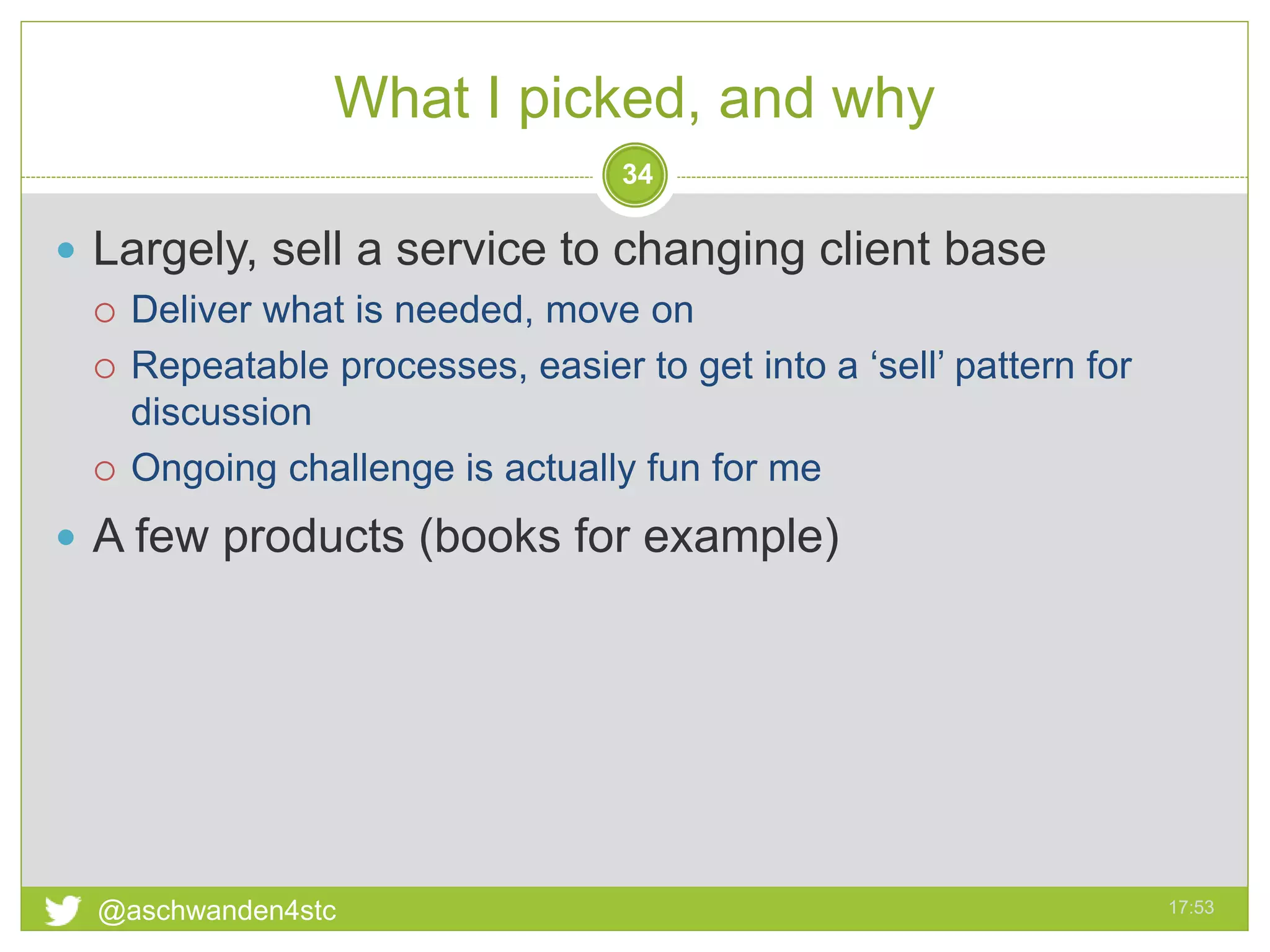
What I picked, and why
17:53@aschwanden4stc
34
 Largely, sell a service to changing client base
 Deliver what is needed, move on
 Repeatable processes, easier to get into a ‘sell’ pattern for
discussion
 Ongoing challenge is actually fun for me
 A few products (books for example)
Things to seriously consider
@aschwanden4stc 17:53
35
Start your own
What is your risk level?
17:53@aschwanden4stc
36
 Low?
 Medium?
 High?
Core steps
17:53@aschwanden4stc
37
 Plan
 Finance
 Market, work, bill, repeat
 Review the plan
 Repeat
Resources
17:53@aschwanden4stc
38
 http://www.canadabusiness.ca/
 Wide range of information on government services, programs
and regulations
 There is a centre in each province and territory
 https://www.canada.ca/en/services/business/grants.h
tml
 Information on grants, loans, private and public sector
financing and leveraging personal assets
Alberta resources
17:53@aschwanden4stc
39
 http://businesslink.ca/
 Business Link is Alberta's entrepreneurial hub
 A non-profit organization that helps entrepreneurs start a
businesses since 1996
 http://www.smallbusiness.alberta.ca/
 Alberta Small Business Resources is a directory of business
resources for new and established entrepreneurs
 http://www.nadc.gov.ab.ca/toolkit/business_develop
ment/checklist_alberta.htm
 Checklist for Starting a Business in Northern Alberta
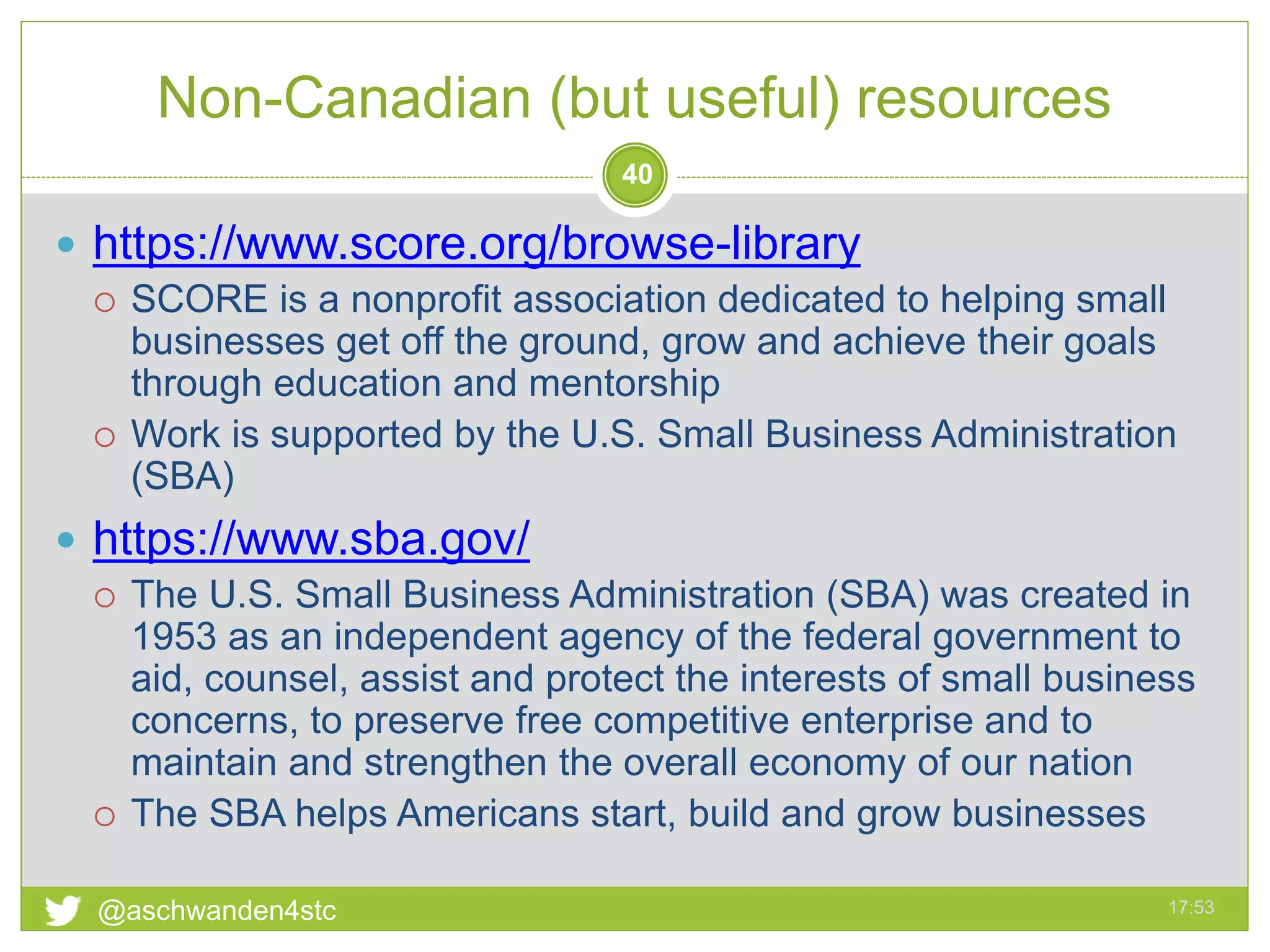
Non-Canadian (but useful) resources
17:53@aschwanden4stc
40
 https://www.score.org/browse-library
 SCORE is a nonprofit association dedicated to helping small
businesses get off the ground, grow and achieve their goals
through education and mentorship
 Work is supported by the U.S. Small Business Administration
(SBA)
 https://www.sba.gov/
 The U.S. Small Business Administration (SBA) was created in
1953 as an independent agency of the federal government to
aid, counsel, assist and protect the interests of small business
concerns, to preserve free competitive enterprise and to
maintain and strengthen the overall economy of our nation
 The SBA helps Americans start, build and grow businesses
Consider joining STC
17:53@aschwanden4stc
41
 www.stc.org
 Members span the field of the technical communication
profession
 Members represent every industry segment and many countries
 Award-winning publications, Intercom and Technical
Communication
 Offers Certified Professional Technical Communicator (CPTC)
program; validates knowledge, competency and currency in the
field through professional certification
 Produces many educational events throughout the year
designed to advance the knowledge of members and promote
technical communication education, managerial techniques and
tool skills
 Career advancement is also supported by the STC through an
annual salary survey, job board, mentoring and networking
Other materials to read
17:53@aschwanden4stc
42
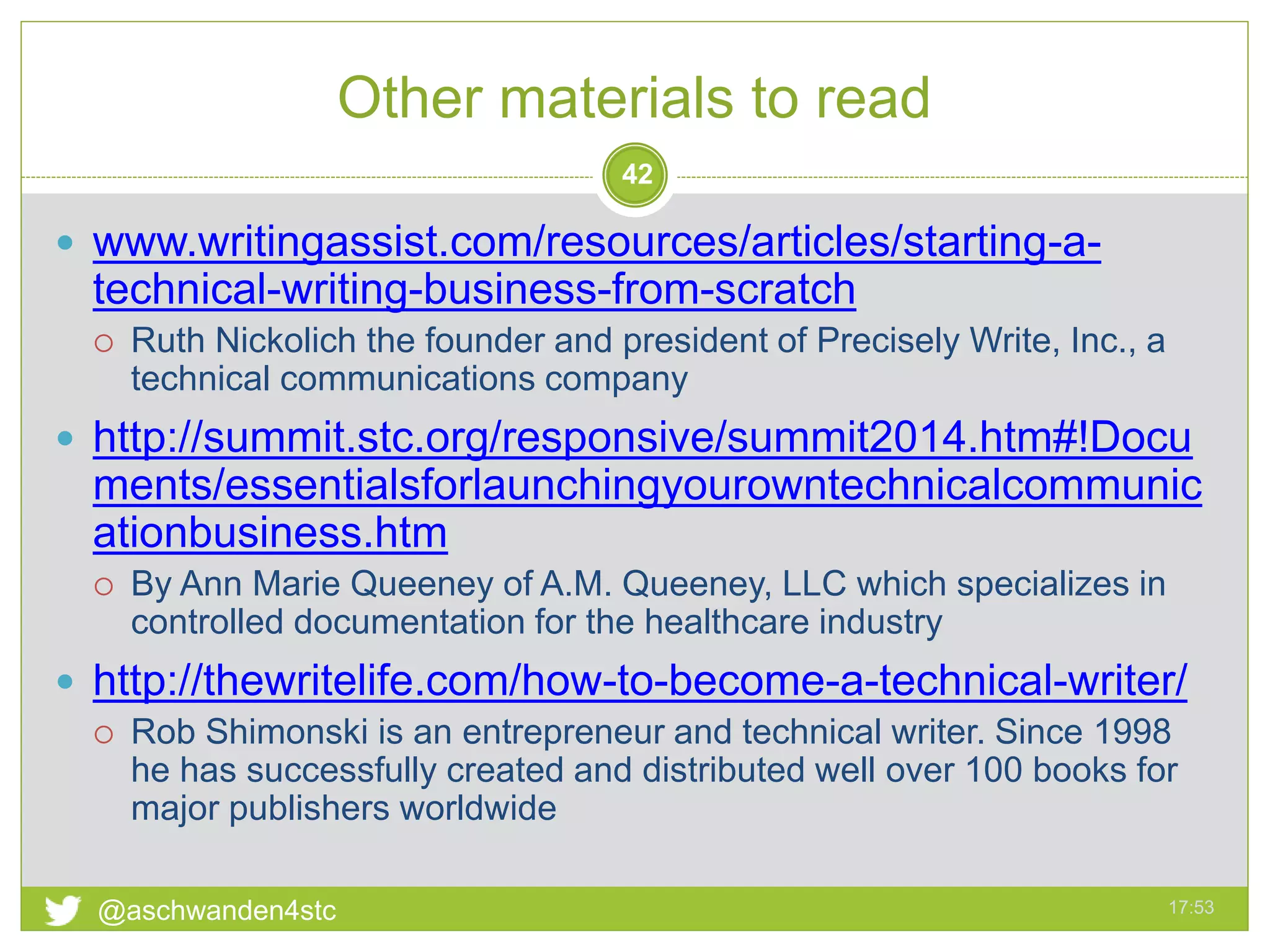
 www.writingassist.com/resources/articles/starting-a-
technical-writing-business-from-scratch
 Ruth Nickolich the founder and president of Precisely Write, Inc., a
technical communications company
 http://summit.stc.org/responsive/summit2014.htm#!Docu
ments/essentialsforlaunchingyourowntechnicalcommunic
ationbusiness.htm
 By Ann Marie Queeney of A.M. Queeney, LLC which specializes in
controlled documentation for the healthcare industry
 http://thewritelife.com/how-to-become-a-technical-writer/
 Rob Shimonski is an entrepreneur and technical writer. Since 1998
he has successfully created and distributed well over 100 books for
major publishers worldwide
More reading
17:53@aschwanden4stc
43
 http://www.morebusiness.com/technical-writing-
business
 http://www.wahm.com/articles/4-mistakes-to-avoid-
when-starting-out-as-a-technical-writer.html
 http://www.techscribe.co.uk/ta/promoting-technical-
writing.htm
 http://articles.bplans.com/10-things-every-small-
business-in-america-needs-to-do/
 https://www.entrepreneur.com/article/272598
 http://www.moneycrashers.com/what-need-start-
business/
Yes, even MORE to read
17:53@aschwanden4stc
44
 http://www.forbes.com/sites/yec/2013/06/11/five-things-
you-should-know-before-starting-a-
business/#1c15e1636bd0
 http://www.businessnewsdaily.com/1484-starting-a-
business.html
 https://www.quora.com/What-are-five-essential-things-
you-need-to-start-a-small-business
 http://www.smarta.com/advice/starting-up/starting-your-
own-business/21-things-to-research-before-starting-a-
business/
 https://www.nolo.com/legal-encyclopedia/start-own-
business-50-things-30077.html
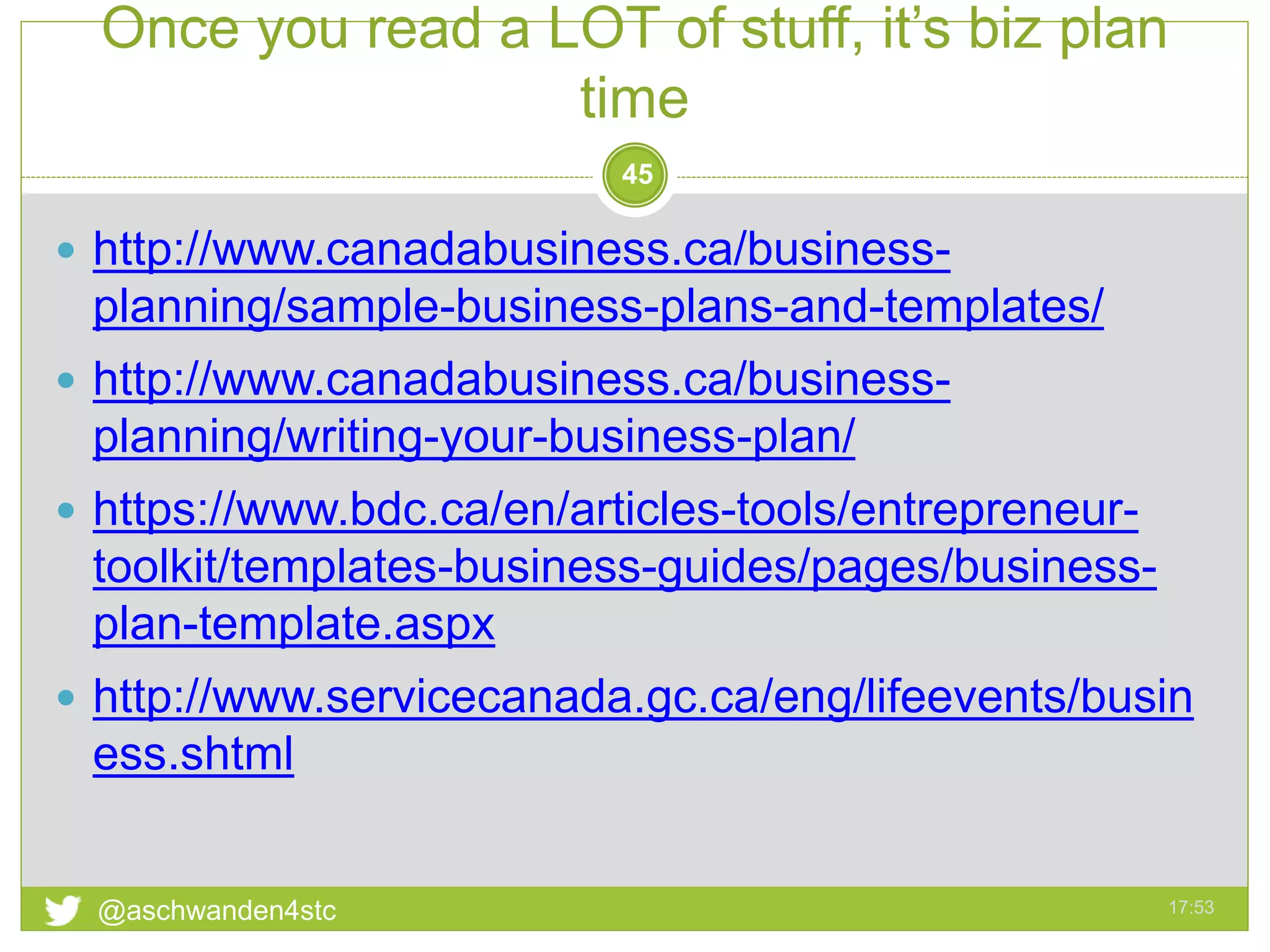
Once you read a LOT of stuff, it’s biz plan
time
17:53@aschwanden4stc
45
 http://www.canadabusiness.ca/business-
planning/sample-business-plans-and-templates/
 http://www.canadabusiness.ca/business-
planning/writing-your-business-plan/
 https://www.bdc.ca/en/articles-tools/entrepreneur-
toolkit/templates-business-guides/pages/business-
plan-template.aspx
 http://www.servicecanada.gc.ca/eng/lifeevents/busin
ess.shtml
Planning Your Business
17:53@aschwanden4stc
46
 The business plan is the most important document you
need
 It helps you to think through your business idea before
you start
 Once running, it helps you evaluate your progress
against your business goals
 When/if it’s time to obtain additional financing, it shows
your banker how you will be able to pay back the loan
 A business plan is a living document
 Review it yearly to ensure it reflects your current
situation and your goals
Key section in a business plan
17:53@aschwanden4stc
47
1. Introduction
2. The Team
3. Business Environment
4. Marketing Plan
5. Operations
6. Finance
7. Risks and Conclusions
Ideas on building connections
@aschwanden4stc 17:53
48
Get the word out
Tell people what you do
17:53@aschwanden4stc
49
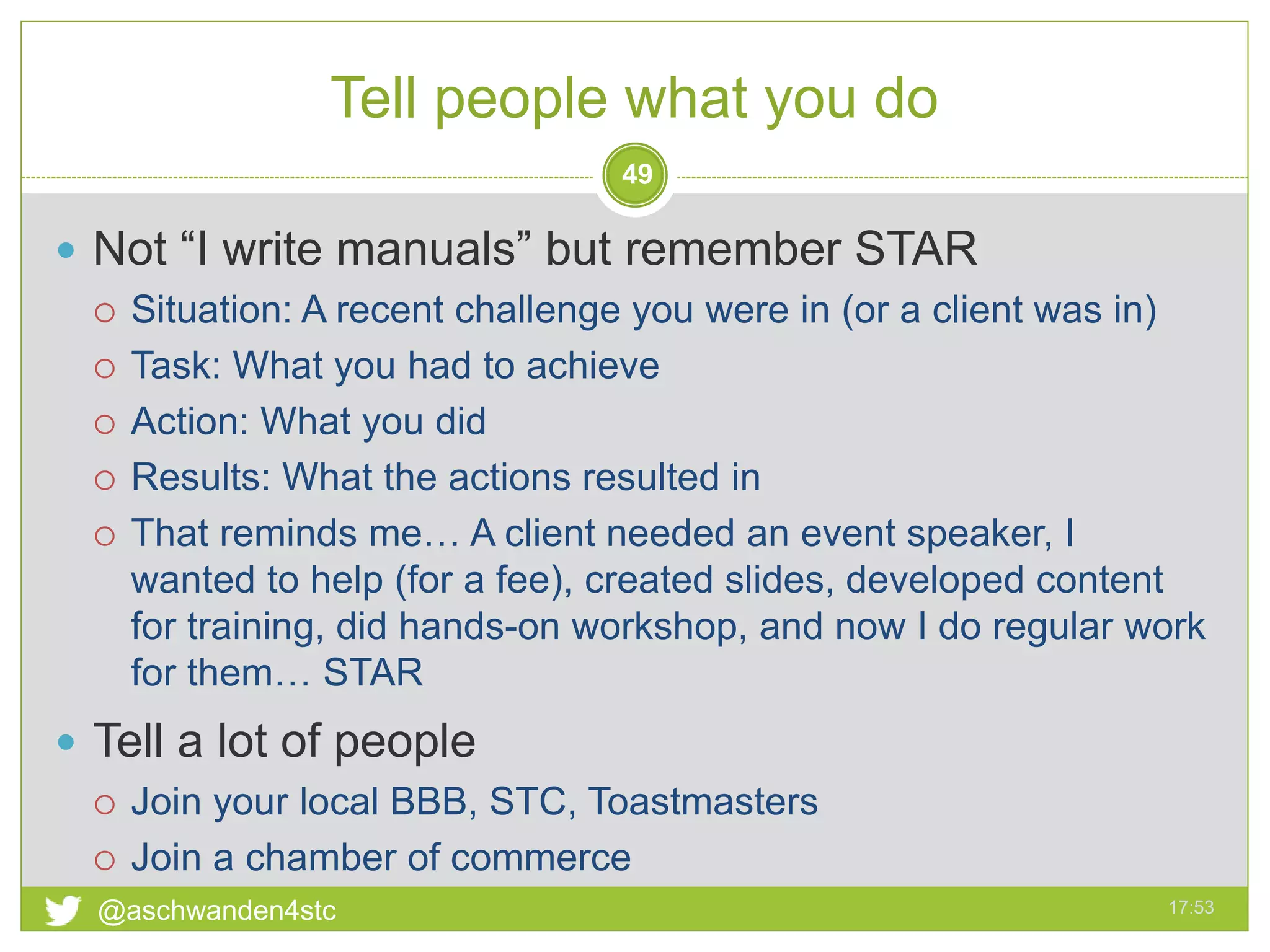
 Not “I write manuals” but remember STAR
 Situation: A recent challenge you were in (or a client was in)
 Task: What you had to achieve
 Action: What you did
 Results: What the actions resulted in
 That reminds me… A client needed an event speaker, I
wanted to help (for a fee), created slides, developed content
for training, did hands-on workshop, and now I do regular work
for them… STAR
 Tell a lot of people
 Join your local BBB, STC, Toastmasters
 Join a chamber of commerce
Show people what you do
17:53@aschwanden4stc
50
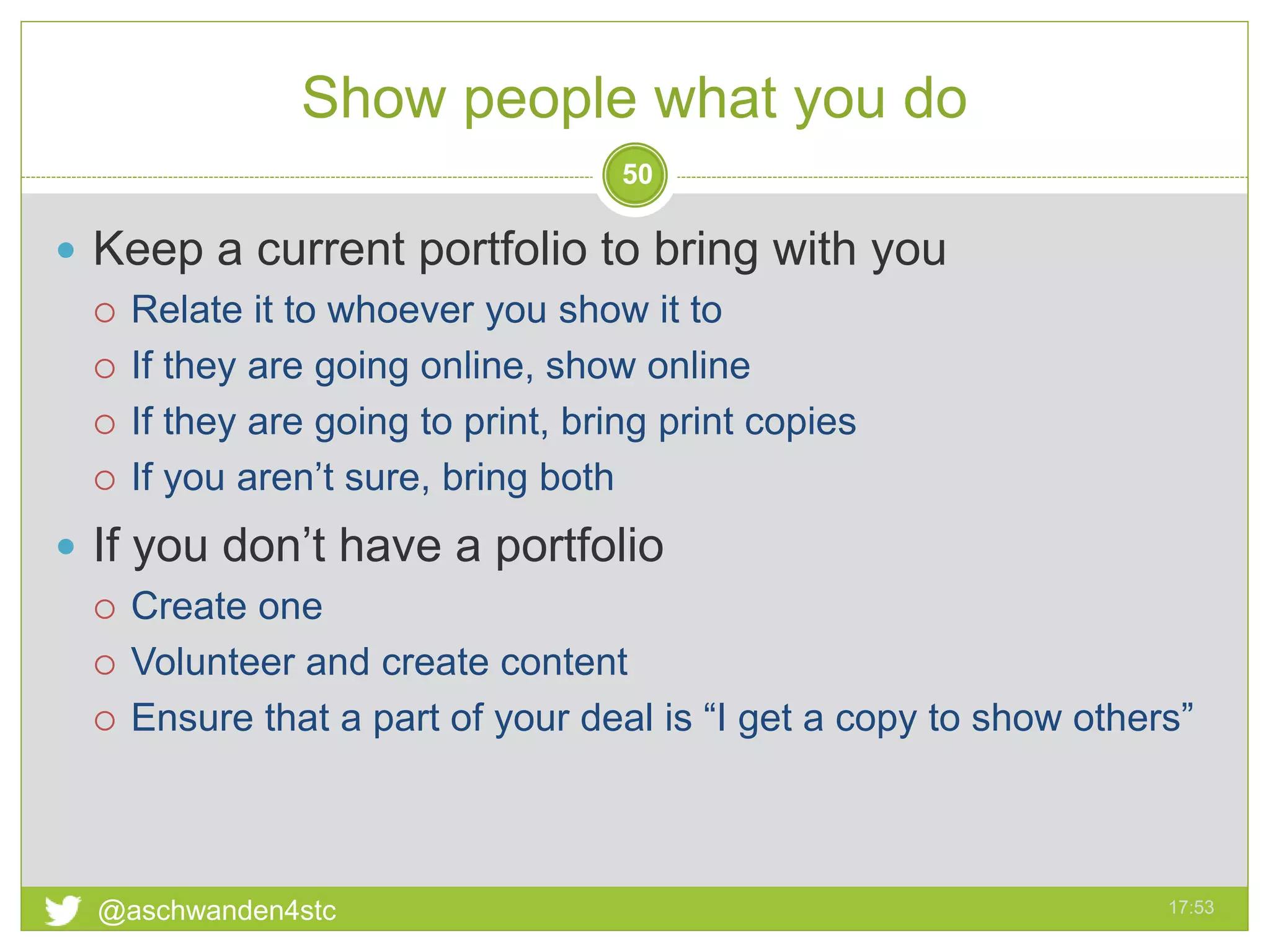
 Keep a current portfolio to bring with you
 Relate it to whoever you show it to
 If they are going online, show online
 If they are going to print, bring print copies
 If you aren’t sure, bring both
 If you don’t have a portfolio
 Create one
 Volunteer and create content
 Ensure that a part of your deal is “I get a copy to show others”
Have people buy into what you do
17:53@aschwanden4stc
51
 Don’t volunteer
 At least, not if it is not helping your business
 Find GOOD places to volunteer, ones that match your passion
 When you do, take credit for it
 Trade shows and conferences
 Find ones that are relevant
 Offer to speak, or pay to exhibit
 Get yourself in to learn, network, and market
How I got in, got going, and got ‘here’
@aschwanden4stc 17:53
52
Bringing it all together
Entrepreneurship
17:53@aschwanden4stc
53
 I wanted my own business forever
 Employed by over 50 companies by the time I was
22
 Many for no more than a week or two, some for as long as 3
or 4 years (part time)
 Started a business right after that
 Second-hand bookstore
 Worked part time delivering Chinese food
 Worked part time delivering computer training
 I was a contractor working in computer training
Timing is everything
17:53@aschwanden4stc
54
 Got into software training as the PC took off in
companies
 Lots of money to be made
 Learned FrameMaker, writing training manuals
 Got to be a FrameMaker sales lead at a training
company
 However, like all good things…
 The business I worked for (a partnership) fractured
 People went their own ways
 So I hired them and started a training business
Business changes
17:53@aschwanden4stc
55
 Our training business had about a dozen employees
(FT), plus a few PT, and at least a dozen contract
trainers
 We did work all over the planet
 Drug submission, airplane manuals, government, private
business, casinos, automakers, software and hardware
 However, like all good things…
 The industry I was most dependent on (software/hardware)
went up in a dot com bomb
 I had to lay off friends and family (in that order)
 So we scaled back, regrouped, and came at it fresh
People wanted content
17:53@aschwanden4stc
56
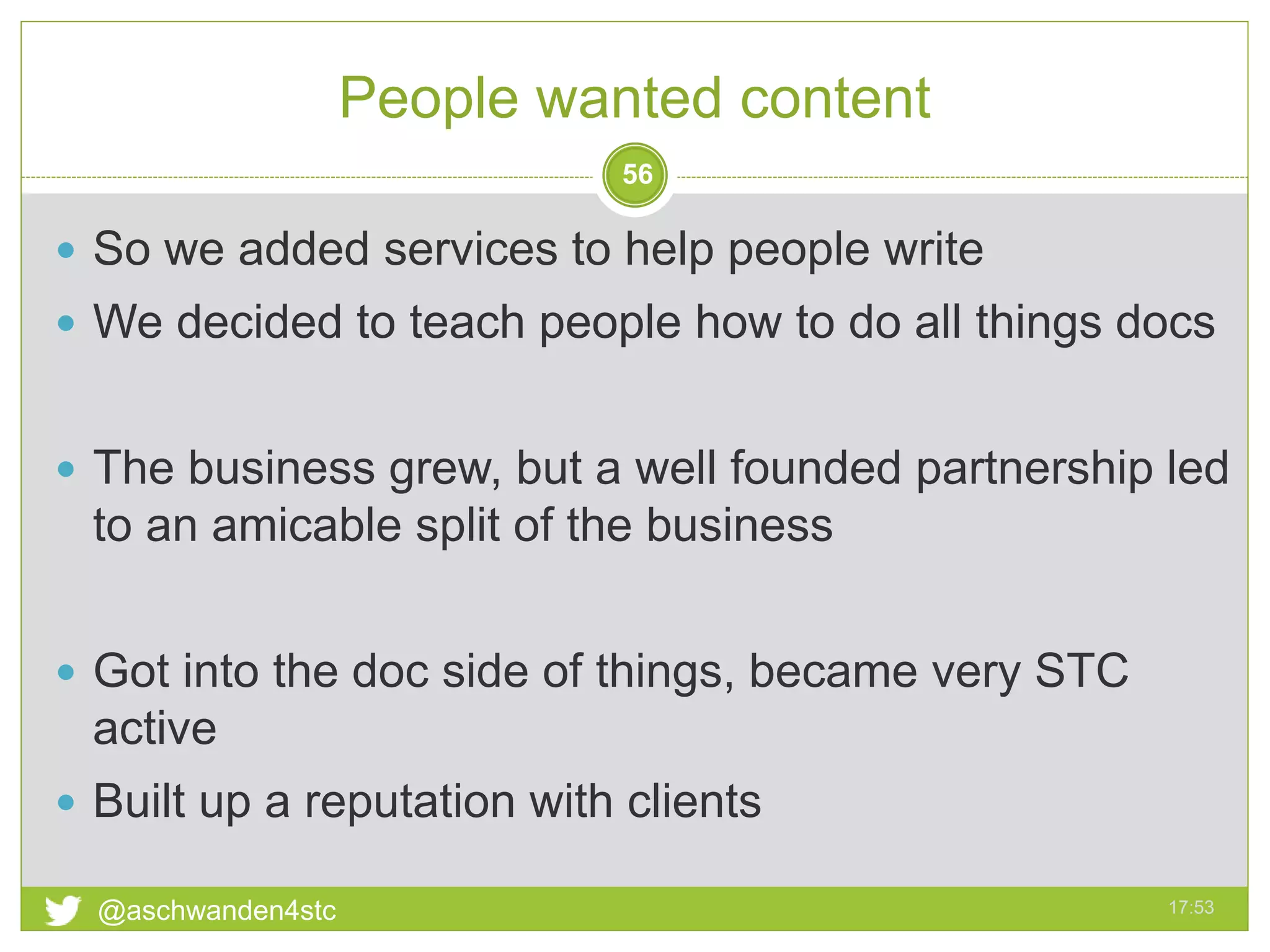
 So we added services to help people write
 We decided to teach people how to do all things docs
 The business grew, but a well founded partnership led
to an amicable split of the business
 Got into the doc side of things, became very STC
active
 Built up a reputation with clients
Learn from the best
17:53@aschwanden4stc
57
 High school
 Entrepreneurship class, day 1, teacher intro, challenge
 First day, 40 students, end of it about 24
 Business competition (USA)
 Most people made products, some sold services, myself and
another student brought it together with the least effort, most
profit
 Lessons learned
 Second best lesson ever learned
 Best lesson ever learned
What I really love to do
17:53@aschwanden4stc
58
 Resolve challenges
 Deal with issues before they become problems
 Use clear communication and creativity to solve
things
 Over, under, around, or through it
 See things from a fresh angle, talk to people, interact
with those who are “going somewhere” not those
who “grumble and complain”
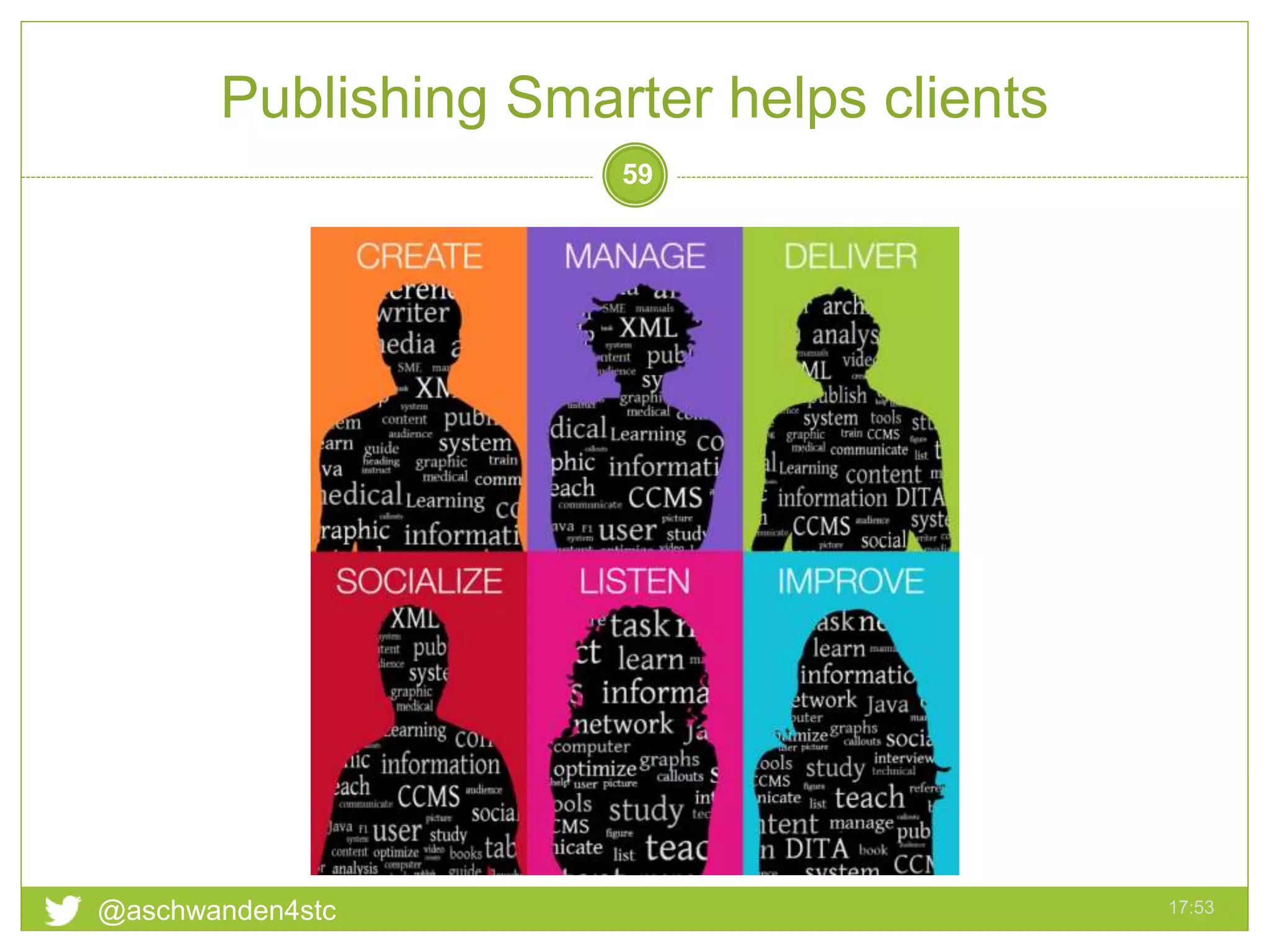
Publishing Smarter helps clients
17:53@aschwanden4stc
59
Follow up contact information
17:53@aschwanden4stc
60
905 833 8448 (Eastern Time)
bernard@publishingsmarter.com
www.linkedin.com/in/bernardaschwanden
@aschwanden4stc
www.publishingsmarter.com

Running a business (Alberta STC)

  • 1.
  • 2.
    Thank you 17:53@aschwanden4stc 2  AlbertaSTC and its volunteers  Cohort Technical Communications
  • 3.
    Outline 17:53@aschwanden4stc 3  Want torun a business? Make the right decisions, as incorrect ones impact the bottom line.  Where do you turn for advice? When do you NOT follow the expert opinions?  Explore ideas about business models, staffing, client development, and administration.  Ask questions and get input on real issues you face when starting and running a business.  We discuss starting or managing a business and explores the real issues that are faced every day by business owners.  Develop your (very) small business (one person shop?) into something bigger.  ID what to think about when going into business or growing a business.  Dive deeper with a discussion around the entrepreneurial spirit and how it can help you build and grow a business into a steady source of revenue doing things you love to do (and handing off the "other" stuff to people more qualified).
  • 4.
    Housekeeping and notetaking 17:53@aschwanden4stc 4  Not all slides or topics are equally weighted  Use some, discard others  Slides speed varies (reference)  Questions? Ask any time!  I’d love to claim errors/typos is on purpose… they isn’t, weren’t never, and ain’t; I’ll fix ‘em as I can…
  • 5.
    Disclaimer 17:53 5  In theinterest of brevity I will be making some blanket statements to keep things simple  Not all that I tell you will be 100% the truth, but I’ll stay as close as I can  I will likely get in trouble from purists  In some cases this is just wrong of them  Of course, they will also make valid points
  • 6.
    About your speaker 17:53@aschwanden4stc Publishing Smarter: President  Content strategist, publishing technologies expert, author, and geek- enough  Solves communications problems to help businesses be efficient and profitable  Society for Technical Communication  Past President 6
  • 7.
    Business Models Not hereto tell you which to pick
  • 8.
    Just want tohave a brief discussion 17:53@aschwanden4stc 8  Things to think about at a very high level  Reasons that some business models are better or worse  Sole proprietorship  Partnership  Incorporation  Co-operative
  • 9.
     Pro  Usuallyone owner/decision maker, admin is simpler, generally easy to register, simpler at tax time  Con  Legally, it’s all you, failure can jeopardize your own money/finances, less tax flexibility, tougher to raise 3rd party funds (stock for example), company leadership/growth can be tough Sole proprietorship 9
  • 10.
    Partnership 17:53@aschwanden4stc 10  Pro  Theworking relationships  Shared skills towards a goal  Shared costs  Support network built right in  Con  Your partners  Shared liabilities  Shared profits  Risk of relationships being lost due to business
  • 11.
    Incorporated 17:53@aschwanden4stc 11  Pro  Limitedliability  Able to raise funds (stock offerings for example)  More likely to be considered legit  Unless you name your business poorly such as (and these are real)  Cadabra Inc. (later renamed to Amazon)  http://www.sandmfamilyoutletstx.com/ which is  Other ‘creative’ spellings of common names  Con  Less direct control as shares thin out  More legal structure, more complex tax filings  More paperwork
  • 12.
    Co-operative 17:53@aschwanden4stc 12  Usually havevery large base of people to draw on  The Global 300 Co-operatives Report analysed co- operatives by seven sectors — which include Agriculture/Forestry, Banking/Credit Unions, Consumer/Retail, Insurance, Workers/Industrial, Health and Utilities and 'Other' category  http://www.thenews.coop/49090/news/general/view-top-300-co- operatives-around-world/  I don’t have enough experience to talk about this  United Farmers of Alberta  MEC (Mountain Equipment Co-op)  Desjardins Group and the Co-operators (Canada, insurance)
  • 13.
    What I picked,and why 17:53@aschwanden4stc 13  Sole proprietorship  Low risk in what I do  Easy to set my own schedule  Pro  I get to decide the direction of the business, make all calls  When it goes well, I don’t have to think about cash in the bank, etc  Against  Can be tough to get good people to stay (they look for their opportunities)  If just me, then issues when I’m unable to deliver (sick, overbooked, specific jobs I don’t have the skills for)
  • 14.
    Toughest thing sofar 17:53@aschwanden4stc 14  Deciding if I would be valuated and bought by others  So far, not happening…   Deciding if I would stick with the sole-prop model  So far, yup  Having to layoff friends and family  Remember the dot com crash? Me too… 
  • 15.
    Best things sofar 17:53@aschwanden4stc 15  Travel when and where I want  Hawaii  India  Germany  Denmark  Hawaii  Most of the USA  Most of Canada  Calgary  Hawaii
  • 16.
  • 17.
  • 18.
    Part time 17:53@aschwanden4stc 18  Pro Ramp up as needed  No need to put together benefits  Bring in a short term but specific skill  Pay only when you need them (but might pay more per hour)  Con  Training them up to the job  They may look for better/stable options  When people DO get to know them and they leave… then what?
  • 19.
    Full time 17:53@aschwanden4stc 19  Pro You know your payroll  People have specific functions  Easier to schedule and plan  Con  Meeting payroll  Eventually adding HR or other roles to the team  Costs go up across the board (phones, internet access, etc)
  • 20.
    Contractors 17:53@aschwanden4stc 20  Pro  Verysimilar to the part time and full time  Less of a legal issue (paperwork goes away)  Con  Similar to part time and full time  Legal issues (if you contract them for TOO many hours, they might actually be employees)  Less of a connection to full time/part time staff
  • 21.
    What I picked,and why 17:53@aschwanden4stc 21  At one point, full time  Easy to budget time/money  People were vested in the job, put in extra time (often for pizza/beer)  Now, contractors and, I suppose, part time  Contractors for specific skills (IA, Editor, Writer, Developer)  Part time for things I know I need (accounting for example)
  • 22.
    Toughest thing sofar 17:53@aschwanden4stc 22  Again, having to lay off the family and friends  Seeing people I contract with move to other jobs  No longer available to work with me  Sometimes even competing for the same business!
  • 23.
    Best thing sofar 17:53@aschwanden4stc 23  Developing friendships with people that last years  Getting new insights and ideas from others  Having someone with a shared interest to talk to
  • 24.
    Who you needto work with @aschwanden4stc 17:53 24 Administration
  • 25.
    Legal 17:53@aschwanden4stc 25  They helpwith stuff that sucks  Contracts to ID issues before they become problems  Business organization (helping to incorporate, sole prop, partnership)  Real estate (review all the documents before you sign)  Taxes and licenses (yes, an accountant is needed too)  Intellectual property (media/design/creative, help with protection)  Finding a lawyer  Start with finances, what can you afford?  Should be well connected (ideally recommended)  Lots of experience  Similar clients
  • 26.
    Bankers 17:53@aschwanden4stc 26  Get toknow the banker NOW, not when you start a biz  Build credit NOW, not when you start a biz  Show collateral and a solid grasp of finance basics  They can review a business plan and provide guidance  Often do this for “free” as you are a bank client  At some point you likely want to borrow money
  • 27.
    Accountants 17:53@aschwanden4stc 27  Focus onyour finances  Help take a chunk of work that you may hate (I do)  Billing, banking, taxes, that crap with QuickBooks, Sage, or whatever  Open scary envelopes from Revenue Canada (taxes you owe mostly)  Sounds impressive (I love telling clients that my accountant will prep the invoice)  Review your business plan with another perspective  They understand taxes and how to pay them
  • 28.
    What I picked,and why 17:53@aschwanden4stc 28  Legal  Few and far between  Most contracts are *mostly* easy to read  My standard agreements include:  Non-compete  Non-disclosure  Contract terms  Banking  I’m with RBC, easy, local, ALL my accounts, they listen (or I walk)  Accounting  Found an accountant recommended by a friend
  • 29.
    Ideas that maybe helpful (or not) @aschwanden4stc 17:53 29 Developing relationships, clients
  • 30.
    Ongoing clients 17:53@aschwanden4stc 30  Pro Steady income  Reliable work  Good relationships to keep  Con  If you have fewer, and one or two leave, it impacts your bottom line  You may get “out of practice” of building new client leads/relations  Things could become routine, and that can be boring
  • 31.
    Clients that turnover 17:53@aschwanden4stc 31  Pro  You get to do new and interesting things  Makes it easier to get broad referral (if you do well, people may move to other companies and come back to you)  Con  Keep trying to get new clients  Projects may be shorter term  More paperwork
  • 32.
    Sell a product 17:53@aschwanden4stc 32 Pro  Many products have return customers  Good products can ‘sell themselves’  Easy to develop customer loyalty  Repeatable products are easy to make in bulk  Think Coke, Netflix, Ford  Con  You need to make it (so you need people, or machines)  You need to ship it (costs, pass them to the consumer?)  You need to keep protecting it (legal)  You need to manage costs (competition)
  • 33.
    Sell a service 17:53@aschwanden4stc 33 Pro  People often return year after year  Good services build up a good reputation  Easy to develop customer loyalty  Repeatable process is easy to sell in bulk  Think Netflix, legal, accounting  Con  You need to keep people (or movies, shows, etc)  You need to deliver it (online, in person)  You need to keep protecting it (legal)  You need to manage costs (competition)
  • 34.
    What I picked,and why 17:53@aschwanden4stc 34  Largely, sell a service to changing client base  Deliver what is needed, move on  Repeatable processes, easier to get into a ‘sell’ pattern for discussion  Ongoing challenge is actually fun for me  A few products (books for example)
  • 35.
    Things to seriouslyconsider @aschwanden4stc 17:53 35 Start your own
  • 36.
    What is yourrisk level? 17:53@aschwanden4stc 36  Low?  Medium?  High?
  • 37.
    Core steps 17:53@aschwanden4stc 37  Plan Finance  Market, work, bill, repeat  Review the plan  Repeat
  • 38.
    Resources 17:53@aschwanden4stc 38  http://www.canadabusiness.ca/  Widerange of information on government services, programs and regulations  There is a centre in each province and territory  https://www.canada.ca/en/services/business/grants.h tml  Information on grants, loans, private and public sector financing and leveraging personal assets
  • 39.
    Alberta resources 17:53@aschwanden4stc 39  http://businesslink.ca/ Business Link is Alberta's entrepreneurial hub  A non-profit organization that helps entrepreneurs start a businesses since 1996  http://www.smallbusiness.alberta.ca/  Alberta Small Business Resources is a directory of business resources for new and established entrepreneurs  http://www.nadc.gov.ab.ca/toolkit/business_develop ment/checklist_alberta.htm  Checklist for Starting a Business in Northern Alberta
  • 40.
    Non-Canadian (but useful)resources 17:53@aschwanden4stc 40  https://www.score.org/browse-library  SCORE is a nonprofit association dedicated to helping small businesses get off the ground, grow and achieve their goals through education and mentorship  Work is supported by the U.S. Small Business Administration (SBA)  https://www.sba.gov/  The U.S. Small Business Administration (SBA) was created in 1953 as an independent agency of the federal government to aid, counsel, assist and protect the interests of small business concerns, to preserve free competitive enterprise and to maintain and strengthen the overall economy of our nation  The SBA helps Americans start, build and grow businesses
  • 41.
    Consider joining STC 17:53@aschwanden4stc 41 www.stc.org  Members span the field of the technical communication profession  Members represent every industry segment and many countries  Award-winning publications, Intercom and Technical Communication  Offers Certified Professional Technical Communicator (CPTC) program; validates knowledge, competency and currency in the field through professional certification  Produces many educational events throughout the year designed to advance the knowledge of members and promote technical communication education, managerial techniques and tool skills  Career advancement is also supported by the STC through an annual salary survey, job board, mentoring and networking
  • 42.
    Other materials toread 17:53@aschwanden4stc 42  www.writingassist.com/resources/articles/starting-a- technical-writing-business-from-scratch  Ruth Nickolich the founder and president of Precisely Write, Inc., a technical communications company  http://summit.stc.org/responsive/summit2014.htm#!Docu ments/essentialsforlaunchingyourowntechnicalcommunic ationbusiness.htm  By Ann Marie Queeney of A.M. Queeney, LLC which specializes in controlled documentation for the healthcare industry  http://thewritelife.com/how-to-become-a-technical-writer/  Rob Shimonski is an entrepreneur and technical writer. Since 1998 he has successfully created and distributed well over 100 books for major publishers worldwide
  • 43.
    More reading 17:53@aschwanden4stc 43  http://www.morebusiness.com/technical-writing- business http://www.wahm.com/articles/4-mistakes-to-avoid- when-starting-out-as-a-technical-writer.html  http://www.techscribe.co.uk/ta/promoting-technical- writing.htm  http://articles.bplans.com/10-things-every-small- business-in-america-needs-to-do/  https://www.entrepreneur.com/article/272598  http://www.moneycrashers.com/what-need-start- business/
  • 44.
    Yes, even MOREto read 17:53@aschwanden4stc 44  http://www.forbes.com/sites/yec/2013/06/11/five-things- you-should-know-before-starting-a- business/#1c15e1636bd0  http://www.businessnewsdaily.com/1484-starting-a- business.html  https://www.quora.com/What-are-five-essential-things- you-need-to-start-a-small-business  http://www.smarta.com/advice/starting-up/starting-your- own-business/21-things-to-research-before-starting-a- business/  https://www.nolo.com/legal-encyclopedia/start-own- business-50-things-30077.html
  • 45.
    Once you reada LOT of stuff, it’s biz plan time 17:53@aschwanden4stc 45  http://www.canadabusiness.ca/business- planning/sample-business-plans-and-templates/  http://www.canadabusiness.ca/business- planning/writing-your-business-plan/  https://www.bdc.ca/en/articles-tools/entrepreneur- toolkit/templates-business-guides/pages/business- plan-template.aspx  http://www.servicecanada.gc.ca/eng/lifeevents/busin ess.shtml
  • 46.
    Planning Your Business 17:53@aschwanden4stc 46 The business plan is the most important document you need  It helps you to think through your business idea before you start  Once running, it helps you evaluate your progress against your business goals  When/if it’s time to obtain additional financing, it shows your banker how you will be able to pay back the loan  A business plan is a living document  Review it yearly to ensure it reflects your current situation and your goals
  • 47.
    Key section ina business plan 17:53@aschwanden4stc 47 1. Introduction 2. The Team 3. Business Environment 4. Marketing Plan 5. Operations 6. Finance 7. Risks and Conclusions
  • 48.
    Ideas on buildingconnections @aschwanden4stc 17:53 48 Get the word out
  • 49.
    Tell people whatyou do 17:53@aschwanden4stc 49  Not “I write manuals” but remember STAR  Situation: A recent challenge you were in (or a client was in)  Task: What you had to achieve  Action: What you did  Results: What the actions resulted in  That reminds me… A client needed an event speaker, I wanted to help (for a fee), created slides, developed content for training, did hands-on workshop, and now I do regular work for them… STAR  Tell a lot of people  Join your local BBB, STC, Toastmasters  Join a chamber of commerce
  • 50.
    Show people whatyou do 17:53@aschwanden4stc 50  Keep a current portfolio to bring with you  Relate it to whoever you show it to  If they are going online, show online  If they are going to print, bring print copies  If you aren’t sure, bring both  If you don’t have a portfolio  Create one  Volunteer and create content  Ensure that a part of your deal is “I get a copy to show others”
  • 51.
    Have people buyinto what you do 17:53@aschwanden4stc 51  Don’t volunteer  At least, not if it is not helping your business  Find GOOD places to volunteer, ones that match your passion  When you do, take credit for it  Trade shows and conferences  Find ones that are relevant  Offer to speak, or pay to exhibit  Get yourself in to learn, network, and market
  • 52.
    How I gotin, got going, and got ‘here’ @aschwanden4stc 17:53 52 Bringing it all together
  • 53.
    Entrepreneurship 17:53@aschwanden4stc 53  I wantedmy own business forever  Employed by over 50 companies by the time I was 22  Many for no more than a week or two, some for as long as 3 or 4 years (part time)  Started a business right after that  Second-hand bookstore  Worked part time delivering Chinese food  Worked part time delivering computer training  I was a contractor working in computer training
  • 54.
    Timing is everything 17:53@aschwanden4stc 54 Got into software training as the PC took off in companies  Lots of money to be made  Learned FrameMaker, writing training manuals  Got to be a FrameMaker sales lead at a training company  However, like all good things…  The business I worked for (a partnership) fractured  People went their own ways  So I hired them and started a training business
  • 55.
    Business changes 17:53@aschwanden4stc 55  Ourtraining business had about a dozen employees (FT), plus a few PT, and at least a dozen contract trainers  We did work all over the planet  Drug submission, airplane manuals, government, private business, casinos, automakers, software and hardware  However, like all good things…  The industry I was most dependent on (software/hardware) went up in a dot com bomb  I had to lay off friends and family (in that order)  So we scaled back, regrouped, and came at it fresh
  • 56.
    People wanted content 17:53@aschwanden4stc 56 So we added services to help people write  We decided to teach people how to do all things docs  The business grew, but a well founded partnership led to an amicable split of the business  Got into the doc side of things, became very STC active  Built up a reputation with clients
  • 57.
    Learn from thebest 17:53@aschwanden4stc 57  High school  Entrepreneurship class, day 1, teacher intro, challenge  First day, 40 students, end of it about 24  Business competition (USA)  Most people made products, some sold services, myself and another student brought it together with the least effort, most profit  Lessons learned  Second best lesson ever learned  Best lesson ever learned
  • 58.
    What I reallylove to do 17:53@aschwanden4stc 58  Resolve challenges  Deal with issues before they become problems  Use clear communication and creativity to solve things  Over, under, around, or through it  See things from a fresh angle, talk to people, interact with those who are “going somewhere” not those who “grumble and complain”
  • 59.
    Publishing Smarter helpsclients 17:53@aschwanden4stc 59
  • 60.
    Follow up contactinformation 17:53@aschwanden4stc 60 905 833 8448 (Eastern Time) bernard@publishingsmarter.com www.linkedin.com/in/bernardaschwanden @aschwanden4stc www.publishingsmarter.com