STREAM B
Stuart Lowrie
Senior Professional Officer, The City of
Edinburgh Council
Bustracker – www.mybustracker.co.uk:
Web Based RTPI Development and User
Statistics Analysis
Will there ever be a case for
removing on-street displays?
Stuart Lowrie
Acting Public Transport Manager
The City of Edinburgh Council
3
• Launched in 2004
• Funding from Scottish Executive Public Transport Fund
• Partnership between Council, Lothian Buses and Ineo
• Initially 85 on-street signs located on Quality Bus Corridors
• Designed for use by multiple operators
• Radio based system
4
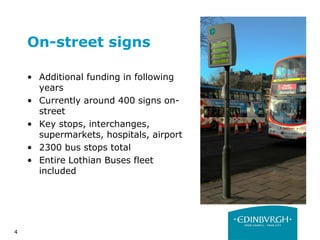
On-street signs
• Additional funding in following
years
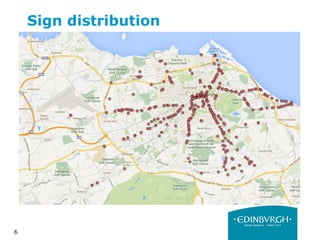
• Currently around 400 signs on-
street
• Key stops, interchanges,
supermarkets, hospitals, airport
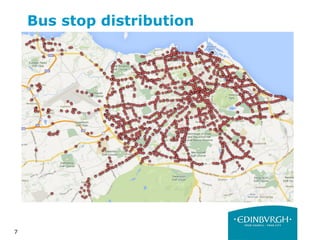
• 2300 bus stops total
• Entire Lothian Buses fleet
included
5
On-street signs
• Demand for new signs still high
• Devised scoring rationale for new sign installations
• Rollout of talking signs, 20 locations
• Limited budget available
• Maintenance costs associated with signs is high
6
Sign distribution
7
Bus stop distribution
8
Web / Mobile
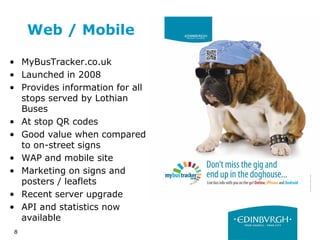
• MyBusTracker.co.uk
• Launched in 2008
• Provides information for all
stops served by Lothian
Buses
• At stop QR codes
• Good value when compared
to on-street signs
• WAP and mobile site
• Marketing on signs and
posters / leaflets
• Recent server upgrade
• API and statistics now
available
9
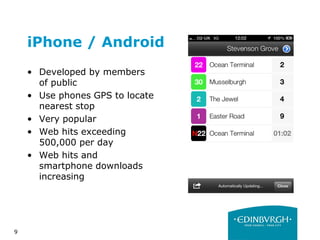
iPhone / Android
• Developed by members
of public
• Use phones GPS to locate
nearest stop
• Very popular
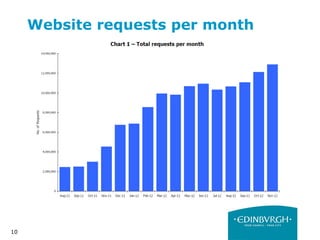
• Web hits exceeding
500,000 per day
• Web hits and
smartphone downloads
increasing
10
Website requests per month
11
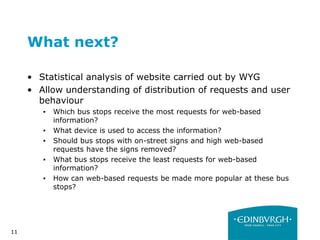
What next?
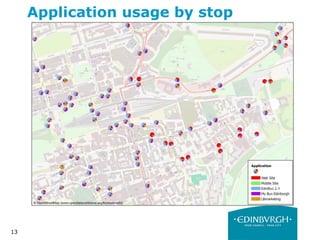
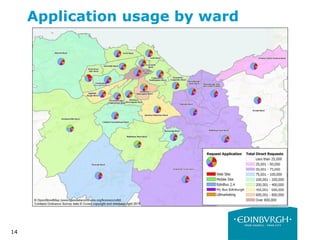
• Statistical analysis of website carried out by WYG
• Allow understanding of distribution of requests and user
behaviour
▪ Which bus stops receive the most requests for web-based
information?
▪ What device is used to access the information?
▪ Should bus stops with on-street signs and high web-based
requests have the signs removed?
▪ What bus stops receive the least requests for web-based
information?
▪ How can web-based requests be made more popular at these bus
stops?
12
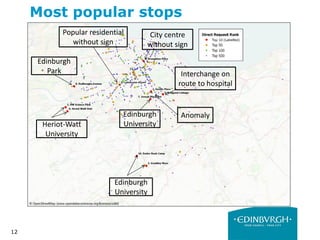
Most popular stops
Edinburgh
University
Heriot-Watt
University
Edinburgh
Park
Edinburgh
University
Interchange on
route to hospital
City centre
without sign
Popular residential
without sign
Anomaly
13
Application usage by stop
14
Application usage by ward
15
Using the information
• At stop advertising
• Approach businesses, hotels B&B’s, schools
• Identify stops that may have less need for signs and
develop a strategy for removal
• Web stats and sign scoring matrix can be used as
justification for why one particular sign is removed and
not another
16
Conclusions
• Website and smartphone use is becoming increasingly
popular – set to continue, smartphone sales outsell all
others
• On-street signs are still very popular – especially with
elderly
• Currently no political desire to reduce sign numbers
• Popular tourist destination – signs are undoubtedly
useful
• Cheaper alternatives being explored – possible web
based solution with city centre wi-fi
• Actually signs are good value for money.
17
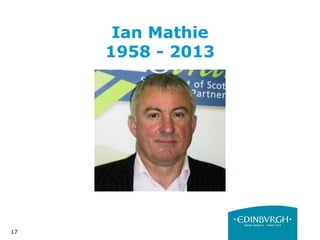
Ian Mathie
1958 - 2013
18
Thank you
Stuart Lowrie
Acting Public and Accessible Transport Manager
stuart.lowrie@edinburgh.gov.uk

RTPI 2013 Stuart Lowrie

  • 1.
    STREAM B Stuart Lowrie SeniorProfessional Officer, The City of Edinburgh Council Bustracker – www.mybustracker.co.uk: Web Based RTPI Development and User Statistics Analysis
  • 2.
    Will there everbe a case for removing on-street displays? Stuart Lowrie Acting Public Transport Manager The City of Edinburgh Council
  • 3.
    3 • Launched in2004 • Funding from Scottish Executive Public Transport Fund • Partnership between Council, Lothian Buses and Ineo • Initially 85 on-street signs located on Quality Bus Corridors • Designed for use by multiple operators • Radio based system
  • 4.
    4 On-street signs • Additionalfunding in following years • Currently around 400 signs on- street • Key stops, interchanges, supermarkets, hospitals, airport • 2300 bus stops total • Entire Lothian Buses fleet included
  • 5.
    5 On-street signs • Demandfor new signs still high • Devised scoring rationale for new sign installations • Rollout of talking signs, 20 locations • Limited budget available • Maintenance costs associated with signs is high
  • 6.
  • 7.
  • 8.
    8 Web / Mobile •MyBusTracker.co.uk • Launched in 2008 • Provides information for all stops served by Lothian Buses • At stop QR codes • Good value when compared to on-street signs • WAP and mobile site • Marketing on signs and posters / leaflets • Recent server upgrade • API and statistics now available
  • 9.
    9 iPhone / Android •Developed by members of public • Use phones GPS to locate nearest stop • Very popular • Web hits exceeding 500,000 per day • Web hits and smartphone downloads increasing
  • 10.
  • 11.
    11 What next? • Statisticalanalysis of website carried out by WYG • Allow understanding of distribution of requests and user behaviour ▪ Which bus stops receive the most requests for web-based information? ▪ What device is used to access the information? ▪ Should bus stops with on-street signs and high web-based requests have the signs removed? ▪ What bus stops receive the least requests for web-based information? ▪ How can web-based requests be made more popular at these bus stops?
  • 12.
    12 Most popular stops Edinburgh University Heriot-Watt University Edinburgh Park Edinburgh University Interchangeon route to hospital City centre without sign Popular residential without sign Anomaly
  • 13.
  • 14.
  • 15.
    15 Using the information •At stop advertising • Approach businesses, hotels B&B’s, schools • Identify stops that may have less need for signs and develop a strategy for removal • Web stats and sign scoring matrix can be used as justification for why one particular sign is removed and not another
  • 16.
    16 Conclusions • Website andsmartphone use is becoming increasingly popular – set to continue, smartphone sales outsell all others • On-street signs are still very popular – especially with elderly • Currently no political desire to reduce sign numbers • Popular tourist destination – signs are undoubtedly useful • Cheaper alternatives being explored – possible web based solution with city centre wi-fi • Actually signs are good value for money.
  • 17.
  • 18.
    18 Thank you Stuart Lowrie ActingPublic and Accessible Transport Manager stuart.lowrie@edinburgh.gov.uk