History
• The same year that Seebeck made his discovery about
thermoelectricity, Sir Humphrey Davy announced that the
resistivity of metals showed a marked temperature
dependence.
• Fifty years later, Sir William Siemens proffer the use of
platinum as the element in a resistance thermometer.
• His choice proved most propitious, as platinum is used to
this day as the primary element in all high-accuracy
resistance thermometers.
• In fact, the Platinum Resistance Temperature Detector,15
or PRTD, is used today as an interpolation standard from
the oxygen point (-182.96°C) to the antimony point
(630.74°C).
BASIC THEORY
• The electrical conductivity of a metal depends on the
movement of electrons through its crystal lattice.
• Due to thermal excitation, the electrical resistance of a
conductor varies according to its temperature and this forms
the basic principals of resistance thermometry.
• The effect is most commonly exhibited as an increase in
resistance with increasing temperature, a positive temperature
coefficient of resistance.
• When utilising this effect for temperature measurement, a
large value of temperature coefficient is a deal.
• Stability of the characteristic over the short and long term is
vital if practical use is to made of the conductor in question.
• The relationship between the temperature and the electrical
resistance is usually non-linear and described by a higher
order polynomial.
0
50
100
150
200
250
300
350
400
-300 -100 100 300 500 700 900
t, o
C
R,
Ohm
Platinum RTD
Copper RTD
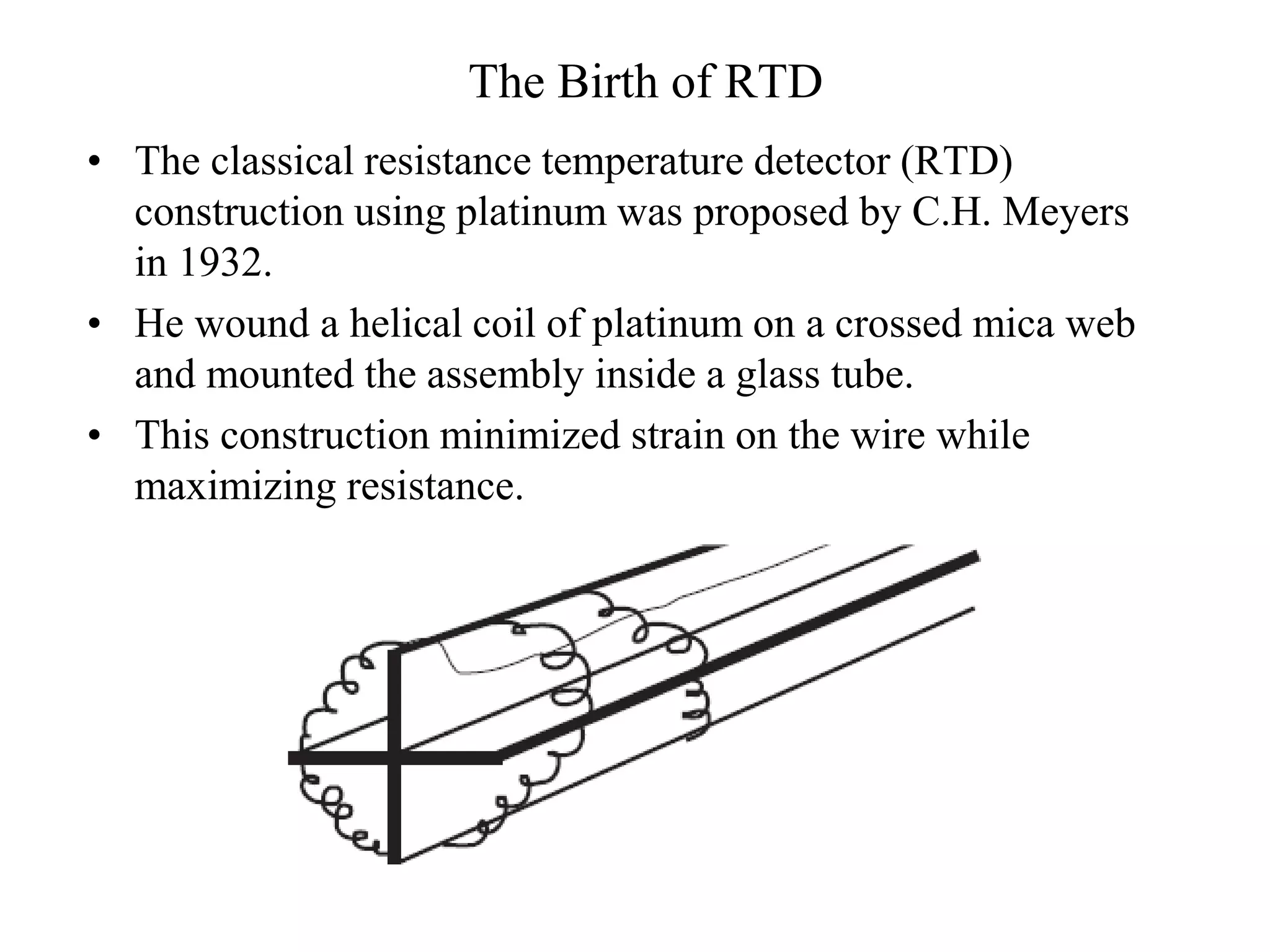
The Birth of RTD
• The classical resistance temperature detector (RTD)
construction using platinum was proposed by C.H. Meyers
in 1932.
• He wound a helical coil of platinum on a crossed mica web
and mounted the assembly inside a glass tube.
• This construction minimized strain on the wire while
maximizing resistance.
Laboratory Standard
• Meyersʼ design produced a very stable element.
• The thermal contact between the platinum and the
measured point is quite poor.
• This results in a large thermal response time.
• The fragility of the structure limits its use today
primarily to that of a laboratory standard.
• Another laboratory standard has taken the place of
Meyersʼ design.
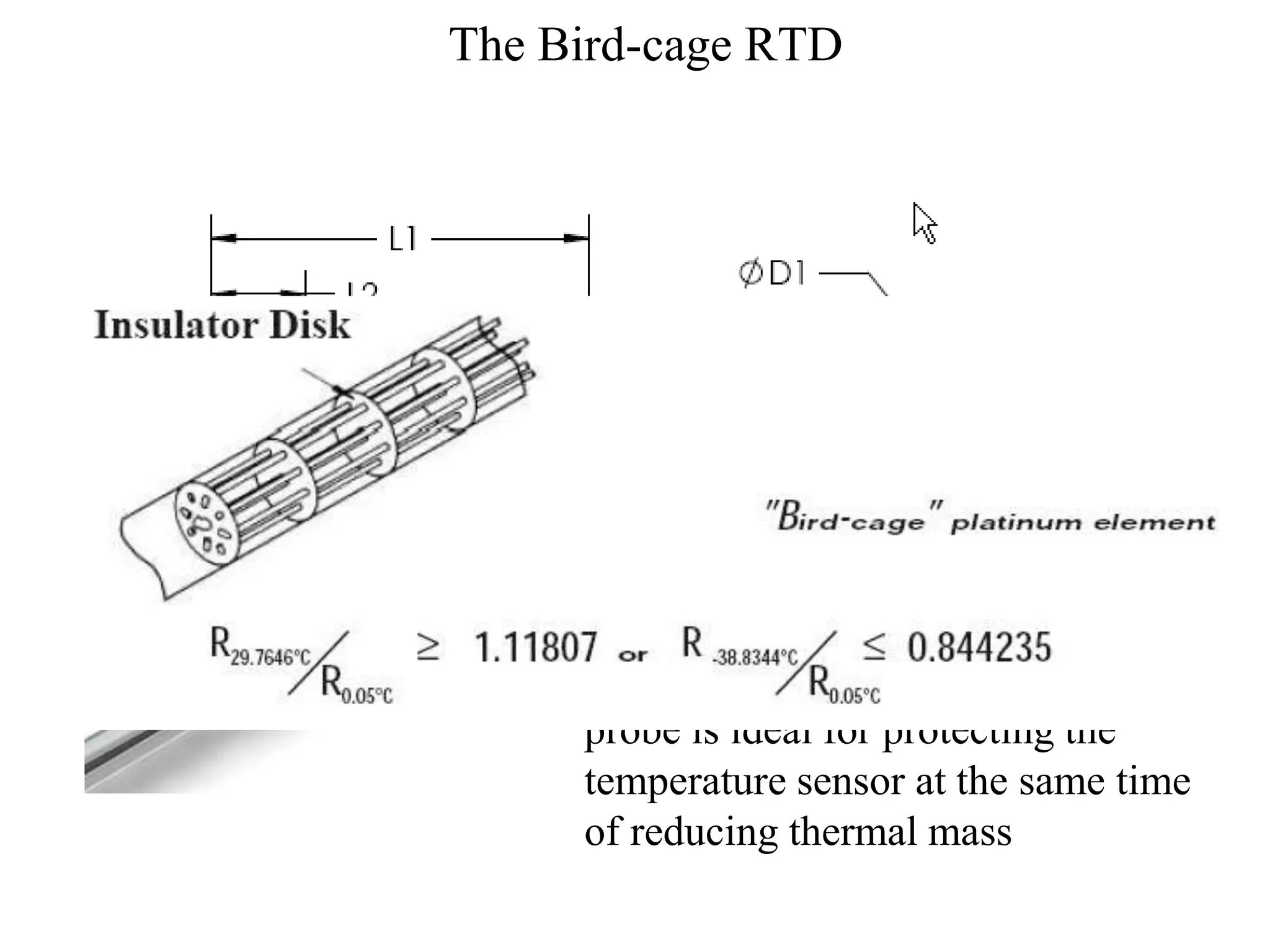
• This is the bird-cage element proposed by Evans
and Burns.
The Bird-cage RTD
Stainless Steel open ended fluid
probe is ideal for protecting the
temperature sensor at the same time
of reducing thermal mass
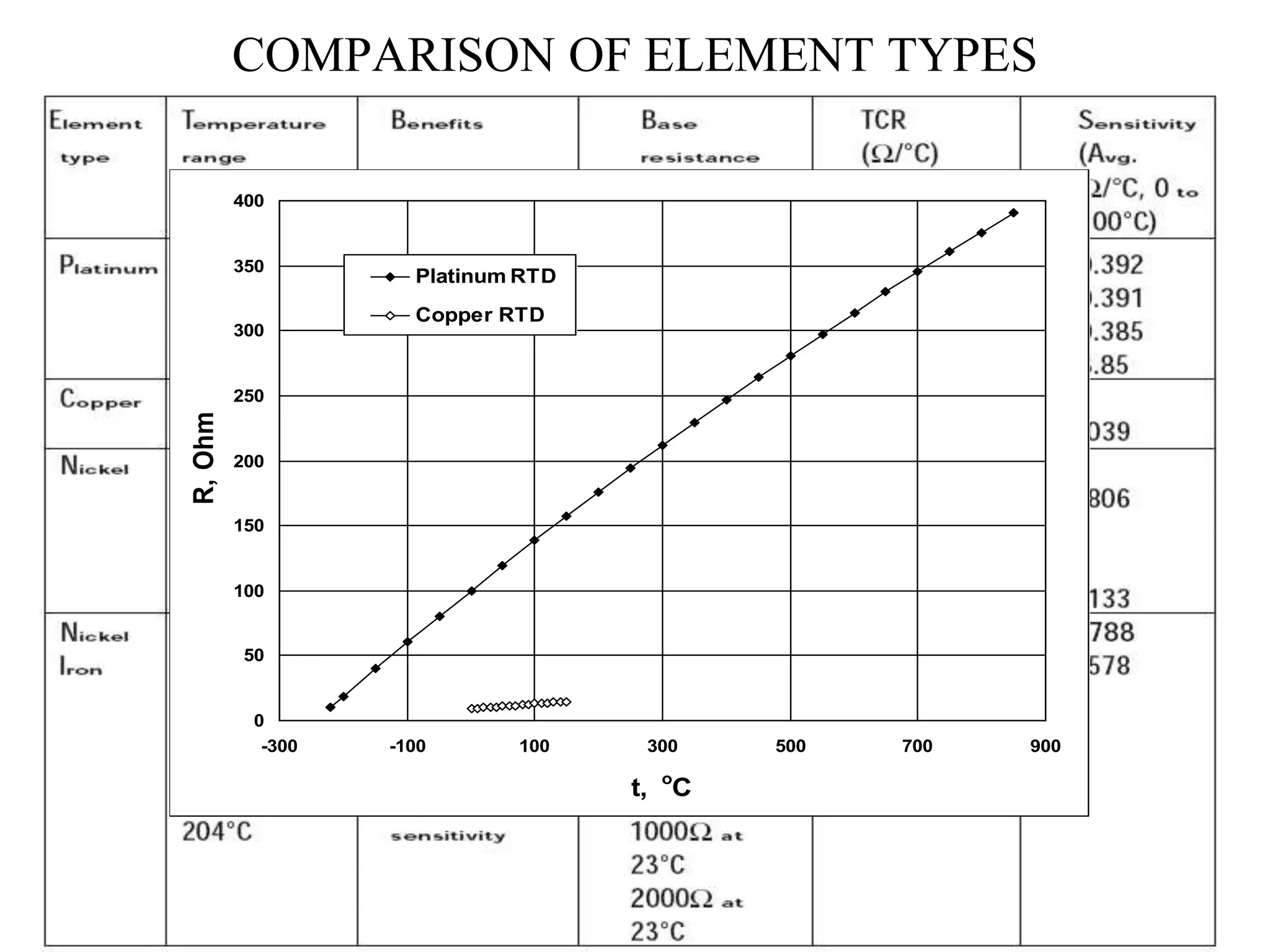
COMPARISON OF ELEMENT TYPES
0
50
100
150
200
250
300
350
400
-300 -100 100 300 500 700 900
t, o
C
R,
Ohm
Platinum RTD
Copper RTD
Platinum Sensing Resistors
• Platinum, with its wide temperature range and stability, has
become the preferred element material for resistance
thermometers.
• Platinum sensing resistors are available with alternative Ro
values, for example 10, 25 and 100 Ohms.
• A working form of resistance thermometer sensor is
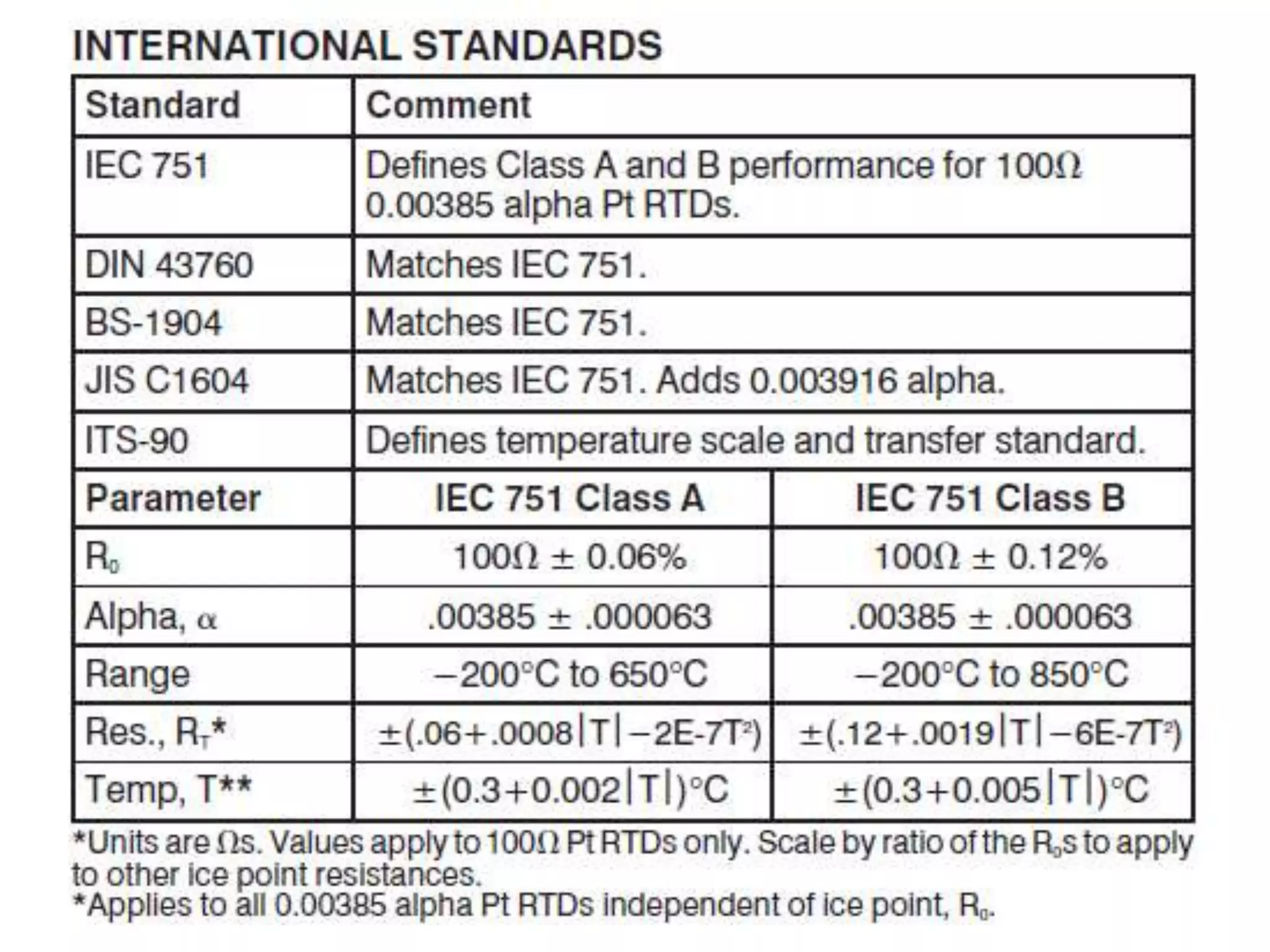
defined in IEC and DIN specifications.
• This forms the basis of most industrial and laboratory
electrical thermometers.
• The platinum sensing resistor, Pt100 to IEC 751 is
dominant in many parts of the world.
• Its advantages include chemical stability, relative ease of
manufacture, the availability of wire in a highly pure form
and excellent reproducibility of its electrical characteristic.
• The result is a truly interchangeable sensing resistor which
is widely commercially available at a reasonable cost.
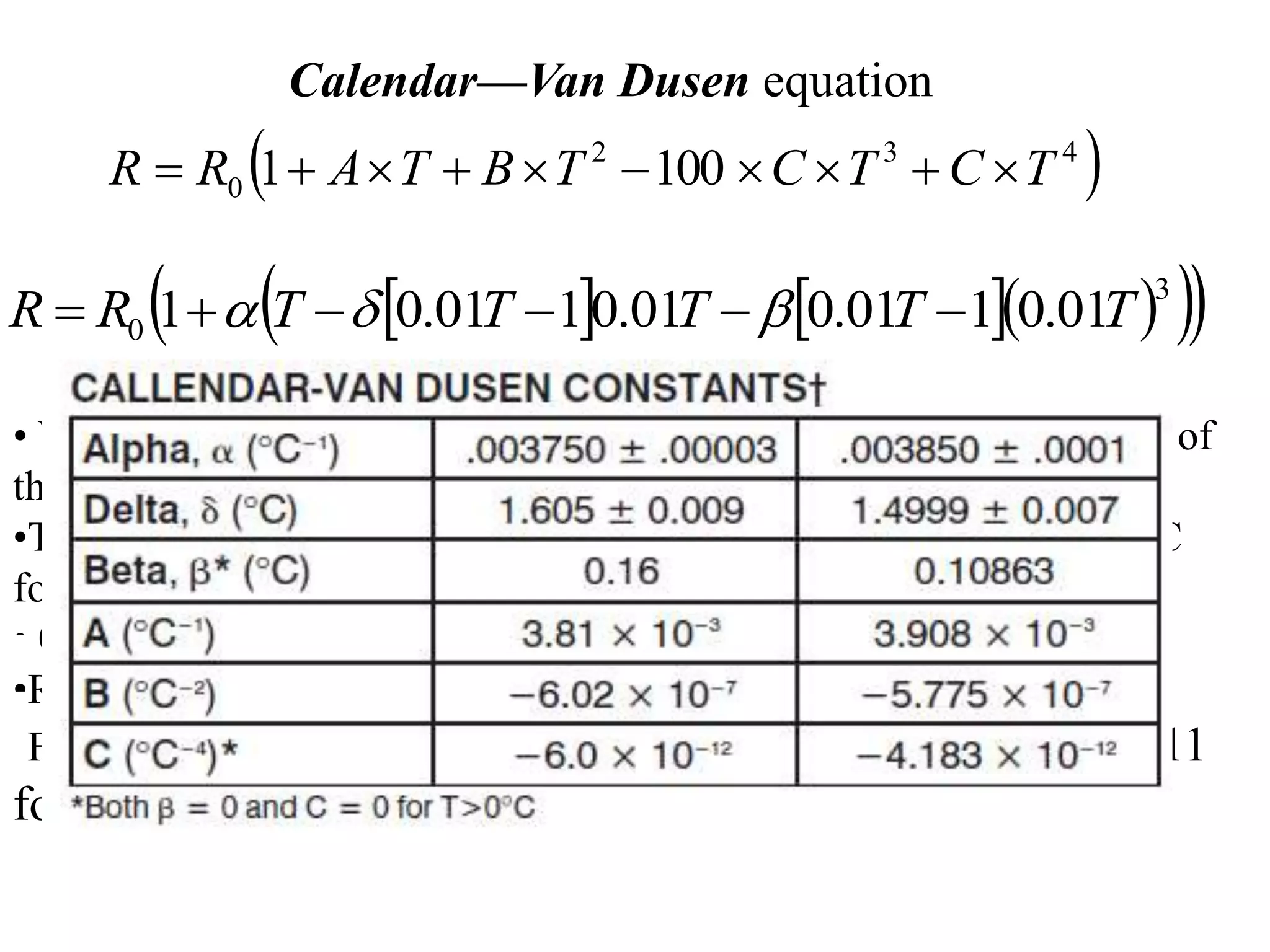
Calendar—Van Dusen equation
    
 
 
3
0 01
.
0
1
01
.
0
01
.
0
1
01
.
0
1 T
T
T
T
T
R
R 




 


• Where, , and are calibration constants, dependent on the purity of
the platinum which is country dependent.
•The dominant constant is  which has a value of either 0.003921/°C
for the so-called U.S. calibration curve, or
• 0.003851/°C for the "European" calibration curve.
•RTD sensors corresponding to either curve are available.
•For the U.S. calibration curve,   1.49,   0 for T < 0 and  = 0.11
for T>0.
 
4
3
2
0 100
1 T
C
T
C
T
B
T
A
R
R 









RTD ppt.ppt

RTD ppt.ppt

  • 1.
    History • The sameyear that Seebeck made his discovery about thermoelectricity, Sir Humphrey Davy announced that the resistivity of metals showed a marked temperature dependence. • Fifty years later, Sir William Siemens proffer the use of platinum as the element in a resistance thermometer. • His choice proved most propitious, as platinum is used to this day as the primary element in all high-accuracy resistance thermometers. • In fact, the Platinum Resistance Temperature Detector,15 or PRTD, is used today as an interpolation standard from the oxygen point (-182.96°C) to the antimony point (630.74°C).
  • 2.
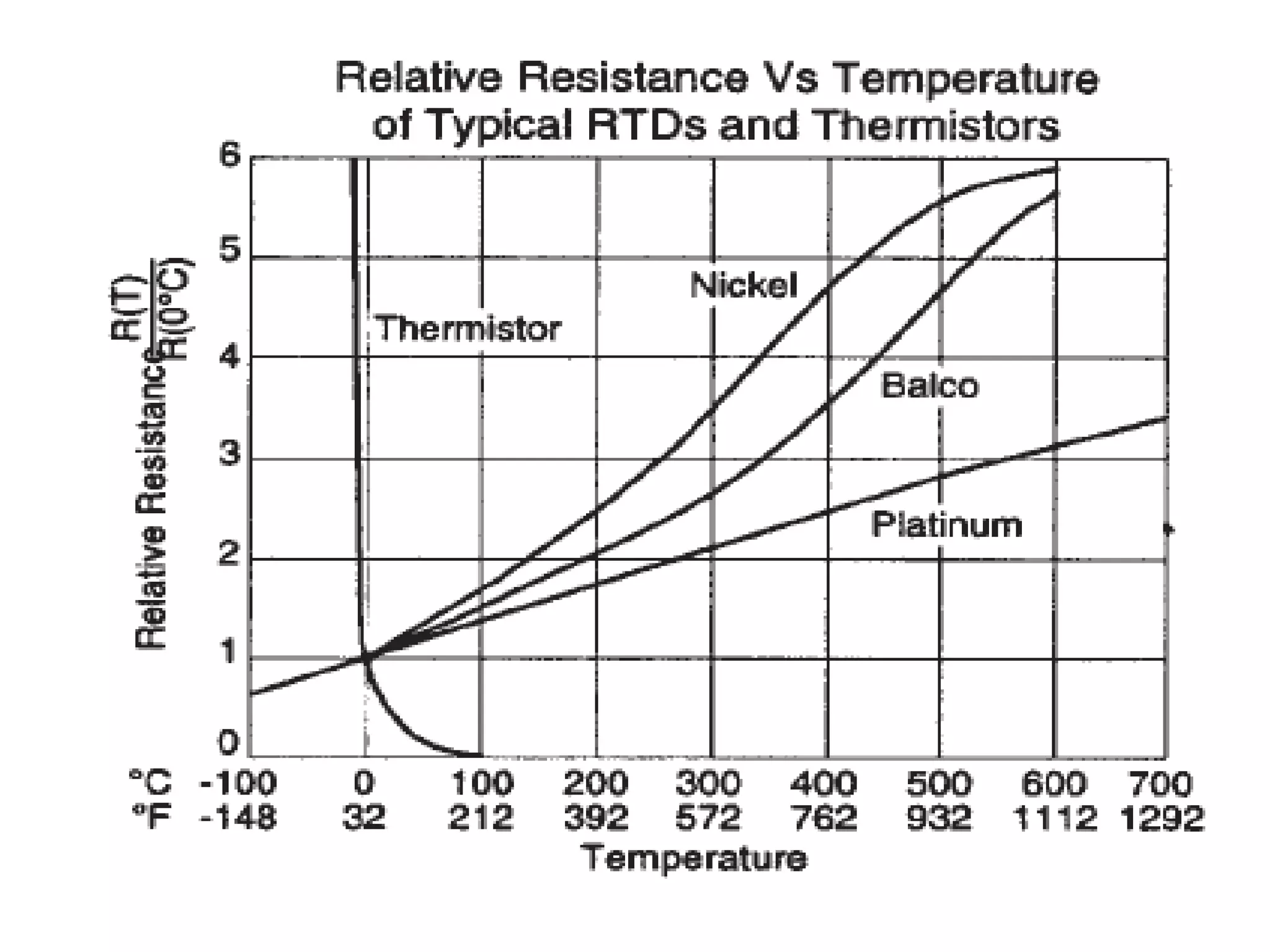
    BASIC THEORY • Theelectrical conductivity of a metal depends on the movement of electrons through its crystal lattice. • Due to thermal excitation, the electrical resistance of a conductor varies according to its temperature and this forms the basic principals of resistance thermometry. • The effect is most commonly exhibited as an increase in resistance with increasing temperature, a positive temperature coefficient of resistance. • When utilising this effect for temperature measurement, a large value of temperature coefficient is a deal. • Stability of the characteristic over the short and long term is vital if practical use is to made of the conductor in question. • The relationship between the temperature and the electrical resistance is usually non-linear and described by a higher order polynomial.
  • 3.
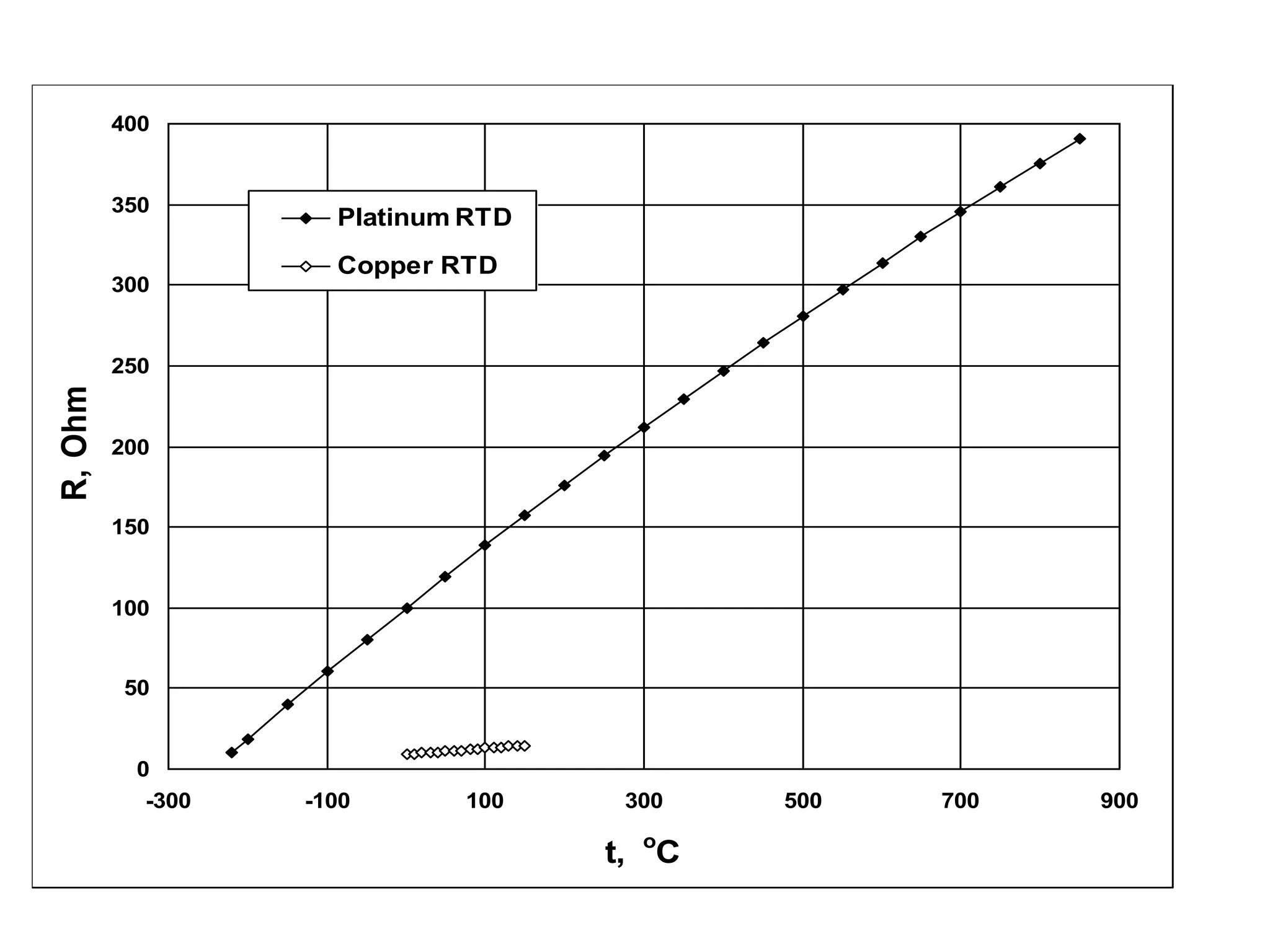
    0 50 100 150 200 250 300 350 400 -300 -100 100300 500 700 900 t, o C R, Ohm Platinum RTD Copper RTD
  • 5.
    The Birth ofRTD • The classical resistance temperature detector (RTD) construction using platinum was proposed by C.H. Meyers in 1932. • He wound a helical coil of platinum on a crossed mica web and mounted the assembly inside a glass tube. • This construction minimized strain on the wire while maximizing resistance.
  • 6.
    Laboratory Standard • Meyersʼdesign produced a very stable element. • The thermal contact between the platinum and the measured point is quite poor. • This results in a large thermal response time. • The fragility of the structure limits its use today primarily to that of a laboratory standard. • Another laboratory standard has taken the place of Meyersʼ design. • This is the bird-cage element proposed by Evans and Burns.
  • 7.
    The Bird-cage RTD StainlessSteel open ended fluid probe is ideal for protecting the temperature sensor at the same time of reducing thermal mass
  • 8.
    COMPARISON OF ELEMENTTYPES 0 50 100 150 200 250 300 350 400 -300 -100 100 300 500 700 900 t, o C R, Ohm Platinum RTD Copper RTD
  • 9.
    Platinum Sensing Resistors •Platinum, with its wide temperature range and stability, has become the preferred element material for resistance thermometers. • Platinum sensing resistors are available with alternative Ro values, for example 10, 25 and 100 Ohms. • A working form of resistance thermometer sensor is defined in IEC and DIN specifications. • This forms the basis of most industrial and laboratory electrical thermometers. • The platinum sensing resistor, Pt100 to IEC 751 is dominant in many parts of the world. • Its advantages include chemical stability, relative ease of manufacture, the availability of wire in a highly pure form and excellent reproducibility of its electrical characteristic. • The result is a truly interchangeable sensing resistor which is widely commercially available at a reasonable cost.
  • 10.
    Calendar—Van Dusen equation         3 0 01 . 0 1 01 . 0 01 . 0 1 01 . 0 1 T T T T T R R          • Where, , and are calibration constants, dependent on the purity of the platinum which is country dependent. •The dominant constant is  which has a value of either 0.003921/°C for the so-called U.S. calibration curve, or • 0.003851/°C for the "European" calibration curve. •RTD sensors corresponding to either curve are available. •For the U.S. calibration curve,   1.49,   0 for T < 0 and  = 0.11 for T>0.   4 3 2 0 100 1 T C T C T B T A R R          