EMV Survey Results:
Lack of time, deployment expertise cited
as top obstacles to EMV readiness
Europay, Mastercard and Visa (EMV), the standard credit card processing method used widely
throughout the world, has proven effective at significantly reducing face-to-face credit card fraud. In
the U.K., for example, starting with EMV’s implementation in 2004, face-to-face credit card fraud fell
70 percent over the next six years. France claims an 80 percent reduction. The U.S. is the last major
market that still uses the outdated mag stripe technology, but that’s about to change. In October of
this year, what’s known as the “liability shift” will take place, meaning liability for the cost of fraud
will fall on the entity using the lesser technology.
One would think the enormity of the potential risk of a credit card security breach would drive
businesses to adopt the chip and PIN technology before the October 1st deadline. But is this actually
the case? To get a fuller picture of how businesses are approaching the upcoming liability shift and
their knowledge of and attitudes towards the pending EMV transition, Randstad Technologies
surveyed C-level executives and IT decision makers representing a cross-section of affected industries.
This report summarizes the findings of that survey.
www.randstadtechnologies.com
Introduction
Many businesses might miss the deadline
One of the more prominent and puzzling findings of this survey is that while nearly 60 percent of the respondents indicated they were
actively preparing for the EMV technology transition, the remaining 40 percent were pretty much evenly divided between those
either not preparing or unaware if they were. With time running out to meet the deadline, firms that have not acted by now,
especially those with numerous and geographically scattered locations, have either decided the risks are worth taking, the deadline will
be extended, or they can scramble and accomplish the transition. Given that consumer transition to the new cards has been slow,
perhaps they feel no urgency to upgrade their systems.
Greatest conversion obstacles — expertise and time
The survey also found that lack of time ranked as the top obstacle to meeting the deadline (comprised 19 percent of responses),
followed by access to technology expertise (comprised 17 percent of responses). It’s not surprising that lack of time is a factor given the
challenges organizations face getting access to the expertise required to meet the deadline. Because so many firms lack the
experienced internal personnel to handle card reader deployment, they rely on outside firms for help. Given that many of these outside
firms are fully committed to fulfilling their current workloads, the availability of skilled point-of-sale professionals who know both
deployment and EMV system certification is scarce and will only become more so as the deadline nears.
www.randstadtechnologies.com
Executive Summary
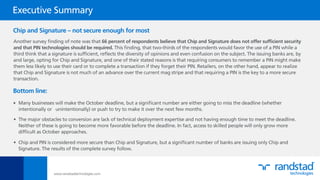
Another survey finding of note was that 66 percent of respondents believe that Chip and Signature does not offer sufficient security
and that PIN technologies should be required. This finding, that two-thirds of the respondents would favor the use of a PIN while a
third think that a signature is sufficient, reflects the diversity of opinions and even confusion on the subject. The issuing banks are, by
and large, opting for Chip and Signature, and one of their stated reasons is that requiring consumers to remember a PIN might make
them less likely to use their card or to complete a transaction if they forget their PIN. Retailers, on the other hand, appear to realize
that Chip and Signature is not much of an advance over the current mag stripe and that requiring a PIN is the key to a more secure
transaction.
www.randstadtechnologies.com
•
Executive Summary
Chip and Signature – not secure enough for most
Bottom line:
•
•
Many businesses will make the October deadline, but a significant number are either going to miss the deadline (whether
intentionally or unintentionally) or push to try to make it over the next few months.
The major obstacles to conversion are lack of technical deployment expertise and not having enough time to meet the deadline.
Neither of these is going to become more favorable before the deadline. In fact, access to skilled people will only grow more
difficult as October approaches.
Chip and PIN is considered more secure than Chip and Signature, but a significant number of banks are issuing only Chip and
Signature. The results of the complete survey follow.
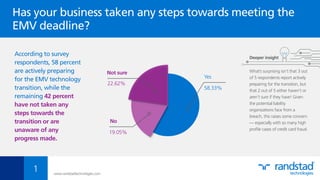
No
19.05%
Not sure
22.62%
Yes
58.33%
According to survey
respondents, 58 percent
are actively preparing
for the EMV technology
transition, while the
remaining 42 percent
have not taken any
steps towards the
transition or are
unaware of any
progress made.
What’s surprising isn’t that 3 out
of 5 respondents report actively
preparing for the transition, but
that 2 out of 5 either haven’t or
aren’t sure if they have! Given
the potential liability
organizations face from a
breach, this raises some concern
— especially with so many high
profile cases of credit card fraud.
Deeper insight
www.randstadtechnologies.com
Has your business taken any steps towards meeting the
EMV deadline?
1
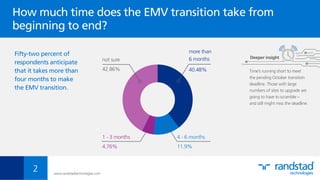
Fifty-two percent of
respondents anticipate
that it takes more than
four months to make
the EMV transition.
Time’s running short to meet
the pending October transition
deadline. Those with large
numbers of sites to upgrade are
going to have to scramble –
and still might miss the deadline.
Deeper insight
www.randstadtechnologies.com
How much time does the EMV transition take from
beginning to end?
2
more than
6 months
40.48%
4 - 6 months
11.9%
1 - 3 months
4.76%
not sure
42.86%
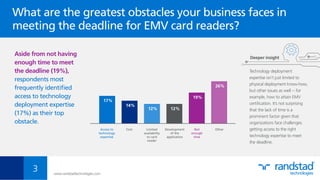
Aside from not having
enough time to meet
the deadline (19%),
respondents most
frequently identified
access to technology
deployment expertise
(17%) as their top
obstacle.
Technology deployment
expertise isn’t just limited to
physical deployment know-how,
but other issues as well -- for
example, how to attain EMV
certification. It’s not surprising
that the lack of time is a
prominent factor given that
organizations face challenges
getting access to the right
technology expertise to meet
the deadline.
Deeper insight
www.randstadtechnologies.com
What are the greatest obstacles your business faces in
meeting the deadline for EMV card readers?
3
17%
14%
12% 12%
19%
26%
Access to
technology
expertise
Cost Limited
availability
to card
reader
Development
of the
application
Not
enough
time
Other
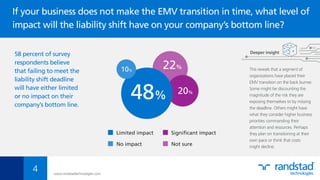
58 percent of survey
respondents believe
that failing to meet the
liability shift deadline
will have either limited
or no impact on their
company’s bottom line.
This reveals that a segment of
organizations have placed their
EMV transition on the back burner.
Some might be discounting the
magnitude of the risk they are
exposing themselves to by missing
the deadline. Others might have
what they consider higher business
priorities commanding their
attention and resources. Perhaps
they plan on transitioning at their
own pace or think that costs
might decline.
Deeper insight
www.randstadtechnologies.com
If your business does not make the EMV transition in time, what level of
impact will the liability shift have on your company’s bottom line?
4
Limited impact
No impact
Significant impact
Not sure
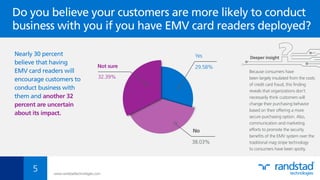
Nearly 30 percent
believe that having
EMV card readers will
encourage customers to
conduct business with
them and another 32
percent are uncertain
about its impact.
Because consumers have
been largely insulated from the costs
of credit card fraud, this finding
reveals that organizations don’t
necessarily think customers will
change their purchasing behavior
based on their offering a more
secure purchasing option. Also,
communication and marketing
efforts to promote the security
benefits of the EMV system over the
traditional mag stripe technology
to consumers have been spotty.
Deeper insight
www.randstadtechnologies.com
Do you believe your customers are more likely to conduct
business with you if you have EMV card readers deployed?
Not sure
32.39%
Yes
29.58%
No
38.03%
5
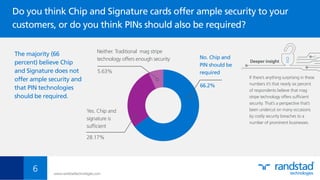
The majority (66
percent) believe Chip
and Signature does not
offer ample security and
that PIN technologies
should be required.
If there’s anything surprising in these
numbers it’s that nearly six percent
of respondents believe that mag
stripe technology offers sufficient
security. That’s a perspective that’s
been undercut on many occasions
by costly security breaches to a
number of prominent businesses.
Deeper insight
www.randstadtechnologies.com
Do you think Chip and Signature cards offer ample security to your
customers, or do you think PINs should also be required?
6
No. Chip and
PIN should be
required
66.2%
Yes. Chip and
signature is
sufficient
28.17%
Neither. Traditional mag stripe
technology offers enough security
5.63%
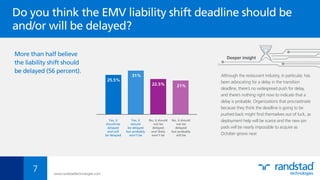
More than half believe
the liability shift should
be delayed (56 percent).
Although the restaurant industry, in particular, has
been advocating for a delay in the transition
deadline, there’s no widespread push for delay,
and there’s nothing right now to indicate that a
delay is probable. Organizations that procrastinate
because they think the deadline is going to be
pushed back might find themselves out of luck, as
deployment help will be scarce and the new pin
pads will be nearly impossible to acquire as
October grows near.
Deeper insight
www.randstadtechnologies.com
Do you think the EMV liability shift deadline should be
and/or will be delayed?
7
25.5%
31%
22.5% 21%
Yes, it
should be
delayed
and will
be delayed
Yes, it
should
be delayed
but probably
won’t be
No, it should
not be
delayed
and likely
won’t be
No, it should
not be
delayed
but probably
will be
Conclusion:
Given that the liability shift is only a few months away and it’s unlikely to be
delayed, it’s surprising that so many organizations are either waiting until
the last minute to act or are willing to incur the associated risks from
missing the deadline. For those organizations that still think they can make
the October deadline, the longer they wait, the more they are going to find
that deployment expertise and the new card readers will be in short supply.
Additionally, those willing to incur the risks should be aware that thieves
will be looking for the weakest link — and if they turn out to be that link,
the price for ignoring the deadline could be steep.
www.randstadtechnologies.com
Methodology:
Randstad Technologies surveyed 84 IT decision makers within large-scale*
national businesses to gauge their readiness for the EMV liability shift
deadline in October. Respondents included C-level and director-level staff
within top industries affected by the deadline, including retail, hospitality,
restaurants, financial services and others. The survey was conducted from
May 13, 2015 through June 19, 2015.
* according to these results “large-scale” business are those with 100 or more sites
www.randstadtechnologies.com

EMV Survey Results

  • 1.
    EMV Survey Results: Lackof time, deployment expertise cited as top obstacles to EMV readiness
  • 2.
    Europay, Mastercard andVisa (EMV), the standard credit card processing method used widely throughout the world, has proven effective at significantly reducing face-to-face credit card fraud. In the U.K., for example, starting with EMV’s implementation in 2004, face-to-face credit card fraud fell 70 percent over the next six years. France claims an 80 percent reduction. The U.S. is the last major market that still uses the outdated mag stripe technology, but that’s about to change. In October of this year, what’s known as the “liability shift” will take place, meaning liability for the cost of fraud will fall on the entity using the lesser technology. One would think the enormity of the potential risk of a credit card security breach would drive businesses to adopt the chip and PIN technology before the October 1st deadline. But is this actually the case? To get a fuller picture of how businesses are approaching the upcoming liability shift and their knowledge of and attitudes towards the pending EMV transition, Randstad Technologies surveyed C-level executives and IT decision makers representing a cross-section of affected industries. This report summarizes the findings of that survey. www.randstadtechnologies.com Introduction
  • 3.
    Many businesses mightmiss the deadline One of the more prominent and puzzling findings of this survey is that while nearly 60 percent of the respondents indicated they were actively preparing for the EMV technology transition, the remaining 40 percent were pretty much evenly divided between those either not preparing or unaware if they were. With time running out to meet the deadline, firms that have not acted by now, especially those with numerous and geographically scattered locations, have either decided the risks are worth taking, the deadline will be extended, or they can scramble and accomplish the transition. Given that consumer transition to the new cards has been slow, perhaps they feel no urgency to upgrade their systems. Greatest conversion obstacles — expertise and time The survey also found that lack of time ranked as the top obstacle to meeting the deadline (comprised 19 percent of responses), followed by access to technology expertise (comprised 17 percent of responses). It’s not surprising that lack of time is a factor given the challenges organizations face getting access to the expertise required to meet the deadline. Because so many firms lack the experienced internal personnel to handle card reader deployment, they rely on outside firms for help. Given that many of these outside firms are fully committed to fulfilling their current workloads, the availability of skilled point-of-sale professionals who know both deployment and EMV system certification is scarce and will only become more so as the deadline nears. www.randstadtechnologies.com Executive Summary
  • 4.
    Another survey findingof note was that 66 percent of respondents believe that Chip and Signature does not offer sufficient security and that PIN technologies should be required. This finding, that two-thirds of the respondents would favor the use of a PIN while a third think that a signature is sufficient, reflects the diversity of opinions and even confusion on the subject. The issuing banks are, by and large, opting for Chip and Signature, and one of their stated reasons is that requiring consumers to remember a PIN might make them less likely to use their card or to complete a transaction if they forget their PIN. Retailers, on the other hand, appear to realize that Chip and Signature is not much of an advance over the current mag stripe and that requiring a PIN is the key to a more secure transaction. www.randstadtechnologies.com • Executive Summary Chip and Signature – not secure enough for most Bottom line: • • Many businesses will make the October deadline, but a significant number are either going to miss the deadline (whether intentionally or unintentionally) or push to try to make it over the next few months. The major obstacles to conversion are lack of technical deployment expertise and not having enough time to meet the deadline. Neither of these is going to become more favorable before the deadline. In fact, access to skilled people will only grow more difficult as October approaches. Chip and PIN is considered more secure than Chip and Signature, but a significant number of banks are issuing only Chip and Signature. The results of the complete survey follow.
  • 5.
    No 19.05% Not sure 22.62% Yes 58.33% According tosurvey respondents, 58 percent are actively preparing for the EMV technology transition, while the remaining 42 percent have not taken any steps towards the transition or are unaware of any progress made. What’s surprising isn’t that 3 out of 5 respondents report actively preparing for the transition, but that 2 out of 5 either haven’t or aren’t sure if they have! Given the potential liability organizations face from a breach, this raises some concern — especially with so many high profile cases of credit card fraud. Deeper insight www.randstadtechnologies.com Has your business taken any steps towards meeting the EMV deadline? 1
  • 6.
    Fifty-two percent of respondentsanticipate that it takes more than four months to make the EMV transition. Time’s running short to meet the pending October transition deadline. Those with large numbers of sites to upgrade are going to have to scramble – and still might miss the deadline. Deeper insight www.randstadtechnologies.com How much time does the EMV transition take from beginning to end? 2 more than 6 months 40.48% 4 - 6 months 11.9% 1 - 3 months 4.76% not sure 42.86%
  • 7.
    Aside from nothaving enough time to meet the deadline (19%), respondents most frequently identified access to technology deployment expertise (17%) as their top obstacle. Technology deployment expertise isn’t just limited to physical deployment know-how, but other issues as well -- for example, how to attain EMV certification. It’s not surprising that the lack of time is a prominent factor given that organizations face challenges getting access to the right technology expertise to meet the deadline. Deeper insight www.randstadtechnologies.com What are the greatest obstacles your business faces in meeting the deadline for EMV card readers? 3 17% 14% 12% 12% 19% 26% Access to technology expertise Cost Limited availability to card reader Development of the application Not enough time Other
  • 8.
    58 percent ofsurvey respondents believe that failing to meet the liability shift deadline will have either limited or no impact on their company’s bottom line. This reveals that a segment of organizations have placed their EMV transition on the back burner. Some might be discounting the magnitude of the risk they are exposing themselves to by missing the deadline. Others might have what they consider higher business priorities commanding their attention and resources. Perhaps they plan on transitioning at their own pace or think that costs might decline. Deeper insight www.randstadtechnologies.com If your business does not make the EMV transition in time, what level of impact will the liability shift have on your company’s bottom line? 4 Limited impact No impact Significant impact Not sure
  • 9.
    Nearly 30 percent believethat having EMV card readers will encourage customers to conduct business with them and another 32 percent are uncertain about its impact. Because consumers have been largely insulated from the costs of credit card fraud, this finding reveals that organizations don’t necessarily think customers will change their purchasing behavior based on their offering a more secure purchasing option. Also, communication and marketing efforts to promote the security benefits of the EMV system over the traditional mag stripe technology to consumers have been spotty. Deeper insight www.randstadtechnologies.com Do you believe your customers are more likely to conduct business with you if you have EMV card readers deployed? Not sure 32.39% Yes 29.58% No 38.03% 5
  • 10.
    The majority (66 percent)believe Chip and Signature does not offer ample security and that PIN technologies should be required. If there’s anything surprising in these numbers it’s that nearly six percent of respondents believe that mag stripe technology offers sufficient security. That’s a perspective that’s been undercut on many occasions by costly security breaches to a number of prominent businesses. Deeper insight www.randstadtechnologies.com Do you think Chip and Signature cards offer ample security to your customers, or do you think PINs should also be required? 6 No. Chip and PIN should be required 66.2% Yes. Chip and signature is sufficient 28.17% Neither. Traditional mag stripe technology offers enough security 5.63%
  • 11.
    More than halfbelieve the liability shift should be delayed (56 percent). Although the restaurant industry, in particular, has been advocating for a delay in the transition deadline, there’s no widespread push for delay, and there’s nothing right now to indicate that a delay is probable. Organizations that procrastinate because they think the deadline is going to be pushed back might find themselves out of luck, as deployment help will be scarce and the new pin pads will be nearly impossible to acquire as October grows near. Deeper insight www.randstadtechnologies.com Do you think the EMV liability shift deadline should be and/or will be delayed? 7 25.5% 31% 22.5% 21% Yes, it should be delayed and will be delayed Yes, it should be delayed but probably won’t be No, it should not be delayed and likely won’t be No, it should not be delayed but probably will be
  • 12.
    Conclusion: Given that theliability shift is only a few months away and it’s unlikely to be delayed, it’s surprising that so many organizations are either waiting until the last minute to act or are willing to incur the associated risks from missing the deadline. For those organizations that still think they can make the October deadline, the longer they wait, the more they are going to find that deployment expertise and the new card readers will be in short supply. Additionally, those willing to incur the risks should be aware that thieves will be looking for the weakest link — and if they turn out to be that link, the price for ignoring the deadline could be steep. www.randstadtechnologies.com
  • 13.
    Methodology: Randstad Technologies surveyed84 IT decision makers within large-scale* national businesses to gauge their readiness for the EMV liability shift deadline in October. Respondents included C-level and director-level staff within top industries affected by the deadline, including retail, hospitality, restaurants, financial services and others. The survey was conducted from May 13, 2015 through June 19, 2015. * according to these results “large-scale” business are those with 100 or more sites www.randstadtechnologies.com