2020 predictions.
four workforce trends to watch for in
the year ahead
© Randstad North America, Inc. 2019 | 2
diversity and
inclusion.
social impact drives business
outcomes — if companies
make it a priority
trend 1
© Randstad North America, Inc. 2019 | 3
D&I delivers business impact.
America's demographic makeup continues to shift,
and in order to stay successful, businesses will need
to shift with it. Some, like Randstad, Johnson &
Johnson and AT&T, got ahead of this curve by
making diversity and inclusion (D&I) a core tenet of
their business models years ago.
This increased focus on D&I isn't just a feel-good
move — it's a strategic business decision designed to
increase innovation, improve messaging, enable
better hiring and retention and foster connections
with consumers.
© Randstad North America, Inc. 2019 | 4
the business case for D&I is clear.
A McKinsey study found that today's
most diverse organizations are "35
percent more likely to have financial
returns above their respective national
industry medians."
A Deloitte study, meanwhile, found that
companies with inclusive cultures are:
more likely to meet or exceed
financial targets2x
more likely to be high-performing3x
more likely to be agile and innovative6x
more likely to achieve better
business outcomes8x
© Randstad North America, Inc. 2019 | 5
"Figures like these are why leading companies today are investing in roles
dedicated to improving D&I. They're realizing that it's not just a part of one
person's job — it's a full-time job for an entire team. Most major companies
today recognize that they need to be inclusive in order to innovate and succeed,
and they're investing in talent who can help do that."
— Audra Jenkins, chief diversity and inclusion officer, Randstad North America
it takes a village to achieve
real D&I outcomes.
© Randstad North America, Inc. 2019 | 6
"Diversity used to be seen as critical for B2C companies, but
less so for those in the B2B sector. Today, however, there's
a diversity imperative for both types of companies, and that's
something that's changed recently — and rapidly. [B2B
customers] are not just looking to improve D&I internally.
They're also looking for improvements from their suppliers."
— Jim Link, chief human resources officer, Randstad
D&I will affect the B2B
sector — finally.
© Randstad North America, Inc. 2019 | 7
"Companies with healthy D&I cultures better represent their buyers, and they're
better able to serve all customers because they understand the wants and needs
of the very diverse buying public. Smart companies know this, and the gulf
between those organizations and the ones that still don't 'get it' is only going to
get wider. Sooner rather than later, that gulf will become too wide to cross."
— Jim Link, chief human resources officer, Randstad
inclusion enables customer engagement.
© Randstad North America, Inc. 2019 | 8
D&I will emerge as a key differentiator in
2020.
As demographics change — and as candidate
expectations change with them — prepare to see
significant investment in D&I in 2020.
Leading companies will continue to pull ahead of
the competition, while those that haven't
prioritized D&I will fall further behind. Those that
make D&I a core component of their cultures will
win the day in 2020 and beyond.
© Randstad North America, Inc. 2019 | 9
AI.
the artificial intelligence
revolution finally bears fruit
trend 2
© Randstad North America, Inc. 2019 | 10
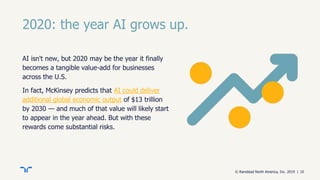
2020: the year AI grows up.
AI isn't new, but 2020 may be the year it finally
becomes a tangible value-add for businesses
across the U.S.
In fact, McKinsey predicts that AI could deliver
additional global economic output of $13 trillion
by 2030 — and much of that value will likely start
to appear in the year ahead. But with these
rewards come substantial risks.
© Randstad North America, Inc. 2019 | 11
"AI is becoming more and more normal and less frightening to
the overall workforce, especially as the workforce becomes
dominated by millennials and Gen Z."
— Jim Link, chief human resources officer, Randstad
millennials and gen z also drive
AI adoption.
© Randstad North America, Inc. 2019 | 12
smart adopters of AI will pull ahead in 2020.
Adoption is only the first step in the AI journey. An
organization's ability to leverage AI to its fullest will
differentiate them from the rest in 2020. This means
having:
• a clear strategic vision
• an actionable plan for implementation
• the right people with the right skills
• the ability to maintain and analyze output
© Randstad North America, Inc. 2019 | 13
"There's no doubt we'll see more adoption of chatbots and AI, but the next
hurdle is synthesizing the insights they can provide. That's where businesses
will derive real value from AI and similar technologies in 2020."
— Jim Link, chief human resources officer, Randstad
insight will be the leading driver of ROI.
© Randstad North America, Inc. 2019 | 14
AI makes HR human again
— but it's not perfect.
Adopting AI should free up overworked HR
teams to do more "human" work, like building
relationships within an AI-built talent pipeline
and developing stronger internal partnerships
with other business units.
But there's also risk involved, which could make
increasingly automated HR functions unreliable,
robotic or just plain dysfunctional.
© Randstad North America, Inc. 2019 | 15
2020 will be a make-or-break year for AI users.
We've spent nearly a decade talking about AI,
but 2020 will be the year most companies
finally find ways to derive meaningful value
from it. While many will implement it to
automate manual, repetitive processes,
companies that use its capabilities to drive
smarter decision-making will be the biggest
winners.
© Randstad North America, Inc. 2019 | 16
upskilling.
the deadlock around upskilling
and meaningful work continues
trend 3
© Randstad North America, Inc. 2019 | 17
who's responsible for upskilling?
A Pew study — as well as Randstad's own
research — revealed that the vast majority of
U.S. workers believe it's imperative to train and
develop new skills in order to keep up with
changes in the workplace.
However, the majority of workers also say that
neither government nor employers bear primary
responsibility for providing them with those skills.
© Randstad North America, Inc. 2019 | 18
"According to Pew's recent survey, over the next 30 years, Americans will look to
the education system (39%) and to individuals themselves (39%) to bear the
responsibility of having the right skills and training to get a good job."
— Scott Gutz, CEO, Monster.com
some say the education system and DIY ...
© Randstad North America, Inc. 2019 | 19
... but millennials are looking to employers.
The younger segment of the workforce,
however, sees things differently.
Monster's 2019 State of the Candidate
report found that millennials believe
businesses (30%) have the greatest
responsibility for preparing workers,
followed by educational institutions
(24%).
© Randstad North America, Inc. 2019 | 20
savvy employers will capitalize on this in 2020.
In 2020, millennials and Gen Z will continue to
self-educate about work-related topics and skills.
If companies can meet them halfway and offer
upskilling opportunities in-house, they'll seize a
major opportunity to improve hiring — and
retention.
© Randstad North America, Inc. 2019 | 21
"Newer generations work in a different way, and they're
constantly adapting to new tools and platforms — far more
quickly than more experienced workers. It's almost second
nature."
— Jodi Chavez, group president, Randstad Professional Staffing Group
young professionals learn
and adapt by nature ...
© Randstad North America, Inc. 2019 | 22
... but management is missing the boat.
These "more experienced workers" are often in
leadership roles, and by not understanding or
addressing the upskilling imperative, they're not
only depriving their younger hires of much-needed
training, they're also causing a turnover problem
— whether they realize it or not.
© Randstad North America, Inc. 2019 | 23
"We know the number-one reason people quit is the inability to learn and grow
at their current organization."
— Scott Gutz, CEO, Monster.com
this lack of upskilling opportunities
drives turnover.
© Randstad North America, Inc. 2019 | 24
expect a sea change in upskilling in 2020.
To get the most out of your staff —
and to keep them on staff —
companies will have to make training,
learning and providing challenging,
meaningful work a priority in 2020.
They'll also have to think beyond the
day to day and anticipate skills that
will be needed in the future.
© Randstad North America, Inc. 2019 | 25
employer
branding.
tech opens new channels
and transforms messaging
trend 4
© Randstad North America, Inc. 2019 | 26
in today's talent market, every channel matters.
The latest tech is creating new ways
for companies to tell compelling stories
about their employer brands. In 2020,
companies will increasingly leverage
these new channels — alongside
traditional ones like compensation and
benefits — to land skilled workers in a
tight talent market.
© Randstad North America, Inc. 2019 | 27
employer branding finally matures.
2020 will be the year employer branding
finally grows up and takes its (rightful)
place in smart companies' marketing mix.
In fact, most large companies today have
already begun producing engaging videos
that spotlight current employees as a core
part of their employer branding strategies.
© Randstad North America, Inc. 2019 | 28
new tech and sophisticated strategies
to watch for.
Look for this trend to become even more
prevalent in 2020 — and as it does, the
importance of primarily visual
communication channels like Instagram in
companies' recruitment efforts will likely
increase as well.
Meanwhile, organizations across the board
(including the U.S. Navy, General Mills and
Jaguar) are developing VR experiences to
help drive recruiting efforts.
© Randstad North America, Inc. 2019 | 29
"Employer branding has become so digitally focused, if you're not out there in
every digital channel, you're going to be left behind — if you haven't already
been."
— Jim Link, chief human resources officer, Randstad
the make-or-break year for
employer branding.
© Randstad North America, Inc. 2019 | 30
"Employees have evolved from being enamored with bean bags and free
snacks at work. They've shifted to a place of personal and professional
fulfillment. Health and wellness, mental health support, development
opportunities, tuition reimbursement and the like are what matter to
today's employees. A fun work environment is still appealing, but it's no
longer superseding those tangible benefits."
— Traci Fiatte, CEO, professional and global staffing,
Randstad US
tangible benefits resonate above all.
© Randstad North America, Inc. 2019 | 31
real-world employees have real-world impact.
The smartest companies are going beyond the
methods traditionally used to showcase
employer brands. Instead of posting only about
mission statements, company culture or office
amenities, companies like Johnson & Johnson
are showcasing actual employees making real-
world impact — and talking about what it's like
to work there.
© Randstad North America, Inc. 2019 | 32
"The overall population is shifting, and if you don't understand their wants and
needs by having those perspectives internally, you can't sell to them or engage with
them. Successful employer brands will be the ones that truly represent the U.S.
population."
— Jodi Chavez, group president, Randstad Professional Staffing Group
can companies adapt to a
changing workforce?
© Randstad North America, Inc. 2019 | 33
pull ahead — or play catch-up.
Expect to see the most sophisticated employer
brands explore new channels and leverage
employee ambassadors in new ways in the year
ahead. Also, expect to see companies that are
behind the curve struggle to catch up. In both
cases, significant resources will be allocated to
employer branding efforts in 2020.
The only question is how much ROI those
dollars will deliver.
© Randstad North America, Inc. 2019 |
randstad
human forward.

2020 predictions slideshare

  • 1.
    2020 predictions. four workforcetrends to watch for in the year ahead
  • 2.
    © Randstad NorthAmerica, Inc. 2019 | 2 diversity and inclusion. social impact drives business outcomes — if companies make it a priority trend 1
  • 3.
    © Randstad NorthAmerica, Inc. 2019 | 3 D&I delivers business impact. America's demographic makeup continues to shift, and in order to stay successful, businesses will need to shift with it. Some, like Randstad, Johnson & Johnson and AT&T, got ahead of this curve by making diversity and inclusion (D&I) a core tenet of their business models years ago. This increased focus on D&I isn't just a feel-good move — it's a strategic business decision designed to increase innovation, improve messaging, enable better hiring and retention and foster connections with consumers.
  • 4.
    © Randstad NorthAmerica, Inc. 2019 | 4 the business case for D&I is clear. A McKinsey study found that today's most diverse organizations are "35 percent more likely to have financial returns above their respective national industry medians." A Deloitte study, meanwhile, found that companies with inclusive cultures are: more likely to meet or exceed financial targets2x more likely to be high-performing3x more likely to be agile and innovative6x more likely to achieve better business outcomes8x
  • 5.
    © Randstad NorthAmerica, Inc. 2019 | 5 "Figures like these are why leading companies today are investing in roles dedicated to improving D&I. They're realizing that it's not just a part of one person's job — it's a full-time job for an entire team. Most major companies today recognize that they need to be inclusive in order to innovate and succeed, and they're investing in talent who can help do that." — Audra Jenkins, chief diversity and inclusion officer, Randstad North America it takes a village to achieve real D&I outcomes.
  • 6.
    © Randstad NorthAmerica, Inc. 2019 | 6 "Diversity used to be seen as critical for B2C companies, but less so for those in the B2B sector. Today, however, there's a diversity imperative for both types of companies, and that's something that's changed recently — and rapidly. [B2B customers] are not just looking to improve D&I internally. They're also looking for improvements from their suppliers." — Jim Link, chief human resources officer, Randstad D&I will affect the B2B sector — finally.
  • 7.
    © Randstad NorthAmerica, Inc. 2019 | 7 "Companies with healthy D&I cultures better represent their buyers, and they're better able to serve all customers because they understand the wants and needs of the very diverse buying public. Smart companies know this, and the gulf between those organizations and the ones that still don't 'get it' is only going to get wider. Sooner rather than later, that gulf will become too wide to cross." — Jim Link, chief human resources officer, Randstad inclusion enables customer engagement.
  • 8.
    © Randstad NorthAmerica, Inc. 2019 | 8 D&I will emerge as a key differentiator in 2020. As demographics change — and as candidate expectations change with them — prepare to see significant investment in D&I in 2020. Leading companies will continue to pull ahead of the competition, while those that haven't prioritized D&I will fall further behind. Those that make D&I a core component of their cultures will win the day in 2020 and beyond.
  • 9.
    © Randstad NorthAmerica, Inc. 2019 | 9 AI. the artificial intelligence revolution finally bears fruit trend 2
  • 10.
    © Randstad NorthAmerica, Inc. 2019 | 10 2020: the year AI grows up. AI isn't new, but 2020 may be the year it finally becomes a tangible value-add for businesses across the U.S. In fact, McKinsey predicts that AI could deliver additional global economic output of $13 trillion by 2030 — and much of that value will likely start to appear in the year ahead. But with these rewards come substantial risks.
  • 11.
    © Randstad NorthAmerica, Inc. 2019 | 11 "AI is becoming more and more normal and less frightening to the overall workforce, especially as the workforce becomes dominated by millennials and Gen Z." — Jim Link, chief human resources officer, Randstad millennials and gen z also drive AI adoption.
  • 12.
    © Randstad NorthAmerica, Inc. 2019 | 12 smart adopters of AI will pull ahead in 2020. Adoption is only the first step in the AI journey. An organization's ability to leverage AI to its fullest will differentiate them from the rest in 2020. This means having: • a clear strategic vision • an actionable plan for implementation • the right people with the right skills • the ability to maintain and analyze output
  • 13.
    © Randstad NorthAmerica, Inc. 2019 | 13 "There's no doubt we'll see more adoption of chatbots and AI, but the next hurdle is synthesizing the insights they can provide. That's where businesses will derive real value from AI and similar technologies in 2020." — Jim Link, chief human resources officer, Randstad insight will be the leading driver of ROI.
  • 14.
    © Randstad NorthAmerica, Inc. 2019 | 14 AI makes HR human again — but it's not perfect. Adopting AI should free up overworked HR teams to do more "human" work, like building relationships within an AI-built talent pipeline and developing stronger internal partnerships with other business units. But there's also risk involved, which could make increasingly automated HR functions unreliable, robotic or just plain dysfunctional.
  • 15.
    © Randstad NorthAmerica, Inc. 2019 | 15 2020 will be a make-or-break year for AI users. We've spent nearly a decade talking about AI, but 2020 will be the year most companies finally find ways to derive meaningful value from it. While many will implement it to automate manual, repetitive processes, companies that use its capabilities to drive smarter decision-making will be the biggest winners.
  • 16.
    © Randstad NorthAmerica, Inc. 2019 | 16 upskilling. the deadlock around upskilling and meaningful work continues trend 3
  • 17.
    © Randstad NorthAmerica, Inc. 2019 | 17 who's responsible for upskilling? A Pew study — as well as Randstad's own research — revealed that the vast majority of U.S. workers believe it's imperative to train and develop new skills in order to keep up with changes in the workplace. However, the majority of workers also say that neither government nor employers bear primary responsibility for providing them with those skills.
  • 18.
    © Randstad NorthAmerica, Inc. 2019 | 18 "According to Pew's recent survey, over the next 30 years, Americans will look to the education system (39%) and to individuals themselves (39%) to bear the responsibility of having the right skills and training to get a good job." — Scott Gutz, CEO, Monster.com some say the education system and DIY ...
  • 19.
    © Randstad NorthAmerica, Inc. 2019 | 19 ... but millennials are looking to employers. The younger segment of the workforce, however, sees things differently. Monster's 2019 State of the Candidate report found that millennials believe businesses (30%) have the greatest responsibility for preparing workers, followed by educational institutions (24%).
  • 20.
    © Randstad NorthAmerica, Inc. 2019 | 20 savvy employers will capitalize on this in 2020. In 2020, millennials and Gen Z will continue to self-educate about work-related topics and skills. If companies can meet them halfway and offer upskilling opportunities in-house, they'll seize a major opportunity to improve hiring — and retention.
  • 21.
    © Randstad NorthAmerica, Inc. 2019 | 21 "Newer generations work in a different way, and they're constantly adapting to new tools and platforms — far more quickly than more experienced workers. It's almost second nature." — Jodi Chavez, group president, Randstad Professional Staffing Group young professionals learn and adapt by nature ...
  • 22.
    © Randstad NorthAmerica, Inc. 2019 | 22 ... but management is missing the boat. These "more experienced workers" are often in leadership roles, and by not understanding or addressing the upskilling imperative, they're not only depriving their younger hires of much-needed training, they're also causing a turnover problem — whether they realize it or not.
  • 23.
    © Randstad NorthAmerica, Inc. 2019 | 23 "We know the number-one reason people quit is the inability to learn and grow at their current organization." — Scott Gutz, CEO, Monster.com this lack of upskilling opportunities drives turnover.
  • 24.
    © Randstad NorthAmerica, Inc. 2019 | 24 expect a sea change in upskilling in 2020. To get the most out of your staff — and to keep them on staff — companies will have to make training, learning and providing challenging, meaningful work a priority in 2020. They'll also have to think beyond the day to day and anticipate skills that will be needed in the future.
  • 25.
    © Randstad NorthAmerica, Inc. 2019 | 25 employer branding. tech opens new channels and transforms messaging trend 4
  • 26.
    © Randstad NorthAmerica, Inc. 2019 | 26 in today's talent market, every channel matters. The latest tech is creating new ways for companies to tell compelling stories about their employer brands. In 2020, companies will increasingly leverage these new channels — alongside traditional ones like compensation and benefits — to land skilled workers in a tight talent market.
  • 27.
    © Randstad NorthAmerica, Inc. 2019 | 27 employer branding finally matures. 2020 will be the year employer branding finally grows up and takes its (rightful) place in smart companies' marketing mix. In fact, most large companies today have already begun producing engaging videos that spotlight current employees as a core part of their employer branding strategies.
  • 28.
    © Randstad NorthAmerica, Inc. 2019 | 28 new tech and sophisticated strategies to watch for. Look for this trend to become even more prevalent in 2020 — and as it does, the importance of primarily visual communication channels like Instagram in companies' recruitment efforts will likely increase as well. Meanwhile, organizations across the board (including the U.S. Navy, General Mills and Jaguar) are developing VR experiences to help drive recruiting efforts.
  • 29.
    © Randstad NorthAmerica, Inc. 2019 | 29 "Employer branding has become so digitally focused, if you're not out there in every digital channel, you're going to be left behind — if you haven't already been." — Jim Link, chief human resources officer, Randstad the make-or-break year for employer branding.
  • 30.
    © Randstad NorthAmerica, Inc. 2019 | 30 "Employees have evolved from being enamored with bean bags and free snacks at work. They've shifted to a place of personal and professional fulfillment. Health and wellness, mental health support, development opportunities, tuition reimbursement and the like are what matter to today's employees. A fun work environment is still appealing, but it's no longer superseding those tangible benefits." — Traci Fiatte, CEO, professional and global staffing, Randstad US tangible benefits resonate above all.
  • 31.
    © Randstad NorthAmerica, Inc. 2019 | 31 real-world employees have real-world impact. The smartest companies are going beyond the methods traditionally used to showcase employer brands. Instead of posting only about mission statements, company culture or office amenities, companies like Johnson & Johnson are showcasing actual employees making real- world impact — and talking about what it's like to work there.
  • 32.
    © Randstad NorthAmerica, Inc. 2019 | 32 "The overall population is shifting, and if you don't understand their wants and needs by having those perspectives internally, you can't sell to them or engage with them. Successful employer brands will be the ones that truly represent the U.S. population." — Jodi Chavez, group president, Randstad Professional Staffing Group can companies adapt to a changing workforce?
  • 33.
    © Randstad NorthAmerica, Inc. 2019 | 33 pull ahead — or play catch-up. Expect to see the most sophisticated employer brands explore new channels and leverage employee ambassadors in new ways in the year ahead. Also, expect to see companies that are behind the curve struggle to catch up. In both cases, significant resources will be allocated to employer branding efforts in 2020. The only question is how much ROI those dollars will deliver.
  • 34.
    © Randstad NorthAmerica, Inc. 2019 | randstad human forward.