Payment
Technology
The Shift
The Basics
Liability
The Point
of Sale
Counterpart
The Solution
01
02
03
04
05
06
07
Cajun
Kitchen
Case Study
08
About
SBMerchant
EMV &
Point of Sale:
Protecting Small Businesses
THE BASICS
When new technology sweeps the country, there are bound to be glitches. Between credit
card companies, payment companies, and word-of-mouth amongst business owners,
misinformation still floats around the topic of “EMV.”
Europay, Mastercard and Visa (EMV) are the three card companies who originally invented
the new chip technology. Europe’s been using this method for years, but the US is lagging
behind. However, since the United States accounts for half of the world’s fraudulent card
transactions and has seen doubled fraud rates in recent years, the U.S. has decided to
adopt EMV as the new payment standard¹.
What does this mean for your business? Below we cover the differences between: stripe,
chip, and contactless payment technology, why the United States has shifted, how the
“liability shift” affects you, and how to best adopt EMV.
¹Gemalto’s 2014 Breach Level Index
01
PAYMENT TECHNOLOGY
The payment industry must evolve with technology. Since the 1950’s, companies have
continued to improve the way consumers pay for goods and services in a variety of
methods. Here’s a breakdown of these different payment experiences.
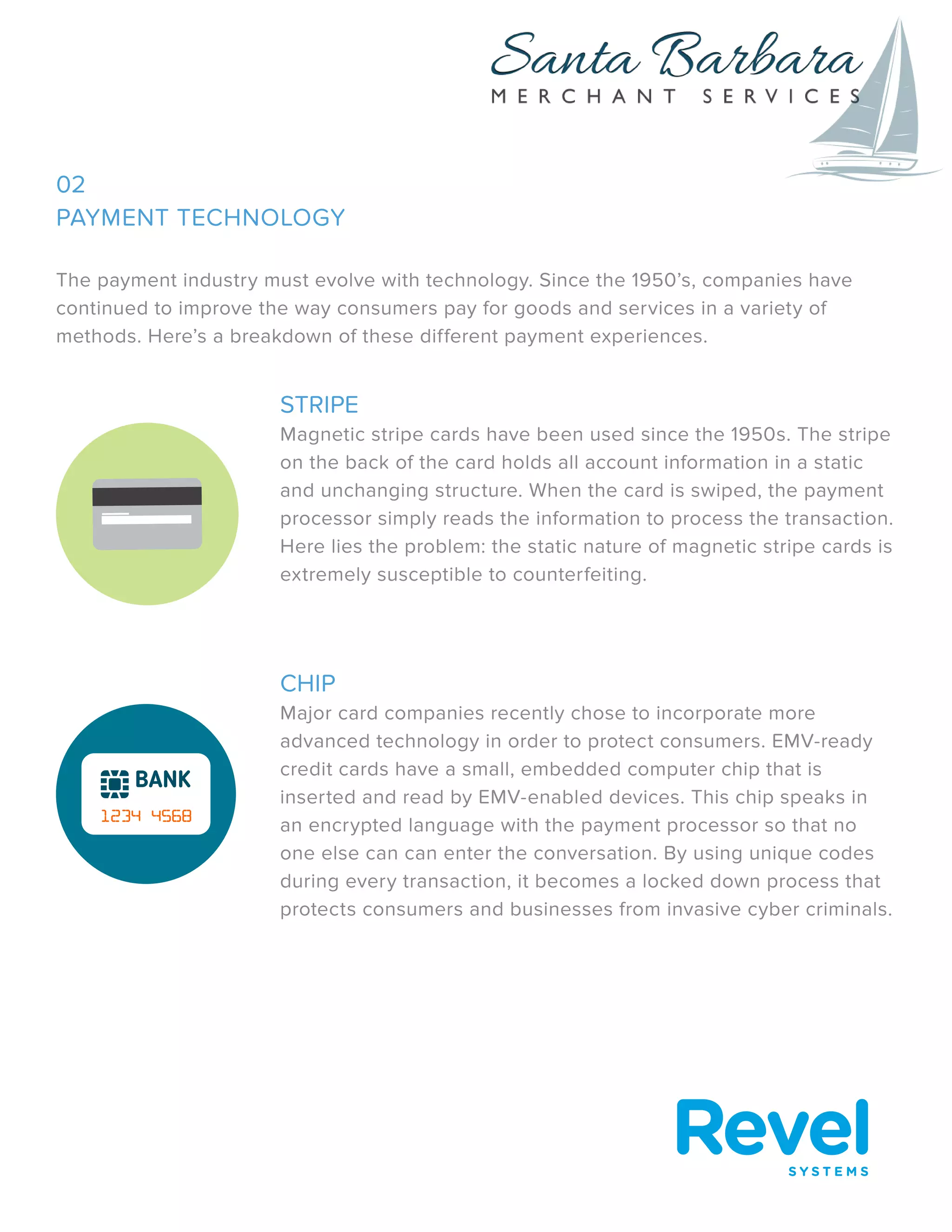
STRIPE
Magnetic stripe cards have been used since the 1950s. The stripe
on the back of the card holds all account information in a static
and unchanging structure. When the card is swiped, the payment
processor simply reads the information to process the transaction.
Here lies the problem: the static nature of magnetic stripe cards is
extremely susceptible to counterfeiting.
02
CHIP
Major card companies recently chose to incorporate more
advanced technology in order to protect consumers. EMV-ready
credit cards have a small, embedded computer chip that is
inserted and read by EMV-enabled devices. This chip speaks in
an encrypted language with the payment processor so that no
one else can can enter the conversation. By using unique codes
during every transaction, it becomes a locked down process that
protects consumers and businesses from invasive cyber criminals.
NFC
As consumer behavior shifts more and more digital, so do pay-
ments. Mobile payment solutions use Near Field Communication
(NFC) to process transactions. Smartphones with NFC chips use
a payment application to connect with NFC-enabled credit card
terminals. The phone only has to be a few centimeters from the
terminal and the transaction is complete.
This method enhances security by using an additional passcode
or fingerprint to approve the transaction. The transaction is then
validated with a separate chip called the Secure Element (SE),
which authorizes the payment back to the NFC modem. Similar to
EMV, NFC generates a one-time use code to transmit the user’s
card number and secure the transaction.
THE SHIFT
Most card fraud occurs in the United States, with 22 data records either lost or stolen
every second¹. As consumers’ online digital activity becomes more popular, more data
about what they do and who they are is at risk. Cyber criminals steal credit card data and
financial information from anywhere they can access personal data. Payment security is
now a significant security concern for all types of businesses.
Other countries have already upgraded to EMV technology; Europe currently has over
90% EMV-enabled terminals, and Asia is moving swiftly with new payment mandates¹.
The United States was reluctant to adopt the change because it meant upgrading 15
million payment terminals, issuing chip-enabled cards, and getting banks, processors,
and retailers on the same page². But as more of the world shifts to EMV, the United States
becomes a beacon for fraudulent stripe card activity. Several large companies such as
Target and Home Depot have suffered enormous data breaches in the last few years. After
the UK saw a 70% decline in counterfeit card transactions after going EMV, and Canada
saw a $234 million drop in fraud card losses, it became time to shift³.
03
²The Nilson Report
³Aite Group
THE SOLUTION
Whether you’re a global enterprise or a small-scale coffee shop, you and your customers
are at risk. Although it’s a huge change for millions of ATMs, POS terminals, kiosks,
vending machines and more, it is a worthy investment. EMV protects you and your
customers in a variety of ways:
04
Waive an annual audit
EMV card issuers can
waive a merchant annual
PCI-DSS audit if 75% of
their transactions are
processed with EMV
certified devices.
Be ahead of the
competition
Don’t be at the tail end
of the EMV movement.
Start accepting EMV chip
cards and NFC-contactless
payments with just one
upgraded processor.
Avoid unnecessary
chargebacks
Neglecting to accept EMV
chip cards for payment or
swiping a credit card with
a chip on it can result in
being liable for credit card
fraud.
Protect credit card data
Meet EMV standards to
reduce fraud and ensure the
highest level of security for
your business and customer
data.
Don’t become a target
Hackers seek out
businesses that have not yet
adopted EMV.
LIABILITY
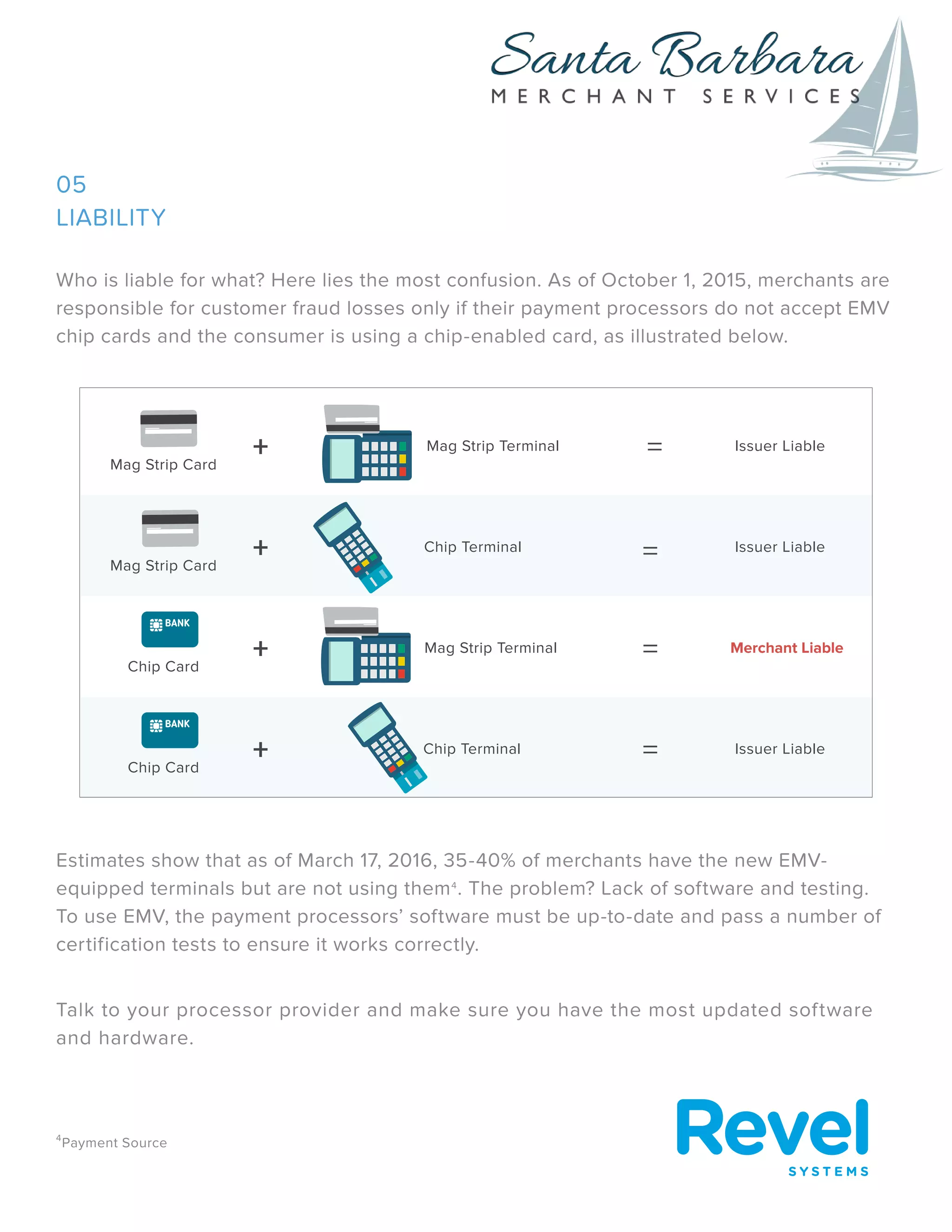
Who is liable for what? Here lies the most confusion. As of October 1, 2015, merchants are
responsible for customer fraud losses only if their payment processors do not accept EMV
chip cards and the consumer is using a chip-enabled card, as illustrated below.
Estimates show that as of March 17, 2016, 35-40% of merchants have the new EMV-
equipped terminals but are not using them4
. The problem? Lack of software and testing.
To use EMV, the payment processors’ software must be up-to-date and pass a number of
certification tests to ensure it works correctly.
Talk to your processor provider and make sure you have the most updated software
and hardware.
05
4
Payment Source
Mag Strip Card
+ Mag Strip Terminal = Issuer Liable
Mag Strip Card
+ Chip Terminal
= Issuer Liable
Chip Card
+ Mag Strip Terminal = Merchant Liable
Chip Card
+ Chip Terminal = Issuer Liable
THE POS COUNTERPART
The Point of Sale (POS) is the main hub of your business. It allows transactions to flow
steadily while engaging customers. Having an up-to-date POS that works seamlessly
with EMV-enabled processors is key to not only running business smoothly, but also
maintaining security.
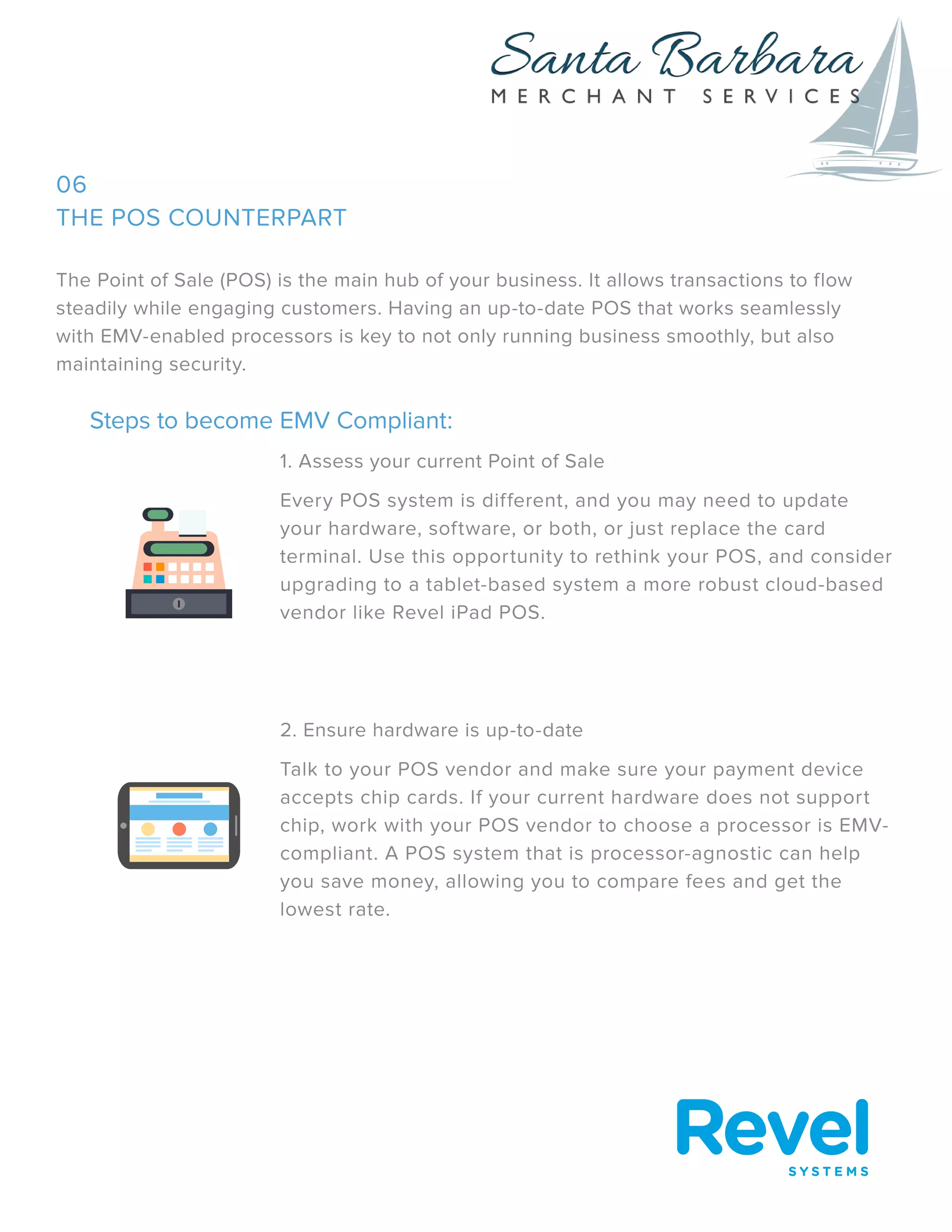
Steps to become EMV Compliant:
1. Assess your current Point of Sale
Every POS system is different, and you may need to update
your hardware, software, or both, or just replace the card
terminal. Use this opportunity to rethink your POS, and consider
upgrading to a tablet-based system a more robust cloud-based
vendor like Revel iPad POS.
2. Ensure hardware is up-to-date
Talk to your POS vendor and make sure your payment device
accepts chip cards. If your current hardware does not support
chip, work with your POS vendor to choose a processor is EMV-
compliant. A POS system that is processor-agnostic can help
you save money, allowing you to compare fees and get the
lowest rate.
06
Steps to become EMV Compliant (cont.):
3. Ensure hardware is tested and approved
If your current terminal can accept chip cards, ensure that it has
the necessary approvals and has gone through required testing.
EMV terminals require more frequent updates to software and
EMV-specific parameters. Work with your payment processor to
ensure that your payment device is always up-to-date.
4. Train your staff
Many consumers are still learning how to use chip cards. Train
your staff and management to help consumers during check-out.
What sets Revel’s iPad POS apart:
Get your business on track today with an EMV-ready processor and a trusted iPad Point
of Sale.
Processor Agnostic
Revel integrates with several gateways
to give you the freedom and flexibility
to work with a preferred processor.
Compare and contrast rates to reduce
costs.
P2PE Compliance
The Revel payment ecosystem allows
corporations to securely process
payments using validated point-to-
point encryption (P2PE). Built by a
PCI-Compliant expert, Revel will always
be at the forefront of payment security
standards.
Hybrid Cloud Architecture
Revel is the only Point of Sale system
with a hybrid cloud/local architecture.
This unique configuration allows for
uninterrupted performance during
internet slowdown or complete service
disruption.
Always On Mode
Revel’s Always On Mode allows
merchants to continue to accept credit
cards even offline, giving managers
the option to continue to process
credit card payments with controlled
parameters to mitigate exposure. All
data automatically re-syncs with the
cloud once connectivity returns.
In 1984, Richard Jimenez Sr., a Santa Barbara native, took over the the struggling Cajun Kitchen
on De La Vina Street in Santa Barbara. A prep cook with no restaurant management experience,
Richard along with his wife learned as they went along, raised a family and opened additional
location that have become loved throughout the community as local favorites. Now their two
oldest sons, Richard Jr. and Juan, have joined them at Cajun Kitchen to continue to bring their
traditions into the future. Cajun Kitchen selected Revel Systems as their iPad Point of Sale
because they needed a solution that could modernize its restaurants, ensure EMV
compliance, improve customer experience and be easily applied and operated across
multiple business units.
Juan Jimenez, of Cajun Kitchen, shared, “My experience working with Santa Barbara Merchant
Services has been rad. Good ROI converting from Aloha. Flawless execution by SBMS, and I
really like having someone that feels like part of the team.” Cajun Kitchen has rolled out Revel to
2 locations so far, and has designated the system as its new standard iPad Point of Sale. Juan and
his team feel “future-proofed” and know that they have technology that they can evolve with
over time.
07
Case Study
About SBMerchant.com
Santa Barbara Merchant Services Inc was founded
in 2009 in Santa Barbara, CA, with the goal of
changing the status quo and empowering
entrepreneurs with the tools they need to succeed.
Founder Craig Saling quickly developed a local
following of friends/customers that have referred
the local brand to almost every State.
SB Merchant offers a feature-rich POS solution
and installation team for restaurant, retail and
grocery establishments with integrated payroll,
inventory tracking, customer relationship
management and more. Revel’s open API allows
users to integrate directly with third-party
applications, including mobile payments, online-
ordering, gift or reward cards and advanced
financial software suites.
Connect With Us
1912 De La Vina Street
Santa Barbara, CA 93101
Web: sbmerchant.com
Blog: sbmerchant.com/blog
Twitter: @sbmerchant
Phone: +1 (805) 259-3211

SBMS EMV Doc

  • 1.
    Payment Technology The Shift The Basics Liability ThePoint of Sale Counterpart The Solution 01 02 03 04 05 06 07 Cajun Kitchen Case Study 08 About SBMerchant EMV & Point of Sale: Protecting Small Businesses
  • 2.
    THE BASICS When newtechnology sweeps the country, there are bound to be glitches. Between credit card companies, payment companies, and word-of-mouth amongst business owners, misinformation still floats around the topic of “EMV.” Europay, Mastercard and Visa (EMV) are the three card companies who originally invented the new chip technology. Europe’s been using this method for years, but the US is lagging behind. However, since the United States accounts for half of the world’s fraudulent card transactions and has seen doubled fraud rates in recent years, the U.S. has decided to adopt EMV as the new payment standard¹. What does this mean for your business? Below we cover the differences between: stripe, chip, and contactless payment technology, why the United States has shifted, how the “liability shift” affects you, and how to best adopt EMV. ¹Gemalto’s 2014 Breach Level Index 01
  • 3.
    PAYMENT TECHNOLOGY The paymentindustry must evolve with technology. Since the 1950’s, companies have continued to improve the way consumers pay for goods and services in a variety of methods. Here’s a breakdown of these different payment experiences. STRIPE Magnetic stripe cards have been used since the 1950s. The stripe on the back of the card holds all account information in a static and unchanging structure. When the card is swiped, the payment processor simply reads the information to process the transaction. Here lies the problem: the static nature of magnetic stripe cards is extremely susceptible to counterfeiting. 02 CHIP Major card companies recently chose to incorporate more advanced technology in order to protect consumers. EMV-ready credit cards have a small, embedded computer chip that is inserted and read by EMV-enabled devices. This chip speaks in an encrypted language with the payment processor so that no one else can can enter the conversation. By using unique codes during every transaction, it becomes a locked down process that protects consumers and businesses from invasive cyber criminals.
  • 4.
    NFC As consumer behaviorshifts more and more digital, so do pay- ments. Mobile payment solutions use Near Field Communication (NFC) to process transactions. Smartphones with NFC chips use a payment application to connect with NFC-enabled credit card terminals. The phone only has to be a few centimeters from the terminal and the transaction is complete. This method enhances security by using an additional passcode or fingerprint to approve the transaction. The transaction is then validated with a separate chip called the Secure Element (SE), which authorizes the payment back to the NFC modem. Similar to EMV, NFC generates a one-time use code to transmit the user’s card number and secure the transaction.
  • 5.
    THE SHIFT Most cardfraud occurs in the United States, with 22 data records either lost or stolen every second¹. As consumers’ online digital activity becomes more popular, more data about what they do and who they are is at risk. Cyber criminals steal credit card data and financial information from anywhere they can access personal data. Payment security is now a significant security concern for all types of businesses. Other countries have already upgraded to EMV technology; Europe currently has over 90% EMV-enabled terminals, and Asia is moving swiftly with new payment mandates¹. The United States was reluctant to adopt the change because it meant upgrading 15 million payment terminals, issuing chip-enabled cards, and getting banks, processors, and retailers on the same page². But as more of the world shifts to EMV, the United States becomes a beacon for fraudulent stripe card activity. Several large companies such as Target and Home Depot have suffered enormous data breaches in the last few years. After the UK saw a 70% decline in counterfeit card transactions after going EMV, and Canada saw a $234 million drop in fraud card losses, it became time to shift³. 03 ²The Nilson Report ³Aite Group
  • 6.
    THE SOLUTION Whether you’rea global enterprise or a small-scale coffee shop, you and your customers are at risk. Although it’s a huge change for millions of ATMs, POS terminals, kiosks, vending machines and more, it is a worthy investment. EMV protects you and your customers in a variety of ways: 04 Waive an annual audit EMV card issuers can waive a merchant annual PCI-DSS audit if 75% of their transactions are processed with EMV certified devices. Be ahead of the competition Don’t be at the tail end of the EMV movement. Start accepting EMV chip cards and NFC-contactless payments with just one upgraded processor. Avoid unnecessary chargebacks Neglecting to accept EMV chip cards for payment or swiping a credit card with a chip on it can result in being liable for credit card fraud. Protect credit card data Meet EMV standards to reduce fraud and ensure the highest level of security for your business and customer data. Don’t become a target Hackers seek out businesses that have not yet adopted EMV.
  • 7.
    LIABILITY Who is liablefor what? Here lies the most confusion. As of October 1, 2015, merchants are responsible for customer fraud losses only if their payment processors do not accept EMV chip cards and the consumer is using a chip-enabled card, as illustrated below. Estimates show that as of March 17, 2016, 35-40% of merchants have the new EMV- equipped terminals but are not using them4 . The problem? Lack of software and testing. To use EMV, the payment processors’ software must be up-to-date and pass a number of certification tests to ensure it works correctly. Talk to your processor provider and make sure you have the most updated software and hardware. 05 4 Payment Source Mag Strip Card + Mag Strip Terminal = Issuer Liable Mag Strip Card + Chip Terminal = Issuer Liable Chip Card + Mag Strip Terminal = Merchant Liable Chip Card + Chip Terminal = Issuer Liable
  • 8.
    THE POS COUNTERPART ThePoint of Sale (POS) is the main hub of your business. It allows transactions to flow steadily while engaging customers. Having an up-to-date POS that works seamlessly with EMV-enabled processors is key to not only running business smoothly, but also maintaining security. Steps to become EMV Compliant: 1. Assess your current Point of Sale Every POS system is different, and you may need to update your hardware, software, or both, or just replace the card terminal. Use this opportunity to rethink your POS, and consider upgrading to a tablet-based system a more robust cloud-based vendor like Revel iPad POS. 2. Ensure hardware is up-to-date Talk to your POS vendor and make sure your payment device accepts chip cards. If your current hardware does not support chip, work with your POS vendor to choose a processor is EMV- compliant. A POS system that is processor-agnostic can help you save money, allowing you to compare fees and get the lowest rate. 06
  • 9.
    Steps to becomeEMV Compliant (cont.): 3. Ensure hardware is tested and approved If your current terminal can accept chip cards, ensure that it has the necessary approvals and has gone through required testing. EMV terminals require more frequent updates to software and EMV-specific parameters. Work with your payment processor to ensure that your payment device is always up-to-date. 4. Train your staff Many consumers are still learning how to use chip cards. Train your staff and management to help consumers during check-out.
  • 10.
    What sets Revel’siPad POS apart: Get your business on track today with an EMV-ready processor and a trusted iPad Point of Sale. Processor Agnostic Revel integrates with several gateways to give you the freedom and flexibility to work with a preferred processor. Compare and contrast rates to reduce costs. P2PE Compliance The Revel payment ecosystem allows corporations to securely process payments using validated point-to- point encryption (P2PE). Built by a PCI-Compliant expert, Revel will always be at the forefront of payment security standards. Hybrid Cloud Architecture Revel is the only Point of Sale system with a hybrid cloud/local architecture. This unique configuration allows for uninterrupted performance during internet slowdown or complete service disruption. Always On Mode Revel’s Always On Mode allows merchants to continue to accept credit cards even offline, giving managers the option to continue to process credit card payments with controlled parameters to mitigate exposure. All data automatically re-syncs with the cloud once connectivity returns.
  • 11.
    In 1984, RichardJimenez Sr., a Santa Barbara native, took over the the struggling Cajun Kitchen on De La Vina Street in Santa Barbara. A prep cook with no restaurant management experience, Richard along with his wife learned as they went along, raised a family and opened additional location that have become loved throughout the community as local favorites. Now their two oldest sons, Richard Jr. and Juan, have joined them at Cajun Kitchen to continue to bring their traditions into the future. Cajun Kitchen selected Revel Systems as their iPad Point of Sale because they needed a solution that could modernize its restaurants, ensure EMV compliance, improve customer experience and be easily applied and operated across multiple business units. Juan Jimenez, of Cajun Kitchen, shared, “My experience working with Santa Barbara Merchant Services has been rad. Good ROI converting from Aloha. Flawless execution by SBMS, and I really like having someone that feels like part of the team.” Cajun Kitchen has rolled out Revel to 2 locations so far, and has designated the system as its new standard iPad Point of Sale. Juan and his team feel “future-proofed” and know that they have technology that they can evolve with over time. 07 Case Study
  • 12.
    About SBMerchant.com Santa BarbaraMerchant Services Inc was founded in 2009 in Santa Barbara, CA, with the goal of changing the status quo and empowering entrepreneurs with the tools they need to succeed. Founder Craig Saling quickly developed a local following of friends/customers that have referred the local brand to almost every State. SB Merchant offers a feature-rich POS solution and installation team for restaurant, retail and grocery establishments with integrated payroll, inventory tracking, customer relationship management and more. Revel’s open API allows users to integrate directly with third-party applications, including mobile payments, online- ordering, gift or reward cards and advanced financial software suites. Connect With Us 1912 De La Vina Street Santa Barbara, CA 93101 Web: sbmerchant.com Blog: sbmerchant.com/blog Twitter: @sbmerchant Phone: +1 (805) 259-3211