Recurrent miscarriage
Williams 2018
Danforth 2008
Masoume kamalabadi
rpl
Recurrent pregnancy loss is classically defined as
3 or more consecutive pregnancy losses at ≤ 20 weeks
or with a fetal weight < 500 grams.
✘ Affecting approximately 1 percent of fertile couples
✘ Primary RM: in women without any prior successful pregnancy
✘ Secondary RM: repetitive losses follow a live birth
There is no specific classification for women who have multiple
miscarriages interspersed with normal pregnancies.
Etiology
50% idiopathic
Three widely accepted causes of RPL:
✘ parental chromosomal
abnormalities
✘ uterine abnormalities
✘ anti phospholipid antibody
syndrome,
Other suspected but not
proven causes are endocrine,
immunologic, thrombophilic,
environmental AND infectious
factors
The timing of recurrent loss may
offer clues, and in some
women, each miscarriage may
occur near the same GA.
Genetic factors usually result in
early embryonic losses,
whereas autoimmune or uterine
anatomical abnormalities more
likely cause second-trimester
losses.
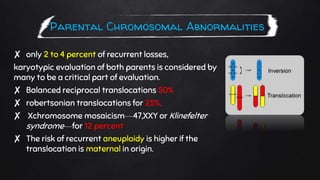
Parental Chromosomal Abnormalities
✘ only 2 to 4 percent of recurrent losses,
karyotypic evaluation of both parents is considered by
many to be a critical part of evaluation.
✘ Balanced reciprocal translocations 50%
✘ robertsonian translocations for 25%,
✘ Xchromosome mosaicism—47,XXY or Klinefelter
syndrome—for 12 percent
✘ The risk of recurrent aneuploidy is higher if the
translocation is maternal in origin.
✘ Chromosomal inversions have also been linked to RPL
The risk of abnormal offspring is slightly higher if the heterozygous
carrier of a pericentric inversion is female. larger inversions are
more likely to be compatible with survival.
Dx: cytogenetic evaluation of both partners.
✘ genetic amniocentesis or chorionic villus sampling
✘ Chromosomal analysis of the products of conception is
also clinically useful
Tx:Parental chromosomal abnormalities do not usually preclude
further attempts at pregnancy, because most couples eventually
have normal offspring.
For the rare homologous robertsonian translocation that prevents
successful pregnancy,artificial donor insemination, in vitro
fertilization with donor oocytes, and adoption.
Anatomical Factors
✘ Uterine anomalies
✘ Leiomyoma
✘ Asherman syndrome
Uterine anomalies
✘ 7% and 8% of women and women with RM estimated to be 10% to 15%
✘ Mechanism:uncertain/diminished blood supply interfering with normal
implantation and placentation and the reduced size of the uterine cavity
✘ The prognosis for successful pregnancy is related to the type of
malformation
✘ Dx:HSG, hysteroscopy, sonohysteroscopy,
✘ and laparoscopy and MRI
✘ No sono
✘ live-birth rate is greater than 80%.
the worst
prognosis
the most
commonly
the most commonly
in PRL
Leiomyoma
Uterine leiomyomas are found in a large
proportion of adult women and can cause
miscarriage, especially if located near the
placental implantation site. That said, data
indicating them to be a significant cause of
recurrent pregnancy loss are not convincing
✘ Submucousal
✘ sono
Asherman syndrome
usually result from destruction of large areas of
endometrium. This can follow uterine curettage
or ablative procedures.
Dx: Characteristic multiple filling defects are seen
with hysterosalpingography or saline-infusion
sonography.
Treatment is done using directed hysteroscopic
lysis of adhesions.
antiphospholipid syndrome APS
5% to 15% of women with RM
Pathogenesis:
Clininical Features :may present with RM in the first trimester, fetal death
in the second or early third trimesters may be more specific for the
condition
Dx: the presence of either the lupus anticoagulant (LA), moderate to high
levels of IgG anticardiolipin (aCL) antibodies, or both.
Tx: Maternally administered unfractionated heparin (UF) and
(LMWH) are considered the treatment
of choice for APS pregnancies, both to improve
embryo-fetal outcome and to protect the mother from
thrombotic events
Prevention
Endocrine Dysfunction
LPD
✘ Evidence linking LPD to RM is less certain and subject to criticism.
Women with LPD polymenorrhea and secondary infertility.
✘ Dx:endometrial biopsy or luteal-phase serum progesterone levels are
widely used to make the diagnosis of LPD
✘ Tx:progesterone
✘ Clomiphene and other ovulatory agents
pco
✘ A possible link between polycystic ovarian
syndrome (PCOS) and RM has been
hypothesized based on the finding that 36% to
56% of women with RM have PCOS based on
ultrasound examination of the ovaries.
✘ related to elevated serum utilizing hormone
levels, high testosterone and androstenedione
concentrations, and/or insulin resistance.
✘ Treatment of insulin resistance with
metformin has been reported to reduce
miscarriage in small studies
Thrombophilic Disorders
✘ The factor V Leiden and prothrombin G20210A mutations are
by far the most common of the inherited thrombophilias,
present in 8% and 3%, respectively, of the general white
population in the United States
✘ in 50% of women with pregnancy-related venous thrombosis as
well as in women with several obstetric complications including
RPL, preeclampsia, and uteroplacental insufficiency
✘ The association appears to be strongest with fetal loss in the
second and third trimesters.
✘ prophylactic anticoagulation during pregnancy
Idiopathic Recurrent Miscarriage
✘ An etiology cannot be identified in at least 50% of couples with RM,
despite a thorough evaluation
✘ Particular attention to the role of alloimmune factors in pregnancy
maintenance
✘ Although no alloimmune mechanism has been unequivocally shown to
cause RM in humans, several types of immunotherapy have been
advocated
✘ The most popular regimen involves injections of the father's leukocytes
✘ Intravenous immune globulin has been proposed as an alternative therapy
Suggested Evaluation of Patients with Recurrent
Miscarriage
History
✘ Determine pattern and trimester of pregnancy losses and
✘ whether a live fetus was present;
✘ clues suggestive of autoimmune disease;
✘ unusual exposure to environmental toxins, drugs, infections;
✘ previous gynecologic disorders or surgery, including D&G and previous
✘ diagnostic tests and treatments
Physical
✘ Abnormalities on pelvic examination, including
findings suggesting abnormal cervix,
✘ DES exposure,
✘ or uterine anomalies
Tests
✘ Lupus anticoagulant and anticardiolipin antibodies
✘ Parental chromosome analyses (father and mother)
✘ Uterine cavity and shape evaluation by
hysterosalpingogram,hysteroscopy, MRI, or other
studies
✘ Chromosome analysis of products of conception
✘ Other laboratory tests if suggested by history and
physical examination.
Hope 
thanks

Rpl.nka

  • 1.
  • 2.
    rpl Recurrent pregnancy lossis classically defined as 3 or more consecutive pregnancy losses at ≤ 20 weeks or with a fetal weight < 500 grams. ✘ Affecting approximately 1 percent of fertile couples ✘ Primary RM: in women without any prior successful pregnancy ✘ Secondary RM: repetitive losses follow a live birth There is no specific classification for women who have multiple miscarriages interspersed with normal pregnancies.
  • 3.
    Etiology 50% idiopathic Three widelyaccepted causes of RPL: ✘ parental chromosomal abnormalities ✘ uterine abnormalities ✘ anti phospholipid antibody syndrome, Other suspected but not proven causes are endocrine, immunologic, thrombophilic, environmental AND infectious factors
  • 4.
    The timing ofrecurrent loss may offer clues, and in some women, each miscarriage may occur near the same GA. Genetic factors usually result in early embryonic losses, whereas autoimmune or uterine anatomical abnormalities more likely cause second-trimester losses.
  • 5.
    Parental Chromosomal Abnormalities ✘only 2 to 4 percent of recurrent losses, karyotypic evaluation of both parents is considered by many to be a critical part of evaluation. ✘ Balanced reciprocal translocations 50% ✘ robertsonian translocations for 25%, ✘ Xchromosome mosaicism—47,XXY or Klinefelter syndrome—for 12 percent ✘ The risk of recurrent aneuploidy is higher if the translocation is maternal in origin.
  • 6.
    ✘ Chromosomal inversionshave also been linked to RPL The risk of abnormal offspring is slightly higher if the heterozygous carrier of a pericentric inversion is female. larger inversions are more likely to be compatible with survival. Dx: cytogenetic evaluation of both partners. ✘ genetic amniocentesis or chorionic villus sampling ✘ Chromosomal analysis of the products of conception is also clinically useful Tx:Parental chromosomal abnormalities do not usually preclude further attempts at pregnancy, because most couples eventually have normal offspring. For the rare homologous robertsonian translocation that prevents successful pregnancy,artificial donor insemination, in vitro fertilization with donor oocytes, and adoption.
  • 7.
    Anatomical Factors ✘ Uterineanomalies ✘ Leiomyoma ✘ Asherman syndrome
  • 8.
    Uterine anomalies ✘ 7%and 8% of women and women with RM estimated to be 10% to 15% ✘ Mechanism:uncertain/diminished blood supply interfering with normal implantation and placentation and the reduced size of the uterine cavity ✘ The prognosis for successful pregnancy is related to the type of malformation ✘ Dx:HSG, hysteroscopy, sonohysteroscopy, ✘ and laparoscopy and MRI ✘ No sono ✘ live-birth rate is greater than 80%.
  • 9.
  • 10.
    Leiomyoma Uterine leiomyomas arefound in a large proportion of adult women and can cause miscarriage, especially if located near the placental implantation site. That said, data indicating them to be a significant cause of recurrent pregnancy loss are not convincing ✘ Submucousal ✘ sono
  • 11.
    Asherman syndrome usually resultfrom destruction of large areas of endometrium. This can follow uterine curettage or ablative procedures. Dx: Characteristic multiple filling defects are seen with hysterosalpingography or saline-infusion sonography. Treatment is done using directed hysteroscopic lysis of adhesions.
  • 12.
    antiphospholipid syndrome APS 5%to 15% of women with RM Pathogenesis: Clininical Features :may present with RM in the first trimester, fetal death in the second or early third trimesters may be more specific for the condition Dx: the presence of either the lupus anticoagulant (LA), moderate to high levels of IgG anticardiolipin (aCL) antibodies, or both. Tx: Maternally administered unfractionated heparin (UF) and (LMWH) are considered the treatment of choice for APS pregnancies, both to improve embryo-fetal outcome and to protect the mother from thrombotic events
  • 13.
  • 14.
    Endocrine Dysfunction LPD ✘ Evidencelinking LPD to RM is less certain and subject to criticism. Women with LPD polymenorrhea and secondary infertility. ✘ Dx:endometrial biopsy or luteal-phase serum progesterone levels are widely used to make the diagnosis of LPD ✘ Tx:progesterone ✘ Clomiphene and other ovulatory agents
  • 15.
    pco ✘ A possiblelink between polycystic ovarian syndrome (PCOS) and RM has been hypothesized based on the finding that 36% to 56% of women with RM have PCOS based on ultrasound examination of the ovaries. ✘ related to elevated serum utilizing hormone levels, high testosterone and androstenedione concentrations, and/or insulin resistance. ✘ Treatment of insulin resistance with metformin has been reported to reduce miscarriage in small studies
  • 16.
    Thrombophilic Disorders ✘ Thefactor V Leiden and prothrombin G20210A mutations are by far the most common of the inherited thrombophilias, present in 8% and 3%, respectively, of the general white population in the United States ✘ in 50% of women with pregnancy-related venous thrombosis as well as in women with several obstetric complications including RPL, preeclampsia, and uteroplacental insufficiency ✘ The association appears to be strongest with fetal loss in the second and third trimesters. ✘ prophylactic anticoagulation during pregnancy
  • 17.
    Idiopathic Recurrent Miscarriage ✘An etiology cannot be identified in at least 50% of couples with RM, despite a thorough evaluation ✘ Particular attention to the role of alloimmune factors in pregnancy maintenance ✘ Although no alloimmune mechanism has been unequivocally shown to cause RM in humans, several types of immunotherapy have been advocated ✘ The most popular regimen involves injections of the father's leukocytes ✘ Intravenous immune globulin has been proposed as an alternative therapy
  • 18.
    Suggested Evaluation ofPatients with Recurrent Miscarriage History ✘ Determine pattern and trimester of pregnancy losses and ✘ whether a live fetus was present; ✘ clues suggestive of autoimmune disease; ✘ unusual exposure to environmental toxins, drugs, infections; ✘ previous gynecologic disorders or surgery, including D&G and previous ✘ diagnostic tests and treatments
  • 19.
    Physical ✘ Abnormalities onpelvic examination, including findings suggesting abnormal cervix, ✘ DES exposure, ✘ or uterine anomalies Tests ✘ Lupus anticoagulant and anticardiolipin antibodies ✘ Parental chromosome analyses (father and mother) ✘ Uterine cavity and shape evaluation by hysterosalpingogram,hysteroscopy, MRI, or other studies ✘ Chromosome analysis of products of conception ✘ Other laboratory tests if suggested by history and physical examination.
  • 20.