RAID TechnologyBy Nicole Moore
About RAIDRedundant Array of Inexpensive DrivesCreated in the late 80s early 90s to create the same or greater storage capacity at a lower price. Uses multiple hard drives for performance and reliability.
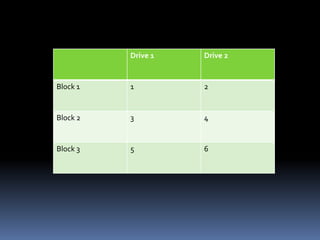
RAID 0Not a valid type of RAID.Uses a method called “striping”.ADVANTAGESIncreased performance. No loss in data capacity.DISADVANTAGESNo redundancy of data.
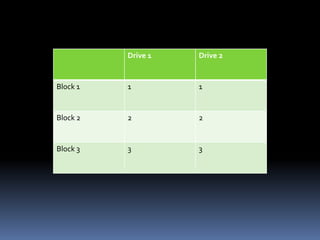
RAID 1First real implication of RAID.Uses a method called “mirroring”.ADVANTAGESProvides full redundancy of data.DISADVANTAGESStorage capacity is only as large as the smallest drive.No performance increases.Downtime required to change active drive during a failure.
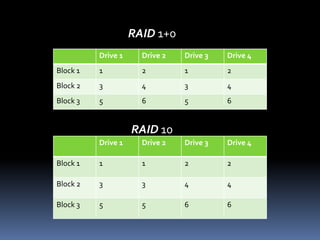
RAID 0+1 and 10Hybird form of RAID.ADVANTAGESIncreased performance .Data fully redundant.DISADVANTAGESLarge number of drives required.Effective data capacity is halved.
RAID 1+0RAID 10
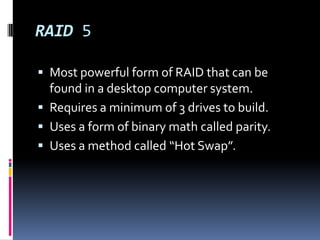
RAID 5Most powerful form of RAID that can be found in a desktop computer system.Requires a minimum of 3 drives to build.Uses a form of binary math called parity.Uses a method called “Hot Swap”.
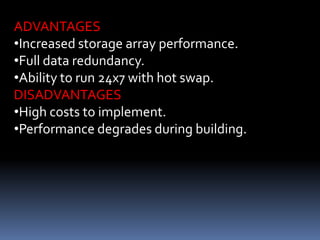
ADVANTAGESIncreased storage array performance.
Full data redundancy.
Ability to run 24x7 with hot swap.DISADVANTAGESHigh costs to implement.
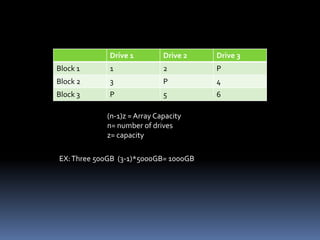
Performance degrades during building.(n-1)z = Array Capacityn= number of drivesz= capacity EX: Three 500GB  (3-1)*5000GB= 1000GB
RAID nOffers higher reliability and more storage space than conventional RAID.Allows customers to select the level of protection desired.Currently implemented in Linux only.

Rp Nmoore

  • 1.
  • 2.
    About RAIDRedundant Arrayof Inexpensive DrivesCreated in the late 80s early 90s to create the same or greater storage capacity at a lower price. Uses multiple hard drives for performance and reliability.
  • 3.
    RAID 0Not avalid type of RAID.Uses a method called “striping”.ADVANTAGESIncreased performance. No loss in data capacity.DISADVANTAGESNo redundancy of data.
  • 5.
    RAID 1First realimplication of RAID.Uses a method called “mirroring”.ADVANTAGESProvides full redundancy of data.DISADVANTAGESStorage capacity is only as large as the smallest drive.No performance increases.Downtime required to change active drive during a failure.
  • 7.
    RAID 0+1 and10Hybird form of RAID.ADVANTAGESIncreased performance .Data fully redundant.DISADVANTAGESLarge number of drives required.Effective data capacity is halved.
  • 8.
  • 9.
    RAID 5Most powerfulform of RAID that can be found in a desktop computer system.Requires a minimum of 3 drives to build.Uses a form of binary math called parity.Uses a method called “Hot Swap”.
  • 10.
  • 11.
  • 12.
    Ability to run24x7 with hot swap.DISADVANTAGESHigh costs to implement.
  • 13.
    Performance degrades duringbuilding.(n-1)z = Array Capacityn= number of drivesz= capacity EX: Three 500GB (3-1)*5000GB= 1000GB
  • 14.
    RAID nOffers higherreliability and more storage space than conventional RAID.Allows customers to select the level of protection desired.Currently implemented in Linux only.