Download to read offline
![DYN
LON
RK
O
J
PE
21
.
00
KI
IO
6.00
K
TO
0
22.0
LOS A
NG
ELE
S
9.
00
NO
Y
16.0
0
N
W
14.00
HELS
INK
I
autoportret 3 [42] 2013 | 4
ROWNOWAGA_1_UK_cs4-3.indd 4
13-10-30 14:38](https://image.slidesharecdn.com/rownowaga1uk-4-7-131120061820-phpapp01/85/Rownowaga-1-uk-4-7-1-320.jpg)
![Marc Augé
Illustrations: Anna Zabdyrska
Centre,
Decentralisation,
Recentralisation
W
e are currently going through
a transformation whose
consequences we have not
yet learnt to control. Space is
increasingly becoming a sensual expression
of our contradictions and paradoxes.
Everyday language keeps on surprising us. We
often use the prefix ‘without’ (sans). We speak
of those ‘without homes’, of people sans papier1,
and since we know for certain that their situation is problematic, we are led on to believe,
as if it were obvious, that having a permanent
place of residence and valid documents is a
sufficient condition for happiness.
Other examples might easily prove the
opposite. The richest people in the world
acquire more and more residences. They own
temporary homes on different continents,
they sail their own yachts and enjoy themLiterally, ‘without papers’; in French, a popular way
to refer to people of non-French origin who reside
in France without the necessary legal documents to
validate their stay (footnote by A.W.).
1
selves in luxury hotels all over the world.
They have documents, to be sure, and yet
they are so self-confident and so confident in
their identity that they hardly realise they
are actually showing those documents when
a need arises. They might be said to accumulate benefits: places of permanent residence,
identity cards and credit cards.
Having said that, I would claim that the fact
that the most affluent collect residences and
exude self-confidence proves that the ideal
of individual life is not necessarily that of
getting stuck in one place like a mollusc to
a rock, or having the means to prove your
identity when asked to show your papers;
quite the opposite: it is a genuine freedom
of movement while remaining relatively
anonymous. The magnetic force of the 19th
century cities on runaway villagers, and of
great cities in the North on migrants from
the South, was born out of the very same
need. Undoubtedly, it is essentially illusory,
and yet it must be considered by all who ask
themselves the question about the ideal city
life of our time.
The city is expanding ceaselessly. The majority of the world’s population lives in the city
and the trend is irreversible. Global urban
drift is transforming the city. What kind of
city do migrants flock to these days?
The phenomenon of global urban drift
corresponds more or less to what we call globalisation, to denote free market, economic
and financial interrelations, development
of means of transport and advances in
e-communication. From this point of view,
the world may be called one giant city. The
‘world-city’, as I proposed to refer to it2, is
characterised by mobility and uniformity. On
the other hand, big metropolises are sprawling and abound in all types of diversity (ethnic, religious, social or economic), including
divisions inherently present in them. We
can therefore contrast the ‘city-world’, with
its divisions, nodes and disparities with the
‘world-city’, which provides the former with
a global context and places its aesthetic and
functional identification marks emphatically
in several key points in the urban landscape,
such as towers, airports, shopping centres or
amusement parks.
The more a big city sprawls, the more ‘decentralised’ it becomes. Visited by tourists
coming from other places, historical centres
become museums and areas of all kinds of
consumption. Prices are high here, and city
centres are inhabited, more often than not,
by the wealthy, who frequently happen to be
foreigners. Production and sometimes also
cultural activities move extra muros. Means of
transport are the focal problem of an urban
agglomeration. Distances between places of
residence and places of work are often considerable. Urban tissue stretches along roads,
Cf. the book Pour une anthropologie de la mobilité,
Paris: Payot & Rivages, 2009, p. 34 (footnote by A.W.).
2
autoportret 3 [42] 2013 | 5
ROWNOWAGA_1_UK_cs4-3.indd 5
13-10-30 14:38](https://image.slidesharecdn.com/rownowaga1uk-4-7-131120061820-phpapp01/85/Rownowaga-1-uk-4-7-2-320.jpg)
![rivers and coasts. In Europe suburbs are getting closer, are merging and mixing; it may
seem that with the spread of ‘urbanity’ we
are losing the ‘city’ itself. Decentralisation of
cities whose elan vitale is moving beyond administrative borders; habitats whose private
interiors are linked with the outside world
through television and the internet; finally,
individuals themselves who are constantly
teleported outside themselves by electronics
- all these factors favour conquest of space,
which, paradoxically, is often related to
dispossession.
How to recover the lost city?
In the global world an answer may be expressed in spatial terms: we must re-think
localness. Contrary to illusions disseminated
via communications technologies, from
television to the internet, we live where we
live. Ubiquity and immediacy still remain
metaphors. It is important to perceive means
of communication as they really are: means
to facilitate life, not to substitute for it.
From this perspective, the task we should
accomplish is enormous. It is to avoid situations when information and image overload
will cause new forms of isolation. Solutions
to halt this trend, which is already perceivable, will have to be spatial, local and,
openly speaking, political, in the broad sense
of the word. How to reconcile the sense of
place and the freedom of non-place in urban
space? Is it possible to rethink the concept
of the city in its entirety, and of housing in
particular?
The city is not an archipelago. Le Corbusier’s
illusion of the city, whose centre was supposed to be a habitat and a unit of cohabitation, brought in the barriers of new suburbs
from which trade and services, originally
intended to turn them into ideal spaces for
living, soon emigrated. What was neglected
was the need for social relations and contact
with the outside world; this is what ‘young
suburbans’ express in their own way, for
example in Paris where they move regularly
from their bleak housing estates towards the
districts of Champs Elysées or Châtelet-Les
Halles, which lie in the heart of the historic city and are also symbols of consumer
society.
Perhaps one day our planet will look like one
complete urban complex. We are starting to
look at it that way, since we celebrate works
by several eminent architects, whic are wellknown all over the world, or follow advances
in e-communication technologies of Paul
Virilio’s ‘virtual meta-city’. It is to be hoped
that by that time we will have found a way to
supply this giant world-city with energy that
is necessary for it to function harmoniously.
It should also be said that the measure of the
success or failure of the project, whether it
be a utopia realised or a programmed end of
the world, will be human relations management; in other words, our ability to reverse
the current process of the growing gap
between the rich and the poor, between the
educated and the uneducated. The energy
necessary to carry out this major project –
the only true effort worth making if each
individual is necessarily assigned the idea of
cognition characteristic of the human species – is essentially mental energy and refers
to the human being’s fundamental qualities:
intelligence, will and imagination.
cultural’ world whose emergence they are
witnessing daily. The hypothesis we would
like to propose here is that an anthropologist can usefully contribute to the reflection
on the necessity to recentre human activity
– not in order to negate new opportunities
ahead of the humanity but so as to confront
them without nostalgy, since they have
always been among questions raised more or
less directly by various cultures and by several philosophical precursors. It is high time
to embrace what is happening on ‘our’ planet
and to refocus on what is vital – on cognition
– when faced with hitherto unknown threats
of the present time.
Current efforts to protect the world by designating ‘human heritage’ sites and establishing ‘natural parks’ are, in a sense, all aimed
at that. However, if they are not accompanied
by a major educational effort, they may be
lost in our world of images, as one out of
many existing forms of consumption. Hence,
the change of scale, which is reflected in
newly emerging landscapes (including the
landscape of the planet as such) – landscapes
that in a sense recapitulate the history of
humanity – may be perceived as a source of
mixed up questions, anxieties and dreams.
Polish translation by Aleksandra Wojda
English translation by
Anna Mirosławska-Olszewska
To many people, culture remains a close, intimate bond which has been in existence and
is still perceivable in microscale in a given
community, its works and its landscape. The
existence of such communities is becoming
increasingly difficult and they can hardly
envisage their place in that planetary ‘post-
autoportret 3 [42] 2013 | 6
ROWNOWAGA_1_UK_cs4-3.indd 6
13-10-30 14:38](https://image.slidesharecdn.com/rownowaga1uk-4-7-131120061820-phpapp01/85/Rownowaga-1-uk-4-7-3-320.jpg)
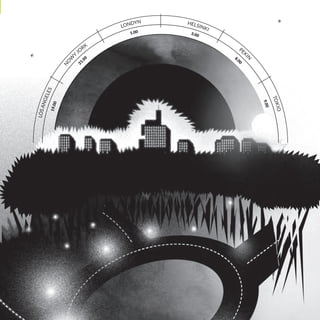

1) The document discusses the transformation of cities and urban spaces as a result of globalization and increased mobility. While cities are decentralizing and sprawling, certain areas become more uniform and centralized around functions like tourism, commerce, and transportation. 2) As cities decentralize, historical centers take on museum-like functions for tourists and wealthy residents while industrial and cultural activities move outward. However, new forms of recentralization also occur as global communication technologies paradoxically contribute to both increased mobility and new forms of isolation. 3) Finding a balance between the sense of place and freedom of movement in urban spaces will require rethinking concepts of the city and housing. It also demands efforts to reverse growing inequality and reconnect people


