See discussions, stats, and author profiles for this publication at: https://www.researchgate.net/publication/343103579
Understanding Urbanism
Chapter · July 2020
DOI: 10.1007/978-981-15-4386-9_1
CITATIONS
2
READS
4,319
1 author:
Some of the authors of this publication are also working on these related projects:
Global Real Estate Project View project
Special Issue (Urban Policy and Research): Cities after COVID-19: Reconsidering urban form, mobility, housing and planning in Australasia View project
Dallas Rogers
The University of Sydney
84 PUBLICATIONS 1,126 CITATIONS
SEE PROFILE
All content following this page was uploaded by Dallas Rogers on 06 October 2020.
The user has requested enhancement of the downloaded file.
1
© The Author(s) 2020
D. Rogers et al. (eds.), Understanding Urbanism,
https://doi.org/10.1007/978-981-15-4386-9_1
Understanding Urbanism
Dallas Rogers
Abstract
By 2050 almost 70 per cent of the world’s people are predicted to live in cities.
This chapter begins with a discussion about the difference between urbanisation
and urbanism, and suggests that it is at the intersections of the various definitions
of these ideas that the most important discussions about cities take place. The
Aboriginal context of urban development in Australia is discussed as a case in
point. The substantive sections provide six brief contextual primers for the chap-
ters in this book, covering: (1) professions and practices; (2) morphology and
change; (3) scales and agglomerations; (4) infrastructures and services; (5) expe-
riences and cultures; and (6) inquiry and analysis. The conclusion suggests to
understand the relationships between the physical form and social function of
cities, and how urbanisation makes people, changes places, shifts power rela-
tions, creates property or changes cultures requires a very broad range of data
collection and analysis tools, as well as a broad sweep of urbanism theory.
1.1 Understanding Urbanism
1.1.1 
What Is Urbanisation and Urbanism?
This is a question that has been asked for a very long time, a question that is hard to
answer. In his meditations on government, democracy and the ancient Athenian
city-state the philosopher Aristotle (384–322 B.C.E) said,
The amalgamation of numerous villages creates a unified city-state, large enough to be self-­
sufficient or nearly so, starting from the need to survive, and continuing its existence for the
sake of a comfortable lifestyle.
D. Rogers (*)
School of Architecture, Design and Planning, University of Sydney,
Darlington, NSW, Australia
e-mail: dallas.rogers@sydney.edu.au
1
2
As hinted at here by Aristotle, at its most foundational, urbanisation ‘is the
increase in the proportion of a population that is urban as opposed to rural’ (Gate
and Stout 2011: 15 citing Davis 2011: Davis 1965). Historically, urbanisation was
underwritten by immigration from the countryside into the city. This rural to urban
migration driver of urbanisation is still largely true today. At the turn of the twenty-­
first century more than 50 per cent of the world’s people lived in cities. In 2020 that
figure had reached 55 per cent, and by 2050 almost 70 per cent of the world’s people
are predicted to live in cities (United Nations 2018). Countries with populations
over 1 billion people, such as China (1.38 billion) and India (1.34 billion), will be
key to global urbanisation. Consider this: when the Peoples’ Republic of China was
established in 1949 only 10 per cent of the national population lived in cities (Ren
2013). By 1978, a time of major market reforms, that figure had only reached 20 per
cent. But 55 per cent of the national population was urban in 2015 and that figure is
predicted to reach 60 per cent by 2030. This ‘demographic’ or ‘population mobility’
definition of urbanisation is a useful starting point for our discussion because it sug-
gests that urbanisation and urbanism are not the same thing.
Urbanism is about what happens inside cities, the form and function of cities,
and how cities relate to the rural. It often refers to the study of how inhabitants of
urban or urbanising areas interact with the social and built environments of cities.
What marks the boundary between the rural and the urban or a town from a city is
the topic of an extended and ongoing debate in urban studies (Gate and Stout 2011;
Lefebvre 1970/2003). In 1938, Louis Wirth (1938) published Urbanism as a way of
life and suggested there were three key urban characteristics: a large population, a
high population density, and social heterogeneity. Wirth proposed with his universal
social theory of the city that the complex phenomena of urbanism could be under-
stood through an analysis of a limited number of basic categories. ‘A sociologically
significant definition of the city’, writes Wirth (1938:190), ‘seeks to select those
elements of urbanism which mark it as a distinctive mode of human group life’.
Wirth’s idea that ‘urban difference’ rather than ‘rural similarity’ shaped the social
relations in the city was a powerful heuristic in its day, even if sociologists and
geographers later rejected universal theories of the city like his. From Aristotle to
Wirth and beyond, cities have be variously defined and analysed by population den-
sity, geographic size, integrated economies with a diversity of goods and services,
the proliferation of specific building types or changes in urban form such as high-­
rise buildings, high population recreational spaces such as stadiums and theatres,
new forms of government and urban governance, or the increasing detachment of a
population from directly providing their own food and energy needs (Brenner and
Schmid 2014; Bounds 2004; Engels 1845; Graham and Hewitt 2013; LeGates and
Stout 2011; Lefebvre 1970/2003; Mumford 1961). Cities might also be defined by
what they produce, such as housing wealth or inequality, or the forms of pollution,
noise, water and food shortages, and other issues and inequalities that are somewhat
unique to urban environments.
It is at the intersections and edges of the various definitions and analyses that the
most interesting discussions about cities take place. But specificity is important.
The architect Alexander D’Hooghe (2010:13) provocatively suggests that
D. Rogers
3
‘urbanism’ today ‘describes the world as it is, and also all its alternatives. Taken this
way, it now means everything and its opposite. Such a word does not deserve to
exist. It is wholly empty’ (p.13). For the term ‘urbanism’ to have practical utility,
then, the build environment professions ‘should not compound urbanism’s attempt
to be everything to everyone. It needs narrow-mindedness’ (p.13). As such, we are
talking about urbanism in a very narrow way in this book, as a set of concerns and
issues associated with the built environment professions (see our six urbanism
themes below); concerns that are common to people who study urbanism or practice
a built environment profession and call themselves urbanists.
An urbanist might be interested in, for example, how the number of people living
in poverty in China fell ‘from 250 million at the start of the reform process in 1978
to 80 million people by the end of 1993 and 29.27 million in 2001’, as people
moved into cities to find work and other opportunities (Jacques, 2012, p.162). In
Australia, urbanist and Yugembir man, Dillon Kombumerri, a principal architect in
the Office of the Government Architect NSW, has been involved in the Sydney
Ochre Grid, a ‘mapping project that seeks to connect both Aboriginal and non-
Aboriginal communities, building knowledge bridges to enable better planning and
design decisions that embrace culture and connection to country’ (Russell 2018:np).
Wiradjuri man, Joel Sherwood-Spring and Wiradjuri/Gamilaroi woman, Lorna
Monro are centring ‘Indigenous voices amongst multicultural Waterloo residents [a
suburb of Sydney on Gadigal land] to critique colonisation and gentrification show-
ing there is a Black History to your flat white’ (Sherwood-Spring and Monro
2018:np). Their work shows how the current gentrification of the Gadigal land at
Waterloo is connected to the violent invasion of Aboriginal lands in Sydney by the
British (Moreton-Robertson 2015; Indigenous Archives Collective 2018). In all
three cases, changes in the built environment and how it is governed were central to
the social outcomes of the urban inhabitants.
Thus, the concept of urbanism is linked to the professions associated with the
physical and social design and management of urban structures and communities.
These professions include urban planning, urban design, architecture, engineering
and heritage management. But urbanism is also linked to a range of academic disci-
plines and fields that are, at least partly, focused on the study of urban life and cul-
ture (Lefebvre 1970/2003). These academic disciplines and fields include urban
sociology, human geography, urban politics, urban anthropology, architecture, engi-
neering and heritage studies, amongst others.
Urbanism is, therefore, a mode of inquiry—a way of analysing and understand-
ing cities—but it is also a component of built environment practice, and it might
even be a component of someone’s identity when they say, ‘I’m an urbanist!’. It is
probably clear by now that answering the question what is urbanisation and urban-
ism? from Aristotle’s ancient Athenian city-state to the megacities of today is
beyond the scope of this book. There are just too many definitions, theories, and
understandings of urbanism to cover, as well as rigorous debates in the built envi-
ronment professions about what these concepts mean and how to deploy them to
inform built environment work. Being an urbanist requires a lifelong commitment
to the study of cities, and this book is an entry point into some of the key ideas you
1 Understanding Urbanism
4
will need to begin your built environment studies. As you work your way through
the chapters, you will develop a critical understanding of the different ways in which
architects, urban planners, urban designers, heritage professionals, engineers, and
other built environment professionals understand and design the urban environment.
In other words, this book is an introduction to some of the key ideas you will
need to begin your built environment education—this is the beginning of your learn-
ing not the end. Rather than focusing on particular case studies, technical practices
or policy and regulatory settings you will be presented with 13 key urbanism ideas.
These key urbanism ideas are organised under the following 13 chapter headings:
Indigenous Cities, Economic Cities, Planned Cities, Heritage and Cities, Designed
Cities, Mobile Cities, Multicultural Cities, Public Cities, Green Cities, Healthy
Cities, Digital Cities, Data Science and Cities, and Political Cities. As you can see,
each chapter covers a specific theme. There are many ways of dividing up the key
ideas for thinking about cities, and the 13 urbanism ideas we selected do not cover
all the possible entry points into an analysis of the city. As an urbanist, you should
ask yourself what are some of the other ways we could have explored the city; what
about gender and cities or queer cities? And while the selection of these 13 urban
themes should be a source of continuous debate, we made pragmatic decisions to
write this book. As such, our 13 themes will provide you with a foundational knowl-
edge of some of the key themes in urbanism upon which to build more discipline-­
specific learning throughout your under- and post-graduate studies.
You will see that each chapter follows a common heading structure. Each chapter
starts with an Introduction to the urbanism theme, followed by the Key Debates in
the urbanism theme and finishes up with a Critical appraisal of the urbanism theme.
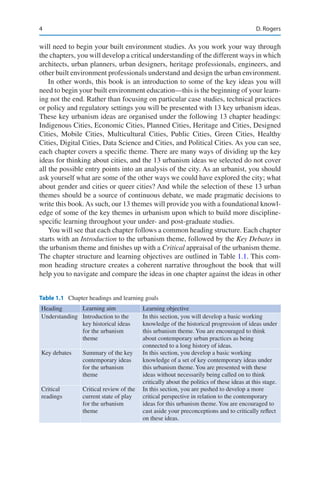
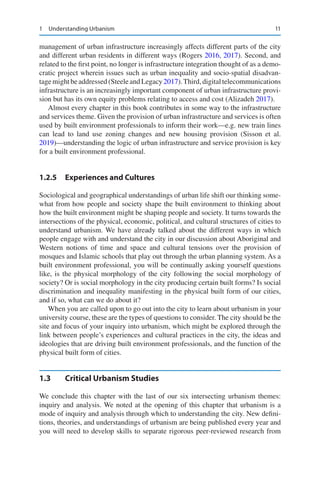
The chapter structure and learning objectives are outlined in Table 1.1. This com-
mon heading structure creates a coherent narrative throughout the book that will
help you to navigate and compare the ideas in one chapter against the ideas in other
Table 1.1 Chapter headings and learning goals
Heading Learning aim Learning objective
Understanding Introduction to the
key historical ideas
for the urbanism
theme
In this section, you will develop a basic working
knowledge of the historical progression of ideas under
this urbanism theme. You are encouraged to think
about contemporary urban practices as being
connected to a long history of ideas.
Key debates Summary of the key
contemporary ideas
for the urbanism
theme
In this section, you develop a basic working
knowledge of a set of key contemporary ideas under
this urbanism theme. You are presented with these
ideas without necessarily being called on to think
critically about the politics of these ideas at this stage.
Critical
readings
Critical review of the
current state of play
for the urbanism
theme
In this section, you are pushed to develop a more
critical perspective in relation to the contemporary
ideas for this urbanism theme. You are encouraged to
cast aside your preconceptions and to critically reflect
on these ideas.
D. Rogers
5
chapters. Furthermore, these 13 urbanism themes have been written in a way that
will allow them to be read in parallel with contemporary case studies wherever you
are reading this book. Because local case studies, empirical data, technical prac-
tices, and policy and regulatory settings change quickly, this will allow your univer-
sity teacher to build local, contemporary case studies into your teaching materials to
be read alongside this book.
In the next section, we provide some brief context to the key urbanism ideas
discussed in this book. We have organised this discussion under six intersecting
themes. These are an alternative suite of categories you could use to organise your
thinking about and analysis of cities. We encourage you to add to our six short con-
textual briefings as you work your way through the book and the case studies pro-
vided by your university teaching staff.
1.2 
Key Debates in Urbanism
As a built environment professional, you will need to work with a wide range of
professionals and have a working knowledge of a complex suite of urban issues and
solutions. These professionals, issues, and solutions will not fall neatly under the 13
themes we present in this book, rather they will cut across, blend, and merge these
themes. In many cases, it will be hard to keep the 13 themes separate, as the issues
intersect and weave across one another. Consider the digital city for example. The
introduction of digital technologies to cities spans almost the full spectrum of
themes discussed throughout this book. Digital technologies have already been used
to profile Aboriginal people in cities (Indigenous cities), they are important drivers
of urban economies (economic cities), they have clear urban planning and design
uses, such as on roads and in public spaces (planned, designed, and mobile cities),
and they can be used in placemaking (multicultural and public cities) and as a mode
of inquiry (data science and cities). As such, we present six intersecting themes here
that are more common ways of thinking about urbanism. These are terms you are
more likely to use throughout your built environment career.
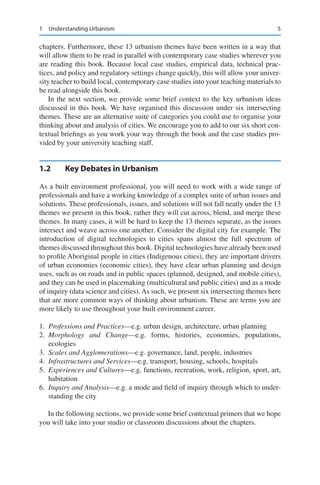
1. Professions and Practices—e.g. urban design, architecture, urban planning
2. Morphology and Change—e.g. forms, histories, economies, populations,
ecologies
3. Scales and Agglomerations—e.g. governance, land, people, industries
4. Infrastructures and Services—e.g. transport, housing, schools, hospitals
5. Experiences and Cultures—e.g. functions, recreation, work, religion, sport, art,
habitation
6. Inquiry and Analysis—e.g. a mode and field of inquiry through which to under-
standing the city
In the following sections, we provide some brief contextual primers that we hope
you will take into your studio or classroom discussions about the chapters.
1 Understanding Urbanism
6
1.2.1 Professions and Practices
A typical reading list of the key historical figures in the built environment often
includesurbanistssuchasEbenezerHoward(1850–1928),LouisWirth(1867–1952),
Ernest W. Burgess (1886–1966), Lewis Mumford (1895–1990), Jane Jacobs
(1916–2006), William Julius Wilson (1935–present), amongst others. Some archi-
tects have made significant contributions to urbanism too, such as Marcus Vitruvius
Pollio (70 BCE–15 BCE), Frank Lloyd Wright (1867–1959), Charles-Édouard
Jeanneret (1887–1965), Robert Venturi (1925–2018), Frank Gehry (1929–), Denise
Scott Brown (1932–) and Daniel Libeskind (1946–). The presentation of these intel-
lectual lineages varies, but these urban thinkers are important for two key reasons.
First, they have provided much of the intellectual footing for students of the built
environment in Western universities throughout the twentieth century. Therefore,
having a working knowledge of these authors and their ideas is necessary in the
professional domain because they provide a commonly cited touchstone in profes-
sional practice. Many Western-trained built environment professionals know who
the American-Canadian Jane Jacobs is, but do they know about scholars like the
Australian Jane Jacobs? If not, the second reason why these key urban thinkers are
important is they represent a blind spot in our thinking about cities, and this is par-
ticularly the case in settler-countries like Australia (Moreton-Robertson 2015). The
work of the Australian Jane Jacobs focuses on postcolonialism, Indigenous rights,
and cities and in her 1996 book entitled Edge of Empire: Postcolonialism and the
City she writes,
In Sydney, as I listened to various papers on postmodern cities, I could not help but wonder
why the processes and formations being discussed were infrequently connected to colonial-
ism, imperialism and postcolonialism... The relations of power and difference established
through nineteenth-century British imperialism linger on and are frequently reactivated in
many contemporary First World cities (Jacobs 1998:1)
The implication of these two factors for the built environment professionals of
tomorrow is that they will need to be knowledgeable in the Western built environ-
ment canon and critical of it too (Kiddle et al. 2018). This book will help you with
both. You will see that we have included some of the key Western thinkers in the
chapters where they are appropriate and useful for the discussion, but we have also
provided alternative positions too. For example, Wirth’s most important contribu-
tion as an applied sociologist was that he called upon researchers and students go
out into the city to learn about the people and places of the city. In other words, we
can take from Wirth his idea that being an urbanist is an applied practice that requires
you to get out of the studio or classroom and into the city and his writing is a useful
touchstone in the history of ideas about the formation and analysis of cities. But
arguably more important for contemporary Western built environment professionals
today is the need to come to terms with the violent colonial foundations of their
professions.
As Libby Porter writes in Chap. 2, ‘Indigenous peoples have universally experi-
enced subjugation, dispossession and domination through colonisation and their
D. Rogers
7
ways of life, forms of knowledge, systems of governance and distinctive laws and
customs have been seriously threatened by dominant cultures’. Planning cities and
constructing buildings on Aboriginal land is literally how Aboriginal peoples were
(and continue to be) dispossessed of their land in Australia, and the built environ-
ment professions are therefore implicated in this ongoing dispossession (Kiddle
et al. 2018; Moreton-Robertson 2015; Rogers 2017). The professional organisations
for the built environment professions in Australia, for example, are still coming to
terms with this history, and they are actively working out how their professions will
move forward in less destructive ways. With this in mind, Libby Porter’s chapter is
a call to action for the built environment professionals of the future.
1.2.2 Morphology and Change
The birth of settler-state urbanism in countries like Australia is different to the birth
of urbanism in Europe. We know much about the early urban empires from scholars
such as Lewis Mumford (1961) and Michael Bounds (2004). Scholars like this write
about the development of cities such as Mesopotamia (4000–3500 B.C.E), Indus
(3000–2500 B.C.E), Egypt (3000 B.C.E), China (2000 B.C.E), Central Andes (500 B.C.E),
Mesoamerica (1000AD), or Southwest Nigeria (1000AD). As discussed in Chaps. 3
and 5, these writers were interested in the different eras of urban development,
showing that early Medieval cities were characterised by trade and economic activ-
ity, mobility via immigration and emigration, the concentration of skills and knowl-
edge, and changing political arrangements vis-à-vis new forms of social and legal
organisation. Mercantile capitalism led to the formation of nation-states and citizen-
ships, with cities becoming the ‘economic engines’ of these nation-states (Bounds
2004). As these new nation-states expanded their territory, they added new cities as
additional economic nodes within the mercantile system. We see in these cities the
beginnings of global capitalism and ideas around free trade and individualism
(Bounds 2004).
Thus, understanding city formation is central to understanding the emergence of
capitalism, free trade and nation-state formation. As discussed in Chap. 2, as the
European trading empires expanded their political, economic, and territorial power
around the world, they linked the rural to the urban and plugged the urbanising
colonial cities into a new global colonial order, as ‘primary rural products’ were
brought into the urban ‘economic engines’ of the colonial state to be commodified
and sent back to the colonial powers. In the process they created the urban in the
‘New World’ (Bounds 2004), which was always central to the colonial project. The
shift from mercantile and colonial wealth to industrial wealth was accompanied by
the rise of industrial cities in the seventieth and eighteen centuries. Chap. 5 dis-
cusses the complex negotiations that surround the efforts to preserve the built form
and social heritage that is connected to these older urban histories.
The changing urban conditions that are associated with the industrial revolution
led to changing ideas about urban life. As discussed in Chap. 4, the labour-driven
in-migration into cities, overcrowding, and the appalling living and working
1 Understanding Urbanism
8
conditions that emerged in these cities resulted in new social philosophies that
intended to remedy the dreadful living and working conditions in industrial cities.
The urban rich and poor alike become conscious of their social position, and this
gave rise to class consciousness in the industrial city (Engels 1845). Within this
context, Chap. 4 deals with the intellectual traditions associated with the develop-
ment of urban planning and the urban morphology of cities during this period.
Chapter 9 addresses multiculturalism in settler-societies like Australia, which is
connected to the colonial and postcolonial migration histories of this country.
Additionally, over the last 50 years a change in job roles and new digital technolo-
gies have ushered in an era that is being defined as the digital or knowledge econ-
omy, as discussed in Chaps. 10 and 11, and these changes can manifest in physical
form in our cities as innovation and tech precincts. Finally, Chap. 12 shows, at a
broader level, how urbanisation is having a severe impact on the health of the planet
and what built environment professionals can do about it.
The chapters contributing to the morphology and change theme will prepare you
for some of the core analytical and practical tasks you will do as a built environment
professional, including preparing heritage reports, conducting demographic analy-
sis, understanding urban economics, and considering built form and ecological mor-
phology over time.
1.2.3 Scales and Agglomerations
Time and space are two of the most important concepts for a built environment
professional. While you will often encounter these ideas via other names—scale,
place, history, agglomeration, etc.—you will always be working with time and
space; these are the tools of your trade (Lefebvre 1970/2003:23–44). There are long
philosophical discussions about time and space, but one of the most common ways
of thinking about these ideas is to separate them into the ‘physical’ and ‘sensory’
conceptualisations of time and space (Rogers 2014). The easiest way to think about
these two conceptualisations, although it not without its problems, is to think about
‘physical’ time and space as mathematical and ‘sensory’ time and space as experi-
ential. Consider how these two notions of time and space are evident in your univer-
sity lecture theatre or teaching studio, and how we might use both of these
conceptualisations to analyse the spatial and temporal dimensions of these spaces.
The physical conceptualisations might be useful for measuring the mathematical
dimensions of the room or recording the time period over which a lecture or studio
is conducted. Equally, the sensory conceptualisations might be useful for measuring
the subjective experiences of students and teaching staff in the lecture or studio over
a given time period. Neither conceptualisation is more valid or more objective than
the other, they are simply different ways of thinking about and analysing time
and space.
As a built environment professional, you will be constantly working across
these two different ways of thinking about the space and time of cities. For exam-
ple, designing a new park requires an understanding of both the physical site
D. Rogers
9
attributes and how people will experience this place; and because not everyone
will experience this place in the same way, nor will everyone agree on how this
park should be used, there is always a politics to time and space. Never underes-
timate the importance of the politics of time and space as a built environment
professional because people’s lives may, and often do, depend on it. What you
design and build, and how you think about time and space in your built environ-
ment practice, is critically important. This is perhaps most powerfully captured in
discussions about the colonisation of Australia and some of the earliest examples
of built environment practice in Australia. As the European settlers moved the
colonial frontier across this continent and built simple structures in the frontier’s
wake, they not only violently dispossessed Aboriginal peoples of their land they
also sought to rewrite Aboriginal peoples’ understandings of these places
(Moreton-Robertson 2015; Rogers 2017). Deborah Bird Rose (1997) reminds us
that the mathematical demarcation of physical space and calendar time are ideas
that were imported to Australia by the European colonisers. Aboriginal peoples
have their own conceptions of time, space, land, and history (Kiddle et al. 2018;
Moreton-Robertson 2015) and Bird Rose talks about the frontier as ‘Year Zero…
a moment of transfiguration—an ontological disjunction violently thrust into
Indigenous space and time” (p.29).
Zero is thus a disjunctive moment when not just history, but a wholly different kind of life,
is about to begin. I am contending that in settler societies the frontier is culturally con-
structed as precisely this moment: a disjunction between wholly different kinds of time. I
suggest that we imagine the frontier as a rolling Year Zero that is carried across the land
cutting an ontological swathe between ‘timeless’ land and historicised land. (Bird Rose
1997: 28)
As shown in the chapters throughout this book, the politics of time and space is
central to the built environment professions today. Chapter 2 covers the ongoing
tensions between Aboriginal and settler-colonial time and space, and Chap. 9 dis-
cusses urban planning proposals to establish mosques and Islamic schools that
‘have attracted particular controversy, with critics often objecting on the grounds of
technical urban planning criteria, e.g. parking, congestion, noise, that disguise
deeper cultural concerns about Muslim “enclaves” and “takeovers”’. Chapter 3
talks about the urban planning idea of industries co-locating together in a city, which
is referred to as agglomeration within the city, and suggest that these complemen-
tary clustering industries will have a strategic advantage over others. Chapter 5 out-
lines a suite of urban scale typologies, including ‘urban place types, centre or
neighbourhood types, street types, open space types, and building types’, and Chap.
14 talks about the politics of urban governance across a number of government
scales—local, state, and federal.
The chapters contributing to the scales and agglomerations theme will prepare
you for some of the most important analytical and practical tasks you will do as a
built environment professional, including thinking about how concepts like scale,
agglomeration, place, history, and heritage are never neutral nor a-political ideas,
rather they are inherently political.
1 Understanding Urbanism
10
1.2.4 Infrastructures and Services
Barney Warf (2003) writes, ‘infrastructure consists of the veins and arteries that
make urban space possible, the networks that facilitate the time-space compression
of urbanity by shuttling people, goods, water, energy, waste, and information within
and among cities’. The critical infrastructures literature shows that the infrastructure
we build in our cities—such as our transport, digital technology, sewerage, energy,
communications, financial, food, and housing systems—will in turn shape our soci-
eties (Steele and Legacy 2017). These systems shape our movement, our social
interactions, our health outcomes, our environment, our economies, our politics,
and more. Despite this, urban infrastructure is an often invisible intervention in the
form and function of the city because while we are highly dependent on it for our
housing, mobility, energy, and sustenance, it is not until something goes wrong with
this infrastructure that it becomes (more) visible to us. Infrastructure can create ten-
sions between people, but it can also bring people together, and it can be built,
destroyed, bought, and sold (Legacy et al. 2018). But perhaps the most important
contextual point about infrastructure is that, as Stephan Graham and Simon Marvin
(2001:11) put it, ‘configurations of infrastructure networks are inevitably imbued
with biased struggles for social, economic, ecological and political power’.
Graham and Marvin argue that the provision of infrastructure was key to the
formation of a new kind of urbanism that emerged in the mid-twentieth century,
post-war period in Western cities. This included the standardising of transport (road,
rail, airports), energy (electricity cables), water (pipes and dams), and telecommu-
nications (telephone poles and lines) across the urban landscapes of Western cities.
These were essential for the smooth production, distribution, and consumption of
the new urban goods and services that would flow over, through and between these
infrastructures. These infrastructures, then, effectively stitched together an other-
wise factious urban landscape and gave Western governments’ more capacity to
regulate, govern, and control the population. The objective of governments at this
time was to provide an integrated and accessible infrastructure network that was
democratically activated and available to everyone. These integrated infrastructure
systems were effectively state-owned monopolies that were controlled and managed
by government and required price controls and other subsidies to maintain their
democratic intent.
However, by the late-twentieth century, as the post-war Welfare State infrastruc-
ture stated to age through poor maintenance and a lack of reinvestment, new ideas
about how to fund, build, and manage urban infrastructure began to emerge. No
longer would the city be underwritten by an integrated and accessible infrastructure
system that was democratically available to everyone. Rather, the city’s infrastruc-
ture was ‘splintered’ and sold off to private companies who would thereafter use
market and user-pay models to provide, build, and manage urban infrastructure
(when later combined with digital technologies Graham and Marvin (2001) call this
process splintering urbanism).
The early twenty-first century has seen three key changes from the earlier post-­
war Welfare State infrastructure period. First, the private funding, provision, and
D. Rogers
11
management of urban infrastructure increasingly affects different parts of the city
and different urban residents in different ways (Rogers 2016, 2017). Second, and
related to the first point, no longer is infrastructure integration thought of as a demo-
cratic project wherein issues such as urban inequality and socio-spatial disadvan-
tagemightbeaddressed(SteeleandLegacy2017).Third,digitaltelecommunications
infrastructure is an increasingly important component of urban infrastructure provi-
sion but has its own equity problems relating to access and cost (Alizadeh 2017).
Almost every chapter in this book contributes in some way to the infrastructure
and services theme. Given the provision of urban infrastructure and services is often
used by built environment professionals to inform their work—e.g. new train lines
can lead to land use zoning changes and new housing provision (Sisson et al.
2019)—understanding the logic of urban infrastructure and service provision is key
for a built environment professional.
1.2.5 Experiences and Cultures
Sociological and geographical understandings of urban life shift our thinking some-
what from how people and society shape the built environment to thinking about
how the built environment might be shaping people and society. It turns towards the
intersections of the physical, economic, political, and cultural structures of cities to
understand urbanism. We have already talked about the different ways in which
people engage with and understand the city in our discussion about Aboriginal and
Western notions of time and space and cultural tensions over the provision of
mosques and Islamic schools that play out through the urban planning system. As a
built environment professional, you will be continually asking yourself questions
like, is the physical morphology of the city following the social morphology of
society? Or is social morphology in the city producing certain built forms? Is social
discrimination and inequality manifesting in the physical built form of our cities,
and if so, what can we do about it?
When you are called upon to go out into the city to learn about urbanism in your
university course, these are the types of questions to consider. The city should be the
site and focus of your inquiry into urbanism, which might be explored through the
link between people’s experiences and cultural practices in the city, the ideas and
ideologies that are driving built environment professionals, and the function of the
physical built form of cities.
1.3 
Critical Urbanism Studies
We conclude this chapter with the last of our six intersecting urbanism themes:
inquiry and analysis. We noted at the opening of this chapter that urbanism is a
mode of inquiry and analysis through which to understanding the city. New defini-
tions, theories, and understandings of urbanism are being published every year and
you will need to develop skills to separate rigorous peer-reviewed research from
1 Understanding Urbanism
12
other information and commentary about cities. Contemporary studies in urbanism
will help you to keep informed about some of the more perennial questions about
cities, such as: what type of urban dweller is the social, economic, and built form
transformations of our city producing? What type of built and social forms will our
city need to take in the future? And what type of urban professionals do we need to
meet the needs and challenges of our future city?
Clearly digital technologies are introducing a suite of important changes to urban
environments, and we have included a chapter on data science and cities—which is
the only urban studies ‘methods’ chapter in the book—because data science is likely
to be a new professional avenue for built environment professionals. However, to
understand the relationships between the physical form and social function of cities,
and how urbanisation makes people, changes places, shifts power relations, creates
property, or changes cultures will require a very broad range of data collection and
analysis tools, as well as a broad sweep of urbanism theory. We encourage you to
return to different urban theories and questions throughout your studies: such as
questions about property and Aboriginal dispossession (Moreton-Robertson 2015),
the role of money and power in producing our social and material cities and the
‘entrepreneurial city’ (Harvey 1989), the relationships between the rural and urban
with ‘planetary urbanism’ (Brenner and Schmid 2014), the role of technology in
cities and ‘platform real estate’ (Fields and Rogers 2019), urban planning and real
estate (Stein 2019), and the sexualisation of the city (Kalms 2017).
We hope you have a long interest in cities and urban life; congratulations, you are
now an urbanist!
References
Alizadeh T (2017) Urban digital strategies: planning in the face of information technology? J
Urban Technol 24(2):35–49
Bounds M (2004) Urban social theory: city, self, and society. Oxford University Press, Oxford
Brenner N, Schmid C (2014) The urban age in question. In: Brenner N (ed) Implosions/explosions:
towards a study of planetary urbanization. Jovis, Berlin, pp 310–337
D’Hooghe A (2010) The liberal monument: urban design and the later modern project. Princeton
Architectural Press, New York
Davis K (1965) The urbanisation of the human population. Sci Am 213(3):40–53
Engels F (1845) The condition of the working class in england. The English edition published in
1887 in New York. Available at: https://www.marxists.org/archive/marx/works/download/pdf/
condition-working-class-england.pdf
Fields D, Rogers D (2019) Towards a critical housing studies research agenda on platform real
estate. Hous Theory Soc (online first)
Gate R, Stout F (2011) The city reader. Routledge, London
Graham S, Hewitt L (2013) Getting off the ground: on the politics of urban verticality. Prog Hum
Geogr 37(1):72–92
Harvey D (1989) From managerialism to entrepreneurialism: the transformation in urban gover-
nance in late capitalism. Geogr Ann Ser B 71B(1):3–17
Indigenous Archives Collective (2018) Indigenous archives collective. Accessed on 16 Feb 2020.
Available at https://indigenousarchives.net/
Jacobs J (1998) Edge of empire: postcolonialism and the city. Routledge, Abingdon
D. Rogers
13
Kalms N (2017) Hypersexual city: the provocation of soft-core urbanism. Routledge, London
Kiddle R, Stewart P, O’Brien K (2018) Our voices: indigeneity and architecture (eds). Oro, San
Francisco
Lefebvre H (1970/2003) The urban revolution. University of Minnesota Press, Minnesota
Legacy C, Cook N, Rogers D, Ruming K (2018) Planning the post-political city: exploring public
participation in the contemporary Australian city. Geogr Res 56(2):176–180
Moreton-Robertson A (2015) The white possessive: property, power, and indigenous sovereignty.
University of Minnesota Press, Minneapolis
Mumford L (1961) The city in history. Harcourt, San Diego
Ren X (2013) Urban China. Polity Press, Cambridge
Rogers D (2014) The Sydney metropolitan strategy as a zoning technology: analyzing the spatial
and temporal dimensions of obsolescence. Environ Plan D 32:108–127
Rogers D (2016) Monitory democracy as citizen-driven participatory planning: the urban politics
of redwatch in Sydney. Urban Policy Res 34(3):225–239
Rogers D (2017) The geopolitics of real estate: reconfiguring property, capital and rights. Rowman
 Littlefield International, London
Russell S (2018) How these design practices are embracing Indigenous culture. Available at:
https://www.australiandesignreview.com/architecture/design-practices-embracing-indigenous-
culture/
Sherwood-Spring J, Monro L (2018) Survival guide. Available at: http://www.radioskidrow.org/
projects/survival-guide
Sisson A, Rogers D, Gibson C (2019) Property speculation, global capital, urban planning and
financialisation: Sydney boom, Sydney bust redux. Aust Geogr 50(1):1–9
Steele W, Legacy C (2017) Critical urban infrastructure. Urban Policy Res 35(1):1–6
Stein S (2019) Capital city: gentrification and the real estate state. Verso, London
United Nations (2018) 68% of the world population projected to live in urban areas by 2050, says
UN. Available at: https://www.un.org/development/desa/en/news/population/2018-revision-
of-world-urbanization-prospects.html
Warf B (2003) Splintering urbanism: networked infrastructures, technological mobilities, and the
urban condition. Ann Assoc Am Geogr 93(1):246–247
1 Understanding Urbanism
View publication stats

Lecture 1- Understanding Urbanism.pdf easy

  • 1.
    See discussions, stats,and author profiles for this publication at: https://www.researchgate.net/publication/343103579 Understanding Urbanism Chapter · July 2020 DOI: 10.1007/978-981-15-4386-9_1 CITATIONS 2 READS 4,319 1 author: Some of the authors of this publication are also working on these related projects: Global Real Estate Project View project Special Issue (Urban Policy and Research): Cities after COVID-19: Reconsidering urban form, mobility, housing and planning in Australasia View project Dallas Rogers The University of Sydney 84 PUBLICATIONS 1,126 CITATIONS SEE PROFILE All content following this page was uploaded by Dallas Rogers on 06 October 2020. The user has requested enhancement of the downloaded file.
  • 2.
    1 © The Author(s)2020 D. Rogers et al. (eds.), Understanding Urbanism, https://doi.org/10.1007/978-981-15-4386-9_1 Understanding Urbanism Dallas Rogers Abstract By 2050 almost 70 per cent of the world’s people are predicted to live in cities. This chapter begins with a discussion about the difference between urbanisation and urbanism, and suggests that it is at the intersections of the various definitions of these ideas that the most important discussions about cities take place. The Aboriginal context of urban development in Australia is discussed as a case in point. The substantive sections provide six brief contextual primers for the chap- ters in this book, covering: (1) professions and practices; (2) morphology and change; (3) scales and agglomerations; (4) infrastructures and services; (5) expe- riences and cultures; and (6) inquiry and analysis. The conclusion suggests to understand the relationships between the physical form and social function of cities, and how urbanisation makes people, changes places, shifts power rela- tions, creates property or changes cultures requires a very broad range of data collection and analysis tools, as well as a broad sweep of urbanism theory. 1.1 Understanding Urbanism 1.1.1 What Is Urbanisation and Urbanism? This is a question that has been asked for a very long time, a question that is hard to answer. In his meditations on government, democracy and the ancient Athenian city-state the philosopher Aristotle (384–322 B.C.E) said, The amalgamation of numerous villages creates a unified city-state, large enough to be self-­ sufficient or nearly so, starting from the need to survive, and continuing its existence for the sake of a comfortable lifestyle. D. Rogers (*) School of Architecture, Design and Planning, University of Sydney, Darlington, NSW, Australia e-mail: dallas.rogers@sydney.edu.au 1
  • 3.
    2 As hinted athere by Aristotle, at its most foundational, urbanisation ‘is the increase in the proportion of a population that is urban as opposed to rural’ (Gate and Stout 2011: 15 citing Davis 2011: Davis 1965). Historically, urbanisation was underwritten by immigration from the countryside into the city. This rural to urban migration driver of urbanisation is still largely true today. At the turn of the twenty-­ first century more than 50 per cent of the world’s people lived in cities. In 2020 that figure had reached 55 per cent, and by 2050 almost 70 per cent of the world’s people are predicted to live in cities (United Nations 2018). Countries with populations over 1 billion people, such as China (1.38 billion) and India (1.34 billion), will be key to global urbanisation. Consider this: when the Peoples’ Republic of China was established in 1949 only 10 per cent of the national population lived in cities (Ren 2013). By 1978, a time of major market reforms, that figure had only reached 20 per cent. But 55 per cent of the national population was urban in 2015 and that figure is predicted to reach 60 per cent by 2030. This ‘demographic’ or ‘population mobility’ definition of urbanisation is a useful starting point for our discussion because it sug- gests that urbanisation and urbanism are not the same thing. Urbanism is about what happens inside cities, the form and function of cities, and how cities relate to the rural. It often refers to the study of how inhabitants of urban or urbanising areas interact with the social and built environments of cities. What marks the boundary between the rural and the urban or a town from a city is the topic of an extended and ongoing debate in urban studies (Gate and Stout 2011; Lefebvre 1970/2003). In 1938, Louis Wirth (1938) published Urbanism as a way of life and suggested there were three key urban characteristics: a large population, a high population density, and social heterogeneity. Wirth proposed with his universal social theory of the city that the complex phenomena of urbanism could be under- stood through an analysis of a limited number of basic categories. ‘A sociologically significant definition of the city’, writes Wirth (1938:190), ‘seeks to select those elements of urbanism which mark it as a distinctive mode of human group life’. Wirth’s idea that ‘urban difference’ rather than ‘rural similarity’ shaped the social relations in the city was a powerful heuristic in its day, even if sociologists and geographers later rejected universal theories of the city like his. From Aristotle to Wirth and beyond, cities have be variously defined and analysed by population den- sity, geographic size, integrated economies with a diversity of goods and services, the proliferation of specific building types or changes in urban form such as high-­ rise buildings, high population recreational spaces such as stadiums and theatres, new forms of government and urban governance, or the increasing detachment of a population from directly providing their own food and energy needs (Brenner and Schmid 2014; Bounds 2004; Engels 1845; Graham and Hewitt 2013; LeGates and Stout 2011; Lefebvre 1970/2003; Mumford 1961). Cities might also be defined by what they produce, such as housing wealth or inequality, or the forms of pollution, noise, water and food shortages, and other issues and inequalities that are somewhat unique to urban environments. It is at the intersections and edges of the various definitions and analyses that the most interesting discussions about cities take place. But specificity is important. The architect Alexander D’Hooghe (2010:13) provocatively suggests that D. Rogers
  • 4.
    3 ‘urbanism’ today ‘describesthe world as it is, and also all its alternatives. Taken this way, it now means everything and its opposite. Such a word does not deserve to exist. It is wholly empty’ (p.13). For the term ‘urbanism’ to have practical utility, then, the build environment professions ‘should not compound urbanism’s attempt to be everything to everyone. It needs narrow-mindedness’ (p.13). As such, we are talking about urbanism in a very narrow way in this book, as a set of concerns and issues associated with the built environment professions (see our six urbanism themes below); concerns that are common to people who study urbanism or practice a built environment profession and call themselves urbanists. An urbanist might be interested in, for example, how the number of people living in poverty in China fell ‘from 250 million at the start of the reform process in 1978 to 80 million people by the end of 1993 and 29.27 million in 2001’, as people moved into cities to find work and other opportunities (Jacques, 2012, p.162). In Australia, urbanist and Yugembir man, Dillon Kombumerri, a principal architect in the Office of the Government Architect NSW, has been involved in the Sydney Ochre Grid, a ‘mapping project that seeks to connect both Aboriginal and non- Aboriginal communities, building knowledge bridges to enable better planning and design decisions that embrace culture and connection to country’ (Russell 2018:np). Wiradjuri man, Joel Sherwood-Spring and Wiradjuri/Gamilaroi woman, Lorna Monro are centring ‘Indigenous voices amongst multicultural Waterloo residents [a suburb of Sydney on Gadigal land] to critique colonisation and gentrification show- ing there is a Black History to your flat white’ (Sherwood-Spring and Monro 2018:np). Their work shows how the current gentrification of the Gadigal land at Waterloo is connected to the violent invasion of Aboriginal lands in Sydney by the British (Moreton-Robertson 2015; Indigenous Archives Collective 2018). In all three cases, changes in the built environment and how it is governed were central to the social outcomes of the urban inhabitants. Thus, the concept of urbanism is linked to the professions associated with the physical and social design and management of urban structures and communities. These professions include urban planning, urban design, architecture, engineering and heritage management. But urbanism is also linked to a range of academic disci- plines and fields that are, at least partly, focused on the study of urban life and cul- ture (Lefebvre 1970/2003). These academic disciplines and fields include urban sociology, human geography, urban politics, urban anthropology, architecture, engi- neering and heritage studies, amongst others. Urbanism is, therefore, a mode of inquiry—a way of analysing and understand- ing cities—but it is also a component of built environment practice, and it might even be a component of someone’s identity when they say, ‘I’m an urbanist!’. It is probably clear by now that answering the question what is urbanisation and urban- ism? from Aristotle’s ancient Athenian city-state to the megacities of today is beyond the scope of this book. There are just too many definitions, theories, and understandings of urbanism to cover, as well as rigorous debates in the built envi- ronment professions about what these concepts mean and how to deploy them to inform built environment work. Being an urbanist requires a lifelong commitment to the study of cities, and this book is an entry point into some of the key ideas you 1 Understanding Urbanism
  • 5.
    4 will need tobegin your built environment studies. As you work your way through the chapters, you will develop a critical understanding of the different ways in which architects, urban planners, urban designers, heritage professionals, engineers, and other built environment professionals understand and design the urban environment. In other words, this book is an introduction to some of the key ideas you will need to begin your built environment education—this is the beginning of your learn- ing not the end. Rather than focusing on particular case studies, technical practices or policy and regulatory settings you will be presented with 13 key urbanism ideas. These key urbanism ideas are organised under the following 13 chapter headings: Indigenous Cities, Economic Cities, Planned Cities, Heritage and Cities, Designed Cities, Mobile Cities, Multicultural Cities, Public Cities, Green Cities, Healthy Cities, Digital Cities, Data Science and Cities, and Political Cities. As you can see, each chapter covers a specific theme. There are many ways of dividing up the key ideas for thinking about cities, and the 13 urbanism ideas we selected do not cover all the possible entry points into an analysis of the city. As an urbanist, you should ask yourself what are some of the other ways we could have explored the city; what about gender and cities or queer cities? And while the selection of these 13 urban themes should be a source of continuous debate, we made pragmatic decisions to write this book. As such, our 13 themes will provide you with a foundational knowl- edge of some of the key themes in urbanism upon which to build more discipline-­ specific learning throughout your under- and post-graduate studies. You will see that each chapter follows a common heading structure. Each chapter starts with an Introduction to the urbanism theme, followed by the Key Debates in the urbanism theme and finishes up with a Critical appraisal of the urbanism theme. The chapter structure and learning objectives are outlined in Table 1.1. This com- mon heading structure creates a coherent narrative throughout the book that will help you to navigate and compare the ideas in one chapter against the ideas in other Table 1.1 Chapter headings and learning goals Heading Learning aim Learning objective Understanding Introduction to the key historical ideas for the urbanism theme In this section, you will develop a basic working knowledge of the historical progression of ideas under this urbanism theme. You are encouraged to think about contemporary urban practices as being connected to a long history of ideas. Key debates Summary of the key contemporary ideas for the urbanism theme In this section, you develop a basic working knowledge of a set of key contemporary ideas under this urbanism theme. You are presented with these ideas without necessarily being called on to think critically about the politics of these ideas at this stage. Critical readings Critical review of the current state of play for the urbanism theme In this section, you are pushed to develop a more critical perspective in relation to the contemporary ideas for this urbanism theme. You are encouraged to cast aside your preconceptions and to critically reflect on these ideas. D. Rogers
  • 6.
    5 chapters. Furthermore, these13 urbanism themes have been written in a way that will allow them to be read in parallel with contemporary case studies wherever you are reading this book. Because local case studies, empirical data, technical prac- tices, and policy and regulatory settings change quickly, this will allow your univer- sity teacher to build local, contemporary case studies into your teaching materials to be read alongside this book. In the next section, we provide some brief context to the key urbanism ideas discussed in this book. We have organised this discussion under six intersecting themes. These are an alternative suite of categories you could use to organise your thinking about and analysis of cities. We encourage you to add to our six short con- textual briefings as you work your way through the book and the case studies pro- vided by your university teaching staff. 1.2 Key Debates in Urbanism As a built environment professional, you will need to work with a wide range of professionals and have a working knowledge of a complex suite of urban issues and solutions. These professionals, issues, and solutions will not fall neatly under the 13 themes we present in this book, rather they will cut across, blend, and merge these themes. In many cases, it will be hard to keep the 13 themes separate, as the issues intersect and weave across one another. Consider the digital city for example. The introduction of digital technologies to cities spans almost the full spectrum of themes discussed throughout this book. Digital technologies have already been used to profile Aboriginal people in cities (Indigenous cities), they are important drivers of urban economies (economic cities), they have clear urban planning and design uses, such as on roads and in public spaces (planned, designed, and mobile cities), and they can be used in placemaking (multicultural and public cities) and as a mode of inquiry (data science and cities). As such, we present six intersecting themes here that are more common ways of thinking about urbanism. These are terms you are more likely to use throughout your built environment career. 1. Professions and Practices—e.g. urban design, architecture, urban planning 2. Morphology and Change—e.g. forms, histories, economies, populations, ecologies 3. Scales and Agglomerations—e.g. governance, land, people, industries 4. Infrastructures and Services—e.g. transport, housing, schools, hospitals 5. Experiences and Cultures—e.g. functions, recreation, work, religion, sport, art, habitation 6. Inquiry and Analysis—e.g. a mode and field of inquiry through which to under- standing the city In the following sections, we provide some brief contextual primers that we hope you will take into your studio or classroom discussions about the chapters. 1 Understanding Urbanism
  • 7.
    6 1.2.1 Professions andPractices A typical reading list of the key historical figures in the built environment often includesurbanistssuchasEbenezerHoward(1850–1928),LouisWirth(1867–1952), Ernest W. Burgess (1886–1966), Lewis Mumford (1895–1990), Jane Jacobs (1916–2006), William Julius Wilson (1935–present), amongst others. Some archi- tects have made significant contributions to urbanism too, such as Marcus Vitruvius Pollio (70 BCE–15 BCE), Frank Lloyd Wright (1867–1959), Charles-Édouard Jeanneret (1887–1965), Robert Venturi (1925–2018), Frank Gehry (1929–), Denise Scott Brown (1932–) and Daniel Libeskind (1946–). The presentation of these intel- lectual lineages varies, but these urban thinkers are important for two key reasons. First, they have provided much of the intellectual footing for students of the built environment in Western universities throughout the twentieth century. Therefore, having a working knowledge of these authors and their ideas is necessary in the professional domain because they provide a commonly cited touchstone in profes- sional practice. Many Western-trained built environment professionals know who the American-Canadian Jane Jacobs is, but do they know about scholars like the Australian Jane Jacobs? If not, the second reason why these key urban thinkers are important is they represent a blind spot in our thinking about cities, and this is par- ticularly the case in settler-countries like Australia (Moreton-Robertson 2015). The work of the Australian Jane Jacobs focuses on postcolonialism, Indigenous rights, and cities and in her 1996 book entitled Edge of Empire: Postcolonialism and the City she writes, In Sydney, as I listened to various papers on postmodern cities, I could not help but wonder why the processes and formations being discussed were infrequently connected to colonial- ism, imperialism and postcolonialism... The relations of power and difference established through nineteenth-century British imperialism linger on and are frequently reactivated in many contemporary First World cities (Jacobs 1998:1) The implication of these two factors for the built environment professionals of tomorrow is that they will need to be knowledgeable in the Western built environ- ment canon and critical of it too (Kiddle et al. 2018). This book will help you with both. You will see that we have included some of the key Western thinkers in the chapters where they are appropriate and useful for the discussion, but we have also provided alternative positions too. For example, Wirth’s most important contribu- tion as an applied sociologist was that he called upon researchers and students go out into the city to learn about the people and places of the city. In other words, we can take from Wirth his idea that being an urbanist is an applied practice that requires you to get out of the studio or classroom and into the city and his writing is a useful touchstone in the history of ideas about the formation and analysis of cities. But arguably more important for contemporary Western built environment professionals today is the need to come to terms with the violent colonial foundations of their professions. As Libby Porter writes in Chap. 2, ‘Indigenous peoples have universally experi- enced subjugation, dispossession and domination through colonisation and their D. Rogers
  • 8.
    7 ways of life,forms of knowledge, systems of governance and distinctive laws and customs have been seriously threatened by dominant cultures’. Planning cities and constructing buildings on Aboriginal land is literally how Aboriginal peoples were (and continue to be) dispossessed of their land in Australia, and the built environ- ment professions are therefore implicated in this ongoing dispossession (Kiddle et al. 2018; Moreton-Robertson 2015; Rogers 2017). The professional organisations for the built environment professions in Australia, for example, are still coming to terms with this history, and they are actively working out how their professions will move forward in less destructive ways. With this in mind, Libby Porter’s chapter is a call to action for the built environment professionals of the future. 1.2.2 Morphology and Change The birth of settler-state urbanism in countries like Australia is different to the birth of urbanism in Europe. We know much about the early urban empires from scholars such as Lewis Mumford (1961) and Michael Bounds (2004). Scholars like this write about the development of cities such as Mesopotamia (4000–3500 B.C.E), Indus (3000–2500 B.C.E), Egypt (3000 B.C.E), China (2000 B.C.E), Central Andes (500 B.C.E), Mesoamerica (1000AD), or Southwest Nigeria (1000AD). As discussed in Chaps. 3 and 5, these writers were interested in the different eras of urban development, showing that early Medieval cities were characterised by trade and economic activ- ity, mobility via immigration and emigration, the concentration of skills and knowl- edge, and changing political arrangements vis-à-vis new forms of social and legal organisation. Mercantile capitalism led to the formation of nation-states and citizen- ships, with cities becoming the ‘economic engines’ of these nation-states (Bounds 2004). As these new nation-states expanded their territory, they added new cities as additional economic nodes within the mercantile system. We see in these cities the beginnings of global capitalism and ideas around free trade and individualism (Bounds 2004). Thus, understanding city formation is central to understanding the emergence of capitalism, free trade and nation-state formation. As discussed in Chap. 2, as the European trading empires expanded their political, economic, and territorial power around the world, they linked the rural to the urban and plugged the urbanising colonial cities into a new global colonial order, as ‘primary rural products’ were brought into the urban ‘economic engines’ of the colonial state to be commodified and sent back to the colonial powers. In the process they created the urban in the ‘New World’ (Bounds 2004), which was always central to the colonial project. The shift from mercantile and colonial wealth to industrial wealth was accompanied by the rise of industrial cities in the seventieth and eighteen centuries. Chap. 5 dis- cusses the complex negotiations that surround the efforts to preserve the built form and social heritage that is connected to these older urban histories. The changing urban conditions that are associated with the industrial revolution led to changing ideas about urban life. As discussed in Chap. 4, the labour-driven in-migration into cities, overcrowding, and the appalling living and working 1 Understanding Urbanism
  • 9.
    8 conditions that emergedin these cities resulted in new social philosophies that intended to remedy the dreadful living and working conditions in industrial cities. The urban rich and poor alike become conscious of their social position, and this gave rise to class consciousness in the industrial city (Engels 1845). Within this context, Chap. 4 deals with the intellectual traditions associated with the develop- ment of urban planning and the urban morphology of cities during this period. Chapter 9 addresses multiculturalism in settler-societies like Australia, which is connected to the colonial and postcolonial migration histories of this country. Additionally, over the last 50 years a change in job roles and new digital technolo- gies have ushered in an era that is being defined as the digital or knowledge econ- omy, as discussed in Chaps. 10 and 11, and these changes can manifest in physical form in our cities as innovation and tech precincts. Finally, Chap. 12 shows, at a broader level, how urbanisation is having a severe impact on the health of the planet and what built environment professionals can do about it. The chapters contributing to the morphology and change theme will prepare you for some of the core analytical and practical tasks you will do as a built environment professional, including preparing heritage reports, conducting demographic analy- sis, understanding urban economics, and considering built form and ecological mor- phology over time. 1.2.3 Scales and Agglomerations Time and space are two of the most important concepts for a built environment professional. While you will often encounter these ideas via other names—scale, place, history, agglomeration, etc.—you will always be working with time and space; these are the tools of your trade (Lefebvre 1970/2003:23–44). There are long philosophical discussions about time and space, but one of the most common ways of thinking about these ideas is to separate them into the ‘physical’ and ‘sensory’ conceptualisations of time and space (Rogers 2014). The easiest way to think about these two conceptualisations, although it not without its problems, is to think about ‘physical’ time and space as mathematical and ‘sensory’ time and space as experi- ential. Consider how these two notions of time and space are evident in your univer- sity lecture theatre or teaching studio, and how we might use both of these conceptualisations to analyse the spatial and temporal dimensions of these spaces. The physical conceptualisations might be useful for measuring the mathematical dimensions of the room or recording the time period over which a lecture or studio is conducted. Equally, the sensory conceptualisations might be useful for measuring the subjective experiences of students and teaching staff in the lecture or studio over a given time period. Neither conceptualisation is more valid or more objective than the other, they are simply different ways of thinking about and analysing time and space. As a built environment professional, you will be constantly working across these two different ways of thinking about the space and time of cities. For exam- ple, designing a new park requires an understanding of both the physical site D. Rogers
  • 10.
    9 attributes and howpeople will experience this place; and because not everyone will experience this place in the same way, nor will everyone agree on how this park should be used, there is always a politics to time and space. Never underes- timate the importance of the politics of time and space as a built environment professional because people’s lives may, and often do, depend on it. What you design and build, and how you think about time and space in your built environ- ment practice, is critically important. This is perhaps most powerfully captured in discussions about the colonisation of Australia and some of the earliest examples of built environment practice in Australia. As the European settlers moved the colonial frontier across this continent and built simple structures in the frontier’s wake, they not only violently dispossessed Aboriginal peoples of their land they also sought to rewrite Aboriginal peoples’ understandings of these places (Moreton-Robertson 2015; Rogers 2017). Deborah Bird Rose (1997) reminds us that the mathematical demarcation of physical space and calendar time are ideas that were imported to Australia by the European colonisers. Aboriginal peoples have their own conceptions of time, space, land, and history (Kiddle et al. 2018; Moreton-Robertson 2015) and Bird Rose talks about the frontier as ‘Year Zero… a moment of transfiguration—an ontological disjunction violently thrust into Indigenous space and time” (p.29). Zero is thus a disjunctive moment when not just history, but a wholly different kind of life, is about to begin. I am contending that in settler societies the frontier is culturally con- structed as precisely this moment: a disjunction between wholly different kinds of time. I suggest that we imagine the frontier as a rolling Year Zero that is carried across the land cutting an ontological swathe between ‘timeless’ land and historicised land. (Bird Rose 1997: 28) As shown in the chapters throughout this book, the politics of time and space is central to the built environment professions today. Chapter 2 covers the ongoing tensions between Aboriginal and settler-colonial time and space, and Chap. 9 dis- cusses urban planning proposals to establish mosques and Islamic schools that ‘have attracted particular controversy, with critics often objecting on the grounds of technical urban planning criteria, e.g. parking, congestion, noise, that disguise deeper cultural concerns about Muslim “enclaves” and “takeovers”’. Chapter 3 talks about the urban planning idea of industries co-locating together in a city, which is referred to as agglomeration within the city, and suggest that these complemen- tary clustering industries will have a strategic advantage over others. Chapter 5 out- lines a suite of urban scale typologies, including ‘urban place types, centre or neighbourhood types, street types, open space types, and building types’, and Chap. 14 talks about the politics of urban governance across a number of government scales—local, state, and federal. The chapters contributing to the scales and agglomerations theme will prepare you for some of the most important analytical and practical tasks you will do as a built environment professional, including thinking about how concepts like scale, agglomeration, place, history, and heritage are never neutral nor a-political ideas, rather they are inherently political. 1 Understanding Urbanism
  • 11.
    10 1.2.4 Infrastructures andServices Barney Warf (2003) writes, ‘infrastructure consists of the veins and arteries that make urban space possible, the networks that facilitate the time-space compression of urbanity by shuttling people, goods, water, energy, waste, and information within and among cities’. The critical infrastructures literature shows that the infrastructure we build in our cities—such as our transport, digital technology, sewerage, energy, communications, financial, food, and housing systems—will in turn shape our soci- eties (Steele and Legacy 2017). These systems shape our movement, our social interactions, our health outcomes, our environment, our economies, our politics, and more. Despite this, urban infrastructure is an often invisible intervention in the form and function of the city because while we are highly dependent on it for our housing, mobility, energy, and sustenance, it is not until something goes wrong with this infrastructure that it becomes (more) visible to us. Infrastructure can create ten- sions between people, but it can also bring people together, and it can be built, destroyed, bought, and sold (Legacy et al. 2018). But perhaps the most important contextual point about infrastructure is that, as Stephan Graham and Simon Marvin (2001:11) put it, ‘configurations of infrastructure networks are inevitably imbued with biased struggles for social, economic, ecological and political power’. Graham and Marvin argue that the provision of infrastructure was key to the formation of a new kind of urbanism that emerged in the mid-twentieth century, post-war period in Western cities. This included the standardising of transport (road, rail, airports), energy (electricity cables), water (pipes and dams), and telecommu- nications (telephone poles and lines) across the urban landscapes of Western cities. These were essential for the smooth production, distribution, and consumption of the new urban goods and services that would flow over, through and between these infrastructures. These infrastructures, then, effectively stitched together an other- wise factious urban landscape and gave Western governments’ more capacity to regulate, govern, and control the population. The objective of governments at this time was to provide an integrated and accessible infrastructure network that was democratically activated and available to everyone. These integrated infrastructure systems were effectively state-owned monopolies that were controlled and managed by government and required price controls and other subsidies to maintain their democratic intent. However, by the late-twentieth century, as the post-war Welfare State infrastruc- ture stated to age through poor maintenance and a lack of reinvestment, new ideas about how to fund, build, and manage urban infrastructure began to emerge. No longer would the city be underwritten by an integrated and accessible infrastructure system that was democratically available to everyone. Rather, the city’s infrastruc- ture was ‘splintered’ and sold off to private companies who would thereafter use market and user-pay models to provide, build, and manage urban infrastructure (when later combined with digital technologies Graham and Marvin (2001) call this process splintering urbanism). The early twenty-first century has seen three key changes from the earlier post-­ war Welfare State infrastructure period. First, the private funding, provision, and D. Rogers
  • 12.
    11 management of urbaninfrastructure increasingly affects different parts of the city and different urban residents in different ways (Rogers 2016, 2017). Second, and related to the first point, no longer is infrastructure integration thought of as a demo- cratic project wherein issues such as urban inequality and socio-spatial disadvan- tagemightbeaddressed(SteeleandLegacy2017).Third,digitaltelecommunications infrastructure is an increasingly important component of urban infrastructure provi- sion but has its own equity problems relating to access and cost (Alizadeh 2017). Almost every chapter in this book contributes in some way to the infrastructure and services theme. Given the provision of urban infrastructure and services is often used by built environment professionals to inform their work—e.g. new train lines can lead to land use zoning changes and new housing provision (Sisson et al. 2019)—understanding the logic of urban infrastructure and service provision is key for a built environment professional. 1.2.5 Experiences and Cultures Sociological and geographical understandings of urban life shift our thinking some- what from how people and society shape the built environment to thinking about how the built environment might be shaping people and society. It turns towards the intersections of the physical, economic, political, and cultural structures of cities to understand urbanism. We have already talked about the different ways in which people engage with and understand the city in our discussion about Aboriginal and Western notions of time and space and cultural tensions over the provision of mosques and Islamic schools that play out through the urban planning system. As a built environment professional, you will be continually asking yourself questions like, is the physical morphology of the city following the social morphology of society? Or is social morphology in the city producing certain built forms? Is social discrimination and inequality manifesting in the physical built form of our cities, and if so, what can we do about it? When you are called upon to go out into the city to learn about urbanism in your university course, these are the types of questions to consider. The city should be the site and focus of your inquiry into urbanism, which might be explored through the link between people’s experiences and cultural practices in the city, the ideas and ideologies that are driving built environment professionals, and the function of the physical built form of cities. 1.3 Critical Urbanism Studies We conclude this chapter with the last of our six intersecting urbanism themes: inquiry and analysis. We noted at the opening of this chapter that urbanism is a mode of inquiry and analysis through which to understanding the city. New defini- tions, theories, and understandings of urbanism are being published every year and you will need to develop skills to separate rigorous peer-reviewed research from 1 Understanding Urbanism
  • 13.
    12 other information andcommentary about cities. Contemporary studies in urbanism will help you to keep informed about some of the more perennial questions about cities, such as: what type of urban dweller is the social, economic, and built form transformations of our city producing? What type of built and social forms will our city need to take in the future? And what type of urban professionals do we need to meet the needs and challenges of our future city? Clearly digital technologies are introducing a suite of important changes to urban environments, and we have included a chapter on data science and cities—which is the only urban studies ‘methods’ chapter in the book—because data science is likely to be a new professional avenue for built environment professionals. However, to understand the relationships between the physical form and social function of cities, and how urbanisation makes people, changes places, shifts power relations, creates property, or changes cultures will require a very broad range of data collection and analysis tools, as well as a broad sweep of urbanism theory. We encourage you to return to different urban theories and questions throughout your studies: such as questions about property and Aboriginal dispossession (Moreton-Robertson 2015), the role of money and power in producing our social and material cities and the ‘entrepreneurial city’ (Harvey 1989), the relationships between the rural and urban with ‘planetary urbanism’ (Brenner and Schmid 2014), the role of technology in cities and ‘platform real estate’ (Fields and Rogers 2019), urban planning and real estate (Stein 2019), and the sexualisation of the city (Kalms 2017). We hope you have a long interest in cities and urban life; congratulations, you are now an urbanist! References Alizadeh T (2017) Urban digital strategies: planning in the face of information technology? J Urban Technol 24(2):35–49 Bounds M (2004) Urban social theory: city, self, and society. Oxford University Press, Oxford Brenner N, Schmid C (2014) The urban age in question. In: Brenner N (ed) Implosions/explosions: towards a study of planetary urbanization. Jovis, Berlin, pp 310–337 D’Hooghe A (2010) The liberal monument: urban design and the later modern project. Princeton Architectural Press, New York Davis K (1965) The urbanisation of the human population. Sci Am 213(3):40–53 Engels F (1845) The condition of the working class in england. The English edition published in 1887 in New York. Available at: https://www.marxists.org/archive/marx/works/download/pdf/ condition-working-class-england.pdf Fields D, Rogers D (2019) Towards a critical housing studies research agenda on platform real estate. Hous Theory Soc (online first) Gate R, Stout F (2011) The city reader. Routledge, London Graham S, Hewitt L (2013) Getting off the ground: on the politics of urban verticality. Prog Hum Geogr 37(1):72–92 Harvey D (1989) From managerialism to entrepreneurialism: the transformation in urban gover- nance in late capitalism. Geogr Ann Ser B 71B(1):3–17 Indigenous Archives Collective (2018) Indigenous archives collective. Accessed on 16 Feb 2020. Available at https://indigenousarchives.net/ Jacobs J (1998) Edge of empire: postcolonialism and the city. Routledge, Abingdon D. Rogers
  • 14.
    13 Kalms N (2017)Hypersexual city: the provocation of soft-core urbanism. Routledge, London Kiddle R, Stewart P, O’Brien K (2018) Our voices: indigeneity and architecture (eds). Oro, San Francisco Lefebvre H (1970/2003) The urban revolution. University of Minnesota Press, Minnesota Legacy C, Cook N, Rogers D, Ruming K (2018) Planning the post-political city: exploring public participation in the contemporary Australian city. Geogr Res 56(2):176–180 Moreton-Robertson A (2015) The white possessive: property, power, and indigenous sovereignty. University of Minnesota Press, Minneapolis Mumford L (1961) The city in history. Harcourt, San Diego Ren X (2013) Urban China. Polity Press, Cambridge Rogers D (2014) The Sydney metropolitan strategy as a zoning technology: analyzing the spatial and temporal dimensions of obsolescence. Environ Plan D 32:108–127 Rogers D (2016) Monitory democracy as citizen-driven participatory planning: the urban politics of redwatch in Sydney. Urban Policy Res 34(3):225–239 Rogers D (2017) The geopolitics of real estate: reconfiguring property, capital and rights. Rowman Littlefield International, London Russell S (2018) How these design practices are embracing Indigenous culture. Available at: https://www.australiandesignreview.com/architecture/design-practices-embracing-indigenous- culture/ Sherwood-Spring J, Monro L (2018) Survival guide. Available at: http://www.radioskidrow.org/ projects/survival-guide Sisson A, Rogers D, Gibson C (2019) Property speculation, global capital, urban planning and financialisation: Sydney boom, Sydney bust redux. Aust Geogr 50(1):1–9 Steele W, Legacy C (2017) Critical urban infrastructure. Urban Policy Res 35(1):1–6 Stein S (2019) Capital city: gentrification and the real estate state. Verso, London United Nations (2018) 68% of the world population projected to live in urban areas by 2050, says UN. Available at: https://www.un.org/development/desa/en/news/population/2018-revision- of-world-urbanization-prospects.html Warf B (2003) Splintering urbanism: networked infrastructures, technological mobilities, and the urban condition. Ann Assoc Am Geogr 93(1):246–247 1 Understanding Urbanism View publication stats