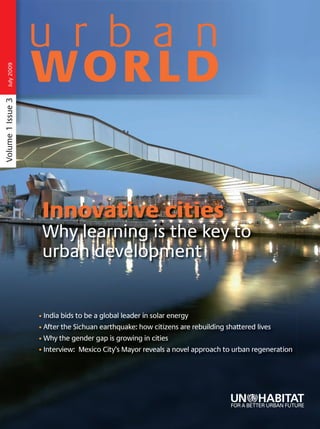

Innovative cities
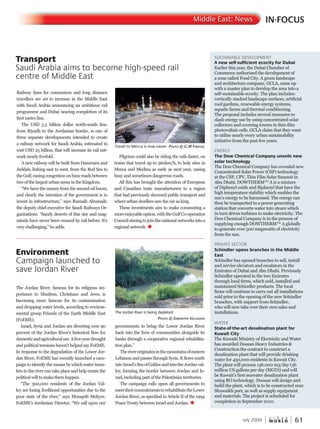
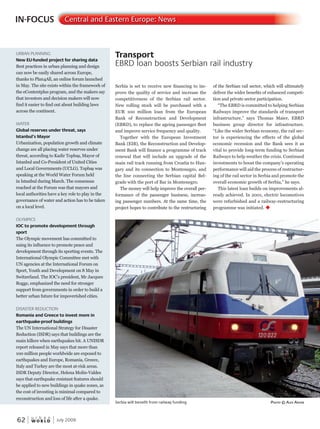
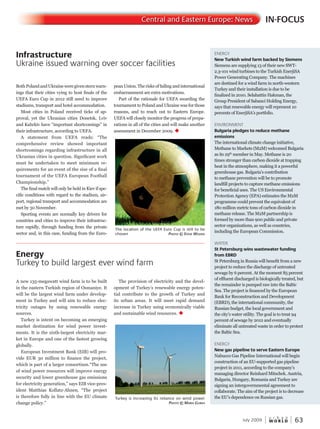
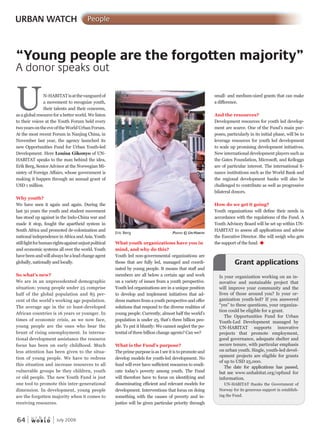
Why learning is the key to
urban development
July2009Volume1Issue3
WORLD
u r b a n
FOR A BETTER URBAN FUTURE
India bids to be a global leader in solar energy
After the Sichuan earthquake: how citizens are rebuilding shattered lives
Why the gender gap is growing in cities
Interview: Mexico City’s Mayor reveals a novel approach to urban regeneration
W O R L D
u r b a n
2 July 2009
CONTENTS
OPINION
4 Message from the Executive
Director
5 Drivers of change
Gary Lawrence ARUP
7 Cities and the business of the
environment
John D. Wiebe
9 Lessons from an elder
statesman
Interview with former
Mozambique President Chissano
COVER STORY
INNOVATIVE CITIES
11 Secrets of innovative cities
Tim Campbell
14 How innovation can drive
economic recovery
Christine Auclair
ANALYSIS
18 A new strategy to close the
gender divide
Emily Wong
22 Global parliamentarians
Berti Leinius
BEST PRACTICES
26 Giving revenue collection a big
boost in Somaliland
Antony Lamba, Asia Adam and
Edward Miller
29 Anji County
Li YU
32 News and project round-ups
(North America and Europe)
28
www.unhabitat.org
© 2008 UN-HABITAT
UN-HABITAT
P.O.Box 30030, GPO
Nairobi 00100, Kenya
Tel. (254-20) 762 3120
Fax. (254-20) 762 3477
E-mail: urbanworld@unhabitat.org
EDITOR: Roman Rollnick
EDITORIAL ASSISTANTS: Tom Osanjo, Eric Orina
EDITORIAL BOARD
Oyebanji Oyeyinka (Chair)
Daniel Biau
Lucia Kiwala
Anatha Krishnan
Eduardo López Moreno
Jane Nyakairu
Edlam Yemeru
Nicholas You
Mariam Yunusa
Raf Tuts
PRESSGROUP HOLDINGS EUROPE S.A.
San Vicente Martir 16-6-1
46002 Valencia, Spain
Tel. (34) 96 303 1000
Fax. (34) 96 303 1234
E-mail: urbanworld@pressgroup.net
PUBLISHER: Angus McGovern
MANAGING EDITOR: Richard Forster
STAFF WRITERS: Jonathan Andrews,
Kirsty Tuxford
ART DIRECTOR: Marisa Gorbe
ADVERTISING: Fernando Ortiz, Clive Lawson,
Kristine Riisbrich Christensen
Urban World is published four times a year by
UN-HABITAT and Pressgroup Holdings Europe
S.A. The views expressed in this publication
are those of the authors and do not reflect the
views and policies of UN-HABITAT. Use of the
term “country” does not imply any judgment
by the authors or UN-HABITAT as to the legal or
other status of any territorial entity.
EDITORIAL
Please send feedback to:
edit @pressgroup.net
ADVERTISING
To advertise in Urban World, please contact:
urbanworld@pressgroup.net
SUBSCRIPTIONS
Contact:
subscriptions@pressgroup.net
REPRINTS
Reprinted and translated
articles should be credited
“Reprinted from Urban World”.
Reprinted articles with bylines
must have the author’s
name. Please send a copy
of reprinted articles to the
editor at
UN-HABITAT.
W O R L D
u r b a n
11
Reprinted and translated
articles should be credited
“Reprinted from
Reprinted articles with bylines
name. Please send a copy
of reprinted articles to theInnovative cities
Why learning is the key to
urban developmentInnovative cities
July2009
Volume1Issue3
WORLDu r b a n
India
bids to be a global leader in solar energy
After the Sichuan earthquake: how citizens are rebuilding shattered lives
Why the gender gap is grow
ing in cities
Interview
: Mexico City’s Mayor reveals a novel approach to urban regeneration
PhotoPhotoP © WWithWithW the PermissionPermissionP of Bof Bof ilBaoBaoB turismoturismot
W O R L D
u r b a n
3
URBAN WATCH
64 People
“Young people are the
forgotten majority”
A donor speaks out
Interview with Eric Berg
UN-HABITAT News
66 UN-HABITAT reveals
Business Award winners
Jake Julian
68 Countdown to Expo 2010
Katja Makelainen and Maria-Jose
Olavarria
69 Publications
70 Book review
Medinas 2030
74 Calendar of events
75 Conference briefing
Cities at the climate change
frontline
IN FOCUS
36 Latin America
Mexico City rides a new wave:
interview with Marcelo Ebrard
Jonathan Andrews
News and project round-ups
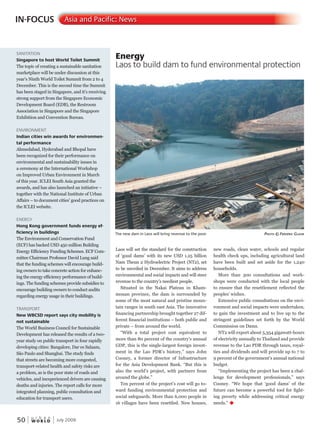
44 Asia and Pacific
Can India lead the global
market for solar power?
Kirsty Tuxford
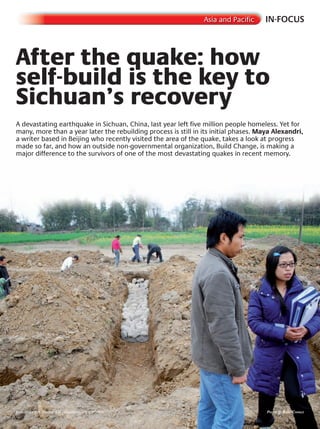
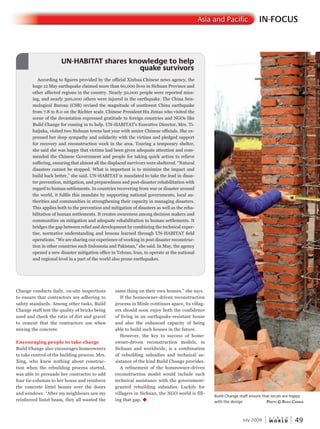
47 After the quake: how self-
build is the key to Sichuan’s
recovery
Maya Alexandri
News and project round-ups
53 Africa
Field report from South Sudan
Eduardo Feuerhake
News and project round-ups
60 Middle East
News and project round-ups
62 Central and Eastern Europe
News and project round-ups
July 2009
65
46
36 Volume 1 Issue 3
FOR A BETTER URBAN FUTURE
W O R L D
u r b a n
4 July 2009
Nearly 150 years ago, the
great French author and
thinker, Jules Verne (1828
– 1905) wrote about air travel, air con-
ditioning, metro rail systems, cars, te-
levision, the internet (a worldwide “te-
legraphic” system), and other pillars of
our globalized urban world several ge-
nerations before any of these were even
invented.
He even wrote about calculators and
a chair with an electric charge that was
used to execute criminals. And perhaps
just as startling, Verne predicted a geo-
metric, modern centrepiece built for
the Louvre. The glass pyramid standing
there today was built well over a lifetime
after his death. In that year 1863, he also
wrote about a tall tower in Paris – a generation before the Eiffel
Tower.
All of this in his futuristic novel, Paris in the 20th
Century.
And well before their time, he also spoke of modern skyscrapers.
His descriptions of the modern innovative city are very similar
to what we have in the real world today. How would he find it
today, browsing around a riverbank stall along the Seine with
posters of our planet from space, some showing the ravages of
climate change and pollution coming from dirty cities?
How would such a great urban thinker find our urbanized
world today?
It is a blight on our generation that he would probably not
have been surprised to see that we have reached a point in his-
tory early in the 21st
century where unless cities can be made
more sustainable, the legacy of negative environmental and so-
cial costs will become irreversible.
In this urban era with more than half of humanity living in cit-
ies and towns, urban poverty, deprivation and social exclusion
will become pervasive with a resultant increase in crime, and
health problems and, of course, political and social unrest.
Cities will continue to provide a refuge for those escaping con-
flict zones. Would Mr. Verne be shocked at our slums, today home
to one billion people mostly in cities in the developing world?
The negative consequences of rapid and poorly planned ur-
banization, including climate change, shows us that the local
and global agendas are one and the same. Well planned and
managed cities and communities are not only at the heart of
any effective strategy in reducing poverty and social exclusion
in an urbanized world, they are also critical to reducing the eco-
logical footprint of cities for sustainable development to become
possible. While there will be no single solution, the issues and
challenges are clearly universal and require global learning and
collaboration.
The question that needs to be posed is how can we harness
the positive aspects of urbanization to promote social inclusion,
smarter growth and thus contribute to our collective stability
and prosperity? How can urbanization become the cornerstone
of a new inclusive civilization? How can
we help create vibrant and socially cohe-
sive urban communities?
Would Mr. Verne have been able to tell
us how to use the economic downturn to
be more inventive and innovative?
The world’s urban professionals have
a huge responsibility in front of them
because reinventing cities is largely in
their hands. Architects, planners, sur-
veyors, engineers and landscape ar-
chitects, have an ethical if not moral
obligation to help confront the urban
challenge ahead. Each time architects
and planners draw a line, they define a
space. That space has to be more socially
inclusive and environmentally sounder.
What they design becomes part of the
urban landscape for generations to come.
The private sector has also an enormous role to play as driv-
ers of economic change and leaders of innovation. But this time,
given the nature of the global crisis, the business community has
realized that it has a stake in investing in people and in commu-
nities on a larger scale.
The private sector understands well that business cannot suc-
ceed in a society that fails and well functioning cities are needed
for harmonious development which in turn drives economies,
underwrites employment, and enables markets to work.
Therefore, the global financial crisis makes investing in inclu-
sive development more urgent than ever.
In this equation, national and local governments have a large
responsibility to support and encourage the professionals and
the private sector to work towards solutions and reinvent cit-
ies together while involving communities. This global challenge
will be at the heart of UN-HABITAT’s work in the years to come
with our new World Urban Campaign. The Campaign advocates
better design and better planning for urban spaces, safer and
healthier communities, and more equitable and inclusive urban
governance in order to attain better quality of life for everyone.
It will be about reinventing cities together as one global
community.
After all, the city is our greatest achievement. Although ro-
bust, it is also fragile, and it must have care and nurturing like all
resilient living organisms. Cities are the cradle of human inven-
tion, art, culture.
Our modern world’s economic, political and social stability
rests on the city’s shoulders. City states preceded the creation of
nation states. And today cities endure and this is truly something
to celebrate.
OPINION Message from the Executive Director
W O R L D
u r b a n
5
Should those of us who are doing just fine
feel any obligation to our fellow humans whose
local systems are in collapse? Should we take
steps to make life better for future people we
will never know? Should we try to make human
development more sustainable?
People now and in the future demand
that we completely integrate the aesthetic
and scientific factors, as well as the real
needs and desires of people – their senses,
their emotions and their diverse identities.
In this context it can be considered that
there are four critical stages to shifting from
one paradigm to another.
1. Gaining clarity about the nature
of the problem or opportunity
What if we accepted that the true cost of oil
is USD 480 a barrel?
There is a tendency to focus on attributes,
rather than fundamentals, because the
attributes are often more intuitively
obvious. Climate change is an attribute
of the more fundamental issues of en-
ergy and population growth and even
population growth is a function of available
energy resources, yet we have decided
that the problem is greenhouse gas
emissions.
That we do not really understand
the long-term causes and effects
at the intersection of natural
phenomena and human behaviour is quite a
barrier to sustainability. Neither mortal nor
computer model has the information and
perspective necessary to demonstrate exactly
what is going on, or what best to do.
The biggest barrier to making more re-
sponsible decisions about the present and fu-
ture is the number of individuals and groups
active in the discussion that are absolutely
certain about things for which certainty is ir-
responsible. One particularly virulent form of
this phenomenon is the propensity of groups
to be certain about the values, motives, and
desires of others without ever discussing
them honestly.
I am convinced that the ideas and viewpoints
of sustainability and sustainable development
are attractive. If we have the courage to reshape
the ideas in ways that have more natural and
emotional appeal to the citizens of the world,
we can, I think, see sustainable development be-
come the context through which civic renewal,
greater justice, more equity, and more construc-
tive ownership in our new urban future can
emerge.
Sustainability is both a physical reality and
a political choice. The physical reality is that
there is a limited amount of land, fresh water
and natural resources. As we use these up or
alter them so they are no longer beneficial,
we limit our future potential. Technological
innovation can help clean up some of our
messes, derive better benefits from underu-
tilized resources, and occasionally provide
substitutes for scarce resources.
OPINIONGary Lawrence
Sustainability and sustainable development are about how the Earth’s natural systems work
and how they affect and are affected by individual and aggregate human behaviour, writes
Gary Lawrence*, Principal and Urban Strategies Leader at Arup.
July 2009
Drivers of change:
building our urban
future
Gary Lawrence PhotoPhotoP © aruP
W O R L D
u r b a n
6 July 2009
OPINION Conflict in Africa taking the Responsibility to Protect
In June 2007, renowned energy expert
and analyst Milton Copulus, estimated
the true cost of oil at USD 480 per barrel.
This takes into account the direct and in-
direct costs, economic costs of oil supply
disruption, and military expenditures. This
would translate to USD 220 to fill the aver-
age family car in the United States. How we
value energy, price it, choose to use it, and
share it drives the climate equation.
If we were willing and able to fold all of
the now external costs of energy into fully-
loaded costs would that in itself make de-
sign more effective? Energy issues shape
possibilities about location, mobility and
access, and building form itself.
2. The problem or opportunity must
be addressed
What if we understood that it would take
at least 120 years for a standard waste in-
cinerator to produce the amount of dioxins
resulting from London’s Millennium fire-
works display?
Often we are certain we know the answer
without having undergone any sort of meth-
odological approach to gaining knowledge.
For instance, communities almost always
resist waste-to-energy facilities in part for
fear of emissions. But do they know that
one of the things most communities love
can be much more damaging? How do we,
in communicating what is really at stake in
such key decisions, move beyond conven-
tional wisdom into actual rational conver-
sations about cause and effect?
It can be all too easy for professionals to
propose solutions to problems that stake-
holders either do not think need addressing
or are of lower priority than other issues
cared about. Part of this is the result of not
getting the question right and this is facili-
tated by the tyranny of experts where the
public is expected to simply defer to the in-
tellectual superiority of others. Experience
teaches us that this is often a path to heart-
ache. And part is a failure to appreciate
and incorporate the wisdom of the masses
when they are provided unbiased informa-
tion that is accessible to them, not just to
the experts.
This is not to suggest that majority must
rule. The literature is pretty clear however
that if institutions and individuals that the
majority trusts and for whom they feel some
Conflict in Africa taking the Responsibility to ProtectConflict in Africa taking the Responsibility to ProtectConflict in Africa taking the Responsibility to ProtectConflict in Africa taking the Responsibility to ProtectGary Lawrence
kinship are not convinced that the problem
at hand is a priority then the majority will
withhold their permission.
3. Knowing what to do and being hon-
est with the public
Some 35 million new housing units are
needed annually – or 95,000 units daily –
to meet the world’s urban housing need. In
2005, one out of three urban dwellers was
living in slum conditions.
We can feel more confidence (and influ-
ence) when addressing attributes of prob-
lems rather than fundamentals, but ad-
dressing attributes will never solve the un-
derlying problems. For instance, design can
go a long way towards addressing aspects of
some problems.
However, great design of products that
do not advance civilization merely uses up
scarce resources without addressing the
core of the problem. The fundamentals are
nearly always political. We make choices
rooted in the interplay of self-interest,
sympathy for others, respect for others, and
concerns about our own morality.
Nowhere is the ascendancy of self-inter-
est more apparent than in addressing our
housing issues.
Getting housing built for the homeless
and poorly housed is a serious problem. In
my days as planning director for the City of
Seattle, we used the term affordable hous-
ing to describe housing units that could be
afforded by those with household incomes
less than the regional median household
income. After a long and painful process,
we discovered that for most residents in
the communities in question, the term af-the communities in question, the term af-the communities in question, the term af
fordable housing meant “housing for peo-
ple who aren’t like us, who don’t share our
values, and who are threats to our property
and lives.” It is not surprising that there is
such resistance to affordable housing.
Finding ways to reduce the psychologi-
cal distance between communities that
perceive themselves as stakeholders in the
future of a place and those that they per-
ceive as not stakeholders is very tough. If
we can’t find formulas in which sympathy,
respect for rights, and concerns about each
other’s individual moral identity balance
the perceived self-interest of those who fear
the change, then it is possible only at huge
political cost.
4. Choosing to do what we know
Cities house half the world’s population
but consume three-quarters of the world’s
resources and produce three-quarters of
the world’s pollution.
We are not focusing sufficiently on the big
questions that shape our future. The activi-
ties of urban settlements are key contribu-
tors to climate change factors. For most
people in the world, the lack of water for
irrigation of crops and the lack of potable
water for drinking will have a much more
dramatic and immediate effect than rising
sea levels and the increasing range of com-
municable disease associated with temper-
ature increases. Global climate change and
its current and potential consequences for
life property and prosperity are accepted as
the major challenge for human society in
the next 100 years.
Without the choice to act, and in the
cases we care about the choice to act differ-
ently, conventional wisdom will dominate
and we will make much less progress than
would otherwise be possible. The choice to
act differently is a risk management issue
– political risk, financial risk and resource
management risk. u
*Gary Lawrence is a principal at Arup
and its Urban Strategies Leader. He
provides thought leadership for strategic
urban development throughout the firm’s
70 global offices. With roots in Seattle,
he has served as advisor to the Clinton
Administration’s Council on Sustainable
Development, UN-HABITAT’s landmark
Habitat II conference in Istanbul in
1996, the US Agency for International
Development, the Brazilian President’s
Office, the British Prime Minister’s
Office, the European Academy for the
Urban Environment in Berlin, and
the Organization for Economic and
Community Development (OECD) in Paris
on matters of sustainable development
and environmental policy. He is actively
involved in the local and national chapters
of the Urban Land Institute, the American
Planning Association, and the US Smart
Growth Leadership Council. In Bellingham,
Gary serves as Adjunct Professor at
Huxley College of Environmental Studies
at Western Washington University.
W O R L D
u r b a n
7July 2009
Environmental concerns and activi-
ties increasingly are a part of our
everyday lives. As nations large
and small, rich and poor strive to cope with
the changing social, economic and ecological
challenges of urban growth, our concepts of
what constitutes the business of the environ-
ment are also changing.
Historically the business of the environ-
ment encompassed activities and enterprises
focused on solving problems of air and water
pollution, the remediation of contaminated
land, the supply and reuse of water, and the
management of liquid and solid wastes.
More recently the environmental market-
place has grown to include the development
of technologies to supply and make more ef-
ficient our use of energy, both traditional fossil
fuel based and from renewable sources.
Increasingly people are finding employ-
ment in a broad cross section of sectors that
now comprise the green economy many of
which did not provide significant environmen-
tal content in the past.
These include activities and enterprises
designed to reduce carbon emissions, particu-
larly in the transport and construction sectors;
to transform our cities into more sustainable
and healthier places in which to live and work;
and to provide more environmentally friendly
goods and services for an increasingly urban-
ized global population.
The business of the environment in to-
day’s urban-centered world has changed to
encompass most of those activities that de-
fine the quality of our daily lives.
The fact that more than half of humanity
now lives in cities is well known.
Responding to the environment-related
challenges of rapidly growing urban popu-
lations – particularly in the mega-cities of
the developing world – is a daunting un-
dertaking, the enormity of which cannot be
minimized. It is a task involving more than
supplying safe drinking water, improving
air quality, providing adequate housing, or
managing the disposal or recycling of waste.
It extends to the very form and design of
cities and of the transportation, communica-
tion and distribution networks that are the
lifelines of cities. It encompasses the crea-
tion of urban spaces where people can live
and work, and to the restoration of ecologi-
cal balances between cities and the hinter-
lands that sustain them. It includes making
better use of the energy needed to power the
services and facilities upon which we depend
to survive.
The enormity of this challenge is in fact
the wellspring of the changes that have
transformed the business of the environ-
ment. The demand for housing in urban ar-
eas has prompted the redesign of buildings
and the products used to construct them to
accommodate greater urban densities while
improving the amenities needed for healthier
living.
The increased demand for and the rising
costs of energy have sparked the redesign
of household appliances, heating and light-
ing fixtures, passenger vehicles, and many
other consumer products to make them more
energy efficient and durable. On a broader
scale they have stimulated a technological
revolution focused on harnessing new forms
of low-carbon energy and transforming and
smartening the electricity grids that power
our cities and towns.
The need to feed, clothe and keep healthy a
growing population has led to more sustain-
able supply networks for food and water, and
in the management of liquid and solid wastes.
Municipal waste to energy systems are becom-
ing commonplace and the technologies they
employ more innovative.
In effect, whereas in the past urbanization
was viewed as a bad thing, that led people to
live in miserable conditions in slums with few
opportunities to find work, or to educate their
children or to escape poverty, many now see
urbanization as the engine of growth that can
lead to cities which, if well planned and man-
aged, offer their residents new opportunities
for productive lives.
A useful analogy to better understand the
enormity of the transformation of the business
OPINIONJohn D. Wiebe
Cities and the
business of the
environment
John D. Wiebe PhotoPhotoP © GloBe foundation
Urbanization has transformed human society and in the
process is redefining the business of the environment, says
John D. Wiebe, President and CEO of the Vancouver-based
GLOBE Foundation of Canada, a not-for-profit organization
dedicated to finding practical business-oriented solutions to
the world’s environmental problems.
W O R L D
u r b a n
8 July 2009
of the environment is to view cities as living
beings. Cities can grow old and can die, as
do all living things; and maintaining good
health applies as much to cities as it does
to the people who live in them. Cities can
be reborn.
Building on the parallel with medicine,
there is equally a split between treating ill-
ness and preventing it, between remedying
environmental problems and preventing
them.
Perhaps the greatest preventative chal-
lenge the world now faces relates to climate
change, and cities are highly vulnerable in
this regard, particularly those in low lying
areas relative to adjacent oceans, or in wa-
ter scarce regions where persistent drought
conditions prevail. Increasingly the busi-
ness of the environment is focused on de-
ploying the measures required to adapt to
the impacts of climate change or to protect
cities from violent weather disturbances
and flooding.
Today’s business of the environment is
cross-sectoral, multi-disciplinary and links
almost every industrial sector in the mod-
ern economy. Almost every organization in
OPINION John D. Wiebe
Cities need to be healthier and more sustainable places
to live and work PhotoPhotoP © dandand PaPaP WleyWleyW
business and government has environmen-
tal considerations it must deal with. Even
the finance, banking and insurance indus-
tries are being influenced by environmental
concerns, many of which relate to climate
change and global warming.
That is why growth estimates for the busi-
ness of the environment are so persistently
high relative to other economic sectors.
Over the past decade growth in traditional
‘end-of-pipe’ environmental business activ-
ity has risen by 3 to 5 percent a year in most
developed economies, but at much higher
rates – approaching and often exceeding 10
percent per year in many emerging econo-
mies, particularly in India and China.
When renewable energy and low carbon
technology sectors are factored in, antici-
pated growth rates for the business of the
environment increases dramatically.
Countries in Eastern Europe still require
enormous investments in basic environ-
mental infrastructure, such as water supply
and waste management. Developing coun-
ties in Asia and South America require mas-
sive investments in primary environmental
services including clean air, water and land
over the next 10 years. The most significant
potential growth in environment-related
business is found in China and India, the
world’s most populated nations.
In addition to the traditional environ-
mental goods and services industries, re-
newable energy technologies are forecast
to grow exponentially over future decades.
The International Energy Agency forecast
that by 2030 renewable electrical genera-
tion including hydropower, wind, solar,
geothermal, wave and tidal power will grow
globally by 145 percent over 2008 figures.
Even in the shorter term, growth fore-
casts for the key components of the envi-
ronmental business sector are positive,
notwithstanding current economic condi-
tions. Growth in traditional environmental
goods and services will exceed 22 percent
by 2015 over 2007/8 levels; by 45 percent
in the emerging low carbon component,
and by an astounding 63 percent in the re-
newable energy sector.
Efforts to tackle climate change will cre-
ate millions of new green jobs in the com-
ing decades, according to a joint study last
year by the International Labour Organiza-
tion and the UN Environment Programme
on the global green economy. Key findings
include:
Sectors particularly important for their
environmental, economic and employment
impact are energy supply, renewable ener-
gy, buildings and construction, transporta-
tion, and basic industries such as agriculture
and forestry.
Already over 2.3 million people work in the
renewable energy sector and an additional
20 million jobs are expected.
In agriculture, 12 million new jobs could
be created in biomass for energy and related
industries.
A worldwide transition to energy-efficient
buildings would create millions of jobs, as
well as existing employment for many of the
estimated 111 million people already in the
construction sector.
Investments in improved energy efficiency
in buildings could generate an additional
2 - 3.5 million green jobs in Europe and the
United States alone, with much higher poten-
tial in developing countries.
Recycling and waste management em-
ploys an estimated 10 million in China and
500,000 in Brazil today and is expected to
grow rapidly in many countries due to esca-
lating commodity prices.
In short, the business of the environment
in the world’s cities will continue to expand
and in the process will improve the quality
of living for city dwellers everywhere, and
also create new livelihoods and economic
prosperity. The future of our planet de-
pends on it. u
The GLOBE Foundation, formed in 1993,
has helped companies and individuals
realize the value of economically viable
environmental business opportunities
through its conferences and events, re-
search and consulting, project manage-
ment, communications and awards. It
helped, for example, to ensure that the
third session of UN-HABITAT’s World
Urban Forum in Vancouver in 2006 was
a landmark historic event. For further in-
formation see: www.globe.ca
The Globe Foundation
W O R L D
u r b a n
9
Here are eight lessons I learned
from President Chissano about
facilitating peace on the local
and global stage. Many of his words of wisdom
below apply to business practices as well.
1. Be realistic
Peace is sometimes more complicated to keep
than to make. After a conflict, people are ea-
ger to recover and you have to go through the
process of reconciliation, especially when the
conflict involves internal enemies – nationals
of the same country.
It’s complicated. After reconciliation the
situation is not the same as before the con-
flict. You cannot reconstitute the country the
same way. You have to learn how to live in
new conditions.
How it applies to business: manage peo-
ple’s expectations regarding conflict and
change.
2. Keep making peace all the time
Peace-building is about many things. The
material reconstruction and infrastructure –
schools, hospitals, shops and homes.
But then there is also social reconstruction.
Families, disarmament and demobilizing, the
reintegration of refugees, and displaced peo-
ple starting life anew. Reconciliation requires
maintaining unity. Peace-building is progres-
sive and it doesn’t stop. You have to keep
working at it all the time.
OPINIONPresident of Mozambique
July 2009
How it applies to business: take a hard
look at who all your stakeholders are and keep
them meaningfully involved all the way.
3. Keep your eye on the horizon
Always keep your eye on the overall vision:
maintaining reconciliation and unity. Learn
how to live in and with new conditions. Keep
being creative.
How it applies to business: balance being
present and future focused.
4. Look to your roots
Don’t forget the root causes of conflict (such
as the root causes of tradition), and don’t just
take a superficial look.
Language is important, values can be
found in verbs – especially in a country where
people speak different languages even in the
same province.
How it applies to business: dig deep -
how does your organizational culture affect
conflict?
Lessons from an
elder statesman
One of the world’s greatest men of peace, Joaquim Chissano,
the former president of Mozambique, told a youth summit on
the eve of the fourth session of the World Urban Forum last
year that he always looks up to them for wise counsel and
advice. Mr. Chissano, who speaks five languages, is the winner
of the inaugural Mo Ibrahim Prize for Achievement in African
Leadership in 2007. He led Mozambique for 18 years during
which he steered the country out of a devastating civil war.
Lee-Anne Ragan met him in Nanjing last November when
they presented a workshop together on peace building at the
fourth session of the World Urban Forum.
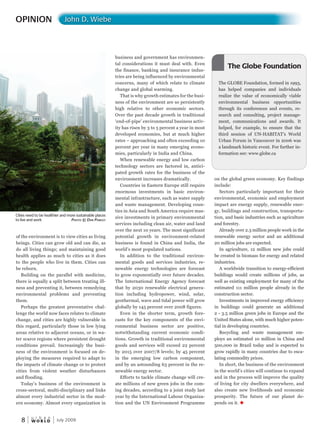
Peace has been kept in Mozambique PhotoPhotoP © alan rainBoW
President Joaquim Chissano PhotoPhotoP © un-hahah Bitat
W O R L D
u r b a n
10
How it applies to business: figure out what
is expressed in your organization that may
not be understood by everyone and ensure
better understanding and shared values.
6. Embrace technology but never lose
sight of the basics
My mother cultivated her fields using tradi-
tional methods. But as the population grew
5. Respect diversity, language and
culture
Mozambique lacks a national language. One
does not realize how much this affects a na-
tion when one has to speak through inter-
preters. You cannot pretend that everyone
will understand what you say. Keep cultures
alive. Show respect for the ways people bury
their dead or celebrate their weddings.
OPINION President of Mozambique
July 2009
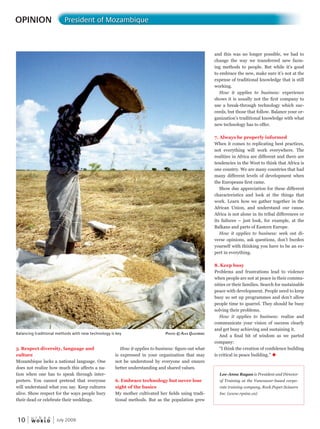
Balancing traditional methods with new technology is key PhotoPhotoP © alex Qlex Qlex uistBuistBuist erG
Lee-Anne Ragan is President and Director
of Training at the Vancouver-based corpo-
rate training company, Rock.Paper.Scissors
Inc. (www.rpsinc.ca)
and this was no longer possible, we had to
change the way we transferred new farm-
ing methods to people. But while it’s good
to embrace the new, make sure it’s not at the
expense of traditional knowledge that is still
working.
How it applies to business: experience
shows it is usually not the first company to
use a break-through technology which suc-
ceeds, but those that follow. Balance your or-
ganization’s traditional knowledge with what
new technology has to offer.
7. Always be properly informed
When it comes to replicating best practices,
not everything will work everywhere. The
realities in Africa are different and there are
tendencies in the West to think that Africa is
one country. We are many countries that had
many different levels of development when
the Europeans first came.
Show due appreciation for these different
characteristics and look at the things that
work. Learn how we gather together in the
African Union, and understand our cause.
Africa is not alone in its tribal differences or
its failures – just look, for example, at the
Balkans and parts of Eastern Europe.
How it applies to business: seek out di-
verse opinions, ask questions, don’t burden
yourself with thinking you have to be an ex-
pert in everything.
8. Keep busy
Problems and frustrations lead to violence
when people are not at peace in their commu-
nities or their families. Search for sustainable
peace with development. People need to keep
busy so set up programmes and don’t allow
people time to quarrel. They should be busy
solving their problems.
How it applies to business: realize and
communicate your vision of success clearly
and get busy achieving and sustaining it.
And a final bit of wisdom as we parted
company:
“I think the creation of confidence building
is critical in peace building.” u
W O R L D
u r b a n
11
COVER STORYInnovative cities
July 2009
Secrets of innovative
cities
Many of the cities that have implemented innovations in recent decades have drawn on
systematic learning, much of it gained from sources outside the city. Here Tim Campbell*,
Chairman of the Urban Age Institute, says that recent evidence suggests that cities are on the
move, actively seeking to find good and better practices.
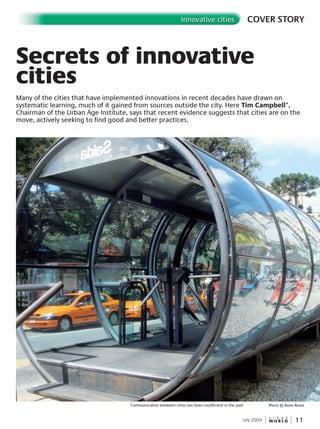
Communication between cities has been insufficient in the past PhotoPhotoP © sashasashas aickin
W O R L D
u r b a n
12 July 2009
COVER STORY Innovative cities
Why don’t cities learn?
In effect, they have already formed a large
shadoweconomyofknowledge.Theyknowthat
successful places have reformed, restructured,
or enjoyed regional competitiveness. What is
not so well known is that successful places en-
joy a kind of soft infrastructure composed of a
learning environment that is characterized by
trustworthy relationships, a culture of sharing,
and a willingness to collaborate.
But how is this achieved? The UN-HABITAT
Dubai Best Practice Awards have identified
and celebrated hundreds of great innovations.
But larger numbers of cities lag behind, or are
bogged down in making reforms. Why are suc-
cesses in a few places not spread more rapidly?
Why don’t cities learn?
The growing body of work in the academic
and institutional literature has largely ignored
these questions, although scholars in several
distinct domains — organizational learning
(and learning organizations), capacity — and
institution building, social capital, regional
competitiveness — provide some clues for ex-
ploration, for instance about the conditions,
mechanisms and measurement of learning.
At the same time, regional economists and
geographers have sensed that city and regional
competitiveness consists of some special re-
gional attributes that depend on home-grown
qualities.
Snapshots of learning innovators
Recent research shows that innovative cities
like Bilbao, Curitiba and Seattle have many
similarities and important differences. First,
they are similar in that a crisis or shock of some
kind jolted them into action.
Bilbao perceived and reacted successfully
to a threat to the city’s economic survival with
eliminationoftradeprotectionswiththeforma-
tion of the European market; Curitiba foresaw
increasing congestion in its inner core and was
already vulnerable to chronic flooding. Seattle
also experienced crises, first in the 1970s and
again in the 1980s, with the cutbacks at Boeing
Aircraft, one of the city’s primary employers.
Second, in each of these cases, the cities val-
ued information and knowledge and took the
initiative to obtain it, creating different mecha-
nisms of discovery, proactively seeking out
knowledge from other parts of the world to feed
into city thinking and planning.
Third, the cases provide three different
versions of proactive learning that might be
labelled “corporate”, “technical”, and “infor-
mal”, respectively.
Bilbao pursued complex organizational ar-
rangements in Metropoli 30, an agency that
brought a large variety of stakeholders to the
table incorporated them into a formal struc-
ture with a balance of powers and transpar-
ency in deliberation, decision-making, and
implementation.
Curitiba structured its learning process in
IPPUC, the Planning and Research Institute
of Curitiba. The most important elements of
learning took place within a smaller techni-
cal staff of seasoned professionals operating
interactively with each other.
The learning style of the Trade Develop-
ment Alliance (TDA) in Seattle is the most
informal, and in many ways, inward of the
three cases. The intense interaction among
participants in Seattle’s annual study tours
and trade missions has the effect of breaking
down barriers and forging new bilateral and
multilateral understandings among public,
private, and civic groups taking part in the
outbound visits.
These cities are all proactive about knowl-
edge, and each has its own way of accom-
plishing this. The flagship organizations in
each case — Metropoli 30, IPPUC, and the
Trade Development Alliance, and more re-
cently the Prosperity Partnership — all play a
role in keeping track of events, documenting
findings, and building a data base.
Each of the cities has taken on the role of
tracking performance indicators. Curitiba en-
joyed a clear mandate from the beginning and
currently supports a strong data base on city
management and performance. Basic infor-
mation on demographics, land use, income,
economic fundamentals, and environmental
quality helped IPPUC partner with national
authorities in many projects and activities,
for instance, housing census and infrastruc-
ture projects.
Bilbao has assigned importance also to
benchmarking and now trades on this data
and comparative analysis that it makes pos-
sible. Likewise, Seattle and the Puget Sound
Prosperity Partnership are now developing
data and city indicators, recruiting other cit-
ies from the Pacific Rim and Europe to take
part in comparative analysis about innova-
tion and competitiveness.
Perhaps the most important repository of
acquired knowledge is in the minds of the
many actors involved in learning – members
of the public and private sectors, civil society
organizations and neighbourhood groups.
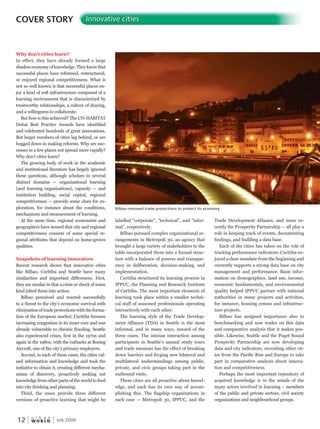
Bilbao removed trade protections to protect its economy
W O R L D
u r b a n
13July 2009
COVER STORYInnovative cities
Proactive cities have excelled in building and
strengthening systemic relationships between
and among members broad segments of civil
society. The continuity of policy, political
commitment, and practice, seen most strik-
ingly in IPPUC, has allowed the creation of
deep reservoirs of knowledge and learning
that are continuously available to city deci-
sion-makers and private and civic partners.
Seattle and Bilbao also built up a large stock
of knowledge in their respective networks.
These practices in all three cities under-
score the importance of longevity of com-
munity members and rates of turnover in the
professional and artistic talent in the com-
munity.
The bottom line is that the soft infrastruc-
ture, i.e. the collaborative character and
cooperative spirit of a place, is intangible
but indispensable. Though information and
communication technologies are important,
they do not show up as a central feature of
innovative cities. Rather, it is the collective
learning in a place, the activities that engage
a wide cross-section of stakeholders that
break down internal barriers and create com-
mon understanding. Innovative places create
a culture of knowledge. Perhaps it could be
called a learning culture.
Learning without change
Of course, not all learners are innovators.
Cities have different types of learning styles
that affect the outcome of their efforts. Let
us call the proactive learner-innovators
Type 1. Others vary in many ways, although
the following categories are neither tidy nor
mutually exclusive.
A second type engage in a specialized, self-
defined classes — like cultural heritage cities
or Agenda 21 cities — let’s call them Type 2.
They focus on specific goals, have a narrower
scope of concern, and restrict the extent to
which the learning reaches into the commu-
nity. Though the process of learning in Type
2 cities may last more than a decade, if the
engagement is intermittent and core stake-
holders are limited, the formation of the soft
infrastructure is stunted.
Similarly, cities that engage in twinning —
lets call them Type 3 learners — may take part
in high intensity learning, but twinning is usu-
ally focused on one or two core business prac-
tices, for instance, procurement or community
based planning, and confined to a restricted
number of participants, often city employees.
The interactive process is short term and usu-
ally technical. Many cities in Type 2 learning
and most in Type 3 have much less opportu-
nity than Type 1 cities to establish a continuity
of learning, extensive and repeated interaction
with many players, and depth of common un-
derstanding.
Similarly again, those cities that learn
new ideas and concepts in conferences and
on the web, Type 4 learners, might be said
to be grazing on externalities of knowledge
events, but enjoy little if any net effect on
collaborative spirit and the construction of
a soft infrastructure.
At the same time, prospective learners can-
not ignore the potential value of grazing. All
cities can benefit from accidental discoveries,
but few cities can expect much in new knowl-
edge and even less in soft infrastructure by
engaging only in Type 4 learning. Accordingly,
cities need to manage two types of learning
connections, loose and strong.
Light on the shadow economy of
learning in cities
An informal survey of 27 cities throws ad-
ditional light on the shadow economy of
learning. A web-based survey conducted
by the Urban Age Institute covered mostly
cities in Asia and Latin America. The
survey identified innovators in terms of
self-declared “reformers” as opposed to
“non-reformers”. To what extent are cit-
ies engaged in learning, what modalities
are involved, and how to innovators differ
from the others?
Intensity of learning: For starters, the sur-
vey found that innovative cities spend a lot
more time learning than the rest. Respond-
ents in reformer cities personally devoted
an average of 3.6 weeks per year (upwards of
12 percent of the real working year) acquir-
ing new knowledge in city to city exchanges,
whereas the non-reformers spent only 2.8
weeks in this activity. These compare to na-
tional level investments in learning of 3 to 6
percent for OECD countries and to 5 to 7 per-
cent of staff time in training in US corpora-
tions in 2008, respectively.
Modality of learning: When asked about
the most effective form of learning, for in-
stance, seminars, private sector sources, uni-
versity courses, activities of associations and
city-to-city exchanges, this latter category
ranked first and was ranked much higher by
the innovative cities.
Content of learning: Cities indicated pri-
ority interest in a surprisingly small number
of substantive and policy areas. Urban plan-
ning and transport were each mentioned by
half the respondents, followed closely by
economic development and urban renewal
and reconstruction. Utilities such as water,
electricity, solid waste and housing trailed
well behind. On management issues, re-
spondents indicated an interest in finance,
urban policy making and metropolitan gov-
ernance, in that order.
Storage of knowledge: An important meas-
ure of learning activity is the extent to which
learning is documented or tracked. Here the
picture is mixed. Only a few respondents
reported no record keeping at all. The rest
made use of a blend of in-depth record keep-
ing, follow-up, and monitoring. The question
is important because of the issue of storage
and ability of a city to build knowledge over
time. Recall that the three cases of proactive
(Type 1) learning cities described earlier sug-
gest that both hard and soft forms of storage
are important, but little is known about how
these forms are blended and interact with
learning or indeed, whether patterns or even
strategies of learning are formed. u
PhotoPhotoP © WithWithW the Permission of Bof Bof ilBaoBaoB turismoturismot
W O R L D
u r b a n
14 July 2009
COVER STORY Innovative cities
How innovation can
drive economic recovery
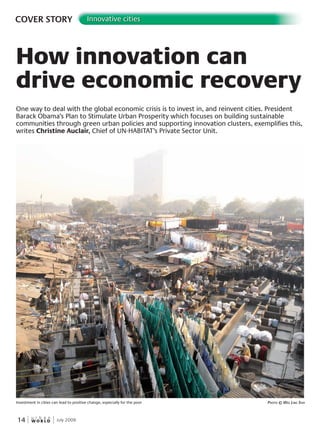
One way to deal with the global economic crisis is to invest in, and reinvent cities. President
Barack Obama’s Plan to Stimulate Urban Prosperity which focuses on building sustainable
communities through green urban policies and supporting innovation clusters, exemplifies this,
writes Christine Auclair, Chief of UN-HABITAT’s Private Sector Unit.
Investment in cities can lead to positive change, especially for the poor PhotoPhotoP © WeeWeeW linG soh
W O R L D
u r b a n
15July 2009
COVER STORYInnovative cities
New housing and related infra-
structure investments in cities
can act as key engines for eco-
nomic regeneration to restore the wealth of
households and generate new demand. Ms.
Jane Jacobs, the late Canadian urban vision-
ary, was among the first to argue that cities are
the true engine of growth and that innovation,
in the long run, is what keeps cities vital and
relevant. The question is: Will the financial
crisis inspire innovation that will help cities
reenergize their creative economies and gen-
erate sustainable solutions?
In the 1930s, at onset of the great depres-
sion a movement of planners came up with vi-
sionary projects, using new technologies and
principles, which made up the modern city as
part of a political project to reinvent societies.
In the United States, the New Deal produced
gigantic infrastructure and housing projects.
War and recession, coupled with population
increase and urbanization, pushed society at
the time to reinvent cities.
Today’s economic downturn has brought
some dramatic fiscal and revenue reductions
in many cities, affecting investment, develop-
ment and maintenance of infrastructure. Busi-
ness is seriously affected in key manufacturing
regions, cutting more and more jobs. In times
of crisis, a CEO will tell you that customers are
under stress. Yet some will disappear and oth-
ers will emerge stronger. And the market, as it
has done for the past 30 years, will return to
growth – led by the companies that took ad-
vantage of the downturn to become even more
valuable, to grow even faster. This time, for
many, confidence in the market has vanished
like a bubble burst before our eyes, calling for
real new thinking.
In order to forge a vision for innovative cit-
ies, one has to go back to the basics and look
at urban survival options in the most affected
part of the world. Walking through a slum,
the amazing number of small businesses is
striking. These are businesses one would
never think of: a visitor can find hand-made
windmills, solar batteries and pumps to bring
water and energy to homes, and retail shops
selling repackaged products in easy sellable
small quantities to cater for slum customers at
amazing prices.
Innovation based on survival strategies can
lead to smart ideas. One recent outstanding
example is mobile phone money transfer sys-
tem used by people without bank accounts.
They are now a huge market for cell phone
companies and such services clearly improve
people’s lives. At the bottom of the pyramid,
there are lessons to be learned. The simple
and most economic solutions generated in
tough times can be optimal at best, and rep-
licable, even if they are not ideal or not what
most people necessarily want.
Where will innovation lead in this double
global financial and environmental crisis?
A simple answer might be where the talent ex-
ists. But matters are far more complex, with the
likeliest beneficiaries being the strongest eco-
nomic regions that work as engines of the global
economy as well as talented and innovative cen-
tres that accompany their development.
Richard Florida, writing last month in the
The Atlantic magazine on how the new down-
turn will reshape America argues that the fi-
nancial crisis will create “great mega-regions
that already power the economy, and the
smaller, talent-attracting innovation centres
inside them”.
Citing the United States as the example, he
said that a reshaped America will be focused
on these mega-regions and be “a landscape
that can accommodate and accelerate inven-
tion, innovation, and creation”.
According to recent studies, the world’s 40
largest mega-regions produce two-thirds of
global economic output an about nine out of
10 new patented innovation. They host only 18
percent of the world population. What is be-
hind the strength of these mega-regions?
The Nobel laureate Robert Lucas, gives one
explanation in the Journal of Monetary Eco-
nomics suggesting that talent-clustering is a
key driver of economic growth. Further, talent
rich eco-systems benefit from an accelerated
rate of urban metabolism said another study
published by the Santa Fe Institute. It added
that successful cities, unlike biological organ-
isms actually get faster as they grow. They can
overcome financial problems with more ease
than others, keeping talents and absorbing
growing and successful businesses. Hence, it
seems that eco-systems most likely to suffer
from the financial downturn are those which
are at a distance from high finance and least
connected to the strong economic hubs.
Along the same lines, a recent study of the
world geography of innovation from McKinsey
illustrated by a new Innovation Heat Map, has
identified the factors common to successful
innovation hubs – the business environment,
government and regulation, human capital,
infrastructure and local demand. The study
shows that innovation hubs are characterized
by broad portfolios of businesses and sectors
and that diversification is the key to long-term
survival.
In the end, those more likely to face the
crisis and foster innovation are the great
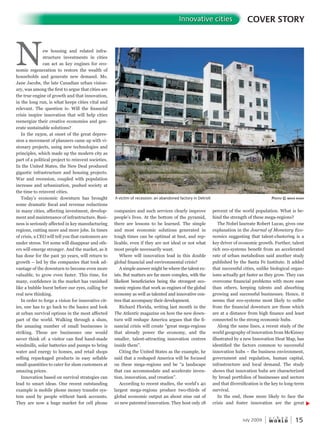
A victim of recession: an abandoned factory in Detroit PhotoPhotoP © maha rashi
W O R L D
u r b a n
16
They argue that a lot can be learned
from the spirit of collaboration in informal
settlements and the ingenuity in the use of
space.
Where is innovation, between the slums
and the high tech mega-city region hubs?
In the present scenario of global eco-
nomic divide, we can expect different types
of innovation, in two different worlds. This
might not be the wisest way to go for future
generations. Facing such a divide calls for
collaboration and interactive learning.
In an increasingly interconnected world,
spurred by digital innovation, the flow of
information will increase, knowledge will be
closer and learning made easier for everyone.
Reinventing cities might then become an
easier game than we think. u
facturing sector, a rapid population de-
cline, empty houses and schools and a city
unable to reinvent itself. The US has never
questioned its suburban sprawl so much
since the collapse of the mortgage system
last year. Writing recently in the New York
Times, two researchers defended the highly
developed Indian slum of Dharavi as “per-
haps safer than most American cities”, “pe-
destrian-friendly where children can play,
in the streets.”
Also, the discovery that Mexican slums
have been built with the waste of San Diego
including aluminium windows and garage
doors can teach us a lot. “Debris is building
these slums,” said Christian Werthmann
and Teddy Cruz as cited in the Boston Globe
earlier this year.
mega-regions with a broad range of activities
and clusters of talents.
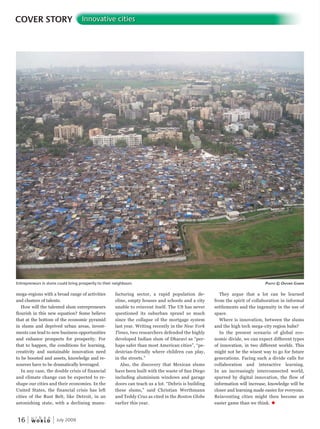
How will the talented slum entrepreneurs
flourish in this new equation? Some believe
that at the bottom of the economic pyramid
in slums and deprived urban areas, invest-
ments can lead to new business opportunities
and enhance prospects for prosperity. For
that to happen, the conditions for learning,
creativity and sustainable innovation need
to be boosted and assets, knowledge and re-
sources have to be dramatically leveraged.
In any case, the double crisis of financial
and climate change can be expected to re-
shape our cities and their economies. In the
United States, the financial crisis has left
cities of the Rust Belt, like Detroit, in an
astonishing state, with a declining manu-
July 2009
COVER STORY Innovative cities
Entrepreneurs in slums could bring prosperity to their neighbours PhotoPhotoP © oxfordoxfordo GamerGamerG
W O R L D
u r b a n
17July 2009
For further information about advertising in Urban World please contact our team at:
Advertising Sales Department
Pressgroup Holdings Europe S.A.
C/San Vicente Martir, 16-6º-1
Valencia 46002 – Spain
Tel: +34 96 303 1000
Fax: +34 96 394 27 88
Email: fernando.ortiz@urbanworldmagazine.com
To subscribe contact: subscriptions@urbanworldmagazine.com
W O R L D
u r b a n
FOR A BETTER URBAN FUTURE
Urban World is the leading publication for those responsible for the social and
economic growth of the world’s cities, providing a unique source of practical
solutions and information on sustainable development.
Each issue provides cutting-edge coverage of developments in:
l Water and wastewater
l Renewable and green energy
l Transport and infrastructure
l Financing urban development
l Tourism and heritage
l Disaster management
Regular news and features on Latin America, Africa, the Middle East, Central and
Eastern Europe and Asia are accompanied by articles highlighting best practices
from North America and Europe.
Readers include government ministers, mayors, local government officials,
procurement heads, urban planners, development bank officials, CEOs and CFOs
of companies assisting urban development, commercial and investment banks,
consultants, lawyers and NGOs. Urban World is published in English, Spanish, Russian
and Mandarin.
W O R L D
u r b a n
18 July 2009
ANALYSIS Women at risk from poverty
The combined impact of rapid urbanization, climate change and global economic downturn
is creating further inequalities between men and women in cities, especially among the poor,
writes Emily Wong of UN-HABITAT’s gender mainstreaming department. Here she explains
how the agency is seeking to remedy this through a new Gender Equality Action Plan.
A new strategy to close
the gender divide
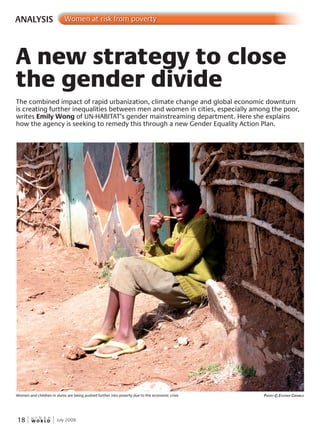
Women and children in slums are being pushed further into poverty due to the economic crisis PhotoPhotoP © evGvGv enia GrinBlo
W O R L D
u r b a n
July 2009 19
In April this year, the 58 member States
in the Governing Council that oversees
UN-HABITAT backed a new strategy
on promoting gender equality and empowering
women. The Gender Equality Action Plan pro-
vides a road map for all UN-HABITAT program-
mes to address gender concerns in the course of
pursuing a better urban future in a world where
more than half of humanity lives in towns and
cities.
Under the Millennium Development Goals,
the global community made a commitment to
achieving “a significant improvement in the lives
of at least 100 million slum dwellers” by 2020.
However, the United Nations has calculated that
the financial crisis, with high and volatile food
and energy prices, has pushed at least 100 mil-
lion people around the world back into poverty.
Both men and women in slums face problems
associated with poverty, poor living conditions
and lack of social safety nets. But research shows
that women and girls are by far the worst af-that women and girls are by far the worst af-that women and girls are by far the worst af
fected. Widows are robbed of land and property
by their own in-laws, because in many coun-
tries traditional practices still override universal
rights. Girls in slums have to choose between
defecating in a plastic bag or risking rape should
they dare venture outside to a dirty public toilet
at night. Often women are left out of decisions
on new homes after a disaster. Women eking out
a living in the informal sector are the first to lose
their livelihoods as the recession bites. Girls are
often forced to sacrifice school to do household
chores instead. Indeed, the list goes on and on.
This is why the Gender Equality Action Plan
is an important tool to galvanize and focus ef-is an important tool to galvanize and focus ef-is an important tool to galvanize and focus ef
forts in closing gender gaps and raising living
standards for the women and girls who are over-
represented among the poorest of the poor, plus
the most disadvantaged.
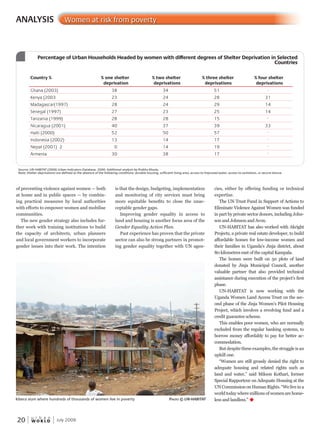
UN-HABITAT’s 2008-2009 flagship report,
the State of the World’s Cities shows that house-
holds headed by women suffer disproportion-
ately from “multiple shelter deprivations”. These
deprivations are defined as any combination of
lack of durable housing, lack of sufficient living
area, lack of access to water, sanitation, and a
lack of security of tenure.
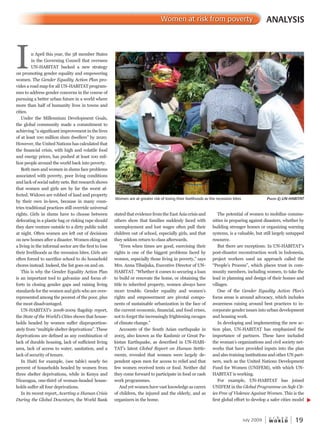
In Haiti for example, (see table) nearly 60
percent of households headed by women from
three shelter deprivations, while in Kenya and
Nicaragua, one-third of woman-headed house-
holds suffer all four deprivations.
In its recent report, Averting a Human Crisis
During the Global Downturn, the World Bank
stated that evidence from the East Asia crisis and
others show that families suddenly faced with
unemployment and lost wages often pull their
children out of school, especially girls, and that
they seldom return to class afterwards.
“Even when times are good, exercising their
rights is one of the biggest problems faced by
women, especially those living in poverty,” says
Mrs. Anna Tibaijuka, Executive Director of UN-
HABITAT. “Whether it comes to securing a loan
to build or renovate the home, or obtaining the
title to inherited property, women always have
more trouble. Gender equality and women’s
rights and empowerment are pivotal compo-
nents of sustainable urbanization in the face of
the current economic, financial, and food crises,
not to forget the increasingly frightening ravages
of climate change.”
Accounts of the South Asian earthquake in
2005, also known as the Kashmir or Great Pa-
kistan Earthquake, as described in UN-HABI-
TAT’s latest Global Report on Human Settle-
ments, revealed that women were largely de-
pendent upon men for access to relief and that
few women received tents or food. Neither did
they come forward to participate in food or cash
work programmes.
And yet women have vast knowledge as carers
of children, the injured and the elderly, and as
organizers in the home.
The potential of women to mobilize commu-
nities in preparing against disasters, whether by
building stronger homes or organizing warning
systems, is a valuable, but still largely untapped
resource.
But there are exceptions. In UN-HABITAT’s
post-disaster reconstruction work in Indonesia,
project workers used an approach called the
“People’s Process”, which places trust in com-
munity members, including women, to take the
lead in planning and design of their homes and
villages.
One of the Gender Equality Action Plan’s
focus areas is around advocacy, which includes
awareness raising around best practices to in-
corporate gender issues into urban development
and housing work.
In developing and implementing the new ac-
tion plan, UN-HABITAT has emphasized the
importance of partners. These have included
the woman’s organizations and civil society net-
works that have provided inputs into the plan
and also training institutions and other UN part-
ners, such as the United Nations Development
Fund for Women (UNIFEM), with which UN-
HABITAT is working.
For example, UN-HABITAT has joined
UNIFEM in the Global Programme on Safe Cit-Global Programme on Safe Cit-Global Programme on Safe Cit
ies Free of Violence Against Women. This is the
first global effort to develop a safer cities model
ANALYSISWomen at risk from poverty
Women are at greater risk of losing their livelihoods as the recession bites PhotoPhotoP © un-haBitat
ANALYSIS Women at risk from poverty
July 200920 W O R L D
u r b a n
Source: UN-HABITAT (2006) Urban Indicators Database, 2006. Additional analysis by Prabha Khosla.
Note: Shelter deprivations are defined as the absence of the following conditions: durable housing, sufficient living area, access to improved water, access to sanitation, or secure tenure.
is that the design, budgeting, implementation
and monitoring of city services must bring
more equitable benefits to close the unac-
ceptable gender gaps.
Improving gender equality in access to
land and housing is another focus area of the
Gender Equality Action Plan.
Past experience has proven that the private
sector can also be strong partners in promot-
ing gender equality together with UN agen-
cies, either by offering funding or technical
expertise.
The UN Trust Fund in Support of Actions to
Eliminate Violence Against Women was funded
in part by private sector donors, including John-
son and Johnson and Avon.
UN-HABITAT has also worked with Akright
Projects, a private real estate developer, to build
affordable homes for low-income women and
their families in Uganda’s Jinja district, about
80 kilometres east of the capital Kampala.
The homes were built on 50 plots of land
donated by Jinja Municipal Council, another
valuable partner that also provided technical
assistance during execution of the project’s first
phase.
UN-HABITAT is now working with the
Uganda Women Land Access Trust on the sec-
ond phase of the Jinja Women’s Pilot Housing
Project, which involves a revolving fund and a
credit guarantee scheme.
This enables poor women, who are normally
excluded from the regular banking systems, to
borrow money affordably to pay for better ac-
commodation.
But despite these examples, the struggle is an
uphill one.
“Women are still grossly denied the right to
adequate housing and related rights such as
land and water,” said Miloon Kothari, former
Special Rapporteur on Adequate Housing at the
UNCommissiononHumanRights.“Weliveina
world today where millions of women are home-
less and landless.” u
of preventing violence against women — both
at home and in public spaces — by combin-
ing practical measures by local authorities
with efforts to empower women and mobilise
communities.
The new gender strategy also includes fur-
ther work with training institutions to build
the capacity of architects, urban planners
and local government workers to incorporate
gender issues into their work. The intention
Country %
deprivation
% two shelter
deprivations
% three shelter
deprivations
% four shelter
deprivations
Ghana (2003) 38 34 51 -
-
-
-
-
-
Kenya (2003 23 24 28 31
Madagascar(1997) 28 24 29 14
Senegal (1997) 27 23 25 14
Tanzania (1999) 28 28 15
Nicaragua (2001) 40 37 39 33
Haiti (2000) 52 50 57
Indonesia (2002) 13 14 17
2 0 14 19
Armenia 30 38 17
Percentage of Urban Households Headed by women with different degrees of Shelter Deprivation in Selected
Countries
% one shelter
Nepal (2001)
Kibera slum where hundreds of thousands of women live in poverty PhotoPhotoP © un-haBitat
W O R L D
u r b a n
July 2009 21
FEATURESxxxxxxx
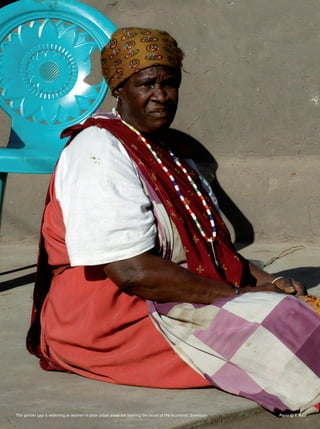
The gender gap is widening as women in poor urban areas are bearing the brunt of the economic downturn Photo © t. rolf
W O R L D
u r b a n
22
ANALYSIS Habitat Agenda update
Exercising political
power - the Global
Parliamentarians on
Habitat
At the Habitat-II conference in Istanbul in 1996, the Habitat Agenda adopted by 171 countries
carried several commitments on adequate and sustainable urban development. Yet after more
than a decade, writes Birte Leinius*, General Secretary of Global Parliamentarians on Habitat,
supporters must weigh its impact. Have participating States acted to ensure that the principles of
the Habitat Agenda are put into practice? One, if not the most important form of implementation,
is the adoption of the agreed policy objectives into national legislation.
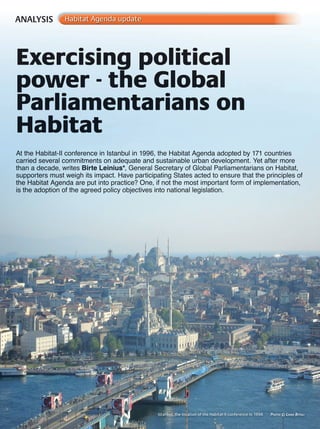
Istanbul, the location of the Habitat-II conference in 1996 Photo © liana Bitoli
W O R L D
u r b a n
July 2009 23
istration and the ongoing regionalization
are essential institutional prerequisites for
sustainable settlement and housing.
l The introduction and strengthening of local
self-government is the basis for an effective
participation of the public in decision-mak-
ing processes.
4. Turkey
l Self-commitment by accession to interna-
tional agreements has led to significant
progress in the implementation of the
objectives and principles of the Habitatobjectives and principles of the Habitatobjectives and principles of the Habita
Agenda.
l The reinforcement of building safety, es-
pecially against natural disasters, is a pre-
requisite for sustainable housing.
ANALYSISHabitat Agenda update
In 2006, the European chapter of
the Global Parliamentarians on
Habitat (GPH) initiated a study to
investigate how the objectives and principles
of the Habitat Agenda were received in the leg-
islation of five selected signatory countries in
Europe.
Peter Götz, Member of the German Bun-
destag and President of the Board of Directors
of the GPH and at the time President of the
GPH-Europe, said it was particularly important
that “in the countries selected for the study, not
only the main laws which deal with sustainabil-
ity of human settlements be identified, but also
the instruments that promote the objectives
and principles of the Habitat Agenda. The study
should give parliamentarians from around the
world valuable ideas on how to implement the
Habitat Agenda in their home countries.”
The five selected signatory countries
of the study are the Federal Republic of
Germany, Finland, the Netherlands, Romania
and Turkey.
From the investigation, it became apparent
that the objectives vary according to the level of
development of the country. Mature industrial
countries such as Finland, the Netherlands and
Germany have hardly any real need to catch up.
Given the appropriate policies, they can focus
their attention on providing other countries,
especially developing countries, with assistance
in implementing the Agenda.
Countries with smaller economies like Ro-
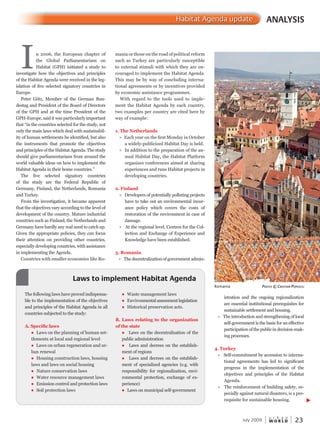
Romania PhotoPhotoP © cristiancristianc PoPescu
mania or those on the road of political reform
such as Turkey are particularly susceptible
to external stimuli with which they are en-
couraged to implement the Habitat Agenda.
This may be by way of concluding interna-
tional agreements or by incentives provided
by economic assistance programmes.
With regard to the tools used to imple-
ment the Habitat Agenda by each country,
two examples per country are cited here by
way of example:
1. The Netherlands
l Each year on the first Monday in October
a widely-publicized Habitat Day is held.
l In addition to the preparation of the an-
nual Habitat Day, the Habitat Platform
organizes conferences aimed at sharing
experiences and runs Habitat projects in
developing countries.
2. Finland
l Developers of potentially polluting projectsDevelopers of potentially polluting projectsDe
have to take out an environmental insur-
ance policy which covers the costs of
restoration of the environment in case of
damage.
l At the regional level, Centres for the Col-
lection and Exchange of Experience and
Knowledge have been established.
3. Romania
l The decentralization of government admin-
Laws to implement Habitat Agenda
The following laws have proved indispensa-
ble to the implementation of the objectives
and principles of the Habitat Agenda in all
countries subjected to the study:
A. Specific laws
l Laws on the planning of human set-
tlements at local and regional level
l Laws on urban regeneration and ur-
ban renewal
l Housing construction laws, housing
laws and laws on social housing
l Nature conservation laws
l Water resource management laws
l Emission control and protection laws
l Soil protection laws
l Waste management laws
l Environmental assessment legislation
l Historical preservation acts.
B. Laws relating to the organization
of the state
l Laws on the decentralization of the
public administration
l Laws and decrees on the establish-
ment of regions
l Laws and decrees on the establish-
ment of specialized agencies (e.g. with
responsibility for regionalization, envi-
ronmental protection, exchange of ex-
perience)
l Laws on municipal self-government
Urban planning and settlements - Often
as a result of scarce public funding in the coun-
tries investigated, the public sector is dependant
on cooperation with the private sector. Only two
of the countries of the study have a legal basis to
regulate public-private partnerships.Intheother
countries, the sectors often cooperate anyway.
Adequate shelter for all and sustainable
settlement development - the financial sup-
port of activities with money from the Euro-
pean Union in both these areas is of great sig-
nificance. In the future, national peculiarities
should be given more attention in the fund-
ing guidelines. The principle of subsidiarity
should continue to be respected because it is
a crucial prerequisite to the implementation
of the Habitat Agenda.
Environmental protection - Due to
EU directives, most of the instruments of the
agenda for environmental protection have al-
ready been implemented. Occasionally there
awareness for sustainable urban and hu-
man development. The study was extend-
ed to include the countries of Bulgaria, the
Czech Republic, Estonia, Hungary, Latvia,
Lithuania, Poland, Slovakia and Slovenia.
At two workshops held in Bucharest, Roma-
nia, in April 2008 and in Berlin, Germany, on
World Habitat Day in October 2008, experts ex-
changed views about whether the Eastern Euro-
pean states possess the necessary instruments in
their legislation to implement the Habitat prin-
ciples. The agreed that many of the identified
legislative instruments for the implementation
of the Habitat Agenda are already being used by
these countries.
However, deficits in the following areas were
discovered:
Housing - In principle, each citizen is en-
couraged to use their own initiative to find
housing. People with low or without income
need governmental assistance.
July 200924 W O R L D
u r b a n
ANALYSIS Habitat Agenda update
5. Germany
l Recycling of waste disposal: The German
Recycling and Waste Management Act is
a very sophisticated solution to the waste
problem.
l The identification of substandard build-
ing materials with uniform symbols
in the European Community simpli-
fies building and increases building
security.
Overall, the study councluded that it is
worthwhile to continue to develop the ability
and the willingness of the national Legislatures,
to learn from each other, even across language
barriers.
In 2008 the Global Parliamentar-
ians on Habitat initiated the second part of
the study. This was released in early 2009.
Its aim was to identify the existing approaches
in the new Eastern European member states
of the European Union to the implemen-
tation of the Habitat Agenda and to raise
The Habitat Platform in Holland runs projects in developing countries PhotoPhotoP © irum shahid
W O R L D
u r b a n
July 2009 25
Participation of civil society - Civil soci-
ety is gaining in importance. Especially the
Baltic countries have a high participation level.
Small loans can also contribute to the activa-
tion of private initiatives.
The results of the habitat studies of 2006 and
2008 are an essential step in the review of the
implementationoftheHabitatAgendainthesig-
natorystates.Itisonlywhenonehasdetermined
whether, how and with which instruments, the
principlesoftheAgendaarebeingimplemented,
that one can bring changes in national laws or
develop instruments at international level. u
ANALYSISHabitat Agenda update
is need for action regarding the introduction of
recycling in waste management, the promotion
of environmentally friendly transport and the
regulation of fees for road use.
Energy policy - In this area, measures
concerning the promotion of energy con-
servation, the production of renewable
resources and the creation of incentives to
use them is necessary. Germany is a good
example to follow in this respect.
Socially sustainable settlements de-
velopment - The majority of countries
already have tools in place to promote
projects such as the employment of physi-
cally or mentally impaired people.
Distribution of the funds - In general,
research institutes focusing on urban and
regional development require stronger fi-
nancial support.
Germany is almost on schedule with implementing the Habitat Agenda PhotoPhotoP © stefanie scheider
Strasbourg River PhotoPhotoP © manuruchmanuruchm
The habitat study was funded by the govern-
ment of the Federal Republic of Germany.
The project was led by the Deutscher Ver-
band für Wohnungswesen, Städtebau und
Raumordnung e.V. Berlin. Prof. Dr. Gerd
Schmidt-Eichstaedt and Dipl.-Ing. Tho-
mas Zimmermann from Planung und Re-
cht GmbH, Berlin, were responsible for its
implementation. The project leader for the
Global Parliamentarians on Habitat was
Dr. Anneke Assen, President of the Former
Parliamentarians on Habitat. The European
GPH presented the findings at the 5th Euro-
pean Forum of the GPH in May 2006 in The
Hague, the Netherlands, and at the World
Urban Forum III (WUF3) in June 2006 in
Vancouver, Canada. For copies of the study
contact Peter Goetz MP, directly
(peter.goetz @ bundestag.de).
W O R L D
u r b a n
26
BEST PRACTICES Field report - Africa
Somaliland’s declaration of independence from the rest of Somalia in 1991 ushered in an era
of relative stability in the former British protectorate, putting distance between the northwest
and the war-ravaged south-central region. However, it is in the new century that Hargeisa has
truly blossomed, write Antony Lamba, Asia Adam, and Edward Miller*. Here, they explain
how a new taxation system using GIS satellite technology has boosted public coffers to bring
much needed urban improvements.
Giving revenue collection
a big boost in Somaliland
A view of Hargeisa Photo © un-haBitat
W O R L D
u r b a n
July 2009 27
From a hilltop on the edge of the
city, Hargeisa is a sprawl of shinycity, Hargeisa is a sprawl of shiny
tin roofs. New single-level dwell-
ings and scrub brush line sandy roads andings and scrub brush line sandy roads and
overlook wide, dry riverbeds. Sprinkled
throughout are buuls, the makeshift huts of, the makeshift huts of
displaced families and the city’s poor. This
capital of Somaliland and its financial and
political centre, keeps growing and growing.
Bomb explosions at a UN compound in
Hargeisa in 2008 provided grim remindersHargeisa in 2008 provided grim reminders
danger does exist and led to the temporarydanger does exist and led to the temporary
relocation of international staff. But Soma-
liland has always been a relatively secure
place for international agencies.
Though daily life in Hargeisa necessitatesThough daily life in Hargeisa necessitates
caution, the pace is slow and the city is quiet.caution, the pace is slow and the city is quiet.
UN staff based there enjoy an overabun-
dance of spaghetti and goat meat and are
able to stroll around markets, some of whichable to stroll around markets, some of which
have been rehabilitated through UN-HABI-
TAT projects.
New taxation system
It was in this context that United Nations
Development Programme (UNDP) and UN-
HABITAT brainstormed on ways of making
a difference. The result: a Geographic In-
formation System (GIS) was established information System (GIS) was established in
Hargeisa Municipality with technical assist-
ance from UN-HABITAT that has boosted
annual property tax revenues by a whopping
250 percent, from USD 169,062 in 2005 to250 percent, from USD 169,062 in 2005 to
USD 588,754 in 2008.
With funding from the European Com-
mission and the UNDP, the project started in
2004 as part of the UNDP Governance and
Financial Services Programme and continued
in 2005 under the UN-HABITAT Urban De-
velopment Programme for the Somali region.
Hargeisa’s problem was daunting: lowHargeisa’s problem was daunting: low
municipal revenue meant overstretchedmunicipal revenue meant overstretched
services and weakened infrastructure couldservices and weakened infrastructure could
not be improved. Where to start? First andnot be improved. Where to start? First and
foremost, UNDP and UN-HABITAT had toforemost, UNDP and UN-HABITAT had to
devise a cost-effective approach to collect-
ing up-to-date household-level data for theing up-to-date household-level data for the
whole municipality.
However, the system had to provide quick,
visible results to attract political support. It also
had to be simple and use on-the-job training so
municipal staff could easily operate and main-
tain it. A building-based geographic databasetain it. A building-based geographic database
with a limited number of relevant variables for
each building would be a perfect fit.
The first step was to build a spatial database
– basically, a customized map that shows the
location of each and every building in the mu-
nicipality, as well as other key features such as
main roads, rivers, and airports – to do this,
a high-resolution satellite image of Hargeisa
was digitized to produce a base map. The proc-
ess created a record of all the buildings on the
base map in a table that also generated unique
numbers to identify each building. After three
weeks, step one was complete.
The second step was to build a database
of property characteristics. The base map
was used to guide a household-level sur-
vey to collect attributes on each property.
Handheld computers were used to collect
the names of occupants, building floor area,
plot area, number of floors, building mate-
rial and quality, service connections, and
property type.
During the property survey, a massive un-
dertaking that lasted eight months, the spa-
tial database information was also verified,
while ground-level digital photographs were
taken of every building.
The third step was to integrate the two da-
tabases (the spatial database and the charac-
teristics database) to produce one geographic
database that links each building in the base
map and its location with a corresponding
set of attributes.
For immediate access to a picture of any
building on the base map, the ground-level
property photos were hyperlinked to the geo-
graphicdatabase.The resultsshowedthatthere
are 59,000 buildings in Hargeisa, 63 percent of
them residential.
The fourth step was to generate unique iden-
tifiers for each building. Hargeisa Municipality
is divided into five districts, 24 sub-districts,
77 neighbourhoods, and 384 sub-neighbour-
hoods. After the boundaries for these adminis-
trative units were identified and integrated into
the base map, the units were used to develop
a unique five-part code (district; sub-district;
neighbourhood; sub-neighbourhood; building
number) for each building.
The fifth and final step was to determine
property tax rates and generate property tax
bills for the year 2006. Altogether, 47,300
properties in Hargeisa were found to be tax-
able. A special computer programme was writ-
ten to automate property tax bill production.
Taxpayer-friendly property tax bills are
produced that clearly indicate the building
BEST PRACTICESField report - Africa
W O R L D
u r b a n
28 July 2009
system became operational, property tax rev-system became operational, property tax rev-system became operational, property tax rev
enue for Hargeisa Municipality rose by 43 per-
cent to USD 241,983, with less than 40 percent
of the taxable properties actually paying the
tax. In 2007, the local council conducted a me-
dia campaign to improve compliance, and vari-
ous community meetings were held. Property
tax revenue increased by 70 percent to USD
412,179 in 2007 and USD 588,754 by the end
of 2008 – an increase of 250 percent between
2005 and 2008.
“I think this new system is better than the
old one: every bill has a picture of the prop-
erty, and the amount payable is reported
right on the bill,” says long-time property
owner Abdirahman Ismail Faraah. “The sys-
BEST PRACTICES Field report - Africa
code, property tax calculations, and tax pay-
able for each property, together with a dig-
ital photograph of the property.
Positive results
In 2006, Hargeisa Municipality opened a GIS
support office to handle the new property tax
system. The office delivers hard copies of prop-
erty tax bills and neighbourhood maps once a
year to each of the five municipal district offic-
es. Trained municipal district staff continually
verify bill information in the field. When it is
wrong, the GIS support office corrects it in the
geographic database.
Overall, the results have been astounding.
In 2006, when the new GIS-based property tax
tem is therefore more efficient and unlikely
to have many mistakes – in the past, the
amount payable was not indicated in the de-
mand letter and property records were not
kept properly. When I paid this time, I also
received a receipt.”
The increased revenue has inspired fur-
ther action. In 2007, Hargeisa Municipality
started a public infrastructure and services
capital investment programme together with
business-minded Hargeisa residents.
Through this programme, the municipal-
ity has for example spent USD 320,000 to
rehabilitate two roads and USD 80,000 to
construct a bridge.
Hargeisa is expanding rapidly, and main-
taining and updating the property database
is costly. However, with continued technical
support from development partners, the lo-
cal council will need only a small percentage
of the increasing property tax revenues to
pay for these costs. u
Abdirahman Ismail Faarah – Hargeisa resident
“I have owned this house for a very long
time. I held the property title until 1994,
when it got lost in the civil war. At the mo-
ment I do not have any ownership docu-
ments for my house, but there is no dis-
pute and I have always been paying taxes
on it. I received the property tax bill for
2006 last July. The new bill has a picture
of my house and all the property details
are correct. I especially liked the photo-
graph. The amount on this bill is higher
than those of previous years. I used to pay
SOS 32,814 (approximately USD 4) and
now I pay SOS 51,275 (USD 6.40), but the
amount is still affordable.
“I came to know about the new property
taxation system when the bill was de-
livered to my house by municipal staff
last July. I saw the TV debates where the
participatory budgeting system was
being advocated along with the new
property taxation system. I think it
is a good idea that can work, and the
municipal authorities must give it a
chance. If the authorities fail to lis-
ten to taxpayers, then the taxpay-
ers should stop paying such taxes.
In my opinion, the increased rev-
enues should be used for projects
that benefit the community directly,
like garbage collection and road main-
tenance. I think 30 percent of the
revenues should be used for district-
based projects, while the rest should
go to Hargeisa Municipality.”
* Antony Lamba is a UN-HABITAT Land
Mangement Officer who has been based
in Hargeisa for the past three years. Asia
Adam has served as a GIS expert with UN-
HABITAT in Hargeisa for the past two years.
Edward Miller is a Nairobi-based editor and
writer specializing in the region.
Abdirahman Ismael Faraah
PhotoPhotoP © un-haBitat
Total number of properties = 59,000
• 78 percent formal, 22 percent informal
• 68 percent residential, 12 percent commercial, 20 percent other
Number of taxable properties in the old system: 15,850 (34 percent)
Number of taxable properties in the new system: 47,334 (80 percent)
Property tax revenue collection:
2004 → USD 144,417 (municipal records = 15,850 taxable properties)
2005 → USD 169,062
2006 → USD 241,983 (GIS-based database = 47,334 taxable properties)
2007 → USD 412,179 (represents 24 percent of total municipal revenues)
2008 → USD 588,754
Hargeisa Property Database and Taxation
BEST PRACTICESSustainable development
A view of Anji County Photo © Bethany carlson
When your declared aim is to become known as the Most Beautiful Countryside in the Nation,
you set yourself the highest possible standards. This is the ambition driving China’s central
government in Anji County, says Li Yu, Director at the International Centre for Planning and
Research at the Cardiff University School of City and Regional Planning.
A Chinese eco-
development model:
Anji County
W O R L D
u r b a n
30 July 2009
BEST PRACTICES Sustainable development
Urban-rural integration
The Anji County Comprehensive Plan (2006-
2020) for integrated urban and rural develop-
ment provides for an ecological hinterland as
well as a recreation and holiday resort, together
with a special manufacturing zone on the Yang-
tze River delta.
In this region 200 kilometres south of Shang-
hai with a population of 450,000, rural tourism
and value-added, green agri-food processing
are the designated engines of local economic
growth. Under this grand plan small towns act
as local gateways and hubs servicing rural areas.
Another priority is poverty reduction, including
the gap between urban and rural areas.
As far as basic infrastructure goes, significant
progress has already been made in Anji District.
All roads in rural settlements are paved and bus
services are now available, as is tap water. Pri-
mary schools, kindergartens and clinics have
been established in all main villages, as part of
plans to enhance collective living standards.
These have been found to be very effective in a
survey of 60 main villages (Table 1).
As far as human settlements are concerned,
the spatial layout of Anji District includes one
centre, five major towns and 60 main villages.
The centre, or gateway, is Dipu together with
Xiaofeng, a nearby economic sub-district. The
five major towns acting as hubs include two
industrial towns to the north and three others
specialized in eco-tourism, food and bamboo
processing respectively. As for the 60 main vil-
lages, their population ranges between 1,000
and 4,000 (500 in remote areas).
Any sustainable town must by definition be
accessible – a challenge, in an area where the
majority of local residents cannot afford private
motor cars. This is why Anji County authorities
provide regular, frequent bus services between
the gateway, hubs and more remote villages, for
the sake of better urban-rural integration. The
network effectively assists labour force conver-
sion from the agricultural to manufacturing and
other sectors, as encouraged by local authorities
for the sake of higher income generation in the
villages.
In the district’s five designated hubs, the two
industrial towns make significant contributions
to tax revenues, on top of demand for consumer
goods and housing and so on. The combined in-
dustrial zones provide consumption capability
and demands for retail, housing and other ur-
ban activities. Urban functions have been devel-
oped in a rational way, with the northern part of
Anji District more urbanized than others. In the
south, service standards and capacities are lower
in the three core towns, in line with comparative
economic competitiveness.
The survey has uncovered a further contrast
within Anji District: in northern industrial
towns, tax revenues are stronger than aggregate
personal income, whereas a reverse pattern pre-
vails in the tourist-oriented southern towns.
Under the plan, main villages are typically
close (i.e. within 10 kilometres) to industrial
parks, with public facilities and services provid-
ed to urban standards along with 3.5 metre wide
roads. Basic amenities include primary schools,
kindergartens, culture centres, clinics and con-
ventional shops – all designed to attract rural
populations and familiarize them with urban
living standards.
Since first proposed in 1996 the concept of
an Ecological Garden of Metropolises has been
a development objective for Anji District. This
led to the closure of 64 polluting industrial sites,
while another 74 were forced to adopt appropri-
ate human waste treatment systems at a cost of
CNY 80 million (USD 11.7 million).
Inward productive investment matters as
much as it does to any other local authority in
China. In Anji, though, every project must go
through environmental assessment by seven
distinct departments, and can be vetoed on pol-
lution grounds.
Anji’s green economy
In the past decade Anji County has managed
to diversify its industrial and service sector
base under the plan. (This includes a strong
tourism sector with over 3.3 million visitors
in 2006). Between 2001 and 2006, gross
agricultural and manufacturing output rose
from CNY 4.7 to 7.5 billion, with the annual
fiscal revenue doubling from CNY 62 to 130
million.
In the past five years, aggregate gross per-
sonal income also increased in both urban
Figure 1: Average income of urban and rural residents
Source: Anji Statistical Bureau (2008)
Table 1: Public Service
Provision in Central Villages
Source: Author
Item % of villages
Solid waste treatment 93.8
Eco-sewage treatment 56
Self-raising fund plus subsidies 90
Self-raising fund 10
Bus services to central villages 100
Tap water supply 60.5
Clinic 100
Kindergarten 88
Primary school 46
High school 8
Free school bus service 10
Tap water supply 60.5
Clinic 100
Kindergarten 88
Primary school 46
High school 8
Free school bus service 10
W O R L D
u r b a n
July 2009 31
and rural areas (Figure 1), with the differen-
tial ratio between these regressing to 1:1.97
in 2008, compared with 1: 2.12 in 2003
(Figure 2) and a nationwide ratio of 1:3.
Renewables and recycling
As part of environmental protection policies,
Anji County government grants subsidize up to
50 percent of the value of individual projects,
including large public solid waste and sewage
treatment projects. Extension of basic utility
services is helping with both recycling and re-
newable energies. Once collected in villages, sol-
id waste is taken to the nearby town and burnt in
the local power station.
As for sewage treatment in rural areas, Anji
District authorities use a green alternative in-
stead of otherwise costly systems. This simple
eco-sewage treatment is based on plants and
sand. Sewage is discharged by gravity through
coveredchannelsfromeachhouseholdtoapond
and treatment device at the lowest point of a vil-
lage. In some cases, the system can be comple-
mented with marsh gas power stations that pro-
duce energy for local households. Bio-filtration
is available for more remote households.
Anji’s renewable energy policy also relies on
the district’s abundant water resources. Thanks
to 113 small hydro-power stations, power out-
ages belong to the past, local development and
income generation thrive, while carbon dioxide
emissions are reduced.
BEST PRACTICESSustainable development
Figure 2: income between urban and rural residents
Source: Anji Statistical Bureau (2008)
Bamboo
Long renowned for its bamboo groves, Anji’s
bamboo processing industry and its products
are environmentally friendly. The district’s
10,000 hectares of bamboo forests support
1,600 processing companies spread over five
industrial parks. The 130 largest firms employ
over 10,000 people and overall the bamboo
industry contributes as much as 61 percent to
average rural income per head (and CNY 9.9
billion to local GDP).
The importance of bamboo processing to
Anji’s eco-friendly economy is best under-
stood through an outline of the whole pro-
duction chain. Villagers take care of the cut-
ting and initial raw treatment. They sell the
treated material to commercial companies,
agents or branches of processing firms in
small towns. The larger firms in turn make and
sell a variety of products. The largest firms sell
as much as 95 percent of production (especially
bamboo floors) abroad, and overall the indus-
try collectively earns an annual CNY 1.2 billion
from exports.
Anji actively encourages eco-tourism, and
in 2007, as many as 4.4 million Chinese and
43,000 foreign tourists visited Anji District,
generating a CNY 1.2 billion income.
The effects on the livelihoods and well-be-
ing of the population are obvious, and in turn
further the the Most Beautiful Countryside in
China objective. This successful experience can
now be replicated elsewhere in the country. u
The bamboo groves in Anji County are an important asset PhotoPhotoP © revati uPadhyaPadhyaP
W O R L D
u r b a n
32 July 2009
Spirnak. “This is the same energy conversion
process Solaren uses for its SSP plant.”
The advantage of SSP is that energy can be
harnessed at all times, day or night – avoid-
ing any weather or seasonal problems and is
completely carbon free.
Once approval has been given, Solaren is con-
tractually obliged to begin commercial opera-
tions in 2016. “The geographical difficulties and
financial costs – once overcome – would lead to
an endless supply of cheap energy for all,” be-
lieves Spirnak. u
Two Californian companies are set to change
the world of renewable energies by aiming to
capture solar energy from space and then beam
it down to earth to be used as electricity.
The companies, Pacific Gas and Electric Co.
(PG&E) and Solaren Corp., are seeking approval
fromstateregulatorstoturnthisscientificdream
into reality. Once the deal has been approved,
the manufacturer Solaren, must then raise bil-
lions of dollars to design, launch and operate
the satellite and receiver station.
Once built it will be the world’s first Space
Solar Power (SSP) Plant. Capturing energy
would involve placing solar panels on a sat-
ellite to generate electricity that is then con-
verted to radio frequency. The receiver on the
ground then converts this to energy and feeds
it into the power grid.
While a system of this scale and exact con-
figuration has not been built yet, Solaren CEO
Gary Spirnak argues that the underlying tech-
nology is already established and is based on
existing communication satellite technology.
“For over 45 years, satellites have collected
solar energy in earth orbit via solar cells, and
converted it to radio frequency energy for
transmissions to earth receiver stations,” says
BEST PRACTICES Innovation and news from North America
TreePeople, a Los Angeles (LA) based envi-
ronmental group, has revived the use of wa-
ter cisterns by building its own at its head-
quarters in an LA city park, recently collect-
ing a desperately needed 817,000 litres from
rainfall.
Rainwater harvesting technology has exist-
ed for thousands of years, with cisterns com-
mon in Rome and Sumeria. Rainwater is col-
lected from a surface, such as a roof, and then
directed towards a barrel or underground
chamber. A gravity fed hose is all that’s need-
ed to make the water useable.
Energy
Satellites to capture
solar power from space
Water
Revitalizing Roman
technology
New ways of harnessing the sun’s power are being developed PhotoPhotoP © takjetakjet
“For decades, government agencies have
viewed rainwater primarily as a flooding haz-
ard and as a water quality issue, rather than
as liquid gold that falls from the sky,” explains
Andy Lipkis, founder of TreePeople. “Recog-
nizing this tremendous waste, we saw the po-
tential in harvesting rainwater by mimicking
the sponge and filter functions of a tree.”
California is currently going through a
statewide drought emergency; Governor Ar-
nold Schwarzenegger is urging people to cut
water usage by 20 percent. As more and more
people move to California, demand is already
outstripping supply.
Utilizing more cisterns would also have
benefits for the bigger environmental pic-
ture in California. A tremendous amount of
energy is used for water-related uses such as
transporting and treating water: 19 percent
of the state’s electricity and 30 percent of its
natural gas.
“Securing a local, reliable water supply
would thus not only save on energy costs, but
would also decrease the amount of green-
house gases released into the atmosphere,”
emphasizes Lipkis.
The systems can range from inexpensive
and low-tech, all the way up to technical en-
gineering projects with complex computer
automated treatment programmes. Lipkis
says this makes them perfect to be adopted in
less-developed countries.
“Many countries around the world have
long utilized this technology out of neces-
sity, so we should look to them for inspira-
tion,” he adds. u
W O R L D
u r b a n
July 2009 33
nology and infrastructure will be fine-tuned
over the following years.
The Bay Area will serve as the first region of
Californiatomaketheswitchfromcarbon-based
transportation to sustainable mobility and joins
Australia, Israel and Denmark as world leaders
in reducing their oil dependence. u
facturers developing cars that have a plug,
and have the ability to drive around the city
and charge as they go,” he adds.
Better Place hopes to finalize approvals for
the Bay Area by the end of 2009 and begin
the infrastructure development in 2010. As
more electric cars enter the market, the tech-
The San Francisco Bay Area is set to develop
the USA’s first electric-car infrastructure sys-
tem. The pioneering company, Better Place,
seeks to provide, through its USD 1 billion busi-
ness plan, stations to re-charge batteries, and
it will offer battery exchange electric vehicles
which can operate on the network by 2012.
A mixture of public and private investment
aims to reinvigorate California’s competitive
advantage in innovative technology helping
the state to become the electric vehicle capi-
tal of the US.
“We are already a world leader in fighting
global warming and promoting renewable
energy,” says California Governor, Arnold
Schwarzenegger. “This type of public-private
partnership is exactly what I envisioned
when we created the first ever low carbon
fuel standard and when the state enacted the
zero emissions vehicle programme.”
Better Place’s CEO and founder, Shai
Agassi says the network will help the envi-
ronment, boost the technology sector and
provide an impetus to the country’s big three
car manufacturers.
“We hope that by the time we deploy, we’ll
see Renault, Nissan and the three US manu-
BEST PRACTICESInnovation and news from North America
LA recognizes the value of rain water PhotoPhotoP © muhammad omran rainWaterWaterW
Transport
California set to
become US electric car
capital
California is leading the way on electric car use PhotoPhotoP © roBerto marinellomarinellom
W O R L D
u r b a n
34 July 2009
valuable resource to the local community.”
The technology is nothing new, but the
innovative application of this wasted heat is
what’s catching the attention of city planners.
The heat can be exported to surrounding are-
as, not just to households adjacent to the cen-
tre and will be available for free to any third
party that wants to take advantage of it.
As the technology is quite basic, Martyn
Bishop, senior technical director from WSP
Buildings believes that the potential around the
world is high. “What we’ve demonstrated with
this scheme is that it won’t impact on a data
centre’s critical services and operation. It’s one
of the few ways ahead that data centres can give
back to the environment,” he says. u
A new GBP 80 million data centre will trans-
form generated waste heat into free heating
for local communities in East London.
Due for completion in 2010, the nine-sto-
rey, 19,000 square metre facility from Tel-
ehouse Europe will export the heat from the
building’s cooling systems to provide up to
nine megawatts of power for the local neigh-
bourhood, which equates to providing hot
water and heating for 90,000 households.
Data centres are sometimes referred to as
“necessary evils”, creating eyesores on the
landscape and spewing out wasted heat. The
Telehouse project is trying to break that image
based on a range of innovative green schemes
that it and the WSP Group, a London-based in-
ternational sustainability and engineering con-
sultancy, have put into action. These include
green-energy systems and high-efficiency chill-
ers to reduce carbon emissions.
“We recognize that any attempt to address
the lack of space within the data centre indus-
try has to be undertaken with a level of envi-
ronmental awareness,” says Bob Harris from
Telehouse Europe. “By making good use of
the waste heat from the facility, we can mini-
mize the environmental impact and provide a
BEST PRACTICES Innovation and news from Europe
Garden plots in the United Kingdom’s inner
cities are undergoing a resurgence that hasn’t
been seen since the Second World War.
All over the UK up to 250,000 allotments
dot the landscape alongside railway lines and
old manufacturing sites. They vary in size from
small vegetable patches to football pitches.
Products cultivated range from flowers, carrots
and potatoes to honey from bee keeping.
A legacy from the industrial revolution, the
plots were almost lost in the 1970s and 1980s as
the valuable inner city land was swallowed by
Energy
Recycled waste heat to
power London homes
Environment
Garden plots growing
back into fashion
The new data centre will heat local communities in East London PhotoPhotoP © telehousetelehouset euroPe
development. In the 1990s ‘grow your own’ be-
came popular again and demand has increased
dramatically throughout the UK.
Most local councils, who have a statutory
duty to provide allotments by law, now rec-
ognize that allotments not only provide an
opportunity for people to grow high quality,
local food, whilst keeping healthy and active,
but that allotments also provide valuable
green spaces for local communities and a ha-
ven for wildlife.
“New allotment sites are starting to pop up
with an opportunity to get growing,” says De-
borah Burn from the Allotment Regeneration
Initiative (ARI). “Many people who have never
gardened before are finding that allotments are
a great place to make friends, take the kids for
fresh air and learn where food comes from and
of course grow delicious food for themselves
and their family,” she adds.
Internationally a similar solution has been
reinvented in cities across sub-Saharan Africa,
where people grow vegetables in unused spaces
for their own consumption and also to sell them.
Richard Wiltshire from ARI believes that,
“they are every bit as much survival gardens as
the originals were for the ‘Dig for Victory’ plots
during the Second World War. As most people
are recent migrants to cities in the sub-Sahara,
they have the knowledge at least on how to
grow food for themselves – as did the early ur-
ban allotment gardeners in the UK.”
The ARI is pushing further for new allotment
sites to be developed and older ones to be pro-
tected, as “we are still aware of many groups
that have had difficulty in getting land.” u
W O R L D
u r b a n
July 2009 35
why we can’t do this,” he says, noting such
a system would be cheaper and cleaner than
building new highways or adding to an over-
burdened aviation system.
Saudi Arabia and the Gulf states are closely
watching the development of Spain’s high-
speed rail network. Many are now planning
their own high-speed train lines as they pre-
The success of the new high-speed rail link
between Barcelona and Madrid is catching
the attention of cities all over the world, in-
cluding the Middle East, China, South Africa
and even North America.
When the line linking Spain’s two biggest
cities opened last year it carried two million
passengers in the first 10 months; it contin-
ues to whisk businessmen the 500 kilometres
between the two cities in under 2.5 hours.
Spain’s high-speed network is still quite
young, but it’s hoping to expand to 9,000
kilometres over the next 10 years. Trains
are winning environmental points too, with
much lower carbon emissions per passenger
compared to flying. The new high-speed net-
works also free up existing lines for cargo,
keeping trucks off the road.
US President, Barack Obama, recently
announced a USD 13 billion for the devel-
opment of a high-speed train network. In a
country that has largely shunned rail travel
in favour of driving and flying he faces an up-
hill battle.
“My high-speed rail proposal will lead to
innovations that change the way we travel in
America,” says Obama. “There’s no reason
BEST PRACTICESInnovation and news from Europe
The UK’s citizens are taking more interest in growing fruit and vegetables PhotoPhotoP © mamam Gda Zych
Transport
Spain leads the way
in high-speed rail
development
Spain’s trains are fast, green and efficient PhotoPhotoP © javierjavierj lóPeZeZe orteGaGaG
pare for a post-oil future, built around serv-
ices that require infrastructure.
High-speed trains seem to tick all the right
boxes for medium distance travel between
cities – their ability to resolve transport prob-
lems and the prestige attached to the launch
of a shiny new train, look set to secure the in-
terest of several large cities worldwide. u
W O R L D
u r b a n
36 July 2009
IN-FOCUS Latin America and the Caribbean
Mexico City is one of the most densely packed cities on earth giving rise to problems of
pollution, crime and traffic. But since 2006 Mayor Marcelo Ebrard has been at the helm
tackling these issues through conventional means as well as through offers of free Viagra, ice-
skating rinks and kissing promotion days. Jonathan Andrews talks to this atypical mayor as his
city undergoes a major transformation.
Mexico City rides a new
wave
Mayor Marcelo Ebrard PhotoPhotoP © mexico citycityc mayormayorm ’s’s’ office
W O R L D
u r b a n
July 2009 37
mental conditions of the city and a better uti-
lization of the city’s comparative advantages.
This has been undertaken in accordance with
the General Development Plan 2007-2012,
which is based on seven main axes: political
reform, equity, security, a competitive econ-
omy, intense cultural movement, sustainable
and long term development and new urban
order. All of this with the purpose of improv-
ing the quality of life of all the members of the
community.
One of the first actions you
implemented was to improve the
historic Zocalo Square, by making
the area more pleasant for visitors
to walk around without hassle from
street vendors and hawkers. How
have you helped relocate the street
vendors, or supported them in their
microenterprises?
We made an agreement with the street ven-
dors and informal sector business leaders
in which we would help them institute their
businesses in an established building or mar-
ket if they would relocate from the streets.
This allows them to have better and more
secure business conditions while also allow-
ing visitors and tourists to visit Mexico City’s
historic downtown in a friendlier environ-
ment. These actions helped increase the flow
of tourists in the historic down town area,
which totalled more than six million in 2007.
Actually, the success of the model was such,
that we are using it to relocate vendors from
other areas in the city in order to implement
our vision for a new urban order.
What have been the main
achievements in your two-and-a-half
years?
We have reinforced and developed social
programmes to change the conditions that
generate social inequity, protect the most
vulnerable groups of society, guarantee the
expansion of social welfare programmes and
accelerate public and private investments to
maintain economic growth. We have imple-
mented a social policy that includes pensions
for the elderly, protecting the unemployed
through unemployment insurance and giving
scholarships to elementary and high school
students. Also, we established a new law that
protects the handicapped, made the protec-
tion of human rights a priority, improved the
mass transit system through a new Rapid
Transit System and a new subway line and of
course we’ve implemented projects such as
the Proyecto Bicentenario, or Bicentennial
Project, which includes the installation of
8,000 cameras that will ensure the security of
the city’s population, and the Plan Verde, or
Green Plan, that will put the city on a path to
sustainable development. The focus, amidst
the current economic crisis, is on maintain-
ing the rhythm of economic activity through
an increase of public investment, which will
account for 27.4 percent of the city’s budget.
Is Mexico City seeing an increase
in tourism as a result of this policy
and also in cleaning and improving
historic areas in the city, such as
Zocalo Square?
Indeed, in 2008 Mexico City received more
than 11.5 million tourists and even though
there are still some security concerns, the
reality is that the problem has been greatly
magnified through the media and it’s not
based on specific facts. Following a series of
measures such as the restoration of down-
town buildings; the formation of the Mixed
Fund for Tourism Promotion, which com-
bines public and private resources with the
objective of promoting Mexico City as a world
class tourist destination; and the creation of
the tourist police, whose goal is to protect the
safety and well-being of tourists, there are a
growing number of tourists that visit the city.
And even though the perception of insecurity
and pollution still exists, the annual survey
undertaken by the Ministry of Tourism shows
that in general, tourists appreciate the kind-
ness of the city’s people, the affordable lodg-
ing prices, the restaurant and entertainment
options, and the security and safeness of the
city.
Mexico City holds a special place in
the country as the cultural, industrial,
business and political heart of the
entire nation. Is there a difficulty in
maintaining and improving Mexico
City as an attractive location, yet
at the same time, keeping the city
sustainable?
As I mentioned before, we see this as a chal-
lenge, certainly a complex one. However,
we have designed our policies and strate-
gies bearing this in mind at all times. The
Your father was an architect. Do you
think he instilled in you from an early
age an appreciation of how buildings,
transport, housing and infrastructure
should all compliment each other, and
function well together in a city?
Certainly. Much of the vision that I have for
the city and that we reflected in our General De-
velopment Programme 2007-2012 in terms of
urban infrastructure distribution and function-
ality was inspired by my childhood.
Obviously, this city has grown and changed
dramatically in the last three decades and
many of the foundation needs have not been
fulfilled as they appear, so one of the pri-
orities of my Administration is to cope with
these infrastructure gaps.
The challenge, however, is to implement a
very ambitious infrastructure programme in
a way that its different components, namely
housing, transportation, water and sewage
systems, hospitals, schools and road infra-
structure are compatible with the idea of
rescuing the concept of public space. This is a
very important concept for us and it has to do
with deploying all the necessary groundwork
that the city and its citizens need, and at the
same time increasing green areas and reduc-
ing excessive visual pollution from advertis-
ing infrastructure. To guarantee this, I have
created the Office of the Public Space Author-
ity, which coordinates with both the Ministry
of Housing and Urban Development, and
with the Ministry of Environment.
When you first became Mayor in
2006, what were the main issues and
problems you faced?
When I first came into office I made a com-
mitment to lead Mexico City into a new path
of equity, welfare and economic growth. This
meant facing up to issues such as public se-
curity, improving the economic and environ-
IN-FOCUSLatin America and the Caribbean
Mayor Marcelo Ebrard
Born in 1958 in Mexico City
Holds a degree in International Re-
lations from the College of Mexico
Studied public policy at the Ecole
Nationale d’Administration (ENA)
in Paris, France
Biography
W O R L D
u r b a n
38 July 2009
IN-FOCUS Latin America and the Caribbean
creation of the Office of the Public Space Au-
thority is one of our quality control instruments
to guarantee that as we deploy our infrastruc-
ture programme and our competitiveness poli-
cies, the city not only maintains its sustainabil-
ity, but also enhances the quality of its public
spaces. A very important element that I would
like to highlight to reinforce the enhancement
of both competitiveness and sustainability is
that our economic, cultural, and educational
orientation is to position Mexico City as Latin
America’s knowledge capital. The strategies to
achieve this goal are 100 percent compatible
with both enhancing competitiveness and sus-
tainability through the development and pro-
motion of high-value added economic activities
that require highly qualified human resources
and soft infrastructure. We are confident that
through the implementation of this vision we
will keep, and even enhance, our position as the
cultural, economic, and political heart of the
country.
We have seen social programmes
your government has implemented
to improve citizens’ quality of life,
such as free Viagra for the elderly and
the Besame mucho, or kiss me a lot,
day for St Valentines, how important
do you rate the social aspects of
a city compared to managing the
infrastructure and transport?
Mexico City’s development plan has three
main pillars; they are healthy public finances
and efficient fiscal policy, infrastructure and
services, and higher investment in human
capital. This last one incorporates the social
factors, such as organizing concerts or al-
lowing free access to historical exhibitions
in museums that are very important to the
residents of Mexico City because they add to
the skill and talent of the population and im-
prove their quality of life. These factors allow
the city to play a key competitive role in the
new conditions of the global economy. Also,
through the implementation of these pro-
grammes, we have proved that people benefit
from not only the fulfillment of basic needs
such as nutrition, health, and housing but
also from the qualitative needs such as en-
tertainment. Through the fulfillment of these
qualitative needs, we are addressing a key
component of quality of life for our citizens.
With the credit crisis gripping the
world, how do you value public/
private partnerships to achieve the
city’s goals?
They are very valuable because they utilize
the comparative advantages of the public and
private sectors and help satisfy the city’s in-
vestment requirements through an increase
in domestic and international capital flows.
Some of the advantages that public/private
partnerships offer are that they go beyond the
annual-investment scheme so that there is
legal certainty and guarantees for long-term
projects, they make the city an active partner of
the economic and social benefits, they increase
the value of the city’s assets and there is no pub-
lic debt involved. This last aspect is key to ac-
complishing two of our public policy priorities,
which are to maintain healthy public finances
and increase the quality of the city’s infrastruc-
ture and provision of public goods and services.
Through the promotion of several amendments
to our legal framework and the identification of
potential infrastructure and public goods and
services provision that could be exploited by
the private sector, we have structured a public
private investment portfolio which is over USD
10 billion for the next three years.
What initiatives have you
implemented with the private sector
and multilateral organizations?
Because of the different investment require-
ments that the city has, various local laws were
amended resulting in a whole new investment
regime that multiplies the possibilities of fi-
nancing public works and services through dif-nancing public works and services through dif-nancing public works and services through dif
ferent financing schemes such as Public-Private
Partnerships, Real Estate Infrastructure Trusts
and Technology Transfer Agreements, among
others. Among the projects developed trough
these investments schemes are the Superhigh-
ways of Mexico City, Multimodal Transfer Sta-
tions, a Tramcar in the downtown area and four
Knowledge Cities.
Also an agreement was signed with the Inter-
American Development Bank to create a Pub-
lic-Private Partnerships Unit in collaboration
with Mexico City’s Ministry of Finance.
Mexico City is renowned for its
pollution. What does your new
environmental plan incorporate?
Mexico City’s Plan Verde, or Green Plan, is the
government’s strategy that will put the city on
the path to sustainable development. Among the
actions and strategies it considers are the better
managementoftrafficflows,improvementinthe
emissions quality of the public transportation
fleet and encouragement of alternative means of
transportation such as walking and cycling.
It is also a communications plan that will al-
low Mexico City’s citizens to know the environ-
mental issues that the city faces and the actions
taken by the government to solve these issues.
Mexico City has invested in infrastructure and transport PhotoPhotoP © alex steffler
W O R L D
u r b a n
July 2009 39
IN-FOCUSLatin America and the Caribbean
Working jointly, the government and different
social organizations will analyze, improve and
constantly enrich the plan to ensure its correct
implementation.
Are citizens supporting the
programmes and ideas from this plan?
The citizens of Mexico City have been in-
volved in this plan since the early stages of its
development during which a citywide survey
on environmental issues was conducted so
that the population could identify and express
their environmental concerns. This informa-
tion, along with the input of experts on this
field, was used to design the programmes and
ideas behind Plan Verde. Also the popula-
tion knows that the improvement of the city’s
environmental conditions offers them and
future generations a better quality of life, so
they have been very supportive and involved
in the implementation of the plan.
You yourself take part in riding your
bike to work along with thousands
of other public officials on the first
Monday of every month, as part of the
Plan Verde. How important is it for
officials to practice what they preach?
It’s very important because in order for the
plan to be successful, every citizen, be it a
public official, a student or whoever, has a
responsibility to improve the environmental
conditions of the city that will put us on the
path to sustainable development. It is very
important for us to set an example and show
that we are committed to the Plan Verde.
Do you think cities, citizens and
businesses are appreciative of the
need for sustainable development?
What more can be achieved to
highlight the importance?
I think that society as a whole is very conscious
of the need for sustainable development, but
people don’t always realize just how much pow-
er they have in the process and that they are an
integral part of the problem and the solution.
What matters is to inform everybody of the en-
vironmental consequences if we continue on
the same road and that future generations will
live in a much grimmer environment if we don’t
implement sound measures today.
Before cities used tax incentives or
lax labour laws to attract businesses
and their corporate headquarters. Do
you think there is now pressure for a
city to show its green credentials and
environmental stewardship to attract
business?
Yes, those factors are very important because
an investor has to consider all factors, not just
economic factors, but also political, social, and
of course environmental factors. In the case of
Mexico City, we were previously an industrial
city, but in the last 30 years the local GDP has
gone from being 51 percent industrial and 23
percent service sector to 14.3 percent industrial
and 50 percent service sector. These charac-
teristics make it vital for the city to offer better
green credentials and better living conditions
for current and potential business employees
than other cities. Because of this, besides the
Plan Verde, we have also created fiscal incen-
tives for businesses that are committed to the
environment. We also believe that companies
around the world are more and more commit-
ted to corporate responsibility.
What’s next for Mexico City?
In terms of ecological development, we will
focus on renewable energies, emission-free
transportation, efficient combustion systems
and cleaning fuels. We will also focus on the
improvement and development of the city’s
infrastructure such as the airport, landfill, wa-
ter treatment facilities, subway, public vehi-
cles renovation and information technologies
and telecommunications infrastructure. u
Environmental conditions are improving in Mexico City PhotoPhotoP © dennis Poulette
Sponsoredstatement
Sponsoredstatement
W O R L D
u r b a n
42 July 2009
CLIMATE
Buenos Aires launches fight against
climate change
A special government team has been established
in Buenos Aires to draw up strategies for fighting
climate change. There will be an assessment of
how vulnerable the city is, how well it can cope
with the effects of climate change, how individual
homes might be affected and the cost of potential
adaptation measures. Special attention will be
given to energy efficient design in buildings and
the city also hopes to launch its first hybrid bus
by the summer.
SECURITY
UN-HABITAT strengthens Latin-American
Safer Cities programme
Priority was given to the Latin-American Safer
Cities programme at the 22nd
UN-HABITATnd
UN-HABITATnd
meeting of the governing council in April.
Thirty-eight representatives from Latin
American countries attended a meeting to
discuss a new plan helping to combat crime
and insecurity in their cities. The meeting
featured the presentation of the Guide for
Local Governments in Latin America: Local
Prevention Towards Social Cohesion and
Citizen Security Policies developed by the
University of Alberto Hurtado, Santiago, Chile
and UN-HABITAT.
HOUSING
Argentina to benefit from investment in
housing
The Executive Director of UN-HABITAT,
Mrs Anna Tibaijuka, has signed six
agreements with partnering countries aimed
at encouraging investment in housing for
the poor. The agreements were finalized in
April and Argentina is one country which will
benefit from the Experimental Reimbursable
Seeding Operations (ERSO) initiative along
with Bangladesh, Kenya, Nepal, Tanzania
and Uganda. ERSO is a system where
UN-HABITAT provides loans to financial
institutions who then give loans to the urban
poor for home renovations and infrastructure
upgrades.
SUSTAINABLE DEVELOPMENT
New cooking stoves save Brazilian forests
Rural populations in Caatinga in north eastern
Brazil are no longer cutting down hundreds
of valuable trees to fuel their ovens because
they have been given efficient new stoves.
Until now, more than 80 percent of the area’s
woodland has disappeared. The project to
provide new ovens was initiated by the NGO,
IDER - Brazil’s Institute for Sustainable
Development and Renewable Energy, with
funding from the Global Village Energy Project
(GVEP). The Renewable Energy and Energy
Efficiency Partnership (REEEP) provided the
cash for the project’s second phase.
Uruguay is taking a giant step in moving away
from its heavy reliance on hydroelectric energy
andfossilfuelbyincorporatinganewwindenergy
project into its energy plan as it aims to become a
leader in renewable energy in Latin America.
Since 2005 Uruguay has been advancing its re-
newable energies industry by giving concessions
from 10 to 20 years to private investors to produce
renewableenergy,includingwindpower.Theplan
also features incentives for homeowners to use
mini-wind turbines to create their own energy.
The first wind park, Nuevo Manantial, in op-
eration since October by a private company,
produces 20 megawatts – a sizeable amount in
comparison to the city of Montevideo which uses
12 megawatts to illuminate its streets.
Five more wind turbines will be added by June
that will increase total energy production by 10
megawatts and could supply all the energy needs
of San Carlos, a town of 25,000 residents east of
Montevideo.
By 2015, the government hopes to increase
this total to 500 megawatts leading to closures
of old power stations fuelled by gas or coal, that
would still take into consideration an increase in
energy demand.
Other methods of generating energy are being
evaluated, including installing mini-turbines for
households. According to the National Energy
Department this could reduce demand from the
grid by 30 percent. The mini turbines could also
in return feed the grid, giving homeowners a re-
duction on their bills.
If the projects are achieved, 6 percent of the
country’s energy will be renewable, well above
the government’s goal. It would also put Uru-
guay at the forefront of renewable energy use
in Latin America. u
IN-FOCUS Latin America and the Caribbean: News
Energy
Uruguay to become leader in Latin American renewables
Sustainable tourism
Dominican Republic takes action to protect
biodiversity
Wind energy will power street lights in Uruguay PhotoPhotoP © laura ulloa
The Dominican Republic (DR) will invest
heavily in infrastructure for further sustain-
able development of its tourism industry.
At its recent annual tourism conference,
Minister of Tourism Francisco Javier Garcia
stressed that the government’s investment
will include building the Atlantic Boulevard
in Puerto Plata, the revitalization and devel-
opment of major highways and roads, and an
“even deeper commitment to ensuring that
the natural beauty of the DR is sustained for
generations to come”.
Garcia announced the DR’s long-term
commitment to developing pleasing, well-lit
urban spaces where tourists can walk among
shops and restaurants while experiencing the
culture and lifestyle of Dominicans.
A special approach to sustainable tourism
developments in the DR’s southwest region
is being undertaken, as the area is the most
W O R L D
u r b a n
July 2009 43
INFRASTRUCTURE
Honduras receives World Bank funds to
rebuild roads
The World Bank has granted USD 25 million
to Honduras for repairs needed after a tropical
storm. Tropical Storm No. 16 caused massive
damage to road infrastructure in Honduras
– more than 700 kilometres of roads were
impacted. Sixteen bridges are also being
reconstructed and the money will be used to
enhance procedures and policies for natural
disaster mitigation and prevention strategies.
ENERGY
New agreement for energy efficient
buildings in Mexico
The public-private Renewable Energy and
Energy Efficiency Partnership (REEEP)
brought together major energy efficiency
stakeholders in Mexico in April to sign
a joint Memorandum of Understanding
(MoU) committing to the formation of a joint
action plan. The aim is to implement energy
efficiency in buildings at state and municipal
level across Mexico. The National Commission
for Energy Efficiency (CONUEE), The
National Network of State Energy Commission
(RENACE) and The Association for Energy
Efficiency in Buildings (AEAEE) all signed the
agreement and hope also to influence similar
initiatives in other Latin American nations.
TOURISM
New online tool to measure impact of
tourism
The Inter-American Development Bank
has released a new Tourism Sustainability
Scorecard, an interactive tool developed to
ensure that the Bank’s investments in private
sector tourism projects maximize social,
economic, cultural and environmental benefits
for local communities and destinations.
Tourism brings in substantial revenue and
alleviates poverty and the World Travel and
Tourism Council estimates that tourism will
contribute as much as USD 217 billion to the
Latin American and Caribbean economies
in 2009. Using the scorecard, the bank
will be able to give priority to projects that
demonstrate potentially positive impacts.
SUSTAINABLE DEVELOPMENT
Mexico signs sustainable development
agreement with UK
Mexico and the UK have signed a commitment
on sustainable development and climate
change. Progress under the previous
sustainable development partnership
programme, which began in 2006, was
discussed as were future priorities under the
new UK-Mexico programme, which continues
until 2010.The project to reduce Mexico City’s
transport emissions was deemed as a success,
as it has led to the creation of a zero emissions
corridor along one of Mexico’s busiest roads.
Mexico hosted World Environment Day in
June and has committed to reduce its carbon
emissions by 50 percent by 2050.
The city of Medellin in Colombia will complete an
ambitious new programme to rehabilitate a vital river
to improve the quality of life for local communities
and the surrounding natural habitat.
The USD 450 million financing will help turn
Medellin into one of the first large Latin American
cities to adequately treat nearly 100 percent of the
wastewater it collects. The loan provided by the
Inter-American Development Bank (IDB), will fi-
nance the Medellin River Sanitation Programme,
to be executed by Empresas Públicas de Medellin
(EPM), which already provides water and sewer
collection services to 99 percent and 98 percent, re-
spectively, of the people in its service area.
The first phase of the programme began eight
years ago on the completion of the San Fernando
Wastewater Treatment Plant. By removing harm-
ful organic material and toxins from approxi-
mately 20 percent of the wastewater flowing into
the Medellin River, the plant has already elimi-
nated the odours that used to emanate from the
river in the southern part of the city. As a result,
new parks have been built and more housing, as
the private sector has invested in areas that were
previously shunned.
“Medellin is a powerful example of how in-
vesting in water and sanitation can yield benefits
that go far beyond public health and the environ-
ment,” says IDB President Luis Alberto Moreno.
“These projects have become a key driver of
Medellin’s emergence as a dynamic, inviting and
socially progressive metropolis.”
In addition to reducing waterborne diseases and
unpleasant odours, the new plant – due to be built at
the northern end of the city – will enable local mu-
nicipalities to plan new riverside parks and residential
andcommercialproperties.Byitscompletionin2012,
95 percent of Medellin’s wastewater will be treated
and will even enable local companies to use treated
wastewater for some industrial applications. u
IN-FOCUSLatin America and the Caribbean: News
Water
IDB funds to clean up Medellin River
bio-diverse territory in the Caribbean. There
are plans for an educational institution near
Baharona that will study the wealth of spe-
cies, fauna and flora in the southwest with
over USD 900 million being invested into in-
novative sustainable tourism developments
in the southwest that could serve as global
models.
The DR is taking a multidisciplinary ap-
proach to tourism, business and environmen-
tal issues. “The public and private sector are
working hand-in-hand creating new projects
that make sense for our environment, busi-
nesses and especially our families’ and visi-
tors’ well-being,” concluded Garcia. u
Water quality will improve in Medelin
PhotoPhotoP © fernandofernandof diaZ
The Dominican Republic is protecting its bio-diversity
PhotoPhotoP © GaGaG Briel Bulla
W O R L D
u r b a n
44 July 2009
Can India lead the global
market for solar power?
Can India lead the global
market for solar power?
Can India lead the global
IN-FOCUS Asia and Pacific
India has stated its intention to bring solar energy into the homes of millions of its citizens.
Kirsty Tuxford examines the merits of the government’s plan and outlines the benefits solar
power can bring for India’s poorest inhabitants.
The Ministery New and Renewable Energy is installing solar cookers to help rural populations Photo © aline dassel
W O R L D
u r b a n
July 2009 45
URBAN WATCHAsia and Pacific
Mahatma Gandhi once said:
“The earth provides enough
to satisfy every man’s need,
but not every man’s greed.” India’s govern-
ment has heeded these wise words with the
launch of the National Action Plan on Clima-
te Change which sets out India’s programme
to promote and invest in sustainable energy.
The Plan announced in June last year con-
sists of eight separate missions including the
National Solar Mission, which aims to “sig-
nificantly increase the share of solar energy
in the total energy mix”. With 5,000 trillion
kWh each year from long hours of sunlight,
Shyam Saran, the PM’s Special Envoy on cli-
mate change, has stated that India wishes to
become the leading solar nation in the world.
Critics say the Indian electricity sector is
not ready for solar and is beset with a number
of problems such as major transmission and
distribution losses, poor generation and end
use efficiency, and very low renewable energy
uptake (see the February 2009 report of the
South Asia Network on Dams, Rivers and
People India’s National Action Plan on Cli-
mate Change: There is little hope here). But
the benefit of solar power as outlined in the
National Solar Mission is that its deployment
can be done independently of the national
grid and integrated when needed. The Action
Plan states that “transmission and develop-
ment losses are very low in decentralized
systems” which is precisely why solar power
could be the way forward for India.
Incentives to turn to solar
Although there is the potential for major expan-
sion of the solar industry, there remain clear
obstacles to India becoming a world leader.
Jaideep Malaviya from the Malaviya Energy
Consultancy in India says: “There is a lack of at-
tractive incentives and lack of awareness over
the climate change issue, which is poorly un-
derstood.”
The government has reacted by putting in
place financial incentives to convince people
and industry to turn to green energy. Finan-
cial assistance for new and renewable energy
projects is being offered by the Indian Renew-
able Energy Development Agency (IREDA),
which is a public limited government company
under the administrative control of the Minis-
try of New and Renewable Energy. The Agency
operates a revolving fund for the promotion,
development and commercialization of new
and renewable sources of energy as well as pro-
vidingfinancialsupporttoenergyefficiencyand
conservation projects, The Agency is running
three programmes in the field of solar energy:
the solar photovoltaic market development
programme, the solar thermal programme and
the solar water pumping programme.
In December 2008, the Ministry of New
and Renewable Energy announced the imple-
mentation of schemes to promote solar energy
across the country. The scheme began with
the installation of solar lighting in the form
of home lighting, lanterns and street lights,
solar-powered pumps and 5.2 MWp of off-grid
and grid-connected solar power plants. A 25
hundred-thousand square metre solar thermal
collector area was created and solar cookers
were installed. Eight thousand remote villages
and hamlets were also linked up to solar energy
systems.
On a micro level, specialist Akshay Urja
shops (solar shops) have been set up across the
country by the Ministry in a substantial effort
to promote the consumption of solar energy.
The plan is to establish one shop on each dis-
trict of the country. The solar shop scheme aims
to encourage private entrepreneurs and NGOs
to set up and operate the shops. Applicants
Target: Install 20,000MW capacity by 2020
2009-2012 – Expand ongoing urban, rural and off-grid projects:
Public buildings and residential building of 500 square metres or more to install
solar heating; micro-financing for solar lighting expected to light up three
million homes.
2012-2017 – Commercial use of solar thermal power plants:
Developing storage options; promoting solar lighting and heating on a large
scale; possible micro-finance available.
2017-2020 – Achieve tariff parity with conventional grid power:
Reach installed capacity of 20 gigawatts (Gw); install one million solar rooftop
systems; reduce the cost of solar projects.
Milestones for increased capacity are envisaged for the years 2030 and 2050
Indian government’s National Solar Mission
plan at a glance
Indian government’s National Solar Mission
plan at a glance
Indian government’s National Solar Mission
Solar power is India’s answer to its energy deficit PhotoPhotoP © PatrickPatrickP moore
W O R L D
u r b a n
46 July 2009
IN-FOCUS Asia and Pacific
are eligible for loans of up to Rs. 10 hundred-
thousand (EUR 154,550) at 7 percent interest
rate through designated banks. In addition,
there are grants and incentives up to a pos-
sible Rs. 10,000 (EUR 154) per month during
the first two years of operation. The scheme
is operated through State Nodal Agencies and
the Renewable Energy Development Agency.
The Ministry admits that despite the fact
that the production of solar energy devices and
systems is on the increase, the initial high cost
of these energy systems is a barrier preventing
their use on a large scale. Other constraints
stem from the inherent intermittent nature of
renewable energy sources, which the Ministry
claims leads to low capacity utilization ranging
from 17 percent to 70 percent, depending on re-
source and location, grid synchronization limi-
tations and the fact that higher capital invest-
ments are required compared to conventional
power projects. The solution put in place by the
Ministry involves the application of preferential
tariffs and fiscal concessions to boost the com-
mercial attractiveness of solar power. The Re-
newable Energy Ministry has for example de-
veloped a generation-based incentive plan for
gridinteractivesolarpowergenerationprojects.
The aim of the plan is to achieve a reduction in
the cost of grid-connected solar systems and
solar power generation, as well as to develop
and demonstrate the technical performance of
grid interactive solar power generation.
The Ministry says that significant achieve-
ments have been made as a result of the incen-
tives. More than 13,700 MW grid-interactive
power generators – 9 percent of the total in-
stalled capacity of the country – have been
established. Rural households have also ben-
efitted from 5.5 million off-grid renewable en-
ergy systems, which includes solar photovoltaic
lighting systems that are functioning to serve
homes with energy for cooking and lighting.
Private sector involvement helps the
poor
Even if the financial incentives work and the
obstacles are overcome, what’s in it for India’s
economy and people if the switch is flicked to
solar? India already boasts the second-fastest
growing economy in the world and Prime
Minister, Dr. Manmohan Singh, in his speech
launching the Action Plan predicted a vast
pooling of scientific, technical and managerial
resources to make use of solar energy which
will “power the economy and transform the
lives of our people”. Jaideep Malaviya agrees:
“[Implementation of solar power will] make
the economy strong since it will be able to
displace an equivalent amount of fossil fuel
usage which is by and large imported.”
Enterprises such as SELCO Solar are capi-
talizing on opportunities now available to the
private sector not only to develop and sell so-
lar technology to big companies but also to
enhance living conditions for the poor and
rural populations in India. SELCO has played
a critical role in persuading commercial and
rural banking institutions to provide financial
backing for solar lighting and sustainable en-
ergy for the most deprived communities. The
company manufactures its own solar panels
and fluorescent light bulbs – keeping costs
down – and the 75,000 households which
now benefit from SELCO’s solar power can
spread the cost of the solar panels over five
years through weekly payments.
Sharing knowledge
India is also looking to other countries’ expe-
rience with renewables. The Ministry of New
and Renewable Energy is focused on interact-
ing with developed and developing countries
in terms of sharing experiences, taking up
joint research, design, development, demon-
stration and manufacture of new and renew-
able energy systems. Memoranda of Under-
standing have already been signed with the
Ministry of Climate and Energy in Denmark,
the Department of Energy in the Republic of
the Philippines and the Cuban government,
amongst others. Collaborations with other
nations – both developed and developing
– will be a positive step to help India rise to
the forefront of the solar industry. But what
does being a world leader mean to India? A
leader in terms of production? Or in terms
of R&D, economic growth or the percentage
of the population hooked up to solar power?
Perhaps the definition of ‘world leader’ is best
embodied in Ghandi’s words so being a leader
in solar energy means simply: “Satisfying eve-
ry man’s needs.” For the sake of future gen-
erations, it is to be hoped that that is the road
India’s government will chose to take.u
Lighting will improve quality of life for poor communities PhotoPhotoP © vivekvivekv chuchuc Gh
Selco’s solar energy benefits the poor PhotoPhotoP © selco
IN-FOCUSAsia and Pacific
After the quake: how
self-build is the key to
After the quake: how
self-build is the key to
After the quake: how
Sichuan’s recovery
self-build is the key to
Sichuan’s recovery
self-build is the key to
A devastating earthquake in Sichuan, China, last year left five million people homeless. Yet for
many, more than a year later the rebuilding process is still in its initial phases. Maya Alexandri,
a writer based in Beijing who recently visited the area of the quake, takes a look at progress
made so far, and how an outside non-governmental organization, Build Change, is making a
major difference to the survivors of one of the most devastating quakes in recent memory.
Residents get involved in rebuilding their homes Photo © Build chanGe
W O R L D
u r b a n
48 July 2009
IN-FOCUS Asia and Pacific
Inthe remote, rural villages near Wen-
chuan, the quake’s epicentre, many
obstacles have slowed the rebuilding
process. Some towns lack adequate roads,
making the delivery of necessary building
equipment and materials impossible, and
forcing many to wait for road repairs first.
Elsewhere, people have been waiting for
the government to pay promised rebuilding
subsidies.
“I thought the government would rebuild
my house for free,” says Xiao Qianghui, a
resident of Minle, Sichuan. “But then I
heard that the government would be giving
each of us 20,000 renminbi [about USD
3,000] instead.”
While some Minle villagers, like Wei
Qingli, whose husband is a construction
worker and whose uncle is a contractor,
were able to begin building their houses
themselves, the homeowner-driven ap-
proach has created problems for other vil-
lagers, like Xing Dayan: “We knew nothing
about housing construction,” she says.
All aspects of the process, from signing
contracts to supervising the construction,
were foreign to many of Minle’s residents.
“I don’t even know what layout my contrac-
tor used to dig the foundation,” says Yang
Shifu.
The response
In Minle, the Chinese government re-
sponded to this challenge by partnering
with Build Change, a non-profit social en-
trepreneurship enterprize that provides
technical assistance to homeowners in de-
veloping countries who are rebuilding after
earthquakes and other disasters. Having
rebuilt houses in Indonesia, after the 2004
tsunami, Build Change has experience with
the homeowner-driven model for recon-
struction.
“If you don’t engage homeowners over the
layout of the house and the architectural de-
sign, the homeowners won’t be confident that
the house is safe,” says Build Change found-
er, Elizabeth Hausler. As a Fulbright fellow in
India after the 2001 earthquake in Gujarat,
Ms. Hausler spoke to people who had been
excluded from the reconstruction process
by the NGOs that had rebuilt their houses.
“These people were sleeping outside because
they didn’t trust that the house wouldn’t col-
lapse on them,” she explains.
The homeowner-driven model has an-
other benefit over the alternatives: sustain-
ability. Houses built by donors tend to use
imported materials, like the lightweight
steel-frame house design that has been pro-
posed as an earthquake-resistant solution
for Sichuan. The design has proved unpop-
ular with locals and, once the donor with-
draws from the area, future houses will not
be built in that design. Other donor-driven
reconstruction efforts around the world
have included houses built from timber not
resistant to local pests, as well as homes
that are inappropriate to the climate.
A new partnership for the people
Since December 2008, the Chinese govern-
ment has been attempting to build local
capacity through its partnership with Build
Change. Build Change has trained villagers
about proper construction techniques and
how to manage contractors. Mrs. Xiao, who
participated in the training, is confident:
“Whoever builds my house, I’ll be able to
supervise the quality.”
Drafting home layouts is another form of
technical assistance that Build Change is provid-
ing in Minle. Before the drawing process begins,
Build Change staffers interview villagers to hear
their preferences.
“Homeowners should make the decisions
about colour, materials, size and where the toilet
goes,” says Ms. Hausler.
BuildChangethendraftslayoutsthatincorpo-
rate the homeowners’ preferences into a design
that includes earthquake resistant features. “The
layout was good and easy to understand,” says
Mrs. Wei, whose family members built a house
themselves based on Build Change’s design.
“Drafting the layouts also helps us to estimate
costs,” Ms. Hausler explains. Cost-estimation
for homeowner-driven reconstruction is critical.
Asked why, Ms. Hausler recalls how Indonesian
tsunami and earthquake survivors had often
spent too much of their rebuilding subsidy on
the foundation of their new home. By the time
the contractor had to connect the vertical tie-
columns to the horizontal ring-beam at the top
of the house – a connection of more importance
to the earthquake-resistant function of a single-
story house than the foundation – the home-
owner had run out of money.
Once budgetary issues have been taken
into account and construction begins, Build
The Build Change organization is helping quake survivors PhotoPhotoP © Build chanchanc Ge
W O R L D
u r b a n
July 2009 49
IN-FOCUSAsia and Pacific
Change conducts daily, on-site inspections
to ensure that contractors are adhering to
safety standards. Among other tasks, Build
Change staff test the quality of bricks being
used and check the ratio of dirt and gravel
to cement that the contractors use when
mixing the concrete.
Encouraging people to take charge
Build Change also encourages homeowners
to take control of the building process. Mrs.
Xing, who knew nothing about construc-
tion when the rebuilding process started,
was able to persuade her contractor to add
four tie-columns to her house and reinforce
the concrete lintel beams over the doors
and windows. “After my neighbours saw my
reinforced lintel beam, they all wanted the
same thing on their own houses,” she says.
If the homeowner-driven reconstruction
process in Minle continues apace, its villag-
ers should soon enjoy both the confidence
of living in an earthquake-resistant house
and also the enhanced capacity of being
able to build such houses in the future.
However, the key to success of home-
owner-driven reconstruction models, in
Sichuan and worldwide, is a combination
of rebuilding subsidies and technical as-
sistance of the kind Build Change provides.
A refinement of the homeowner-driven
reconstruction model would include such
technical assistance with the government-
granted rebuilding subsidies. Luckily for
villagers in Sichuan, the NGO world is fill-
ing that gap. u
According to figures provided by the official Xinhua Chinese news agency, the
huge 12 May earthquake claimed more than 60,000 lives in Sichuan Province and
other affected regions in the country. Nearly 30,000 people were reported miss-
ing, and nearly 300,000 others were injured in the earthquake. The China Seis-
mological Bureau (CSB) revised the magnitude of southwest China earthquake
from 7.8 to 8.0 on the Richter scale. Chinese President Hu Jintao who visited the
scene of the devastation expressed gratitude to foreign countries and NGOs like
Build Change for coming in to help. UN-HABITAT’s Executive Director, Mrs. Ti-
baijuka, visited two Sichuan towns last year with senior Chinese officials. She ex-
pressed her deep sympathy and solidarity with the victims and pledged support
for recovery and reconstruction work in the area. Touring a temporary shelter,
she said she was happy that victims had been given adequate attention and com-
mended the Chinese Government and people for taking quick action to relieve
suffering, ensuring that almost all the displaced survivors were sheltered. “Natural
disasters cannot be stopped. What is important is to minimize the impact and
build back better,” she said. UN-HABITAT is mandated to take the lead in disas-
ter prevention, mitigation, and preparedness and post-disaster rehabilitation with
regard to human settlements. In countries recovering from war or disaster around
the world, it fulfils this mandate by supporting national governments, local au-
thorities and communities in strengthening their capacity in managing disasters.
This applies both to the prevention and mitigation of disasters as well as the reha-
bilitation of human settlements. It creates awareness among decision makers and
communities on mitigation and adequate rehabilitation in human settlements. It
bridges the gap between relief and development by combining the technical exper-
tise, normative understanding and lessons learned through UN-HABITAT field
operations. “We are sharing our experience of working in post disaster reconstruc-
tion in other countries such Indonesia and Pakistan,” she said. In May, the agency
opened a new disaster mitigation office in Tehran, Iran, to operate at the national
and regional level in a part of the world also prone earthquakes.
UN-HABITAT shares knowledge to help
quake survivors
UN-HABITAT shares knowledge to help
quake survivors
UN-HABITAT shares knowledge to help
Build Change staff ensure that locals are happy
with the design PhotoPhotoP © Build chanchanc Ge
W O R L D
u r b a n
50 July 2009
Laos will set the standard for the construction
of ‘good dams’ with its new USD 1.25 billion
Nam Theun 2 Hydroelectric Project (NT2), set
to be unveiled in December. It aims to address
environmental and social impacts and will steer
revenue to the country’s neediest people.
Situated in the Nakai Plateau in Kham-
mouan province, the dam is surrounded by
some of the most natural and pristine moun-
tain ranges in south east Asia. The innovative
financing partnership brought together 27 dif-financing partnership brought together 27 dif-financing partnership brought together 27 dif
ferent financial institutions – both public and
private – from around the world.
“With a total project cost equivalent to
more than 80 percent of the country’s annual
GDP, this is the single-largest foreign invest-
ment in the Lao PDR’s history,” says John
Cooney, a former director of Infrastructure
for the Asia Development Bank. “But this is
also the world’s project, with partners from
around the globe.”
Ten percent of the project’s cost will go to-
ward funding environmental protection and
social safeguards. More than 6,000 people in
16 villages have been resettled. New houses,
new roads, clean water, schools and regular
health check ups, including agricultural land
have been built and set aside for the 1,240
households.
More than 300 consultations and work-
shops were conducted with the local people
to ensure that the resettlement reflected the
peoples’ wishes.
Extensive public consultations on the envi-
ronment and social impacts were undertaken,
to gain the investment and to live up to the
stringent guidelines set forth by the World
Commission on Dams.
NT2 will export about 5,354 gigawatt-hours
of electricity annually to Thailand and provide
revenue to the Lao PDR through taxes, royal-
ties and dividends and will provide up to 7 to
9 percent of the government’s annual national
budget.
“Implementing the project has been a chal-
lenge for development professionals,” says
Cooney. “We hope that ‘good dams’ of the
future can become a powerful tool for fight-
ing poverty while addressing critical energy
needs.” u
IN-FOCUS Asia and Pacific: News
SANITATION
Singapore to host World Toilet Summit
The topic of creating a sustainable sanitation
marketplace will be under discussion at this
year’s Ninth World Toilet Summit from 2 to 4
December. This is the second time the Summit
has been staged in Singapore, and it’s receiving
strong support from the Singapore Economic
Development Board (EDB), the Restroom
Association in Singapore and the Singapore
Exhibition and Convention Bureau.
ENVIRONMENT
Indian cities win awards for environmen-
tal performance
Ahmedabad, Hyderabad and Bhopal have
been recognized for their performance on
environmental and sustainability issues in
a ceremony at the International Workshop
on Improved Urban Environment in March
of this year. ICLEI South Asia granted the
awards, and has also launched an initiative –
together with the National Institute of Urban
Affairs – to document cities’ good practices on
the ICLEI website.
ENERGY
Hong Kong government funds energy ef-
ficiency in buildings
The Environment and Conservation Fund
(ECF) has backed USD 450 million Building
Energy Efficiency Funding Schemes. ECF Com-
mittee Chairman Professor David Lung said
that the funding schemes will encourage build-
ing owners to take concrete action for enhanc-
ing the energy efficiency performance of build-
ings. The funding schemes provide subsidies to
encourage building owners to conduct audits
regarding energy usage in their buildings.
TRANSPORT
New WBCSD report says city mobility is
not sustainable
The World Business Council for Sustainable
Development has released the results of a two-
year study on public transport in four rapidly
developing cities: Bangalore, Dar es Salaam,
São Paulo and Shanghai. The study finds
that streets are becoming more congested,
transport-related health and safety risks are
a problem, as is the poor state of roads and
vehicles, and inexperienced drivers are causing
deaths and injuries. The report calls for more
integrated planning, public consultation and
education for transport users.
Energy
Laos to build dam to fund environmental protection
The new dam in Laos will bring revenue to the poor PhotoPhotoP © frédéricfrédéricf Grédéric Grédéric loor
W O R L D
u r b a n
July 2009 51
IN-FOCUSAsia and Pacific: News
GOVERNMENT
Radical restructuring for Chinese Munici-
pal Government
Ceremonies were held in May in Tianjin, one
of the four province-level municipalities of
China, to inaugurate several new government
agencies. The ceremonies signify the structural
reform of the Municipal Government, which
aims to streamline policy making and execu-
tion. Previously, overlapping responsibilities of
different agencies and departments has caused
confusion.
TRANSPORT
Cycling and ecomobility promoted in
Asian cities
The Sustainable Urban Mobility in Asia
(SUMA) initiative, together with GTZ SUTP
and Interface for Cycling Expertise (I-Ce) have
launched a handbook on how to develop cycle-
friendly policies, facilities and transportation
systems. The book: Cycling-inclusive Policy De-
velopment: A Handbook, is aimed at engineers,
planners, community leaders and advocates
and contains crucial information regarding the
development of cycle-friendly policies. SUTP
members can download the handbook online.
GOVERNMENT
Indian local government accused of re-
sistance to new ideas
Chairman Sam Pitroda of India’s National
Knowledge Commission (NKC) – a body set up
by Prime Minister Manmohan Singh in 2005 to
facilitate transformation into a knowledge soci-
ety – has stated that some levels of government
are resistant to new ideas, transparency and
accountability. Pitroda blames “rigid organi-
zational structures” and says that community
participation at a local level is needed in order
to create and implement effective programmes
for change.
SUSTAINABLE DEVELOPMENT
UNEP approves environmental standards
set at Beijing Olympic Games
An environmental assessment completed by
the UN Environment Programme has found
that China adhered to, and in some areas,
actually exceeded sustainable development
goals for the Beijing Games. The evaluation
measured air quality, transport, energy, eco-
systems, water and waste and Olympic sites
and venues. UNEP were particularly pleased
to see that approximately 90 percent of the
city’s wastewater is now treated, and the
report concluded that: “a lasting environ-
mental legacy has been left in terms of new,
energy-efficient and eco-friendly buildings
and venues”.
People in Jakarta, Indonesia now have a
cheaper alternative method of obtaining
clean drinking water. Air Rahmat or GiftAir Rahmat or GiftAir Rahmat
Water, is a new water purification technology
that is cheaper, faster and safer than boiling
water.
Previously many families would have had
to buy expensive bottled water or use a lot
more heat, energy and time to boil water for
drinking and food preparation. Air Rahmat
means water is clean and ready to use half an
hour after adding the solution.
Over 100 million people in Indonesia lack
access to safe drinking water and more than
70 percent of the country’s 220 million popu-
lation rely on water obtained from potentially
contaminated sources.
The Indonesian Government has intro-
duced Air Rahmat after being developedAir Rahmat after being developedAir Rahmat
through the Aman Tirta public-private part-
nership. Members include CARE, the John
Hopkins Centre for Communication Pro-
grammes and the United States Agency for
International Development.
Thenamereferstoaliquid,1.25percentsodium
hypochlorite solution, which is effective in deacti-
vating microorganisms such as E.coli in water.
Rahmat itself stands for economical, easy to use
and healthy.
The product is already used in more than 25
countries and worldwide more than two million
households use similar products to Air Rahmat.Air Rahmat.Air Rahmat
“By introducing this,” says Soetodjo Yuwono, Sec-
retary,CoordinatingMinistryforPeople’sWelfare,
“we are offering a simple and sustainable solution
to the lack of access to safe water”. u
The new Indian built car, Tata Nano, the
cheapest car in the world, is beating the gloom
that has overcome other car manufacturers
throughout the world by achieving record
sales in its first month. The tiny price tag of
USD 2,500 matches its small proportions yet
the sale figures for its first month have hit
203,000 worth USD 510 million.
Nicknamed the “people’s car” the Tata Nano
aims to provide cheap, safe and fuel efficient
transport to millions of Indians, who want to
upgrade their motorcycles and older more pol-
luting vehicles that plague India’s city streets.
As India develops further and its cities con-
tinue to grow, environmentalists are concerned
that the Tata Nano would only further add to the
problems of congestion and pollution.
“Tata Nano is the least polluting car in In-
dia,” counter claims Tata chairman, Ratan N
Tata. “It provides safe, affordable, four-wheel
transportation to families who previously rode
motorcycles or drove older cars.”
Until recently only two cars were available to
Indians,bothbasedonmodelsthathadnotbeen
overhauled since the 1950s. The Tata Nano aims
to drastically change the manufacturing indus-
try in India but also to improve urban mobility
to all citizens through its affordability. u
Water
New technology brings clean water to Indonesia
Transport
“People’s car” achieves record sales in India
Water for thousands of people PhotoPhotoP © stePhen daviesdaviesd
Tata Nano PhotoPhotoP © eddyeddye thnuthnut
W O R L D
u r b a n
52 July 2009
IN-FOCUS Africa
W O R L D
u r b a n
July 2009 53
Field report from South
Sudan
Communicating and maintaining the best urban practices is not easy even when conditions are
optimal. But trying to make change for the better in a remote and tense corner of Africa takes
a lot of hard thinking and careful, sensitive consideration. Here the Chilean architect, teacher
and illustrator, Eduardo Feuerhake, brings some wisdom from his native wind-swept Tierra del
Fuego to the Juba district, capital of South Sudan, via Mozambique.
Girls in Sudan have to walk long distances to fetch water PhotoPhotoP © shannon varisvarisv
IN-FOCUSAfrica
W O R L D
u r b a n
54 July 2009
IN-FOCUS Africa
In November 2008, UN-HABITAT
called on Mr. Eduardo Feuerhake to
raise community awareness of local
needs and good governance practices and
produce material for immediate, everyday
use. His mission: to make it understandable
to everyone whether literate or illiterate, pol-
icy maker or school girl.
The best way to start, he felt, would be by
walking about to get a feel for the place and
taking some photographs.
“But after decades of civil war out here, I
quickly understood that pointing a camera at
someone is like aiming a gun at them. Peo-
ple do not like it and are nervous, so it always
takes a lot of careful consideration and getting
to know and understand people,” he says.
“You have to bear in mind all the time too
that for at least two generations people here
have had no schooling, so in creating aware-
ness of our work and what we are trying to
do to help the communities uplift themselves,
we have to get down to basics.”
The Chilean architect, who has also
worked on assignment for UN-HABITAT in
Mozambique for six years, was aware too that
the concepts he had to convey were perhaps
more complex than could be explained in
local radio broadcasts – the main means of
public communication in Juba and its sur-
roundings. The radio carries programmes
on peace building, schooling, HIV-AIDS, and
much news in a part of the world where fear
and paranoia still have a grip on the public
psyche. Many people still wonder whether
the war really is over, let alone whether an
election on creating a new country will ever
lead to that goal.
“I had to begin somewhere, and so I decid-
ed to start in schools where there is a wonder-
ful, interesting mix of pupils of all ages very
keen to learn even though there are practi-
cally no text books,” he says.
The more Feuerhake walked about the lo-
cal neighbourhoods, the more he saw and
understood the problems confronting peo-
ple in every walk of life: Outdoor defecation,
children unused to playing because of conflict
trauma, and many forced to work after class-
es, with the girls always expected to trudge a
long way to fetch water and help cook for the
family. Other problems such as muck in the
streets, the lack of drains, dangerous driv-
ing, poor building practices, poor hygiene,
In the 10 southern states of Sudan, the United Nations Development Programme, working with the Government of South Sudan, is
engaged in what is called in UN parlance a Rapid Impact Emergency Project to build urban services such as abattoirs, market places,
public toilets, roads, drains and other sectors managed by the Ministry of Housing, Physical Planning and the Environment. The
project is financed through the Multi-donor Trust Fund for Southern Sudan and the public awareness component is managed by
UN-HABITAT.
insufficient water and sanitation, also pre-
vailed. And not to be forgotten – the large
numbers of disabled war victims without
special support or services.
“And so I had to start somewhere, to show
that where these problems exist, there are so-
lutions. And then to convey the fact that the
key here is the concept of maintenance in a
place where nothing had been maintained for
years,” Feuerhake says.
“I therefore decided on the card game us-
ing the drawings, some of them with photo-
graphic material incorporated. When people
play, no matter what age they are, they auto-
matically discuss the images, and that’s the
whole idea,” he added.
And from this work, the card game was de-
rived, with each set of two drawings showing
the problem and the solution. Using as little
text as possible they are tailored to convey
best practices in management of settlements
and basic services and even architectural in-
novation to people still learning to read.
The card game, with this booklet and the
posters published by UN-HABITAT are now
among the first materials freely available in
South Sudan schools. u
A card games illustrating problems have solutions PhotoPhotoP © un-haBitat
W O R L D
u r b a n
July 2009 55
IN-FOCUSAfrica
W O R L D
u r b a n
56 July 2009
Anew sanitarybag,designedforuse asaportable
toilet, is due to be released in 2010. The bag aims
to reduce the presence of contaminated water in
urban areas where sanitation systems are lacking.
The Peepoo bag is a personal single-use toilet
that sanitizes human excreta thereby preventing
the faeces from contaminating water sources and
the surrounding environment. Lined with urea,
the bag breaks down the contents and renders
them harmless within two weeks, as compared to
two years if untreated.
Many people who live in fast growing urban
slums lack adequate sanitation. According to
Peepoople project manager, Camilla Wirseen, 25
percent of the world’s urban population, or 560
million residents, lack adequate sanitation.
“To build toilets, not to say suitable toilets, in
denseinformalsettlementsisdifficult,almostim-
possible, among other things due to lack of space,
lack of secure tenure or floods,” says Wirseen.
“Often people have to resort to open defecation.
ThePeepoobagoffersachoiceandisindividually
sustainable,” she says.
The Peepoo bag also has value as a fertilizer
due to the increase of urban agriculture. The
used bags can be sold to be utilized in semi-urban
farming such as horticulture gardens, tree nurs-
eries, small plot allotments or flower gardens.
The Peepoo bags have undergone testing in
Nairobi, Kenya with support from GTZ Germany
and Jean African Consultants. Camilla Wirseen
hopes to see the bag available from 2010 and says
its cost should be less than EUR 10 per person a
year.
“We are very concerned that Peepoople coop-
erate with the right partners and are currently in
negotiations with foundations first and foremost,
but also normal venture capitalists,” she adds.
“This project offers a sanitation solution adapted
to user need.”u
Eleven students from Makerere University in
Uganda have unveiled what they believe to be
the poor man’s car for Africa. The prototype
is not yet at the stages of development, and
looks more like something cobbled together
from the scrap heap, but the potential to pro-
vide rural and urban Africa with affordable
transport is within reach.
Whilst not pleasing on the eye, being made
up of sheet metal and wooden seats, the beau-
ty is in the ingenuity the students had in rein-
venting and improving old materials. The die-
sel engine was ripped from an old cotton mill
and tweaked to give fuel performance that
matches the newer and much more expensive
Indian car, the Tata Nano.
The car would especially benefit rural and
urban populations who need to ferry their
crops and goods into the centre of town to the
market. While the first car cost USD 4,500
to produce the students believe that its costs
would reduce significantly and are seeking
financial backing from the public and private
sector. u
IN-FOCUS Africa: News
HOUSING
Migrants fight for shelter
Migrants who had been living in a Methodist
church in Johannesburg have found more
permanent shelter. The relocation was
triggered when local merchants in the area
began legal action to evict the migrants,
claiming that the people sleeping rough were
causing unhygienic conditions. Initially the
accommodation will be for three months.
Skills training is also being given.
SUSTAINABLE DEVELOPMENT
East African ministers back UN-HABITAT
initiative for Lake Victoria
The UN-HABITAT project to reverse
environmental deterioration of Lake Victoria
and improve living conditions in the lake
basin will be expanded thanks to backing
from East African ministers for water. UN-
HABITAT originally formulated the project
at the request of the Kenyan, Tanzanian and
Ugandan governments. Benefits felt from
the work so far include the rehabilitation
and expansion of dilapidated and inadequate
water supplies and sanitation infrastructure,
and improvements to drainage and solid
waste management systems. The project is
complimented by a comprehensive capacity
building programme.
HOUSING
Zimbabwe looks to foreign investors for
new housing
Zimbabwe’s government has outlined
housing as a priority issue within its new
Short Term Recovery Programme. National
Housing and Social Amenities Minister
Fidelis Mhashu says that Zimbabwe needs
USD 10 billion in investment in order to
make a full recovery from the deep political
crisis and historical inflation rate it has
suffered recently. Zimbabwe has invited
international investors to inject funding into
the housing sector, promising that investors
would be adequately covered and guaranteed
security of tenure.
HOUSING
Mauritania government forces move on
slum dwellers
Nine thousand slum-dwelling families from
the outskirts of the capital, Nouakchott in
Mauritania are being relocated to another
poor community known as Kosovo. The
national senator for Kosovo is against the
relocation because he says there are not
enough medical facilities, food or water for the
existing residents and the addition of 24,000
more people would aggravate an already
fragile situation. The National Agency of
Urban Development, the government agency
responsible for the move, argues that the need
for additional services has already been taken
into consideration.
Sanitation
New portable toilet bag to help fight contamination
Transport
Students unveil ‘new’ car for Africa
The Peepoo bag offers a solution to urban sanitation
PhotoPhotoP © PeePeeP PooPle
A car for Africa PhotoPhotoP © dr. yasinyasiny nakunakun ZiraZiraZ BaBaB
W O R L D
u r b a n
July 2009 57
A new report from the London School of Eco-
nomics in the UK – Financing Social Infra-
structure and Addressing Poverty through
Wakf Endowments: Experience from Kenya
and Tanzania – has examined the development
and activities of Islamic charitable trusts, or
Wakfs in East Africa and determined that given
new endowments to fund credit schemes and
training programmes, employment opportuni-
ties could be created and poverty reduced.
Wakfs have religious origins and historically
they have been responsible for funding many
social projects. Properties backed by Wakfs
provide affordable housing and premises for
business and community activities. A Wakf
functions to allow Muslims to place their assets
(usually property) into a trust for the benefit of
others. As a result social and religious facilities
can be built using funds and there is support for
the family and descendants of the asset holder.
The report says that in East Africa Wakfs
have contributed to public infrastructure and
social harmony. Libraries, universities, public
spaces and cemeteries, as well as schools, health
centres and hostels for homeless people have all
been constructed with funds from Wakfs.
FirmregulationsgoverningWakfshaveresultWakfshaveresultWakfs -
ed in their increased credibility in the public eye.
In Kenya for example, the Wakf Commissioners
of Kenya (WCK) look after Wakf properties and
issues. Thanks to this increased administration
the report summarizes that there is considerable
potential to raise more revenue from Wakf enWakf enWakf -
dowments; but the necessary professional exper-
tise and political will is currently lacking.
The report’s author, Saad S Yahya, writes:
“The East African coast is rich in examples of
housing, schools, health centres and other ur-
ban facilities that have been financed through
endowments known as Wakfs, created by citi-
zens concerned with community well-being
and security of next of kin. From its early re-
ligious origins, the practice has developed into
a durable economic institution capable of en-
riching and expanding approaches for mobiliz-
ing resources for poverty reduction.”
Yahya argues that the value of Wakfs is not
being realized. Wakf properties could bring inWakf properties could bring inWakf
higher rental yields and vacant plots could be
developed, but the administrative bodies gov-
erning Wakfs lack the knowledge and expertise
to invest in the urban property sector. u
IN-FOCUSAfrica: News
ENERGY
World Bank funds USD 50 million electric-
ity project in Cote d’Ivoire
The World Bank is backing a USD 50 million
project to rehabilitate the electricity network in
Cote d’Ivoire in Africa. The Urgent Electricity
Rehabilitation Project consists of three compo-
nents and aims to improve the availability, re-
liability, efficiency and financial viability of the
region’s electrical power. The initial phase of
the project will repair and expand the distribu-
tion network; following this, preparations will
be made for future investments in the trans-
mission network, and thirdly, funding will be
made available for an institutional training
programme. There will also be a revolving
fund to pre-finance electricity hook-up charges
for low-income households.
HOUSING
Red Cross to help forgotten people of
Burundi
An informal settlement on the outskirts of the
capital, Bujumbura, has been home to 3,000
displaced people for as long as 15 years in
some cases. There are only two pit latrines and
no clean water supply. Site leaders say they
have received no assistance from the govern-
ment or aid agencies. A representative from
the UN Refugee Agency UNHCR, Bo Schack,
said that UNHCR did not previously know
about the site. Burundi’s Ministry for National
Solidarity said that they too had no knowledge
of the site, but are now distributing food. The
National Red Cross Society is also sending an
assessment team.
WATER
Tunisia launches support programme with
World Bank aid
The Tunisian government and the World
Bank have signed a loan for the equivalent of
USD 30.6 to support a plan for investments in
the Tunisian water sector. The country faces
increasing demands, but shrinking supplies,
and has therefore developed a water sector
support programme. The plan addresses inte-
grated water management and conservation;
economic efficiency of water use in agriculture;
and institutions restructuring and capacity
building in the water sector.
HOUSING
Malawi unveils new National Housing
Policy
Malawi’s capital Lilongwe played host to a
meeting of 65 housing experts in April.
The focus of the talks was to devise ways to
provide housing for the poor as part of a new
National Housing Policy. UN-HABITAT has
spent six months supporting specialists in
urban development while they conducted field
surveys and housing sector studies. Those
present at the talks included representatives
from national and local governments, utility
companies, NGOs, civil society, traditional
leaders, donor organizations, private sector
housing developers, financial institutions, pro-
fessional institutions and academia.
Housing
New report says Islamic charitable trusts could help
reduce poverty in Africa
Housing could be improved if charitable trusts are well utilized PhotoPhotoP © un-haBitat
W O R L D
u r b a n
58 July 2009
W O R L D
u r b a n
July 2009 59
W O R L D
u r b a n
60 July 2009
IN-FOCUS Middle East: News
UN-HABITAT
UN-HABITAT opens new office in Iran
Mrs. Anna Tibaijuka, UN-HABITAT’s
Executive Director applauded the opening
of a new UN-HABITAT Disaster Mitigation
office in the Iranian capital Tehran in May.
Speaking at the inauguration ceremony she
congratulated the Ministry of Housing and
Urban Development for showing initiative in
opening the office “at a time when disasters
are causing more and more destruction and
casualties all over the world”. Also present
at the opening ceremony were the Iranian
Minister of Foreign Affairs, Mr. Manoucher
Mottaki, and the Minister of Housing and
Urban Development, Mr. Mohammad
Saieedi Kia.
AWARDS
Winners of Dubai Awards unveiled
The Dubai International Awards for Best
Practices took place in May and 12 winning
cities received USD 30,000 in cash, a gilted
wind tower and a certificate in recognition
of their work towards building sustainable
development. The winners were from
Burundi, China, Colombia, the Democratic
Republic of Congo, Indonesia, Mexico,
Senegal, South Africa, Spain, and the United
States for the Best Practices category, and
two winners from Palestine and Pakistan
also received awards in the Best Practice
Transfers category.
CONSTRUCTION
New report reveals lack of disabled
access to buildings in Lebanon
A report released by UN-HABITAT in May
has revealed a shocking lack of access for
the physically disabled to private and public
buildings and public spaces in southern
Lebanon. The report’s full findings were
presented at a seminar entitled “Towards
a Barrier Free Environment”, organized by
the Ministry of Interior and Municipalities,
UN-HABITAT, the Lebanese Physical
Handicapped Union and the unions of
municipalities of Tyre, Jabal Amel and Bint
Jabeil.
WATER
Innovative water plan launched in Jordan
Raed Abu Al Saud, Jordan’s minister for
water and irrigation, and the minister
for planning and infrastructure, Suhair
Al Ali, have sealed plans to launch a new
partnership initiative for Jordan’s water.
The stimulus came from the recent World
Economic Forum at the Dead Sea, and
has formed into a project which will bring
public, private and civil society stakeholders,
academics and development organizations
together to build innovative water projects,
learn how to make the most of resources and
attract private and public finance.
Ajman, in the United Arab Emirates (UAE),
has successfully incorporated the first of a new
generation of odour control systems at one of
its sewer and wastewater pumping stations.
Ajman, with a population of 260,000, is the
smallest of the seven emirates making up the
UAE in the Arabian Gulf. Recently a new sew-
er network and wastewater treatment works
for the city was built and as part of the new
network, one of the pumping stations was lo-
cated in a built up area, where odours needed
to be controlled.
The odour control system uses the novel
combination of a catalytic iron-roughing filter
followed by a carbon-polishing filter using the
latest water regenerative carbon technology.
Thanks to the regenerative carbon, the oper-
ating costs of the system are 75 percent lower
than an odour control system using conven-
tional impregnated carbon.
ERG, a UK based company, recommended
the design using catalytic iron in the first stage
filter to reduce hydrogen sulphide levels by 50
percent or more, followed by the water regen-
erative carbon filter, which has been proven at
the site to reduce odour below detectable limits.
The one tonne of carbon media in the sec-
ond stage filter is designed to perform for up
to six months, after which it can be regener-
ated. The carbon will last for up to eight re-
generation cycles giving four year’s perform-
ance. This compares with a traditional caustic
impregnated carbon filter, which would be
spent after only six months and would need to
be completely replenished.
Richard Hanson, Middle East Director for
ERG, adds: “Water regenerable carbon is an
ideal technology for the Middle East where re-
duced running costs and minimal operator in-
volvement are so important in technology se-
lection. We expect it to become widely adopt-
ed, especially as the climate is so completely
suited to the regeneration cycle of warm water
washing and drying. Already we are evaluat-
ing this technology for other pumping stations
in the region.” u
Water
Low-cost technology reduces odour at UAE
wastewater plants
The pumping station no longer emits odours PhotoPhotoP © erG
W O R L D
u r b a n
July 2009 61
Railway lines for commuters and long distance
travellers are set to increase in the Middle East
with Saudi Arabia announcing an ambitious rail
programme and Dubai nearing completion of its
first metro line.
The USD 5.3 billion dollar north-south line,
from Riyadh to the Jordanian border, is one of
three separate developments intended to create
a railway network for Saudi Arabia, estimated to
cost USD 25 billion, that will increase its rail net-
work nearly fivefold.
A new railway will be built from Dammam and
Jeddah, linking east to west, from the Red Sea to
theGulf,easingcongestiononbusyroadsbetween
two of the largest urban areas in the Kingdom.
“We have the money from the second oil boom,
and clearly the intention of the government is to
invest in infrastructure,” says Rumaih Alrumaih,
the deputy chief executive for Saudi Railways Or-
ganisations. “Sandy deserts of this size and mag-
nitude have never been crossed by rail before. It’s
very challenging,” he adds.
Pilgrims could also be riding the rails faster, on
trains that travel up to 360km/h, to holy sites in
Mecca and Medina as early as next year, easing
busy and sometimes dangerous roads.
All this has brought the attention of European
and Canadian train manufacturers to a region
that had previously shunned public transport and
where urban dwellers saw the car as king.
These investments aim to make commuting a
moreenjoyableoption,withtheGulfCo-operation
Councilaimingtojointhenationalnetworksintoa
regional network. u
Environment
Campaign launched to
save Jordan River
IN-FOCUSMiddle East: News
SUSTAINABLE DEVELOPMENT
A new self-sufficient ecocity for Dubai
Earlier this year, the Dubai Chamber of
Commerce authorized the development of
a zone called Food City. A green landscape
and architecture company, GCLA, came up
with a master plan to develop the area into a
self-sustainable ecocity. The plan includes:
vertically stacked landscape surfaces, artificial
roof gardens, renewable energy systems,
aquatic farms and thermal conditioning.
The proposal includes several measures to
slash energy use by using concentrated solar
collectors and covering towers in thin-film
photovoltaic cells. GCLA claim that they want
to utilize nearly every urban sustainability
initiative from the past few years.
ENERGY
The Dow Chemical Company unveils new
solar technology
The Dow Chemical Company has revealed new
Concentrated Solar Power (CSP) technology
at the CSP, CPV, Thin Film Solar Summit in
Abu Dhabi. DOWTHERM™ A is a mixture
of Diphenyl oxide and Biphenyl that have the
high temperature stability which enables the
sun’s energy to be harnessed. The energy can
then be transported to a power generating
station that converts water into steam which
in turn drives turbines to make electricity. The
Dow Chemical Company is in the process of
supplying enough DOWTHERM™ A globally
to generate over 500 megawatts of electricity
from the sun.
PRIVATE SECTOR
Schindler opens branches in the Middle
East
Schindler has opened branches to sell, install
and service elevators and escalators in the
Emirates of Dubai and Abu Dhabi. Previously
Schindler operated in the two Emirates
through local firms, which sold, installed and
maintained Schindler products. The local
firms will continue to carry out all installations
sold prior to the opening of the new Schindler
branches, with support from Schindler,
who will now take over their own sales and
installations.
WATER
State-of-the-art desalination plant for
Kuwait City
The Kuwaiti Ministry of Electricity and Water
has awarded Doosan Heavy Industries &
Construction the contract to construct a
desalination plant that will provide drinking
water for 450,000 residents in Kuwait City.
The plant will process 136,000 m3/day (36
million US gallons per day (MGD)) and will
be Kuwait’s first seawater desalination plant
using RO technology. Doosan will design and
build the plant, which is to be constructed near
Shuwaikh port, as well as supply equipment
and materials. The project is scheduled for
completion in September 2010.
Transport
Saudi Arabia aims to become high-speed rail
centre of Middle East
Travel to Mecca is now easier PhotoPhotoP © G.m faroofaroof Q
The Jordan River, famous for its religious im-
portance to Muslims, Christians and Jews, is
becoming more famous for its contamination
and dropping water levels, according to environ-
mental group Friends of the Earth Middle East
(FoEME).
Israel, Syria and Jordan are diverting over 90
percent of the Jordan River’s historical flow for
domesticandagriculturaluse.Afive-yeardrought
and political tensions haven’t helped say FoEME.
In response to the degradation of the Lower Jor-
dan River, FoEME has recently launched a cam-
paign to identify the means by which water trans-
fers to the river can take place and help create the
political will to make them happen.
“The 300,000 residents of the Jordan Val-
ley are losing livelihood opportunities due to the
poor state of the river,” says Munqeth Mehyer,
FoEME’s Jordanian Director. “We call upon our
governments to bring the Lower Jordan River
back into the lives of communities alongside its
banks through a cooperative regional rehabilita-
tion plan.”
Theriveroriginatesinthemountainsofeastern
Lebanon and passes through Syria. It flows south
intoIsrael’sSeaofGalileeandintotheJordanval-
ley, forming the border between Jordan and Is-
rael, including part of the Palestinian territories.
The campaign calls upon all governments to
meettheircommitmentstorehabilitatetheLower
Jordan River, as specified in Article II of the 1994
Peace Treaty between Israel and Jordan. u
The Jordan River is being depleted
PhotoPhotoP © samanthasamanthas villavillav Gran
W O R L D
u r b a n
62 July 2009
IN-FOCUS Central and Eastern Europe: News
Serbia is set to receive new financing to im-
prove the quality of service and increase the
competitiveness of the Serbian rail sector.
New rolling stock will be purchased with a
EUR 100 million loan from the European
Bank of Reconstruction and Development
(EBRD), to replace the ageing passenger fleet
and improve service frequency and quality.
Together with the European Investment
Bank (EIB), the Reconstruction and Develop-
ment Bank will finance a programme of track
renewal that will include an upgrade of the
main rail track running from Croatia to Hun-
gary and its connection to Montenegro, and
the line connecting the Serbian capital Bel-
grade with the port of Bar in Montenegro.
The money will help improve the overall per-
formance of the passenger business, increas-
ing passenger numbers. At the same time, the
project hopes to contribute to the restructuring
of the Serbian rail sector, which will ultimately
deliver the wider benefits of enhanced competi-
tion and private sector participation.
“The EBRD is committed to helping Serbian
Railways improve the standards of transport
infrastructure,” says Thomas Maier, EBRD
business group director for infrastructure.
“Like the wider Serbian economy, the rail sec-
tor is experiencing the effects of the global
economic recession and the Bank sees it as
vital to provide long-term funding to Serbian
Railways to help weather the crisis. Continued
investments to boost the company’s operating
performance will aid the process of restructur-
ing of the rail sector in Serbia and promote the
overall economic growth of Serbia,” he says.
This latest loan builds on improvements al-
ready achieved. In 2001, electric locomotives
were refurbished and a railway-restructuring
programme was initiated. u
Transport
EBRD loan boosts Serbian rail industry
Serbia will benefit from railway funding PhotoPhotoP © alex anyan
URBAN PLANNING
New EU-funded project for sharing data
Best practices in urban planning and design
can now be easily shared across Europe,
thanks to Plan4All, an online forum launched
in May. The site exists within the framework of
the eContentplus program, and the makers say
that investors and decision makers will now
find it easier to find out about building laws
across the continent.
WATER
Global reserves under threat, says
Istanbul’s Mayor
Urbanization, population growth and climate
change are all placing water reserves under
threat, according to Kadir Topbas, Mayor of
Istanbul and Co-President of United Cities
and Local Governments (UCLG). Topbas was
speaking at the World Water Forum held
in Istanbul during March. The consensus
reached at the Forum was that mayors and
local authorities have a key role to play in the
governance of water and action has to be taken
on a local level.
OLYMPICS
IOC to promote development through
sport
The Olympic movement has committed to
using its influence to promote peace and
development through its sporting events. The
International Olympic Committee met with
UN agencies at the International Forum on
Sport, Youth and Development on 8 May in
Switzerland. The IOC’s president, Mr Jacques
Rogge, emphasized the need for stronger
support from governments in order to build a
better urban future for impoverished cities.
DISASTER REDUCTION
Romania and Greece to invest more in
earthquake-proof buildings
The UN International Strategy for Disaster
Reduction (ISDR) says that buildings are the
main killers when earthquakes hit. A UNISDR
report released in May says that more than
100 million people worldwide are exposed to
earthquakes and Europe, Romania, Greece,
Italy and Turkey are the most at-risk areas.
ISDR Deputy Director, Helena Molin-Valdes
says that earthquake resistant features should
be applied to new buildings in quake zones, as
the cost of investing is minimal compared to
reconstruction and loss of life after a quake.
‚threat, according to Kadir Topbas, Mayor of‚threat, according to Kadir Topbas, Mayor of
‚and Local Governments (UCLG). Topbas was‚and Local Governments (UCLG). Topbas was
W O R L D
u r b a n
July 2009 63
BothPolandandUkraineweregivensternwarn-
ings that their cities vying to host finals of the
UEFA Euro Cup in 2012 still need to improve
stadiums, transport and hotel accommodation.
Most cities in Poland received ticks of ap-
proval, yet the Ukranian cities Donetsk, Lviv
and Kahrkiv have “important shortcomings” in
their infrastructure, according to UEFA.
A statement from UEFA reads: “The
comprehensive review showed important
shortcomings regarding infrastructure in all
Ukranian cities in question. Significant work
must be undertaken to meet minimum re-
quirements for an event of the size of a final
tournament of the UEFA European Football
Championship.”
The final match will only be held in Kiev if spe-
cific conditions with regard to the stadium, air-
port, regional transport and accommodation are
met by 30 November.
Sporting events are normally key drivers for
countries and cities to improve their infrastruc-
ture rapidly, through funding from the private
sector and, in this case, funding from the Euro-
pean Union. The risks of failing and international
embarrassment are extra motivations.
Part of the rationale for UEFA awarding the
tournament to Poland and Ukraine was for those
reasons, and to reach out to Eastern Europe.
UEFA will closely monitor the progress of prepa-
rations in all of the cities and will make another
assessment in December 2009. u
A new 135-megawatt wind farm is to be built
in the eastern Turkish region of Osmaniye. It
will be the largest wind farm under develop-
ment in Turkey and will aim to reduce elec-
tricity outages by using renewable energy
sources.
Turkey is intent on becoming an emerging
market destination for wind power invest-
ments. It is the sixth-largest electricity mar-
ket in Europe and one of the fastest growing
globally.
European Investment Bank (EIB) will pro-
vide EUR 30 million to finance the project,
which is part of a larger consortium.“The use
of wind power resources will improve energy
security and lower greenhouse gas emissions
for electricity generation,” says EIB vice-pres-
ident Matthias Kollatz-Ahnen. “The project
is therefore fully in line with the EU climate
change policy.”
The provision of electricity and the devel-
opment of Turkey’s renewable energy poten-
tial contribute to the growth of Turkey and
its urban areas. It will meet rapid demand
increase in Turkey using economically viable
and sustainable wind resources. u
Infrastructure
Ukraine issued warning over soccer facilities
Energy
Turkey to build largest ever wind farm
IN-FOCUSCentral and Eastern Europe: News
ENERGY
New Turkish wind farm backed by Siemens
Siemens are supplying 13 of their new SWT-
2.3-101 wind turbines to the Turkish EnerjiSA
Power Generating Company. The machines
are destined for a wind farm in north-western
Turkey and their installation is due to be
finalized in 2010. Selahattin Hakman, the
Group President of Sabanci Holding Energy,
says that renewable energy will represent 10
percents of EnerjiSA’s portfolio.
ENVIRONMENT
Bulgaria pledges to reduce methane
emissions
The international climate change initiative,
Methane to Markets (M2M) welcomed Bulgaria
as its 29th
member in May. Methane is 20th
times stronger than carbon dioxide at trapping
heat in the atmosphere, making it a powerful
greenhouse gas. Bulgaria’s contribution
to methane prevention will be to promote
landfill projects to capture methane emissions
for beneficial uses. The US Environmental
Protection Agency (EPA) estimates the M2M
programme could prevent the equivalent of
180 million metric tons of carbon dioxide in
methane release. The M2M partnership is
formed by more than 900 public and private
sector organizations, as well as countries,
including the European Commission.
WATER
St Petersburg wins wastewater funding
from EBRD
St Petersburg in Russia will benefit from a new
project to reduce the discharge of untreated
sewage by 6 percent. At the moment 85 percent
of effluent discharged is biologically treated, but
the remainder is pumped raw into the Baltic
Sea. The project is financed by the European
Bank for Reconstruction and Development
(EBRD), the international community, the
Russian budget, the local government and
the city’s water utility. The goal is to treat 94
percent of sewage by 2012 and eventually
eliminate all untreated waste in order to protect
the Baltic Sea.
ENERGY
New gas pipeline to serve Eastern Europe
Nabucco Gas Pipeline International will begin
construction of an EU-supported gas pipeline
project in 2011, according to the company’s
managing director Reinhard Mitschek. Austria,
Bulgaria, Hungary, Romania and Turkey are
signing an intergovernmental agreement to
collaborate. The aim of the project is to decrease
the EU’s dependence on Russian gas.Turkey is increasing its reliance on wind power
PhotoPhotoP © mariamariam Gurka
The location of the UEFA Euro Cup is still to be
chosen PhotoPhotoP © steve Wteve Wteve oodsWoodsW
W O R L D
u r b a n
64 July 2009
What youth organizations have you in
mind, and why do this?
Youth led non-governmental organizations are
those that are fully led, managed and coordi-
nated by young people. It means that staff and
members are all below a certain age and work
on a variety of issues from a youth perspective.
Youth led organizations are in a unique position
to develop and implement initiatives that ad-
dress matters from a youth perspective and offer
solutions that respond to the diverse realities of
young people. Currently, almost half the world’s
population is under 25, that’s three billion peo-
ple. To put it bluntly: We cannot neglect the po-
tential of three billion change agents? Can we?
What is the Fund’s purpose?
TheprimepurposeisasIseeitistopromoteand
develop models for youth-led development. No
fund will ever have sufficient resources to eradi-
cate today’s poverty among youth. The Fund
will therefore have to focus on identifying and
disseminating efficient and relevant models for
development. Interventions that focus on doing
something with the causes of poverty and in-
justice will be given particular priority through
small- and medium-sized grants that can make
a difference.
And the resources?
Development resources for youth led develop-
ment are scarce. One of the Fund’s main pur-
poses, particularly in its initial phase, will be to
leverage resources for youth led development
to scale up promising development initiatives.
New international development players such as
the Gates Foundation, Microsoft, and Kelloggs
are of particular interest. The international fi-
nance institutions such as the World Bank and
the regional development banks will also be
challenged to contribute as well as progressive
bilateral donors.
How do we get it going?
Youth organizations will define their needs in
accordance with the regulations of the Fund. A
Youth Advisory Board will be set up within UN-
HABITAT to assess all applications and advise
the Executive Director. She will weigh who gets
the support of the fund. u
Eric Berg PhotoPhotoP © ununu -hahah Bitat
URBAN WATCH People
UN-HABITATisatthevanguardof
a movement to recognize youth,
their talents and their concerns,
as a global resource for a better world. We listen
to their voices at the Youth Forum held every
twoyearsontheeveoftheWorldUrbanForum.
At the most recent Forum in Nanjing China, in
November last year, the agency launched its
new Opportunities Fund for Urban Youth-led
Development. Here Louisa Gikonyo of UN-
HABITAT speaks to the man behind the idea,
Erik Berg, Senior Advisor at the Norwegian Mi-
nistry of Foreign Affairs, whose government is
making it happen through an annual grant of
USD 1 million.
Why youth?
We have seen it again and again. During the
last 50 years the youth and student movement
has stood up against in the Indo-China war and
made it stop, fought the apartheid system in
South Africa and promoted de-colonization and
national independence in Africa and Asia. Youth
stillfightforhumanrightsagainstunjustpolitical
and economic systems all over the world. Youth
have beenandwillalwaysbealeadchangeagent
globally, nationally and locally.
So what’s new?
We are in an unprecedented demographic
situation: young people under 25 comprise
half of the global population and 85 per-
cent of the world’s working age population.
The average age in the 10 least-developed
African countries is 16 years or younger. In
times of economic crisis, as we now face,
young people are the ones who bear the
brunt of rising unemployment. In interna-
tional development assistance the resource
focus has been on early childhood. Much
less attention has been given to the situa-
tion of young people. We have to redress
this situation and increase resources to all
vulnerable groups be they children, youth
or old people. The new Youth Fund is just
one tool to promote this inter-generational
dimension. In development, young people
are the forgotten majority when it comes to
receiving resources.
“Young people are the forgotten majority”
A donor speaks out
Is your organization working on an in-
novative and sustainable project that
will improve your community and the
lives of those around you? Is your or-
ganization youth-led? If you answered
“yes” to these questions, your organiza-
tion could be eligible for a grant.
The Opportunities Fund for Urban
Youth-Led Development managed by
UN-HABITAT supports innovative
projects that promote employment,
good governance, adequate shelter and
secure tenure, with particular emphasis
on urban youth. Single, youth-led devel-
opment projects are eligible for grants
of up to USD 25,000.
The date for applications has passed,
but see www.unhabitat.org/opfund for
information.
UN-HABITAT thanks the Government of
Norway for its generous support in establish-
ing the Fund.
Grant applications
W O R L D
u r b a n
July 2009 65
URBAN WATCHPeople
UN-HABITAT opened an office
in the eastern Congolese bor-
der town of Goma in May as
part of a joint United Nations programme
to assist tens of thousands of people forced
to flee during years of conflict in the Lake
Kivu district. The office will work to help
resolve land disputes.
Working with the United Nations High
Commissioner for Refugees (UNHCR) and
the UN peacekeeping mission in Demo-
Two senior UN-HABITAT officials,
Paul Taylor and Michael Mutter
made presentations on urbanization
and poverty to members of the British parlia-
mentary International Development Committee
this May.
At the end of the almost two-hour session,
the chairman of the House of Commons Select
Committee on International Development, Mr.
Malcolm Bruce, admitted their previous lack
of awareness of the importance of urban is-
A new UN-HABITAT office for
eastern Congo
Obama administration to
host World Habitat Day
UN-HABITAT officials
brief UK legislators
World Habitat Day will be in Washington DC
PhotoPhotoP © susan maxmaxm WellWellW
The Obama Administration will co-
host with UN-HABITAT the global
celebrations of World Habitat Day
in Washington, D.C. on 5 October 2009. Cabi-
net Secretary Shaun Donovan, who heads the
US Department for Housing and Urban Devel-
opment, said he welcomed the event as an op-
portunity to foster collaboration between the
two agencies.
A group of 15 policy institutes, NGOs, and
foundations will join the Department for Hous-
ing and Urban Development and UN-HABITAT
in organizing a number of high-level events on
the occasion of WHD 2009.
An occasion celebrated on the first Monday in
October each year, World Habitat Day this year
will focus on the theme of improved urban plan-
ning so that our cities can manage and reduce
the impacts of climate disruption, the economic
crisis and urban poverty around the world. u
sues and the large scale urbanization of poverty
around the world. Mr. Bruce said that most of
the evidence previously presented to the Com-
mittee concerned rural poverty.
“We are concerned with the apparent anti-ur-
ban bias and will raise this with others who will
be giving evidence before us, including the Min-
ister for International Development,” he said.
The two UN-HABITAT officials noted the his-
torically important role of the Department for
International Development (DFID) in support-
ing UN-HABITAT. They also expressed the de-
sire for stronger engagement in the future given
the seriousness of the issues to be addressed and
the potential contribution by the United King-
dom’s strong resource base in universities and
civil society.
Key issues which the inquiry sought to ad-
dress included: how effectively developing coun-
try governments and donors, particularly the
DFID, are addressing the challenges presented
by urban poverty; and DFID’s contribution to
meeting Target 7 of the Millennium Develop-
ment Goals which seeks to improve the lives of
slum dwellers and the provision of basic services
and infrastructure in slums, including energy,
housing, transport, sanitation, water, health and
education. u
cratic Republic of Congo, the programme
is part of the UN Security and Stability
Strategy Plan, which this year will focus
on establishing mediation mechanisms to
address land disputes in North Kivu and
in Ituri with the aim of extending to South
Kivu as soon as possible.
Land problems are at the heart of much
of the violence in the two provinces of
North and South Kivu. Immediately after
conflict, access to land is the main obsta-
cle to the return of refugees and internally
displaced persons. The fact that the 1973
land law is not widespread, and the fact
that a large majority of land transactions
or disputes are settled through customary
law, has also exacerbated the tensions.
The immediate objective is to create the con-
ditions for an estimated 40,000 people to come
home by establishing housing, land and prop-
erty mediation mechanisms in North Kivu and
Ituri during a first phase, and subsequently in
South Kivu, Orientale and Katanga.
The long term objective is to help the
Ministry of Land Affairs develop a sus-
tainable policy and legislative framework
on land administration and urban spatial
development. u
W O R L D
u r b a n
66 July 2009
assessed each submission according to four
primary criteria: impact, sustainability, inno-
vation and affordability.
The Adopt a Light and Safaricom innova-
tions stood out in particular for their effect on
reducing crime, a key element in UN Habi-
tat’s goal to promote sustainable city devel-
opment.
Executive Director of UN Habitat, Mrs.
Anna Tibaijuka says: “The incidence of
crime, robbery and gang violence, as well
as gender based domestic violence, un-
dermine both macro and micro economic
growth and the productivity of a country’s
development, as well as societal and indi-
vidual well-being.”u
URBAN WATCH People
Five companies have been awarded
the highest accolade at the first
ever UN-HABITAT Business
Awards which will be presented at July’s
Habitat Business Forum in Delhi. The win-
ners of the Best Practice Awards include:
Mexico’s CEMEX; WIPRO Ltd of India; Chi-
na Merchants Property Development from
China; and Kenyan companies Adopt a Light
and Safaricom (see boxes).
The awards recognize those companies
that have improved the urban environment
through responsible business practices.
The selection committee, comprised of an
international jury from countries including
China, USA, India, France, Kenya and Russia
UN-HABITAT reveals Business Award
winners
Best Practice: Affordable Housing Solutions
Winner: CEMEX (Mexico)
By Jake Julian
CEMEX, the world’s largest construction
supplies company, which grossed over USD
21 billion in 2008, won the award for Af-
fordable Housing Solutions with their Pat-
rimonio Hoy and Productive Centres for
Self-employment (Community Blockers)
initiatives. The Patrimonio Hoy scheme,
which is marketed as “build your house and
get empowered”, gives low-income families
living in urban and semi-urban access to
loans, services, training and building mate-
rials in order to build their own homes. The
families receive weekly instalments of MXP
200 (USD 14,80) with MXP 165 (USD 13,00)
covering the cost of construction materials
while the remaining MXP 35 (USD 1,80)
covers services such as access to consultants,
fixed material prices for 70 weeks, one year
of material storage, home delivery of materi-
als and improvement of public schools’ in-
frastructure. Under the Community Blockers
programme, people enrolled on the Patri-
monio Hoy scheme are taught how to make
the materials to build their houses. CEMEX
provides training, equipment and supplies
for the fabrication of the materials (cement,
aggregates and steel rods) People in these
communities not only learn new skills but
are given the opportunity to pay back the
loans by selling surplus materials through
CEMEX’s network. As a result of these initia-
tives, the living conditions of more than one
million people have improved. The selec-
tion committee said: “In the face of a major
housing crisis in Mexico, Patrimonio Hoy
presents an innovative scheme that allows
low-income families to build their homes
through micro-credit saving mechanisms,
coupled with access to affordable materials
and technical assistance.”
Lighting streets reduces crime
PhotoPhotoP © adoPt a liGhtGhtG
PhotoPhotoP © cemex
It is now easier for low-income families to
build their own homes PhotoPhotoP © cemex
W O R L D
u r b a n
July 2009 67
URBAN WATCHPeople
Best Practice: Sustainable
Water, Sanitation, Waste Management
and Urban Infrastructure
Winners: WIPRO Ltd. (India) and
Adopt A Light (Kenya)
Best Practice: Innovative
Information and Communications
Technology Solutions
Winner: Safaricom (Kenya)
Best
Practice:
Clean Urban
Energy
Solutions,
Mitigation and
Adaptation to
Climate Change
Winner:
China
Merchants
Property
Development
Co (China)
WIPRO Ltd, an IT company based in Ban-
galore, won the award for its design and
construction of energy-efficient buildings.
By using local and regional building materi-
als it has lowered energy consumption with
an 18 to 30 percent saving in electricity use,
and an 18 to 20 percent saving in water con-
sumption.
Adopt a Light, a Nairobi based private-
public partnership with Nairobi City Coun-
cil, launched a scheme in 2005 to light the
streets and slums of the Kenyan capital. The
simple action of installing lighting reduces
the crime rate by up to 40 percent, accord-
With mugging, carjacking and armed robbery
rife in areas of Kenya, secure transit of money
is a serious challenge. Conventional means
of transferring funds are expensive and slow.
But Safaricom, seeing that the majority of the
population had a mobile phone, or at least
access to one, saw the opportunity to launch
M-PESA, an innovative mobile phone-based
transfer system. The service, with over 10 mil-
lion users, was primarily set up to help the
four million Kenyans who do not have access
to a bank account but with over 5000 agents
across the country, the programme now sup-
ports many businesses too. The model is sim-
China Merchants set out to build a com-
munity with low carbon emissions, clean
water and low waste output by using 65
percent less energy and efficient water
and wastewater treatment techniques.
The Selection Committee was impressed
with the Green Hills project and praised
it by saying that it had “made a consider-
able investment in exploring sustainable
development models and generating a
new approach to sustainable life styles
and urbanization for China”.
ing to independent research conducted in
the UK. So far, the company has installed
over 3,000 streetlights in the city, and 33
high-power, wide-coverage floodlights in
the slums where 60 percent of the Kenyan
work force live. The company funds instal-
lation by finding sponsors to adopt a light
by buying advertising space alongside
the light. The revenue raised covers op-
erational and maintenance costs. The ini-
tiative has additional benefits to reducing
crime in that not only are there fewer road
accidents, but also business and domestic
activities can continue after dark.
ple: mobile phone users visit an agent and
upon proving their identification are regis-
tered. They hand over money and the agent
transfers an equal e-value through the M-
PESA system onto the customer’s handset.
The customer then uses this e-value to send
money to another registered user. People can
use M-PESA to send, receive or withdraw
money, buy airtime, pay bills or save it in
their account. People who previously could
noteasilytransferfunds,arenowabletosend
and receive money, all from their phone. The
Selection Committee described the system as
“fast, secure, efficient and cost effective”. Renewable energy plays a big role in the
Green Hills project PhotoPhotoP © mimim Guel saavedrasaavedras
W O R L D
u r b a n
68 July 2009
The one-year countdown to the
Expo 2010 started 1 May at a
special ceremony in Tiananmen
Square, Beijing, where a giant clock is now
ticking off the seconds, hours and days to
go to the great exhibition due to be held in
Shanghai.
The countdown gained fresh momentum
after United Nations agencies met for a week
in March to finalize plans on how they will
showcase their work at the glittering United
Nations Pavilion. Each agency in the UN sys-
tem will have a week next year to showcase its
work at a specially designated UN pavilion.
The Shanghai World Expo is being coordi-
nated by UN-HABITAT.
“With half of humanity now living in an ur-
ban environment, the world is at the dawn of
a new urban era,” says the Secretary-General,
Mr. Ban Ki-moon. “Expo 2010 in Shanghai,
under the theme Better City, Better Life, is
the first global exposition dedicated to the
Giant steel clock marks
countdown to Expo 2010
By Katja Makelainen and Maria-Jose Olavarria
potential — and the problems — of urban liv-
ing in the 21st century.”
“The United Nations pavilion at Expo
2010, with the theme One Earth, One UN,
will showcase the wide-ranging efforts of the
UN system to help the world to achieve sus-
tainable urban development,” he continues.
“The exhibitions will display not only our
knowledge and best practices, but also our
unity of purpose advancing this crucially im-
portant agenda.”
The United Nations pavilion will be widely
broadcast to our large global network of part-
ners. Marketing of the pavilion will include
press releases, constant web updates, flyers,
regular newsletters, websites, Google Ads,
events programmes, placards at the Pavilion
and magazines – including a special UN edi-
tion available to Expo visitors.
All UN bodies are encouraged to share the
information on sponsorship packages with
their partners. Supporting the UN Pavilion
will enable all sponsors to show their com-
mitment to sustainable urbanization and to
the work of the United Nations around the
world.
UN-HABITAT also announced that Crystal
CG will sponsor the United Nations pavilion
at the Expo Online. Crystal CG is an experi-
enced multimedia provider. It was, for exam-
ple, responsible for creating the magnificent
virtual worlds and design for the Beijing
Olympics.
Crystal CG will partner with the United
Nations pavilion team to bring our pavil-
ion to virtual life and provide an unforget-
table experience to all those around the
world who cannot attend the Expo. The
United Nations team has also recently as-
signed an in-house contact for Expo Online.
E-mail: shanghaiexpo2010@unhabitat.org
to reach the team. See the UN-HABITAT
website at www.unhabitat.org for further
details. u
URBAN WATCH People
FOR A BETTER URBAN FUTURE
New UN-HABITAT publications
UN-HABITAT’s new Annual Report was launched
in Nairobi at the 22nd session of the Governing
Council. For copies of these and other publications,
see our website www.unhabitat.org
The agency has updated the booklet that tells the
UN-HABITAT story and how the agency works. It
is now available in all six languages of the United
Nations.
UN-HABITAT
P.O.Box 30030, GPO
Nairobi 00100, Kenya
Tel. (254-20) 762 3120
Fax. (254-20) 762 3477
www.un-habitat.org
W O R L D
u r b a n
70 July 2009
trum lie buildings on the verge of ruin (about
10 percent of the total stock). In all cases, archi-
tectural and planning rules and regulations are
blithely disregarded, and as a result the herit-
age value of the medinas is eroding on the back
of creeping social disintegration.
No wonder then that, as noted by the authors,
the words “repulsive” and “kitsch” are both
used to characterize the current state of
Moroccan medinas. With their overall pop-
ulation due to shrink further by close to 50
percent by 2030 (on current trends), this
awkward contrast may be there to stay – if
nothing is done.
As the title suggests, the book envisages
a number of scenarios. One can only hope
that these will act as a wake-up call for pub-
lic authorities: so far, weak and poorly co-
ordinated initiatives have not matched the
discourse on cultural heritage preservation,
while the World Bank, UNESCO and often
fledgling local conservation societies can
only do so much.
As a result, in Morocco as in other coun-
tries, the available options for the future
of the medinas have basically remained
the same for the past 25 years, as noted by
Marcello Balbo in his introduction to the
book. In the meantime, however, the threat
of what the authors refer to as “an unsched“an unsched“ -
uled undoing” of the medinas has become
more distinct in Morocco.
Based on an analysis of the situation in
Azemmour and Meknes, Godin and Le Bihan
map out two basic scenarios for Moroccan me-
dinas. In the first, market forces are allowed
to take their course unfettered, opening up
two opposed alternatives. Should the ongoing
global credit crunch ease in a reasonably short
term, local owners would continue to sell their
medina properties to foreign investors. Current
low-income residents and their small businesses
would be driven away with nowhere else to go,
and rehabilitation would be left entirely with
private operators. The medinas would be turned
into gentrified enclaves for upmarket or mass
tourism; instead of social integration with the
opportunities. They gradually took over from
merchants and civil servants from the 1950s
to the 1970s. As these migrants have found
out, even dilapidated areas in medinas offer
better housing than slums on the periphery,
with the souks and small traditional business-
es providing all sorts of low-qualified jobs in
what often remain vibrant city centres.
In this sense, as stressed by the authors, “me“me“ -
dinas provide a very important vector of eco-
nomic and social integration” at local level. On” at local level. On”
the other hand, their exceptional heritage value
is dragging them into a process of integration
into the global economy through the forces at
play in the tourism market.
In the medinas poor, illiterate households
cram into rented abandoned buildings in vari-
ous states of disrepair (50 percent are consid-
eredunhealthy);butpropertyspeculationisrife
as foreigners invest in spacious old mansions,
bringing alterations at odds with the local his-
toric style. At the other end of the housing spec-
URBAN WATCH Book review
Medinas 2030
By Thierry Naudin
TFrom Morocco to Syria, old walled
cities epitomize the exceptional her-
itage that characterizes the south-
ern and eastern shores of the Mediterranean
Sea. Over centuries, these medinas thrived off
many cross-currents of a cultural, religious, so-
cial and economic nature, as testified by their
remarkable urban and architectural features.
The paradox is that in the present global
age their prospects may be coming under
threat, warns a forthcoming book*.
With its 31 old walled cities, five of which
feature on the UNESCO World Heritage
list, Morocco provides an apt illustration of
the dilemmas and hard choices facing me-
dinas today – or so suggest French archi-
tectural and urban planning experts Lucien
Godin and Gérard Le Bihan in a contribu-
tion to the book.
Like the largest and best known among
them – in Marrakesh, Fez and Meknes –
many Moroccan medinas today find them-
selves in the throes of ‘riyadh fever’: tra-
ditional patioed residential buildings are
turned into second homes or upmarket ho-
tels by affluent foreigners, effectively driv-
ing out low-income populations and small
local businesses. This goes to show that,
as in many historic city centres across the
world, demographic and economic cross-
currents play a defining role in Morocco.
Themedinastodayarehometoonlyanes-
timated700,000people,including1,300for-
eigners,comparedwithMorocco’s17milliontotal
urban dwellers. At the same time, the fact that 70
percent of those urban dwellers live in cities that
have preserved their medinas highlights the im-
portant role they can still play in local economies.
In Moulay Idriss, a major pilgrimage centre,
the medina is host to as much as 40 percent of
the whole population, compared with only 1
percent in the business capital Casablanca on
the Atlantic shoreline. Between them, with 20
percent (including 400 foreigners), stands the
famous medina of Marrakesh.
Morocco’s old walled cities today are mainly
host to poor rural migrants in search of better
W O R L D
u r b a n
July 2009 71
them. The sources of funding must be di-
versified, taking advantage of the potential
associated with existing policies (renova-
tion, public-private partnerships, etc.).
Regulations on unhealthy buildings and
those on the verge of ruin should be fully
enforced.
lLocal re-appropriation of the medinas,
some of which have become externalized.
This tough, inescapable challenge must be
met if these age-old urban fabrics are not
to turn into rich- or poor-only areas, and
instead play their own role in local urban
development.
For all their diversity, Morocco’s 31 medi-
nas, and the cities around them, would obvi-
ously stand to benefit from such a revitaliza-
tion programme. As Balbo notes, “a medina
can only contribute effectively to the devel-
opment of the city as a whole if rehabilita-
tion is seen as an opportunity to promote
social inclusion, itself a precondition for
sustainable spatial inclusion.” This is why
he insists that political will must come be-
fore proper policies if medinas are to survive.
In the present and foreseeable economic condi-
tions, this can be a challenge. Short of rising up
to it, though, the cross-currents at work in the
global economy today will undo the medinas
built over so many centuries. u
all on the back of dominant global economic
trends. Kitsch or squat? In both cases the sur-
rounding metropolitan area stands to lose.
The second, preferred scenario would com-
bine the development of tourism and revitali-
zation of the medinas. In what the authors call
“a multiple-function medina“a multiple-function medina“ ”, social diversity”, social diversity”
would be maintained through proper housing
rehabilitation. On top of architectural renova-
tion and reconditioning, the overall quality of
the heritage would be preserved, as well as the
socio-economic and religious roles of the medi-
nas.This,theauthorsadd,wouldbe“inrecogni-
tion of a distinctive feature of Moroccan towns
and cities as the central locus for exchange and
specific functions.” Proper infrastructure in and
around the medinas would restore them as the
historic cores of many towns and cities.
Elaborating on this scenario, they warn that
it is dependent on four distinct conditions:
lSpecific social housing and urban revival
policies must be designed for the medinas.
This must include improved housing con-
ditions and promotion of a greater social
mix through appropriate housing supply
and improved amenities.
lBetter integration of the medinas within the
larger urban areas that have developed
around them must be encouraged. In Mo-
rocco as in other countries, old walled cit-
ies typically play a triple role in towns and
cities: as residential areas, as traditional
centres (particularly for trade and culture)
and as touristic landmarks.
lTogether with legal and institutional frame-
works, financial resources must be aligned
with medina revitalization policies. The
funding of operational schemes can no
longer rely on government subsidies and
the year-to-year vagaries attached to
surroundingconurbations,Morocco’soldwalled
cities would largely depend on tourist circuits
and the presence of vast hotel compounds and
resorts in the vicinity.
Conversely, a prolonged global credit crisis
would put an end to property speculation in
Morocco’s medinas. The tourism sector would
grind to halt, newly-built accommodation would
remain idle and current plans for more would be
abandoned. Thousands of existing or prospec-
tive low-qualified local jobs and other oppor-
tunities would be wiped off. Rural migration to
larger towns would resume, with migrants from
harder-hit sub-Saharan countries adding to the
inflow. Dilapidated buildings in the medinas
would again become a shelter of choice for the
poorest segment of the population. Mass squat-
ting would discourage any efforts at rehabilita-
tion and scarce government funds would be di-
verted to other priorities, with insecurity driving
out any remaining foreigners.
Although the authors stop short of such
coarse characterization, market forces – if left
unfettered in Moroccan medinas – only seem
to pave the way for a game where the (foreign)
rich, push the (local) poor out, or conversely,
*Marcello Balbo*Marcello Balbo* (ed.) Medinas 2030, to be
published in French (L’Harmattan, Paris),
Arabic (Groupe Yamama, Tunis), and English.
The book is based on a seminar on the future of
Southern and Eastern Mediterranean medinas
held in 2008 at UN-HABITAT partner univer-
sity IUAV Venice (Italy) with support from the
European Investment Bank. Thierry Naudin is a
London based writer and editor.
URBAN WATCHBook review
Traditional souks in the heart of the medina PhotoPhotoP © sersers GiGiG montaner
Ancient buildings could be left for Moroccon
residents or developed into hotels
PhotoPhotoP © salvasalvas BarBarB Bera
W O R L D
u r b a n
72 July 2009
W O R L D
u r b a n
July 2009 73
W O R L D
u r b a n
74 July 2009
Urban Research Symposium
28-30 June 2009
Marseille, France
http://www.urs2009.net/
Habitat Business Forum – Innovative
Cities: Showcasing and Debating Urban
Challenges and Solutions
7-9 July 2009
Vighan Bhawan, New Delhi, India
www.ficci-habitatbusinessforum.com
Multilayered Cities and Urban Systems
30 July – 9 August
Hyderabad, Andhra Pradesh, India
http://www.multilayeredcities.com/
10th
Asia Urbanization Conference
16-19 August 2009
University of Hong Kong, Hong Kong, China
http://www.hku.hk/asia2009
15th
International Sustainable Development
and Research Conference
5-8 July 2009
Utrecht University, Utrecht, Netherlands
http://globalchallenge2009.geo.uu.nl/
World Water Week
16-22 August 2009
Stockholm, Sweden
http://www.worldwaterweek.org/
Global Mayors Forum
15-18 September 2009
Hong Kong and Shenzhen, China
http://www.g-mforum.org/English/default.aspx
The symposium focuses on the theme of Cities and Climate Change: Responding to an
Urgent Agenda and aims to push forward the research agenda on climate change from
a city perspective. The event is structured around five broad research clusters which
represent the most relevant issues faced by cities and peri-urban areas on climate
change. Following the event further information will be available in two publications.
The first will contain the most relevant and cutting-edge research papers directed
towards academics and researchers. The second will be a handbook aimed at decision
makers of 40 short papers on the practical applications of dealing with climate change
in cities. There will be a side event on 1 July.
This is the first Habitat Business Forum focusing on cities that have demonstrated
planning and development innovation. The forum will provide a platform to debate
urban challenges and solutions. The private sector, as a key driver of innovation, will
showcase best practices and debate new solutions to housing, infrastructure, energy,
transport and ICT needs in cities.
The conference proposes to present research on and debate several themes including:
Urban Structures and Systems; Resources and Urban Requirements – Water, Energy,
Services, Other Infrastructure; Security and Conflict – for the economy, the people, the
environment; and Urban Infrastructure.
The conference will address the following themes: Urban population change including
migration; Urban systems; Quality of life; Sustainable development; City marketing
and economic development; Social justice; Urban governance; Transportation; Ap-
plications related to GIS; Comparative urbanization; and Environmental conditions in
Asian cities. The event is organized by the Asian Urban Research Association (AURA),
which is a non-profit and private research organization whose primary purpose is to
promote the study of urbanization and urban growth in Asian regions.
The conference follows the theme of Taking up the Global Challenge: Analysing the
implementation of innovations and governance for sustainable development. The focus
will be on the key factors explaining successes (and failures) in the practices of imple-
mentation of innovations and governance for sustainable development from all over the
globe. The event is organized by the International Sustainable Development Research
Society (ISDRS), which aims to foster and communicate the importance of sustain-
able development in a global society. The society is a coalition of academic researchers,
teachers, government, non-governmental organizations and industry.
Hosted and organiz ed by the Stockholm International Water Institute (SIWI), the World
Water Week in Stockholm has been the annual focal point for the planet’s water issues
since 1991. The forum provides a place for the exchange of views and experiences between
the scientific, business, policy and civic communities. It focuses on new thinking and
positive action toward water-related challenges and their impact on the world’s environ-
ment, health, economic and poverty reduction agendas. There will also be an award cer-
emony to celebrate projects already making a difference towards saving water.
The First Global Mayors Forum, themed: High Growth Cities: Meeting the Chal-
lenges for Sustainability. A total of 1,000 international guests are expected, includ-
ing outstanding mayors, city administrators, leaders from the United Nations and
international organizations, and experts on urban development. There will be a
number of activities, including a plenary session, parallel sessions, roundtable ses-
sions and exhibition fair.
URBAN WATCH Calendar of events
W O R L D
u r b a n
July 2009 75
“The way we plan, manage, operate and
consume energy in our cities is the key driver
behind the phenomenon of global warming.
Seventy-five percent of global energy consump-
tion occurs in cities. Roughly half of this comes
from burning fossil fuels for urban transport,”
she said.
“In fact, urban transportation is the planets
fastest-growing source of greenhouse gas emis-
sions. As most cities manage urban transport,
this is the single most important area where
wisely invested city budgets can make the big-
gest contribution in continued climate change
mitigation,” Mrs. Tibaijuka said.
She said that under the UN Framework Con-
vention on Climate Change, many UN agencies
had worked hard to reduce impacts of the cli-
mate change and raise the public awareness. “I
appreciate the participating mayors’ commit-
ment and kindly ask for their further coopera-
tion to join our activities,” she added. u
URBAN WATCHConference briefing
“We know that if we don’t reduce greenhouse
gasesbysomewhereintherangeof80percentby
2050, bad things are going to happen,” Clinton
said in a keynote speech at the third C40 Large
Cities Climate Summit, held this year in Seoul.
“Global warming could lead to a drop in food
production and access to water, creating new
dangers to public health,” Mr. Clinton warned.
“It is absolutely certain if we let the worst hap-
pen, then the consequences will be so severe that
we won’t be able to save the planet for our grand-
children,” Clinton said. The former president,
who now runs the Clinton Climate Initiative,
joined mayors and leaders from 70 cities around
the world for the three-day conference to trade
advice and share experiences on ways they have
gone green.
InherspeechMrs.Tibaijukasaiditwasnoco-
incidencethatglobalclimatechangehadbecome
a leading international development issue at the
same time as the world has become urbanized.
The third C40 Large Cities Climate
Summit drew together mayors and
executives from 40 cities and 17 af-executives from 40 cities and 17 af-executives from 40 cities and 17 af
filiatemunicipalitiesacrosstheglobe.Inhiskey-
note address, the former US leader, whose Clin-
ton Climate Initiative develops programmes to
help cities cut the emissions blamed for global
warming, warned of dire consequences if cities
did not enact policies to mitigate the problem.
Mr. Clinton said the good practices shared
among the C40 members would advance the
reduction of greenhouse gas emissions add-
ing that in the current economic crisis, it was
crucial to invest wisely.
According to Mr. Clinton, in the United
States, for every USD 1 billion invested in
building and construction, 870 jobs are cre-
ated. It was possible today for economies to
grow without emitting greenhouse gases, and
the world must act now to cut emissions be-
fore it is too late, he said.
Cities at the climate
change frontline
UN-HABITAT’s Executive Director and former US President Bill Clinton joined delegates from
cities around the world in May to press home the message that action on climate change has
to be implemented in cities.
Cities should lead the way in reducing emissions PhotoPhotoP © soPhiePhieP montreal
W O R L D
u r b a n
76 July 2009
Message from the
Presidents
2009 will be an extremely important year in
terms of the political decisions that are needed to
combatclimatechange.Theworld’sgovernments
will be meeting in Copenhagen this December
to discuss and, we sincerely hope, agree upon a
successor to the Kyoto Protocol, which in 1997
started the faltering attempts to curb emissions
of greenhouse gases. The summit, COP 15, will be
the most important global climate change meet-
ing ever because there is so much at stake for the
future of our planet, its human populations and
all the other life forms that live on it.
Thescienceisnowclearaboutthelinkbetween
man’s activities, the build up of greenhouse
gases and the warming of the climate system.
With their increasingly sophisticated model-
ling systems, climatologists are now able to
predict, with a reasonable degree of confi-
dence, the likely future effects of this warm-
ing within the different regions of the world.
However, the effects are already becoming
clear, as is evident from the massive shrinkage
of polar sea ice, the rapid retreat of the world’s
glaciers, and the rising mean sea levels which
threaten many of our largest cities. They are
manifest too in the extreme weather patterns
and events that are being experienced in dif-
ferent parts of the world, for example, the devas-
tating drought in south eastern Australia.
Wehavereachedthispresentpositioninjust10
human generations. The sober scientific evidence
suggests that we have a maximum of 10 years to
stabilize greenhouse gas concentrations at a level
that would avoid potentially catastrophic climate
change. We face this threat at a time of continu-
ing population growth that is coupled, on the one
hand, with rising material expectations but, on
the other, with growing concerns about the ade-
quacy of food and water supplies, as well as other
keyresources.Atthesametime,thedeforestation
that reduces the earth’s capacity to absorb carbon
dioxide continues on a massive scale. The present
trends are in the wrong direction.
There is thus a huge weight of responsibil-
ity on the leaders who will be attending COP
15. To achieve the drastic cuts in greenhouse
gas emissions that are needed, we will have to
act on a range of fronts combining technologi-
cal solutions with the pursuit of new and less
Low carbon cities
A message from ISOCARP about its 45th
World Congress to
be held in Porto, Portugal between 18 -22 October 2009
Old Porto riverside PhotoPhotoP © University of Pof Pof orto – facfacf Ulty of engineeringengineeringe
Pierre Laconte
President of ISOCARP
Paulo Pinho
President of the Local Organising
Committee
Sponsoredstatement
SPECIAL FOCUS International Society of City and Regional Planners (ISOCARP)
W O R L D
u r b a n
July 2009 77
that provide clear routes to low carbon cities?
There is then the question of how necessary
growth should be channelled. Is land recycling
automatically the best option in terms of carbon
emissions or can planned urban extensions or
new settlements perform as well, given the right
designs? What does practical experience tell us?
And where the needed emphasis is on restructur-
ing or upgrading of older places, how can we best
achievethisinwaysthatalsoleadtoimproveden-
ergy efficiency and reduced carbon emissions?
Theme 3: Integrating transport,
community energy, and waste/
recycling strategies
Land use planning cannot on its own guar-
antee low carbon cities and high environ-
mental quality; a spatial planning approach
is vital, whereby land use considerations can
be integrated with infrastructural planning.
Thus, efficient public transport systems, and
measures to manage or restrain the unbri-
dled use of the private car, can play a major
role in limiting carbon emissions. Local en-
ergy planning, providing for energy efficient
building layouts and designs, efficient local
electricity and heat generating plant, and the
widespread use of renewable technology, has
also a substantial part to play. And effective
waste planning, through waste minimization,
recycling, and composting, as well as energy
recovery in appropriate cases, makes better
use of resources, and limits landfill disposal
and emissions.
The Congress will look at planning ap-
proaches for these sectors. Thus, on trans-
port, it will address demand management to
reduce the need to use the car, for example
through pricing and car parking policies,
while Porto’s award winning metro system
indicates what can be done to foster the use
of public transport. On energy, Porto 09 will
explore the concept of community energy
example the Mediterranean Basin, the western
USA, southern Africa and north eastern Brazil –
will suffer a further decrease in water resources
due to climate change. By contrast, areas in high
latitudes that are already wet will receive even
more rainfall. Worldwide, sea level rise threatens
the integrity of many coastal cities while extreme
weather events will increase in their intensity. On
the other hand, some regions might benefit in the
medium term, in terms of crop yields, for exam-
ple, before negative effects become more general.
The Congress seeks to address the realities
for cities and urban regions in different parts
of the world. What is the right way forward for
specific cities? Should they adapt to observed
and anticipated climate change, or should the
emphasis be on mitigation, to tackle the causes
of climate change, as part of the collective effort
to reduce the build up of greenhouse gases? The
view of the Intergovernmental Panel on Climate
Change (IPCC) is that, globally, a mix of strate-
gies that includes both mitigation and adapta-
tion is required, but which ingredient should be
prioritizedinanyspecificcity,orarebothequally
important?
There is also the challenge of how we can best
foster and plan for new technologies aimed at
saving energy or reducing resource depletion. In
particular, there are immense opportunities for
thedevelopmentofrenewableenergyindustries,
amongst which wind power is the most mature.
Renewables, energy efficiency and green indus-
tries generally have the potential to create many
millions of jobs worldwide and to transform city
economies. Will green industry be the sign of a
successful city in the 2020s?
Theme 2: The role of strategic land use
planning
The link to planning for low carbon cities is
through the concept of sustainable develop-
ment. However, while we can readily recog-
nize urban sprawl as the antithesis of sustain-
able development, it can be more difficult to
define city structures that work well in those
terms. So a key question for the Congress is
how at the strategic scale we should shape
our cities and urban regions as sustainable,
low carbon places and how we should formu-
late and implement our plans to that end.
Inanyoneplace,theremaybeanumberofop-
tions. From a European perspective, the conven-
tional planning wisdom is that a reasonably high
density, a mix between housing and employment
uses, and a degree of self containment are among
the pre-requisites for low carbon areas. But how
universally valid is such a vision? Also, given that
sustainability has economic and social, as well as
environmentaldimensions,howshouldwesetthe
priorities,oraretheregenuine‘winwin’strategies
resource intensive paths for human develop-
ment. We must move rapidly towards a low
carbon economy in which those emissions
are a fraction of what they are now.
An emphasis upon the cities
Over half of the world’s population now lives
within cities. Because they concentrate peo-
ple and activities, they place a particular bur-
den upon the world’s resources. Their future
is crucial in the search for sustainability and,
if we are to put the world on a lower carbon
path, action based upon the cities will form a
major part of the solution.
Spatial planning and effective city man-
agement will be crucial in bringing this
about. ISOCARP’s 45th
World Congress to be
held in Porto, Portugal this October explores the
role of planning and of all those involved in the
planning and development process, in the drive
to achieve less resource intensive, low carbon
cities. As this special supplement describes, the
Congress provides a major opportunity to dis-
seminate and share experience about strategies
and practical approaches to the planning and
design of low carbon cities. This will be achieved
throughacombinationofkeynotepresentations,
technical seminars, workshops, technical tours
and other events, providing much scope for de-
bate and the reaching of conclusions regarding
best practice.
As a final note, we are delighted that
UN-HABITAT has agreed to play a major role
in our Congress.
We look forward to welcoming you to Porto
this autumn!
Five critical themes
Porto 09 builds upon the results of ISOCARP’s
Congress on urban sprawl held last year in Dal-
ian, China. In sustainability terms, the unre-
strained, land consuming patterns of much
urban growth – the manifestations of sprawl
– are the opposite of what we need to achieve.
Encouragingly, speakers at that Congress were
able to point to numerous examples of schemes
where planning has been able to shape cities
that are more respectful of the environment
in its widest sense. Through its five discussion
themes and its plenary sessions, the 45th
Con-
gress continues the debate. It asks how in prac-
tical terms should low carbon cities be planned,
designed and delivered?
Theme 1: Tackling the effects of
climate change on our cities and
urban regions – today and tomorrow
According to the climatologists, there is a high
level of confidence that already dry areas – for
Integrated public transport in Zurich, Switzerland
PhotoPhotoP © chrischrisc gossoP,P,P isocarP
SponsoredstateSponsoredstatement
SPECIAL FOCUSInternational Society of City and Regional Planners (ISOCARP)
W O R L D
u r b a n
78 July 2009
strategies, as well as action to combat the
growing incidence of heat islands in dense
cities where the priority is to keep the city
cool. Porto’s own sustainable energy action
plan will provide an important case study.
Theme 4: Design for low carbon cities
Planning, by itself, has often been too ‘broad
brushed’ to cope with the necessary detail for
a quality living and working environment.
That is the domain of urban design. Good
design is the key to creating successful places
that are sustainable in the broadest sense.
There is a growing recognition of what con-
stitutes good design and there are numerous
examples from around the world of success-
ful places that both function well and are at-
tractive in architectural and landscape terms.
But the new dimension is the need for those
places to be low carbon as well.
The Porto Congress will address the ingre-
dients of low carbon design. As a key ques-
tion, what are the characteristics of an energy
efficient, resource conscious, building layout
and how can these best be secured within
both new developments, and within existing
ones, often the more difficult challenge? And,
underlying this, what standards of energy ef-
ficiency should we be aiming for?
Good, low carbon design also implies plac-
es that are well connected but where there
is a reduced dependence upon the car. Also,
open space and landscaping are vital as a
balance to intensive built development; they
are crucial to human health and well being,
to biodiversity and to moderating the urban
climate. There is another dimension too, in
terms of local food production; this can have
both economic and social benefits as well as
reducing ‘food miles’.
Theme 5: The management and
delivery of low carbon cities
The move towards low carbon cities will place
immense burdens upon those responsible, from
the public authorities and related agencies, to
the developers who will carry out the work, and
to the communities that will be directly affected.
Spatially, there will be two elements to this, the
new developments that will be planned and
designed following low carbon principles and
the remodelling of older areas. There is also the
question of skills, in what for many will be an en-
tirely new area of work.
So who should take the lead in this process,
central or local government or other agencies?
How should the low carbon city be financed and
who should be the financiers? What monitoring
schemes are needed to measure environmental
performance over the longer term? The switch
from present practices to low carbon cities is go-
ing to require considerable management skill,
and a great willingness to innovate. We believe
that participants in our Congress will gain many
useful ideas.
ISOCARP – knowledge
creation and sharing
ISOCARP is a global association of experienced
professional planners. It was founded in 1965 to
bring together recognized and highly qualified
planners. Today, the ISOCARP network con-
sists of both institutional and individual mem-
bers drawn from more than 70 countries. It is a
non-governmental organization recognized by
the United Nations (UNCHS) and the Council
of Europe and it has formal consultative status
with UNESCO.
The objectives of ISOCARP include the im-
provement of planning practice worldwide.
ISOCARP encourages exchange between
planners, promotes the profession in all as-
SPECIAL FOCUS International Society of City and Regional Planners (ISOCARP)
pects, stimulates research, and improves
awareness on major planning issues. Its main
event is its World Congress held annually in
a different city each year. Other activities in-
clude its Urban Planning Advisory Team and
Young Planning Professionals programmes.
The Porto Congress will include presenta-
tions on both of these (see below).
The Society’s publications include the
ISOCARP Review which is produced annually
in conjunction with the Congress. This attrac-
tive book features many of the most notable
case studies presented at that event. Other
publications include the International Man-
ual of Planning Practice (IMPP), a unique
compendium of, and commentary upon, the
world’s planning systems. The Society also
runs a number of awards; these include its
Awards of Excellence which are conferred
annually in recognition of exceptional urban
initiatives.
Advisory teams
The Urban Planning Advisory Team (UPAT)
Programme seeks to assist individual cities
and regions in the pursuit of specific plan-
ning projects and programmes.
A UPAT gathers a select group of expert
international planners, members of ISO-
CARP, in a multi-skilled, fast response team
that works on a specific urban or regional
planning issue. Within one week, the UPAT
generates a report that provides the commis-
sioning local authority or other body with
recommendations that may serve as a basis,
or as guidelines, for design strategies for the
target city or area. A group of students and/
Solar housing in Freiburg, Germany
PhotoPhotoP © chrischrisc gossoP,P,P isocarP
Sponsoredstatement
PhotoPhotoP © isocarP-sitges ii
W O R L D
u r b a n
July 2009 79
TheDouroYPPWorkshopwilltakeplacejust
before the Porto Congress. As befits the theme
of the Congress, it will focus upon the benefits
of using sustainable energy in the built up areas
of the Douro Region, the world’s oldest demar-
cated wine region, now listed as a World Herit-
age Site by UNESCO.
The YPPs will then present their main find-
ings to a special plenary session of the Porto
Congress. Just after the main Congress, there
will be a second presentation and public dis-
cussion back in the Douro Region. This will
involve Portuguese experts, technicians and
politicians.
Young Planning Professionals from all over
the world are invited to take part in future YPP
Workshops which are planned in conjunction
with the annual ISOCARP Congresses. For fur-
ther information please visit: www.isocarp.org
More about the Congress
The Congress will be held at the University of
Porto, which is well served by the city’s metro
system. The programme is a very rich one
which includes the following:
nPlenary speeches by:
l Professor Jean-Pascal van Ypersele, Vice
Chair of IPCC
l Richard Rosan, President of the Urban-
Land Institute
l Professor Eduardo de Oliveira Fernandes,
President of Porto’s Energy Agency
l Professor Jacqueline McGlade, Executive
Director of the European Environment
Agency
l Paul Taylor, Head of Urban Development,
UN-HABITAT
nTechnical seminars covering:
l Energy, transport and the environment
l Low carbon cities – today and tomorrow
nParallel workshops addressing the five
critical themes
nTechnical tours, choices to include:
l The metro project
l Urban regeneration
l Environmental improvement of Porto’s
waterfront
l Contemporary architecture and cultural
events
nUPAT and YPP presentations
nPorto planning presentation
For more information about the Congress
and about ISOCARP’s many other activities,
visit www.isocarp.org u
SPECIAL FOCUSInternational Society of City and Regional Planners (ISOCARP)
The Porto metro
PhotoPhotoP © University of Pof Pof orto – facfacf Ulty of engineeringengineeringe
YPP Workshop in Dalian, China
PhotoPhotoP © Jiang ling,ing,ing china
or young planning professionals from the lo-
cality complements the team.
The UPATs hosted so far are:
l 2004 La Rioja, Spain Regional, social
and economic development
l 2005 Sitges, Spain (I) Urban regenera-
tion along the railway corridor
l 2006 Cancun, Mexico Disaster man-
agement
l 2006 Schiphol, The Netherlands Mas-
terplan for neighbouring authorities
l 2006 Sitges, Spain (II) Historic centre
pedestrianization
l 2007 Rijswijk, The Netherlands New
functions for an urban hub
l 2007 Schwechat, Austria Airport area
masterplan
l 2007 Sitges, Spain (III) El Garraf re-
gional plan
l 2008 Cuenca, Spain Upgrading of the
historic centre
l 2008 Lincoln City, USA City masterplan
l 2008 Guadalajara, Mexico Appraisal of
the 2001 Panamerican Games Masterplan
l 2008 Zurich, Switzerland Regional plan
l 2009 Szczecin, Poland Metropolitan re-
gion development
There will be a presentation of the results of
the most recent UPATs at the Porto Congress.
ISOCARP would welcome further invitations
for UPATs from individual cities and regions.
Young planners
The Young Planning Professionals (YPP) Pro-
gramme is a crucial component of ISOCARP’s
dedicationtopromoteandenhancetheplanning
profession. The objective is to provide emerging
professionals with an opportunity to work in a
multi-cultural setting and share their experi-
ences.Since1991,ISOCARPhasbeenorganizing
YPP Workshops, bringing together young plan-
ners from all parts of the world. The workshops
are brief, but very intense, brainstorming plan-
ning and design exercises in which our young
colleagues work on real-life planning problems
in the host city in an area defined by the local au-
thority or university departments.
Over a concentrated period of three to four
days, the YPPs work in closely-knit interna-
tional teams, exchanging ideas and learning
from each other. The workshops, thus, pro-
vide a synergetic platform where new ideas
and creative solutions to complex and multi-
faceted urban issues are produced. The tangi-
ble results are then published in a Workshop
Report. The intangible ones, however, stay in
the hearts and minds of the participant YPPs,
who not only learn from each other but make
life-long friends.
ISOCARP welcomes city and regional
planners from all over the world. The
Congress is open to any interested indi-
vidual, party or organization, young plan-
ning professional, expert and interested
professional from other related disci-
plines (ISOCARP members and/or non-
members).
Carbon offsetting
We have calculated the anticipated emis-
sions from this event and are offsetting
these through Climate Care. The cost of
the offset is included in the registration
fee. Climate Care will fund projects in
energy efficiency and sustainable energy
around the world to reduce global carbon
emissions on our behalf.
Registrations are handled online at
www.2009.isocarp.org, via the link to
‘Registrations’.
Early bird registration is open until 31
July 2009.
Late registrations can be accepted until
arrival at Congress.
ISOCARP accepts all major credit cards
and/or bank transfers.
How to register
Sponsoredstatement
W O R L D
u r b a n
80 July 2009
Urban World
Urban World

Urban World

  • 1.
    Innovative cities Why learningis the key to urban development July2009Volume1Issue3 WORLD u r b a n FOR A BETTER URBAN FUTURE India bids to be a global leader in solar energy After the Sichuan earthquake: how citizens are rebuilding shattered lives Why the gender gap is growing in cities Interview: Mexico City’s Mayor reveals a novel approach to urban regeneration
  • 4.
    W O RL D u r b a n 2 July 2009 CONTENTS OPINION 4 Message from the Executive Director 5 Drivers of change Gary Lawrence ARUP 7 Cities and the business of the environment John D. Wiebe 9 Lessons from an elder statesman Interview with former Mozambique President Chissano COVER STORY INNOVATIVE CITIES 11 Secrets of innovative cities Tim Campbell 14 How innovation can drive economic recovery Christine Auclair ANALYSIS 18 A new strategy to close the gender divide Emily Wong 22 Global parliamentarians Berti Leinius BEST PRACTICES 26 Giving revenue collection a big boost in Somaliland Antony Lamba, Asia Adam and Edward Miller 29 Anji County Li YU 32 News and project round-ups (North America and Europe) 28 www.unhabitat.org © 2008 UN-HABITAT UN-HABITAT P.O.Box 30030, GPO Nairobi 00100, Kenya Tel. (254-20) 762 3120 Fax. (254-20) 762 3477 E-mail: urbanworld@unhabitat.org EDITOR: Roman Rollnick EDITORIAL ASSISTANTS: Tom Osanjo, Eric Orina EDITORIAL BOARD Oyebanji Oyeyinka (Chair) Daniel Biau Lucia Kiwala Anatha Krishnan Eduardo López Moreno Jane Nyakairu Edlam Yemeru Nicholas You Mariam Yunusa Raf Tuts PRESSGROUP HOLDINGS EUROPE S.A. San Vicente Martir 16-6-1 46002 Valencia, Spain Tel. (34) 96 303 1000 Fax. (34) 96 303 1234 E-mail: urbanworld@pressgroup.net PUBLISHER: Angus McGovern MANAGING EDITOR: Richard Forster STAFF WRITERS: Jonathan Andrews, Kirsty Tuxford ART DIRECTOR: Marisa Gorbe ADVERTISING: Fernando Ortiz, Clive Lawson, Kristine Riisbrich Christensen Urban World is published four times a year by UN-HABITAT and Pressgroup Holdings Europe S.A. The views expressed in this publication are those of the authors and do not reflect the views and policies of UN-HABITAT. Use of the term “country” does not imply any judgment by the authors or UN-HABITAT as to the legal or other status of any territorial entity. EDITORIAL Please send feedback to: edit @pressgroup.net ADVERTISING To advertise in Urban World, please contact: urbanworld@pressgroup.net SUBSCRIPTIONS Contact: subscriptions@pressgroup.net REPRINTS Reprinted and translated articles should be credited “Reprinted from Urban World”. Reprinted articles with bylines must have the author’s name. Please send a copy of reprinted articles to the editor at UN-HABITAT. W O R L D u r b a n 11 Reprinted and translated articles should be credited “Reprinted from Reprinted articles with bylines name. Please send a copy of reprinted articles to theInnovative cities Why learning is the key to urban developmentInnovative cities July2009 Volume1Issue3 WORLDu r b a n India bids to be a global leader in solar energy After the Sichuan earthquake: how citizens are rebuilding shattered lives Why the gender gap is grow ing in cities Interview : Mexico City’s Mayor reveals a novel approach to urban regeneration PhotoPhotoP © WWithWithW the PermissionPermissionP of Bof Bof ilBaoBaoB turismoturismot
  • 5.
    W O RL D u r b a n 3 URBAN WATCH 64 People “Young people are the forgotten majority” A donor speaks out Interview with Eric Berg UN-HABITAT News 66 UN-HABITAT reveals Business Award winners Jake Julian 68 Countdown to Expo 2010 Katja Makelainen and Maria-Jose Olavarria 69 Publications 70 Book review Medinas 2030 74 Calendar of events 75 Conference briefing Cities at the climate change frontline IN FOCUS 36 Latin America Mexico City rides a new wave: interview with Marcelo Ebrard Jonathan Andrews News and project round-ups 44 Asia and Pacific Can India lead the global market for solar power? Kirsty Tuxford 47 After the quake: how self- build is the key to Sichuan’s recovery Maya Alexandri News and project round-ups 53 Africa Field report from South Sudan Eduardo Feuerhake News and project round-ups 60 Middle East News and project round-ups 62 Central and Eastern Europe News and project round-ups July 2009 65 46 36 Volume 1 Issue 3 FOR A BETTER URBAN FUTURE
  • 6.
    W O RL D u r b a n 4 July 2009 Nearly 150 years ago, the great French author and thinker, Jules Verne (1828 – 1905) wrote about air travel, air con- ditioning, metro rail systems, cars, te- levision, the internet (a worldwide “te- legraphic” system), and other pillars of our globalized urban world several ge- nerations before any of these were even invented. He even wrote about calculators and a chair with an electric charge that was used to execute criminals. And perhaps just as startling, Verne predicted a geo- metric, modern centrepiece built for the Louvre. The glass pyramid standing there today was built well over a lifetime after his death. In that year 1863, he also wrote about a tall tower in Paris – a generation before the Eiffel Tower. All of this in his futuristic novel, Paris in the 20th Century. And well before their time, he also spoke of modern skyscrapers. His descriptions of the modern innovative city are very similar to what we have in the real world today. How would he find it today, browsing around a riverbank stall along the Seine with posters of our planet from space, some showing the ravages of climate change and pollution coming from dirty cities? How would such a great urban thinker find our urbanized world today? It is a blight on our generation that he would probably not have been surprised to see that we have reached a point in his- tory early in the 21st century where unless cities can be made more sustainable, the legacy of negative environmental and so- cial costs will become irreversible. In this urban era with more than half of humanity living in cit- ies and towns, urban poverty, deprivation and social exclusion will become pervasive with a resultant increase in crime, and health problems and, of course, political and social unrest. Cities will continue to provide a refuge for those escaping con- flict zones. Would Mr. Verne be shocked at our slums, today home to one billion people mostly in cities in the developing world? The negative consequences of rapid and poorly planned ur- banization, including climate change, shows us that the local and global agendas are one and the same. Well planned and managed cities and communities are not only at the heart of any effective strategy in reducing poverty and social exclusion in an urbanized world, they are also critical to reducing the eco- logical footprint of cities for sustainable development to become possible. While there will be no single solution, the issues and challenges are clearly universal and require global learning and collaboration. The question that needs to be posed is how can we harness the positive aspects of urbanization to promote social inclusion, smarter growth and thus contribute to our collective stability and prosperity? How can urbanization become the cornerstone of a new inclusive civilization? How can we help create vibrant and socially cohe- sive urban communities? Would Mr. Verne have been able to tell us how to use the economic downturn to be more inventive and innovative? The world’s urban professionals have a huge responsibility in front of them because reinventing cities is largely in their hands. Architects, planners, sur- veyors, engineers and landscape ar- chitects, have an ethical if not moral obligation to help confront the urban challenge ahead. Each time architects and planners draw a line, they define a space. That space has to be more socially inclusive and environmentally sounder. What they design becomes part of the urban landscape for generations to come. The private sector has also an enormous role to play as driv- ers of economic change and leaders of innovation. But this time, given the nature of the global crisis, the business community has realized that it has a stake in investing in people and in commu- nities on a larger scale. The private sector understands well that business cannot suc- ceed in a society that fails and well functioning cities are needed for harmonious development which in turn drives economies, underwrites employment, and enables markets to work. Therefore, the global financial crisis makes investing in inclu- sive development more urgent than ever. In this equation, national and local governments have a large responsibility to support and encourage the professionals and the private sector to work towards solutions and reinvent cit- ies together while involving communities. This global challenge will be at the heart of UN-HABITAT’s work in the years to come with our new World Urban Campaign. The Campaign advocates better design and better planning for urban spaces, safer and healthier communities, and more equitable and inclusive urban governance in order to attain better quality of life for everyone. It will be about reinventing cities together as one global community. After all, the city is our greatest achievement. Although ro- bust, it is also fragile, and it must have care and nurturing like all resilient living organisms. Cities are the cradle of human inven- tion, art, culture. Our modern world’s economic, political and social stability rests on the city’s shoulders. City states preceded the creation of nation states. And today cities endure and this is truly something to celebrate. OPINION Message from the Executive Director
  • 7.
    W O RL D u r b a n 5 Should those of us who are doing just fine feel any obligation to our fellow humans whose local systems are in collapse? Should we take steps to make life better for future people we will never know? Should we try to make human development more sustainable? People now and in the future demand that we completely integrate the aesthetic and scientific factors, as well as the real needs and desires of people – their senses, their emotions and their diverse identities. In this context it can be considered that there are four critical stages to shifting from one paradigm to another. 1. Gaining clarity about the nature of the problem or opportunity What if we accepted that the true cost of oil is USD 480 a barrel? There is a tendency to focus on attributes, rather than fundamentals, because the attributes are often more intuitively obvious. Climate change is an attribute of the more fundamental issues of en- ergy and population growth and even population growth is a function of available energy resources, yet we have decided that the problem is greenhouse gas emissions. That we do not really understand the long-term causes and effects at the intersection of natural phenomena and human behaviour is quite a barrier to sustainability. Neither mortal nor computer model has the information and perspective necessary to demonstrate exactly what is going on, or what best to do. The biggest barrier to making more re- sponsible decisions about the present and fu- ture is the number of individuals and groups active in the discussion that are absolutely certain about things for which certainty is ir- responsible. One particularly virulent form of this phenomenon is the propensity of groups to be certain about the values, motives, and desires of others without ever discussing them honestly. I am convinced that the ideas and viewpoints of sustainability and sustainable development are attractive. If we have the courage to reshape the ideas in ways that have more natural and emotional appeal to the citizens of the world, we can, I think, see sustainable development be- come the context through which civic renewal, greater justice, more equity, and more construc- tive ownership in our new urban future can emerge. Sustainability is both a physical reality and a political choice. The physical reality is that there is a limited amount of land, fresh water and natural resources. As we use these up or alter them so they are no longer beneficial, we limit our future potential. Technological innovation can help clean up some of our messes, derive better benefits from underu- tilized resources, and occasionally provide substitutes for scarce resources. OPINIONGary Lawrence Sustainability and sustainable development are about how the Earth’s natural systems work and how they affect and are affected by individual and aggregate human behaviour, writes Gary Lawrence*, Principal and Urban Strategies Leader at Arup. July 2009 Drivers of change: building our urban future Gary Lawrence PhotoPhotoP © aruP
  • 8.
    W O RL D u r b a n 6 July 2009 OPINION Conflict in Africa taking the Responsibility to Protect In June 2007, renowned energy expert and analyst Milton Copulus, estimated the true cost of oil at USD 480 per barrel. This takes into account the direct and in- direct costs, economic costs of oil supply disruption, and military expenditures. This would translate to USD 220 to fill the aver- age family car in the United States. How we value energy, price it, choose to use it, and share it drives the climate equation. If we were willing and able to fold all of the now external costs of energy into fully- loaded costs would that in itself make de- sign more effective? Energy issues shape possibilities about location, mobility and access, and building form itself. 2. The problem or opportunity must be addressed What if we understood that it would take at least 120 years for a standard waste in- cinerator to produce the amount of dioxins resulting from London’s Millennium fire- works display? Often we are certain we know the answer without having undergone any sort of meth- odological approach to gaining knowledge. For instance, communities almost always resist waste-to-energy facilities in part for fear of emissions. But do they know that one of the things most communities love can be much more damaging? How do we, in communicating what is really at stake in such key decisions, move beyond conven- tional wisdom into actual rational conver- sations about cause and effect? It can be all too easy for professionals to propose solutions to problems that stake- holders either do not think need addressing or are of lower priority than other issues cared about. Part of this is the result of not getting the question right and this is facili- tated by the tyranny of experts where the public is expected to simply defer to the in- tellectual superiority of others. Experience teaches us that this is often a path to heart- ache. And part is a failure to appreciate and incorporate the wisdom of the masses when they are provided unbiased informa- tion that is accessible to them, not just to the experts. This is not to suggest that majority must rule. The literature is pretty clear however that if institutions and individuals that the majority trusts and for whom they feel some Conflict in Africa taking the Responsibility to ProtectConflict in Africa taking the Responsibility to ProtectConflict in Africa taking the Responsibility to ProtectConflict in Africa taking the Responsibility to ProtectGary Lawrence kinship are not convinced that the problem at hand is a priority then the majority will withhold their permission. 3. Knowing what to do and being hon- est with the public Some 35 million new housing units are needed annually – or 95,000 units daily – to meet the world’s urban housing need. In 2005, one out of three urban dwellers was living in slum conditions. We can feel more confidence (and influ- ence) when addressing attributes of prob- lems rather than fundamentals, but ad- dressing attributes will never solve the un- derlying problems. For instance, design can go a long way towards addressing aspects of some problems. However, great design of products that do not advance civilization merely uses up scarce resources without addressing the core of the problem. The fundamentals are nearly always political. We make choices rooted in the interplay of self-interest, sympathy for others, respect for others, and concerns about our own morality. Nowhere is the ascendancy of self-inter- est more apparent than in addressing our housing issues. Getting housing built for the homeless and poorly housed is a serious problem. In my days as planning director for the City of Seattle, we used the term affordable hous- ing to describe housing units that could be afforded by those with household incomes less than the regional median household income. After a long and painful process, we discovered that for most residents in the communities in question, the term af-the communities in question, the term af-the communities in question, the term af fordable housing meant “housing for peo- ple who aren’t like us, who don’t share our values, and who are threats to our property and lives.” It is not surprising that there is such resistance to affordable housing. Finding ways to reduce the psychologi- cal distance between communities that perceive themselves as stakeholders in the future of a place and those that they per- ceive as not stakeholders is very tough. If we can’t find formulas in which sympathy, respect for rights, and concerns about each other’s individual moral identity balance the perceived self-interest of those who fear the change, then it is possible only at huge political cost. 4. Choosing to do what we know Cities house half the world’s population but consume three-quarters of the world’s resources and produce three-quarters of the world’s pollution. We are not focusing sufficiently on the big questions that shape our future. The activi- ties of urban settlements are key contribu- tors to climate change factors. For most people in the world, the lack of water for irrigation of crops and the lack of potable water for drinking will have a much more dramatic and immediate effect than rising sea levels and the increasing range of com- municable disease associated with temper- ature increases. Global climate change and its current and potential consequences for life property and prosperity are accepted as the major challenge for human society in the next 100 years. Without the choice to act, and in the cases we care about the choice to act differ- ently, conventional wisdom will dominate and we will make much less progress than would otherwise be possible. The choice to act differently is a risk management issue – political risk, financial risk and resource management risk. u *Gary Lawrence is a principal at Arup and its Urban Strategies Leader. He provides thought leadership for strategic urban development throughout the firm’s 70 global offices. With roots in Seattle, he has served as advisor to the Clinton Administration’s Council on Sustainable Development, UN-HABITAT’s landmark Habitat II conference in Istanbul in 1996, the US Agency for International Development, the Brazilian President’s Office, the British Prime Minister’s Office, the European Academy for the Urban Environment in Berlin, and the Organization for Economic and Community Development (OECD) in Paris on matters of sustainable development and environmental policy. He is actively involved in the local and national chapters of the Urban Land Institute, the American Planning Association, and the US Smart Growth Leadership Council. In Bellingham, Gary serves as Adjunct Professor at Huxley College of Environmental Studies at Western Washington University.
  • 9.
    W O RL D u r b a n 7July 2009 Environmental concerns and activi- ties increasingly are a part of our everyday lives. As nations large and small, rich and poor strive to cope with the changing social, economic and ecological challenges of urban growth, our concepts of what constitutes the business of the environ- ment are also changing. Historically the business of the environ- ment encompassed activities and enterprises focused on solving problems of air and water pollution, the remediation of contaminated land, the supply and reuse of water, and the management of liquid and solid wastes. More recently the environmental market- place has grown to include the development of technologies to supply and make more ef- ficient our use of energy, both traditional fossil fuel based and from renewable sources. Increasingly people are finding employ- ment in a broad cross section of sectors that now comprise the green economy many of which did not provide significant environmen- tal content in the past. These include activities and enterprises designed to reduce carbon emissions, particu- larly in the transport and construction sectors; to transform our cities into more sustainable and healthier places in which to live and work; and to provide more environmentally friendly goods and services for an increasingly urban- ized global population. The business of the environment in to- day’s urban-centered world has changed to encompass most of those activities that de- fine the quality of our daily lives. The fact that more than half of humanity now lives in cities is well known. Responding to the environment-related challenges of rapidly growing urban popu- lations – particularly in the mega-cities of the developing world – is a daunting un- dertaking, the enormity of which cannot be minimized. It is a task involving more than supplying safe drinking water, improving air quality, providing adequate housing, or managing the disposal or recycling of waste. It extends to the very form and design of cities and of the transportation, communica- tion and distribution networks that are the lifelines of cities. It encompasses the crea- tion of urban spaces where people can live and work, and to the restoration of ecologi- cal balances between cities and the hinter- lands that sustain them. It includes making better use of the energy needed to power the services and facilities upon which we depend to survive. The enormity of this challenge is in fact the wellspring of the changes that have transformed the business of the environ- ment. The demand for housing in urban ar- eas has prompted the redesign of buildings and the products used to construct them to accommodate greater urban densities while improving the amenities needed for healthier living. The increased demand for and the rising costs of energy have sparked the redesign of household appliances, heating and light- ing fixtures, passenger vehicles, and many other consumer products to make them more energy efficient and durable. On a broader scale they have stimulated a technological revolution focused on harnessing new forms of low-carbon energy and transforming and smartening the electricity grids that power our cities and towns. The need to feed, clothe and keep healthy a growing population has led to more sustain- able supply networks for food and water, and in the management of liquid and solid wastes. Municipal waste to energy systems are becom- ing commonplace and the technologies they employ more innovative. In effect, whereas in the past urbanization was viewed as a bad thing, that led people to live in miserable conditions in slums with few opportunities to find work, or to educate their children or to escape poverty, many now see urbanization as the engine of growth that can lead to cities which, if well planned and man- aged, offer their residents new opportunities for productive lives. A useful analogy to better understand the enormity of the transformation of the business OPINIONJohn D. Wiebe Cities and the business of the environment John D. Wiebe PhotoPhotoP © GloBe foundation Urbanization has transformed human society and in the process is redefining the business of the environment, says John D. Wiebe, President and CEO of the Vancouver-based GLOBE Foundation of Canada, a not-for-profit organization dedicated to finding practical business-oriented solutions to the world’s environmental problems.
  • 10.
    W O RL D u r b a n 8 July 2009 of the environment is to view cities as living beings. Cities can grow old and can die, as do all living things; and maintaining good health applies as much to cities as it does to the people who live in them. Cities can be reborn. Building on the parallel with medicine, there is equally a split between treating ill- ness and preventing it, between remedying environmental problems and preventing them. Perhaps the greatest preventative chal- lenge the world now faces relates to climate change, and cities are highly vulnerable in this regard, particularly those in low lying areas relative to adjacent oceans, or in wa- ter scarce regions where persistent drought conditions prevail. Increasingly the busi- ness of the environment is focused on de- ploying the measures required to adapt to the impacts of climate change or to protect cities from violent weather disturbances and flooding. Today’s business of the environment is cross-sectoral, multi-disciplinary and links almost every industrial sector in the mod- ern economy. Almost every organization in OPINION John D. Wiebe Cities need to be healthier and more sustainable places to live and work PhotoPhotoP © dandand PaPaP WleyWleyW business and government has environmen- tal considerations it must deal with. Even the finance, banking and insurance indus- tries are being influenced by environmental concerns, many of which relate to climate change and global warming. That is why growth estimates for the busi- ness of the environment are so persistently high relative to other economic sectors. Over the past decade growth in traditional ‘end-of-pipe’ environmental business activ- ity has risen by 3 to 5 percent a year in most developed economies, but at much higher rates – approaching and often exceeding 10 percent per year in many emerging econo- mies, particularly in India and China. When renewable energy and low carbon technology sectors are factored in, antici- pated growth rates for the business of the environment increases dramatically. Countries in Eastern Europe still require enormous investments in basic environ- mental infrastructure, such as water supply and waste management. Developing coun- ties in Asia and South America require mas- sive investments in primary environmental services including clean air, water and land over the next 10 years. The most significant potential growth in environment-related business is found in China and India, the world’s most populated nations. In addition to the traditional environ- mental goods and services industries, re- newable energy technologies are forecast to grow exponentially over future decades. The International Energy Agency forecast that by 2030 renewable electrical genera- tion including hydropower, wind, solar, geothermal, wave and tidal power will grow globally by 145 percent over 2008 figures. Even in the shorter term, growth fore- casts for the key components of the envi- ronmental business sector are positive, notwithstanding current economic condi- tions. Growth in traditional environmental goods and services will exceed 22 percent by 2015 over 2007/8 levels; by 45 percent in the emerging low carbon component, and by an astounding 63 percent in the re- newable energy sector. Efforts to tackle climate change will cre- ate millions of new green jobs in the com- ing decades, according to a joint study last year by the International Labour Organiza- tion and the UN Environment Programme on the global green economy. Key findings include: Sectors particularly important for their environmental, economic and employment impact are energy supply, renewable ener- gy, buildings and construction, transporta- tion, and basic industries such as agriculture and forestry. Already over 2.3 million people work in the renewable energy sector and an additional 20 million jobs are expected. In agriculture, 12 million new jobs could be created in biomass for energy and related industries. A worldwide transition to energy-efficient buildings would create millions of jobs, as well as existing employment for many of the estimated 111 million people already in the construction sector. Investments in improved energy efficiency in buildings could generate an additional 2 - 3.5 million green jobs in Europe and the United States alone, with much higher poten- tial in developing countries. Recycling and waste management em- ploys an estimated 10 million in China and 500,000 in Brazil today and is expected to grow rapidly in many countries due to esca- lating commodity prices. In short, the business of the environment in the world’s cities will continue to expand and in the process will improve the quality of living for city dwellers everywhere, and also create new livelihoods and economic prosperity. The future of our planet de- pends on it. u The GLOBE Foundation, formed in 1993, has helped companies and individuals realize the value of economically viable environmental business opportunities through its conferences and events, re- search and consulting, project manage- ment, communications and awards. It helped, for example, to ensure that the third session of UN-HABITAT’s World Urban Forum in Vancouver in 2006 was a landmark historic event. For further in- formation see: www.globe.ca The Globe Foundation
  • 11.
    W O RL D u r b a n 9 Here are eight lessons I learned from President Chissano about facilitating peace on the local and global stage. Many of his words of wisdom below apply to business practices as well. 1. Be realistic Peace is sometimes more complicated to keep than to make. After a conflict, people are ea- ger to recover and you have to go through the process of reconciliation, especially when the conflict involves internal enemies – nationals of the same country. It’s complicated. After reconciliation the situation is not the same as before the con- flict. You cannot reconstitute the country the same way. You have to learn how to live in new conditions. How it applies to business: manage peo- ple’s expectations regarding conflict and change. 2. Keep making peace all the time Peace-building is about many things. The material reconstruction and infrastructure – schools, hospitals, shops and homes. But then there is also social reconstruction. Families, disarmament and demobilizing, the reintegration of refugees, and displaced peo- ple starting life anew. Reconciliation requires maintaining unity. Peace-building is progres- sive and it doesn’t stop. You have to keep working at it all the time. OPINIONPresident of Mozambique July 2009 How it applies to business: take a hard look at who all your stakeholders are and keep them meaningfully involved all the way. 3. Keep your eye on the horizon Always keep your eye on the overall vision: maintaining reconciliation and unity. Learn how to live in and with new conditions. Keep being creative. How it applies to business: balance being present and future focused. 4. Look to your roots Don’t forget the root causes of conflict (such as the root causes of tradition), and don’t just take a superficial look. Language is important, values can be found in verbs – especially in a country where people speak different languages even in the same province. How it applies to business: dig deep - how does your organizational culture affect conflict? Lessons from an elder statesman One of the world’s greatest men of peace, Joaquim Chissano, the former president of Mozambique, told a youth summit on the eve of the fourth session of the World Urban Forum last year that he always looks up to them for wise counsel and advice. Mr. Chissano, who speaks five languages, is the winner of the inaugural Mo Ibrahim Prize for Achievement in African Leadership in 2007. He led Mozambique for 18 years during which he steered the country out of a devastating civil war. Lee-Anne Ragan met him in Nanjing last November when they presented a workshop together on peace building at the fourth session of the World Urban Forum. Peace has been kept in Mozambique PhotoPhotoP © alan rainBoW President Joaquim Chissano PhotoPhotoP © un-hahah Bitat
  • 12.
    W O RL D u r b a n 10 How it applies to business: figure out what is expressed in your organization that may not be understood by everyone and ensure better understanding and shared values. 6. Embrace technology but never lose sight of the basics My mother cultivated her fields using tradi- tional methods. But as the population grew 5. Respect diversity, language and culture Mozambique lacks a national language. One does not realize how much this affects a na- tion when one has to speak through inter- preters. You cannot pretend that everyone will understand what you say. Keep cultures alive. Show respect for the ways people bury their dead or celebrate their weddings. OPINION President of Mozambique July 2009 Balancing traditional methods with new technology is key PhotoPhotoP © alex Qlex Qlex uistBuistBuist erG Lee-Anne Ragan is President and Director of Training at the Vancouver-based corpo- rate training company, Rock.Paper.Scissors Inc. (www.rpsinc.ca) and this was no longer possible, we had to change the way we transferred new farm- ing methods to people. But while it’s good to embrace the new, make sure it’s not at the expense of traditional knowledge that is still working. How it applies to business: experience shows it is usually not the first company to use a break-through technology which suc- ceeds, but those that follow. Balance your or- ganization’s traditional knowledge with what new technology has to offer. 7. Always be properly informed When it comes to replicating best practices, not everything will work everywhere. The realities in Africa are different and there are tendencies in the West to think that Africa is one country. We are many countries that had many different levels of development when the Europeans first came. Show due appreciation for these different characteristics and look at the things that work. Learn how we gather together in the African Union, and understand our cause. Africa is not alone in its tribal differences or its failures – just look, for example, at the Balkans and parts of Eastern Europe. How it applies to business: seek out di- verse opinions, ask questions, don’t burden yourself with thinking you have to be an ex- pert in everything. 8. Keep busy Problems and frustrations lead to violence when people are not at peace in their commu- nities or their families. Search for sustainable peace with development. People need to keep busy so set up programmes and don’t allow people time to quarrel. They should be busy solving their problems. How it applies to business: realize and communicate your vision of success clearly and get busy achieving and sustaining it. And a final bit of wisdom as we parted company: “I think the creation of confidence building is critical in peace building.” u
  • 13.
    W O RL D u r b a n 11 COVER STORYInnovative cities July 2009 Secrets of innovative cities Many of the cities that have implemented innovations in recent decades have drawn on systematic learning, much of it gained from sources outside the city. Here Tim Campbell*, Chairman of the Urban Age Institute, says that recent evidence suggests that cities are on the move, actively seeking to find good and better practices. Communication between cities has been insufficient in the past PhotoPhotoP © sashasashas aickin
  • 14.
    W O RL D u r b a n 12 July 2009 COVER STORY Innovative cities Why don’t cities learn? In effect, they have already formed a large shadoweconomyofknowledge.Theyknowthat successful places have reformed, restructured, or enjoyed regional competitiveness. What is not so well known is that successful places en- joy a kind of soft infrastructure composed of a learning environment that is characterized by trustworthy relationships, a culture of sharing, and a willingness to collaborate. But how is this achieved? The UN-HABITAT Dubai Best Practice Awards have identified and celebrated hundreds of great innovations. But larger numbers of cities lag behind, or are bogged down in making reforms. Why are suc- cesses in a few places not spread more rapidly? Why don’t cities learn? The growing body of work in the academic and institutional literature has largely ignored these questions, although scholars in several distinct domains — organizational learning (and learning organizations), capacity — and institution building, social capital, regional competitiveness — provide some clues for ex- ploration, for instance about the conditions, mechanisms and measurement of learning. At the same time, regional economists and geographers have sensed that city and regional competitiveness consists of some special re- gional attributes that depend on home-grown qualities. Snapshots of learning innovators Recent research shows that innovative cities like Bilbao, Curitiba and Seattle have many similarities and important differences. First, they are similar in that a crisis or shock of some kind jolted them into action. Bilbao perceived and reacted successfully to a threat to the city’s economic survival with eliminationoftradeprotectionswiththeforma- tion of the European market; Curitiba foresaw increasing congestion in its inner core and was already vulnerable to chronic flooding. Seattle also experienced crises, first in the 1970s and again in the 1980s, with the cutbacks at Boeing Aircraft, one of the city’s primary employers. Second, in each of these cases, the cities val- ued information and knowledge and took the initiative to obtain it, creating different mecha- nisms of discovery, proactively seeking out knowledge from other parts of the world to feed into city thinking and planning. Third, the cases provide three different versions of proactive learning that might be labelled “corporate”, “technical”, and “infor- mal”, respectively. Bilbao pursued complex organizational ar- rangements in Metropoli 30, an agency that brought a large variety of stakeholders to the table incorporated them into a formal struc- ture with a balance of powers and transpar- ency in deliberation, decision-making, and implementation. Curitiba structured its learning process in IPPUC, the Planning and Research Institute of Curitiba. The most important elements of learning took place within a smaller techni- cal staff of seasoned professionals operating interactively with each other. The learning style of the Trade Develop- ment Alliance (TDA) in Seattle is the most informal, and in many ways, inward of the three cases. The intense interaction among participants in Seattle’s annual study tours and trade missions has the effect of breaking down barriers and forging new bilateral and multilateral understandings among public, private, and civic groups taking part in the outbound visits. These cities are all proactive about knowl- edge, and each has its own way of accom- plishing this. The flagship organizations in each case — Metropoli 30, IPPUC, and the Trade Development Alliance, and more re- cently the Prosperity Partnership — all play a role in keeping track of events, documenting findings, and building a data base. Each of the cities has taken on the role of tracking performance indicators. Curitiba en- joyed a clear mandate from the beginning and currently supports a strong data base on city management and performance. Basic infor- mation on demographics, land use, income, economic fundamentals, and environmental quality helped IPPUC partner with national authorities in many projects and activities, for instance, housing census and infrastruc- ture projects. Bilbao has assigned importance also to benchmarking and now trades on this data and comparative analysis that it makes pos- sible. Likewise, Seattle and the Puget Sound Prosperity Partnership are now developing data and city indicators, recruiting other cit- ies from the Pacific Rim and Europe to take part in comparative analysis about innova- tion and competitiveness. Perhaps the most important repository of acquired knowledge is in the minds of the many actors involved in learning – members of the public and private sectors, civil society organizations and neighbourhood groups. Bilbao removed trade protections to protect its economy
  • 15.
    W O RL D u r b a n 13July 2009 COVER STORYInnovative cities Proactive cities have excelled in building and strengthening systemic relationships between and among members broad segments of civil society. The continuity of policy, political commitment, and practice, seen most strik- ingly in IPPUC, has allowed the creation of deep reservoirs of knowledge and learning that are continuously available to city deci- sion-makers and private and civic partners. Seattle and Bilbao also built up a large stock of knowledge in their respective networks. These practices in all three cities under- score the importance of longevity of com- munity members and rates of turnover in the professional and artistic talent in the com- munity. The bottom line is that the soft infrastruc- ture, i.e. the collaborative character and cooperative spirit of a place, is intangible but indispensable. Though information and communication technologies are important, they do not show up as a central feature of innovative cities. Rather, it is the collective learning in a place, the activities that engage a wide cross-section of stakeholders that break down internal barriers and create com- mon understanding. Innovative places create a culture of knowledge. Perhaps it could be called a learning culture. Learning without change Of course, not all learners are innovators. Cities have different types of learning styles that affect the outcome of their efforts. Let us call the proactive learner-innovators Type 1. Others vary in many ways, although the following categories are neither tidy nor mutually exclusive. A second type engage in a specialized, self- defined classes — like cultural heritage cities or Agenda 21 cities — let’s call them Type 2. They focus on specific goals, have a narrower scope of concern, and restrict the extent to which the learning reaches into the commu- nity. Though the process of learning in Type 2 cities may last more than a decade, if the engagement is intermittent and core stake- holders are limited, the formation of the soft infrastructure is stunted. Similarly, cities that engage in twinning — lets call them Type 3 learners — may take part in high intensity learning, but twinning is usu- ally focused on one or two core business prac- tices, for instance, procurement or community based planning, and confined to a restricted number of participants, often city employees. The interactive process is short term and usu- ally technical. Many cities in Type 2 learning and most in Type 3 have much less opportu- nity than Type 1 cities to establish a continuity of learning, extensive and repeated interaction with many players, and depth of common un- derstanding. Similarly again, those cities that learn new ideas and concepts in conferences and on the web, Type 4 learners, might be said to be grazing on externalities of knowledge events, but enjoy little if any net effect on collaborative spirit and the construction of a soft infrastructure. At the same time, prospective learners can- not ignore the potential value of grazing. All cities can benefit from accidental discoveries, but few cities can expect much in new knowl- edge and even less in soft infrastructure by engaging only in Type 4 learning. Accordingly, cities need to manage two types of learning connections, loose and strong. Light on the shadow economy of learning in cities An informal survey of 27 cities throws ad- ditional light on the shadow economy of learning. A web-based survey conducted by the Urban Age Institute covered mostly cities in Asia and Latin America. The survey identified innovators in terms of self-declared “reformers” as opposed to “non-reformers”. To what extent are cit- ies engaged in learning, what modalities are involved, and how to innovators differ from the others? Intensity of learning: For starters, the sur- vey found that innovative cities spend a lot more time learning than the rest. Respond- ents in reformer cities personally devoted an average of 3.6 weeks per year (upwards of 12 percent of the real working year) acquir- ing new knowledge in city to city exchanges, whereas the non-reformers spent only 2.8 weeks in this activity. These compare to na- tional level investments in learning of 3 to 6 percent for OECD countries and to 5 to 7 per- cent of staff time in training in US corpora- tions in 2008, respectively. Modality of learning: When asked about the most effective form of learning, for in- stance, seminars, private sector sources, uni- versity courses, activities of associations and city-to-city exchanges, this latter category ranked first and was ranked much higher by the innovative cities. Content of learning: Cities indicated pri- ority interest in a surprisingly small number of substantive and policy areas. Urban plan- ning and transport were each mentioned by half the respondents, followed closely by economic development and urban renewal and reconstruction. Utilities such as water, electricity, solid waste and housing trailed well behind. On management issues, re- spondents indicated an interest in finance, urban policy making and metropolitan gov- ernance, in that order. Storage of knowledge: An important meas- ure of learning activity is the extent to which learning is documented or tracked. Here the picture is mixed. Only a few respondents reported no record keeping at all. The rest made use of a blend of in-depth record keep- ing, follow-up, and monitoring. The question is important because of the issue of storage and ability of a city to build knowledge over time. Recall that the three cases of proactive (Type 1) learning cities described earlier sug- gest that both hard and soft forms of storage are important, but little is known about how these forms are blended and interact with learning or indeed, whether patterns or even strategies of learning are formed. u PhotoPhotoP © WithWithW the Permission of Bof Bof ilBaoBaoB turismoturismot
  • 16.
    W O RL D u r b a n 14 July 2009 COVER STORY Innovative cities How innovation can drive economic recovery One way to deal with the global economic crisis is to invest in, and reinvent cities. President Barack Obama’s Plan to Stimulate Urban Prosperity which focuses on building sustainable communities through green urban policies and supporting innovation clusters, exemplifies this, writes Christine Auclair, Chief of UN-HABITAT’s Private Sector Unit. Investment in cities can lead to positive change, especially for the poor PhotoPhotoP © WeeWeeW linG soh
  • 17.
    W O RL D u r b a n 15July 2009 COVER STORYInnovative cities New housing and related infra- structure investments in cities can act as key engines for eco- nomic regeneration to restore the wealth of households and generate new demand. Ms. Jane Jacobs, the late Canadian urban vision- ary, was among the first to argue that cities are the true engine of growth and that innovation, in the long run, is what keeps cities vital and relevant. The question is: Will the financial crisis inspire innovation that will help cities reenergize their creative economies and gen- erate sustainable solutions? In the 1930s, at onset of the great depres- sion a movement of planners came up with vi- sionary projects, using new technologies and principles, which made up the modern city as part of a political project to reinvent societies. In the United States, the New Deal produced gigantic infrastructure and housing projects. War and recession, coupled with population increase and urbanization, pushed society at the time to reinvent cities. Today’s economic downturn has brought some dramatic fiscal and revenue reductions in many cities, affecting investment, develop- ment and maintenance of infrastructure. Busi- ness is seriously affected in key manufacturing regions, cutting more and more jobs. In times of crisis, a CEO will tell you that customers are under stress. Yet some will disappear and oth- ers will emerge stronger. And the market, as it has done for the past 30 years, will return to growth – led by the companies that took ad- vantage of the downturn to become even more valuable, to grow even faster. This time, for many, confidence in the market has vanished like a bubble burst before our eyes, calling for real new thinking. In order to forge a vision for innovative cit- ies, one has to go back to the basics and look at urban survival options in the most affected part of the world. Walking through a slum, the amazing number of small businesses is striking. These are businesses one would never think of: a visitor can find hand-made windmills, solar batteries and pumps to bring water and energy to homes, and retail shops selling repackaged products in easy sellable small quantities to cater for slum customers at amazing prices. Innovation based on survival strategies can lead to smart ideas. One recent outstanding example is mobile phone money transfer sys- tem used by people without bank accounts. They are now a huge market for cell phone companies and such services clearly improve people’s lives. At the bottom of the pyramid, there are lessons to be learned. The simple and most economic solutions generated in tough times can be optimal at best, and rep- licable, even if they are not ideal or not what most people necessarily want. Where will innovation lead in this double global financial and environmental crisis? A simple answer might be where the talent ex- ists. But matters are far more complex, with the likeliest beneficiaries being the strongest eco- nomic regions that work as engines of the global economy as well as talented and innovative cen- tres that accompany their development. Richard Florida, writing last month in the The Atlantic magazine on how the new down- turn will reshape America argues that the fi- nancial crisis will create “great mega-regions that already power the economy, and the smaller, talent-attracting innovation centres inside them”. Citing the United States as the example, he said that a reshaped America will be focused on these mega-regions and be “a landscape that can accommodate and accelerate inven- tion, innovation, and creation”. According to recent studies, the world’s 40 largest mega-regions produce two-thirds of global economic output an about nine out of 10 new patented innovation. They host only 18 percent of the world population. What is be- hind the strength of these mega-regions? The Nobel laureate Robert Lucas, gives one explanation in the Journal of Monetary Eco- nomics suggesting that talent-clustering is a key driver of economic growth. Further, talent rich eco-systems benefit from an accelerated rate of urban metabolism said another study published by the Santa Fe Institute. It added that successful cities, unlike biological organ- isms actually get faster as they grow. They can overcome financial problems with more ease than others, keeping talents and absorbing growing and successful businesses. Hence, it seems that eco-systems most likely to suffer from the financial downturn are those which are at a distance from high finance and least connected to the strong economic hubs. Along the same lines, a recent study of the world geography of innovation from McKinsey illustrated by a new Innovation Heat Map, has identified the factors common to successful innovation hubs – the business environment, government and regulation, human capital, infrastructure and local demand. The study shows that innovation hubs are characterized by broad portfolios of businesses and sectors and that diversification is the key to long-term survival. In the end, those more likely to face the crisis and foster innovation are the great A victim of recession: an abandoned factory in Detroit PhotoPhotoP © maha rashi
  • 18.
    W O RL D u r b a n 16 They argue that a lot can be learned from the spirit of collaboration in informal settlements and the ingenuity in the use of space. Where is innovation, between the slums and the high tech mega-city region hubs? In the present scenario of global eco- nomic divide, we can expect different types of innovation, in two different worlds. This might not be the wisest way to go for future generations. Facing such a divide calls for collaboration and interactive learning. In an increasingly interconnected world, spurred by digital innovation, the flow of information will increase, knowledge will be closer and learning made easier for everyone. Reinventing cities might then become an easier game than we think. u facturing sector, a rapid population de- cline, empty houses and schools and a city unable to reinvent itself. The US has never questioned its suburban sprawl so much since the collapse of the mortgage system last year. Writing recently in the New York Times, two researchers defended the highly developed Indian slum of Dharavi as “per- haps safer than most American cities”, “pe- destrian-friendly where children can play, in the streets.” Also, the discovery that Mexican slums have been built with the waste of San Diego including aluminium windows and garage doors can teach us a lot. “Debris is building these slums,” said Christian Werthmann and Teddy Cruz as cited in the Boston Globe earlier this year. mega-regions with a broad range of activities and clusters of talents. How will the talented slum entrepreneurs flourish in this new equation? Some believe that at the bottom of the economic pyramid in slums and deprived urban areas, invest- ments can lead to new business opportunities and enhance prospects for prosperity. For that to happen, the conditions for learning, creativity and sustainable innovation need to be boosted and assets, knowledge and re- sources have to be dramatically leveraged. In any case, the double crisis of financial and climate change can be expected to re- shape our cities and their economies. In the United States, the financial crisis has left cities of the Rust Belt, like Detroit, in an astonishing state, with a declining manu- July 2009 COVER STORY Innovative cities Entrepreneurs in slums could bring prosperity to their neighbours PhotoPhotoP © oxfordoxfordo GamerGamerG
  • 19.
    W O RL D u r b a n 17July 2009 For further information about advertising in Urban World please contact our team at: Advertising Sales Department Pressgroup Holdings Europe S.A. C/San Vicente Martir, 16-6º-1 Valencia 46002 – Spain Tel: +34 96 303 1000 Fax: +34 96 394 27 88 Email: fernando.ortiz@urbanworldmagazine.com To subscribe contact: subscriptions@urbanworldmagazine.com W O R L D u r b a n FOR A BETTER URBAN FUTURE Urban World is the leading publication for those responsible for the social and economic growth of the world’s cities, providing a unique source of practical solutions and information on sustainable development. Each issue provides cutting-edge coverage of developments in: l Water and wastewater l Renewable and green energy l Transport and infrastructure l Financing urban development l Tourism and heritage l Disaster management Regular news and features on Latin America, Africa, the Middle East, Central and Eastern Europe and Asia are accompanied by articles highlighting best practices from North America and Europe. Readers include government ministers, mayors, local government officials, procurement heads, urban planners, development bank officials, CEOs and CFOs of companies assisting urban development, commercial and investment banks, consultants, lawyers and NGOs. Urban World is published in English, Spanish, Russian and Mandarin.
  • 20.
    W O RL D u r b a n 18 July 2009 ANALYSIS Women at risk from poverty The combined impact of rapid urbanization, climate change and global economic downturn is creating further inequalities between men and women in cities, especially among the poor, writes Emily Wong of UN-HABITAT’s gender mainstreaming department. Here she explains how the agency is seeking to remedy this through a new Gender Equality Action Plan. A new strategy to close the gender divide Women and children in slums are being pushed further into poverty due to the economic crisis PhotoPhotoP © evGvGv enia GrinBlo
  • 21.
    W O RL D u r b a n July 2009 19 In April this year, the 58 member States in the Governing Council that oversees UN-HABITAT backed a new strategy on promoting gender equality and empowering women. The Gender Equality Action Plan pro- vides a road map for all UN-HABITAT program- mes to address gender concerns in the course of pursuing a better urban future in a world where more than half of humanity lives in towns and cities. Under the Millennium Development Goals, the global community made a commitment to achieving “a significant improvement in the lives of at least 100 million slum dwellers” by 2020. However, the United Nations has calculated that the financial crisis, with high and volatile food and energy prices, has pushed at least 100 mil- lion people around the world back into poverty. Both men and women in slums face problems associated with poverty, poor living conditions and lack of social safety nets. But research shows that women and girls are by far the worst af-that women and girls are by far the worst af-that women and girls are by far the worst af fected. Widows are robbed of land and property by their own in-laws, because in many coun- tries traditional practices still override universal rights. Girls in slums have to choose between defecating in a plastic bag or risking rape should they dare venture outside to a dirty public toilet at night. Often women are left out of decisions on new homes after a disaster. Women eking out a living in the informal sector are the first to lose their livelihoods as the recession bites. Girls are often forced to sacrifice school to do household chores instead. Indeed, the list goes on and on. This is why the Gender Equality Action Plan is an important tool to galvanize and focus ef-is an important tool to galvanize and focus ef-is an important tool to galvanize and focus ef forts in closing gender gaps and raising living standards for the women and girls who are over- represented among the poorest of the poor, plus the most disadvantaged. UN-HABITAT’s 2008-2009 flagship report, the State of the World’s Cities shows that house- holds headed by women suffer disproportion- ately from “multiple shelter deprivations”. These deprivations are defined as any combination of lack of durable housing, lack of sufficient living area, lack of access to water, sanitation, and a lack of security of tenure. In Haiti for example, (see table) nearly 60 percent of households headed by women from three shelter deprivations, while in Kenya and Nicaragua, one-third of woman-headed house- holds suffer all four deprivations. In its recent report, Averting a Human Crisis During the Global Downturn, the World Bank stated that evidence from the East Asia crisis and others show that families suddenly faced with unemployment and lost wages often pull their children out of school, especially girls, and that they seldom return to class afterwards. “Even when times are good, exercising their rights is one of the biggest problems faced by women, especially those living in poverty,” says Mrs. Anna Tibaijuka, Executive Director of UN- HABITAT. “Whether it comes to securing a loan to build or renovate the home, or obtaining the title to inherited property, women always have more trouble. Gender equality and women’s rights and empowerment are pivotal compo- nents of sustainable urbanization in the face of the current economic, financial, and food crises, not to forget the increasingly frightening ravages of climate change.” Accounts of the South Asian earthquake in 2005, also known as the Kashmir or Great Pa- kistan Earthquake, as described in UN-HABI- TAT’s latest Global Report on Human Settle- ments, revealed that women were largely de- pendent upon men for access to relief and that few women received tents or food. Neither did they come forward to participate in food or cash work programmes. And yet women have vast knowledge as carers of children, the injured and the elderly, and as organizers in the home. The potential of women to mobilize commu- nities in preparing against disasters, whether by building stronger homes or organizing warning systems, is a valuable, but still largely untapped resource. But there are exceptions. In UN-HABITAT’s post-disaster reconstruction work in Indonesia, project workers used an approach called the “People’s Process”, which places trust in com- munity members, including women, to take the lead in planning and design of their homes and villages. One of the Gender Equality Action Plan’s focus areas is around advocacy, which includes awareness raising around best practices to in- corporate gender issues into urban development and housing work. In developing and implementing the new ac- tion plan, UN-HABITAT has emphasized the importance of partners. These have included the woman’s organizations and civil society net- works that have provided inputs into the plan and also training institutions and other UN part- ners, such as the United Nations Development Fund for Women (UNIFEM), with which UN- HABITAT is working. For example, UN-HABITAT has joined UNIFEM in the Global Programme on Safe Cit-Global Programme on Safe Cit-Global Programme on Safe Cit ies Free of Violence Against Women. This is the first global effort to develop a safer cities model ANALYSISWomen at risk from poverty Women are at greater risk of losing their livelihoods as the recession bites PhotoPhotoP © un-haBitat
  • 22.
    ANALYSIS Women atrisk from poverty July 200920 W O R L D u r b a n Source: UN-HABITAT (2006) Urban Indicators Database, 2006. Additional analysis by Prabha Khosla. Note: Shelter deprivations are defined as the absence of the following conditions: durable housing, sufficient living area, access to improved water, access to sanitation, or secure tenure. is that the design, budgeting, implementation and monitoring of city services must bring more equitable benefits to close the unac- ceptable gender gaps. Improving gender equality in access to land and housing is another focus area of the Gender Equality Action Plan. Past experience has proven that the private sector can also be strong partners in promot- ing gender equality together with UN agen- cies, either by offering funding or technical expertise. The UN Trust Fund in Support of Actions to Eliminate Violence Against Women was funded in part by private sector donors, including John- son and Johnson and Avon. UN-HABITAT has also worked with Akright Projects, a private real estate developer, to build affordable homes for low-income women and their families in Uganda’s Jinja district, about 80 kilometres east of the capital Kampala. The homes were built on 50 plots of land donated by Jinja Municipal Council, another valuable partner that also provided technical assistance during execution of the project’s first phase. UN-HABITAT is now working with the Uganda Women Land Access Trust on the sec- ond phase of the Jinja Women’s Pilot Housing Project, which involves a revolving fund and a credit guarantee scheme. This enables poor women, who are normally excluded from the regular banking systems, to borrow money affordably to pay for better ac- commodation. But despite these examples, the struggle is an uphill one. “Women are still grossly denied the right to adequate housing and related rights such as land and water,” said Miloon Kothari, former Special Rapporteur on Adequate Housing at the UNCommissiononHumanRights.“Weliveina world today where millions of women are home- less and landless.” u of preventing violence against women — both at home and in public spaces — by combin- ing practical measures by local authorities with efforts to empower women and mobilise communities. The new gender strategy also includes fur- ther work with training institutions to build the capacity of architects, urban planners and local government workers to incorporate gender issues into their work. The intention Country % deprivation % two shelter deprivations % three shelter deprivations % four shelter deprivations Ghana (2003) 38 34 51 - - - - - - Kenya (2003 23 24 28 31 Madagascar(1997) 28 24 29 14 Senegal (1997) 27 23 25 14 Tanzania (1999) 28 28 15 Nicaragua (2001) 40 37 39 33 Haiti (2000) 52 50 57 Indonesia (2002) 13 14 17 2 0 14 19 Armenia 30 38 17 Percentage of Urban Households Headed by women with different degrees of Shelter Deprivation in Selected Countries % one shelter Nepal (2001) Kibera slum where hundreds of thousands of women live in poverty PhotoPhotoP © un-haBitat
  • 23.
    W O RL D u r b a n July 2009 21 FEATURESxxxxxxx The gender gap is widening as women in poor urban areas are bearing the brunt of the economic downturn Photo © t. rolf
  • 24.
    W O RL D u r b a n 22 ANALYSIS Habitat Agenda update Exercising political power - the Global Parliamentarians on Habitat At the Habitat-II conference in Istanbul in 1996, the Habitat Agenda adopted by 171 countries carried several commitments on adequate and sustainable urban development. Yet after more than a decade, writes Birte Leinius*, General Secretary of Global Parliamentarians on Habitat, supporters must weigh its impact. Have participating States acted to ensure that the principles of the Habitat Agenda are put into practice? One, if not the most important form of implementation, is the adoption of the agreed policy objectives into national legislation. Istanbul, the location of the Habitat-II conference in 1996 Photo © liana Bitoli
  • 25.
    W O RL D u r b a n July 2009 23 istration and the ongoing regionalization are essential institutional prerequisites for sustainable settlement and housing. l The introduction and strengthening of local self-government is the basis for an effective participation of the public in decision-mak- ing processes. 4. Turkey l Self-commitment by accession to interna- tional agreements has led to significant progress in the implementation of the objectives and principles of the Habitatobjectives and principles of the Habitatobjectives and principles of the Habita Agenda. l The reinforcement of building safety, es- pecially against natural disasters, is a pre- requisite for sustainable housing. ANALYSISHabitat Agenda update In 2006, the European chapter of the Global Parliamentarians on Habitat (GPH) initiated a study to investigate how the objectives and principles of the Habitat Agenda were received in the leg- islation of five selected signatory countries in Europe. Peter Götz, Member of the German Bun- destag and President of the Board of Directors of the GPH and at the time President of the GPH-Europe, said it was particularly important that “in the countries selected for the study, not only the main laws which deal with sustainabil- ity of human settlements be identified, but also the instruments that promote the objectives and principles of the Habitat Agenda. The study should give parliamentarians from around the world valuable ideas on how to implement the Habitat Agenda in their home countries.” The five selected signatory countries of the study are the Federal Republic of Germany, Finland, the Netherlands, Romania and Turkey. From the investigation, it became apparent that the objectives vary according to the level of development of the country. Mature industrial countries such as Finland, the Netherlands and Germany have hardly any real need to catch up. Given the appropriate policies, they can focus their attention on providing other countries, especially developing countries, with assistance in implementing the Agenda. Countries with smaller economies like Ro- Romania PhotoPhotoP © cristiancristianc PoPescu mania or those on the road of political reform such as Turkey are particularly susceptible to external stimuli with which they are en- couraged to implement the Habitat Agenda. This may be by way of concluding interna- tional agreements or by incentives provided by economic assistance programmes. With regard to the tools used to imple- ment the Habitat Agenda by each country, two examples per country are cited here by way of example: 1. The Netherlands l Each year on the first Monday in October a widely-publicized Habitat Day is held. l In addition to the preparation of the an- nual Habitat Day, the Habitat Platform organizes conferences aimed at sharing experiences and runs Habitat projects in developing countries. 2. Finland l Developers of potentially polluting projectsDevelopers of potentially polluting projectsDe have to take out an environmental insur- ance policy which covers the costs of restoration of the environment in case of damage. l At the regional level, Centres for the Col- lection and Exchange of Experience and Knowledge have been established. 3. Romania l The decentralization of government admin- Laws to implement Habitat Agenda The following laws have proved indispensa- ble to the implementation of the objectives and principles of the Habitat Agenda in all countries subjected to the study: A. Specific laws l Laws on the planning of human set- tlements at local and regional level l Laws on urban regeneration and ur- ban renewal l Housing construction laws, housing laws and laws on social housing l Nature conservation laws l Water resource management laws l Emission control and protection laws l Soil protection laws l Waste management laws l Environmental assessment legislation l Historical preservation acts. B. Laws relating to the organization of the state l Laws on the decentralization of the public administration l Laws and decrees on the establish- ment of regions l Laws and decrees on the establish- ment of specialized agencies (e.g. with responsibility for regionalization, envi- ronmental protection, exchange of ex- perience) l Laws on municipal self-government
  • 26.
    Urban planning andsettlements - Often as a result of scarce public funding in the coun- tries investigated, the public sector is dependant on cooperation with the private sector. Only two of the countries of the study have a legal basis to regulate public-private partnerships.Intheother countries, the sectors often cooperate anyway. Adequate shelter for all and sustainable settlement development - the financial sup- port of activities with money from the Euro- pean Union in both these areas is of great sig- nificance. In the future, national peculiarities should be given more attention in the fund- ing guidelines. The principle of subsidiarity should continue to be respected because it is a crucial prerequisite to the implementation of the Habitat Agenda. Environmental protection - Due to EU directives, most of the instruments of the agenda for environmental protection have al- ready been implemented. Occasionally there awareness for sustainable urban and hu- man development. The study was extend- ed to include the countries of Bulgaria, the Czech Republic, Estonia, Hungary, Latvia, Lithuania, Poland, Slovakia and Slovenia. At two workshops held in Bucharest, Roma- nia, in April 2008 and in Berlin, Germany, on World Habitat Day in October 2008, experts ex- changed views about whether the Eastern Euro- pean states possess the necessary instruments in their legislation to implement the Habitat prin- ciples. The agreed that many of the identified legislative instruments for the implementation of the Habitat Agenda are already being used by these countries. However, deficits in the following areas were discovered: Housing - In principle, each citizen is en- couraged to use their own initiative to find housing. People with low or without income need governmental assistance. July 200924 W O R L D u r b a n ANALYSIS Habitat Agenda update 5. Germany l Recycling of waste disposal: The German Recycling and Waste Management Act is a very sophisticated solution to the waste problem. l The identification of substandard build- ing materials with uniform symbols in the European Community simpli- fies building and increases building security. Overall, the study councluded that it is worthwhile to continue to develop the ability and the willingness of the national Legislatures, to learn from each other, even across language barriers. In 2008 the Global Parliamentar- ians on Habitat initiated the second part of the study. This was released in early 2009. Its aim was to identify the existing approaches in the new Eastern European member states of the European Union to the implemen- tation of the Habitat Agenda and to raise The Habitat Platform in Holland runs projects in developing countries PhotoPhotoP © irum shahid
  • 27.
    W O RL D u r b a n July 2009 25 Participation of civil society - Civil soci- ety is gaining in importance. Especially the Baltic countries have a high participation level. Small loans can also contribute to the activa- tion of private initiatives. The results of the habitat studies of 2006 and 2008 are an essential step in the review of the implementationoftheHabitatAgendainthesig- natorystates.Itisonlywhenonehasdetermined whether, how and with which instruments, the principlesoftheAgendaarebeingimplemented, that one can bring changes in national laws or develop instruments at international level. u ANALYSISHabitat Agenda update is need for action regarding the introduction of recycling in waste management, the promotion of environmentally friendly transport and the regulation of fees for road use. Energy policy - In this area, measures concerning the promotion of energy con- servation, the production of renewable resources and the creation of incentives to use them is necessary. Germany is a good example to follow in this respect. Socially sustainable settlements de- velopment - The majority of countries already have tools in place to promote projects such as the employment of physi- cally or mentally impaired people. Distribution of the funds - In general, research institutes focusing on urban and regional development require stronger fi- nancial support. Germany is almost on schedule with implementing the Habitat Agenda PhotoPhotoP © stefanie scheider Strasbourg River PhotoPhotoP © manuruchmanuruchm The habitat study was funded by the govern- ment of the Federal Republic of Germany. The project was led by the Deutscher Ver- band für Wohnungswesen, Städtebau und Raumordnung e.V. Berlin. Prof. Dr. Gerd Schmidt-Eichstaedt and Dipl.-Ing. Tho- mas Zimmermann from Planung und Re- cht GmbH, Berlin, were responsible for its implementation. The project leader for the Global Parliamentarians on Habitat was Dr. Anneke Assen, President of the Former Parliamentarians on Habitat. The European GPH presented the findings at the 5th Euro- pean Forum of the GPH in May 2006 in The Hague, the Netherlands, and at the World Urban Forum III (WUF3) in June 2006 in Vancouver, Canada. For copies of the study contact Peter Goetz MP, directly (peter.goetz @ bundestag.de).
  • 28.
    W O RL D u r b a n 26 BEST PRACTICES Field report - Africa Somaliland’s declaration of independence from the rest of Somalia in 1991 ushered in an era of relative stability in the former British protectorate, putting distance between the northwest and the war-ravaged south-central region. However, it is in the new century that Hargeisa has truly blossomed, write Antony Lamba, Asia Adam, and Edward Miller*. Here, they explain how a new taxation system using GIS satellite technology has boosted public coffers to bring much needed urban improvements. Giving revenue collection a big boost in Somaliland A view of Hargeisa Photo © un-haBitat
  • 29.
    W O RL D u r b a n July 2009 27 From a hilltop on the edge of the city, Hargeisa is a sprawl of shinycity, Hargeisa is a sprawl of shiny tin roofs. New single-level dwell- ings and scrub brush line sandy roads andings and scrub brush line sandy roads and overlook wide, dry riverbeds. Sprinkled throughout are buuls, the makeshift huts of, the makeshift huts of displaced families and the city’s poor. This capital of Somaliland and its financial and political centre, keeps growing and growing. Bomb explosions at a UN compound in Hargeisa in 2008 provided grim remindersHargeisa in 2008 provided grim reminders danger does exist and led to the temporarydanger does exist and led to the temporary relocation of international staff. But Soma- liland has always been a relatively secure place for international agencies. Though daily life in Hargeisa necessitatesThough daily life in Hargeisa necessitates caution, the pace is slow and the city is quiet.caution, the pace is slow and the city is quiet. UN staff based there enjoy an overabun- dance of spaghetti and goat meat and are able to stroll around markets, some of whichable to stroll around markets, some of which have been rehabilitated through UN-HABI- TAT projects. New taxation system It was in this context that United Nations Development Programme (UNDP) and UN- HABITAT brainstormed on ways of making a difference. The result: a Geographic In- formation System (GIS) was established information System (GIS) was established in Hargeisa Municipality with technical assist- ance from UN-HABITAT that has boosted annual property tax revenues by a whopping 250 percent, from USD 169,062 in 2005 to250 percent, from USD 169,062 in 2005 to USD 588,754 in 2008. With funding from the European Com- mission and the UNDP, the project started in 2004 as part of the UNDP Governance and Financial Services Programme and continued in 2005 under the UN-HABITAT Urban De- velopment Programme for the Somali region. Hargeisa’s problem was daunting: lowHargeisa’s problem was daunting: low municipal revenue meant overstretchedmunicipal revenue meant overstretched services and weakened infrastructure couldservices and weakened infrastructure could not be improved. Where to start? First andnot be improved. Where to start? First and foremost, UNDP and UN-HABITAT had toforemost, UNDP and UN-HABITAT had to devise a cost-effective approach to collect- ing up-to-date household-level data for theing up-to-date household-level data for the whole municipality. However, the system had to provide quick, visible results to attract political support. It also had to be simple and use on-the-job training so municipal staff could easily operate and main- tain it. A building-based geographic databasetain it. A building-based geographic database with a limited number of relevant variables for each building would be a perfect fit. The first step was to build a spatial database – basically, a customized map that shows the location of each and every building in the mu- nicipality, as well as other key features such as main roads, rivers, and airports – to do this, a high-resolution satellite image of Hargeisa was digitized to produce a base map. The proc- ess created a record of all the buildings on the base map in a table that also generated unique numbers to identify each building. After three weeks, step one was complete. The second step was to build a database of property characteristics. The base map was used to guide a household-level sur- vey to collect attributes on each property. Handheld computers were used to collect the names of occupants, building floor area, plot area, number of floors, building mate- rial and quality, service connections, and property type. During the property survey, a massive un- dertaking that lasted eight months, the spa- tial database information was also verified, while ground-level digital photographs were taken of every building. The third step was to integrate the two da- tabases (the spatial database and the charac- teristics database) to produce one geographic database that links each building in the base map and its location with a corresponding set of attributes. For immediate access to a picture of any building on the base map, the ground-level property photos were hyperlinked to the geo- graphicdatabase.The resultsshowedthatthere are 59,000 buildings in Hargeisa, 63 percent of them residential. The fourth step was to generate unique iden- tifiers for each building. Hargeisa Municipality is divided into five districts, 24 sub-districts, 77 neighbourhoods, and 384 sub-neighbour- hoods. After the boundaries for these adminis- trative units were identified and integrated into the base map, the units were used to develop a unique five-part code (district; sub-district; neighbourhood; sub-neighbourhood; building number) for each building. The fifth and final step was to determine property tax rates and generate property tax bills for the year 2006. Altogether, 47,300 properties in Hargeisa were found to be tax- able. A special computer programme was writ- ten to automate property tax bill production. Taxpayer-friendly property tax bills are produced that clearly indicate the building BEST PRACTICESField report - Africa
  • 30.
    W O RL D u r b a n 28 July 2009 system became operational, property tax rev-system became operational, property tax rev-system became operational, property tax rev enue for Hargeisa Municipality rose by 43 per- cent to USD 241,983, with less than 40 percent of the taxable properties actually paying the tax. In 2007, the local council conducted a me- dia campaign to improve compliance, and vari- ous community meetings were held. Property tax revenue increased by 70 percent to USD 412,179 in 2007 and USD 588,754 by the end of 2008 – an increase of 250 percent between 2005 and 2008. “I think this new system is better than the old one: every bill has a picture of the prop- erty, and the amount payable is reported right on the bill,” says long-time property owner Abdirahman Ismail Faraah. “The sys- BEST PRACTICES Field report - Africa code, property tax calculations, and tax pay- able for each property, together with a dig- ital photograph of the property. Positive results In 2006, Hargeisa Municipality opened a GIS support office to handle the new property tax system. The office delivers hard copies of prop- erty tax bills and neighbourhood maps once a year to each of the five municipal district offic- es. Trained municipal district staff continually verify bill information in the field. When it is wrong, the GIS support office corrects it in the geographic database. Overall, the results have been astounding. In 2006, when the new GIS-based property tax tem is therefore more efficient and unlikely to have many mistakes – in the past, the amount payable was not indicated in the de- mand letter and property records were not kept properly. When I paid this time, I also received a receipt.” The increased revenue has inspired fur- ther action. In 2007, Hargeisa Municipality started a public infrastructure and services capital investment programme together with business-minded Hargeisa residents. Through this programme, the municipal- ity has for example spent USD 320,000 to rehabilitate two roads and USD 80,000 to construct a bridge. Hargeisa is expanding rapidly, and main- taining and updating the property database is costly. However, with continued technical support from development partners, the lo- cal council will need only a small percentage of the increasing property tax revenues to pay for these costs. u Abdirahman Ismail Faarah – Hargeisa resident “I have owned this house for a very long time. I held the property title until 1994, when it got lost in the civil war. At the mo- ment I do not have any ownership docu- ments for my house, but there is no dis- pute and I have always been paying taxes on it. I received the property tax bill for 2006 last July. The new bill has a picture of my house and all the property details are correct. I especially liked the photo- graph. The amount on this bill is higher than those of previous years. I used to pay SOS 32,814 (approximately USD 4) and now I pay SOS 51,275 (USD 6.40), but the amount is still affordable. “I came to know about the new property taxation system when the bill was de- livered to my house by municipal staff last July. I saw the TV debates where the participatory budgeting system was being advocated along with the new property taxation system. I think it is a good idea that can work, and the municipal authorities must give it a chance. If the authorities fail to lis- ten to taxpayers, then the taxpay- ers should stop paying such taxes. In my opinion, the increased rev- enues should be used for projects that benefit the community directly, like garbage collection and road main- tenance. I think 30 percent of the revenues should be used for district- based projects, while the rest should go to Hargeisa Municipality.” * Antony Lamba is a UN-HABITAT Land Mangement Officer who has been based in Hargeisa for the past three years. Asia Adam has served as a GIS expert with UN- HABITAT in Hargeisa for the past two years. Edward Miller is a Nairobi-based editor and writer specializing in the region. Abdirahman Ismael Faraah PhotoPhotoP © un-haBitat Total number of properties = 59,000 • 78 percent formal, 22 percent informal • 68 percent residential, 12 percent commercial, 20 percent other Number of taxable properties in the old system: 15,850 (34 percent) Number of taxable properties in the new system: 47,334 (80 percent) Property tax revenue collection: 2004 → USD 144,417 (municipal records = 15,850 taxable properties) 2005 → USD 169,062 2006 → USD 241,983 (GIS-based database = 47,334 taxable properties) 2007 → USD 412,179 (represents 24 percent of total municipal revenues) 2008 → USD 588,754 Hargeisa Property Database and Taxation
  • 31.
    BEST PRACTICESSustainable development Aview of Anji County Photo © Bethany carlson When your declared aim is to become known as the Most Beautiful Countryside in the Nation, you set yourself the highest possible standards. This is the ambition driving China’s central government in Anji County, says Li Yu, Director at the International Centre for Planning and Research at the Cardiff University School of City and Regional Planning. A Chinese eco- development model: Anji County
  • 32.
    W O RL D u r b a n 30 July 2009 BEST PRACTICES Sustainable development Urban-rural integration The Anji County Comprehensive Plan (2006- 2020) for integrated urban and rural develop- ment provides for an ecological hinterland as well as a recreation and holiday resort, together with a special manufacturing zone on the Yang- tze River delta. In this region 200 kilometres south of Shang- hai with a population of 450,000, rural tourism and value-added, green agri-food processing are the designated engines of local economic growth. Under this grand plan small towns act as local gateways and hubs servicing rural areas. Another priority is poverty reduction, including the gap between urban and rural areas. As far as basic infrastructure goes, significant progress has already been made in Anji District. All roads in rural settlements are paved and bus services are now available, as is tap water. Pri- mary schools, kindergartens and clinics have been established in all main villages, as part of plans to enhance collective living standards. These have been found to be very effective in a survey of 60 main villages (Table 1). As far as human settlements are concerned, the spatial layout of Anji District includes one centre, five major towns and 60 main villages. The centre, or gateway, is Dipu together with Xiaofeng, a nearby economic sub-district. The five major towns acting as hubs include two industrial towns to the north and three others specialized in eco-tourism, food and bamboo processing respectively. As for the 60 main vil- lages, their population ranges between 1,000 and 4,000 (500 in remote areas). Any sustainable town must by definition be accessible – a challenge, in an area where the majority of local residents cannot afford private motor cars. This is why Anji County authorities provide regular, frequent bus services between the gateway, hubs and more remote villages, for the sake of better urban-rural integration. The network effectively assists labour force conver- sion from the agricultural to manufacturing and other sectors, as encouraged by local authorities for the sake of higher income generation in the villages. In the district’s five designated hubs, the two industrial towns make significant contributions to tax revenues, on top of demand for consumer goods and housing and so on. The combined in- dustrial zones provide consumption capability and demands for retail, housing and other ur- ban activities. Urban functions have been devel- oped in a rational way, with the northern part of Anji District more urbanized than others. In the south, service standards and capacities are lower in the three core towns, in line with comparative economic competitiveness. The survey has uncovered a further contrast within Anji District: in northern industrial towns, tax revenues are stronger than aggregate personal income, whereas a reverse pattern pre- vails in the tourist-oriented southern towns. Under the plan, main villages are typically close (i.e. within 10 kilometres) to industrial parks, with public facilities and services provid- ed to urban standards along with 3.5 metre wide roads. Basic amenities include primary schools, kindergartens, culture centres, clinics and con- ventional shops – all designed to attract rural populations and familiarize them with urban living standards. Since first proposed in 1996 the concept of an Ecological Garden of Metropolises has been a development objective for Anji District. This led to the closure of 64 polluting industrial sites, while another 74 were forced to adopt appropri- ate human waste treatment systems at a cost of CNY 80 million (USD 11.7 million). Inward productive investment matters as much as it does to any other local authority in China. In Anji, though, every project must go through environmental assessment by seven distinct departments, and can be vetoed on pol- lution grounds. Anji’s green economy In the past decade Anji County has managed to diversify its industrial and service sector base under the plan. (This includes a strong tourism sector with over 3.3 million visitors in 2006). Between 2001 and 2006, gross agricultural and manufacturing output rose from CNY 4.7 to 7.5 billion, with the annual fiscal revenue doubling from CNY 62 to 130 million. In the past five years, aggregate gross per- sonal income also increased in both urban Figure 1: Average income of urban and rural residents Source: Anji Statistical Bureau (2008) Table 1: Public Service Provision in Central Villages Source: Author Item % of villages Solid waste treatment 93.8 Eco-sewage treatment 56 Self-raising fund plus subsidies 90 Self-raising fund 10 Bus services to central villages 100 Tap water supply 60.5 Clinic 100 Kindergarten 88 Primary school 46 High school 8 Free school bus service 10 Tap water supply 60.5 Clinic 100 Kindergarten 88 Primary school 46 High school 8 Free school bus service 10
  • 33.
    W O RL D u r b a n July 2009 31 and rural areas (Figure 1), with the differen- tial ratio between these regressing to 1:1.97 in 2008, compared with 1: 2.12 in 2003 (Figure 2) and a nationwide ratio of 1:3. Renewables and recycling As part of environmental protection policies, Anji County government grants subsidize up to 50 percent of the value of individual projects, including large public solid waste and sewage treatment projects. Extension of basic utility services is helping with both recycling and re- newable energies. Once collected in villages, sol- id waste is taken to the nearby town and burnt in the local power station. As for sewage treatment in rural areas, Anji District authorities use a green alternative in- stead of otherwise costly systems. This simple eco-sewage treatment is based on plants and sand. Sewage is discharged by gravity through coveredchannelsfromeachhouseholdtoapond and treatment device at the lowest point of a vil- lage. In some cases, the system can be comple- mented with marsh gas power stations that pro- duce energy for local households. Bio-filtration is available for more remote households. Anji’s renewable energy policy also relies on the district’s abundant water resources. Thanks to 113 small hydro-power stations, power out- ages belong to the past, local development and income generation thrive, while carbon dioxide emissions are reduced. BEST PRACTICESSustainable development Figure 2: income between urban and rural residents Source: Anji Statistical Bureau (2008) Bamboo Long renowned for its bamboo groves, Anji’s bamboo processing industry and its products are environmentally friendly. The district’s 10,000 hectares of bamboo forests support 1,600 processing companies spread over five industrial parks. The 130 largest firms employ over 10,000 people and overall the bamboo industry contributes as much as 61 percent to average rural income per head (and CNY 9.9 billion to local GDP). The importance of bamboo processing to Anji’s eco-friendly economy is best under- stood through an outline of the whole pro- duction chain. Villagers take care of the cut- ting and initial raw treatment. They sell the treated material to commercial companies, agents or branches of processing firms in small towns. The larger firms in turn make and sell a variety of products. The largest firms sell as much as 95 percent of production (especially bamboo floors) abroad, and overall the indus- try collectively earns an annual CNY 1.2 billion from exports. Anji actively encourages eco-tourism, and in 2007, as many as 4.4 million Chinese and 43,000 foreign tourists visited Anji District, generating a CNY 1.2 billion income. The effects on the livelihoods and well-be- ing of the population are obvious, and in turn further the the Most Beautiful Countryside in China objective. This successful experience can now be replicated elsewhere in the country. u The bamboo groves in Anji County are an important asset PhotoPhotoP © revati uPadhyaPadhyaP
  • 34.
    W O RL D u r b a n 32 July 2009 Spirnak. “This is the same energy conversion process Solaren uses for its SSP plant.” The advantage of SSP is that energy can be harnessed at all times, day or night – avoid- ing any weather or seasonal problems and is completely carbon free. Once approval has been given, Solaren is con- tractually obliged to begin commercial opera- tions in 2016. “The geographical difficulties and financial costs – once overcome – would lead to an endless supply of cheap energy for all,” be- lieves Spirnak. u Two Californian companies are set to change the world of renewable energies by aiming to capture solar energy from space and then beam it down to earth to be used as electricity. The companies, Pacific Gas and Electric Co. (PG&E) and Solaren Corp., are seeking approval fromstateregulatorstoturnthisscientificdream into reality. Once the deal has been approved, the manufacturer Solaren, must then raise bil- lions of dollars to design, launch and operate the satellite and receiver station. Once built it will be the world’s first Space Solar Power (SSP) Plant. Capturing energy would involve placing solar panels on a sat- ellite to generate electricity that is then con- verted to radio frequency. The receiver on the ground then converts this to energy and feeds it into the power grid. While a system of this scale and exact con- figuration has not been built yet, Solaren CEO Gary Spirnak argues that the underlying tech- nology is already established and is based on existing communication satellite technology. “For over 45 years, satellites have collected solar energy in earth orbit via solar cells, and converted it to radio frequency energy for transmissions to earth receiver stations,” says BEST PRACTICES Innovation and news from North America TreePeople, a Los Angeles (LA) based envi- ronmental group, has revived the use of wa- ter cisterns by building its own at its head- quarters in an LA city park, recently collect- ing a desperately needed 817,000 litres from rainfall. Rainwater harvesting technology has exist- ed for thousands of years, with cisterns com- mon in Rome and Sumeria. Rainwater is col- lected from a surface, such as a roof, and then directed towards a barrel or underground chamber. A gravity fed hose is all that’s need- ed to make the water useable. Energy Satellites to capture solar power from space Water Revitalizing Roman technology New ways of harnessing the sun’s power are being developed PhotoPhotoP © takjetakjet “For decades, government agencies have viewed rainwater primarily as a flooding haz- ard and as a water quality issue, rather than as liquid gold that falls from the sky,” explains Andy Lipkis, founder of TreePeople. “Recog- nizing this tremendous waste, we saw the po- tential in harvesting rainwater by mimicking the sponge and filter functions of a tree.” California is currently going through a statewide drought emergency; Governor Ar- nold Schwarzenegger is urging people to cut water usage by 20 percent. As more and more people move to California, demand is already outstripping supply. Utilizing more cisterns would also have benefits for the bigger environmental pic- ture in California. A tremendous amount of energy is used for water-related uses such as transporting and treating water: 19 percent of the state’s electricity and 30 percent of its natural gas. “Securing a local, reliable water supply would thus not only save on energy costs, but would also decrease the amount of green- house gases released into the atmosphere,” emphasizes Lipkis. The systems can range from inexpensive and low-tech, all the way up to technical en- gineering projects with complex computer automated treatment programmes. Lipkis says this makes them perfect to be adopted in less-developed countries. “Many countries around the world have long utilized this technology out of neces- sity, so we should look to them for inspira- tion,” he adds. u
  • 35.
    W O RL D u r b a n July 2009 33 nology and infrastructure will be fine-tuned over the following years. The Bay Area will serve as the first region of Californiatomaketheswitchfromcarbon-based transportation to sustainable mobility and joins Australia, Israel and Denmark as world leaders in reducing their oil dependence. u facturers developing cars that have a plug, and have the ability to drive around the city and charge as they go,” he adds. Better Place hopes to finalize approvals for the Bay Area by the end of 2009 and begin the infrastructure development in 2010. As more electric cars enter the market, the tech- The San Francisco Bay Area is set to develop the USA’s first electric-car infrastructure sys- tem. The pioneering company, Better Place, seeks to provide, through its USD 1 billion busi- ness plan, stations to re-charge batteries, and it will offer battery exchange electric vehicles which can operate on the network by 2012. A mixture of public and private investment aims to reinvigorate California’s competitive advantage in innovative technology helping the state to become the electric vehicle capi- tal of the US. “We are already a world leader in fighting global warming and promoting renewable energy,” says California Governor, Arnold Schwarzenegger. “This type of public-private partnership is exactly what I envisioned when we created the first ever low carbon fuel standard and when the state enacted the zero emissions vehicle programme.” Better Place’s CEO and founder, Shai Agassi says the network will help the envi- ronment, boost the technology sector and provide an impetus to the country’s big three car manufacturers. “We hope that by the time we deploy, we’ll see Renault, Nissan and the three US manu- BEST PRACTICESInnovation and news from North America LA recognizes the value of rain water PhotoPhotoP © muhammad omran rainWaterWaterW Transport California set to become US electric car capital California is leading the way on electric car use PhotoPhotoP © roBerto marinellomarinellom
  • 36.
    W O RL D u r b a n 34 July 2009 valuable resource to the local community.” The technology is nothing new, but the innovative application of this wasted heat is what’s catching the attention of city planners. The heat can be exported to surrounding are- as, not just to households adjacent to the cen- tre and will be available for free to any third party that wants to take advantage of it. As the technology is quite basic, Martyn Bishop, senior technical director from WSP Buildings believes that the potential around the world is high. “What we’ve demonstrated with this scheme is that it won’t impact on a data centre’s critical services and operation. It’s one of the few ways ahead that data centres can give back to the environment,” he says. u A new GBP 80 million data centre will trans- form generated waste heat into free heating for local communities in East London. Due for completion in 2010, the nine-sto- rey, 19,000 square metre facility from Tel- ehouse Europe will export the heat from the building’s cooling systems to provide up to nine megawatts of power for the local neigh- bourhood, which equates to providing hot water and heating for 90,000 households. Data centres are sometimes referred to as “necessary evils”, creating eyesores on the landscape and spewing out wasted heat. The Telehouse project is trying to break that image based on a range of innovative green schemes that it and the WSP Group, a London-based in- ternational sustainability and engineering con- sultancy, have put into action. These include green-energy systems and high-efficiency chill- ers to reduce carbon emissions. “We recognize that any attempt to address the lack of space within the data centre indus- try has to be undertaken with a level of envi- ronmental awareness,” says Bob Harris from Telehouse Europe. “By making good use of the waste heat from the facility, we can mini- mize the environmental impact and provide a BEST PRACTICES Innovation and news from Europe Garden plots in the United Kingdom’s inner cities are undergoing a resurgence that hasn’t been seen since the Second World War. All over the UK up to 250,000 allotments dot the landscape alongside railway lines and old manufacturing sites. They vary in size from small vegetable patches to football pitches. Products cultivated range from flowers, carrots and potatoes to honey from bee keeping. A legacy from the industrial revolution, the plots were almost lost in the 1970s and 1980s as the valuable inner city land was swallowed by Energy Recycled waste heat to power London homes Environment Garden plots growing back into fashion The new data centre will heat local communities in East London PhotoPhotoP © telehousetelehouset euroPe development. In the 1990s ‘grow your own’ be- came popular again and demand has increased dramatically throughout the UK. Most local councils, who have a statutory duty to provide allotments by law, now rec- ognize that allotments not only provide an opportunity for people to grow high quality, local food, whilst keeping healthy and active, but that allotments also provide valuable green spaces for local communities and a ha- ven for wildlife. “New allotment sites are starting to pop up with an opportunity to get growing,” says De- borah Burn from the Allotment Regeneration Initiative (ARI). “Many people who have never gardened before are finding that allotments are a great place to make friends, take the kids for fresh air and learn where food comes from and of course grow delicious food for themselves and their family,” she adds. Internationally a similar solution has been reinvented in cities across sub-Saharan Africa, where people grow vegetables in unused spaces for their own consumption and also to sell them. Richard Wiltshire from ARI believes that, “they are every bit as much survival gardens as the originals were for the ‘Dig for Victory’ plots during the Second World War. As most people are recent migrants to cities in the sub-Sahara, they have the knowledge at least on how to grow food for themselves – as did the early ur- ban allotment gardeners in the UK.” The ARI is pushing further for new allotment sites to be developed and older ones to be pro- tected, as “we are still aware of many groups that have had difficulty in getting land.” u
  • 37.
    W O RL D u r b a n July 2009 35 why we can’t do this,” he says, noting such a system would be cheaper and cleaner than building new highways or adding to an over- burdened aviation system. Saudi Arabia and the Gulf states are closely watching the development of Spain’s high- speed rail network. Many are now planning their own high-speed train lines as they pre- The success of the new high-speed rail link between Barcelona and Madrid is catching the attention of cities all over the world, in- cluding the Middle East, China, South Africa and even North America. When the line linking Spain’s two biggest cities opened last year it carried two million passengers in the first 10 months; it contin- ues to whisk businessmen the 500 kilometres between the two cities in under 2.5 hours. Spain’s high-speed network is still quite young, but it’s hoping to expand to 9,000 kilometres over the next 10 years. Trains are winning environmental points too, with much lower carbon emissions per passenger compared to flying. The new high-speed net- works also free up existing lines for cargo, keeping trucks off the road. US President, Barack Obama, recently announced a USD 13 billion for the devel- opment of a high-speed train network. In a country that has largely shunned rail travel in favour of driving and flying he faces an up- hill battle. “My high-speed rail proposal will lead to innovations that change the way we travel in America,” says Obama. “There’s no reason BEST PRACTICESInnovation and news from Europe The UK’s citizens are taking more interest in growing fruit and vegetables PhotoPhotoP © mamam Gda Zych Transport Spain leads the way in high-speed rail development Spain’s trains are fast, green and efficient PhotoPhotoP © javierjavierj lóPeZeZe orteGaGaG pare for a post-oil future, built around serv- ices that require infrastructure. High-speed trains seem to tick all the right boxes for medium distance travel between cities – their ability to resolve transport prob- lems and the prestige attached to the launch of a shiny new train, look set to secure the in- terest of several large cities worldwide. u
  • 38.
    W O RL D u r b a n 36 July 2009 IN-FOCUS Latin America and the Caribbean Mexico City is one of the most densely packed cities on earth giving rise to problems of pollution, crime and traffic. But since 2006 Mayor Marcelo Ebrard has been at the helm tackling these issues through conventional means as well as through offers of free Viagra, ice- skating rinks and kissing promotion days. Jonathan Andrews talks to this atypical mayor as his city undergoes a major transformation. Mexico City rides a new wave Mayor Marcelo Ebrard PhotoPhotoP © mexico citycityc mayormayorm ’s’s’ office
  • 39.
    W O RL D u r b a n July 2009 37 mental conditions of the city and a better uti- lization of the city’s comparative advantages. This has been undertaken in accordance with the General Development Plan 2007-2012, which is based on seven main axes: political reform, equity, security, a competitive econ- omy, intense cultural movement, sustainable and long term development and new urban order. All of this with the purpose of improv- ing the quality of life of all the members of the community. One of the first actions you implemented was to improve the historic Zocalo Square, by making the area more pleasant for visitors to walk around without hassle from street vendors and hawkers. How have you helped relocate the street vendors, or supported them in their microenterprises? We made an agreement with the street ven- dors and informal sector business leaders in which we would help them institute their businesses in an established building or mar- ket if they would relocate from the streets. This allows them to have better and more secure business conditions while also allow- ing visitors and tourists to visit Mexico City’s historic downtown in a friendlier environ- ment. These actions helped increase the flow of tourists in the historic down town area, which totalled more than six million in 2007. Actually, the success of the model was such, that we are using it to relocate vendors from other areas in the city in order to implement our vision for a new urban order. What have been the main achievements in your two-and-a-half years? We have reinforced and developed social programmes to change the conditions that generate social inequity, protect the most vulnerable groups of society, guarantee the expansion of social welfare programmes and accelerate public and private investments to maintain economic growth. We have imple- mented a social policy that includes pensions for the elderly, protecting the unemployed through unemployment insurance and giving scholarships to elementary and high school students. Also, we established a new law that protects the handicapped, made the protec- tion of human rights a priority, improved the mass transit system through a new Rapid Transit System and a new subway line and of course we’ve implemented projects such as the Proyecto Bicentenario, or Bicentennial Project, which includes the installation of 8,000 cameras that will ensure the security of the city’s population, and the Plan Verde, or Green Plan, that will put the city on a path to sustainable development. The focus, amidst the current economic crisis, is on maintain- ing the rhythm of economic activity through an increase of public investment, which will account for 27.4 percent of the city’s budget. Is Mexico City seeing an increase in tourism as a result of this policy and also in cleaning and improving historic areas in the city, such as Zocalo Square? Indeed, in 2008 Mexico City received more than 11.5 million tourists and even though there are still some security concerns, the reality is that the problem has been greatly magnified through the media and it’s not based on specific facts. Following a series of measures such as the restoration of down- town buildings; the formation of the Mixed Fund for Tourism Promotion, which com- bines public and private resources with the objective of promoting Mexico City as a world class tourist destination; and the creation of the tourist police, whose goal is to protect the safety and well-being of tourists, there are a growing number of tourists that visit the city. And even though the perception of insecurity and pollution still exists, the annual survey undertaken by the Ministry of Tourism shows that in general, tourists appreciate the kind- ness of the city’s people, the affordable lodg- ing prices, the restaurant and entertainment options, and the security and safeness of the city. Mexico City holds a special place in the country as the cultural, industrial, business and political heart of the entire nation. Is there a difficulty in maintaining and improving Mexico City as an attractive location, yet at the same time, keeping the city sustainable? As I mentioned before, we see this as a chal- lenge, certainly a complex one. However, we have designed our policies and strate- gies bearing this in mind at all times. The Your father was an architect. Do you think he instilled in you from an early age an appreciation of how buildings, transport, housing and infrastructure should all compliment each other, and function well together in a city? Certainly. Much of the vision that I have for the city and that we reflected in our General De- velopment Programme 2007-2012 in terms of urban infrastructure distribution and function- ality was inspired by my childhood. Obviously, this city has grown and changed dramatically in the last three decades and many of the foundation needs have not been fulfilled as they appear, so one of the pri- orities of my Administration is to cope with these infrastructure gaps. The challenge, however, is to implement a very ambitious infrastructure programme in a way that its different components, namely housing, transportation, water and sewage systems, hospitals, schools and road infra- structure are compatible with the idea of rescuing the concept of public space. This is a very important concept for us and it has to do with deploying all the necessary groundwork that the city and its citizens need, and at the same time increasing green areas and reduc- ing excessive visual pollution from advertis- ing infrastructure. To guarantee this, I have created the Office of the Public Space Author- ity, which coordinates with both the Ministry of Housing and Urban Development, and with the Ministry of Environment. When you first became Mayor in 2006, what were the main issues and problems you faced? When I first came into office I made a com- mitment to lead Mexico City into a new path of equity, welfare and economic growth. This meant facing up to issues such as public se- curity, improving the economic and environ- IN-FOCUSLatin America and the Caribbean Mayor Marcelo Ebrard Born in 1958 in Mexico City Holds a degree in International Re- lations from the College of Mexico Studied public policy at the Ecole Nationale d’Administration (ENA) in Paris, France Biography
  • 40.
    W O RL D u r b a n 38 July 2009 IN-FOCUS Latin America and the Caribbean creation of the Office of the Public Space Au- thority is one of our quality control instruments to guarantee that as we deploy our infrastruc- ture programme and our competitiveness poli- cies, the city not only maintains its sustainabil- ity, but also enhances the quality of its public spaces. A very important element that I would like to highlight to reinforce the enhancement of both competitiveness and sustainability is that our economic, cultural, and educational orientation is to position Mexico City as Latin America’s knowledge capital. The strategies to achieve this goal are 100 percent compatible with both enhancing competitiveness and sus- tainability through the development and pro- motion of high-value added economic activities that require highly qualified human resources and soft infrastructure. We are confident that through the implementation of this vision we will keep, and even enhance, our position as the cultural, economic, and political heart of the country. We have seen social programmes your government has implemented to improve citizens’ quality of life, such as free Viagra for the elderly and the Besame mucho, or kiss me a lot, day for St Valentines, how important do you rate the social aspects of a city compared to managing the infrastructure and transport? Mexico City’s development plan has three main pillars; they are healthy public finances and efficient fiscal policy, infrastructure and services, and higher investment in human capital. This last one incorporates the social factors, such as organizing concerts or al- lowing free access to historical exhibitions in museums that are very important to the residents of Mexico City because they add to the skill and talent of the population and im- prove their quality of life. These factors allow the city to play a key competitive role in the new conditions of the global economy. Also, through the implementation of these pro- grammes, we have proved that people benefit from not only the fulfillment of basic needs such as nutrition, health, and housing but also from the qualitative needs such as en- tertainment. Through the fulfillment of these qualitative needs, we are addressing a key component of quality of life for our citizens. With the credit crisis gripping the world, how do you value public/ private partnerships to achieve the city’s goals? They are very valuable because they utilize the comparative advantages of the public and private sectors and help satisfy the city’s in- vestment requirements through an increase in domestic and international capital flows. Some of the advantages that public/private partnerships offer are that they go beyond the annual-investment scheme so that there is legal certainty and guarantees for long-term projects, they make the city an active partner of the economic and social benefits, they increase the value of the city’s assets and there is no pub- lic debt involved. This last aspect is key to ac- complishing two of our public policy priorities, which are to maintain healthy public finances and increase the quality of the city’s infrastruc- ture and provision of public goods and services. Through the promotion of several amendments to our legal framework and the identification of potential infrastructure and public goods and services provision that could be exploited by the private sector, we have structured a public private investment portfolio which is over USD 10 billion for the next three years. What initiatives have you implemented with the private sector and multilateral organizations? Because of the different investment require- ments that the city has, various local laws were amended resulting in a whole new investment regime that multiplies the possibilities of fi- nancing public works and services through dif-nancing public works and services through dif-nancing public works and services through dif ferent financing schemes such as Public-Private Partnerships, Real Estate Infrastructure Trusts and Technology Transfer Agreements, among others. Among the projects developed trough these investments schemes are the Superhigh- ways of Mexico City, Multimodal Transfer Sta- tions, a Tramcar in the downtown area and four Knowledge Cities. Also an agreement was signed with the Inter- American Development Bank to create a Pub- lic-Private Partnerships Unit in collaboration with Mexico City’s Ministry of Finance. Mexico City is renowned for its pollution. What does your new environmental plan incorporate? Mexico City’s Plan Verde, or Green Plan, is the government’s strategy that will put the city on the path to sustainable development. Among the actions and strategies it considers are the better managementoftrafficflows,improvementinthe emissions quality of the public transportation fleet and encouragement of alternative means of transportation such as walking and cycling. It is also a communications plan that will al- low Mexico City’s citizens to know the environ- mental issues that the city faces and the actions taken by the government to solve these issues. Mexico City has invested in infrastructure and transport PhotoPhotoP © alex steffler
  • 41.
    W O RL D u r b a n July 2009 39 IN-FOCUSLatin America and the Caribbean Working jointly, the government and different social organizations will analyze, improve and constantly enrich the plan to ensure its correct implementation. Are citizens supporting the programmes and ideas from this plan? The citizens of Mexico City have been in- volved in this plan since the early stages of its development during which a citywide survey on environmental issues was conducted so that the population could identify and express their environmental concerns. This informa- tion, along with the input of experts on this field, was used to design the programmes and ideas behind Plan Verde. Also the popula- tion knows that the improvement of the city’s environmental conditions offers them and future generations a better quality of life, so they have been very supportive and involved in the implementation of the plan. You yourself take part in riding your bike to work along with thousands of other public officials on the first Monday of every month, as part of the Plan Verde. How important is it for officials to practice what they preach? It’s very important because in order for the plan to be successful, every citizen, be it a public official, a student or whoever, has a responsibility to improve the environmental conditions of the city that will put us on the path to sustainable development. It is very important for us to set an example and show that we are committed to the Plan Verde. Do you think cities, citizens and businesses are appreciative of the need for sustainable development? What more can be achieved to highlight the importance? I think that society as a whole is very conscious of the need for sustainable development, but people don’t always realize just how much pow- er they have in the process and that they are an integral part of the problem and the solution. What matters is to inform everybody of the en- vironmental consequences if we continue on the same road and that future generations will live in a much grimmer environment if we don’t implement sound measures today. Before cities used tax incentives or lax labour laws to attract businesses and their corporate headquarters. Do you think there is now pressure for a city to show its green credentials and environmental stewardship to attract business? Yes, those factors are very important because an investor has to consider all factors, not just economic factors, but also political, social, and of course environmental factors. In the case of Mexico City, we were previously an industrial city, but in the last 30 years the local GDP has gone from being 51 percent industrial and 23 percent service sector to 14.3 percent industrial and 50 percent service sector. These charac- teristics make it vital for the city to offer better green credentials and better living conditions for current and potential business employees than other cities. Because of this, besides the Plan Verde, we have also created fiscal incen- tives for businesses that are committed to the environment. We also believe that companies around the world are more and more commit- ted to corporate responsibility. What’s next for Mexico City? In terms of ecological development, we will focus on renewable energies, emission-free transportation, efficient combustion systems and cleaning fuels. We will also focus on the improvement and development of the city’s infrastructure such as the airport, landfill, wa- ter treatment facilities, subway, public vehi- cles renovation and information technologies and telecommunications infrastructure. u Environmental conditions are improving in Mexico City PhotoPhotoP © dennis Poulette
  • 42.
  • 43.
  • 44.
    W O RL D u r b a n 42 July 2009 CLIMATE Buenos Aires launches fight against climate change A special government team has been established in Buenos Aires to draw up strategies for fighting climate change. There will be an assessment of how vulnerable the city is, how well it can cope with the effects of climate change, how individual homes might be affected and the cost of potential adaptation measures. Special attention will be given to energy efficient design in buildings and the city also hopes to launch its first hybrid bus by the summer. SECURITY UN-HABITAT strengthens Latin-American Safer Cities programme Priority was given to the Latin-American Safer Cities programme at the 22nd UN-HABITATnd UN-HABITATnd meeting of the governing council in April. Thirty-eight representatives from Latin American countries attended a meeting to discuss a new plan helping to combat crime and insecurity in their cities. The meeting featured the presentation of the Guide for Local Governments in Latin America: Local Prevention Towards Social Cohesion and Citizen Security Policies developed by the University of Alberto Hurtado, Santiago, Chile and UN-HABITAT. HOUSING Argentina to benefit from investment in housing The Executive Director of UN-HABITAT, Mrs Anna Tibaijuka, has signed six agreements with partnering countries aimed at encouraging investment in housing for the poor. The agreements were finalized in April and Argentina is one country which will benefit from the Experimental Reimbursable Seeding Operations (ERSO) initiative along with Bangladesh, Kenya, Nepal, Tanzania and Uganda. ERSO is a system where UN-HABITAT provides loans to financial institutions who then give loans to the urban poor for home renovations and infrastructure upgrades. SUSTAINABLE DEVELOPMENT New cooking stoves save Brazilian forests Rural populations in Caatinga in north eastern Brazil are no longer cutting down hundreds of valuable trees to fuel their ovens because they have been given efficient new stoves. Until now, more than 80 percent of the area’s woodland has disappeared. The project to provide new ovens was initiated by the NGO, IDER - Brazil’s Institute for Sustainable Development and Renewable Energy, with funding from the Global Village Energy Project (GVEP). The Renewable Energy and Energy Efficiency Partnership (REEEP) provided the cash for the project’s second phase. Uruguay is taking a giant step in moving away from its heavy reliance on hydroelectric energy andfossilfuelbyincorporatinganewwindenergy project into its energy plan as it aims to become a leader in renewable energy in Latin America. Since 2005 Uruguay has been advancing its re- newable energies industry by giving concessions from 10 to 20 years to private investors to produce renewableenergy,includingwindpower.Theplan also features incentives for homeowners to use mini-wind turbines to create their own energy. The first wind park, Nuevo Manantial, in op- eration since October by a private company, produces 20 megawatts – a sizeable amount in comparison to the city of Montevideo which uses 12 megawatts to illuminate its streets. Five more wind turbines will be added by June that will increase total energy production by 10 megawatts and could supply all the energy needs of San Carlos, a town of 25,000 residents east of Montevideo. By 2015, the government hopes to increase this total to 500 megawatts leading to closures of old power stations fuelled by gas or coal, that would still take into consideration an increase in energy demand. Other methods of generating energy are being evaluated, including installing mini-turbines for households. According to the National Energy Department this could reduce demand from the grid by 30 percent. The mini turbines could also in return feed the grid, giving homeowners a re- duction on their bills. If the projects are achieved, 6 percent of the country’s energy will be renewable, well above the government’s goal. It would also put Uru- guay at the forefront of renewable energy use in Latin America. u IN-FOCUS Latin America and the Caribbean: News Energy Uruguay to become leader in Latin American renewables Sustainable tourism Dominican Republic takes action to protect biodiversity Wind energy will power street lights in Uruguay PhotoPhotoP © laura ulloa The Dominican Republic (DR) will invest heavily in infrastructure for further sustain- able development of its tourism industry. At its recent annual tourism conference, Minister of Tourism Francisco Javier Garcia stressed that the government’s investment will include building the Atlantic Boulevard in Puerto Plata, the revitalization and devel- opment of major highways and roads, and an “even deeper commitment to ensuring that the natural beauty of the DR is sustained for generations to come”. Garcia announced the DR’s long-term commitment to developing pleasing, well-lit urban spaces where tourists can walk among shops and restaurants while experiencing the culture and lifestyle of Dominicans. A special approach to sustainable tourism developments in the DR’s southwest region is being undertaken, as the area is the most
  • 45.
    W O RL D u r b a n July 2009 43 INFRASTRUCTURE Honduras receives World Bank funds to rebuild roads The World Bank has granted USD 25 million to Honduras for repairs needed after a tropical storm. Tropical Storm No. 16 caused massive damage to road infrastructure in Honduras – more than 700 kilometres of roads were impacted. Sixteen bridges are also being reconstructed and the money will be used to enhance procedures and policies for natural disaster mitigation and prevention strategies. ENERGY New agreement for energy efficient buildings in Mexico The public-private Renewable Energy and Energy Efficiency Partnership (REEEP) brought together major energy efficiency stakeholders in Mexico in April to sign a joint Memorandum of Understanding (MoU) committing to the formation of a joint action plan. The aim is to implement energy efficiency in buildings at state and municipal level across Mexico. The National Commission for Energy Efficiency (CONUEE), The National Network of State Energy Commission (RENACE) and The Association for Energy Efficiency in Buildings (AEAEE) all signed the agreement and hope also to influence similar initiatives in other Latin American nations. TOURISM New online tool to measure impact of tourism The Inter-American Development Bank has released a new Tourism Sustainability Scorecard, an interactive tool developed to ensure that the Bank’s investments in private sector tourism projects maximize social, economic, cultural and environmental benefits for local communities and destinations. Tourism brings in substantial revenue and alleviates poverty and the World Travel and Tourism Council estimates that tourism will contribute as much as USD 217 billion to the Latin American and Caribbean economies in 2009. Using the scorecard, the bank will be able to give priority to projects that demonstrate potentially positive impacts. SUSTAINABLE DEVELOPMENT Mexico signs sustainable development agreement with UK Mexico and the UK have signed a commitment on sustainable development and climate change. Progress under the previous sustainable development partnership programme, which began in 2006, was discussed as were future priorities under the new UK-Mexico programme, which continues until 2010.The project to reduce Mexico City’s transport emissions was deemed as a success, as it has led to the creation of a zero emissions corridor along one of Mexico’s busiest roads. Mexico hosted World Environment Day in June and has committed to reduce its carbon emissions by 50 percent by 2050. The city of Medellin in Colombia will complete an ambitious new programme to rehabilitate a vital river to improve the quality of life for local communities and the surrounding natural habitat. The USD 450 million financing will help turn Medellin into one of the first large Latin American cities to adequately treat nearly 100 percent of the wastewater it collects. The loan provided by the Inter-American Development Bank (IDB), will fi- nance the Medellin River Sanitation Programme, to be executed by Empresas Públicas de Medellin (EPM), which already provides water and sewer collection services to 99 percent and 98 percent, re- spectively, of the people in its service area. The first phase of the programme began eight years ago on the completion of the San Fernando Wastewater Treatment Plant. By removing harm- ful organic material and toxins from approxi- mately 20 percent of the wastewater flowing into the Medellin River, the plant has already elimi- nated the odours that used to emanate from the river in the southern part of the city. As a result, new parks have been built and more housing, as the private sector has invested in areas that were previously shunned. “Medellin is a powerful example of how in- vesting in water and sanitation can yield benefits that go far beyond public health and the environ- ment,” says IDB President Luis Alberto Moreno. “These projects have become a key driver of Medellin’s emergence as a dynamic, inviting and socially progressive metropolis.” In addition to reducing waterborne diseases and unpleasant odours, the new plant – due to be built at the northern end of the city – will enable local mu- nicipalities to plan new riverside parks and residential andcommercialproperties.Byitscompletionin2012, 95 percent of Medellin’s wastewater will be treated and will even enable local companies to use treated wastewater for some industrial applications. u IN-FOCUSLatin America and the Caribbean: News Water IDB funds to clean up Medellin River bio-diverse territory in the Caribbean. There are plans for an educational institution near Baharona that will study the wealth of spe- cies, fauna and flora in the southwest with over USD 900 million being invested into in- novative sustainable tourism developments in the southwest that could serve as global models. The DR is taking a multidisciplinary ap- proach to tourism, business and environmen- tal issues. “The public and private sector are working hand-in-hand creating new projects that make sense for our environment, busi- nesses and especially our families’ and visi- tors’ well-being,” concluded Garcia. u Water quality will improve in Medelin PhotoPhotoP © fernandofernandof diaZ The Dominican Republic is protecting its bio-diversity PhotoPhotoP © GaGaG Briel Bulla
  • 46.
    W O RL D u r b a n 44 July 2009 Can India lead the global market for solar power? Can India lead the global market for solar power? Can India lead the global IN-FOCUS Asia and Pacific India has stated its intention to bring solar energy into the homes of millions of its citizens. Kirsty Tuxford examines the merits of the government’s plan and outlines the benefits solar power can bring for India’s poorest inhabitants. The Ministery New and Renewable Energy is installing solar cookers to help rural populations Photo © aline dassel
  • 47.
    W O RL D u r b a n July 2009 45 URBAN WATCHAsia and Pacific Mahatma Gandhi once said: “The earth provides enough to satisfy every man’s need, but not every man’s greed.” India’s govern- ment has heeded these wise words with the launch of the National Action Plan on Clima- te Change which sets out India’s programme to promote and invest in sustainable energy. The Plan announced in June last year con- sists of eight separate missions including the National Solar Mission, which aims to “sig- nificantly increase the share of solar energy in the total energy mix”. With 5,000 trillion kWh each year from long hours of sunlight, Shyam Saran, the PM’s Special Envoy on cli- mate change, has stated that India wishes to become the leading solar nation in the world. Critics say the Indian electricity sector is not ready for solar and is beset with a number of problems such as major transmission and distribution losses, poor generation and end use efficiency, and very low renewable energy uptake (see the February 2009 report of the South Asia Network on Dams, Rivers and People India’s National Action Plan on Cli- mate Change: There is little hope here). But the benefit of solar power as outlined in the National Solar Mission is that its deployment can be done independently of the national grid and integrated when needed. The Action Plan states that “transmission and develop- ment losses are very low in decentralized systems” which is precisely why solar power could be the way forward for India. Incentives to turn to solar Although there is the potential for major expan- sion of the solar industry, there remain clear obstacles to India becoming a world leader. Jaideep Malaviya from the Malaviya Energy Consultancy in India says: “There is a lack of at- tractive incentives and lack of awareness over the climate change issue, which is poorly un- derstood.” The government has reacted by putting in place financial incentives to convince people and industry to turn to green energy. Finan- cial assistance for new and renewable energy projects is being offered by the Indian Renew- able Energy Development Agency (IREDA), which is a public limited government company under the administrative control of the Minis- try of New and Renewable Energy. The Agency operates a revolving fund for the promotion, development and commercialization of new and renewable sources of energy as well as pro- vidingfinancialsupporttoenergyefficiencyand conservation projects, The Agency is running three programmes in the field of solar energy: the solar photovoltaic market development programme, the solar thermal programme and the solar water pumping programme. In December 2008, the Ministry of New and Renewable Energy announced the imple- mentation of schemes to promote solar energy across the country. The scheme began with the installation of solar lighting in the form of home lighting, lanterns and street lights, solar-powered pumps and 5.2 MWp of off-grid and grid-connected solar power plants. A 25 hundred-thousand square metre solar thermal collector area was created and solar cookers were installed. Eight thousand remote villages and hamlets were also linked up to solar energy systems. On a micro level, specialist Akshay Urja shops (solar shops) have been set up across the country by the Ministry in a substantial effort to promote the consumption of solar energy. The plan is to establish one shop on each dis- trict of the country. The solar shop scheme aims to encourage private entrepreneurs and NGOs to set up and operate the shops. Applicants Target: Install 20,000MW capacity by 2020 2009-2012 – Expand ongoing urban, rural and off-grid projects: Public buildings and residential building of 500 square metres or more to install solar heating; micro-financing for solar lighting expected to light up three million homes. 2012-2017 – Commercial use of solar thermal power plants: Developing storage options; promoting solar lighting and heating on a large scale; possible micro-finance available. 2017-2020 – Achieve tariff parity with conventional grid power: Reach installed capacity of 20 gigawatts (Gw); install one million solar rooftop systems; reduce the cost of solar projects. Milestones for increased capacity are envisaged for the years 2030 and 2050 Indian government’s National Solar Mission plan at a glance Indian government’s National Solar Mission plan at a glance Indian government’s National Solar Mission Solar power is India’s answer to its energy deficit PhotoPhotoP © PatrickPatrickP moore
  • 48.
    W O RL D u r b a n 46 July 2009 IN-FOCUS Asia and Pacific are eligible for loans of up to Rs. 10 hundred- thousand (EUR 154,550) at 7 percent interest rate through designated banks. In addition, there are grants and incentives up to a pos- sible Rs. 10,000 (EUR 154) per month during the first two years of operation. The scheme is operated through State Nodal Agencies and the Renewable Energy Development Agency. The Ministry admits that despite the fact that the production of solar energy devices and systems is on the increase, the initial high cost of these energy systems is a barrier preventing their use on a large scale. Other constraints stem from the inherent intermittent nature of renewable energy sources, which the Ministry claims leads to low capacity utilization ranging from 17 percent to 70 percent, depending on re- source and location, grid synchronization limi- tations and the fact that higher capital invest- ments are required compared to conventional power projects. The solution put in place by the Ministry involves the application of preferential tariffs and fiscal concessions to boost the com- mercial attractiveness of solar power. The Re- newable Energy Ministry has for example de- veloped a generation-based incentive plan for gridinteractivesolarpowergenerationprojects. The aim of the plan is to achieve a reduction in the cost of grid-connected solar systems and solar power generation, as well as to develop and demonstrate the technical performance of grid interactive solar power generation. The Ministry says that significant achieve- ments have been made as a result of the incen- tives. More than 13,700 MW grid-interactive power generators – 9 percent of the total in- stalled capacity of the country – have been established. Rural households have also ben- efitted from 5.5 million off-grid renewable en- ergy systems, which includes solar photovoltaic lighting systems that are functioning to serve homes with energy for cooking and lighting. Private sector involvement helps the poor Even if the financial incentives work and the obstacles are overcome, what’s in it for India’s economy and people if the switch is flicked to solar? India already boasts the second-fastest growing economy in the world and Prime Minister, Dr. Manmohan Singh, in his speech launching the Action Plan predicted a vast pooling of scientific, technical and managerial resources to make use of solar energy which will “power the economy and transform the lives of our people”. Jaideep Malaviya agrees: “[Implementation of solar power will] make the economy strong since it will be able to displace an equivalent amount of fossil fuel usage which is by and large imported.” Enterprises such as SELCO Solar are capi- talizing on opportunities now available to the private sector not only to develop and sell so- lar technology to big companies but also to enhance living conditions for the poor and rural populations in India. SELCO has played a critical role in persuading commercial and rural banking institutions to provide financial backing for solar lighting and sustainable en- ergy for the most deprived communities. The company manufactures its own solar panels and fluorescent light bulbs – keeping costs down – and the 75,000 households which now benefit from SELCO’s solar power can spread the cost of the solar panels over five years through weekly payments. Sharing knowledge India is also looking to other countries’ expe- rience with renewables. The Ministry of New and Renewable Energy is focused on interact- ing with developed and developing countries in terms of sharing experiences, taking up joint research, design, development, demon- stration and manufacture of new and renew- able energy systems. Memoranda of Under- standing have already been signed with the Ministry of Climate and Energy in Denmark, the Department of Energy in the Republic of the Philippines and the Cuban government, amongst others. Collaborations with other nations – both developed and developing – will be a positive step to help India rise to the forefront of the solar industry. But what does being a world leader mean to India? A leader in terms of production? Or in terms of R&D, economic growth or the percentage of the population hooked up to solar power? Perhaps the definition of ‘world leader’ is best embodied in Ghandi’s words so being a leader in solar energy means simply: “Satisfying eve- ry man’s needs.” For the sake of future gen- erations, it is to be hoped that that is the road India’s government will chose to take.u Lighting will improve quality of life for poor communities PhotoPhotoP © vivekvivekv chuchuc Gh Selco’s solar energy benefits the poor PhotoPhotoP © selco
  • 49.
    IN-FOCUSAsia and Pacific Afterthe quake: how self-build is the key to After the quake: how self-build is the key to After the quake: how Sichuan’s recovery self-build is the key to Sichuan’s recovery self-build is the key to A devastating earthquake in Sichuan, China, last year left five million people homeless. Yet for many, more than a year later the rebuilding process is still in its initial phases. Maya Alexandri, a writer based in Beijing who recently visited the area of the quake, takes a look at progress made so far, and how an outside non-governmental organization, Build Change, is making a major difference to the survivors of one of the most devastating quakes in recent memory. Residents get involved in rebuilding their homes Photo © Build chanGe
  • 50.
    W O RL D u r b a n 48 July 2009 IN-FOCUS Asia and Pacific Inthe remote, rural villages near Wen- chuan, the quake’s epicentre, many obstacles have slowed the rebuilding process. Some towns lack adequate roads, making the delivery of necessary building equipment and materials impossible, and forcing many to wait for road repairs first. Elsewhere, people have been waiting for the government to pay promised rebuilding subsidies. “I thought the government would rebuild my house for free,” says Xiao Qianghui, a resident of Minle, Sichuan. “But then I heard that the government would be giving each of us 20,000 renminbi [about USD 3,000] instead.” While some Minle villagers, like Wei Qingli, whose husband is a construction worker and whose uncle is a contractor, were able to begin building their houses themselves, the homeowner-driven ap- proach has created problems for other vil- lagers, like Xing Dayan: “We knew nothing about housing construction,” she says. All aspects of the process, from signing contracts to supervising the construction, were foreign to many of Minle’s residents. “I don’t even know what layout my contrac- tor used to dig the foundation,” says Yang Shifu. The response In Minle, the Chinese government re- sponded to this challenge by partnering with Build Change, a non-profit social en- trepreneurship enterprize that provides technical assistance to homeowners in de- veloping countries who are rebuilding after earthquakes and other disasters. Having rebuilt houses in Indonesia, after the 2004 tsunami, Build Change has experience with the homeowner-driven model for recon- struction. “If you don’t engage homeowners over the layout of the house and the architectural de- sign, the homeowners won’t be confident that the house is safe,” says Build Change found- er, Elizabeth Hausler. As a Fulbright fellow in India after the 2001 earthquake in Gujarat, Ms. Hausler spoke to people who had been excluded from the reconstruction process by the NGOs that had rebuilt their houses. “These people were sleeping outside because they didn’t trust that the house wouldn’t col- lapse on them,” she explains. The homeowner-driven model has an- other benefit over the alternatives: sustain- ability. Houses built by donors tend to use imported materials, like the lightweight steel-frame house design that has been pro- posed as an earthquake-resistant solution for Sichuan. The design has proved unpop- ular with locals and, once the donor with- draws from the area, future houses will not be built in that design. Other donor-driven reconstruction efforts around the world have included houses built from timber not resistant to local pests, as well as homes that are inappropriate to the climate. A new partnership for the people Since December 2008, the Chinese govern- ment has been attempting to build local capacity through its partnership with Build Change. Build Change has trained villagers about proper construction techniques and how to manage contractors. Mrs. Xiao, who participated in the training, is confident: “Whoever builds my house, I’ll be able to supervise the quality.” Drafting home layouts is another form of technical assistance that Build Change is provid- ing in Minle. Before the drawing process begins, Build Change staffers interview villagers to hear their preferences. “Homeowners should make the decisions about colour, materials, size and where the toilet goes,” says Ms. Hausler. BuildChangethendraftslayoutsthatincorpo- rate the homeowners’ preferences into a design that includes earthquake resistant features. “The layout was good and easy to understand,” says Mrs. Wei, whose family members built a house themselves based on Build Change’s design. “Drafting the layouts also helps us to estimate costs,” Ms. Hausler explains. Cost-estimation for homeowner-driven reconstruction is critical. Asked why, Ms. Hausler recalls how Indonesian tsunami and earthquake survivors had often spent too much of their rebuilding subsidy on the foundation of their new home. By the time the contractor had to connect the vertical tie- columns to the horizontal ring-beam at the top of the house – a connection of more importance to the earthquake-resistant function of a single- story house than the foundation – the home- owner had run out of money. Once budgetary issues have been taken into account and construction begins, Build The Build Change organization is helping quake survivors PhotoPhotoP © Build chanchanc Ge
  • 51.
    W O RL D u r b a n July 2009 49 IN-FOCUSAsia and Pacific Change conducts daily, on-site inspections to ensure that contractors are adhering to safety standards. Among other tasks, Build Change staff test the quality of bricks being used and check the ratio of dirt and gravel to cement that the contractors use when mixing the concrete. Encouraging people to take charge Build Change also encourages homeowners to take control of the building process. Mrs. Xing, who knew nothing about construc- tion when the rebuilding process started, was able to persuade her contractor to add four tie-columns to her house and reinforce the concrete lintel beams over the doors and windows. “After my neighbours saw my reinforced lintel beam, they all wanted the same thing on their own houses,” she says. If the homeowner-driven reconstruction process in Minle continues apace, its villag- ers should soon enjoy both the confidence of living in an earthquake-resistant house and also the enhanced capacity of being able to build such houses in the future. However, the key to success of home- owner-driven reconstruction models, in Sichuan and worldwide, is a combination of rebuilding subsidies and technical as- sistance of the kind Build Change provides. A refinement of the homeowner-driven reconstruction model would include such technical assistance with the government- granted rebuilding subsidies. Luckily for villagers in Sichuan, the NGO world is fill- ing that gap. u According to figures provided by the official Xinhua Chinese news agency, the huge 12 May earthquake claimed more than 60,000 lives in Sichuan Province and other affected regions in the country. Nearly 30,000 people were reported miss- ing, and nearly 300,000 others were injured in the earthquake. The China Seis- mological Bureau (CSB) revised the magnitude of southwest China earthquake from 7.8 to 8.0 on the Richter scale. Chinese President Hu Jintao who visited the scene of the devastation expressed gratitude to foreign countries and NGOs like Build Change for coming in to help. UN-HABITAT’s Executive Director, Mrs. Ti- baijuka, visited two Sichuan towns last year with senior Chinese officials. She ex- pressed her deep sympathy and solidarity with the victims and pledged support for recovery and reconstruction work in the area. Touring a temporary shelter, she said she was happy that victims had been given adequate attention and com- mended the Chinese Government and people for taking quick action to relieve suffering, ensuring that almost all the displaced survivors were sheltered. “Natural disasters cannot be stopped. What is important is to minimize the impact and build back better,” she said. UN-HABITAT is mandated to take the lead in disas- ter prevention, mitigation, and preparedness and post-disaster rehabilitation with regard to human settlements. In countries recovering from war or disaster around the world, it fulfils this mandate by supporting national governments, local au- thorities and communities in strengthening their capacity in managing disasters. This applies both to the prevention and mitigation of disasters as well as the reha- bilitation of human settlements. It creates awareness among decision makers and communities on mitigation and adequate rehabilitation in human settlements. It bridges the gap between relief and development by combining the technical exper- tise, normative understanding and lessons learned through UN-HABITAT field operations. “We are sharing our experience of working in post disaster reconstruc- tion in other countries such Indonesia and Pakistan,” she said. In May, the agency opened a new disaster mitigation office in Tehran, Iran, to operate at the national and regional level in a part of the world also prone earthquakes. UN-HABITAT shares knowledge to help quake survivors UN-HABITAT shares knowledge to help quake survivors UN-HABITAT shares knowledge to help Build Change staff ensure that locals are happy with the design PhotoPhotoP © Build chanchanc Ge
  • 52.
    W O RL D u r b a n 50 July 2009 Laos will set the standard for the construction of ‘good dams’ with its new USD 1.25 billion Nam Theun 2 Hydroelectric Project (NT2), set to be unveiled in December. It aims to address environmental and social impacts and will steer revenue to the country’s neediest people. Situated in the Nakai Plateau in Kham- mouan province, the dam is surrounded by some of the most natural and pristine moun- tain ranges in south east Asia. The innovative financing partnership brought together 27 dif-financing partnership brought together 27 dif-financing partnership brought together 27 dif ferent financial institutions – both public and private – from around the world. “With a total project cost equivalent to more than 80 percent of the country’s annual GDP, this is the single-largest foreign invest- ment in the Lao PDR’s history,” says John Cooney, a former director of Infrastructure for the Asia Development Bank. “But this is also the world’s project, with partners from around the globe.” Ten percent of the project’s cost will go to- ward funding environmental protection and social safeguards. More than 6,000 people in 16 villages have been resettled. New houses, new roads, clean water, schools and regular health check ups, including agricultural land have been built and set aside for the 1,240 households. More than 300 consultations and work- shops were conducted with the local people to ensure that the resettlement reflected the peoples’ wishes. Extensive public consultations on the envi- ronment and social impacts were undertaken, to gain the investment and to live up to the stringent guidelines set forth by the World Commission on Dams. NT2 will export about 5,354 gigawatt-hours of electricity annually to Thailand and provide revenue to the Lao PDR through taxes, royal- ties and dividends and will provide up to 7 to 9 percent of the government’s annual national budget. “Implementing the project has been a chal- lenge for development professionals,” says Cooney. “We hope that ‘good dams’ of the future can become a powerful tool for fight- ing poverty while addressing critical energy needs.” u IN-FOCUS Asia and Pacific: News SANITATION Singapore to host World Toilet Summit The topic of creating a sustainable sanitation marketplace will be under discussion at this year’s Ninth World Toilet Summit from 2 to 4 December. This is the second time the Summit has been staged in Singapore, and it’s receiving strong support from the Singapore Economic Development Board (EDB), the Restroom Association in Singapore and the Singapore Exhibition and Convention Bureau. ENVIRONMENT Indian cities win awards for environmen- tal performance Ahmedabad, Hyderabad and Bhopal have been recognized for their performance on environmental and sustainability issues in a ceremony at the International Workshop on Improved Urban Environment in March of this year. ICLEI South Asia granted the awards, and has also launched an initiative – together with the National Institute of Urban Affairs – to document cities’ good practices on the ICLEI website. ENERGY Hong Kong government funds energy ef- ficiency in buildings The Environment and Conservation Fund (ECF) has backed USD 450 million Building Energy Efficiency Funding Schemes. ECF Com- mittee Chairman Professor David Lung said that the funding schemes will encourage build- ing owners to take concrete action for enhanc- ing the energy efficiency performance of build- ings. The funding schemes provide subsidies to encourage building owners to conduct audits regarding energy usage in their buildings. TRANSPORT New WBCSD report says city mobility is not sustainable The World Business Council for Sustainable Development has released the results of a two- year study on public transport in four rapidly developing cities: Bangalore, Dar es Salaam, São Paulo and Shanghai. The study finds that streets are becoming more congested, transport-related health and safety risks are a problem, as is the poor state of roads and vehicles, and inexperienced drivers are causing deaths and injuries. The report calls for more integrated planning, public consultation and education for transport users. Energy Laos to build dam to fund environmental protection The new dam in Laos will bring revenue to the poor PhotoPhotoP © frédéricfrédéricf Grédéric Grédéric loor
  • 53.
    W O RL D u r b a n July 2009 51 IN-FOCUSAsia and Pacific: News GOVERNMENT Radical restructuring for Chinese Munici- pal Government Ceremonies were held in May in Tianjin, one of the four province-level municipalities of China, to inaugurate several new government agencies. The ceremonies signify the structural reform of the Municipal Government, which aims to streamline policy making and execu- tion. Previously, overlapping responsibilities of different agencies and departments has caused confusion. TRANSPORT Cycling and ecomobility promoted in Asian cities The Sustainable Urban Mobility in Asia (SUMA) initiative, together with GTZ SUTP and Interface for Cycling Expertise (I-Ce) have launched a handbook on how to develop cycle- friendly policies, facilities and transportation systems. The book: Cycling-inclusive Policy De- velopment: A Handbook, is aimed at engineers, planners, community leaders and advocates and contains crucial information regarding the development of cycle-friendly policies. SUTP members can download the handbook online. GOVERNMENT Indian local government accused of re- sistance to new ideas Chairman Sam Pitroda of India’s National Knowledge Commission (NKC) – a body set up by Prime Minister Manmohan Singh in 2005 to facilitate transformation into a knowledge soci- ety – has stated that some levels of government are resistant to new ideas, transparency and accountability. Pitroda blames “rigid organi- zational structures” and says that community participation at a local level is needed in order to create and implement effective programmes for change. SUSTAINABLE DEVELOPMENT UNEP approves environmental standards set at Beijing Olympic Games An environmental assessment completed by the UN Environment Programme has found that China adhered to, and in some areas, actually exceeded sustainable development goals for the Beijing Games. The evaluation measured air quality, transport, energy, eco- systems, water and waste and Olympic sites and venues. UNEP were particularly pleased to see that approximately 90 percent of the city’s wastewater is now treated, and the report concluded that: “a lasting environ- mental legacy has been left in terms of new, energy-efficient and eco-friendly buildings and venues”. People in Jakarta, Indonesia now have a cheaper alternative method of obtaining clean drinking water. Air Rahmat or GiftAir Rahmat or GiftAir Rahmat Water, is a new water purification technology that is cheaper, faster and safer than boiling water. Previously many families would have had to buy expensive bottled water or use a lot more heat, energy and time to boil water for drinking and food preparation. Air Rahmat means water is clean and ready to use half an hour after adding the solution. Over 100 million people in Indonesia lack access to safe drinking water and more than 70 percent of the country’s 220 million popu- lation rely on water obtained from potentially contaminated sources. The Indonesian Government has intro- duced Air Rahmat after being developedAir Rahmat after being developedAir Rahmat through the Aman Tirta public-private part- nership. Members include CARE, the John Hopkins Centre for Communication Pro- grammes and the United States Agency for International Development. Thenamereferstoaliquid,1.25percentsodium hypochlorite solution, which is effective in deacti- vating microorganisms such as E.coli in water. Rahmat itself stands for economical, easy to use and healthy. The product is already used in more than 25 countries and worldwide more than two million households use similar products to Air Rahmat.Air Rahmat.Air Rahmat “By introducing this,” says Soetodjo Yuwono, Sec- retary,CoordinatingMinistryforPeople’sWelfare, “we are offering a simple and sustainable solution to the lack of access to safe water”. u The new Indian built car, Tata Nano, the cheapest car in the world, is beating the gloom that has overcome other car manufacturers throughout the world by achieving record sales in its first month. The tiny price tag of USD 2,500 matches its small proportions yet the sale figures for its first month have hit 203,000 worth USD 510 million. Nicknamed the “people’s car” the Tata Nano aims to provide cheap, safe and fuel efficient transport to millions of Indians, who want to upgrade their motorcycles and older more pol- luting vehicles that plague India’s city streets. As India develops further and its cities con- tinue to grow, environmentalists are concerned that the Tata Nano would only further add to the problems of congestion and pollution. “Tata Nano is the least polluting car in In- dia,” counter claims Tata chairman, Ratan N Tata. “It provides safe, affordable, four-wheel transportation to families who previously rode motorcycles or drove older cars.” Until recently only two cars were available to Indians,bothbasedonmodelsthathadnotbeen overhauled since the 1950s. The Tata Nano aims to drastically change the manufacturing indus- try in India but also to improve urban mobility to all citizens through its affordability. u Water New technology brings clean water to Indonesia Transport “People’s car” achieves record sales in India Water for thousands of people PhotoPhotoP © stePhen daviesdaviesd Tata Nano PhotoPhotoP © eddyeddye thnuthnut
  • 54.
    W O RL D u r b a n 52 July 2009 IN-FOCUS Africa
  • 55.
    W O RL D u r b a n July 2009 53 Field report from South Sudan Communicating and maintaining the best urban practices is not easy even when conditions are optimal. But trying to make change for the better in a remote and tense corner of Africa takes a lot of hard thinking and careful, sensitive consideration. Here the Chilean architect, teacher and illustrator, Eduardo Feuerhake, brings some wisdom from his native wind-swept Tierra del Fuego to the Juba district, capital of South Sudan, via Mozambique. Girls in Sudan have to walk long distances to fetch water PhotoPhotoP © shannon varisvarisv IN-FOCUSAfrica
  • 56.
    W O RL D u r b a n 54 July 2009 IN-FOCUS Africa In November 2008, UN-HABITAT called on Mr. Eduardo Feuerhake to raise community awareness of local needs and good governance practices and produce material for immediate, everyday use. His mission: to make it understandable to everyone whether literate or illiterate, pol- icy maker or school girl. The best way to start, he felt, would be by walking about to get a feel for the place and taking some photographs. “But after decades of civil war out here, I quickly understood that pointing a camera at someone is like aiming a gun at them. Peo- ple do not like it and are nervous, so it always takes a lot of careful consideration and getting to know and understand people,” he says. “You have to bear in mind all the time too that for at least two generations people here have had no schooling, so in creating aware- ness of our work and what we are trying to do to help the communities uplift themselves, we have to get down to basics.” The Chilean architect, who has also worked on assignment for UN-HABITAT in Mozambique for six years, was aware too that the concepts he had to convey were perhaps more complex than could be explained in local radio broadcasts – the main means of public communication in Juba and its sur- roundings. The radio carries programmes on peace building, schooling, HIV-AIDS, and much news in a part of the world where fear and paranoia still have a grip on the public psyche. Many people still wonder whether the war really is over, let alone whether an election on creating a new country will ever lead to that goal. “I had to begin somewhere, and so I decid- ed to start in schools where there is a wonder- ful, interesting mix of pupils of all ages very keen to learn even though there are practi- cally no text books,” he says. The more Feuerhake walked about the lo- cal neighbourhoods, the more he saw and understood the problems confronting peo- ple in every walk of life: Outdoor defecation, children unused to playing because of conflict trauma, and many forced to work after class- es, with the girls always expected to trudge a long way to fetch water and help cook for the family. Other problems such as muck in the streets, the lack of drains, dangerous driv- ing, poor building practices, poor hygiene, In the 10 southern states of Sudan, the United Nations Development Programme, working with the Government of South Sudan, is engaged in what is called in UN parlance a Rapid Impact Emergency Project to build urban services such as abattoirs, market places, public toilets, roads, drains and other sectors managed by the Ministry of Housing, Physical Planning and the Environment. The project is financed through the Multi-donor Trust Fund for Southern Sudan and the public awareness component is managed by UN-HABITAT. insufficient water and sanitation, also pre- vailed. And not to be forgotten – the large numbers of disabled war victims without special support or services. “And so I had to start somewhere, to show that where these problems exist, there are so- lutions. And then to convey the fact that the key here is the concept of maintenance in a place where nothing had been maintained for years,” Feuerhake says. “I therefore decided on the card game us- ing the drawings, some of them with photo- graphic material incorporated. When people play, no matter what age they are, they auto- matically discuss the images, and that’s the whole idea,” he added. And from this work, the card game was de- rived, with each set of two drawings showing the problem and the solution. Using as little text as possible they are tailored to convey best practices in management of settlements and basic services and even architectural in- novation to people still learning to read. The card game, with this booklet and the posters published by UN-HABITAT are now among the first materials freely available in South Sudan schools. u A card games illustrating problems have solutions PhotoPhotoP © un-haBitat
  • 57.
    W O RL D u r b a n July 2009 55 IN-FOCUSAfrica
  • 58.
    W O RL D u r b a n 56 July 2009 Anew sanitarybag,designedforuse asaportable toilet, is due to be released in 2010. The bag aims to reduce the presence of contaminated water in urban areas where sanitation systems are lacking. The Peepoo bag is a personal single-use toilet that sanitizes human excreta thereby preventing the faeces from contaminating water sources and the surrounding environment. Lined with urea, the bag breaks down the contents and renders them harmless within two weeks, as compared to two years if untreated. Many people who live in fast growing urban slums lack adequate sanitation. According to Peepoople project manager, Camilla Wirseen, 25 percent of the world’s urban population, or 560 million residents, lack adequate sanitation. “To build toilets, not to say suitable toilets, in denseinformalsettlementsisdifficult,almostim- possible, among other things due to lack of space, lack of secure tenure or floods,” says Wirseen. “Often people have to resort to open defecation. ThePeepoobagoffersachoiceandisindividually sustainable,” she says. The Peepoo bag also has value as a fertilizer due to the increase of urban agriculture. The used bags can be sold to be utilized in semi-urban farming such as horticulture gardens, tree nurs- eries, small plot allotments or flower gardens. The Peepoo bags have undergone testing in Nairobi, Kenya with support from GTZ Germany and Jean African Consultants. Camilla Wirseen hopes to see the bag available from 2010 and says its cost should be less than EUR 10 per person a year. “We are very concerned that Peepoople coop- erate with the right partners and are currently in negotiations with foundations first and foremost, but also normal venture capitalists,” she adds. “This project offers a sanitation solution adapted to user need.”u Eleven students from Makerere University in Uganda have unveiled what they believe to be the poor man’s car for Africa. The prototype is not yet at the stages of development, and looks more like something cobbled together from the scrap heap, but the potential to pro- vide rural and urban Africa with affordable transport is within reach. Whilst not pleasing on the eye, being made up of sheet metal and wooden seats, the beau- ty is in the ingenuity the students had in rein- venting and improving old materials. The die- sel engine was ripped from an old cotton mill and tweaked to give fuel performance that matches the newer and much more expensive Indian car, the Tata Nano. The car would especially benefit rural and urban populations who need to ferry their crops and goods into the centre of town to the market. While the first car cost USD 4,500 to produce the students believe that its costs would reduce significantly and are seeking financial backing from the public and private sector. u IN-FOCUS Africa: News HOUSING Migrants fight for shelter Migrants who had been living in a Methodist church in Johannesburg have found more permanent shelter. The relocation was triggered when local merchants in the area began legal action to evict the migrants, claiming that the people sleeping rough were causing unhygienic conditions. Initially the accommodation will be for three months. Skills training is also being given. SUSTAINABLE DEVELOPMENT East African ministers back UN-HABITAT initiative for Lake Victoria The UN-HABITAT project to reverse environmental deterioration of Lake Victoria and improve living conditions in the lake basin will be expanded thanks to backing from East African ministers for water. UN- HABITAT originally formulated the project at the request of the Kenyan, Tanzanian and Ugandan governments. Benefits felt from the work so far include the rehabilitation and expansion of dilapidated and inadequate water supplies and sanitation infrastructure, and improvements to drainage and solid waste management systems. The project is complimented by a comprehensive capacity building programme. HOUSING Zimbabwe looks to foreign investors for new housing Zimbabwe’s government has outlined housing as a priority issue within its new Short Term Recovery Programme. National Housing and Social Amenities Minister Fidelis Mhashu says that Zimbabwe needs USD 10 billion in investment in order to make a full recovery from the deep political crisis and historical inflation rate it has suffered recently. Zimbabwe has invited international investors to inject funding into the housing sector, promising that investors would be adequately covered and guaranteed security of tenure. HOUSING Mauritania government forces move on slum dwellers Nine thousand slum-dwelling families from the outskirts of the capital, Nouakchott in Mauritania are being relocated to another poor community known as Kosovo. The national senator for Kosovo is against the relocation because he says there are not enough medical facilities, food or water for the existing residents and the addition of 24,000 more people would aggravate an already fragile situation. The National Agency of Urban Development, the government agency responsible for the move, argues that the need for additional services has already been taken into consideration. Sanitation New portable toilet bag to help fight contamination Transport Students unveil ‘new’ car for Africa The Peepoo bag offers a solution to urban sanitation PhotoPhotoP © PeePeeP PooPle A car for Africa PhotoPhotoP © dr. yasinyasiny nakunakun ZiraZiraZ BaBaB
  • 59.
    W O RL D u r b a n July 2009 57 A new report from the London School of Eco- nomics in the UK – Financing Social Infra- structure and Addressing Poverty through Wakf Endowments: Experience from Kenya and Tanzania – has examined the development and activities of Islamic charitable trusts, or Wakfs in East Africa and determined that given new endowments to fund credit schemes and training programmes, employment opportuni- ties could be created and poverty reduced. Wakfs have religious origins and historically they have been responsible for funding many social projects. Properties backed by Wakfs provide affordable housing and premises for business and community activities. A Wakf functions to allow Muslims to place their assets (usually property) into a trust for the benefit of others. As a result social and religious facilities can be built using funds and there is support for the family and descendants of the asset holder. The report says that in East Africa Wakfs have contributed to public infrastructure and social harmony. Libraries, universities, public spaces and cemeteries, as well as schools, health centres and hostels for homeless people have all been constructed with funds from Wakfs. FirmregulationsgoverningWakfshaveresultWakfshaveresultWakfs - ed in their increased credibility in the public eye. In Kenya for example, the Wakf Commissioners of Kenya (WCK) look after Wakf properties and issues. Thanks to this increased administration the report summarizes that there is considerable potential to raise more revenue from Wakf enWakf enWakf - dowments; but the necessary professional exper- tise and political will is currently lacking. The report’s author, Saad S Yahya, writes: “The East African coast is rich in examples of housing, schools, health centres and other ur- ban facilities that have been financed through endowments known as Wakfs, created by citi- zens concerned with community well-being and security of next of kin. From its early re- ligious origins, the practice has developed into a durable economic institution capable of en- riching and expanding approaches for mobiliz- ing resources for poverty reduction.” Yahya argues that the value of Wakfs is not being realized. Wakf properties could bring inWakf properties could bring inWakf higher rental yields and vacant plots could be developed, but the administrative bodies gov- erning Wakfs lack the knowledge and expertise to invest in the urban property sector. u IN-FOCUSAfrica: News ENERGY World Bank funds USD 50 million electric- ity project in Cote d’Ivoire The World Bank is backing a USD 50 million project to rehabilitate the electricity network in Cote d’Ivoire in Africa. The Urgent Electricity Rehabilitation Project consists of three compo- nents and aims to improve the availability, re- liability, efficiency and financial viability of the region’s electrical power. The initial phase of the project will repair and expand the distribu- tion network; following this, preparations will be made for future investments in the trans- mission network, and thirdly, funding will be made available for an institutional training programme. There will also be a revolving fund to pre-finance electricity hook-up charges for low-income households. HOUSING Red Cross to help forgotten people of Burundi An informal settlement on the outskirts of the capital, Bujumbura, has been home to 3,000 displaced people for as long as 15 years in some cases. There are only two pit latrines and no clean water supply. Site leaders say they have received no assistance from the govern- ment or aid agencies. A representative from the UN Refugee Agency UNHCR, Bo Schack, said that UNHCR did not previously know about the site. Burundi’s Ministry for National Solidarity said that they too had no knowledge of the site, but are now distributing food. The National Red Cross Society is also sending an assessment team. WATER Tunisia launches support programme with World Bank aid The Tunisian government and the World Bank have signed a loan for the equivalent of USD 30.6 to support a plan for investments in the Tunisian water sector. The country faces increasing demands, but shrinking supplies, and has therefore developed a water sector support programme. The plan addresses inte- grated water management and conservation; economic efficiency of water use in agriculture; and institutions restructuring and capacity building in the water sector. HOUSING Malawi unveils new National Housing Policy Malawi’s capital Lilongwe played host to a meeting of 65 housing experts in April. The focus of the talks was to devise ways to provide housing for the poor as part of a new National Housing Policy. UN-HABITAT has spent six months supporting specialists in urban development while they conducted field surveys and housing sector studies. Those present at the talks included representatives from national and local governments, utility companies, NGOs, civil society, traditional leaders, donor organizations, private sector housing developers, financial institutions, pro- fessional institutions and academia. Housing New report says Islamic charitable trusts could help reduce poverty in Africa Housing could be improved if charitable trusts are well utilized PhotoPhotoP © un-haBitat
  • 60.
    W O RL D u r b a n 58 July 2009
  • 61.
    W O RL D u r b a n July 2009 59
  • 62.
    W O RL D u r b a n 60 July 2009 IN-FOCUS Middle East: News UN-HABITAT UN-HABITAT opens new office in Iran Mrs. Anna Tibaijuka, UN-HABITAT’s Executive Director applauded the opening of a new UN-HABITAT Disaster Mitigation office in the Iranian capital Tehran in May. Speaking at the inauguration ceremony she congratulated the Ministry of Housing and Urban Development for showing initiative in opening the office “at a time when disasters are causing more and more destruction and casualties all over the world”. Also present at the opening ceremony were the Iranian Minister of Foreign Affairs, Mr. Manoucher Mottaki, and the Minister of Housing and Urban Development, Mr. Mohammad Saieedi Kia. AWARDS Winners of Dubai Awards unveiled The Dubai International Awards for Best Practices took place in May and 12 winning cities received USD 30,000 in cash, a gilted wind tower and a certificate in recognition of their work towards building sustainable development. The winners were from Burundi, China, Colombia, the Democratic Republic of Congo, Indonesia, Mexico, Senegal, South Africa, Spain, and the United States for the Best Practices category, and two winners from Palestine and Pakistan also received awards in the Best Practice Transfers category. CONSTRUCTION New report reveals lack of disabled access to buildings in Lebanon A report released by UN-HABITAT in May has revealed a shocking lack of access for the physically disabled to private and public buildings and public spaces in southern Lebanon. The report’s full findings were presented at a seminar entitled “Towards a Barrier Free Environment”, organized by the Ministry of Interior and Municipalities, UN-HABITAT, the Lebanese Physical Handicapped Union and the unions of municipalities of Tyre, Jabal Amel and Bint Jabeil. WATER Innovative water plan launched in Jordan Raed Abu Al Saud, Jordan’s minister for water and irrigation, and the minister for planning and infrastructure, Suhair Al Ali, have sealed plans to launch a new partnership initiative for Jordan’s water. The stimulus came from the recent World Economic Forum at the Dead Sea, and has formed into a project which will bring public, private and civil society stakeholders, academics and development organizations together to build innovative water projects, learn how to make the most of resources and attract private and public finance. Ajman, in the United Arab Emirates (UAE), has successfully incorporated the first of a new generation of odour control systems at one of its sewer and wastewater pumping stations. Ajman, with a population of 260,000, is the smallest of the seven emirates making up the UAE in the Arabian Gulf. Recently a new sew- er network and wastewater treatment works for the city was built and as part of the new network, one of the pumping stations was lo- cated in a built up area, where odours needed to be controlled. The odour control system uses the novel combination of a catalytic iron-roughing filter followed by a carbon-polishing filter using the latest water regenerative carbon technology. Thanks to the regenerative carbon, the oper- ating costs of the system are 75 percent lower than an odour control system using conven- tional impregnated carbon. ERG, a UK based company, recommended the design using catalytic iron in the first stage filter to reduce hydrogen sulphide levels by 50 percent or more, followed by the water regen- erative carbon filter, which has been proven at the site to reduce odour below detectable limits. The one tonne of carbon media in the sec- ond stage filter is designed to perform for up to six months, after which it can be regener- ated. The carbon will last for up to eight re- generation cycles giving four year’s perform- ance. This compares with a traditional caustic impregnated carbon filter, which would be spent after only six months and would need to be completely replenished. Richard Hanson, Middle East Director for ERG, adds: “Water regenerable carbon is an ideal technology for the Middle East where re- duced running costs and minimal operator in- volvement are so important in technology se- lection. We expect it to become widely adopt- ed, especially as the climate is so completely suited to the regeneration cycle of warm water washing and drying. Already we are evaluat- ing this technology for other pumping stations in the region.” u Water Low-cost technology reduces odour at UAE wastewater plants The pumping station no longer emits odours PhotoPhotoP © erG
  • 63.
    W O RL D u r b a n July 2009 61 Railway lines for commuters and long distance travellers are set to increase in the Middle East with Saudi Arabia announcing an ambitious rail programme and Dubai nearing completion of its first metro line. The USD 5.3 billion dollar north-south line, from Riyadh to the Jordanian border, is one of three separate developments intended to create a railway network for Saudi Arabia, estimated to cost USD 25 billion, that will increase its rail net- work nearly fivefold. A new railway will be built from Dammam and Jeddah, linking east to west, from the Red Sea to theGulf,easingcongestiononbusyroadsbetween two of the largest urban areas in the Kingdom. “We have the money from the second oil boom, and clearly the intention of the government is to invest in infrastructure,” says Rumaih Alrumaih, the deputy chief executive for Saudi Railways Or- ganisations. “Sandy deserts of this size and mag- nitude have never been crossed by rail before. It’s very challenging,” he adds. Pilgrims could also be riding the rails faster, on trains that travel up to 360km/h, to holy sites in Mecca and Medina as early as next year, easing busy and sometimes dangerous roads. All this has brought the attention of European and Canadian train manufacturers to a region that had previously shunned public transport and where urban dwellers saw the car as king. These investments aim to make commuting a moreenjoyableoption,withtheGulfCo-operation Councilaimingtojointhenationalnetworksintoa regional network. u Environment Campaign launched to save Jordan River IN-FOCUSMiddle East: News SUSTAINABLE DEVELOPMENT A new self-sufficient ecocity for Dubai Earlier this year, the Dubai Chamber of Commerce authorized the development of a zone called Food City. A green landscape and architecture company, GCLA, came up with a master plan to develop the area into a self-sustainable ecocity. The plan includes: vertically stacked landscape surfaces, artificial roof gardens, renewable energy systems, aquatic farms and thermal conditioning. The proposal includes several measures to slash energy use by using concentrated solar collectors and covering towers in thin-film photovoltaic cells. GCLA claim that they want to utilize nearly every urban sustainability initiative from the past few years. ENERGY The Dow Chemical Company unveils new solar technology The Dow Chemical Company has revealed new Concentrated Solar Power (CSP) technology at the CSP, CPV, Thin Film Solar Summit in Abu Dhabi. DOWTHERM™ A is a mixture of Diphenyl oxide and Biphenyl that have the high temperature stability which enables the sun’s energy to be harnessed. The energy can then be transported to a power generating station that converts water into steam which in turn drives turbines to make electricity. The Dow Chemical Company is in the process of supplying enough DOWTHERM™ A globally to generate over 500 megawatts of electricity from the sun. PRIVATE SECTOR Schindler opens branches in the Middle East Schindler has opened branches to sell, install and service elevators and escalators in the Emirates of Dubai and Abu Dhabi. Previously Schindler operated in the two Emirates through local firms, which sold, installed and maintained Schindler products. The local firms will continue to carry out all installations sold prior to the opening of the new Schindler branches, with support from Schindler, who will now take over their own sales and installations. WATER State-of-the-art desalination plant for Kuwait City The Kuwaiti Ministry of Electricity and Water has awarded Doosan Heavy Industries & Construction the contract to construct a desalination plant that will provide drinking water for 450,000 residents in Kuwait City. The plant will process 136,000 m3/day (36 million US gallons per day (MGD)) and will be Kuwait’s first seawater desalination plant using RO technology. Doosan will design and build the plant, which is to be constructed near Shuwaikh port, as well as supply equipment and materials. The project is scheduled for completion in September 2010. Transport Saudi Arabia aims to become high-speed rail centre of Middle East Travel to Mecca is now easier PhotoPhotoP © G.m faroofaroof Q The Jordan River, famous for its religious im- portance to Muslims, Christians and Jews, is becoming more famous for its contamination and dropping water levels, according to environ- mental group Friends of the Earth Middle East (FoEME). Israel, Syria and Jordan are diverting over 90 percent of the Jordan River’s historical flow for domesticandagriculturaluse.Afive-yeardrought and political tensions haven’t helped say FoEME. In response to the degradation of the Lower Jor- dan River, FoEME has recently launched a cam- paign to identify the means by which water trans- fers to the river can take place and help create the political will to make them happen. “The 300,000 residents of the Jordan Val- ley are losing livelihood opportunities due to the poor state of the river,” says Munqeth Mehyer, FoEME’s Jordanian Director. “We call upon our governments to bring the Lower Jordan River back into the lives of communities alongside its banks through a cooperative regional rehabilita- tion plan.” Theriveroriginatesinthemountainsofeastern Lebanon and passes through Syria. It flows south intoIsrael’sSeaofGalileeandintotheJordanval- ley, forming the border between Jordan and Is- rael, including part of the Palestinian territories. The campaign calls upon all governments to meettheircommitmentstorehabilitatetheLower Jordan River, as specified in Article II of the 1994 Peace Treaty between Israel and Jordan. u The Jordan River is being depleted PhotoPhotoP © samanthasamanthas villavillav Gran
  • 64.
    W O RL D u r b a n 62 July 2009 IN-FOCUS Central and Eastern Europe: News Serbia is set to receive new financing to im- prove the quality of service and increase the competitiveness of the Serbian rail sector. New rolling stock will be purchased with a EUR 100 million loan from the European Bank of Reconstruction and Development (EBRD), to replace the ageing passenger fleet and improve service frequency and quality. Together with the European Investment Bank (EIB), the Reconstruction and Develop- ment Bank will finance a programme of track renewal that will include an upgrade of the main rail track running from Croatia to Hun- gary and its connection to Montenegro, and the line connecting the Serbian capital Bel- grade with the port of Bar in Montenegro. The money will help improve the overall per- formance of the passenger business, increas- ing passenger numbers. At the same time, the project hopes to contribute to the restructuring of the Serbian rail sector, which will ultimately deliver the wider benefits of enhanced competi- tion and private sector participation. “The EBRD is committed to helping Serbian Railways improve the standards of transport infrastructure,” says Thomas Maier, EBRD business group director for infrastructure. “Like the wider Serbian economy, the rail sec- tor is experiencing the effects of the global economic recession and the Bank sees it as vital to provide long-term funding to Serbian Railways to help weather the crisis. Continued investments to boost the company’s operating performance will aid the process of restructur- ing of the rail sector in Serbia and promote the overall economic growth of Serbia,” he says. This latest loan builds on improvements al- ready achieved. In 2001, electric locomotives were refurbished and a railway-restructuring programme was initiated. u Transport EBRD loan boosts Serbian rail industry Serbia will benefit from railway funding PhotoPhotoP © alex anyan URBAN PLANNING New EU-funded project for sharing data Best practices in urban planning and design can now be easily shared across Europe, thanks to Plan4All, an online forum launched in May. The site exists within the framework of the eContentplus program, and the makers say that investors and decision makers will now find it easier to find out about building laws across the continent. WATER Global reserves under threat, says Istanbul’s Mayor Urbanization, population growth and climate change are all placing water reserves under threat, according to Kadir Topbas, Mayor of Istanbul and Co-President of United Cities and Local Governments (UCLG). Topbas was speaking at the World Water Forum held in Istanbul during March. The consensus reached at the Forum was that mayors and local authorities have a key role to play in the governance of water and action has to be taken on a local level. OLYMPICS IOC to promote development through sport The Olympic movement has committed to using its influence to promote peace and development through its sporting events. The International Olympic Committee met with UN agencies at the International Forum on Sport, Youth and Development on 8 May in Switzerland. The IOC’s president, Mr Jacques Rogge, emphasized the need for stronger support from governments in order to build a better urban future for impoverished cities. DISASTER REDUCTION Romania and Greece to invest more in earthquake-proof buildings The UN International Strategy for Disaster Reduction (ISDR) says that buildings are the main killers when earthquakes hit. A UNISDR report released in May says that more than 100 million people worldwide are exposed to earthquakes and Europe, Romania, Greece, Italy and Turkey are the most at-risk areas. ISDR Deputy Director, Helena Molin-Valdes says that earthquake resistant features should be applied to new buildings in quake zones, as the cost of investing is minimal compared to reconstruction and loss of life after a quake. ‚threat, according to Kadir Topbas, Mayor of‚threat, according to Kadir Topbas, Mayor of ‚and Local Governments (UCLG). Topbas was‚and Local Governments (UCLG). Topbas was
  • 65.
    W O RL D u r b a n July 2009 63 BothPolandandUkraineweregivensternwarn- ings that their cities vying to host finals of the UEFA Euro Cup in 2012 still need to improve stadiums, transport and hotel accommodation. Most cities in Poland received ticks of ap- proval, yet the Ukranian cities Donetsk, Lviv and Kahrkiv have “important shortcomings” in their infrastructure, according to UEFA. A statement from UEFA reads: “The comprehensive review showed important shortcomings regarding infrastructure in all Ukranian cities in question. Significant work must be undertaken to meet minimum re- quirements for an event of the size of a final tournament of the UEFA European Football Championship.” The final match will only be held in Kiev if spe- cific conditions with regard to the stadium, air- port, regional transport and accommodation are met by 30 November. Sporting events are normally key drivers for countries and cities to improve their infrastruc- ture rapidly, through funding from the private sector and, in this case, funding from the Euro- pean Union. The risks of failing and international embarrassment are extra motivations. Part of the rationale for UEFA awarding the tournament to Poland and Ukraine was for those reasons, and to reach out to Eastern Europe. UEFA will closely monitor the progress of prepa- rations in all of the cities and will make another assessment in December 2009. u A new 135-megawatt wind farm is to be built in the eastern Turkish region of Osmaniye. It will be the largest wind farm under develop- ment in Turkey and will aim to reduce elec- tricity outages by using renewable energy sources. Turkey is intent on becoming an emerging market destination for wind power invest- ments. It is the sixth-largest electricity mar- ket in Europe and one of the fastest growing globally. European Investment Bank (EIB) will pro- vide EUR 30 million to finance the project, which is part of a larger consortium.“The use of wind power resources will improve energy security and lower greenhouse gas emissions for electricity generation,” says EIB vice-pres- ident Matthias Kollatz-Ahnen. “The project is therefore fully in line with the EU climate change policy.” The provision of electricity and the devel- opment of Turkey’s renewable energy poten- tial contribute to the growth of Turkey and its urban areas. It will meet rapid demand increase in Turkey using economically viable and sustainable wind resources. u Infrastructure Ukraine issued warning over soccer facilities Energy Turkey to build largest ever wind farm IN-FOCUSCentral and Eastern Europe: News ENERGY New Turkish wind farm backed by Siemens Siemens are supplying 13 of their new SWT- 2.3-101 wind turbines to the Turkish EnerjiSA Power Generating Company. The machines are destined for a wind farm in north-western Turkey and their installation is due to be finalized in 2010. Selahattin Hakman, the Group President of Sabanci Holding Energy, says that renewable energy will represent 10 percents of EnerjiSA’s portfolio. ENVIRONMENT Bulgaria pledges to reduce methane emissions The international climate change initiative, Methane to Markets (M2M) welcomed Bulgaria as its 29th member in May. Methane is 20th member in May. Methane is 20th times stronger than carbon dioxide at trapping heat in the atmosphere, making it a powerful greenhouse gas. Bulgaria’s contribution to methane prevention will be to promote landfill projects to capture methane emissions for beneficial uses. The US Environmental Protection Agency (EPA) estimates the M2M programme could prevent the equivalent of 180 million metric tons of carbon dioxide in methane release. The M2M partnership is formed by more than 900 public and private sector organizations, as well as countries, including the European Commission. WATER St Petersburg wins wastewater funding from EBRD St Petersburg in Russia will benefit from a new project to reduce the discharge of untreated sewage by 6 percent. At the moment 85 percent of effluent discharged is biologically treated, but the remainder is pumped raw into the Baltic Sea. The project is financed by the European Bank for Reconstruction and Development (EBRD), the international community, the Russian budget, the local government and the city’s water utility. The goal is to treat 94 percent of sewage by 2012 and eventually eliminate all untreated waste in order to protect the Baltic Sea. ENERGY New gas pipeline to serve Eastern Europe Nabucco Gas Pipeline International will begin construction of an EU-supported gas pipeline project in 2011, according to the company’s managing director Reinhard Mitschek. Austria, Bulgaria, Hungary, Romania and Turkey are signing an intergovernmental agreement to collaborate. The aim of the project is to decrease the EU’s dependence on Russian gas.Turkey is increasing its reliance on wind power PhotoPhotoP © mariamariam Gurka The location of the UEFA Euro Cup is still to be chosen PhotoPhotoP © steve Wteve Wteve oodsWoodsW
  • 66.
    W O RL D u r b a n 64 July 2009 What youth organizations have you in mind, and why do this? Youth led non-governmental organizations are those that are fully led, managed and coordi- nated by young people. It means that staff and members are all below a certain age and work on a variety of issues from a youth perspective. Youth led organizations are in a unique position to develop and implement initiatives that ad- dress matters from a youth perspective and offer solutions that respond to the diverse realities of young people. Currently, almost half the world’s population is under 25, that’s three billion peo- ple. To put it bluntly: We cannot neglect the po- tential of three billion change agents? Can we? What is the Fund’s purpose? TheprimepurposeisasIseeitistopromoteand develop models for youth-led development. No fund will ever have sufficient resources to eradi- cate today’s poverty among youth. The Fund will therefore have to focus on identifying and disseminating efficient and relevant models for development. Interventions that focus on doing something with the causes of poverty and in- justice will be given particular priority through small- and medium-sized grants that can make a difference. And the resources? Development resources for youth led develop- ment are scarce. One of the Fund’s main pur- poses, particularly in its initial phase, will be to leverage resources for youth led development to scale up promising development initiatives. New international development players such as the Gates Foundation, Microsoft, and Kelloggs are of particular interest. The international fi- nance institutions such as the World Bank and the regional development banks will also be challenged to contribute as well as progressive bilateral donors. How do we get it going? Youth organizations will define their needs in accordance with the regulations of the Fund. A Youth Advisory Board will be set up within UN- HABITAT to assess all applications and advise the Executive Director. She will weigh who gets the support of the fund. u Eric Berg PhotoPhotoP © ununu -hahah Bitat URBAN WATCH People UN-HABITATisatthevanguardof a movement to recognize youth, their talents and their concerns, as a global resource for a better world. We listen to their voices at the Youth Forum held every twoyearsontheeveoftheWorldUrbanForum. At the most recent Forum in Nanjing China, in November last year, the agency launched its new Opportunities Fund for Urban Youth-led Development. Here Louisa Gikonyo of UN- HABITAT speaks to the man behind the idea, Erik Berg, Senior Advisor at the Norwegian Mi- nistry of Foreign Affairs, whose government is making it happen through an annual grant of USD 1 million. Why youth? We have seen it again and again. During the last 50 years the youth and student movement has stood up against in the Indo-China war and made it stop, fought the apartheid system in South Africa and promoted de-colonization and national independence in Africa and Asia. Youth stillfightforhumanrightsagainstunjustpolitical and economic systems all over the world. Youth have beenandwillalwaysbealeadchangeagent globally, nationally and locally. So what’s new? We are in an unprecedented demographic situation: young people under 25 comprise half of the global population and 85 per- cent of the world’s working age population. The average age in the 10 least-developed African countries is 16 years or younger. In times of economic crisis, as we now face, young people are the ones who bear the brunt of rising unemployment. In interna- tional development assistance the resource focus has been on early childhood. Much less attention has been given to the situa- tion of young people. We have to redress this situation and increase resources to all vulnerable groups be they children, youth or old people. The new Youth Fund is just one tool to promote this inter-generational dimension. In development, young people are the forgotten majority when it comes to receiving resources. “Young people are the forgotten majority” A donor speaks out Is your organization working on an in- novative and sustainable project that will improve your community and the lives of those around you? Is your or- ganization youth-led? If you answered “yes” to these questions, your organiza- tion could be eligible for a grant. The Opportunities Fund for Urban Youth-Led Development managed by UN-HABITAT supports innovative projects that promote employment, good governance, adequate shelter and secure tenure, with particular emphasis on urban youth. Single, youth-led devel- opment projects are eligible for grants of up to USD 25,000. The date for applications has passed, but see www.unhabitat.org/opfund for information. UN-HABITAT thanks the Government of Norway for its generous support in establish- ing the Fund. Grant applications
  • 67.
    W O RL D u r b a n July 2009 65 URBAN WATCHPeople UN-HABITAT opened an office in the eastern Congolese bor- der town of Goma in May as part of a joint United Nations programme to assist tens of thousands of people forced to flee during years of conflict in the Lake Kivu district. The office will work to help resolve land disputes. Working with the United Nations High Commissioner for Refugees (UNHCR) and the UN peacekeeping mission in Demo- Two senior UN-HABITAT officials, Paul Taylor and Michael Mutter made presentations on urbanization and poverty to members of the British parlia- mentary International Development Committee this May. At the end of the almost two-hour session, the chairman of the House of Commons Select Committee on International Development, Mr. Malcolm Bruce, admitted their previous lack of awareness of the importance of urban is- A new UN-HABITAT office for eastern Congo Obama administration to host World Habitat Day UN-HABITAT officials brief UK legislators World Habitat Day will be in Washington DC PhotoPhotoP © susan maxmaxm WellWellW The Obama Administration will co- host with UN-HABITAT the global celebrations of World Habitat Day in Washington, D.C. on 5 October 2009. Cabi- net Secretary Shaun Donovan, who heads the US Department for Housing and Urban Devel- opment, said he welcomed the event as an op- portunity to foster collaboration between the two agencies. A group of 15 policy institutes, NGOs, and foundations will join the Department for Hous- ing and Urban Development and UN-HABITAT in organizing a number of high-level events on the occasion of WHD 2009. An occasion celebrated on the first Monday in October each year, World Habitat Day this year will focus on the theme of improved urban plan- ning so that our cities can manage and reduce the impacts of climate disruption, the economic crisis and urban poverty around the world. u sues and the large scale urbanization of poverty around the world. Mr. Bruce said that most of the evidence previously presented to the Com- mittee concerned rural poverty. “We are concerned with the apparent anti-ur- ban bias and will raise this with others who will be giving evidence before us, including the Min- ister for International Development,” he said. The two UN-HABITAT officials noted the his- torically important role of the Department for International Development (DFID) in support- ing UN-HABITAT. They also expressed the de- sire for stronger engagement in the future given the seriousness of the issues to be addressed and the potential contribution by the United King- dom’s strong resource base in universities and civil society. Key issues which the inquiry sought to ad- dress included: how effectively developing coun- try governments and donors, particularly the DFID, are addressing the challenges presented by urban poverty; and DFID’s contribution to meeting Target 7 of the Millennium Develop- ment Goals which seeks to improve the lives of slum dwellers and the provision of basic services and infrastructure in slums, including energy, housing, transport, sanitation, water, health and education. u cratic Republic of Congo, the programme is part of the UN Security and Stability Strategy Plan, which this year will focus on establishing mediation mechanisms to address land disputes in North Kivu and in Ituri with the aim of extending to South Kivu as soon as possible. Land problems are at the heart of much of the violence in the two provinces of North and South Kivu. Immediately after conflict, access to land is the main obsta- cle to the return of refugees and internally displaced persons. The fact that the 1973 land law is not widespread, and the fact that a large majority of land transactions or disputes are settled through customary law, has also exacerbated the tensions. The immediate objective is to create the con- ditions for an estimated 40,000 people to come home by establishing housing, land and prop- erty mediation mechanisms in North Kivu and Ituri during a first phase, and subsequently in South Kivu, Orientale and Katanga. The long term objective is to help the Ministry of Land Affairs develop a sus- tainable policy and legislative framework on land administration and urban spatial development. u
  • 68.
    W O RL D u r b a n 66 July 2009 assessed each submission according to four primary criteria: impact, sustainability, inno- vation and affordability. The Adopt a Light and Safaricom innova- tions stood out in particular for their effect on reducing crime, a key element in UN Habi- tat’s goal to promote sustainable city devel- opment. Executive Director of UN Habitat, Mrs. Anna Tibaijuka says: “The incidence of crime, robbery and gang violence, as well as gender based domestic violence, un- dermine both macro and micro economic growth and the productivity of a country’s development, as well as societal and indi- vidual well-being.”u URBAN WATCH People Five companies have been awarded the highest accolade at the first ever UN-HABITAT Business Awards which will be presented at July’s Habitat Business Forum in Delhi. The win- ners of the Best Practice Awards include: Mexico’s CEMEX; WIPRO Ltd of India; Chi- na Merchants Property Development from China; and Kenyan companies Adopt a Light and Safaricom (see boxes). The awards recognize those companies that have improved the urban environment through responsible business practices. The selection committee, comprised of an international jury from countries including China, USA, India, France, Kenya and Russia UN-HABITAT reveals Business Award winners Best Practice: Affordable Housing Solutions Winner: CEMEX (Mexico) By Jake Julian CEMEX, the world’s largest construction supplies company, which grossed over USD 21 billion in 2008, won the award for Af- fordable Housing Solutions with their Pat- rimonio Hoy and Productive Centres for Self-employment (Community Blockers) initiatives. The Patrimonio Hoy scheme, which is marketed as “build your house and get empowered”, gives low-income families living in urban and semi-urban access to loans, services, training and building mate- rials in order to build their own homes. The families receive weekly instalments of MXP 200 (USD 14,80) with MXP 165 (USD 13,00) covering the cost of construction materials while the remaining MXP 35 (USD 1,80) covers services such as access to consultants, fixed material prices for 70 weeks, one year of material storage, home delivery of materi- als and improvement of public schools’ in- frastructure. Under the Community Blockers programme, people enrolled on the Patri- monio Hoy scheme are taught how to make the materials to build their houses. CEMEX provides training, equipment and supplies for the fabrication of the materials (cement, aggregates and steel rods) People in these communities not only learn new skills but are given the opportunity to pay back the loans by selling surplus materials through CEMEX’s network. As a result of these initia- tives, the living conditions of more than one million people have improved. The selec- tion committee said: “In the face of a major housing crisis in Mexico, Patrimonio Hoy presents an innovative scheme that allows low-income families to build their homes through micro-credit saving mechanisms, coupled with access to affordable materials and technical assistance.” Lighting streets reduces crime PhotoPhotoP © adoPt a liGhtGhtG PhotoPhotoP © cemex It is now easier for low-income families to build their own homes PhotoPhotoP © cemex
  • 69.
    W O RL D u r b a n July 2009 67 URBAN WATCHPeople Best Practice: Sustainable Water, Sanitation, Waste Management and Urban Infrastructure Winners: WIPRO Ltd. (India) and Adopt A Light (Kenya) Best Practice: Innovative Information and Communications Technology Solutions Winner: Safaricom (Kenya) Best Practice: Clean Urban Energy Solutions, Mitigation and Adaptation to Climate Change Winner: China Merchants Property Development Co (China) WIPRO Ltd, an IT company based in Ban- galore, won the award for its design and construction of energy-efficient buildings. By using local and regional building materi- als it has lowered energy consumption with an 18 to 30 percent saving in electricity use, and an 18 to 20 percent saving in water con- sumption. Adopt a Light, a Nairobi based private- public partnership with Nairobi City Coun- cil, launched a scheme in 2005 to light the streets and slums of the Kenyan capital. The simple action of installing lighting reduces the crime rate by up to 40 percent, accord- With mugging, carjacking and armed robbery rife in areas of Kenya, secure transit of money is a serious challenge. Conventional means of transferring funds are expensive and slow. But Safaricom, seeing that the majority of the population had a mobile phone, or at least access to one, saw the opportunity to launch M-PESA, an innovative mobile phone-based transfer system. The service, with over 10 mil- lion users, was primarily set up to help the four million Kenyans who do not have access to a bank account but with over 5000 agents across the country, the programme now sup- ports many businesses too. The model is sim- China Merchants set out to build a com- munity with low carbon emissions, clean water and low waste output by using 65 percent less energy and efficient water and wastewater treatment techniques. The Selection Committee was impressed with the Green Hills project and praised it by saying that it had “made a consider- able investment in exploring sustainable development models and generating a new approach to sustainable life styles and urbanization for China”. ing to independent research conducted in the UK. So far, the company has installed over 3,000 streetlights in the city, and 33 high-power, wide-coverage floodlights in the slums where 60 percent of the Kenyan work force live. The company funds instal- lation by finding sponsors to adopt a light by buying advertising space alongside the light. The revenue raised covers op- erational and maintenance costs. The ini- tiative has additional benefits to reducing crime in that not only are there fewer road accidents, but also business and domestic activities can continue after dark. ple: mobile phone users visit an agent and upon proving their identification are regis- tered. They hand over money and the agent transfers an equal e-value through the M- PESA system onto the customer’s handset. The customer then uses this e-value to send money to another registered user. People can use M-PESA to send, receive or withdraw money, buy airtime, pay bills or save it in their account. People who previously could noteasilytransferfunds,arenowabletosend and receive money, all from their phone. The Selection Committee described the system as “fast, secure, efficient and cost effective”. Renewable energy plays a big role in the Green Hills project PhotoPhotoP © mimim Guel saavedrasaavedras
  • 70.
    W O RL D u r b a n 68 July 2009 The one-year countdown to the Expo 2010 started 1 May at a special ceremony in Tiananmen Square, Beijing, where a giant clock is now ticking off the seconds, hours and days to go to the great exhibition due to be held in Shanghai. The countdown gained fresh momentum after United Nations agencies met for a week in March to finalize plans on how they will showcase their work at the glittering United Nations Pavilion. Each agency in the UN sys- tem will have a week next year to showcase its work at a specially designated UN pavilion. The Shanghai World Expo is being coordi- nated by UN-HABITAT. “With half of humanity now living in an ur- ban environment, the world is at the dawn of a new urban era,” says the Secretary-General, Mr. Ban Ki-moon. “Expo 2010 in Shanghai, under the theme Better City, Better Life, is the first global exposition dedicated to the Giant steel clock marks countdown to Expo 2010 By Katja Makelainen and Maria-Jose Olavarria potential — and the problems — of urban liv- ing in the 21st century.” “The United Nations pavilion at Expo 2010, with the theme One Earth, One UN, will showcase the wide-ranging efforts of the UN system to help the world to achieve sus- tainable urban development,” he continues. “The exhibitions will display not only our knowledge and best practices, but also our unity of purpose advancing this crucially im- portant agenda.” The United Nations pavilion will be widely broadcast to our large global network of part- ners. Marketing of the pavilion will include press releases, constant web updates, flyers, regular newsletters, websites, Google Ads, events programmes, placards at the Pavilion and magazines – including a special UN edi- tion available to Expo visitors. All UN bodies are encouraged to share the information on sponsorship packages with their partners. Supporting the UN Pavilion will enable all sponsors to show their com- mitment to sustainable urbanization and to the work of the United Nations around the world. UN-HABITAT also announced that Crystal CG will sponsor the United Nations pavilion at the Expo Online. Crystal CG is an experi- enced multimedia provider. It was, for exam- ple, responsible for creating the magnificent virtual worlds and design for the Beijing Olympics. Crystal CG will partner with the United Nations pavilion team to bring our pavil- ion to virtual life and provide an unforget- table experience to all those around the world who cannot attend the Expo. The United Nations team has also recently as- signed an in-house contact for Expo Online. E-mail: shanghaiexpo2010@unhabitat.org to reach the team. See the UN-HABITAT website at www.unhabitat.org for further details. u URBAN WATCH People
  • 71.
    FOR A BETTERURBAN FUTURE New UN-HABITAT publications UN-HABITAT’s new Annual Report was launched in Nairobi at the 22nd session of the Governing Council. For copies of these and other publications, see our website www.unhabitat.org The agency has updated the booklet that tells the UN-HABITAT story and how the agency works. It is now available in all six languages of the United Nations. UN-HABITAT P.O.Box 30030, GPO Nairobi 00100, Kenya Tel. (254-20) 762 3120 Fax. (254-20) 762 3477 www.un-habitat.org
  • 72.
    W O RL D u r b a n 70 July 2009 trum lie buildings on the verge of ruin (about 10 percent of the total stock). In all cases, archi- tectural and planning rules and regulations are blithely disregarded, and as a result the herit- age value of the medinas is eroding on the back of creeping social disintegration. No wonder then that, as noted by the authors, the words “repulsive” and “kitsch” are both used to characterize the current state of Moroccan medinas. With their overall pop- ulation due to shrink further by close to 50 percent by 2030 (on current trends), this awkward contrast may be there to stay – if nothing is done. As the title suggests, the book envisages a number of scenarios. One can only hope that these will act as a wake-up call for pub- lic authorities: so far, weak and poorly co- ordinated initiatives have not matched the discourse on cultural heritage preservation, while the World Bank, UNESCO and often fledgling local conservation societies can only do so much. As a result, in Morocco as in other coun- tries, the available options for the future of the medinas have basically remained the same for the past 25 years, as noted by Marcello Balbo in his introduction to the book. In the meantime, however, the threat of what the authors refer to as “an unsched“an unsched“ - uled undoing” of the medinas has become more distinct in Morocco. Based on an analysis of the situation in Azemmour and Meknes, Godin and Le Bihan map out two basic scenarios for Moroccan me- dinas. In the first, market forces are allowed to take their course unfettered, opening up two opposed alternatives. Should the ongoing global credit crunch ease in a reasonably short term, local owners would continue to sell their medina properties to foreign investors. Current low-income residents and their small businesses would be driven away with nowhere else to go, and rehabilitation would be left entirely with private operators. The medinas would be turned into gentrified enclaves for upmarket or mass tourism; instead of social integration with the opportunities. They gradually took over from merchants and civil servants from the 1950s to the 1970s. As these migrants have found out, even dilapidated areas in medinas offer better housing than slums on the periphery, with the souks and small traditional business- es providing all sorts of low-qualified jobs in what often remain vibrant city centres. In this sense, as stressed by the authors, “me“me“ - dinas provide a very important vector of eco- nomic and social integration” at local level. On” at local level. On” the other hand, their exceptional heritage value is dragging them into a process of integration into the global economy through the forces at play in the tourism market. In the medinas poor, illiterate households cram into rented abandoned buildings in vari- ous states of disrepair (50 percent are consid- eredunhealthy);butpropertyspeculationisrife as foreigners invest in spacious old mansions, bringing alterations at odds with the local his- toric style. At the other end of the housing spec- URBAN WATCH Book review Medinas 2030 By Thierry Naudin TFrom Morocco to Syria, old walled cities epitomize the exceptional her- itage that characterizes the south- ern and eastern shores of the Mediterranean Sea. Over centuries, these medinas thrived off many cross-currents of a cultural, religious, so- cial and economic nature, as testified by their remarkable urban and architectural features. The paradox is that in the present global age their prospects may be coming under threat, warns a forthcoming book*. With its 31 old walled cities, five of which feature on the UNESCO World Heritage list, Morocco provides an apt illustration of the dilemmas and hard choices facing me- dinas today – or so suggest French archi- tectural and urban planning experts Lucien Godin and Gérard Le Bihan in a contribu- tion to the book. Like the largest and best known among them – in Marrakesh, Fez and Meknes – many Moroccan medinas today find them- selves in the throes of ‘riyadh fever’: tra- ditional patioed residential buildings are turned into second homes or upmarket ho- tels by affluent foreigners, effectively driv- ing out low-income populations and small local businesses. This goes to show that, as in many historic city centres across the world, demographic and economic cross- currents play a defining role in Morocco. Themedinastodayarehometoonlyanes- timated700,000people,including1,300for- eigners,comparedwithMorocco’s17milliontotal urban dwellers. At the same time, the fact that 70 percent of those urban dwellers live in cities that have preserved their medinas highlights the im- portant role they can still play in local economies. In Moulay Idriss, a major pilgrimage centre, the medina is host to as much as 40 percent of the whole population, compared with only 1 percent in the business capital Casablanca on the Atlantic shoreline. Between them, with 20 percent (including 400 foreigners), stands the famous medina of Marrakesh. Morocco’s old walled cities today are mainly host to poor rural migrants in search of better
  • 73.
    W O RL D u r b a n July 2009 71 them. The sources of funding must be di- versified, taking advantage of the potential associated with existing policies (renova- tion, public-private partnerships, etc.). Regulations on unhealthy buildings and those on the verge of ruin should be fully enforced. lLocal re-appropriation of the medinas, some of which have become externalized. This tough, inescapable challenge must be met if these age-old urban fabrics are not to turn into rich- or poor-only areas, and instead play their own role in local urban development. For all their diversity, Morocco’s 31 medi- nas, and the cities around them, would obvi- ously stand to benefit from such a revitaliza- tion programme. As Balbo notes, “a medina can only contribute effectively to the devel- opment of the city as a whole if rehabilita- tion is seen as an opportunity to promote social inclusion, itself a precondition for sustainable spatial inclusion.” This is why he insists that political will must come be- fore proper policies if medinas are to survive. In the present and foreseeable economic condi- tions, this can be a challenge. Short of rising up to it, though, the cross-currents at work in the global economy today will undo the medinas built over so many centuries. u all on the back of dominant global economic trends. Kitsch or squat? In both cases the sur- rounding metropolitan area stands to lose. The second, preferred scenario would com- bine the development of tourism and revitali- zation of the medinas. In what the authors call “a multiple-function medina“a multiple-function medina“ ”, social diversity”, social diversity” would be maintained through proper housing rehabilitation. On top of architectural renova- tion and reconditioning, the overall quality of the heritage would be preserved, as well as the socio-economic and religious roles of the medi- nas.This,theauthorsadd,wouldbe“inrecogni- tion of a distinctive feature of Moroccan towns and cities as the central locus for exchange and specific functions.” Proper infrastructure in and around the medinas would restore them as the historic cores of many towns and cities. Elaborating on this scenario, they warn that it is dependent on four distinct conditions: lSpecific social housing and urban revival policies must be designed for the medinas. This must include improved housing con- ditions and promotion of a greater social mix through appropriate housing supply and improved amenities. lBetter integration of the medinas within the larger urban areas that have developed around them must be encouraged. In Mo- rocco as in other countries, old walled cit- ies typically play a triple role in towns and cities: as residential areas, as traditional centres (particularly for trade and culture) and as touristic landmarks. lTogether with legal and institutional frame- works, financial resources must be aligned with medina revitalization policies. The funding of operational schemes can no longer rely on government subsidies and the year-to-year vagaries attached to surroundingconurbations,Morocco’soldwalled cities would largely depend on tourist circuits and the presence of vast hotel compounds and resorts in the vicinity. Conversely, a prolonged global credit crisis would put an end to property speculation in Morocco’s medinas. The tourism sector would grind to halt, newly-built accommodation would remain idle and current plans for more would be abandoned. Thousands of existing or prospec- tive low-qualified local jobs and other oppor- tunities would be wiped off. Rural migration to larger towns would resume, with migrants from harder-hit sub-Saharan countries adding to the inflow. Dilapidated buildings in the medinas would again become a shelter of choice for the poorest segment of the population. Mass squat- ting would discourage any efforts at rehabilita- tion and scarce government funds would be di- verted to other priorities, with insecurity driving out any remaining foreigners. Although the authors stop short of such coarse characterization, market forces – if left unfettered in Moroccan medinas – only seem to pave the way for a game where the (foreign) rich, push the (local) poor out, or conversely, *Marcello Balbo*Marcello Balbo* (ed.) Medinas 2030, to be published in French (L’Harmattan, Paris), Arabic (Groupe Yamama, Tunis), and English. The book is based on a seminar on the future of Southern and Eastern Mediterranean medinas held in 2008 at UN-HABITAT partner univer- sity IUAV Venice (Italy) with support from the European Investment Bank. Thierry Naudin is a London based writer and editor. URBAN WATCHBook review Traditional souks in the heart of the medina PhotoPhotoP © sersers GiGiG montaner Ancient buildings could be left for Moroccon residents or developed into hotels PhotoPhotoP © salvasalvas BarBarB Bera
  • 74.
    W O RL D u r b a n 72 July 2009
  • 75.
    W O RL D u r b a n July 2009 73
  • 76.
    W O RL D u r b a n 74 July 2009 Urban Research Symposium 28-30 June 2009 Marseille, France http://www.urs2009.net/ Habitat Business Forum – Innovative Cities: Showcasing and Debating Urban Challenges and Solutions 7-9 July 2009 Vighan Bhawan, New Delhi, India www.ficci-habitatbusinessforum.com Multilayered Cities and Urban Systems 30 July – 9 August Hyderabad, Andhra Pradesh, India http://www.multilayeredcities.com/ 10th Asia Urbanization Conference 16-19 August 2009 University of Hong Kong, Hong Kong, China http://www.hku.hk/asia2009 15th International Sustainable Development and Research Conference 5-8 July 2009 Utrecht University, Utrecht, Netherlands http://globalchallenge2009.geo.uu.nl/ World Water Week 16-22 August 2009 Stockholm, Sweden http://www.worldwaterweek.org/ Global Mayors Forum 15-18 September 2009 Hong Kong and Shenzhen, China http://www.g-mforum.org/English/default.aspx The symposium focuses on the theme of Cities and Climate Change: Responding to an Urgent Agenda and aims to push forward the research agenda on climate change from a city perspective. The event is structured around five broad research clusters which represent the most relevant issues faced by cities and peri-urban areas on climate change. Following the event further information will be available in two publications. The first will contain the most relevant and cutting-edge research papers directed towards academics and researchers. The second will be a handbook aimed at decision makers of 40 short papers on the practical applications of dealing with climate change in cities. There will be a side event on 1 July. This is the first Habitat Business Forum focusing on cities that have demonstrated planning and development innovation. The forum will provide a platform to debate urban challenges and solutions. The private sector, as a key driver of innovation, will showcase best practices and debate new solutions to housing, infrastructure, energy, transport and ICT needs in cities. The conference proposes to present research on and debate several themes including: Urban Structures and Systems; Resources and Urban Requirements – Water, Energy, Services, Other Infrastructure; Security and Conflict – for the economy, the people, the environment; and Urban Infrastructure. The conference will address the following themes: Urban population change including migration; Urban systems; Quality of life; Sustainable development; City marketing and economic development; Social justice; Urban governance; Transportation; Ap- plications related to GIS; Comparative urbanization; and Environmental conditions in Asian cities. The event is organized by the Asian Urban Research Association (AURA), which is a non-profit and private research organization whose primary purpose is to promote the study of urbanization and urban growth in Asian regions. The conference follows the theme of Taking up the Global Challenge: Analysing the implementation of innovations and governance for sustainable development. The focus will be on the key factors explaining successes (and failures) in the practices of imple- mentation of innovations and governance for sustainable development from all over the globe. The event is organized by the International Sustainable Development Research Society (ISDRS), which aims to foster and communicate the importance of sustain- able development in a global society. The society is a coalition of academic researchers, teachers, government, non-governmental organizations and industry. Hosted and organiz ed by the Stockholm International Water Institute (SIWI), the World Water Week in Stockholm has been the annual focal point for the planet’s water issues since 1991. The forum provides a place for the exchange of views and experiences between the scientific, business, policy and civic communities. It focuses on new thinking and positive action toward water-related challenges and their impact on the world’s environ- ment, health, economic and poverty reduction agendas. There will also be an award cer- emony to celebrate projects already making a difference towards saving water. The First Global Mayors Forum, themed: High Growth Cities: Meeting the Chal- lenges for Sustainability. A total of 1,000 international guests are expected, includ- ing outstanding mayors, city administrators, leaders from the United Nations and international organizations, and experts on urban development. There will be a number of activities, including a plenary session, parallel sessions, roundtable ses- sions and exhibition fair. URBAN WATCH Calendar of events
  • 77.
    W O RL D u r b a n July 2009 75 “The way we plan, manage, operate and consume energy in our cities is the key driver behind the phenomenon of global warming. Seventy-five percent of global energy consump- tion occurs in cities. Roughly half of this comes from burning fossil fuels for urban transport,” she said. “In fact, urban transportation is the planets fastest-growing source of greenhouse gas emis- sions. As most cities manage urban transport, this is the single most important area where wisely invested city budgets can make the big- gest contribution in continued climate change mitigation,” Mrs. Tibaijuka said. She said that under the UN Framework Con- vention on Climate Change, many UN agencies had worked hard to reduce impacts of the cli- mate change and raise the public awareness. “I appreciate the participating mayors’ commit- ment and kindly ask for their further coopera- tion to join our activities,” she added. u URBAN WATCHConference briefing “We know that if we don’t reduce greenhouse gasesbysomewhereintherangeof80percentby 2050, bad things are going to happen,” Clinton said in a keynote speech at the third C40 Large Cities Climate Summit, held this year in Seoul. “Global warming could lead to a drop in food production and access to water, creating new dangers to public health,” Mr. Clinton warned. “It is absolutely certain if we let the worst hap- pen, then the consequences will be so severe that we won’t be able to save the planet for our grand- children,” Clinton said. The former president, who now runs the Clinton Climate Initiative, joined mayors and leaders from 70 cities around the world for the three-day conference to trade advice and share experiences on ways they have gone green. InherspeechMrs.Tibaijukasaiditwasnoco- incidencethatglobalclimatechangehadbecome a leading international development issue at the same time as the world has become urbanized. The third C40 Large Cities Climate Summit drew together mayors and executives from 40 cities and 17 af-executives from 40 cities and 17 af-executives from 40 cities and 17 af filiatemunicipalitiesacrosstheglobe.Inhiskey- note address, the former US leader, whose Clin- ton Climate Initiative develops programmes to help cities cut the emissions blamed for global warming, warned of dire consequences if cities did not enact policies to mitigate the problem. Mr. Clinton said the good practices shared among the C40 members would advance the reduction of greenhouse gas emissions add- ing that in the current economic crisis, it was crucial to invest wisely. According to Mr. Clinton, in the United States, for every USD 1 billion invested in building and construction, 870 jobs are cre- ated. It was possible today for economies to grow without emitting greenhouse gases, and the world must act now to cut emissions be- fore it is too late, he said. Cities at the climate change frontline UN-HABITAT’s Executive Director and former US President Bill Clinton joined delegates from cities around the world in May to press home the message that action on climate change has to be implemented in cities. Cities should lead the way in reducing emissions PhotoPhotoP © soPhiePhieP montreal
  • 78.
    W O RL D u r b a n 76 July 2009 Message from the Presidents 2009 will be an extremely important year in terms of the political decisions that are needed to combatclimatechange.Theworld’sgovernments will be meeting in Copenhagen this December to discuss and, we sincerely hope, agree upon a successor to the Kyoto Protocol, which in 1997 started the faltering attempts to curb emissions of greenhouse gases. The summit, COP 15, will be the most important global climate change meet- ing ever because there is so much at stake for the future of our planet, its human populations and all the other life forms that live on it. Thescienceisnowclearaboutthelinkbetween man’s activities, the build up of greenhouse gases and the warming of the climate system. With their increasingly sophisticated model- ling systems, climatologists are now able to predict, with a reasonable degree of confi- dence, the likely future effects of this warm- ing within the different regions of the world. However, the effects are already becoming clear, as is evident from the massive shrinkage of polar sea ice, the rapid retreat of the world’s glaciers, and the rising mean sea levels which threaten many of our largest cities. They are manifest too in the extreme weather patterns and events that are being experienced in dif- ferent parts of the world, for example, the devas- tating drought in south eastern Australia. Wehavereachedthispresentpositioninjust10 human generations. The sober scientific evidence suggests that we have a maximum of 10 years to stabilize greenhouse gas concentrations at a level that would avoid potentially catastrophic climate change. We face this threat at a time of continu- ing population growth that is coupled, on the one hand, with rising material expectations but, on the other, with growing concerns about the ade- quacy of food and water supplies, as well as other keyresources.Atthesametime,thedeforestation that reduces the earth’s capacity to absorb carbon dioxide continues on a massive scale. The present trends are in the wrong direction. There is thus a huge weight of responsibil- ity on the leaders who will be attending COP 15. To achieve the drastic cuts in greenhouse gas emissions that are needed, we will have to act on a range of fronts combining technologi- cal solutions with the pursuit of new and less Low carbon cities A message from ISOCARP about its 45th World Congress to be held in Porto, Portugal between 18 -22 October 2009 Old Porto riverside PhotoPhotoP © University of Pof Pof orto – facfacf Ulty of engineeringengineeringe Pierre Laconte President of ISOCARP Paulo Pinho President of the Local Organising Committee Sponsoredstatement SPECIAL FOCUS International Society of City and Regional Planners (ISOCARP)
  • 79.
    W O RL D u r b a n July 2009 77 that provide clear routes to low carbon cities? There is then the question of how necessary growth should be channelled. Is land recycling automatically the best option in terms of carbon emissions or can planned urban extensions or new settlements perform as well, given the right designs? What does practical experience tell us? And where the needed emphasis is on restructur- ing or upgrading of older places, how can we best achievethisinwaysthatalsoleadtoimproveden- ergy efficiency and reduced carbon emissions? Theme 3: Integrating transport, community energy, and waste/ recycling strategies Land use planning cannot on its own guar- antee low carbon cities and high environ- mental quality; a spatial planning approach is vital, whereby land use considerations can be integrated with infrastructural planning. Thus, efficient public transport systems, and measures to manage or restrain the unbri- dled use of the private car, can play a major role in limiting carbon emissions. Local en- ergy planning, providing for energy efficient building layouts and designs, efficient local electricity and heat generating plant, and the widespread use of renewable technology, has also a substantial part to play. And effective waste planning, through waste minimization, recycling, and composting, as well as energy recovery in appropriate cases, makes better use of resources, and limits landfill disposal and emissions. The Congress will look at planning ap- proaches for these sectors. Thus, on trans- port, it will address demand management to reduce the need to use the car, for example through pricing and car parking policies, while Porto’s award winning metro system indicates what can be done to foster the use of public transport. On energy, Porto 09 will explore the concept of community energy example the Mediterranean Basin, the western USA, southern Africa and north eastern Brazil – will suffer a further decrease in water resources due to climate change. By contrast, areas in high latitudes that are already wet will receive even more rainfall. Worldwide, sea level rise threatens the integrity of many coastal cities while extreme weather events will increase in their intensity. On the other hand, some regions might benefit in the medium term, in terms of crop yields, for exam- ple, before negative effects become more general. The Congress seeks to address the realities for cities and urban regions in different parts of the world. What is the right way forward for specific cities? Should they adapt to observed and anticipated climate change, or should the emphasis be on mitigation, to tackle the causes of climate change, as part of the collective effort to reduce the build up of greenhouse gases? The view of the Intergovernmental Panel on Climate Change (IPCC) is that, globally, a mix of strate- gies that includes both mitigation and adapta- tion is required, but which ingredient should be prioritizedinanyspecificcity,orarebothequally important? There is also the challenge of how we can best foster and plan for new technologies aimed at saving energy or reducing resource depletion. In particular, there are immense opportunities for thedevelopmentofrenewableenergyindustries, amongst which wind power is the most mature. Renewables, energy efficiency and green indus- tries generally have the potential to create many millions of jobs worldwide and to transform city economies. Will green industry be the sign of a successful city in the 2020s? Theme 2: The role of strategic land use planning The link to planning for low carbon cities is through the concept of sustainable develop- ment. However, while we can readily recog- nize urban sprawl as the antithesis of sustain- able development, it can be more difficult to define city structures that work well in those terms. So a key question for the Congress is how at the strategic scale we should shape our cities and urban regions as sustainable, low carbon places and how we should formu- late and implement our plans to that end. Inanyoneplace,theremaybeanumberofop- tions. From a European perspective, the conven- tional planning wisdom is that a reasonably high density, a mix between housing and employment uses, and a degree of self containment are among the pre-requisites for low carbon areas. But how universally valid is such a vision? Also, given that sustainability has economic and social, as well as environmentaldimensions,howshouldwesetthe priorities,oraretheregenuine‘winwin’strategies resource intensive paths for human develop- ment. We must move rapidly towards a low carbon economy in which those emissions are a fraction of what they are now. An emphasis upon the cities Over half of the world’s population now lives within cities. Because they concentrate peo- ple and activities, they place a particular bur- den upon the world’s resources. Their future is crucial in the search for sustainability and, if we are to put the world on a lower carbon path, action based upon the cities will form a major part of the solution. Spatial planning and effective city man- agement will be crucial in bringing this about. ISOCARP’s 45th World Congress to be held in Porto, Portugal this October explores the role of planning and of all those involved in the planning and development process, in the drive to achieve less resource intensive, low carbon cities. As this special supplement describes, the Congress provides a major opportunity to dis- seminate and share experience about strategies and practical approaches to the planning and design of low carbon cities. This will be achieved throughacombinationofkeynotepresentations, technical seminars, workshops, technical tours and other events, providing much scope for de- bate and the reaching of conclusions regarding best practice. As a final note, we are delighted that UN-HABITAT has agreed to play a major role in our Congress. We look forward to welcoming you to Porto this autumn! Five critical themes Porto 09 builds upon the results of ISOCARP’s Congress on urban sprawl held last year in Dal- ian, China. In sustainability terms, the unre- strained, land consuming patterns of much urban growth – the manifestations of sprawl – are the opposite of what we need to achieve. Encouragingly, speakers at that Congress were able to point to numerous examples of schemes where planning has been able to shape cities that are more respectful of the environment in its widest sense. Through its five discussion themes and its plenary sessions, the 45th Con- gress continues the debate. It asks how in prac- tical terms should low carbon cities be planned, designed and delivered? Theme 1: Tackling the effects of climate change on our cities and urban regions – today and tomorrow According to the climatologists, there is a high level of confidence that already dry areas – for Integrated public transport in Zurich, Switzerland PhotoPhotoP © chrischrisc gossoP,P,P isocarP SponsoredstateSponsoredstatement SPECIAL FOCUSInternational Society of City and Regional Planners (ISOCARP)
  • 80.
    W O RL D u r b a n 78 July 2009 strategies, as well as action to combat the growing incidence of heat islands in dense cities where the priority is to keep the city cool. Porto’s own sustainable energy action plan will provide an important case study. Theme 4: Design for low carbon cities Planning, by itself, has often been too ‘broad brushed’ to cope with the necessary detail for a quality living and working environment. That is the domain of urban design. Good design is the key to creating successful places that are sustainable in the broadest sense. There is a growing recognition of what con- stitutes good design and there are numerous examples from around the world of success- ful places that both function well and are at- tractive in architectural and landscape terms. But the new dimension is the need for those places to be low carbon as well. The Porto Congress will address the ingre- dients of low carbon design. As a key ques- tion, what are the characteristics of an energy efficient, resource conscious, building layout and how can these best be secured within both new developments, and within existing ones, often the more difficult challenge? And, underlying this, what standards of energy ef- ficiency should we be aiming for? Good, low carbon design also implies plac- es that are well connected but where there is a reduced dependence upon the car. Also, open space and landscaping are vital as a balance to intensive built development; they are crucial to human health and well being, to biodiversity and to moderating the urban climate. There is another dimension too, in terms of local food production; this can have both economic and social benefits as well as reducing ‘food miles’. Theme 5: The management and delivery of low carbon cities The move towards low carbon cities will place immense burdens upon those responsible, from the public authorities and related agencies, to the developers who will carry out the work, and to the communities that will be directly affected. Spatially, there will be two elements to this, the new developments that will be planned and designed following low carbon principles and the remodelling of older areas. There is also the question of skills, in what for many will be an en- tirely new area of work. So who should take the lead in this process, central or local government or other agencies? How should the low carbon city be financed and who should be the financiers? What monitoring schemes are needed to measure environmental performance over the longer term? The switch from present practices to low carbon cities is go- ing to require considerable management skill, and a great willingness to innovate. We believe that participants in our Congress will gain many useful ideas. ISOCARP – knowledge creation and sharing ISOCARP is a global association of experienced professional planners. It was founded in 1965 to bring together recognized and highly qualified planners. Today, the ISOCARP network con- sists of both institutional and individual mem- bers drawn from more than 70 countries. It is a non-governmental organization recognized by the United Nations (UNCHS) and the Council of Europe and it has formal consultative status with UNESCO. The objectives of ISOCARP include the im- provement of planning practice worldwide. ISOCARP encourages exchange between planners, promotes the profession in all as- SPECIAL FOCUS International Society of City and Regional Planners (ISOCARP) pects, stimulates research, and improves awareness on major planning issues. Its main event is its World Congress held annually in a different city each year. Other activities in- clude its Urban Planning Advisory Team and Young Planning Professionals programmes. The Porto Congress will include presenta- tions on both of these (see below). The Society’s publications include the ISOCARP Review which is produced annually in conjunction with the Congress. This attrac- tive book features many of the most notable case studies presented at that event. Other publications include the International Man- ual of Planning Practice (IMPP), a unique compendium of, and commentary upon, the world’s planning systems. The Society also runs a number of awards; these include its Awards of Excellence which are conferred annually in recognition of exceptional urban initiatives. Advisory teams The Urban Planning Advisory Team (UPAT) Programme seeks to assist individual cities and regions in the pursuit of specific plan- ning projects and programmes. A UPAT gathers a select group of expert international planners, members of ISO- CARP, in a multi-skilled, fast response team that works on a specific urban or regional planning issue. Within one week, the UPAT generates a report that provides the commis- sioning local authority or other body with recommendations that may serve as a basis, or as guidelines, for design strategies for the target city or area. A group of students and/ Solar housing in Freiburg, Germany PhotoPhotoP © chrischrisc gossoP,P,P isocarP Sponsoredstatement PhotoPhotoP © isocarP-sitges ii
  • 81.
    W O RL D u r b a n July 2009 79 TheDouroYPPWorkshopwilltakeplacejust before the Porto Congress. As befits the theme of the Congress, it will focus upon the benefits of using sustainable energy in the built up areas of the Douro Region, the world’s oldest demar- cated wine region, now listed as a World Herit- age Site by UNESCO. The YPPs will then present their main find- ings to a special plenary session of the Porto Congress. Just after the main Congress, there will be a second presentation and public dis- cussion back in the Douro Region. This will involve Portuguese experts, technicians and politicians. Young Planning Professionals from all over the world are invited to take part in future YPP Workshops which are planned in conjunction with the annual ISOCARP Congresses. For fur- ther information please visit: www.isocarp.org More about the Congress The Congress will be held at the University of Porto, which is well served by the city’s metro system. The programme is a very rich one which includes the following: nPlenary speeches by: l Professor Jean-Pascal van Ypersele, Vice Chair of IPCC l Richard Rosan, President of the Urban- Land Institute l Professor Eduardo de Oliveira Fernandes, President of Porto’s Energy Agency l Professor Jacqueline McGlade, Executive Director of the European Environment Agency l Paul Taylor, Head of Urban Development, UN-HABITAT nTechnical seminars covering: l Energy, transport and the environment l Low carbon cities – today and tomorrow nParallel workshops addressing the five critical themes nTechnical tours, choices to include: l The metro project l Urban regeneration l Environmental improvement of Porto’s waterfront l Contemporary architecture and cultural events nUPAT and YPP presentations nPorto planning presentation For more information about the Congress and about ISOCARP’s many other activities, visit www.isocarp.org u SPECIAL FOCUSInternational Society of City and Regional Planners (ISOCARP) The Porto metro PhotoPhotoP © University of Pof Pof orto – facfacf Ulty of engineeringengineeringe YPP Workshop in Dalian, China PhotoPhotoP © Jiang ling,ing,ing china or young planning professionals from the lo- cality complements the team. The UPATs hosted so far are: l 2004 La Rioja, Spain Regional, social and economic development l 2005 Sitges, Spain (I) Urban regenera- tion along the railway corridor l 2006 Cancun, Mexico Disaster man- agement l 2006 Schiphol, The Netherlands Mas- terplan for neighbouring authorities l 2006 Sitges, Spain (II) Historic centre pedestrianization l 2007 Rijswijk, The Netherlands New functions for an urban hub l 2007 Schwechat, Austria Airport area masterplan l 2007 Sitges, Spain (III) El Garraf re- gional plan l 2008 Cuenca, Spain Upgrading of the historic centre l 2008 Lincoln City, USA City masterplan l 2008 Guadalajara, Mexico Appraisal of the 2001 Panamerican Games Masterplan l 2008 Zurich, Switzerland Regional plan l 2009 Szczecin, Poland Metropolitan re- gion development There will be a presentation of the results of the most recent UPATs at the Porto Congress. ISOCARP would welcome further invitations for UPATs from individual cities and regions. Young planners The Young Planning Professionals (YPP) Pro- gramme is a crucial component of ISOCARP’s dedicationtopromoteandenhancetheplanning profession. The objective is to provide emerging professionals with an opportunity to work in a multi-cultural setting and share their experi- ences.Since1991,ISOCARPhasbeenorganizing YPP Workshops, bringing together young plan- ners from all parts of the world. The workshops are brief, but very intense, brainstorming plan- ning and design exercises in which our young colleagues work on real-life planning problems in the host city in an area defined by the local au- thority or university departments. Over a concentrated period of three to four days, the YPPs work in closely-knit interna- tional teams, exchanging ideas and learning from each other. The workshops, thus, pro- vide a synergetic platform where new ideas and creative solutions to complex and multi- faceted urban issues are produced. The tangi- ble results are then published in a Workshop Report. The intangible ones, however, stay in the hearts and minds of the participant YPPs, who not only learn from each other but make life-long friends. ISOCARP welcomes city and regional planners from all over the world. The Congress is open to any interested indi- vidual, party or organization, young plan- ning professional, expert and interested professional from other related disci- plines (ISOCARP members and/or non- members). Carbon offsetting We have calculated the anticipated emis- sions from this event and are offsetting these through Climate Care. The cost of the offset is included in the registration fee. Climate Care will fund projects in energy efficiency and sustainable energy around the world to reduce global carbon emissions on our behalf. Registrations are handled online at www.2009.isocarp.org, via the link to ‘Registrations’. Early bird registration is open until 31 July 2009. Late registrations can be accepted until arrival at Congress. ISOCARP accepts all major credit cards and/or bank transfers. How to register Sponsoredstatement
  • 82.
    W O RL D u r b a n 80 July 2009