Romeo and Juliet By Zachary Isaacs
Notes About  Romeo and Juliet Plot not conceived by Shakespeare Dramatization of Arthur Brooke’s narrative poem  The Tragicall History of Romeus and Juliet Written around 1594 First printed edition appeared in 1597 in a “bad quarto”
Publishing in His Time Rarely were entire copies of the script available due to cost Actors knew own lines and cues only Drama not meant to be read as serious literature Shakespeare’s plays were printed (often without his permission) in quartos Compiled in First Folio (1623)
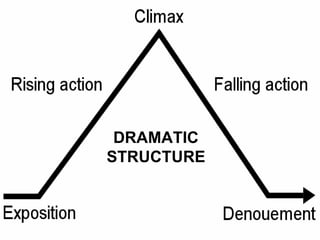
Gustave Freytag’s Pyramid From  Die Technik des Dramas (1863) Divided drama into five parts which correspond to the five acts These parts are: Exposition (Act I) Rising action (Act II) Climax (Act III) Falling action (Act IV)  Denouement or catastrophe (Act V)
DRAMATIC STRUCTURE
Exposition The exposition provides the background information necessary to understand the play. The protagonist(s), the basic conflict, the setting, and other dramatic elements are all introduced in this portion of the play.
Exposition in  R&J Prologue explains the plot; mini-play “ ancient grudge” “ star-cross’d lovers” Setting of Verona Internal and external conflicts The gravity of Prince Escalus All characters introduced and developed Love lives of Romeo and Juliet (Rosaline and Paris) Foreshadowing (Tybalt’s anger)
Inciting Moment The inciting moment is the event that sets the remainder of the story in motion Occurs at the end of the exposition (Act I) In Sophocles’  Oedipus Rex : the oracle In  R&J : the meeting of Romeo and Juliet Without their meeting at the party, the rest of the story is impossible [The Spark]
Rising Action Rising action is the period in which events intensify and/or complicate the conflict. In  Oedipus Rex : Oedipus kills Laius, solves Sphinx’s riddle, marries Jocasta
Rising Action in  R&J Romeo is enamored of Juliet and pays her a late-night visit Act II, Scene II: famous “balcony scene” The two make wedding plans Act II ends with Friar Laurence about to perform marriage ceremony
It’s  complicated … Romeo is in love with Juliet, a Capulet Juliet understands this (“doff thy name”) The Rosaline factor Tybalt sends challenge to Montague house Nurse and Friar implicated
Climax Turning or tipping point Zenith of tension and emotion Peripateia : “plot reversal” Hamartia : “tragic flaw” Anagnorisis : “tragic recognition” In  Oedipus Rex:  Jocasta and Oedipus learn the truth
“ I coulda been a comedy!” Without the death of Act III, it is possible that  R&J  would not end tragically Possible second half of play: Capulets, Montagues, Tybalt, and/or Paris attempt to thwart marriage ceremony Romeo and Juliet overcome intervention and happily marry Capulets and Montagues reconcile Others marry (Paris and Rosaline?)
Climax in  R&J Contrast between Act II, VI and Act III, I First sign: death of Mercutio Hamartia  and  peripateia : death of Tybalt Anagnorisis :  “ And fire-ey’d fury be my conduct now!” (III,I,126) “ O, I am fortune’s fool.” (III,I,138)
Act III by scene Mercutio, Tybalt killed; Romeo banished Juliet gets news from Nurse Romeo hears from Friar about banishment; Nurse tells Romeo to meet Juliet Paris meets with Capulets to arrange wedding R&J meet; Capulets tell Juliet of wedding plan
Falling Action The falling action is the period after the  climax in which the characters deal with the climax and consequences of the climax become evident In  Oedipus Rex:  Jocasta hangs herself and Oedipus blinds himself with her brooches
Falling Action in  R&J Paris and Juliet are set to marry Friar gives Juliet sleeping potion and plans for Romeo and Juliet to run away Capulet changes date of wedding Juliet takes potion in her chamber Nurse goes to fetch Juliet, finds her unconscious, and assumes her dead Capulets and others mourn Juliet’s “death”
Denouement The denouement (or catastrophe) of a tragedy serves as a conclusion to the story Untangling of the plot Resolution of conflict Brings about a sense of  catharsis  for the audience In  Oedipus Rex : Oedipus gives his children to Creon and goes into exile
Denouement in  R&J Balthasar brings news of Juliet’s death of Romeo Romeo buys poison from apothecary Friar Laurence finds out from Friar John that Romeo never received his letter Romeo kills Paris in Juliet’s tomb Romeo commits suicide by poison Juliet wakes to find Paris and Romeo dead and dies by stabbing herself with a dagger Friar explains himself Capulets and Montagues resolve their feud
Mercutio Name is evocative of “mercurial,” meaning lively, witty, and unpredictable; suits him well Goes from one extreme to the other Example: Mercutio is stabbed and vacillates between graveness and lightheartedness “ I am hurt.  A plague o’ both your houses” (III,I,91-2) “ Ay, ay, a scratch, a scratch” (III,I,94)
The Nurse Breast-fed and raised Juliet Serves as a motherly figure, confidante, and messenger Provides comic relief Offers practical alternative to Juliet’s idealistic view of love
Other Characters Benvolio:  acts as a moderator when Romeo and Mercutio debate; foil to Romeo Capulet:  stock character of the angry father Prince:  represents law and order
Themes Moderation vs. excess The nature of love Fate vs. personal responsibility
Theme of Moderation Aristotle’s belief in the necessity of moderation is found in  Nicomachean Ethics Moral virtues are found between extremes of action (golden mean) For example, generosity is the moral virtue found between a deficiency (stinginess) and an excess (prodigality) Found in Eastern philosophy: the Buddhist “middle way” is meant to avoid extremism
The Friar Embodies Aristotle’s concept of the “golden mean” Acts as a foil to Romeo, who represents youth’s impatience, haste, and short-sightedness Preaches the values of moderation “ Wisely and slow; they stumble that run fast” (II, IV,90) “ Therefore love moderate; long love doth so. Too swift arrives as tardy as too slow.” (II,VI, 14-5) “ Uneven is the course.  I like it not.” (IV,I,5)
Immoderate Romeo Dotes on Rosaline Quickly falls in love with and marries Juliet (Rosaline who?) Slays Tybalt after condemning fighting Views banishment as death Refuses to listen to Friar’s counsel: “ O, then I see that mad men have no ears” (III,III,61) Fights stranger (Paris) in the tomb Commits suicide right before Juliet wakes
Extreme Juliet Falls in love with Romeo immediately Describes her love as  “boundless” and “infinite” Requires that Romeo’s “purpose” is “marriage” Ignores Friar’s offer to hide her with nuns Prepared to die if she cannot live with Romeo: “ If all else fail, myself have power to die” (III,V,242)
Love Fickleness (Romeo and Rosaline?) Romeo and Juliet have love at first sight Love is inhibited by both families Arranged marriage
Who’s to blame?
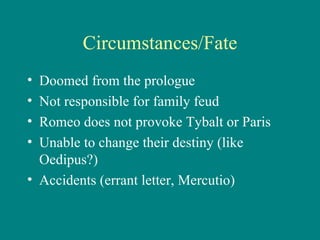
Circumstances/Fate Doomed from the prologue Not responsible for family feud Romeo does not provoke Tybalt or Paris Unable to change their destiny (like Oedipus?) Accidents (errant letter, Mercutio)
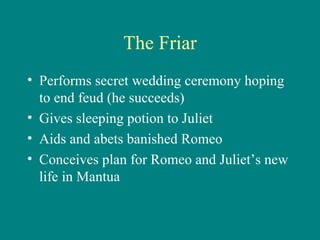
The Friar Performs secret wedding ceremony hoping to end feud (he succeeds) Gives sleeping potion to Juliet Aids and abets banished Romeo Conceives plan for Romeo and Juliet’s new life in Mantua
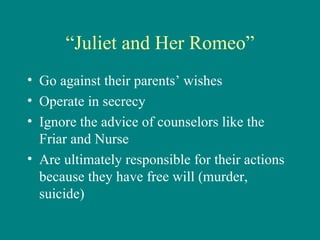
“ Juliet and Her Romeo” Go against their parents’ wishes Operate in secrecy Ignore the advice of counselors like the Friar and Nurse Are ultimately responsible for their actions because they have free will (murder, suicide)
Thank you QUESTIONS? COMMENTS?

R And J Power Summary

  • 1.
    Romeo and JulietBy Zachary Isaacs
  • 2.
    Notes About Romeo and Juliet Plot not conceived by Shakespeare Dramatization of Arthur Brooke’s narrative poem The Tragicall History of Romeus and Juliet Written around 1594 First printed edition appeared in 1597 in a “bad quarto”
  • 3.
    Publishing in HisTime Rarely were entire copies of the script available due to cost Actors knew own lines and cues only Drama not meant to be read as serious literature Shakespeare’s plays were printed (often without his permission) in quartos Compiled in First Folio (1623)
  • 4.
    Gustave Freytag’s PyramidFrom Die Technik des Dramas (1863) Divided drama into five parts which correspond to the five acts These parts are: Exposition (Act I) Rising action (Act II) Climax (Act III) Falling action (Act IV) Denouement or catastrophe (Act V)
  • 5.
  • 6.
    Exposition The expositionprovides the background information necessary to understand the play. The protagonist(s), the basic conflict, the setting, and other dramatic elements are all introduced in this portion of the play.
  • 7.
    Exposition in R&J Prologue explains the plot; mini-play “ ancient grudge” “ star-cross’d lovers” Setting of Verona Internal and external conflicts The gravity of Prince Escalus All characters introduced and developed Love lives of Romeo and Juliet (Rosaline and Paris) Foreshadowing (Tybalt’s anger)
  • 8.
    Inciting Moment Theinciting moment is the event that sets the remainder of the story in motion Occurs at the end of the exposition (Act I) In Sophocles’ Oedipus Rex : the oracle In R&J : the meeting of Romeo and Juliet Without their meeting at the party, the rest of the story is impossible [The Spark]
  • 9.
    Rising Action Risingaction is the period in which events intensify and/or complicate the conflict. In Oedipus Rex : Oedipus kills Laius, solves Sphinx’s riddle, marries Jocasta
  • 10.
    Rising Action in R&J Romeo is enamored of Juliet and pays her a late-night visit Act II, Scene II: famous “balcony scene” The two make wedding plans Act II ends with Friar Laurence about to perform marriage ceremony
  • 11.
    It’s complicated… Romeo is in love with Juliet, a Capulet Juliet understands this (“doff thy name”) The Rosaline factor Tybalt sends challenge to Montague house Nurse and Friar implicated
  • 12.
    Climax Turning ortipping point Zenith of tension and emotion Peripateia : “plot reversal” Hamartia : “tragic flaw” Anagnorisis : “tragic recognition” In Oedipus Rex: Jocasta and Oedipus learn the truth
  • 13.
    “ I couldabeen a comedy!” Without the death of Act III, it is possible that R&J would not end tragically Possible second half of play: Capulets, Montagues, Tybalt, and/or Paris attempt to thwart marriage ceremony Romeo and Juliet overcome intervention and happily marry Capulets and Montagues reconcile Others marry (Paris and Rosaline?)
  • 14.
    Climax in R&J Contrast between Act II, VI and Act III, I First sign: death of Mercutio Hamartia and peripateia : death of Tybalt Anagnorisis : “ And fire-ey’d fury be my conduct now!” (III,I,126) “ O, I am fortune’s fool.” (III,I,138)
  • 15.
    Act III byscene Mercutio, Tybalt killed; Romeo banished Juliet gets news from Nurse Romeo hears from Friar about banishment; Nurse tells Romeo to meet Juliet Paris meets with Capulets to arrange wedding R&J meet; Capulets tell Juliet of wedding plan
  • 16.
    Falling Action Thefalling action is the period after the climax in which the characters deal with the climax and consequences of the climax become evident In Oedipus Rex: Jocasta hangs herself and Oedipus blinds himself with her brooches
  • 17.
    Falling Action in R&J Paris and Juliet are set to marry Friar gives Juliet sleeping potion and plans for Romeo and Juliet to run away Capulet changes date of wedding Juliet takes potion in her chamber Nurse goes to fetch Juliet, finds her unconscious, and assumes her dead Capulets and others mourn Juliet’s “death”
  • 18.
    Denouement The denouement(or catastrophe) of a tragedy serves as a conclusion to the story Untangling of the plot Resolution of conflict Brings about a sense of catharsis for the audience In Oedipus Rex : Oedipus gives his children to Creon and goes into exile
  • 19.
    Denouement in R&J Balthasar brings news of Juliet’s death of Romeo Romeo buys poison from apothecary Friar Laurence finds out from Friar John that Romeo never received his letter Romeo kills Paris in Juliet’s tomb Romeo commits suicide by poison Juliet wakes to find Paris and Romeo dead and dies by stabbing herself with a dagger Friar explains himself Capulets and Montagues resolve their feud
  • 20.
    Mercutio Name isevocative of “mercurial,” meaning lively, witty, and unpredictable; suits him well Goes from one extreme to the other Example: Mercutio is stabbed and vacillates between graveness and lightheartedness “ I am hurt. A plague o’ both your houses” (III,I,91-2) “ Ay, ay, a scratch, a scratch” (III,I,94)
  • 21.
    The Nurse Breast-fedand raised Juliet Serves as a motherly figure, confidante, and messenger Provides comic relief Offers practical alternative to Juliet’s idealistic view of love
  • 22.
    Other Characters Benvolio: acts as a moderator when Romeo and Mercutio debate; foil to Romeo Capulet: stock character of the angry father Prince: represents law and order
  • 23.
    Themes Moderation vs.excess The nature of love Fate vs. personal responsibility
  • 24.
    Theme of ModerationAristotle’s belief in the necessity of moderation is found in Nicomachean Ethics Moral virtues are found between extremes of action (golden mean) For example, generosity is the moral virtue found between a deficiency (stinginess) and an excess (prodigality) Found in Eastern philosophy: the Buddhist “middle way” is meant to avoid extremism
  • 25.
    The Friar EmbodiesAristotle’s concept of the “golden mean” Acts as a foil to Romeo, who represents youth’s impatience, haste, and short-sightedness Preaches the values of moderation “ Wisely and slow; they stumble that run fast” (II, IV,90) “ Therefore love moderate; long love doth so. Too swift arrives as tardy as too slow.” (II,VI, 14-5) “ Uneven is the course. I like it not.” (IV,I,5)
  • 26.
    Immoderate Romeo Doteson Rosaline Quickly falls in love with and marries Juliet (Rosaline who?) Slays Tybalt after condemning fighting Views banishment as death Refuses to listen to Friar’s counsel: “ O, then I see that mad men have no ears” (III,III,61) Fights stranger (Paris) in the tomb Commits suicide right before Juliet wakes
  • 27.
    Extreme Juliet Fallsin love with Romeo immediately Describes her love as “boundless” and “infinite” Requires that Romeo’s “purpose” is “marriage” Ignores Friar’s offer to hide her with nuns Prepared to die if she cannot live with Romeo: “ If all else fail, myself have power to die” (III,V,242)
  • 28.
    Love Fickleness (Romeoand Rosaline?) Romeo and Juliet have love at first sight Love is inhibited by both families Arranged marriage
  • 29.
  • 30.
    Circumstances/Fate Doomed fromthe prologue Not responsible for family feud Romeo does not provoke Tybalt or Paris Unable to change their destiny (like Oedipus?) Accidents (errant letter, Mercutio)
  • 31.
    The Friar Performssecret wedding ceremony hoping to end feud (he succeeds) Gives sleeping potion to Juliet Aids and abets banished Romeo Conceives plan for Romeo and Juliet’s new life in Mantua
  • 32.
    “ Juliet andHer Romeo” Go against their parents’ wishes Operate in secrecy Ignore the advice of counselors like the Friar and Nurse Are ultimately responsible for their actions because they have free will (murder, suicide)
  • 33.