Romeo and Juliet
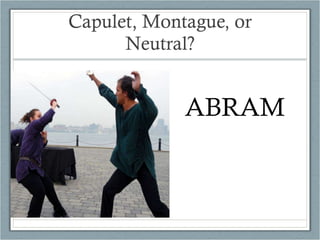
Capulet, Montague, or Neutral? ABRAM
ABRAM = MONTAGUE
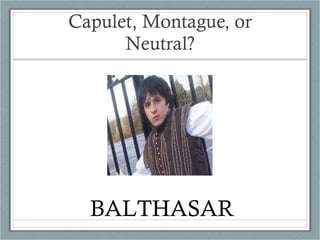
Capulet, Montague, or Neutral? BALTHASAR
BALTHASAR = MONTAGUE
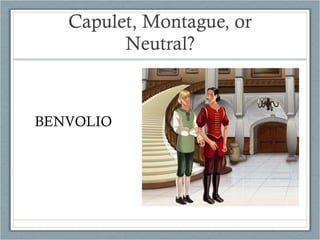
Capulet, Montague, or Neutral? BENVOLIO
BENVOLIO = MONTAGUE
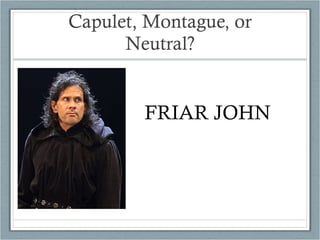
Capulet, Montague, or Neutral? FRIAR JOHN
FRIAR JOHN = NEUTRAL
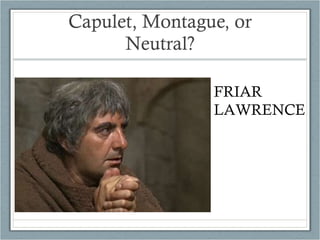
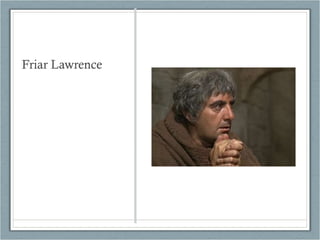
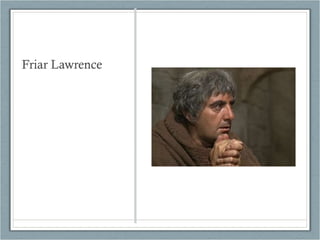
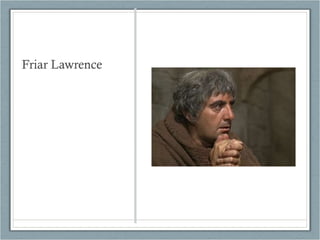
Capulet, Montague, or Neutral? FRIAR LAWRENCE
FRIAR LAWRENCE = MONTAGUE The Friar counts as a Montague because he’s a Montague, a close confidant of Romeo, before anything else.  Though, yes, it’s true.  Later he helps both Romeo and Juliet and hopes for a reconciliation between the two families.
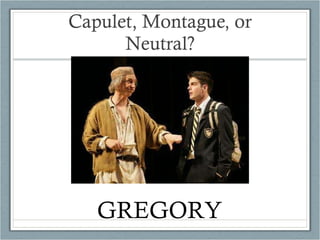
Capulet, Montague, or Neutral? GREGORY
GREGORY = CAPULET
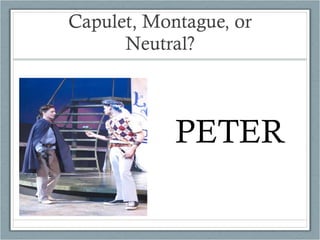
Capulet, Montague, or Neutral? PETER
PETER = CAPULET
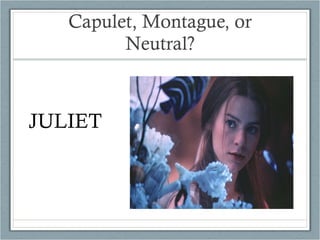
Capulet, Montague, or Neutral? JULIET
JULIET = CAPULET
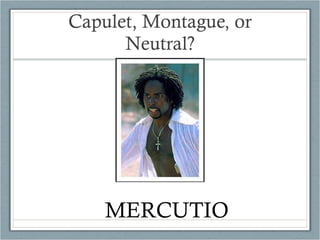
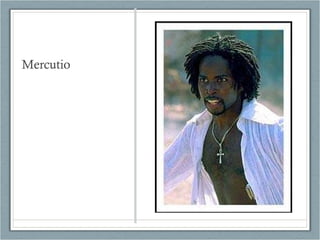
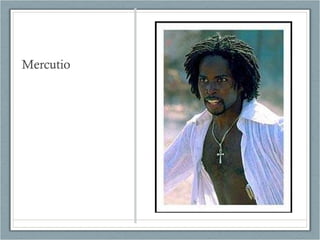
Capulet, Montague, or Neutral? MERCUTIO
MERCUTIO = MONTAGUE
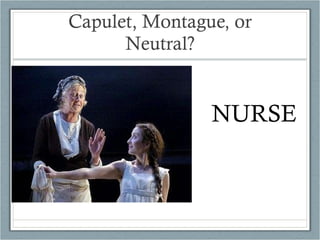
Capulet, Montague, or Neutral? NURSE
NURSE = CAPULET Just like Friar Lawrence, the Nurse in the exposition of the play is clearly aligned with just one family – in this case the Capulets – but later does things to assist a member of the other family as well.  In the end, though, she’s a Capulet through and through, telling Juliet she should just “marry with the County.”
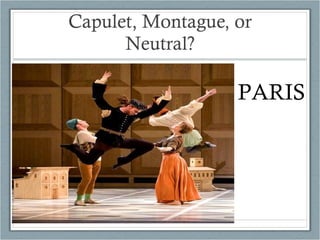
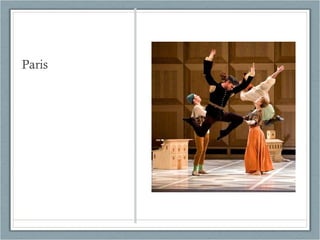
Capulet, Montague, or Neutral? PARIS
PARIS = CAPULET
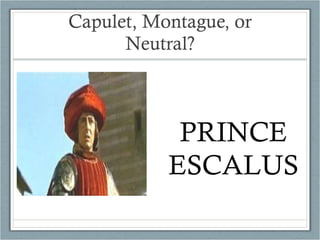
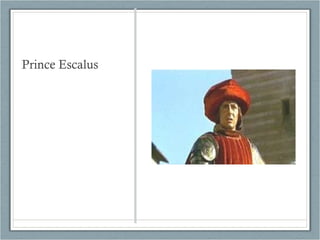
Capulet, Montague, or Neutral? PRINCE ESCALUS
PRINCE ESCALUS = NEUTRAL
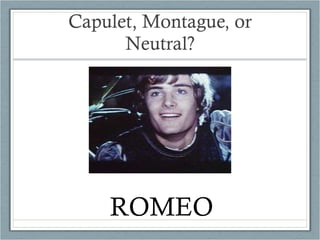
Capulet, Montague, or Neutral? ROMEO
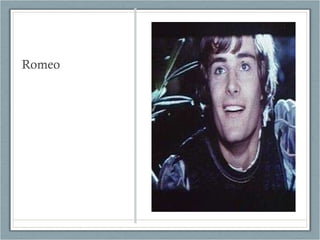
ROMEO = MONTAGUE
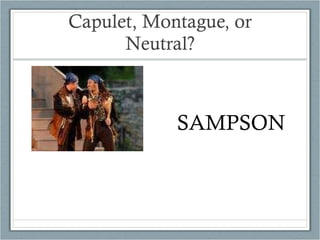
Capulet, Montague, or Neutral? SAMPSON
SAMPSON = CAPULET
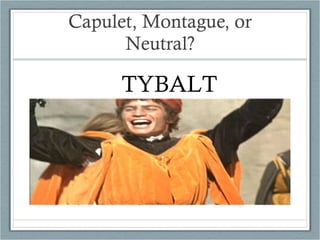
Capulet, Montague, or Neutral? TYBALT
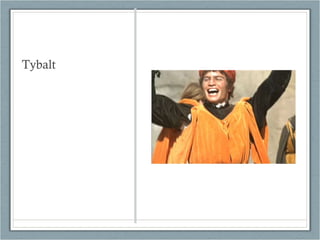
TYBALT = CAPULET
In the prologue before Act I, Romeo and Juliet are referred to as . . .
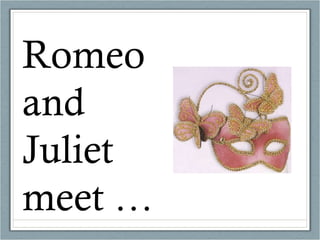
Romeo and Juliet meet …
As the play opens, Romeo is sad because . . .
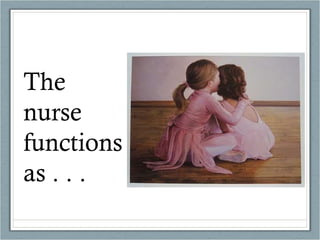
The nurse functions as . . .
The Friar agrees to marry Romeo and Juliet because . . .
Tybalt becomes furious at Romeo when he . . .
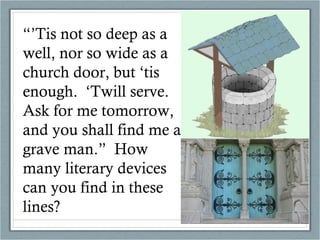
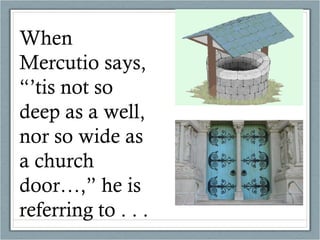
When Mercutio says, “’tis not so deep as a well, nor so wide as a church door…,” he is referring to . . .
“’ Tis not so deep as a well, nor so wide as a church door, but ‘tis enough.  ‘Twill serve.  Ask for me tomorrow, and you shall find me a grave man.”  How many literary devices can you find in these lines?
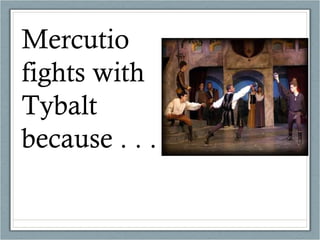
Mercutio fights with Tybalt because . . .
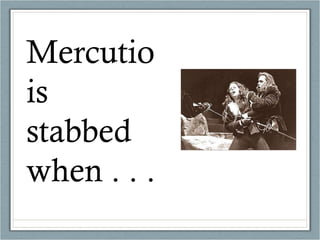
Mercutio is stabbed when . . .
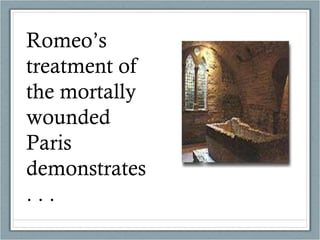
Romeo’s treatment of the mortally wounded Paris demonstrates . . .
Juliet gets her poison from __________ and Romeo gets his from __________.
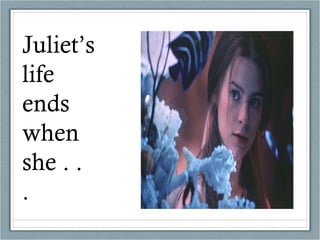
Juliet’s life ends when she . . .
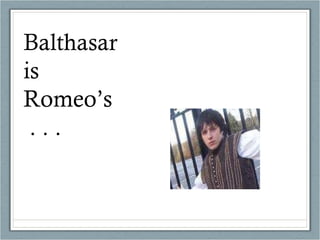
Balthasar is Romeo’s  . . .
To which city does Romeo go after being banished, and why was he exiled?
Who convinces Romeo to attend the masquerade ball at the Capulets?
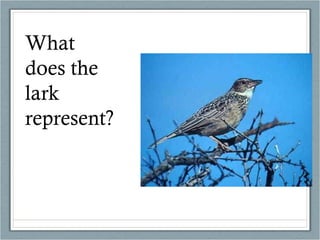
What does the lark represent?
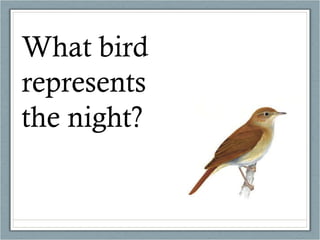
What bird represents the night?
Who first finds Juliet after she takes the potion that will make her appear dead?
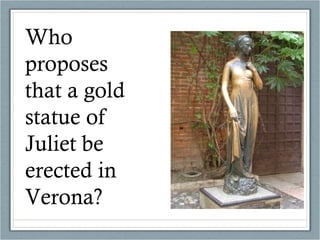
Who proposes that a gold statue of Juliet be erected in Verona?
How and where does Romeo commit suicide?
Who is the last person to see Juliet alive?
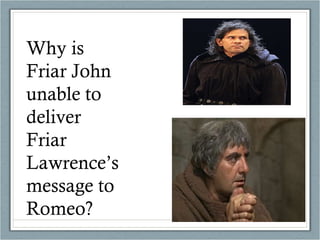
Why is Friar John unable to deliver Friar Lawrence’s message to Romeo?
Why does the apothecary agree to sell Romeo the poison?
As this transaction occurs, the apothecary says to Romeo, “My poverty, but not my will, consents.” To this Romeo replies, “I [pay] thy poverty and not thy will.” This is an example of what literary device?
In the first two scenes of the play, Romeo was in love with . . .
Whom does Mercutio curse as he lay dying?
What line does Mercutio utter as he draws his last breath?
Who said it? “ Good night, good night!  Parting is such sweet sorrow/ That I shall say good night till it be morrow.”
Juliet
Who said it? “ My child is yet a stranger in the world,/ She hath not seen the change of fourteen years;/ Let two more summers wither in their pride/ Ere we may think her ripe to be a bride.”
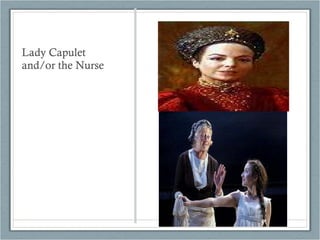
Lady Capulet and/or the Nurse
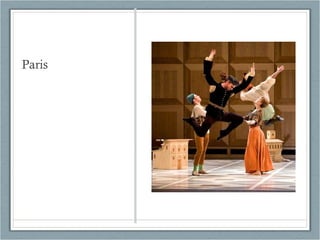
To whom is he speaking? “ My child is yet a stranger in the world,/ She hath not seen the change of fourteen years;/ Let two more summers wither in their pride/ Ere we may think her ripe to be a bride.”
Paris
What poetic device is being used? “ My child is yet a stranger in the world,/ She hath not seen the change of fourteen years;/ Let two more summers wither in their pride/ Ere we may think her ripe to be a bride.”
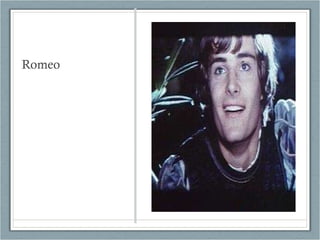
Who said it? “ Out of her favor where I am in love.”
Romeo
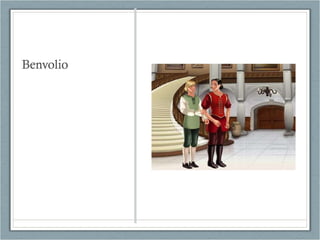
To whom is he talking? “ Out of her favor where I am in love.”
Benvolio
About whom is he talking? “ Out of her favor where I am in love.”
Rosaline
Who said it? “ O Romeo, Romeo!  Wherefore art thou Romeo?”
Juliet
Who said it? “ I’ll look to like, if looking liking move; / But no more deep will I endart mine eye/ than your consent gives strength to make it fly.”
Juliet
To whom is she speaking? “ I’ll look to like, if looking liking move; / But no more deep will I endart mine eye/ than your consent gives strength to make it fly.”
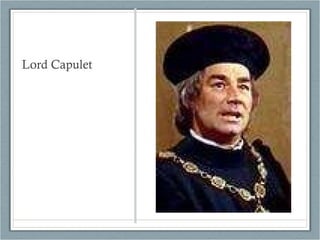
Lord Capulet
About whom is she speaking? “ I’ll look to like, if looking liking move; / But no more deep will I endart mine eye/ than your consent gives strength to make it fly.”
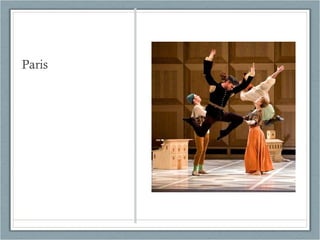
Paris
Who said it? “ A plague a both your houses!/ They have made worms’ meat of me.”
Mercutio
Who said it? “ Affliction is enamored of they parts,/ And thou art wedded to calamity.”
Friar Lawrence
Who said it? “ Ask for me tomorrow, and you/ Shall find me a grave man.”
Mercutio
Who said it? “ Young men’s love then lies/ Not truly in their hearts, but in their eyes.”
Friar Lawrence
Who said it? “ You say you do not know the lady’s mind./ Uneven is the course; I like it not.”
Friar Lawrence
To whom is he speaking? “ You say you do not know the lady’s mind./ Uneven is the course; I like it not.”
Paris
Who is speaking? “ I do protest I never injured thee, /But love thee better than thou canst devise/ Till thou salt know the reason of my love; / And so, good Capulet, which name I tender/ As dearly as mine own, be satisfied.”
Romeo
To whom is he speaking? “ I do protest I never injured thee, /But love thee better than thou canst devise/ Till thou salt know the reason of my love; / And so, good Capulet, which name I tender/ As dearly as mine own, be satisfied.”
Tybalt
Who is speaking? “ Where be these enemies?  Capulet, Montague,/ See what a scourge is laid up on your hate,/ That heaven finds means to kill your joys with love.”
Prince Escalus

Romeo and juliet review