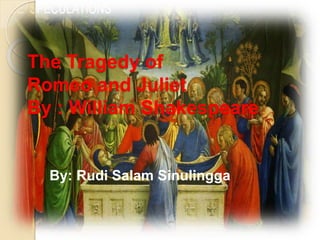
The Tragedy of 
Romeo and Juliet 
By : William Shakespeare 
By: Rudi Salam Sinulingga
Act I 
This list of Romeo and Juliet quotes is no where near exhaustive. It will, 
however, give you a good start to understanding the play. 
Quote: From forth the fatal loins of these two foes / A pair of star-crossed 
lovers take their life / Whose misadventured piteous overthrows / Doth with 
their death bury their parents' strife (Prologue, 6-9) 
Analysis: Shakespeare gives us the plot of the play before the play even 
begins. There is obviously more to be learned from the play than the series 
of events. Fatal loins makes for an interesting discussion. 
Quote: O she doth teach the torches to burn bright! / It seems she hangs 
upon the cheek of night / As a rich jewel in an Ethiop's ear-- / Beauty too 
rich for use, for Earth too dear! (I, v, 43-46) 
Analysis: Romeo proclaims his infatuation for Juliet. He has seen her for 
about 2.63 seconds and has never spoken with her. He utters this mere 
hours after uttering similar thoughts about Rosaline. These words give 
insight into Romeo's instability and his being controlled by his emotions. 
The final line foreshadows Juliet's death.
Act II 
Quote: O Romeo, Romeo! Wherefore art thou Romeo? / Deny thy father and refuse thy 
name (II, ii, 33-34. 
Analysis: The key word in Juliet's question is wherefore, which means why, not where as 
many foolish neophyte Shakespeareans believe. Juliet, in these lines, declares her 
willingness to disown her own family if she can be with her true love, who she's known for 
almost an hour-and-a-half. And you wonder why fathers go bald. 
Quote: What's in a name? That which we call a rose / By any other name would smell as 
sweet. (II, ii, 43-44). 
Analysis: Juliet still tries to subdue her conscience with this reasoning, claiming that 
Romeo's name matters not, for he is her true love. Juliet is wrong. A rose would not smell as 
sweet if you called it a Harkraken or Schnockter or a Sewage Weed. That's just my 
analysis. What do you think? 
Quote: Good night, good night! Parting is such sweet sorrow / That I shall say good night till 
it be morrow (II, ii, 184-5). 
Analysis: Juliet speaks all the good lines. She's a rather aggressive Middle Ages girl, don't 
you think? Juliet obviously cares little for societal restrictions.
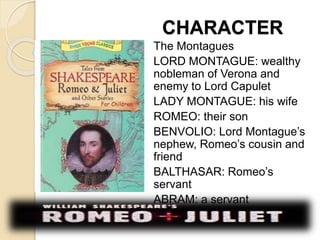
CHARACTER 
The Montagues 
LORD MONTAGUE: wealthy 
nobleman of Verona and 
enemy to Lord Capulet 
LADY MONTAGUE: his wife 
ROMEO: their son 
BENVOLIO: Lord Montague’s 
nephew, Romeo’s cousin and 
friend 
BALTHASAR: Romeo’s 
servant 
ABRAM: a servant
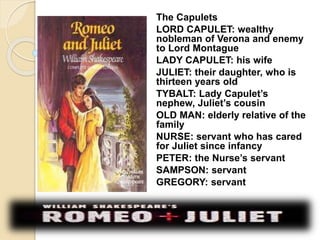
The Capulets 
LORD CAPULET: wealthy 
nobleman of Verona and enemy 
to Lord Montague 
LADY CAPULET: his wife 
JULIET: their daughter, who is 
thirteen years old 
TYBALT: Lady Capulet’s 
nephew, Juliet’s cousin 
OLD MAN: elderly relative of the 
family 
NURSE: servant who has cared 
for Juliet since infancy 
PETER: the Nurse’s servant 
SAMPSON: servant 
GREGORY: servant
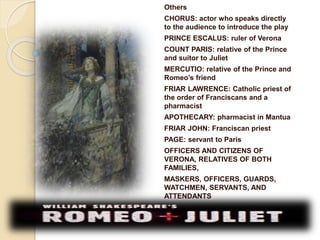
Others 
CHORUS: actor who speaks directly 
to the audience to introduce the play 
PRINCE ESCALUS: ruler of Verona 
COUNT PARIS: relative of the Prince 
and suitor to Juliet 
MERCUTIO: relative of the Prince and 
Romeo’s friend 
FRIAR LAWRENCE: Catholic priest of 
the order of Franciscans and a 
pharmacist 
APOTHECARY: pharmacist in Mantua 
FRIAR JOHN: Franciscan priest 
PAGE: servant to Paris 
OFFICERS AND CITIZENS OF 
VERONA, RELATIVES OF BOTH 
FAMILIES, 
MASKERS, OFFICERS, GUARDS, 
WATCHMEN, SERVANTS, AND 
ATTENDANTS
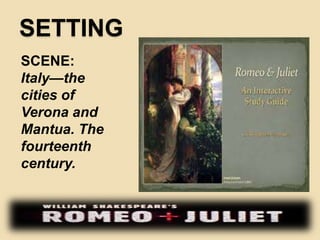
SETTING 
SCENE: 
Italy—the 
cities of 
Verona and 
Mantua. The 
fourteenth 
century.
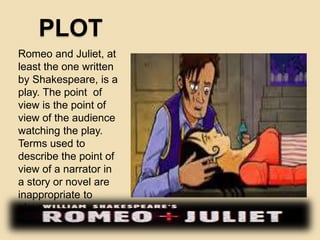
PLOT 
Romeo and Juliet, at 
least the one written 
by Shakespeare, is a 
play. The point of 
view is the point of 
view of the audience 
watching the play. 
Terms used to 
describe the point of 
view of a narrator in 
a story or novel are 
inappropriate to 
plays.
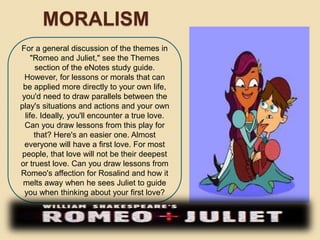
MORALISM 
For a general discussion of the themes in 
"Romeo and Juliet," see the Themes 
section of the eNotes study guide. 
However, for lessons or morals that can 
be applied more directly to your own life, 
you'd need to draw parallels between the 
play's situations and actions and your own 
life. Ideally, you'll encounter a true love. 
Can you draw lessons from this play for 
that? Here's an easier one. Almost 
everyone will have a first love. For most 
people, that love will not be their deepest 
or truest love. Can you draw lessons from 
Romeo's affection for Rosalind and how it 
melts away when he sees Juliet to guide 
you when thinking about your first love?
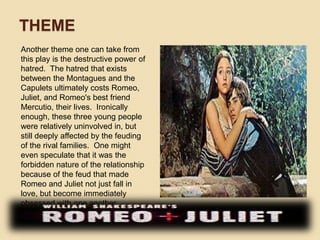
THEME 
Another theme one can take from 
this play is the destructive power of 
hatred. The hatred that exists 
between the Montagues and the 
Capulets ultimately costs Romeo, 
Juliet, and Romeo's best friend 
Mercutio, their lives. Ironically 
enough, these three young people 
were relatively uninvolved in, but 
still deeply affected by the feuding 
of the rival families. One might 
even speculate that it was the 
forbidden nature of the relationship 
because of the feud that made 
Romeo and Juliet not just fall in 
love, but become immediately 
obsessed with one another.
POINT OF VIEW 
An interesting question. 
Since it is a play, the main 
point of view is an 
objective one: we see all 
events from the outside, 
as if we were observing 
them. If you translated this 
to the way points of view 
are described for fiction, 
that would be THIRD 
PERSON limited, since 
we can't see inside the 
characters' minds.

Romo and Juliet

  • 1.
    The Tragedy of Romeo and Juliet By : William Shakespeare By: Rudi Salam Sinulingga
  • 2.
    Act I Thislist of Romeo and Juliet quotes is no where near exhaustive. It will, however, give you a good start to understanding the play. Quote: From forth the fatal loins of these two foes / A pair of star-crossed lovers take their life / Whose misadventured piteous overthrows / Doth with their death bury their parents' strife (Prologue, 6-9) Analysis: Shakespeare gives us the plot of the play before the play even begins. There is obviously more to be learned from the play than the series of events. Fatal loins makes for an interesting discussion. Quote: O she doth teach the torches to burn bright! / It seems she hangs upon the cheek of night / As a rich jewel in an Ethiop's ear-- / Beauty too rich for use, for Earth too dear! (I, v, 43-46) Analysis: Romeo proclaims his infatuation for Juliet. He has seen her for about 2.63 seconds and has never spoken with her. He utters this mere hours after uttering similar thoughts about Rosaline. These words give insight into Romeo's instability and his being controlled by his emotions. The final line foreshadows Juliet's death.
  • 3.
    Act II Quote:O Romeo, Romeo! Wherefore art thou Romeo? / Deny thy father and refuse thy name (II, ii, 33-34. Analysis: The key word in Juliet's question is wherefore, which means why, not where as many foolish neophyte Shakespeareans believe. Juliet, in these lines, declares her willingness to disown her own family if she can be with her true love, who she's known for almost an hour-and-a-half. And you wonder why fathers go bald. Quote: What's in a name? That which we call a rose / By any other name would smell as sweet. (II, ii, 43-44). Analysis: Juliet still tries to subdue her conscience with this reasoning, claiming that Romeo's name matters not, for he is her true love. Juliet is wrong. A rose would not smell as sweet if you called it a Harkraken or Schnockter or a Sewage Weed. That's just my analysis. What do you think? Quote: Good night, good night! Parting is such sweet sorrow / That I shall say good night till it be morrow (II, ii, 184-5). Analysis: Juliet speaks all the good lines. She's a rather aggressive Middle Ages girl, don't you think? Juliet obviously cares little for societal restrictions.
  • 4.
    CHARACTER The Montagues LORD MONTAGUE: wealthy nobleman of Verona and enemy to Lord Capulet LADY MONTAGUE: his wife ROMEO: their son BENVOLIO: Lord Montague’s nephew, Romeo’s cousin and friend BALTHASAR: Romeo’s servant ABRAM: a servant
  • 5.
    The Capulets LORDCAPULET: wealthy nobleman of Verona and enemy to Lord Montague LADY CAPULET: his wife JULIET: their daughter, who is thirteen years old TYBALT: Lady Capulet’s nephew, Juliet’s cousin OLD MAN: elderly relative of the family NURSE: servant who has cared for Juliet since infancy PETER: the Nurse’s servant SAMPSON: servant GREGORY: servant
  • 6.
    Others CHORUS: actorwho speaks directly to the audience to introduce the play PRINCE ESCALUS: ruler of Verona COUNT PARIS: relative of the Prince and suitor to Juliet MERCUTIO: relative of the Prince and Romeo’s friend FRIAR LAWRENCE: Catholic priest of the order of Franciscans and a pharmacist APOTHECARY: pharmacist in Mantua FRIAR JOHN: Franciscan priest PAGE: servant to Paris OFFICERS AND CITIZENS OF VERONA, RELATIVES OF BOTH FAMILIES, MASKERS, OFFICERS, GUARDS, WATCHMEN, SERVANTS, AND ATTENDANTS
  • 7.
    SETTING SCENE: Italy—the cities of Verona and Mantua. The fourteenth century.
  • 8.
    PLOT Romeo andJuliet, at least the one written by Shakespeare, is a play. The point of view is the point of view of the audience watching the play. Terms used to describe the point of view of a narrator in a story or novel are inappropriate to plays.
  • 9.
    MORALISM For ageneral discussion of the themes in "Romeo and Juliet," see the Themes section of the eNotes study guide. However, for lessons or morals that can be applied more directly to your own life, you'd need to draw parallels between the play's situations and actions and your own life. Ideally, you'll encounter a true love. Can you draw lessons from this play for that? Here's an easier one. Almost everyone will have a first love. For most people, that love will not be their deepest or truest love. Can you draw lessons from Romeo's affection for Rosalind and how it melts away when he sees Juliet to guide you when thinking about your first love?
  • 10.
    THEME Another themeone can take from this play is the destructive power of hatred. The hatred that exists between the Montagues and the Capulets ultimately costs Romeo, Juliet, and Romeo's best friend Mercutio, their lives. Ironically enough, these three young people were relatively uninvolved in, but still deeply affected by the feuding of the rival families. One might even speculate that it was the forbidden nature of the relationship because of the feud that made Romeo and Juliet not just fall in love, but become immediately obsessed with one another.
  • 11.
    POINT OF VIEW An interesting question. Since it is a play, the main point of view is an objective one: we see all events from the outside, as if we were observing them. If you translated this to the way points of view are described for fiction, that would be THIRD PERSON limited, since we can't see inside the characters' minds.