Romania is split in three unofficial provinces:
Transilvania (the green one), Moldova (the red
one), and Valachia (the blue one).
Officialy Romania is split into 41 counties,
each with its own municipality (usually the largest
city in the county will be its municipality, akin to a
county capital).
Also our neighbor on the East side, Moldova,
and Bukovina in the North (now part of Ukraine)
used to be part of Romania and people living there
still speak Romanian.
With 238,400 square kilometers, Romania is the
ninth largest country of the
European Union by area, and has the seventh largest
population of the European Union with more than
19 million people.
POPULATION :
21,666,000 people living
currently on Romania’s
territory
NATIONAL DAY December
1st 1918 (Bucharest, the
current capital, Alba Iulia,
the city where all the
Romanian provinces were
united for the first time in
1601, Timisoara, the city
where the 1989
Revolution started, are
hosting impressive
military parades)
NATIONAL FLAG
The Tricolor
CURRENCY New Romanian Leu (RON). As of
September 2016, this is the latest conversion rate.
Bucharest is Romania's capital and the best known
city in Romania.
• Its nickname is “Little Paris”.
• The population is 1,944,367 inhabitants.
• It is located on the banks of the Dâmboviţa River
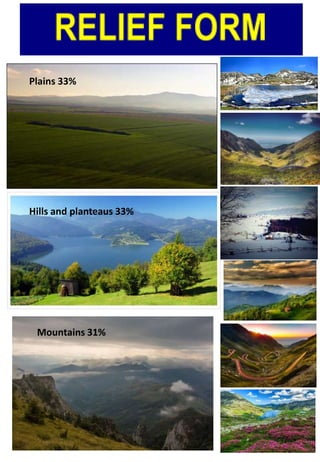
Plains 33%
Hills and planteaus 33%
Mountains 31%
Romania is famous
for its Carpathian
Mountains, the Danube
and the Black Sea.
What can you can visit
in Romania if you come
here? Take a look at
these:
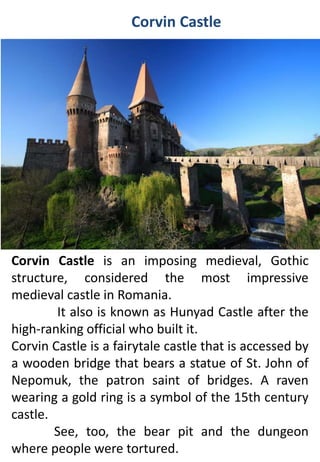
Corvin Castle
Corvin Castle is an imposing medieval, Gothic
structure, considered the most impressive
medieval castle in Romania.
It also is known as Hunyad Castle after the
high-ranking official who built it.
Corvin Castle is a fairytale castle that is accessed by
a wooden bridge that bears a statue of St. John of
Nepomuk, the patron saint of bridges. A raven
wearing a gold ring is a symbol of the 15th century
castle.
See, too, the bear pit and the dungeon
where people were tortured.
Sucevita Monastery
The Sucevita Monastery is architecturally unique, no
doubt about that. Somehow the blend of the Gothic
and Byzantine styles, plus Moldavia’s painted
churches comes together in a spectacular building.
The front is cylindrical, topped with a conical roof
while the back is rectangular and topped with a small
tower. Inside, you’ll find painted murals from the
early 1600s and tomb covers embroidered with silver
thread. The monastery, located in northeast
Romania, is considered one of the most important
painted churches in Moldavia.
Biertan Fortified Church
Biertan Fortified Church stands head and shoulders
above the other buildings in Biertan, It was originally
a Catholic church built when the region belonged to
Hungary. It became a Lutheran church after the
Reformation. Rather than build a fortress to defend
against Ottoman invaders, townspeople fortified the
church. Built in Late Gothic style, it is one of the
largest fortified churches in Romania. The church is
noted for its towers, including one used to store food
during sieges and another to imprison husbands who
wanted a divorce.
Merry Cemetery
Merry Cemetery in the town of Sapanta isn’t your
ordinary run-of-the-mill cemetery. It’s more like a
folk art gallery, with colorful tombstones, crosses
and statuary celebrating the lives of the deceased.
This colorful tradition began with a 14-year-old boy
who began carving crosses in 1908. He added
poems and painted a portrait of the deceased on
the cross; sometimes he even painted how they
died. And thus a tradition was born. The
background on everything is deep blue, with other
colors symbolizing life, death and fertility.
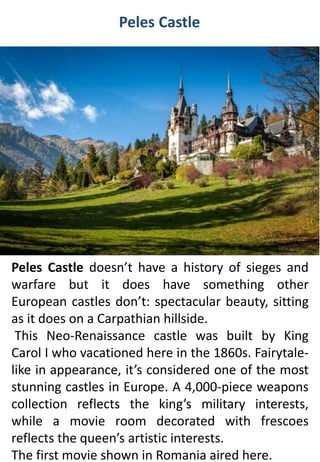
Peles Castle
Peles Castle doesn’t have a history of sieges and
warfare but it does have something other
European castles don’t: spectacular beauty, sitting
as it does on a Carpathian hillside.
This Neo-Renaissance castle was built by King
Carol I who vacationed here in the 1860s. Fairytale-
like in appearance, it’s considered one of the most
stunning castles in Europe. A 4,000-piece weapons
collection reflects the king’s military interests,
while a movie room decorated with frescoes
reflects the queen’s artistic interests.
The first movie shown in Romania aired here.
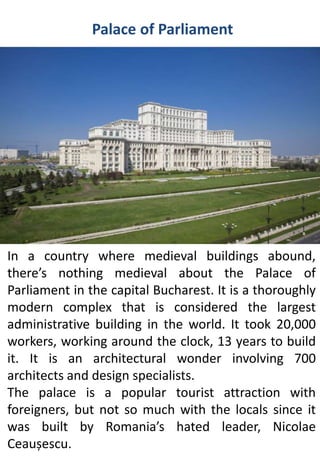
Palace of Parliament
In a country where medieval buildings abound,
there’s nothing medieval about the Palace of
Parliament in the capital Bucharest. It is a thoroughly
modern complex that is considered the largest
administrative building in the world. It took 20,000
workers, working around the clock, 13 years to build
it. It is an architectural wonder involving 700
architects and design specialists.
The palace is a popular tourist attraction with
foreigners, but not so much with the locals since it
was built by Romania’s hated leader, Nicolae
Ceaușescu.
Sighisoara Historic Center
If you have preconceived notions of what medieval
life was like, Sighisoara Historic Center will certainly
fulfill them.
Old Town Sighisoara is definitely medieval at its
finest. Found by 12th century Transylvanian Saxons,
Sighisoara is a great example of a fortified medieval
town. It has the traditional narrow streets flanked by
colorful stone buildings. It is the birthplace of Vlad
the Impaler, the inspiration for Bram Stoker’s Dracula.
Sighisoara celebrates its medievalness every July with
a festival that includes rock bands.
Bran Castle
Bran Castle is often associated with Dracula as his
home, though there’s no indication that author
Bram Stoker even knew of this medieval castle.
The castle, a Romanian landmark, has a fairy tale
quality, peeking out from forested a hillside near
Brasov in Transylvania. With roots dating to the 13th
century, this medieval castle today is a museum
showcasing art and furniture collected by Queen
Maria.
It also is home to an open-air museum
featuring Romanian peasant buildings from around
the country.
Constantin Brancusi (1876 - 1957)
— the artist whose works redefined
sculpture, the most important
sculptor of the Twentieth-Century.
Henri Coanda (1886-1972)Romanian engineer and
aerodynamics pioneer, Henri Coanda was educated to
become an army officer like his father. He abandoned
the military career shortly after graduation and went to
Paris to study aeronautics. After years of working on
propeller planes and a series of experiments – one of
these injuring him – Henri Coanda was awarded, in
1934, the French patent for the Coanda Effect.
Petrache Poenaru
Poenaru's fountain pen
In 1826 he went to France and
attended the École
Polytechnique in Paris, where
he studied geodesy and
surveying. ")
He was so busy taking notes and copying courses,
that he invented a fountain pen that used a swan's
quill as an ink reservoir. On 25 May 1827, the
Manufacture Department of the French Ministry of
the Interior registered Poenaru’s invention "plume
portable sans fin, qui s’alimente elle-meme avec de
l’ancre" ("never-ending portable pen, which
recharges itself with ink
Ana Aslan was a Romanian biologist and physician.
Ana Aslan was considered a
pioneer of social medicine.
Years after becoming the head
of the physiology department at
the Institute of Endocrinology
of Bucharest, she founded the
Institute of Geriatrics of
Bucharest.
George Enescu (1881-1955)
Gheorghe Zamfir
An exceptional pan flute musician, Gheorghe Zamfir
plays this instrument like no one else, expanding the
traditional 20 pipes version to 22, 25, 28, and 30
pipes. This creative approach allowed him to
interpret and compose elaborate musical pieces that
brought him world-fame. He toured for decades,
being the first artist to perform during the private
mise of Pope John Paul the II.
George Enescu was a
Romanian musician.
Enescu is regarded as one
of the greatest musicians
in Romanian history; he
was a composer, violinist,
pianist, conductor, and
teacher.
Nadia Comaneci
Nadia Comaneci
became one of the most
famous Romanians in
the world after receiving
the first 10 in the history
of gymnastics.
This happened in 1976, at the Montreal Olympics,
when she was only 14. During her gymnast career,
Nadia Comaneci won nine Olympic medals and
four world championships. Her performance
encouraged and inspired generations of young
gymnasts from Romania and around the world.
Simona Halep
Simona Halep is one of the most
loved athletes from Romania .
2015: Premier Mandatory title, US
Open semifinal
2018: French Open champion,
Australian Open runner-up
2019: Wimbledon champion
2020: Consistent results, 3 WTA titles
Gheorghe Hagi:
Gheorghe Hagi was a great midfielder,
famed for his “magic wand” left foot.
In the 1990s he played for Real
Madrid, Brescia, Barcelona and
Galatasaray. He won many trophies in
four different countries.
He played for Romania in three World Cups.
Galatasaray fans called him “Comandante”. For
Romanian fans he was the “Maradona of the
Carpathians”. The 2003 UEFA Jubilee named him
Romania’s “Golden Player”.
Romanian food is delicious.
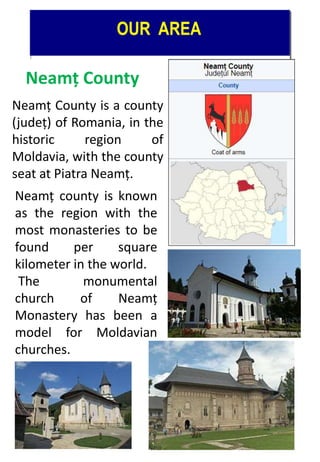
Neamț County
Neamț County is a county
(județ) of Romania, in the
historic region of
Moldavia, with the county
seat at Piatra Neamț.
Neamț county is known
as the region with the
most monasteries to be
found per square
kilometer in the world.
The monumental
church of Neamț
Monastery has been a
model for Moldavian
churches.
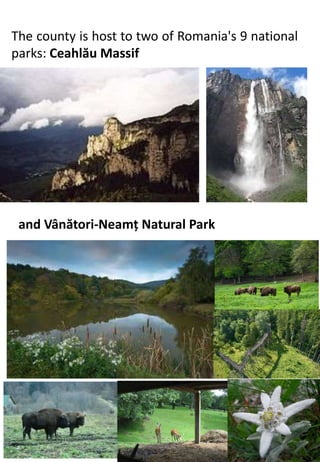
The county is host to two of Romania's 9 national
parks: Ceahlău Massif
and Vânători-Neamț Natural Park
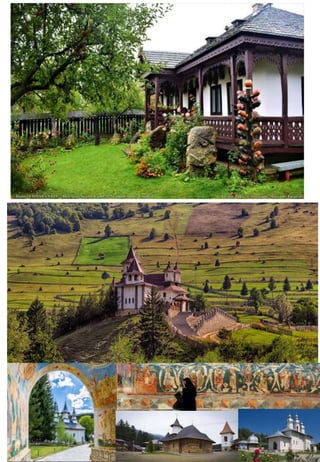
Neamț Citadel
Bicaz Gorge
Durău is a ski resort
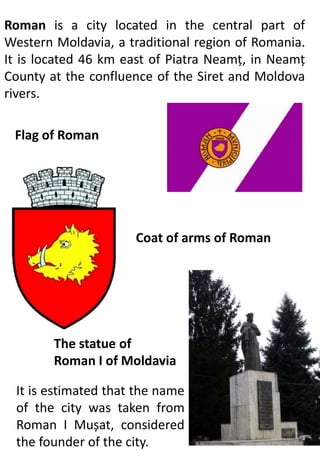
Roman is a city located in the central part of
Western Moldavia, a traditional region of Romania.
It is located 46 km east of Piatra Neamț, in Neamț
County at the confluence of the Siret and Moldova
rivers.
Flag of Roman
Coat of arms of Roman
The statue of
Roman I of Moldavia
It is estimated that the name
of the city was taken from
Roman I Mușat, considered
the founder of the city.
Roman is a city located
in the central part of
Western Moldavia, a
traditional region of
Romania.
It is located 46 km east
of Piatra Neamț, in
Neamț County at the
confluence of the Siret
and Moldova rivers.
We are waiting for you
in Romania!

About our Country

  • 2.
    Romania is splitin three unofficial provinces: Transilvania (the green one), Moldova (the red one), and Valachia (the blue one). Officialy Romania is split into 41 counties, each with its own municipality (usually the largest city in the county will be its municipality, akin to a county capital). Also our neighbor on the East side, Moldova, and Bukovina in the North (now part of Ukraine) used to be part of Romania and people living there still speak Romanian. With 238,400 square kilometers, Romania is the ninth largest country of the European Union by area, and has the seventh largest population of the European Union with more than 19 million people.
  • 3.
    POPULATION : 21,666,000 peopleliving currently on Romania’s territory NATIONAL DAY December 1st 1918 (Bucharest, the current capital, Alba Iulia, the city where all the Romanian provinces were united for the first time in 1601, Timisoara, the city where the 1989 Revolution started, are hosting impressive military parades) NATIONAL FLAG The Tricolor CURRENCY New Romanian Leu (RON). As of September 2016, this is the latest conversion rate.
  • 4.
    Bucharest is Romania'scapital and the best known city in Romania. • Its nickname is “Little Paris”. • The population is 1,944,367 inhabitants. • It is located on the banks of the Dâmboviţa River
  • 5.
    Plains 33% Hills andplanteaus 33% Mountains 31%
  • 6.
    Romania is famous forits Carpathian Mountains, the Danube and the Black Sea. What can you can visit in Romania if you come here? Take a look at these:
  • 8.
    Corvin Castle Corvin Castleis an imposing medieval, Gothic structure, considered the most impressive medieval castle in Romania. It also is known as Hunyad Castle after the high-ranking official who built it. Corvin Castle is a fairytale castle that is accessed by a wooden bridge that bears a statue of St. John of Nepomuk, the patron saint of bridges. A raven wearing a gold ring is a symbol of the 15th century castle. See, too, the bear pit and the dungeon where people were tortured.
  • 9.
    Sucevita Monastery The SucevitaMonastery is architecturally unique, no doubt about that. Somehow the blend of the Gothic and Byzantine styles, plus Moldavia’s painted churches comes together in a spectacular building. The front is cylindrical, topped with a conical roof while the back is rectangular and topped with a small tower. Inside, you’ll find painted murals from the early 1600s and tomb covers embroidered with silver thread. The monastery, located in northeast Romania, is considered one of the most important painted churches in Moldavia.
  • 10.
    Biertan Fortified Church BiertanFortified Church stands head and shoulders above the other buildings in Biertan, It was originally a Catholic church built when the region belonged to Hungary. It became a Lutheran church after the Reformation. Rather than build a fortress to defend against Ottoman invaders, townspeople fortified the church. Built in Late Gothic style, it is one of the largest fortified churches in Romania. The church is noted for its towers, including one used to store food during sieges and another to imprison husbands who wanted a divorce.
  • 11.
    Merry Cemetery Merry Cemeteryin the town of Sapanta isn’t your ordinary run-of-the-mill cemetery. It’s more like a folk art gallery, with colorful tombstones, crosses and statuary celebrating the lives of the deceased. This colorful tradition began with a 14-year-old boy who began carving crosses in 1908. He added poems and painted a portrait of the deceased on the cross; sometimes he even painted how they died. And thus a tradition was born. The background on everything is deep blue, with other colors symbolizing life, death and fertility.
  • 12.
    Peles Castle Peles Castledoesn’t have a history of sieges and warfare but it does have something other European castles don’t: spectacular beauty, sitting as it does on a Carpathian hillside. This Neo-Renaissance castle was built by King Carol I who vacationed here in the 1860s. Fairytale- like in appearance, it’s considered one of the most stunning castles in Europe. A 4,000-piece weapons collection reflects the king’s military interests, while a movie room decorated with frescoes reflects the queen’s artistic interests. The first movie shown in Romania aired here.
  • 13.
    Palace of Parliament Ina country where medieval buildings abound, there’s nothing medieval about the Palace of Parliament in the capital Bucharest. It is a thoroughly modern complex that is considered the largest administrative building in the world. It took 20,000 workers, working around the clock, 13 years to build it. It is an architectural wonder involving 700 architects and design specialists. The palace is a popular tourist attraction with foreigners, but not so much with the locals since it was built by Romania’s hated leader, Nicolae Ceaușescu.
  • 14.
    Sighisoara Historic Center Ifyou have preconceived notions of what medieval life was like, Sighisoara Historic Center will certainly fulfill them. Old Town Sighisoara is definitely medieval at its finest. Found by 12th century Transylvanian Saxons, Sighisoara is a great example of a fortified medieval town. It has the traditional narrow streets flanked by colorful stone buildings. It is the birthplace of Vlad the Impaler, the inspiration for Bram Stoker’s Dracula. Sighisoara celebrates its medievalness every July with a festival that includes rock bands.
  • 15.
    Bran Castle Bran Castleis often associated with Dracula as his home, though there’s no indication that author Bram Stoker even knew of this medieval castle. The castle, a Romanian landmark, has a fairy tale quality, peeking out from forested a hillside near Brasov in Transylvania. With roots dating to the 13th century, this medieval castle today is a museum showcasing art and furniture collected by Queen Maria. It also is home to an open-air museum featuring Romanian peasant buildings from around the country.
  • 16.
    Constantin Brancusi (1876- 1957) — the artist whose works redefined sculpture, the most important sculptor of the Twentieth-Century. Henri Coanda (1886-1972)Romanian engineer and aerodynamics pioneer, Henri Coanda was educated to become an army officer like his father. He abandoned the military career shortly after graduation and went to Paris to study aeronautics. After years of working on propeller planes and a series of experiments – one of these injuring him – Henri Coanda was awarded, in 1934, the French patent for the Coanda Effect.
  • 17.
    Petrache Poenaru Poenaru's fountainpen In 1826 he went to France and attended the École Polytechnique in Paris, where he studied geodesy and surveying. ") He was so busy taking notes and copying courses, that he invented a fountain pen that used a swan's quill as an ink reservoir. On 25 May 1827, the Manufacture Department of the French Ministry of the Interior registered Poenaru’s invention "plume portable sans fin, qui s’alimente elle-meme avec de l’ancre" ("never-ending portable pen, which recharges itself with ink Ana Aslan was a Romanian biologist and physician. Ana Aslan was considered a pioneer of social medicine. Years after becoming the head of the physiology department at the Institute of Endocrinology of Bucharest, she founded the Institute of Geriatrics of Bucharest.
  • 18.
    George Enescu (1881-1955) GheorgheZamfir An exceptional pan flute musician, Gheorghe Zamfir plays this instrument like no one else, expanding the traditional 20 pipes version to 22, 25, 28, and 30 pipes. This creative approach allowed him to interpret and compose elaborate musical pieces that brought him world-fame. He toured for decades, being the first artist to perform during the private mise of Pope John Paul the II. George Enescu was a Romanian musician. Enescu is regarded as one of the greatest musicians in Romanian history; he was a composer, violinist, pianist, conductor, and teacher.
  • 19.
    Nadia Comaneci Nadia Comaneci becameone of the most famous Romanians in the world after receiving the first 10 in the history of gymnastics. This happened in 1976, at the Montreal Olympics, when she was only 14. During her gymnast career, Nadia Comaneci won nine Olympic medals and four world championships. Her performance encouraged and inspired generations of young gymnasts from Romania and around the world.
  • 20.
    Simona Halep Simona Halepis one of the most loved athletes from Romania . 2015: Premier Mandatory title, US Open semifinal 2018: French Open champion, Australian Open runner-up 2019: Wimbledon champion 2020: Consistent results, 3 WTA titles Gheorghe Hagi: Gheorghe Hagi was a great midfielder, famed for his “magic wand” left foot. In the 1990s he played for Real Madrid, Brescia, Barcelona and Galatasaray. He won many trophies in four different countries. He played for Romania in three World Cups. Galatasaray fans called him “Comandante”. For Romanian fans he was the “Maradona of the Carpathians”. The 2003 UEFA Jubilee named him Romania’s “Golden Player”.
  • 21.
    Romanian food isdelicious.
  • 24.
    Neamț County Neamț Countyis a county (județ) of Romania, in the historic region of Moldavia, with the county seat at Piatra Neamț. Neamț county is known as the region with the most monasteries to be found per square kilometer in the world. The monumental church of Neamț Monastery has been a model for Moldavian churches.
  • 25.
    The county ishost to two of Romania's 9 national parks: Ceahlău Massif and Vânători-Neamț Natural Park
  • 26.
  • 30.
    Roman is acity located in the central part of Western Moldavia, a traditional region of Romania. It is located 46 km east of Piatra Neamț, in Neamț County at the confluence of the Siret and Moldova rivers. Flag of Roman Coat of arms of Roman The statue of Roman I of Moldavia It is estimated that the name of the city was taken from Roman I Mușat, considered the founder of the city.
  • 31.
    Roman is acity located in the central part of Western Moldavia, a traditional region of Romania. It is located 46 km east of Piatra Neamț, in Neamț County at the confluence of the Siret and Moldova rivers.
  • 35.
    We are waitingfor you in Romania!