Alba Iulia,  a European town
Summary About Alba Iulia Location Economy The cultural life Monuments
1. About Alba Iulia “ Alba Iulia” is the name of an urban settlement in Romania where the most important historical events took place. The town was the main political, military, administrative and cultural centre in Transylvania.
The town is mentioned at the beginning of the Middle Ages in medieval chronicles by the name of Alba Iulia in Latin, Fehevar in Hungarian and Weissemburg in German.
The real developing period of the town began with the latter half of the 16 th  century when Transylvania became independent under the Ottoman sovereignty and Alba-Iulia became its capital.
Alba-Iulia gloriously became the first capital of the three Romanian countries at the end of the sixteenth century.
Romania’s national holiday, the Union Day (also called  Unification Day)  on December the 1 st  , commemorates the assembly of the delegates of ethnic Romanians held in Alba Iulia, which declared the Union of Transylvania with Romania. This holiday, set after the 1989 Romanian Revolution, marks the unification not only of Transylvania, but also of the provinces of Banat, Basarabia and Bucovina with Romania Summary
2. Location Situated at 270 m altitude, distanced at 380 km from Bucharest, 100 km from Cluj and 241 km from Arad, the city lies in the perimeter formed by the rivers Ampoi and Sebes and the top of the Apuseni Mountains that ascend mildly and lithely towards the terraces of the river Mures and the Transylvanian hills.  MAP Summary
Back
3. Economy Alba Iulia is a rail junction and distribution center for a  wine-making region , where wheat, poultry, and fruit are raised.  The town's light manufactures include leather goods, furniture, and footwear. The main export merchandise has been:  footwear (16.4%), clothing (13,9%), leather items (10.8%), furniture (8.7%), pottery (8.3%), industrial and mechanical equipment (8.2%), copper products (8.1%).
 
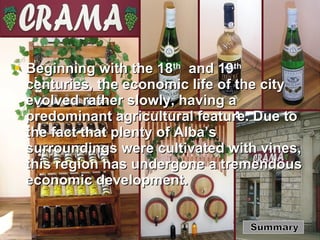
Beginning with the 18 th   and 19 th  centuries, the economic life of the city evolved rather slowly, having a predominant agricultural feature. Due to the fact that plenty of Alba’s surroundings were cultivated with vines, this region has undergone a tremendous economic development. Summary
4. The cultural life In a combined manner, through costumes, traditions and customs, Alba Iulia area gathers  the influences from the Apuseni Mountains, the surroundings of Mures, Sebes and Secas.The Romanians harmoniously live together with other nations settled here along ages. The famous vine yards of Alba Iulia, the melancholic Romanian folklore songs inspired from the genuine folklore of the Mures valley and the Apuseni Mountains, the beauty of the costumes, the kindness and wisdom of the people, all these make this county a legendary realm.  Summary
5. Monuments The Fortress of Alba Iulia (Alba Carolina Fortress) The gates of the fortress The Reunification Cathedral   The Roman Catholic Cathedral Summary
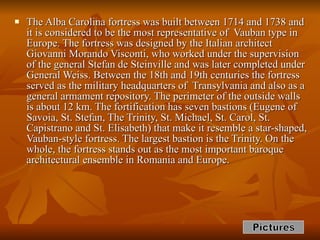
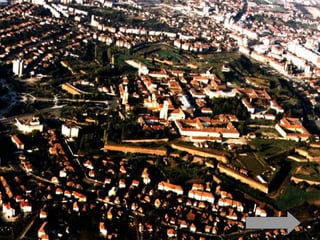
The Alba Carolina fortress was built between 1714 and 1738 and it is considered to be the most representative of  Vauban type in Europe. The fortress was designed by the Italian architect Giovanni Morando Visconti, who worked under the supervision of the general Stefan de Steinville and was later completed under General Weiss. Between the 18th and 19th centuries the fortress served as the military headquarters of  Transylvania and also as a general armament repository. The perimeter of the outside walls is about 12 km. The fortification has seven bastions (Eugene of Savoia, St. Stefan, The Trinity, St. Michael, St. Carol, St. Capistrano and St. Elisabeth) that make it resemble a star-shaped, Vauban-style fortress. The largest bastion is the Trinity. On the whole, the fortress stands out as the most important baroque architectural ensemble in Romania and Europe.  Pictures


Back to monuments
The First Gate
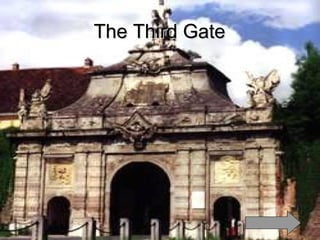
The Third Gate
The Fourth Gate
The Fourth Gate Back to monuments
More information Pictures
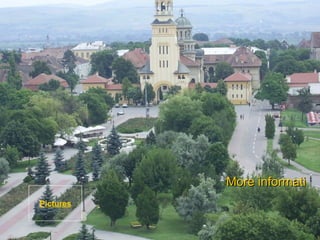
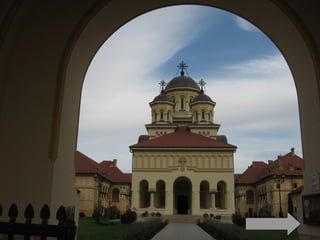
The Reunification Cathedral  Grandiose building, the Reunification Cathedral was built between 1921-1923, following the project drawn by the architect D.G. Stefanescu, led by the engineer T. Eremia.  The Great Romanian monarchs were crowned here on the 15th of October 1922.  The establishment is shaped as a Greek cross, with an open porch.  One can get inside through a right-angled narthex with three round headed vault units, a narrow have and a sanctuary.  Constantin Petrescu painted the fresco in traditional iconography style.  Pictures
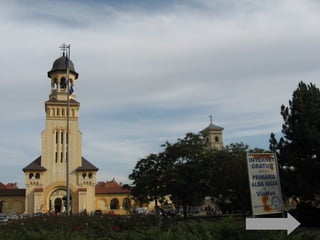
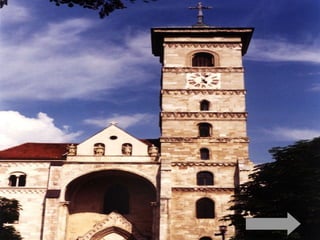
The tower of cathedral


Back to monuments
The Roman Catholic Cathedral  Built in the 13th century, the Roman Catholic Cathedral is considered to be an important monument of early Transylvanian medieval architecture.  It harmoniously combines Gothic and Roman style elements.  The establishment was meant to be a three Trinitarian  semicircular  transept. Undoubtedly, the most important early Transylvanian Renaissance building is "Lazo" Chapel situated on the northern side of the Cathedral. The Chapel has a late gothic pointed arch.  The keystone is decorated with blazons of some Transylvanian personalities.  Inside the cathedral there is Iancu of Hunedoara`s sarcophagus next to those of his elder son Ladislau (situated in the lateral southern nave), of Queen Isabella and of son, Ioan Sigismund (situated in the opposite lateral nave).  Pictures


The interior of the Roman-Catholic Cathedral Back to monuments
The Bathyaneum Library  The Bathyaneum library is a former church, built in baroque style. In 1780, bishop Ignatiu Bathyany, also known as the Lorsch Gospel, a passionate bibliophile, transformed the inside of the establishment into a library containing Marcu and Matei Gospel, David’s Psalter, Codex Burgundus (15th century), Biblia Sacra (13th century) the Pentateuch from Orastie (1850), Serba Cantacuzino`s Bible, the New Testament from Balgrad (1648).The first astronomical observatory was founded here in 1792.  It is famous all over the world for its ample series of manuscripts, incunabula and rare books, such as Codex Aureus (19 th  century)
The Obelisk
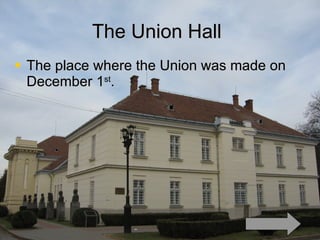
The Union Hall  The place where the Union was made on December 1 st .
The Equestrian Statue and the  bas-relief dedicated to Michael the Brave
Princely Palace
The Military high school  “Michael the Brave”
The city hall Summary

Alba iulia

  • 1.
    Alba Iulia, a European town
  • 2.
    Summary About AlbaIulia Location Economy The cultural life Monuments
  • 3.
    1. About AlbaIulia “ Alba Iulia” is the name of an urban settlement in Romania where the most important historical events took place. The town was the main political, military, administrative and cultural centre in Transylvania.
  • 4.
    The town ismentioned at the beginning of the Middle Ages in medieval chronicles by the name of Alba Iulia in Latin, Fehevar in Hungarian and Weissemburg in German.
  • 5.
    The real developingperiod of the town began with the latter half of the 16 th century when Transylvania became independent under the Ottoman sovereignty and Alba-Iulia became its capital.
  • 6.
    Alba-Iulia gloriously becamethe first capital of the three Romanian countries at the end of the sixteenth century.
  • 7.
    Romania’s national holiday,the Union Day (also called Unification Day) on December the 1 st , commemorates the assembly of the delegates of ethnic Romanians held in Alba Iulia, which declared the Union of Transylvania with Romania. This holiday, set after the 1989 Romanian Revolution, marks the unification not only of Transylvania, but also of the provinces of Banat, Basarabia and Bucovina with Romania Summary
  • 8.
    2. Location Situatedat 270 m altitude, distanced at 380 km from Bucharest, 100 km from Cluj and 241 km from Arad, the city lies in the perimeter formed by the rivers Ampoi and Sebes and the top of the Apuseni Mountains that ascend mildly and lithely towards the terraces of the river Mures and the Transylvanian hills. MAP Summary
  • 9.
  • 10.
    3. Economy AlbaIulia is a rail junction and distribution center for a wine-making region , where wheat, poultry, and fruit are raised. The town's light manufactures include leather goods, furniture, and footwear. The main export merchandise has been: footwear (16.4%), clothing (13,9%), leather items (10.8%), furniture (8.7%), pottery (8.3%), industrial and mechanical equipment (8.2%), copper products (8.1%).
  • 11.
  • 12.
    Beginning with the18 th and 19 th centuries, the economic life of the city evolved rather slowly, having a predominant agricultural feature. Due to the fact that plenty of Alba’s surroundings were cultivated with vines, this region has undergone a tremendous economic development. Summary
  • 13.
    4. The culturallife In a combined manner, through costumes, traditions and customs, Alba Iulia area gathers the influences from the Apuseni Mountains, the surroundings of Mures, Sebes and Secas.The Romanians harmoniously live together with other nations settled here along ages. The famous vine yards of Alba Iulia, the melancholic Romanian folklore songs inspired from the genuine folklore of the Mures valley and the Apuseni Mountains, the beauty of the costumes, the kindness and wisdom of the people, all these make this county a legendary realm. Summary
  • 14.
    5. Monuments TheFortress of Alba Iulia (Alba Carolina Fortress) The gates of the fortress The Reunification Cathedral The Roman Catholic Cathedral Summary
  • 15.
    The Alba Carolinafortress was built between 1714 and 1738 and it is considered to be the most representative of Vauban type in Europe. The fortress was designed by the Italian architect Giovanni Morando Visconti, who worked under the supervision of the general Stefan de Steinville and was later completed under General Weiss. Between the 18th and 19th centuries the fortress served as the military headquarters of Transylvania and also as a general armament repository. The perimeter of the outside walls is about 12 km. The fortification has seven bastions (Eugene of Savoia, St. Stefan, The Trinity, St. Michael, St. Carol, St. Capistrano and St. Elisabeth) that make it resemble a star-shaped, Vauban-style fortress. The largest bastion is the Trinity. On the whole, the fortress stands out as the most important baroque architectural ensemble in Romania and Europe. Pictures
  • 16.
  • 17.
  • 18.
  • 19.
  • 20.
  • 21.
  • 22.
  • 23.
    The Fourth GateBack to monuments
  • 24.
  • 25.
    The Reunification Cathedral Grandiose building, the Reunification Cathedral was built between 1921-1923, following the project drawn by the architect D.G. Stefanescu, led by the engineer T. Eremia. The Great Romanian monarchs were crowned here on the 15th of October 1922. The establishment is shaped as a Greek cross, with an open porch. One can get inside through a right-angled narthex with three round headed vault units, a narrow have and a sanctuary. Constantin Petrescu painted the fresco in traditional iconography style. Pictures
  • 26.
    The tower ofcathedral
  • 27.
  • 28.
  • 29.
  • 30.
  • 31.
  • 32.
  • 33.
  • 34.
  • 35.
    The Roman CatholicCathedral Built in the 13th century, the Roman Catholic Cathedral is considered to be an important monument of early Transylvanian medieval architecture. It harmoniously combines Gothic and Roman style elements. The establishment was meant to be a three Trinitarian semicircular transept. Undoubtedly, the most important early Transylvanian Renaissance building is "Lazo" Chapel situated on the northern side of the Cathedral. The Chapel has a late gothic pointed arch. The keystone is decorated with blazons of some Transylvanian personalities. Inside the cathedral there is Iancu of Hunedoara`s sarcophagus next to those of his elder son Ladislau (situated in the lateral southern nave), of Queen Isabella and of son, Ioan Sigismund (situated in the opposite lateral nave). Pictures
  • 36.
  • 37.
  • 38.
  • 39.
  • 40.
    The interior ofthe Roman-Catholic Cathedral Back to monuments
  • 41.
    The Bathyaneum Library The Bathyaneum library is a former church, built in baroque style. In 1780, bishop Ignatiu Bathyany, also known as the Lorsch Gospel, a passionate bibliophile, transformed the inside of the establishment into a library containing Marcu and Matei Gospel, David’s Psalter, Codex Burgundus (15th century), Biblia Sacra (13th century) the Pentateuch from Orastie (1850), Serba Cantacuzino`s Bible, the New Testament from Balgrad (1648).The first astronomical observatory was founded here in 1792. It is famous all over the world for its ample series of manuscripts, incunabula and rare books, such as Codex Aureus (19 th century)
  • 42.
  • 43.
    The Union Hall The place where the Union was made on December 1 st .
  • 44.
    The Equestrian Statueand the bas-relief dedicated to Michael the Brave
  • 45.
  • 46.
    The Military highschool “Michael the Brave”
  • 47.