

Romancing the Media for Your Business 2011


1
Romancing the Media for Your Business 2011


2
Romancing the Media for Your Business 2011

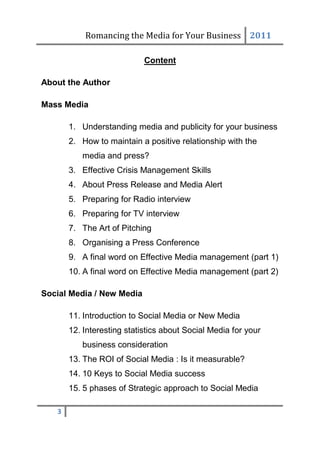
                            Content

About the Author

Mass Media

       1. Understanding media and publicity for your business
       2. How to maintain a positive relationship with the
          media and press?
       3. Effective Crisis Management Skills
       4. About Press Release and Media Alert
       5. Preparing for Radio interview
       6. Preparing for TV interview
       7. The Art of Pitching
       8. Organising a Press Conference
       9. A final word on Effective Media management (part 1)
       10. A final word on Effective Media management (part 2)

Social Media / New Media

       11. Introduction to Social Media or New Media
       12. Interesting statistics about Social Media for your
          business consideration
       13. The ROI of Social Media : Is it measurable?
       14. 10 Keys to Social Media success
       15. 5 phases of Strategic approach to Social Media

   3
Romancing the Media for Your Business 2011

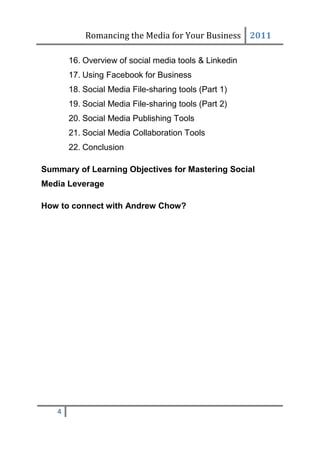
       16. Overview of social media tools & Linkedin
       17. Using Facebook for Business
       18. Social Media File-sharing tools (Part 1)
       19. Social Media File-sharing tools (Part 2)
       20. Social Media Publishing Tools
       21. Social Media Collaboration Tools
       22. Conclusion

Summary of Learning Objectives for Mastering Social
Media Leverage

How to connect with Andrew Chow?


   4
Romancing the Media for Your Business 2011

About the Author

                            Andrew Chow is a certified
                            Life Coach, Entrepreneur,
                            Speaker, Author and Modern
                            Match Maker. He won the
                            Spirit of Enterprise Award in
                            2008 and Successful
                            Entrepreneur Award in 2010.

                             Andrew graduated from
                             Thames Valley University and
                             had more than 130 interviews
                          and features about him and his
business since 2005. During the same period, numerous
valuable experiences are drawn from managing the press
and media (Channel News Asia, News 8, 938Live,
Business Times, Zao Bao, Berita Harian, Today, The New
Paper, My Paper, STOMP, FEMALE, HER WORLD,
PEAK, SHAPE, Lifestyle, etc). Andrew is also one of the
choice interview candidates for Singapore lifestyle among
foreign media like Canadian TV, Swiss Radio, German
TV, AFP.

Riding on wave of Social Media, he has successfully
founded 4 social networking portals with more than 12,000
profiles for social and business networking.


   5
Romancing the Media for Your Business 2011

Andrew is able to develop Social Media courses under
WSQ framework by The Workforce Development Agency
(WDA), and a regular speaker at business meeting
organised by SACEOS, SCCCI and regional conferences.

Specialties:

      Forging of Strategic Alliance
      Sponsorship Management
      Creation of new business models
      Strategic Marketing & Sponsorship Management
      Certified Exhibition Organiser
      Certified NLP Practitioner & Life Coach -
       Enneagram
      Profiling - Hypnotherapy - Timeline Intervention
      Public Relation Practitioner Media Management
      Training Seminar Organisation & Planning Trade
       Show Management
      Life Coaching
      Personal Branding
      Creation of Social Networking Portal


   6
Romancing the Media for Your Business 2011

1. Understanding Media and Publicity for your
    business


       a. Many small and medium enterprises do not
          really understand how to work with the media to
          generate buzz and publicity. They often have a
          misconception that the media publicity is
          exclusive to big companies having huge budget
          for public relation specialists providing strategic
          counsel.


       b. Media relation is both an art and a science.
          Knowing your basics and adding some creativity
          and flair will produce an effective pitch.


       c. Understanding what constitute news and
          knowing what the media and press want will give
          your company a head start in gaining publicity.
          Having good publicity about your product and
          branding will always enhance the public
          perception on their value.


       d. There are basically two types of news. The Hard
          News which are primarily basic facts and figure.

7
Romancing the Media for Your Business 2011

       The soft news is news of human interest. The
       press usually prefer news that are :


            i. Unusual
           ii. Current
          iii. Local
          iv. Abnormal
           v. Sensation
          vi. Socially impactful


       A Public relation practitioner once told me that if
       all else fail, there will always be three issues
       which are of interest to the media. They are
       MONEY, Sex and HEALTH.

    e. The press and media are powerful stake holders
       of your business. The press usually likes to
       develop a story while the media prefer to explore
       different angles. For example, there is no story if
       you announce to the press that your company is
       celebrating its 20th anniversary this year.
       However, if your company plan to denote 20
       million to charity to celebrate its 20th anniversary,
       it will be a big story!

8
Romancing the Media for Your Business 2011


9
Romancing the Media for Your Business 2011

2. How to maintain positive relationship with the media
     and press?


     o   Compile a list of journalists and reporter contacts
         and develop friendship with them. Try to remember
         their professional interest in their work and seek to
         be a resource information centre for other contacts.
         Be truthful about the quality of a story and its
         sources. Always give reporters special access to
         you by releasing your personal mobile number. Send
         them an email once in a while you see their features
         published.


     o   The common mistake newsmakers make in dealing
         with reporter is to insist on a perfect story to
         advocate your position. The reporters’ job isn’t to
         protect your reputation or advance your career. Do
         not expect them to ask you questions to help you to
         say what you want to say.


     o   All reporters want to produce a professional story,
         accepted by their editor and audience with a specific
         angle. Understanding their job will enable you to


10
Romancing the Media for Your Business 2011

         build rapport with them and pave the way for media
         pitching.


     o   Know your rights with the media will be helpful.
         Always remember you have the right to be treated
         with respect. You can refuse to answer any personal
         questions. You have the right to be quoted
         accurately. Always repeat your key messages if
         there is a need to. You have the right to determine
         when and where you will be interviewed.


11
Romancing the Media for Your Business 2011

3. Effective Crisis Management Skills


      o   No company will ever be fully prepared for any
          crisis to their business. The key is to develop a
          standard contingency plan to keep the public
          informed through the media on how they handle
          the crisis.


      o   There are Ten Questions a Reporter Will Want to
          Know in a Hard News Situation:


          -   What happened?
          -   Why did it happen?
          -   Was anyone injured or affected from it?
          -   Could this have been prevented?
          -   Has this ever happened before?
          -   Currently, what are you doing about it?
          -   When will the problem be solved?
          -   How will you prevent this from happening
              again?
          -   Did you know this was going to happen?
          -   What would you like to say to those affected?


12
Romancing the Media for Your Business 2011

     o   Have a designated person in your company to
         answer questions from the press. In an extreme
         crisis situation, the CEO or the Chairman of the
         company should preferably be the main spoke
         person in order to project an honest and open
         attitude.


     o   When dealing with reporters from the tabloids,
         please ensure you handle tricky questions
         carefully. Never release information which you
         “off the record”, it will be published. Avoid being
         put into a situation which you have to answer a
         YES or NO. Be prepared for open ended
         questions and prepare a Frequent asked
         Question (FAQ) list.


     a. Try your best to avoid having negative press
         publicity. The negative impact will remain in the
         minds of the public for a long time. Always
         remember if bad press happen once is an
         incident. If it happens twice is a coincidence. If it
         happens 3 times, it has a pattern! Having it 4
         times, it has become a lifestyle!


13
Romancing the Media for Your Business 2011

4. Preparing your Press Release / Media Alert

     A press release brings information to the attention of the
     press and broadcast media, and in turn the public,
     generating publicity.

     The following guidelines should help you on your way.

        Include basic information. The release should
         answer the questions: who, what, when, where, why
         and how.
        Get your story across early. If your first sentence or
         paragraph is obscure, complicated or boring,
         journalists probably won't bother reading on.
        Keep the release concise - one side if possible, and
         no more than two.
        Avoid jargon, acronyms and abbreviations unless
         they are generally well-known by your target
         audience.
        Include quotes - draft them yourself if need be, but
         always get them approved!
        Don’t make misleading statements.
        Make sure your subject and style suit the target
         audience.


14
Romancing the Media for Your Business 2011

        For events, give a precise timetable and location,
         including clear information on any opportunities for
         photos and interviews in a 'Note to Editors' at the
         end of the release.
        Give the release a short title. The purpose is to
         attract interest so make it clear and self-explanatory.
        Put the date on the release.
        Always include a contact name and phone number,
         an email and web address for further information.
        Use double or 1.5 lines spacing to make the release
         easier to read.
        Check with all those involved for factual accuracy.
        Check spelling, grammar and punctuation.


15
Romancing the Media for Your Business 2011

5. Preparing for Radio Interview


     Before the Interview

        o   Practice both long and short answers
        o   Submit a list of suggested questions to the
            producer or host of the show
        o   Obtain a volume control for your telephone (Any
            Radio store for $20.00)
        o   Learn how to turn Call Waiting off on your phone
        o   Arrange for your own callers to participate


     The Day of the Interview

        o   Turn off the ringer on other telephones near you
        o   Have a glass of water nearby
        o   Arrange your notes on your desk so that they
            can be easily accessed
        o   Perform mental and physical relaxation
            exercises


16
Romancing the Media for Your Business 2011

     During the Interview

        o   Speak in a normal conversational voice, but
            display enthusiasm
        o   Be creative by providing useful information,
            revealing new information, or using memorable
            words or phrases
        o   Limit your answers to less than five sentences.
        o   Avoid using filler words (Umm, well, like, you
            know, really, etc.)
        o   Concentrate on the interview process to
            anticipate the upcoming moments
        o   Do not speak too much, leave room for the
            interviewer to ask questions. It’s his show after
            all, not yours.
        o   Make your "sales pitch" only at the end of the
            interview.
        o   Repeat all numbers, addresses, URLs, etc.


     After the Interview

        o   Send the producer and host a written thank-you
            note


17
Romancing the Media for Your Business 2011

     o   Follow up on any promises made on-air to
         listeners
     o   Remind the producer of your interest in being a
         guest again


18
Romancing the Media for Your Business 2011

6. Preparing for Television interview


        Dress Code
           o   Do not wear bright white, weather map blue,
               or chrome key blue.
           o   When you are booked for a studio
               appearance, find out the colour of the set and
               dress so that you don't blend in.
           o   Do not wear contrasting patterns. Wear bold,
               fashionable ties, but not ones that distract.
           o   Do not wear any shiny fabrics or anything
               that glares.
           o   Do not wear bracelets. Women should wear
               pearls instead of shiny necklaces.


        Gestures and Body Movement
           o   Use gestures economically to make points.
           o   Too much body movement is distracting.
           o   Every movement is body language and some
               of it is not good.
           o   Leave your body open and quiet. Both men
               and women should cross their legs when
               seated.


19

Romancing the Media for your Business

  • 1.
    Romancing the Mediafor Your Business 2011 1
  • 2.
    Romancing the Mediafor Your Business 2011 2
  • 3.
    Romancing the Mediafor Your Business 2011 Content About the Author Mass Media 1. Understanding media and publicity for your business 2. How to maintain a positive relationship with the media and press? 3. Effective Crisis Management Skills 4. About Press Release and Media Alert 5. Preparing for Radio interview 6. Preparing for TV interview 7. The Art of Pitching 8. Organising a Press Conference 9. A final word on Effective Media management (part 1) 10. A final word on Effective Media management (part 2) Social Media / New Media 11. Introduction to Social Media or New Media 12. Interesting statistics about Social Media for your business consideration 13. The ROI of Social Media : Is it measurable? 14. 10 Keys to Social Media success 15. 5 phases of Strategic approach to Social Media 3
  • 4.
    Romancing the Mediafor Your Business 2011 16. Overview of social media tools & Linkedin 17. Using Facebook for Business 18. Social Media File-sharing tools (Part 1) 19. Social Media File-sharing tools (Part 2) 20. Social Media Publishing Tools 21. Social Media Collaboration Tools 22. Conclusion Summary of Learning Objectives for Mastering Social Media Leverage How to connect with Andrew Chow? 4
  • 5.
    Romancing the Mediafor Your Business 2011 About the Author Andrew Chow is a certified Life Coach, Entrepreneur, Speaker, Author and Modern Match Maker. He won the Spirit of Enterprise Award in 2008 and Successful Entrepreneur Award in 2010. Andrew graduated from Thames Valley University and had more than 130 interviews and features about him and his business since 2005. During the same period, numerous valuable experiences are drawn from managing the press and media (Channel News Asia, News 8, 938Live, Business Times, Zao Bao, Berita Harian, Today, The New Paper, My Paper, STOMP, FEMALE, HER WORLD, PEAK, SHAPE, Lifestyle, etc). Andrew is also one of the choice interview candidates for Singapore lifestyle among foreign media like Canadian TV, Swiss Radio, German TV, AFP. Riding on wave of Social Media, he has successfully founded 4 social networking portals with more than 12,000 profiles for social and business networking. 5
  • 6.
    Romancing the Mediafor Your Business 2011 Andrew is able to develop Social Media courses under WSQ framework by The Workforce Development Agency (WDA), and a regular speaker at business meeting organised by SACEOS, SCCCI and regional conferences. Specialties:  Forging of Strategic Alliance  Sponsorship Management  Creation of new business models  Strategic Marketing & Sponsorship Management  Certified Exhibition Organiser  Certified NLP Practitioner & Life Coach - Enneagram  Profiling - Hypnotherapy - Timeline Intervention  Public Relation Practitioner Media Management  Training Seminar Organisation & Planning Trade Show Management  Life Coaching  Personal Branding  Creation of Social Networking Portal 6
  • 7.
    Romancing the Mediafor Your Business 2011 1. Understanding Media and Publicity for your business a. Many small and medium enterprises do not really understand how to work with the media to generate buzz and publicity. They often have a misconception that the media publicity is exclusive to big companies having huge budget for public relation specialists providing strategic counsel. b. Media relation is both an art and a science. Knowing your basics and adding some creativity and flair will produce an effective pitch. c. Understanding what constitute news and knowing what the media and press want will give your company a head start in gaining publicity. Having good publicity about your product and branding will always enhance the public perception on their value. d. There are basically two types of news. The Hard News which are primarily basic facts and figure. 7
  • 8.
    Romancing the Mediafor Your Business 2011 The soft news is news of human interest. The press usually prefer news that are : i. Unusual ii. Current iii. Local iv. Abnormal v. Sensation vi. Socially impactful A Public relation practitioner once told me that if all else fail, there will always be three issues which are of interest to the media. They are MONEY, Sex and HEALTH. e. The press and media are powerful stake holders of your business. The press usually likes to develop a story while the media prefer to explore different angles. For example, there is no story if you announce to the press that your company is celebrating its 20th anniversary this year. However, if your company plan to denote 20 million to charity to celebrate its 20th anniversary, it will be a big story! 8
  • 9.
    Romancing the Mediafor Your Business 2011 9
  • 10.
    Romancing the Mediafor Your Business 2011 2. How to maintain positive relationship with the media and press? o Compile a list of journalists and reporter contacts and develop friendship with them. Try to remember their professional interest in their work and seek to be a resource information centre for other contacts. Be truthful about the quality of a story and its sources. Always give reporters special access to you by releasing your personal mobile number. Send them an email once in a while you see their features published. o The common mistake newsmakers make in dealing with reporter is to insist on a perfect story to advocate your position. The reporters’ job isn’t to protect your reputation or advance your career. Do not expect them to ask you questions to help you to say what you want to say. o All reporters want to produce a professional story, accepted by their editor and audience with a specific angle. Understanding their job will enable you to 10
  • 11.
    Romancing the Mediafor Your Business 2011 build rapport with them and pave the way for media pitching. o Know your rights with the media will be helpful. Always remember you have the right to be treated with respect. You can refuse to answer any personal questions. You have the right to be quoted accurately. Always repeat your key messages if there is a need to. You have the right to determine when and where you will be interviewed. 11
  • 12.
    Romancing the Mediafor Your Business 2011 3. Effective Crisis Management Skills o No company will ever be fully prepared for any crisis to their business. The key is to develop a standard contingency plan to keep the public informed through the media on how they handle the crisis. o There are Ten Questions a Reporter Will Want to Know in a Hard News Situation: - What happened? - Why did it happen? - Was anyone injured or affected from it? - Could this have been prevented? - Has this ever happened before? - Currently, what are you doing about it? - When will the problem be solved? - How will you prevent this from happening again? - Did you know this was going to happen? - What would you like to say to those affected? 12
  • 13.
    Romancing the Mediafor Your Business 2011 o Have a designated person in your company to answer questions from the press. In an extreme crisis situation, the CEO or the Chairman of the company should preferably be the main spoke person in order to project an honest and open attitude. o When dealing with reporters from the tabloids, please ensure you handle tricky questions carefully. Never release information which you “off the record”, it will be published. Avoid being put into a situation which you have to answer a YES or NO. Be prepared for open ended questions and prepare a Frequent asked Question (FAQ) list. a. Try your best to avoid having negative press publicity. The negative impact will remain in the minds of the public for a long time. Always remember if bad press happen once is an incident. If it happens twice is a coincidence. If it happens 3 times, it has a pattern! Having it 4 times, it has become a lifestyle! 13
  • 14.
    Romancing the Mediafor Your Business 2011 4. Preparing your Press Release / Media Alert A press release brings information to the attention of the press and broadcast media, and in turn the public, generating publicity. The following guidelines should help you on your way.  Include basic information. The release should answer the questions: who, what, when, where, why and how.  Get your story across early. If your first sentence or paragraph is obscure, complicated or boring, journalists probably won't bother reading on.  Keep the release concise - one side if possible, and no more than two.  Avoid jargon, acronyms and abbreviations unless they are generally well-known by your target audience.  Include quotes - draft them yourself if need be, but always get them approved!  Don’t make misleading statements.  Make sure your subject and style suit the target audience. 14
  • 15.
    Romancing the Mediafor Your Business 2011  For events, give a precise timetable and location, including clear information on any opportunities for photos and interviews in a 'Note to Editors' at the end of the release.  Give the release a short title. The purpose is to attract interest so make it clear and self-explanatory.  Put the date on the release.  Always include a contact name and phone number, an email and web address for further information.  Use double or 1.5 lines spacing to make the release easier to read.  Check with all those involved for factual accuracy.  Check spelling, grammar and punctuation. 15
  • 16.
    Romancing the Mediafor Your Business 2011 5. Preparing for Radio Interview Before the Interview o Practice both long and short answers o Submit a list of suggested questions to the producer or host of the show o Obtain a volume control for your telephone (Any Radio store for $20.00) o Learn how to turn Call Waiting off on your phone o Arrange for your own callers to participate The Day of the Interview o Turn off the ringer on other telephones near you o Have a glass of water nearby o Arrange your notes on your desk so that they can be easily accessed o Perform mental and physical relaxation exercises 16
  • 17.
    Romancing the Mediafor Your Business 2011 During the Interview o Speak in a normal conversational voice, but display enthusiasm o Be creative by providing useful information, revealing new information, or using memorable words or phrases o Limit your answers to less than five sentences. o Avoid using filler words (Umm, well, like, you know, really, etc.) o Concentrate on the interview process to anticipate the upcoming moments o Do not speak too much, leave room for the interviewer to ask questions. It’s his show after all, not yours. o Make your "sales pitch" only at the end of the interview. o Repeat all numbers, addresses, URLs, etc. After the Interview o Send the producer and host a written thank-you note 17
  • 18.
    Romancing the Mediafor Your Business 2011 o Follow up on any promises made on-air to listeners o Remind the producer of your interest in being a guest again 18
  • 19.
    Romancing the Mediafor Your Business 2011 6. Preparing for Television interview  Dress Code o Do not wear bright white, weather map blue, or chrome key blue. o When you are booked for a studio appearance, find out the colour of the set and dress so that you don't blend in. o Do not wear contrasting patterns. Wear bold, fashionable ties, but not ones that distract. o Do not wear any shiny fabrics or anything that glares. o Do not wear bracelets. Women should wear pearls instead of shiny necklaces.  Gestures and Body Movement o Use gestures economically to make points. o Too much body movement is distracting. o Every movement is body language and some of it is not good. o Leave your body open and quiet. Both men and women should cross their legs when seated. 19