FOREST RESOURCES
Important Questions:
 Explain how forest helps in maintaining
ecological balance.
 Afforestation is the need of the hour. Justify.
 Give the classification of forests and discuss
the effects of deforestation on society
 Describe in detail types of forests resources
and what are problems created by
deforestation?
Forest Resources:
Introduction
Forest resources play an important role in the economy of any country. It is
highly complex, changing environment made up of a living and non living
things. Living things include trees, shrubs, wildlife etc. and non living things
include water, nutrients, rocks, sunlight and air.
Forest vary a great deal in compensation and density and are distinct from
meadows and pastures. Forest are important to humans and the natural
world. For humans, they have many recreational, economic, historical, cultural
and religious values. Forest provide fuel, wood
Forest Resources:
Introduction
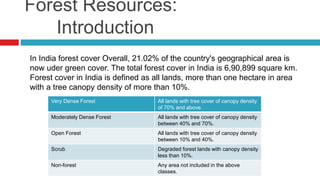
In India forest cover Overall, 21.02% of the country's geographical area is
now uder green cover. The total forest cover in India is 6,90,899 square km.
Forest cover in India is defined as all lands, more than one hectare in area
with a tree canopy density of more than 10%.
Very Dense Forest All lands with tree cover of canopy density
of 70% and above.
Moderately Dense Forest All lands with tree cover of canopy density
between 40% and 70%.
Open Forest All lands with tree cover of canopy density
between 10% and 40%.
Scrub Degraded forest lands with canopy density
less than 10%.
Non-forest Any area not included in the above
classes.
Forest Resources: Functions of
Forests
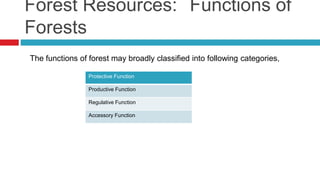
The functions of forest may broadly classified into following categories,
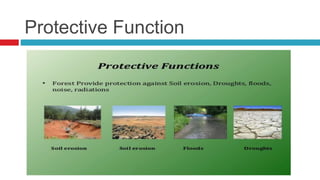
Protective Function
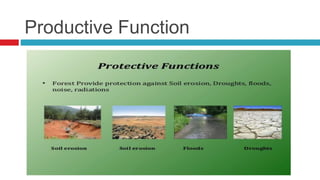
Productive Function
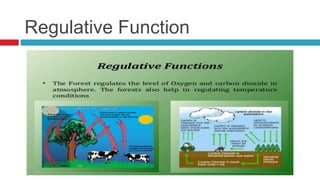
Regulative Function
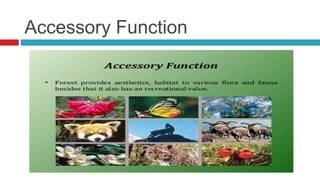
Accessory Function
Protective Function
Productive Function
Regulative Function
Accessory Function
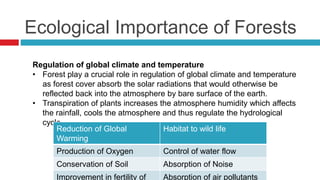
Ecological Importance of Forests
Regulation of global climate and temperature
• Forest play a crucial role in regulation of global climate and temperature
as forest cover absorb the solar radiations that would otherwise be
reflected back into the atmosphere by bare surface of the earth.
• Transpiration of plants increases the atmosphere humidity which affects
the rainfall, cools the atmosphere and thus regulate the hydrological
cycle.
Reduction of Global
Warming
Habitat to wild life
Production of Oxygen Control of water flow
Conservation of Soil Absorption of Noise
Improvement in fertility of Absorption of air pollutants
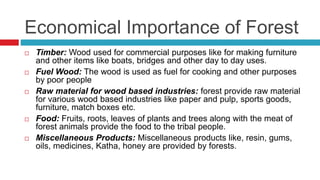
Economical Importance of Forest
 Timber: Wood used for commercial purposes like for making furniture
and other items like boats, bridges and other day to day uses.
 Fuel Wood: The wood is used as fuel for cooking and other purposes
by poor people
 Raw material for wood based industries: forest provide raw material
for various wood based industries like paper and pulp, sports goods,
furniture, match boxes etc.
 Food: Fruits, roots, leaves of plants and trees along with the meat of
forest animals provide the food to the tribal people.
 Miscellaneous Products: Miscellaneous products like, resin, gums,
oils, medicines, Katha, honey are provided by forests.
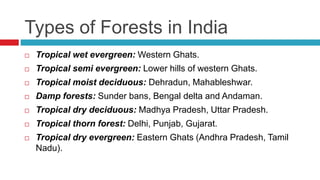
Types of Forests in India
 Tropical wet evergreen: Western Ghats.
 Tropical semi evergreen: Lower hills of western Ghats.
 Tropical moist deciduous: Dehradun, Mahableshwar.
 Damp forests: Sunder bans, Bengal delta and Andaman.
 Tropical dry deciduous: Madhya Pradesh, Uttar Pradesh.
 Tropical thorn forest: Delhi, Punjab, Gujarat.
 Tropical dry evergreen: Eastern Ghats (Andhra Pradesh, Tamil
Nadu).
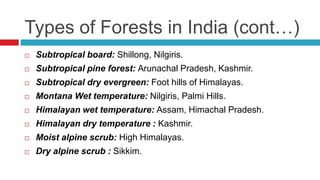
Types of Forests in India (cont…)
 Subtropical board: Shillong, Nilgiris.
 Subtropical pine forest: Arunachal Pradesh, Kashmir.
 Subtropical dry evergreen: Foot hills of Himalayas.
 Montana Wet temperature: Nilgiris, Palmi Hills.
 Himalayan wet temperature: Assam, Himachal Pradesh.
 Himalayan dry temperature : Kashmir.
 Moist alpine scrub: High Himalayas.
 Dry alpine scrub : Sikkim.
Deforestation
 Forest are exploited since early times for humans to meet
human demand.
 The permanent destruction of forest is call deforestation.
Causes of Deforestation
 Population explosion: Population explosion is the root cause of all
the environmental problems, vast area of forests are cleared for
human settlement.
 Shifting Cultivation: It is a traditional agroforestry system widely
practiced in north eastern region of country in which felling and
burning of forests followed by cultivation of crop for few years and
abandon of cultivation of crop for few years and abandon of
cultivation allow forests for re-growth cause extreme damage to
forest.
 Growing food demand: To meet the food demand of rapidly
growing population more and more forests are cleared off for
agricultural purpose.
Causes of Deforestation (cont...)
 Fire Wood: Increasing demand of wood for fuel increases pressure
on forests.
 Raw material for wood based industry: Increasing demand of
wood for making furniture, plywood, match box etc. results into
tremendous pressure on forests.
 Infrastructure development: Massive destruction of forest occurs
for various infrastructure development like, big dams, highways
projects etc.
 Forest fires: Forest fires may be natural or man made cause a
huge ;pss pf fprest.
Causes of Deforestation (cont...)
 Over grazing: Overgrazing of land by cattle result into soil erosion,
desertification.
 Natural forces: Floods, storms, heavy winds, snow, lightening are
some of the natural forces.
 Infrastructure development: Massive destruction of forest occurs
for various infrastructure development like, big dams, highways
projects etc.
 Forest fires: Forest fires may be natural or man made cause a
huge ;pss pf forest.
Effects of Deforestation
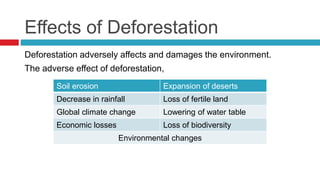
Deforestation adversely affects and damages the environment.
The adverse effect of deforestation,
Soil erosion Expansion of deserts
Decrease in rainfall Loss of fertile land
Global climate change Lowering of water table
Economic losses Loss of biodiversity
Environmental changes
Afforestation
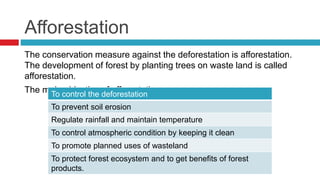
The conservation measure against the deforestation is afforestation.
The development of forest by planting trees on waste land is called
afforestation.
The main objective of afforestation,To control the deforestation
To prevent soil erosion
Regulate rainfall and maintain temperature
To control atmospheric condition by keeping it clean
To promote planned uses of wasteland
To protect forest ecosystem and to get benefits of forest
products.
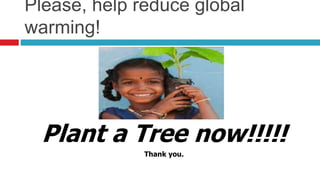
Please, help reduce global
warming!
Plant a Tree now!!!!!
Thank you.

Forest resources

  • 1.
  • 2.
    Important Questions:  Explainhow forest helps in maintaining ecological balance.  Afforestation is the need of the hour. Justify.  Give the classification of forests and discuss the effects of deforestation on society  Describe in detail types of forests resources and what are problems created by deforestation?
  • 3.
    Forest Resources: Introduction Forest resourcesplay an important role in the economy of any country. It is highly complex, changing environment made up of a living and non living things. Living things include trees, shrubs, wildlife etc. and non living things include water, nutrients, rocks, sunlight and air. Forest vary a great deal in compensation and density and are distinct from meadows and pastures. Forest are important to humans and the natural world. For humans, they have many recreational, economic, historical, cultural and religious values. Forest provide fuel, wood
  • 4.
    Forest Resources: Introduction In Indiaforest cover Overall, 21.02% of the country's geographical area is now uder green cover. The total forest cover in India is 6,90,899 square km. Forest cover in India is defined as all lands, more than one hectare in area with a tree canopy density of more than 10%. Very Dense Forest All lands with tree cover of canopy density of 70% and above. Moderately Dense Forest All lands with tree cover of canopy density between 40% and 70%. Open Forest All lands with tree cover of canopy density between 10% and 40%. Scrub Degraded forest lands with canopy density less than 10%. Non-forest Any area not included in the above classes.
  • 5.
    Forest Resources: Functionsof Forests The functions of forest may broadly classified into following categories, Protective Function Productive Function Regulative Function Accessory Function
  • 6.
  • 7.
  • 8.
  • 9.
  • 10.
    Ecological Importance ofForests Regulation of global climate and temperature • Forest play a crucial role in regulation of global climate and temperature as forest cover absorb the solar radiations that would otherwise be reflected back into the atmosphere by bare surface of the earth. • Transpiration of plants increases the atmosphere humidity which affects the rainfall, cools the atmosphere and thus regulate the hydrological cycle. Reduction of Global Warming Habitat to wild life Production of Oxygen Control of water flow Conservation of Soil Absorption of Noise Improvement in fertility of Absorption of air pollutants
  • 11.
    Economical Importance ofForest  Timber: Wood used for commercial purposes like for making furniture and other items like boats, bridges and other day to day uses.  Fuel Wood: The wood is used as fuel for cooking and other purposes by poor people  Raw material for wood based industries: forest provide raw material for various wood based industries like paper and pulp, sports goods, furniture, match boxes etc.  Food: Fruits, roots, leaves of plants and trees along with the meat of forest animals provide the food to the tribal people.  Miscellaneous Products: Miscellaneous products like, resin, gums, oils, medicines, Katha, honey are provided by forests.
  • 12.
    Types of Forestsin India  Tropical wet evergreen: Western Ghats.  Tropical semi evergreen: Lower hills of western Ghats.  Tropical moist deciduous: Dehradun, Mahableshwar.  Damp forests: Sunder bans, Bengal delta and Andaman.  Tropical dry deciduous: Madhya Pradesh, Uttar Pradesh.  Tropical thorn forest: Delhi, Punjab, Gujarat.  Tropical dry evergreen: Eastern Ghats (Andhra Pradesh, Tamil Nadu).
  • 13.
    Types of Forestsin India (cont…)  Subtropical board: Shillong, Nilgiris.  Subtropical pine forest: Arunachal Pradesh, Kashmir.  Subtropical dry evergreen: Foot hills of Himalayas.  Montana Wet temperature: Nilgiris, Palmi Hills.  Himalayan wet temperature: Assam, Himachal Pradesh.  Himalayan dry temperature : Kashmir.  Moist alpine scrub: High Himalayas.  Dry alpine scrub : Sikkim.
  • 14.
    Deforestation  Forest areexploited since early times for humans to meet human demand.  The permanent destruction of forest is call deforestation.
  • 15.
    Causes of Deforestation Population explosion: Population explosion is the root cause of all the environmental problems, vast area of forests are cleared for human settlement.  Shifting Cultivation: It is a traditional agroforestry system widely practiced in north eastern region of country in which felling and burning of forests followed by cultivation of crop for few years and abandon of cultivation of crop for few years and abandon of cultivation allow forests for re-growth cause extreme damage to forest.  Growing food demand: To meet the food demand of rapidly growing population more and more forests are cleared off for agricultural purpose.
  • 16.
    Causes of Deforestation(cont...)  Fire Wood: Increasing demand of wood for fuel increases pressure on forests.  Raw material for wood based industry: Increasing demand of wood for making furniture, plywood, match box etc. results into tremendous pressure on forests.  Infrastructure development: Massive destruction of forest occurs for various infrastructure development like, big dams, highways projects etc.  Forest fires: Forest fires may be natural or man made cause a huge ;pss pf fprest.
  • 17.
    Causes of Deforestation(cont...)  Over grazing: Overgrazing of land by cattle result into soil erosion, desertification.  Natural forces: Floods, storms, heavy winds, snow, lightening are some of the natural forces.  Infrastructure development: Massive destruction of forest occurs for various infrastructure development like, big dams, highways projects etc.  Forest fires: Forest fires may be natural or man made cause a huge ;pss pf forest.
  • 18.
    Effects of Deforestation Deforestationadversely affects and damages the environment. The adverse effect of deforestation, Soil erosion Expansion of deserts Decrease in rainfall Loss of fertile land Global climate change Lowering of water table Economic losses Loss of biodiversity Environmental changes
  • 19.
    Afforestation The conservation measureagainst the deforestation is afforestation. The development of forest by planting trees on waste land is called afforestation. The main objective of afforestation,To control the deforestation To prevent soil erosion Regulate rainfall and maintain temperature To control atmospheric condition by keeping it clean To promote planned uses of wasteland To protect forest ecosystem and to get benefits of forest products.
  • 20.
    Please, help reduceglobal warming! Plant a Tree now!!!!! Thank you.